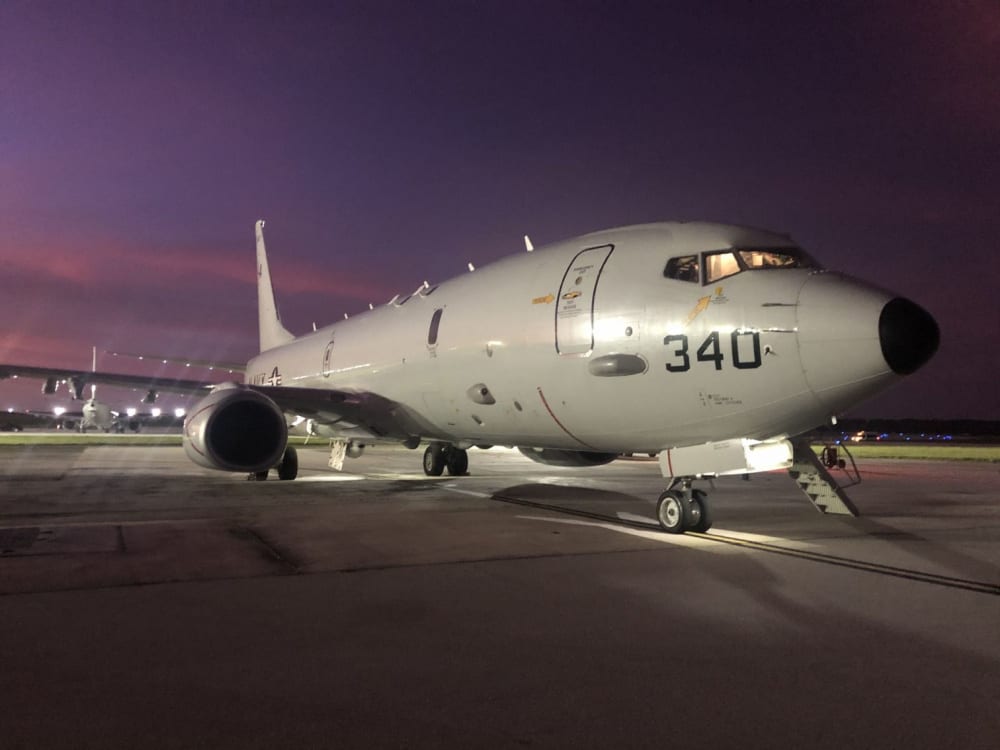
The U.S. Navy has awarded a $1.6 billion contract to Boeing for 11 P-8A Poseidon maritime patrol reconnaissance aircraft. U.S. NAVY
ARLINGTON, Va. — The U.S. Navy has awarded a $1.6 billion production contract to Boeing for 11 P-8A Poseidon maritime patrol reconnaissance aircraft, nine for the U.S. Navy and two for the Royal Australian Air Force (RAAF).
The Naval Air Systems Command contract modification was announced March 31 by the Defense Department.
The contract brings the total number of U.S. Navy P-8A aircraft under contract to 128 and the RAAF total to 14. Australia has been a cooperative partner in the P-8A joint program since 2009.
Other nations have ordered Poseidons through Foreign Military Sales. The United Kingdom is procuring nine; Norway, five; New Zealand, four; and South Korea, six.
Through direct commercial sales, India has received or has ordered a total of 12 P-8I versions, which it calls Neptunes.
“The P-8A continues to be an invaluable asset and these additional aircraft will help deliver expanded maritime patrol and reconnaissance capabilities to the fleet,” said Capt. Eric Gardner, program manager for the U.S. Navy’s Maritime Patrol and Reconnaissance Program Office, quoted in a March 31 Boeing release.
“We continue to hear feedback from deployed Navy squadrons who tell us the P-8A is exceeding expectations,” Stu Voboril, vice president and program manager for Boeing’s P-8A program, said in the release. “Our focus is on delivering the world’s best maritime patrol aircraft. That only happens when teams truly collaborate, listen and focus on customer priorities.”
Navy Orders One E-2D Aircraft Inside Major Support Contract
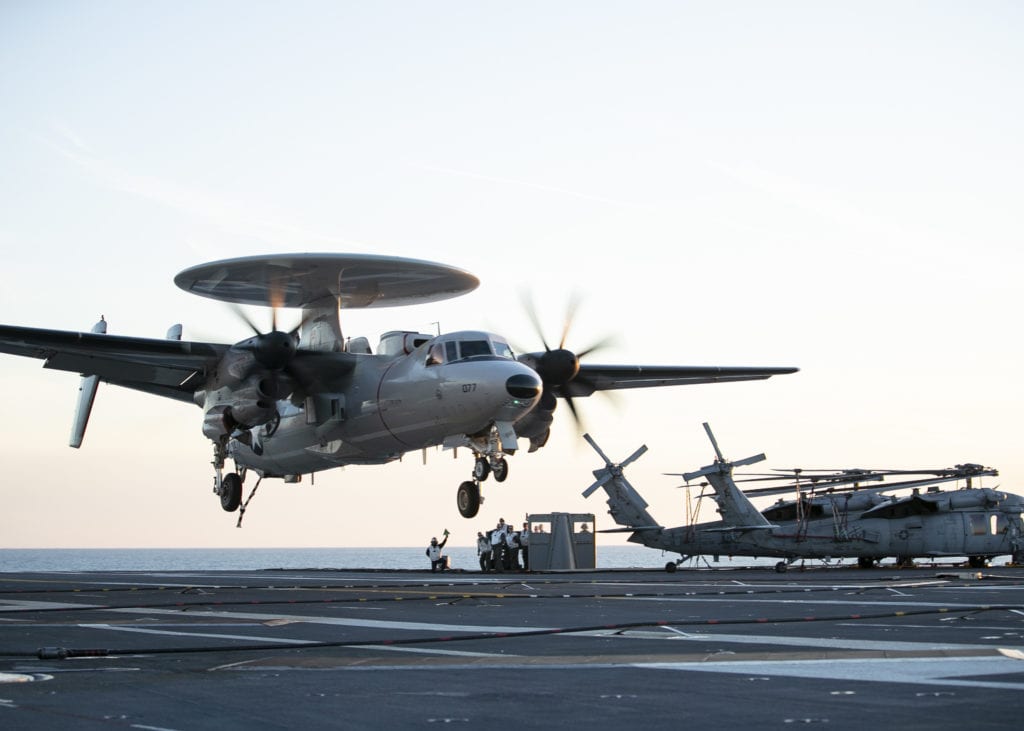
An E-2D Advanced Hawkeye assigned to Air Test and Evaluation Squadron (VX) 20 lands aboard USS Gerald R. Ford’s (CVN 78) flight deck. U.S. NAVY / Mass Communication Specialist 2nd Class Sean Elliott
ARLINGTON, Va. — The U.S. Navy has awarded Northrop Grumman a contract modification to support the service’s fleet of E-2D Advanced Hawkeye battle management aircraft and to build one additional E-2D.
Northrop Grumman Systems Corp. Aerospace Systems, Melbourne, Florida, was awarded a $195 million contract modification from the Naval Air Systems Command to exercise options “to provide support services to include non-recurring engineering, software support activity and product support in support of E-2D Advanced Hawkeye Lot 9 full-rate production aircraft, according to a March 31 Defense Department contract announcement. In addition, the action includes the procurement of one additional E-2D.
The Navy’s program of record plans to procure a total of 86 E-2Ds. The Japanese Air Self-Defense Force is purchasing 13 E-2Ds.
The Navy is more than halfway through transition of its nine fleet airborne command and control (VAW) squadrons from the E-2C Hawkeye to the E-2D.
Austal Launches Future LCS Canberra for U.S. Navy
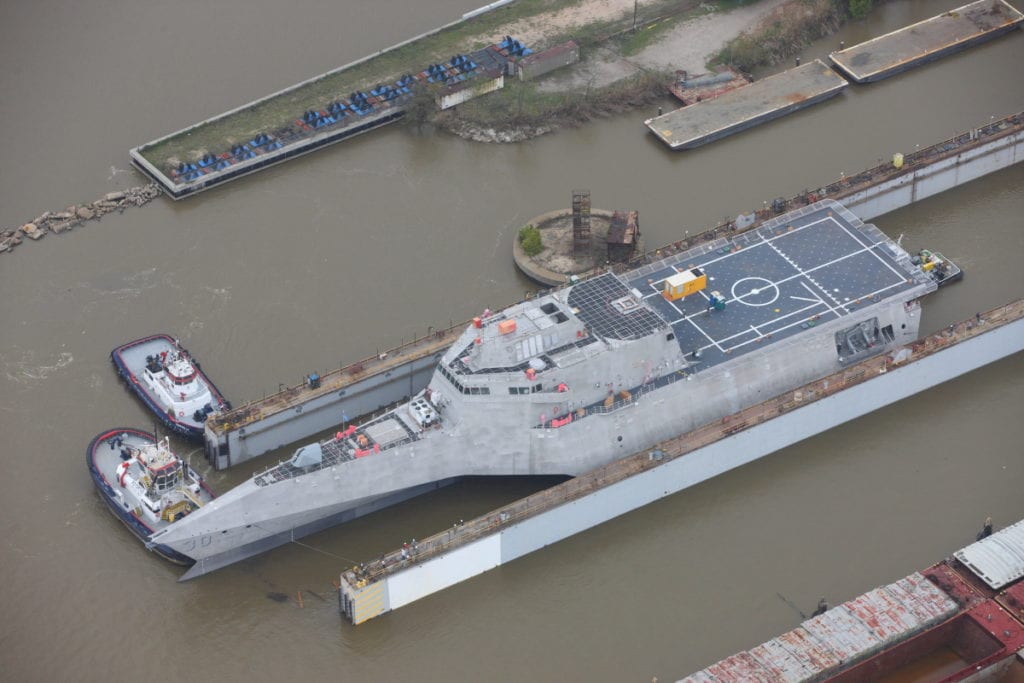
The future USS Canberra (LCS 30), launched into the Mobile River, Alabama, on March 30 by Austal USA. AUSTAL USA
MOBILE, Ala. — Austal USA launched the future USS Canberra(LCS 30) into Alabama’s Mobile River on March 30, the company said in an April 1 release.
The Canberra, an Independence-class littoral combat ship, is the first ship to be launched by Austal USA in 2021 and the first to be launched from the company’s recently acquired dry dock. The Canberra is one of 19 Independence-class LCSs being built by Austal for the U.S. Navy. Austal USA so far has delivered 11 of the class to the Navy.
The next steps for the Canberra are sea trials and then delivery to the Navy.
LCS 30 is named in honor of the HMAS Canberra, a Royal Australian Navy heavy cruiser that fought in the Battle of Savo Island in the Solomon Islands in August 1942 during World War II and was sunk along with three U.S. Navy heavy cruisers by imperial Japanese navy forces. Later in the war, the U.S. Navy commissioned a heavy cruiser, USS Canberra (CA 70), in honor of the Australian ship and crew. The Canberra later was modified into a guided-missile heavy cruiser that served during the Vietnam War.
Coast Guard Cutter Walnut Arrives at New Homeport in Pensacola
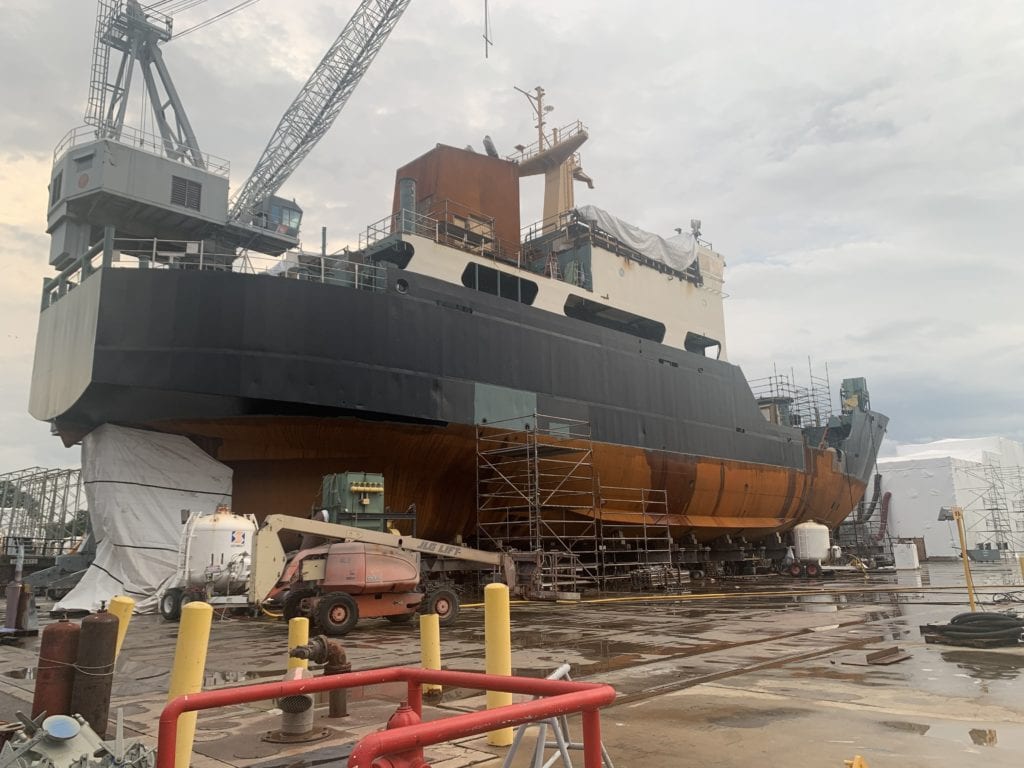
The Coast Guard Cutter Walnut returns to its new homeport in Pensacola, Florida, March 31, 2021. The Walnut crew performed a major maintenance availability project to enable the 225-foot cutter to reach the end of its 30-year planned life service and was previously homeported in Honolulu. U.S. COAST GUARD
PENSACOLA, Fla. — The crew of Coast Guard Cutter Walnut arrived at the cutter’s new homeport, the Coast Guard 8th District said in a March 31 release.
The Walnut crew performed a major maintenance availability project to enable the 225-foot cutter to reach the end of its 30-year planned life service.
“The Walnut crew looks forward to our arrival in Pensacola, Florida, and values our role in supporting Coast Guard District Eight’s continued efforts to maintain a safe and effective maritime transportation system,” said Lt. Cmdr. Christopher Bonner, commanding officer of Coast Guard Cutter Walnut. “As evidenced by the historic hurricane season of 2020, the Coast Guard and its buoy tender fleet played and will continue to play a critical role in responding to devastating natural disasters and reconstituting waterways in and around this nation’s most critical maritime ports.”
The dockside period included loading and inventorying thousands of pounds of critical shipboard materials and equipment, conducting mission critical training to prepare for possible shipboard casualties while underway, and conducting extensive maintenance and repair on most of the shipboard machinery, electronics and auxiliary systems.
The cutter Walnut is a 225-Foot seagoing buoy tender, which was previously homeported in Honolulu and will now be homeported in Pensacola, Florida. The cutter’s primary missions are aids to navigation, search and rescue, maritime law enforcement, maritime environmental protection and national defense missions.
Light Carrier Concept ‘Not Compelling,’ Navy’s Air Warfare Director Says
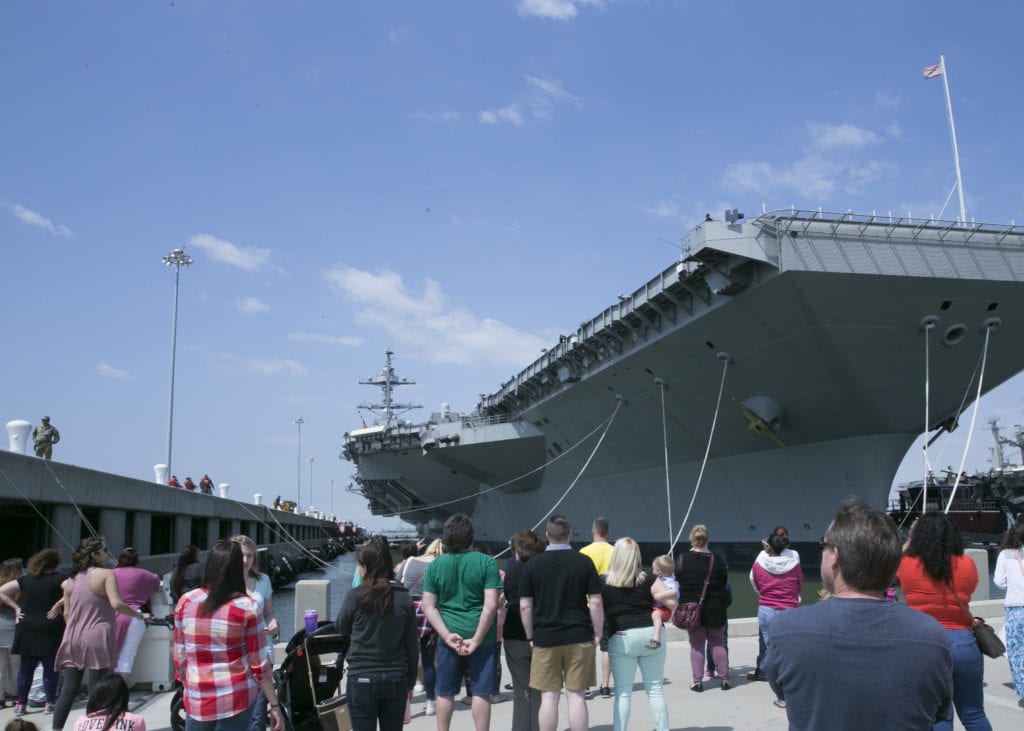
Then- Pre-Commissioning Unit Gerald R. Ford (CVN 78) at Naval Station Norfolk in 2017. Some pundits and observers are calling for light carriers to augment or replace large nuclear-powered aircraft carriers. U.S. NAVY / Mass Communication Specialist 2nd Class Kristopher Ruiz
ARLINGTON, Va. — The U.S. Navy’s director of Air Warfare does not see a compelling case for the service to build and deploy light aircraft carriers to augment or replace the service’s large, nuclear-powered aircraft carriers (CVNs).
“I believe the L-class ships [amphibious assault ships] operating with the F-35B would fit that bill,” said Rear Adm. Gregory Harris, the Navy’s director for Air Warfare, speaking this week at a Navy League Special Topic Breakfast webinar, sponsored by General Dynamics. “Others would disagree.”
Harris noted that some pundits and other observers advocate light carriers because of the high cost of building, maintaining and operating the fleet of 11 CVNs, which some see as vulnerable to high-end threats such as submarines and hypersonic weapons. The capabilities of the F-35B Lightning II strike fighter have given the light carrier proponents support for their case that such a carrier armed with an air wing of F-35Bs would be highly valuable in most likely combat scenarios.
The Navy has in the past filled amphibious assault ship flight decks with Marine Corps AV-8B Harrier II jets for combat operations from the Persian Gulf, and recently conducted an experiment on the new USS America with a load of F-35Bs.
Defenders of CVNs note that the ship’s size enables it to carry a larger air wing, including E-2 battle management aircraft that are vital to the carrier’s over-the-horizon search and air defense capabilities. Often, they point to the 1982 Falklands War, where the U.K. Royal Navy suffered for lack of an ability to detect low-flying Argentinian attack aircraft soon enough to intercept them.
Harris said that the Navy is “committed to executing an analysis of alternatives to look at a light carrier or a follow-on carrier to the Ford class might look like.”
He referred to an earlier study that looked at 70 potential hull forms for aircraft carriers before settling on the Ford class.
“I would say that the majority of that study is still very valid,” he said. “Some of the mission sets may have changed slightly so we will look at those in light of the current threat out there in the world is valid and not unnecessary. It will be good for us to do that. I’m confident that over the long run we’ll find that there’s not a compelling return on investment to make a smaller carrier just [because of] speed, station-keeping, the air wing that you would put on top of that carrier, and the ability to have the fuel for the air wing and for the carrier to have for the surface combatants.
“So, we will execute that,” the admiral said. “We’re going to start a little bit of pre-AOA [analysis of alternatives] activities this summer and then we will look to kick that AOA off probably in the [2022] time frame to go ahead and formally revisit that.”
Navy Grapples with Slow Strike Fighter Training Output, Admiral Says
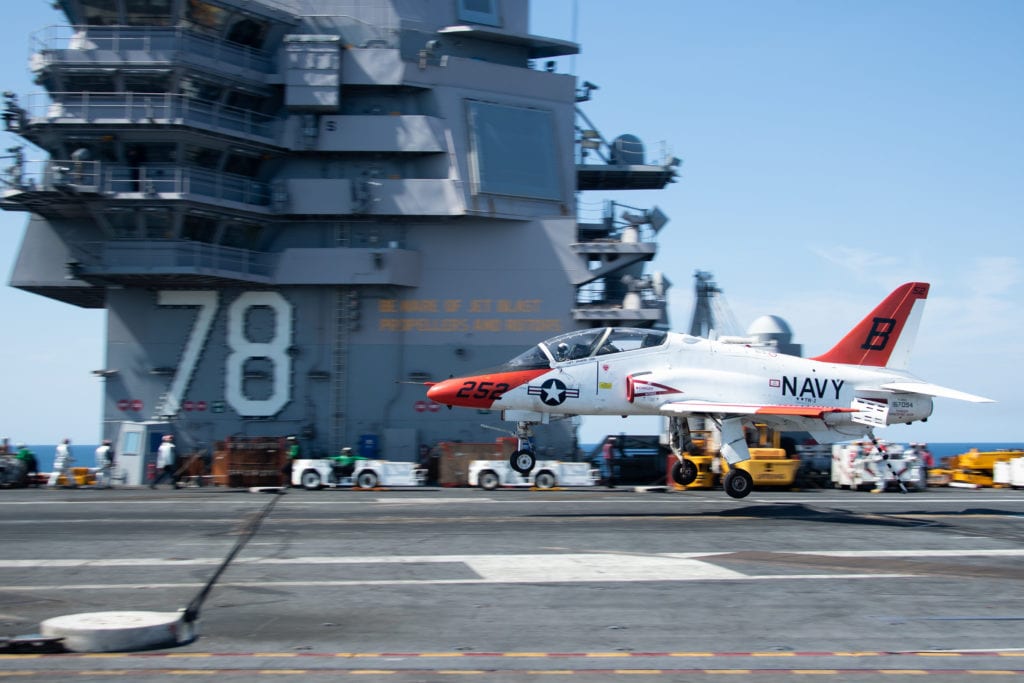
A T-45C Goshawk attached to Training Air Wing (TW) 1 lands on the flight deck of the aircraft carrier USS Gerald R. Ford (CVN 78) during commander, Naval Air Training Command carrier qualifications, March 14, 2021. U.S. NAVY / Mass Communication Specialist Seaman Jackson Adkins
ARLINGTON, Va. — The U.S. Navy is struggling with supplying the fleet with enough strike fighter pilots to fill its squadrons, but is seeing some progress after resolving some training aircraft issues.
The strike fighter training pipeline is “too darn long,” said Rear Adm. Gregory Harris, the Navy’s director for Air Warfare, speaking this week in a Navy League Special Topic Breakfast webinar, sponsored by General Dynamics. “We have had significant delays over a number of years inside that program. Flat out early, we underloaded the program because we were having difficulties, so we did not pull in enough aviators, which led to some of our strike fighter pilot shortfall that we have right now.”
Harris also said the Navy has had “a number of different issues associated with different aircraft inside the series,” referring to the daunting problems with the T-45 strike training jet’s oxygen system, which resulted in a pause in training pending corrective actions.
“We made our way through that and started pushing up production in the T-45 line,” he said, “But we [also] went through some hiccups with our T-6. We switched vendors for the supply side of the T-6 and that caused perturbations down in the primary training. We have managed to make our way widely through the T-6 piece very successfully, pushing students through aggressively into the helicopter syllabus and now we’re getting all cylinders cooking in the strike fighter syllabus.”
The admiral noted that training delays also occurred in the strike fighter fleet replacement squadron (FRS) on the West Coast (Strike Fighter Squadron 122) with the low aircraft mission capable rates a few years ago that now have risen to 80% or greater.
“That helped to alleviate the pressure on the FRS there in [Naval Air Station] Lemoore, California,” he said. “We have that FRS now moving at full speed. So, for beginning to end for a strike fighter pilot, it should be roughly 2 ½ years. It’s taking three years and sometimes a little bit more to get those students through.”
Harris said his own son was awarded his aviator wings last week after a time “much longer than I would have liked” in the pipeline, but he noted that another aviator winged during the same ceremony completed the syllabus in 9.5 months, the design duration, evidence that progress is being made in shortening the time in training.
USS Tripoli Marks Significant Steps Toward Fleet Tasking with Fitting Out Availability, Sea Trials
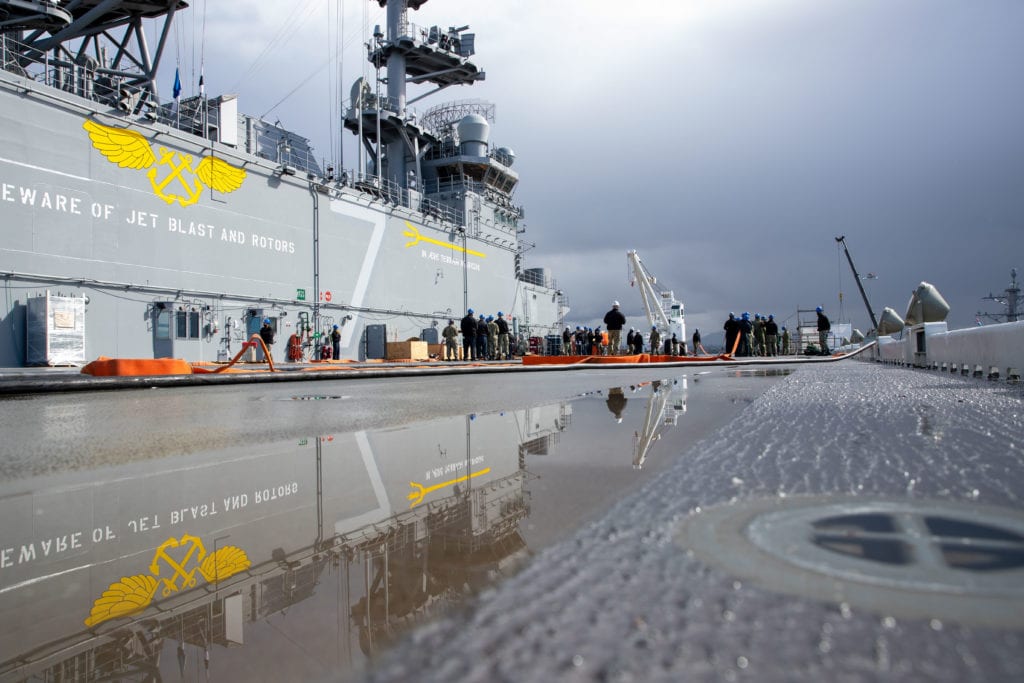
Sailors participate in a flight deck firefighting drill aboard the amphibious assault ship USS Tripoli (LHA 7), March 11, 2021. Tripoli is an America-class amphibious assault ship homeported in San Diego. U.S. NAVY / Mass Communication Specialist 2nd Class Joshua Hinson
SAN DIEGO — USS Tripoli (LHA 7), the second amphibious assault ship in the America class, is highlighting its capabilities with the completion of its Fitting Out Availability (FOA) on March 26 and upcoming sea trials, Team Ships and USS Tripoli Public Affairs said in a March 31 release.
The FOA entails changes that resulted from lessons learned and feedback from USS America’s (LHA 6) availability and work postponed due to COVID-19 protocols. Work completed during this time directly supports the vessel’s F-35B Joint Strike Fighter (JSF) capability, including onboard space reconfiguration and preparing for advanced logistical systems installment.
When the ship is underway for sea trials, the crew will begin validating performance, operating many of the ship’s onboard systems, including navigation, damage control, mechanical and electrical systems, combat systems, communications and propulsion applications to ensure mission readiness.
“This amphibious assault ship is ready to provide critical capabilities in supporting overall mission readiness to the Sailors and Marines of the Pacific Fleet,” said Capt. Cedric McNeal, program manager, Amphibious Warfare Programs. “With its enhanced JSF capability, this ship meets the operational needs of today, while providing capacity for the future fight.”
Tripoli incorporates key components to provide the fleet with a more aviation-centric platform. The ship’s design features an enlarged hangar deck, aviation maintenance facilities realignment and expansion, a significant increase in available stowage for parts and support equipment, and increased aviation fuel capacity.
The ship will enter its Post Delivery Test and Trials phase, followed by Final Contract Trials with the Board of Inspection and Survey and the Post Shakedown Availability before eventual national tasking.
“The combined post-delivery and Tripoli team completed six months of depot-level work on time, a significant accomplishment in this COVID environment,” said Capt. Joel Lang, Tripoli’s commanding officer. “The crew is ready to take the ship to sea to complete bow-to-stern testing to prove the combat effectiveness of assault carrier 7.”
The future USS Bougainville (LHA 8) is currently in production at Huntington Ingalls Industries and LHA 9 contract award is on track for 2021.
Ike Supports Operation Inherent Resolve from Eastern Mediterranean
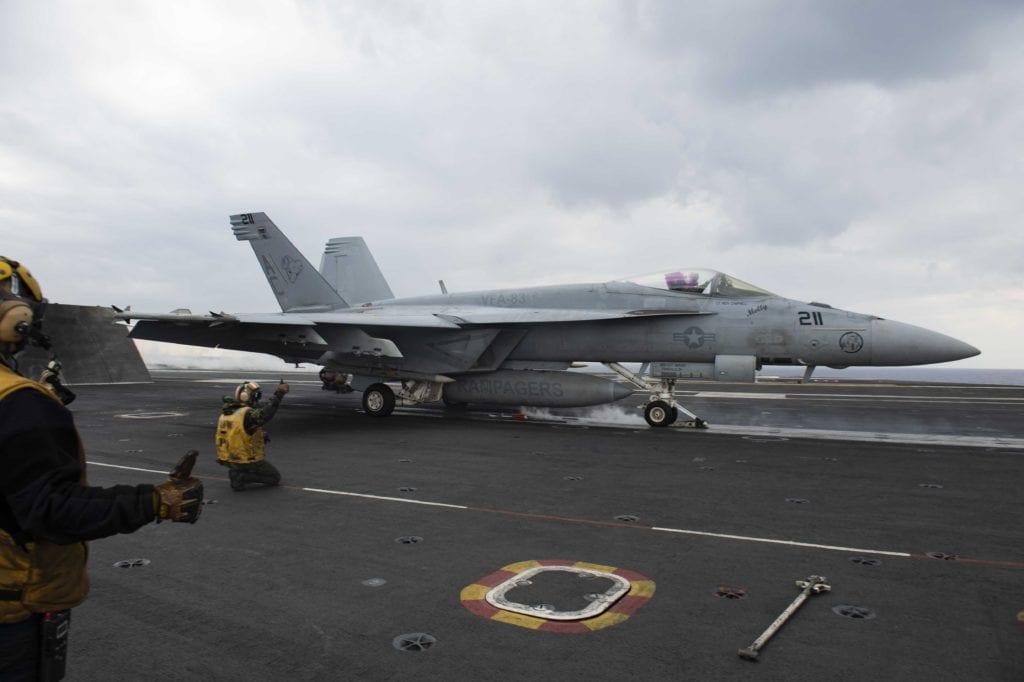
An F/A-18E Super Hornet, attached to the “Rampagers” of Strike Fighter Squadron (VFA) 83, launches from the flight deck in preparation for operation inherent resolve aboard the Nimitz-class aircraft carrier USS Dwight D. Eisenhower (CVN 69), in the Mediterranean Sea, March 31, 2021. U.S. NAVY / Mass Communication Specialist 2nd Class Sophie A. Pinkham
NAPLES — Dwight D. Eisenhower Carrier Strike Group began flight operations in support of Operation Inherent Resolve (OIR) from the Eastern Mediterranean Sea, March 31, 2021.
Aircraft from Carrier Air Wing (CVW) 3 supported Combined Joint Task Force OIR, demonstrating U.S. commitment to security in the region, U.S. 6th Fleet Public Affairs said in a March 31 release.
“Our Strike Group is ready and capable of providing direct, long-range combat operational air support from the Eastern Mediterranean Sea,” said Rear Adm. Scott F. Robertson, commander, Carrier Strike Group Two. “CSG-2’s presence in U.S. 6th Fleet shows the flexibility of our naval forces to conduct operations whenever and wherever necessary. We can provide a wide range of options to our nation and allies in deterring adversarial aggression and disruption of maritime security and regional stability.”
IKE’s operation in the Mediterranean Sea demonstrates the capability of the U.S. Navy to support OIR from multiple theaters, highlighting the mobility, flexibility, and power projection capability of the U.S. Navy’s carrier strike groups.
Operating from the Eastern Mediterranean enables IKE to seamlessly support three combatant commanders, ensuring immediate responses in a rapidly evolving security environment. IKE CSG brings multi-mission capable platforms to the U.S. 6th Fleet area of operations with strike, ballistic missile defense, and intelligence, surveillance, and reconnaissance capabilities.
Deploying ships and aircraft of the strike group, commanded by Robertson, include flagship USS Dwight D. Eisenhower (CVN 69); the Ticonderoga-class guided-missile cruiser USS Monterey (CG 61); Destroyer Squadron 22 ships include Arleigh Burke-class guided-missile destroyers USS Mitscher (DDG 57), USS Laboon (DDG 58), USS Mahan (DDG 72), and USS Thomas Hudner (DDG 116).
Squadrons of Carrier Air Wing (CVW) 3, embarked on Eisenhower include the “Fighting Swordsmen” of Strike Fighter Squadron (VFA) 32, “Gunslingers” of Strike Fighter Squadron (VFA) 105, “Wildcats” of Strike Fighter Squadron (VFA) 131, “Rampagers” of Strike Fighter Squadron (VFA) 83; “Dusty Dogs” of Helicopter Sea Combat Squadron (HSC) 7, “Swamp Foxes” of Helicopter Maritime Strike Squadron (HSM) 74, “Screwtops” of Airborne Command and Control Squadron (VAW) 123, “Zappers” of Electronic Attack Squadron (VAQ) 130 and a detachment from Fleet Logistics Support Squadron (VRC) 40 “Rawhides.”
Navy’s Next-Generation Air Dominance Increment to Replace EA-18G, Admiral Says
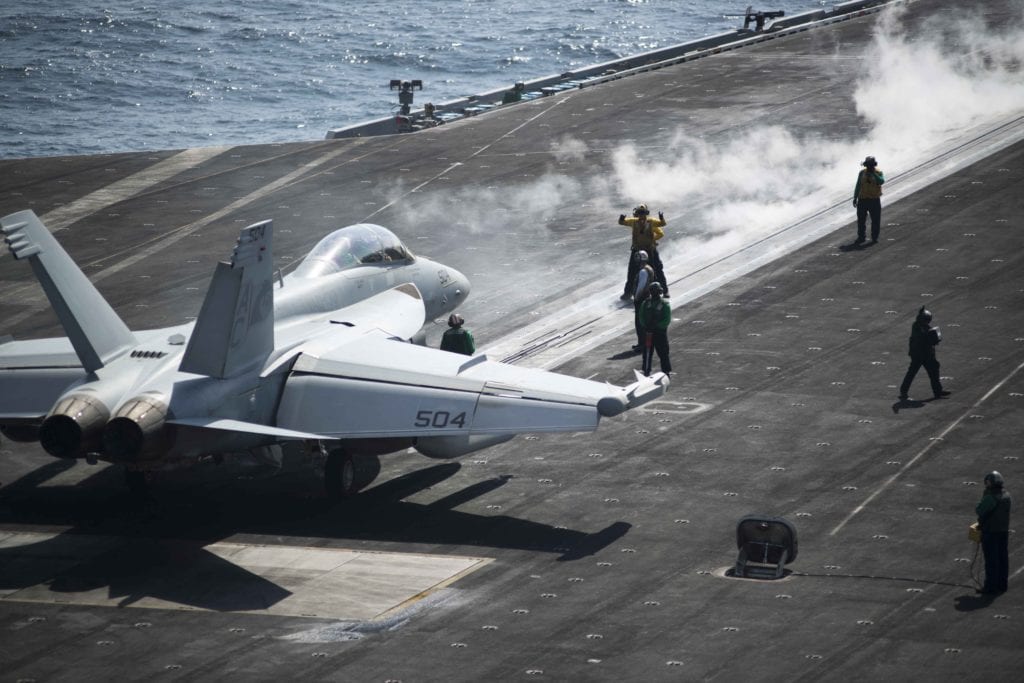
An EA-18G Growler prepares to launch from the flight deck of the aircraft carrier USS Harry S. Truman (CVN 75) in this 2013 photo. The Growler is due to be replaced by the Navy’s Next-Generation Air Dominance (NGAD) family of systems. U.S. NAVY / Mass Communication Specialist 2nd Class Lyle H. Wilkie III
ARLINGTON, Va. — The U.S. Navy’s Next-Generation Air Dominance (NGAD) family of systems is planned to include a replacement for the EA-18G Growler electronic attack aircraft in addition to the F/A-18E/F Super Hornet strike fighter, a senior official said.
Rear Adm. Gregory Harris, the Navy’s director for Air Warfare, speaking in a March 30 Navy League Special Topic Breakfast webinar, sponsored by General Dynamics, said Increment 2 of the NGAD program is the planned phase to replace the EA-18G.
Harris said NGAD’s Increment 1, the F/A-XX — the planned replacement for the F/A-18E/F — will be the centerpiece of the NGAD family of systems.
“We’re going through the study portions of what [Increment] 2 will be to replace the EA-18G Growler, and we expect that family of systems will accommodate manned and unmanned.”
The F/A-XX “may or not be manned,” Harris said. “The platform meets the fixed-wing portion of the Next-Generation Air Dominance family of systems. We truly see NGAD as more than just a single aircraft. We believe that as manned/unmanned teaming comes online, we will integrate those aspects of manned and unmanned teaming into that. We euphemistically refer to it as our ‘little buddy,’ an adjunct air-to-air platform, EW [electronic warfare] platform, discussion of whether it could be an advanced early warning platform. We will have to replace the E-2D sometime in the future.”
The admiral noted that the notional carrier air wing of the future may have a 60-40 percent manned-unmanned split, but over time will shift to a 40-60 percent manned/unmanned split.
“A lot of that is going to be dependent on the success we see with the MQ-25 Stingray and our ability to truly operate around the aircraft carrier and safely execute that both on the flight deck and in the airplane,” he said.
Harris said the NGAD is in the concept refinement phase and is the Navy is working closely with the Air Force NGAD program, “recognizing that the two will likely be different as far as mold lines just based on different services’ needs, but a lot of the internal mission systems will be similar and open mission system architecture and government-referenced design that will enable us to use best of breed.”
He said the NGAD program is looking to avoid “vendor lock,” whereby the program is locked into using a particular mission system when a superior, less costly or more sustainable system becomes available.
“Industry should look at different ways to team,” Harris said. “Our industry primes get very comfortable with the folks they’ve worked with in the past. Some of that has worked out very well for us; other times it may not have worked a well as well would have liked. I recommended that they broaden their view and look at as many of those folks as they can to team. This will enable a lot of the smaller companies to work into the niche market they may be very successful at.”
Unmanned Missile Carrier a Potential for Aerial Manned/Unmanned Teaming, Admiral Says
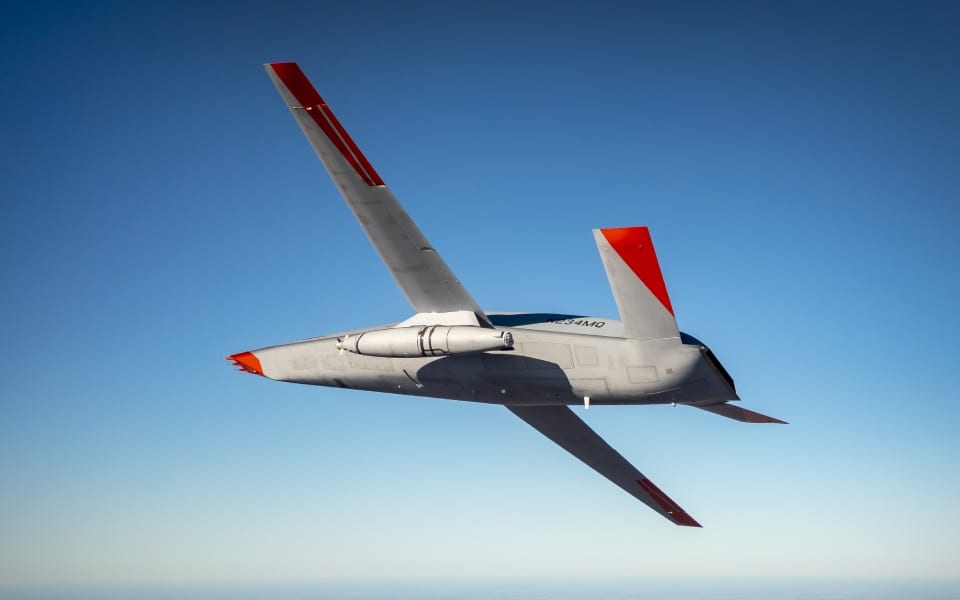
The Boeing-owned MQ-25 T1 test asset, a predecessor to the engineering development model aircraft being produced under a 2018 contract award. THE BOEING CO.
ARLINGTON, Va. — As the Navy looks forward to fielding its MQ-25A Stingray unmanned carrier-based aerial refueling tanker, it is looking to the future potential of unmanned carrier-based aircraft in other missions, including those involving manned/unmanned teaming and incorporating artificial intelligence. A missile-carrying unmanned aerial vehicle (UAV) is within the imaginable possibilities.
Acknowledging the complexity of developing UAVs for aerial warfare, Rear Adm. Gregory Harris, the Navy’s director for Air Warfare, speaking in a March 30 Navy League Special Topic Breakfast webinar, sponsored by General Dynamics, discussed his current thinking regarding said manned/unmanned teaming for tactical combat aircraft.
“Having an unmanned platform out there as an adjunct missile carrier I see as not a step too far too soon,” Harris said. “I could have an unmanned friend — typically I say a flying Dorito chip — but I’m thinking it doesn’t have to be that way. An unmanned system with missiles I can clearly in my mind envision a way to say: ‘Defensive combat spread; shoot on this target, and I will squeeze the trigger,’ or ‘I will just enable that unmanned platform to shoot a designated target.’ That doesn’t stretch beyond the realm of my imagination.”
“When I have that unmanned platform making decisions which target anything it wants to shoot on, that’s where I start to have that scratched both from a policy standpoint,” he said. “What’s the rule of order going to be when Hal is out there executing a strike on itself?” he said, referencing the renegade computer than took over a spaceship in the motion picture 2001: A Space Odyssey. “I jokingly look at all of the movies out there and they typically don’t end well when we do that.
“In the next two or three years we’ll probably have a better idea of whether a replacement for the F/A-18E/F will be manned or unmanned,” Harris said. “I believe it most likely will be manned. I’m open to the other aspects of it. A family of systems definitely will include manned and unmanned systems.”
Harris said the development of the MQ-25 “has been very successful,” noting the Boeing prototype has been flying with its aerial refueling store.
He said the MQ-25 will be able to carry fuel for up to three carrier launch and recovery cycles or be able to pass 14,000 to 16,000 pounds of fuel up to 500 nautical miles on a strike mission. It will have some unspecified intelligence, surveillance and reconnaissance capability.