HMS Queen Elizabeth Assumes Role as Royal Navy’s New Fleet Flagship
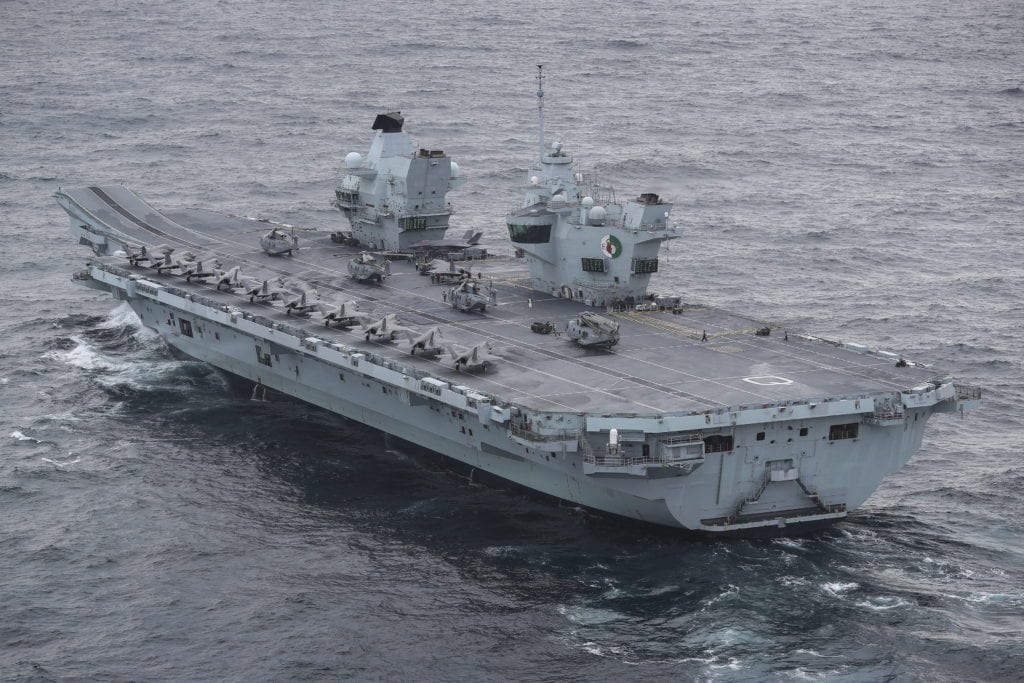
The full U.K. Carrier Strike Group assembled for the first time during Group Exercise 2020 on Oct. 4. Aircraft carrier HMS Queen Elizabeth leads a flotilla of destroyers and frigates from the U.K., U.S. and the Netherlands, together with two Royal Fleet Auxiliaries. It is the most powerful task force assembled by any European Navy in almost 20 years. Royal Navy
LONDON — HMS Queen Elizabeth assumed the role of fleet flagship as the Royal Navy moves closer to deploying the world’s most technologically advanced carrier strike group, the U.K. Ministry of Defence said in a Jan. 29 release.
Fleet Commander Vice-Admiral Jerry Kyd was received on the aircraft carrier to mark the transfer of the role from HMS Albion, while Royal Navy ships and shore establishments were informed by a signal at 1330.
The First Sea Lord, Admiral Tony Radakin, said: “The position of fleet flagship is a symbol of HMS Queen Elizabeth’s importance to the nation, not just in restoring our carrier strike capability, but as a rolling statement of British commitment to global security, prosperity and trade.
“It’s right that we bestow such a historic title now. In the coming months HMS Queen Elizabeth will lead the most ambitious Royal Navy deployment in decades,” Radakin said. She will be a focal point as we look forward to an extraordinary year.”
It was announced last week that the United Kingdom’s new flagship and Lightning Force of F-35B stealth strike fighters will also be complemented by a detachment of the fifth-generation aircraft from the U.S. Marine Corps, and a U.S. Navy destroyer during her first operational strike group deployment.
HMS Queen Elizabeth and her strike group will spend time developing collective war-fighting skills when NATO navies gather for exercise Strike Warrior off Scotland during the spring, before departing for the Mediterranean.
“It is a fantastic privilege for Queen Elizabeth to be made the fleet flagship as we prepare to sail at the heart of U.K.’s very high readiness Carrier Strike Group,” said Capt. Angus Essenhigh, commanding officer of the Queen Elizabeth. “We look forward to doing the nation proud as we deploy on operations for the first time.”
Last year, Prime Minister Boris Johnson confirmed that HMS Queen Elizabeth will be at the center of a carrier strike group deployment to the Mediterranean, the Indian Ocean and East Asia. She will embark F-35B from 617 Squadron (the “Dambusters”), Royal Navy Merlin helicopters, and be escorted and supported by Royal Navy Type 45 destroyers, Type 23 frigates and support ships of the Royal Fleet Auxiliary.
Assault ship HMS Albion had been flagship since March 2018, deploying to the Indo-Pacific for 10 months; to the Baltic for major multi-national exercises; and latterly to the Mediterranean leading NATO security patrols and experimental warfare trials. Her sister ship, HMS Bulwark, previously led the Fleet for four years.
“While it is with some sadness that we hand over the responsibility to HMS Queen Elizabeth, we are proud to be part of the transfer which marks a new era for the Royal Navy and the nation,” said Capt. Simon Kelly, commanding officer of HMS Albion.
Coast Guard Transfers 2 Suspected Smugglers, $8.5M in Seized Cocaine
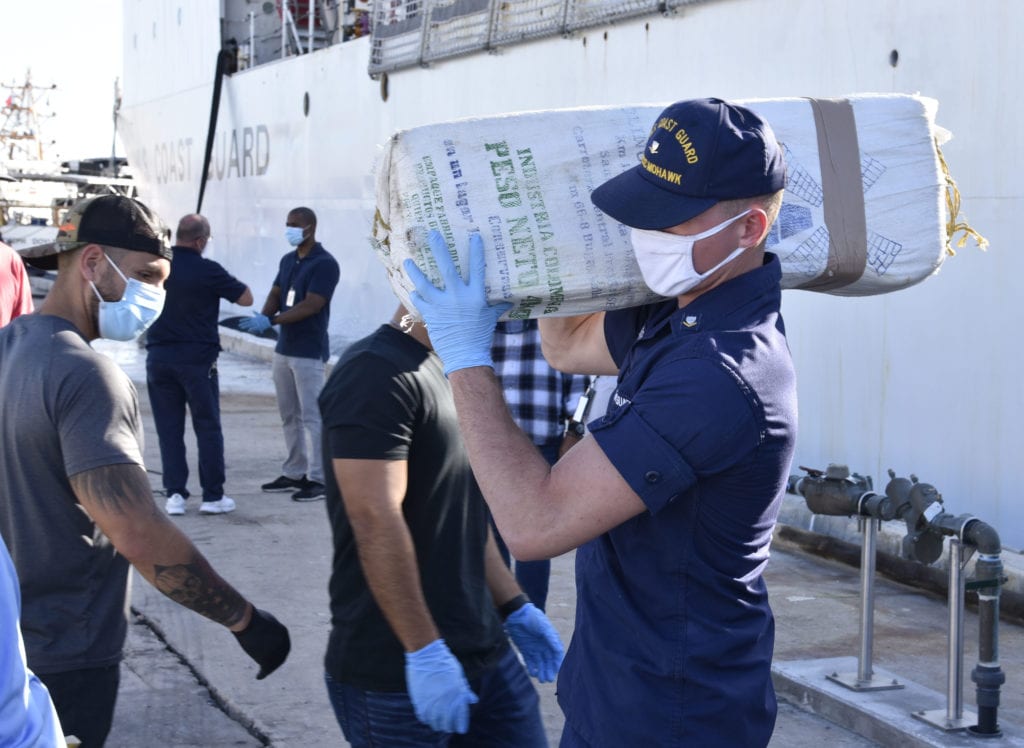
Coast Guard offloads 302 kilograms of cocaine valued at $8.5 million, and transfers custody of two suspected smugglers to Caribbean Corridor Strike Force federal agents in San Juan, Puerto Rico Jan. 28, 2021, following the interdiction of a go-fast vessel in the Caribbean Sea. U.S. Coast Guard
SAN JUAN, Puerto Rico — The Coast Guard Cutters Mohawk and Charles David Jr. transferred custody of two suspected smugglers and $8.5 million in seized cocaine to federal agents at Coast Guard Base San Juan Jan. 28, following the interdiction of a drug smuggling go-fast vessel in the Caribbean Sea, the Coast Guard 7th District said in a Jan. 29 release.
The interdiction was the result of multi-agency efforts in support of U.S. Southern Command’s enhanced counter-narcotics operations in the Western Hemisphere, the Organized Crime Drug Enforcement Task Force (OCDETF) and High Intensity Drug Trafficking Area (HIDTA) programs, and the Caribbean Corridor Strike Force (CCSF). The United States Attorney’s Office for the District of Puerto Rico is leading the prosecution for this case.
“This successful interdiction is a reflection of the seamless teamwork and the unwavering resolve between the Coast Guard, our federal law enforcement and Department of Defense partners to protect the nation’s southernmost maritime border against narcotrafficking threats,” said Cmdr. James L. Jarnac, Coast Guard Cutter Mohawk commanding officer. “The strength of our joint collaboration and partnerships is key to a safer Caribbean Region and disrupting transnational criminal organization activities through the interdiction of drug smuggling vessel’s in the maritime domain.”
The bust occurred during the afternoon of Jan. 24, 2021, after the aircrew of a maritime patrol aircraft detected a suspicious 25-foot go-fast vessel, approximately 200 nautical miles south of the Dominican Republic.
The Coast Guard Cutter Mohawk diverted in response to the sighting and interdicted the go-fast vessel with the assistance of the cutter’s small boat. Following the interdiction, the Coast Guard Mohawk’s boarding team located and recovered nine bales of suspected contraband, which weighed approximately 302 kilograms (666 pounds) and tested positive for cocaine.
The crew of the cutter Mohawk embarked the seized contraband and the two men from the go-fast vessel, who both claimed to be Dominican Republic nationals. The Coast Guard Cutter Charles David Jr. later embarked the two suspected smugglers and a representative sample of the contraband that were disembarked in San Juan, Puerto Rico, where Caribbean Corridor Strike Force federal law enforcement agents received custody.
Cutter Charles David Jr. is a 154-foot fast response cutter, while the Cutter Mohawk is a 270-foot medium-endurance cutter, both homeported in Key West, Florida.
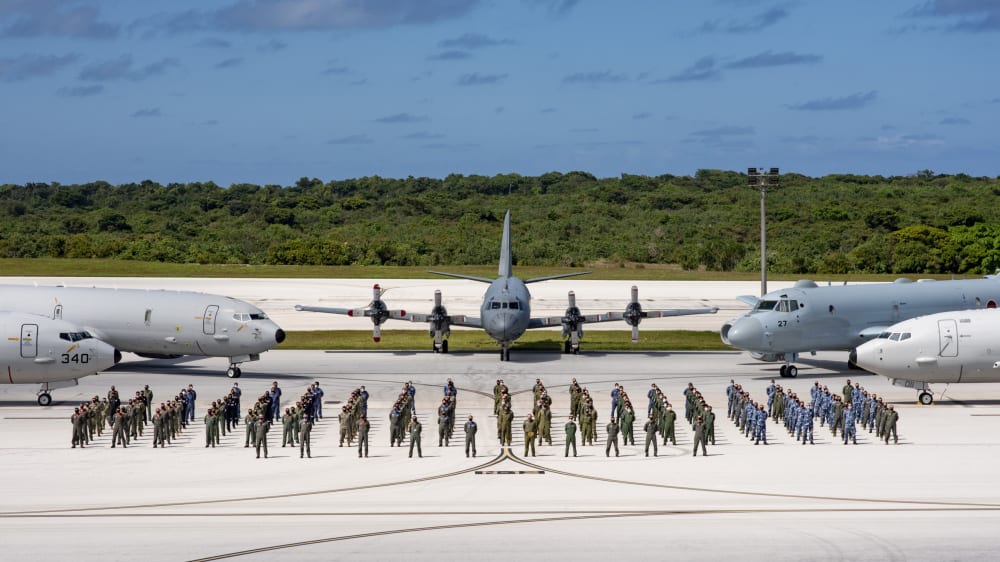
Members of the Royal Australian Air Force, Japan Maritime Self Defense Force, Indian navy and Royal Canadian Air Force, along with Patrol Squadron (VP) 5’s “Mad Foxes” and VP 8’s “Fighting Tigers,” pose for a photo at the conclusion of Exercise Sea Dragon. U.S. Navy / Lt. Cmdr. Kyle Hooker
Maritime Patrol aircraft and crews from five partner nations gathered at Andersen Air Force Base in Guam to participate in Sea Dragon 2021 Anti-Submarine Warfare (ASW) exercise. The exercise wrapped up Jan 27.
The Sea Dragon series of exercises are led by commander, Patrol & Reconnaissance Force, 7th Fleet (CTF-72), based out of Misawa, Japan. They are intended to demonstrate advanced ASW tactics, while at the same time continuing to build on multinational participation with U.S. allies and partners, as well as commitment to the security of the Pacific region.
This year, P-8A Poseidon Maritime patrol and reconnaissance aircraft and crews from Patrol and Reconnaissance Squadrons (VP) 5 and 8 trained together with the counterparts from the Royal Australian Air Force, Japan Maritime Self Defense Force, Indian navy and the Royal Canadian Air Force during the exercise.
The “Mad Foxes” of VP-5 are currently deployed to Kadena, Okinawa, and the “Fighting Tigers” of VP-8 are operating from Misawa, Japan. Both squadrons are based at Naval Air Station Jacksonville, Florida.
The U.S., Australia and India took part in the exercise with Boeing P-8 Poseidon aircraft. Japan flew the Kawasaki P-1, while Canada operated the CP-140 Aurora.
Sea Dragon 2021 centered on ASW training and excellence. The exercise included 250 hours of ground and classroom training and 125 hours of in-flight training ranging from tracking simulated targets to the final problem of finding and tracking Los Angeles-class nuclear submarine. The classroom training sessions helped the aircrews build plans and discuss how to incorporate tactics, capabilities and equipment for their respective nations into the exercise.
At the beginning of the exercise, Lt. Cmdr. Kyle Hooker, officer in charge of the VP-5 detachment, said he was eager for the opportunity to further develop our partnerships with Japan, India, Canada, and Australia during at Sea Dragon 2021.
“The COVID environment will be challenging for all our participants, but I know we will come together to adapt and overcome while executing our goal of anti-submarine warfare interoperability,” he said.
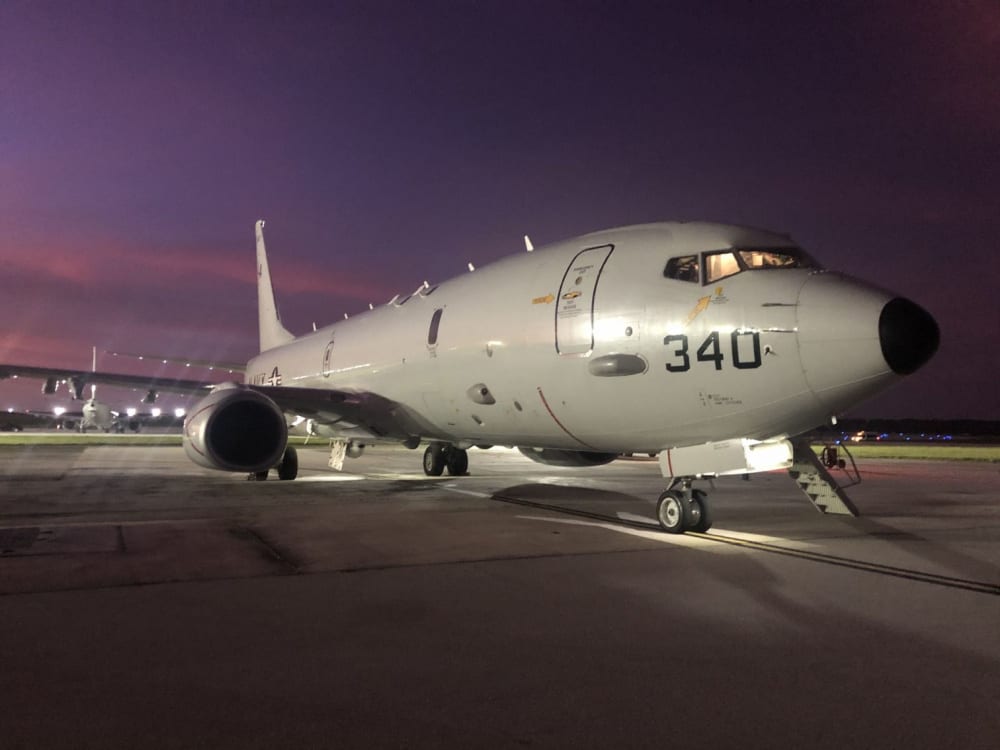
A P-8A Poseidon from Patrol Squadron (VP) 5 is prepared for its first training event of Sea Dragon 21. It involved tracking several Expendable Mobile Anti-Submarine Warfare Training Target’s (EMATT), which simulate the characteristics of a submarine. U.S. Navy / Lt. Cmdr. Kyle Hooker
VP-5 pilot Lt. Reed Arce said his squadron viewed Sea Dragon 2021 as an opportunity for both learning and competition.
“VP-5 was certainly looking forward to the opportunity to flex our ASW muscles and enjoy some friendly competition with our allied partners during Exercise Sea Dragon. We learned so much when comparing tactics between aircrews, and the ability to constantly improve our warfighting skills. We hope to leave Guam with all participants being at their peak performance in prosecuting sub-surface threats anywhere in the world,” he said.
VP-8 pilot Lt. Joseph Moralesvargas said Sea Dragon 2021 gave his squadron the chance to coordinate and be on station with other crews and other countries.
“The opportunity to speak with other operators and hear their philosophy and insight on ASW has given me new perspective,” he said. “I can’t think of any other exercise that would give us this chance,” he said.
Sea Dragon culminated with live tracking exercises with the nuclear-powered fast attack submarine, USS Providence (SSN-719) acting as the adversary.
The Sea Dragon events are graded, and the nation with the highest overall score wins the Dragon Belt award. The belt was awarded to the Royal New Zealand Air Force last year. This year, Royal Canadian Air Force 407 Long Range Patrol Squadron, which operates the CP-140 Aurora, had the highest total point score, and will bring the coveted Dragon Belt home with them to Canadian Forces Base Comox in British Columbia.
The importance of ASW in the Indo-Pacific region cannot be understated, with growing numbers of Chinese, Russian and North Korean submarines. The ability for allies and partners to work together with capable MPA aircraft and crews to successfully conduct ASW is vital to counter this threat.
General Dynamics Receives $43.2M Contract for Columbia/Dreadnought-Class SSBN Fire Control Systems
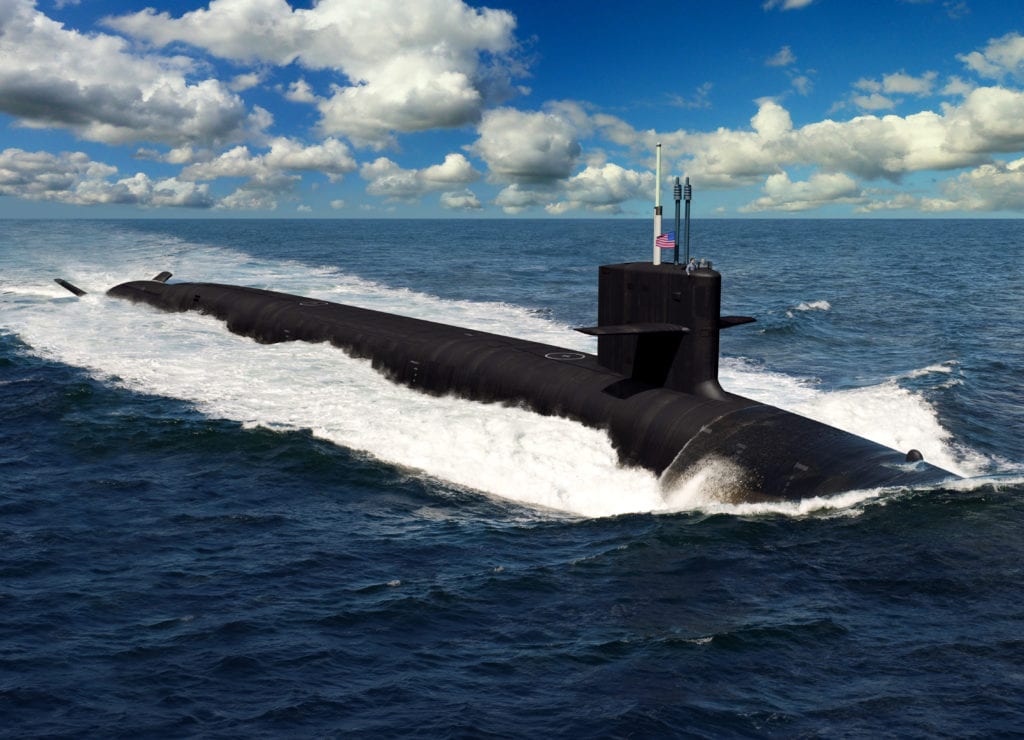
An artist’s rendering of the future Columbia-class ballistic missile submarines. The 12 submarines of the Columbia class are a shipbuilding priority and will replace the Ohio-class submarines reaching maximum extended service life. U.S. Navy
PITTSFIELD, Mass. – The U.S. Navy recently awarded a contract modification to General Dynamics Mission Systems that includes a broad scope of work for the Columbia and Dreadnought ballistic-missile submarine class to support development, production, and installation requirements.
This $43.2 million award is comprised of development, production, installation, and deployed-systems support exclusively for the Columbia/Dreadnaught (CLB/UKD) class of U.S. and U.K. submarine strategic weapons systems and subsystems and coincides with one of the largest manufacturing floor expansions at the Pittsfield, Massachusetts facility.
General Dynamics Mission Systems’ Maritime and Strategic Systems line of business will deliver fire control systems for the U.S. Navy’s first Columbia class submarine (US01) and the first U.S. Columbia class training facility (Kings Bay Trident Training Facility, KB-TTF) as well as installation support and pre-deployment planning for both U.S. and U.K. sites. This contract also includes CLB/UKD design completion scope and continuation of design activities for the first planned refresh of the CLB/UKD fire control system, as well as design support for CLB/UKD planning at the KB-TTF and procurement of the infrastructure material to support the new Trident Training Facility labs. The majority of the work in support of this contract will take place in Pittsfield.
“In November, we celebrated with our Navy partner, 65 years of outstanding support to our nation’s strategic deterrent mission,” said Laura Hooks, vice president of General Dynamics Mission Systems’ Strategic Systems business. “We are entering the next era of development and production for the Navy’s fire control system on the newest fleet of submarines that will extend this deterrent capability for another 65 years.”
U.S. Coast Guard, Russian Border Guard Patrolled Maritime Boundary Line
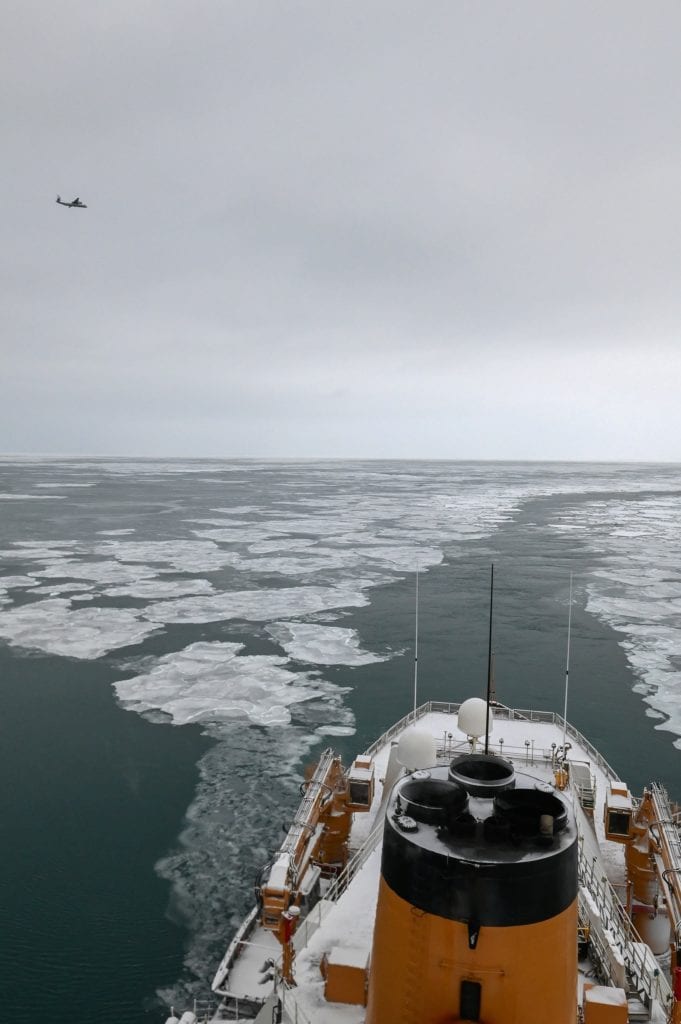
Coast Guard Cutter Polar Star crew and a Russian aircraft crew patrolled the Bering Sea maritime boundary line between Russia and the United States in mid-January. The 45-year-old heavy icebreaker is underway for a months-long patrol to support national security objectives throughout Alaskan waters and into the Arctic, including along the Maritime Boundary Line between the United States and Russia. U.S. Coast Guard / Petty Officer 1st Class Cynthia Oldham
JUNEAU, Alaska – The Coast Guard Cutter Polar Star crew and a Russian aircraft crew patrolled the Bering Sea maritime boundary line between Russia and the United States in mid-January, the Coast Guard 17th District said in a Jan. 27 release.
Following routine coordinated communications between the Russian Border Guard Directorate for the Eastern Arctic District and the Coast Guard Seventeenth District in Juneau, Alaska, the cutter Polar Star crew and a Russian Border Guard AN-26 aircraft crew patrolled a portion of the 1,700-mile maritime boundary line to support mutual agreements. The agreements consist of combined operations including search and rescue missions, contingency operations, routine communications exercises, and operations to counter illegal, unreported, and unregulated fishing.
The purpose of combined operations and communications exercises are to enforce rules and regulations and protect the sovereign rights and economies of both countries. The routine coordination maintains a strong working relationship and improves joint response capabilities for pollution, law enforcement, and search and rescue cases along our shared maritime border.
A working relationship at the operational level between the Coast Guard and Russian Border Guard remains critical to ensuring stability in the region. The partnership protects shared interests in fish stocks, safety of life at sea, coordinates environmental responses, and counters illicit activity on the high seas.
In July 2020, Coast Guard Cutter Munro conducted a similar communications exercise with the Russian Border Guard Vessel Kamchatka in the Bering Strait.
The Russian Border Guard’s effective enforcement of the maritime boundary line, and direct communication with their fishing industry, significantly reduces foreign fishing vessel incursions of the U.S. exclusive economic zone.
Since 2018, the Coast Guard has detected only one Russian fishing vessel incursion along the maritime boundary line. The Russian Border Guard immediately conducted an investigation of the incident and issued fines for that incursion.
“The United States Coast Guard works diligently to maintain a unique cooperative relationship with the Russian Border Guard in an effort to enhance the protection of shared interests in and around the Arctic region. The coordinated communications exercises on the high seas these past weeks with Polar Star demonstrate a recognition of the importance of that relationship,” said Capt. Jason Brennell, chief of enforcement for the Coast Guard’s 17th District.
MBDA and Rheinmetall Win Contract for Naval High-Energy Laser System
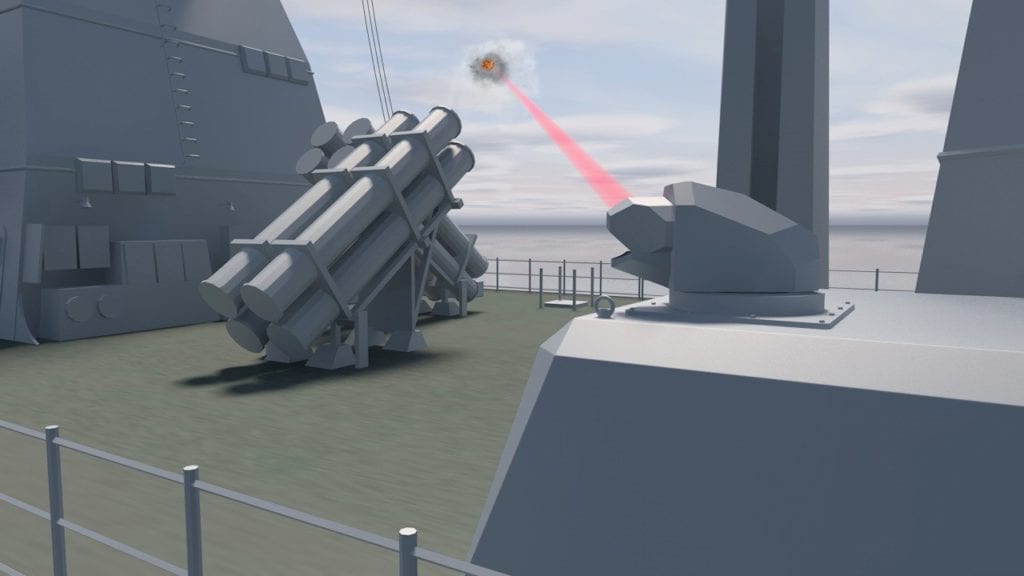
An artist’s conception of a laser weapon. MBDA
SCHROBENHAUSEN/ DUSSELDORF, Germany – Germany’s Federal Office for Bundeswehr Equipment, Information Technology and In-Service Support (BAAINBw) has awarded ARGE consortium — consisting of MBDA Deutschland GmbH and Rheinmetall Waffe Munition GmbH — a contract to fabricate, integrate and support testing of a laser weapon demonstrator in the maritime environment, MBDA said in a Jan. 28 release. The order value is in the low double-digit million euro range.
Work will be shared out on a roughly equal basis. MBDA Deutschland is responsible for tracking, the operator’s console and linking the laser weapon demonstrator to the command-and-control system. Rheinmetall is in charge of the laser weapon station, the beam guiding system, cooling, and integration of the laser weapon system into the project container of the laser source demonstrator.
The demonstrator is to be fabricated, tested and integrated by the end of the 2021. Trials onboard the German Navy frigate F124 Sachsen are to take place in 2022.
“The contract is an important step on the path to an operational high-energy laser system, said Doris Laarmann, head of laser business development at MBDA Deutschland. “Our two companies will apply their respective strengths to make this project a success on behalf of the German navy. Once it’s installed, the demonstrator will also be used to test important aspects such as the interaction and function of the sensor suite, combat management system and effector as well as rules of engagement.”
Alexander Graf, head of Rheinmetall Waffe Munition’s laser weapons program, and Dr. Markus Jung, who leads the company’s laser weapon development effort, agreed, saying the contract marks a systematic extension of the functional prototype laser weapon successfully tested in recent years, with the experience gained now dovetailing into one of the most ambitious projects in the field of laser weapon development in Europe.
A breakthrough development in the history of defense technology, lasers engage targets at the speed of light, operating with great precision and producing very little collateral damage. A demonstrator system featuring these capabilities will soon be put to the test under highly realistic operating conditions onboard a German frigate.
Q&A: Rear Adm. John Korka, Commander, Naval Facilities Engineering Systems Command
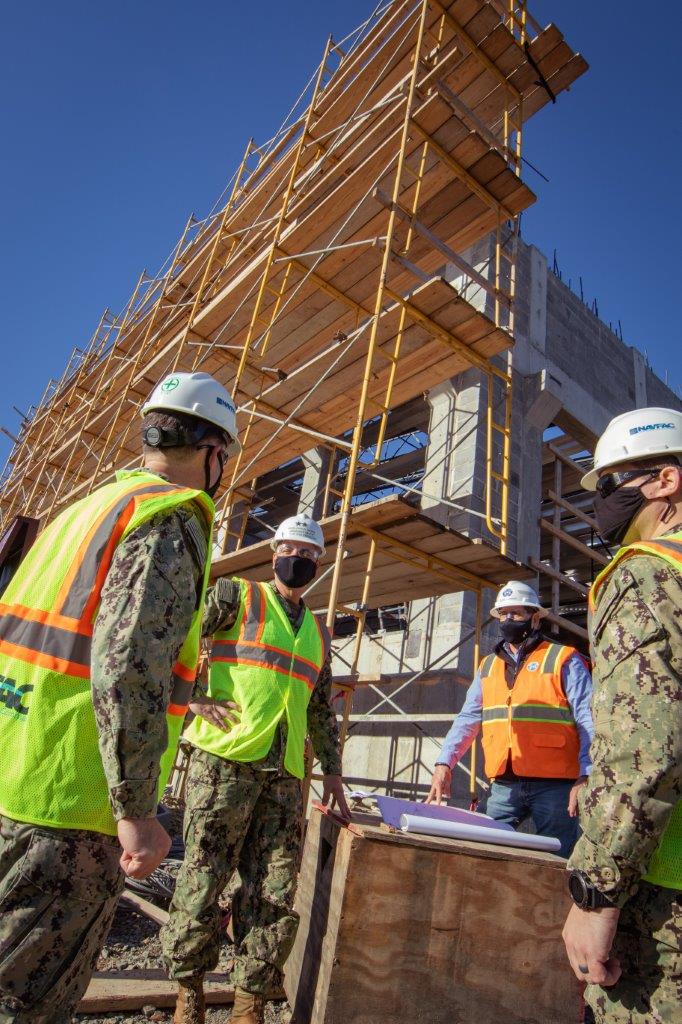
Rear Adm. John Korka, commander, Naval Facilities Engineering Systems Command and chief of Civil Engineers, assesses progress on a construction project at the U.S. Naval Observatory in Washington, D.C., Nov. 16, 2020. U.S. Navy / Mass Communication Specialist 1st Class Gary Granger/Released)
Rear Adm. John Korka, Civil Engineer Corps (CEC), is the commander of Naval Facilities Engineering Systems Command (NAVFAC) and chief of Civil Engineers. He leads NAVFAC’s CEC officers, civilians and contractors who serve as engineers, architects, contract specialists and technical professionals. His command delivers facilities engineering, expeditionary, and acquisition support to the Navy and Marine Corps, Unified Commanders, and Department of Defense agencies.
Korka discussed NAVFAC’s activities with Senior Editor Richard R. Burgess. Excerpts follow:
The Navy acquisition community has pushed contracts ahead of schedule to help industry get through the COVID crisis. What has NAVFAC done to advance contract awards or task orders to help in the current pandemic?
KORKA: At the start of this global pandemic, the CNO [chief of naval operations] and [James F. Geurts, assistant secretary of the Navy for research, development and acquisition] did something that I thought was critical. They set the tone and established priorities for operating in the COVID-19 environment. First and foremost, the health and safety of our military and civilian workforces was absolute. Second, we needed to maintain readiness and ensure the Navy does not come to an all stop. Lastly, it was important to support the whole of government approach in tackling COVID-19. Along with these priorities, Secretary Geurts released policy and emphasized our responsibility to keep execution moving forward smartly, support efforts to sustain a healthy industrial base, and to make sure that we did not use COVID as a rationale to stop efforts — I am talking primarily our construction work and sustaining functions to support base operations.
We used the priorities from the CNO and secretary to quickly move out as a SYSCOM [systems command] along three fronts — safety protocols, operating virtually and ceaseless communications. From the onset we strictly enforced adhering and complying with COVID-19 protocols. We were not going to compromise safety in any evolution, and we also wanted to make sure that our contractors were mindful of these requirements since protocols would be enforced.
The next leap was even more important — our jump into the digital domain. By that I mean we already had a good plan to move into online processing and pressing ahead into the virtual front. The pandemic actually accelerated that effort for us. Since the start of the COVID-19 emergency, we’ve had virtual site visits to accommodate contractors who were restricted in movement; we’ve held virtual safety training to educate contractors on bidding government work; and we’ve established policy and procedures for accepting electronic proposal submissions. All these happened quickly and allowed us to still do things that, typically, would have required a physical presence.
Lastly, we implemented a pretty aggressive outreach campaign with our industry partners to improve lines of communication. We held monthly virtual roundtable discussions with the construction/engineering industry, base operating support services contractors, and small business. These efforts definitely helped us better understand some of their challenges and recognize if industry needed our help with any policy relief. The monthly communication meetings are still occurring and have proven to be very successful.
Overall, I am proud of how everything came together within NAVFAC to continue to award and manage contracts during an unprecedented and challenging period of time.
Last year you discussed NAVFAC’s efforts to help the Columbia-class submarine join the fleet in the future. What major projects do you have in work right now, particularly in the Shipyard Infrastructure Optimization Program (SIOP)?
KORKA: In August, NAVFAC celebrated its 178th birthday, and what is interesting is that since the command’s commissioning we have always been responsible for building, maintaining, and recapitalizing shipyards. In fact, that is why we were established as a SYSCOM. Right now, our infrastructure recapitalization efforts remain ongoing, which is at the heart of our heritage, so that is pretty motivating.
When it comes to SIOP — this massive and daunting 20-year, $20 billion plus program — we continue to stay in close alliance with the fleet from a requirements standpoint which rests at NAVSEA [Naval Sea Systems Command], as well as supporting the shore enterprise at CNIC [Commander, Navy Installations Command]. Right now, we are looking at the development of “digital twins” at each of the shipyards [which] should really help us understand the optimal workflow configuration. This initiative will allow us to develop plans and engineering designs for specific projects with the proper sequence. Today, work is ongoing across all the shipyards — Portsmouth Naval Shipyard in Maine; Norfolk Naval Shipyard in Portsmouth, Virginia; Pearl Harbor Naval Shipyard in Hawaii; and Puget Sound Naval Shipyard in Washington — at each one of these locations, we have planning and construction efforts underway.
We are furthest along at the Portsmouth Naval Shipyard, where we have over $300 million worth of projects associated with the new multi-mission drydock facility and planning to support the future construction of a super flood basin project. All this work supports the future refueling of the SSN-688 [Los Angeles-class attack submarines]. At Norfolk Naval Shipyard, over $320 million in construction and repair work is going towards drydock and utility upgrades. In Pearl Harbor, we are doing some of the design to support the Virginia class Block V extension for the drydock. At Puget Sound Naval Shipyard, we are doing preliminary design and environmental work. All of this shipyard work is aimed at repairing, modernizing, and returning ships back to the fleet and preparing infrastructure for the fleet of the future.
Without question, this effort is probably one of the most significant and direct contributions that we will be making as a SYSCOM for enabling lethality and maximizing our Navy readiness for many years to come. We are pretty charged up and inspired by the challenges and opportunities provided by SIOP.
Jonathan Feng, a civilian assigned to the Naval Facilities Engineering Command Southeast (NAVFAC SE) Community Emergency Response Team (CERT), pre-flight checks a camera drone for damage assessment at Naval Air Station Pensacola, Florida. CERT was providing disaster relief efforts following Hurricane Sally. U.S. Navy / Mass Communication Specialist 2nd Class Anderson W. Branch
With the nation being hit with a lot of hurricanes and an earthquake in the last couple years, what progress has been made by NAVFAC in those recovery efforts?
KORKA: NAVFAC has a lot to be proud of with regard to responding to natural disasters that damaged infrastructure at our Navy and Marine Corps bases over the past two years. We showed our agility and technical know-how as a SYSCOM with these events — the hurricane that hit [Marine Corps bases at] Camp Lejeune, Cherry Point and New River [in North Carolina] pretty hard, as well as the earthquake at China Lake, California — tested our technical and acquisition acumen. Thanks to our responsiveness, agility, and technical and contracting authorities, we were able to get a significant number of construction projects awarded.
To support the surge of construction and repair work, we established two new commands, OICC [Officer in Charge Construction] China Lake, and OICC Florence [for bases in North Carolina] that are solely responsible for directing and managing these efforts. We have about 200 people on the ground today at both locations that we did not have in the past to oversee all the construction work. At China Lake, we are looking to award 18 military construction projects valued at $2.3 billion in total. So far, we awarded nine of these projects at a little over a billion dollars, only 14 months after the earthquake occurred, which alone is an impressive feat. The projects consist of an array of work, from an advanced weapons hangar to a mission integration lab, weapons magazines, an aircraft control tower, and even a new aircraft-parking apron. In fiscal year 2021, we plan to award an additional $1 billion dollars for work in China Lake. The teams are in place, projects have been awarded, and we are making good progress.
For the Hurricane Florence recovery, we have 30 military construction projects underway valued at $1.7 billion. Some of these projects include a Marine special operations training facility, maintenance hangars, service support facilities, a logistics operations school, and an array of troop support facilities.
For both disasters, we greatly benefitted from swift funding support as well as tremendous coordination with the Office of the Secretariat, OPNAV and Headquarters Marine Corps staff, NAVAIR [Naval Air Systems Command], and CNIC for defining requirements. We are pressing ahead even in the face of COVID, which has not slowed us down. I see this as a great testament to our resiliency, commitment, and our technical competence.
What are the trends with building and operating military housing, public and private?
KORKA: Quality housing is probably one of the most important contributions to enabling warfighter lethality. Giving our men and women in uniform places that they can call home and where their families will be safe is something that helps them to focus on their mission while they are deployed. We’ve gotten some unfavorable media coverage regarding the PPV [public-private venture] housing program over the past two years, so we looked at four main efforts to improve the quality of our military housing to ensure that our warfighters and their families live in safe, quality homes.
First, about a year ago we refocused our efforts, exercising our authorities under the Housing Revitalization Act in 1996 to regain the trust of our residents by reinforcing the Navy’s oversight role and responsibilities.
Second, early in 2020 we conducted a thorough review of how we work with our PPV partners to ensure that they were responsive to the residents’ work orders with quality results. We used data analytics, developed a standardized way to measure their performance and took a hard look at the recurring problems to figure out root causes and develop long-term solutions.
Third, we also shifted our focus from just property management to evaluating the financial management of our public/private ventures. This meant improving and standardizing some of the financial reporting and performing portfolio reviews in greater detail to recognize and prevent deficiencies.
Lastly, to address the health of these agreements, we are working with OSD [the Office of the Secretary of Defense] as well as Congress to make policy changes and apply lessons learned from our sister services, the Army and Air Force. In the end, we owe it to our Sailors, Marines and their families to provide them safe and quality homes. It’s important to remember that these are long-term agreements, 30-50 years in length, so effective sustainment and oversight of our DoN PPV housing portfolio must be taken seriously. Regaining the trust of our families is the most important outcome here, and we are committed to success in this area.
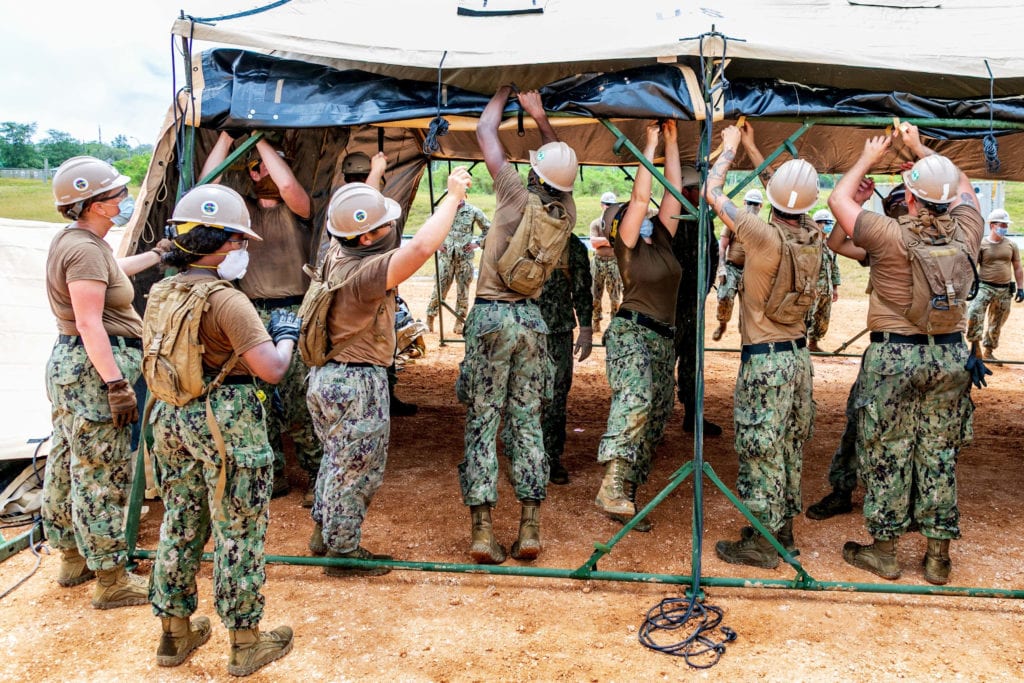
Sailors assigned to Task Force 75.5 assemble a tent during construction of a 150-bed Expeditionary Medical Facility on board Naval Base Guam. The EMF will provide expanded medical capabilities in support of DoD’s COVID-19 response and will enable forces to be postured to support Guam and the region if a Defense Support of Civil Authorities mission is requested. U.S. Navy / Chief Mass Communication Specialist Matthew R. White
NAVFAC has been building and upgrading facilities on Guam and the Marianas to host the Marine Corps forces. What progress has been made in those facilities?
KORKA: My previous flag assignment was as the commander, NAVFAC Pacific, in Hawaii, where I was dual-hatted as the U.S. Pacific Fleet engineer. We had the responsibility of overseeing all the work in Guam and throughout the Marianas Islands, and across the Pacific theater. The posturing of forces is extremely critical in this era of great power competition and the construction work underway in that region is an important element of the strategic objectives in the Pacific AO [area of operations]. We are still doing a lot of the environmental impact statements, and some training requirements are still being finalized. Work is definitely underway, and our job is to support Marine Corps needs.
In Guam, we have 103 projects valued at $6.5 billion. So far, more than 500 acres have been cleared, we have completed 14 projects, 15 are still underway, and five more are in the process of being awarded. These projects are spread across Andersen Air Force Base, Apra Harbor, Finegayan, and Marianas islands. They cover everything from aviation to sea embarkation, non-live firing training, some off-base improvements in the utility system, and roads. Today, you can now see a base called Camp Blaz that did not exist over a year ago.
Our Pacific work goes beyond the Marianas islands. We have projects that support the posture initiatives throughout the Indo-Pacific region to include Darwin, Australia, Indonesia and Palau. The bottom line is our SYSCOM is taking on this once-in-a-lifetime construction surge with urgency and flexibility. We’re on the right course and vector to continue to deliver at the speed of relevance for the Marine Corps.
How are the Seabees performing in the COVID environment?
KORKA: The Seabees that were deployed in Guam played a role in the construction of a 150-bed Expeditionary Medical Facility onboard Naval Base Guam for expanded medical capabilities in support of DoD’s COVID-19 response. Their performance personified our “can do” rally cry.
Some deployment cycles were affected in terms of extensions or delays, but in the end, our Seabee units continued the mission our Navy and Marine Corps called upon them to execute.
From a readiness standpoint, we’ve been very disciplined on adhering to the CNO’s priorities and following the established COVID protocols, which has gone a very long way to maintaining our level of readiness.
Anything else you would like to add?
KORKA: Thank you. I would like to take advantage of this question to brag a little bit about NAVFAC. As a SYSCOM, we have done a lot this year around the world. I believe that our SYSCOM has shown the responsiveness, resiliency and agility that our Navy and Marine Corps needed. It was a record-breaking year… the volume of work was about $13 billion in contracts — the prior year was only $10.9 billion, the highest since 2009 — and we did all this while facing COVID. I think that says a great deal about the talent and commitment of the people of this command.
In response to the global pandemic, we were able to assist the Army Corps of Engineers in the conversion of hotels to alternative care facilities. We supported the Corps at 14 locations in the Midwest and Mid-Atlantic [states], as well as in the Southeast and Guam.
Over the last 18 months, we have put a special focus on our technical and contracting authorities and capabilities to better enable warfighting and also support of distributed maritime operations and expeditionary advanced base operations. As an example, our warfare center in Port Hueneme, California, executed the first ever landing of the rotary-wing aircraft on a Navy lighterage system. This proved out a viable concept of refueling and re-arming in a contested environment.
Using a Perform to Plan (P2P) approach, we are employing data and analytic capabilities to inform investment priorities and focus leadership engagement … at every echelon around the globe our sights are squarely aimed on speed, agility, and costs in support of fleet readiness. We stood up an analytics office to better monitor and accelerate our performance and to improve our execution. We also stood up a real estate acquisition office to promote projects that enhance warfighting readiness and avoid costs. Overseas, our team designed and deployed two miles of port security barriers for the Navy’s Fifth Fleet within nine months of request.
While this was a big year in terms of business volume, we still have a lot of work ahead of us. However, I believe that we are on the correct vector and we are moving ahead with urgency to support the Navy and Marine Corps. It is a unique period with great power competition and I believe we are adjusting to this in the right ways. It is an honor for me to serve in this command and support the fleet and our great nation.
Leonardo DRS Awarded Navy Contract for Technical Insertion of Surface Fleet Combat Management Systems
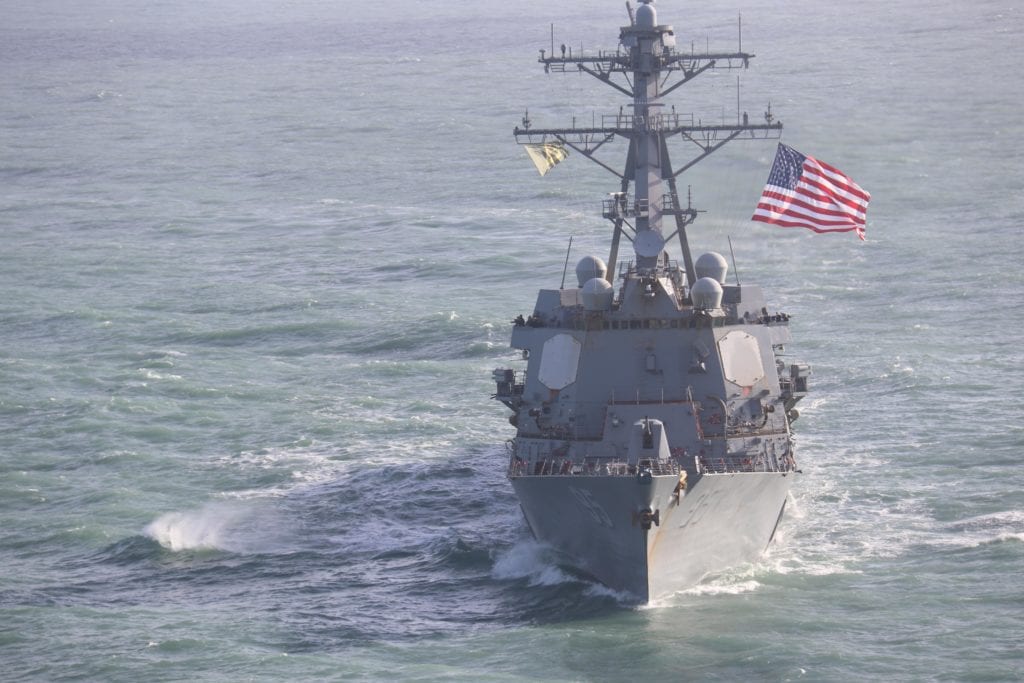
The Arleigh Burke-class guided missile destroyer USS James E. Williams (DDG 95) transits the Caribbean Sea, Jan. 16, 2021. Leonardo DRS has received a Navy contract to supply system hardware and life cycle support for Aegis and Ship Self-Defense Combat Management Systems, equipped on the Arleigh Burke class destroyers and other surface combatants. U.S. Navy / AW2 Timothy Hopkins
ARLINGTON, Va. — Leonardo DRS Inc. has received a contract from the U.S. Navy to supply critical system hardware and full life-cycle support for Aegis and Ship Self-Defense System Combat Management Systems, the company announced in a Jan. 27 release.
The cost-plus-fixed-fee and firm-fixed-price, indefinite-delivery/indefinite-quantity multiple award contract was awarded in December 2020 and is worth up to $211.5 million.
Under the contract Leonardo DRS will provide sustainment of Technical Insertion (TI)-16 Combat Systems Processing, Network, Storage and Display Hardware fielded across the surface ship fleet. Included in the contract is the sustainment, manufacture, assembly, and testing of TI-16 hardware, spares; engineering services, procurement, and installation of ordinance alteration kits and related products.
Leonardo DRS is the prime contractor for the surface navy, producing consoles, displays and peripherals (CDP) and the Common Processing System (CPS) TI-16 for the Navy’s surface combatants.
“We are excited about this award and proud to provide full life-cycle combat system hardware support to ensure fleet readiness remains high,” said Tracy Howard, senior vice president and general manager of the Leonardo DRS Naval Electronics business. “Additionally, our extensive experience will bring increased capability to the Fleet as the Integrated Combat System is fielded over the next 5 years in support of these future U.S. Navy requirements,” he said.
Work will be done at the Leonardo DRS Laurel Technologies facilities in Johnstown, Pennsylvania and Chesapeake, Virginia.
Coast Guard, Border Patrol Seize $1.9 million in Cocaine; Apprehend 2 Smugglers
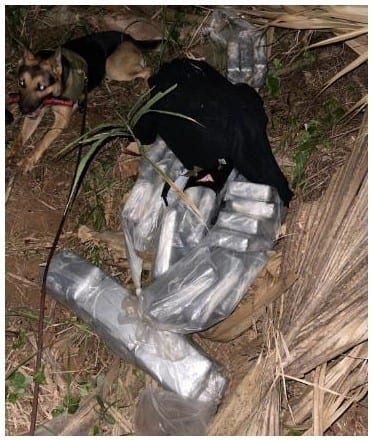
A U.S. Border Patrol K-9 rests after U.S. Ramey Sector Border Patrol agents, with the assistance of a U.S. Coast Guard HC-144 Ocean Sentry aircrew, apprehended two male Dominican Republic nationals and seized 157 pounds (71 Kilos) of cocaine with a wholesale value of $1.9 million, during a maritime drug smuggling attempt near Villa Montana in Isabela, Puerto Rico Jan. 23. U.S. Border Patrol
AGUADILLA, Puerto Rico – A Coast Guard aircrew combined efforts with U.S. Border Patrol agents during a drug smuggling event Jan. 23 that resulted in the seizure of 157 pounds (71 Kilos) of cocaine and the arrest of two suspected smugglers from the Dominican Republic near Villa Montana in Isabela, Puerto Rico, the Coast Guard 7th District said in a Jan. 27 release.
The estimated wholesale value of the seized cocaine is $1.9 million.
The joint collaboration is the result of ongoing Caribbean Border Interagency Group CBIG multiagency efforts in their common goal of securing the borders of Puerto Rico against illegal threats.
“We continue to disrupt and apprehend smugglers that attempt to smuggle people and narcotics across our borders,” said Xavier Morales, chief patrol agent for the Ramey Sector.
“Once our crew located the vessel, U.S. Border Patrol responded quickly to seize the suspects and narcotics. Our partnership is integral to protecting our shores and keeping our community safe,” said Lt. Karl Alejandre, Coast Guard Air Station Miami HC-144 Ocean Sentry aircraft commander.
While on a routine patrol Saturday night, the crew of a Coast Guard aircraft detected a suspect 21-foot go-fast vessel, approximately four nautical miles northwest of Aguadilla, Puerto Rico. Coast Guard watchstanders in Sector San Juan alerted the U.S. Border Patrol from Ramey Sector and placed the Coast Guard aircrew in direct communication with responding Border Patrol units ashore. While maintaining aerial surveillance of the vessel, the Coast Guard aircrew vectored in the Border Patrol units to the location where the suspected smugglers made landfall. Shortly thereafter, the Border Patrol agents, which included a K-9 unit, apprehended the two men and seized 58 packages of cocaine.
U.S. Immigration and Customs Enforcement — Homeland Security Investigations assumed custody the contraband and the suspected smugglers for investigation and prosecution.
U.S., Swedish Naval Leaders: Total Defense Requires a Maritime-Aware Society
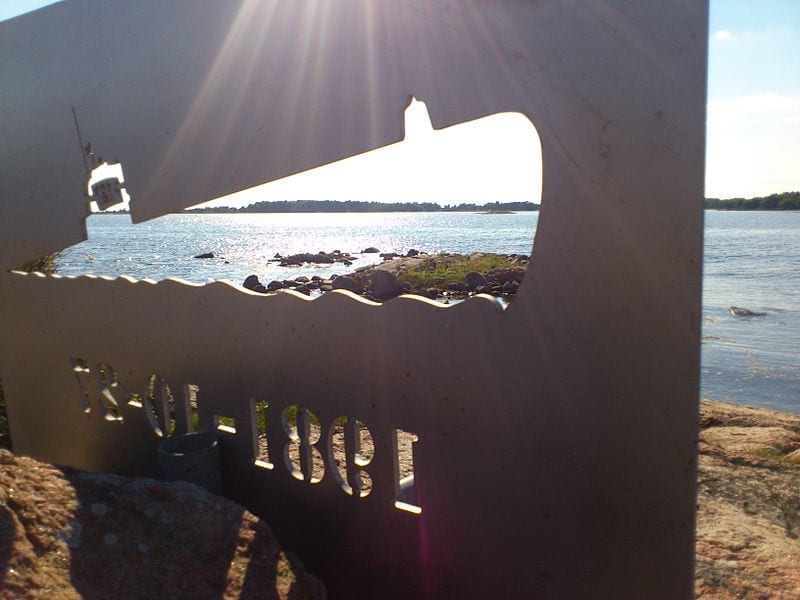
Artwork marks the spot in Sweden where a Soviet Whiskey-class submarine ran aground in 1981, and was spotted by a Swedish civilian. Wikipedia / Kallegauffin
ARLINGTON, Va. — Senior officers in the U.S. and Royal Swedish navies said that even with modern systems, maritime defense is enhanced by a maritime-aware society. Security is a function of a whole-of-society approach.
Speaking Jan. 26 in an American Enterprise Institute (AEI) webinar, U.S. Navy Vice Adm. Andrew Lewis, commander, U.S. Second Fleet, and Rear Adm. Ewa Skoog Haslum, chief, Royal Swedish Navy, discussed “gray zone” threats in the maritime domain, with emphasis on the northern European waters.
“We need to think this as a total defense task to solve, because it’s not only the military force that can provide security,” Haslum said. “In Sweden we are rebuilding the total defense. We are looking at civilian authorities together with the military and together we a rebuilding a new kind of defense that really includes the whole society, because all of the agencies need to work together.”
Haslum stressed the importance of reliable and trustworthy information flow nationally and internationally, describing that flow as key to nations working together to maintain maritime security and a free flow of commerce. She also emphasized being ready to respond to unexpected scenarios, including being cut off from digital information or being subjected to manipulated information.
The moderator, AEI Resident Fellow Elizabeth Braw, recalled the “whiskey on the rocks” incident, a surprise appearance of a Soviet navy Whiskey-class submarine that ran aground on the coast of Sweden in 1981. She noted that it was a Swedish civilian who spotted the submarine.
Lewis praised the maritime awareness of Scandinavian societies.
“We have a lot to learn, not just in our military but in our society writ large, as a seagoing nation,” Lewis said. “That’s something we can take away from our partners. That is not something quite as lost in Sweden or Norway. They are very much maritime nations.”
He cited a loss of awareness in such institutions at coastwatchers and of the loss of skill such as celestial navigation, which the U.S. Naval Academy recently restored to is curricula.
“When we lose Global Positioning [System], when we lose exquisite communications, or satellite communications — as we see in higher latitudes that’s very difficult to maintain — even when we lose line-of-sight electronic communications or digital capability, it goes back to a visual world, a world in which we need to rely upon [the] senses of our eyes and ears to do the things that we need to do.
“More and more, as the electromagnetic spectrum is infringed upon, and manipulated by nefarious actors, we have to rely upon what I would call mission orders, the way to operate tactically, operationally and strategically on intent, where you have very young operators and civilians who understand what they’re seeing and know how to report it or how to defend themselves,” he said. “That’s something we could educate our entire societies on, the existential threat to our way of life.”