Raytheon to Deliver New Submarine Communications System
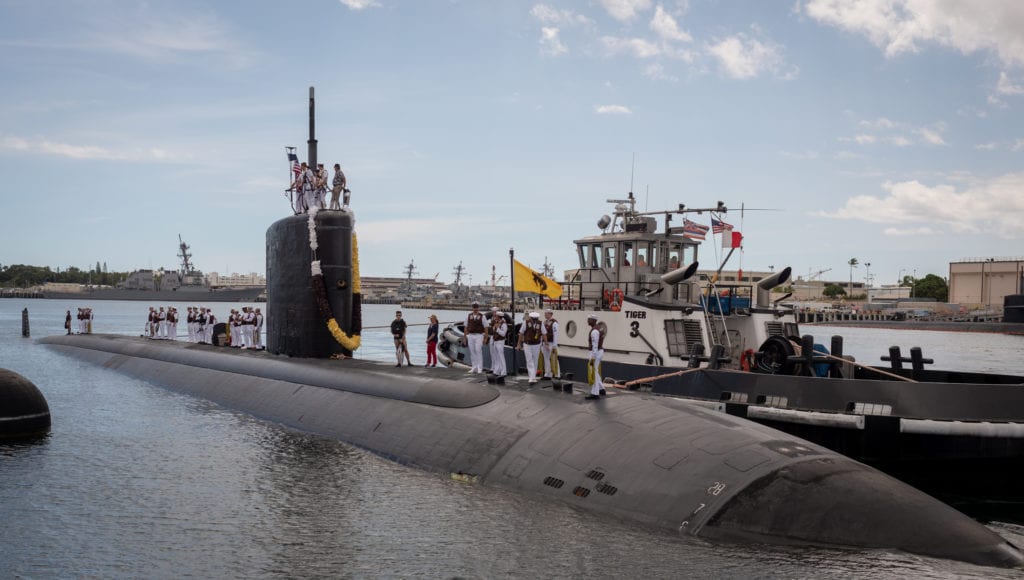
The Los Angeles-Class fast-attack submarine USS Cheyenne (SSN 773) and its crew arrive at Joint Base Pearl Harbor-Hickam, after completing their latest deployment, April 26, 2019. Raytheon Intelligence & Space has been awarded a $90 million contractor for Submarine High-Data Rate antenna systems. U.S. Navy / Mass Communication Specialist 1st Class Daniel Hinton
ARLINGTON, Va. — Raytheon Intelligence & Space, a Raytheon Technologies business, was awarded a $90 million contract by the U.S. Navy for 23 Submarine High-Data Rate antenna systems, the company said in a Jan. 11 release. Contracted in 2020, the work is expected to be completed on the new antennas by January 2024.
The SubHDR system is used to provide submarines with high-capacity communications. The system vastly improves a submarine’s mission capability and the quality of life for sailors by affording them high-data rate communications with the world outside of the sub without sacrificing the submarine’s stealth.
“Connecting people securely is essential to the success of any operation,” said Denis Donohue, vice president, Communications and Airspace Modernization Systems for Raytheon Intelligence & Space.
“The SubHDR system provides secure connectivity for submarines that supports mission-critical information delivery to the right people at the right time.”
SubHDR links submariners to the Global Broadcast Service, the Milstar satellite constellation and the Defense Satellite Communications System, via a unique mast antenna that connects them to the above-sea world.
The SubHDR System gives submarines high-data rate, multi-band SATCOM capability. Operating via military satellites, SubHDR enables underwater forces to be full participants in coordinated fleet battle group and joint task force network centric operations. The mast-mounted SATCOM system transmits secure wideband multimedia, secure and non-secure internet access, voice and data traffic, imagery and video teleconferencing.
On First Voyage, USCGC Stone Crew Interdicts Narcotics in Caribbean
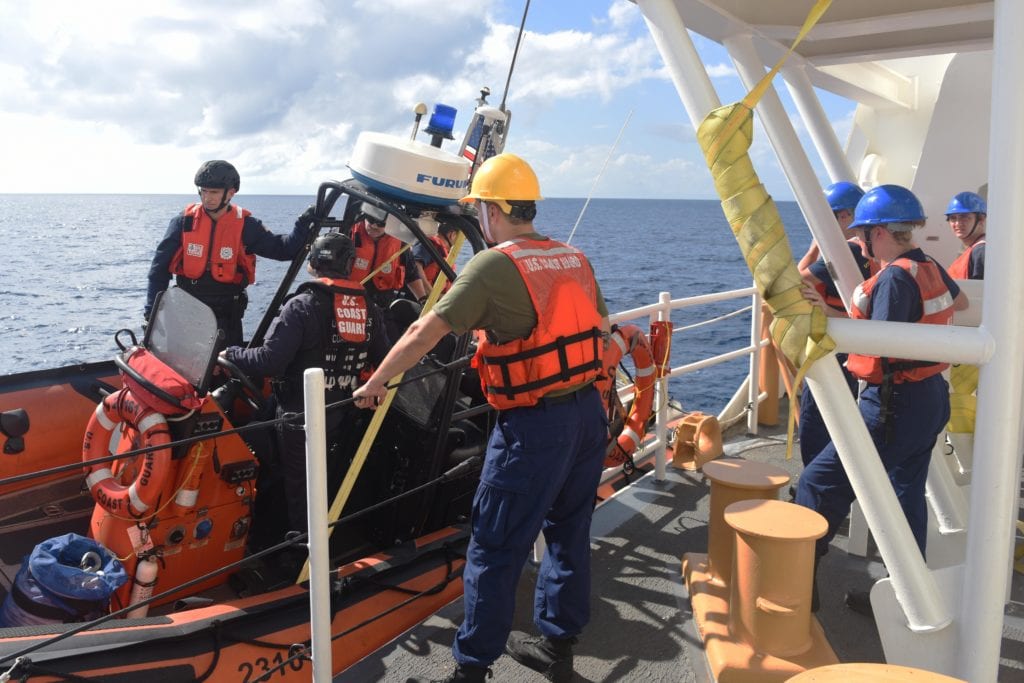
The crew on the USCGC Stone (WMSL 758) prepare to launch one of the ship’s small boats in the Caribbean Sea on Jan. 6, 2021. The Stone sent a boarding team on the boat to intercept a vessel suspected of engaging in illegal activity. U.S. Coast Guard / Petty Officer 3rd Class John Hightower
PORTSMOUTH, Va. — While in transit to conduct joint operations off the coast of Guyana as part of Operation Southern Cross, USCGC Stone (WMSL 758) encountered and interdicted a suspected narcotic trafficking vessel south of the Dominican Republic Jan. 7, the Coast Guard Atlantic Area said in a Jan. 11 release.
Having stopped the illicit activity, Stone handed off the case to the USCGC Raymond Evans (WPC 1110), a fast response cutter from Key West, Florida, and continued its patrol south.
Early on Jan. 7, acting on information from a maritime patrol aircraft, the Stone crew approached the vessel of interest and exercised U.S. Coast Guard authorities to stop their transit and interdict illicit maritime trade.
The USCGC Raymond Evans arrived on the scene shortly after. A Coast Guard boarding team from the Raymond Evans conducted a law enforcement boarding, testing packages found aboard the vessel, revealing bales of cocaine estimated at 2,148.5 pounds (970 kilograms) total.
Stone’s crew remained on scene during the search of the vessel to assist if need. Following the boarding, the Raymond Evans crew took possession of the contraband and detained the four suspected narcotics trafficking vessel members. They are working with the U.S. Coast Guard 7th District and Department of Justice on the next steps.
“I’m very proud of the crew for completing this evolution safely and making an immediate impact on our first patrol,” said Capt. Adam Morrison, commanding officer of USCGC Stone (WMSL 758). “This case illustrates that Stone is a competent partner, and our crew is ready for the front-lines. We look forward to our upcoming engagements, first with Guyana.”
Vice Adm. Steven Poulin, commander of U.S. Coast Guard Atlantic Area, said USCGC Stone “is a highly-capable multipurpose platform and ready to conduct missions to save lives, support lawful activities on the high seas, and highlight and build Coast Guard partnerships with other nations.
“I am not surprised that Stone interdicted drug smugglers – it is what the captain, crew, and every U.S. Coast Guard member is prepared to do every day underway. Stone’s crew is exhibiting the highest professional competence, reinforcing that Stone is well-suited to help our partners in the South Atlantic expose and address illicit activities in the maritime domain. These transnational criminal activities – be it illegal fishing or the trafficking of people, drugs, money, etc. – challenge global security, and only together can we combat these threats.”
“Our teammates aboard USCGC Stone are helping keep our shared neighborhood, the Western Hemisphere, safe, successfully stopping illicit narcotics smuggling, while continuing their equally important mission to counter predatory and irresponsible IUU fishing, a growing threat to our partner nations’ sovereignty and our collective regional security,” said Rear Adm. Andrew J. Tiongson, director of operations, U.S. Southern Command.
Operation Southern Cross is a multi-month deployment to the South Atlantic countering illegal, unregulated, and unreported fishing while strengthening relationships for maritime sovereignty and security throughout the region.
Environmental Changes in the Arctic Seen Having Strategic Implications for US and Partner Nations
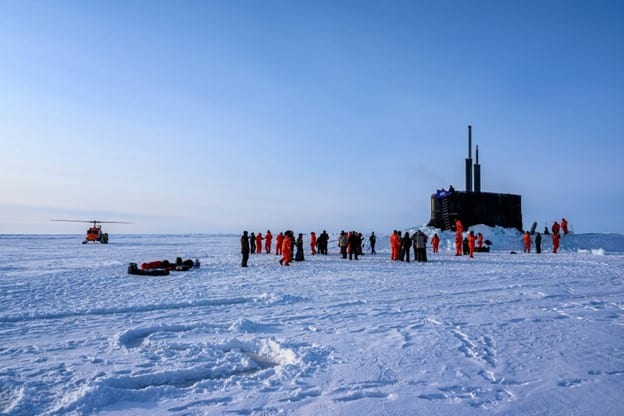
The crew of the Seawolf-class fast-attack submarine USS Connecticut (SSN 22) enjoys ice liberty after surfacing in the Arctic Circle during Ice Exercise (ICEX) 2020 in this May, 2020, photo. ICEX 2020 is a biennial submarine exercise which promotes interoperability between allies and partners to maintain operational readiness and regional stability, while improving capabilities to operate in the Arctic environment. U.S. Navy / Mass Communication Specialist 1st Class Michael B. Zingaro
A Jan. 6, 2021, report from the Congressional Research Service on changes in the Arctic says the diminishment of Arctic sea ice has led to increased human activities in the region and heightened interest in, and concerns about, the Arctic’s future.
Accessibility to the region has increased interest in tourism, mineral extraction, fishing and commerce. An open Arctic means during some times of the year, ships can cut about 40% of the time it takes to pass from Asia to Europe, cutting time and costs to ship goods. The resurgence of Russia’s military, which has a significant presence in the Russian Arctic, and especially the growing numbers and quality of Russian submarines, means the region’s strategic importance has also increased.
And, of course, the scientific community wants to understand the environmental changes and all of the implications.
“Record low extents of Arctic sea ice over the past decade have focused scientific and policy attention on links to global climate change and projected ice-free seasons in the Arctic within decades,” the CRS report says. “These changes have potential consequences for weather in the United States, access to mineral and biological resources in the Arctic, the economies and cultures of peoples in the region, and national security.”
Broadly speaking, the report states physical changes in the Arctic include warming ocean, soil, and air temperatures; melting permafrost; shifting vegetation and animal abundances; and altered characteristics of Arctic cyclones. All these changes are expected to affect traditional livelihoods and cultures in the region and survival of polar bear and other animal populations, and raise risks of pollution, food supply, safety, cultural losses, and national security. Moreover, linkages (“teleconnections”) between warming Arctic conditions and extreme events in the mid-latitude continents are increasingly evident, identified in such extreme events as the heat waves and fires in Russia in 2010; severe winters in the eastern United States and Europe in 2009/2010 and in Europe in 2011/2012; and Indian summer monsoons and droughts. Hence, changing climate in the Arctic suggests important implications both locally and across the hemisphere.
Due to observed and projected climate change, scientists have concluded the Arctic will have changed from an ice-covered environment to a recurrent ice-free ocean (in summers) as soon as the late 2030s. The character of ice cover is expected to change as well, with the ice being thinner, more fragile, and more regionally variable. The variability in recent years of both ice quantity and location could be expected to continue.
While it will still be a cold and inhospitable place, these changes will appear to be a warm welcome to increased human activity. Concerns about these concerns are shared by America’s allies, including NATO.
Great power competition
In testimony before Congress, Chief of Naval Operations Adm. Mike Gilday said the Arctic “has become an emerging area of great power competition,” and the sea services are seeking to “better understand the Navy and Marine Corps’ role in protecting the Arctic homeland, safeguarding the Arctic region’s global commons.”
With the return of great power competition, the Department of Defense and the Coast Guard (part of the Department of Homeland Security) are devoting increased attention to the Arctic in their planning and operations, the CRS report noted. “DoD as a whole, as well as the Navy and Marine Corps, the Air Force, and the Coast Guard individually, have issued Arctic strategy documents in recent years, and the Army reportedly is planning to issue one.”
The newly released Navy-Marine Corps Arctic Strategy looks at the Arctic as part of the great power competition maneuver space. “Without sustained American naval presence and partnerships in the Arctic region, peace and prosperity will be increasingly challenged by Russia and China, whose interests and values differ dramatically from ours,” it says.
Navy Secretary Kenneth Braithwaite said the Navy remains committed to protecting the Arctic environment and ensuring naval forces do their part to help preserve it. The Navy, he said, will be “operating again in a more permanent manner above the Arctic Circle.”
The CRS report points to remarks made by Secretary of State Michael Pompeo from a May 2019 Arctic Council meeting where he praised international cooperation in the Arctic, but specifically called out Russia and China for their lack of transparency and self-serving activities.
“Just because the Artic is a place of wilderness does not mean it should become a place of lawlessness,” Pompeo said.
According to the report, some observers believe the U.S.-led international order in general may be eroding or collapsing, and the nature of the international order that could emerge in its wake is uncertain, with significant implications for the Arctic.
China’s growing activities in the Arctic may also reflect a view that as a major world power, China should, like other major world powers, be active in the polar regions for conducting research and other purposes.
Asserting sovereignty in the U.S. Arctic requires presence, and maritime presence requires ships. While The Coast Guard is building new multi-mission, heavy icebreakers called Polar Security Cutters, the Coast Guard currently has few ice-capable vessels, and the Navy has none.
Navy Envisions Containerized Weapon System to Arm Amphibious Ships
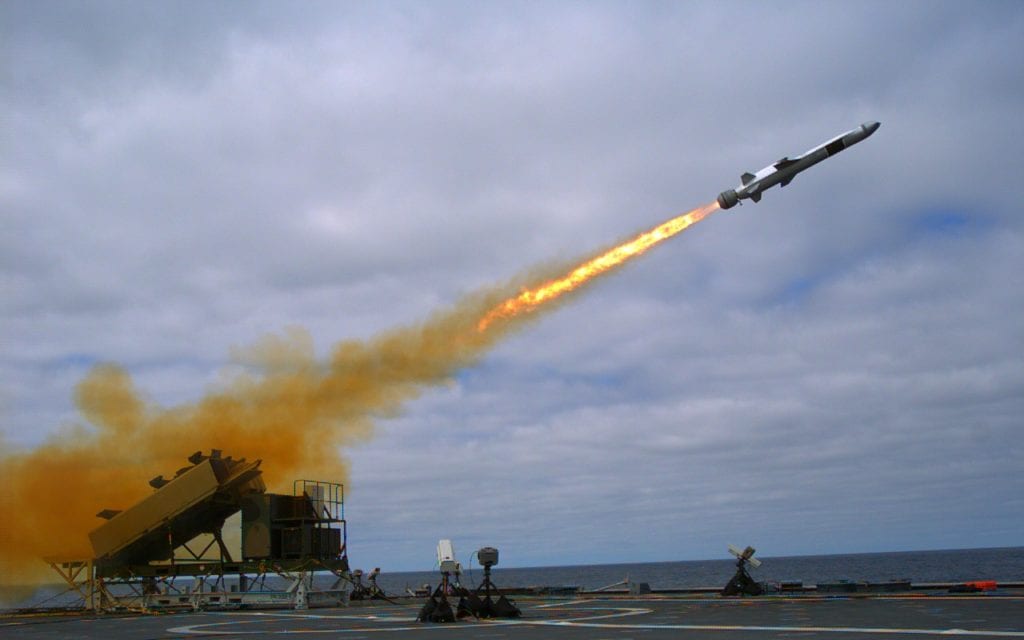
A Naval Strike Missile is launched from the littoral combat ship USS Coronado (LCS 4) during missile testing operations off the coast of Southern California in this 2014 photo. the NSM is a candidate to increase the lethality of U.S. Navy amphibious warfare ships. U.S. Navy / Mass Communication Specialist 2nd Class Zachary D. Bell
ARLINGTON, Va. — The U.S. Marine Corps general in charge of the U.S. Navy’s expeditionary warfare directorate said the Navy is looking at options to increase the lethality of its amphibious warfare ships with a containerized weapon system. A demonstration of this capability may occur after a year of development.
Speaking to reporters on Jan. 8, MGen Tracy W. King, director of expeditionary warfare in the Office of the Chief of Naval Operations, did not specify which types of missile could or would arm an amphibious warfare [L-class] ship, but a leading candidate is the RGM-184 Naval Strike Missile (NSM) — built by a Raytheon-Kongsberg partnership, being installed on littoral combat ships and the Constellation-class guided-missile frigate.
“We have these magnificent 600-foot-long, highly survivable, highly LPD 17s,” King said. “The LPDs need the ability to reach out and defend themselves and sink another ship. It’s not from the aspect of using them as a strike platform; it will drastically increase their survivability if the enemy has to honor that threat. My intent is to ensure that my desire to increase lethality of LPDs doesn’t interfere with [Director of Surface Warfare Rear Adm. Paul] Schlise’s efforts to increase lethality on LCSs.
“We’re working with Raytheon and other partners to see if they can increase production to get it [the Naval Strike Missile] out there. I suspect what you will see in the next year that we will probably test-fire a system off of an L-class ship and let the fleet play around with it, build up the doctrine on how we will use it and to confirm or deny whether it is worth the expense, which we think it is. We need the operators to confirm that.”
King said that Vice Adm. James W. Kilby, deputy chief of naval operations for warfighting requirements and capabilities, has him conducting a formal analysis and running some excursions on what the war games would tell us about lethality, and survivability and would the enemy actually honor it. He would than show empirical data to the fleet commanders.
“It’s a legitimate concern [about] putting these very rare systems on an L-class ship instead of another kind of warship,” King said. “We’re going to do it cautiously. My prediction is that we will have one within the next 12 months. We will let the fleet play around with it probably a year or so and then decide how we’re going to field it.”
King said a likely solution is a containerized weapon system that the Marine Corps will be using.
“When we jump on aboard a ship, that [weapon system] becomes available to the ship’s captain,” he said. “So maybe we don’t need to install launchers and NSMs. Maybe the Marine Corps EABO [Expeditionary Advance Base Operations] forces serve as the main battery when we are moving out. To me that just makes sense. We give the latitude and flexibility to the ship’s captain to use those assets when he needs to.”
King acknowledged the concern of some in the Marine Corps that the missiles could be expended in combat at sea before the Marines reach their destination.
“I am a little bit dismissive of that complaint because the ship’s got to get there first,” he said. “So, I think you’re going to see us deploying containerized weapon systems that we can use wherever we want to use them.”
CAE USA Awarded Navy Contract to Provide T-44C Aircrew Training Services
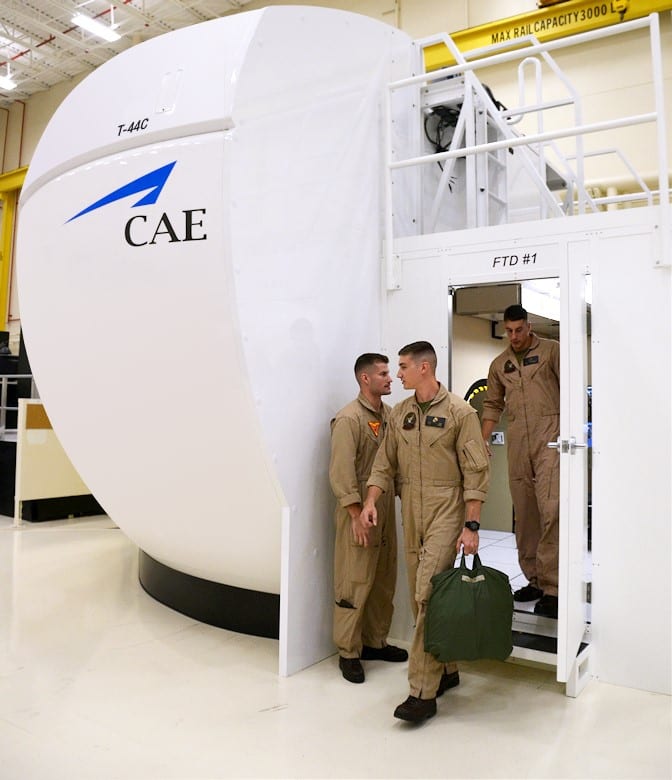
CAE USA will continue providing T-44C aircrew training to the U.S. Navy at NAS Corpus Christi, Texas. CAE USA
TAMPA, Fla. — CAE USA has been awarded a U.S. Navy contract to continue providing comprehensive T-44C Pegasus aircrew training services at Naval Air Station (NAS) Corpus Christi in Texas, the company said in Jan. 7 release.
Awarded as a base one-year contract with additional one-year options through mid-2027, the contract is valued at more than $70 million. CAE USA provides T-44C aircrew training services to the Chief of Naval Air Training (CNATRA) under a contractor-owned, contractor-operated training program. The T-44C is the Navy’s variant of the King Air aircraft used for intermediate and advanced multi-engine pilot training.
“We started delivering T-44C aircrew training to the Navy in 2013 and are honored the Navy has selected CAE USA to continue providing the essential training services for CNATRA’s multi-engine training pipeline,” said Ray Duquette, president and general manager, CAE USA.
CAE USA provides qualified instructors who deliver all the required T-44C classroom and simulator training at NAS Corpus Christi. CAE owns, operates and maintains a suite of T-44C training devices that are used extensively as part of the T-44C training syllabus. CAE is also introducing new virtual reality trainers based on the Microsoft HoloLens that will be used for T-44C familiarization and procedural training tasks. This will enable more student throughput by freeing the T-44C training devices and aircraft for more advanced training. In total, more than 400 U.S. Navy, Marine Corps, and international students train annually on the T-44C at NAS Corpus Christi.
“The Navy T-44C aircrew training program is a great example of how CAE partners with our military customers to introduce digital innovations such as virtual reality technologies that help contribute to more efficient and effective training,” said Dan Gelston, group president, Defense & Security, CAE.
The T-44C aircrew training program falls under the responsibility of CNATRA, which oversees the Naval Air Training Command and the training of all naval aviators and naval flight officers.
Halter Marine Upgrades Launch Way in preparation for Polar Security Cutter
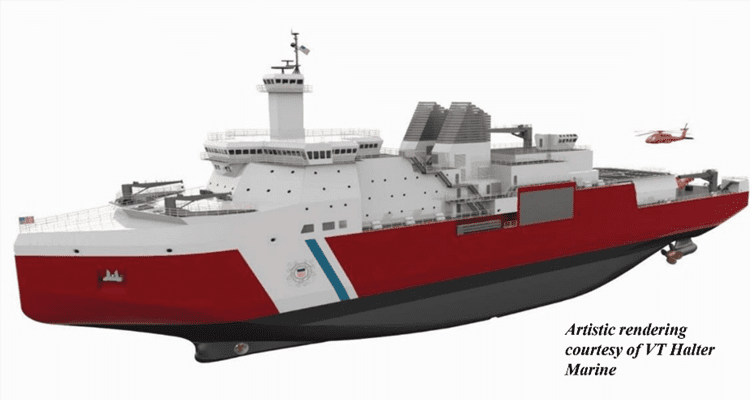
A rendering of the U.S. Coast Guard’s forthcoming Polar Security Cutter. U.S. Coast Guard
PASCAGOULA, Miss. — The U.S Coast Guard’s Polar Security Cutter (PSC) is rapidly progressing through the detailed design phase, and Halter Marine is actively preparing for its construction, the company said in a Jan. 6 release.
In July 2021, Halter Marine will complete upgrades to the launch way area where the PSC will be constructed. The 460-foot icebreaker is the heaviest vessel per foot of length that Halter Marine has constructed at its Pascagoula, Mississippi, shipyard. The launch way has been fortified to accommodate the PSC’s 19,000-ton launch weight.
The Crowley Taino and El Coqui were the heaviest vessels previously to launch from the company’s dock. These two vessels are 720 feet in length, providing a greater distance to leverage their weight.
“Based on weight per foot, the PSC outweighs those vessels,” said Bob Merchent, president and CEO of Halter Marine. “The PSC needs 22 tons of capacity per linear foot of rail line, and we have designed the new launch way to accommodate 27 tons per linear foot. We are preparing for our newest vessel while also looking forward to future, larger vessels.”
The upgrade project began in July by removing 11 launch way rail lines. Next, crews dug 1,283 holes that were filled with grout and concrete to serve as new piles. These piles will transfer the PSC’s heavy load to a deeper level than previously possible.
“Each drilled hole is 110 feet long, and we are pouring 27 miles of piles,” said Kevin Amis, executive vice president of operations for Halter Marine. “We are completing this project with a perfect safety record. I’m proud of the women and men at Halter Marine and Malouf Construction for accomplishing this invaluable project with a true focus on safety.”
The launch way upgrade project is funded with a generous grant from the Mississippi Development Authority (MDA).
“We appreciate the continued support of the MDA along with our federal, state and local officials,” Merchent said. “We are thankful for that, and we are all proud to support the men and women of the U.S. Coast Guard by providing them with better capabilities to operate in the Arctic.”
France to Procure E-2D Advanced Hawkeye Aircraft from U.S. Navy
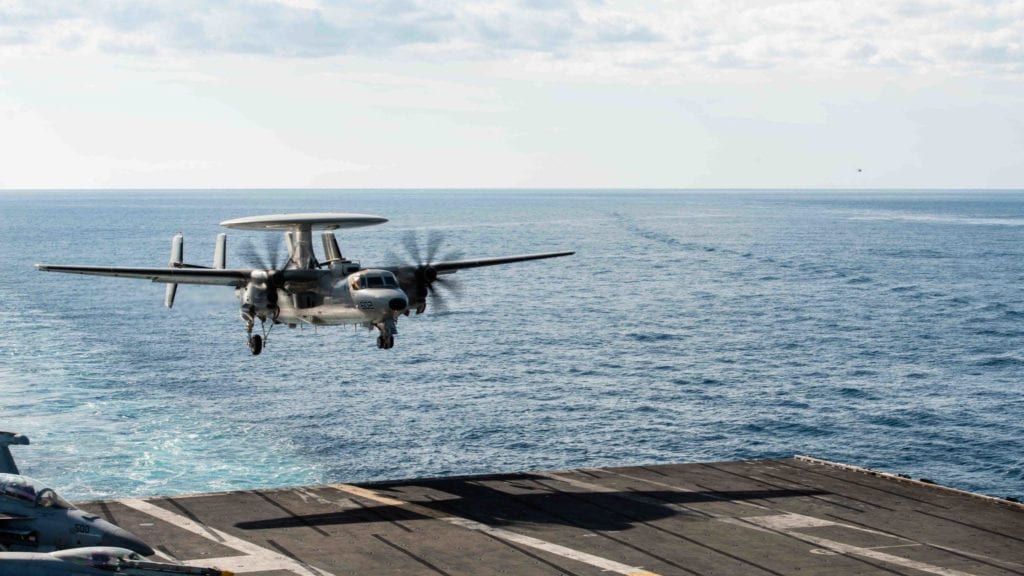
In December, France signed a Letter of Offer and Acceptance to procure three E-2D Advanced Hawkeye aircraft from the U.S. Navy like the one pictured in this October, 2020 photo. U.S. Navy
PATUXENT RIVER, Md.—France became the second international customer of the E-2D Advanced Hawkeye (AHE), Dec. 2, with a signed Letter of Offer and Acceptance to procure three E-2D aircraft from the U.S. Navy, for a maximum value of $2 billion, Naval Air Systems Command said in a Jan. 5 release.
“The E-2/C-2 program office is looking forward to continuing a longstanding partnership with France and beginning a new chapter with the E-2D,” said Capt. Pete Arrobio, program manager of the E-2/C-2 Airborne Command & Control Systems Program Office (PMA-231). “This procurement will increase interoperability among the U.S. Fleet and international partners.”
The three E-2Ds are scheduled to be delivered by 2028 and will replace the three existing E-2C Hawkeyes of the French navy, Marine Nationale.
The E-2D AHE, produced by Northrop Grumman, represents a two-generation leap in technology compared to its predecessor, the E-2C Hawkeye. The aircraft features a state-of-the-art radar and upgraded aircraft systems that improve supportability and increase readiness. The centerpiece of the E-2D AHE is the APY-9 radar system, designed specifically to provide enhanced surveillance detection and tracking capability against advanced threat aircraft and cruise missile systems in the overland, littoral, and open ocean environments. With the addition of aerial refueling capabilities, the E-2D remains the most advanced command and control platform in the world.
The French navy becomes the second international customer of the E-2D Advanced Hawkeye. The Japan Air Self Defense Force has purchased 13 E-2D aircraft to date.
Marine Corps Presidential Helicopter Testbed Retired
Glenn Perryman, deputy program executive officer for Air Anti-Submarine Warfare, Assault, and Special Mission Programs, stands in front of Sikorsky NVH-3A Sea King BuNo 150614, which his father flew as commanding officer of Marine Helicopter Squadron (HMX) 1. The helicopter subsequently served Air Test and Evaluation Squadron (HX) 21 as a testbed for 32 years before making its last flight in October 2020. NAVAIR
PATUXENT RIVER, Md. — After a 32-year career supporting the development of new technologies for the fleet, a historic Sikorsky NVH-3A Sea King helicopter assigned to Air Test and Evaluation Squadron (HX) 21 at Naval Air Station Patuxent River has flown its last mission — and a program executive with a special tie to the aircraft is hoping it will soon find a new permanent home where its story can be shared, the Naval Air Warfare Center Aircraft Division said in a Jan. 6 release.
The dark-green Sea King, known universally as “614” — in reference to its military serial number, 150614 — rolled off the Sikorsky Aircraft assembly line in 1962 as a Sikorsky HSS-2 (later redesignated SH-3A). A decade later, the aircraft was assigned to Marine Helicopter Squadron (HMX) 1, where it was redesignated VH-3A and served for four years as a presidential helicopter for Presidents Richard Nixon and Gerald Ford. After a brief stint with Helicopter Combat Support Squadron (HC) 6, the Marine Corps transferred 614 to the Military Aircraft Storage and Disposition Center at Davis-Monthan Air Force Base in Arizona. There it rested for seven years, after accumulating a mere 4,500 hours of flight time.
Then, in 1984, the aircraft was pulled out of storage and underwent depot maintenance, and in 1988 arrived at the then-Naval Air Test Center (NATC) at NAS Patuxent River. Given the one-of-a-kind designation NVH-3A, 614 spent the next 25 years as a testbed for innovations in sensors, avionics, radios, computer hardware and software, composite rotor blades, and more. It even hosted the Navy’s first successful demonstration of satellite Wi-Fi in a rotary wing aircraft.
After 614 was stripped to its metal bones in 2013 for a cockpit modernization project that was canceled before the aircraft could be refitted, HX-21’s Presidential Helicopter Maintenance Team and flight test team undertook an unprecedented effort to return the aircraft to service as a VH-3D testbed. They installed a new power plant, drivetrain, rotors, and landing gear, as well as new electrical, avionics and fuel systems, and machined more than 200 custom parts. On April 4, 2017, the fully rebuilt aircraft took to the air once again.
For three more years, 614 flew in support of a wide range of innovative test programs at NAS Patuxent River, including secure wide-band line-of-sight communications technologies, night vision equipment for the executive transport mission, high-speed rotor and engine shaft track and balance functions, and test flight exercises with U.S. Naval Test Pilot School students. But on Oct. 22, 2020, 614 made its final flight and the aircraft now rests inside one of HX-21’s hangars, awaiting the next chapter in its storied life.
While 614 is well-loved by the men and women of HX-21, the aircraft has a uniquely special meaning to Glenn Perryman, deputy program executive officer for Air Anti-Submarine Warfare, Assault, and Special Mission Programs (PEO(A)). From 1971 to 1974, Perryman’s father, Col. James Perryman Jr., served as commanding officer of HMX-1, and flew 614. In fact, Col. Perryman flew President Nixon twice on 614.
The elder Perryman served two combat tours in Vietnam before joining HMX-1 — and 614 was the first VH-3A he flew at his new squadron. (“How cool is that?” the younger Perryman remarked.) By the time he completed his squadron commander tour, Col. Perryman had made 48 flights in 614 totaling just over 66 hours’ flying time. Col. Perryman passed away on New Year’s Eve 2013, at the age of 80 — the same year that the younger Perryman joined PEO(A) as its deputy program executive officer.
Bringing his family history full circle, Perryman had an opportunity to fly in 614 in January 2018, not long after the newly refurbished aircraft had been returned to service with HX-21. Vice Adm. Dean Peters, commander of Naval Air Systems Command, was also on board for that flight, Perryman recalls.
“It was phenomenal,” Perryman said. “To have the opportunity to fly in the same helicopter that my father flew almost 50 years ago, to sit in the same cockpit where he sat, is something that I’ll never forget, quite frankly. Not everyone gets that kind of opportunity.”
Perryman said his father’s time at HMX-1 was the source of many childhood memories for him. “The squadron dominated our lives, as you can imagine,” he said. “Wherever the president went, my dad would have to go. My brother and I thought it was the neatest thing in the world that our dad flew the president.”
It was this combination of the aircraft’s unique history and his personal connection to it that spurred Perryman to action when he heard HX-21 planned to retire the aircraft. “It’s a piece of history,” he said. “It has served unique missions in its lifetime — presidential helicopter, developmental test aircraft for many new technologies. Not every aircraft has this kind of history attached to it.”
Perryman believes 614 hasn’t used up all of its nine lives yet.
“It’s in superb mechanical condition right now, and if it can be preserved in some way, it will last even longer,” Perryman said. “I’m doing everything I can to facilitate that. I would be happy to donate my father’s log books to go along with the aircraft. I have some Nixon memorabilia, too. Wherever it ends up, I hope that it will be preserved.”
“I cannot think of a more symbolic representation of what we do at the Presidential Helicopters Program than aircraft 614,” stated Col. Eric Ropella, program manager of the Presidential Helicopters Program (PMA-274). “This aircraft gives a full, rich history as both a no-fail mission aircraft that flew Presidents Nixon and Ford, and as a test bed for delivering the newest capabilities to the presidential fleet. It seems only fitting that we try and find a place of honor for 614 and its 32 years of service here in front of the Presidential Helicopters Support Facility as a static memorial and display.”
Navy Contracts SAFE Boats for Work on Mk VI Patrol Boats for Ukraine
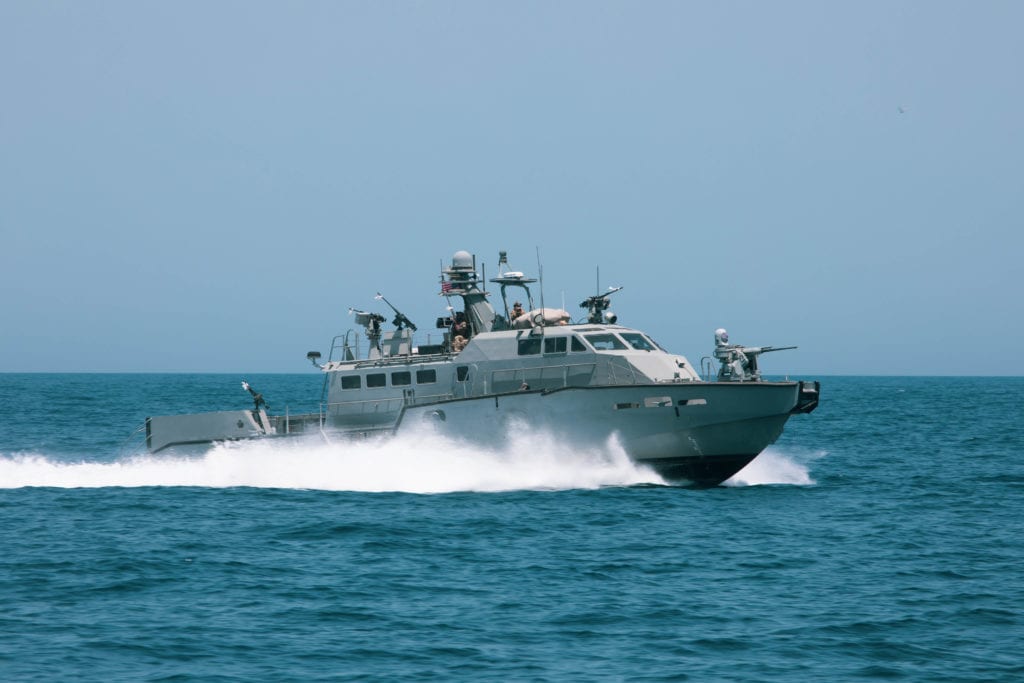
A Mark VI patrol boat participates in the bilateral Mine Countermeasures Exercise 2020 (MCMEX 20) with the mine countermeasures ship USS Gladiator (MCM 11) in the Arabian Gulf, March 28. U.S. Army / Pfc. Christopher Cameron
ARLINGTON, Va. — The U.S. Navy has awarded a contract to a Bremerton, Washington-based boat builder to begin work on Mark VI patrol boats for Ukraine.
The Naval Sea Systems on Dec. 31 awarded SAFE Boats International LLC a “$19,969,119 not-to-exceed, firm-fixed-price, un-definitized contract action for long-lead-time material and associated pre-production and planning support for two Mk VI patrol boats to be delivered to the government of Ukraine,” the Defense Department said in a Jan. 5 contract announcement. The funding is allocated under the Fiscal 2020 Title 10 Ukraine Security Assistance Initiative.
The U.S. State Department approved the possible foreign military sale of up to 16 Mk VI patrol boats and related equipment to Ukraine for an estimated cost of $600 million, the Defense Security Cooperation Agency said in a June 17 release.
The patrol boats will be operated by the Ukrainian navy to defend territorial waters and other maritime interests. They each will be armed with two MSI Seahawk A2 gun systems and two Mk44 cannons and equipped with electro-optical/infrared sensors and loud-speaker systems.
The sale will “improve Ukraine’s capability to meet current and future threats by providing a modern, fast, short-range vessel,” the DSCA said.
Mk VI patrol boats are used by the Navy Expeditionary Combat Command for escort of high-value ships, coastal patrol, and other maritime security missions.
Work on the contract is expected to be completed by December 2022.
Strategic Command Admiral Praises Navy’s Choice of C-130J for TACAMO Mission
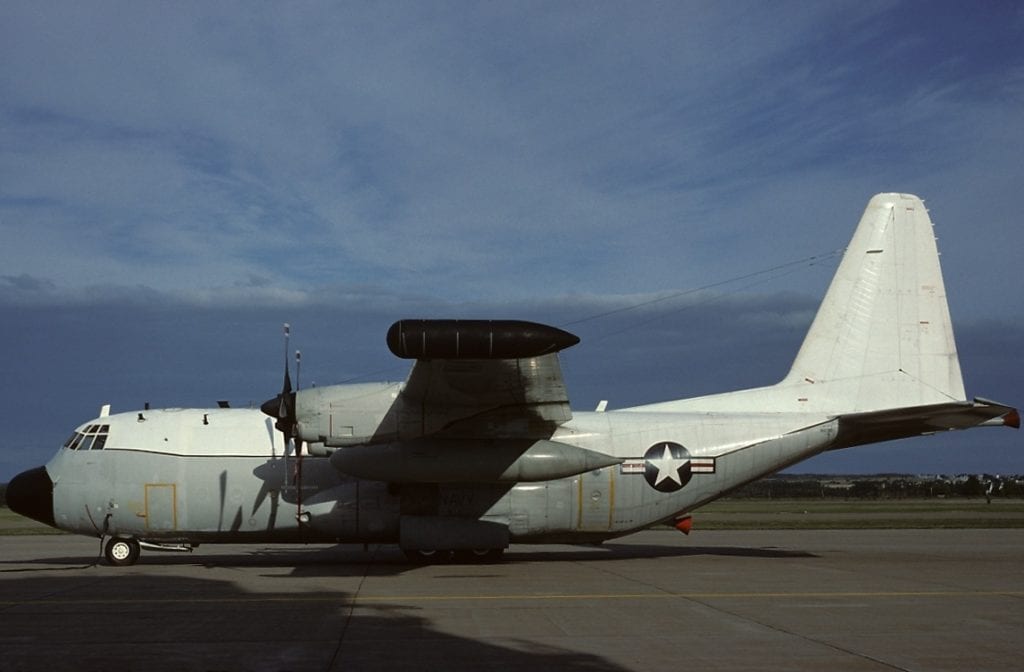
A Lockheed EC-130Q Hercules, which previously handled the Navy’s TACAMO work. The Navy has now decided to acquire the C-130J-30 Super Hercules as its platform for communicating with deployed ballistic-missile submarines. Wikipedia / Alain Rioux
ARLINGTON, Va. — The admiral in charge of the nation’s strategic nuclear deterrent forces has praised the Navy’s decision to acquire the C-130J-30 Super Hercules aircraft as a platform for communicating with its deployed ballistic-missile submarine force. Four decades ago, the Navy was using earlier C-130 versions — built by Lockheed — for the same mission.
“The Navy is fully capable of supporting my mission requirements to ensure survivable communications to the ballistic-missile submarines and I think they’re making a great decision to go to the C-130,” said Adm. Charles Richard, commander, U.S. Strategic Command, speaking in a Jan. 5 webinar to the Defense Writers Group, in response to a reporter’s question.
The communications role is called TACAMO by the Navy — a term meaning “Take Charge and Move Out” — has been performed for three decades by the service’s Boeing E-6 Mercury aircraft, a variant of the Boeing 707 airliner. After the Cold War, the Airborne National Command Post role previously performed by Air Force EC-135 “Looking Glass” aircraft was incorporated into the E-6 with the installation of the Airborne Launch Control System (ALCS), combining the TACAMO and ALCS in one platform.
The Navy has performed the TACMO mission since 1963, beginning with four C-130G (later EC-130G) Hercules aircraft, later augmented by eight newer EC-130Q Hercules. The E-6 replaced the EC-130s, giving the two TACAMO squadrons, VQ-3 and VQ-4, a faster, quieter, more comfortable platform for the long missions.
The TACAMO aircraft are equipped with a long trailing wire antenna used to relay very-low-frequency radio messages to submerged ballistic-missile submarines. The airframes go through considerable stress as they maintain high angle of bank for long periods to maintain tight orbits to wind the trailing-wire antenna into a vertical position, needed for the radio waves to penetrate the water most effectively.
The Request for Information issued on Dec. 18 by the Naval Air Systems Command’s TACAMO Program Office (PMA-271) announced that the Navy “intends to negotiate and award sole-source contracts to Lockheed Martin Corporation, Marietta, [Georgia], for the efforts associated with the procurement of up to three C-130J-30 “Stretch” green airframes in [fiscal 2022/2023] for testing and analysis.
The C-130J is the current, much more modern version of the C-130 and is flown by the Air Force, Marine Corps and Coast Guard, as well as many foreign air forces. The C-130J-30 is similar but has a 15-foot-longer fuselage. The rugged C-130J is able to operate from many more airfields than the current E-6B Mercury.
“Lockheed Martin Corporation is the sole designer, developer, and manufacturer of the C-130J-30 and is the only source capable of producing the C-130J and derivative aircraft and providing support equipment, logistics support, defensive systems services, and engineering services,” the Navy’s announcement said. “The Analysis of Alternatives results indicated that the four-engine, militarized C-130J-30 is optimally configured aircraft for performing the TACAMO mission. The characteristics of this airframe also maximize the operational deployability of the assets to austere environments. The C-130 is currently extensively fielded within the Department of Defense, and deployed at various bases that create operation, training and logistics support synergies for TACAMO execution. Lockheed Martin already has an established domestic production line that has the ability to produce test units for PMA271 that will enable acceleration of the risk reduction and subsequent engineering and manufacturing development test program.”