U.S. Coast Guard Responds to Russian Military Vessel off Honolulu
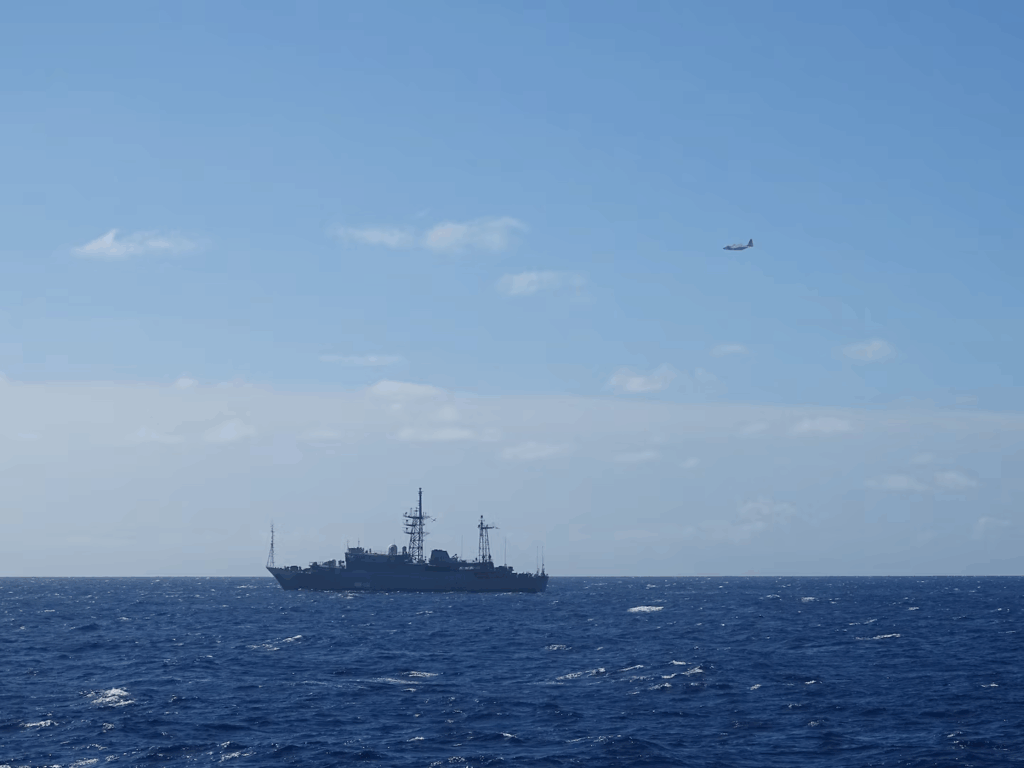
A Coast Guard HC-130 Hercules airplane crew from Air Station Barbers Point monitors a Russian military vessel approximately 15 nautical miles south of Oahu Oct. 29, 2025. Coast Guard personnel are monitoring the vessel’s activities near U.S. territorial waters, which extend to 12 miles offshore. (U.S. Coast Guard photo, courtesy Cutter William Hart)
Coast Guard Oceania District External Affairs, Nov. 13, 2025
HONOLULU — The U.S. Coast Guard detected and monitored a Russian military vessel operating near U.S. territorial waters approximately 15 nautical miles south of Oahu on Oct. 29.
A Coast Guard HC-130 Hercules from Air Station Barbers Point and the Coast Guard Cutter William Hart (WPC 1134) responded to the Russian Federation Navy Auxiliary General Intelligence ship Kareliya, a Vishnya-class intelligence ship, by conducting a safe and professional overflight and transiting near the vessel.
Acting in accordance with international law, Coast Guard personnel are monitoring the Russian vessel’s activities near U.S. territorial waters to provide maritime security for U.S. vessels operating in the area and to support U.S. homeland defense efforts.
“The U.S. Coast Guard routinely monitors maritime activity around the Hawaiian Islands and throughout the Pacific to ensure the safety and security of U.S. waters,” said Capt. Matthew Chong, chief of response, Coast Guard Oceania District. “Working in concert with partners and allies, our crews monitor and respond to foreign military vessel activity near our territorial waters to protect our maritime borders and defend our sovereign interests.”
Coast Guard Oceania District works in conjunction with U.S. Indo-Pacific Command and interagency partners to constantly monitor the activity of foreign military vessels operating near U.S. territorial waters, including the waters of U.S. territories Guam and American Samoa, to ensure homeland security and defense.
Under customary international law, foreign military vessels are permitted to transit and operate outside other nations’ territorial seas, which extend up to 12 nautical miles from shore.
General Dynamics NASSCO Awarded $1.7B to Construct T-AO 215 and T-AO 216
NASSCO currently under contract to build 17 of the Navy’s 20-ship program of record, and has delivered four to date.
From NASSCO
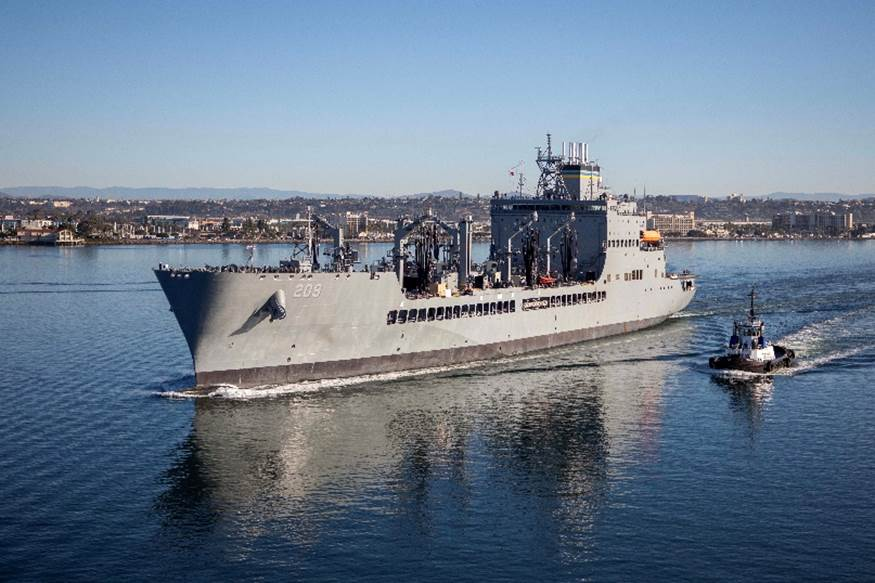
SAN DIEGO, November 10, 2025 – General Dynamics NASSCO, a business unit of General Dynamics (NYSE:GD), announced today that it has been awarded $1.7 billion for the construction of T-AO 215 and T-AO 216. The ships are part of NASSCO’s current multi-ship contract from the U.S. Navy for the construction of up to eight additional John Lewis-class fleet replenishment oilers (T-AO 214 through 221).
“The T-AO program holds significant importance to the men and women of NASSCO and is one we take great pride in – it’s the longest running Navy production series in NASSCO history,” said Dave Carver, president of General Dynamics NASSCO. “The timely funding for these two ships will act to stabilize the workforce by sustaining an important backlog and prevent future layoffs. Our entire NASSCO team is honored to continue to support the critical national security mission of the U.S. Navy.”
In 2016, the Navy awarded NASSCO with a contract to design and build the first six ships in the next generation of fleet oilers, the John Lewis-class. In 2022, that contract was modified to add an additional three oilers (T-AO 211 – 213). In 2024 NASSCO received an additional eight-ship contract to build T-AOs 10-17.
Designed to transfer fuel to U.S. Navy ships operating at sea, the 742-feet vessels have a full load displacement of 49,850 tons, capacity to carry 162,000 barrels of oil and significant amounts of dry cargo, as well as providing aviation capability while traveling at speeds up to 20 knots.
The first four ships of the program have been delivered to the U.S. Navy, with five additional T-AOs currently under construction in the NASSCO shipyard.
SeeByte, BlueZone Group Ally to Strengthen Australian Naval Capabilities
From Seebyte, Nov. 11, 2025
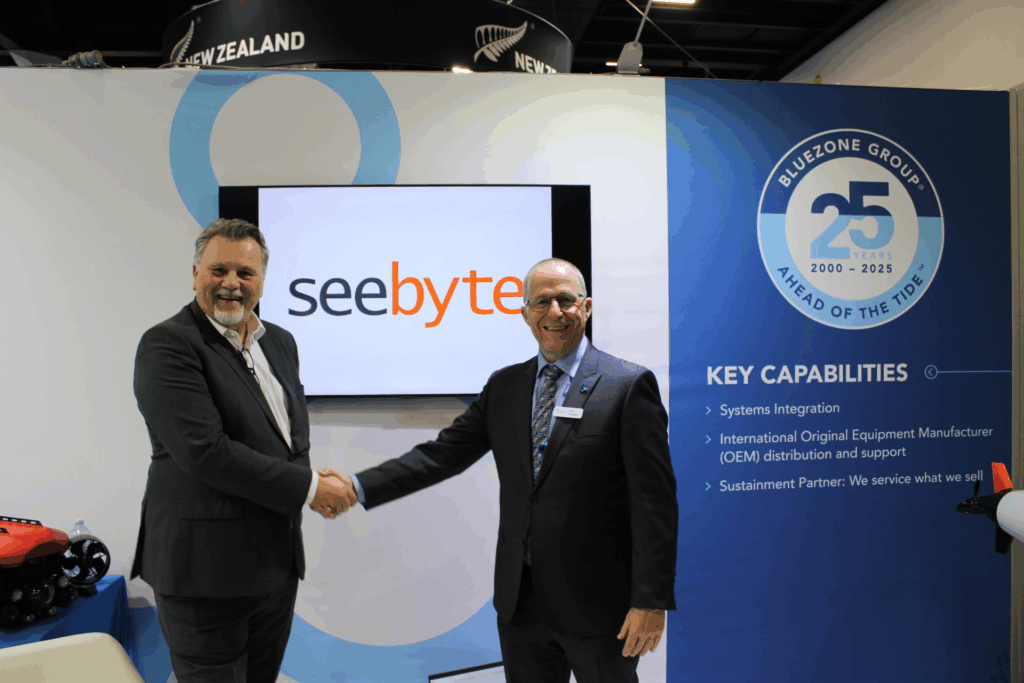
SeeByte, a UK-based leader in advanced maritime defence and uncrewed systems technology, is proud to announce the signing of a representative agreement with BlueZone Group, a trusted Australian defence solutions provider. This partnership is a pivotal step in enhancing the Royal Australian Navy’s operational edge through cutting-edge autonomous maritime technologies.
By appointing BlueZone Group as its official representative in Australia, SeeByte is reinforcing its commitment to supporting the Royal Australian Navy’s focus on future force readiness, autonomous systems integration, and maintaining strategic advantage in the maritime domain.
Under this agreement, BlueZone Group will represent SeeByte in Australia, acting as its exclusive local representative across government, defence, and industry engagements. This includes supporting business development, strategic partnerships, and programme delivery in the maritime domain, with a focus on autonomous platforms, mission systems, C2 integration, and ISR capabilities.
“As we expand our operational footprint in the Indo-Pacific, we are pleased to formalise this partnership with BlueZone Group” said Robert Johnson, Chief Commercial Officer at SeeByte. “Australia is a pivotal strategic region for SeeByte, and this collaboration helps empower them with cutting-edge technology, strengthening sovereign capability, and advancing combat readiness.”
“We look forward to representing SeeByte and supporting their integration into the Australian defence ecosystem. Their cutting-edge technology and operational experience will add significant value to Australia’s future capability landscape”, said Neil Hodges, Managing Director at BlueZone Group.
The agreement enhances SeeByte’s ability to engage directly with the Australian Defence Force (ADF) and key stakeholders supporting AUKUS Pillar II initiatives.
RTX’s Raytheon, Avio Sign MoU for New Solid Rocket Motor Facility in U.S.
Facility will be instrumental in meeting growing demand
From RTX
ARLINGTON, Va. (November 10, 2025) — Raytheon, an RTX (NYSE: RTX) business, has signed a Memorandum of Understanding to help Avio establish a state-of-the-art solid rocket motor (SRM) facility in the United States, serving Raytheon and other customers as a vertically integrated merchant supplier. Raytheon will have preferred access to a share of the Avio plant production capacity to meet future demand.
This strategic partnership marks another significant milestone in the collaboration between the two companies, building on a contract signed in July 2024 for preliminary engineering work on the Mk 104 rocket motor and a recent purchase order to fund through Critical Design Review and procurement of long lead material for qualification.
“This agreement will help establish an additional supplier of solid rocket motors within the U.S. and demonstrates our commitment to meeting the increasing demands of our customers,” said Bob Butz, vice president of Operations, Supply Chain and Quality at Raytheon. “By leveraging Avio’s experience and unique capabilities in solid rocket motor propulsion development and manufacturing, we’re strengthening our capacity for critical weapon systems.”
The new Avio facility will be instrumental in meeting the growing demand for advanced SRMs and will contribute to the continued success of both companies in delivering high-quality defense products. Avio and Raytheon are committed to working together to ensure the successful implementation of this initiative and to support the defense needs of the United States and its allies.
“We are proud to be partnered with Raytheon for their future production capacity needs at our new factory facility. We look forward to leveraging the incredible pedigree and experience of our parent company Avio S.p.A. as we build our factory and establish in the U.S. as a true vertically integrated merchant supplier,” said VADM Ret. Jim Syring, CEO of Avio USA.
Houthi Militia Ceasing Attacks in Red Sea Would Have Seismic Impact on Container Shipping
From Xeneta
OSLO – Norway, 11 November 2026 – Houthi militia have reportedly ceased attacks on Israel and shipping in the Red Sea (source: AP) – the impact would be seismic for global ocean container shipping, but an immediate largescale return to the region will require a series of further assurances, analysts warn.
Peter Sand, Chief Analyst at Xeneta – the ocean and air freight intelligence platform – said: “Details are sketchy and you cannot base the safety of crews, ships and cargo on the word of Houthi militia. Carriers need far more assurance than that and, perhaps more importantly, so do insurance companies.
“Different carriers have different tolerances to risk and we have seen some intermittently testing the water, with the CMA CGM Zheng He and CMA CGM Benjamin Franklin making voyages through the region in November, but generally the number of container ships transiting the Suez Canal has been trending downwards during 2025.
“Transits may start to increase if there is a perceived lower risk, but we are unlikely to see an imminent return to 2023 levels.”
Longer sailing distances around the Cape of Good Hope in Africa due to the threat of Houthi attacks in the Red Sea region is currently absorbing around 2 million TEU (20ft equivalent container units) of global container shipping capacity and increasing the transport demands on the fleet.
A largescale return to the Red Sea would therefore reduce the transport work required of the fleet and potentially cause freight rates to plummet – unless carriers take drastic measures, such as idling, demolition, slow-steaming and widespread blank sailings.
Sand said: “Average spot rates from Far East to North Europe, Mediterranean and US East Coast – three trades that would ordinarily transit the Red Sea – are all down more than 50% since the start of year. A largescale return of container ships to the Red Sea would flood the market with capacity and cause freight rates to plunge even lower across trades at a global level, not just those directly impacted by the diversions.
“Carriers are already heading into loss-making territory and freight rates are expected to fall up to -25% globally in 2026, even with no change to the situation in the Red Sea.
“Shippers should be making contingency plans because a largescale return would cause severe disruption across global ocean supply chains as services transiting Suez Canal are reinstated.
“There are still many questions to be answered, but the impact of a largescale return would be seismic for shippers and carriers.”
USCGC Frederick Hatch Returns to Guam Following Drydock in Honolulu
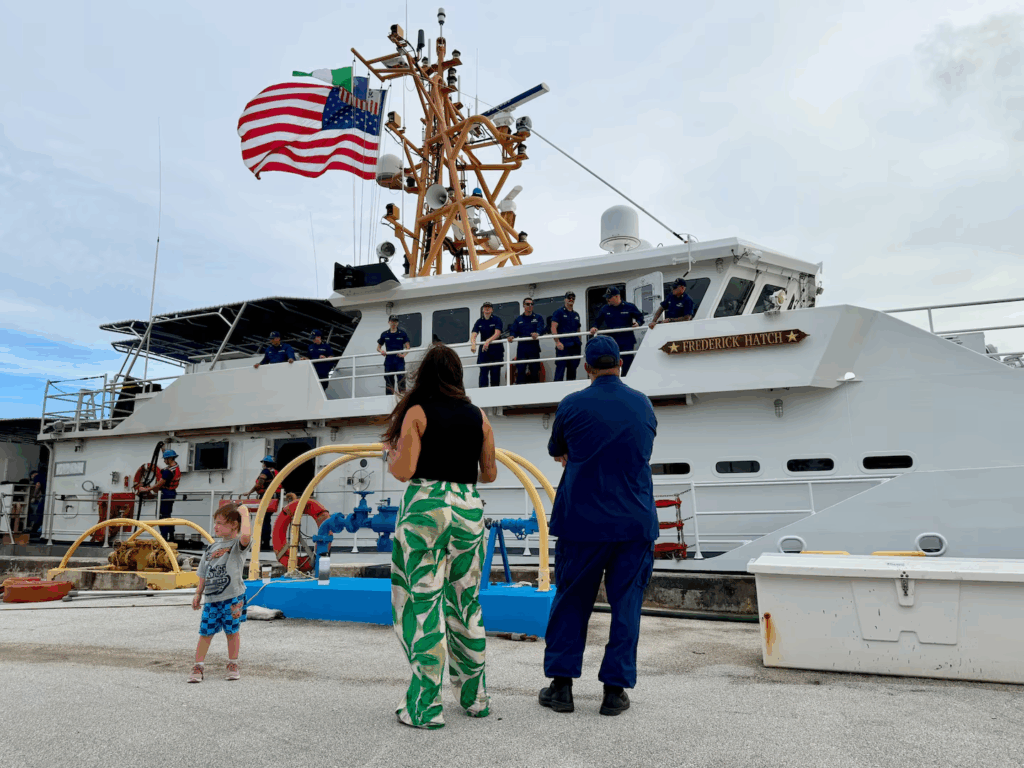
The USCGC Frederick Hatch (WPC 1143) crew return to homeport Nov. 5, 2025, after a deployment of more than eight months that included scheduled drydock maintenance in Honolulu and activities in the Republic of the Marshall Islands. The cutter departed Guam on Feb. 24 and is the third Guam-based Fast Response Cutter to complete the significant systems overhaul. Crews and contractors restored full mission capability through a $4.5 million drydock addressing required maintenance and a major engineering upgrade. The crew also on loaded $750,000 in unit gear and steamed over 7,970 nautical miles.
From U.S. Coast Guard Forces Micronesia/Sector Guam,Nov. 11, 2025
SANTA RITA, Guam — The USCGC Frederick Hatch (WPC 1143) crew returned to homeport Nov. 5, after a deployment of more than eight months that included scheduled drydock maintenance in Honolulu and activities in the Republic of the Marshall Islands.
“The crew of Frederick Hatch stands among the finest Fast Response Cutter teams I have led,” said Lt. Cmdr. Vaughn Gehman, commanding officer. They continue to deliver reliable, safe operations across the Pacific. Their resilience and skill in extended operations are an inspiration for continued service afloat.”
The cutter departed Guam on Feb. 24 and is the third Guam-based Fast Response Cutter to complete the significant systems overhaul. Crews and contractors restored full mission capability through a $4.5 million drydock addressing required maintenance and a major engineering upgrade. The vessel also onloaded $750,000 in unit gear and steamed over 7,970 nautical miles.
En route to Hawai’i, the crew turned a weather delay into a security engagement during a March port call in Majuro, RMI. The crew conducted activities with the crew of the French navy frigate FS Prairial (F731), including a passing exercise to enhance interoperability and practice communication, navigation, and operational procedures to ensure effective cooperation in joint operations, a simulated fire response, and best practices for fisheries inspection and boardings. The exchange reinforced U.S. commitments with allies and partners in the region.
On the return leg, the crew proved a new at-sea refueling concept. With four days to prepare for the complex evolution, Frederick Hatch received more than 12,000 gallons of fuel from a larger cutter while underway. The evolution extended endurance and reduced risk during long transits. The cutter crew also delivered 4,000 pounds of difficult-to-ship goods to forces in Guam, boosting regional readiness.
The team qualified over a dozen members in roles such as underway officer of the deck, underway engineering officer of the watch, in-port officer of the deck, quartermaster of the watch, and onboard training team members, while also integrating seven new crew members.
The return of the Frederick Hatch restores three fully operational Fast Response Cutters in Guam. Two additional cutters remain in pre-commissioning status with crews training on the island. The fleet, in concert with Forces Micronesia/Sector Guam, secures U.S. and territorial borders, ensures the flow of commerce, and stands ready to respond to crises across the Pacific.
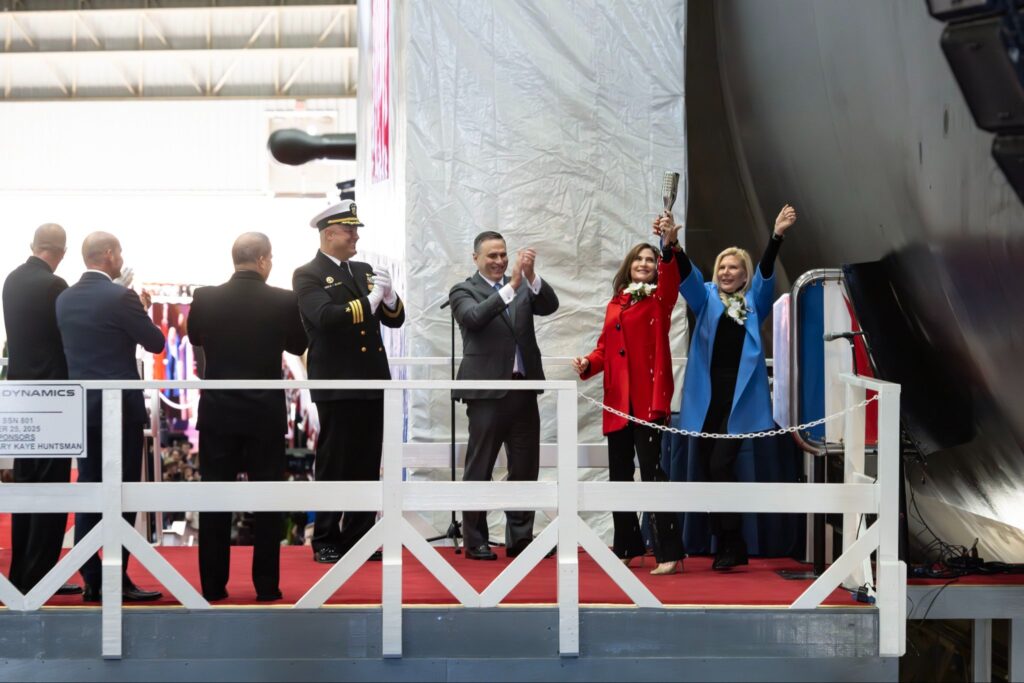
Future Attack Submarine Utah Christened at Electric Boat
By Richard R. Burgess, Senior Editor
ARLINGTON, Va. — The future Virginia-class nuclear-powered attack submarine Utah (SSN 801) was christened during ceremonies at the General Dynamics Electric Boat shipyard in Groton, Connecticut, on October 25, 2025.
According to a posting on X @GDElectricBoat “The Virginia-class assembly building at shipyard was all decked out on October 25 for the christening of PCU Utah (SSN 801). EB shipbuilders, the ship’s crew, U.S. Navy personnel and government officials joined both live and virtually to celebrate this significant milestone commemorated by a joint swing. Mrs. Sharon Lee (left) and Mrs. Mary Kaye Huntsman, co-sponsors of Utah, broke a bottle of sparkling cyser — a honey and apple cider wine from Utah — on the ship’s hull to commemorate the christening.”
When commissioned, the USS Utah will be the 10th and final Block 4 version of the Virginia-class submarines to be built by General Dynamics Electric Boat and HII’s Newport News Shipbuilding.
Coast Guard Exceeds Fiscal Year 2025 Recruiting Goals, Achieves Highest Numbers Since 1991
WASHINGTON – The Coast Guard announced Friday it exceeded its fiscal year 2025 (FY25) recruiting goals, achieving the highest accession numbers since 1991.
The Coast Guard accessed 5,204 active-duty enlisted service members in FY25, which was 121% of its FY25 target of 4,300. This success was the second year in a row that the Coast Guard met its active-duty enlisted recruiting goals after the Service brought in 4,422 new service members last year.
In addition to the success of the active-duty enlisted recruiting efforts, the Service commissioned 371 new officers, to achieve 101% of the overall goal. This represents the largest officer target achieved in recorded history.
In the reserve component, the Coast Guard accessed 777 reservists, which was 104% of the official target of 750. This was the third year in a row that the Coast Guard met its recruiting goals for the Coast Guard reserve.
To support these recruiting efforts, the Coast Guard opened 7 new recruiting offices in FY25. These offices are located in:
Miami, Florida
Los Angeles, California
Long Island, New York
Austin, Texas
Grand Rapids, Michigan
Cincinnati, Ohio
Davenport, Iowa
All enlisted members begin their Coast Guard careers at Training Center Cape May in Cape May, New Jersey, where they complete basic training to prepare for service. Officer accessions occur on board the Coast Guard Academy in New London, Connecticut, where candidates are trained and commissioned for service as Coast Guard officers.
“The Coast Guard far exceeded our recruiting goals in Fiscal Year 2025, showing that more Americans want to serve in the Coast Guard than ever before,” said Adm. Kevin Lunday, acting commandant of the Coast Guard. “Thanks to our recruiters for their great success. We aren’t just growing – we are bringing in the best talent from across the United States and building the workforce of the future.”
These results align with the goals of Force Design 2028, a strategic initiative to modernize the Coast Guard’s workforce, enhance readiness and grow its military force by 15,000 members by FY28 to support fleet expansion and meet emerging mission demands.
Industry leaders Unite to Deliver Combat System Capability for SSN-AUKUS
From General Dynamics Mission Systems
CHANTILLY, Va. – Four major defense companies have proposed the establishment of an AUKUS Combat Systems Collaborative Team in contemplation of a potential role for Australia’s SSN-AUKUS conventionally armed nuclear-powered submarines, under a Memorandum of Understanding (MoU) signed Wednesday, Nov. 5.
BAE Systems, Raytheon Australia, General Dynamics Mission Systems and Thales propose to lead the design and lay the foundations for manufacture and integration of combat systems for SSN-AUKUS under agreements to be negotiated with the Commonwealth of Australia and United Kingdom government. SSN-AUKUS will be based on the UK’s next-generation design and incorporate technology from all three nations. The combination of technology from all three nations is intended to deliver a world-class submarine that meets Australia’s long-term defense requirements.
The collaboration draws on over 150 years of collective experience in the design, integration, and delivery from industry leaders across three nations, an expertise that is intended to meet the demands of delivering a cutting-edge combat system for SSN-AUKUS in a way that reduces both programmatic and workforce risks across the program while accelerating speed to capability.
Under the MOU, the parties have agreed to work collaboratively to design a best of class tri-national Combat System as a shared solution for Australia and the UK in support of SSN-AUKUS. This system builds on General Dynamics Mission Systems’ existing AN/BYG-1 combat control system that is cofunded by the U.S. and Australia and leverages the existing industrial base and workforce supporting both the U.S. Navy and the RAN.
AN/BYG-1 is an open-architecture system which integrates tactical control, payload and weapons control and information assurance. The system is installed on Australia’s Collins class submarines, as well as the U.S. Navy’s Virginia, Los Angeles, Ohio, Columbia, and Seawolf-class submarines.
The Collaborative Team intend to optimize Australian involvement in Combat System design and delivery, while facilitating skills, technology and knowledge transfer across the AUKUS nations to strengthen Australian industry for the SSN-AUKUS program.
Craig Lockhart, Chief Executive Officer of BAE Systems Australia, said:
“This Memorandum of Understanding is another strategic step forward to developing the most effective and advanced combat system for SSN-AUKUS, simultaneously strengthening Australia’s operational sovereignty and industrial capability.
“By aligning with our industry and trilateral partners, this signing will accelerate and enhance combat system development that is interoperable by design, reaffirming our role as a trusted partner to the Commonwealth of Australia and Royal Australian Navy.”
Ohad Katz, Managing Director of Raytheon Australia, said:
“As Australia’s sovereign submarine combat system partner, Raytheon Australia and our workforce bring more than 25 years of expertise in design, integration and sustainment, including upgrades and updates, of the Collins Class submarine combat system to this team, establishing the base for a truly sovereign capability ready to deliver the RAN’s most ambitious naval program.
“As the RAN moves to a multi-class submarine fleet, leveraging the existing workforce, with proven processes that sustain Collins will ensure continuity, confidence, and low-risk delivery.”
Laura Hooks, vice president and general manager of Maritime and Strategic Systems, at General Dynamics Mission Systems, said: “We are excited to formalize a collaborative path forward as we work together to strengthen critical defense capabilities in the Indo-Pacific region.
“The MOU acknowledges that the team successfully delivering submarine combat system capability to the three nations via separate efforts today should be entrusted to sustain and integrate combat systems aboard Virginia and AUKUS submarines in the future, ensuring continuity, confidence and low-risk delivery. It sets a standard of teamwork that will allow us to more efficiently explore future business opportunities in the United States, United Kingdom, and Australia.”
Steven Lockley, Chief Operating Officer of Underwater Systems, Defence Mission Systems, Thales UK said: “Success on international programs such as AUKUS requires strong international partners in order to deliver maximum customer value and sustained capability. Thales is pleased to continue its long-term Combat Systems relationships with BAES and Raytheon Australia and look forward to also working with a new partner in General Dynamics Mission Systems. Together, we will deliver a hugely capable and sustainable AUKUS Combat System maximising the attributes of our companies across the AUKUS countries.”
General Dynamics Mission Systems is the prime contractor for the US Navy’s AN/BYG-1 Combat Control System, Common Weapon Launcher (CWL), and Torpedo Guidance and Control Subsystems.
BAE Systems is the prime contractor for the design and manufacture of the Royal Navy’s UK submarine fleet and will produce the design of the SSN-AUKUS submarines and build the UK’s SSN-AUKUS submarines in Barrow, UK. BAE Systems Australia Submarines, alongside ASC Pty Ltd, has been selected by the CoA to build Australia’s SSN-AUKUS submarines in Adelaide, Australia based on that UK SSNAUKUS design.
Thales, a supplier of integrated sonar systems for submarines, surface ships and airborne platforms, has been appointed as the Main Sonar Design Authority and Integrator, and Sonar Contracting Authority (MSDA&I and SCA) for the UK SSN Programme by BAE Systems UK as the Combat Systems Integrator (CSI).
Raytheon Australia is a combat system integrator and naval sustainment partner for the Royal Australian Navy (RAN) submarine and surface ship combat systems and is the combat system manager and integrator for the RAN Collins Class Submarines and a key partner in the joint US/Australian AN/BYG-1 Submarine Combat Control System.
General Dynamics Mission Systems, a business unit of General Dynamics (NYSE: GD), provides mission critical solutions to the challenges facing our defense, intelligence and cyber security customers across all domains. Headquartered in Chantilly, Virginia, General Dynamics Mission Systems employs approximately 12,000 people worldwide. For more information about the General Dynamics Mission Systems broad portfolio of capabilities, visit gdmissionsystems.com.
Department of the Navy Honors 250 Years of the U.S. Navy and Marine Corps on Veterans Day
U.S. Marines with I Marine Expeditionary Force present the ceremonial birthday cake during I MEF’s 250th Marine Corps Birthday Ball at Harrah’s Resort Southern California in Valley Center, California, Nov. 1, 2025. (U.S. Marine Corps photo by Lance Cpl. Nan Yang)
From Headquarters, U.S. Marine Corps, Nov. 5, 2025
WASHINGTON, D.C. — This Veterans Day, the Department of the Navy commemorates 250 years of American seapower with “Above, Below, and Beyond,” a two-hour Presidential special airing Sunday, Nov. 9, 2025, on Fox Nation.
A once-in-a-generation broadcast, the special takes viewers behind the scenes of the world’s preeminent maritime force; revealing never-before-seen footage, rare access, and first-hand accounts from Sailors, Marines, and the families who stand the watch with them.
Using never-before-seen footage, viewers will see dynamic Navy and Marine Corps operations across air, land, sea, space, and cyber; a rare look at how our sea services deliver peace through strength.
Filmed across the nation and around the globe, the special moves from the decks of aircraft carriers to the depths of submarine commands, offering an inside view of the operations that keep the Navy–Marine Corps team the most lethal and vital force in America’s arsenal so when the world looks to the sea, it sees our flag, and behind it a team that is disciplined, lethal, and dominant.
It also spotlights the men and women of American industry: the shipyard workers, welders, pipefitters, electricians, engineers, and suppliers, whose craftsmanship turns steel into ships and keeps the Fleet at sea.
Viewers will witness seapower at speed—carrier strike groups executing blue-water power projection, amphibious forces driving ship-to-shore operations in contested littorals, and elite naval aviators flying precision profiles inside the Navy’s TOPGUN training squadron.
The two-hour special shows the world that the United States Navy – Marine Corps Team has been the enduring, forward deployed force that keeps danger far from our shores. Across these two hours, the Navy–Marine Corps team will show why the United States commands the seas, secures global trade, and sets the course for the future.
We show the world that ‘freedom isn’t free’ is not just a tagline.
“In 1775, the Founders made a bet; that America’s future would be written at sea. For 250 years, Sailors and Marines have written freedom’s story from the front lines of history,” said John C. Phelan, Secretary of the Navy. “To be a superpower, you must be a seapower. In this tribute, we show the world and our adversaries that America’s Navy–Marine Corps team and their families is what makes America a superpower. This honors both those in uniform and the families who give them strength. The next century of American seapower won’t be defined by a single platform, but by the character of our people.”
Featuring participation from the President, Vice President, Secretary of War, Secretary of the Navy alongside active-duty service members and veterans, “Above, Below, and Beyond” spans every domain of modern seapower.
This special reminds the world that freedom is not free; it’s defended by the strength of America’s Navy and Marine Corps team. We safeguard something infinitely greater than our might. Their resolve keeps the future open and ensures the blessings our Founders promised: life, liberty, and the pursuit of happiness.
Viewers will see carrier strike groups protecting vital sea lanes; Marines conducting expeditionary training alongside allies; and the shipbuilders, engineers, logisticians, and families whose quiet professionalism sustains the Fleet. It is a living portrait of American seapower: past, present, and the future we are building now.
“For 250 years, America’s Navy and Marine Corps have stood the watch—bold, resilient, and always ready—protecting our Nation and defending the ideals of freedom across every domain,” said Adm. Daryl Caudle, Chief of Naval Operations. “This tribute honors not only our history, but the extraordinary Sailors and Marines who continue to shape our future with innovation, courage, and an unbreakable commitment to service.”
“The Marine Corps’ 250th anniversary is a testament to our enduring legacy as the Nation’s expeditionary force, always ready to answer the Nation’s call,” said Gen. Eric Smith, Commandant of the Marine Corps. “As we celebrate this historic milestone, we honor our past and those who have gone before us. We reaffirm our commitment to our culture, one another, our Corps, and our Nation.”
For more than two centuries, the Navy–Marine Corps team has ensured freedom of navigation, safeguarded global commerce, and provided the Nation unmatched capability to deter aggression and respond to crisis. With two-thirds of trade and 80% of goods moving by sea, the maritime security provided by our Navy- Marine Corps team is the backbone of prosperity and deterrence.
Today, they continue to adapt—advancing shipbuilding, unmanned systems, hypersonics, AI, and cyber defense so America’s maritime dominance endures into the two hundred and fifty years and beyond.