DoD’s Lord: Potential for 3-Month Slowdown in Defense Acquisition
Ellen M. Lord, deputy secretary of defense for acquisition and sustainment, told reporters on April 30 that the COVID-19 pandemic might cause a three-month slowdown in procurement and sustainment. National Defense Industrial Association via YouTube
ARLINGTON, Va. — The Defense Department’s top acquisition official said the department is working closely with the industrial base to mitigate the effects of the COVID-19 pandemic but said there is the potential for a three-month slowdown in procurement and sustainment.
“We continue to assess the impact of a potential three-month slowdown to many programs due to COVID-19,” said Ellen M. Lord, deputy secretary of defense for acquisition and sustainment, speaking April 30 at the Pentagon to reporters.
“I intentionally used the word slowdown and impact and not saying the word ‘delay,’ which carries a very different connotation,” Lord added. “We have seen inefficiencies across many programs. COVID-19 is temporarily shutting down defense manufacturing facilities and production lines, disrupting supply chains and distressing the financial stability of the companies DoD relies on to protect the nation. DoD continues to partner with industry to do everything possible to keep programs on schedule and to minimize the cost and schedule impacts.”
Lord praised the work of the Defense Contracting Management Agency (DCMA) and Defense Logistics Agency (DLA) in tracking the status of companies up and down the defense supply chain.
“Out of the 10,509 companies DCMA tracks, 93 are closed, down 13 from last week, with 141 companies having closed and reopened, up very significantly 73 from last week’s number of 68,” she said. “This is the first time we have seen reopening numbers larger than the number of closures.
“Out of the 11,413 companies DLA tracks, 437 are closed with 237 having closed and re-opened, almost 100 companies from last week.”
Lord noted that “while we have seen minor improvements, we continue to see the greatest impacts in the aviation supply chain, shipbuilding and small space launch [companies].”
Lord said her office’s policy team led by Jen Santos is “leading multiple industry calls making calls every week with 18 industrial associations.”
“Tim Harrington, director of Defense Pricing and Contracting, has issued 22 defense pricing and cost memos, aggressively responding to industry needs and impacts. The memos include guidance for increased telecommuting, increased progress payment rates, acquisition timeline impacts, reimbursement for those prevented from working, and more,” she said.
Lord gave an update on the $3 billion of increased cash flow due to increased progress payment rates, noting that this week the Defense Department processed more than $1.2 billion in invoices at the higher progress payment rate.
“We have spoken with each of our major prime companies, and they have each confirmed their detailed plans to work with their supply chains to accelerate payments and to identify distressed companies and small businesses,” she said. “I want to particularly commend Lockheed Martin, who publicly committed to accelerating $450 million to their supply chain.”
Lord said that her acquisition and sustainment team “remains focused on partnering with industry to maintain readiness and drive modernization.”
Hospital Ship Comfort Departs NYC, Prepared for Future COVID-19 Response
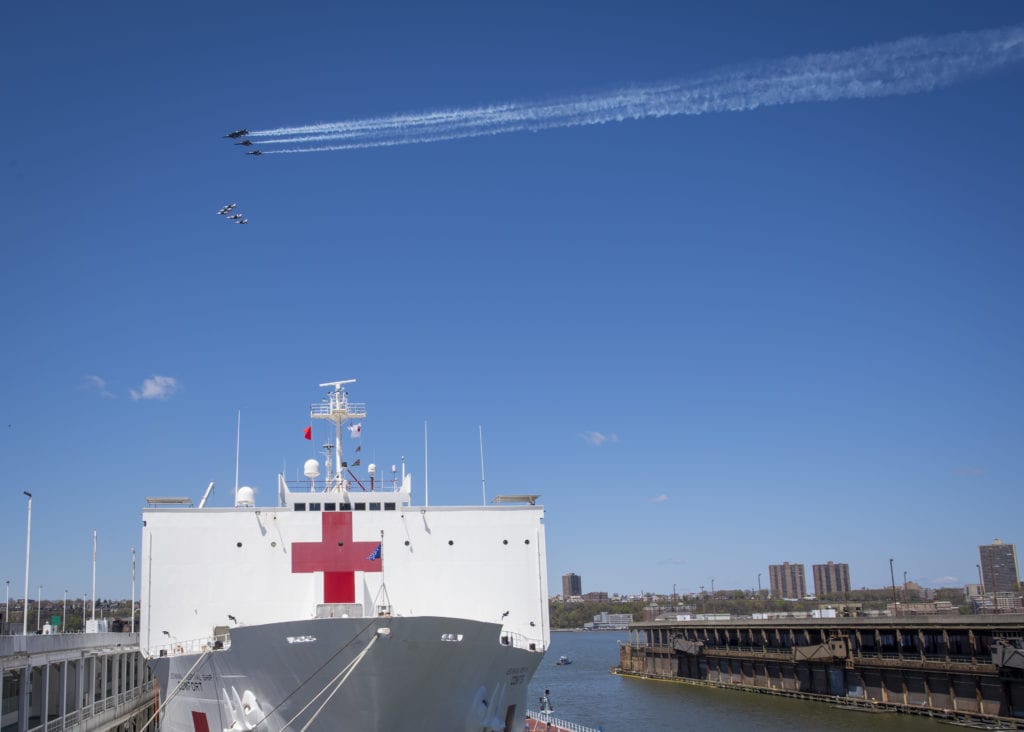
The Navy’s Blue Angels and the U.S. Air Force Thunderbirds fly over the hospital ship USNS Comfort on April 28 to honor frontline COVID-19 relief workers with formations over New York City, Newark and Trenton, New Jersey, and Philadelphia. The Comfort left New York on its return to Norfolk, Virginia, on April 30. U.S. Navy/Mass Communication Specialist 1st Class Kleynia R. McKnight
NEW YORK — The hospital ship USNS Comfort departed New York City on April 30 after supporting the Pentagon’s COVID-19 response assistance to New York and New Jersey residents during the novel coronavirus outbreak, according to a U.S. 2nd Fleet news release.
The Comfort has been at Pier 90 in New York City for a month, providing relief to a health care system stressed by the surge of COVID-19 patients. Even as the ship departs New York, the Comfort and its embarked medical task force remain prepared for future tasking. The U.S. Navy, along with other U.S. Northern Command-dedicated forces, remains engaged throughout the nation in support of the broader COVID-19 response.
“USNS Comfort arrived in New York City to provide relief to frontline health care providers, and each patient who was brought aboard ensured one more bed was available in a local hospital,” said Vice Adm. Andrew Lewis, commander of the 2nd Fleet and Maritime Component Element-East. “While the ship is departing New York City, make no mistake, the fight is not over, and we stand ready to support the response to COVID-19 in whatever capacity we are needed.”
Comfort, which arrived in New York City March 30, was originally tasked with providing care to non-COVID patients, bringing the first aboard on April 1. It quickly became apparent that to be of help to the city, the Comfort needed to treat all patients, regardless of their COVID status.
On April 6, after being directed to accept COVID-positive patients and following a thorough assessment of the existing design of the ship, Military Sealift Command civil service mariners physically separated the hospital from the rest of the ship by cordoning off doors and ladder wells on the main deck, reconfiguring the ship to admit and treat all patients.
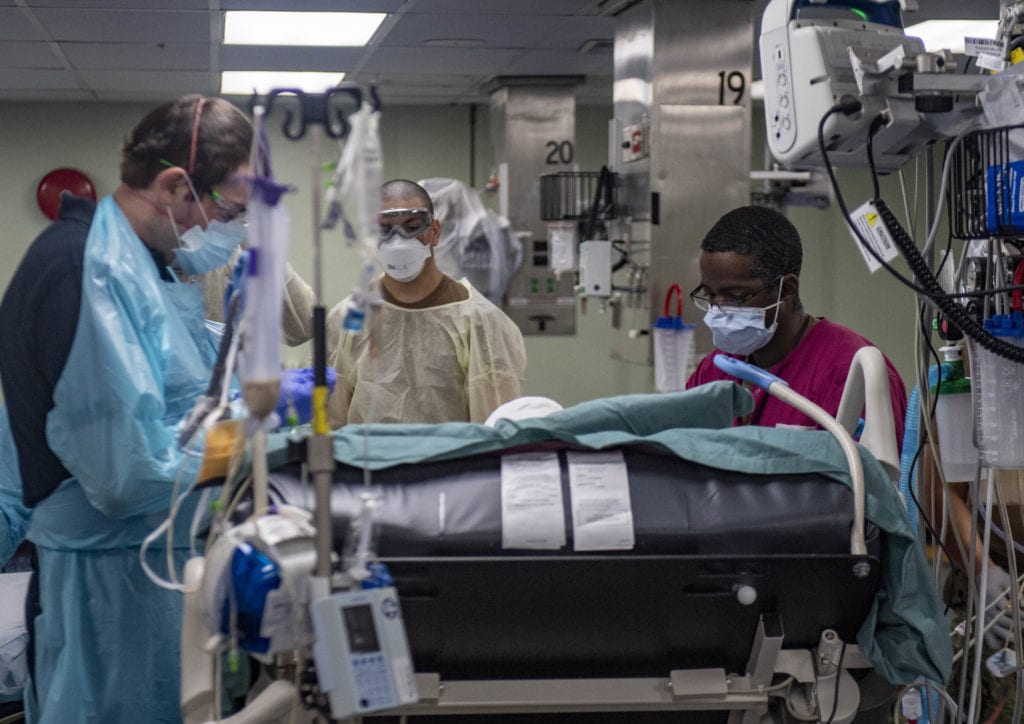
“This amazing crew of over 1,200 people treated 182 patients, of which approximately 70% were afflicted by COVID-19,” said Capt. Patrick Amersbach, commander of the Comfort’s medical treatment facility. “We were dedicated to providing the highest quality of care to each person who arrived to our hospital.”
In the Comfort’s intensive care units, critical care nurses and respiratory technicians worked together to provide constant care to many complex, high-acuity COVID-19 patients. Many of these patients suffered from rapid, multi-system organ failure that required them to be put on ventilators.
Sailors transport the last patient off the Comfort on April 28 for relocation to a local hospital for follow-up care. U.S. Navy/Mass Communication Specialist 1st Class Scott Bigley
“It is truly an honor and I am humbled to lead a team of world-class medical professionals,” Amersbach said. “We came together from different units across the nation and were able to quickly adapt to the rapidly changing environment.”
More than 110 surgical procedures such as appendectomies, bronchoscopies, chest tube insertions, laparoscopic procedures and tracheotomies were performed aboard. Additionally, the Comfort’s radiology technicians performed more than 540 X-rays and CT-scans, while the pharmacy department prepared more than 1,300 intravenous and oral medications for patients aboard. The ship’s supply department ensured the distribution of ample personal protective equipment (PPE) for all personnel, which were procured via a robust logistics system.
“While the ship is departing New York City, make no mistake, the fight is not over, and we stand ready to support the response to COVID-19 in whatever capacity we are needed.”
Vice Adm. Andrew Lewis, commander of the U.S. 2nd Fleet
“The success of this mission in New York City hinged on coordination with FEMA, state and local officials and the partnership between Comfort, the Javits [convention center] and hospitals across New York and New Jersey,” said Capt. Joseph O’Brien, mission commander of Task Force New York.
“We all worked towards the common goal of ensuring that every patient who required care was able to receive it. The Comfort team is proud to help during these unprecedented times.”
The Comfort is scheduled to return to Naval Station Norfolk, Virginia, where the ship will return to a “Ready 5” status to remain ready for tasking for COVID-19 operations in support of the Federal Emergency Management Agency.
The Comfort departs New York Harbor on April 30 after a month of treating patients in New York and New Jersey. U.S. Navy/Mass Communication Specialist 3rd Class Brendan Fitzgerald
U.S. Coast Guard, Australia to Begin Officer Exchange Program
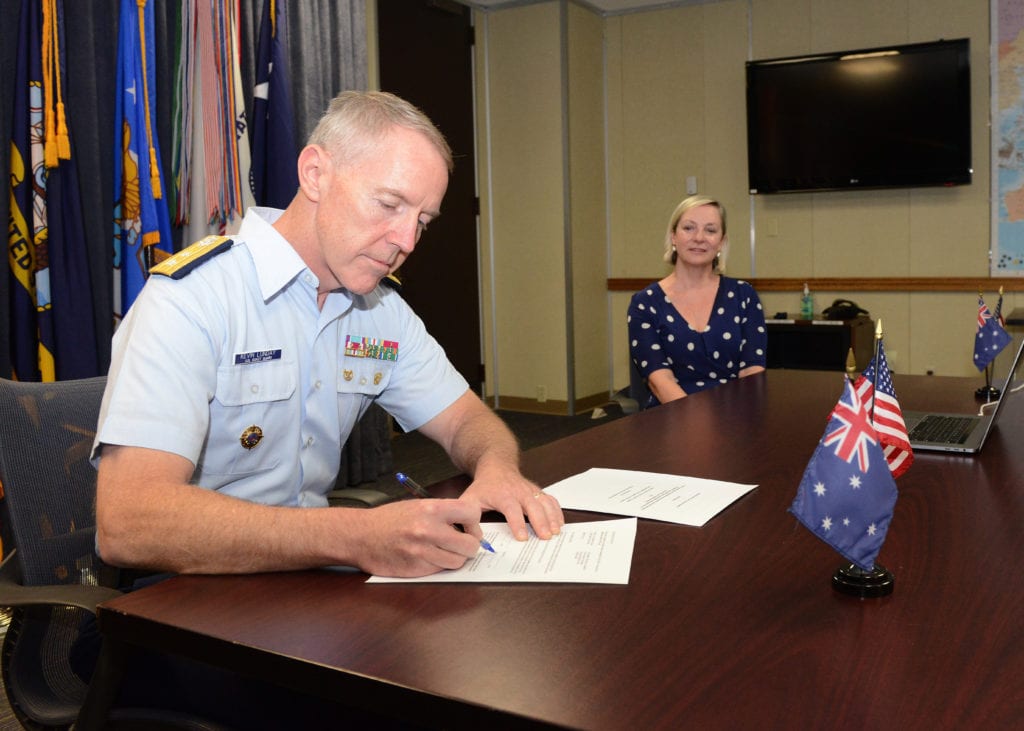
Rear Adm. Kevin Lunday, commander, Coast Guard 14th District, and Kingsley Woodford-Smith, the assistant commissioner, Australian Boarder Force, virtually sign a memorandum of agreement creating a system of mutual officer exchange. U.S. Coast Guard/Petty Officer 3rd Class Matthew West
HONOLULU — The U.S. Coast Guard and the Australian Department of Home Affairs on April 27 signed an agreement for a system of mutual officer exchange from their offices in Hawaii and Canberra, the Coast Guard 14th District said in a release.
Rear Adm. Kevin Lunday, commander of the 14th District, and Kingsley Woodford-Smith, assistant commissioner of Australian Border Force, signed the memorandum of agreement.
“The memorandum of agreement solidifies an already incredible relationship with our Australian partners in the Blue Pacific region,” said Cmdr. Jason Brand, chief of enforcement with the 14th District.
“The agreement enhances the interoperability between the U.S. Coast Guard and Australian Department of Home Affairs by creating a personnel exchange system designed to share experience, professional knowledge and doctrine between the partners. This exchange is another tool for our work to promote and further a free and open Indo-Pacific.”
The memorandum establishes a seagoing officer exchange program allowing one Australian Border Force marine unit officer to serve a four- to six-week assignment among the units in Honolulu. A U.S. Coast Guard officer will deploy with the Australian Border Force fleet.
Upon signing the agreement, Rear Adm. Lunday commented, “The U.S. and Australian alliance is built on over a century of mateship. This agreement reflects the importance of our combined operations to maritime governance and security across Oceania, especially as the U.S. Coast Guard is expanding its permanent presence and operations in the Pacific.”
In attendance was Ambassador Jane Hardy, the Australian consul-general in Honolulu, who said of the agreement “this significant bilateral initiative will develop further our mutual efforts to maintain and enhance regional security. The skill and bravery of our U.S. Coast Guard ‘mates’ and Australian Border Force exemplify the heart of the Australia-US Alliance.”
Australian and Coast Guard personnel often find themselves working alongside one another during joint missions throughout the Pacific from search and rescue cases to the prevention of illegal, unreported, and unregulated fishing (IUU).
Examples of such efforts include the work of Royal Australian navy HMAS Toowoomba and a Coast Guard Station Honolulu 45-foot response boat-medium crews to respond to a de-masted sailboat off Hawaii in 2018 and joint exercises between the HMAS Choules and the Coast Guard Cutter Walnut in the South Pacific during Operation Aiga 2019.
Both countries annually contribute resources to operations of the Pacific Island Forum Fisheries Agency (FFA), Western and Central Pacific Fisheries Commission (WCPFC), and Pacific Quadrilateral Defence Coordination Group (P-QUAD) such as the recent FFA Operation Rai Balang.
Under Op Rai Balang, crews from Coast Guard Cutter Sequoia, an Air Station Barbers Point HC-130 Hercules aircrew, and the crew of the Australian navy’s HMAS Maryborough all contributed to the surveillance operation to disrupt IUU fishing in March. The joint efforts protect the organization’s member states’ exclusive economic zones and ensure Pacific fish stocks remain sustainable.
Scheduled later this year, the partners will reach a new milestone when the Coast Guard sends a surface asset for the first time to serve alongside Australia’s during P-QUAD’s Operation Nasse.
“We plan to send crews aboard Coast Guard Cutter Kimball (WMSL 256) and an Air Station Barbers Point HC-130 Hercules airplane to support the P-QUAD operation for the first time,” Brand said.
“The U.S. and Australia have been standing side-by-side for more than 100 years. This is more than a partnership, it is mateship. As we increase operations with our Australian counterparts, this new personnel exchange allows us to take the next step to integrate further for more fruitful outcomes maximizing the value of the experience and resources of our nations.”
Pacific Fleet to Host At-Sea-Only RIMPAC Exercise in August
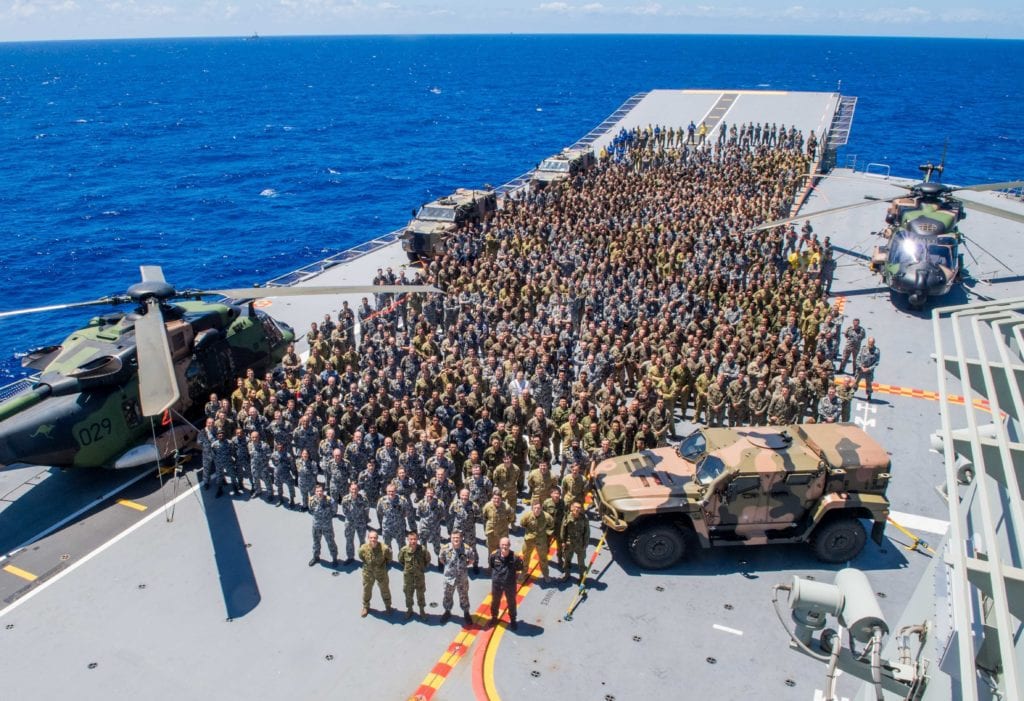
Military members from the Royal Australian Navy, Australian army, U.S. Marines, Sri Lankan navy and marines, Royal Malaysian Army, His Majesty’s Armed Forces of Brunei, the Japan Ground Self-Defense Force and the New Zealand army gather for a group photo on the flight deck of the landing helicopter dock ship HMAS Adelaide during the last RIMPAC two years ago. U.S. Navy/Mass Communication Specialist 2nd Class Kelsey J. Hockenberger
PEARL HARBOR, Hawaii — The U.S. Navy will sponsor the 27th Rim of the Pacific exercise, from Aug. 17 to Aug. 31, the U.S. Pacific Fleet said in a release.
Hosted by the commander, U.S. Pacific Fleet, this biennial maritime exercise will be an at-sea-only event in light of COVID-19 concerns. The theme of RIMPAC 2020 is “Capable, Adaptive, Partners.”
The at-sea-only construct for RIMPAC 2020 was developed to ensure the safety of all forces participating by minimizing shore-based contingents. Commander, U.S. Pacific Fleet crafted the modified RIMPAC plan as a way to conduct a meaningful exercise with maximum training value and minimum risk to the force, allies and partners, and the people of Hawaii.
The world’s largest international maritime exercise, RIMPAC is designed to foster and sustain cooperative relationships, critical to ensuring the safety of sea lanes and security in support of a free and open Indo-Pacific region.
The exercise, which takes place in the waters surrounding the Hawaiian Islands, is a training platform designed to enhance interoperability and strategic maritime partnerships. In 2018, during the last RIMPAC, 26 nations participated in and around Hawaii.
“In these challenging times, it is more important than ever that our maritime forces work together to protect vital shipping lanes and ensure freedom of navigation through international waters,” said Adm. John Aquilino, commander, U.S. Pacific Fleet. “And we will operate safely, using prudent mitigation measures.”
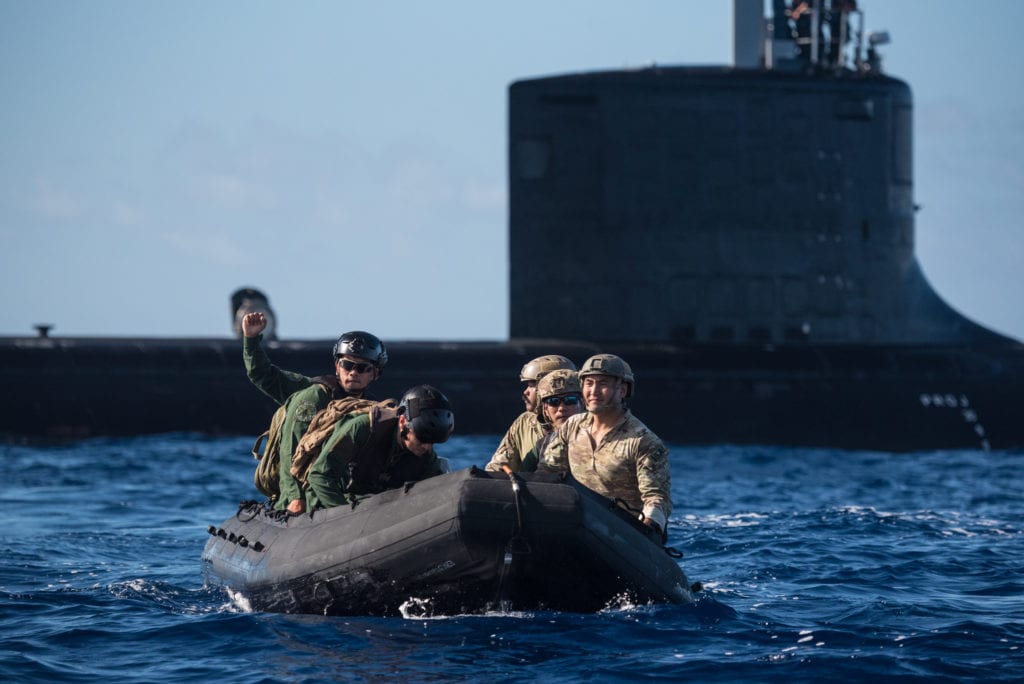
Multinational special operations forces participate in a submarine insertion exercise with the Virginia-class fast-attack submarine USS Hawaii and combat rubber raiding craft off the coast of Oahu, Hawaii, during RIMPAC 2018. U.S. Navy/Mass Communication Specialist 1st Class Daniel Hinton
As the U.S. Navy continues to limit the spread of COVID-19, RIMPAC 2020 is not scheduled to include social events ashore. Joint Base Pearl Harbor-Hickam will be accessible for logistics support, with a minimal footprint of staff ashore for command and control, logistics and other support functions.
This year’s exercise will include multinational anti-submarine warfare, maritime intercept operations and live-fire training events, among other cooperative training opportunities. Continued planning will remain flexible as Navy leaders monitor and assess evolving circumstances.
“We remain committed to and capable of safeguarding allies and partners throughout the Indo-Pacific region,” Aquilino said. “The flexible approach to RIMPAC 2020 strikes the right balance between combatting future adversaries and the COVID-19 threat.”
RIMPAC 2020 will be led by the commander of the U.S. 3rd Fleet, Vice Adm. Scott D. Conn.
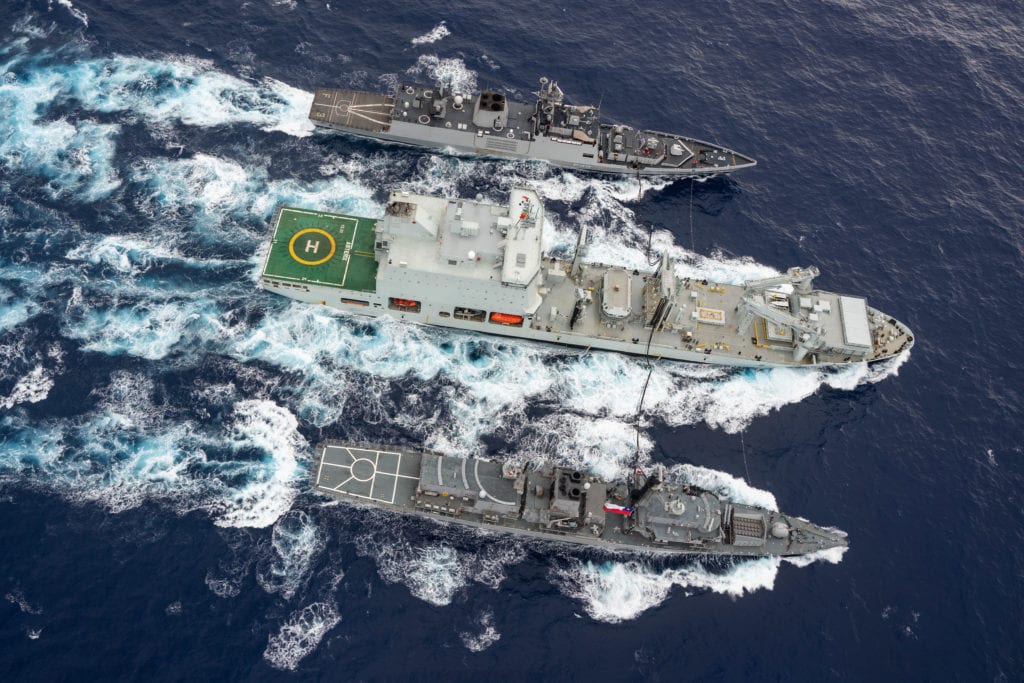
The Chilean navy frigate CNS Almirante Lynch and the Indian navy stealth multi-role frigate INS Sahyadri perform a replenishment-at-sea with the Royal Canadian Navy supply ship MV Asterix off the coast of Hawaii during RIMPAC 2018. Twenty-five nations, 46 ships, five submarines and about 200 aircraft and 25,000 personnel participated. U.S. Navy/Mass Communication Specialist 1st Class Arthurgwain L. Marquez
Navy Opens Deeper Inquiry Into Theodore Roosevelt; Move Delays Decision on Captain’s Reinstatement
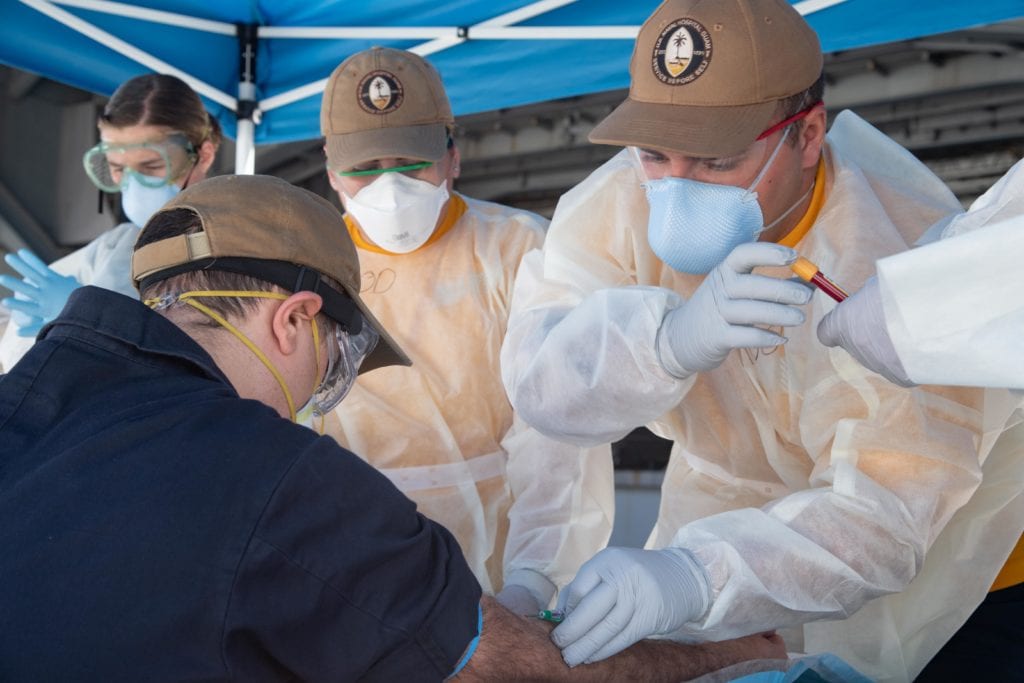
Navy Hospitalman Rudy Flores (right), assigned to Naval Hospital Guam, takes a blood sample on April 23 from Mass Communication Specialist 1st Class Christopher Liaghat, a crewman assigned to the USS Theodore Roosevelt, as part of an investigation of the COVID-19 outbreak there. U.S. Navy/Mass Communication Specialist Seaman Kaylianna Genier
ARLINGTON, Va. — Acting U.S. Navy Secretary James McPherson has directed Chief of Naval Operations Adm. Mike Gilday to conduct a second deeper investigation of the events surrounding the COVID-19 outbreak on the aircraft carrier USS Theodore Roosevelt that has claimed the life of a Roosevelt Sailor, hospitalized others and infected hundreds more.
The results of a first preliminary investigation were forwarded last week by Gilday to McPherson, who took them under review. McPherson is a retired Navy flag officer in the Judge Advocate General Corps.
“Following [discussion with Gilday], I have unanswered questions that the preliminary inquiry has identified and that can only be answered by a deeper review,” McPherson said in an April 29 statement.
“This investigation will build on the good work of the initial inquiry to provide a more fulsome understanding of the sequence of events, actions and decisions of the chain of command surrounding the COVID-19 outbreak aboard USS Theodore Roosevelt.”
Vice Chief of Naval Operations Adm. Robert Burke will be in charge of the second investigation, which is expected to wrap up by May 27, unless an extension is granted, according to an April 30 statement from Cmdr. Nate Christensen, a spokesman for Gilday. From there, Gilday is expected to review the results and issue any recommendations.
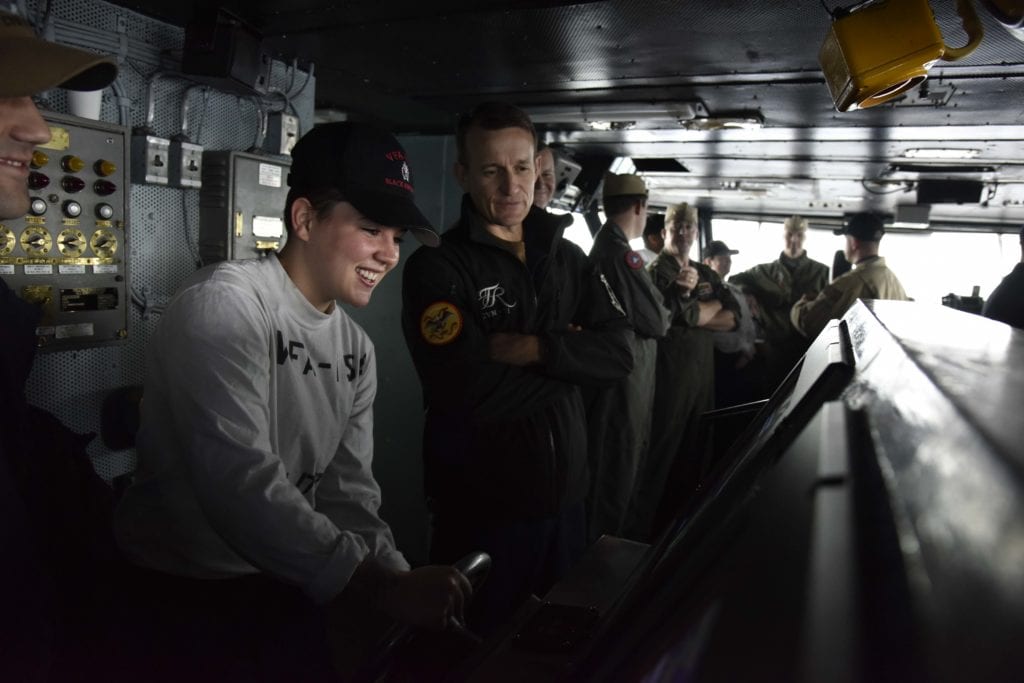
Capt. Brett Crozier (center), at the time commanding officer of the USS Theodore Roosevelt, in February instructs Information Systems Technician 3rd Class Eden Betzler on how to steer the ship. U.S. Navy/Mass Communication Specialist 2nd Class Pyoung K. Yi
The Navy reported as of April 25 that the entire crew of the Theodore Roosevelt had been tested for the virus, resulting in 4,105 negatives but 833 positives — including the carrier’s former commanding officer, Capt. Brett Crozier.
Of the total cases, 112 Sailors had recovered and 4,273 Sailors from the Roosevelt had been moved ashore. Also, as of April 25, two of the ship’s Sailors were in U.S. Naval Hospital Guam under treatment for COVID-19 symptoms. Another Sailor died from complications of the infection, the Navy announced on April 13.
The Theodore Roosevelt’s public affairs office announced April 29 that the ship was preparing to return to sea following a bow-to-stern cleaning process. The crew members that were quarantined ashore are beginning to move back on board.
“This investigation will build on the good work of the initial inquiry to provide a more fulsome understanding of the sequence of events, actions and decisions of the chain of command surrounding the COVID-19 outbreak aboard USS Theodore Roosevelt.”
Acting Navy Secretary James McPherson
Since March 27, the Roosevelt has been sidelined in Apra Harbor, Guam. Crozier was relieved of his command on April 2 by then-acting Navy Secretary Thomas Modly after fallout from a letter written by the captain to his chain of command leaked to a San Francisco newspaper. A few days later, Modly flew to Guam to visit the ship and address the crew, but he stepped down on April 7 after his address — which was highly critical of Crozier — generated many calls for Modly’s resignation.
According to several press reports, Gilday recommended Crozier’s reinstatement to McPherson. Defense Secretary Mark Esper received a verbal update from Gilday on April 24. Another report said that U.S. Army Gen. Mark Milley, chairman of the Joint Chiefs of Staff, recommended the more extensive investigation.
Gilday had directed Burke to probe the circumstances and climate of the entire Pacific Fleet “to help determine what may have contributed to a breakdown in the chain of command,” Modly said April 2, the day he relieved Crozier as commander of the ship only months after Crozier had assumed command.
A day earlier, at a press briefing on the Roosevelt virus outbreak, Gilday spoke of “a potential comms breakdown, wherever it occurred. We’re not looking to shoot the messenger here, we want to get this right.”
Deputy Editor Scott Achelpohl and Seapower Correspondent John M. Doyle contributed to this report.
U.S. Navy Airman Andrue Barraza departs the Theodore Roosevelt on April 25 for quarantine after completing essential watch-standing duties. U.S. Navy/Mass Communication Specialist 1st Class Chris Liaghat
Triton Deploys at Last: The Navy Takes Its New UAV to the Western Pacific
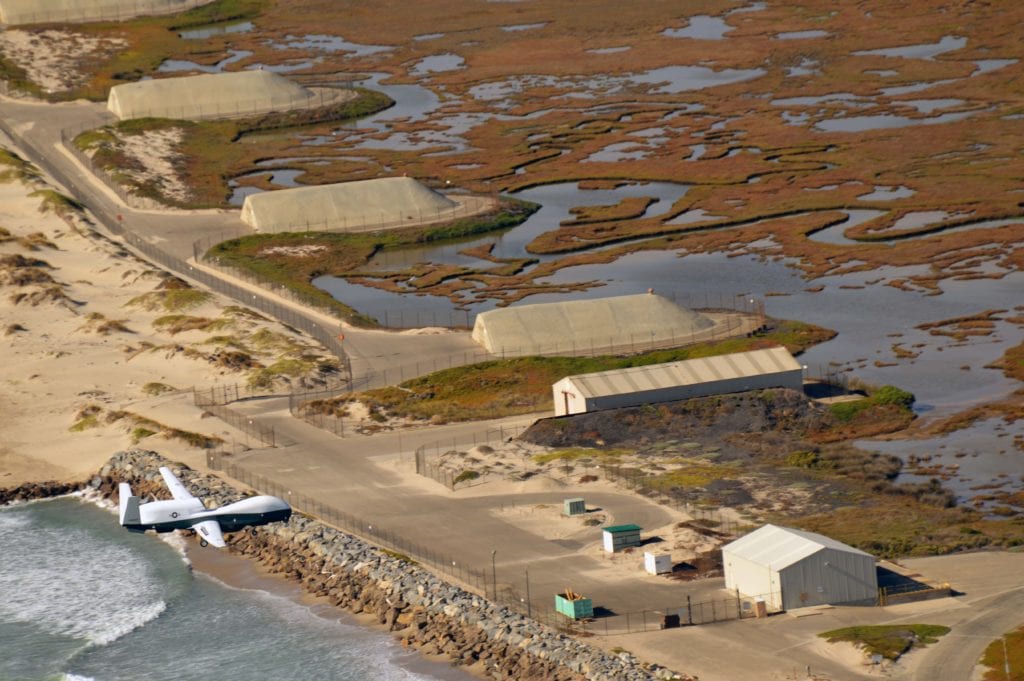
An MQ-4C Triton sits in a hangar at Andersen Air Force Base, Guam, after arriving for a deployment as part of an early operational capability test. U.S. Air Force/Senior Airman Ryan Brooks
In January, the U.S. Navy’s newest surveillance aircraft, the Northrop Grumman-built MQ-4C Triton, a high-altitude, long-endurance unmanned aerial vehicle (UAV), embarked on its first deployment, a move to demonstrate what the Navy calls early operational capability.
Two MQ-4Cs assigned to Unmanned Patrol Squadron 19 (VUP-19), the first Triton squadron, deployed to Andersen Air Force Base on Guam and were in place by Jan. 26 to fly missions in support of the U.S. 7th Fleet.
Check out the digital edition of the May Seapower magazine here.
“VUP-19 is operating Triton to further develop the concept of operations and fleet learning associated with operating a high-altitude, long-endurance system in the maritime domain,” Capt. Dan Mackin, the Navy’s Triton program manager, said in response to a query from Seapower. “The squadron plans to conduct multiple flights per month in support of Commander Task Force 72, 7th Fleet and Indo-Pacific Command.”
“The fielding of the Navy’s premier unmanned aircraft system and its additive, persistent, multisensor data collection and real-time dissemination capability will revolutionize the way maritime intelligence, surveillance and reconnaissance [ISR] is performed,” Mackin said in a Jan. 26 Navy release.
“While developing the concept of operations, the MQ-4C Triton is actively conducting missions that are complementing the P-8A Poseidon,” said Cmdr. Kim DaCosta-Azar, commanding officer of VUP-19, in an email response to Seapower. “This complement brings increased persistence, capability and capacity through its multisensor mission payload.”
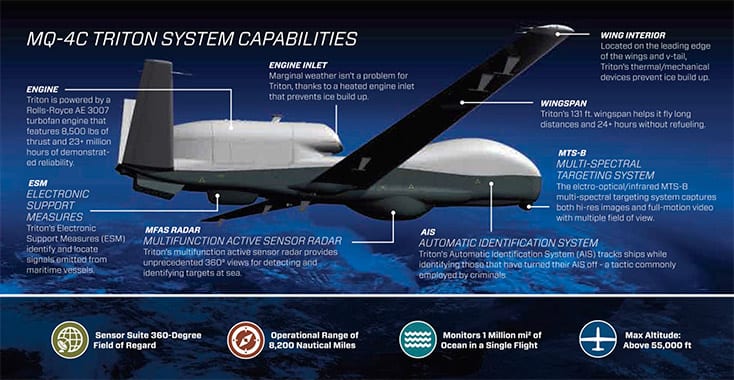
The MQ-4C’s mission payload includes a Northrop Grumman-built ZPY-3 Multifunction Active Sensor, an X-band radar with modes that include maritime surface search, spot synthetic aperture radar (SAR), strip SAR, inverse SAR snapshot and inverse SAR high-resolution. The radar’s 360-degree scan enables the Triton to cover 2.7 million square miles during a mission.
The Triton’s suite also includes a Sierra Nevada-built ZLQ-1 electronic surveillance measures sensor equipped with specific emitter identification and with an automatic identification system. A Raytheon-built MTS-B multispectral electro/optical/infrared sensor with a laser designator/pointer/range-finder capability also is installed.
“The fielding of the Navy’s premier unmanned aircraft system and its additive, persistent, multisensor data collection and real-time dissemination capability will revolutionize the way maritime [ISR] is performed.”
Capt. Dan Mackin, the Navy’s Triton program manager
The Triton can transmit its data to a ground station, including video live-streaming. It also can be an alternative communications relay to space-based satellites.
“The MQ-4C Triton will provide 7th Fleet with a round-the-clock ISR capability, as the aircraft have capability to fly more than 24 hours during each mission,” DaCosta-Azar said. “The VUP-19 detachment has the ability to pilot the MQ-4C from Guam or from Jacksonville, Florida, mission-control station. The majority of the VUP-19 crew operates from Naval Air Station Jacksonville.”
VUP-19 is headquartered at Naval Air Station Jacksonville, but its Tritons are home-based at Naval Air Station Point Mugu, California.
“The introduction of MQ-4C Triton to the 7th Fleet area of operations expands the reach of the U.S. Navy’s maritime patrol and reconnaissance force in the Western Pacific,” said Capt. Matt Rutherford, Task Force 72’s commander. “Coupling the capabilities of the MQ-4C with the proven performance of P-8, P-3 and EP-3 will enable improved maritime domain awareness in support of regional and national security objectives.”
Praise for — and Commitment to — the MQ-4C
Chief of Naval Operations Adm. Michael Gilday praised the Triton during March 11 testimony before the Senate Appropriations Committee’s Defense subcommittee.
“The capabilities that the MQ-4 brings are game-changing in terms of long-range ISR at altitude, with sensors that we haven’t had supporting the fleet before,” he said. “We’re still committed” to the Triton.
Mackin said the Navy’s program of record remains at 68 UAVs, despite a gap of two years — 2021 and 2022 — proposed in the Navy’s 2021 budget proposal. The total does not include the two Navy-owned and one Northrop Grumman-owned test aircraft.
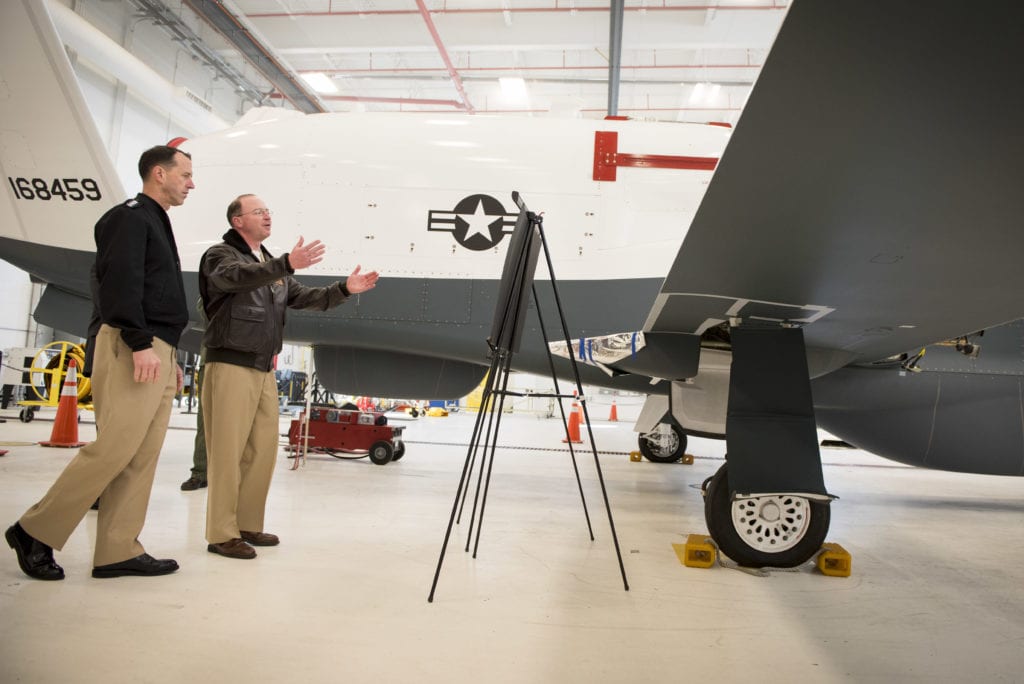
Then-Chief of Naval Operations Adm. John Richardson views the Triton at Naval Air Station Patuxent River, Maryland, in 2016. U.S. Navy/Mass Communication Specialist 1st Class Nathan Laird
The Navy has ordered 20 Tritons to date and has accepted delivery of seven: three flyable test aircraft (including one owned by Northrop Grumman), one fatigue test article and three production aircraft, the latter three delivered to VUP-19. One of the VUP-19 Tritons was involved in a flight mishap during a landing at NAS Point Mugu on Sept. 13, 2018.
“The Triton aircraft damaged during the gear-up landing at Point Mugu has been stricken from inventory although some components were salvaged for use on training devices,” Mackin said.
Configurations With More Advanced Capabilities
He said the two MQ-4Cs deployed to Guam are in the Triton’s baseline configuration known as IFC 3 (Integrated Functional Capability 3). The Navy is working on deploying the Triton with IFC 4, which gives the UAV a signals intelligence capability and will put it on the path to replace the Navy’s EP-3E electronic reconnaissance aircraft. IFC 4, also called the multi-int (multi-intelligence) capability, is planned for fiscal 2022.
Multi-int capability deployed in four Tritons at a single site to establish a 24/7 orbit over the Western Pacific area of operations also will mark the achievement of initial operational capability for the Triton.
The Northrop Grumman-owned MQ-4C in the test program is being used to advance the Triton’s capabilities.
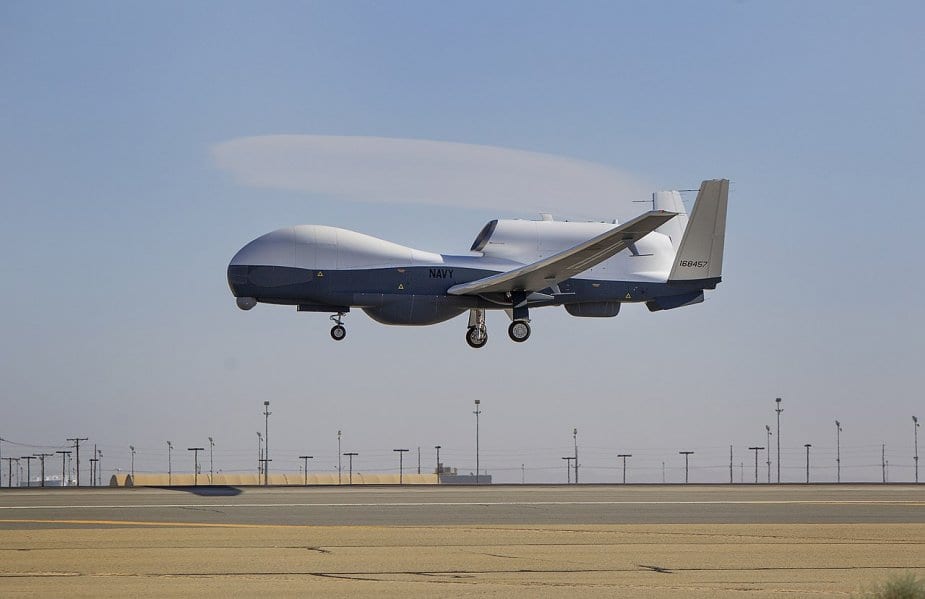
The Triton completes its first flight on May 22, 2013, from the Northrop Grumman manufacturing facility in Palmdale, California. U.S. Navy via Northrop Grumman/Alex Evers
“We are … integrating and testing IFC-4 upgrades to meet the U.S. Navy’s and Australia’s multi-intelligence requirement, which will ultimately enable the U.S. Navy to retire the EP-3,” said Doug Shaffer, vice president and program manager, Triton program, Northrop Grumman, in response to a query from Seapower.
Mackin said there “is a plan for upgrading older aircraft to the multi-int configuration with some [aircraft] already” in the works.
VUP-19 eventually will operate 12 MQ-4Cs operated and maintained by 500 personnel. The Navy plans to establish a second Triton squadron, VUP-11, at Naval Air Station Whidbey Island, Washington. The two squadrons together eventually will field 20 Tritons at five sites to sustain five around-the-clock orbits. The remaining 48 Tritons would be used for training, attrition and the maintenance pipeline over the service life of the UAV.
The groundwork for the MQ-4C, based on the U.S. Air Force Block 20 RQ-4A Global Hawk, was laid more than a decade ago with the Broad-Area Maritime Surveillance Demonstration (BAMS-D) program, in which the Navy acquired from the Air Force two Block 10 RQ-4As and their integrated sensors that included an electro-optical sensor, SAR with a ground moving target indicator and wide-area search modes. The Navy added an LR-100 electronic surveillance measures sensor, the automatic identification system, inverse SAR capability, and maritime moving target and maritime search sensing.
The first Triton, assigned to VUP-19, Detachment Point Mugu, arrives at Naval Base Ventura County, California, in 2017. U.S. Navy/Public Affairs Specialist Theresa Miller
The Navy in 2011 received three more RQ-4As from the Air Force for the BAMS-D. Since then, one RQ-4A was lost in a mishap in eastern Maryland in 2012 and another was shot down by Iranian forces last June. A third was damaged in a takeoff mishap in November. Mackin said repair is underway on the damaged RQ-4A.
The Navy deployed the RQ-4A to the U.S. Central Command area of responsibility in early 2009 for a planned six-month deployment. Now, more than 11 years later, after continuous deployment, the Navy still values the BAMS-D program as it awaits more deployments of the MQ-4C Triton.
According to the 2021 budget proposal, the Navy plans to phase out the BAMS-D, beginning in fiscal 2023, to allow the sea service to fund the whole MQ-4C program. “The MQ-4C will assume the signal intelligence mission from the EP-3E in [fiscal] 2022, which will require aircraft and control station modifications and calibrations to keep pace with emerging signals of interest at greater sensitivity thresholds.”
Allies See Triton’s Value, Sign Up to Take Delivery
Two allied nations are on track to operate the Triton. Australia signed a memorandum of understanding for up to six Tritons in June 2019, with delivery of the first scheduled for 2023. Germany also has announced its intention to procure three Tritons. Foreign procurement may be key in sustaining a steady Triton production line if the Navy gaps the procurement in 2021 and 2022.
“A two-year gap in production would have significant negative effects on the production line and the supplier base,” Shaffer said. “A pause would mean we lose the lessons learned that have enabled our suppliers and Northrop Grumman to achieve production efficiencies and get to this mature point of the program, which would then add more risks and costs to the program.
“We estimate that stopping and restarting the line alone will cost roughly $100 million to $150 million and then each aircraft likely costs about $20 million more. We are working closely with the Navy on multiple options [that] could keep the production line open and potentially result in cost savings for both the Navy and Australia.
“We have had multiple discussions with the U.S. Navy and Australia about options to fill the [fiscal] ’21 and ’22 production lines with Australian aircraft,” he said. “An acceleration of the Australian program would result in significant savings to Australia and ensure cost savings to the U.S. Navy by preventing a pause in Triton production. While any decision to accelerate the Australian program is between the U.S. Navy and Australia, we are prepared to provide the necessary support to an accelerated Australian program.”
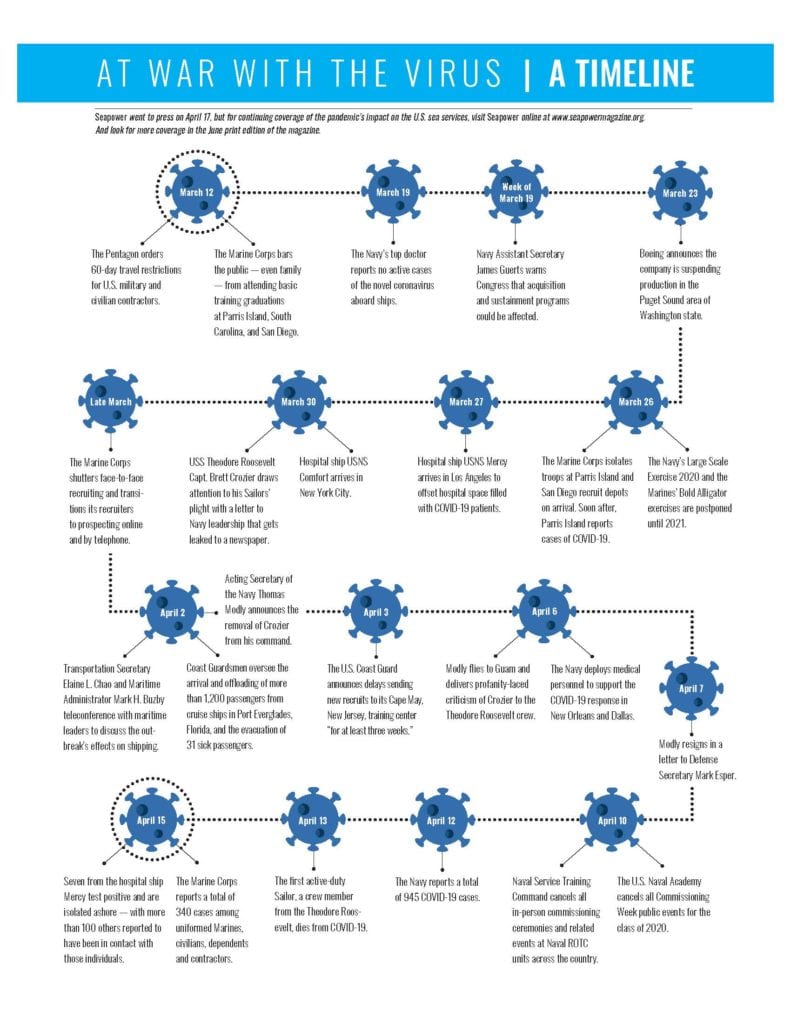
At War With the Virus — A Timeline
At War With the Virus: Sea Services Forced to Radically Change Course to Battle the COVID-19 Outbreak
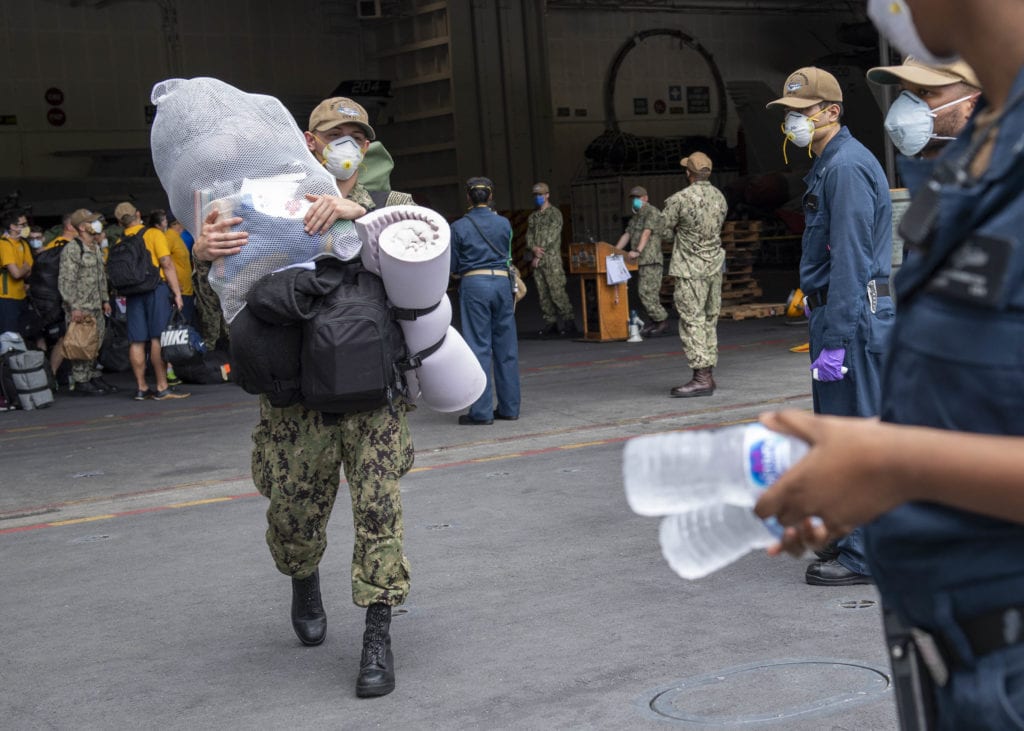
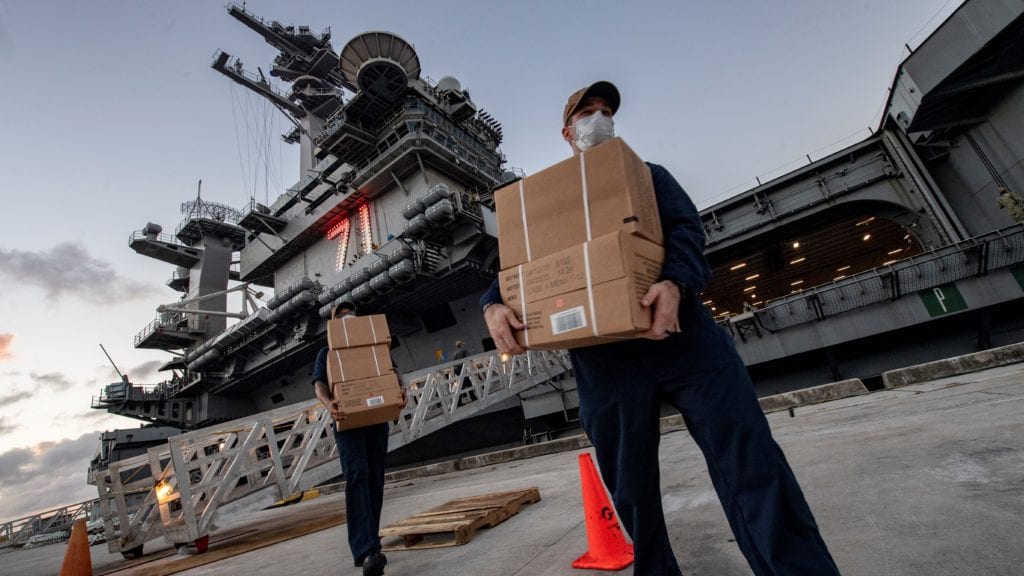
Sailors assigned to the aircraft carrier USS Theodore Roosevelt move meals ready to eat for Sailors who were negative for COVID-19 and asymptomatic at local hotels in an effort to implement social distancing and stop the spread of COVID-19. U.S. Navy/Mass Communication Specialist 1st Class Julio Rivera
The novel coronavirus has been a stunning and tragic disrupter of U.S. sea service operations — both major and routine, traditional events as well as long-planned operations.
Shortly after the World Health Organization declared COVID-19 a pandemic on March 11, the effect on America’s military started to come into sharper focus.
Check out the digital edition of the May Seapower magazine here.
By April 16, the U.S. Navy had reported 1,224 novel coronavirus cases. Most of those, 983, were Sailors, including 655 from the USS Theodore Roosevelt — the ship that is the hot spot for the virus. Another 134 cases were civilians, 53 dependents and 54 contractors.
A total of 13 Sailors, 13 civilians, three dependents and six contractors had been hospitalized. Also by April 16, 200 had recovered, the Navy said. On April 13, the Navy said that the first active-duty Sailor had died — a Roosevelt crew member — joining three civilian employees and two Navy contractors who perished.
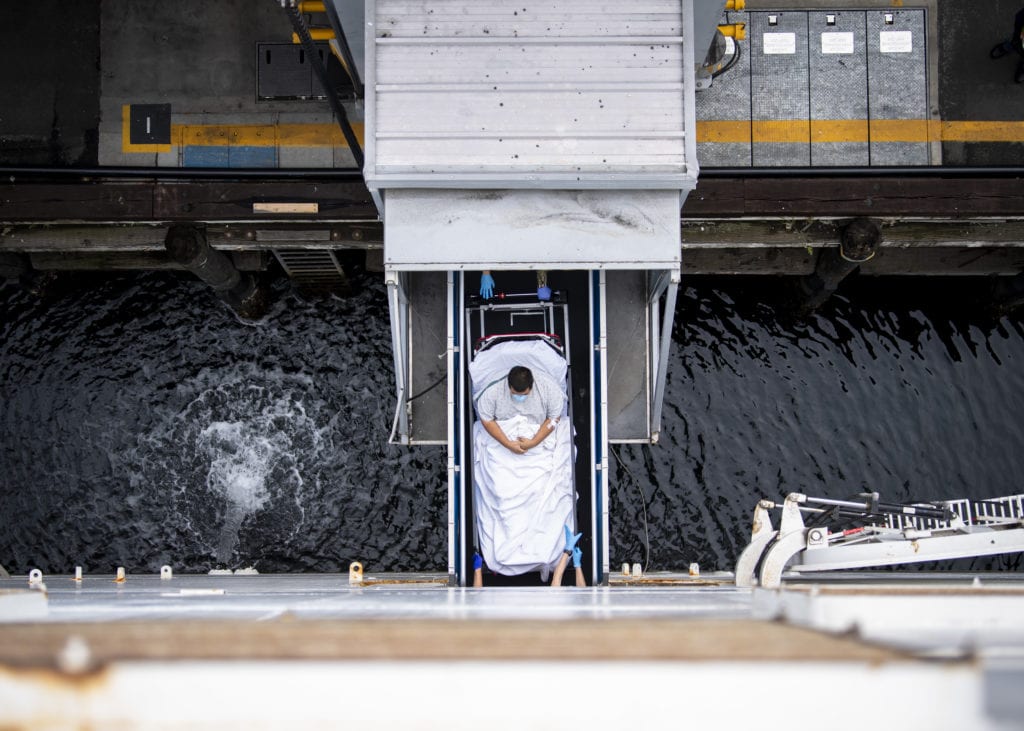
Sailors transport a patient to the hospital ship USNS Mercy. U.S. Navy/Mass Communication Specialist 2nd Class Ryan M. Breeden
As of April 16, the U.S. Marine Corps reported 340 COVID-19 positives among uniformed Marines, dependants, civilians and contractors. The U.S. Coast Guard had 90 cases but 31 had recovered by that date. Also by April 15, the hospital ship Mercy, docked in L.A., had seven test positive and sent into isolation. More than 100 had been in contact with those who tested positive there.
Spotlight on the Teddy Roosevelt
By mid-April, four aircraft carriers — the cornerstone of the Navy’s ability to project power forward — had at least one Sailor on board test positive for the viral infection. The USS Nimitz and USS Carl Vinson, both based in Bremerton, Washington, and the USS Ronald Reagan in Japan all were in port when their COVID-19 cases were discovered.
But nowhere was the outbreak more acute or visible to the world than on the fourth aircraft carrier, the Theodore Roosevelt, which put into port at Guam. That carrier became the first ship at sea to report a case.
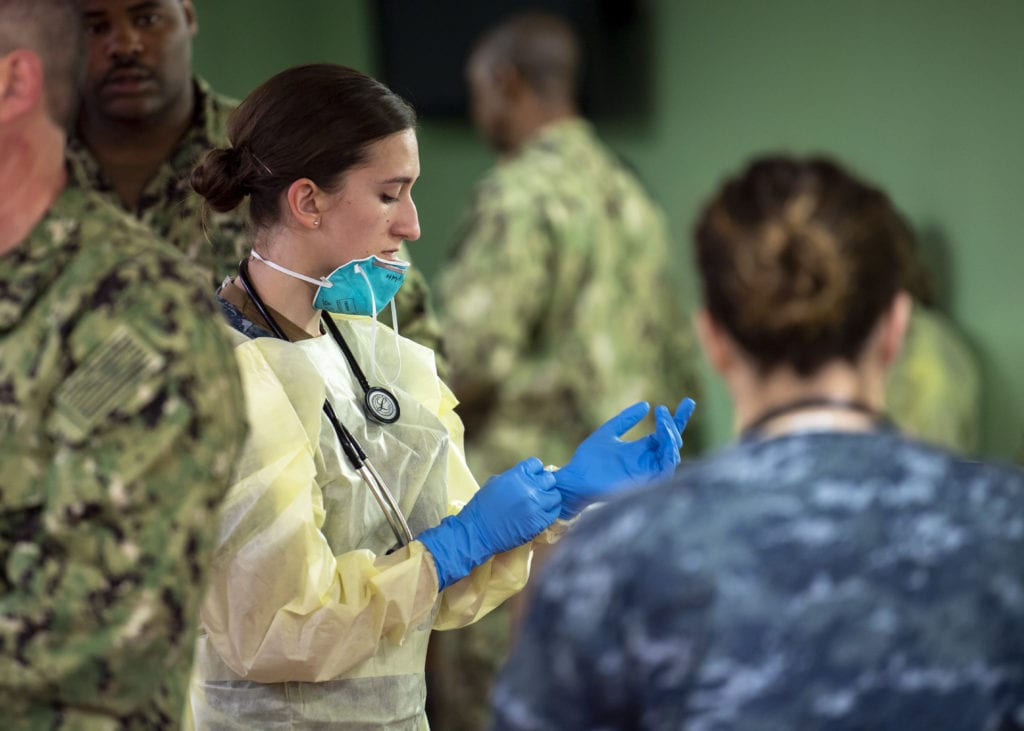
Hospital Corpsman 3rd Class Kimberly Wyss dons surgical gloves aboard the hospital ship USNS Mercy, which is deployed to Los Angeles in support of the nation’s COVID-19 response efforts and serves as a referral hospital for non-COVID-19 patients admitted to L.A.-area hospitals. U.S. Navy/Mass Communication Specialist 2nd Class Ryan M. Breeden
The then-captain of the Theodore Roosevelt, Brett Crozier, who later tested positive and went into quarantine himself, drew attention to his Sailors’ plight with a March 30 letter to Navy leadership. The letter was leaked and ran the next day with a story in the San Francisco Chronicle, drawing worldwide media attention.
As outcry grew over the fate of the Roosevelt’s crew, then-acting Navy Secretary Thomas Modly announced April 2 the removal of Crozier from his command. Modly then flew to Guam, where he would compound the controversy in a speech to the crew that included profanity-laced criticism of Crozier. The speech stirred more criticism of the Navy and Modly, who submitted his resignation on April 7.
By April 15, it was reported that Chief of Naval Operations Adm. Mike Gilday, after prelimary findings from a follow-on report of the affair, was considering reinstating Crozier.
As of April 16, 94% of the Theodore Roosevelt’s crew had been tested; 3,919 were negative with the 655 positives. Five were hospitalized in Guam, with one in intensive care. Of the 4,800 crew, 4,059 Sailors had moved ashore.
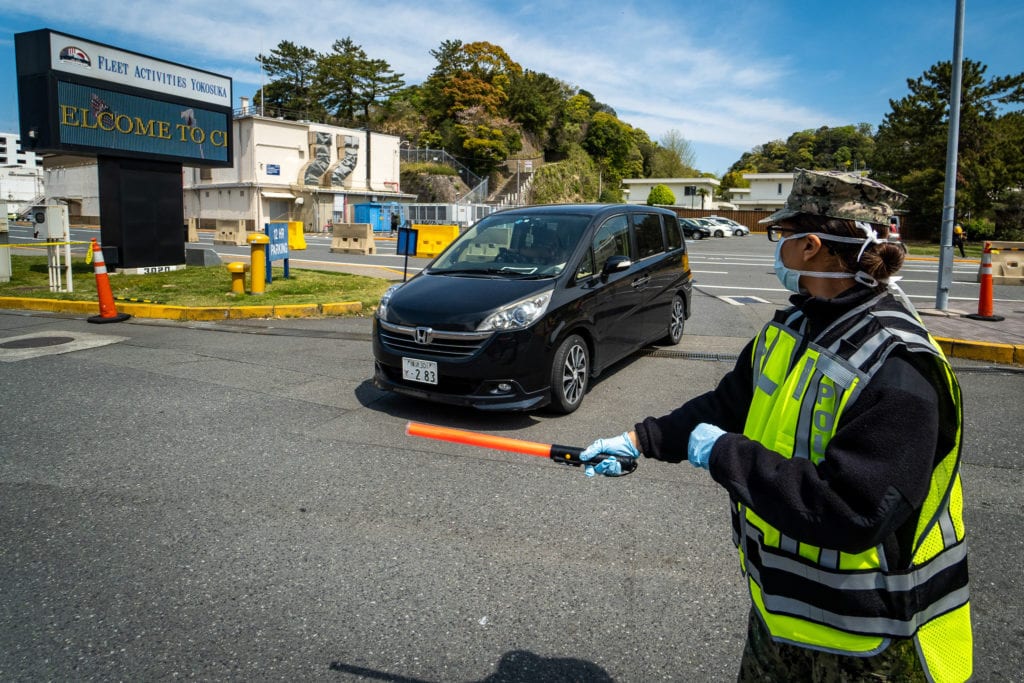
Commander, Fleet Activities Yokosuka, security department Sailors direct incoming gate traffic to COVID-19 screening stations on base. U.S. Navy/Taylor Curry
Concern for the Submarine Fleet
Of special concern is the health of the ballistic missile submarine force — the maritime leg of the nuclear triad with bombers and ground-based missiles — and other subs.
Crew members were undergoing enhanced medical screenings and 14-day isolation before beginning training or deployment aboard a sub, Gilday announced on March 24.
As of press time for Seapower in mid-April, no cases had been reported within the submarine force, but the Navy and all other services, starting in late March, were not reporting COVID-19 cases broken down by specific sectors of the fleet to protect operational security.
Wargame Foreshadows a Real Pandemic
Three months before the outbreak was detected in China, 50 experts participated in a wargame, Urban Outbreak 2019, that simulated the rapid spread of a disease.
The scenario involved a nation of 21 million people hit by a virus that led to respiratory failure and death.
The wargame generated a debate among “players” over the need for mass-enforced quarantine, like the U.S. population faces today. The players split between those who espoused quarantine as a reality and those who believed it would drive the infection underground and spread the disease faster.
The game’s results were scheduled to be discussed at a workshop in March, but like so many events in and out of the military these days, the real-life COVID-19 risk forced officials to postpone the workshop until at least this summer.
Geurts: Third Zumwalt DDG Will Be Commissioned After Combat Systems Activation
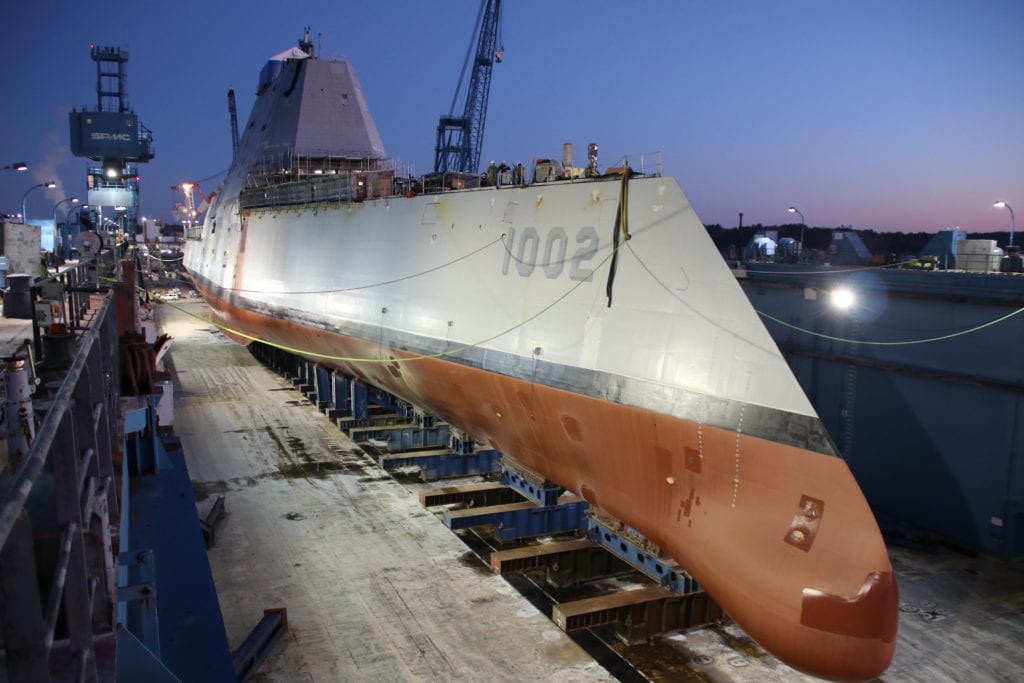
The USS Lyndon B. Johnson is made ready before flooding of the dry dock at General Dynamic-Bath Iron Works shipyard and subsequent launching of the third Zumwalt-class destroyer in 2018. U.S. Navy via General Dynamics-Bath Iron Works
ARLINGTON, Va. — The U.S. Navy’s third Zumwalt-class guided-missile destroyer will be commissioned after its combat systems are fully installed and activated, rather than going through a two-part delivery, the Navy’s top acquisition official said.
The future USS Lyndon B. Johnson (DDG 1002), under construction at the Bath Iron Works shipyard in Bath, Maine, will not be commissioned until after its combat systems are installed, unlike the process used for its two predecessors, USS Zumwalt (DDG 1000) and Michael Monsoor (DDG 1001), said James F. Geurts, assistant secretary of the Navy for research, development and acquisition, speaking to reporters in an April 28 teleconference.
In the case of the first two of the class, the ships’ hulls were completed and put through trials and then delivered to the Navy before their combat systems were installed. The Zumwalt was commissioned — in a status the Navy calls In Commission, Special — in Baltimore and then proceeded to San Diego for installation and activation of its combat systems. It was delivered to the Navy on April 24 and will begin at-sea testing of its systems preparing for its initial operational test and evaluation and its 2021 initial operational capability milestone.
The USS Michael Monsoor similarly was commissioned on Jan. 26, 2019, and proceeded to San Diego for its combat systems installation, which was completed in March.
The Lyndon B. Johnson is 93% complete, Geurts said, but will not be delivered and commissioned until its combat systems are installed. Since the combat systems activation will be conducted in San Diego, it will need to proceed there in a status other than as a commissioned ship.
“We did change to a single-phased delivery for that ship, and so we are adjusting that ship’s future plans based on all the learning we’ve had on DDG 1000 and DDG 1001,” Geurts said.
“I’m personally not a fan of two-phased delivery,” he said. “I can understand why we do them. In certain cases, I think they’re also problematic because you end up delivering the ship more than once and you can get into a delayed test-maintain-fix cycle.”
CACI to Support U.S. Navy Satellite Systems, Networks for Special Operations
ARLINGTON, Va. — CACI International has been awarded contract to provide communications systems, satellite communications and network-support services to the Naval Information Warfare Center (NIWC) Atlantic in support of U.S. Special Operations Command, the company said in a release.
The award is a five-year and six-month (if all options are exercised), single-award indefinite delivery/indefinite quantity contract, with a ceiling value of $199 million.
Under the contract, CACI engineers and technicians will provide mission expertise, including fielding and training for operational systems, maintenance, logistics and 24/7 technical support for personnel working with the satellite and network systems. CACI will support about 2,000 satellite communications systems worldwide, as well as wide-area network infrastructure services for nearly 90 sites.
CACI has a modern facility designed to support and enhance NIWC’s mission. CACI experts can maintain, assemble and test satellite communications systems at the Fayetteville, North Carolina, facility.
“This recompete award results from the long-standing professional and productive relationship between our dedicated team and NIWC, focused on providing service members with the critical communications support they need to execute their mission,” said John Mengucci, CACI’s president and CEO.
CACI Executive Chairman and Chairman of the Board J.P. (Jack) London said, “As our country continues to face evolving national security threats, CACI remains focused on providing the support our customers rely on to safeguard our nation.”