Coast Guard Cutter Offloads 1,300 Pounds of Marijuana
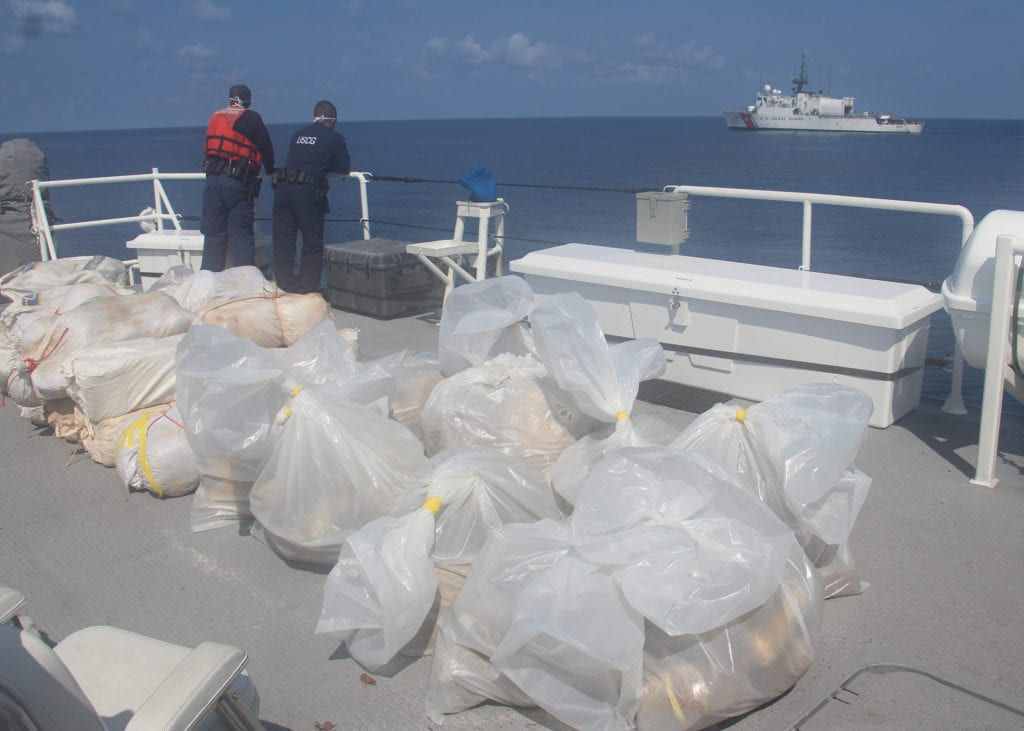
The Coast Guard Cutter Kathleen Moore crew offloaded about 1,300 pounds of marijuana, worth an estimated $1.1 million, on April 13 at Coast Guard Base Miami Beach. U.S. Coast Guard/Ensign Bruna Pavan
MIAMI — The U.S. Coast Guard Cutter Kathleen Moore crew offloaded about 1,300 pounds of marijuana, worth an estimated $1.1 million, on April 13, at Coast Guard Base Miami Beach, according to the Coast Guard’s 7th District.
The drugs were interdicted by the Coast Guard Cutter Harriet Lane in the Caribbean from a suspected drug smuggling vessel.
Numerous U.S. agencies from the Departments of Defense, Justice and Homeland Security cooperated in the effort to combat transnational organized crime. The Coast Guard, Navy, Customs and Border Protection, FBI, Drug Enforcement Administration, and Immigration and Customs Enforcement, along with allied and international partner agencies, play a role in counter-drug operations.
During at-sea interdictions, a suspect vessel is initially detected and monitored by allied, military or law enforcement personnel coordinated by Joint Interagency Task Force-South based in Key West, Florida.
The Harriet Lane is a 270-foot medium-endurance cutter home ported in Portsmouth, Virginia. The Kathleen Moore is a 154-foot fast-response cutter home ported in Key West.
On April 1, U.S. Southern Command began enhanced counter-narcotics operations in the Western Hemisphere to disrupt the flow of drugs. The law enforcement phase of counter-smuggling operations in the Caribbean is conducted under the authority of the 7th Coast Guard District, headquartered in Miami. The interdictions, including the actual boardings, are led and conducted by members of the U.S. Coast Guard.
Special Operations Command Accepts Submersible with General Atomics LiFT Batteries
SAN DIEGO — General Atomics Electromagnetic Systems (GA-EMS) announced April 21 that the first Dry Combat Submersible (DCS) featuring its lithium-ion fault tolerant (LiFT) battery system as an energy source was accepted by the U.S. Special Operations Command (USSOCOM).
The DCS is a long-endurance delivery vehicle capable of transporting personnel in a dry environment. GA-EMS is under contract with Lockheed Martin Corp. to provide LiFT batteries to power the DCS propulsion and internal support systems.
“With demonstrated performance through sea trials and the confidence of USSCOM, our LiFT battery system is becoming a go-to technology when performance is essential for mission assurance,” said Scott Forney, president of GA-EMS.
“The acceptance of the first DCS with LiFT technology represents a solid leap toward meeting the demand for battery systems that offer greater reliability, capability and safety to support critical undersea operations. We are proud to be the provider of this energy source and look forward to seeing DCS vehicles with LiFT battery systems onboard achieve USSOCOM acceptance.”
The LiFT battery system’s modular design and single-cell fault tolerance is designed to prevent uncontrolled and catastrophic cascading lithium-ion cell failure, improving the safety of personnel and platforms while keeping power available for high mission assurance.
LiFT battery systems have undergone at-sea testing by the U.S. Navy and have been classified for use on undersea vehicles by Det Norske Veritas Germanischer Lloyd (DNV-GL), an international accredited registrar and classification society for the maritime industry.
Second Unsafe Intercept by Russia Reported in U.S. 6th Fleet AOR
MEDITERRANEAN SEA — For the second time in four days, Russian pilots flew in an unsafe and unprofessional manner while intercepting a U.S. Navy P-8A maritime patrol and reconnaissance aircraft April 19 in the U.S. 6th Fleet area of responsibility (AOR), according to a release from the 6th Fleet.
A P-8A aircraft flying in international airspace over the Mediterranean Sea was intercepted twice by a Russian SU-35 over a period of about 100 minutes. The first intercept was deemed safe and professional. The second intercept was determined to be unsafe and unprofessional due to the SU-35 conducting a high-speed, high-powered maneuver that decreased aircraft separation to within 25 feet, directly in front of the P-8A, exposing the U.S. aircraft to wake turbulence and jet exhaust.
In response, the P-8A, which was operating at a constant altitude and airspeed, descended to create separation and ensure safety of both aircraft.
The unnecessary actions of the Russian SU-35 pilot were inconsistent with good airmanship and international flight rules, seriously jeopardizing the safety of flight of both aircraft.
This incident follows an April 15 interaction over the same waters, where a Russian SU-35 flew inverted within 25 feet of the U.S. P-8A.
In both cases, the U.S. aircraft were operating consistent with international law and did not provoke this Russian activity.
Rite-Solutions Selected in $74 Million Undersea Weapon Systems Navy Contract
Middletown, R.I. — Rite-Solutions recently was selected as one of 17 companies that will participate in a five-year, $73.7 million contract to help the U.S. Navy develop future generations of its Undersea Weapons Family of Systems (FoS), the company said in an April 20 release.
The contract, announced by the Naval Undersea Warfare Center (NUWC) in Newport, Rhode Island, will develop core technologies in 12 functional areas such as payloads, propulsion, power storage and conversion, vehicle control and command and control.
“We were awarded two functional areas where we have outstanding core capabilities: software development, and modeling and simulation,” said Dennis McLaughlin, president and CEO at Rite-Solutions. “We are very pleased that NUWC recognizes our strengths in building high-performing teams and innovative software-based solutions, as reflected in this award.”
NUWC will release task-order requests for proposals in specific or combined functional areas that companies that received awards may bid on. Unlike contracts that source a finished product from a single company, NUWC will receive components from multiple companies.
“This contract is very similar to the approach NUWC used with the Unmanned Undersea Vehicles (UUVs) Multiple Award Contract,” adds Mike Coffey, Rite-Solutions executive vice president.
“NUWC is taking a best-of-breed approach to acquiring technologies that will enable them to develop, build and support these complex systems. They will integrate and test the different technologies in the prototype phases of weapons development, which will establish the blueprints for future production.”
As with the UUV FoS contract, Rite-Solutions is a prime contractor alongside other companies with demonstrated expertise in undersea warfare. “We are pleased to be included on this contract, with some of the biggest and most reputable companies in the aerospace and defense industry,” Coffey said.
Attack Submarine USS Vermont Commissioned
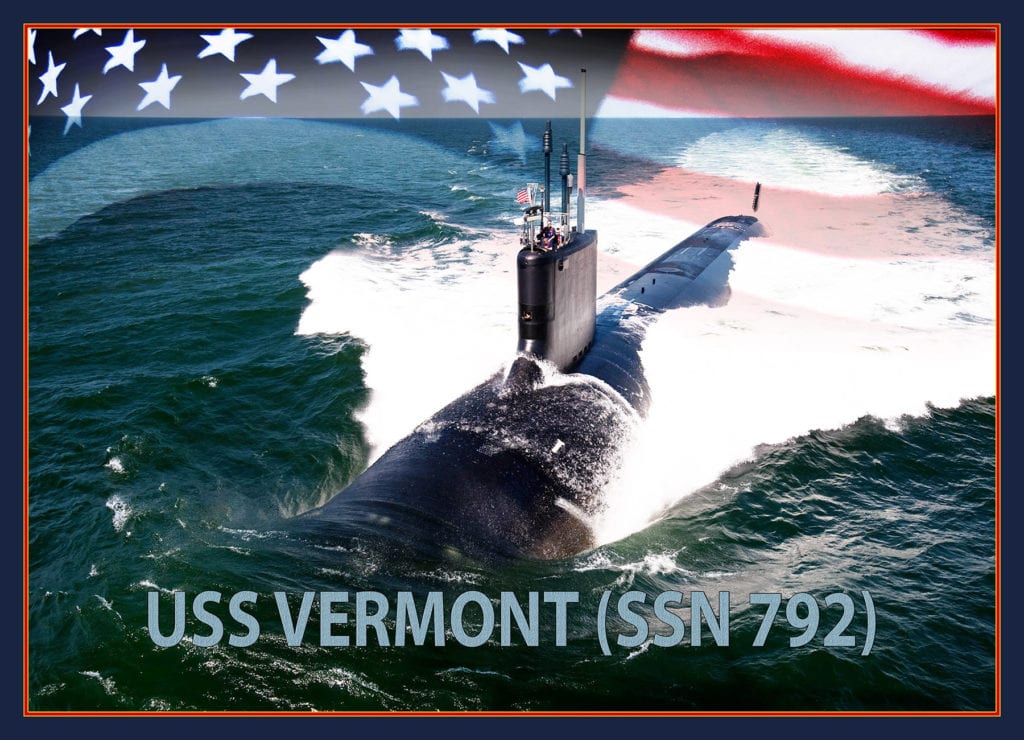
A photo illustration of the Virginia-class attack submarine USS Vermont. U.S. Navy
WASHINGTON — The U.S. Navy commissioned USS Vermont (SSN 792), the 19th Virginia-class attack submarine, on April 18, the Navy said in a release.
Although the traditional public commissioning ceremony was canceled due to public health restrictions on large public gatherings, the Navy commissioned USS Vermont administratively and transitioned the boat to normal operations. Meanwhile, the Navy is looking at a future opportunity to commemorate the special event with the ship’s sponsor, crew and commissioning committee.
“This Virginia-class fast-attack submarine will continue the proud naval legacy of the state of Vermont and the ships that have borne her name,” said acting Navy Secretary James E. McPherson.
Vice Adm. Daryl Caudle, the Navy’s commander of submarine forces, said Vermont’s entry to service marks a new phase of American undersea warfare dominance for a global submarine force that is ready to deter, defend and defeat threats to our nation, allies and rules-based international order.
“This warship carries on a proud Vermont legacy in naval warfare and unyielding determination stretching back to the birth of our nation,” Caudle said.
“To her crew, congratulations on completing the arduous readiness training to enter sea trials and prepare this ship for battle. I am proud to serve with each of you! Stand ready to defend our nation wherever we are threatened — honoring your motto — FREEDOM AND UNITY. May God bless our Submarine Force, the people of Vermont, and our families! From the depths, we strike!”
“This warship carries on a proud Vermont legacy in naval warfare and unyielding determination stretching back to the birth of our nation.”
Vice Adm. Daryl Caudle, commander of submarine forces
USS Vermont’s sponsor, Gloria Valdez, former deputy assistant secretary of the Navy (Ships), offered her gratitude to everyone who played a role in delivering USS Vermont to service. She said she is proud to represent the crew and the first Block IV Virginia-class submarine to enter service.
“I am very proud of the Sailors and families of USS Vermont, who worked so hard to bring her to life, and also feel extremely grateful to everyone who played a role preparing her to defend our nation for generations to come,” Valdez said. “I look forward to commemorating this special occasion together with the crew in the future.”
Vermont’s commanding officer, Cmdr. Charles W. Phillips III, highlighted Vermont’s accomplishments over the past several weeks getting through initial sea trials. The hard work and dedication of the entire team the past few years was evident in the successful execution of at-sea testing, he said.
Phillips added he is especially thankful to the crew and their families, ship sponsor Valdez and the USS Vermont Commissioning Committee, led by Debra Martin, for all their hard work and support of the crew.
“We recognize just how important the submarine force is during this era of Great Power Competition,” Phillips said. “As part of the nation’s maritime asymmetric advantage over our competitors, we are ready to perform whatever duty is most needed.”
“The crew is hungry to hone our skills at-sea and become an effective fighting unit, and we will work tirelessly to justify the nation’s confidence in us,” he added. “Today marks the culmination of six years of dedicated work by the men and women who constructed the nation’s newest and most capable warship. We are all honored to be part of this historic moment.”
USS Vermont is the third U.S. Navy vessel to bear the name of the Green Mountain State. The first Vermont was one of nine 74-gun warships authorized by Congress in 1816. The second Vermont, Battleship No. 20, was commissioned in 1907 and first deployed in December that year as part of the “Great White Fleet.” She was decommissioned in June 1920.
The USS Vermont is 377 feet long, has a 34-foot beam and will be able to dive to depths greater than 800 feet and operate at speeds in excess of 25 knots submerged. The boat’s construction began in May 2014, and it will provide the Navy the capabilities required to maintain the nation’s undersea superiority well into the 21st century.
Vermont is the first the first of 10 Virginia-class Block IV submarines. Block IV submarines incorporate design changes to reduce total ownership cost, as well as allow the Navy to increase the time between maintenance stops and the number of deployments.
DOT Announces Nearly $20 Million in Funding to Small Shipyards
WASHINGTON — The U.S. Department of Transportation’s Maritime Administration (MARAD) has awarded $19.6 million in discretionary grants to 24 small U.S. shipyards through the Small Shipyard Grant Program, according to an April 20 release from MARAD. The funding will help modernize America’s small shipyards, making them more efficient in constructing commercial vessels.
“This $19.6 million federal government investment in the nation’s small shipyards will help maintain the U.S. shipyard infrastructure of our country,” U.S. Secretary of Transportation Elaine L. Chao said.
MARAD’s Small Shipyard Grant Program provides funding to assist eligible shipyards in modernizing operations, improving efficiency and reaping the benefits of increased productivity by investing in emerging technologies and a highly skilled workforce. Projects under the program include capital and related improvement projects that foster efficiency, competitive operations and quality ship construction, repair and reconfiguration. In addition, the program can fund training projects that foster employee skills and enhance productivity.
“Small shipyard grants play a significant role in supporting local communities by creating jobs for working families,” Maritime Administrator Mark H. Buzby said. “These shipyards are a tangible investment in our nation’s maritime infrastructure and the future of our maritime workforce.”
The economic footprint of American shipyards is nearly 400,000jobs, $25.1 billion of labor income and $37.3 billion in gross domestic product.
Navy Cybersecurity Director: ‘No Relaxation of Defenses’ During Telework Time
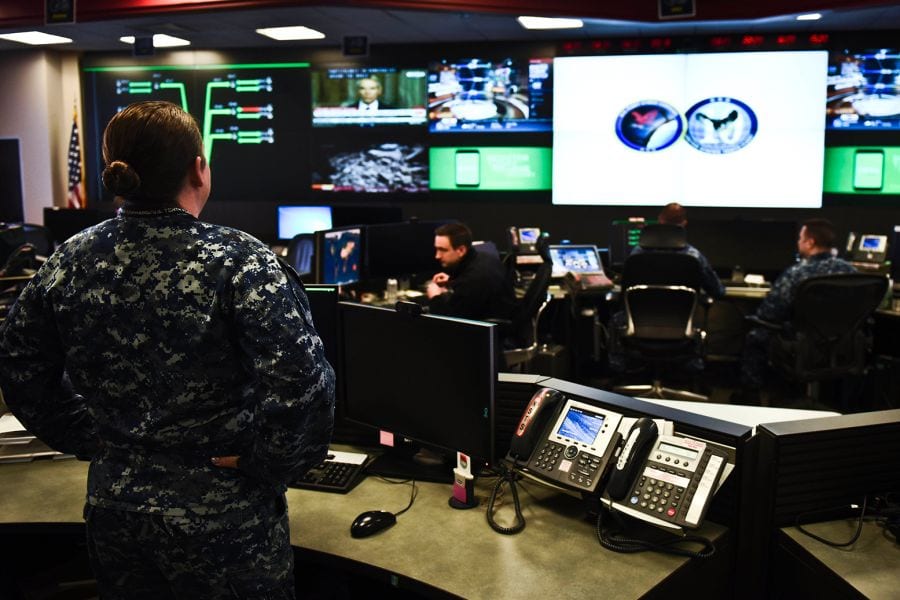
Sailors stand watch in the Fleet Operations Center at the headquarters of U.S. Fleet Cyber Command. U.S. Navy
ARLINGTON, Va. — The U.S. Navy is maintaining a vigilant cyber watch over its data networks as it balances network security and protecting the health of its Sailors amid the COVID-19 pandemic, a Navy admiral said.
“We’re trying to balance two different priorities,” Rear Adm. Kathleen Creighton, director of cybersecurity in the Office of the Chief of Naval Operations, said during an April 17 webcast that was part of the Navy League’s Sea-Air-Space 2020: Virtual Edition. “One is keeping our Sailors and civilians safe and to enable them to work remotely and second is to ensure operational readiness.”
To register and then watch this Sea-Air-Space 2020: Virtual Edition webinar live online, click here.
Creighton said the Navy has had to go through a big cultural shift from working in offices to “ensuring as many people as possible can work from home remotely.”
She said that, in addition to Defense Department partners, the Navy’s industry partners had taken a “first responder-type approach to helping the Navy” by adding infrastructure to handle the ballooning demand for secure telework.
“We’re trying to balance two different priorities. One is keeping our Sailors and civilians safe and to enable them to work remotely and second is to ensure operational readiness.”
Rear Adm. Katherine Creighton
The admiral cited the need for significant expansion of capacity, the need to maximize collaboration capabilities, and determination of any need to change cybersecurity policy “to ensure we can take advantage of remote telework options.”
She said that “on any given day probably only a few thousand people accessed the Navy’s network remotely … before COVID-19. Now, we are seeing upwards of 150,000 or more people accessing the network remotely.”
The great increase in telework required an expansion in capacity requirement for laptop computers, mobile phones, iPads and the VPN servers that they connect to as well as an expansion of Microsoft Outlook 365 use. Circuitry also had to be added to handle the increased use of devices as well as more people manning the help desk for the network.
Creighton said the Navy “has been on a road to modernize and to start using more collaboration capabilities, and this crisis has pushed us to roll those out faster. We’re using some temporary capabilities, and we’re looking to accelerate our permanent capabilities.”
She said the Navy is discovering where the bottlenecks in the network are and fixing them on a piece-by-piece basis. In addition to expanded circuitry, the Navy has been cleaning up user accounts and increasing licenses.
“Every time we increased the capacity, it was used. It filled right up,” she said. “So, the Navy is taking working from home very seriously, trying to protect our Sailors and civilians.”
“Our adversaries in cyberspace know we were doing business differently, so they are responding in kind,” she said, “so we have made sure that anything we have done has not relaxed our cybersecurity standards.”
“There has been no relaxation of any defenses,” she said. “We are securely connecting with that same network from home.”
Creighton said a temporary cloud is being set up to handle a faster roll-out of Office 365.
Looking to the future after the COVID-19 pandemic, Creighton said she believes “there would be a desire to continue a greater level of telework than we saw in the past, so we need to be sure that our network has the capacity to do that, that we have the procedures in place to do it, but most importantly we’re able to do it securely to protect our information and our people’s identity and other things we value as a Navy.”
Marine Cyber Official: ‘Our Networks Are Resilient’ in COVID-19 Environment
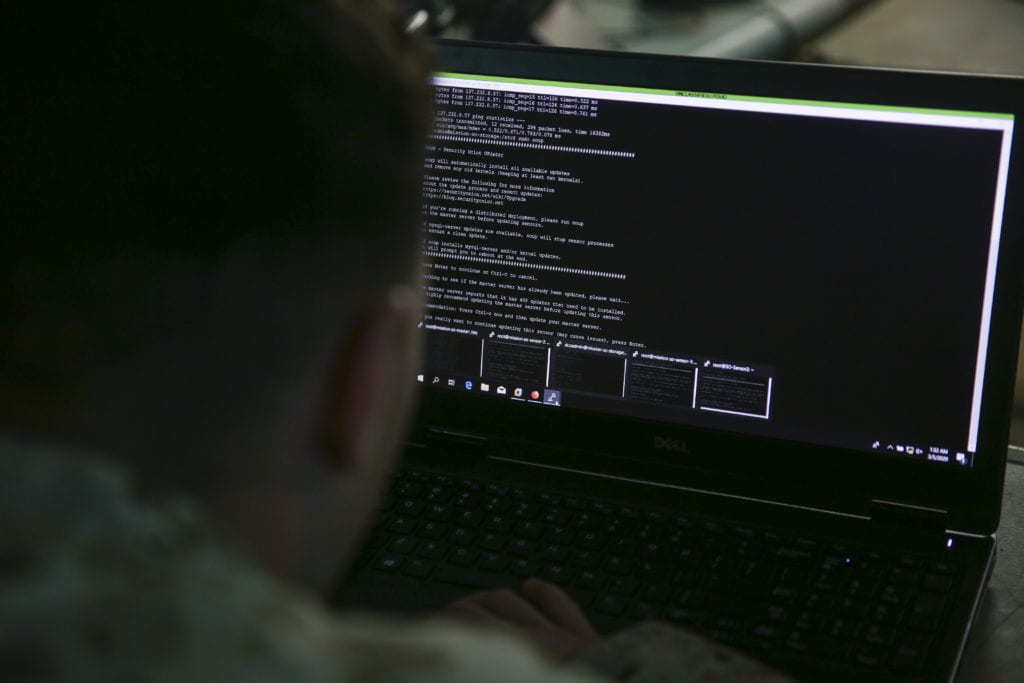
A U.S. Marine assess data during an exercise, Native Fury 20, in the United Arab Emirates on March 5. U.S. Marine Corps/Sgt. Alexis Flores
ARLINGTON, Va. — The U.S. Marine Corps’ cyber networks are being defended and upgraded even as the COVID-19 pandemic forces ad hoc adaptation in their operation, a senior Marine Corps official said.
“Our networks are good, and they are operating at a good capacity and are resilient,” said Gregg Kendrick, executive director of Marine Corps Forces Cyberspace Command, speaking April 17 in a webcast for Navy League’s Sea-Air-Space 2020: Virtual Edition.
To register and then watch this Sea-Air-Space 2020: Virtual Edition webinar live online, click here.
“We’re pleased with our effective efforts in our ability to support the force as it has gone to ad hoc telework or alternate work sites and maintain our capacity and, more importantly, our operational capability to support our warfighters and our commanders that are out there deployed in harm’s way.”
Kendrick said the Corps is monitoring its networks differently in the current environment.
“We do look at our virtual private networks and then we look at our physical and transport layer, our network stack from Layer 1 to Layer 4, so from that perspective we’re focused on those types of metrics and really watching our latency,” he said.
“So, we are very focused on the security. Every decision we have made in regards to supporting the ad hoc telework option has really [been] focused. We’ve had a fundamental security look, and we’ve really looked at our modernization efforts to ensure that we are aware of any of the advanced persistent threats and/or capabilities that are out there to ensure that we have a good, resilient as well as available network.”
“We’re pleased with our effective efforts in our ability to support the force as it has gone to ad hoc telework or alternate work sites and maintain our capacity.”
Gregg Kendrick, Marine Corps Forces Cyberspace Command
Kendrick said his force is looking at “which applications are in use the most, which are stressed the most at the highest capacity, what exactly are our latent measures, … and our overall bandwidth [including] by bandwidth region. Everything [security metrics] is funneled through our enterprise security desk so that we can rapidly pull metrics and shift resources as needed to support our Marine warfighters.”
He said Cyberspace Command is starting to see trends in the pandemic environment, “but we are definitely waiting for this to evolve and then we will be able to draw conclusions, but at the same time we don’t want to let a trend propagate to a point where we have to go into a different work cycle.”
“The bad guys are always looking at what we’re doing, and they are looking to do harm,” Kendrick said. “We protect our workforce. We secure, operate and defend the Marine Corps enterprise networks.”
Kendrick said that through the Corp’s new command-and-control network structure the service is bringing a “unity of command that provides a much clearer readiness picture of our network, our resiliency picture, and then a better overall visualization of the data flow from the end points all the way to the data centers and then back out where they need to go.”
The executive director said the Corps is adopting Microsoft Office 365 to achieve a more efficient capability combined with a hybrid cloud architecture, aiming for higher velocity.
“In the end state the adversary gets a vote,” he said. “They move at speed unconstrained by rules of engagement or the laws of nation states. We need to implement the best infrastructure, the best applications, the best operational processes as efficiently as possible so that we can modernize, provide the best capability to the warfighter, at the same time ensuring security from adversary actions and resiliency across the networks.”
Navy Awards Ship-to-Shore Connector Contract to Textron
WASHINGTON — The U.S. Navy has awarded a contract for the fiscal year 2017-2020 procurement of ship to shore connector craft, the Navy’s Program Executive Office (PEO)–Ships said in an April 16 release.
Ship to shore connectors are the evolutionary replacement for the existing fleet of landing craft air cushion (LCAC) vehicles and will primarily transport weapon systems, equipment, cargo and personnel of the assault elements through varied environmental conditions from amphibious ships over to the beach.
“As the program continues to move forward with delivering these important capabilities to the fleet, the procurement of these additional craft is critical,” said Tom Rivers, program manager of the Amphibious Warfare Program Office for PEO-Ships.
Textron Systems was awarded the $386 million fixed price incentive-firm target and firm fixed price contract modification for the construction of 15 craft. Work will be performed primarily in New Orleans.
The contract award is one of several recent milestones for the program. The Navy accepted delivery of the first of the next-generation landing craft, Ship to Shore Connector Craft 100, on Feb. 6. Craft 100 is the developmental unit for the next-generation landing craft and will be located in Panama City, Florida, where additional testing and crew training will be conducted.
The second craft, LCAC 101, is making headway and will head to sea within the next few weeks for builder’s trials for assessment of its operational readiness. During the trials, LCAC 101 will undergo integrated testing in both unloaded and loaded states to ensure the craft will successfully meet all requirements. The detail design and construction contract procured nine craft. Beyond Craft 100 and LCAC 101, an additional seven craft are in the later stages of production.
Marine Corps Makes First Operational MQ-9A Flight in Middle East
SAN DIEGO — U.S. Marine Corps pilots and sensor operators from Marine Unmanned Aerial Vehicle Squadron 1 (VMU-1) conducted their first operational flight of an MQ-9A Reaper unmanned aircraft system in the Middle East on March 20, according to an Aeronautical Systems Inc. (GA-ASI) release.
The multisensor reconnaissance-equipped MQ-9A UAS produced by General Atomics has provided crucial support to Marine forward operations on the battlefield.
With oversight from the GA-ASI team, VMU-1 “Watchdog” crews took control of a company owned/company operated (COCO) MQ-9A supporting forward-deployed Marines. This achievement comes shortly after surpassing 7,000 hours of COCO flight operations since September 2018.
“This achievement represents a unique milestone and example of the Marine Corps’ legacy of innovation,” said David R. Alexander, president of GA-ASI. “As a partner with the Marine Corps, we look forward to expanding the role of medium-altitude, long-endurance UAS in support of maritime littoral missions.”
VMU-1 leases MQ-9A Reaper aircraft to fulfill its urgent needs request for persistent intelligence, surveillance and reconnaissance (ISR) in Afghanistan. GA-ASI has been working with VMU-1 as the Marine Corps transitions its COCO MQ-9A contract to a government owned/government operated (GOGO) contract in the coming year.
The GOGO capability fulfills the commandant’s directive for USMC Group 5 persistent ISR capability with strike. VMU-1 will be the test bed and incubator to provide crucial information, lessons learned, requirements, tactics, techniques, and procedures that will aid in the Marine Corps efforts for the successful acquisition and fielding of the Marine Air-Ground Task Force Unmanned Aircraft System Expeditionary Group 5 capability.