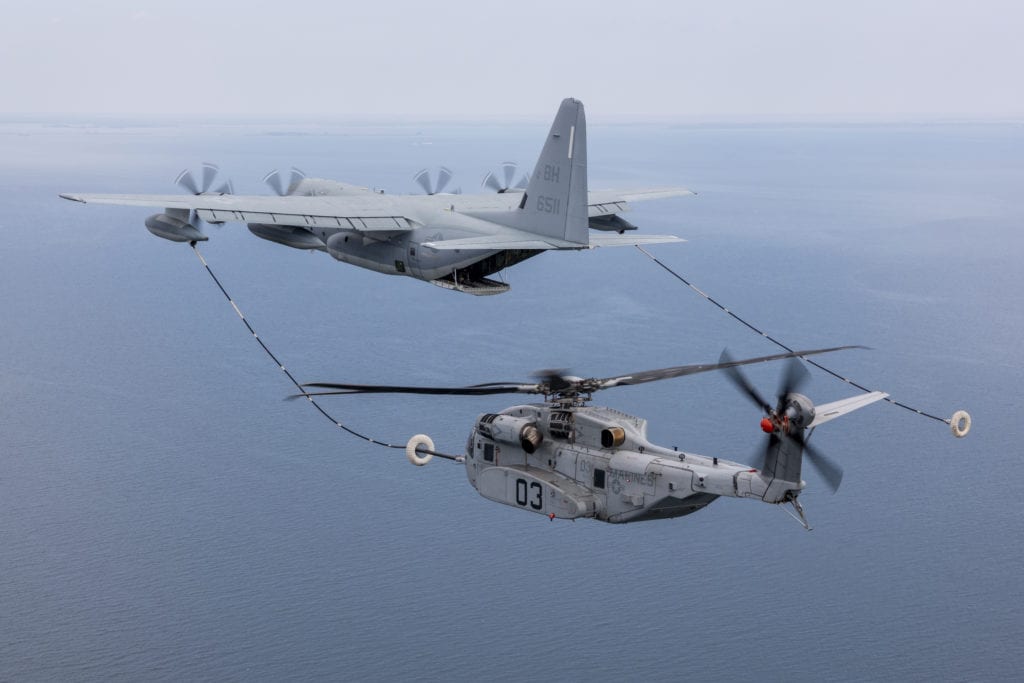
A CH-53K King Stallion heavy lift helicopter refuels from a KC-130J over the Chesapeake Bay on April 6. Sikorsky
NAVAL AIR STATION PATUXENT RIVER, Md. — The CH-53K King Stallion aced an air-to-air refueling test this week, successfully demonstrating long-range logistics support capabilities for the U.S. Marine Corps, Naval Air Systems Command said in a release. The 4.5-hour test was accomplished over the Chesapeake Bay with a KC-130J aerial refueling tanker.
“The aircraft went to the tanker this week and it was very successful, proving it is a long-range vertical logistic workhorse,” said Marine Col. Jack Perrin, H-53 heavy lift helicopters program manager.
According to the CH-53K test team, the wake survey test assessed the performance of the aircraft when flying behind the tanker in strong, turbulent air. The aircraft’s crew successfully plugged the drogue, a funnel-shaped basket towed behind the KC-130J. These tests were performed at increasing closure rates to ensure the CH-53K can handle the forces on the refueling probe when contacting the drogue during aerial refueling.
“The aircraft was able to meet the desired performance for all engagements,” Perrin said. “The ‘K’ is the long-range enabler that we need now and into the future.”
The CH-53K King Stallion continues to execute within the reprogrammed CH-53K timeline, moving toward completion of developmental test, leading to initial operational test and evaluation in 2021 and first fleet deployment in 2023-2024.
“The successful air-to-air refueling test reinforces the superior capabilities of the CH-53K heavy lift helicopter and its ability to carry more Marines, cargo and equipment over longer ranges and in more challenging environments than any other rotorcraft in the world,” Bill Falk, Sikorsky program director, CH-53K, said in an April 10 release.
“As the only fully marinized heavy lift helicopter, it will allow the Marines the operational flexibility and reach to fly over open waters to complete long-range missions in support of expeditionary advanced base operations.”
Pentagon Calls Out China Coast Guard Sinking of Vietnamese Fishing Vessel
ARLINGTON, Va. — The Defense Department spoke out against the recent actions of the China Coast Guard that violated the accepted norms of maritime freedom of navigation and sovereignty.
“The Department of Defense is greatly concerned by reports of a China Coast Guard vessel’s collision with and sinking of a Vietnam fishing vessel in the vicinity of the Paracel Islands in the South China Sea,” the department said in an April 9 statement.
“The PRC’s behavior stands in contrast to the United States’ vision of a free and open Indo-Pacific region, in which all nations, large and small, are secure in their sovereignty, free from coercion, and able to pursue economic growth consistent with accepted international rules and norms. The United States will continue to support efforts by our allies and partners to ensure freedom of navigation and economic opportunity throughout the entire Indo-Pacific.
“The COVID-19 pandemic underscores the importance of the rules-based international order, as it sets the conditions that enable us to address this shared threat in a way that is transparent, focused, and effective,” the statement added. “We call on all parties to refrain from actions that would destabilize the region, distract from the global response to the pandemic or risk needlessly contributing to loss of life and property.”
HII Begins Fabrication of Destroyer Ted Stevens
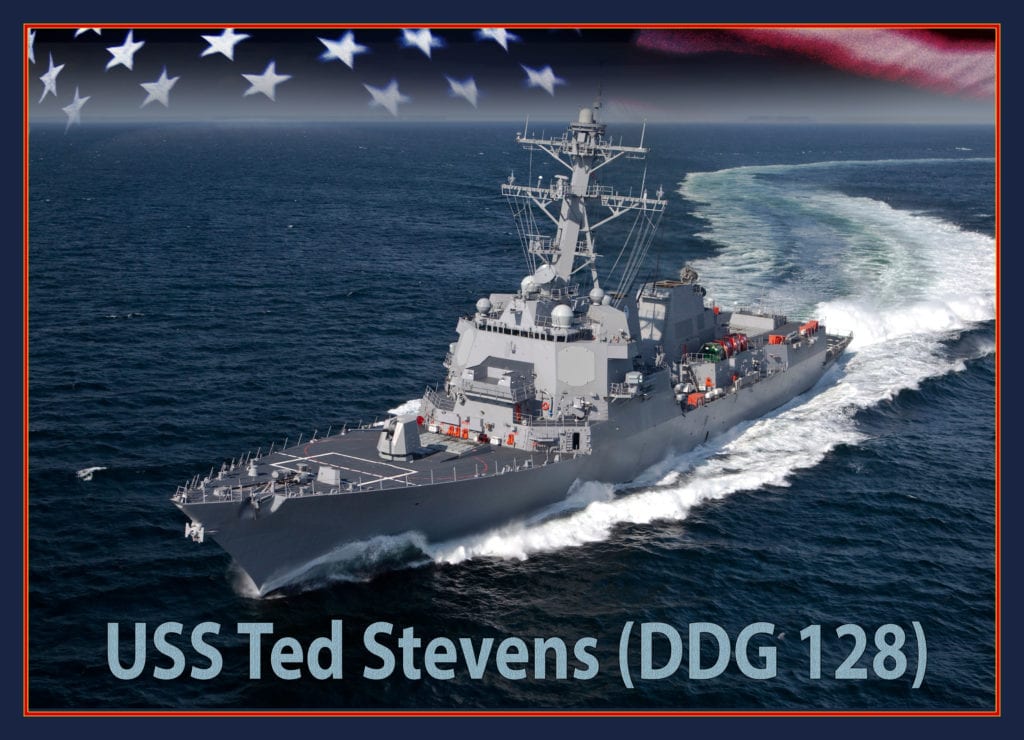
An artist rendering of the future Arleigh Burke-class guided-missile destroyer USS Ted Stevens. U.S. Navy
PASCAGOULA, Miss. — Huntington Ingalls Industries’ Ingalls Shipbuilding division started fabrication of the Arleigh Burke-class destroyer Ted Stevens on April 6, the company said in a release. The start of fabrication signifies that the first 100 tons of steel have been cut.
“As we begin this important milestone in the construction of another great warship, we look forward to continuing production and carrying on the extraordinary legacy of the Navy destroyer fleet,” said George Nungesser, Ingalls’ DDG 51 program manager.
The ship honors former U.S. Sen. Ted Stevens, who served as a pilot in World War II and later represented Alaska. At the time he left office in 2009, he was the longest-serving Republican senator in history.
Ingalls has delivered 31 Arleigh Burke-class destroyers to the Navy. Other destroyers under construction include Delbert D. Black, Frank E. Peterson Jr., Lenah H. Sutcliffe Higbee and Jack H. Lucas.
Arleigh Burke-class destroyers are highly capable, multimission ships and can conduct a variety of operations, from peacetime presence and crisis management to sea control and power projection, all in support of the U.S. military strategy. The guided missile destroyers are capable of simultaneously fighting air, surface and subsurface battles. The ship contains myriad offensive and defensive weapons designed to support maritime defense needs well into the 21st century.
AeroVironment Awarded $10.7 Million Puma 3 UAS Contract for Navy, Marines
SIMI VALLEY, Calif. — AeroVironment Inc. received a $10.7 million firm-fixed-price contract award for Puma 3 AE systems and spares in February for the U.S. Navy and Marine Corps Small Tactical Unmanned Aircraft Systems (SUAS) Program, the company said in a release.
“Puma 3 AE is a combat-proven enabler of U.S. Navy and Marine Corps tactical operations, providing persistent situational awareness, expeditionary reconnaissance, surveillance, and target acquisition, force protection and overwatch — anywhere and at any time,” said Rick Pedigo, AeroVironment’s vice president of business development.
The AeroVironment Puma 3 AE is a man-portable unmanned aircraft system designed for land and maritime operations. The hand-launched Puma 3 AE has a wingspan of 9.2 feet, weighs 15 pounds and can operate for up to 2.5 hours at a range of up to 12.4 miles with a standard antenna and up to 37.2 miles with AeroVironment’s Long-Range Tracking Antenna (LRTA).
Capable of landing in water or on land, the Puma, with its Mantis i45 EO/IR sensor suite, empowers the operator with extended flight time and a level of imaging capability never available in small UAS.
AeroVironment small UAS make up most of the unmanned aircraft in the Defense Department’s inventory and its rapidly growing international customer base numbers more than 45 allies and partner nations.
Coast Guard Interdicts Lancha Crews Illegally Fishing U.S. Waters
CORPUS CHRISTI, Texas — Multiple U.S. Coast Guard law enforcement crews detected and interdicted three Mexican lancha boat crews engaged in illegal fishing in federal waters off the coast of southern Texas on April 6.
Coast Guard crews consisting of air support, a small boat crew and a cutter stopped three lanchas about 50 miles north of the maritime boundary line where a total of 13 lanchamen were engaged in illegal fishing. About 12 miles of longline gear and illegal fishing equipment as well as 2,020 pounds of illegally caught red snapper were seized.
“The Coast Guard’s continued commitment to protecting wildlife and deterring illegal fishing is highlighted in this case,” said Chief Warrant Officer Homar Barrera, Sector/Air Station Corpus Christi command duty officer. “The teamwork between the command center and assets on scene resulted in the flawless execution of multiple interdictions.”
A lancha is a fishing boat used by Mexican fishermen that is about 20 to 30 feet long with a slender profile, having one outboard motor and can travel at speeds exceeding 30 mph. Lanchas are frequently used to transport illegal narcotics to the U.S. and illegally fish in the U.S. exclusive economic zone near the U.S./Mexico border in the Gulf of Mexico.
Philly Shipyard Selected to Build NSMV
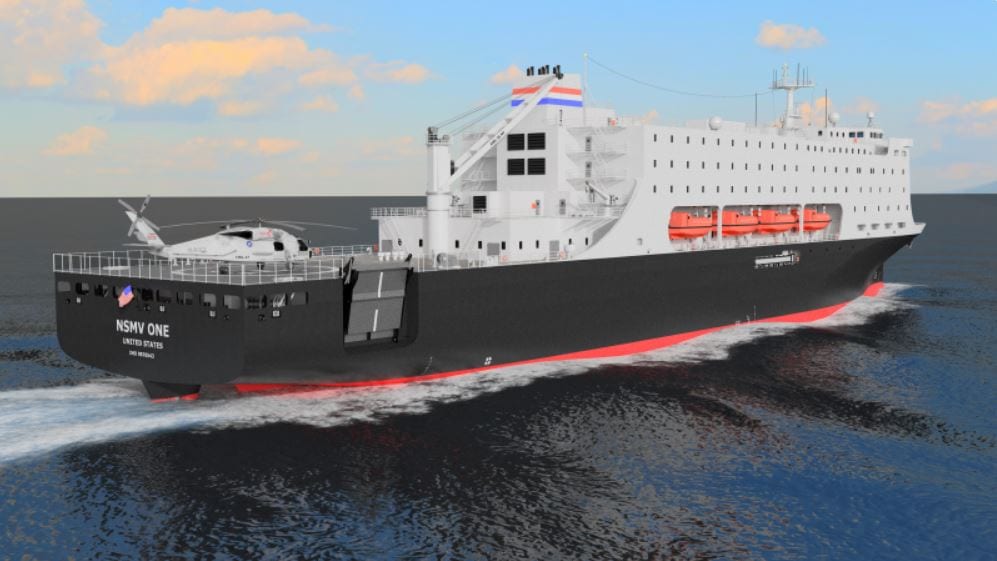
An artist’s rendering of the National Security Multi-Mission Vessel (NSMV). MARAD
WASHINGTON — TOTE Services has selected Philly Shipyard Inc. of Philadelphia to build the newest class of training ship, the National Security Multi-Mission Vessel (NSMV), the Maritime Administration (MARAD) announced April 8.
The shipyard will construct up to five new ships to provide maritime training for America’s future mariners and to support humanitarian assistance and disaster relief in times of need.
“This new world-class vessel, constructed at an American shipyard, is part of our much-needed program to replace the aging training vessels currently operated by state maritime academies,” Transportation Secretary Elaine L. Chao said.
Last May, TOTE contracted with MARAD as the vessel construction manager to deliver one to five NSMVs. This occurred after Congress required that the NSMVs be procured using commercial design and build practices.
Following construction and delivery of the ships to TOTE, the vessels will be transferred to MARAD for their mission of training future licensed mariners at state maritime academies and responding to humanitarian and natural disasters.
“Investing in maritime education creates more American jobs,” Maritime Administrator Mark H. Buzby said.
The NSMV will feature numerous instructional spaces and a full training bridge and have space for up to 600 cadets to train in an at-sea academic environment.
In its role as a National Defense Reserve Fleet vessel, the NSMV will incorporate medical capabilities, a command-and-control platform and berthing for up to 1,000 first responders and recovery workers. The vessel’s roll-on/roll-off ramp and crane to facilitate container storage capabilities will enable it to provide critical support equipment and supplies to those in need during a disaster.
RAF Declares IOC for Poseidon Maritime Patrol Aircraft
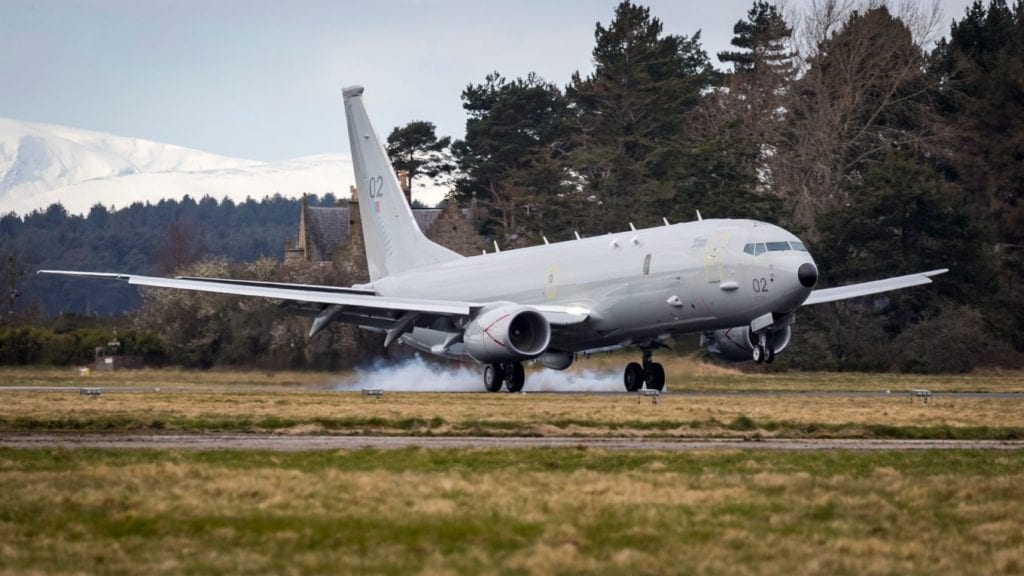
The Royal Air Force receives the newest addition to its P-8A Poseidon fleet, City of Elgin ZP802. Royal Air Force
LONDON — The U.K. Royal Air Force has formally declared an Initial Operating Capability (IOC) of its brand-new Poseidon MRA Mk1 Maritime Patrol Aircraft, the RAF said in a release. The MRA Mk1 is the U.K. designation for the P-8A Poseidon flown by the U.S. Navy.
“The United Kingdom’s Poseidon fleet, currently comprising of two aircraft with seven more to be delivered, strengthens our maritime security, helping to protect our people and our interests, at home and overseas,” the release said.
“Poseidon will now be patrolling our seas, hunting potentially hostile submarines and helping to defend our nuclear deterrent. It uses the very latest in cutting-edge technology to detect, identify and monitor hostile contacts both above and below the waves. It can carry up to 129 sonobuoys to search for enemy submarines and can be armed with Mk54 torpedoes if required to attack enemy submarines.”
“It’s a really exciting time for us in this program, which is moving fast and the team at RAF Lossiemouth has delivered some great results in very quick time,” said Air Commodore Richard Barrow, Poseidon senior responsible owner.
“We’ve still got a long way to go with introducing this next-generation capability into service, but Poseidon is a game-changer, not just for hunting submarines but for a range of other roles from anti-ship warfare, maritime reconnaissance and long-range search and rescue tasks.”
The Poseidon aircraft are operated by 54 Squadron and 120 Squadron, who are currently flying from Kinloss Airfield in Moray, Scotland.
The Poseidons will move to their permanent home at RAF Lossiemouth later this year once the refurbishment work on the runways and airfield infrastructure has been completed, including a new strategic facility. Number 201 Squadron will also stand up later this year.
NAVSEA Bids Farewell to Longest-Serving Civil Servant in Defense Department
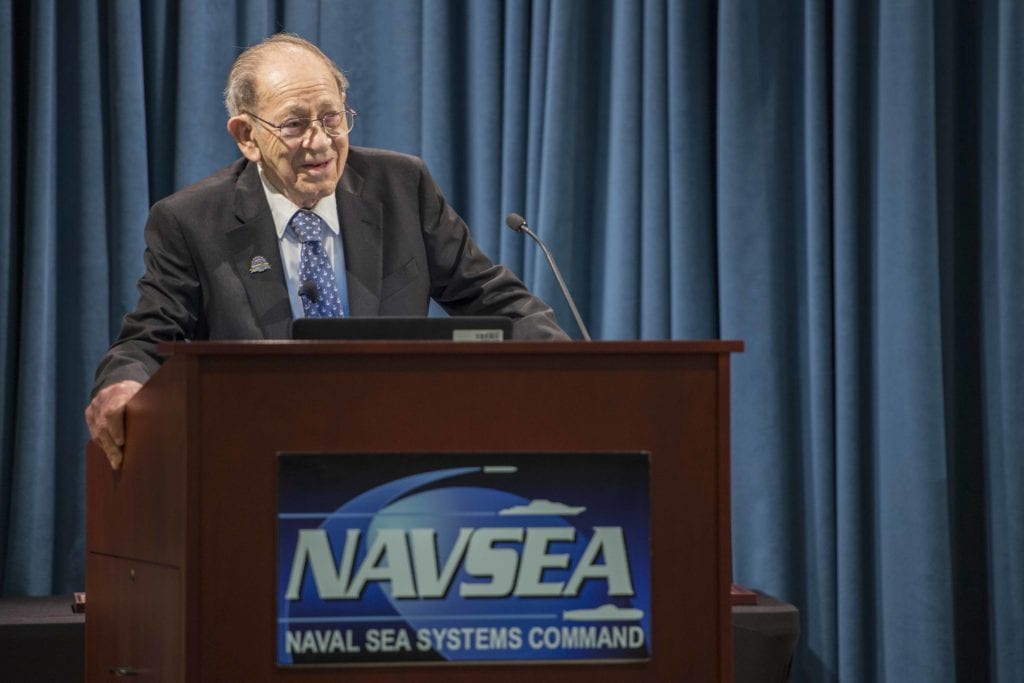
Sarkis Tatigian delivers remarks in 2017 during a celebration of his 75 years of federal service at the Washington Navy Yard. U.S. Navy/Mass Communication Specialist 2nd Class Jackie Hart
WASHINGTON — Sarkis Tatigian, who began his U.S. Navy career at the age of 19 during World War II, passed away earlier this week, leaving behind a nearly 78-year legacy of service to the Department of Defense, Naval Sea Systems Command said in an April 7 release.
At the time of his death, Tatigian, the longest serving civil servant in the history of the DoD, was serving as NAVSEA’s small business advocate.
“Mr. Tatigian truly lived a life dedicated to advocacy and the service of others,” said NAVSEA’s executive director, James Smerchansky.
“His decades of work oversaw the expansion of the small business industrial base and more than $100 billion in contracts awarded to diverse, small businesses. As we bid fair winds and following seas to Mr. Tatigian, NAVSEA will greatly miss his presence, but we will never forget the positive impact he made on this command and the entire U.S. Navy.”
“Mr. Tatigian truly lived a life dedicated to advocacy and the service of others.”
NAVSEA Executive Director James Smerchansky
Tatigian’s civilian career with the Navy began in July 1942 as a junior radio inspector at the naval aircraft factory in the Philadelphia Navy Yard and the Navy Office of Inspector of Naval Aircraft in Linden, New Jersey.
He left his position as an inspector in March 1943 and entered the uniformed Navy as an active-duty Sailor. In June 1944, he started working as an aviation electronics technician’s mate in the development of the Navy’s first guided anti-ship munition, the ASM-N-2 “BAT” glide bomb, which later became an operational weapon used by the fleet at the end of World War II.
In 1946, he left active duty and returned to the Navy department and civil service with the Bureau of Ordnance in Washington, working on the Navy’s first generation of guided-missile systems. From there, he moved on to his life’s passion, helping small businesses, as a small business analyst for the bureau. While in the position, Tatigian developed a small business mobile exhibit that traveled coast-to-coast, visiting all state capitals and cities with populations exceeding 400,000. For his organizational efforts on the exhibit, Tatigian received congressional recognition.
“I was retirement eligible in October 1973. But when you don’t have something to wake up for, that’s when you start to decline. And, if you love what you do and derive a sense of personal worthiness, it’s not really work.”
Sarkis Tatigian
In June 1979, Tatigian was appointed NAVSEA’s associate director of the Small and Disadvantaged Business Utilization Office. The office was eventually renamed the Small Business Program Office, where he continued to serve as an advocate for small business.
In 2012, it was announced during a ceremony honoring Tatigian’s 70 years of service that the Navy’s Office of Business Opportunities Director’s Award would be renamed the Sarkis Tatigian Small Business Award.
The award recognizes outstanding performance by a field activity in creating an organizational climate resulting in the advancement of small business opportunity through exceptionally-managed small business programs and challenging initiatives and who has made significant contributions to the command and the DON small business program. Because of his contributions, Tatigian even won the award that bears his name.
In 2017, NAVSEA celebrated Tatigian’s 75th anniversary of civil service. A unique service pin was specially made to mark the occasion as one celebrating that many years of service had never been given before to an employee.
Tatigian, explained upon his 75th anniversary, why he was driven to continue to come to work each day at NAVSEA.
“I was retirement eligible in October 1973,” Tatigian said. “But when you don’t have something to wake up for, that’s when you start to decline. And, if you love what you do and derive a sense of personal worthiness, it’s not really work.”
Modly Resigns After Backlash Over Insults Directed at Carrier’s Ousted Captain
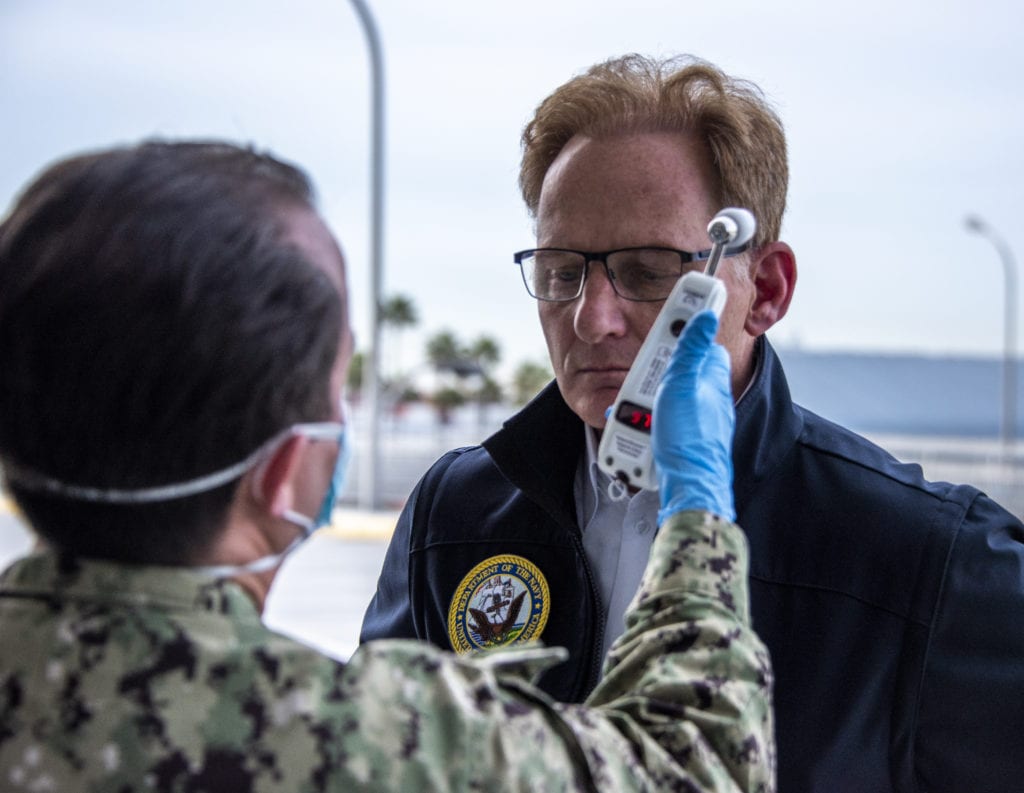
Acting Navy Secretary Thomas B. Modly, who had his temperature checked March 31 during a COVID-19 screening before boarding the hospital ship Mercy in Los Angeles, resigned April 7 after a backlash over his comments toward the former captain of the aircraft carrier USS Theodore Roosevelt. He later apologized for those remarks. U.S. Navy/Mass Communication Specialist 2nd Class Natalie M. Byers
ARLINGTON, Va. — Thomas B. Modly resigned as acting Navy secretary on April 7, a day after calling the ousted captain of the coronavirus-infected USS Theodore Roosevelt “stupid” in a profanity-laced speech to the aircraft carrier’s crew.
Defense Secretary Mark Esper accepted Modly’s resignation, noting in a statement that Modly “resigned on his own accord, putting the Navy and the Sailors above self.”
Esper said he was appointing current Army Undersecretary James McPherson, a retired Navy admiral, as acting Navy secretary until a permanent secretary can be confirmed. McPherson himself was confirmed by the Senate for the Army post only 14 days ago.
In his statement, Esper said he had “the deepest respect for anyone who serves our country, and who places the greater good above all else. Secretary Modly did that today, and I wish him all the best.”
Esper noted that the investigation which Chief of Naval Operations Adm. Mike Gilday had launched into the Roosevelt affair was continuing and any further action regarding its fired commander, Capt. Brett Crozier, “will wait until that investigation is completed.”
Esper said he was appointing current Army Undersecretary James McPherson, a retired Navy admiral, as acting Navy secretary until a permanent secretary can be confirmed.
Modly’s resignation came after a tumultuous series of events that saw him relieve Crozier from command on April 2, fly to Guam, where the ship is docked, and defend his actions in a April 6 address to the ship’s crew that was sprinkled with profanity. In that speech, Modly called Crozier “too naive or too stupid to be the commanding officer of a ship like this,” according transcripts of recordings of Modly’s remarks made by several of the carrier’s crew.
Modly later said, “I stand by every word I said,” even the profanity. However, less than 24 hours after the speech, Modly issued an apology to Crozier, to the Theodore Roosevelt’s crew and the Navy.
“Let me be clear,” Modly said in his statement of apology, “I do not think Capt. Brett Crozier is naive or stupid. I think and have always believed him to be the opposite. I believe, precisely because he is not naive and stupid, that he sent his alarming e-mail with the intention of getting into the public domain in an effort to draw public attention to the situation on his ship.”
Modly “resigned on his own accord, putting the Navy and the Sailors above self.”
Defense Secretary Mark Esper
Crozier’s March 30 letter to dozens of Navy brass and fellow naval aviators sparked the initial controversy that ultimately led to Modly’s resignation a week later.
After three Sailors on the Roosevelt tested positive for COVID-19 — and still more were found to be infected after the carrier made a scheduled port visit at Guam — Crozier believed the carrier had inadequate space to isolate or quarantine Sailors. “The spread of the disease is ongoing and accelerating,” Crozier wrote. He called for disembarking all but a token force of about 10% of the crew until all could be tested for infection, isolated for the required 14 days and the ship sanitized.
The letter was leaked to the San Francisco Chronicle, which published it on March 31, gaining worldwide media attention and highlighting Crozier’s plea: “We are not at war. Sailors do not need to die. If we do not act now, we are failing to properly take care of our most trusted asset — our Sailors.”
The next day, at a Pentagon press briefing, Modly said he was “disappointed” to hear those remarks but added, “We need a lot of transparency in this situation, and we need that information to flow up through the chain of command.”
On April 3, Modly ordered Crozier relieved of his command, saying he had “lost confidence in his ability to lead” during the virus outbreak. Before the letter was published, Navy leadership had already been in touch with Crozier, Modly said. The captain said he wanted his crew evacuated from the ship faster but did not relay “the various levels of alarm that I, along with the rest of the world, learned from his letter when it was published two days later,” Modly said.
Surface Warfare Center Technology Division, Maryland Distillery Partner to Produce Hand Sanitizer
INDIAN HEAD, Md. — The Naval Surface Warfare Center’s Indian Head Explosive Ordnance Disposal Technology Division (IHEODTD) is helping one business give back to emergency responders in dire need of virus-killing hand sanitizers, the division said in an April 6 release.
Following Maryland Gov. Larry Hogan’s executive order limiting social gatherings and the closing of nonessential businesses, Blue Dyer Distilling Co. of Waldorf, Maryland, saw that in their downtime they could fill a niche in the community.
Understanding local first responders were running critically low on hand sanitizer, they pivoted their operations from manufacturing spirits to the production of the much-needed sanitizer. An agreement was signed April 6 with IHEODTD to allow the two organizations to speed the release of the product to first responders.
To date, Dunbar said his distillery has produced about 200 gallons of hand sanitizer, which has been delivered to more than 30 state, local and government agencies.
“We are providing materials, facilities and operators on-site to aid with the large-scale production of this critical commodity,” said Chris Wilhelm, the IHEODTD Office of Research and Technology Applications lead. “This is an opportunity to help a local business do some good in an area where we have the materials and capabilities to aid them. If we can find a unique way to leverage our assets during this crisis, we are going to find a way to do so.”
The agreement allows for Blue Dyer to receive raw materials produced at the command for use at their distillery to produce the hand sanitizer. The agreement is in effect for six months, with the potential for more time added based on need.
Walker Dunbar, the distillery’s founder and co-owner, said that with help from IHEODTD, he and Blue Dyer co-founder Ryan Vierheller are situated to produce large quantities of hand sanitizers to local and federal agencies as well as other organizations serving the public interest.
“Once we realized there was an immediate need for life, health and public safety, we prepared our facility for full-time production,” Walker said. “The assistance we received from Dr. Wilhelm and the rest of the command has been amazing.”