Coast Guard to Invest $350M in Robotics, Autonomous Systems
From Headquarters, U.S. Coast Guard, Sept. 24, 2025
WASHINGTON— The Coast Guard announced Wednesday it will invest nearly $350 million to expand robotics and autonomous systems, strengthening mission execution and operational capabilities.
The funding, provided under the One Big Beautiful Bill Act (OBBBA), includes $11 million in fiscal year 2025 for immediate upgrades to critical autonomous systems.
Initial investments include:
$4.8 million to procure 16 VideoRay Defender remotely operated vehicles (ROVs) to replace Deployable Specialized Forces’ aging fleet.
$2 million to procure six Qinetiq Squad Packable Utility Robot (SPUR) and 12 mini-SPUR robots to replace outdated unmanned ground vehicles (UGVs) at Strike Teams.
$4.3 million to purchase 125 SkyDio X10D short-range unmanned aircraft systems (SR-UAS).
These investments are the first in a series of robotics and autonomous systems projects the Coast Guard will pursue using OBBBA funding. The technologies will meet immediate mission needs, improve personnel safety and strengthen the Coast Guard’s capabilities to control, secure, and defend U.S. borders and maritime approaches.
“These unmanned systems provide increased domain awareness, mitigating risk and enhancing mission success as the Coast Guard continues to operate in hazardous environments,” said Anthony Antognoli, the Coast Guard’s first RAS program executive officer. “The Coast Guard’s mission demands agility, awareness and adaptability. Robotics and autonomous systems deliver all three, enabling us to respond faster, operate smarter and extend our reach where it matters most. We are not waiting for the future to arrive. We are delivering it to the fleet today.”
The Coast Guard’s Deployable Specialized Forces will use the new ROVs for waterfront and pier inspections, hull assessments, subsurface infrastructure surveys, disaster response and search and rescue missions. Their use will reduce reliance on Coast Guard divers, improving efficiency and safety.
Coast Guard Strike Teams, which respond to hazardous materials spills, major marine casualties, groundings, natural disasters, chemical, biological, radiological or nuclear (CBRN) incidents and national special security events, will use the new UGVs to access and sample air in confined spaces aboard commercial vessels.
The SR-UAS will support operations including infrastructure inspections, environmental observation, pollution response, post-storm surveys, ice surveys and communications.
The Program Executive Office for Robotics and Autonomous Systems is part of the Coast Guard’s Force Design 2028 plan, which aims to fully integrate capabilities across the service. Focused on four campaigns – people, organization, contracting and acquisition and technology – Force Design 2028 is an accelerated effort to establish a blueprint for change and transform the Coast Guard into a more agile, capable, and responsive force.
Navy’s NEPTUNE Program Energizes Innovation from Lab to Fleet
“The NEPTUNE program exemplifies the kind of innovative partnerships we need to accelerate defense technology development,” commented Dr. Scott Higgins, ONR program officer, and NEPTUNE lead.
By funding university research teams that include military or veteran students, and focusing on energy-related domains like energy storage, power generation and micro-grids. NEPTUNE rapidly transitions lab concepts toward operational naval solutions. The program has established strategic partnerships with institutions including Stanford, MIT, Purdue University, UC Davis, and others. The results of such partnerships align with the Secretary of the Navy’s priorities of people, capabilities, and processes.
NEPTUNE’s approach emphasizes moving research along the technology readiness scale by advancing basic science (TRL 2-4) to prototype demonstrations in real-world environments (TRL 7). This is done by fostering connections between the Department of the Navy, colleges and universities, and industry.
“These collaborations are proving instrumental in rapidly transitioning innovative technologies from laboratory concepts to operational naval assets” said Dr. Jeff Decker, managing director of Stanford’s Tech Transfer for Defense and a Hacking for Defense program director.
Programs like NEPTUNE are accelerating the time between the lab and real-world impact,” said Justin Fanelli, chief technology officer for the Department of the Navy. “By embedding operational needs directly into university projects, we’re not just moving new technologies forward, we’re ensuring it’s deployable where it matters most – at sea and in the field.”
From Purdue Lab to Startup: EnergyMind Takes Flight
A prime example of NEPTUNE’s impact is the technology transition from Professor Vikas Tomar’s lab at Purdue University into a new startup called Primordis, Inc. Supported by NEPTUNE-funded research at Purdue, Dr. Tomar’s team developed a suite of artificial intelligence algorithms for energy management of autonomous systems, mobile robots, and data centers. His work has resulted in three related patents and now forms the core of Primordis’ EnergyMind platform. Founded in late 2024, Primordis.ai is bringing Purdue University technology to market, targeting applications in both defense and industry.
“This is about bridging the gap between what we demonstrate in the lab and what the warfighter needs on the field,” explains Dr. Tomar, a professor of aeronautics and astronautics and Primordis co-founder.
Primordis describes EnergyMind as a new form of Autonomous Energy Intelligence (AEI) – essentially, a real-time AI decision agent for operators and platforms. Unlike conventional monitoring systems that merely track usage or give static forecasts, EnergyMind proactively guides decision-making on energy use in dynamic environments. It integrates mission timeline goals, operational range priorities, and immediate power consumption into a single predictive gauge. Backed by machine learning, the system continuously learns from context and predicts energy bottlenecks before they occur, suggesting or automatically executing adjustments in real time.
At the individual asset level (say, an unmanned vehicle or a server), EnergyMind can reschedule tasks or rebalance loads to extend runtime without sacrificing performance. At the fleet or enterprise level, it manages charging cycles, route planning, and load distribution across multiple assets to optimize overall energy availability and resilience. Crucially, the platform is hardware-agnostic as it is compatible with any battery chemistry and neutral to OEM, and works in standalone devices or networked across an entire operation. By blending predictive energy “survivability” analytics with the commander’s intent, EnergyMind aims to extend operational reach, reduce downtime, cut sustainment costs, and enhance the endurance of systems ranging from autonomous drones to data centers.
Transitioning this technology out of academia was enabled by NEPTUNE’s support, noted Dr. Tomar. “NEPTUNE allowed us to de-risk the early research and focus on a solution for real naval problems.”
The NEPTUNE framework connected his team with Navy stakeholders who provided feedback during development, ensuring the resulting technology addresses operational pain points like limited battery life and unpredictable power demands in the field. With ONR’s backing, what began as a basic research project on AI-driven battery health monitoring quickly evolved into a deployable capability. In November 2024, Dr. Tomar and colleagues launched Primordis to commercialize EnergyMind and related innovations. The startup is already securing pilot contracts, including with Navy and Marine Corps end-users to integrate EnergyMind into next-generation platforms. This trajectory from lab to spin-off exemplifies how NEPTUNE accelerates the naval “innovation pipeline,” turning university research into products for Sailors and Marines.
AI Power Management for the Fleet
Primordis’s technology is arriving at a pivotal moment, as the Navy and Department of Defense push to electrify platforms and improve energy efficiency across the board. The EnergyMind platform provides a critical piece: AI-powered energy management that can dramatically extend the endurance and reliability of electrically propelled systems. Military and commercial stakeholders are taking note of its potential.
Jeff Wright is CEO of SplashOne Robotics, and the former CTO of Special Operations Command Pacific (SOCPAC), where he led the development of INDOPACOM’s un-manned systems strategy. “We believe this integration [EnergyMind on drones] will create a decisive edge in contested environments where energy autonomy is just as critical as speed, agility, and firepower” he stated. “Single digits of improvement in system life can be decisive: 20% increases are quantum leaps and a ‘no brainer’ to include in our designs.”
Kevin Murray, senior director of Strategic Growth at Anduril Industries shared, “As the former director of S&T and CTO for the U.S. Marine Corps, I see application of this technology across numerous DoD robotic and autonomous system programs at all levels, all the way down to soldier borne mission command and FPV drone operations. I’m unaware of anything similar that could be as impactful.”
Front-line requirements are driving interest as well. A Program Executive Officer at NAVWAR, the Navy’s warfare systems command, underscored the need for greater endurance in unmanned systems. “I need on-station time doubled or tripled for certain USVs. EnergyMind is the type of solution we are looking for,” the PEO remarked. Even industry partners echo this enthusiasm – the CEO of one UAV manufacturer noted that a mere 2% range increase in their drones would be game-changing, so “a 20% increase using Primordis’ technology will be phenomenal.” Such testimonials highlight how advanced energy-management AI could fundamentally improve combat effectiveness: longer loiter times for uncrewed vessels, more patrol hours per battery, and reduced logistics for fuel or battery resupply.
Primordis is positioning EnergyMind to support a wide array of defense systems. In the near term, the company is working with original equipment manufacturers (OEMs) of battery-powered unmanned aerial, surface, and underwater vehicles to embed AI energy controllers in their platforms. The technology is equally relevant to operational energy at the enterprise level – for example, managing the micro-grids powering expeditionary bases, command-and-control hubs, or even directing energy usage for high-power systems like radar and directed-energy weapons. By extending battery life and optimizing power use, tools like EnergyMind can bolster concepts such as Expeditionary Advanced Base Operations (EABO) by reducing the logistics burden and increasing platform uptime. Navy and Marine Corps initiatives that depend on swarms of autonomous systems or long-endurance sensors could see immediate benefits. As one Air Force special operations architect observed, an AI energy management layer can dramatically extend the performance of emerging technologies like high-density batteries and wireless power beaming – multiplying the impact of those innovations in the field. In short, the EnergyMind solution born from NEPTUNE research is poised to give U.S. forces a tactical advantage: the ability to outlast and outmaneuver by intelligently managing every watt.
A Broader NEPTUNE Impact
The Purdue-Primordis story is just one illustration of NEPTUNE’s broader impact on naval technology. Across the country, NEPTUNE-sponsored projects are yielding tangible results in surprisingly short timeframes. A standout example comes from the Massachusetts Institute of Technology, where Professor Steven Leeb’s team, also part of NEPTUNE, developed a groundbreaking Combat Power Monitor (CPM) for shipboard use. Leveraging advances in energy sensing and analytics, Leeb’s group created a system to continuously monitor a ship’s electrical consumption and power quality, enabling real-time insights for condition-based maintenance and fuel economization. With NEPTUNE backing, the MIT researchers moved this concept from the lab to a prototype installed on active Navy and Coast Guard vessels in only 24 months.
“With Professor Leeb’s work, the ability to monitor and manage energy usage on ships ensures that our vessels can operate longer, with greater endurance, and with reduced logistical footprints,” noted Fanelli. “Put simply, Leeb’s work improves naval readiness by keeping ships afloat and out of drydock, which is a focal point for the chief of Naval Operations.”
Such enhancements are crucial in scenarios where at-sea resupply is challenging or when minimizing energy signatures is vital for stealth[19]. The CPM’s rapid transition to ship trials, made possible by NEPTUNE’s university partnerships, underscores how this program speeds up innovation.
As the NEPTUNE initiative continues, it represents a strategic investment in future naval capabilities. By funding promising ideas in academia and teaming scientists with warfighters early, ONR is compressing the timeline from discovery to deployment. Dr. Scott Higgins emphasizes that its mission is not just to invent new technologies but to ensure those innovations make a difference for sailors and marines. The program’s success stories – from smart battery AI at Primordis to MIT’s combat power sensors – are proving the model.
“We stand at an inflection point – an era marked by great power competition, proliferating threats, rapid technological convergence and an increasingly contested maritime domain. To prevail, we must build and sustain a Navy that is ready to fight and win – today, tomorrow and well into the future.” said Admiral Daryl L. Caudle, United States Navy, 34th chief of Naval Operations. “NEPTUNE’s university partnerships are answering that call, delivering energy-smart solutions to the Fleet and fueling a culture of innovation that will help the Navy sail stronger into the future.”
“The unique construct of the NEPTUNE program allows Navy and DoD stakeholders to share capability gaps and technology needs with academic researchers and engages veteran, active duty, reserve and ROTC students in mission-focused research,” noted Corey Love, senior science and technology manager for Power and Energy at the U.S. Naval Research Laboratory and former NEPTUNE program officer. “The positive impact on workforce development hits on two levels: first it provides opportunities to support advanced degrees in science and engineering for veterans, with many who will go on to military civilian or defense industry research positions; and second, it exposes our future military leaders with an appreciation of energy challenges and the importance of making energy-informed decisions on the battlefield. Combined with the focus on advancing technology to promote entrepreneurship to develop the industry required for the future Navy, the tenants of NEPTUNE address Navy priorities outlined by senior leadership.”
To learn more about the ONR NEPTUNE program, visit onr.navy.mil; for more information on the Technology Transfer for Defense program at Stanford University, visit techtransferfordefense.stanford.edu or on the Hacking for Defense Program, visit h4d.stanford.edu.
GDIT Awarded $1.5B Enterprise IT Modernization Contract to Strengthen STRATCOM Readiness
Company will leverage digital engineering, AI, and cyber capabilities to enhance strategic deterrence, including critical nuclear command and control systems
From General Dynamics Information Technology, Sept 25, 2025
FALLS CHURCH, Va. – General Dynamics Information Technology (GDIT), a business unit of General Dynamics (NYSE:GD), announced today that it was awarded an enterprise IT modernization contract to strengthen the U.S. Strategic Command’s (STRATCOM) operational readiness. The new $1.5 billion contract, awarded in May, covers a one-year base period and six option years.
STRATCOM oversees the nation’s strategic deterrence, global strike, nuclear command and control, and electromagnetic spectrum operations around the world. To support its global missions, STRATCOM requires a cutting-edge enterprise IT network environment that connects data and systems to national decision makers and mobile warfighters.
Under this contract, GDIT will leverage its digital engineering capabilities to cut costs, increase efficiency and enhance collaboration among mission partners. The company will also integrate artificial intelligence/machine learning technologies into STRATCOM’s enterprise data to empower decision makers to act quickly. Additionally, GDIT will transition STRATCOM to a new hybrid cloud environment to enable greater flexibility and scalability. To protect the combatant command’s networks and their data from evolving cyber threats, the company will also implement advanced cyber and zero trust solutions.
“Modernizing STRATCOM’s IT capabilities is critical to protecting our national security and maintaining our strategic deterrence edge,” said Brian Sheridan, GDIT’s senior vice president for Defense. “We look forward to delivering a secure, agile and resilient network that enables our warfighters to be better connected, informed and ready.”
The award further expands the company’s mission-critical IT services for combatant commands. GDIT also provides digital modernization services for the U.S. Central Command as well as technical and mission support services for the U.S. Special Operations Command.
Boeing to Relocate F/A-18 Service Life Modification Work to Support St. Louis Site Expansion
The program will be relocated starting in 2026 with all St. Louis based work ending in 2027
From Boeing
ST. LOUIS, Sept. 24, 2025 — As part of Boeing’s [NYSE: BA] expansion and transition plans to support future programs, the company is relocating its F/A-18 Super Hornet Service Life Modification (SLM) work out of the St. Louis region and will sunset the St. Louis based work in 2027.
Boeing is considering multiple sites to transfer the work to with case studies starting at the San Antonio and Jacksonville sites. Boeing currently performs SLM work in San Antonio and in partnership with the U.S. Navy at Fleet Readiness Center (FRC) Southwest in San Diego, Calif. Additional F/A-18 modification work also occurs in Jacksonville, Fla.
An upgraded SLM F/A-18 Super Hornet departs St. Louis heading back to the U.S. Navy fleet. This fighter is equipped with Block III capabilities. Photo Credit / Art Credit: Boeing
“Our expansion plans across the St. Louis site triggered the execution of a multi-year strategic plan, requiring the relocation of some work,” said Dan Gillian, vice president and general manager of Air Dominance and senior St. Louis site executive. “Given we are already successfully conducting SLM at other locations, this move is logical so we can continue to meet our customers commitments while ensuring we are well poised for future work.”
The St. Louis region is home to F-15EX, T-7A and MQ-25 production as well as JDAM and other munitions production lines. In March, the U.S. Air Force announced Boeing will design, build and deliver the F-47 6th generation fighter. Current St. Louis SLM team members will support these programs.
Super Hornet is the backbone of the Navy’s strike fighter inventory, and SLM is critical to supporting the U.S. Navy’s readiness needs. SLM adds Block III capabilities and 4,000 flight hours to existing Navy Super Hornets. Since the program began, Boeing and the Navy have increased inductions each year while improving the turnaround time of the fighters. This work is projected to continue through the mid-2030s. All Block II Super Hornets can be upgraded to the Block III capability suite through SLM.
“We have worked with the Navy for years to improve SLM while growing in San Antonio and FRC Southwest. Delivering multiple fighters and capabilities from multiple locations is what we do, and we will continue that work on the Super Hornets for the life of the fleet,” said Mark Sears, Boeing Fighters vice president.
Coast Guard Prepares for Aircraft Fleet Expansions with Awards for Engines, Radar
A rescue swimmer from U.S. Coast Guard Air Station Astoria dangles below an MH-60 Jayhawk helicopter as it hovers above Elliott Bay near Seattle, Washington, Aug. 1, 2023. The demonstration was part of the Parade of Ships for the annual Seafair festival. (U.S. Coast Guard photo by Petty Officer 2nd Class Steve Strohmaier)
WASHINGTON — The Coast Guard recently completed contract actions aimed at accelerating delivery of new MH-60 medium-range recovery helicopters and HC-130J long-range surveillance aircraft and expanding mission capabilities of the expanded aviation fleet.
On Sept. 8, the Coast Guard placed a $14.3 million order for delivery of 13 General Electric T700 engines for its MH-60 helicopter fleet. On Sept. 18, the Service contracted with L3 Harris Technologies Inc. for delivery of three AN/APY-11 multi-mode radar systems, valued at $13.9 million, to be installed on future HC-130Js during the Minotaur missionization process.
Both orders were made possible due to investments in the Coast Guard fleet made by the One Big Beautiful Bill Act (OBBBA).
The T700 engines are among the long lead-time components needed to grow the Coast Guard’s MH-60 fleet and expedite transition of several air stations from the MH-65E to the MH-60. The MH-60’s range, speed, payload and avionics and sensors suite make it a capable platform for all 11 Coast Guard missions. The aircraft’s ability to locate, identify and track surface targets day or night makes it a valuable search and rescue and law enforcement asset. Transition of air stations is necessary to sustain rotary wing capability as the MH-65E continues to face supportability issues driven by a diminishing supply base for an out-of-production aircraft.
The AN/APY-11 radar system was chosen as the optimal multi-mode radar to enhance operational effectiveness as part of the Minotaur Mission System Suite. The Minotaur Mission System enables the collection and correlation of sensor and track data, which is used to conduct drug and alien interdictions, search and rescue, and other statutory missions.
The Coast Guard’s long-range surveillance fleet is a proven asset vital to control, secure and defend the U.S. border and maritime approaches, facilitate commerce vital to economic prosperity, and respond to crises and contingencies. The Coast Guard HC-130J fleet is the Department of Homeland Security’s airlift asset and can provide critical support to DHS partners in response to national events as well as logistical support during routine operations.
The OBBBA includes more than $3.3 billion to expand the Coast Guard’s HC-130J and MH-60 fleets. Nearly $2.3 billion is for the production and fielding of new MH-60 aircraft and delivery of multiple simulators. Approximately $1.1 billion is for production and missionization of six additional HC-130J aircraft, along with associated spare parts and the service’s first HC-130J simulator
Raytheon, Avio USA Expand Collaboration to Accelerate Mk 104 Rocket Motor Production
ARLINGTON, Va. (September 24, 2025) — Raytheon, an RTX (NYSE: RTX) business, and Avio USA have executed a purchase order for funding of up to $26 million for continued engineering work on the Mk 104 dual-thrust rocket motor to support Raytheon’s Standard Missile franchise.
The purchase order comes 13 months after the businesses signed a contract for preliminary engineering work on the Mk 104 rocket motor. This project secures funding through the Critical Design Review phase, procurement of long lead material for qualification, and will enable increased and accelerated capacity for solid rocket motor production.
“This purchase order represents an important step in expanding our supply chain to ensure the resilience and availability of the Mk 104 rocket motor,” said Barbara Borgonovi, president of Naval Power at Raytheon. “By strategically implementing second sourcing for critical materials, we are not only enhancing our ability to meet customer demand but also strengthening our production capacity for the Standard Missile franchise.”
Prior to this purchase order, the companies successfully completed both a System Requirements Review and Preliminary Design Review, establishing a solid foundation for the next phases of development and production.
“We are proud to continue our work on Mk 104, which is so critical to the United States and our allies,” said VADM (Ret.) James Syring, CEO, Avio USA. “We look forward to advancing the motor through full qualification and into production in the future.”
“Avio is happy to support Avio USA on the Mk 104 activities, providing its longstanding expertise on SRM engineering, material characterization, laboratory and fire testing, sourcing and motor integration with the aim to ultimately support Raytheon’s accelerated ability to deliver to their end customers,” said Giulio Ranzo, CEO of Avio SpA.
Blue Water Autonomy Taps Conrad Shipyard to Build Autonomous Surface Vessels
From Blue Water Autonomy, Sept. 24, 2025
Post-Series A milestone marks shift from R&D to real-world scale and signals new life for American shipyards
BOSTON, Sept. 24, 2025 /PRNewswire/ – Blue Water Autonomy, the Boston-based technology and shipbuilding company designing and building highly producible unmanned ships for the U.S. Navy, today announced it has entered into a production agreement with Conrad Shipyard, a premier Gulf Coast shipbuilder headquartered in Louisiana. The partnership marks a major step forward in Blue Water’s plan to deploy autonomous surface vessels at fleet scale.
The news comes just weeks after Blue Water announced its Series A, bringing the company to $61 million raised to date, and reflects the company’s continued momentum in building operationally ready, scalable unmanned ships that meet near-term defense priorities.
“We’re designing for deployment, not just demonstration,” said Rylan Hamilton, co-founder and CEO of Blue Water Autonomy. “Conrad is a world-class shipbuilder with proven capability, and this partnership puts us in a position to deliver ships quickly, while demonstrating the expertise and scale of existing U.S. shipbuilding capacity.”
Under the agreement, Conrad will assemble Blue Water’s first class of autonomous ships. Conrad plans to use multiple facilities to take advantage of its advanced shipbuilding approach, including highly automated panel line and welding techniques, allowing for parallel builds and scalable throughput.
“Blue Water Autonomy’s design reflects the kind of forward-looking innovation that U.S. shipbuilders are ready to deliver,” said Cecil Hernandez, President and CEO of Conrad Shipyard. “We’re proud to support this program and help bring autonomous naval capabilities to life with the speed, precision, and craftsmanship we’ve been trusted to deliver for over 75 years across commercial and military shipbuilding.”
Blue Water’s partnership with Conrad comes on the heels of consecutive senior shipbuilding hires to build internal capability. Earlier this year, the company hired Tim Glinatsis, a 25-year veteran of General Dynamics NASSCO and Bath Iron Works, followed by multiple hires from the DARPA NOMARS autonomous ship program, including marine engineering lead Ryan Maatta.
U.S. Industrial Base: Ready to Build
This milestone also reflects the company’s broader strategy to activate underutilized U.S. shipyard capacity, particularly small and mid-tier yards that can adapt quickly to new platforms.
“We’ve designed our vessels to be modular, producible, and buildable across the country,” said Hamilton. “What we’re proving with Conrad is just the start. We want to show that the U.S. has the infrastructure to support autonomy at scale, and the talent to build it.”
Blue Water is focused on working with U.S. shipyards that are fully operational today, shipyards like Conrad, that are proven in both commercial and military shipbuilding and can deliver with speed, scale, and precision. Unlike manned warships, which often require years-long timelines and specialized build environments, Blue Water’s platform is intended to be produced, updated, and maintained with speed and flexibility in mind.
U.S., ROK Navies Conduct CONSOL During Freedom Edge 25
AT SEA (Sept. 18, 2025) – Republic of Korea’s Cheonji-class fast combat support ship ROKS Daecheong (AOE-58) connects its fuel line to Military Sealift Command’s commercial charter oiler MT Allied Pacific during a consolidated cargo replenishment (CONSOL) at sea, Sept. 18, in support of Freedom Edge 2025. CONSOL capability is when a specially outfitted MSC-controlled tanker conducts underway refueling operations, transferring fuel and/or cargo to combat logistics-force ships at sea. (Courtesy photo)
AT SEA – Military Sealift Command’s (MSC) commercial charter oiler motor tanker (MT) Allied Pacific conducted a consolidated cargo replenishment (CONSOL) at sea with Republic of Korea’s (ROK) Cheonji-class fast combat support ship ROKS Daecheong (AOE-58), Sept. 18, in support of Freedom Edge 25.
Freedom Edge highlights trilateral defense cooperation between the United States, Japan, and the Republic of Korea, demonstrating their ability to achieve peace through strength on the Korean Peninsula and across the Indo-Pacific.
“Every CONSOL with allies and partners demonstrate not just technical proficiency, but the trust and interoperability at the heart of our alliance,” said U.S. Navy Capt. David L. Reyes, commodore, MSC Far East. “It’s important that we continue to build on these efforts—each evolution strengthens our ability to operate together and ensures the fleet remains lethal, resilient and ready in the Indo-Pacific.”
A CONSOL allows a specially outfitted MSC-controlled tanker to conduct underway refueling and cargo transfer operations with combat logistics force (CLF) ships at sea. This capability reduces the need for CLF ships to return to shore for resupply, cutting costs and maximizing time on station to support the fleet.
According to contracted mariner Capt. Edward Markuske, master of MT Allied Pacific, his crew appreciated the opportunity to work with ROK allies.
“They were very professional and committed to completing the mission while alongside our vessel,” said Markuske. “I hope we get more opportunities to work together with our allies in the Far East, because these joint exercises are integral to our ability to work together going forward. Our ship’s crew appreciates the sense of purpose that comes from being on mission and a job well done.”
This evolution builds on a previous CONSOL between Allied Pacific and Daecheong in June 2025, expanding the ROK Navy’s capacity to sustain fleet operations at sea with fuel, cargo, and stores.
“Collaborating with our international partners to conduct CONSOL exercises enhances the training of our commercial chartered vessels,” said Peter P. Bok, marine transportation specialist, MSC Far East. “The professional development provided to civilian mariners ensures they are prepared to address any potential challenge and maintain peak operational readiness, thereby supporting our Navy’s effectiveness during times of conflict, and help ensure their lethality.”
MSC Far East supports the U.S. 7th Fleet and ensures approximately 50 ships in the Indo-Pacific Region are manned, trained, and equipped to deliver essential supplies, fuel, cargo, and equipment to warfighters, both at sea and on shore. U.S. 7th Fleet is the U.S. Navy’s largest forward-deployed numbered fleet and routinely interacts and operates with allies and partners in preserving a free and open Indo-Pacific region.
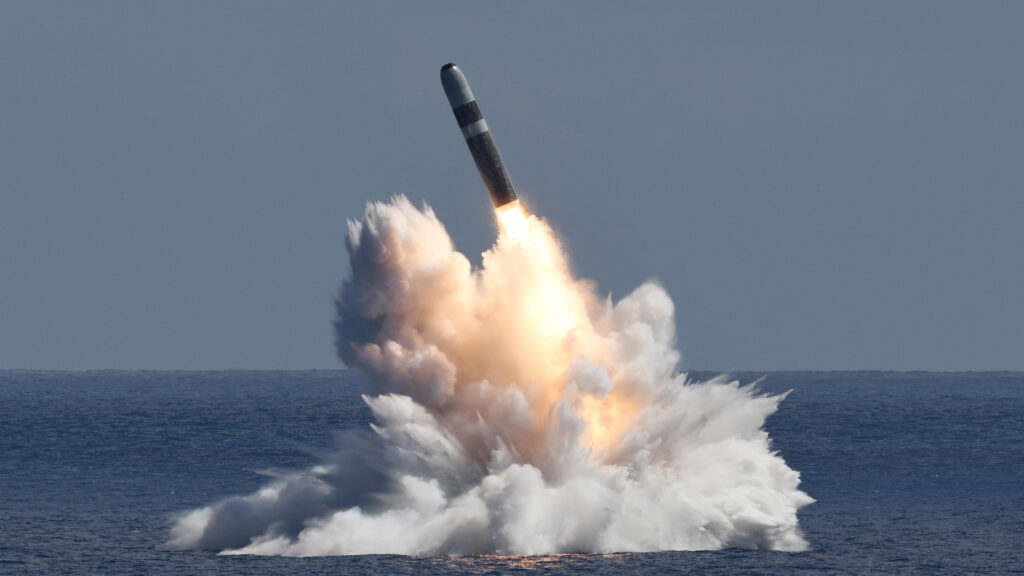
Successful Trident II D5 Life Extension Launches Demonstrate Readiness of Sea-Based Deterrent
ATLANTIC OCEAN (Sept. 17-21, 2025) – An unarmed Trident II D5 Life Extension (D5LE) missile launches from an Ohio-class ballistic missile submarine (SSBN) off the coast of Florida. (Photo by Shelby Thompson)
From April Crew-Kelly, Navy Strategic Systems Progams Public Affairs, Sept. 23, 2025
ATLANTIC OCEAN – The U.S. Navy’s Strategic Systems Programs conducted four scheduled missile test flights of unarmed Trident II D5LE missiles from an Ohio-class ballistic missile submarine off the east coast of Florida from September 17-21. One launch test event Sunday evening lit up the night sky and was visible from Puerto Rico.
Flight tests are conducted on a recurring, scheduled basis to evaluate and ensure the continued reliability and accuracy of the system. The missile tests were not conducted in response to any ongoing world events.
These test flights were part of a planned test event and resulted in the achievement of 197 total successful missile flight test launches of the Trident II D5 strategic weapon system. The test flights were launched from a submerged SSBN and landed in a broad ocean area of the Atlantic Ocean. As part of standard safety requirements, Notice to Airmen (NOTAMs) were issued identifying no-fly zones and Notice to Mariners (NOTMARs) were issued to sea-going vessels identifying stay-out areas for the pre-scheduled test period.
The Trident II D5 strategic weapon system is a highly accurate and reliable weapon system. The D5 missiles were originally developed in the 1980s, and a life-extension refresh was completed in 2017 to extend the service life of the system to the 2040s.
“Our Nation’s submarine launched ballistic missile system has been a critical component of our national security since the 1960s, and these launches continue to demonstrate the credibility and reliability of our strategic deterrence capabilities,” said Vice Adm. Johnny R. Wolfe, Director of the Navy’s Strategic Systems Programs, the command responsible for the Navy’s strategic weapons.
A credible, effective strategic deterrent is essential to our national security and the security of U.S. allies. U.S. strategic weapons capabilities deter aggression and assure our allies by providing unique deterrence effects no other element of U.S. military power can replace.
“For the dedicated SSP team, maintaining our current capability and actively demonstrating through flight testing that the system is ready to respond if called upon is central to ensuring our nation’s Peace through Strength. The team is also pushing ahead developing the next generation strategic weapon system to ensure the sea-based deterrence capability of tomorrow,” Wolfe said.
Strategic Systems Programs is the Navy command providing cradle-to-grave lifecycle support for the sea-based leg of the nation’s nuclear Triad. This includes training, systems, equipment, facilities and personnel responsible for ensuring the safety, security, and effectiveness of the nation’s Submarine Launched Ballistic Missile (SLBM) Trident II D5LE strategic weapon system deployed on Ohio-class SSBNs.
USS John L. Canley Arrives in Palau During Pacific Partnership 2025
KOROR, Palau (Sept. 22, 2025) The Lewis B. Puller-class expeditionary sea base USS John L. Canley (ESB 6), arrives in Koror, Palau in support of Pacific Partnership 2025, Sept. 22, 2025. Now, in its 21st iteration, the Pacific Partnership series is the largest annual multinational humanitarian assistance and disaster management preparedness mission conducted in the Indo-Pacific. Pacific Partnership works collaboratively with host and partner nations to enhance regional interoperability and disaster response capabilities, increased security and stability in the region, and foster new and enduring friendships in the Indo-Pacific. (U.S. Navy photo by Mass Communication Specialist 2nd Class Jordan Jennings)
KOROR, Palau — The Lewis B. Puller-class expeditionary sea base USS John L. Canley (ESB 6) arrived in Koror, Palau Sept. 22, 2025.
“It’s wonderful for our mission to return to Palau, where we look forward to working alongside our multinational allies, partners, and friends as we prepare in calm for possible future time of crisis,” said Capt. Mark B. Stefanik, mission commander for Pacific Partnership. “It’s exciting to be here, as our nations share a rich history of collaboration and cultural ties. We look forward to strengthening that mutual cooperation and friendship in the days and years ahead.”
Pacific Partnership mission includes stops in the Federated States of Micronesia, Papua New Guinea, Chuuk, Pohnpei, Palau, Samoa, Fiji, Vanuatu and the Philippines. “I’m excited to collaborate with the pharmacy staff in Palau, who are asking excellent clinical questions and showing strong engagement,” said Lt. Kamara Gray, pharmacist with the Pacific Partnership medical team. “One area I am particularly looking forward to is antimicrobial stewardship, training on how to use antibiotics appropriately, including knowing the right time to transition from oral to intravenous treatments. I’m also eager to learn about the antibiotics that are no longer effective here due to resistance.”
Pacific Partnership fosters multilateral cooperation and emphasizes a multinational and whole-of-government approach by planning and executing operations with partner nation militaries, host nation civilian agencies, international organizations, non-governmental organizations, the U.S. State Department, U.S. interagency, and other U.S military service branches. This subsequently provides a strong foundation of trust and enhances our collective ability to respond in times of crisis.
In the aftermath of the December 2004 tsunami that devastated parts of South and Southeast Asia, the United States mobilized numerous military assests and personnel to support the relief effort. Recognizing the opportunity to build on the goodwill and lessons learned from Pacific Partnership began as a military-led humanitarian response to one of the world’s most catastrophic natural disasters. Building on the success and goodwill and lessons learned from that initial mission, the U.S. Navy planned and executed the inaugural Pacific Partnership mission in 2006; its primary aim was to proactively prepare for a more effective response to natural disasters while strengthening relationships and security ties between nations.
Pacific Partnership, now in its 21st iteration, is the largest multinational humanitarian and civic assistance mission conducted in the Indo-Pacific. Each year, the mission team works alongside partners and allies to strengthen relationships, bolster host nation capacity to provide essential humanitarian services, and support efforts to reduce the risk of, prepare for, and respond to disasters. The PP25 team is led by U.S. Navy Capt. Mark B. Stefanik, commander of Destroyer Squadron (DESRON) 31, serving as the mission commander.