Lockheed Develops Rack to Make F-35A/C a Six-Shooter
Marines prepare F-35B Lightning II aircraft on the flight deck of the amphibious assault ship USS Wasp. The F-35B can’t accommodate the new Sidekick weapons rack, as its weapons bay is too small, but the F-35C, the Navy’s variant of the joint strike fighter, can. Mass Communication Specialist 3rd Class Benjamin F. Davella III
ARLINGTON,
Va. — The builder of the F-35 Lightning II joint strike fighter has designed a
new weapons rack to enable the aircraft to carry two more missiles internally.
The new rack,
called Sidekick, enables each of the two weapons bays of the Air Force F-35A
and Navy carrier-capable F-35C to carry three AIM-120 Advanced Medium-Range
Air-to-Air Missile (AMRAAM) instead of the current two, for a total of six internally
carried AMRAAMs.
Speaking May
1 to reporters at a Lockheed Martin media briefing, a company F-35 test pilot,
Tony ‘Brick’ Wilson, said the rack was developed entirely with company internal
research and development funds.
“The extra missiles add a little weight but are not adding extra drag.”
Tony ‘Brick’ Wilson, F-35 TEST PILOT
The rack is
not compatible with the vertical lift Marine Corps F-35B version, which has
smaller weapons bay.
The F-35 can
carry more AMRAAMs on external pylons, but Wilson pointed out that carrying two
more internally preserves the stealth characteristics of the F-35.
“The extra
missiles add a little weight but are not adding extra drag,” Wilson said.
Wilson also said the F-35 has the external structural capacity for hypersonic weapons should that be required in the future.
He also said
the company, working with the Air Force Research Lab, has developed and installed
on the F-35A — six years ahead of schedule — the Auto Ground Collision
Avoidance System (AGCAS).
The AGCAS has
“saved eight pilots’ lives,” Wilson said.
He
said the AGCAS will be installed later on the F-35B and on the F-35C in 2021.
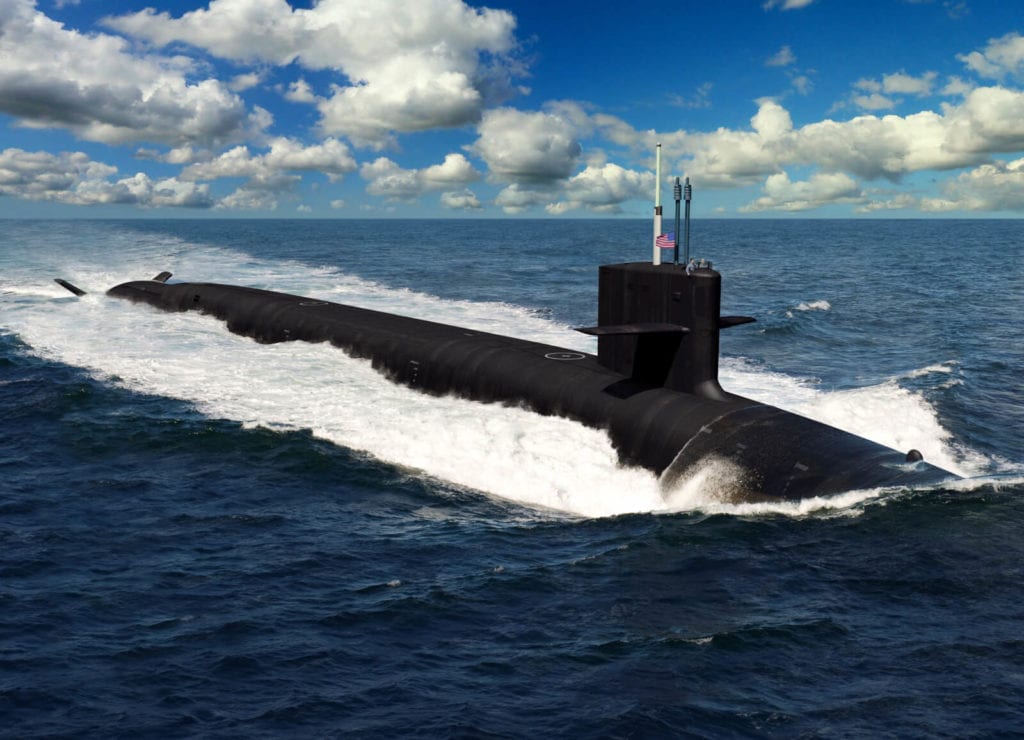
Navy Leaders to Meet May 16 to Assess Sub Construction Delays, Columbia Class Schedule, Secretary Tells House Panel
An artist rendering of the future Columbia-class ballistic missile submarine. U.S. Navy leaders will meet with industry officials in May to examine how they can add more space in the tight schedule to build the first of the Columbia-class ballistic missile submarines, Navy Secretary Richard V. Spencer said. U.S. Navy illustration.
U.S. Navy leaders will meet with industry officials in May
to examine how they can improve the increasingly challenged submarine
production program and try adding more space in the tight schedule to build the
first of the Columbia-class ballistic missile submarines, Navy Secretary
Richard V. Spencer said April 30.
The Navy would like to increase the production of its
Virginia-class attack submarines from two a year to three to stop the decline
in the already inadequate number of attack boats. But that pace is hampered by
the fact that the two shipyards building those boats also are responsible for
getting the Columbia class into service by 2031, when the Navy’s Ohio-class
boomers will be unable to continue their crucial strategic deterrence patrols,
Spencer said.
“We do have concerns,” Spencer told the House Appropriations
Defense Subcommittee. To address those issues, the Navy will sit down with
industry leaders May 16 to assess the sub construction yards and the supply
chain and seek to “build in margin where we can” for the Columbia-class
schedule.
“If we do not, it will run off the rails,” Spencer said in
response to questions from the panel responsible for providing the money the
Navy Department will need for all its programs.
In addition to the questions the appropriators had about the
Columbia class, the Navy’s self-declared No. 1 procurement priority, the
subcommittee’s chairman, Rep. Pete Visclosky (D-Indiana), hounded the Navy
leaders on the chronic problems in submarine maintenance and acceptance of new
warships with multiple material problems.
Visclosky pointed out that three of the older Los Angeles
class attack submarines — Boise, Columbus and Hartford — are no longer
certified to submerge because they have not received maintenance that is
overdue. He emphasized that Boise was scheduled to go into the repair yard in
2013 but still is waiting for an opening.
And Visclosky was particularly troubled by the Navy failing
to request funds to repair the three inoperable submarines in its regular
fiscal 2020 budget request but added them to the unfunded requirements list.
Spencer and Chief of Naval Operations Adm. John M.
Richardson conceded they were having trouble getting submarines into required
maintenance, which was aggravating the inability to meet combatant commanders’
requests for the attack boats, with some reports putting the shortfall as high
as 50 percent.
The two Navy leaders argued that the submarine maintenance
problem stemmed from the sharp reduction in funding during the years when the
Budget Control Act forced sequestration.
But Visclosky replied that “sequestration happened some time
ago” and Congress “provided a lot of money” the last two years.
Spencer said the shipyards cut their skilled work force
during the lean years and are now working to replace those workers and improve
their aged facilities. He and Richardson emphasized the Navy’s program to
modernize the government-owned shipyards and to incentivize the private yards
to also update and expand.
Visclosky also demanded the Navy provide details on the
problem highlighted in a recent Government Accountability Office report showing
a long list of new ships the Navy has accepted from the builders with a range
of deficiencies. He stressed the aircraft carrier Gerald R. Ford (CVN-78), the
first in its class of aircraft carriers, is not expected to be operational
until 2023, nearly five years later than expected because of numerous
construction deficiencies.
The chairman wanted to know how the cost of correcting those
flaws was divided between the Navy and its contractors, noting that GAO
indicated the government has been paying 96 percent. Spencer promised to
provide the data.
Boeing’s MQ-25 Prototype Will Save the Navy 18 Months of Development
ARLINGTON, Virginia — The existence of a working prototype of the Navy’s MQ-25A Stingray carrier-based aerial refueling UAV will save 18 months of development time and could be a factor if the Navy decides to move up the date of the aircraft’s Initial Operational Capability (IOC), currently planned for 2024.
“Eighteen months of early learning is the biggest step” to pushing up IOC, said Dave Bujold, Boeing’s MQ-25 program director, speaking to reporters April 29 at Boeing’s facility in Arlington.
Boeing built its company-owned prototype, called T-1, for the canceled UCLASS (Unmanned Carrier-Launched Aerial Surveillance and Strike) UAV program and, unlike its competitors, had the prototype on hand for the MQ-25 competition. T1 has not yet flown but has participated in taxi tests and overnight on April 28 was transported from the St. Louis, Missouri, plant to Mid-America airport in southern Illinois for additional ground tests and eventually its first flight.
Boeing expects to fly T-1 later in 2019.
Bujold said that T-1 is a “very strong representation of the EMD [engineering and manufacturing development] aircraft” and that waiting for the first EMD aircraft to emerge from the factory would add 18 months to the program.
At Mid-America, T-1 will receive the aerial refueling system of the F/A-18E/F Super Hornet strike fighter and the Joint Precision Aircraft Landing System. The plan includes, in addition to more ground testing, a “couple hundred flight hours,” Bujold said.
Eventually, T-1 will be transported to participate in risk-reduction deck handling trials on board an East Coast aircraft carrier.
Testing is planned to continue through fiscal 2021, the year the first EMD MQ-25A is completed. Bujold said the design will be frozen sometime in 2020.
He said that a factor that could help speed up development is the fact that Navy program officials are embedded with Boeing officials in a common government maritime acceleration team. Rather than having to communicate with stacks of documents, Boeing and Navy officials operate through a shared network drive, a method that, he said, “speeds up acquisition,” using “rolling [program] reviews.”
Australia to Purchase Second Triton UAV
CANBERRA, Australia —The Australian government has agreed to purchase a second MQ-4C Triton, Northrop Grumman Corp., manufacturer of the aircraft, said in a release.
Australia’s 2016 Defence White Paper identified the requirement for seven high-altitude, long-endurance Triton unmanned aircraft. Northrop Grumman will deliver the Triton through a cooperative program with the U.S. Navy.
“Northrop Grumman is excited to develop this unrivaled capability for the Royal Australian Air Force,” said Doug Shaffer, vice president and program manager for the Triton at the company. “Triton will provide the Australian Defence Force a high-altitude, long-endurance system for intelligence, reconnaissance and broad-area surveillance missions to enhance the security of Australia’s borders.”
Defence Minister Christopher Pyne identified “people smuggling and the exploitation of our natural resources” as threats that Triton’s capabilities can help to address.
Minister for Defence Industry Linda Reynolds identified the opportunities this program will create for Australian industry and said that “there will be significant opportunity for Australian industry to share in billions of dollars of system maintenance and network management functions.”
Northrop Grumman is committed to developing a sovereign defense capability for Australia through industrial partnership and participation, direct investment and technology transfer, the company said.
CNO Warns Forum of Challenges of ‘Great Power Competition’
With the return of the “Great Power Competition,” the U.S. Navy’s top officer on April 29 emphasized the need to strengthen ties with allies and partner nations and to condition commanders to avoid turning at-sea incidents into major battles while giving them training that prepares them to fight those battles if necessary.
The Navy also must ensure it acquires new technologies that will win a future war, rather than preserving current capabilities, and that it conducts futuristic training to build a flexible and resilient force that can cope with the unexpected challenges of the future, Chief of Naval Operations Adm. John M. Richardson told the Future Security Forum in Washington, D.C.
“One thing that characterizes our view of success is how we move forward,” Richardson said. The worst thing the Navy could do is remain static, he said.
“What is more relevant for the future? Is it the Harry S. Truman or something else,” he said, noting that revolutionary technologies “are just around the corner.”
The CNO was responding to a question about the Navy’s fiscal 2020 proposal to retire the aircraft carrier Truman at midlife — rather than refueling her — to free up funds to develop the future technologies. That proposal is opposed by key leaders in Congress.
Asked how the Navy was preparing for the return of the “Great Power Competition” with an increasingly antagonistic Russia and rapidly modernizing China, Richardson said it was important to think of tensions in the Black Sea and the western Pacific as regional, not bilateral issues and to help “make all our allies and partners more resilient to this. … How do we reply as an alliance, a team.”
He also stressed the need to be able to respond faster to the competitors’ actions and “to anticipate what the adversary is going to do, and not be reactive.”
Richardson said the Navy also spends a lot of time focusing on things that can happen at sea and doing everything it can “to mitigate the risk” of those contacts with Russian or Chinese ship escalating into a clash. That includes the protocols they have with China “on what to do when we meet at sea,” to communicate and not overreact.
He said he makes that point in his frequent contacts with his peers in the Chinese navy.
“If we don’t consider each other as enemies, don’t act as enemies” when meeting at sea, he said.
Asked if he was concerned that the Navy has not had to fight a major blue water battle since World War II, Richardson said “it’s a real challenge.” He said that he had a discussion of that issue during a recent visit to the Naval War College in Newport, Rhode Island, and during a dinner with a group of future ship commanders.
“It’s about training. How to make it as challenging, as demanding as possible,” and addressing the challenge of training commanders “to exercise the full scope of their authority.”
He also emphasized the need to use simulation and virtual reality to make training more realistic and to better train Sailors to prepare for the challenges of the future.
Sailors, Marines Head to Australia for 6 Months of Intense Training, Exercises With Pacific-Area Allies, Partner Nations
U.S. Marines with Mike Battery, 3rd Battalion, 11th Marine Regiment, 1st Marine Division, fire an M777 Howitzer at known targets during training last August at Mount Bundey Training Area, Northern Territory, Australia, during MRF-D 2018. Credit: MARINE CORPS / Photo by Staff Sgt. Daniel Wetzel
A combined-arms task force of about 1,700 U.S. Marines and Sailors have deployed into Australia for six months of intensive training and an array of exercises that will involve contact with perhaps a dozen allies and friendly nations in strategically vital Southeast Asia and the southern Pacific.
The deployment, called Marine Rotation Force-Darwin (MRF-D) 2019, will provide the Marine Air Ground Task Force (MAGTF) a smorgasbord of training — some in jungle and mountain terrain — practicing amphibious and humanitarian-assistance, disaster-relief operations and combined-arms, live-fire drills in a training area the size of Connecticut, said Marine Col. Charles A. Western, the liaison officer to Australian Defense Forces for Marine Forces Pacific.
Asked the value of the Darwin rotations, Western emphasized “readiness.”
Noting that he had made three deployments to Okinawa with an infantry battalion, he said, “When you go to Okinawa, you are at the top of your readiness spectrum when get there,” having conducted all the extensive pre-deployment training, including live-fire drills.
But in Okinawa “some of the training is circumscribed by what you can fire, by how big the training areas are,” Western said.
What Darwin and the Northern Territory of Australia provides “is the ability to maintain that level of training when deployed, if not increase it. … When they deploy here, along with the Australians, they focused on their training and their readiness. So, it’s really a great opportunity for them to come out here,” he added.
“Speaking from a tactical level, this is me with my Marine infantry hat on, the biggest reason for us to come to Australia is this big, huge training area — the Bradshaw Field Training Area.”
The MAGTF also will participate in numerous multilateral exercises along the northern and eastern coast of Australia and as far away as Thailand, building relations with close allies and partner nations, Western said.
“That’s one of the pillars of MRF-D, the multilateral engagement. We are arm-in-arm with the Australians in everything we do. And there are 10 or 11 multilateral events that we participate in while we’re here.”
The MRF-D deployments have gradually increased in size since the first Marine Rotation Force-Darwin in 2012, taking advantage of the extensive open area and established Australian bases in the sparsely populated Northern Territory and building on a century of close relations with the Australian military.
“Last year, 2018, was designated the Year of Mateship,” Western said, a play on the Australian habit of calling friends “mates.” Last year marked 100 years since U.S. troops fought alongside the Australian Army in World War I in Europe. “We’ve been shoulder-to-shoulder everywhere since.”
U.S. and Australian forces also fought together extensively in the southern Pacific during World War II and again in Korea, Vietnam and some of the 21st-century fights against violent extremists.
MRF-D 2019 involves a MAGTF that consists of an aviation combat element (ACE), Medium Tilt-Rotor Squadron 363 from Kaneohe Bay, Hawaii; a ground combat element (GCE), 1st Battalion, 1st Marines; a logistical combat element (LCE); and a command element from Camp Pendleton, California, Western said.
VMM-363, a MV-22B squadron with 10 tilt-rotor Ospreys, will be augmented by four AH-1Z Viper attack helicopters and three UH-1Y Venom utility choppers.
The force of 1,705 Marines and Navy support personnel, such as doctors, nurses, medical corpsmen and chaplains, may be augmented by additional Marines for Exercise Koolendong, the capstone event at the end of the rotation, he said.
U.S. forces began arriving in April and will depart in October.
Capt. Benjamin J. O’Donnell, an infantry officer with 2nd Battalion, 4th Marine Regiment, 1st Marine Division, views targets while providing indirect fire support from M777 artillery, 81 mm mortars and close air support during training last year at Mount Bundey Training Area, Northern Territory, Australia, during Marine Rotation Force Darwin 2018. Credit: MARINE CORPS / Photo by Staff Sgt. Daniel Wetzel
The GCE and LCE will be based initially at Robertson Barracks in Darwin and the ACE at Royal Australian Air Force Base Darwin. During the rotation, the Marines will conduct training and exercises at the Bradshaw and Mount Bundy training areas in Northern Territory, a jungle training area on the east coast, and at multiple other locations along the east coast for Talisman Saber 19 and other bilateral and multilateral events, Western said.
Talisman Saber is a U.S. Pacific Command exercise, held every two years, that will involve U.S. Navy ships, the MRF-D Marines, Australian, Japanese and Canadian forces and “a bunch of other nations participating,” Western explained.
“A big chuck of Talisman Saber is really about sea power, with the Marines and Australians and the Japanese Army amphibious forces.” U.S. Marines will embark on U.S. or Australian amphibious ships and conduct combined amphibious operations with the Australian landing forces.
“All the [U.S.] services are involved. It’s a joint and combined exercise with the Australians,” Western said. “So, the U.S. Air Force is coming down.
“The MRF-D is really just a small part of that,” he said, providing forces to the Okinawa-based III Marine Expeditionary Force, which will command the combined landing force.
MRF-D also will participate in exercise Southern Jackeroon, which will be conducted in the Australian training area, with Australian, Japanese and U.S. Army elements, Western said. They also will provide some subject matter expertise in engineering to the Australians, “a train-the-trainer kind of thing. And we are participating aboard the HMAS Canberra, one of their LHDs [amphibious assault ships] in an exercise in Thailand.
“We are providing some Marines to PacFleet for one of their CARAT exercises, which goes throughout the Pacific area,” he added.
CARAT, or Cooperation Afloat Readiness and Training, is an annual series of bilateral exercises conducted by the Pacific Fleet with countries of the Association of Southeast Asian Nations (ASEAN). Bangladesh, Brunei, Cambodia, Indonesia, Malaysia, the Philippines, Singapore, Sri Lanka and Thailand have participated in previous CARATs.
Other multilateral exercises the Marines will participate in include Exercise Carabaroo, with the Philippines and Australia; Southern Jackeroo, with Japan and Australia; and Indo-Pacific Endeavor, Western said. Carabaroo, which combines the names of the Philippine carabao and the Australian kangaroo, is an urban warfare training exercise conducted in Australia.
Marine Corps Commandant Gen. Robert B. Neller said in a March 18 memo to Navy Secretary Richard V. Spencer that the unbudgeted assignment of Marines to the Mexican border, the unfunded Pentagon-directed force increase for MRF-D, the need to repair more than $1.7 billion in damage to two East Coast Marine bases and other unexpected activities are “imposing unacceptable risks to Marine Corps combat readiness and solvency.”
The unexpected diversion of personnel and funds could force him to reduce support for Talisman Saber and cancel several planned international exercises, including two with Indonesia, Neller said in the March 18 memo.
Western said he is “tracking the possible impact of budget shortfalls. They will not affect the bulk of MRF-D that begins flowing in next month, just the possible Force Enhancement deployment of the Hawaii-based infantry battalion later in the summer.”
Some of the MRF-D Marines will take advantage of their deployment to conduct training at the Australian jungle training center, experience that could be increasingly important given the growing focus on Asia.
“Koolendong is really our capstone exercise, a combined force exercise with the Australians,” Western said. It comes at the end of the deployment, so they can demonstrate the skills built up during the six months in Australia, he said.
“We bring all elements of the MAGTF together to conduct a live-fire exercise” in the vast Australian training area. “It’s an opportunity to do a MAGTF-level live-fire event,” something that is difficult to achieve in other training ranges.
Although Koolendong is conducted primarily with the Australians, French troops also will be involved, Western said. “They send a platoon out every year” from their base in New Caledonia, he said.
The level of international engagements by MRF-D is increased because Australia makes a point of inviting the militaries from nations in the region to participate in or observe their exercises with the U.S. forces, Western said.
“It’s their country, and we are more than willing to work with the Australians in their efforts to invite multiple countries to come down and participate. Every year, they have an international observers program in which they bring senior international military officers from the region down to Darwin to see what the Marine Corps and the Australians are doing. It is a bit of outreach,” he said.“Regional engagement is one of our pillars for the MRF-D program.” ■
USS America, USS New Orleans to Forward Deploy to Japan; USS Stethem, USS Wasp to Return to U.S.
PEARL HARBOR (Jan. 23, 2018) The amphibious assault ship USS America (LHA 6) and its amphibious ready group (ARG) are moored at Joint Base Pearl Harbor-Hickam.
SASEBO, Japan — The Navy announced that the amphibious assault ship USS America (LHA 6) and landing platform dock USS New Orleans (LPD 18) will become part of the U.S. 7th Fleet forward-deployed forces in Sasebo, Japan, the commander, Naval Forces Japan Public Affairs, said in a release.
The guided-missile destroyer USS Stethem (DDG 63) will shift its homeport to San Diego for its midlife modernization and the amphibious assault ship USS Wasp (LHD 1) will shift its homeport to Norfolk, Virginia, to undergo scheduled maintenance.
America is capable of supporting the F-35B Lightning II, the Marine Corps vertical-lift variant of the Joint Strike Fighter, as part of an embarked U.S. Marine Corps Air Combat Element.
The United States values Japan’s contributions to the peace, security and stability of the Indo-Pacific and its long-term commitment and hospitality in hosting U.S. forces forward deployed there. These forces, along with their counterparts in the Japan Self-Defense Forces, make up the core capabilities needed by the alliance to meet our common strategic objectives.
The security environment in the Indo-Pacific requires that the Navy station the most capable ships forward. This posture allows the most rapid response times possible for maritime and joint forces and brings our most capable ships with the greatest amount of striking power and operational capability to bear in the timeliest manner.
Maintaining a forward-deployed force capability supports the U.S. commitment to the defense of Japan and the security and stability of the vital Indo-Pacific region.
America will provide the Marine Corps with a means of combat operations utilizing the F-35B fighter. New Orleans is capable of ship-to-shore movement by tilt-rotor and helicopter. In addition to combat operations, both ships can conduct humanitarian-assistance operations.
L3 Technologies Awarded Contract for Battle Force Tactical Training
NORFOLK, Virginia — L3 Integrated Maritime Systems has been awarded a $76 million contract to support U.S. Navy shipboard integrated training systems and provide instruction, engineering, systems integration and life-cycle support for the Battle Force Tactical Trainer (BFTT) family of training devices.
BFTT allows coordinated stimulation and simulation of shipboard combat systems to facilitate Navy team training. This training helps Sailors conduct realistic joint warfare drills across the spectrum of armed conflict and enables unit-level team training and battle group fleet synthetic exercises.
“We are pleased to continue to support the U.S. Navy’s combat systems training to maintain proficiency and mission readiness,” said Bill Toti, president of L3 Integrated. “We are dedicated to providing the best training and program support to the Navy’s afloat training groups and our country’s frontline warfighters.”
BFTT delivers training to sailors while aboard their ships in the environment in which they will fight. It assists fleet commanding officers in generating exercises to prepare for expected missions and provides playback of their crew’s performance for continuous improvement. L3 provides instruction and training support at all major Navy ports around the world and Aegis ashore locations.
Black to Become 19th Sergeant Major of the Marine Corps
Sgt. Maj. Troy E. Black has been selected to be the 19th Sergeant Major of the Marine Corps, the Corps announced in a release.
Black is the current Sergeant Major of Manpower and Reserve Affairs and will replace the current Sergeant Major of the Marine Corps, Sgt. Maj. Ronald L. Green, during a post and relief ceremony later this year.
Following the ceremony, Green will retire after 35 years of service.
Since his enlistment in 1988, Black has, among other billets, served as Sergeant Major of Officer Candidates School, the 11th Marine Expeditionary Unit, and 1st Marine Logistics Group. He has deployed extensively, including in support of Operation Desert Storm/Desert Shield, Operation Iraqi Freedom, and Operation Enduring Freedom as well as numerous MEU and Fleet Anti-Terrorism Security Team Company deployments.
His personal awards include the Legion of Merit with Gold Star, Bronze Star with Combat Distinguishing Device, Meritorious Service Medal with two Gold Stars, Navy and Marine Corps Commendation Medal with Combat Distinguishing Device and three Gold Stars, Navy and Marine Corps Achievement Medal with Gold Star and the Combat Action Ribbon with two Gold Stars.
The post of Sergeant Major of the Marine Corps was established in 1957 as the senior enlisted adviser to the commandant of the Marine Corps, the first such post in any of the branches of U.S. military. The Sergeant Major of the Marine Corps is selected by the commandant and typically serves a four-year term.
U.S. Must Add Low-Yield Nuclear Arsenal to Counter Russian Upgrades, Joint Chiefs Vice Chairman Tells Conference
ARLINGTON, Virginia — The United States’ ability to deter a strategic nuclear attack is being eroded by Russia’s fielding of new types of weapons, and the U.S. must respond with new nuclear systems, which may include a sea-launched, nuclear-armed cruise missile, the country’s second highest military officer said April 25.
“Our strategic deterrence is threatened by new classes of weapons. We have to address that,” said Air Force Gen. Paul J. Selva, the vice chairman of the Joint Chiefs of Staff.
One of the weapons that must be matched is the arsenal of low-yield nuclear warheads that Russian President Vladimir Putin has mentioned in a several provocative speeches, Selva said.
Although Russia has had low-yield nuclear weapons for decades, what is new is Russia’s recently stated strategy of using them early in a conflict to force the United States to capitulate rather than replying with the high-power strategic weapons, Selva said. “They call that escalate to de-escalate. That’s inherently destabilizing.”
“Until a few months ago, we didn’t possess a similar low-yield nuclear weapon with which to match that threat. We could only respond with a big one,” he said. That is why last year’s Nuclear Posture Review advocated producing lower-yield warheads, the first of which were completed recently.
Production of lower-yield nuclear warheads, which were phased out of the U.S. inventory after the end of the Cold War, was strongly attacked by opponents of nuclear weapons, who argued that such weapons could make it easier for a president to turn to atomic arms in a conflict.
Selva said: “If any competitor attacks us with a low-yield weapon, we have the option to reply in kind, which is inherently de-escalatory.”
Asked how the new warheads would be used, Selva said the preference was a sea-launched cruise missile, like nuclear-armed Tomahawk land attack missiles (TLAM) that were deployed on U.S. attack submarines during the Cold War, rather than strategic weapons launched from Ohio-class ballistic missile subs.
“Right now, we don’t possess a sea-launched cruise missile that has a nuclear warhead. We have advocated for it and are working on how we might regain a sea-launched cruise missile,” he said. That weapon “provides the capability to extend our deterrent umbrella over some of our Asian allies that we now have to use intercontinental-range systems.”
Selva, who is a key player in nearly all aspects of strategic weapons development and employment, devoted much of his keynote address to the Strategic Deterrence Coalition conference at the Key Bridge Marriott to the massive program of modernizing all elements of the strategic deterrent triad, which consists of the 14 Ohio-class subs and their Polaris missiles, B-52 bombers and land-based Minuteman III ICBMs.
“What is our backstop to all types of nuclear threat? It is our strategic triad, forces that are capable of replying to any use of nuclear weapons against the United States or its allies?” Selva said.
“We must maintain a credible, safe, secure, reliable nuclear arsenal until we can negotiate” a global agreement “to rid the world of nuclear weapons.”
But Selva said the military has “squeezed every bit of life out of” existing weapons and “left ourselves very little margin to be able to deliver the new systems to replace them.”
The Ohio-class submarines “will age out of the fleet by the time we bring in the Columbia class” that would replace them, the B-52s would be nearly 90 years old when replaced by the new B-21s and the Minuteman missiles may need a fourth life extension, when only two were planned, he said.
Although Selva said the total program is estimated to cost $320 billion over 10 years — a figure disputed by private and government analysts — at the peak the program would need “roughly 3.2 to 3.7 percent of the defense budget,” which he called “a bargain.”