Navy Awards Raytheon $258 Million Contract for SM-2 Missiles
From RTX, Aug. 13, 2025
TUCSON, Arizona — The DoD recently announced that Raytheon has been awarded a $258 million contract for the engineering, manufacturing, and development of SM-2 Block IIICU All Up Rounds. This is a new contract for the follow-on integration and test phase of a development program we’ve been in contract for. Majority of work will be performed in Tucson, Arizona and is expected to be completed by September 2031.
“This contract signals the increased demand given the critical role these interceptors are playing for the U.S. and our allies,” said Barbara Borgonovi, president of Naval Power at Raytheon. “The SM-2 Block IIICU variant incorporates several upgrades and will provide the U.S. Navy with a more capable and versatile missile for modern naval defense operations.”
About SM-2:
SM-2 is a cornerstone of a ship’s layered defense. It provides firepower against high-speed, highly maneuverable anti-ship missiles and aircraft and protects naval assets that give warfighters greater operational flexibility.
The missile can be launched from the MK-41 Vertical Launcher System (VLS) and MK-57 Advanced VLS. It will remain a primary anti-air warfare effector for USN Aegis destroyers and cruisers for several more decades.
More than 12,000 SM-2 missiles have been delivered to the U.S. and allied customers. International customers include Australia, Canada, Germany, Japan, Korea, Netherlands, Spain and Taiwan. Chile and Denmark will be the two newest SM-2 missile customers.
The U.S. Navy confirmed it fired SM-2 to intercept anti-ship missiles and drones in the Red Sea in early 2024 to defend against attacks by Houthi rebels targeting commercial vessels transiting the waterway.
Leonardo DRS Completes First Open-Water Demonstration of Counter-UAS Equipment
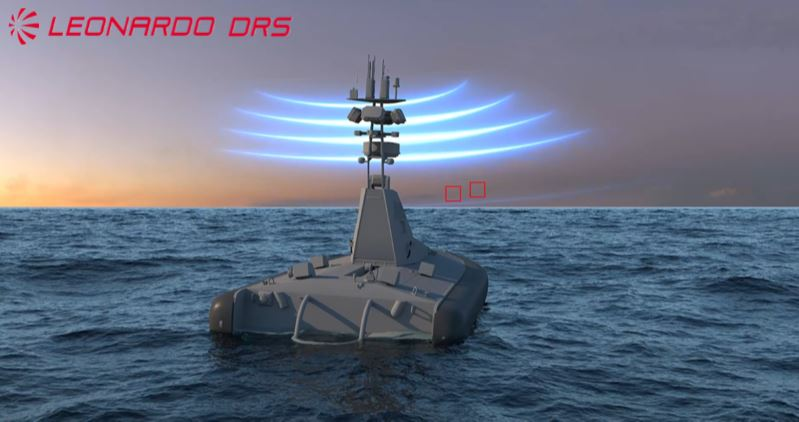
Concept USV with integrated Leonardo DRS MEP. (Leonardo DRS)
From Leonardo DRS, Aug. 12, 2025
ARLINGTON, Va., Aug. 12, 2025 ̶ Leonardo DRS, Inc. (NASDAQ: DRS) announced today that is has successfully completed its first series of open-water demonstrations of its advanced maritime Mission Equipment Package (MEP) for counterUAS (CUAS) naval fleet protection.
The DRS maritime MEP is a scalable C-UAS system based on DRS’s proven land-based mobile short-range air defense and C-UAS systems. This system is designed to be mounted on a range of small uncrewed surface vessels providing remote ship protection at varying distances, providing a real solution as the Navy looks to autonomous surface vessels to protect ships from air and surface threats.
The initial demonstrations were conducted under realistic sea conditions and demonstrated the MEP’s core integrated systems performance – the detection, identification and tracking of a UAS threat and counter-surface ship tracking. The mission equipment package used in the demonstration included a suite of DRS sensors and command-and-control technologies including the BlackLab passive radio frequency (RF) detection system, STAG electro-optic/infrared (EO/IR) gimbal with advanced thermal cameras, and a tactical data management system using DRS’s sensor fusion operating system and AI to support fusion and target recognition using RF and Optical modalities.
“The U.S. Navy faces the same evolving drone threats as our land forces, and we recognize the urgency of delivering a reliable solution to protect the lives of sailors,” said Cari Ossenfort, senior vice president and general manager of the Leonardo DRS Naval Electronics business unit. “By leveraging our proven expertise in mobile ground-based counter-UAS and short-range air defense systems, we have rapidly developed and demonstrated a maritime force protection capability that provides sailors with full-spectrum situational awareness and the tools to detect, track, and defeat threats at the tactical edge.”
The DRS Maritime MEP is designed for mission-flexibility through modularity and platform agnosticism. It is able to integrate advanced active and passive RF, EO/IR sensors, 4G/5G electronicwarfare systems, and scalable kinetic or nonkinetic effectors using its MOSA open system architecture embedded in the Leonardo DRS operating system.
The development and integration of the maritime Mission Equipment Package is an example of DRS’s deep experience as a leading innovator and integrator supporting a wide range of missions for the U.S. military and allies around the world. The company’s integration capability extends across all domains to support force protection, computer networking and C5I, as well as naval power and propulsion systems.
Coast Guard Awards $32M for Runway Reconstruction at Base Elizabeth City, NC
From U.S. Coast Guard East District, Aug. 12, 2025
NORFOLK, Va. – The U.S. Coast Guard’s Facilities Design and Construction Center in Norfolk, Virginia, has awarded RQ Construction a $32 million design-build contract for the reconstruction of crosswind Runway 1-19 and the restoration of taxiways Kilo and Golf at Base Elizabeth City, North Carolina.
The project involves a complete reconstruction of Runway 1-19, which measures 4,518 feet in length and 150 feet in width. The scope of work also includes upgrading the runway lighting system, encompassing runway end identifier lights, edge lights, guidance signs, associated electrical infrastructure and taxiway lighting. A new end-of-runway turnaround apron will be constructed at the Runway 1-19 approach end.
“This significant infrastructure investment will greatly improve air traffic operations and enhance air traffic safety at Base Elizabeth City,” said Capt. Neal Armstrong, commanding officer of the Coast Guard Facilities Design and Construction Center. “Importantly, the project will be constructed without requiring the closure of the primary Runway 10-28, minimizing disruption to ongoing operations.”
Construction is scheduled to begin in 2026 and is expected to be completed by fall 2027.
Base Elizabeth City is a key Coast Guard installation that coordinates and provides regional mission support, including critical search and rescue missions, within the U.S. Coast Guard East District. Air Station Elizabeth City operates HC-130J Hercules aircraft and MH-60T Jayhawk helicopters. Base Elizabeth City is also home to the Coast Guard Aviation Logistics Center, which provides depot-level maintenance for all fixed- and rotary-wing aircraft (HC-27J, HC-144, HC-130J/H, MH-60T and MH-65D), and the Elizabeth City Regional Airport, which hosts a variety of general aviation and light commercial aircraft.
Coast Guard Commissions USCGC Earl Cunningham in Kodiak, Alaska
The Coast Guard commissioned its newest cutter, Coast Guard Cutter Earl Cunningham (WPC 1159), for official entry into its service fleet during a ceremony held in Kodiak, Alaska, Aug. 11, 2025. The ceremony was presided over by Adm. Kevin Lunday, acting commandant of the Coast Guard, and members of the Cunningham family were also in attendance, including the cutter’s sponsor, Penney Helmer, who is also the granddaughter of Earl Cunningham. (U.S. Coast Guard photo by PA3 Carmen Caver)
From Coast Guard Arctic District Public Affairs, Aug. 11, 2025
KODIAK, Alaska — The U.S. Coast Guard commissioned its newest cutter, Coast Guard Cutter Earl Cunningham (WPC 1159), for official entry into its service fleet during a ceremony held in Kodiak, Monday.
The ceremony was presided over by Adm. Kevin Lunday, acting commandant of the Coast Guard. Members of the Cunningham family were also in attendance, including the cutter’s sponsor, Penney Helmer, granddaughter of Earl Cunningham.
“Commissioning the USCGC Earl Cunningham strengthens our ability to control, secure, and defend Alaska’s U.S. border and maritime approaches, protect resources vital to our economic prosperity, and respond to crises throughout the Aleutian Islands,” said Adm. Lunday. “This crew will honor the heroic legacy and selfless devotion to duty exemplified by Petty Officer Cunningham in the years ahead.”
The Earl Cunningham is the 59th Fast Response Cutter (FRC) in the service and the second of three FRCs scheduled to be homeported at Coast Guard Base Kodiak. The crew of the Cunningham primarily serves in and around the Aleutian Islands, Bering Sea, Gulf of Alaska, and North Pacific Ocean. The cutter is designed for missions such as search and rescue; fishery patrols; drug and migrant interdiction; national defense; and ports, waterways, and coastal security.
The namesake for the cutter, Petty Officer 2nd Class Earl Cunningham, enlisted in the Coast Guard in 1928 and was appointed as a surfman. On February 8, 1936, Cunningham volunteered to rescue two ice fishermen that were trapped in the water on Lake Michigan. Cunningham was able to reach them on his skiff and pulled them out of the water. However, adverse weather conditions prevented them from returning to shore.
Three days later, one of the fishermen walked 9 miles across the ice onto shore to safety. The other died trying to make it across the ice with him. Cunningham had died and was found on February 12, frozen in place, still manning the oars of the rescue skiff.
For his ultimate sacrifice, Cunningham was awarded the Gold Life Saving Metal posthumously. He was survived by his wife Helen and three sons.
Cunningham had also previously served in the Army and fought in the trenches of France during World War I, leaving the service as a corporal to eventually join the Coast Guard.
The Coast Guard has ordered a series of new FRCs to replace the 1980s-era Island-class 110-foot patrol boats. Supported by historic investments made possible through President Trump’s One Big Beautiful Bill Act, the legislation provides nearly $25 billion – the largest single funding commitment in Coast Guard history – including $1 billion dollars for additional FRCs.
The FRCs feature advanced command, control, communications, computers, intelligence, surveillance and reconnaissance equipment, and over-the-horizon cutter boat deployment, enhancing the Coast Guard’s operations to control, secure, and defend the U.S. border and maritime approaches. These new assets and capabilities continue the Coast Guard’s modernization through Force Design 2028, an initiative introduced by Secretary of Homeland Security Kristi Noem to transform the Coast Guard into a more agile, capable and responsive fighting force.
The commissioning ceremony is a traditional milestone in the life of a cutter that marks its entry into active service and represents the cutter’s readiness to conduct Coast Guard operations.
Fairbanks Morse Defense to Supply Valves, Actuators for U.S. Coast Guard WCC Program
BELOIT, Wis. – August 12, 2025 – Fairbanks Morse Defense (FMD) has secured a contract from Birdon America to supply key fluid control components for the U.S. Coast Guard’s Waterways Commerce Cutter (WCC) program. The company will deliver motor-operated valves for the first two vessels.
“Safeguarding maritime commerce extends beyond the open ocean. We must also ensure the security and reliability of our inland waterways,” said Michael Johnston, President of Components at Fairbanks Morse Defense. “This contract underscores Fairbanks Morse Defense’s enduring commitment to maritime readiness across all critical corridors that drive the nation’s economy.”
The WCC program is a major modernization effort to replace the Coast Guard’s decades-old fleet of inland buoy and construction tenders, which is approaching obsolescence. These vessels are responsible for maintaining more than 28,000 aids to navigation across 12,000 miles of inland waterways, which are critical routes for the transport of over 630 million tons of cargo annually. Beyond navigation, the cutters also support search and rescue, environmental protection, marine safety, and port security.
The new fleet will have up to 30 vessels consisting of three designs: River Buoy Tenders, Inland Construction Tenders, and Inland Buoy Tenders. The first of these new vessels, which will be constructed at Birdon’s recently acquired Bayou La Batre shipyard in Alabama, includes sixteen River Buoy Tenders and eleven Inland Construction Tenders.
Initial deliveries are expected to be operational in 2027.
Acquired by Fairbanks Morse Defense in 2021, Hunt Valve, together with its divisions, Hunt Valve Actuator, Montreal Bronze, and Pima Valve, LLC, is a trusted provider of advanced fluid power engineering solutions for U.S. and Canadian maritime defense forces. The company brings decades of expertise in delivering high-performance, severe-duty valves and engineered system solutions that meet the rigorous standards of the Navy and Coast Guard and are built to endure the world’s most demanding naval environments.
BAE Systems Awarded $181M Contract Expanding Amphibious Combat Vehicle program
From BAE Systems
August 12, 2025 – BAE Systems received a $181 million contract from the U.S. Marine Corps (USMC) to produce 31 additional Amphibious Combat Vehicles (ACVs), a part of the recently awarded full-rate production (FRP) Lot 5/6 contract. This latest award, designated as FRP 5C, brings the total number of ACV-30s ordered to 91.
The FRP 5/6 contract includes a series of options to produce up to 150 vehicles, with the USMC exercising the option for FRP 5A and 5B in May for 60 vehicles, valued at $360 million.
BAE Systems is also currently under contract for the ACV-Personnel and ACV-Command variants. Work for the ACV-30mm will take place in York, Pennsylvania; Johnstown, Pennsylvania; and Charleston, South Carolina, through the fourth quarter of 2026.
U.S. Central Command Bids Farewell to Gen. Kurilla, Welcomes Adm. Cooper
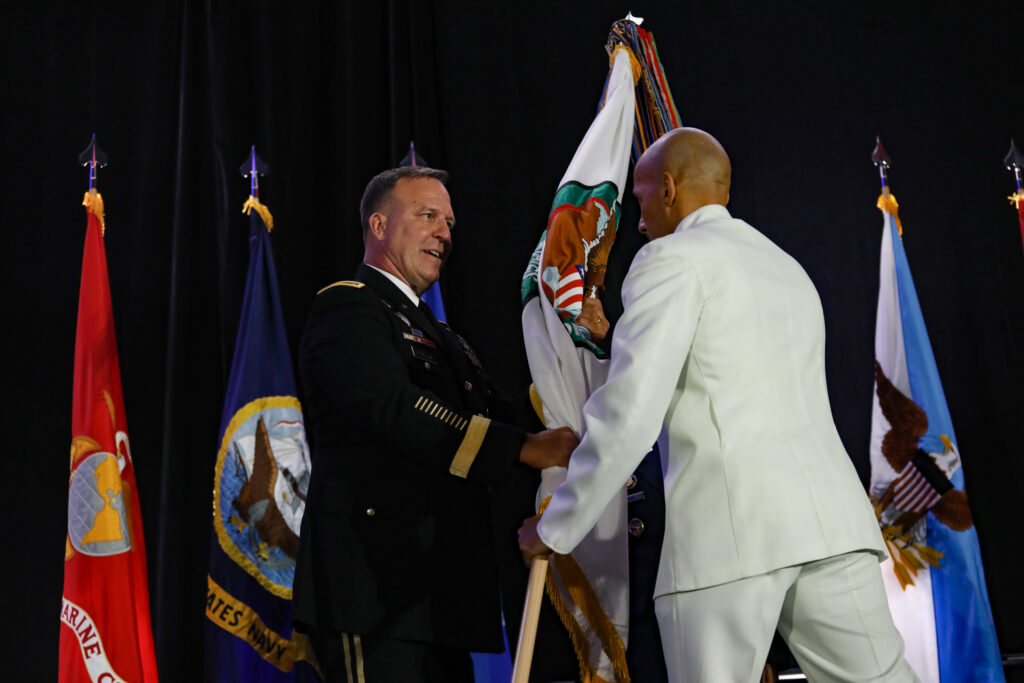
U.S. Central Command’s (USCENTCOM) Senior Enlisted Leader, Fleet Master Chief Derrick Walters passes the USCENTCOM flag to the outgoing commander of USCENTCOM, U.S. Army Gen. Michael Erik Kurilla, during a change of command ceremony, 8 August 2025. Multiple Department of Defense officials attended the event as well as distinguished defense leaders from partner nations around the world. (U.S. Central Command Public Affairs photo by Tom Gagnier)
From U.S. Central Command, August 8, 2025
TAMPA, Fla. — U.S. Army Gen. Michael Erik Kurilla, the outgoing commander of U.S. Central Command (CENTCOM), relinquished command today to U.S. Navy Adm. Brad Cooper during a change of command ceremony held at the Tampa Convention Center. Prior to assuming command, Adm. Cooper served as deputy commander of CENTCOM.
Multiple Department of Defense officials attended the event as well as distinguished defense leaders from partner nations around the world.
Gen. Kurilla assumed command of CENTCOM in April 2022. During his time as commander, he led U.S. military efforts in the Middle East maintaining regional stability and security as well as the enduring defeat of ISIS. He led the planning and execution of over 15 major combined combat operations, including Operations Rough Rider and Midnight Hammer.
“I know that under the leadership of Adm. Brad Cooper, with the support of the Defense Department and Joint Staff, the counsel and contributions of our allies and partners, and support of our headquarters and component teams, the Soldiers, Sailors, Airmen, Marines, Coastguardsmen, and Guardians of Central Command who serve this nation on the front lines of freedom will always succeed,” said Gen. Kurilla. “It has been the honor of my life to have been their commander.”
Adm. Cooper is a 1989 graduate of the U.S Naval Academy and holds a master’s degree in strategic intelligence from the National Intelligence University. As the commander of CENTCOM, Adm. Cooper will have oversight of all U.S. military missions throughout the 21-country area of responsibility which includes the Middle East and Central Asia.
“U.S. Central Command and the entire joint force have performed exceptionally well under the leadership of Gen. Kurilla, helping to bolster partnerships, increase lethality of U.S. forces, and defend Americans and civilians abroad,” said Adm. Cooper. “I am deeply grateful for the opportunity to lead America’s sons and daughters as we support the important mission of enhancing regional security and stability in the Central Command region.”
NAVSEA Leaders Discuss Advanced Technology Needs
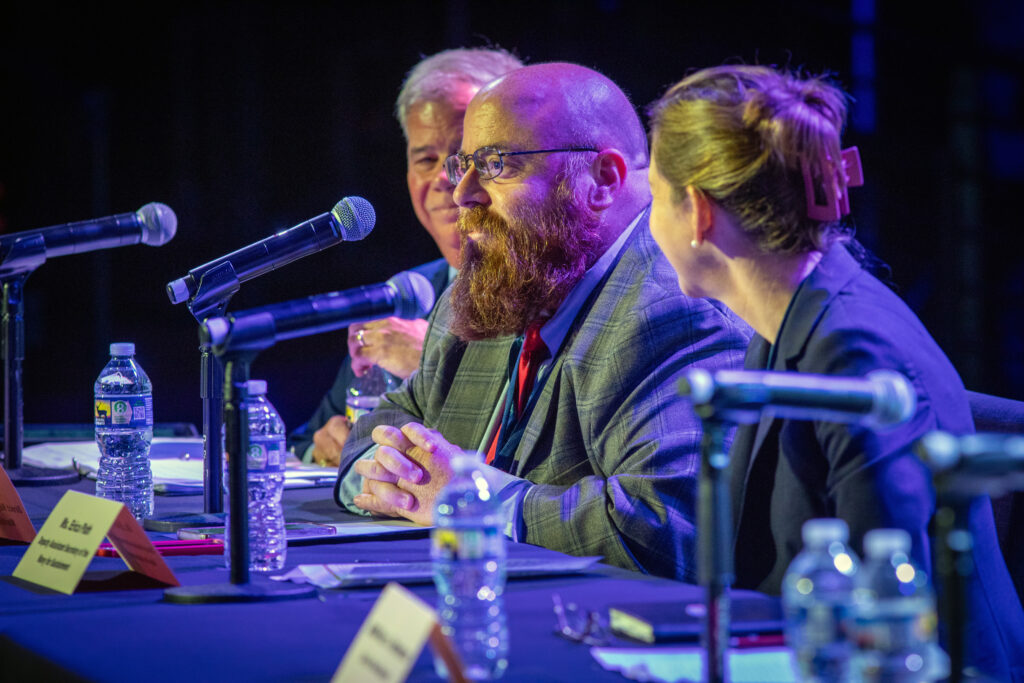
WASHINGTON, DC (August 7, 2025) – Mr. Matt Sermon, Direct Reporting Program Manager, Maritime Industrial Base (MIB), participated in the Strategic Panel at the Maritime Innovation Forum: Advanced Manufacturing: Innovation for Maritime Readiness, that was held at the Capital Turnaround. (U.S. Navy photo by Laura Lakeway)
By NAVSEA Office of Corporate Communications, Aug. 7, 2025
WASHINGTON — Today, Naval Sea Systems Command (NAVSEA) leaders joined more than 360 industry representatives at the Maritime Innovation Forum to discuss the adoption of advanced technologies to improve shipbuilding and repair performance.
The Maritime Innovation Forum 2025 is a national initiative that showcases transformative technologies aligned with the U.S. Navy’s Advanced Manufacturing Strategy.
The forum included a keynote address from Vice Chief of Naval Operations, Admiral Jim Kilby as well as a panel discussion with senior leaders discussing the need to scale innovation. Tom Perotti, executive director and deputy chief engineer of NAVSEA engineering directorate, explained the importance of aligning advanced manufacturing solutions with authorities like Other Transactions (OTs) to quickly address capability gaps and readiness.
“To meet the speed and scale the Fleet demands, we must make advanced manufacturing a foundational capability across the entire shipbuilding enterprise,” said Perotti. “Through innovative tools and systems, scalable solutions and authorities like OTs, we are working to solve problems faster while building a more innovative and agile Navy.”
Matt Sermon, direct report program manager for the Maritime Industrial Base, echoed this forward-looking approach by highlighting recent successes with additive manufacturing.
“We’ve seen in just a few years that additive manufacturing can supply select parts for our ships now,” Sermon said. “What we want to see in a few more years are entire shipyards, workforce and supply chains integrated by advanced manufacturing processes, technologies and of course, AI.”
Throughout the forum, NAVSEA leaders discussed case studies where OT authorities have been successfully leveraged. Since 2020, NAVSEA has awarded more than 600 OT agreements to expedite needed ship construction, maintenance and modernization solutions. NAVSEA’s OT successes shared at the forum included the following:
LM2500 Gas Turbine Navy Common Core Controller (GTNC3): With over 300 LM2500 engines powering the surface Fleet, GTNC3 standardizes the control system across platforms. Developed under the Maritime Sustainment Technology and Innovation Consortium (MSTIC) OT, GTNC3 addresses longstanding variability in control architecture and strengthens long-term sustainment.
Strike Up/Down System (SUDS): This innovation supports rearming the MK41 Vertical Launch System at sea. SUDS was developed under the DoD Ordnance Technology Consortium OT and aims to reduce the need for ships to return to the port for rearming and preserve combat readiness.
High-Density Ribbon Fiber Optic Cable and Shipboard Tooling: This initiative increases fiber density by 12-fold, while maintaining compliance. Developed under the National Shipbuilding Research Program OT with contributions from Ingalls Shipbuilding, Newport News Shipbuilding and others, it enhances shipboard data transfer while simplifying installation.
These projects exemplify how OT agreements fill critical technical gaps across NAVSEA’s acquisition portfolio, delivering faster, more affordable and flexible solutions to the Fleet.
During the afternoon of the forum, there were presentations about innovative technologies in the areas of additive manufacturing and 3D printing, robotics and automation, coatings and surfaces, as well as next-generation digital tools, materials and processes. These presentations showcased high-impact technology that aligns with the Navy’s modernization goals and industrial expansion priorities.
Through these collaborative efforts, the Maritime Innovation Forum illustrated how technological innovation, alternative agreements and partnerships are directly strengthening the Navy’s maritime readiness and industrial base.
In closing remarks, Rear Adm. Pete Small, NAVSEA’s chief engineer and Warfare Centers commander, reiterated the importance of collaboration and emphasized NAVSEA’s commitment to scaling innovation that delivers results.
“This forum is a testament to what we can achieve when we come together to collaborate on innovative, scalable and real-world solutions to today’s most pressing shipbuilding and sustainment challenges,” said Small. “The demand is here, and NAVSEA is driving it forward with the help of partnerships, innovative technology and advanced manufacturing.”
Coast Guard Commissions Icebreaker Storis in Juneau
The Coast Guard Cutter Storis in Juneau for its commissioning as the nation’s newest Arctic icebreaker. Photo credit: Craig S. Neus
JUNEAU, ALASKA— On Saturday, Aug. 10, U.S. Senator Dan Sullivan (R-Alaska) and Admiral Kevin Lunday, acting commandant of the U.S. Coast Guard, participated in the commissioning ceremony of the United States Coast Guard Cutter Storis (WAGB 21) in Juneau.
Storis, the renamed and reconditioned former commercial icebreaker Aiviq, is the country’s first new icebreaker in a quarter century. Sullivan has championed the effort to build new American icebreakers and to procure commercially available icebreakers, and to homeport them in Alaska in order to close the icebreaker gap in the Arctic.
News reporters on the bow-mounted helicopter pad aboard USCGC Storis. Photo credit: Craig S. Neus
“Storis adds vital capability to the U.S. polar icebreaker fleet at a critical time, when our adversaries are expanding their activities in and near U.S. waters, and the challenges and threats we face as a nation are growing more complex every day,” Lunday said at the ceremony.
“With the arrival of the Storis to its new homeport in Juneau, we mark not just the commissioning of a vessel, but a strategic milestone in America’s Arctic future,”Sullivan said.“This ship is an investment in real capability, real people, and a real presence in the region that defines the next chapter of global security, commerce, and energy. The homeporting of the Storis right here in Juneau sends a clear and deliberate message: The United States is an Arctic nation, Alaska is an Arctic state, and the United States Coast Guard is a capable and growing Arctic force.”
Members of the public and press visit Storis the weekend of its commissioning. Photo credit: Craig S. Neus.
The recent One Big Beautiful Bill, signed into law July 4, included $300 million to support the shoreside infrastructure needed for Storis’ homeporting. Until that is complete, Storis will be temporarily berthed in Seattle, Washington, with the Coast Guard’s two other polar icebreakers.
“The United States is an Arctic nation, and it is so because of the great state of Alaska,” Lunday said.
The United States’ only operational heavy icebreaker, the 1970s-era Polar Star, is undergoing repairs in California and the Coast Guard’s medium icebreaker Healey is returning to homeport for repairs after an engine fire. Meanwhile, Sullivan said, Russia has 55 icebreakers and is building more and by 2025, China, which has no sovereignty over any Arctic waters, is set to surpass the United States’ icebreaker fleet.
A view of the Storis’ bridge. The ship is crewed with a hybrid crew consisting of military cuttermen and civilian mariners. Photo credit: Craig S. Neus
“If we’re not ready to lead in the Arctic, others will, and they’ll be happy to do it for us,” Sullivan said. “That’s why the Storis is so important.”
Lunday said the recent funding bill also funds the beginning of a new generation of icebreakers for the service.
“This is a remarkable moment because it doesn’t happen very often, but it’s going to be happening a lot more,” Lunday said of the commissioning.
U.S. Coast Guard Responds to Increased Chinese Research Vessel Activity in U.S. Arctic
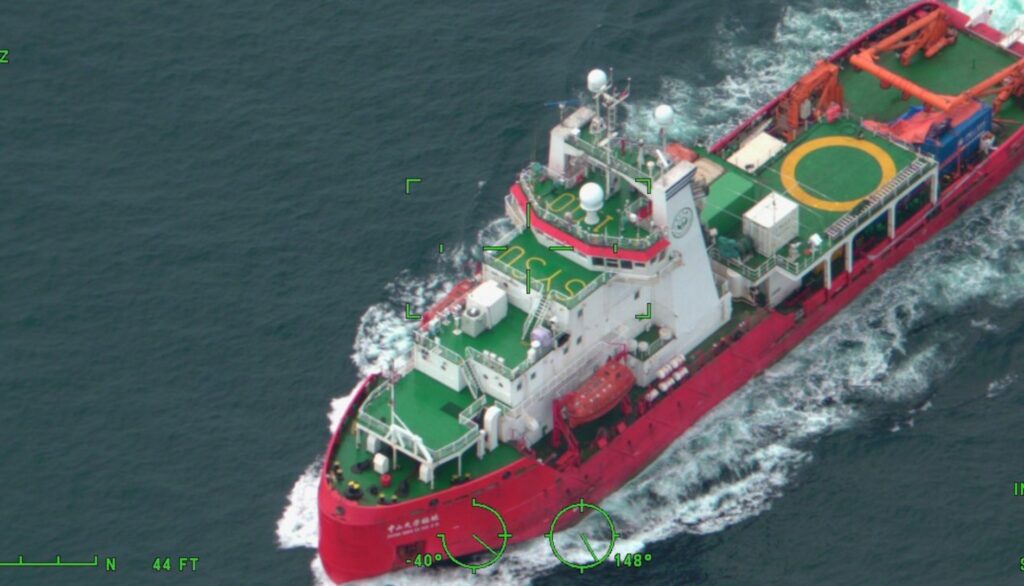
The Zhong Shan Da Xue Ji Di, a Liberian Flagged Research Vessel, owned and operated by the Chinese University Sun Yat-Sen, as detected by a Coast Guard C-130 Hercules aircraft from Air Station Kodiak. (U.S. Coast Guard courtesy photo)
JUNEAU, Alaska — The U.S. Coast Guard detected and responded to two Chinese research vessels operating in the U.S. Arctic and is currently monitoring a total of five similar vessels in or near the U.S Arctic.
On August 5, a C-130J Hercules fixed wing aircraft from Air Station Kodiak responded to the Chinese research vessels Ji Di and the Zhong Shan Da Xue Ji Di. Both vessels were transiting northeast in the Bering Sea.
On August 6, the crew of U.S. Coast Guard Cutter Waesche (WMSL 751) again responded to the Zhong Shan Da Xue Ji Di as it was transiting north in the Chukchi Sea above the Arctic Circle, after passing through the Bering Strait.
The C-130 and USCGC Waesche were patrolling under Operation Frontier Sentinel, an operation that responds to adversaries operating in and around Alaskan and U.S. Arctic waters. The U.S. Coast Guard’s responses are intended to counter malign activities, defend sovereign interests, and promote maritime conduct consistent with international law and norms.
The presence of these vessels is consistent with a three-year trend of increased activity from Chinese research vessels operating in the U.S. Arctic. Last year, three Chinese research vessels conducted research operations north of the Bering Strait.
The Coast Guard Arctic District works in conjunction with international partners, U.S. Northern Command, and Alaskan Command to constantly monitor the activity of foreign vessels operating near U.S. sovereign waters and the extended outer continental shelf to ensure homeland security, homeland defense, and compliance with U.S. and international law.
The Coast Guard is America’s only surface presence in the Arctic — a growing zone of strategic global competition. A robust national fleet of icebreakers, made possible by historic investment in the Coast Guard, will secure U.S. access, security, and leadership in the Arctic.
On Sunday, the Coast Guard will commission the Coast Guard Cutter Storis, the newest icebreaker in the fleet, at a ceremony in Juneau.