Austal USA Starts Construction on Second OPC for Coast Guard

MOBILE, Ala. –  Austal USA started construction on its second Heritage-class Offshore Patrol Cutter (OPC), Icarus (WMSM 920).  Like Pickering (WMSM 919), Icarus is being built at the company’s Mobile, Ala. ship manufacturing facility as part of a contract that includes options for up to 11 cutters with a potential value of $3.3 billion.  

“Construction on the first OPC is well underway and we are excited to begin building our second OPC, Icarus,” commented, Harley Combs, vice president surface programs. “Our steel production line is running smoothly with all of the steel modules under construction for Pickering.” 

To accommodate Austal USA’s unique build strategy, the engineering and production teams collaborated to optimize the stage 1 OPC hull structure design to reduce weight, resulting in a more efficient build process and increasing the life expectancy of the vessel.  The Austal USA team also developed a 3-D model for the cutter early in the design process. This allowed each module to be outfitted to a significantly higher percentage than industry benchmarks.   

Icarus is the second USCG cutter to bear the name. The first Icarus, WPC 110, was commissioned in 1932 and was the first Coast Guard ship to sink an enemy submarine during World War II and the first to bring foreign POWs to America since the War of 1812.   

The 360-foot OPC will provide the majority of the Coast Guard’s offshore presence conducting a variety of missions including law enforcement, drug and migrant interdiction, and search and rescue.  With a range of 10,200 nautical miles at 14 knots and a 60-day endurance period, each OPC will be capable of deploying independently or as part of task groups, serving as a mobile command and control platform for surge operations such as hurricane response, mass migration incidents and other events. The cutters will also support Arctic objectives by helping regulate and protect emerging commerce and energy exploration in Alaska. 

Including Icarus, Austal USA has seven ships under construction.  A new assembly building will be used to support the final assembly of the Offshore Patrol Cutters is under completion.  When complete the building  will provide 192,000 square feet of new covered manufacturing space.  The building will consist of three bays, two of which are specifically designed to erect the OPC. 


Coast Guard Offloads $88M in Illicit Drugs Interdicted in the Eastern Pacific 

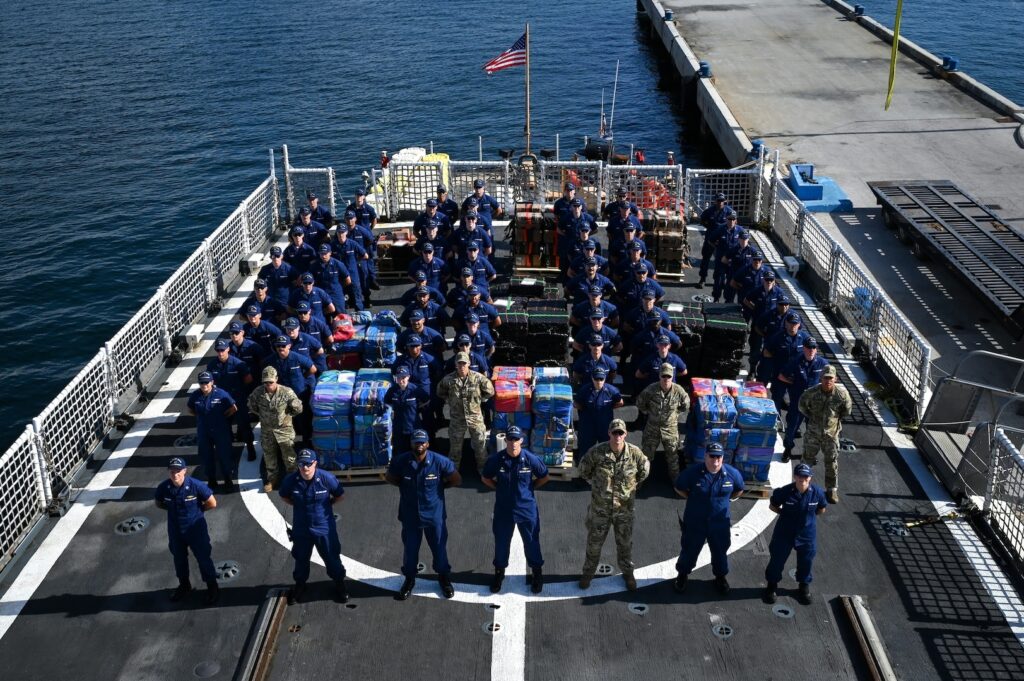
The crew of the U.S. Coast Guard Cutter Escanaba standing at parade rest on the flight deck at Port Everglades, Florida, August 5, 2025. The seized contraband was transferred to partner agencies for accountability and destruction. (U.S. Coast Guard photo by Petty Officer 3rd Class Jessica Walker) 

Release From U.S. Coast Guard Southeast District

MIAMI – U.S. Coast Guard Cutter Escanaba’s crew offloaded approximately 11,922 pounds of cocaine worth an estimated $88.2 million, Tuesday, at Port Everglades.  

The seized contraband was the result of three separate interdictions in the eastern Pacific by the crew of the Escanaba, Pacific Area Tactical Law Enforcement Team, and embarked Coast Guard Helicopter Interdiction Tactical Squadron aircrew.  

“The professionalism and cohesiveness of our team on board were the biggest contributors to our operational successes,” said Petty Officer Third Class Nadia Sands, an Operations Specialist in the cutter’s Combat Information Center. “This crew and command routinely embody the spirit of ‘One Team, One Dream’ and that spirit will continue to drive us to achieving our goals of protecting our borders and countering transnational criminal actors in the region.”  

The following assets and crews were involved in the interdiction operations:    

  • U.S. Coast Guard Cutter Escanaba (WMEC 907)   

  • U.S. Coast Guard Helicopter Interdiction Tactical Squadron  

  • U.S. Coast Guard Pacific Area Tactical Law Enforcement Team  

Detecting and interdicting illicit drug traffickers on the high seas involves significant coordination. Joint Interagency Task Force-South conducts the detection and monitoring of aerial and maritime transit of illegal drugs. Once an interdiction becomes imminent, the law enforcement phase of the operation begins, and control of the operation shifts to the U.S. Coast Guard for the interdiction and apprehension phases. Interdictions in the Eastern Pacific Ocean are performed by members of the U.S. Coast Guard under the authority and control of the Southwest Coast Guard District, headquartered in Alameda, California.    

Escanaba is a 270-foot Famous-class medium endurance cutter homeported in Portsmouth, Virginia, under U.S. Coast Guard Atlantic Area Command.    

For breaking news, follow us on X (formerly Twitter). For additional information, find us on Facebook and follow us on Instagram.    

Make a difference on land, at sea or in the air with the Coast Guard. Visit GoCoastGuard.com to learn more about active duty and reserve, officer and enlisted opportunities. Information on how to apply to the U.S. Coast Guard Academy can be found here.   


Exail Partners With U.S. Key Player to Supply 100 Navigation Systems for Naval UUVs 

LINCOLN, R. I.) July 30, 2025 — Exail, a leading provider of navigation solutions, has secured a new contract with a U.S.-based global defense player. The agreement involves the delivery of 100 Phins Compact Inertial Navigation Systems (INS) to equip Unmanned Underwater Vehicles (UUVs). 

Offering highly precise navigation capabilities, the Phins Compact INS ensures reliable performance in demanding environments and remains resilient to external signal disruptions. Its compact design enables rapid integration, allowing UUVs to carry out missions with flexibility and efficiency, even in dynamic and unpredictable maritime defense scenarios. 

“We are grateful for our client’s trust in Exail technology. We are confident that our INS will deliver the precision and robustness required for UUVs to operate effectively across varied environments,” said Carlos Lopes, Sales Director at Exail. “Over the years, we’ve worked closely with our customers to develop a navigation suite that truly meets defense challenges. Today, our INS is a global benchmark in subsea navigation.” 

This contract strengthens Exail’s global leadership in subsea navigation, with its INS technology trusted by over 50 navies and widely deployed on a broad range of subsea autonomous vehicles worldwide. It also represents a key milestone in the company’s expanding presence in the United States, supporting defense programs with proven, high-performance solutions. 


Senators Introduce Bill to Exempt Shipbuilding Workforce from Cuts

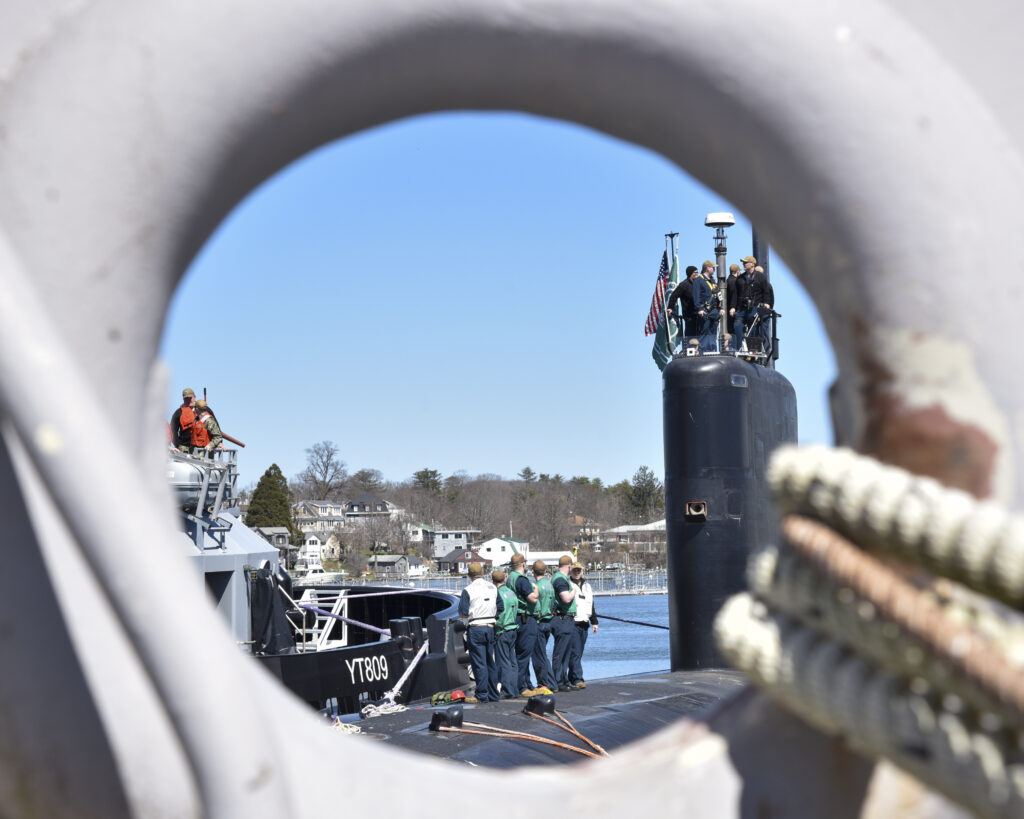
USS Greeneville (SSN 772) departs Portsmouth Naval Shipyard in Kittery, Maine, in April 2024. Greeneville had been at the shipyard for a scheduled maintenance period since June 2021. Photo credit: U.S. Navy | Mass Communication Specialist 1st Class Charlotte Oliver

WASHINGTON — A bipartisan group of New England lawmakers has introduced a bill in Congress to protect the shipbuilding workforce.

U.S. Senators Jeanne Shaheen (D-N.H.), a senior member of the U.S. Senate Armed Services Committee and co-chair of the U.S. Senate Navy Caucus, Maggie Hassan (D-N.H.), Susan Collins (R-Maine) and Angus King (I-Maine) introduced the Protecting Public Naval Shipyards (PNSY) Act to exempt the workforces of America’s four public shipyards, like the Portsmouth Naval Shipyard, from recent hiring freezes and mass layoffs.

The bill aims to ensure the maintenance and overhaul of America’s nuclear-powered submarine fleet continues uninterrupted by requiring the U.S. Department of Defense to exempt certain positions at public shipyards from workforce reductions. 

“Our shipyard workforce represents an essential component of our national defense and preparedness – they should have never been subjected to this administration’s ill-considered hiring freezes,” Shaheen said. “The Portsmouth Naval Shipyard workforce is supposed to be exempt from the hiring freeze, but there continues to be issues with implementation. Our bipartisan bill enshrines that exemption in federal law and ensures that no public shipyard is subjected to such chaos and uncertainty in the future, allowing them to focus instead on the vital role they play in our national security.” 

“Our nation’s public shipyards depend on a highly skilled and experienced workforce,” Collins said. “At Portsmouth Naval Shipyard, workers set the gold standard for repairing, retrofitting, and refueling our nation’s nuclear submarines. This bipartisan bill would protect the men and women at PNSY, and at all four of our nation’s public shipyards, helping sustain the critical contributions these shipyards make to our national defense, the readiness of our Navy, and the economies of their surrounding regions.” 

Protecting PNSY Act would require DoD to exempt positions at the public shipyards from workforce reductions that are critical to maintenance of our submarine fleet and that support the Shipyard Infrastructure Optimization Program (SIOP). The bipartisan bill also removes hiring limits for these positions. 

Click HERE to read the bill text. 


Bollinger Shipyards Applauds Full Funding of Polar Security Cutter Program

Release From Bollinger Shipyards 

PASCAGOULA, Miss. — August 5, 2025 — With the recent enactment of the “One Big Beautiful Bill Act,” the U.S. Coast Guard’s Polar Security Cutter (PSC) program is now funded through completion of all three vessels – a historic milestone for American shipbuilding and a strong affirmation of the federal government’s full confidence in Bollinger’s ability to deliver this critical national asset. 

“This is more than a funding milestone—it’s a vote of confidence in American industrial capability and in Bollinger’s proven ability to deliver,” said Ben Bordelon, President and CEO of Bollinger Shipyards. “We took on a troubled program knowing the stakes were high. Since day one, our team has been laser-focused on restoring momentum, rebuilding trust, and delivering results. Today’s announcement is a testament to that effort.” 

The recently enacted “One Big Beautiful Bill Act” included $4.3 billion for the advanced procurement and construction of vessels two and three of the PSC program, fully funding the program through completion. 

Bollinger acquired the PSC program from Singapore-based ST Engineering in 2022 through its acquisition of VT Halter Marine. At the time, the program faced significant challenges, including schedule delays, cost overruns, and an incomplete concept design. Since then, Bollinger has worked in close partnership with the U.S. Coast Guard and Navy to stabilize and restructure the program, bringing it back on track through disciplined project management, strategic investment, and a revitalized workforce. 

Earlier this year, Bollinger received a $951.6 million contract modification to advance the construction of the first PSC. With the new funding secured for vessels two and three, the program is now fully resourced to deliver a modern fleet of heavy icebreakers capable of operating in the most extreme polar environments. 

The PSC program is the cornerstone of the Coast Guard’s Arctic and Antarctic strategy, enabling year-round access to polar regions for national defense, scientific research, and maritime sovereignty. The new cutters will be the first American-built heavy icebreakers in nearly 50 years. 

“Bollinger is proud to be building the most advanced icebreaking vessels in U.S. history,” Bordelon added. “We’re not just building ships—we’re building capability, security, and opportunity for generations to come.” 

As Bollinger continues to enhance its operations in Mississippi into world-class shipyards, the company remains committed to making strategic investments to modernize and expand its capabilities. Since acquiring VT Halter, Bollinger has made a significant economic impact in the state through targeted investments and workforce expansion. To date, Bollinger has invested $76 million across its Mississippi facilities, including Bollinger Mississippi Shipbuilding (BMS), Bollinger Mississippi Repair (BMR), Bollinger Gulfport Shipyard (BGS), and CHAND Gulf Coast. 

“Mississippi shipbuilders are the best in the nation and this is further proof of that,” said Mississippi Governor Tate Reeves. “Our state has what it takes to deliver results and keep our country safe. Congratulations to the entire Bollinger team on this incredible win for Mississippi.” 

Since the acquisition in 2022, Bollinger has increased its Mississippi workforce by over 61%, with production roles at BMS alone increasing by more than 178%. These numbers are expected to rise as the program reaches full production over the coming years. A key driver of this growth has been Bollinger’s innovative Bootcamp workforce development programs, which continue to strengthen the skilled labor pipeline. 

“Our investment in developing the next generation of skilled American workers not only strengthens our competitive edge in the shipbuilding industry but also underscores our commitment to fostering economic growth and American innovation,” added Bordelon. “We are committed to providing high-quality careers that positively impact the families and communities we support along Mississippi’s Gulf coast.” 

This contract modification primarily supports operations at Bollinger Mississippi Shipbuilding, with additional project contributions from facilities located in Massachusetts, Illinois, Virginia, Georgia, Louisiana, and other regions. Completion of the first Polar Security Cutter is anticipated by May 2030. 

The Polar Security Cutter will provide the United States with enhanced operational capability in polar regions, playing a critical role in safeguarding national security, economic stability, and supporting vital maritime and commercial interests. 


Austal USA Receives Contract for Second Offshore Patrol Cutter

Release From Austal USA

Mobile, Ala. –  Austal USA has received a contract option award from the U.S. Coast Guard for the construction of the second Stage 2 Heritage-class Offshore Patrol Cutter (OPC) and acquisition of long lead-time material to support construction of a third Stage 2 OPC.  The $273 million option is part of a contract that includes options for up to 11 OPCs with a potential value of $3.3 billion.  

“The exercise of this option is a strong sign of the successful partnership between the Coast Guard and our shipbuilding team on the OPC program,” commented Austal USA President Michelle Kruger. “This award is an important step in moving into serial production and delivering this critical capability.  It is a testament to the capabilities of our talented shipbuilders at Austal USA.” 

Austal USA began building the company’s first OPC, Pickering, last summer.  All of Pickering’s steel modules are under construction in Austal USA’s steel assembly line.  Construction on the second cutter will begin this week. Progress on the OPC program is occurring concurrently with a major facility with $750M in construction underway to increase capacity for both surface vessel and submarine manufacturing.  The OPC joins the U.S. Navy’s Towing Salvage and Rescue (T-ATS) and Landing Craft Utility (LCU) programs in serial production in the company’s Mobile ship manufacturing facility.   

The 360-foot OPC will provide the majority of the Coast Guard’s offshore presence conducting a variety of missions including law enforcement, drug and migrant interdiction, and search and rescue.  With a range of 10,200 nautical miles at 14 knots and a 60-day endurance period, each OPC will be capable of deploying independently or as part of task groups, serving as a mobile command and control platform for surge operations such as hurricane response, mass migration incidents and other events. The cutters will also support Arctic objectives by helping regulate and protect emerging commerce and energy exploration in Alaska. 


L3Harris Successfully Tests New Power Plant System for Advanced Lightweight Torpedo

Release From Aerojet Rocketdyne

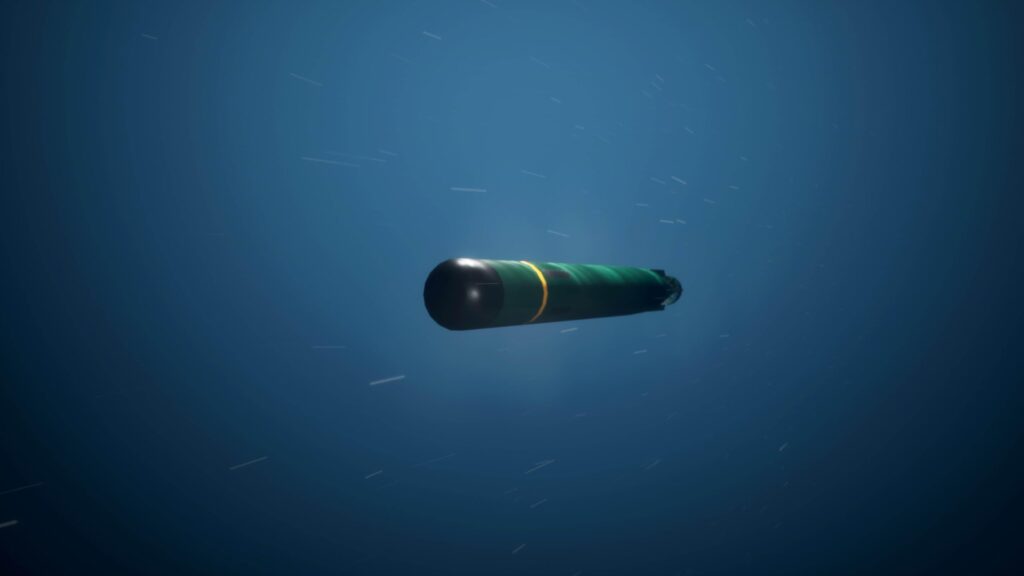
L3Harris Technologies has successfully completed testing of the first power plant system for the Stored Chemical Energy Propulsion System (SCEPS) that will power the U.S. Navy’s MK 54 MOD 2 Increment 2 Advanced Lightweight Torpedo. The power plant system testing validated the functionality and performance of this key component and positions L3Harris to begin SCEPS design verification testing of the fully integrated system later this year. 

L3Harris is on contract with the Navy to deliver proof of design for SCEPS propulsion for the MK 54 MOD 2 torpedo, which includes the power plant system and an integrated tail and torpedo afterbody assembly. 

“The power plant system is at the very heart of the propulsion system that will power the Navy’s MK 54 MOD 2 torpedo,” said Scott Alexander, President, Missile Solutions, Aerojet Rocketdyne, L3Harris. “We are pleased with the performance of the system during these tests and look forward to completing design verification testing of the entire afterbody later this year.” 

L3Harris’ Center of Excellence for Undersea Propulsion Manufacturing, based in Orlando, Florida, includes the only SCEPS manufacturing capability within the U.S. industrial base, and plays a key role supporting the Navy’s next generation torpedoes. In parallel with ongoing U.S. Navy contracts, the company has been independently funding fabrication and testing of prototype SCEPS components to further the innovative technology. 

SCEPS uses a lithium boiler to generate heat used to create steam that drives a turbine to propel the torpedo to intercept its intended target. The innovative propulsion system will significantly improve U.S. Navy torpedo capabilities. 


Shield AI’s New V-BAT Passes Operational Evaluation with U.S. Coast Guard

Release From Shield AI

SAN DIEGO (July 31, 2025) – Shield AI, the deep-tech company developing cutting-edge autonomy software and next-generation defense aircraft, announced that its new V-BAT 5.3 unmanned aircraft system (UAS) has successfully completed Operational Test & Evaluation (OT&E) with the U.S. Coast Guard.   

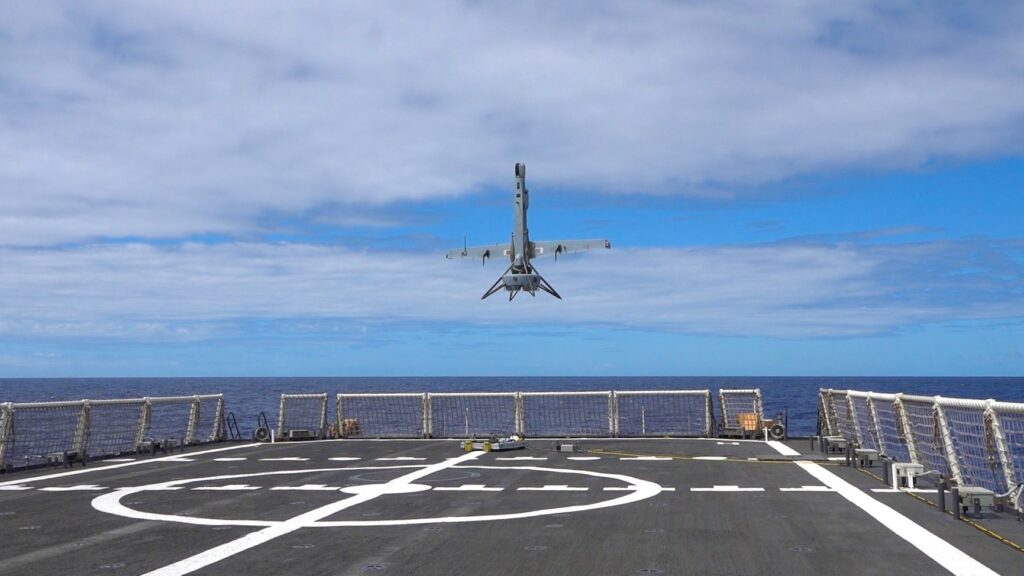
The V-BAT passed the operational test by scoring 100% on all Key Performance Parameters and Key System Attributes aboard Coast Guard Cutter Midgett over the course of four days of flight tests. This milestone clears the way for full deployment under a $198 million indefinite-delivery, indefinite-quantity firm fixed-price contract awarded in June 2024 to deliver Intelligence, Surveillance, and Reconnaissance (ISR) services using the V-BAT platform.  

“V-BAT’s role in the Coast Guard’s transformation under Force Design 2028 underscores how rapidly unmanned systems are reshaping maritime operations,” said Brandon Tseng, Shield AI’s President, Co-founder, and former Navy SEAL. “Passing this OT&E on time and on target is an important milestone, but it’s just the beginning. Our focus now turns to expanding the V-BAT capability within the Coast Guard to deliver outcomes every day at unprecedented scale.”  

V-BAT is Shield AI’s operationally deployed single-engine, ducted-fan vertical take-off and landing (VTOL) UAS, capable of launching and recovering without personnel. Trusted by U.S. and international forces, it supports a broad range of missions across Group 1 to Group 5 categories and beyond. 


QinetiQ US Secures $26M in Naval Defense Contracts with General Dynamics Electric Boat

Release From QintetiQ

Multi-year agreement strengthens QinetiQ’s position in naval defense systems with critical components for Virginia and Columbia class submarines 

MCLEAN, Va., July 29, 2025 — QinetiQ US secures approximately $26 million in subcontracts from General Dynamics Electric Boat to deliver key electrical and electromechanical systems for the U.S. Navy’s Virginia and Columbia class submarine programs. 

Under these contracts, QinetiQ US will build, test and deliver complex electrical and electromechanical systems that enable critical onboard operations. These specialized components play vital roles in performance and mission effectiveness. 

“These awards highlight Electric Boat’s confidence in QinetiQ’s engineering expertise, manufacturing capability and our role within the Navy submarine industrial base to deliver mission-critical systems for the nation’s fleet,” said Tom Vecchiolla, President and Chief Executive of QinetiQ US. “Our technical solutions support enhanced operational capabilities for these advanced submarines, enabling the U.S. Navy’s undersea dominance.” 

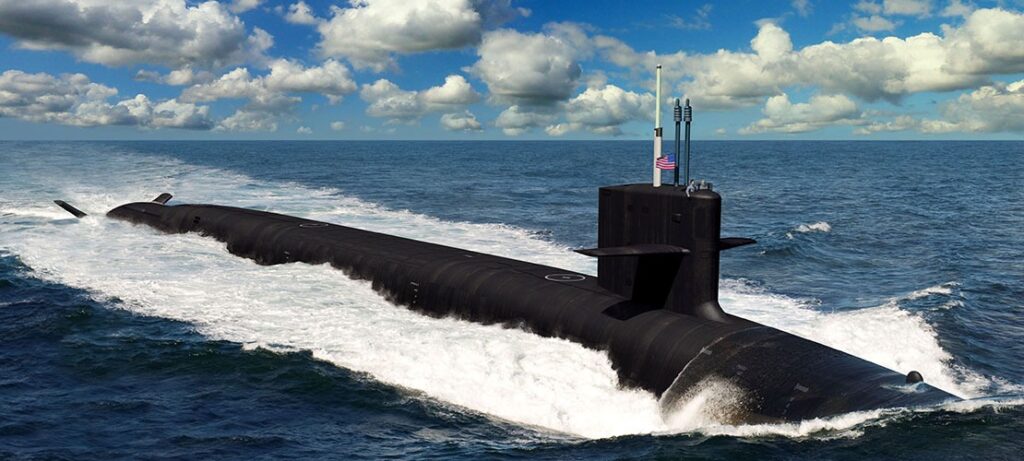
The Virginia and Columbia class submarines represent the current and future of the U.S. Navy’s undersea warfare capabilities. The Virginia class is a nuclear-powered fast-attack submarine designed to excel in littoral and deep-water missions, while the Columbia class will replace the Ohio-class ballistic missile submarines as a critical component of the nation’s nuclear deterrent. 

Production of all electrical and electromechanical systems will take place at QinetiQ’s US-based manufacturing facilities with deliveries scheduled throughout the period of performance. 


F/A-18 and EA-18G Surpass 12 Million Flight Hours 

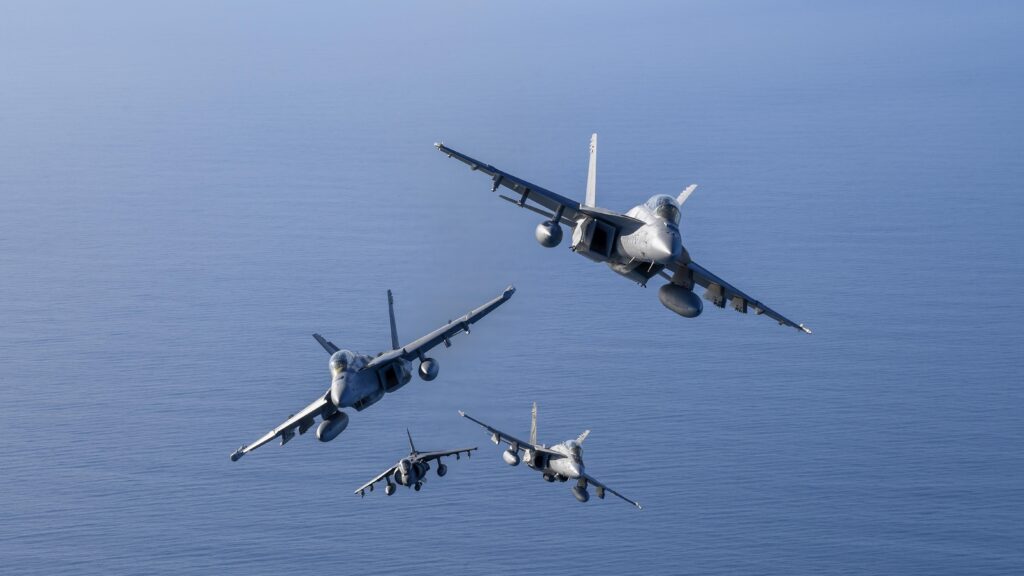
A formation of Air Test and Evaluation Squadron (VX) 31 “Dust Devils” aircraft, including an EA-18G Growler, AV-8B Harrier II+, an F/A-18E Super Hornet, and an F/A-18D Hornet, flies over Point Mugu’s Sea Range in Californation during a photo exercise. These aircraft demonstrate the Naval Air Warfare Center Weapons Division’s commitment to advancing fleet capabilities through rigorous testing and operational support.  

RELEASE FROM NAVAL AIR SYSTEMS COMMAND

NAS PATUXENT RIVER, Md. — The U.S. Navy’s F/A-18 and EA-18G aircraft fleet has surpassed 12 million flight hours, marking an important milestone for one of the most enduring families of aircraft in modern naval aviation. This achievement underscores the capability, reliability and availability of these aircraft, which have served as the backbone of the U.S. Navy and Marine Corps air power for decades.   

Put into perspective, the aircraft have completed the equivalent of 500,000 days, or nearly 1,370 years, of nonstop flight defending national interests and ensuring global security.   

“When you call the roar of these aircraft ‘the sound of freedom,’ it holds real weight,” said Capt. Michael Burks, program manager for the F/A-18 and EA-18G program office (PMA-265). “Throughout their service, the F/A-18 and EA-18G family has supported nearly every major U.S. military conflict of the past 40 years and continues to adapt to rapidly changing threat environments. From the initial deployment of the Hornet to the advanced capabilities of the Super Hornet and Growler, these aircraft have delivered forward presence, tactical airpower and critical electronic warfare capabilities around the globe.” 

Since the F/A-18 Hornet was first introduced in the 1980s, it has quickly become a versatile and capable fighter and attack aircraft. Its successor, the F/A-18E/F Super Hornet, and its electronic warfare counterpart, the EA-18G Growler, introduced significant advancements in radar, avionics, payload capacity and electronic attack.  

Key modernization efforts include Super Hornet Service Life Modification (SLM), which extends Super Hornet service life from 6,000 to 10,000 flight hours, and the delivery of Block III Super Hornets, which are equipped with advanced sensors, enhanced survivability and a redesigned cockpit for improved pilot performance. Growler Block II modifications will enhance mission systems, enable future capability growth and strengthen the Navy’s electronic warfare superiority.  

“This milestone is a significant achievement and a reflection of the generations of Sailors, Marines and civilians who sustain, fly and innovate these platforms every day,” said Burks. “Twelve million flight hours demonstrates our commitment to delivering world-class capability, enabling our warfighters to execute their missions with an asymmetric advantage and return home safely.” 

The flight hour milestone comes at a notable time for naval aviation, coinciding with the 30th anniversary of the Super Hornet’s first flight in November, and as the U.S. Navy and Marine Corps prepare to celebrate 250 years of service to the nation this year.   

As part of Program Executive Office for Tactical Aircraft Programs (PEO(T)), PMA-265 supports, sustains and advances the F/A-18A-D Hornet, F/A-18E/F Super Hornet and EA-18G Growler, delivering critical capabilities to ensure naval aviators succeed in dynamic and contested operational environments.