SECDEF Announces Marine Corps General Officer Nominations 

From the U.S. Department of Defense, June 20, 2025 

ARLINGTON, Va. — Secretary of Defense Pete Hegseth announced today that the President has made the following nominations: 

Marine Corps Gen. Christopher J. Mahoney for reappointment to the grade of general, with assignment as vice chairman of the Joint Chiefs of Staff, Pentagon, Washington, D.C. Mahoney is currently serving as assistant commandant of the Marine Corps, Headquarters, U.S. Marine Corps, Pentagon, Washington, D.C. 

Marine Corps Lt. Gen. Gregory L. Masiello for reappointment to the grade of lieutenant general, with assignment as director, Joint Strike Fighter Program, Office of the Secretary of Defense, Pentagon, Washington, D.C. Masiello is currently serving as director, Defense Contract Management Agency, Fort Lee, Virginia. 

Marine Corps Lt. Gen. Benjamin T. Watson for reappointment to the grade of lieutenant general, with assignment as deputy commandant, Training and Education and commanding general, Training and Education Command, Quantico, Virginia. Watson is currently serving as commanding general, Training and Education Command, Quantico, Virginia. 

Marine Corps Maj. Gen. Jay M. Bargeron for appointment to the grade of lieutenant general, with assignment as deputy commandant for Plans, Policies, and Operations, Headquarters, U.S. Marine Corps, Pentagon, Washington, D.C. Bargeron is currently serving as director, J-5, U.S. Indo-Pacific Command, Hawaii. 

Marine Corps Maj. Gen. William J. Bowers for appointment to the grade of lieutenant general, with assignment as deputy commandant for Manpower and Reserve Affairs, Quantico, Virginia.  Bowers is currently serving as commanding general, Marine Corps Recruiting Command, Quantico, Virginia. 

Marine Corps Maj. Gen. Stephen E. Liszewski for appointment to the grade of lieutenant general, with assignment as director, Joint Force Development, J-7, Joint Staff, Pentagon, Washington, D.C. Liszewski is currently serving as vice director, Joint Staff, Pentagon, Washington, D.C. 

Marine Corps Maj. Gen. David L. Odom for appointment to the grade of lieutenant general, with assignment as director for operations, J-3, Joint Staff, Pentagon, Washington, D.C. Odom is currently serving as director, Joint Capabilities Integration Directorate, Headquarters, U.S. Marine Corps, Quantico, Virginia. 


Kaine & Ricketts Introduce Bipartisan AUKUS Improvement Act 

From the office of Sen. Tim Kaine, June 20, 2025 

WASHINGTON, D.C. – U.S. Senator Tim Kaine (D-VA), a member of the Senate Armed Services and Foreign Relations Committees, and Senator Pete Ricketts (R-NE), a member of the Foreign Relations Committee, introduced the AUKUS Improvement Act, bipartisan legislation to strengthen the Australia-United Kingdom-United States (AUKUS) agreement by streamlining defense industrial base collaboration and co-production of Virginia-class submarines. This legislation builds upon provisions that Kaine pushed to get signed into law as part of the Fiscal Year 2024 National Defense Authorization Act. 

“The AUKUS partnership is critical to countering the threat from China and ensuring the Indo-Pacific remains free and open,” said Kaine. “I’m proud to introduce this bipartisan legislation to strengthen AUKUS and boost defense collaboration among our countries.” 

Specifically, the AUKUS Improvement Act would: 

Exempt U.S. State Department-vetted entities that have been approved as AUKUS Authorized Users from the requirement to obtain Third Party transfer approvals under Foreign Military Sales. 

Exempt Australia and the United Kingdom from the need for Congressional Notification for overseas manufacturing. 

Kaine has been a strong champion of AUKUS in Congress and has helped get signed into law provisions to implement and strengthen the partnership. He has played a key role in securing more resources for the submarine industrial base, including additional funding for the Virginia-class submarine program that is currently facing significant delays because of workforce challenges and supply chain disruptions. The on-time completion of Virginia-class submarines, which are built in Virginia and Connecticut, is critical to fulfilling the AUKUS agreement, through which the U.S. will sell at least two Virginia-class submarines to Australia to boost security and freedom of navigation in the Indo-Pacific, and counter Chinese military aggression in the region.  

In addition to Kaine and Ricketts, the legislation is cosponsored by U.S. Senators John Cornyn (R-TX), Chris Murphy (D-CT), Dan Sullivan (R-AK), Chris Coons (D-DE), Deb Fischer (R-NE), and Rick Scott (R-FL). 

Full text of the legislation is available here


Acting CNO Kilby Visits BlackSea Technologies in Baltimore, Observes Small USV Operations 

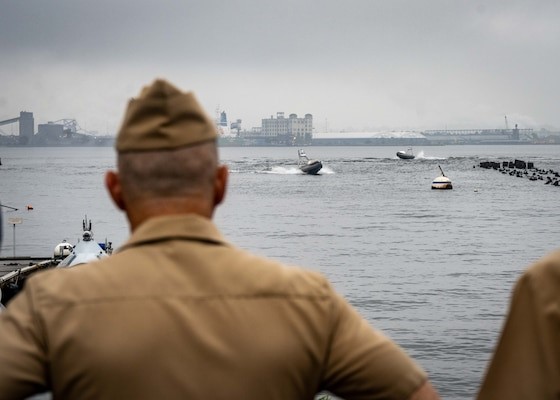
BALTIMORE, Md. – Acting Chief of Naval Operations Adm. Jim Kilby visited the Black Sea Technologies (BlackSea) personnel to explore ways to enhance the U.S. Navy’s Global Autonomous Reconnaissance Craft (GARC) program, during a visit to the BlackSea facilities, June 18, 2025. (U.S. Navy photo by Mass Communications Specialist 1st Class Joe J. Cardona Gonzalez)

From the Navy Office of Information, June 18, 2025 

Acting Chief of Naval Operations Adm. Jim Kilby visited the BlackSea Technologies (BlackSea) headquarters and production facilities in Baltimore, June 18, to see first-hand how BlackSea supports the U.S. Navy’s Small Unmanned Surface Vehicles (sUSV) program and how it plans to continue to expand its capabilities to support fleet operations. 

Acting Chief of Naval Operations Adm. Jim Kilby visited the BlackSea Technologies (BlackSea) headquarters and production facilities in Baltimore, June 18, to see first-hand how BlackSea supports the U.S. Navy’s Small Unmanned Surface Vehicles (sUSV) program and how it plans to continue to expand its capabilities to support fleet operations. 

The Navy is procuring sUSVs for fleet operations and experimentation to advance robotic maritime strategies and tactics. 

“These systems will play a critical role in the future of naval warfare by extending fleet reach, improving situational awareness, and increasing combat effectiveness,” said Kilby. “We see unmanned systems as a force multiplier for traditional vessels, not a replacement.” 

During the visit, Kilby met with BlackSea personnel to explore ways to enhance and grow the U.S. Navy’s Global Autonomous Reconnaissance Craft (GARC) program. GARCs are 16-foot USVs that enable research, testing, and operations that will allow integration throughout the surface, expeditionary, and joint maritime forces. 

Small unmanned surface vehicles are part of the Navy’s family of unmanned maritime systems, designed to complement and support the traditional fleet across a range of missions. Small USVs are assigned to Unmanned Surface Vessel Squadron (USVRON) Three and USVRON Seven for testing and experimentation, including launch and recovery from Navy platforms. 

Through analysis, simulation, prototyping, and demonstration, the Navy plans to field and operate progressively more capable unmanned maritime systems that enhance fleet endurance and resilience while minimizing risk to human life. Small USVs are rapidly integrating into the fleet exercises such as Fourth Fleet’s Hybrid Fleet Campaign Event (FLEX) international exercises such as the recent Baltic Operations (BALTOPS). 

“The development and deployment of unmanned systems, including the small USV, is a strategic acquisition for the Navy,” Kilby added. “A strong partnership with industry is critical as we seek to maintain technological superiority and operational advantage in an increasingly complex maritime environment.” 

Kilby concluded his visit by observing a demonstration of the GARC and the BlackSea Seabased Petroleum Discharge System and conducting a comprehensive tour of the manufacturing facility. During the tour, he engaged with BlackSea workforce and subject matter experts to gain deeper insights into the versatility and innovative capabilities of these advanced systems. 

Strong partnerships with industry are essential to accelerating these advancements and delivering cutting-edge technologies. These innovations are shaping the future of naval operations and strengthening our maritime advantage. 


Vigor Marine Group Launches as Unified Maritime Leader 

Nationwide capabilities to bolster U.S. defense and commercial maritime readiness 

PORTLAND, OR (June 19, 2025) – Five leading marine and industrial service companies — Vigor, Continental Maritime of San Diego, MHI Ship Repair & Services, Seaward Marine Services, and Accurate Marine Environmental — today announced their unification under a single name: Vigor Marine Group. As a full-service prime contractor, the group delivers comprehensive solutions for the maintenance, modernization, and lifecycle management of military and commercial vessels across the United States. 

“Vigor Marine Group represents a unified identity for a highly experienced team with bi-coastal capabilities,” said Francesco Valente, CEO of Vigor Marine Group. “Each of our companies has built a strong reputation for innovation, quality, and reliability. Now, together, we can provide customers the strength of a national platform combined with the responsiveness of local shipyards, enabling us to build on our legacy of performance and on-time delivery.” 

Vigor Marine Group offers a broad range of services, including drydocking, pier-side, and topside marine services, with integrated project management teams on both coasts to ensure the timely return of vessels to service. 

Key National Initiatives 
 
Vigor Marine Group plays a crucial role in several high-profile national projects: 

  • It was among the first contractors selected for the U.S. Navy’s Arleigh Burke-class Destroyer Modernization 2.0 program. 

  • The group has helped lead the $4 billion zero-emission transition for Washington State Ferries, starting with hybrid-electric conversions of three Jumbo Mark II-class ferries. 

  • Vigor Marine Group is partnering with the U.S. Army to produce the Maneuver Support Vessel (Light), a next-generation landing craft to replace the aging LCM-8 fleet. 

Organizational Divisions 
 
VMG is structured into three key divisions: 

  • Maintenance & Modernization: This division includes Vigor’s shipyards in Portland, Seattle, and Ketchikan, the largest footprint for any operator in the Pacific Northwest; Vigor Marine CM San Diego, a certified master ship repair contractor for the U.S. Navy; and Vigor Marine MHI Norfolk, a premier East Coast repair yard.  

  • Marine Services: Comprising Vigor Services Accurate (tank cleaning and wastewater treatment) and Vigor Services Seaward (underwater hull cleaning and coating). 

  • Marine Fabrication: Continuing Vigor’s legacy in small-craft production for defense, fisheries, and commercial customers. 

“We are proud to bring forward the full value of Vigor Marine Group,” said Valente. “As the largest maintenance and modernization group on the West Coast, one of the leading builders of aluminum-hull combatant crafts in the U.S., and a top-tier partner for cruise ship and Navy MRO services, we are well-positioned for growth. This unification will enable us to continue innovating as a trusted solutions provider and a critical national asset for maritime and defense operations.” 

Infrastructure and Workforce 
 
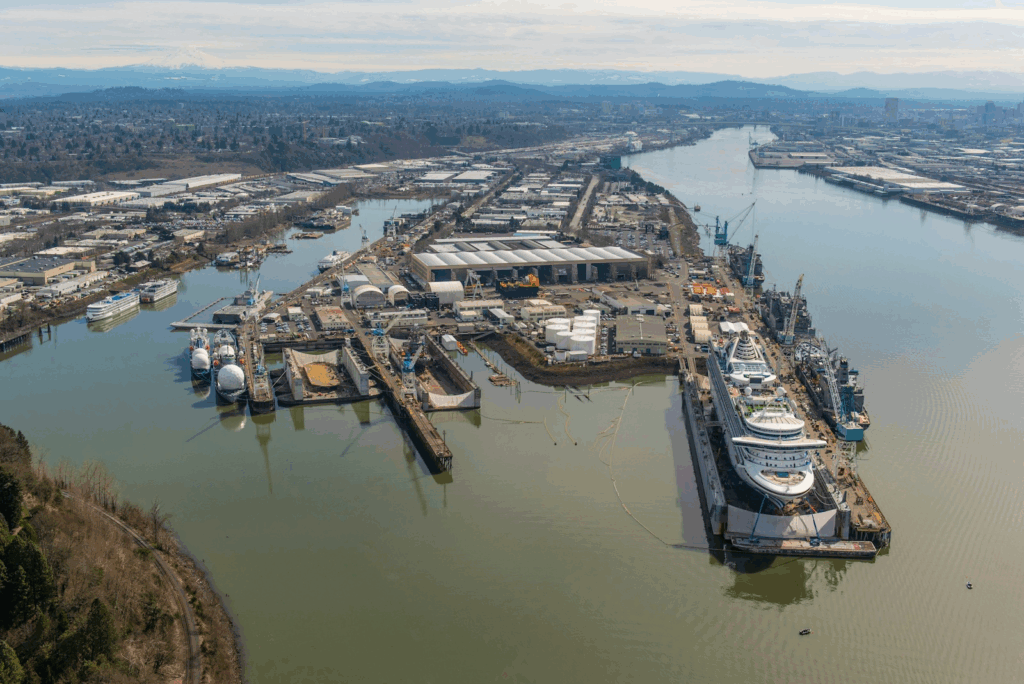
Vigor Marine Group operates from five shipyards and eight dry docks, including North America’s largest floating dry dock, with over 17,000 feet of pier space located on historically significant maritime sites, such as former Todd and Kaiser shipyards and key U.S. naval installations. 

With a workforce of 2,600 skilled employees across five states, Vigor Marine Group is recognized for its award-winning safety culture, technical expertise, and commitment to workforce development. The team also has a history of supporting operations in other strategic naval ports such as Pearl Harbor. 

Background of Titan Acquisition Holdings 
 
The companies comprising Vigor Marine Group were originally united under Titan Acquisition Holdings, which was established in 2019 when The Carlyle Group and Stellex Capital Management acquired Vigor Industrial, MHI, Seaward Marine, and Accurate Marine. In 2020, Continental Maritime of San Diego was added to the portfolio. In 2023, Lone Star Funds became Titan’s controlling owner, and Francesco Valente, former CEO of Fincantieri Marine Group, joined as CEO in September 2024. 

Today, Vigor Marine Group serves a diverse range of customers, including the U.S. Navy, Military Sealift Command, U.S. Army, U.S. Coast Guard, cruise line operators, state ferry systems, and commercial fleets, offering unparalleled expertise, scale, and service across the maritime lifecycle. 


Pacific Partnership 2025 Concludes Mission Stop in Suva, Fiji, June 16, 2025 

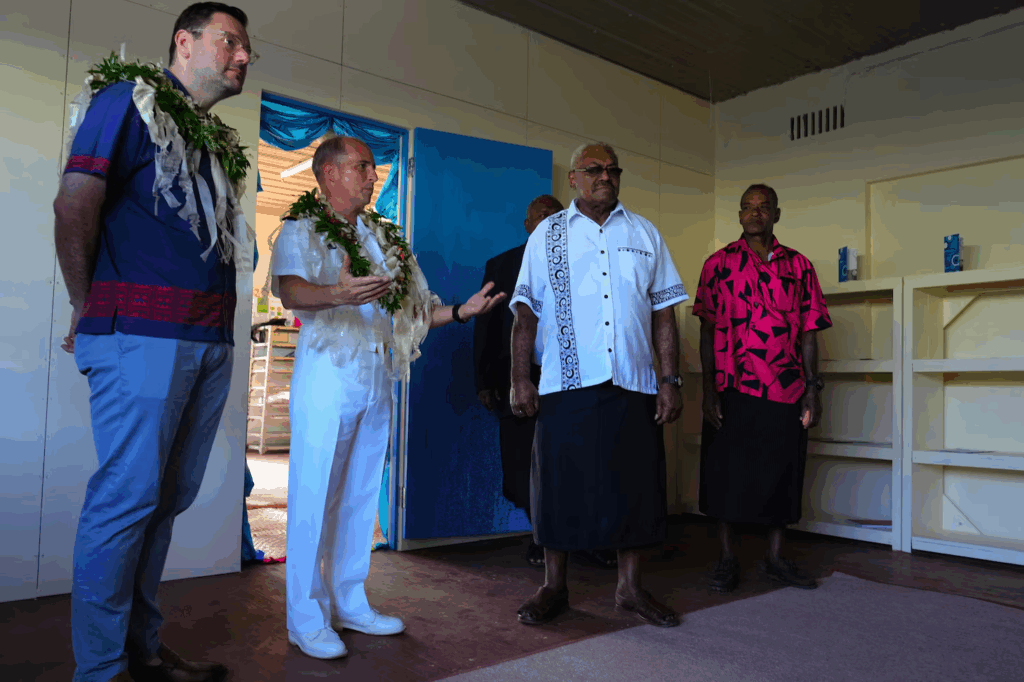
SUVA, Fiji (June 16, 2025) Capt. Mark B. Stefanik, center left, mission commander of Pacific Partnership 2025 (PP-25), shows Mr. Samuela Togenavanua, local tribe leader of Suva, and other local dignitaries a newly renovated classroom at Waiqanake District School as part of PP-25 in Suva, Fiji, June 16, 2025. (U.S. Navy photo by MC2 Moises Sandoval/Released)

By MC2 Moises Sandoval, June 20, 2025 

SUVA, Fiji  –  Pacific Partnership 2025 officially concluded its mission stop in Fiji with a closing ceremony hosted at the Waiqanake District School on June 16, 2025. 
 
The largest annual multinational humanitarian assistance and disaster response preparedness mission conducted in the Indo-Pacific, Pacific Partnership enables participants, including United States and Fijian personnel, to work together to enhance disaster response capabilities and foster new and enduring friendships. 
 
“The United States of America believes in a free and open Pacific for all nations,” said U.S. Navy Capt. Mark B. Stefanik, mission commander during the closing ceremony. “We deeply value our long history with Fiji and we hope that the work done here helps to reinforce our commitment to this island and to the people of Fiji.” 
 
While in Fiji, the medical team, consisting of U.S. and Fijian public health services personnel, conducted a total of 16 side-by-side subject matter expert exchanges in the fields of hemoculture, permaculture, agriculture, and apiculture. The team accrued more than 26 hours of hands-on training through public health engagements such as the Polymerase Chain Reaction laboratory, spay and neuter clinics, ruminant husbandry training, and a beekeeping tour assembling over 42 participants from across Suva. 
 
The Pacific Partnership engineering team also capitalized on the opportunity to provide focused support to address several local infrastructure concerns. A total of 12 U.S. Navy Sailors, assigned to Amphibious Construction Battalion 1, and 8 New Zealand Royal Army Engineers collaborated to undertake the construction and repairs of the Waiqanake District School, to include the complete renovation and installation of a small library in a classroom building. The team also removed obsolete rain gutters from three different classroom buildings and rendered a fresh coat of paint to two classroom buildings. Waiqanake District School, which accommodates over 300 staff, faculty and students, hosted a ribbon cutting ceremony in celebration for the newly renovated facilities on June 16. 
 
U.S. Navy Musicians with the Pacific Fleet “Big Wave” Brass Band engaged in a variety of live performances across more than 10 school campuses and venues across the island of Viti Levu, Fiji. This musical ensemble featured 10 musicians, which hosted concerts between Suva and Nadi, including the closing ceremony of Pacific Partnership 2025’s mission stop in Fiji. 
 
Now in its 21st iteration, Pacific Partnership series is the largest annual multinational humanitarian assistance and disaster management preparedness mission conducted in the Indo-Pacific. Pacific Partnership works collaboratively with host and partner nations to enhance regional interoperability and disaster response capabilities, increase security and stability in the region, and foster new and enduring friendships in the Indo-Pacific. 


U.S. Navy Achieves FY25 Recruiting Goal 3 Months Early 

From the Navy Office of Information, June 18, 2025 

WASHINGTON – The U.S. Navy achieved its 2025 recruiting goal June 18, three months ahead of the end of the current fiscal year after contracting 40,600 future Sailors. 

Achieving the contracting milestone reflects the Navy’s focused efforts for connecting with qualified, motivated candidates across the country. The sea service is now positioned to send more than 40,600 future Sailors to Recruit Training Command by September. 

“More qualified and motivated Americans than ever are stepping forward and answering the call to serve their country,” said Secretary of the Navy John Phelan. “This is a critical time in history. 

The world is more complex and contested than it has been in decades, and our ability to respond starts with our greatest asset, our people. Since November, Navy recruiting has skyrocketed, a testament to President Trump’s leadership and the dedication of our dynamic Navy recruiters.” 

Recruiting success in 2025 built on last year’s momentum when the Navy surpassed the recruiting goal of 40,600 by 378. By the end of 2024, Navy Recruiting Command contracted 40,978 future Sailors, more than any year since 2002. 

To achieve recent recruiting success, Navy Recruiting Command established a Recruiting Operations Center to monitor data in real time. The Navy also implemented the Future Sailor Preparatory Course to improve accession success, streamlined medical waiver reviews, and identified and removed barriers to recruiter productivity. 

“Reaching our annual goal this early is a testament to the dedication and innovation of our recruiting force,” said Rear Adm. Jim Waters, commander of Navy Recruiting Command. “It shows that when we remove barriers, accelerate processes, and meet people where they are, the right individuals answer the call.” 

The Navy continues to process applicants and place future Sailors into future training dates and job assignments. Meeting the goal early allows for a more deliberate Navy process in aligning future Sailor talent and career interest with fleet needs. 

“We’re still working hard every day,” said Waters. “Meeting the recruiting target is not the finish line — it’s a signal that we’re on the right course and ready to keep building the force of the future.” 


GD Electric Boat Awarded $987M Contract Modification for Submarine Production 

From General Dynamics, June 18, 2025 

GROTON, Conn. — General Dynamics Electric Boat, a business unit of General Dynamics (NYSE: GD), announced today it has been awarded a $987 million contract modification to a previously awarded contract supporting submarine production. This modification is for additional Component Development, Class Lead Yard Support (CLYS), and Submarine Industrial Base (SIB) supplier development enhancements, as detailed in the U.S. Department of Defense contract award.  

“This contract modification funds important shipyard and supply chain work essential to achieving the necessary growth in output and supports our efforts to accelerate submarine delivery,” said Mark Rayha, president of General Dynamics Electric Boat. “The ongoing support for the shipyards and our supply base from the Navy, Congress and the administration is appreciated and necessary for us to meet the Navy’s current and future demand for submarines.” 

Work will be performed in Groton, Connecticut (70%); Newport News, Virginia (15%); and Quonset Point, Rhode Island (15%) and is expected to be completed by 2031. 

General Dynamics Electric Boat designs, builds, repairs and modernizes nuclear submarines for the U.S. Navy. Headquartered in Groton, Connecticut, it employs more than 24,000 people. More information about General Dynamics Electric Boat is available at www.gdeb.com


Caudle Nominated to be Next CNO 

ARLINGTON, Va. — President Donald Trump has nominated   

Admiral Daryl Caudle as the next chief of naval operations. Caudle, a submarine officer, currently serves as commander. U.S. Fleet Forces Command, headquartered in Norfolk, Virginia. 

The nomination was received by the Senate Armed Services Committee on June 17, according to a tracker on congress.gov. 

Below is the official biography of Admiral Caudle from the Navy’s website: 

“Adm. Daryl Caudle is a native of Winston-Salem, North Carolina and a 1985 graduate of North Carolina State University (magna cum laude) with a degree in chemical engineering. He was then commissioned after attending Officer Candidate School in Newport, Rhode Island. Caudle holds advanced degrees from the Naval Postgraduate School, Master of Science (distinction) in Physics; from Old Dominion University, and Master of Science in Engineering Management. He also attended the School of Advanced Studies, University of Phoenix, where he obtained a Doctor of Management in Organizational Leadership with a specialization in Information Systems and Technology. 

His doctoral dissertation research was conducted on military decision making uncertainty regarding the use of force in cyberspace. He is also a licensed professional engineer. 

He assumed command of U.S. Fleet Forces Command; U.S. Naval Forces Northern Command; U.S. Naval Forces Strategic Command; and U.S. Strategic Command Joint Force Maritime Component Commander on December 7, 2021. 

Prior to this assignment, he served as commander, Submarine Forces; commander, Submarine Force Atlantic; commander, Task Force (CTF) 114, CTF 88, and CTF 46; and commander, Allied Submarine Command. 

His other flag assignments include deputy chief for security cooperation, Office of the Defense Representative, Pakistan; deputy commander, Joint Functional Component Command-Global Strike; deputy commander, U.S. 6th Fleet; director of operations U.S. Naval Forces Europe-Africa; commander, Submarine Group Eight; commander, Submarine Force, U.S. Pacific Fleet; and vice director for Strategy, Plans, and Policy on the Joint Staff (J-5) in Washington, D.C. 

His early sea tours included assignments as division officer, USS George Washington Carver (SSBN 656G); engineer, USS Stonewall Jackson (SSN 634B); engineer, USS Sand Lance (SSN 660); and executive officer of USS Montpelier (SSN 765). 

Caudle’s first command assignment was as commanding officer of USS Jefferson City (SSN 759). As deputy commander, Submarine Squadron 11, he served as commanding officer of USS Topeka (SSN 754) and USS Helena (SSN 725) due to emergent losses of the normally assigned commanding officers. He also commanded Submarine Squadron 3. 

His tours ashore include assignments as assistant force nuclear power officer, Commander Submarine Force, U.S. Atlantic Fleet; officer-in-charge of Moored Training Ship (MTS 635); deputy commander of Submarine Squadron 11; assistant deputy director for information and cyberspace policy on the Joint Staff (J-5) in Washington, D.C.; and as chief of staff Commander Submarine Force, U.S. Pacific Fleet. 

His personal decorations include the Navy Distinguished Service Medal, Defense Superior Service Medal (four awards), Legion of Merit (four Awards), Meritorious Service Medal (Three Awards), Navy and Marine Corps Commendation Medal (five Awards), and the Navy and Marine Corps Achievement Medal (four Awards).” 


Austal USA Launches First Steel Ship, the Future USNS Billy Frank 

MOBILE, Ala. –Austal USA successfully launched the company’s first steel ship, the future USNS Billy Frank Jr. (T-ATS 11), on June 14.  Named after a native American Korean War veteran who, as an activist, fought for justice and environmental preservation in the Northwest United States, Billy Frank Jr. is a Navy Towing, Salvage and Rescue Ship – one of 3 under construction at Austal USA and the first steel product of the company’s state-of-the-art automated steel panel line. 

“It was amazing to see the flawless rollout of our first steel ship,” said Harley Combs, vice president of surface ship programs. “The completion of this milestone is the result of the hard work and dedication of our talented workforce.  I am so proud of all they have accomplished.”  

At 3,100 metric tons, T-ATS 11 is the heaviest ship Austal USA has launched to date. The launch was executed using the proven process used to launch most of the 32 Navy ships the company has built and delivered to the Navy over the last 15 years. 

T-ATS will provide ocean-going towing, salvage and rescue capabilities to support fleet operations. T-ATS will be a multi-mission common hull platform capable of towing U.S. Navy ships and will have 6,000 square feet of deck space for embarked systems. The large, unobstructed deck allows for the embarkation of a variety of stand-alone and interchangeable systems. The T-ATS platform will combine the capabilities of the retiring Rescue and Salvage Ship (T-ARS 50) and Fleet Ocean Tug (T-ATF 166) platforms. T-ATS will be able to support current missions including towing, salvage, rescue, oil spill response, humanitarian assistance, and wide-area search and surveillance. The platform also enables future rapid capability initiatives such as supporting modular payloads with hotel services and appropriate interfaces. 

With the ship over 85 percent complete at the time of launch, the future USNS Billy Frank Jr. will now prepare for her next major milestone, engine light off, as she gets ready for sea trials and delivery. 

​ 


NOAA Awards $95.4M Contract for Upgrades, Maintenance on NOAA’s Oscar Dyson 

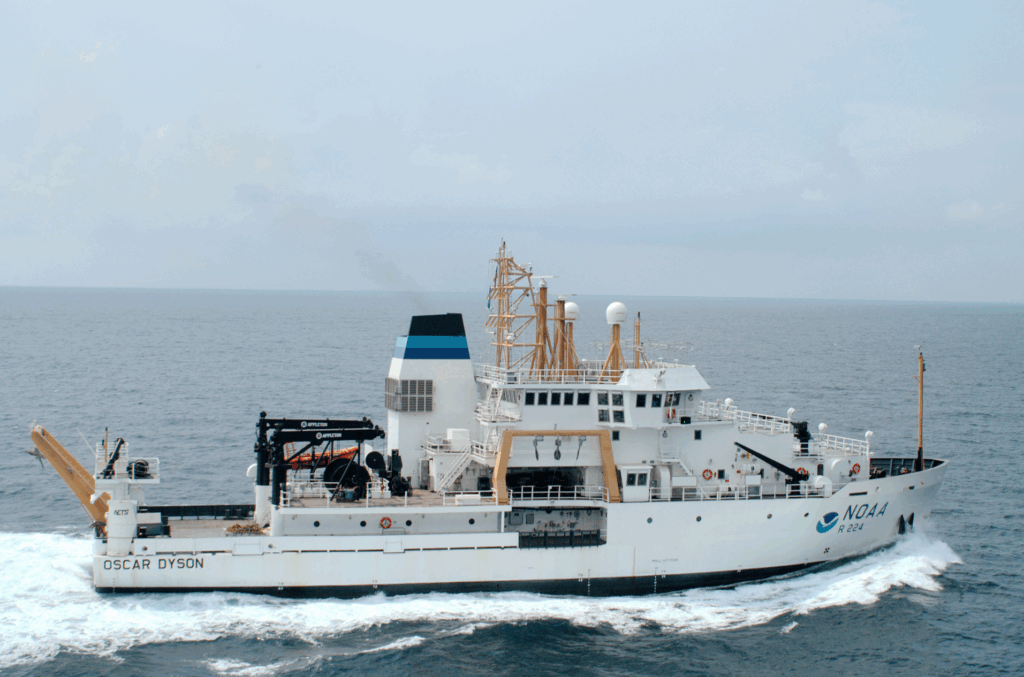
NOAA Ship Oscar Dyson working in the Bering Sea in Alaska. Credit: NOAA Marine and Aviation Operations/CDR Carl Rhodes

From Keeley Belva, NOAA, June 18, 2025 

NOAA has awarded $95,408,666 to JAG Alaska, Inc. from Seward, Alaska, to complete expanded upgrades and maintenance on NOAA Ship Oscar Dyson. Following the 2026 field season, the ship will go into a year-long maintenance period.  

NOAA is working to maximize the service life of each of its vessels through long-term maintenance planning and tracking. The goal of this forward-looking maintenance is to provide up-to-date, dependable vessels for NOAA’s scientists and science partners. NOAA anticipates that the Oscar Dyson will be available for service in time for the 2028 field season. 

“These upgrades will help the ship continue to meet the needs of the nation in primarily Alaskan and Arctic waters well into the future,” said NOAA Corps Rear Adm. Chad Cary, director of the NOAA Commissioned Officer Corps and NOAA Marine and Aviation Operations. “Modernizing the shipboard technology will improve the Dyson’s fuel efficiency and operational safety, while ensuring that future research performed by the Dyson continues to be second to none.” 

NOAA Ship Oscar Dyson was commissioned in 2005 and plays a major role in collecting data that is used to manage Alaska pollock—one of the world’s largest commercial fisheries. Replacing the propulsion system with variable speed, Tier 4 generators, quiet air conditioning motors and cutting-edge technology will equip the Dyson to continue supporting future NOAA science missions. The comprehensive maintenance will also replace pumps, fans, cranes, fire detection system and radars, as well as increase the number of single-person staterooms.  

NOAA has begun modifying other ships in its fleet to backfill the Dyson during the maintenance period. NOAA Ship Bell M. Shimada will be outfitted with polar life rafts, rescue boat heaters and other adaptations necessary for work in Alaska waters. These adjustments will help to ensure that the collection of science and data in Alaska, as supported by the Dyson, will continue seamlessly.  

“Great news coming out of Alaska today. Supporting small shipyards in the state is vital to our blue economy, and I am excited to see these extensive upgrades to NOAA Ship Oscar Dyson happening right in our own backyard,” said Alaska Senator Lisa Murkowski. “The mid-life renovation of this critical research vessel will allow for the collection of accurate data that will inform Alaska’s fisheries – all while putting Alaskans to work. I appreciate NOAA’s investment in Alaska and our fisheries, and look forward to seeing the Oscar Dyson back out at sea.” 

“I want to thank Secretary Lutnick and Acting NOAA Administrator Laura Grimm for prioritizing the completion of the contract to maintain NOAA Ship Oscar Dyson. Homeported in Kodiak, this research vessel plays a vital role in conducting surveys of fish, mammals and other invertebrates and helps support robust and sustainable fisheries,” said Alaska Senator Dan Sullivan. “Even better, I am glad to see one of our great Alaskan shipyards will be conducting the repairs, keeping the ship close to home so that it can swiftly return to its important work once the maintenance is finished.” 

NOAA Marine and Aviation Operations operates a fleet of 15 hydrographic survey, oceanographic research and fisheries survey vessels. NOAA ships operate in the U.S. and around the world. The ships are run by a combination of NOAA commissioned officers and civilian professional mariners.