Coast Guard Commandant Adm. Linda Fagan salutes the national ensign while embarking U.S. Coast Guard Cutter Calhoun (WMSL 759), April 20, 2024, following the cutter’s official commissioning in North Charleston, South Carolina. Photo credit: U.S. Coast Guard | Petty Officer 2nd Class Brandon Hillard
President Trump’s new administration has removed Admiral Linda L. Fagan as commandant of the Coast Guard, an early end to the tenure of the first female to head a U.S. military branch.
The removal, on Trump’s first full day back in office, was first reported by Fox News, which said Acting Homeland Security Secretary Benjamine Huffman removed Fagan. Admiral Kevin Lunday, the vice commandant, is now the acting commandant.
“She was terminated because of her leadership deficiencies, operational failures, and inability to advance the strategic objectives of the U.S. Coast Guard,” a senior Department of Homeland Security official told Seapower in a statement.
The list of reasons includes failure to address threats at the southern border, “especially in interdicting fentanyl and other illicit substances” and “insufficient coordination with the Department of Homeland Security to prioritize operations along maritime borders.”
It also includes “inadequate leadership” in recruitment and retention; persistent cost overruns in icebreakers and helicopter programs; “inadequate accountability for acquisition failures highlighted during the Trump 45 Administration;” the “mishandling and coverup of Operation Fouled Anchor,” an investigation into sexual harassment at the Coast Guard Academy and in the service; and “excessive focus on Diversity, Equity, and Inclusion (DEI) policies including at the U.S. Coast Guard Academy, diverting resources and attention from operational imperatives.”
Fagan was the Coast Guard’s first four-star admiral and was confirmed as commandant in 2022.
Rep. Joe Courtney (D-Connecticut), ranking member of the House Armed Services Committee’s Seapower and Projection Forces subcommittee, posted on X that Fagan’s dismissal “is an abuse of power that slanders her good name and outstanding record. Under Admiral Fagan, Coast Guard recruitment is up, not down, and drug interdictions too. Trump’s fecklessness harms morale and confidence in the chain of command.”
On Jan. 21, the Coast Guard released a statement attributed to Lunday, which said, “Per the president’s executive orders, I have directed my operational commanders to immediately surge assets — cutters, aircraft, boats and deployable specialized forces — to increase Coast Guard presence and focus starting with the following key areas:
The southeast U.S. border approaching Florida to deter and prevent a maritime mass migration from Haiti and/or Cuba;
The maritime border around Alaska, Hawai’i, the U.S. territories of Guam, the Commonwealth of the Northern Mariana Islands, American Samoa, Puerto Rico and the U.S. Virgin Islands;
The maritime border between the Bahamas and south Florida;
The southwest maritime border between the U.S. and Mexico in the Pacific;
The maritime border between Texas and Mexico in the Gulf of America; and
Support to Customs and Border Protection on maritime portions of the southwest U.S. border.
Together, in coordination with our Department of Homeland Security and Department of Defense teammates, we will detect, deter and interdict illegal migration, drug smuggling and other terrorist or hostile activity before it reaches our border.”
Navy, Industry Working to Surge Capability as 2027 Draws Closer
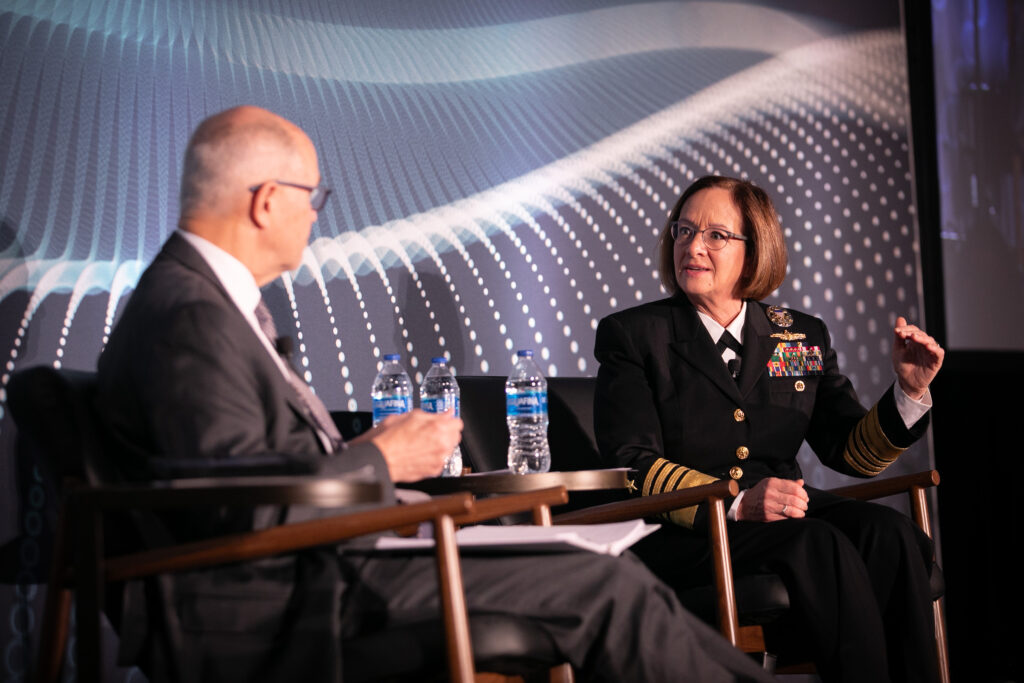
Chief of Naval Operations Adm. Lisa Franchetti participates in a Q&A session moderated by retired Vice Adm. Richard Hunt at the Surface Navy Association National Symposium in Arlington, Virginia, Jan. 14, 2025. Photo credit: U.S. Navy | Senior Chief Mass Communication Specialist Elliott Fabrizio
As the U.S. military braces for a potential conflict with China in 2027, maritime defense and industry leaders alike are trying to get the most out of the existing fleet while planning for a more capable future fleet with a mix of manned and uncrewed platforms.
“The countdown clock in my office continues to tick away and it tells me when I walked in today that there are 716 days left until 1 January, 2027. There is no time to waste,” Chief of Naval Operations Admiral Lisa M. Franchetti said this week at the Surface Navy Association’s annual symposium, referring to a year when Chinese President Xi Jinping has reportedly told his generals to be ready for war.
“The People’s Republic of China is our pacing challenge and presents a complex multi-domain and multi access threat,” Franchetti said. “And I’m eyes wide open that the challenge posed by the PRC to our Navy goes well beyond just the size of the PLAN [People’s Liberation Army Navy] fleet. It includes gray zone and economic campaigns, expansion of dual use infrastructure like airfield and dual use forces like the Chinese maritime militia and a growing nuclear arsenal.”
To counter that, and guard against the expected threat to Taiwan, Franchetti said she needs a larger fleet and one with more robotic and automated systems from programs such as the Replicator initiative, the rapid development effort NavalX and the Disruptive Capabilities Office.
From the Russian invasion of Ukraine to the Houthis in the Red Sea, “we are seeing the increase in use and effective adaptation of robotic and autonomous systems in every domain,” she said. “It’s abundantly clear that we need to both have these capabilities and have the capability to defeat ’em kinetically and non kinetically … the future of war at sea is neither fully robotic nor fully manned.”
Secretary of the Navy Carlos Del Toro, in his last address as SECNAV to the Surface Navy Association, agreed.
“…Our challenge is not only about maintaining naval superiority, but also ensuring that the U.S. military is prepared to confront the evolving threats that are opposed by the People’s Republic of China, especially in the realms of advanced technology, maritime claims, and military modernization,” he said. “Much like President Kennedy’s recognition of the need for modernized nuclear deterrent, today’s Navy and Marine Corps must continue to adopt, leveraging both man and unmanned capabilities to counter the PRC’s growing naval and technological advances.”
Admiral Daryl Caudle, commander of Fleet Forces Command, has the job of training and equipping the fleets that will need to contain China’s potential military expansion.
“The speed of modern warfare, combined with ever-shrinking indications and warnings windows, means we won’t have the luxury of long lead times to bring the full capabilities of our fleet to bear,” Caudle said in his keynote address to the SNA.
“Every day, about 100 [U.S. Navy] ships are deployed around the globe. Furthermore, about 100 ships are in lengthy depot maintenance availabilities that would take weeks, if not months, to close out just by buttoning up all the existing work and returning systems to service. This leaves the last 100 ships that are not deployed nor in depot, and the question — can we do more with those ships to make them ready to flow into combat? The answer is hell yes, and we are,” Caudle said.
That includes making use of the Combat Surge Ready certification for ships, a formal process and designation for getting ships on the Response Plan watchbill.
Efforts like the ongoing Shipyard Infrastructure Optimization Program, or SIOP, won’t add a lot of ship mass to the Navy by 2027, Caudle said, but the combat surge effort can up those numbers in the short term.
“When we sustain 80% Combat Surge Ready or better for all ships not in depot maintenance, the number of platforms ready to surge and flow into combat step-increases from around 100 to 180,” Caudle said. “…The goal of sustaining 80% Combat Surge Ready will require some new ways of thinking and may be uncomfortable for some, but we know our force structure will certainly not change between now and 2027 and will not significantly change over the next decade. Bottom Line: We must be constantly making ready ships not in depot or currently deployed.”
Industry Efforts
Getting more ships to the fleet requires having a large, well-trained workforce, something the maritime industry has been struggling with in recent years.
Christopher Kastner, CEO of shipbuilding giant HII, sat down with reporters on the eve of the SNA symposium to discuss how his company is trying to attract more workers, particularly more experienced ones, and dealing with an “almost arthritic” supply chain.
One way is by buying relevant suppliers. HII announced in December it has agreed to buy W International SC and Vivid Empire SC, South Carolina metal fabricators specializing in building structures, modules and assemblies for shipbuilders.
“We did that simply to increase capacity and increase throughput,” Kastner said. “We’re going to where the labor is, right? … We’re expanding into Texas, Louisiana, we’ve expanded in Norfolk, Virginia. You see this expansion in South Carolina. We’re going to where the labor is.”
Paying better wages for the shipbuilding workforce is also key, he said, and the Navy has taken steps to help do that for the submarine industrial base. It’s a key effort at a time when the gap between shipbuilding work and less demanding retail work has narrowed, making it harder to attract new workers.
“I definitely think there’s momentum, there’s recognition by the Navy, as you saw on the [defense budget] supplemental, that they want to address wages in the submarine industrial base. I don’t think it should be limited at the submarine industrial base, and it should be all of shipbuilding, [we] should be able to adjust wages to attract and increase talent into the industry.”
President Carter’s Funeral Procession in Washington Reflects Navy Roots
Carter’s horse-drawn caisson on its way to the U.S. Capitol. Photo credit: Brett Davis
WASHINGTON — President James Earl “Jimmy” Carter Jr.’s final procession through Washington started Jan. 7 at the U.S. Navy Memorial, where his casket was loaded onto a horse-drawn caisson for transportation to the Capitol where he is lying in state.
The 39th president of the United States had requested the transfer be made at the Navy Memorial as he planned his own funeral. He will lie in state until Thursday, when the state funeral will be held at the Washington National Cathedral.
Carter, who passed away in December at age 100, was the fifth consecutive president with prior Navy service, according to the U.S. Naval History and Heritage Command. He received an appointment to the academy and became a member of the class of 1947, although he completed an accelerated wartime program and graduated in 1946, commissioning as an ensign.
He served first on the USS Wyoming, a battleship that had been converted to a floating laboratory for testing new electronics and gunnery equipment, according to the command.
After two years of surface ship duty, Carter applied for submarine duty and was assigned to the USS Pomfret and later the USS K-1, and in 1952 joined the new program to create nuclear-powered submarines. According to the Naval History and Heritage Command, Carter served with the U.S. Atomic Energy Commission’s Naval Reactors Branch, aiding in the design and development of nuclear propulsion for Navy ships and submarines.
Carter was preparing to become the engineering officer for the nuclear powerplant for the USS Seawolf (SSN 575), one of the first nuclear-powered subs, and helped set up training for the enlisted Sailors who would serve on the boat.
However, his father, James Earl Carter, passed away, and Carter resigned from the Navy to return to Georgia to manage the family peanut farm and, eventually, to launch his political career.
A Navy honor guard marched in the procession for Carter’s lying in state at the Capitol. Photo credit: Brett Davis
His naval roots were never forgotten, and the Seawolf-class USS Jimmy Carter (SSN 23) is named for him, as is an academic hall at the U.S. Naval Academy.
“His legacy and beliefs are imbued in the Sailors that set sail aboard the USS Jimmy Carter and walk the halls of the newly renamed Carter Hall at the United States Naval Academy,” Admiral Lisa Franchetti, the chief of naval operations, said in a statement upon Carter’s death.
“President Carter’s life of service will continue to be an example for us and help us navigate our course. His work is finished, but the U.S. Navy’s work continues. President Carter, we have the watch.”
Lawmakers Introduce SHIPS Act to Revitalize Shipbuilding, Commercial Maritime Industries
U.S. Merchant Marine Academy graduates throw their covers in celebration during the Merchant Marine Academy Commencement Ceremony in Kings Point, New York, June 22, 2024. Credit: U.S. Marine Corps | Staff Sgt. Kelsey Dornfeld
A bipartisan group of U.S. Senators and Representatives on Dec. 19 introduced introduced the Shipbuilding and Harbor Infrastructure for Prosperity and Security (SHIPS) for America Act, comprehensive legislation to revitalize the United States shipbuilding and commercial maritime industries.
The SHIPS for America Act was introduced by Sens. Mark Kelly (D-Arizona) and Todd Young (R-Indiana) and Reps. John Garamendi (D-California) and Trent Kelly (R-Mississippi). After decades of neglect, the United States has a weakened shipbuilding capacity, a declining commercial shipping fleet dwarfed by China and a diminished ability to supply the U.S. military during wartime, the lawmakers said.
They said the bipartisan proposal would restore American leadership across the oceans by establishing national oversight and consistent funding for U.S. maritime policy, incentivizing domestic shipbuilding, enabling U.S.-flagged vessels to better compete in international commerce, rebuilding the U.S. shipyard industrial base and expanding the mariner and shipyard workforce.
“We’ve always been a maritime nation, but the truth is we’ve lost ground to China, who now dominates international shipping and can build merchant and military ships much more quickly than we can,” said Kelly, a U.S. Navy veteran and the first U.S Merchant Marine Academy graduate to serve in Congress.
“The SHIPS for America Act is the answer to this challenge. By supporting shipbuilding, shipping, and workforce development, it will strengthen supply chains, reduce our reliance on foreign vessels, put Americans to work in good-paying jobs, and support the Navy and Coast Guard’s shipbuilding needs. I’m excited to introduce this comprehensive, fully paid for legislation today alongside my Republican and Democratic colleagues and our partners representing all parts of the industry, and together we’re going to work to get this effort across the finish line.”
“America has been a maritime nation since our founding, and seapower was a significant contributor to our rise to being the most powerful nation on earth. Unfortunately, the bottom line now is America needs more ships. Shipbuilding is a national security priority and a stopgap against foreign threats and coercion. Our bill will revitalize the U.S. maritime industry, grow our shipbuilding capacity, rebuild America’s shipyard industrial base, and support nationwide workforce development in this industry. This legislation is critical to our warfighting capabilities and keeping pace with China,” Young said.
The move drew support from a wide variety of maritime-related groups and is backed by the Navy League of the United States.
“The Navy League applauds the introduction of the SHIPS for America Act, a landmark legislative achievement that will comprehensively meet the needs of the U.S. merchant marine and bolster our shipbuilding industrial base,” said Mike Stevens, CEO of the Navy League.
“In today’s global threat environment, arguably the most perilous since the end of the Cold War, the United States must not only maintain the finest Navy, Marine Corps, and Coast Guard on the seas, but also ensure a robust U.S.-flag merchant marine and a resilient shipbuilding industrial base. These elements are crucial for safeguarding our national and economic security in the event of large-scale military conflict. The SHIPS for America Actaddresses these vital considerations and reaffirms that America is, and always will be, a maritime nation.”
The SHIPS for America Act would:
Coordinate U.S. maritime policy by establishing the position of Maritime Security Advisor within the White House, who would lead an interagency Maritime Security Board tasked with making whole-of-government strategic decisions for how to implement a National Maritime Strategy. The bill also establishes a Maritime Security Trust Fund that would reinvest duties and fees paid by the maritime industry into maritime security programs and infrastructure supporting maritime commerce.
Establish a national goal of expanding the U.S.-flag international fleet by 250 ships in 10 years by creating the Strategic Commercial Fleet Program, which would facilitate the development of a fleet of commercially operated, U.S.-flagged, American crewed, and domestically built merchant vessels that can operate competitively in international commerce.
Enhance the competitiveness of U.S.-flagged vessels in international commerce by establishing a Rulemaking Committee on Commercial Maritime Regulations and Standards to cut through the U.S. Coast Guard’s bureaucracy and red tape that limits the international competitiveness of U.S.-flagged vessels, requiring that government-funded cargo move aboard U.S.-flag vessels, and requiring a portion of commercial goods imported from China to move aboard U.S.-flag vessels starting in 2029.
Expand the U.S. shipyard industrial base, for both military and commercial oceangoing vessels, by establishing a 25 percent investment tax credit for shipyard investments, transforming the Title XI Federal Ship Financing Program into a revolving fund, and establishing a Shipbuilding Financial Incentives program to support innovative approaches to domestic ship building and ship repair.
Accelerate U.S. leadership in next-generation ship design, manufacturing processes, and ship energy systems by establishing the U.S. Center for Maritime Innovation, which would create regional hubs across the country.
Make historic investments in maritime workforce by establishing a Maritime and Shipbuilding Recruiting Campaign, allowing mariners to retain their credentials through a newly established Merchant Marine Career Retention Program, investing in long-overdue infrastructure needs for the U.S. Merchant Marine Academy, and supporting State Maritime Academies and Centers for Excellence for Domestic Maritime Workforce Training and Education. The bill also would streamline and modernize the U.S. Coast Guard’s Merchant Mariner Credentialing system.
Ready to Dive: ROV Pioneer Shares Seafaring Stories in New Book
A remotely operated vehicle prepares to go on a dive. Credit: Curt Newport
Curt Newport spent his career as a member of an elite club — as an underwater salvage expert, he has participated in more than 150 undersea operations, ranging from the recovery of astronaut Gus Grissom’s Liberty Bell 7 suborbital spacecraft to salvaging Air India Flight 182, the space shuttle Challenger and even sending images back from the RMS Titanic.
After 47 years as a trailblazer for using robotics for underwater salvage, Newport retired in 2022 and is the author of a new memoir, “Ready to Dive,” about his career, published by Purdue University Press. (He has also been a race car driver and musician, but there is only so much room in the magazine.) Underwater explorers such as Jacques Cousteau and TV shows such as “Sea Hunt” helped stoke Newport’s early interest in the undersea world. He got a job building ship fenders for $3.50 an hour, then graduated to building and maintaining saturation diving systems before deciding to attend commercial diving school in California.
When he graduated, the company Ocean Systems had purchased a remotely operated vehicle (ROV) named Scorpio One, and Newport was hired to work on that team. He worked on oilfields with ROVs, did submarine cable work for communications companies such as AT&T, “and eventually graduated up into doing deep-ocean search and recovery, mostly for the Navy,” he told Seapower. With that, he was off to the races for a career stretching nearly five decades.
Undersea Technology
Technology has long been used in deep-ocean work, from towed sonar arrays to ROVs, each with their own strengths and weaknesses.
Towed arrays or camera sleds are useful and can provide real-time data but have a sizable turning radius. “The downside of those towed systems is if you’re working in deep water you’re going to have some very long turnaround times. When you get to the end of a search line, you’re going to make a turn, and in deep water, that can take anywhere from nine to 12 hours,” he said.
ROVs are nimbler to deploy and have gotten larger and more capable over the years, being able to dive anywhere from 300 meters down to 7,000 meters (almost 23,000 feet). They have been joined by autonomous underwater vehicles that require no tether.
There are also manned submersibles, which hit the news again last summer when the Titan submersible imploded during a dive to the ruins of the Titanic. Newport has done two dives in the Russian Mir 1 manned submersible, to 4,800 meters (including a dive to a sunken ship) but now it and the Mir 2 have been decommissioned and are displayed in museums.
“Really for the deep work, the advantage of an autonomous vehicle is you don’t have those long turn times. And actually, the quality of the side-scan data is better because you’re not being towed by a ship. It’s a very stable imaging platform,” he said. “The problem is, you can’t see any of the side scan data until you’ve recovered the vehicle and downloaded the data. That’s a disadvantage. And they tend to be kind of complicated.”
In the early days, the crews spent as much time wrestling with the vehicles as they did diving, Newport said.
“When I first started out with the Scorpio One vehicle, we spent most of our time broken down as opposed to diving because they were just complicated vehicles there, it was a new technology and we had a lot of problems with them. And you still have problems with it, but they’ve gotten to be a lot more reliable,” especially with their communication systems and sensors.
“And the imaging systems were nothing like what we have now,” he said. “I mean, the first vehicle I worked with, we didn’t even have a colored camera. We had a black and white. We had one black and white SIT camera, SIT means silicon, silicon intensified target. It’s a low-light camera,” Newport said. “And you know, nowadays vehicles will have four or five, six cameras. You got cameras all over the place. And we didn’t have that. And the manipulators we had back then were fairly crude. But, you know, for the type of salvage work we were doing, you don’t need a really sophisticated manipulator. In fact, it’s better to not have one.”
Newport suits up for a dive in 1977. Credit: Curt Newport
Now there are also sophisticated acoustic tracking systems that can operate as deep as 11,000 meters. In a nutshell, the differences between now and when Newport started in the diving business are “reliability and the ability to tell where the heck the vehicle is relative to the ship,” he said.
The Subsea Bounty
There are a great many things at the bottom of the world’s oceans waiting to be recovered or discovered. It’s “just limitless,” he said. “When you think about human history, how long humans have been using the ocean to go from one place or another, thousands of years, and the things that are lost in deep water are generally well preserved.”
At one wooden shipwreck in 16,000 feet of water, he found silk fabric still intact and gold wrapped in newspaper that was still readable. In the deep ocean environment, “it’s only 36 degrees down there forever, pretty much. There’s no light. There’s no oxygen. So, everything is really well preserved. … Airplanes, ships, whatever, it’s all down there, but it costs money to do that stuff.”
Newport said the most interesting salvage of his career “has got to be Grissom’s Liberty Bell 7 spacecraft.”
That cramped vehicle was launched on July 21, 1961, in the early days of the space race with the Soviet Union. It conducted a short, sub-orbital flight and made Virgil “Gus” Grissom the second American to fly in space, but it started to sink after splashdown and nearly drowned him. It stayed below the waves for nearly four decades until Newport’s team found it in an expedition funded by the Discovery Channel. “It’s one of those things that no one really expected us to ever be able to find it,” he said. “You know, the thing is only nine feet tall, six feet in diameter, is lost in deep water, about 6,000 feet. And everybody who knew anything about this said, ‘well, it’s lost and gone forever.’”
The salvage team was just starting their work “and it was the first target we dove on. It just came out of the gloom down there, there it was. So that, that was the most amazing ever,” he said.
Now that he’s retired, one thing Newport doesn’t do is spend time on boats.
“Ever since I started in this business, I have very rarely ever got on a boat for recreation. It just seems too much like work,” he said. “If you’re a bus driver, and then [on] your vacation time, you don’t go on a cross-country trip. You stay home. The same thing with boats, with ships, you know. People can go out in little liners and whatever all they want, I’ll just stay here and have my cocktail or something.”
Curt Newport, author of “Ready to Dive.” Credit: Curt Newport
Book Excerpt from ‘Ready to Dive’
On Finding the Wreck of the Challenger
I was in California visiting my brother when Challenger was lost. Like other Americans, I watched with a heavy heart as another American spacecraft was lost at sea. Unlike Liberty Bell 7, this one did not remain intact, and its location would be marked by tangled debris drifting in the Gulf Stream currents. Tons of wreckage peppered the seafloor, much like the Air India jetliner, and once again, it would be up to people like me to help find the one piece of wreckage that provides conclusive proof of the cause of the disaster. The salvage of Challenger was the largest search and recovery operation in history and required the use of a mixture of underwater technologies: side-scan sonars to map the debris field, manned submersibles to identify wreckage, and divers and remote vehicles to recover the evidence.
The task confronting the Navy was overwhelming: Search an area encompassing about 470 square nautical miles and identify all targets as being Challenger or non-Challenger, inspect and categorize the targets, then recover all wreckage that might bear evidence of the disaster. Unfortunately, the location where Challenger went down was heavily traveled by ship and air traffic and drug smugglers, and it had been the repository of a large percentage of NASA’s launch failures. There was a lot of space junk littering the seafloor.
The Navy set up their priorities as follows. First, they simply had to find the smoking gun. While it was strongly suspected that a segment of Challenger’s right-hand booster had failed, NASA had to be sure. In the tons of debris stuck on the bottom, we had to find that one piece. Second, for humanitarian purposes, the Navy had to recover the astronauts’ remains. Based on my Air India experience, I knew there would not be much left to recover. Challenger’s crew compartment had struck the ocean at over 200 miles per hour and broken up into several pieces. Third, we had to find and recover the tracking and data relay satellite located in the shuttle’s cargo bay. If it was not found, the government would have to spend millions of dollars to change satellite communication codes so the Soviets could not find the TDRS and subsequently monitor our military communications.
And finally, we found what everyone wanted to see: a 6,000-pound chunk of steel. On one edge was an opening unlike what we had seen before. It was rounded and melted, not broken and sharp. This was how Challenger had perished.
Retired Admiral Urges Government Transparency on UAPs
A screen shot of Gallaudet testifying before a joint hearing of the Committee on Oversight and Accountability.
A retired Navy admiral and former acting administrator of the National Oceanic and Atmospheric Administration was one of the key witnesses at a remarkable House hearing on Nov. 13 to continue to investigate the mystery of unidentified anomalous phenomena, the fast-flying, quick-maneuvering craft formerly known as UFOs.
Retired Admiral Tim Gallaudet told a joint subcommittee hearing of the Committee on Oversight and Accountability that when he was serving as commander of the Navy Meteorology and Oceanography Command in 2015 he became aware of how UAPs were interacting with “humanity,” specifically the Navy.
His personnel were participating in a naval exercise off the U.S. East Coast that included the USS Theodore Roosevelt Carrier Strike Group and was overseen by a four-star admiral, he said.
“During this exercise, I received an email on the Navy’s secure network from the operations officer of Fleet Forces Command,” Gallaudet said. “The email was addressed to all subordinate commanders, and the subject line read in all capital letters: URGENT SAFETY OF FLIGHT ISSUE. The text of the email was brief but alarming, with words to the effect: “If any of you know what these are, tell me ASAP. We are having multiple near-midair collisions, and if we do not resolve it soon, we will have to shut down the exercise.”
The video included what has come to be called the “go-fast” video, now-unclassified imagery captured by a Navy F/A-18 that shows an object “exhibiting flight and structural characteristics unlike anything in our arsenal,” Gallaudet said. The next day, the email disappeared from Gallaudet’s account and the accounts of other recipients and was never discussed again.
“I concluded that the UAP information must have been classified within a special access program managed by an intelligence agency — a compartmented program that even senior officials, including myself, were not read into. Last year’s UAP hearing before this oversight committee confirmed that UAP-related information is not only being withheld from senior officials and members of Congress, but elements of the government are engaging in a disinformation campaign to include personal attacks designed to discredit UAP whistleblowers,” he said.
He said he has spoken to Navy officials about UAPs moving underwater as well, including ones that could outpace Navy submarines. Asked what he thought UAPs are, he said “there is strong evidence that they are non human, higher intelligence.”
Since leaving government, Gallaudet, who now heads Ocean STL Consulting, said he has become an advocate for greater government transparency.
He recommended Congress establish oversight of the executive branch’s management of any UAP programs; empower an independent UAP Records Review Board to examine all relevant UAP data; and pass and establish a “whole of government approach” to whatever UAPs are.
“My speaking out has encouraged others to do the same, and it is my hope that over time, the number of your constituents who want to know the truth about UAP will increase to such an extent that the congressional action I have just recommended will become inevitable,” Gallaudet said.
Navy Announces Site for New Navy Museum
Secretary of the Navy Carlos Del Toro addresses the crowd at the site selection ceremony on Oct. 18. Also pictured are Nina Albert, deputy mayor of the District of Columbia for planning and economic development, and Rear Admiral Samuel J. Cox (retired), director of the Naval History and Heritage Command. Seapower | Brett Davis
WASHINGTON — Secretary of the Navy Carlos Del Toro highlighted a site selection ceremony for the future of the National Museum of the United States Navy on Oct. 18.
“This is a moment of immense pride and anticipation for the Navy, for our nation, and for all who cherish maritime heritage,” Del Toro said, standing near two dilapidated buildings that will be part of the new museum campus.
The site is adjacent to the Navy Yard in Washington and a short walk from the current Navy museum, housed in an aging facility largely off-limits to the general public. The new museum is intended to be a state-of-the-art look at the U.S. Navy, will be open to the public and is near a vibrant neighborhood that also boasts the stadiums for the Washington Nationals baseball team and the DC United, DC Power FC and Washington Spirit soccer teams. It’s expected to attract up to two million visitors annually, well over the 100,000 annual attendance of the current museum, most of whom are already in the Navy.
Del Toro said he is well aware of the draw of Nationals Stadium, and said “I want half of them over here before the game and after the game.”
Rep. Eleanor Holmes Norton, the district’s congressional representative, highlighted the city’s historic ties to the Navy. She said 30,000 city residents are veterans and “deserve the full equality of statehood,” as district residents don’t have voting rights in Congress.
A Long Road Ahead
While service officials now know where the museum will be located, they haven’t yet raised the money, don’t know what it will look like and don’t yet know what artifacts will be in it. All of those efforts are underway by the organizations that will create it: the Navy Museum Development Foundation that will raise the money ($475 million or more) and construct the building and the Naval History and Heritage Command that will select what goes in it. Once the museum is built, the foundation will give it to the Navy, which will staff and operate it.
Rear Admiral Samuel J. Cox (retired), director of the Naval History and Heritage Command, gently poked fun at the museums of the Marine Corps and Army, which he described as being “out in the wilds of Virginia” while the new Navy museum will be next to an all-hours neighborhood.
The new museum, still years away — a groundbreaking is tentatively planned for next October and the first phase likely won’t open until 2030 — has already been a long time coming. Nina Albert, D.C.’s deputy mayor for planning and economic development, was one of the speakers at the event and noted she had served on a Navy museum site selection committee 17 years ago.
“The vision will be worth the work and it will be worth the wait,” she said.
Part of the delay was a prolonged and what Cox called “tortuous” process to acquire the land from the city in a swap that saw the Navy Yard give up some of its land on the other side of the base near the river to acquire the plot that will house the new museum.
The museum will ultimately be 240,000 square feet and filled with meaningful artifacts, such as the bell from the USS Jacob Jones, sunk in 1917 off the coast of Cornwell, England, by a German U-boat and rediscovered in 2022. It was the first U.S. Navy destroyer sunk by enemy action. The bell, recovered by the British Ministry of Defence and transferred to the U.S. Navy earlier this year, is being prepared for display, said Vice Chief of Naval Operations Admiral James J. Kilby.
The museum is carrying high hopes for Navy officials. Former Secretary of the Navy Kenneth J. Braithwaite II said “it will not be a musty old hall with a bunch of old artifacts … it will be the spark that will draw people to the service of our country in the uniform of the United States Navy. This will be a new crown jewel in this city.”
Forging Industry Can Meet Defense Demand, Group Says
A Rock Island Arsenal-Joint Manufacturing and Technology Center artisan transfers a metal component during the forging process as part of a demonstration at the U.S. Army Tank-automotive and Armaments Command Casting & Forging Summit in 2022. The event gathered experts and officials across the government, military, industry and academia to discuss how to best modernize and sustain manufacturing operations critical to national security. U.S. ARMY U.S. Army | Hayley Smith, Rock Island Arsenal-Joint Manufacturing and Technology Center
The forging industry has a message for the Department of Defense and the country’s defense contractors: it has tremendous capacity and is ready to work.
That message is being spread by a new education campaign from the Forging Industry Association. The group’s CEO, Jim Warren, told reporters on Oct. 9 there is a perception within the DoD that the forging industry lacks capacity, but that’s not the case.
“We have no problem with capacity on anything,” he said. If there is a problem in the future, it will be with an expected surge in construction of commercial aircraft, but until then, “we can do it all,” including making forged and cast components for ships and submarines.
The real issue, he said, is with an uncertain demand signal that makes it hard to predict when forged and cast products will be needed. The Forging Industry Association’s message to the DoD and the prime contractors is, “can we please run more like a commercial industry?” Warren said.
The FIA is promoting a new survey from the auditing firm Wipfli, which concluded that 63% of forging companies do work within the defense industry and members, on average, are using 51% of their available capacity.
Companies that do primarily defense work have an even lower capacity use, at 41%. The FIA concluded these companies have ample capacity to do additional defense work if it was available. The study also showed that 76% of forgers have invested in robotics, so they are working to boost their efficiency.
“Washington is making historic investments in our technological edge to compete in this new era of great power competition. But the North American forging industry is at risk of being neglected — by a combination of inattention from government authorities, a stubborn myth that it lacks sufficient capacity to meet demand, and trade policies that hobble us and aid our adversaries,” Warren said in a statement.
Helpful Steps
The FIA wants the government to take several steps, including streamlining the process for adding forging companies to approved vendor lists; adding more varied types of materials; extending contract periods to allow companies to make better use of their capacity; and make additional investments in new technology, infrastructure and workforce development programs.
The Defense Production Act Title III and the Industrial Base Analysis and Sustainment programs could help fund new technology to help improve the quality of hot forged parts, FIA said.
There are also trade issues. As is the case with other industries, the FIA says government-subsidized Chinese companies are unfairly competing in the market.
“What’s needed are higher tariffs on Chinese forgings — more than the current 25% tariffs currently in place — to help bring back some of that lost business,” Warren said in a statement. “More aggressive efforts are also called for to prevent China, India, and others from dumping into the market forgings such as gears and connecting rods that are far below fair market. That means considering outright bans on certain countries from importing forgings.”
Navy Unveils ‘Strike Group’ Recruitment Technology
Lieutenant Commander Tiffany Pearson at the Strike Group mixed-reality system, on display at the Navy Memorial in Washington, D.C. Brett Davis
WASHINGTON — The U.S. Navy displayed one of its latest high-tech recruitment tools, the Strike Group, in Washington, D.C. last week at the Navy Memorial.
The modular, mobile system showcases different aspects of Navy life in an aircraft carrier strike group, giving potential Sailors an idea of careers they could pursue on or under the water.
“What we have here is our interchangeable, cutting-edge, multi-unit mobile experience,” said Lieutenant Commander Tiffany Pearson, who was doing community outreach. “It’s called the Strike Group. Obviously it alludes to our carrier strike group in the Navy, and the goal here was to engage our target demographic, 17 to 24 years old, so Generation Z. Generation Z is huge on gaming, as you can see we have different patches at each different station, so game badges are a way to incentivize people to keep going.”
In Washington, the modules were arrayed around the U.S. Navy Memorial Plaza, just down Pennsylvania Avenue from the Capitol.
The Strike Group includes these modules:
All Hands, where players test their skills on the deck of a virtual aircraft carrier in a first-person reality game
Support, where participants survey an interactive map of the world showing Navy ships conducting humanitarian missions
Fly, where players operate a full-motion flight simulator
Dive, where participants take on the role of a Navy diver as part of an Underwater Construction Team
Achieve, which participants learn about hundreds of potential jobs in the Navy and get an AI-generated image of themselves in their recommended role
Seek, which showcases the “silent service” and allows playes to learn about life on a submarine taking part in an Ice Exercise near the North Pole
Train, where a Navy Seal trainer guides participants through a series of challenges to test their physical strength, mental fortitude and willpower.
At each station, participants would collect a badge showing their achievement.
“The overall motivation behind that is, unfortunately a lot of people do not have interaction with military members today, either active duty or reservist,” Pearson said. “So, our goal is, with this, to bring it around the country to high schools and colleges, universities, so individuals can get a hands-on experience … to see what it’s like to fly a plane maybe, or to be a diver if that interests them, or even see what humanitarian missions we’ve done. … We even have a trailer that shows them who they could be in the Navy.”
The Navy has previously used similar demonstrations, but the systems were both larger and less flexible. One was the Nimitz, which showcased life on an aircraft carrier, and another was the Burke, highlighting the Navy’s destroyers.
For the latest system, “we call it a strike group because it just doesn’t limit it to one platform … here, it’s a strike group, all-hands efforts,” Pearson said.
The weather for the system’s public debut was not the best, rainy and overcast, but Pearson said a number of potential recruits loved interacting with the technology, so “it has been a bit of a challenge, but it’s been great.”
Senate Committee Report Calls for Coast Guard Action on Sexual Harassment Claims
Admiral Linda Fagan and Master Chief Petty Officer of the Coast Guard Heath Jones converse Oct. 19. 2023 with Senator Tammy Duckworth in observance of National Disability Employment Awareness Month. U.S. Coast Guard | Petty Officer 2nd Class Erik Villa Rodriguez
In a new report entitled “A Pervasive Problem,” the majority staff of the Homeland Security Committee’s Permanent Subcommittee on Investigations concluded the U.S. Coast Guard must do more to eliminate sexual harassment in its ranks and at the service’s academy and should use evidence uncovered by the panel to prosecute perpetrators.
“The Subcommittee has heard from more than 80 whistleblowers, who together have made clear the need for immediate change both at the Academy and in the Coast Guard,” the report’s conclusion says. “Their stories detail systemic sexual assault and harassment, including a culture of silencing, retaliation, and failed accountability. Although Operation Fouled Anchor initially brought these problems to light, they span both the Academy and the Fleet — the Coast Guard as a whole must work to build a culture in which everyone is safe, respected, and valued.”
The panel has been looking into the issue for more than a year, and recently held a hearing featuring Coast Guard Commandant Admiral Linda L. Fagan as the main witness, focusing on Operation Fouled Anchor, the Coast Guard’s investigation into sexual harassment allegations. Members of the panel charged the service had buried the results of its own investigation until CNN brought them to light. Fagan pledged to be transparent in dealing with the issue, which is also being investigated by the service’s inspector general.
However, in a “note from the chair” that begins the new report, panel chairman Sen. Richard Blumenthal of Connecticut writes, “I am deeply disappointed by the Coast Guard’s responses to this Subcommittee’s requests for critically necessary information. Despite repeatedly and publicly claiming a commitment to transparency, the organization has often resisted constructive responses. Such repeated opposition to disclosure has made us wonder whether the Coast Guard is, once again, attempting to escape Congressional scrutiny.”
Victim Reports
The report includes statements from numerous reports of sexual assault going back decades, as well as what survivors describe as attempts to silence them.
“These stories, spanning from the 1970s through the 2020s, depict systemic failures at the Coast Guard Academy and in the Coast Guard that continue to this day,” the report says.
In one account, “after learning that she had experienced months of sexual misconduct, a superior allegedly told an enlisted whistleblower: ‘Okay, I want you to think about these men and their careers. They could lose their jobs over this, and you could ruin their lives. And then CGIS [Coast Guard Investigative Services] is going to show up and make you out to be a liar. No one will believe you. Do you want that? I want you to think about all of this before you decide to tell anyone else.’”
In some cases, “fear of punishment for collateral misconduct deterred victims of abuse from reporting. One whistleblower shared that, as a cadet in the 2010s, the threat of discipline for unrelated misconduct was used to keep her from reporting repeated sexual assaults by the same perpetrator for a year. She said: ‘He blackmailed me, using his position over me and the fact that I drank underage to get me to have sex with him. He knew that I would get into more trouble for underage drinking than he would for blackmailing me for sex. He was right. …’”
Blumenthal’s opening note says the subcommittee will continue its work, and “our continuing investigation is likely to provide evidence that will assist and motivate the Coast Guard to impose discipline. It is imperative that the Coast Guard uses all means available to hold accountable both individual perpetrators and the leadership that covered up their wrongdoing … the culture will not change until the Coast Guard makes clear that sexual assault and harassment will not be tolerated.”
Coast Guard Response
The Coast Guard provided a statement to Seapower in response to the report.
“Sexual assault, sexual harassment, and all forms of abuse have no place in the Coast Guard. We are committed to fostering lasting institutional and cultural change that ensures a safe and respectful environment free of sexual assault, sexual harassment, and other harmful behaviors. Should such incidents occur, the Coast Guard is committed to supporting victims, upholding the law, and reinforcing the service’s core values,” the statement says.
“We are actively implementing the commandant’s 33 directed actions announced in November 2023 to strengthen our service culture, improve support and care of victims, and hold perpetrators accountable. Our progress completing 18 of these directed actions so far represents the early stages of enduring change that will ensure every person in the Coast Guard experiences a safe work environment where they are respected and valued. More information regarding the Coast Guard’s actions to address sexual assault, and ensure accountability, care, and support, is available here.”