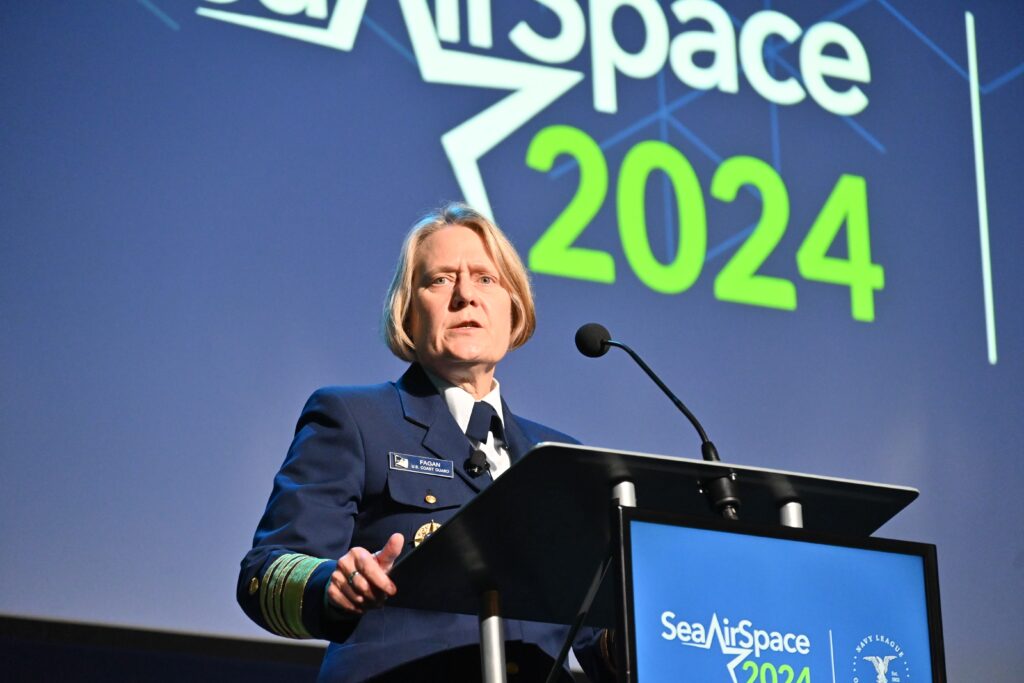
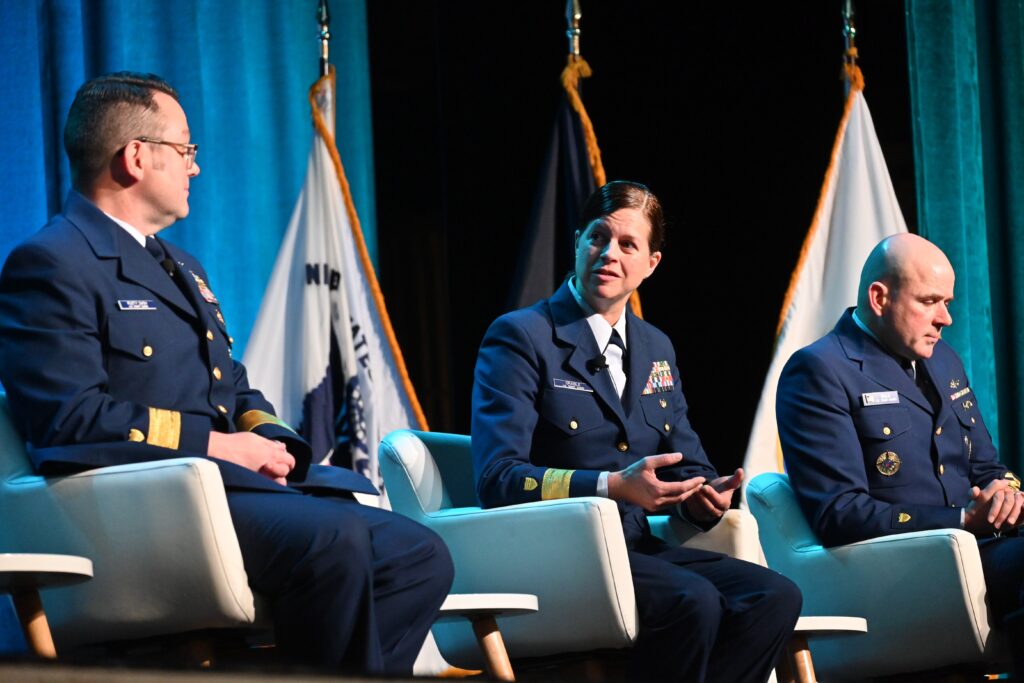
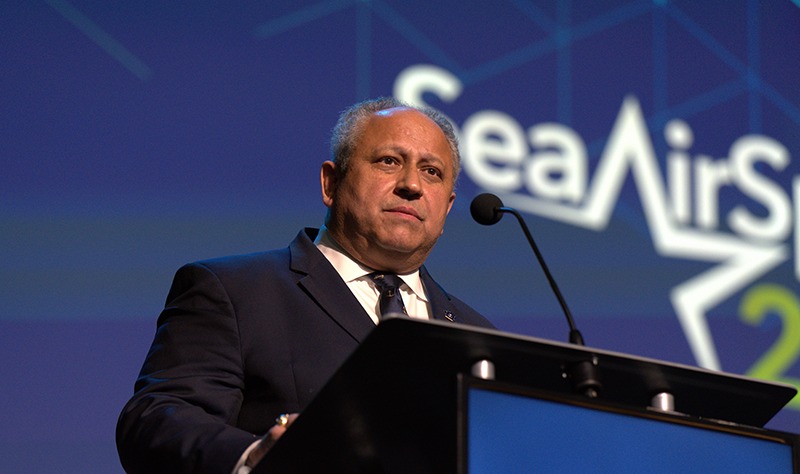
Secretary of the Navy Carlos Del Toro addresses the crowd at the site selection ceremony on Oct. 18. Also pictured are Nina Albert, deputy mayor of the District of Columbia for planning and economic development, and Rear Admiral Samuel J. Cox (retired), director of the Naval History and Heritage Command. Seapower | Brett Davis
WASHINGTON — Secretary of the Navy Carlos Del Toro highlighted a site selection ceremony for the future of the National Museum of the United States Navy on Oct. 18.
“This is a moment of immense pride and anticipation for the Navy, for our nation, and for all who cherish maritime heritage,” Del Toro said, standing near two dilapidated buildings that will be part of the new museum campus.
The site is adjacent to the Navy Yard in Washington and a short walk from the current Navy museum, housed in an aging facility largely off-limits to the general public. The new museum is intended to be a state-of-the-art look at the U.S. Navy, will be open to the public and is near a vibrant neighborhood that also boasts the stadiums for the Washington Nationals baseball team and the DC United, DC Power FC and Washington Spirit soccer teams. It’s expected to attract up to two million visitors annually, well over the 100,000 annual attendance of the current museum, most of whom are already in the Navy.
Del Toro said he is well aware of the draw of Nationals Stadium, and said “I want half of them over here before the game and after the game.”
Rep. Eleanor Holmes Norton, the district’s congressional representative, highlighted the city’s historic ties to the Navy. She said 30,000 city residents are veterans and “deserve the full equality of statehood,” as district residents don’t have voting rights in Congress.
A Long Road Ahead
While service officials now know where the museum will be located, they haven’t yet raised the money, don’t know what it will look like and don’t yet know what artifacts will be in it. All of those efforts are underway by the organizations that will create it: the Navy Museum Development Foundation that will raise the money ($475 million or more) and construct the building and the Naval History and Heritage Command that will select what goes in it. Once the museum is built, the foundation will give it to the Navy, which will staff and operate it.
Rear Admiral Samuel J. Cox (retired), director of the Naval History and Heritage Command, gently poked fun at the museums of the Marine Corps and Army, which he described as being “out in the wilds of Virginia” while the new Navy museum will be next to an all-hours neighborhood.
The new museum, still years away — a groundbreaking is tentatively planned for next October and the first phase likely won’t open until 2030 — has already been a long time coming. Nina Albert, D.C.’s deputy mayor for planning and economic development, was one of the speakers at the event and noted she had served on a Navy museum site selection committee 17 years ago.
“The vision will be worth the work and it will be worth the wait,” she said.
Part of the delay was a prolonged and what Cox called “tortuous” process to acquire the land from the city in a swap that saw the Navy Yard give up some of its land on the other side of the base near the river to acquire the plot that will house the new museum.
The museum will ultimately be 240,000 square feet and filled with meaningful artifacts, such as the bell from the USS Jacob Jones, sunk in 1917 off the coast of Cornwell, England, by a German U-boat and rediscovered in 2022. It was the first U.S. Navy destroyer sunk by enemy action. The bell, recovered by the British Ministry of Defence and transferred to the U.S. Navy earlier this year, is being prepared for display, said Vice Chief of Naval Operations Admiral James J. Kilby.
The museum is carrying high hopes for Navy officials. Former Secretary of the Navy Kenneth J. Braithwaite II said “it will not be a musty old hall with a bunch of old artifacts … it will be the spark that will draw people to the service of our country in the uniform of the United States Navy. This will be a new crown jewel in this city.”
Forging Industry Can Meet Defense Demand, Group Says
A Rock Island Arsenal-Joint Manufacturing and Technology Center artisan transfers a metal component during the forging process as part of a demonstration at the U.S. Army Tank-automotive and Armaments Command Casting & Forging Summit in 2022. The event gathered experts and officials across the government, military, industry and academia to discuss how to best modernize and sustain manufacturing operations critical to national security. U.S. ARMY U.S. Army | Hayley Smith, Rock Island Arsenal-Joint Manufacturing and Technology Center
The forging industry has a message for the Department of Defense and the country’s defense contractors: it has tremendous capacity and is ready to work.
That message is being spread by a new education campaign from the Forging Industry Association. The group’s CEO, Jim Warren, told reporters on Oct. 9 there is a perception within the DoD that the forging industry lacks capacity, but that’s not the case.
“We have no problem with capacity on anything,” he said. If there is a problem in the future, it will be with an expected surge in construction of commercial aircraft, but until then, “we can do it all,” including making forged and cast components for ships and submarines.
The real issue, he said, is with an uncertain demand signal that makes it hard to predict when forged and cast products will be needed. The Forging Industry Association’s message to the DoD and the prime contractors is, “can we please run more like a commercial industry?” Warren said.
The FIA is promoting a new survey from the auditing firm Wipfli, which concluded that 63% of forging companies do work within the defense industry and members, on average, are using 51% of their available capacity.
Companies that do primarily defense work have an even lower capacity use, at 41%. The FIA concluded these companies have ample capacity to do additional defense work if it was available. The study also showed that 76% of forgers have invested in robotics, so they are working to boost their efficiency.
“Washington is making historic investments in our technological edge to compete in this new era of great power competition. But the North American forging industry is at risk of being neglected — by a combination of inattention from government authorities, a stubborn myth that it lacks sufficient capacity to meet demand, and trade policies that hobble us and aid our adversaries,” Warren said in a statement.
Helpful Steps
The FIA wants the government to take several steps, including streamlining the process for adding forging companies to approved vendor lists; adding more varied types of materials; extending contract periods to allow companies to make better use of their capacity; and make additional investments in new technology, infrastructure and workforce development programs.
The Defense Production Act Title III and the Industrial Base Analysis and Sustainment programs could help fund new technology to help improve the quality of hot forged parts, FIA said.
There are also trade issues. As is the case with other industries, the FIA says government-subsidized Chinese companies are unfairly competing in the market.
“What’s needed are higher tariffs on Chinese forgings — more than the current 25% tariffs currently in place — to help bring back some of that lost business,” Warren said in a statement. “More aggressive efforts are also called for to prevent China, India, and others from dumping into the market forgings such as gears and connecting rods that are far below fair market. That means considering outright bans on certain countries from importing forgings.”
Navy Unveils ‘Strike Group’ Recruitment Technology
Lieutenant Commander Tiffany Pearson at the Strike Group mixed-reality system, on display at the Navy Memorial in Washington, D.C. Brett Davis
WASHINGTON — The U.S. Navy displayed one of its latest high-tech recruitment tools, the Strike Group, in Washington, D.C. last week at the Navy Memorial.
The modular, mobile system showcases different aspects of Navy life in an aircraft carrier strike group, giving potential Sailors an idea of careers they could pursue on or under the water.
“What we have here is our interchangeable, cutting-edge, multi-unit mobile experience,” said Lieutenant Commander Tiffany Pearson, who was doing community outreach. “It’s called the Strike Group. Obviously it alludes to our carrier strike group in the Navy, and the goal here was to engage our target demographic, 17 to 24 years old, so Generation Z. Generation Z is huge on gaming, as you can see we have different patches at each different station, so game badges are a way to incentivize people to keep going.”
In Washington, the modules were arrayed around the U.S. Navy Memorial Plaza, just down Pennsylvania Avenue from the Capitol.
The Strike Group includes these modules:
All Hands, where players test their skills on the deck of a virtual aircraft carrier in a first-person reality game
Support, where participants survey an interactive map of the world showing Navy ships conducting humanitarian missions
Fly, where players operate a full-motion flight simulator
Dive, where participants take on the role of a Navy diver as part of an Underwater Construction Team
Achieve, which participants learn about hundreds of potential jobs in the Navy and get an AI-generated image of themselves in their recommended role
Seek, which showcases the “silent service” and allows playes to learn about life on a submarine taking part in an Ice Exercise near the North Pole
Train, where a Navy Seal trainer guides participants through a series of challenges to test their physical strength, mental fortitude and willpower.
At each station, participants would collect a badge showing their achievement.
“The overall motivation behind that is, unfortunately a lot of people do not have interaction with military members today, either active duty or reservist,” Pearson said. “So, our goal is, with this, to bring it around the country to high schools and colleges, universities, so individuals can get a hands-on experience … to see what it’s like to fly a plane maybe, or to be a diver if that interests them, or even see what humanitarian missions we’ve done. … We even have a trailer that shows them who they could be in the Navy.”
The Navy has previously used similar demonstrations, but the systems were both larger and less flexible. One was the Nimitz, which showcased life on an aircraft carrier, and another was the Burke, highlighting the Navy’s destroyers.
For the latest system, “we call it a strike group because it just doesn’t limit it to one platform … here, it’s a strike group, all-hands efforts,” Pearson said.
The weather for the system’s public debut was not the best, rainy and overcast, but Pearson said a number of potential recruits loved interacting with the technology, so “it has been a bit of a challenge, but it’s been great.”
Senate Committee Report Calls for Coast Guard Action on Sexual Harassment Claims
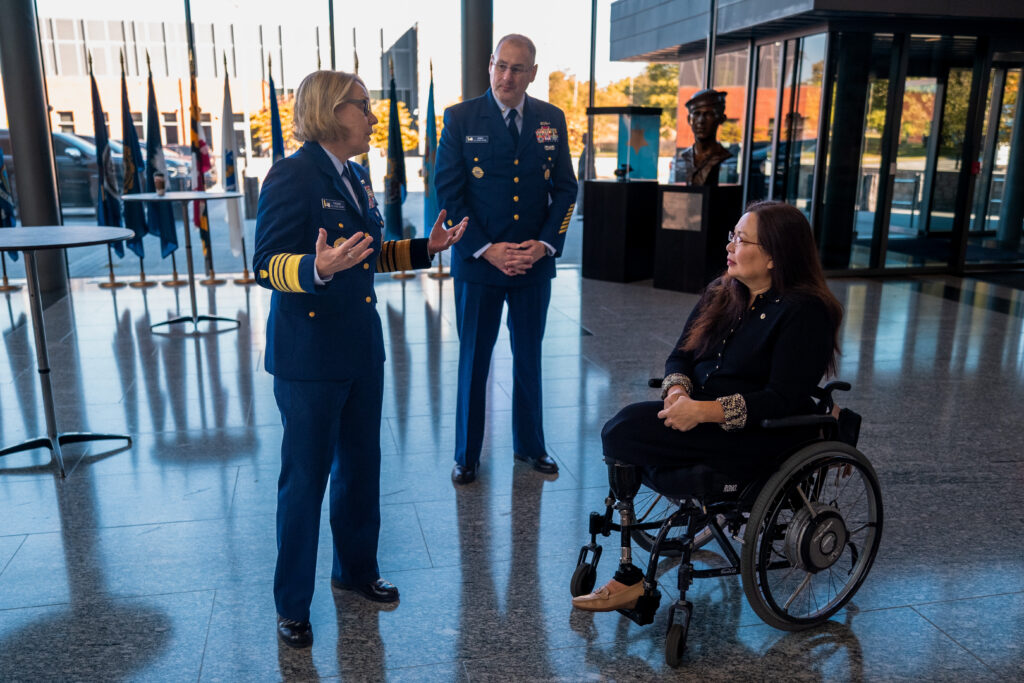
Admiral Linda Fagan and Master Chief Petty Officer of the Coast Guard Heath Jones converse Oct. 19. 2023 with Senator Tammy Duckworth in observance of National Disability Employment Awareness Month. U.S. Coast Guard | Petty Officer 2nd Class Erik Villa Rodriguez
In a new report entitled “A Pervasive Problem,” the majority staff of the Homeland Security Committee’s Permanent Subcommittee on Investigations concluded the U.S. Coast Guard must do more to eliminate sexual harassment in its ranks and at the service’s academy and should use evidence uncovered by the panel to prosecute perpetrators.
“The Subcommittee has heard from more than 80 whistleblowers, who together have made clear the need for immediate change both at the Academy and in the Coast Guard,” the report’s conclusion says. “Their stories detail systemic sexual assault and harassment, including a culture of silencing, retaliation, and failed accountability. Although Operation Fouled Anchor initially brought these problems to light, they span both the Academy and the Fleet — the Coast Guard as a whole must work to build a culture in which everyone is safe, respected, and valued.”
The panel has been looking into the issue for more than a year, and recently held a hearing featuring Coast Guard Commandant Admiral Linda L. Fagan as the main witness, focusing on Operation Fouled Anchor, the Coast Guard’s investigation into sexual harassment allegations. Members of the panel charged the service had buried the results of its own investigation until CNN brought them to light. Fagan pledged to be transparent in dealing with the issue, which is also being investigated by the service’s inspector general.
However, in a “note from the chair” that begins the new report, panel chairman Sen. Richard Blumenthal of Connecticut writes, “I am deeply disappointed by the Coast Guard’s responses to this Subcommittee’s requests for critically necessary information. Despite repeatedly and publicly claiming a commitment to transparency, the organization has often resisted constructive responses. Such repeated opposition to disclosure has made us wonder whether the Coast Guard is, once again, attempting to escape Congressional scrutiny.”
Victim Reports
The report includes statements from numerous reports of sexual assault going back decades, as well as what survivors describe as attempts to silence them.
“These stories, spanning from the 1970s through the 2020s, depict systemic failures at the Coast Guard Academy and in the Coast Guard that continue to this day,” the report says.
In one account, “after learning that she had experienced months of sexual misconduct, a superior allegedly told an enlisted whistleblower: ‘Okay, I want you to think about these men and their careers. They could lose their jobs over this, and you could ruin their lives. And then CGIS [Coast Guard Investigative Services] is going to show up and make you out to be a liar. No one will believe you. Do you want that? I want you to think about all of this before you decide to tell anyone else.’”
In some cases, “fear of punishment for collateral misconduct deterred victims of abuse from reporting. One whistleblower shared that, as a cadet in the 2010s, the threat of discipline for unrelated misconduct was used to keep her from reporting repeated sexual assaults by the same perpetrator for a year. She said: ‘He blackmailed me, using his position over me and the fact that I drank underage to get me to have sex with him. He knew that I would get into more trouble for underage drinking than he would for blackmailing me for sex. He was right. …’”
Blumenthal’s opening note says the subcommittee will continue its work, and “our continuing investigation is likely to provide evidence that will assist and motivate the Coast Guard to impose discipline. It is imperative that the Coast Guard uses all means available to hold accountable both individual perpetrators and the leadership that covered up their wrongdoing … the culture will not change until the Coast Guard makes clear that sexual assault and harassment will not be tolerated.”
Coast Guard Response
The Coast Guard provided a statement to Seapower in response to the report.
“Sexual assault, sexual harassment, and all forms of abuse have no place in the Coast Guard. We are committed to fostering lasting institutional and cultural change that ensures a safe and respectful environment free of sexual assault, sexual harassment, and other harmful behaviors. Should such incidents occur, the Coast Guard is committed to supporting victims, upholding the law, and reinforcing the service’s core values,” the statement says.
“We are actively implementing the commandant’s 33 directed actions announced in November 2023 to strengthen our service culture, improve support and care of victims, and hold perpetrators accountable. Our progress completing 18 of these directed actions so far represents the early stages of enduring change that will ensure every person in the Coast Guard experiences a safe work environment where they are respected and valued. More information regarding the Coast Guard’s actions to address sexual assault, and ensure accountability, care, and support, is available here.”
Career Advancement: MARAD Has a Story to Tell of Good Jobs, Work-Life Balance
Ann Phillips, administrator of the U.S. Department of Transportation’s Maritime Administration. Brett Davis
The Maritime Administration has a good story to tell, and Ann Phillips, the retired Navy admiral who runs MARAD, is seeking new ways to tell it.
“Not enough people know enough about the maritime ministry, and they don’t know what opportunities are there for them,” she said in an interview with Seapower at the Department of Transportation headquarters in Washington, D.C. “It’s good paying jobs, good paying union jobs, good paying jobs with a career advancement opportunity.”
MARAD, established in 1950, is the DOT agency responsible for the nation’s waterborne transportation system, including supporting the technical aspects of ships and shipping, port and vessel operations and national security-related maritime transportation. It maintains a fleet of cargo ships in reserve to provide sealift surge capability in wartime and in case of national emergencies. Phillips was sworn in as administrator on May 16, 2022, after serving nearly 31 years in the U.S. Navy as a surface warfare officer.
Like its military brethren, the maritime industry faces challenges, such as an aging ships in the Ready Reserve Force (part of the wartime surge capability) and a shortage of Mariners. A few years ago, MARAD faced a shortage of an estimated 1,800 Mariners to be able to activate the full Ready Reserve Force for six months, such as might be required in wartime.
“And along came COVID, which made it worse for sure,” Phillips said. “People left because they weren’t guaranteed replacements. They left because they were stuck overseas. They left because they didn’t want to get COVID or they didn’t want to get involved in all the challenges of operating under those circumstances.”
Things are looking brighter. Enrollment is trending up at the MARAD-funded and owned Merchant Marine Academy in Kings Point, New York, as well as the six state academies in California, Michigan, Maine, Massachusetts, New York and Texas.
MARAD has a Student Incentive Program for the state academies, and Congress authorized doubling the incentive to $64,000 over four years, which mostly covers student expenses. Upon graduation, officers become part of the Navy’s Strategic Sealift Officer Force, according to a description of the program published by the California State University Maritime Academy.
“This year we completely filled up all the slots for the Student Incentive Program for the first time in forever,” Phillips said. There was a question as to whether upping the funding would matter, but “it would appear the answer is yes, it will make a difference,” Phillips said with a laugh.
The academy at Kings Point has also been working hard on recruiting, she said, and has 300 students coming into the new freshman class, up from recent years.
“They have to get through the very arduous and rigorous curriculum at Kings Point. But, that’s a success,” Phillips said.
Improvements
MARAD has made several improvements lately to continue to attract and retain recruits, both in terms of hardware and policy and standards.
It has developed a program to designate some qualified training entities as Centers of Excellence for Domestic Maritime Workforce Training and Education, a voluntary program intended to improve and support the workforce. As of earlier this year, 32 centers have been designated, including colleges and other facilities in 17 states and Guam.
“It’s not just credentialing Mariners, it’s also workforce development for maritime more broadly,” Phillips said. The designation gives the centers “bragging rights” but for the industry it helps tap into a broader set of potential industry members and provides “other opportunities to get the word about out about the maritime industry and what it can do for you.”
On the policy and standards side, MARAD has implemented EMBARC, which stands for Every Mariner Builds A Respectful Culture. The program was introduced by MARAD and the Merchant Marine Academy in December 2021. It lays out policies, programs, procedures and practices to help prevent and respond to sexual assault and harassment. The owners and operators of any vessel that embarks Merchant Marine Academy cadets on board must adopt the EMBARC standards, which include zero tolerance for sexual assault and harassment, eliminating barriers to reporting such incidents, supporting survivors, witnesses and bystanders who report incidents, among several others.
“Any vessel that is required to carry midshipmen, which is anybody receiving a payment under the maritime security program, tanker security, or cable fleet security program, plus our operators of Ready Reserve fleet vessels, all have to be a part of the program, or we may withhold their stipend, their payment,” Phillips said.
MARAD isn’t interested in withholding payments, but in ensuring the safety of Mariners at sea. Other ship operators that aren’t required to comply have been coming forward to do so, Phillips said, meaning a “vast percentage of the U.S.-flag fleet” is now EMBARC compliant.
The program was underway before she became administrator, Phillips noted, “but to be able to take it from a program to a law in a year is almost unheard of. And it has made a difference. It has made a difference. Talking to midshipmen — we have a Midshipman Advisory Council now, we were tasked to put together at Kings Point — and they talk to me about how they feel EMBARC matters and has made a difference to them. Some of them have said, I don’t know a maritime industry without EMBARC.”
EMBARC and other quality-of-life improvements MARAD is making may help in recruiting women, who are not a large part of the commercial maritime industry to date. Phillips said 8% of the U.S. industry are women but just 2% globally.
Empire State, the first ship in the new National Security Multi-Mission Vessel program to build state-of-the-art training ships for the Merchant Marine academies. Philly Shipyard
“There are not many women in the industry, broadly. And so, that’s a shortfall. Fifty percent of our country’s population, roughly, are women, and yet 8% of the industry is women. We know this from the Navy, you’ve got to get to a critical mass. And once you do, everything becomes more straightforward because the novelty is gone, right?” Phillips said. “And so, we’re not yet there in maritime, but if we want to, if we want to grow our Mariner pool [but] we’re missing half the people in the country, then well, that’s an obvious place to look. And if you want to make people feel safe at sea, that applies to everybody. That’s just not women. That’s Mariners broadly. So, all of that comes together in EMBARC.”
NSMV
There is also a strong new hardware push, namely getting MARAD’s new National Security Multi-Mission Vessels, or NSMVs, out to the training academies to replace the older National Defense Reserve Fleet ships now in use. A model of an NSMV sat in the middle of the table in the MARAD office where we spoke.
“New York has theirs. She just took off on her summer cruise yesterday morning,” Phillips said on June 11 of the ship, Empire State. “Massachusetts will be getting theirs later this summer, Patriot State, and there’s three more coming for the rest of the Maritime Academies. They are tremendous training vessels. It’s much more modern than the ships that we’ve had. Although I cast no aspersions on steam vessels or the training vessels that the academies have been using, they have all served their purpose and served their country well … but this is a state-of-the-art vessel.”
The NSMV represents more than just a shiny new ship, Phillips said, it’s also a boon to recruitment and retention. Students at all six of the state academies and the Merchant Marine Academy will have access to the ships, which can also be mobilized by the federal government if they are needed to respond to disasters or for humanitarian assistance.
“It makes a difference with young recruits,” she said. “They don’t want to see steam.” The new ships also are a way to boost quality of life, as they give cadets a flexibility their forebears didn’t have.
“I think the, the work-life balance piece matters now more than ever,” Phillips said. “And we’ve seen, when I visit our Ready Reserve fleet ships — which of course are much older — and quality of life is, of course, challenged on an older vessel. But when I ask Mariners what they want, they want connectivity. They want internet, they want Starlink [satellite communications], they want be able to get on Instagram and talk to their kids. All these things that this can do, right?” she said, pointing to the NSMV model. “All these things that can do. But they want that. They want a gym. They want good quality food.
“They just want to know you care about them.”
In addition to benefiting the training schools, the NSMV is helping bolster America’s shipbuilding industry, which suffers from a worker shortage and backed-up schedules. The NSMV ships are being built by Philly Shipyard under a firm fixed-price contract from TOTE Services LLC, the program’s vessel construction manager.
“Philly had 88 people on their rolls and now they have easily 1,400 people working on this,” Phillips said. “And we’ve been a part of that the whole way. Our small shipyard grant program helped provide them opportunities to get their very modest amounts of money to get their apprenticeship training up and running.”
The NSMV contract also enabled the shipyard to win other contracts, and now “they’ve got an order book and they’re off to the races … that’s an example of how that can be done. So, let’s keep doing it,” she said.
The Flexibility of Maritime
Merchant Marine Academy graduates also have unusual flexibility, in that they can commission with any of the military services if they choose.
“If you go to King’s Point, you … graduate with your license, either third mate or third engineer, you graduate with a Naval Reserve Commission or perhaps an active-duty commission. You can do that too. And of course, you have your degree. So, you have an engineering degree, a license, and a military commission. The world is your oyster. You can do all kinds of things with that. You’re pretty much set for the rest of your life,” Phillips said.
She recounted a story from an academy graduate whose father wanted her to go to the Naval Academy, as he was a Navy man.
“She said, no, daddy, I want to go to Kings Point, because then I can go to any of the services,” Phillips said. “And he admitted to me, yeah, she was right. In the end, she did not accept a commission, but she works for the Navy and she’s a port engineer for the Navy and handles naval vessels and using her King’s Point experience.”
Students can wait until their senior year to decide to join any of the other services.
“We’ve had Space Force commissions last year, I think two Coast Guard — lots of folks do that — but all services,” she said, noting their Merchant Marine background is still useful even if they go into another service.
“If they’re going to join the Navy with a Navy commission then they aren’t sailing U.S. flag, right? But they still come with that background. And I can tell you from personal experience, that’s a connection. … One of the ships I was on, the supply officer was a Kings Point graduate. She could stand a bridge watch any day of the week. She had no problem. All of that was learned here. She done it. She had experiential learning. It was easy for her.”
Phillips said being a Merchant Mariner is simply a good job that not enough people know about, and most people don’t understand how much of their daily goods are shipped over water.
“They don’t realize how much of their goods are moved commercially on rivers or in coastwise trade. They just don’t really think about it,” Phillips said. Also, “people don’t think of it as an industry. They don’t think of it as an industry where they can have a long-term career.”
And a flexible career at that. Phillips said during her Navy years, “when I came back from deployment, if I had duty the next day, it was like, oh, that’s nice. You got back from deployment. You’ve been gone for eight months. Don’t be late for watch. But when you’re off in the industry, you’re off. You can work six months a year. You can work nine months a year. It’s up to you. You can do it in pieces. It depends on who you’re sailing for and what your watch rotation is. But you get an excellent salary and you get excellent benefits … if you’re part of a labor union or with your company.”
That flexibility means “you can manage your life in a different way,” Phillips said. “And you can’t do that in the military.”
The Future
Asked where she would like the maritime industry to be in five years, Phillips said she’d like to see the construction of more sealift and tanker security vessels, expanded capacity at the Kings Point academy and a congressional appropriation for a grant program to help expand the work of the Centers of Excellence.
“The Center of Excellence program has a grant program authorized, but not appropriated,” Phillips said. “So, an appropriation there would help us work collaboratively across the selected centers of excellence institutions and give them the ability to build more capacity, to do more recruiting locally.”
One goal she described as aspirational would be a collaboration across all the maritime stakeholders to create an advocacy program for Merchant Mariners to “get that word out there” about the good jobs the industry can provide.
The U.S. Marine Corps has had Super Bowl ads: Why not one for the Merchant Marine?
From the July-August issue of Seapower magazine.
Senators Blast Coast Guard Chief for Sexual Assault Response
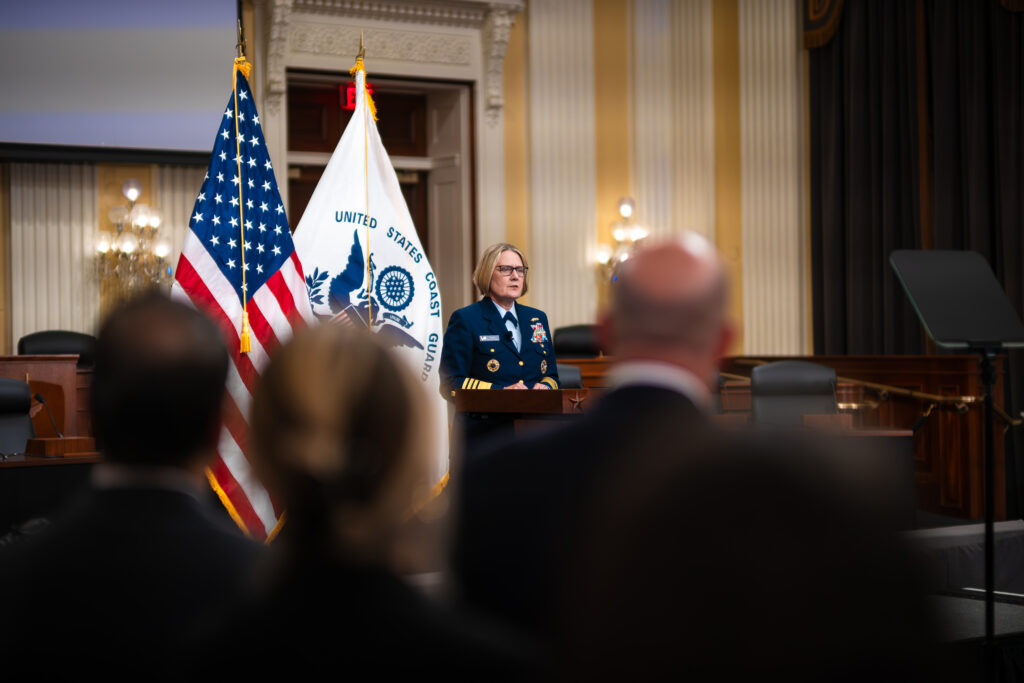
Adm. Linda L. Fagan, commandant of the Coast Guard, speaks to guests during the 2024 State of the Coast Guard Address in Washington, D.C., March 20. U.S. Coast Guard | Petty Officer 1st Class Brandon Giles
Coast Guard Commandant Admiral Linda L. Fagan endured withering criticism of the service’s treatment of sexual harassment issues at the Coast Guard Academy on June 11, as Senators from both sides of the aisle said the Coast Guard has not been forthcoming with its investigations or in helping the Senate panel conduct its own.
The Homeland Security & Government Affairs Committee’s Permanent Subcommittee on Investigations looked into the Coast Guard’s Operation Fouled Anchor investigation into sexual assault at the Coast Guard Academy. During a hearing, members said the Coast Guard buried its own critical report, retaliated against whistleblowers and has been dragging its feet in providing information about the report to the committee.
Sen. Richard Blumenthal (D-Connecticut), the panel’s chair, said Operation Fouled Anchor “was hidden from the public as well as Congress” and decried what he called “a culture of coverup continuance.”
Blumenthal said the Coast Guard attempted to say much of the assault and harassment had occurred in the past, but more than 40 whistleblowers told the committee it is ongoing.
“The question is, what will the Coast Guard do about it now, in the present?” Blumenthal asked. “We are now expecting action.” He also said, “our investigation has shown a deep moral rot inside the Coast Guard.”
Fagan appeared at the hearing as the primary witness, along with Master Chief Heath Jones, the highest-ranking enlisted officer in the Coast Guard
Fagan said the Coast Guard is trying to provide all relevant documents to the committee, is cooperating with an Inspector General review of the Fouled Anchor effort, and is about to contract with an outside, independent investigator with $1.5 million provided by Congress.
The Inspector General (IG) is “looking into Operationa Fouled Anchor, the totality of it, including action or inaction of senior leadership,” Fagan said.
“Sexual assault is “unacceptable. Not in my Coast Guard,” said Fagan, the service’s first female commandant. “It is not who we are.”
She said she has met with victims of assault, and “to the victims, the survivors, I am truly sorry for what you have had to go through.”
She said the failure to provide the Fouled Anchor report to Congress was a mistake that eroded trust but said now the service is being fully responsive to the subcommittee.
“I cannot change the past. But as the commandant today, I reaffirm to our workforce, past and present, that I remain steadfast to making lasting cultural change,” Fagan said.
Sen. Ron Johnson (R-Wisconsin), the ranking member of the panel, complained that the Coast Guard had issued a “data dump” of 1,000 pages of heavily redacted material on Operation Fouled Anchor, which he said was purposefully confusing and hard to follow.
Operation Fouled Anchor
The issue of Operation Fouled Anchor, first uncovered by CNN, burst into the news just days before the hearing, when Shannon Norenberg, the sexual assault response coordinator at the Coast Guard Academy, resigned and post an open letter on Maritime Legal Aid.com in which she wrote, “The Coast Guard lied to me. Worse than that, they used me to lie to victims, used me to silence victims, and used me in a coordinated effort to discourage victims of sexual assault at the Academy from speaking to Congress about their assaults and about the Coast Guard’s investigation of their cases.”
Fagan said Norenberg, who was in the room, “has been an incredible employee for us” and “the allegations she has made will be part of the IG investigation.” She said she had not read Norenberg’s posted statement but would do so.
Norenberg had started working with Operation Fouled Anchor in 2018, her letter says, but it had been ongoing for four years before that and had investigated dozens of sexual assaults reported at the academy.
Part of her work with the operation was to call victims and offer what she called “official expressions of regret,” along with in-person meetings in 2019 with 25 to 30 victims. Norenberg discovered she would not be offering CG-6095s to victims, which is proof offered to the Department of Veterans Affairs that the victim reported an assault while in the military, making it easier for them to obtain VA services to deal with their trauma.
Blumenthal said he was especially outraged by this, calling it “one of the most damning parts of her letter.” He asked Fagan what she would do to provide access to VA services for sexual assault victims.
Fagan replied “I am committed to working with the IG,” and later said, “my priority is supporting victims … I don’t want any victim to not get the support they are entitled to.”
Blumenthal said “the IG report cannot be used as a shield for inaction” or as a reason for not disclosing documents, drawing a small smattering of applause.
Fagan said she did not become aware of the full extent of potential victims uncovered by Operation Fouled Anchor “until we had some of the FOIA requests from CNN.”
She said her predecessor, Admiral Karl Schultz, was commandant of the Coast Guard at the time the decision was made to not reveal the findings of Operation Fouled Anchor but said she did not know if he was involved.
Blumenthal said maybe she didn’t want to know, but Fagan replied, “I am committed to full transparency with regard to the allegations.” She said the service will continue to cooperate with the IG and the third-party investigator “so we can understand what was known, when, and bring clarity to the allegations.”
Navy League Congressional Fly-In Makes Successful In-Person Return to Capitol Hill
Rep. Joe Courtney (D-Connecticut) discusses sea service issues with Navy League National President Christopher Townsend and CEO Mike Stevens during the Congressional Fly-In. James Peterson
Navy League members from councils around the country visited the offices of dozens of lawmakers on Capitol Hill on Wednesday as part of the first in-person Congressional Fly-In held since 2019.
They came to discuss the needs of the sea services with members of the House of Representatives and Senate, and to touch base with lawmakers and staff that represent their council regions during more than 100 meetings.
The messages included calling for funding two Virginia-class submarines in fiscal year 2025 and writing a “SHIPS Act,” modeled on the CHIPS Act that helped restore microchip manufacturing and production capacity in the United States. The Navy League visitors also called for an annual shipbuilding and conversion budget of at least $35 billion.
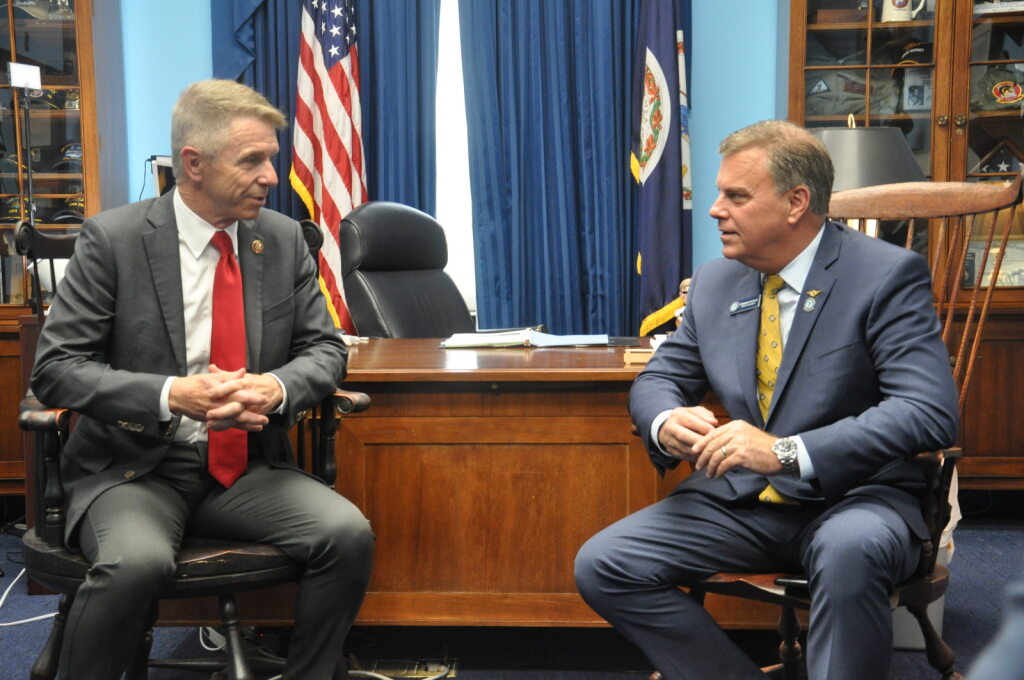
Rep. Rob Wittman (R-Virginia) talks with Christopher Townsend. James Peterson
The council members also discussed the need to fund the sea services’ unfunded priorities, including barracks restoration and modernization for the Marine Corps, icebreakers and new cutters for the Coast Guard and defending the Jones Act for the U.S.-flag Merchant Marine.
They also educated lawmakers and their staffs on the need to create future Sailors, Marines and Mariners by supporting the Sea Cadets, Young Marines and funding for the state Maritime Academies’ student incentive programs.
On the eve of the fly-in, the Navy League notched a major victory for its advocacy work as the House Armed Services Committee voted to include funding for a second Virginia-class submarine in its upcoming National Defense Authorization Act markup.
“We had a great time,” Sinclair Harris, retired rear admiral and national vice president of the Navy League, said at the end of the day. “We had six visits, one with a member of Congress, the rest were staffers, but all of them were very engaged, they all understood the importance of what the Navy League does and supports and educates and advocates for.”
Sara Fuentes, who led a group of council members representing the Southern Region, said, “what makes the Navy League so unique and special is that anyone can get behind our issues because they benefit all Americans. It was a real pleasure to meet with Democrats, to meet with Republicans, all different kinds of offices, inland, coastal, and have them all understand and support our sea services and understand the need to really invest in them.”
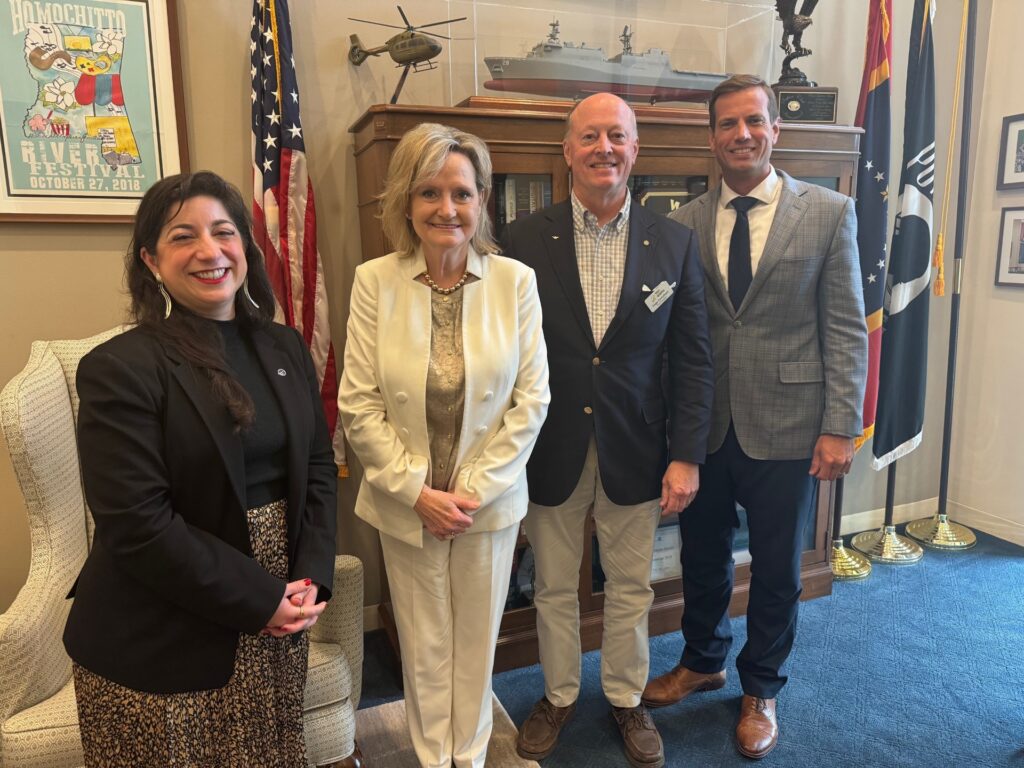
Members of the Southern Region meet with Sen. Cindy Hyde-Smith (R-Mississippi), second from left. Sara Fuentes
Scott Maguire, a board member of the Portland-Blueback Council, said his team made eight visits to House and Senate members, and “they were very receptive to what we had to say and seemed supportive, so I’m looking forward to their approvals on what we have suggested.”
Merilyn Wong and William Stephens of the Marin County Council said they visited their local representative and convinced him to become a co-sponsor of the Pay Our Coast Guard Parity Act, which ensures Coast Guardsmen are compensated for their work during government shutdowns.
“Every staff person was very receptive, interested in our presentation, wanted to learn a little bit more about it. We kept telling them about the Center for Maritime Strategy, to take advantage of that, something they didn’t really know, so that was helpful,” said Michele Langford, Pacific Central Region president.
Navy League National President Christopher “Towny” Townsend said “it was a fantastic day. We got to execute one of our primary missions of advocating for our sea services here in person in the halls of Congress.
COVID-19 restrictions put a hold on events like the Congressional Fly-In, but Townsend said it was a good time to come back in person “and spread the Navy League gospel, talk about the needs of the sea services.”
Budget, Recruitment Challenges Drive Coast Guard Creativity, Officials Say
Coast Guard Commandant Admiral Linda Fagan speaks at the fifth annual Coast Guard breakfast. Brett Davis
Challenges with budgets, recruitment and retention levels are giving the U.S. Coast Guard the opportunity to be creative in addressing them and to update its policies and procedures, service officials said at the fifth annual Coast Guard Breakfast at Sea-Air-Space 2024.
Coast Guard Commandant Admiral Linda Fagan said the service has about half the maintenance budget it needs to maintain its legacy ships and equipment and is competing with the other services for shipbuilding and other industrial base services.
On the personnel side, persistent shortfalls in recruiting and retention ꟷ the service is down about 10% for enlisted personnel, Fagan said ꟷ have forced the Coast Guard to innovate and rethink the types of workers it recruits and how it enables their career.
“That crisis has really given us the opportunity to think,” Fagan said. “It strikes me the system that we’re operating, and much like the other services, the boot camps and schools, they’re optimized for 18 year olds fresh out of high school with little to no life experience, yet that’s not the recruiting pool that we’re experiencing or drawing into the service,” Fagan said.
The service is moving to a vastly different recruitment method, bringing in people aged as much as “42 years young” with much more life experience, enabling much greater flexibility for service members with families and making it easier for guard members to leave the service and re-enter.
That’s what enabled Rear Admiral Jo-Ann Burdian, the assistant commandant for response policy, to even be on stage on Wednesday at Sea-Air-Space, she said. She left active service as a lieutenant commander because she had three kids under the age of two at home.
“And when they were ready for me to come back, I still felt that calling back. I still felt like I had work to do for our Coast Guard and the nation, and the ability to come back and still go to graduate school, still compete for special assignments and be sitting here today” is a testament to the Coast Guard, she said.
Rear Admiral Russell Dash, commander of the Personnel Service Center, noted “we don’t always do press releases when we change policy, but we were the first one that went to 42 years old to be able to join the Coast Guard,” preceding the Navy’s similar move.
Chief of Naval Operations Admiral Lisa Franchetti said on Monday at Sea-Air-Space that a parent and child could enter Navy service at the same time, one at 42 and one at 18, but Dash said the Coast Guard has actually had that happen.
He said the service’s previous philosophies needed to change to make such things happen.
“There’s the acknowledgement that our standard of every single member of the Coast Guard needs to be worldwide deployable at every moment of their career, and the moment that you’re not worldwide deployable, we start a shot clock and say, you’ve got to fix yourself and get to this point, or we’re going to separate you. That’s wonderful when we had lines out the door, a waiting list to join the Coast Guard. But in the competition for talent, we’ve got to accept that’s not a standard that is maintainable for us. So, that has given us the opportunity to drive innovation.”
Rear Admiral Amy Grable makes a point about maintenance issues. Brett Davis
Maintenance
The service’s changes aren’t limited to personnel. To deal with that maintenance shortfall, the Coast Guard has gotten creative there as well.
“We do have shortfalls across all of our portfolios, including aviation, surface and shore,” said Rear Admiral Amy Grable, assistant commandant for Engineering and Logistics.
“We’re deferring 50% of our maintenance on many of our major cutters. And what that means to our crews is, what we used to call cannibalizing parts from one cutter to put on another cutter. It’s now so routine that we have a name for it, we call it a controlled parts exchange,” she said.
HASC Members Prepare to Dive into Navy Budget
Members of the House Armed Services Committee seem prepared to overturn some Navy decisions as outlined in the fiscal 2025 budget request, including retiring some ships early and funding only one Virginia-class submarine.
“What has happened is, as the top line is increased, the game has become, ‘we’ll add a bunch of the stuff that we know Congress won’t add, and we’ll take out stuff that we know Congress is going to put back in.’ And that will be a net gain. That game has to stop,” said Rep. Wittman (R-Virginia), chair of the House Subcommittee on Tactical Air and Land Forces.
As for the Virginia-class sub, Wittman said the Navy position that the program is behind anyway and the shipbuilders can’t keep up doesn’t make sense.
“It really is about demand signal and, and you can’t have it both ways. You can’t say, well, the reason we are reducing the submarine request is because we don’t think the industrial base can do it. That’s wrong,” he said. “The industrial base can do it if you send them the demand signal. We’re at about 1.6, I think, submarines today annually, we need to be at 2.3. The way we get there is to send the proper demand signal.”
Rep. Joe Courtney (D-Connecticut), the ranking member on the Subcommittee on Seapower and Projection Forces, said a defense industry report issued in December highlighted the need for procurement stability.
“Procurement stability was the watchword throughout that report,” he said. “And, we’re sacrificing that. I mean, literally, within weeks” of the report.
Naval aviation is also an issue, as the Navy has an air attack shortfall, noted moderator Bryan Clark, a senior fellow at the Hudson Institute.
“There are some, thanks to Congress, some Super Hornets being procured in this year’s appropriations,” he said. “But there doesn’t seem to be a clear path ahead for the carrier air wing.”
This drew an animated response from Wittman, who said there doesn’t seem to be a sense of urgency about the situation.
“The challenge now is to make sure we get enough F-35s in production to be able to sustain these carrier wings,” and to make sure there’s not a “valley” as the Super Hornets retire, “where now all of a sudden you have aircraft carriers sitting at the dock because there’s no aircraft on board. That means we have to get those lines to intersect. That’s more of a challenge than what a lot of folks think because the tactical air component of that is about maintaining production.”
The aircraft also need technical refresh three, an upgraded software capability that contractor Lockheed Martin warned will be delayed.
“I mean, there needs to be an all hands on deck mentality to go, no, that’s not acceptable. We need these aircraft and now we’re going to have hundreds of aircraft sitting on the tarmac waiting to get a software upgrade, right?”
Wittman continued, “F-35 is it, right? That’s all we have, right? Let’s get our fanny in gear and get this thing going and get it on the decks of the aircraft carriers, get it in the hands of our pilots in the Air Force. Get our fanny in gear. I mean, this is it. I hate to get fired up about it, but I’m fired up about it because this is the future of tactile air for this nation. Get our fanny in gear,” he said, slapping the arms of his chair for emphasis.
Workforce Woes
The panel, which included Reps. Donald Norcross (D-New Jersey), Jen Kiggans (R-Virginia) and Ronny Jackson (R-Texas), also discussed the workforce issues plaguing the defense industry.
Kiggans, a former Navy helicopter pilot, said she sat on a HASC task force looking at recruitment and retention and what rose to the top were several issues: Compensation, housing and child care.
“That 5.2% pay raise that we just gave our servicemen and women in the appropriations bills that were passed a couple weeks ago, that’s a good starting place, but there’s still more work to do,” Kiggans said.
As for housing, she said college dorms are better than the places junior enlisted Sailors and Marines are asked to live. “We have to do better for our junior Soldiers, Sailors and Airmen and Marines to be able to expect them to want to do the job that we ask,” she said.
On the pay issue, Wittman said, “this 5.2% increase this year was great, but remember, the lower you are on the salary scale, the percentage is not as quite as much in your paycheck. Take for example, if you come into our services, if you are a private in the Army, the Marine Corps, third-class Seamen, third-class Airman, your starting salary is $23,000 a year. That’s 11 dollars and 50 cents an hour asking you to do the most dangerous work of the nation, putting your life on the line. And guess what? You go to Chick-fil-A and serve chicken sandwiches and make more money in a much, much less challenging or dangerous environment. We have got to fix the junior enlisted salary differential.”
Government, Industry Must Meet in ‘Common Place of Excellence,’ Del Toro Says
Industry and government alike must modernize their processes and up their game to overcome shipbuilding challenges, Secretary of the Navy Carlos Del Toro said April 9 at the lunch session at Sea-Air-Space, including by working with shipbuilding partners overseas.
Del Toro began the speech with a bit of levity, bringing the U.S. Marine Corps mascot Chesty the bulldog onto the stage, before describing the challenges that face the nation, from Houthi rebel attacks in the Red Sea to the state of the nation’s shipbuilding facilities and workforce.
“You have to understand, we, the nation, abandoned the shipbuilding industry and making the necessary investments in around the early 1980s,” Del Toro said. “Because we thought that somehow the private sector would just take care of itself. And some ways it did. China moved in with cheap labor and labor practices that weren’t fair. In fact, the United States is considering suing China for some of those unfair practices.”
Incentives weren’t made, and after the Cold War the nation lost many of it shipbuilders, he said, adding, “thank God” the nation still has the shipbuilders it does.
“But the fact is, we need more capacity if we want to a grow a Navy fleet. Let me be clear, we need a bigger Navy fleet to meet the challenges of the future. We need to have the industry to be able to grow that capacity. So, this is a whole of government discussion that we’ve initiated in the Navy across the government and there’s a lot of interest that’s growing in many different places throughout government. And I think that you’ll see this actually continue,” he said.
Del Toro cited a recent visit to South Korea, where he saw what could be the future.
“Right now, we build the most capable warships in the world in shipyards that are sometimes decades behind the global technological standard. This is an inefficient approach requiring far too much time and taxpayer dollars. And it’s certainly an approach that is only inadequate to pace our 21st century competitors,” he said.
Japan and Korea, he noted, build high-quality ships “for a fraction of the cost that we do. When my team and I went to South Korea, we were floored at the level of digitization and real-time monitoring of shipbuilding progress with readily available information down to the individual pieces of stock materials. Their top executives can tell us to the day when ships would actually be delivered,” he said.
“It’s an ethos of commitment to constant improvement that is the foundation of their reputation, consistently delivering on time and on budget, even during COVID. The daunting challenges that we face are also an opportunity, a great opportunity to partner with a greater number of shipbuilders here in the U.S. and with our closest allies abroad. We have an opportunity to attract the most advanced shipbuilders in the world to work with our first-rate ship builders of the world … and invest in commercial shipyards here at home,” Del Toro said. “This will allow us to modernize and expand our shipbuilding industrial capacity, creating good paying new-collar American jobs that come with a healthier and more competitive shipbuilding workforce.”
Previous decades of investment are what have enabled the Navy to fight off the Houthi rebels as effectively as it has, Del Toro said.
“Ladies and gentlemen, sometimes I think the American people think that this is somehow commonplace to do this, as our CNO said the other day. There is absolutely nothing commonplace about this. Our United States Navy has been attacked. We have conducted strikes like we haven’t seen in many ways since World War II.”
He said investments in training have led to the successful engagements, along with the investments in the Aegis Combat System and the SPY-1 radar
“Those investments are the reason why our Sailors and Marines have been able to combat thethis with proficiency that they have demonstrated to win the fight of the future,” he said.
The services must make similar investments today in robotics and other technologies. Del Toro noted the service has newly introduced the robotics warfare specialist rating. The RW “will be the subject matter expert for computer vision, mission, autonomy, navigation, autonomy, data systems, artificial intelligence and machine learning,” he said, calling it a “significant milestone in our journey towards achieving a truly hybrid fleet.”
And, he said again, the nation needs to investment in shipbuilding.
“The findings of the 45-day comprehensive shipbuilding review have underscored too many of our industrial partners are behind schedule and over budget on our highest priority programs. Let’s be clear, I want American industry to thrive, as a business owner for almost two decades. I understand your perspective. I’m pushing our shipbuilding industry to invest in itself to get better, be technological leaders and to once again deliver platforms on time and on budget. We must deliver for the American people because it’s our line of work. We don’t get to make excuses,” he said.
“Of course, there’s work for us to do on our end and the government as well. I’m determined to address the longstanding challenges in our procurement processes that cause industry heartburn as they tried to do business with us. And there are many that we have to work through. I expect our leaders in the government to foster culture of excellence and accountability across our own acquisition workforce.
“The point is this,” Del Toro said. “Just as our country needs you and industry to be at the top of your game, I’m determined to ensure that we and the Department of the Navy are also on the top of our game. We must meet industry in a common place of excellence.”