Navy to Commission Amphibious Transport Dock Ship Fort Lauderdale
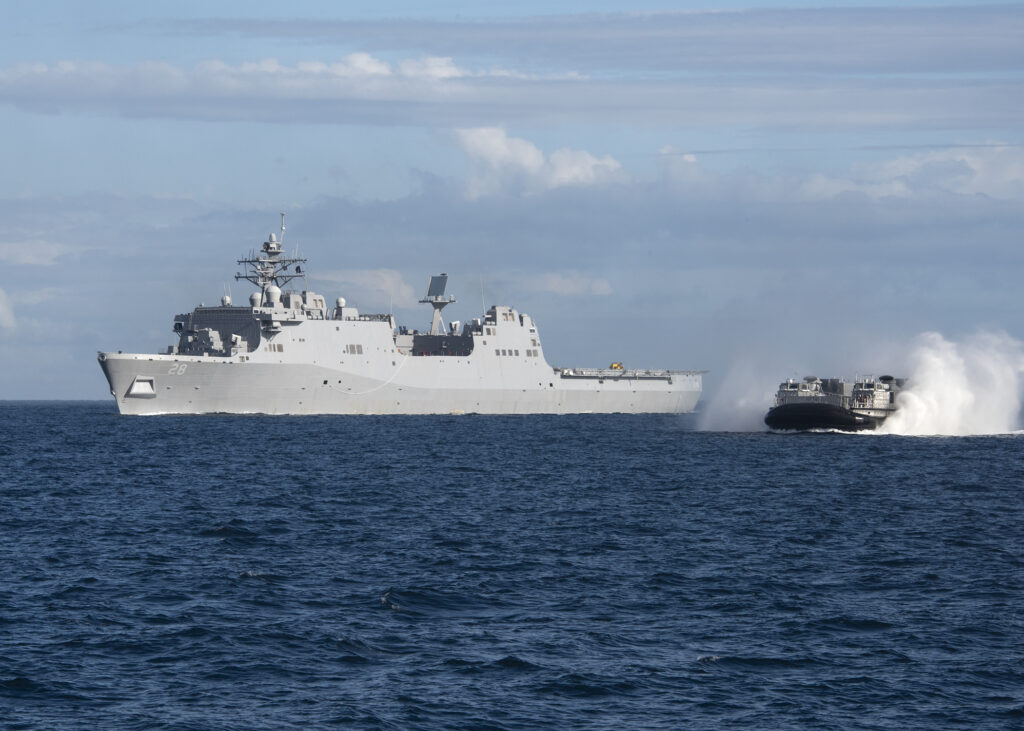
The Navy’s newest amphibious transport dock ship, USS Fort Lauderdale, transports the Navy’s newest connectors to their new homeport. U.S. NAVY
ARLINGTON, Va. — The Navy will commission its newest amphibious transport dock, the future USS Fort Lauderdale (LPD 28), during a 10 a.m. EDT ceremony Saturday, July 30, in Fort Lauderdale, Florida, the Defense Department said July 29.
The future USS Fort Lauderdale is the first naval ship to honor the city of Fort Lauderdale, Florida.
“Tomorrow we commission the future USS Fort Lauderdale, bringing a powerful war ship with a dedicated and determined crew to life,” said Secretary of the Navy Carlos Del Toro. “This ship will play an integral part in strengthening America’s partnerships and protecting our country’s security abroad.”
The future USS Fort Lauderdale is the 12th San Antonio-class ship, designed to support embarking, transporting, and bringing elements of 650 Marines ashore by landing craft or air-cushion vehicles. A flight deck hangar further enhances the ship’s capabilities, which can support the MV-22 Osprey tilt-rotor aircraft.
The ceremony will be live streamed at: USS Fort Lauderdale Commissioning. The link becomes active approximately 10 minutes prior to the event (9:50 a.m. EDT).
Mayflower Autonomous Ship Reaches Canada After Suffering Mechanical Issues
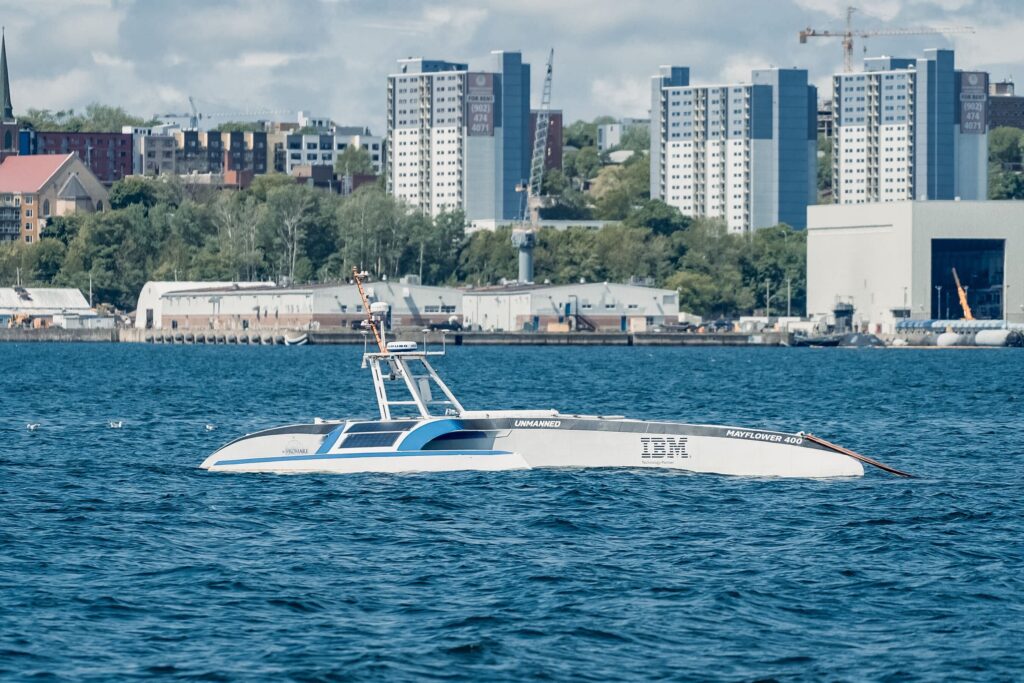
The Mayflower Autonomous Ship arrives in Halifax, Nova Scotia, for equipment troubleshooting before continuing its journey. IBM
HALIFAX, NOVA SCOTIA — After a 40-day voyage, and after more than year of delay due to a mechanical problem, the Mayflower autonomous ship arrived in North America, at Halifax, Nova Scotia on June 5, announced program partners IBM and ProMare.
The ship has been dogged by mechanical problems even as its artificial intelligence guidance system was able to guide it across the ocean.
The catamaran traveled from Plymouth, United Kingdom, to Halifax, and later is expected to make appearances in the Washington, D.C. area. According to IBM, it’s the first nautical vessel to complete an unmanned, crewless voyage across the Atlantic.
Mayflower was intended to reach Plymouth, Massachusetts. Over the May 28-29 weekend, the Mayflower developed an issue with the charging circuit for the generator starter batteries, according to IBM.
On May 30, the team had to switch to the back-up navigation PC. ProMare decided to divert to Halifax, Nova Scotia, as the closest viable port, to investigate and fix these issues.
The ship was designed and built by marine research nonprofit ProMare, with IBM acting as lead technology and science partner.
Artificial intelligence and edge computing technologies underpin the ship’s AI Captain, which uses six cameras, more than 30 sensors and 15 edge computing devices to help make decisions.
“This makes it possible for the AI Captain to adhere to maritime law while making crucial split-second decisions, like rerouting itself around hazards or marine animals, all without human interaction or intervention,” IBM said in a blog post.
Leaders Honor Merchant Marine Bravery in World War II, Ongoing Pandemic for National Maritime Day
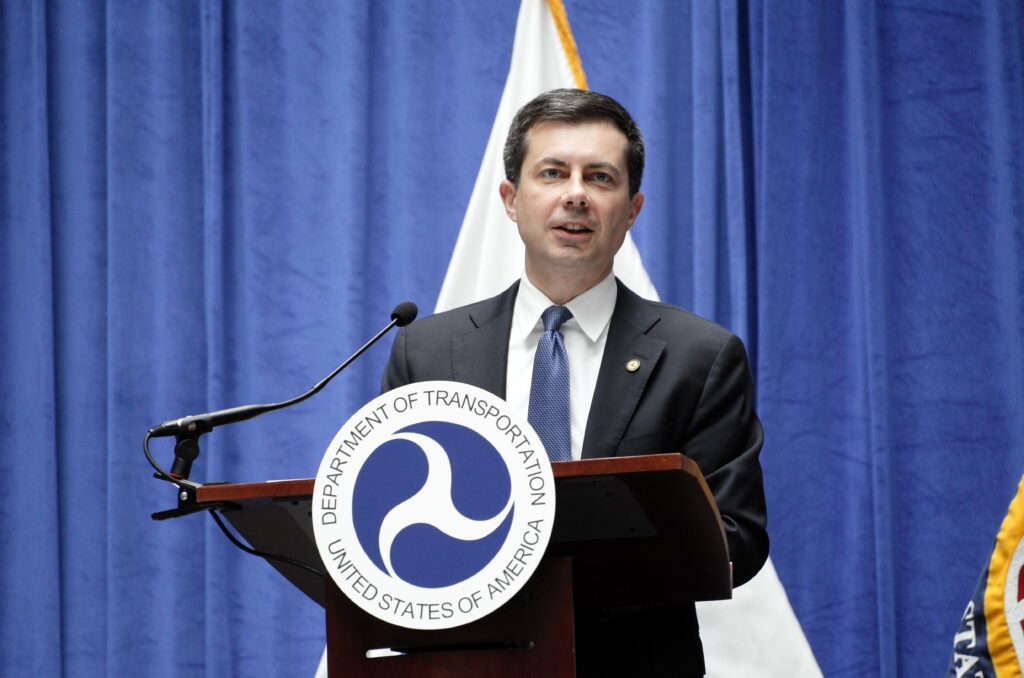
Secretary of Transportation Pete Buttigieg speaks at the DOT’s National Maritime Day observance. SEAPOWER / Brett Davis
WASHINGTON, D.C. — Transportation and military officials observed the annual National Maritime Day on May 24, saying the Merchant Marines were the unsung heroes of the second world war and continue to be heroes by shipping vital supplies during the ongoing pandemic.
“We have always been, and always will be, a nation whose destiny is connect to the sea,” Secretary of Transportation Pete Buttigieg said during the ceremony at the Department of Transportation headquarters.
The ceremony especially honored the Merchant Mariners who helped win World War II, losing their lives at a higher rate than any other services. On May 18, congressional leaders revealed a new Congressional Gold Medal for American Merchant Mariners.
During World War II, they delivered an average 17 million pounds of cargo to the armed forces every hour, and “often they did so without protection against U Boats, destroyers and the aircraft that menaced the waters,” Buttigieg said.
Now, during a pandemic, “you have kept America afloat,” he said.
Daniel Maffei. left, Ann Phillips, the new administrator of the Maritime Administration, and Polly Trottenberg, the deputy secretary of transportation, during the presentation of a wreath to honor fallen Merchant Marines. SEAPOWER / Brett Davis
Daniel Maffei, chairman of the Federal Maritime Commission, said the COVID pandemic put current mariners to the test again, and “they put their lives on the line for our country.” Americans stayed home to help fight the spread of the virus, but “thanks especially to the workers in our ports, America was never cut off.”
Retired Navy Rear Adm. Ann Phillips, sworn in as the 20th administrator of the Maritime Administration on May 16, also cited maritime bravery during World War II and said, “today, our mariners continue to navigate historic challenges” such as the pandemic and supply chain disruptions.
Strengthening the maritime services is critical, said outgoing Coast Guard Commandant Adm. Karl Schultz.
Maritime officials like to talk about ships and boats and ports, he said, but “it’s really the mariners. It’s not the steel, it’s not the concrete … mariners deserve the best support we as a nation can provide,” including updated technology, streamlined induction processes and a renewed fight against sexual assault to create a safe environment for all mariners.
Rear Adm. Michael A. Wettlaufer, command of Military Sealift Command, said his service is also embarking on modernization to improve the environment for the maritime fleet. He cited the 2021 delivery of a component from a Navy ship and Coast Guard vessel as an example, and said in the future “I expect to be able to deliver key components between ships” at distances of up to several hundred miles.
Navy to Commission Future Littoral Combat Ship Minneapolis-Saint Paul
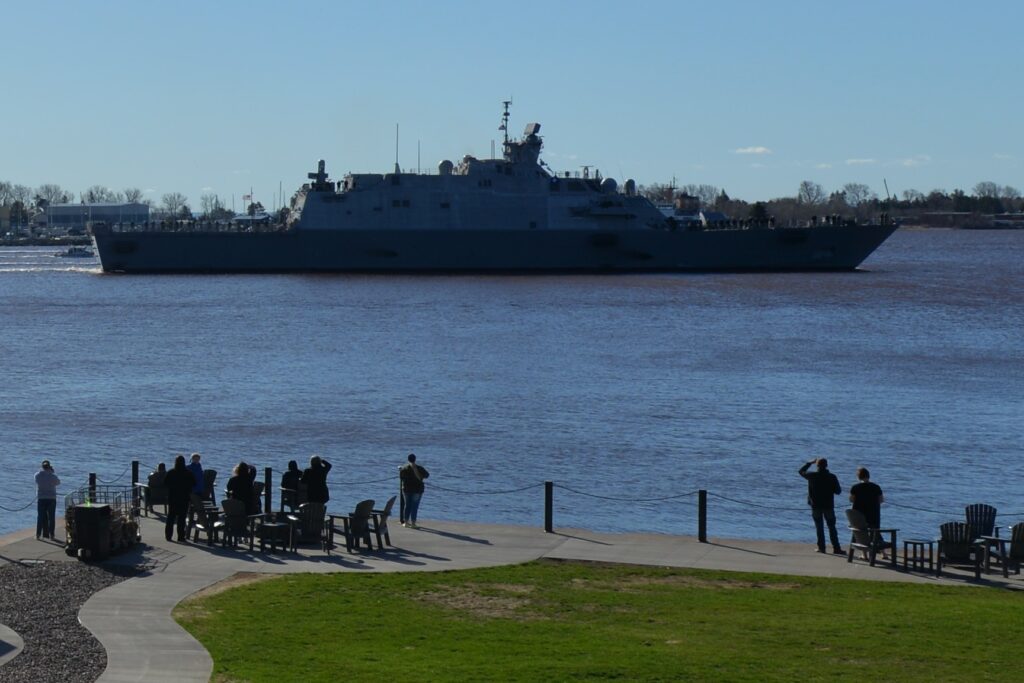
The future USS Minneapolis-Saint Paul (PCU LCS-21) arrives in Duluth, Minnesota on May 16. PCU LCS-21 is a United States Navy Freedom-class littoral combat ship that will be commissioned in the Port of Duluth on Saturday, May 21. U.S. AIR NATIONAL GUARD / 1st Lt. Crystal Kirchner
ARLINGTON, Va. — The Navy will commission the future USS Minneapolis-Saint Paul (LCS 21) as the newest Freedom-variant littoral combat ship during a 10 a.m. CDT ceremony Saturday, May 21, in Duluth, Minnesota, the Defense Department said May 20.
USS Minneapolis-Saint Paul is the second naval ship to honor Minnesota’s Twin Cities, although each city has been honored twice before.
The principal speaker is U.S. Rep. Betty McCollum. Additional speakers include Minnesota Gov. Tim Walz; U.S. Sen. Amy Klobuchar; U.S. Rep. Pete Stauber; Undersecretary of the Navy Erik Raven; Vice Adm. Scott Conn, deputy chief of naval operations for warfighting requirements and capabilities; and Jon Rambeau, vice president and general manager of Lockheed Martin Integrated Warfare Systems and Sensors. The ship’s sponsor is Jodi Greene, principle at the Mabus Group and former deputy undersecretary of the Navy for policy. She will give the first order to “man our ship and bring her to life.”
“It is fitting that a littoral combat ship is named for Minneapolis-Saint Paul, honoring the rich history, hard work, and contributions of the people there,” said Secretary of the Navy Carlos Del Toro. “I am certain the crew who will man this ship will carry on the legacy of the Twin Cities and will play an important role in the defense of our nation and maritime freedom.”
The first U.S. Navy warship named Minneapolis-Saint Paul was a Los Angeles-class submarine launched in 1983 that participated in Operation Desert Shield/Desert Storm. USS Minneapolis-Saint Paul (SSN 708) was the first submarine to carry Tomahawk missiles specifically designed for use in strikes against Iraq during the Gulf War. Having served for over two decades with distinction, the Navy decommissioned the submarine in 2007.
USS Minneapolis-Saint Paul will homeport at Naval Station Mayport, Florida.
The ceremony will be live-streamed at USS Minneapolis-Saint Paul Commissioning. The link becomes active approximately 10 minutes before the event (9:50 a.m. CST).
L3Harris Selected for US Navy Next-Generation Submarine Tender Design Study
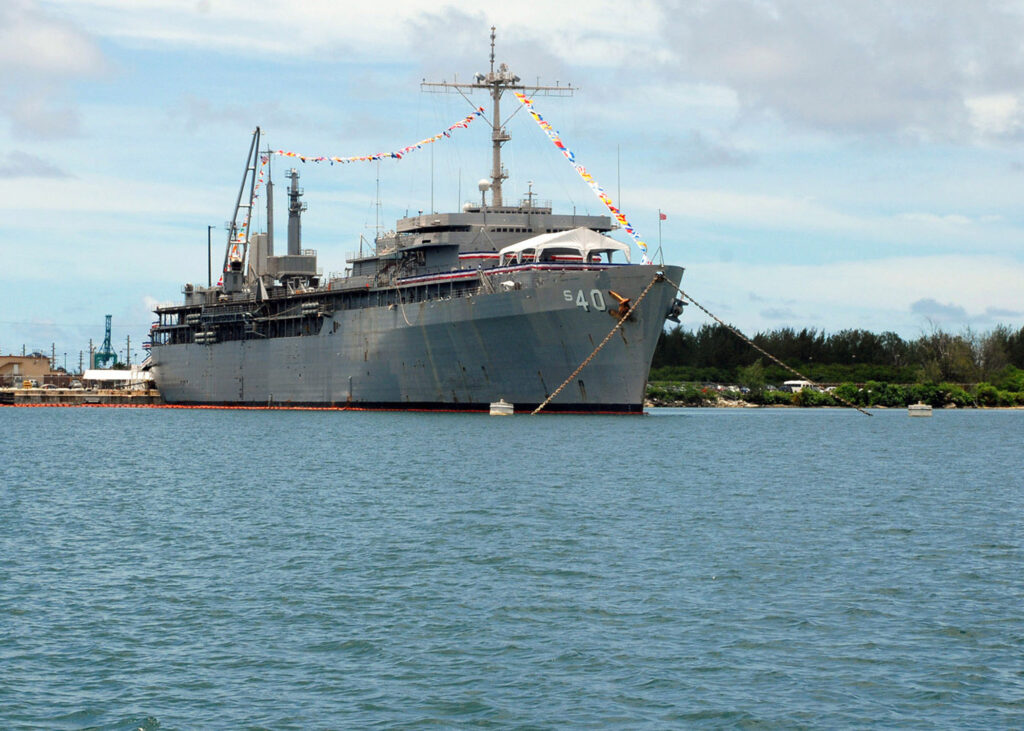
USS Frank Cable (AS 40) in 2009. Cable is one of two aging submarine tenders intended to be replaced by the new AS(X). U.S. NAVY
HERNDON, Va. — L3Harris Technologies is one of three companies selected to provide preliminary designs for the next generation submarine tender, a support vessel that will provide expeditionary maintenance and repairs for U.S. Navy submarines, the company said May 17.
L3Harris will support the development of the AS(X) ship specifications, interface specifications, ship cost estimates and construction schedules under the base AS(X) Concept Refinement and Preliminary Design contract. The nine-month concept refinement and preliminary design study includes options for an additional nine-month concept refinement and preliminary design update and an overarching 36-month period for special studies.
“We are excited to participate in the design study for the AS(X) submarine tender,” said Rosemary Chapdelaine, president of Maritime at L3Harris. “In the coming months, we will work closely with our customer and industry partners to bring innovative solutions to advance the technology that will inform and define the future capabilities on this new class of ships.”
The AS(X) will be capable of providing support and maintenance for up to four submarines, replacing the U.S. Navy’s two aging tenders, the USS Emory S. Land (AS 39) and USS Frank Cable (AS 40), commissioned in 1979. The current tenders provide intermediate-level maintenance and repairs, hotel services and logistics support at sea to nuclear-powered guided missile and attack submarines deployed in the 5th and 7th fleets areas of responsibility.
L3Harris’ Herndon, Virgina, facility will perform the program management and engineering design tasks and is partnered with Philly Shipyard Inc. and VARD Inc. for design development.
U.S. Coast Guard FRC Interdicts $17 Million in Drugs in Middle East
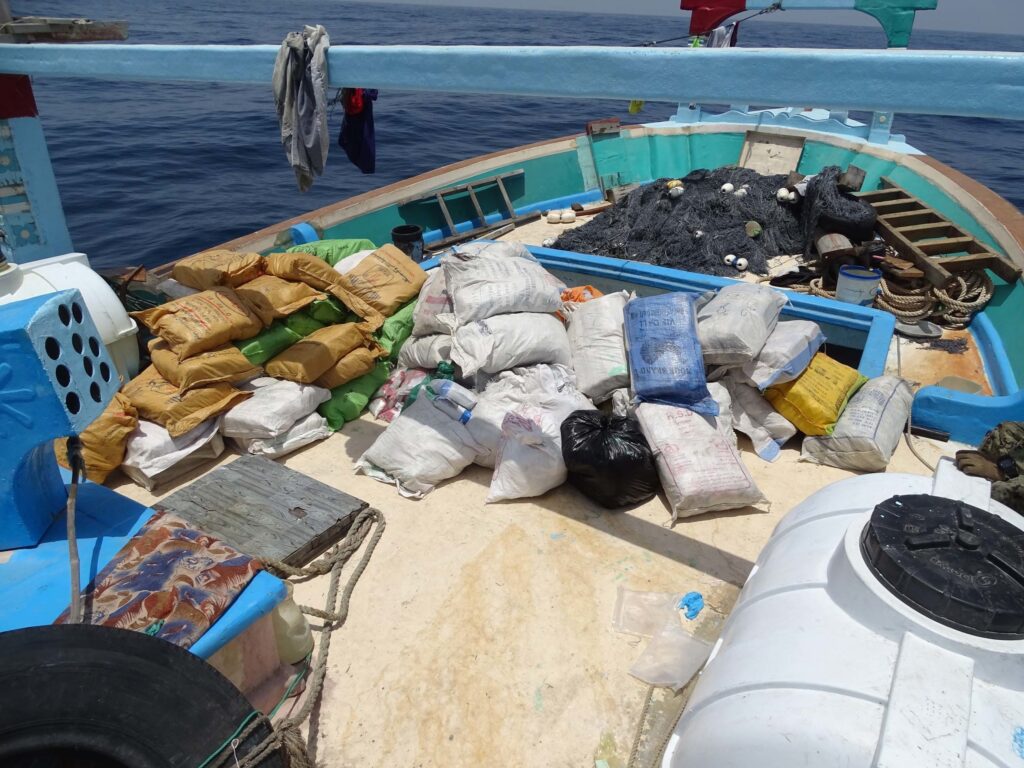
Bags of illegal narcotics lie on the deck of a fishing vessel interdicted by U.S. Coast Guard fast response cutter USCGC Glen Harris (WPC 1144) in the Gulf of Oman, May 15. U.S. NAVY
MANAMA, Bahrain — A U.S. Coast Guard fast response cutter seized illicit narcotics from a fishing vessel while conducting patrols in the Gulf of Oman, May 15, Combined Maritime Forces Public Affairs said May 15.
USCGC Glen Harris (WPC 1144) seized 182 kilograms of heroin, 182 kilograms of methamphetamine, 27 kilograms of amphetamine pills and 568 kilograms of hashish with a total estimated U.S. street value of $17 million.
Glen Harris was operating as part of Combined Task Force 150, one of four task forces within the Combined Maritime Forces. The international naval force has increased regional patrols to locate and disrupt unlawful maritime activity.
On May 12, USCGC Emlen Tunnell (WPC 1145) interdicted a separate fishing vessel in the Gulf of Oman and seized methamphetamine and hashish worth $10,000, following the seizure of $4 million in heroin May 5 by United Kingdom frigate HMS Montrose (F 236).
Combined Maritime Forces is the largest multinational naval partnership in the world. The organization includes 34 nations and is headquartered in Bahrain with U.S. Naval Forces Central Command and U.S. 5th Fleet.
Coast Guard is Upping its Game on Cyber, Human Resources and Equipment, Panelists Say
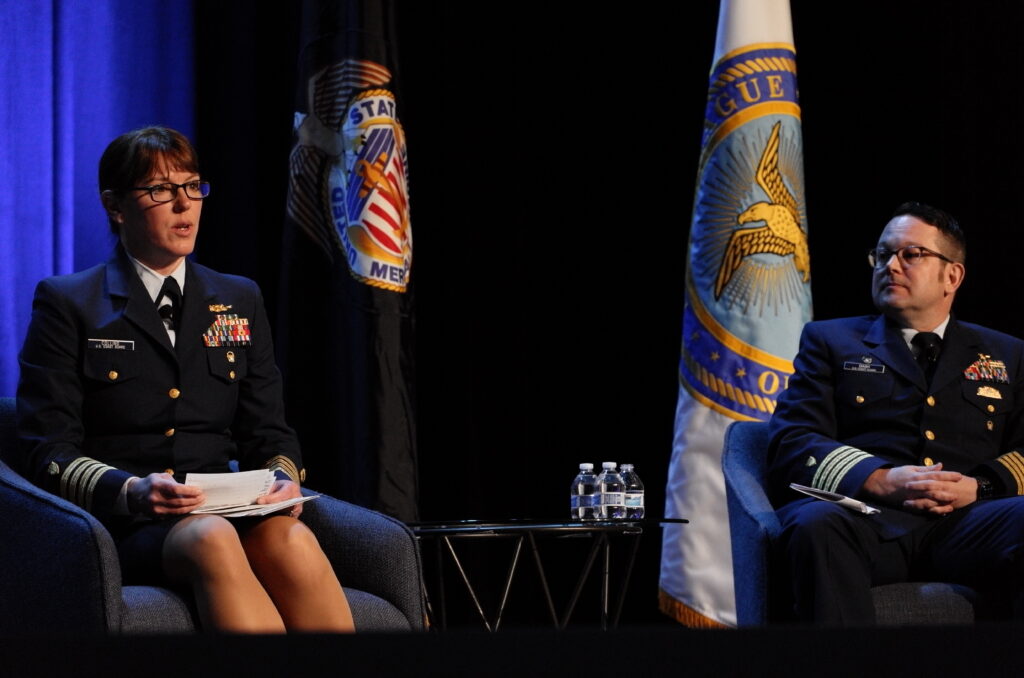
Capt. Laura D. Collins, acting director of civilian human resources at the Diversity and Leadership Directorate, discusses Coast Guard advances in training while Capt. Russell E. “Rusty” Dash, the C51 Service Center commanding officer, looks on. BRETT DAVIS
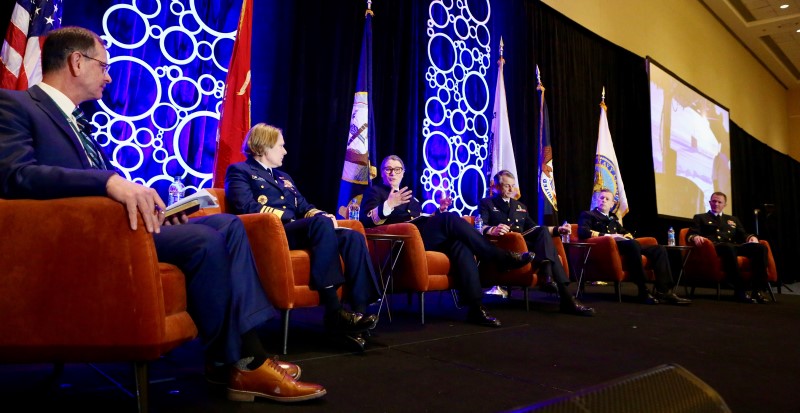
NATIONAL HARBOR, Md. — In his last Sea-Air-Space visit in uniform, U.S. Coast Guard Commandant Karl Schultz led a panel discussion about the service, which is rapidly seeking to upgrade its equipment, software and human resources to keep up in a competitive world.
“The demand for Coast Guard services, at home and abroad, has never been higher,” Schultz said.
He introduced his nominated successor, Adm. Linda Fagan, the current vice commandant, and her nominated vice commandant, Vice Adm. Steven D. Poulin.
“I will sleep well at night,” Schultz said. “They are rock stars and we are in good hands.”
Schultz guided the panel through a discussion of how the service is upping its game when it comes to connectivity, human resources and equipment, including ships to replace or augment an aging fleet.
Capt. Russell E. “Rusty” Dash, the C51 Service Center commanding officer, said under Shultz’s direction the Coast Guard kicked off a “tech revolution” in March 2020, to try to get away from the service’s reputation of delivering “yesterday’s technology tomorrow.
“The tech revolution is about empowering the people of the Coast Guard with reliable, mobile and integrated capabilities so they can better do their job,” he said, noting that most Coast Guard work doesn’t take place behind a desk.
It’s a mobile-first approach that gives Coasties the hardware and apps they need to “do their work wherever they do their work,” and includes beefing up cutter connectivity as well as on-shore networks.
The service is also getting ready to turn on a “software factory,” based on the Air Force software factory model, to promote “software developed by Coasties for Coasties in a standard way,” Dash said.
Capt. Laura D. Collins, acting director of civilian human resources at the Diversity and Leadership Directorate, said the service is taking a similar approach with its people.
“We want a best-in-class workforce for a best-in-class Coast Guard,” she said, building on a document called Ready Workforce 2030, which calls for modernized learning and training tailored to the individual.
“In order to be the employer of choice, we’ve got to train to retain,” she said, including on-demand e-learning not just training at dedicated centers.
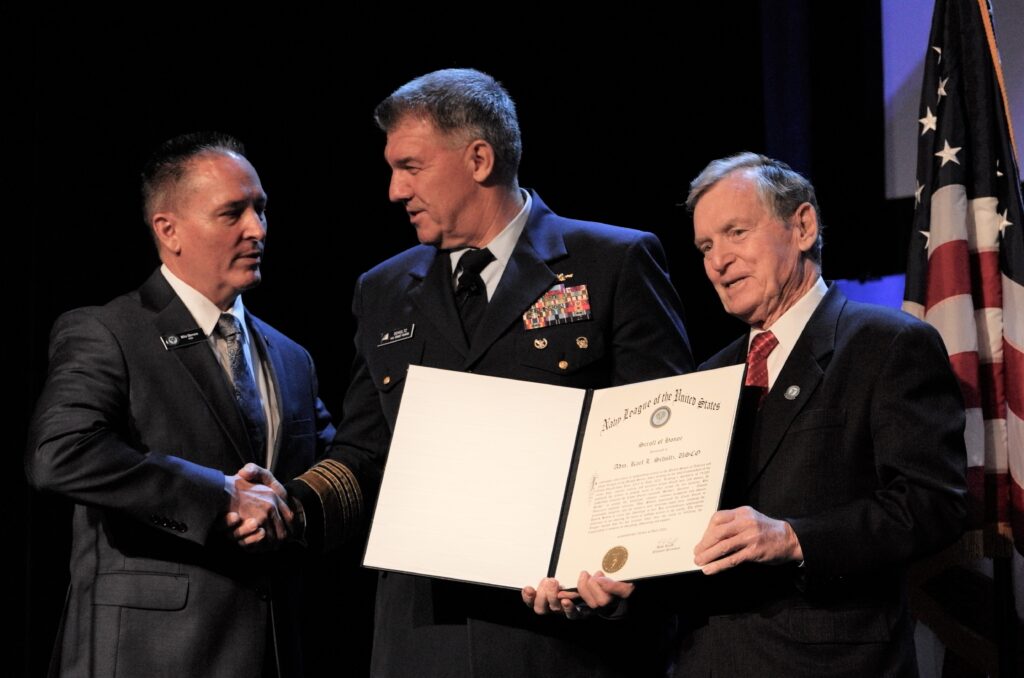
Navy League CEO Mike Stevens, left, and National President David Reilly, right, present Coast Guard Commandant Adm. Karl Schultz with the Navy League Scroll of Honor. BRETT DAVIS
Rear Adm. Douglas Schofield, assistant commandant for acquisition and chief acquisition officer, highlighted new ships coming on line, include the offshore patrol cutter and a new icebreaker.
The offshore patrol cutter joins new national security cutters and fast response cutters, and will complement them through its presence in exclusive economic zones and beyond.
“It is critical for that multi-mission presence that you always talk about, sir,” and has “outstanding human system integration,” including common boat launch systems and helicopter accommodations.
Schultz noted there is significant conversations about how many ships the U.S. Navy has, but the question of how many ships the Coast Guard has tends to fall under the radar.
“We’re going to have a fleet of 100 new ships here. When you roll in these 11 national security cutters … 64, now 66, fast response cutters, 25 OPCs, that is a fleet of 100 very capable ships … I think that 100 is going to continue to up our game.”
At the end of the breakfast, Schultz was presented with the Navy League Scroll of Honor by National President David Reilly and CEO Mike Stevens.
SmartPower Boosts Epirus’ Leonidas Drone-Busting Directed Energy System
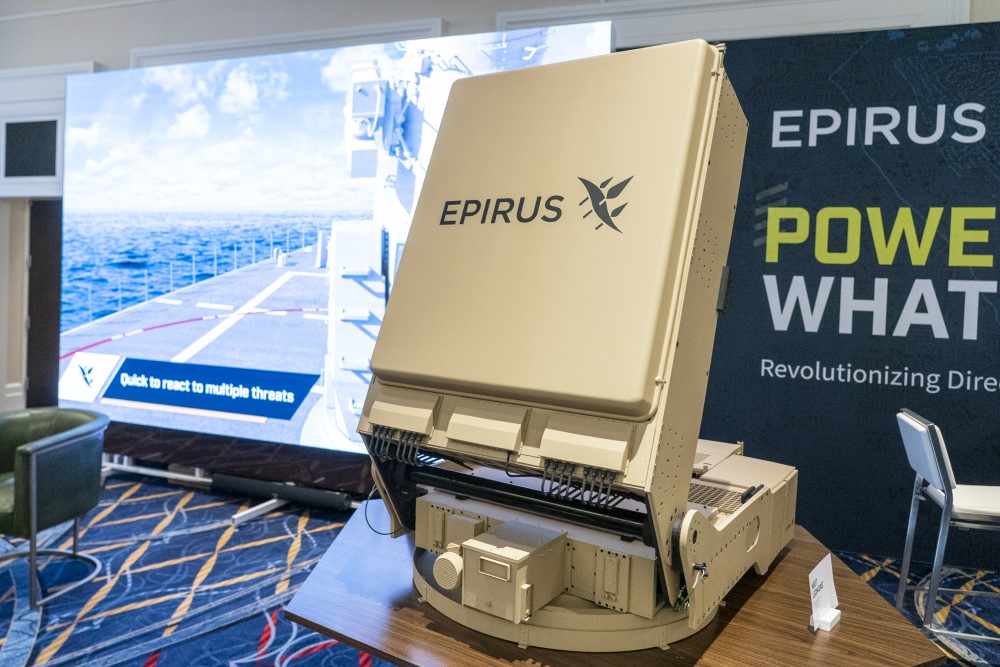
Epirus’ Leonidas directed-energy defense system, displayed in scale model form. SOLARES PHOTOGRAPHY
NATIONAL HARBOR, Md. — Epirus, a Southern California startup, has incorporated its SmartPower concept into a directed-energy system capable of disabling the electronics of threats such as drones, says Andy Lowery, the company’s chief product officer.
The company, located in the VIP Lounge near the Prince George’s Exhibit Hall, “started to take a look at embedded systems, especially when energy conversion was the process,” Lowery said. That means things like microwaves and lasers, where power is converted.
“We decided to see if we couldn’t digitize them and basically create a digital mind that controls the analog circuits that do the conversion,” he said. “We were able to very meaningfully improve the performance of those conversion circuits” while also solving heating issues that dogged earlier versions.
One result, on display in model form, is Leonidas, which the company describes as “an electronics system with the power and precision to neutralize a single [drone] system in tight, crowded spaces or disable multiple threats across a wide area.”
It’s not through traditional jamming, Lowery said, but instead “it’s literally just zapping it, like with such a high electrical field that the electronics can’t work.”
It’s also scalable, in the form of Leonidas Pod, a much smaller version that could be carried by drones and deployed from ships; that system has already had a sale.
Epirus, in existence for only about three years, is moving fast.
“We’re on our third-generation system … and we’re ready to start operationally deploying,” Lowery said. “We’ve had four to five companies express interest in being pilot customers on the defense side, looking to deploy upwards to half a dozen systems over the next 12 months or so, of the big ones.”
SAIC Partners to Promote Loitering Munition, Underwater Comms System
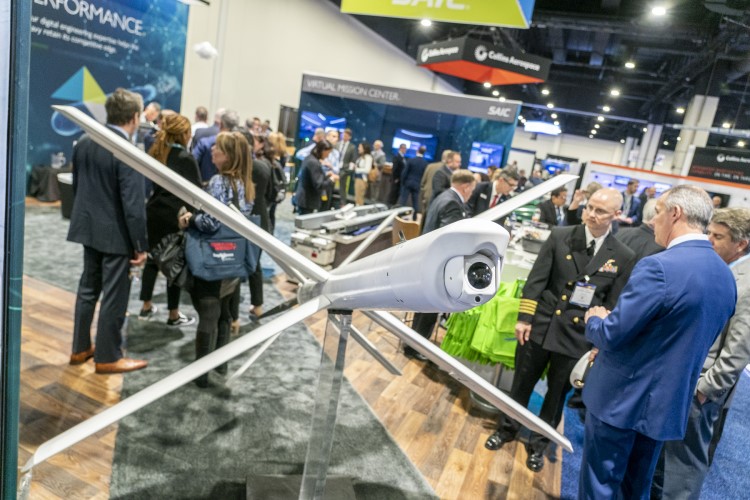
The UVision Hero 400-EC loitering munition, which SAIC is helping develop to meet U.S. Navy requirements. LISA NIPP
NATIONAL HARBOR, Md. — SAIC (Booth 801) is working with partners on weapons systems it says are of great interest to the U.S. Navy and other militaries: a loitering munition, such as those that have seen action in Ukraine, and an underwater communication system flexible enough to let divers control unmanned aircraft.
One is the Hero 400-EC long-endurance loitering munition system, originally developed by Israel’s UVision. The canister-launched system could carry a variety of payloads, including munitions and has an endurance of up to two hours.
“We help them bring overseas technology that perhaps meets the requirements of DoD, and we take that technology, we Americanize it and then offer it up to DoD to meet their requirements,” said Bob Carruthers, vice president of SAIC’s Charleston Naval Business Unit in North Carolina.
UVision won a Marine Corps contract for a smaller version of the Hero. The Navy is developing requirements for a larger loitering munition for use on ships such as destroyers and cruisers, for which the 400 could contend, Carruthers said.
On the underwater side, SAIC is working with Mistral Inc. on the C-Master MKII and Orca, “a covert underwater communication system,” said Peter J. Brown of SAIC’s Industrial Manufacturing & Systems Engineering.
As many as 15 divers could share their locations and communicate underwater using the system’s small antenna, and could even launch small unmanned aircraft and control drones or loitering munitions from underwater without the antenna having to break the surface.
“You can see 15 other divers on that screen, up to 3 kilometers away, underwater, using low intercept probability acoustic signatures, and at the same time you could potentially control a UAV, get the feed and control a terminal munition,” Carruthers said.
Brown said the system has been tested in prototype form with other navies and U.S. SEALs have had a look at it as well and provided feedback.
Arctic Nations Cope With Ramifications of Rapidly Warming Region
Rear Adm. Ewa Skoog Haslum, chief of Navy for Sweden, discusses the expansive needs of the Arctic, noting current military cooperation may not be enough to tackle its challenges. LISA NIPP
NATIONAL HARBOR, Md. — The Arctic is getting hotter, both literally and figuratively, and allied Arctic nations are grappling with the issues posed by increased access to the region by industry and hostile nations such as Russia and China.
“No doubt, the level of activity in the Arctic is continuing to grow,” said Rear Adm. Ronald J. Piret, commander of Naval Meteorology and Oceanography Command, speaking as a panelist on “The Geostratic Importance of the Artic” on April 4.
Piret and fellow panelists from Canada, Sweden and the Joint Arctic Command, agreed that international cooperation in the region is vital and more of it will be needed as the Arctic grows more accessible due to climate change.
Adm. Linda Fagan, vice commandant of the U.S. Coast Guard, said great partnerships in the region already exists and the United States is seeking more of them, but she said, “We need to be thinking beyond coast guards and navies to industry and academia.”
In some cases, even the current level of military cooperation isn’t enough, some speakers said. Rear Adm. Ewa Skoog Haslum, chief of Navy for Sweden, said “we [the Swedish navy] need to be a little bit bigger and to share the burden.”
Chris Henderson, deputy commissioner for the Canadian Coast Guard, said having enough access to be able to increase cooperation is a challenge, as all his assets are spoken for, so if an international exercise opens up it can be a challenge to find a ship able to participate.
There’s also the issue of increasing activity from Russia and China. Just as traditional allied nations are operating, “all the autocratic nations are present in the Arctic as well,” Haslum said.