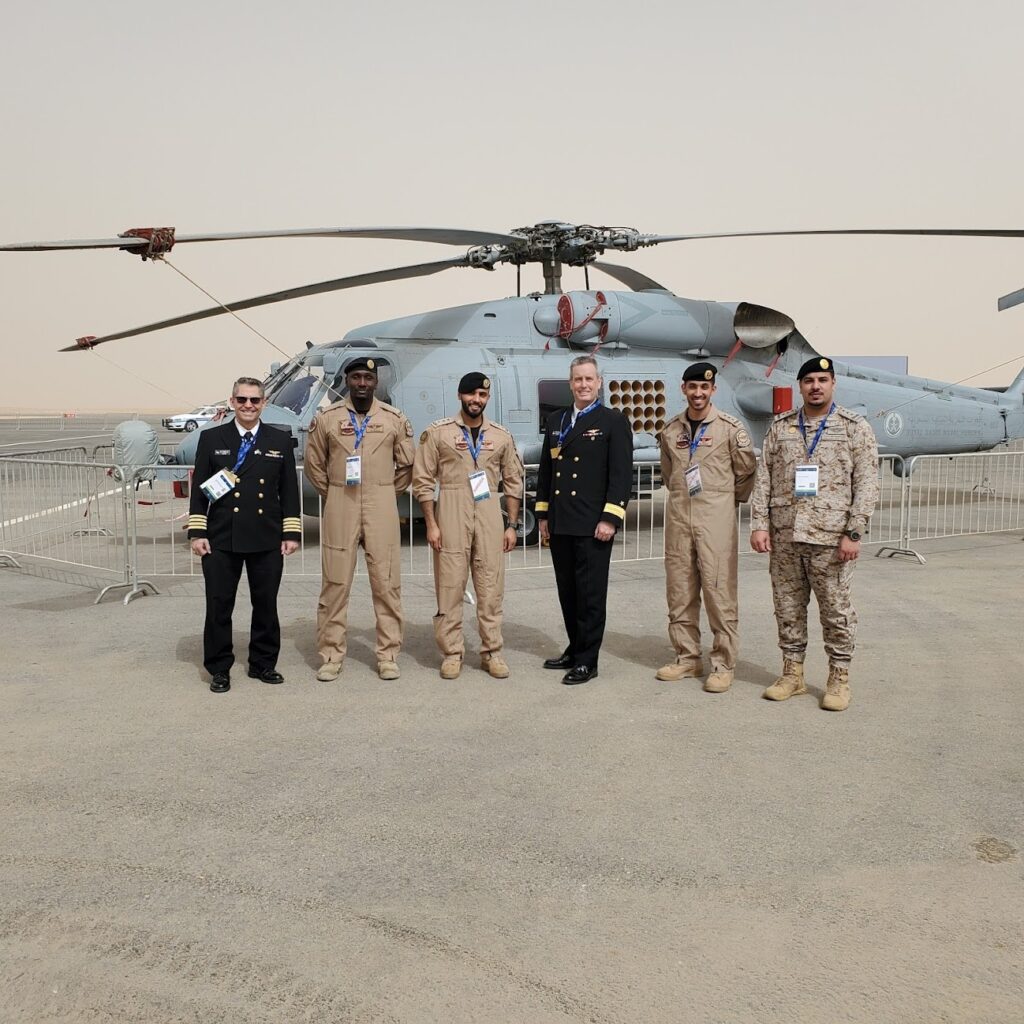
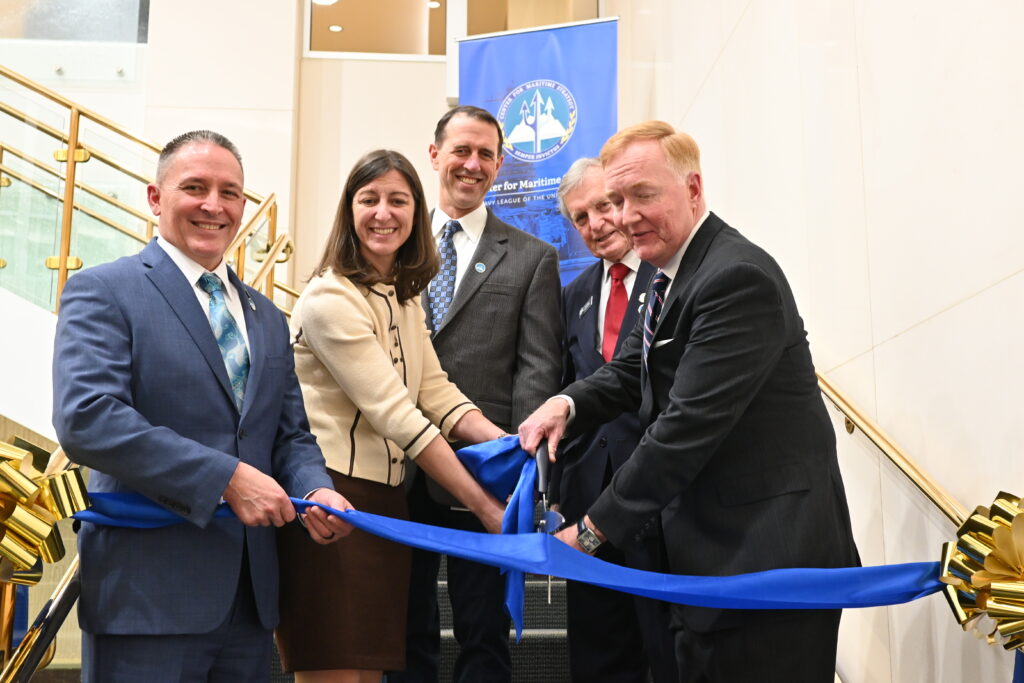
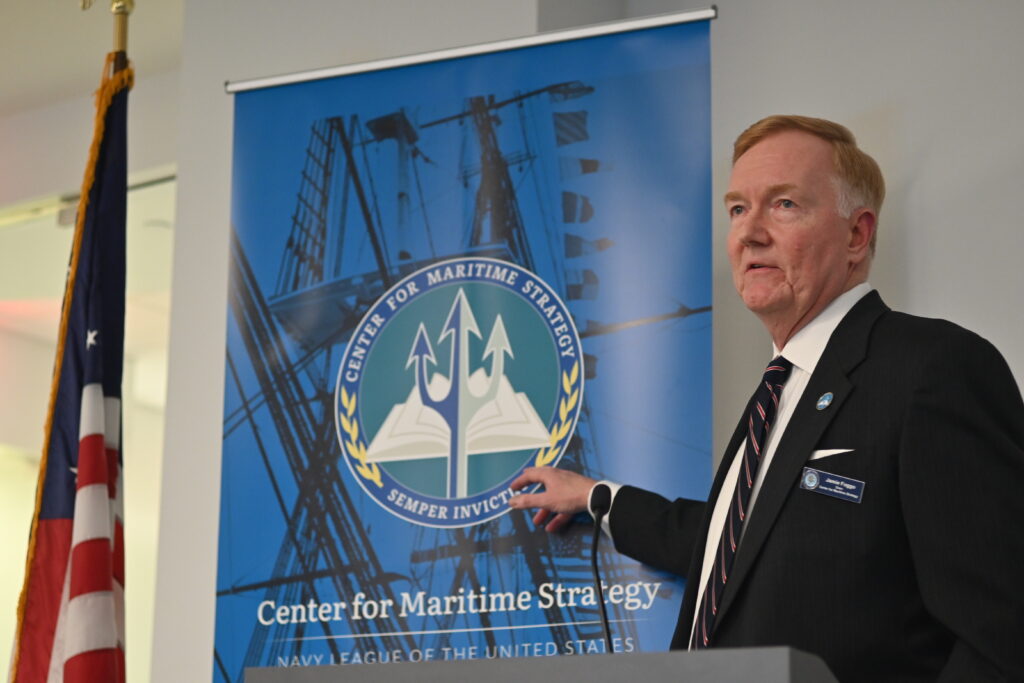
Coast Guard and Navy League officials celebrate the service’s 231st birthday on Aug. 4. NAVY LEAGUE
NATIONAL HARBOR, Md. — The U.S. Coast Guard celebrated its 231st birthday on Aug. 4 and Commandant Adm. Karl Schultz and service officials said it is increasing cooperation with international partners, working with industry on energy projects such as wind farms and making changes to increase diversity and guard retention.
“I think it’s an exciting time for us,” Schultz said, telling the audience at Sea-Air-Space 2021, “let us figure out where we can team up with you.”
Ann Castiglione-Cataldo, director of international affairs and foreign policy, said the service is working to build capable partnerships around the world to tackle such issues as illegal, unreported, and unregulated fishing and climate change.
“All coast guards are grappling with this,” she said.
Rear Adm. John Mauger, assistant commandant for prevention policy, said his office is working to maintain safe use of the waterways for all users, which includes working with states and localities on installing coastal wind farms and assisting with commercial space launch operations.
There are currently only five wind turbines active off of Rhode Island and two in Virginia, Mauger said, but many more projects are in the works, and the service is advising on their location to help maintain access to waterways.
Commercial space launches are also coming to the fore. The Coast Guard helps keep waterways clear near launch sites. In the old NASA days, that just meant monitoring areas in Florida and Texas, but commercial space launches can occur from many more places, including floating platforms.
The Coast Guard has had issues with retaining female Coast Guard personnel, said Michel Godfrey, the director of civilian human resources, diversity and leadership. At one point, retention rates past the 15-year mark for women lagged behind men by 10%, but recent efforts have cut that to 3%.
One such effort is the parental leave program, which pulls in Coast Guard reservists to temporarily replace service members on maternity leave.
“They come back and they are a stronger member of the Coast Guard,” Godfrey said.
Schultz said, “Talent management is where we win or lose in the Coast Guard.”
After the presentation, Navy League National President David Reilly and CEO Mike Stevens presented Schultz with the Admiral Arleigh Burke Leadership Award, the Navy League’s highest honor. He then celebrated the Coast Guard’s founding by Alexander Hamilton with a cake.
IBM Leverages Hybrid Clouds and AI to Enable New Technology
Ray Spicer, shown here in IBM’s space in the Maryland pre-function lobby, says the company is focusing on hybrid cloud computing and AI. NAVY LEAGUE
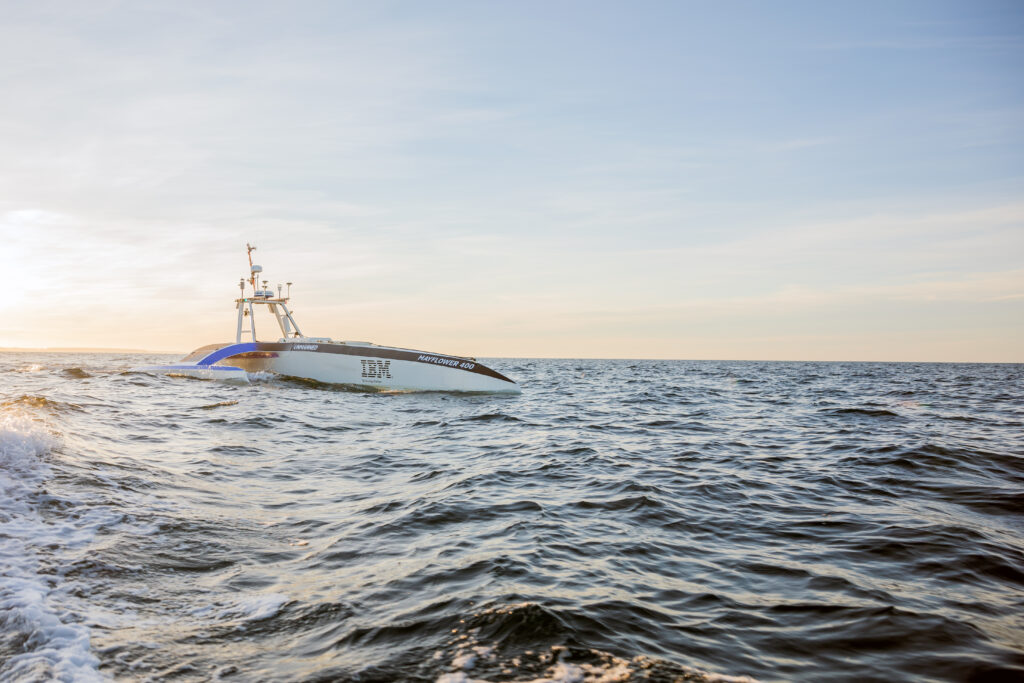
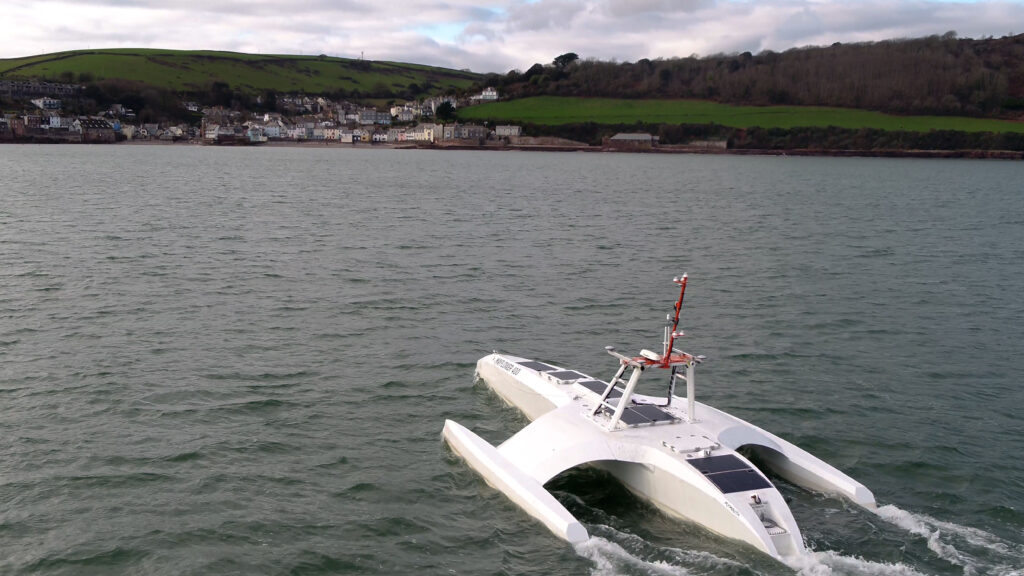
IBM is leveraging hybrid cloud computing and AI — what it calls augmented intelligence — to create new technology systems, such as its Mayflower unmanned surface vehicle, capable of making its own decisions while far from port.
Ray Spicer, a retired U.S. Navy rear admiral who is now vice president of defense and intelligence at IBM, says “hybrid cloud and AI is where the company is really focused these days, very heavily.”
Rather than concentrating data into one large cloud, IBM is able to work with various types of clouds, whether they are personal or public, small or massive.
“Having all those clouds being able to uplink together is the way to go,” Spicer said.
A hybrid cloud scenario allows the company to “containerize” apps that can pluck the data they need from a cloud where it resides, which “allows you to move the workloads to the data” rather than the other way around.
An example is the computing system Watson, which famously won on “Jeopardy!” in 2011. It has only gotten smarter since then and has been broken into component segments aimed at different markets, from financial operations to customer service to health care.
This sort of flexibility contributed to Mayflower, which leveraged technology from other industries. For example, software aimed at enabling rapid fraud detection can also be used to help Mayflower make rapid decisions on the high seas.
This sort of AI is helpful for things like collision regulations, or colregs, the rules of the sea, Spicer said. Sailors forget them from time to time and have to be retrained, but “you teach AI one time, and it doesn’t forget.”
US Facing ‘Pearl Harbor Moment’ From Cyber Attacks, Vice Adm. Trussler Says
Vice Adm. Jeffrey Trussler says cyber attacks are something that now threaten every American. NAVY LEAGUE / Lisa Nipp
NATIONAL HARBOR, Md. — Vice Adm. Jeffrey Trussler, deputy chief of naval operations for information warfare and director of naval intelligence, said cybersecurity threats to the United States are such that “frankly, where we sit today in 2021, we ought to be having one of those Pearl Harbor moments without the Pearl Harbor.”
Trussler spoke on a panel at Sea-Air-Space 2021 panel on “Cyber Today’s Fight, Tomorrows Capabilities,” along with Rear Adm. Michael Ryan, commander of U.S. Coast Guard Cyber Command, Karen Van Dyke, director for positioning, navigation, and timing and spectrum management at the Department of Transportation, and Ryan Roberts, senior manager of cyber and strategic risk at Deloitte.
Trussler said cyber attacks — such as the one that disabled the Colonial Pipeline, affecting the flow of oil along the East Coast and Southeast — shows that the threat is no longer just about defense and security, but “you could be impacted personally from anywhere around the world, based on our dependency on technology … I’m worried that enough people aren’t hearing, wow, it’s a new world.”
Ryan said the Coast Guard is issuing an update to its Cyber Strategic Outlook and wants to embrace innovation on the cybersecurity front, which is where industry can help.
“We understand the value of partnerships, particularly with those in the room,” he said.
Van Dyke said from her point of view, a big fear is the jamming and spoofing of Global Positioning System signals.
“It’s a weak signal coming from space,” she said of GPS, and “it doesn’t take much power to jam GPS over a wide area.”
Jamming is a temporary threat, but spoofing can actually permanently disrupt communications, as a GPS user might lose access to their receiver for good.
“This is an increasing concern,” Van Dyke said, and DoT is working with the Department of Defense to counter these and other threats.
Roberts said automation will take on a larger role when responding to future cyber attacks, as eventually humans will be too slow.
If a major attack happens “and we convene a committee to decide what we’re going to do, we’ve already lost,” he said. “Over time, we’re going to have to remove that human in the loop and get to autonomous decision making.” It’s a scary thought, but “humans are not going to be able to respond quickly enough.”
Interagency cooperation is key to fighting cyber attacks, the panelists said. Trussler said he learned new things just by being on the panel, and said “Sea-Air-Space has done a really good job” in bringing together different viewpoints.
Ryan said the Coast Guard is already working with commercia shipping ports to assess their facilities so they can harden their infrastructure.
That’s a niche area for the service, he said, “but reflective of the fact this is a joint fight.”
Saildrone Voyager: A Unique Solution for 24/7/365 Maritime Domain Awareness
The Saildrone Voyager, a 33-foot sailboat-like vehicle primarily powered by wind and solar energy. SAILDRONE
According to the U.S. Coast Guard’s 2020 “Illegal, Unreported and Unregulated Fishing Strategic Outlook,” IUU fishing has replaced piracy as the leading global maritime security threat. Saildrone uncrewed surface vehicles (USVs) have sailed more than 500,000 nautical miles collecting valuable data about the marine environment for fisheries research, climate science, and ocean mapping. Now, a new class of Saildrone vehicles equipped with radar, 360-degree cameras, Automatic Identification System (AIS) and proprietary machine learning algorithms makes Saildrone a unique solution for combating IUU fishing, narcotics interdiction, and other maritime domain awareness (MDA) activities, anytime and in any ocean.
The Saildrone Voyager is a 33-foot sailboat-like vehicle predominantly powered by wind for propulsion and solar energy for electronics, communications, and navigation. With an average speed of up to five knots, the Saildrone Voyager can operate continuously in the open ocean for up to 180 days while producing a minimal carbon footprint. Saildrone USVs can be deployed and retrieved from any oceanside dock and transit autonomously to and from the operating area.
Global Fishing Watch uses a combination of publicly available AIS data and satellite imagery to expose areas of illegal fishing activity. The Voyager fuses optical data and machine learning to detect targets that are otherwise not transmitting their position in real time. These detection events are then fused with other data sources — AIS and acoustics — to deliver a fully informed picture of the surrounding maritime domain. Stationed strategically, a group of Voyagers can deliver 24/7/365 protection of marine assets.
Saildrone possesses the world’s largest data set of images of the open ocean. Tens of millions of images, collected by the Saildrone fleet deployed all over the world during more than six years of operational missions, have been annotated with human analysis highlighting anything of interest — vessels, birds, icebergs, etc. With this enormous data set, Saildrone’s ML model automatically recognizes objects in real time, providing unprecedented situational awareness to remote command centers.
In October 2020, Saildrone performed a successful 30-day demonstration of MDA capabilities for the U.S. Coast Guard off the coast of Hawaii. Each week highlighted a specific real-world use case for persistent MDA: general traffic monitoring, IUU fishing, search and patrol and port security. Additionally, Saildrone USVs can conduct long-duration intelligence, surveillance and reconnaissance missions enabling narcotics interdictions.
Saildrone USVs also carry a robust payload of oceanographic and meteorological sensors for continuous high-resolution environmental monitoring above and below the sea surface. Optional sensors include an Acoustic Doppler Current Profiler (ADCP), which can help to identify conditions in which a loitering vessel might drift into a protected area, and multibeam sonar for high-resolution ocean mapping, necessary for improving safety of navigation.
Data is transferred in real time via a secure satellite network. Saildrone data can be viewed in the proprietary Saildrone Mission Portal or linked directly into existing architecture, for example, Minotaur via an API interface. The Saildrone Mission Portal provides a variety of tools — overlays of satellite products, model GRIB files, and ingestion of other assets such as ships, buoys, tagged animals, or other autonomous platforms — for on-the-fly mission analysis and fleet management.
Saildrone USVs are rugged and have a proven track record of performing long-duration missions in remote areas and extreme conditions. The Saildrone fleet has logged more than 13,000 days at sea in some of the most extreme weather conditions on the planet. They have tracked fish in the North Sea, surveyed ocean eddies off Africa, air-sea heat transfer in the Gulf Stream and discovered a shipwreck in the Gulf of Mexico. They have crossed the Atlantic Ocean in both directions, sailed up to the Arctic ice edge setting a northern latitude record for an autonomous vehicle of 75.49°N and survived Southern Ocean storms to circumnavigate Antarctica.
The robustness of the underlying core components, a wind-powered vehicle capable of long-duration missions and a machine learning-based approach to vessel detection, makes Saildrone an ideal solution for persistent maritime domain awareness in any ocean.
Future Maritime Center of Excellence to Transform Coast Guard Academy Waterfront
The U.S. Coast Guard Academy is situated along the Thames River in New London, Connecticut. U.S. COAST GUARD
NEW LONDON, Conn. — A more than $23 million project is now underway at the U.S. Coast Guard Academy that will transform the waterfront area of the 90-year-old campus, the academy’s public affairs office said in a July 29 release.
The future Maritime Center of Excellence (MCOE) will enhance the waterfront facilities at the Academy by offering interactive and high-tech classrooms for a variety of educational and leadership development courses.
The 20,000 square foot structure will be the Academy’s first Leadership in Energy and Environmental Design (LEED) certified building and will highlight the unique waterfront leadership programs and nationally prominent intercollegiate sailing program.
In a twist on the traditional groundbreaking ceremony, leaders signed a ceremonial steel beam which will be used in the construction of the future center during a July 29 event to commemorate the start of the project.
Present at the event were Rear Adm. Bill Kelly, superintendent of the Coast Guard Academy, retired Coast Guard Capt. Andrea Marcille, president of the U.S. Coast Guard Academy Alumni Association and retired Coast Guard Vice Adm. Manson Brown, chair of the Alumni Association Board of Directors.
The modern design of the MCOE includes ambitious sustainability design goals in line with coordinated climate resiliency efforts across the service, and one of several lines of effort that the Department of Homeland Security and its component agencies have taken to address the dangers posed by global climate change.
The construction is targeting LEED Gold certification. LEED certification involves a set of rating systems for the design, construction, operation, and maintenance of modern buildings to achieve sustainability and resource efficiency goals.
“This LEED certified, multi-purpose facility will serve as gathering spot for cadets and officer candidates from across our great nation,” said Rear Adm. Kelly. “It will be a space where young women and men can gather to learn and grow and I am certain it will serve as a facility that will enhance an appreciation for the water and all its power and beauty and ultimately it will help us instill a liking for the sea and its lore.”
The interior spaces of the future center have been designed with access to daylight, and natural ventilation to minimize reliance on artificial lighting and air conditioning. Double-height spaces for vessel maintenance, office space, and an atrium will provide natural ventilation. Other sustainability goals include the exploration of ground-source heating and cooling, solar panels, and rainwater harvesting. The building exterior will also feature durable, resilient materials that are easily maintained.
With a curvilinear vaulted roof, wooden decks, and true north orientation the building is designed to highlight the waterfront landscape. The new facility will also feature interactive and high-tech classrooms such as the Science and Engineering Innovation Laboratory designed to encourage collaboration in areas of digital processing, robotics, alternative fuels and emissions, and environmental and coastal resiliency among others.
This represents a significant step forward as the Academy works to recapitalize 1930’s infrastructure and build modernized training and education venues to deliver the knowledge, skills, experience and values necessary to develop the future Coast Guard workforce.
Jones Act Seen as Key Hedge Against China’s Growing Merchant Might
Naval Air Crewman (Helicopter) 2nd Class Benjamin Whitney, from Syracuse, New York, lowers a litter during rescue training with a merchant ship in the Gulf of Aden, March 1, 2019, during Lucky Mariner 19. Lucky Mariner is an annual exercise led by Naval Coordination and Guidance for Shipping (NCAGS) alongside shipping and coalition maritime forces designed to exercise command and control and provide standardized direction during periods of increased tension to protect the free flow of commerce. U.S. NAVY / Mass Communication Specialist 2nd Class Logan C. Kellums
The Jones Act and commercial cargo operations in general must be strengthened to avoid further erosion of U.S. shipping strength versus commercial powerhouse China, said speakers at a Navy League Sea-Air-Space Prequel “Lunch and Learn” virtual session on July 21.
Dr. Sal Mercogliano, associate professor of history at Campbell University in North Carolina and a former merchant mariner, led a panel discussion entitled “The Jones Act, Where Commerce and Defense Converge.”
Mercogliano and the speakers sounded the alarm about the status of the U.S. merchant marine, particularly when compared to China.
“Are we a true proponent of sea power if we have the No. 1 Navy in the world and the No. 21 merchant marine in the world, when China is basically No. 2 in both and growing?” Mercogliano asked.
China has the largest merchant fleet, “which dwarfs ours,” the largest coast guard, the world’s only maritime militia, produces 96% of the world’s shipping containers and owns seven of the 10 busiest ports in the world, said panelist Tony Padilla, director of the Office of Cargo and Commercial Sealift at the Department of Transportation’s Maritime Administration.
On an average day in the United States, 23 U.S.-flagged vessels call at ports, compared with 2,800 foreign-flagged vessels, he said. In the critical Indo-Pacific region, 35 U.S.-flagged vessels call at ports on an average day, compared with 20,000 foreign-flagged vessels.
“This should be a wake-up call,” he said. “This is a major issue that we need to get to like yesterday, like last year, like 10 years ago.”
Panelist Mike Roberts, senior vice president of government relations for Crowley Maritime Corp. and president of the American Maritime Partnership, joined Padilla in pointing out the dangers posed by China, an authoritarian country.
“China’s advantage in the commercial maritime sector is simply overwhelming in sheer numbers. The Navy League reported last December that there were roughly 6,000 large commercial ships controlled by China internationally. The corresponding number of American-flagged ships is below 200 and that includes ships operating in U.S. domestic trades,” Roberts said.
“It’s all about policy — laissez faire on steroids on the U.S. side, versus mercantilism on steroids on the China side.”
The Jones Act — officially known as the Merchant Marine Act of 1920 — ensures that only U.S.-built, flagged and crewed ships can operate in domestic commerce, although it does allow for waivers of those requirements. Roberts said it is sometimes derided as a protectionist law aimed at bolstering the defense market, but one big value is promoting U.S. industry and workers.
“Foreign ships don’t obey American rules, hire American workers or pay American taxes. They should not be allowed to trade in our domestic markets, and that’s simply a function of American sovereignty, and not protectionism,” he said.
Costs are higher using U.S. workers versus developing nations’ labor, but “it’s simply not OK to replace American workers with foreign workers right here in America,” he said. “Those who complain about the cost of the Jones Act invariably miss that point.”
Jennifer Carpenter, president and CEO of the American Waterways Operators, a trade association for the tugboat, towboat and barge industry, said the U.S. commercial fleet showed its worth during the darkest days of the COVID-19 pandemic by keeping goods flowing.
Throughout the worst days of the pandemic, “tugboats, towboats, barges and other domestic vessels continued to move the commodities that kept a weakened economy afloat,” not least by delivering equipment to fight the virus.
“How much worse could things have been if we’d had to rely on foreign vessels to move supplies on our domestic waters and if we had to deal with the potential to the disruption to our maritime commerce in the middle of contending with COVID?” Carpenter said. “Thanks to the Jones Act, we didn’t have to find out.”
Carpenter said commercial shipping can respond quickly in the case of disaster, such as when ships stepped up to deliver oil to riverine ports in the wake of the Colonial Pipeline shutdown. Jones Act opponents sometimes call for waivers in the wake of such events, but she said the recent National Defense Authorization Act puts new requirements on such waivers and includes transparency and accountability as to who is asking for them, “so Congress can provide oversight.”
The act also specifies that renewable energy projects — mainly, offshore wind farms — are subject to the Jones Act, just like oil and gas work is.
Building wind farms is a “generational opportunity,” Carpenter said. “Let’s let American maritime companies and American mariners make this tremendous investment that is going to serve our country and our economy and our security so well.”
SECDEF Announced Flag JAG Flag Nomination
ARLINGTON, Va. — Secretary of Defense Lloyd J. Austin III announced July 23 that the president has made the following nomination:
Navy Capt. David G. Wilson for appointment to the rank of rear admiral (lower half). Wilson is currently serving as assistant judge advocate general (Operations and Management), Washington, D.C.
Sea-Air-Space 2021 Prequel: Sea Services Can Provide Great Opportunities, but More Work is Needed to Ensure Diversity, Speakers Say
Outgoing Defense Information Systems Agency (DISA) Central Field Command, commander, U.S. Army Col. Corey L. Brumsey, passes the command flag to director, DISA and Commander, Joint Force Headquarters – Department of Defense Information Network, U.S. Navy Vice Adm. Nancy A. Norton, during a change of command ceremony at U.S. Central Command Headquarters, June 28, 2019. U.S. CENTRAL COMMAND PUBLIC AFFAIRS / Tom Gagnier
Three top female service officials said the sea services and military can provide great opportunities for women and minorities, but more work needs to be done to encourage those people to join the armed forces and help them meet their goals once inside.
“I think it’s really important for us to recognize the value and significance of the leadership opportunities that we get in the military and in the Department of Defense as civilians, at a much more junior age, much younger than our civilian counterparts ever would,” said Vice Adm. Nancy Norton, who retired as vice director of the Defense Information Systems Agency and commander of the Joint Force Heaquarters Department of Defense Information Network after a 34-year career.
“What we want to do, as women, is be great leaders, just like any man or woman in the military, and look for opportunities to better enable men and women across the board in all leadership opportunities,” she said.
Norton spoke on the “Women and Warfare” session as part of the Sea-Air-Space 2021 Prequel, along with Rear Adm. Melissa Bert, judge advocate general for the U.S. Coast Guard, and Col. Kelly Frushour, deputy director of the Communications Directorate at Marine Corps headquarters.
All the women said they weren’t expecting to make a career of it when they joined the military, but once inside what kept them going were the opportunities and the people.
“I never actually made a conscious decision to stay in the Navy, I just kept doing things that I loved, and the Navy kept giving me opportunities to do new things and to see new places, to go places I would never have had the opportunity to experience,” Norton said.
Bert joined the Coast Guard at a time when it was only 10 percent female and did two tours on ships where she was the only woman on board. That helped her decide she didn’t want a seagoing career, so the Coast Guard sent her to law school.
“Through a lot of great friends and mentors and coaches, I just stayed with it, and it’s been fun. My closest friends are in the Coast Guard and I met my husband, who is not in the Coast Guard, but I met him through the coast guard, so it’s just a second family to me, that’s why I stayed,” Bert said. “It wasn’t even the mission as much as the people.”
Frushour said she was an Air Force brat who attended a “hail and farwell” ceremony at the U.S. embassy in Norway, her father’s last posting, for a departing Marine and his replacement.
For the new arrival, “it didn’t seem like a start over for him, it seemed like he had moved into a new family, into a new group of friends. As a military brat who had grown up all over the place, that really stayed with me. What a great thing, to be able to join an organization that is doing good work, to be able to serve my country, be able to travel, and wherever you go, you’re just joining friends and family that are already there.”
Norton said the military really is a meritocracy, and “frankly, one of the reasons I’ve loved being in the military is from the time I started I’ve always felt like the military has led society in diversity and equality in many, many ways … If you work hard and are dedicated to the people and the mission, you can be successful, and I think it’s important that we in the military, and those of us who are retired and continue to influence the Department of Defense, continue to make it a leader in our social change and social justice across the board.”
However, changes still need to be made, Bert said.
“We still have model, because it was formed by men, we have a model that is for a stay at home person, whether it’s a husband or wife, who’s raising the kids, we don’t really acknowledge that having a family is part of most people’s lives,” Bert said. “It should not be a choice … either six years at sea as a SWO [surface warfare officer] and then deciding, I can’t have this lifestyle, or just moving all the time.”
That model is “a great way to drive out really talented people, not just women. It’s not a lifestyle choice [where] we’re going to get the best in American society. … We need to start listening to women and underrepresented minorities and look at ways we can change.”
Sea-Air-Space 2021 Prequel: Cooperation is Key for Maintaining Maritime Security, International Navy Chiefs Say
A member of Explosive Ordnance Disposal Mobile Unit (EODMU) 8, performs mine recovery training as part of BALTOPS 50. The 50th BALTOPS represents a continuous, steady commitment to reinforcing interoperability in the Alliance and providing collective maritime security in the Baltic Sea. U.S. NAVY / Mass Communication Specialist 1st Class Christopher Hurd
Top officials from several allied navies said cooperation and collaboration is one key way to bolster their capability in tough budget times.
U.S. Navy Rear Adm. Francis D. Morley, director of the Navy International Programs Office, led a Sea-Air-Space 2021 Prequel virtual session in July with international heads of navy, including speakers from the United Kingdom, Sweden, Spain and Japan.
Vice Adm. Nick Hine, second Sea Lord of the Royal Navy, said where possible, allies should move beyond interoperability and embrace interchangeability.
That is “not about individual naval units working together operationally, indeed tactically, but a strategic conversation about how we consider our entire approach to collaboration. This is about using our collective resource better to be more productive and deliver better security outcomes,” Hine said. “We have started that journey, but to be truly interchangeable with our allies, we must align strategic visions, cohere our planning and resources, jointly plan and execute operationally and technically, not only acting together but acting as one.”
That could include common doctrines, systems architecture, supply chains, data sharing as well as “common platforms and weapon systems that can be jointly developed and delivered to sovereign units,” he said.
As an example, he cited the U.K.’s Carrier Strike Group 21, led by the aircraft carrier HMS Queen Elizabeth, that has U.S. Marine Corps, Royal Navy and Royal Air Force F-35 pilots “flying and fighting together,” as the recently did in strikes against Daesh, the terrorist group also known as ISIS.
Another example he cited is the London Tech Bridge, an incubator which highlights American and British technology and rapidly exploits it.
“Even if we are unable to achieved interchangeability in full, the ambition and the drive towards it will strengthen interoperability between allied navies,” Hine said.
Rear Adm. Ignacio Villanueva Serrano, force commander of the Spanish navy, said a medium-sized navy such as his own needs to enhance several capabilities to stay relevant, including leveraging space as an extension of the air and sea, new “connectors and vectors for seapower projection” and unmanned systems, all of which, “one way or another, will be required in the new security and defense environment.”
Serrano and Hine both noted that technology is becoming more widely available across the board, to large navies and small actors alike.
The current environment is “marked by a struggle for technological superiority and easy access by all to emerging and advanced technologies, where it can be difficult to gain advantage in direct confrontation,” Serrano said. “In this context, the use of hybrid strategies will prevail and opposing actors will try to act at the limit of international legality, covered by fake news to manipulate public opinion and provoking critical doubts on the use of all military forces and capability.”
Navies such as those of Spain and Sweden need to modernize and beef up their capabilities, said Serrano and Rear Adm. Ewa Skoog Haslum, chief of navy for the Swedish Navy, the first woman to lead a branch of the country’s armed forces.
“Interoperability requires us to find both technology solutions and the continued develop of sharing recognized maritime picture with our different partners,” she said. “Together, we are not only stronger, but better.”
She cited the recent Baltic Operations (BALTOPS) exercise, which celebrated its 50th anniversary this year and included 16 NATO nations and two partner nations, including Sweden.
Sweden is embarking on a military buildup that will see mid-life updates on corvettes, including adding electronic warfare suites and air defense missiles, four new surface combatants, with two arriving by 2030, operationalizing a fifth new submarine and re-establishing a marine regiment on the country’s west coast, among other changes.
Next year will mark the 500th birthday of the Royal Swedish Navy, she noted, and a new defense resolution gives a clear growth goal for 2025 and beyond, “and we are now eager to grow.”
Spain wants to lean in to new credible landing forces and littoral strike capabilities, Serrano said, using short takeoff and landing aircraft and small landing platforms, as well as underwater vehicles for mine detection and unmanned surface vehicles for force protection.
“In our navy, we are aiming for those systems and concepts,” he said.
In a pre-taped segment, Adm. Hiroshi Yamamura, chief of staff of the Japanese Maritime Self Defense, said the Indo-Pacific region is “vitally important for our security.” To that end, the Japanese defense ministry recently unveiled a “free and open Indo-Pacific vision” to enforce regional prosperity and security in the Indian Ocean and Pacific Ocean.
It would do this through defense cooperation and exchange activities and through active engagement in the region in cooperation with partner countries, Yamamura said.
Yamamura noted the many challenges in the region, from more assertive and aggressive actions by China and Russia to ongoing tensions in the Middle East to a “still unpredictable” North Korea.
As an “overreaching capability” to help counter these threats and defend Japan’s surrounding waters and territories, Yamamura said Japan will bolster its information warfare capability and its strategic communications.
“I am confident that the backbone of global security is to maintain the international maritime order of the world,” he said. “Cooperation and exchanges with neighbor partners are more effective that promoting efforts on our own.”
AeroVironment Debuts Crysalis Ground Control System
The new Crysalis ground control station, shown here in its Ultralight form. AEROVIRONMENT
Unmanned aircraft maker AeroVironment announced Crysalis, a new flexible, cross-platform ground control system the company says will form the command-and-control basis for all its products going forward.
Company President and CEO Wahid Nawabi and other company officials announced the product in a live video press conference on July 6, saying the goal is to make command and control much simpler for the warfighter and provide a “window” to all the systems they control, eventually including air, ground and maritime equipment.
“With the introduction of Crysalis, we are streamlining command and control of our small UAS and empowering warfighters with actionable intelligence at the speed of war to increase their tactical decision making,” Nawabi said. “Crysalis can be integrated into our portfolio of intelligent, multi-domain robotic systems and deliver easy-to-use, yet powerful new capabilities that enable our customers to succeed in full spectrum operations.”
Crysalis, which the company calls “ground control, simplified,” is built around hardware, software and antennas and comes in four sizes: RVT, or remote video terminal, the smallest, wearable, phone-based system; Ultralight, also wearable, but which adds joysticks and physical controls and is the smallest size that allows full command and control; Tactical, which adds a battery splitter for hot-swapping batteries for longer power life; and Command, a laptop-based variant intended for a fixed or semi-fixed command post location.
It’s cross platform with Windows, Android and Linux, and is flexible in that an Android-powered Crysalis system on a phone could interact with a Windows system on a laptop.
Ease of use is key to reduce “cognitive load” on warfighters, Nawabi said, and the system is designed to put critical information front and center. Size was also a key driver for the system because, as Chief Software Engineer Mark Graybill said, “Weight is about how much ammo you can’t pack.”