Cost of Critical Metals for Submarine Construction Climbs During Ukraine Crisis
The Bystrinsky Mining and Concentration Plant is the largest greenfield project in the Russian metals industry. WIKIPEDIA / Andrey Kuzmin
WASHINGTON, D.C. — The availability of raw materials and components was a topic of conversation at yesterday’s Submarine Industrial Base Council congressional breakfast in Washington, D.C.
Attendees noted the pandemic’s impact on the supply chain has made just-in-time deliveries virtually impossible. In the case of specialty steel companies, the availability and prices of raw material such as nickel, especially critical for the high-quality steel used in submarine construction, has been particularly troublesome.
The London Metals Exchange, one of the oldest commodity exchanges, had to suspend trading of nickel because of heavy activity and the concern over Russia’s invasion of Ukraine. Nickel is a critical ingredient in heavy-duty vehicle batteries, stainless steel and other alloys and is vital to many defense-industry products.
Nickel is already in short supply, with inventories available on the LME being reduced by half since October. LME nickel prices more than doubled on Tuesday, March 8, to more than $100,000 per ton. The market panic caused the LME to temporarily stop posting prices for the mineral. Other exchanges have experienced similar activity.
Russia is a major supplier of nickel — about 10% of global output — and Russian company Nordickel is the world’s largest supplier of battery-grade nickel, providing 5%-20% of the world’s supply.
Prices on other commodities like copper, tin, lead and zinc are also higher this week
LME hopes to reopen trading on nickel soon. LME’s website currently states that the exchange has “been continuing to work on the evolving nickel situation, with the intention of ensuring it is able to reopen the market, with trading continuing in an orderly manner, in an appropriate timeframe.”
“The current events are unprecedented,” the LME said in a notice to members.
University of Maine Manufactures World’s Largest 3D-Printed Boat for Military
The University of Maine’s Advanced Structures and Composites Center in Orono has printed two of the largest 3D-printed vessels for the U.S. Marine Corps for testing. UNIVERSITY OF MAINE AT ORONO
ORONO, Maine — The world’s largest polymer additive manufacturing machine printed the world’s largest 3D printed vessel at the University of Maine’s Advanced Structures and Composites Center in Orono, Maine. In fact, it printed two of them.
The prototype vessels were built with Marines in mind. One of the two logistics support vessels can carry a pair of 20-foot shipping containers, while the other can transport a Marine rifle squad with three days of food, water and supplies.
This isn’t the first time the UMaine Composites Center printed a vessel. In 2019, the Center printed 3Dirigo and earned two Guinness World Records — the world’s largest 3D printed boat and the world’s largest 3D printed object. The 25-foot, 5,000-pound boat was printed in 72 hours. “Dirigo” is the motto of the State of Maine and means “I lead” in Latin.
The two new vessels are multi-material composites with engineering polymer and fiber reinforcement. The composites center fabricated and assembled one of the vessels in a month instead of up to year, which is typical using traditional methods and materials.
The university hosted a ceremony attended by the state’s two senators, Republican Susan Collins and Independent Angus King, along with representatives from the Defense Department on Friday, Feb. 25, to mark the production of the vessel. In a statement issued by the senators and university, the achievement was called “a significant milestone towards demonstrating advanced manufacturing techniques to rapidly constitute critical DoD assets closer to the point of need.”
Due to national security concerns, no photos or video of the boats was allowed.
‘The Future of Manufacturing’
“Marine Corps Systems Command’s Advanced Manufacturing Operations Cell, in collaboration with the UMaine Composites Center, used advanced manufacturing techniques to successfully develop the expendable polymeric composite ship-to-shore vessels,” the statement says. “The longer of the two vessels, the largest ever 3D-printed, simulates ship-to-shore movement of 20-foot containers representing equipment and supplies. The second vessel can transport a Marine rifle-squad with organic equipment and three days of supplies. The prototypes can be connected, maximizing the transport capability of a single-tow vehicle.”
“This is literally the future of manufacturing that’s happening right here at the University,” King said.
The Marine Corps established the Advanced Manufacturing Operations Cell in 2019 to support Marines with new advanced manufacturing and technologies and techniques, as well as to conduct testing, experimentation and analysis.
Multiple small logistics vessels will be needed by the Navy-Marine Corps team to support distributed maritime operations and expeditionary advanced base operations.
“This project demonstrates the art of the possible and the potential for AM [additive manufacturing] to fundamentally alter how we think about connectors and their role in mobility and distribution within a contested environment,” said Lt. Gen. Edward Banta, Deputy Commandant – Installation & Logistics, U.S. Marine Corps.
“The University of Maine is at the forefront of cutting-edge research and high-impact technologies, including advanced manufacturing, AI and 3D printing important for industries in Maine and beyond,” said University of Maine System Chancellor Dannel Malloy. “These prototype vessels are the latest innovations from the Composites Center that demonstrate the future of manufacturing.”
“Two years ago, we demonstrated that it was possible to 3D print a 25-foot patrol vessel in three days. Since then, partnering with the DOD, we have been improving material properties, speeding up the printing process and connecting our printer with high-performance computers that can monitor the print. With these tools in place, we have now printed a prototype vessel that will be tested by the U.S. Marine Corps.”
From the lab in Orono, the boats will travel next go to California for sea testing and evaluation.
Dahlgren Focuses Energy Weapons on Target
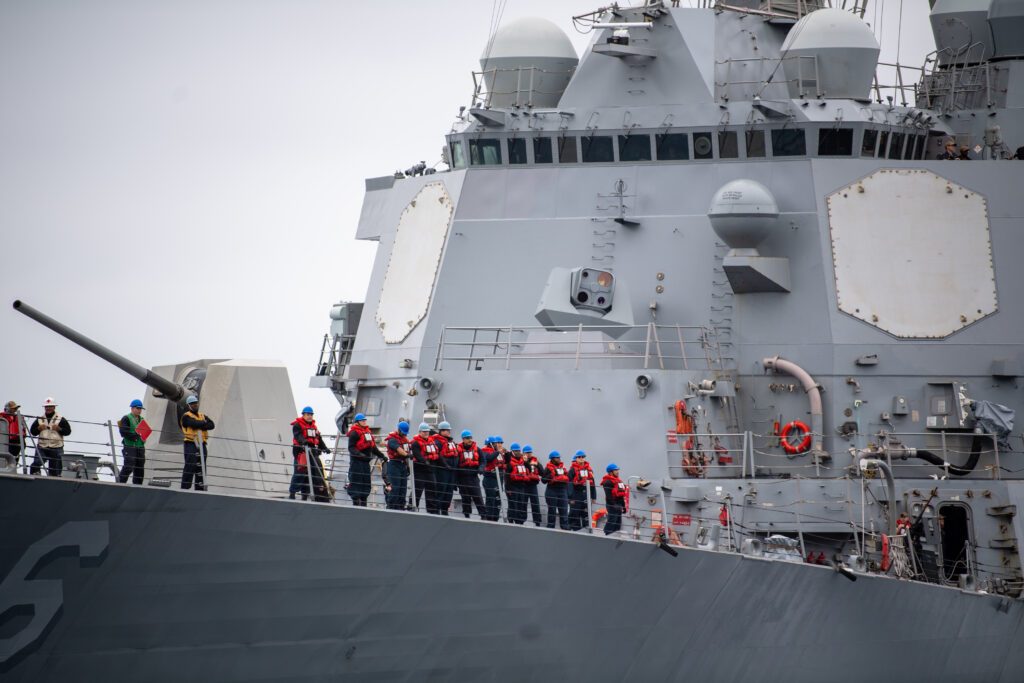
Arleigh Burke-class guided-missile destroyer USS Stockdale (DDG 106) Sailors prepare to conduct a replenishment-at-sea with Nimitz-class aircraft carrier USS Carl Vinson (CVN 70), July 12, 2021. Stockdale’s Optical Dazzling Interdictor (ODIN) laser system is seen just below the bridge. U.S. NAVY / Mass Communication Specialist Seaman Elisha Smith
DAHLGREN, Va. — The U.S. Navy has been researching and perfecting directed energy weapons to include railguns, high-powered microwaves and lasers, along with hypervelocity projectiles — to make futuristic weapons a reality on ships today.
The Naval Surface Warfare Center Dahlgren Division in Dahlgren, Virginia, has been leading the way in creating capabilities to give warfighters a high-tech advantage at sea, to include directed energy weapons.
“We take great pride in being a hands-on research, development, test and evaluation institution, where we possess and practice the organic technical knowledge for the Department of the Navy with respect to surface warfare,” said Dale Sisson, NSWC Dahlgren Division’s technical director. “That ends up being a fairly broad ranging mission, for sure. Having the opportunity to design, develop, test and integrate warfighting systems through the confluence of a physical range infrastructure, and a digital architecture such as our digital proving ground, is fundamentally who we are.
“We’re also in the threat engineering business, which means we understand those threats well, and that knowledge translates back into understanding how to develop the weapons to counter that on a defensive standpoint, as well as create the offensive advantage that puts us ahead of the game,” said Sisson.
While the Navy’s railgun efforts are currently on hold, laser systems are installed or in the process of being integrated into ship combat systems today. In fact, much of Dahlgren’s work on railguns is being leveraged today for new capabilities such as hypervelocity projectiles.
Today, lasers are a reality in the fleet. A prototype Optical Dazzling Interdictor, Navy, or ODIN system, designed and built by Dahlgren, is being evaluated aboard the Arleigh Burke-class guided missile destroyers USS Dewey (DDG 105), and other Burke-class ships. The Lockheed Martin High-Energy Laser with Integrated Optical-dazzler and Surveillance system is being tested aboard another Burke-class ship, USS Preble (DDG 88). The Solid-State Laser Technology Maturation (SSL-TM) program is developing an integrated Laser Weapons System Demonstrator, built by Northrop Grumman, which is installed and being tested aboard landing ship dock USS Portland (LPD 21).
All of them can thank Dahlgren for vital concept development, design and testing. Dahlgren’s Laser Lethality Laboratory and Laser Firing Range have provided knowledge, expertise and experience to mature the technologies and integrate the capabilities into the combat systems on the Navy’s warships.
“Our laser firing range allows us to fire across Upper Machodoc Creek so we can examine how the maritime boundary layer between the water and the atmosphere affects laser performance. We have a two-story building within our explosive experimental area we use as a backstop for laser beams,” Sisson said. “We can shoot up to about four kilometers, depending on where we position lasers on the range from the backstop.”
Dr. Chris Lloyd, distinguished scientist for laser weapon system lethality, leads the Navy’s laser lethality efforts.
“NSWCDD has extensive experience in integration of Navy laser weapon systems, from subcomponents up to full systems. The Navy laser lethality team supports development, assessment and deployment of laser weapons and conducts rigorous testing, modeling and simulation to drive requirements for advanced laser weapon system development for the Navy. Lethality is more than simply damaging materials, but understanding how threats are going to respond. We have to understand threat response, based on the damage we inflict, and apply that data, along with weapon system parameters and propagation information to tell the complete weapon effectiveness story,” he said.
“Our industry partners team closely with the government directed energy workforce to integrate and test laser weapon systems at Dahlgren test ranges as well as other DoD test locations in the country,” said Lloyd. “If they have a system that’s ready to be tested in preparation for deployment, we can use actual system performance test data in our lethality and effectiveness analyses to validate models and assess overall lethality.”
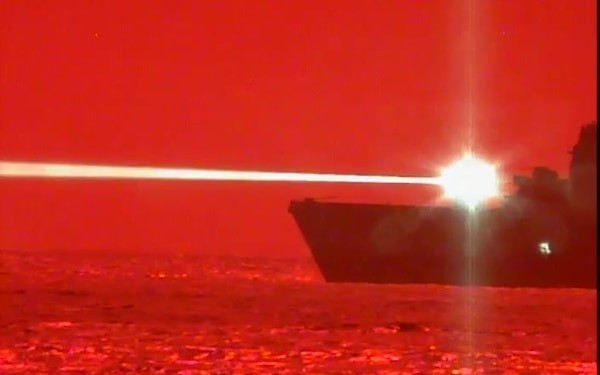
1001 Amphibious transport dock ship USS Portland (LPD 27) successfully disabled an unmanned aerial vehicle with a solid-state laser, Technology Maturation Laser Weapon System Demonstrator (LWSD) MK 2 MOD 0 in May 2020 in this still image from U.S. Navy video from Pacific Fleet Public Affairs. U.S. NAVY
Working Together
Lloyd said the Dahlgren team has been part of technical area working groups that have been together for the better part of 20 years, and, as a result of that, have become very proficient at working together and sharing data.
“We collaborate closely with the Army, Air Force, Missile Defense Agency and the Joint Directed Energy Transition Office,” he said. “We also work with the FFRDCs [Federally Funded Research and Development Centers] and academia to advance key S and T [science and technology] areas.”
Dahlgren’s lethality lab has several key features, including a repurposed World War II tunnel for longer range propagation studies. It’s environmentally controlled, and can introduce moisture and aerosols to see how they affect not only propagation but lethality.
“We can look at battlefield contaminants, atmospheric conditions, and understand lethality through those conditions,” said Lloyd.
“We’re in the business of putting holes in targets and damaging components. That’s the ‘target vulnerability’ piece of it,” he said. “But we’re interested in the overall weapon lethality. We have to understand the weapon system performance specifications, as well as the atmospheric conditions and the impact on overall effectiveness. We work very closely with the atmospheric community to grasp those principles and pull them into the modeling. We also collect vulnerability data on different materials all the way up to subsystem components and full systems.”
Another aspect of Dahlgren’s laser lethality efforts involves the modeling and simulation analysis team. “Fundamental properties for the materials we test against are fed into those models, along with all the basic parameters like conductivity,” said Lloyd. “It all has to be well understood.”
Sisson said the science and technology is important, but Dahlgren’s staff knows how to put that knowledge into practical systems.
“We have the technical knowledge to build a system. But that’s not enough. We have that true subject matter expertise that knows how to design, develop, deliver and field systems. When we’re working on a tactical laser system, our engineers also understand systems integration and what it takes to go acquire things. We have to be able to install and operate that system on a ship reliably and effectively,” Sisson said. “We need a system to target the beam and conduct battle damage assessment, and it has to integrate with the ship’s combat management system. We have to be able to make it fit and work on a ship in a challenging maritime environment.”
Not Just A Laser
“Dahlgren has been instrumental in the continued technology maturation for high energy lasers and the success of LWSD,” said Donna Howland, acting general manager of Northrop Grumman’s Directed Energy operating unit. “We learned from their expertise on how to operationalize high energy lasers.”
“It’s not just a laser. We want to integrate the laser — as both a sensor and weapon — as a full participant in the combat system,” said Capt. Casey Plew, NSWC Dahlgren Division’s commanding officer. “We’re building a weapon that includes the mount, power, thermal management, command and control, tracking and doctrine, all done in coordination with government, industry and academia partners.
“Lasers are a great piece of the mission we perform, but they are only one part of the complex puzzle. And the awesome women and men of NSWC Dahlgren Division have been helping to solve our surface navy warfighting puzzles — for almost 104 years. It is in our DNA. It is what we do,” said Plew.
NATO ASW Exercise Under Way off Sicily
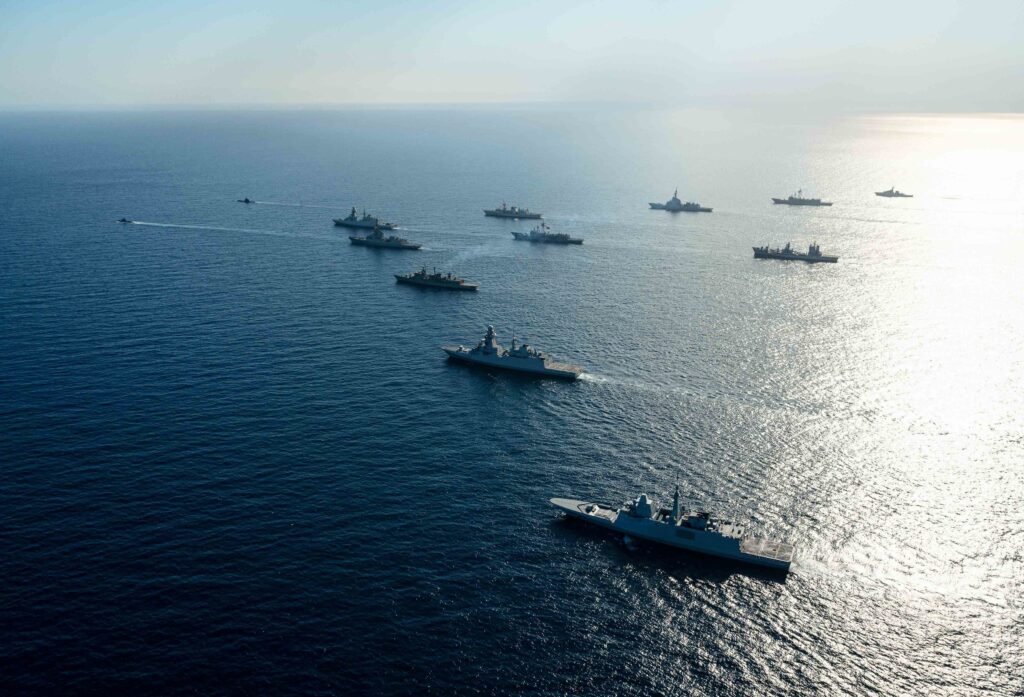
Standing NATO Maritime Group 2 ships and submarines sail in formation in the Ionian Sea off the coast of Sicily Feb. 21 during Exercise Dynamic Manta 22. NATO ALLIED MARITIME COMMAND
MEDITERRANEAN SEA — While the NATO maritime forces have had to navigate around the rocks and shoals of the global pandemic, it has not stopped them from exercising and raising their game in looking for adversary submarines in the Mediterranean.
The annual Dynamic Manta antisubmarine warfare exercises are conducted in the central Mediterranean, usually around Sicily, and takes advantage of the maritime patrol air bases at Sigonella and Catania in Italy. This year is no exception.
Ships, submarines, aircraft and personnel from nine allied nations will take part in the antisubmarine warfare and anti-surface warfare training exercises from Feb. 21 to March 4.
Submarines from France, Greece, and Italy have been joined by surface combatants from Canada, France, Greece, Italy, Spain, Turkey, the United Kingdom and the U.S. for the exercise. Maritime patrol aircraft from Canada, France, Germany, Greece, Italy, U.K. and the U.S. are supporting the simulated, multi-threat environment during the exercise.
The task group is joining up in Catania harbor. The nearby Italian naval helicopter base in Catania and U.S. Naval Air Station at Sigonella are supporting Dynamic Manta 22 operations. Logistical support is being provided from the Italian naval base at Augusta Bay.
Dynamic Manta is one of the two major antisubmarine warfare exercises led every year by NATO Maritime Command. Dynamic Manta involves NATO Standing Maritime Group Two in the Mediterranean. The other, Dynamic Mongoose, takes place in the North Atlantic in the summer, involving NATO Standing Maritime Group One.
“NATO’s maritime power lies in the ability of the standing forces to rapidly join with high readiness, high-capacity national forces to deliver effects when and where needed,” said U.S. Navy Rear Adm. Stephen Mack, commander, Submarines NATO, who is commanding Dynamic Manta 22. “Exercises like this, along with regular training between allied navy units and our multinational standing naval forces, is a force multiplier that provides a collectively trained and interoperable force, ready to work together as the maritime portion of the VJTF [Very High Joint Readiness Task Force].”
Mack added, “This exercise is a visible demonstration of the alliance’s ability to cooperate and effectively integrate. Alliance unit, solidarity, and cohesion are the core of NATO.”
Noble Fusion 2022 Prepares Maritime Forces for Distributed Maritime Operations in the Pacific
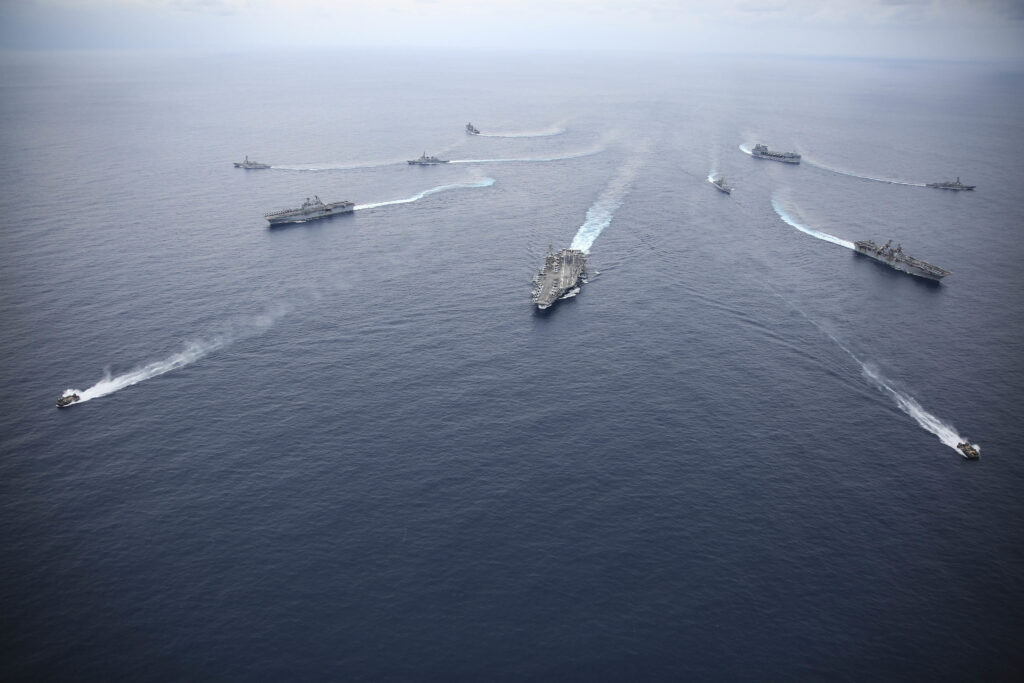
Ships of the America and Essex Amphibious Ready Groups and Abraham Lincoln Carrier Strike Group fall out of formation with the Japan Maritime Self-Defense Force during operation Noble Fusion. Front row: Landing craft, air cushion from the USS Essex (LHD 2). Second row, left to right: USS America (LHA 6), USS Abraham Lincoln (CVN 72), Essex. Third row, left to right: USS Dewey (DDG 105), JS Kongō (DDG 173), USS Mobile Bay (CG 53), USS Spruance (DDG 111). Back row, left to right: USS Ashland (LSD 48), USS Miguel Keith (ESB 5). U.S. NAVY / Mass Communication Specialist 3rd Class Thaddeus Berry
PACIFIC OCEAN — A multi-national and multi-strike group conducted a sweeping series of operations the Western Pacific earlier this month.
Noble Fusion 2022 took place Feb. 3-7, involving two Amphibious Ready Groups with embarked Marine Expeditionary Units along with a Carrier Strike Group. U.S. Army and Air Force units, and units of the Japan Self Defense Forces, also took part.
The exercise was led by Combined Task Force 76/79. According to a Navy statement, Noble Fusion 2022 units operated from “the Luzon Strait to the Miyako Strait and the East China Sea, encompassing a wide swath of the First Island Chain, including littoral areas in the vicinity of Okinawa.”
“For the first time since 2018, two Amphibious Ready Groups with embarked Marine Expeditionary Units conducted operations together in the Indo-Pacific region,” said Navy spokesperson Lt. Cmdr. Sherrie Flippin. “The most recent exercise Noble Fusion highlighted Naval Expeditionary Forces’ capability to rapidly aggregate Marine Expeditionary Unit/Amphibious Ready Group teams at sea with joint force elements, allies and a Carrier Strike Group, in order to conduct sea-denial, seize key maritime terrain, guarantee freedom of movement, and create advantage for U.S., partner and allied forces.”
The exercise commenced with amphibious maneuvers to demonstrate the ability to seize key maritime terrain involving the 11th MEU/USS Essex (LHD 2) ARG and Carrier Strike Group-3’s USS Abraham Lincoln (CVN-72) flying AV-8B Harriers, MV-22B Ospreys and a Navy E-2D Advanced Hawkeye over the Luzon Strait. Abraham Lincoln was escorted by the Arleigh Burke-class destroyer USS Spruance (DDG 111) and the Ticonderoga-class cruiser USS Mobile Bay (CG 53).
Later, the 31st MEU/USS America (LHA-6) ARG conducted strikes in the First Island Chain with F-35B Lightning II fighters. Additionally, F-35B’s of Marine Aircraft Group 12 out of Iwakuni, Japan, as well as F-15C Eagles with the U.S. Air Force’s 18th Wing out of Kadena Air Base, teamed up with a P-8 Poseidon from Task Force 72, to conduct a maritime strike.
“This type of training demonstrates the resilience and interoperability with our joint forces and our partners and allies,” said Col. Michael Nakonieczny, commander of the 31st MEU, speaking to reporters Feb. 16.
“It’s important for us to consider ourselves partners, trying to figure out how we become better warfighters as a combined team,” said Capt. Greg Baker, commodore of Amphibious Squadron 11, who joined Nakonieczny on the call with journalists.
USS Dewey (DDG 105) and JS Kongo (DDG 173) conducted surface operations to protect and defend the force. Commander Destroyer Squadron 7 was the surface warfare commander throughout the exercise.
“Sea-denial operations with cruisers and destroyers, seizing key maritime terrain with aviation and surface movement, guaranteeing freedom of movement — these are the things we do every day in the Indo-Pacific,” said Navy Capt. Tom Ogden, the DESRON 7 commodore. “This exercise validates the ability of U.S. forces and allies to establish sea control and maintain readiness while also providing security and enabling stability.”
Brig. Gen. Kyle Ellison, commanding general, 3rd Marine Expeditionary Brigade and CTF-79 commander, said Noble Fusion 2022 was about using the sea as maneuver space to achieve positional advantage.
“It was about exercising our ability to maneuver critical capability to locations in the time and space of our choosing,” Ellison said. “We achieved positional advantage with the integration of two ARGs with their associated MEUs enabled by a carrier strike group. These capable warships must remain a critical component of our integrated deterrence strategy. Rest assured, we proved as an integrated, naval, joint and allied force that we are completely committed to a free and open Indo-Pacific region. We are effectively contributing to that goal now and our operational prowess will only improve.”
The capstone event was a night strike in the First Island Chain by F-35C Lightning II aircraft from Lincoln and AV-8B Harriers from Essex, along with F-18E Super Hornets acting as an aggressor force. Night aerial refueling supported the strike, with 11th MEU AV-8B Harrier attack aircraft being refueled by KC-130J Hercules aircraft of Marine Aircraft Group 12.
“Noble fusion has been an incredible opportunity to rapidly, and at a time and place of our choosing, demonstrate that when our allies and U.S. joint forces come together, we are the premier fighter force in the region,” said Rear Adm. Chris Engdahl, commander of Expeditionary Strike Group 7/Task Force 76. “Seamlessly integrating our advanced platforms alongside our professional staffs at sea and ashore allowed us the chance to reinforce our command and control in the air, on the ground, at sea, and below the surface.”
U.S. Pacific Fleet Will Leverage Knowledge, Expertise of Naval Postgraduate School With New Nimitz Research Group
The Naval Postgraduate School and U.S. Pacific Fleet announced the establishment of the Nimitz Research Group on Feb. 16. Under the aegis of NPS’ Naval Warfare Studies Institute, the new organization will leverage NPS’ interdisciplinary education and research capabilities and institutional knowledge in new ways to meet the needs and emerging challenges of the Pacific Fleet. U.S. NAVY
MONTEREY, Calif. — The Naval Postgraduate School at Monterey, California, and Commander, U.S. Pacific Fleet are joining forces to harness educational and research knowledge and expertise specifically as it pertains to the Indo-Pacific region with a new effort, the Nimitz Research Group.
Nimitz Research Group will fall under NPS’ Naval Warfare Studies Institute, which will provide NPS faculty and students who will “serve as an extension of the PACFLT staff in Hawaii by participating in fleet exercises and events and providing additional research capacity and subject matter expertise,” according to an Naval Postgraduate School press release.
The Nimitz Research Group was launched Feb. 16 by the NPS president, retired Vice Adm. Ann E. Rondeau, and Adm. Samuel Paparo, commander of the U.S. Pacific Fleet.
“The establishment of the Nimitz Research Group marks a further evolution in our outstanding partnership with the U.S. Pacific Fleet,” said Rondeau. “We have always seen NPS as a center of excellence and innovation, a place where our faculty and students work together to solve the operational challenges of our fleet and force. Through the Nimitz Research Group, we will be able to provide those solutions by deploying our talent and our experience in direct support of our Pacific Fleet partners.”
According to NPS spokesman Lt. Cmdr. Ed Early, the Nimitz Research Group is modeled after Naval Warfare Studies Institute’s Bucklew Research Group, which already provides similar support to Naval Special Warfare. Early said the Navy SEAL officers who are Bucklew scholars attending NPS on a two-year master’s degree program serve as an extension of Naval Special Warfare Group commands, who in turn benefit from the SEALs’ education, research efforts, interactions with the academic community, and proximity to Silicon Valley.
“The example set by the Bucklew Research Group proved to be an ideal model for PACFLT’s requirements.,” Early said. “As a result, the Nimitz Research Group was conceived with the goal of providing coherence and unity of action for NPS’ support to PACFLT.”
Paparo, himself a graduate of NPS’ Systems Analysis program, wanted to leverage the Bucklew Research Group model to focus the unique capabilities of Naval Postgraduate School faculty members as well as the operational experience of NPS’ 2,500 mid-career officers, senior noncommissioned officers and civilians to support the commander of Pacific Fleet’s priorities and research needs.
“The Nimitz Research Group links the intellectual rigor of NPS, its key location in the nation’s hub of technical innovation and the expertise of innovative warfighters in the Pacific Fleet to research, develop and implement new and dynamic combat capabilities,” said Paparo. “Together we will build critical advantages over our competitors to maximize our strengths — battlespace awareness, agility, maneuverability and collective capabilities of the joint forces.”
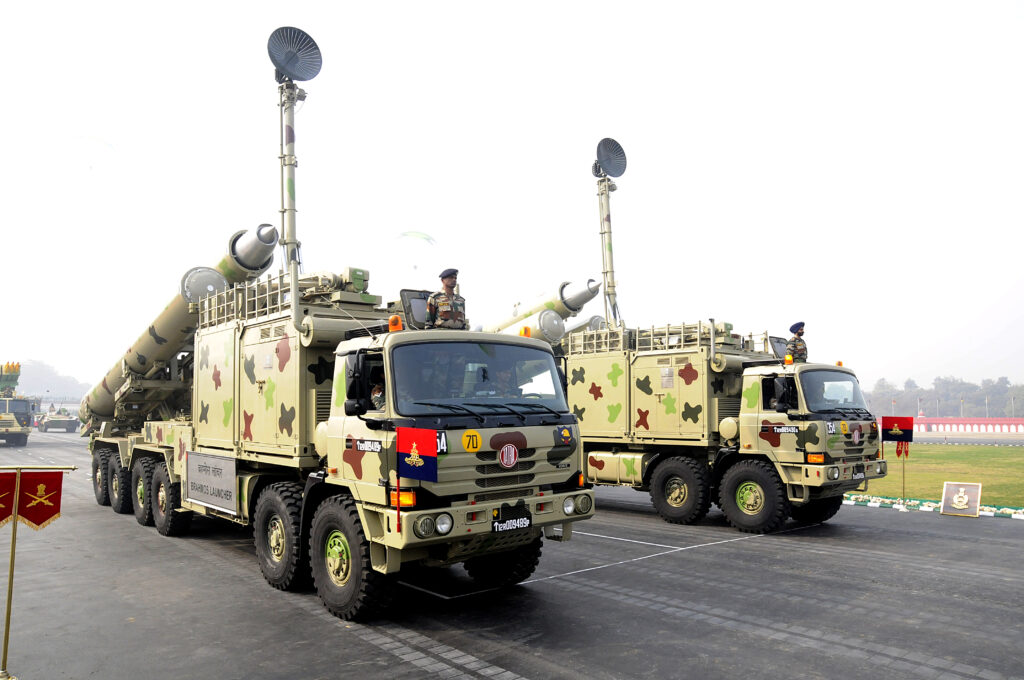
Indian army BrahMos missiles mounted on mobile autonomous launchers. WIKIPEDIA
The Philippines Department of National Defense has contracted for BrahMos shore-based anti-ship missile system. The $368 million contract is for three batteries, as well as launcher vehicles, command and control, training and support.
“Equipping our navy with this vital asset is imperative as the Philippines continues to protect the integrity of its territory and defend its national interests. As the world’s fastest supersonic cruise missiles, the BrahMos missiles will provide deterrence against any attempt to undermine our sovereignty and sovereign rights, especially in the West Philippine Sea,” said Defense Secretary Delfin N. Lorenzana.
The BrahMos uses either an active radar homing system or satellite targeting to deliver its 440-pound warhead. The missile travels at Mach 4 and can reach targets up to 180 miles away. The cruise missile can be used against fixed land targets as well as ships at sea.
The Philippines have been alarmed by Chinese claims to large portions of the South China Sea, including Philippine islands. India, as well, has been engaged in hostilities with China at the border in Ladakh. Both nations are modernizing their militaries, and China is a major motivation.
The BrahMos program began in 1998. BrahMos is a joint Russian-Indian project, and comes in land-based and ship-mounted versions. The weapon is operational with India’s navy and army. India has been seeking export customers for Brahmos for some time. The Philippines deal is the first.
The BrahMos anti-ship batteries will be operated by the Philippines marines. Additional BrahMos systems for precision strike land attack missions are being sought for the army artillery regiment.
The installed radar with the launcher system has limited range, nowhere near the range of the weapon. The system is best employed as part of an integrated with a intelligence, surveillance reconnaissance engagement network, which can include land, sea and space-based sensors, something the Philippines need to develop.
Indonesia’s New Fast-Attack Trimaran Combines Speed and Stealth
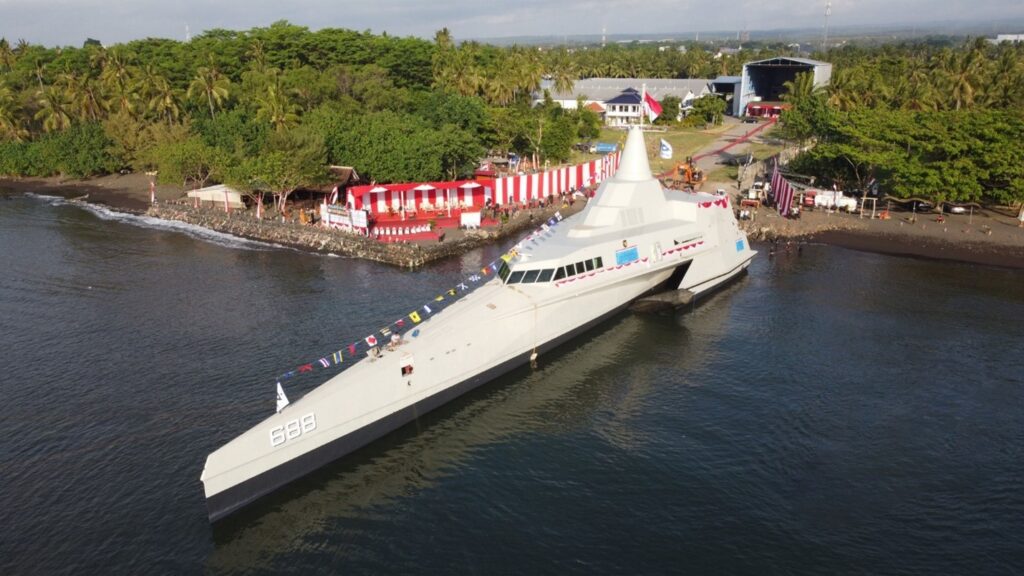
The Indonesian navy’s first stealth trimaran fast-attack craft, KRI Golok. PT LUNDIN
INDONESIA — The Indonesian navy commissioned its first stealth trimaran fast attack craft, KRI Golok (688), at Surabaya on the island of Java on Jan. 14. The ship was built by PT Lundin at Banyuwangi, on Java’s eastern tip, from composite fiber materials.
The commissioning ceremony took place at the naval base in Surabaya, East Java. Also commissioned at the ceremony was the lead ship in a new class of hospital ships KRI dr. Wahidin Sudirohusodo (991),
Speaking at the ceremony, Adm. Yudo Morgono, chief of the Indonesian navy, said, “This type of ship is not only important to support naval operations as part of the task force and the navy fleet, but is a tangible manifestation of the navy’s commitment to modernizing defense equipment in humanitarian operations.”
The term “golok” refers to a cutting took, similar to a machete, which can serve as a tool or weapon. During the naming ceremony last August, Margono said the composite material offers high strength, light weight, excellent fatigue resistance and is virtually corrosion free. The Indonesian navy sees the trimaran design and material as a prototype development purposes.
“With its high speed and high destructive power, it is hoped that this ship will be able to carry out the hit and run fast missile boat tactic,” Margono said.
The ship has not yet been fitted with weapons, but is able to mount a gun up to 76mm and can carry up to eight antiship missiles, such as the RBS 15, Naval Strike Missile, Harpoon or Exocet.
According to a video prepared by PT Lundin, the ship has greatly reduced radar, infrared, acoustic and magnetic signatures. The weapons and RHIB are concealed inside the structure or discretely shaped to maintain stealth.
PT Lundin said the composite and carbon fiber foam-sandwich material — fabricated with fire-resistant vinyl ester resin — creates a structure that is much lighter than steel or aluminum, resin but has similar fire-resistance and ballistics protection properties and superior protection from blast and underwater explosions.
According to an Indonesian navy statement, the fast attack craft has an overall length of 205 feet (62.53 meters); a 52.5-foot (16 meter) beam; a 61-foot mast height (18.7 meters), and a current displacement of 245 tons. The ship will be heavier after the installation of weapons. The trimaran can achieve speeds up to 30 knots, and can cruise at 16 knots for 2,000 nautical miles. The ship and its 25-person crew will have an endurance of 40 days. Additional personnel, such as special forces or a humanitarian assistance landing party can also be carried.
The wave-piercing trimaran can cut through waves instead of ride over them, maintain higher speeds and heavier sea states. An enclosed hangar on the stern can carry a 12-meter RHIB.
The trimaran, with four water jets, is well suited for Indonesia’s archipelagic operations. The FAC is extremely maneuverable, has a shallow draft and can literally back up onto a beach — where its radar signature becomes indistinguishable from the land — waiting for targets to engage.
Golok is powered by four 1800 HP MAN V12 diesel engines, each connected to a Marine Jet Power 550 waterjets. In a company video, PT Lundin refers to the trimaran as the “ultimate in high-speed missile boats.”
Turkish frigate serving as flagship for NATO Operation Sea Guardian in Mediterranean
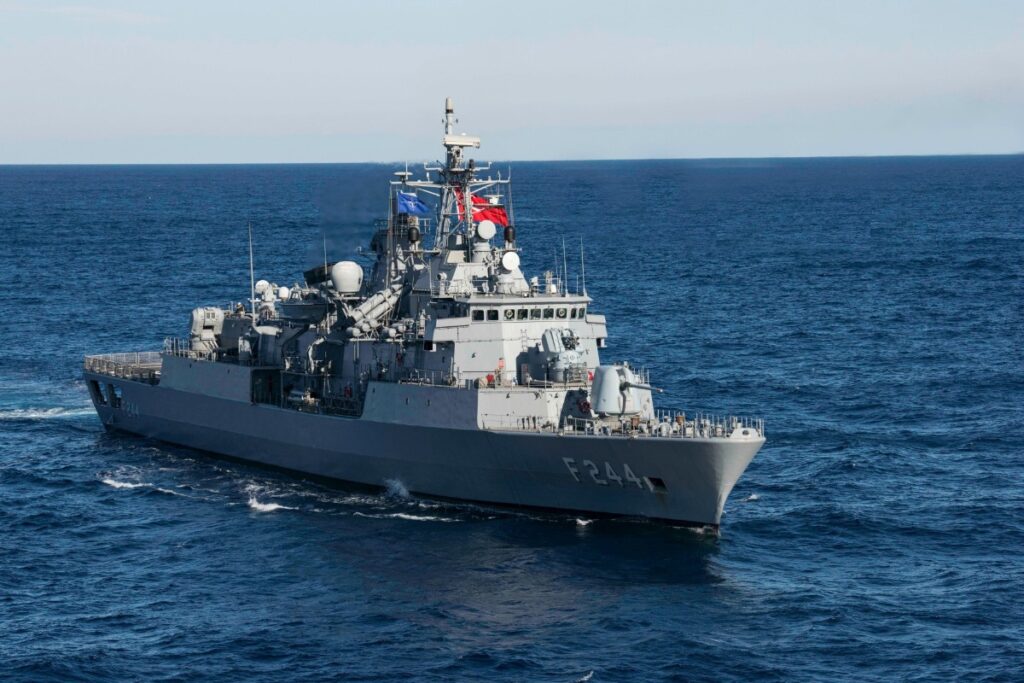
The Turkish frigate TCG Barbaros is serving as flagship for NATO’s Operation Sea Guardian focused patrol. NATO ALLIED MARITIME COMMAND
MEDITERRANEAN SEA — NATO is continuing its Operation Sea Guardian with its first focused patrol for 2022.
Turkish frigate TCG Barbaros is currently deployed to the Eastern Mediterranean Sea and is serving as flagship for NATO’s current OSG focused patrol.
According to a statement from NATO Allied Maritime Command, Barbaros’s three-week deployment is the first of six Operation Sea Guardina-focused operations scheduled this year and will run until Feb. 12, 2022.
“This focused patrol incorporates maritime patrol aircraft from Greece, Poland and Turkey in addition to submarines from Greece and Turkey in support of the flagship,” the statement said. “Simultaneously, Standing NATO Maritime Group 2 comprised of the flagship ITS Margottini, ESPS Blas de Lezo and TCG Goksu will be deployed in the Eastern Mediterranean Sea, contributing NATO’s maritime situational awareness efforts.”
According to MARCOM, Operation Sea Guardian is a non-Article 5, “collaborative, year-round maritime security operation designed to maintain maritime situational awareness, deter and counter terrorism activity and build capacity and interoperability among NATO Allies and partners.”
Aimed at working with Mediterranean stakeholders and partners, the operation has been conducting focused patrols at specific areas of interest in the Mediterranean Sea. Operation patrols commenced in 2016 to “maintain an accurate picture of the maritime environment and contribute to the safety and security in the region.”
NATO’s website states that “Operation Sea Guardian is a flexible operation that can potentially cover the full range of NATO’s maritime security operation tasks. At present, it is operating in the Mediterranean and is conducting three MSO tasks: maritime security capacity building and support to maritime situational awareness and to maritime counter-terrorism.”
As needed, Operation Sea Guardian can also be directed to uphold freedom of navigation, conduct maritime interdiction, fight the proliferation of weapons of mass destruction and protect critical infrastructure.
“I cannot think of a better example that speaks to the relevance of inter-agency cooperation than Operation Sea Guardian,” said Allied MARCOM’s commander, Royal Navy Vice Adm. Keith Blount, speaking at the NATO Maritime Security Conference last year at Souda Bay, Crete. “Our obligation to ensure maritime security in the Mediterranean requires a multitude of actions, in collaboration with our allies and partners, and represents the full spectrum of capabilities that we possess.”
Canadian Patrol Ship Circumnavigates North America on First Voyage
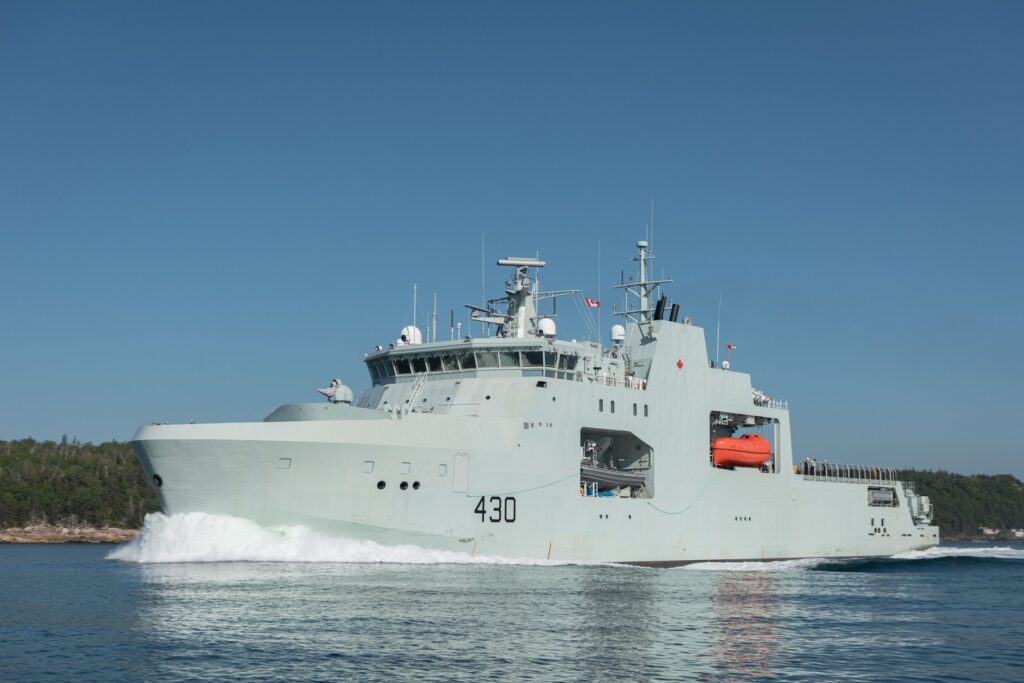
HMCS Harry DeWolf, which recently called at Naval Station Norfolk as part of its circumnavigation of North America. WIKIPEDIA / Hken 167
The Royal Canadian Navy Arctic and offshore patrol ship HMCS Harry DeWolf (AOPV 430) recently called at Naval Station Norfolk, Virginia, as the final stop on its historic circumnavigation of North America.
Commissioned in June, Harry DeWolf is the Royal Canadian Navy’s first new warship in 25 years and its first ice-capable vessel since HMCS Labrador in 1958.
For its first voyage, Harry DeWolf transited to the Arctic to participate in Canada’s Operation Nanook annual training exercises in the high north, then continued through the Northwest Passage and working with the U.S. Coast Guard in Alaskan waters. From there the patrol vessel proceeded to San Diego and embarked a U.S. Coast Guard law enforcement detachment and conducted counter-narcotics operations in the Eastern Pacific and the Caribbean Basin.
In Alaska, the ship participated in a mass casualty drill with the U.S. Coast Guard. Further south, the crew took part in Op Caribbe, Canada’s contribution to U.S. enhanced counter-narcotics operations under U.S. Joint Interagency Task Force South in the Eastern Pacific and Caribbean. Working with an embarked U.S. Coast Guard Law Enforcement Detachment, Harry DeWolf helped with the seizure and offload of approximately 26,250 pounds of cocaine and 3,700 pounds of marijuana worth about $504 million from the USCGC Hamilton (WMSL 753) in Port Everglades, Florida, Nov. 22.
The ship arrived in Norfolk Dec. 9 and departed Dec. 12.
While highly capable for polar operations, the ship is also designed to conduct patrols wherever needed in the world. HMCS Harry DeWolf Commanding Officer Cmdr. Corey Gleason said the unique ship design is specific to Canadian needs.
“Our allies all have offshore patrol vessels, but they don’t have the Arctic stamp on it. If we are truly going to operate our domestic waters, we have to be to go north, not just during the navigable between July and October, but any time. Earlier this year we were up in the dead of winter breaking ice, with no other ships,” he said.
The deployment also demonstrated the endurance of the ship as it visited ports and communities in Nunavut, Northwest Territories and Yukon Territory. While the ship did take on fuel during port visits to Nuuk, Greenland, and Dutch Harbor, Alaska, Gleason said the ship has the range to sail from Halifax to the Esquimalt naval base in British Columbia on a single tank of fuel.
“I always knew that this ship had an incredible capability anywhere in the world. And we demonstrated that tenfold in the four and a half months that were deployed,” he said.
Gleason said the Royal Canadian Navy doesn’t have a great deal of experience operating in the ice. As the skipper of the first Arctic and offshore patrol ship, Gleason said he spent a lot of time providing ship-handling experience to his officers, and he’s been training the commanding officers, executive officers and navigators of the other ships to help them get ready for the Arctic when their ships are commissioned.
During the deployment, the ship underscored the close working relationship between maritime services of Canada and the U.S.
“In terms of our cooperation, the United States is really is our premier partner in the Arctic,” said Martin Loken, deputy head of mission for foreign policy and national security at the Embassy of Canada in Washington. “Canada’s Arctic and Northern Policy Framework sets out our overall government approach to the north and to the Arctic. There are a lot of elements there, and almost every single one of them aligns with U.S. interests in the Arctic, whether it’s providing economic opportunities for populations, building and investing in stronger, more resilient infrastructure, preparing for the impacts of climate change, advancing indigenous reconciliation, and the list goes on.”
A U.S. naval officer joined the ship for its first deployment. Lt. j.g. Kyle Luchau of the guided-missile destroyer USS Winston S. Churchill (DDG 80), served as a liaison officer and completed the circumnavigation of North America.
The RCN plans to build six Arctic and offshore patrol ships at the Irving Shipyard in Halifax, which are being constructed as part of Canada’s National Shipbuilding Strategy. Two more AOPS will be built for the Canadian Coast Guard.