Strike Groups with Fifth-Generation Fighters Demonstrate Interoperability, Interchangeability
Ships from four nations take part in large scale formation sailing. On Aug. 24, the ships of the United Kingdom Carrier Strike Group, led by the Royal Navy flagship HMS Queen Elizabeth, met with the USS America, USS New Orleans, JS Ise and JS Asahi. Working with ships from the US Navy and the Japan Maritime Self Defence Force, a close formation was formed and on completion the Japanese ships broke away to conduct a ceremonial sail past. ROYAL NAVY / Dan Rosenbaum
A multinational task force is operating together as part of Large Scale Global Exercise 2021 (LSGE 21) in the Pacific.
The U.K. Carrier Strike Group 21 (CSG 21) and U.S. Expeditionary Strike Group 7 (ESG 7) are conducting multinational advanced aviation operations as part of U.S. Indo-Pacific Command’s LSGE 21.
According to Lt. Cmdr. Sherrie Flippin, spokesperson for ESG 7, “LSGE is a Joint Staff-sponsored exercise intended to rehearse the integration of defense activities in the Indo-Pacific Region. LSGE 21 is the first iteration of this event, involving the coordination of operations, activities, and investments in support of large-scale operational maneuvers.
“Currently, both HMS Queen Elizabeth Carrier Strike Group and USS America Expeditionary Strike Group are conducting multinational advanced aviation operations to further enhance proficiency and capability to respond to shared challenges in the region.”
LSGE 21 commenced Aug. 2 and is taking place throughout the Indo-Pacific region. It will run until the end of this week.
Royal Navy Commodore Steve Moorhouse commands Carrier Strike Group 21 and is embarked aboard HMS Queen Elizabeth (R08). Rear Adm. Chris Engdahl is in command of ESG 7 and is aboard his flagship, USS America (LHA 6). They spoke to a small group of reporters by phone while they were underway on Tuesday.
HMS Queen Elizabeth leads the U.K.’s Carrier Strike Group and is operating a mixed air group of F-35Bs, with a squadron of U.K. jets and a squadron from the U.S. Marine Corps, Marine Fighter Attack Squadron 211 (VMFA 211), and is escorted by surface combatant escorts from the U.S. Navy, Dutch Navy and Royal Navy — HMS Defender (D36), USS The Sullivans (DDG 68), HMS Kent (F 78) and HNLMS Evertsen (F805).
“HMS Queen Elizabeth is the largest warship has ever built for the Royal Navy, and she was designed from the keel up to operate the F-35B aircraft,” said Moorhouse. “We have our own 617 Squadron of Royal Air Force and Royal Navy personnel, as well as a U.S. Marine Corps Squadron. When we talk about a fifth-generation aircraft, we now have ourselves a fifth-generation aircraft carrier. This is the largest force of fifth-generation aircraft to put to sea anywhere in the world.”
For LSGE 21, both strike groups have been contending with a multi-domain tactical scenario, from undersea to surface and air, as well as cyber and space, and to include the Marines going ashore and operation on land.
The USS America Expeditionary Strike Group (AMA ESG) is carrying Sailors and Marines from 31st Marine Expeditionary Unit with aviation support from Marine Medium Tiltrotor Squadron 262 (Reinforced), and Marine Fighter Attack Squadron 12 (VMFA 12), along with staff members from Expeditionary Strike Group 7, Amphibious Squadron 11, and Destroyer Squadron 7, Tactical Air Control Squadron 12, Fleet Surgical Team 7 and an embarked helicopter detachment from Helicopter Sea-Combat Control Squadron 25. Also part of the ESG is USS New Orleans with personnel from Naval Beach Unit 7, Fleet Surgical Team 7, and additional personnel from the 31st MEU.
“For years we have operated with partners, and we’ve been able to talk and communicate. But what we’re really trying to do here is take it to the next level of integrating. Our Dutch and American warship are absolutely integral to our strike group operations,” Moorehouse said. “But as we operate with the America strike group, our aircraft — both fixed and rotary — have been flying and operating from each other’s deck seamlessly.”
“We extended the range of our fifth-generation fighters by moving them from one aircraft carrier to another. We recovered, rearmed, refueled and relaunched those planes to continue the mission,” Engdahl added.
Helping to sustain the task force at sea are the Royal Fleet Auxiliaries RFA Fort Victoria and RFA Tidespring. Furthermore, USS America is optimized for aviation operations and does not have a well deck for LCACs (landing craft air cushion) or LCUs (landing craft-utility) with amphibious vehicles inside.
“One of her attributes is the capacity for significantly more fuel than other amphibious ships — literally millions of gallons of fuel — which means she can supply fuel to the other ships in company,” Engdahl said.
Engdahl said LSGE 21 provided great practice to enhance the tactical abilities of the crews of the ships and the aviation units embark.
“It reflects the strength of our alliance, our partnerships, the ongoing military relationship. And the relationship that we have is really bolstered by the interchangeability of the platforms that we employ.”
General Dynamics Moves Knifefish Production to New UUV Center of Excellence
General Dynamics Mission Systems and U.S. Navy representatives dedicate the opening of the General Dynamics Unmanned Underwater Vehicle Center of Excellence at Taunton, Massachusetts. The facility will manufacture the Knifefish mine countermeasures UUV. GENERAL DYNAMICS
General Dynamics Mission Systems cut the ribbon to open a new and expanded production line for its Knifefish medium-class surface mine countermeasure unmanned underwater vehicle (SMCM UUV) systems at the company’s UUV Center of Excellence (COE) in Taunton, Massachusetts.
Up until now, Knifefish has been assembled at the General Dynamics Bluefin Robotics facility in Quincy, Massachusetts. The system achieved a successful Milestone C decision and approval to enter low-rate initial production (LRIP) in 2019, followed by a contract for five Knifefish systems (10 total UUVs) and support equipment in August of 2019. The first of those Knifefish under that contract were delivered to the Navy in March.
The 20,000 square-foot COE occupies repurposed manufacturing space within the company’s Taunton facility to provide manufacturing, assembly and testing capabilities for Knifefish and Bluefin UUVs. The 500,000 square-foot Taunton manufacturing plant develops communications systems for the U.S. Army and provides engineering, manufacturing and production support for a number of the company’s products and programs.
“Our manufacturing facility has decades of experience in manufacturing high-consequence, highly critical components and electronic assemblies for many agencies across the Department of Defense,” said Paul Dalton, vice president of undersea systems. “And we are thrilled today to be adding unmanned underwater vehicles to that strong legacy of manufacturing performance.”
Carlo Zaffanella, vice president and general manager of maritime and strategic systems for General Dynamics Mission Systems, was pleased that the company has invested about $30 million in UUV design and manufacturing, and is bringing manufacturing work for its traditional Navy businesses to the Taunton plant that has long supported Army customers.
“Opening this manufacturing and assembly facility allows us to leverage the highly skilled and extremely experienced Taunton workforce. This skill set found in our Taunton employees is exactly the type of expertise we need to manufacture highly reliable UUVs,” said Zaffanella. “We have expanded our maritime operations to include the Taunton UUV Manufacturing and Assembly Center of Excellence to produce our existing best in class small and medium UUVs and allow for additional expansion space for growth on future UUV programs of all sizes. This location was specifically selected to provide additional capacity that will allow for larger scaling and optimization of UUV production with purpose-built manufacturing cells, fixtures, and special test equipment, while maintaining proximity to our Bluefin Robotics engineering team in Quincy.”
General Dynamics moved the production line to Taunton to allow for growth. Once Knifefish gets into full rate production with the Navy, the company said there’s still room here to grow to support the Navy, commercial customers or foreign military sales.
“Capacity was a big reason for setting this up,” said Craig Regnier, who manages the Taunton operation. We want it to be able to scale to meet the demands, likely in the volume of systems. With our Bluefin-9 and Bluefin-12, and our other commercial vehicle production lines running at the same time, we needed the ability to scale all those up in volume to meet demand. We dedicated our 8,000 square feet today, and we can expand easily up to 12,000 square feet and beyond.”
Regnier said the factory has the space, capacity, and most of all, the skilled workers to take on the new product line. “The kind of manufacturing that was already done here is exactly the kind of manufacturing that we need for Knifefish. The workers will learn certain processes that are new and unique and different. But generally speaking, we already have the right people who are highly skilled at electronic system integration. We can do immersive salt water testing in a very controlled environment here at our manufacturing facility, and then bring it to Quincy, where we have our waterfront and our own dedicated ship that we can go out into the harbor and launch and recover, and do the different levels of testing that the navy needs from us. It’s really just ideal setup for us.”
Knifefish is based on the Bluefin-21 UUV. It is intended for deployment from the Navy’s littoral combat ship (LCS) MCM mission package, as well as operating from other Navy vessels of opportunity. Knifefish will reduce risk to personnel by operating within minefields as an off-board sensor while the host ship stays outside the minefield boundaries.
General Dynamics Mission Systems is the system integrator for the Independence-variant of the Navy’s LCS. “We brought some of our expertise to making the mission modules and mission packages that go on that ship,” Zaffanella said.
The Navy program of record is for 30 Knifefish systems, with each system including two vehicles and associated equipment.
“It goes back to taking the man out of the minefield, the more we can do and expand that portfolio of capabilities that can be done unmanned, the more we can remove those threats from the sea. Unmanned is a gamechanger in that regard,” said Capt. Godfrey “Gus” Weekes, Program Manager, LCS Mission Modules (PMS 420).
A Knifefish unmanned undersea vehicle training model undergoes crane operations aboard the Military Sealift Command expeditionary fast transport vessel USNS Spearhead (T-EPF 1) as part of a training exercise enabling mine countermeasure missions from an EPF as a vessel of opportunity. U.S. NAVY / Master-at-Arms 1st Class Alexander Knapp
While Knifefish is one of the mission modules in the LCS mine countermeasures mission package, the full mission package has not reached initial operating capability.
As the prime contractor for the SMCM UUV, which later became Knifefish, General Dynamics partnered with Bluefin Robotics to provide the vehicle, and in 2016, General Dynamics Mission Systems bought Bluefin Robotics.
The battery-powered Knifefish can propel itself, use its sensors and process large amounts of data on board for missions of 24 hours and more. The Taunton facility will manufacture the batteries used in Knifefish and other Bluefin Robotics vehicles.
Knifefish has a low-frequency broadband sonar system (LFBB) capable of detecting bottom and buried “proud” mines, as well as identifying mines in high clutter environments.
According to the Naval Research Laboratory’s Acoustics Division Superintendent, Dr. Brian Houston, LFBB is an an active sonar that employs synthetic aperture processing, and artificial intelligence for detection and classification.
“LFBB exploits the structural acoustics involved with underwater sonar. When you transmit sound, the acoustic return is very different depending on the physical object reflecting that acoustic energy. It might be a naturally occurring thing like a rock on the bottom, or something that’s man-made, like a mine. In the water column, it might be a submarine versus a whale. What’s in the acoustic return is very different for each of those targets. Sonar has traditionally helped us know where something is, how far a way it is, and sometime provides an image. But in addition to bearing and range, we can now determine what it is,” Houston said. “That return has specific physics in it that we can exploit, and we can know something about the physical object and based on how it responds.”
Because if its capabilities, Knifefish is subject to International Traffic in Arms Regulations (ITAR) restrictions. But the basic Bluefin Robotics vehicles are commercially available. “We’ve constructed and architected our commercial vehicles so that they’re largely ITAR free. In fact, the Bluefin-9 and Bluefin-12 are being delivered today into a program for a military customer overseas,” said Zaffanella. “When we designed those vehicles, the intent was to keep them free from ITAR restrictions.”
Knifefish is the only UUV that can identify proud mines. But, with its open architecture and modular design, General Dynamics officials say that Knifefish could be equipped with other sensors, as well. Knifefish is designed and architected — both software and hardware — to accommodate upgrades as it goes forward. “We designed Knifefish using an open architecture concept that can be quickly and efficiently modified to accommodate a wide range of missions,” Zaffanella said.
“What makes Knifefish different from other vehicles is the sonar that can detect buried mines,” said Zaffanella. “But the sensor is not something that’s bolted on to the vehicle. The electrical and mechanical integration of the sonar into the vehicle is a fundamental part of its design and is necessary in order to make it work. Buttoned up it looks like a relatively simple and straightforward UUV. But the amount of technology that is inside of that is breathtaking.”
The free-flooding design allows the vehicle to be assembled in sections, which makes it easier to ship and store. “This is genuine modularity — both physical and software modularity. It comes apart in sections and you can upgrade each of the things that are in there, whether it’s the system electronic portion, the communications, or the batteries. In a modular system like this, it’s pretty easy to change out one section for another to add or change capability,” Zaffanella said.
Knifefish operates autonomously, so that an operator doesn’t have to tell it what to do. “We strongly believe that the era of maritime autonomy is very much upon us,” said Zaffanella. “The ability to make systems that are unmanned, that can do things that manned vessels cannot, and take sailors out of harm’s way, that era, and engineering the technologies needed, all of that now exists.”
“We foresee unmanned vessels will eventually be part of the fundamental fabric of how the Navy conducts its operations,” he said. “Our Taunton facility and the great manufacturing expertise here will be at the forefront of it all.”
Standard Replenishment: Navies Help Each Other at ‘Speed of Combat’
Capt. Bobby Summers, master of USNS Ericsson (T-AO 194), supervises a replenishment at sea with the Japan Maritime Self-Defense Force’s, helicopter destroyer JS Ise (DDH 182). Ericsson provides critical supplies to U.S. Navy and partner nations’ ships operating in the Indo-Pacific Region. MILITARY SEALIFT COMMAND FAR EAST / Jeyh Janik
Navies that operate frigate-sized ships and larger will generally need to provide for a replenishment-at-sea capability, but many of those navies do not have large replenishment ships that can operate on extended missions to sustain their ships while deployed, or one may not be present where their warships are operating.
They can, however, be supported by oilers and replenishment ships from other navies, as long as both the combatants and logistics ships are built and operated to the international standard. When navies that follow that standard, there is a much large force of replenishment vessels for everyone.
According to Cmdr. J.H. “Han” van Huizen, NATO Maritime Command Branch head for Logistic Operations & Exercises, both NATO and the nations have collective responsibility for the logistic support of alliance operations and missions (AOM).
“The nations are responsible for ensuring that maritime units and formations assigned to NATO are properly supported by an effective and efficient tailored logistics structure for AOM, including a proportional contribution to theater-level support capabilities,” he said.
“From the NATO perspective, logistics is a national responsibility, but the nations and NATO authorities have a collective responsibility for logistic support of NATO’s multinational operations. Logistics support must be sufficient to sustain maritime operations and is required in theater to support forward deployed maritime forces,” van Huizen said. “When operating in a task group, for example, the ships will coordinate efforts like replenishment at sea [RAS] with designated fleet logistic coordinators and a group logistic coordinator. Cooperation among the nations and NATO authorities is essential.”
Interoperability is achieved because the navies have agreed-upon standards. They use the same rigs, procedures, terminology and documentation. Interoperability starts with design standards and includes the concepts of operations and operational procedures. NATO and partner nations can do this because they have agreed to follow the same standards and the same manual.
The U.S. Navy’s manual for underway replenishment is essentially the same as the NATO manual, which provides conceptual interoperability from the start.
“ATP-16 is the NATO document that has the parts to procedures on how things are going to happen. This is the document to make sure all those countries that are listed in the manual can interact easily with each other,” said Richard Hadley, an underway replenishment (UNREP) engineer with Naval Surface Warfare Center Port Hueneme Division in California.
To achieve interoperability, the visual signals have to be the same on both the delivering and receiving ships. The sound-powered phones have to connect the same way. Emergency breakaway procedures have to be the same.
Interoperability has to be designed in from the beginning, not done as an afterthought. “There’s a device on a cargo receiving station called the NATO Long Link, and the pelican hook on all of the delivering ships will connect with that. It’s the same on all of the ships,” Hadley said.
“We’re the engineers who design and support the UNREP system, not the people who are out there every day conducting these evolutions, but we take our work very seriously,” Hadley said. “It has to be safe. It has to be effective and reliable. You don’t want the fleet to have logistics problems, because your system goes down. If the system doesn’t work, the fleet won’t be able to do what they need to do. We always have to be aware of that.”
Singapore-based Commander, Logistics Group Western Pacific (COMLOG WESTPAC)/Task Force 73 (CTF 73), is the U.S. 7th Fleet’s provider of combat-ready logistics, operating government owned and contracted ships to keep those ships armed, fueled and fed.
“Reliable and responsive sustainment enable ships to remain at sea — ships at sea are key to the global presence that underpins regional security and stability,” said Cmdr. Rob Paul, deputy assistant chief of staff for Logistics, COMLOG WESTPAC/CTF 73. “Replenishments at sea are one way we enhance our interchangeability with friends, partners and allies in the region. This is true whether we are resupplying other nations, or they are resupplying us, because our partners and allies are able to supply us with fresh food, stores and fuel, and we can do the same for them. We can sustain nearly any partner or ally in this region and vice versa. That is at the core of interchangeability and interoperability.”
According to Paul, the U.S. has conducted replenishment operations with Australia, France, India, Japan, Republic of Korea and Singapore. The U.S has received cargo and/or fuel from Australia, Japan and Republic of Korea in the past year.
The U.S. Navy’s fleet replenishment oiler USNS Big Horn (T-AO 198), left, conducts an underway replenishment with the French Navy’s amphibious assault ship FS Tonnerre (L 9014), while the French frigate FS Surcouf (F711) follows. FRENCH NAVY
Safety First
Because replenishments and refueling at sea are inherently dangerous, Paul said the most important attribute allied and partner navies share are basic safety features.
“Prior coordination before any RAS helps ensure safe and efficient operations. While there are standard operating guidelines we publish in an unclassified manual, before each replenishment operation we transmit an official message that reiterates agreed upon procedures and guidance regarding many factors from ship speed to acceptable weather,” he said.
After safety, it becomes a matter of efficiency, such as the standard NATO fittings that can provide the optimal fuel transfer rates.
“It’s also important to ensure you are delivering the right cargo,” Paul said. “We coordinate that at the fleet logistics level. Our CLF fleet replenishment oilers and dry goods and ammunition ships can receive cargo, stow it and transfer it using the same general process as any partner or allied cargo vessel.”
The U.S. and allied and partner navies follow the same protocols or procedures to seamlessly deliver or receive fuel, ammunition and stores at sea.
Paul said great advances are being made in the areas of authorities and legal considerations as well. “We are making strides is at higher levels of engagement, specifically, navigating through the complex accounting process,” he said. “Both we and our partners are committed to strengthening and simplifying these channels to ensure the comprehensive process — from ordering, scheduling, paying and delivery — moves at the speed of combat.”
“At the tactical level, we routinely prove that our procedures really are very similar,” Paul said. “What’s important is that we continue working and exercising together, because through those exchanges we continue building a shared confidence in our interchangeability and interoperability during the sustainment process.”
One example of enhanced interoperability is the Japanese Maritime Self-Defense Force (JMSDF) assigning an officer to the CTF 73 staff to serve as a liaison regarding replenishment at sea with their respective ships. The liaison officer works with the CTF 73 logistics officer in planning and executing combined replenishment operations to ensure the efficiency of combined logistics operations between the JMSDF, U.S. Navy and Military Sealift Command.
Japanese Maritime Self Defense Force Towada-class replenishment ship JS Towada (AOE 422) sails connected to U.S. Navy Arleigh Burke-class guided missile destroyer USS Barry (DDG 52) during an underway replenishment during routine operations in the East China Sea. U.S. NAVY / Lt. j.g. Samuel Hardgrove
Tactical Edge
U.S., Japanese and French ships demonstrated the ability for allied and partner navies to successfully replenish each other’s ships this in May in the Philippine Sea when fleet replenishment oiler USNS Big Horn (T-AO 198) conducted a replenishment-at-sea with the French navy amphibious assault ship FS Tonnerre (L 9014), and JMSDF Replenishment Ship JS Masyuu (AOE 425)replenished the French Navy frigate FS Surcouf (F 711).
“Replenishment-at-sea is a maneuver of special interest for our Navy assets operating in the Indo-Pacific,” said French navy Rear Adm. Jean-Mathieu Rey, joint commander of French armed forces, in Asia-Pacific. “First, it highlights the excellent level of tactical interoperability between partners, as RAS is a complex maritime operation, requiring perfect seamanship training and technical coordination. Then, it allows our respective naval forces to operate durably at sea without the constraint of replenishment port visits. Today, in the specific context of the current pandemic, whereas access to some harbor is denied to our navy ship, this capacity is of first importance.”
Because of the interoperability and standard procedures, crewmembers involved with underway replenishment, either the delivering or receiving ship, know what to expect from the ship alongside.
“Coordinating operations throughout 7th fleet with our allies and partners ashore and afloat is made simple through the use of standardized publications and instructions and operations are conducted safely and professionally IAW standardized procedures,” said Ryan Snow, a cargo mate aboard USNS Charles Drew (T-AKE 10), currently operating in the Indo-Pacific AOR.
“We apply common skills, together with a number of international navies in support of operations at sea,” said Charles Drew’s 2nd Officer Brian Knudson. It is by these common procedures and safety protocols, that we are able to sustain joint operations.”
While it may appear to become routine, it isn’t.
Underway replenishment “happens all the time, every day, somewhere in the world, but it’s inherently dangerous,” said Hadley. “All sorts of bad things can happen if you don’t have professionals that know what they’re doing.”
PEO Ships Divides Program Office Responsibilities
A U.S. Navy landing craft, air cushion is marshaled into the USS Arlington (LPD-24) carrying tactical vehicles during Defense Support of Civil Authorities (DSCA) mission rehearsals at Naval Base Norfolk, Virginia, July 21, 2021. Under a new program office shift, PMS 300 will assume duties for boats and craft and PMS 325 will focus on larger platforms. U.S. MARINE CORPS / Lance Cpl. Scott Jenkins
The Naval Sea Systems Command Program Executive Office Ships (PEO Ships) is establishing a new program office to distribute the support ships, boats and craft responsibilities of PMS 325. PMS 325 currently manages acquisition and life-cycle support for auxiliary ships, boats, service craft and targets, special mission ships and foreign military sales. PMS 300 will assume the duties for boats and craft, while 325 will focus on the larger platforms.
According to NAVSEA spokesman Alan Baribeau, PEO Ships continually assesses and where necessary adjusts program office resources to ensure they are best aligned to efficiently and effectively deliver capability to requirements.
“The PMS 325 portfolio has grown significantly over time and based on forecasted workload has reached the point where splitting into two separate, focused program offices is prudent,” Baribeau said. “PMS 300 is being established as the USN & FMS Boats and Craft Program Office; it will oversee FMS, boats & combatant craft and service craft/targets. PMS 325 will be renamed the Auxiliary and Special Mission Shipbuilding Program Office and will oversee auxiliary ships and special mission ships including Next Generation Logistics Ship (NGLS), the Navy Cable Ship (T-ARC(X)) Program to replace the Navy’s only undersea cable installation and repair ship, and the ), and new TAGOS(X) Ocean Surveillance Shipbuilding Program.”
Exercise Sea Breeze 2021 Comes to a Close in Black Sea
The Arleigh Burke-class guided-missile destroyer USS Ross (DDG 71) from the topside of the Royal Navy HMS Trent (P224) Odesa, Ukraine during Exercise Sea Breeze 2021, July 2, 2021. U.K. ROYAL NAVY / HMS Trent
The U.S. and Ukrainian navies wrapped up Exercise Sea Breeze 2021 July 10 in the Black Sea region.
“We’ve had the largest Sea Breeze since we began over 20 years ago,” said Capt. Stuart Bauman, the Sea Breeze 21 exercise director on the U.S. side during a press conference on Friday. “We’ve had the participation of 30 nations including observers and mentors; more than 5,000 Sailors, Soldiers, and Airmen; more than 40 aircraft participate; 32 ships and just a great amount of cooperation and partnership between all of the nations.”
Bauman said there was great participation from both NATO and non-NATO participants across a wide variety all around the globe, including Asia, Africa, North America, Europe, and the Middle East. “We had great participation from a wide variety of countries. We had folks come in to be mentors with the Ukrainian forces, we had teams participating in our diving exercises as well as being observers and across all of the different air, land, and maritime components.”
Participating Sea Breeze 21 nations included Albania, Australia, Brazil, Bulgaria, Canada, Denmark, Egypt, Estonia, France, Georgia, Greece, Israel, Italy, Japan, Latvia, Lithuania, Moldova, Morocco, Norway, Pakistan, Poland, Romania, Senegal, Spain, South Korea, Sweden, Tunisia, Turkey, Ukraine, United Arab Emirates, United Kingdom and the United States.
“The level of cooperation and integration is at its highest level that we’ve seen, and the Ukrainians are very capable as well as all of the partners that have joined in,” Bauman said. “And we’ve covered everything from maritime components to air, to land to special operations.”
Bauman said the forces took part in sea, air and land warfighting scenarios. “We had quite a bit of interoperability between many different nations across all of the domains of warfare, and they’ve all done an outstanding job.”
Cmdr. John D. John, commanding officer of Rota, Spain-based USS Ross (DG-71), said he and his crew were part of a five-ship battle group that incorporated a Ukrainian vessel, Hryhoriy Kuropiatnykov, the Bulgarian ship Bodry, the British ship Trent, and Romanian ship Macellariu. “Our mission has been to promote interoperability and enhance warfighting readiness for our collective of the Black Sea region to ensure safety and prosperity in this region for allies and partners.”
John said Sea Breeze enhances combat readiness amongst participating NATO and allied partner nations to rapidly respond to any threats. “I believe that we proved that our ability to seamlessly operate together to maintain a stable and prosperous Black Sea region sends a message to the world that we are committed to enhancing stability and deterring aggression. No nation can confront today’s challenges alone, and the Black Sea is no different. While it may be smaller than other international bodies of water, it’s still quite large and provides an appropriate area for nations to come together to learn from each other, strengthen relationships, and also contribute to each other to ensure the continued success of the longstanding alliance with NATO and our partner nations.”
John said the exercise took place in international waters in the Black Sea, and therefore there was the opportunity for both non-participating units and civilian vessels to be in and around the exercise area. “From all accounts, all vessels and aircraft participated or conducted themselves in accordance with international law and maritime regulations and with due regard for safety.”
“As professional mariners, regardless of what nation, safety at sea is paramount for all vessels,” John said. “There were at least two interactions over bridge-to-bridge VHF radio communication where both a non-participating unit and a participating unit communicated with each other effectively and professionally to ensure safe navigation of the exercise area. All of those communications were conducted in a routine and professional manner.”
U.S. Marine Corps Lieutenant Colonel Mastin Robeson, Jr., the commander of 1st Battalion, 6th Marines, was speaking from Oleshky Sands in Kherson Oblast, Ukraine, collocated with the 88th Marine Infantry Battalion as well as the 1st Separate Battalion, Airborne Marines. “I’ve got with me approximately 400 Marines from across the 2nd Marine Expeditionary Force, also known as II MEF. And our mission was to deploy from Camp LeJeune, North Carolina to Oleshky Sands to conduct training with other nation forces, to include Ukrainian marines, Georgian soldiers, as well as Moldovan forces.”
Robeson said the exercise consisted of multiple phases. “The first phase was an opportunity to really get familiar with the other services that we were working with from other nations. We had a transition period on the 4th of July where we paused to celebrate Naval Forces Day for the Ukraine and, of course, Independence Day for the United States, and then we moved into a final exercise.”
“The exercise has been a great experience for the Marines from 1st Battalion, 6th Marines and those from II MEF that accompanied us out here. The opportunity to operate in an expeditionary environment where we’re living in tents and out training with partner forces who maintaining stability in the Black Sea is a great win for us and I think a great win for the partners we worked with. We found that our partner forces are professionals, skilled, and have a lot of pride in what they do. We had the chance to work with equipment and folks we don’t work with every day,” said Robeson. “It was a great opportunity to exchange esprit de corps between the nations. And for the record, we had a lot of rain out here the whole way through it.”
A chart showing how international participation in Sea Breeze has increased over the years.
During the exercise, U.S., Ukrainian, Canadian, Polish and Georgian divers worked together to remove a civilian vessel that sunk in 2016 that was blocking a portion of the Odessa Port pier. Officials said the cooperative dive and salvage operation demonstrated the tangible lasting impacts the partnerships between participants as well as increasing port access and maritime safety.
During the press conference, reporters asked Bauman if Sea Breeze was a sign of increased NATO or American deployments in the Black Sea in the future. “Sea Breeze is just one of many exercises that we conduct both around the world and in Europe and the Black Sea region,” he said. “We do very regular deployments with a variety of partner countries, and we will continue to do so to strengthen and stabilize the region.”
Bauman said Russia should not be alarmed by the Sea Breeze maneuvers. “We have been performing and executing Sea Breeze for many years, all the way back to 1997, and so we have a long history of establishing what our cadence is and the types of activities that we perform, and even well beyond that just a general level of professionalism and being able to conduct military exercises safely and without provocation. We are very transparent in our intentions as well as providing boundaries on where we will be and when we will be there. All of our partners have a very high level of professionalism such that we minimize any provocation and operate only in accordance with those well-established conventions in international waters and air space. In fact, all vessels, both civilian and military, that were operating in the exercise area conducted themselves with professionalism in accordance with international law and maritime regulations with the most due regard for safety at sea, he said. “There was no interference at all.”
According to Bauman, most ships that participated in Sea Breeze will also be participating in Breeze, a Bulgarian-led exercise. “They will be remaining in the Black Sea for a period of time, but obviously not to exceed the time limits of the Montreux Convention.”
Navy Completes Refits for Three Oceanographic Research Ships to Add Years of Service
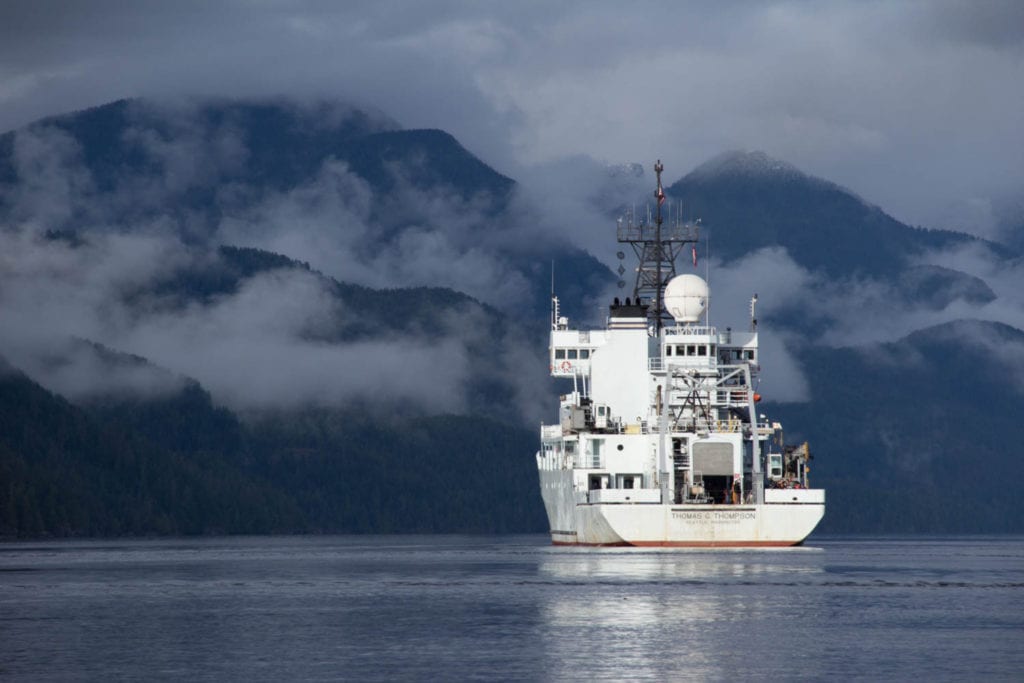
Research Vessel (R/V) Thomas G. Thompson (AGOR 23) in Nootka Sound. UW OCEANOGRAPHY – UNIVERSITY OF WASHINGTON
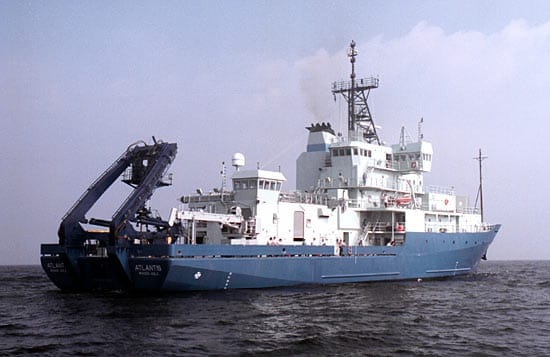
The Navy has completed refitting three of its oldest but largest oceanographic research ships (AGORs), permitting them to serve for an additional 15 years. The global-class ships, R/V Thomas G. Thompson (AGOR 23), R/V Roger Revelle (AGOR 24) and R/V Atlantis (AGOR 25), entered service between 1991 and 1998 and were built for a 30-year service life.
The final ship, Atlantis, will complete its overhaul on July 10. Rob Sparrock, program manager for research ships with the Office of Naval Research (ONR), said the Navy’s investment of $150 million for all three of the research ships was a good value. “We’ve extended their service lives by at least 15 years, so we got 45 years of service for less than the cost of one new ship with a 30-year service life.”
Sparrock manages six Navy-owned oceanographic research vessels; the historic deep-submersible vehicle Alvin; and the Floating Instrument Platform, or FLIP, which are charter-leased to U.S. academic research institutions to operate and maintain in support of Navy and U.S. ocean research objectives.
ONR also employs other oceanographic platforms, such as unmanned underwater vehicles and unmanned air vehicles, which are used to collect field data through the Naval Research Facilities program.
The Thomas G. Thompson was delivered to the Office of Naval Research on July 8, 1991 and is operated by the University of Washington. A permanent civilian crew is assigned to the ship, but various researchers deploy in support of their specific programs and are typically funded by the National Science Foundation, Navy, NOAA and other federal/state agencies.
Because her expected service life was 30 years, she would have been retired this year. Instead, Vigor Industrial shipyard in Seattle was contracted to renovate the ship, which began in June of 2016 at a cost of $52 million.
Sparrock said the ships were upgraded with new diesel engines, which are more reliable and environmentally friendly, as well as quieter, an important attribute in oceanographic research. The ships now have better laboratory and work spaces, along with improved habitability, new berthing spaces and a gym.
“They’re 25 to 30 years old, but we’ve made them ‘newer’ and greener than most research vessels,” he said.
During the refit, the propulsion system was largely replaced with new diesel generators, overhauled propulsion motors, and new switchboards, control systems and alarms. Electrical cable and pipework were replaced as well as the air conditioning, refrigeration, sewage and freshwater systems. New research and navigation instruments were also added.
The two newest Navy Ocean-class AGORs, R/V Neil Armstrong and R/V Sally Ride, are five and six years old, respectively. By conducting the service life extensions on the oldest on the Navy’s 15 research ships, Sparrock said the Navy’s ocean-going fleet is “good for another 10 to 15 years.”
The AGORs are operated by partner academic institutions. A fourth ship of the class, the NOAAS Ronald H. Brown, was built for and operated by the National Oceanic and Atmospheric Administration. All four ships were built at VT Halter Marine in Pascagoula, Mississippi.
While Atlantis can perform the same kinds of research as the other Globals, and will sometimes deploy without the deep submergence vessel, only Atlantis can support Alvin. They’re a pair. “Atlantis will perform 280 to 300 days of underway science a year, with 100-plus days devoted to Alvin work.” Sparrock said.
Atlantis is operated by Woods Hole Oceanographic Institution (WHOI), and is the mothership to the Navy’s deep-diving Alvin bathyscaph. Although Alvin first entered service in 1964, it has been systematically modernized and upgraded over the years to remain quite youthful, and has made more than 5,000 dives.
“She’s been rebuilt so often that it’s not a 60-year-old platform we’re refurbishing, said Sparrock. “Most recently, we upgraded her to have a 6,500-meter depth capability.”
Sparrock said Alvin is the last of the Navy’s deep ocean research submersibles, and has a long history of finding lost nuclear weapons, discovering previously unknown hydrothermal vents and associated sea life, and locating the Titanic. “It’s a fascinating tool of the Academic Research Fleet,” Sparrock said. “Alvin is a national treasure.”
In addition to the Global-class ships, there are also regional-class and local-class ships, which perform missions in coastal waters. The National Science Foundation and State Institutions also own ships in the Academic Research Fleet. Scheduling for the 18 vessels of the U.S. Academic Research Fleet is coordinated by the University-National Oceanographic Laboratory System (UNOLS), an organization representing 59 academic institutions and national laboratories that conduct in oceanographic research and work together to coordinate the oceanographic ship and research facility schedules.
NOAA’s Ronald H. Brown and the U.S. Coast Guard medium icebreaker USCGC Healy are not part of the academic research fleet per se, but participate in UNOLS scheduling.
Exercise Sea Breeze Underway in the Black Sea
Special forces from several countries participated in Exercise Sea Breeze 2021 in Ukraine, June 30, 2021. Exercise Sea Breeze is a multinational maritime exercise cohosted by the U.S. 6th Fleet and the Ukrainian Navy since 1997. Sea Breeze 2021 is designed to enhance interoperability of participating nations and strengthens maritime security and peace in the region. U.S. NAVY / UKR SOF
U.S. 6th Fleet and the Ukrainian Navy are cohosting the annual naval Exercise Sea Breeze 2021 (SB21) in the Black Sea region. SB21 kicked off on June 28 and runs through July 10.
According to a statement from the U.S. 6th Fleet, SB21 will “focus on multiple warfare areas including amphibious warfare, land maneuver warfare, diving operations, maritime interdiction operations, air defense, special operations integration, anti-submarine warfare, and search and rescue operations.”
The first Sea Breeze exercise took place in 1997, and it has grown steadily to involve more nations and participants. “This year’s iteration has the largest number of participating nations in the exercise’s history with 32 countries from six continents providing 5,000 troops, 32 ships, 40 aircraft, and 18 special operations and dive teams scheduled to participate,” said Lt. Bobby Dixon, a spokesman for the 6th Fleet.
Nations participating in SB21 include Albania, Australia, Brazil, Bulgaria, Canada, Denmark, Egypt, Estonia, France, Georgia, Greece, Israel, Italy, Japan, Latvia, Lithuania, Moldova, Morocco, Norway, Pakistan, Poland, Romania, Senegal, Spain, South Korea, Sweden, Tunisia, Turkey, Ukraine, United Arab Emirates, United Kingdom, and the United States. Participants will engage in realistic maritime training to build experience and teamwork and strengthen interoperability.
NATO has participated in Sea Breeze since the beginning, and the annual exercise’s popularity has continued to grow in popularity over the years.
The ships and embarked aircraft of Standing NATO Maritime Group 2 will take part in the exercise. The exercise will focus on multiple warfare areas including amphibious warfare, land maneuver warfare, diving operations, maritime interdiction operations, air defense, special operations integration, anti-submarine warfare, and search and rescue operations in the Black Sea region.
According to a NATO press release, “This is good example to how allies and partners provide unique training opportunities, designed to enhance readiness, improve collaboration, and interoperability in the Black Sea region.”
“Sea Breeze allows allies and partners to come together and operate in the Black Sea and build capabilities and to conduct coordinated operations in international waters,” said Capt. Kyle Gantt, the deputy commodore and the deputy commander of Task Force 65.
Task Force 65, based at Rota, Spain, is the U.S. Navy’s forward-deployed destroyer squadron in Europe, and represents the United States annually as the lead task force executing exercise Sea Breeze.
Gannt said Sea Breeze improves partner capabilities and interoperability. “I’ve been very impressed with the capability of the Ukrainian navy,” said Gantt. “All of the exercises are conducted using standard procedures, which are common among our allies and we use when operating with our partners.”
The exercise is following appropriate COVID 19 protocols. “Last year, significant limitation was imposed due to COVID-19 pandemic and there were no ships were able to visit Ukrainian ports. This year training will be conducted to the fullest extent,” said Rear Adm. Oleksiy Neyezhpapa, commander of the Ukrainian navy. “More foreign equipment will be deployed than in the Sea Breeze of the past year.”
Capt. Cameron Chen, commander of Task Force 68, said the training and coordination with the Sea Breeze partners will help build and increase the capabilities of the Ukrainian military. “We are the Naval Expeditionary Force component for Sixth Fleet. We provide EOD [explosive ordnance disposal], divers, MCM [mine countermeasure] capability, and naval construction force and maritime expeditionary security to Europe and Africa. More Iterations like this, more exercises and continued partnerships, I think, is the key to strengthening ties and improving capabilities in the region.”
Since Russia’s illegal annexation of Crimea in 2014, NATO has increased its presence in the Black Sea. According to a statement from Supreme Headquarters Allied Powers Europe, NATO supports Ukraine’s sovereignty and territorial integrity within its internationally recognized borders, extending to its territorial waters.
“NATO does not and will not recognize Russia’s illegal and illegitimate annexation of Crimea and denounces its temporary occupation,” the statement said. “NATO continues to operate in international waters and the alliance’s actions are always defensive in nature, proportionate in posture, and in line with international laws and conventions. The multinational character of NATO deployments, and transparency in all of its exercises and activities, reflects allies’ fundamental commitment to the principles of collective defense, transatlantic unity, and interoperability in order to maintain peace and preserve security.”
No Provocation
Russia consistently monitors allied operations in the Black Sea with interest. This June, Russia fired warning shots at a Royal Navy destroyer that it said was in Russian waters, harassed a Dutch frigate, and has “spoofed” AIS tracking information to show allied ships near Crimea when they were actually faraway or in port in Odessa.
Gantt said the exercise was not intended to provoke Russia.
“This is a long-planned exercise. In fact, this is an exercise that has happened since 1997. In fact, this is the 21st iteration. This is in no way a reactive exercise. This is a longstanding commitment to an exercise in the Black Sea co-hosted by the United States and the Ukrainian navies. All nations have the right to operate in international waters, and this exercise will take place either in Ukraine or in international waters.”
“Russia routinely observes our operations, and it is their right to do so when they’re doing that in international waters,” said Gannt. “What we expect is that all nations will operate professionally at sea. We expect that all nations will respect the international laws and norms that govern safe and professional operations at sea. I expect that from Russia and I expect that from all of the forces here operating in Sea Breeze.”
Gannt pointed out that the U.S. and Russia have a longstanding Incidents at Sea agreement (INCSEA) to reduce the chance of an incident at sea between the two countries and, in the event that one occurred, to prevent it from escalating.
“INCSEA provides a standardized set of communications to make sure there is no question when ships communicate with each other how they are — what their intentions are, and it’s a longstanding process that, quite frankly, removes risk. That’s an important part of what we’re doing here with Sea Breeze. We are demonstrating to the world that the Black Sea is an international sea; it is open and available for the free transport of commerce, of shipping, for all nations, and it is not owned by any one nation.”
As in past years, Sea Breeze serves to demonstrate the commitment of the U.S., NATO and partner nations to the stability and prosperity of the region.
“We are committed to maintaining the safety and security of the Black Sea,” said Chargé d’affaires Kristina Kvien of the U.S. Embassy in Ukraine.
NATO Trains Crews in Anti-Submarine Warfare off Norway
Commodore Bradley Peats of the Royal Canadian Navy, who is commanding ships from NATO Standing Maritime Group 1. ROYAL CANADIAN NAVY
Ships and aircraft participating in one NATO’s signature maritime exercises head to the waters of the high north for Dynamic Mongoose 2021 (DYMO 21). The exercise, sponsored by NATO’s Allied Maritime Command (MARCOM), based at Northwood, U.K, will take place between June 29 and July 9.
Vice Admiral Didier Piaton of the French navy, the MARCOM deputy commander, said MARCOM is organizing planning and conducting the exercise in the maritime joint environment. “It’s important to our nations and our navies to maintain and enhance our collective skills in maritime warfare,” he said.
Dynamic Mongoose exercises are held annually in the North Atlantic, in which NATO trains and practices anti-submarine warfare (ASW) skills under various circumstances. MARCOM also leads the annual ASW exercise Dynamic Manta in the Mediterranean. Together, they represent NATO’S premier deep water, high-end ASW and anti-surface warfare exercises.
Ships from NATO Standing Maritime Group 1 (SNMG1), under the command of Commodore Bradley Peats, Royal Canadian Navy, will participate along with submarines from the U.S. and Norway. Peats commands SNMG1 ships from Canada, Denmark, Netherlands, Norway and the U.K. from his flagship, HMCS Halifax (FFH 330).
Dynamic Mongoose exercises “will improve our surface, subsurface and maritime air forces abilities to work together effectively and seamlessly while enhancing our joint warfighting capabilities and proficiency in the surface and sub-surface threat subsurface domain,” said Peats. “These efforts pay dividends in times of crisis and conflict and proves NATO’s collective capability to respond in a timely and effective manner to potential threats to maritime security, stability and commerce in the region.”
Peats, speaking to reporters today, said ASW requires complex and close coordination between surface ships, submarines, maritime helicopters and maritime patrol aircraft to effectively find, track, and, if necessary, neutralize submarines. “Each type of asset brings its own unique capabilities to the table. For example, surface ships have a long endurance and can host anti-submarine warfare capable maritime helicopters. Fixed-wing patrol aircraft can cover long distances and wide areas relatively quickly. Submarines are excellent and covert searches and tracking,” he said.
Aviation units from Canada, Germany, U.K., Norway, U.S. and the Netherlands are participating. Rotary winged aircraft will operate from the ships and land-based maritime patrol aircraft will operate from Lossiemouth, U.K., Keflavik, Iceland, and Andoya, Norway.
Representing the host nation, Chief of the Royal Norwegian Navy Rear Adm. Rune Andersen said allied maritime presence in the North Atlantic is very welcomed. “NATO is the cornerstone for Norwegian security. Our ability to operate together is vital for our security. Supporting allied training and activity in and around Norway is a key task for the Norwegian armed forces.”
Andersen said the significance of exercises like Dynamic Mongoose has grown with the increased military activity in the North Atlantic. “Anti-submarine warfare is a complex undertaking. The undersea domain is a challenging operating environment. It requires good command and control and coordination between surface and air units. Operators at sea and in the air need advanced exercises to train, practice and to improve and maintain their skills.”
Rear Adm. Andrew Burcher, who is Commander Submarines NATO and the officer-in-charge of the exercise, said an in-stride debriefing team has been established, as it has for several previous Dynamic Mongoose and Dynamic Manta exercises, to provide real-time feedback to the assets that are at sea. The team is supported by the NATO Centre for Maritime Research and Experimentation in La Spezia, Italy, to gather data and evaluate what the different assets are doing, collating that information and then providing feedback on how the units they are performing.
“It’s a real value to the units participating in the exercise to get real-time feedback that they can then put into practice for the next case-ex or serial that they do,” Burcher said. “With each subsequent exercise we’ve increased the level of detail and information provided through this methodology. It gives us a significant advantage.”
Burcher said it’s all part of a process of continuous improvement. “We make improvements, and with the next iteration we can we make improvements on top of that, and part of that process is practice. Each time we have an exercise like Dynamic Mongoose, we practice that capability, and demonstrate it in the environment where it’s going to be utilized.”
Reporters wanted to know if the exercise was an attempt to send a message to Russia. Piaton said Dynamic Mongoose, like all exercises in NATO, is conducted in a transparent and unprovocative manner with a declared defensive posture. “NATO’s daily mission is deterrence. We’re here to train our crews and make sure our deterrence is credible.”
Andersen noted the annual exercise has been taking place for many years, and is occurring within Norway’s EEZ. “It’s quite far from Russia, actually,” he said.
According to NATO spokesman Cmdr. S. Korhan Zorlu of the Turkish navy, appropriate COVID 19 protocols are being observed afloat and ashore.
Security Officials Conduct Regional Maritime Security Intelligence and Interdiction Exercise in Miami
U.S. Coast Guard Maritime Security Response Team personnel train on a rigid-hull inflatable boat from the Cyclone-class coastal patrol ship USS Thunderbolt (PC 12) in the Gulf of Oman in 2018. Thunderbolt was deployed to the U.S. 5th Fleet area of operations in support of naval operations to ensure maritime stability and security in the Central Region, connecting the Mediterranean and the Pacific through the western Indian Ocean and three strategic choke points. U.S. ARMY / Specialist David Resnick
Maritime security stakeholders from foreign governments, federal, state, local and tribal law enforcement and port agencies came together in Miami June 9 to strengthen and focus collaboration and cooperation between stakeholders to promote whole-of-government efforts to address maritime security issues.
Led by the Maritime Domain Awareness Executive Steering Committee (MDA ESC), the Regional Maritime Security Intelligence and Interdiction table-top exercise (TTX) was held as part of the Maritime Security East 2021 conference, held June 8-9. The MDA ESC is led by Rear Adm. Gene Price, director of the National Maritime Intelligence-Integration Office, who represents the intelligence community in that role.
The goal of the TTX was to build a common understanding of organizations, roles and priorities involved in improving maritime domain awareness
According to Joe Cunningham, the MDA ESC’s executive director, the TTX was designed to achieve several key objectives.
“We want to build a common understanding of organizations, roles, and priorities involved in improving MDA, as well as address potential unintentional barriers to whole-of-government MDA efforts. We’re presenting problems and identifying gaps and barriers, as discussing ways to share information and get around those barriers. We have to coordinate, collaborate and communicate.”
During the scenario, the participants discussed the deployment of various surveillance and response assets, and communicating and sharing intelligence between agencies at all levels.
“By shedding light on these issues, we were able to improve multilateral and regional MDA and response efforts, identify overlapping authorities and improve maritime information and intelligence sharing,” Cunningham said.
“Information is a national asset that requires a responsible balancing act between information sharing and safeguarding,” Cunningham said. “It is critical to interagency governance, coordination and unification efforts across the full spectrum of partners at all levels.”
The MDA ESC is comprised of senior executive-level principals designated by their respective departmental executive agents for MDA from cabinet-level departments (currently State, Commerce, Defense, Transportation and Homeland Security) and the designated maritime representative of the intelligence community. The MDA ESC coordinates MDA policies, strategies, and initiatives.
The MDA ESC provides forums, activities, and venues to engage the global maritime community of interest to promote collaboration and information sharing to enhance MDA.
“We’ve been a partner of the MDA ESC for many years, and a contributor to the important work they do,” said Sareth Neak, the conference’s organizer. “We’re pleased they chose to host this TTX at MARSEC East 2021.”
Will the Navy’s FLIP Fade Away, or Find a Forever Home?
Fifty-five feet remain visible after the crew of the Floating Instrument Platform, or FLIP, partially flood the ballast tanks causing the vessel to turn stern first into the ocean. The 355-foot research vessel, owned by the Office of Naval Research and operated by the Marine Physical Laboratory at Scripps Institution of Oceanography at University of California, conducts investigations in a number of fields, including acoustics, oceanography, meteorology and marine mammal observation. U.S. NAVY / John F. Williams
The U.S. Navy’s unique 355-foot Floating Instrument Platform, or FLIP, used by researchers to gather persistent oceanic and atmospheric observations and conduct acoustic research for more than 50 years, is now inactive.
There isn’t enough funded research to put FLIP through another refit so she has been removed from service. Rob Sparrock, the program officer overseeing ONR’s research vessel program, thinks FLIP deserves to retire with dignity, and wants to find a fitting forever home where her accomplishments can be remembered and appreciated.
The U.S. Navy’s Office of Naval Research (ONR) built the 355-foot to conduct acoustic research. The unpowered FLIP looked like a baseball bat. It was towed to a location in the ocean where it was going to work, and the 300-foot tank section was filled with seawater so that part sank, leaving the remaining 55-foot section to stand upright. It could be anchored to the bottom, but more often it was left to drift with the wind and currents.
The Department of the Navy’s Floating Instrument Platform (FLIP) begins the process of transitioning from horizontal to vertical by filling ballast tanks in the stern during a cruise commemorating 50 years of continuous service to the scientific community. U.S. NAVY / John F. Williams
When at sea, she carried a crew of five when at sea along with a research party of up to 11 scientists. FLIP could make its own electricity and water and carry supplies for about 35 days. Once a research mission was complete, high-pressure air stored in bottles in the ballast tanks was released into the tanks to force the seawater out return FLIP to the horizontal, and she would be towed back to port.
FLIP was designed by the naval architecture firm Glosten Associates; built by Gunderson Bros. Engineering Corporation; and entered service in 1962 under the auspices of the Marine Physical Laboratory of Scripps Institution of Oceanography in San Diego.
Over its illustrious career, FLIP permitted researchers to study sound waves at various depths in the ocean without the interference of ambient noise from a ship’s propulsion system, but it also provided a platform to study wave height and air-sea interaction; water temperature and density; marine mammals; and gather meteorological data. FLIP has been used to examine ocean circulation, storm wave formation, and how thermal energy is transferred between the ocean and the atmosphere.
While FLIP’s unique qualities made it the idea platform for many science missions, some of the research that used to require a platform like FLIP can now be conducted using other means, such as unmanned systems like floats and unmanned vehicles. As funding and therefor demand for FLIP from some of FLIPs regular customers was reduced, the business case for maintaining and upgrading FLIP changed.
“It would cost about $8 million to make FLIP useable for another five or 10 years, but that funding could be better used elsewhere,” said Sparrock. “We came up with lots of creative ideas, but there wasn’t enough inertia or funding to keep it going.”
While funding has fallen, nobody wants FLIP to just fade away.
“I’d like to see a naval base or maritime museum adopt FLIP, and install the 55-foot section in the upright position so people can see it and actually go on it,” Sparrock said. “The other 300 feet can be sunk as a reef for divers.”
So, Sparrock continues his efforts to find FLIP a fitting location for her forever home. “FLIP is so historic; it just doesn’t seem right to scrap her.”