Defender-Europe 21 Exercise Tests Ability to Move Military Might Overseas

A stevedore at the Port of Jacksonville drives a military vehicle onto the U.S. Navy’s Military Sealift Command’s USNS Bob Hope March 26, 2021. The vessel was bound for the Defender-Europe 21 linked exercise. U.S. ARMY / Kimberly Spinner

A major U.S.-led multi-national exercise in Europe is testing America’s ability to move troops, cargo and vehicles overseas to support NATO and partner nations.

Defender-Europe is an annual, large-scale U.S. Army Europe and Africa-led, multinational, joint exercise designed to build strategic and operational readiness and interoperability between U.S., NATO allies and partners. Defender-Europe 21 activities began in March in the U.S. and across Europe and will continue into June.

Movement of vehicles from the Military Sealift Command large medium speed roll-on/roll-off (LMSR) USNS Bob Hope (T-AKR-300) are taking place this week in Albania.

“Defender-Europe 21 is a critical exercise that will provide V Corps with another great opportunity to build readiness in our march towards full operational capability, and promote interoperability as we work alongside allies and partners,” said Lt. Gen. John Kolasheski, V Corps commanding general. “We are looking forward to this chance to work closely with U.S. Army Europe and Africa and demonstrate U.S. resolve and commitment to Europe.”

Exercise Defender-Europe 21 will include “nearly simultaneous operations across more than 30 training areas” in a dozen countries.

While the exercise is a U.S.-led training event, it involves more than 30,000 multinational military personnel from 27 nations, along with 10,000 U.S. personnel including rotational forces from the continental U.S. About 10 percent are members of the National Guard or Army Reserve.

Last year’s exercise, Defender-Europe 20, was scaled back due to COVID restrictions, and while the pandemic does have an impact on this year’s events, with all activities being conducted in accordance with COVID 19 protocols, there are more NATO ally and partner nations conducting activities over a wider area than what was planned for last year.

A strict COVID prevention and mitigation strategy has been implemented by U.S. and participating nations. U.S.-based personnel will conduct pre-deployment COVID testing, quarantine in Europe upon arrival and conduct another COVID test before travelling in theater.

“While we are closely monitoring the COVID situation, we’ve proven we have the capability to train safely despite the pandemic. No matter what, our nations count on our forces being ready to defend the peace,” said Gen. Christopher Cavoli, U.S. Army Europe and Africa commanding general.

Cavoli said exercises like Defender-Europe 21 are essential to building readiness and or interoperability. “Defender-Europe 21 provides us the best opportunity to hone our abilities alongside our allies and partners in the strategically important Balkans and Black Sea region so that collectively, we are ready to respond to any crisis that may arise,” he said.

Ships and aircraft began movement of people and equipment from the continental U.S. in March, and Army prepositioned stock sites in Germany, Italy and the Netherlands began to moving supplies and equipment into position to support the training activities.

Seaports in five European countries — Albania, Croatia, Germany, Greece and Slovenia — were used to send or receive more than 1,200 pieces of equipment to or from the continental United States as part of the exercise.

Besides USNS Bob Hope, the expeditionary fast transport USNS Yuma (T-EPF 8) is also participating in the exercise, transporting cargo from USNS Bob Hope to other locations. 

Journey from Jacksonville

For the U.S. Army’s 7th Transportation Brigade–Expeditionary, and the Military Surface Deployment and Distribution Command’s (SDDC) 841st Transportation Battalion, the loadout began at the Port of Jacksonville’s Blount Island Marine Terminal March 25-26, with the loading about 750 pieces of tactical vehicles and other equipment of the 53d Infantry Combat Team onto the Bob Hope.

Bob Hope is the first ship in a class of seven 62,000-ton, 951-foot vehicle cargo ships. It was built at Avondale Shipyard in Louisiana and entered service in 1998. The ships supports the U.S. Army storing and transporting supplies, tanks, trucks and other vehicles to equip an Army brigade. It is one of 11 T-AKRs operated by the Military Sealift Command with civil service mariner or contract crews. The ship is one of the 15 ships assigned to the Surge Sealift program, which are ships held in a reduced operational status until activated for missions.

“The support of Jaxport and its skilled labor force ensures that we have the right tools to carry out our mission seamlessly from start to finish,” said Lt. Col. Altwan Whitfield, Commander, 841st Transportation Battalion. “The most challenging part of a deployment operation is ensuring the synchronization of all of the elements, it is not a one-person show — it’s a team effort.”

With its key highway and rail connections, Jacksonville is designated as one of the nation’s 17 strategic seaports to move U.S. military cargo for national defense, foreign humanitarian aid and disaster relief.

“One of Jaxport’s most important roles is serving the community as one of the military’s strategic seaports,” Jaxport Chairman Jamie Shelton said. “By investing in our facilities and maintaining a world-class port, we ensure that we can continue to support our service members and the important work they do to protect our national security.”

“Supporting Defender-Europe 21 is a great opportunity,” said Maj. Mark Huey, 841st Transportation Battalion terminal management team officer in charge at Jacksonville. “The mission integrates units from the Reserve, National Guard and active duty, then also units on the naval side. We really get to exercise our full functionality.”

From Jacksonville, Bob Hope sailed to Portsmouth, Virginia, and loaded more equipment for the exercise before sailing for Durres, Albania, including an Army causeway section, warping tugs and other lighterage needed to move equipment from ships at anchor to shore.   

The deployment of Bob Hope and the embarked equipment provided an opportunity to demonstrate the Joint Logistics Over the Shore (JLOTS) concept. 

According to “JLOTS Vision 2010,” JLOTS is a unified commander’s joint employment of joint employment of Army and Navy LOTS assets to Army and Navy LOTS assets to deploy and deploy and sustain a force sustain a force. JLOTS operations allow U.S. strategic sealift strategic sealift ships to discharge over a bare, inadequate or damaged port, or over a bare beach. JLOTS watercraft can also be used to beach.

While Navy amphibious ships routinely deploy with Landing Craft, Air Cushion (LCACs), the Army gave up its air-cushioned watercraft about 35 years ago, and the Navy’s LCAC inventory cannot self-deploy or be lifted onboard existing sealift ships. 

According to a news release from the 7th Transportation Brigade, “JLOTS operations are part of U.S. Transportation Command’s strategic sealift mission. The process allows combined Army and Navy forces to move equipment to and from a ship on air-cushioned watercraft to overcome anti-access and area-denial challenges while improving the ability to move forces closer to tactical assembly areas. JLOTS missions are unique in that they allow for an entire brigade-sized element to be moved on and off a ship with an improvised port infrastructure, providing flexibility to choose load locations such as a bare beach, austere port, or a damaged or fixed port.”

“It doesn’t require ramps, it doesn’t require anything other than the causeway, which can be assembled organically from the vessel. The ramp is able to lower onto the causeway and then equipment can begin to [roll-on/roll-off] expeditiously and be pushed ashore,” said Chief Warrant Officer 2 Jordan Milo, 841st Transportation Battalion mobility warrant officer and Defender-Europe 21 operations officer in charge at the Port of Portsmouth.

“Any limiting factors that would have existed from not having an improved infrastructure port, or if the depth of the water wouldn’t allow for the vessel to come in, that’s where these JLOTS operations allow us to project power ashore where we need it,” said Milo.

U.S. Soldiers unload a truck from the U.S. Army Logistic Support Vessel MG Charles P. Gross during Defender-Europe 21 Joint Logistics Over-the-Shore operations, May 1, 2021 in Durres, Albania. U.S. ARMY / Staff Sgt. Elizabeth Bryson

JLOTS Albania

The JLOTS capability was showcased at Durres, Albania, this week when USNS Bob Hope discharged its cargo of heavy equipment onto smaller vessels that was transferred to shore for onward movement, including USNS Yuma and the British roll on/roll off vessel Hurst Point, which delivered equipment from the U.K.’s 104th Logistic Support Brigade to Gazenica in Zadar, Croatia.

“As part of Defender-Europe 2021, we are transferring up to 1,000 vehicles for the 53rd Infantry Brigade Combat Team who, will arrive in Albania in the coming days, said Capt. James Hilton, the U.S. senior defense official/defense attache/security cooperation officer to Albania. He told attendees at a VIP event to witness the exercise port operations that JLOTS is a multi-step process.

“First, the vehicles are loaded onto a large, medium speed roll on/roll off vessel [LMSR] in the United States. That ship sails across the ocean in advance of the troops. Upon arrival, the vehicles must be transferred from the ship to the shore. In some ports, the LMSR pulls up to the pier and discharges the vehicles directly. However, a secure port is never guaranteed, so crews must practice an alternative method of offloading.

“Because the USNS Bob Hope is too large to enter the port of Durres, U.S. Army and Navy Soldiers and Sailors work together to construct a roll on/roll off to discharge facility that is connected to the LMSR a few miles away from here. Vehicles are then loaded onto smaller ships called logistic support vessels which transport the vehicles the final miles to the pier here. Additional ships from the United States and the United Kingdom will transfer vehicles to other Adriatic ports in support of Defender-Europe 2021.”

According to exercise officials, this was the first time this capability had been demonstrated since World War II. U.S. Ambassador to Albania Yuri Kim said Defender-Europe 21 was the largest ever multi-national military exercise in southeast Europe, and is taking place on the 30th anniversary of the reestablishment of U.S. Albanian relations.

Pentagon Press Secretary John F. Kirby said the exercise is building operational readiness and interoperability between NATO allies and partners. “It’s defensive in nature, focused on deterring aggression, while preparing our forces to respond to crisis and conduct large-scale combat operations if necessary.”

“When a crisis begins is not the time to wish America had the expeditionary capability and capacity to support power projection requirements of the Army and Marine Corps,” said retired Rear Adm. Sinclair Harris, Navy League national vice president of military affairs and chair of the Maritime Policy Committee.

“Not everything that is needed can be flown and America’s military has the unique and asymmetric advantage of being able to put what we need, where we need it, and when we need it. Be it for humanitarian operations or combat ops, ships like the USNS Bob Hope and systems such as JLOTS provide game changing options for our combatant commanders.” 

The exercise will conclude in June with the redeployment of U.S.-based forces and equipment back home.
Indonesian Navy Finds Broken Hull on Bottom, Declares Submarine KRI Nanggala Lost

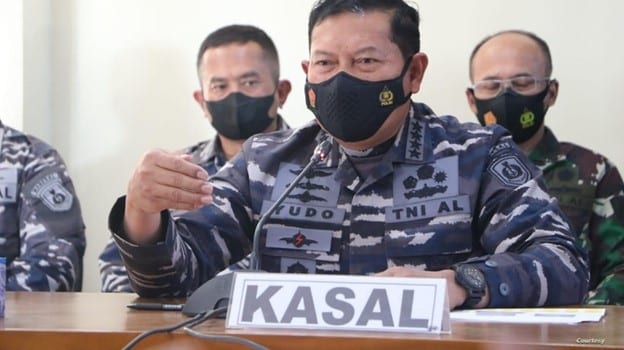
Navy Chief Yudo Margono talks to the media on the retrieval of items from the missing KRI Nanggala sub, at Ngurah Rai Military Air Base in Bali, Indonesia, April 24, 2021. INDONESIAN MILITARY / VOICE OF AMERICA

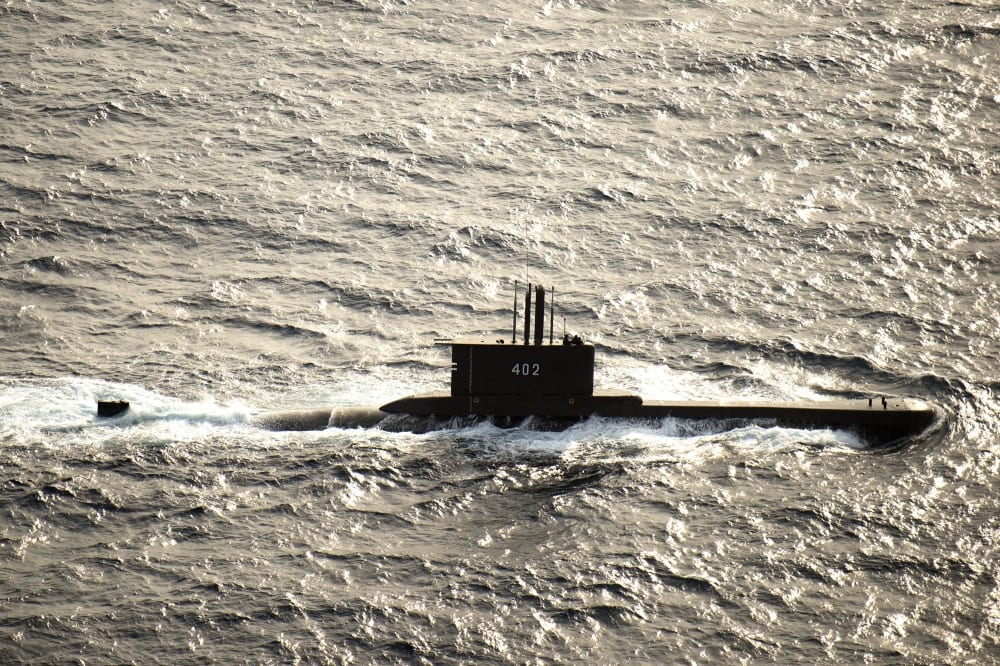
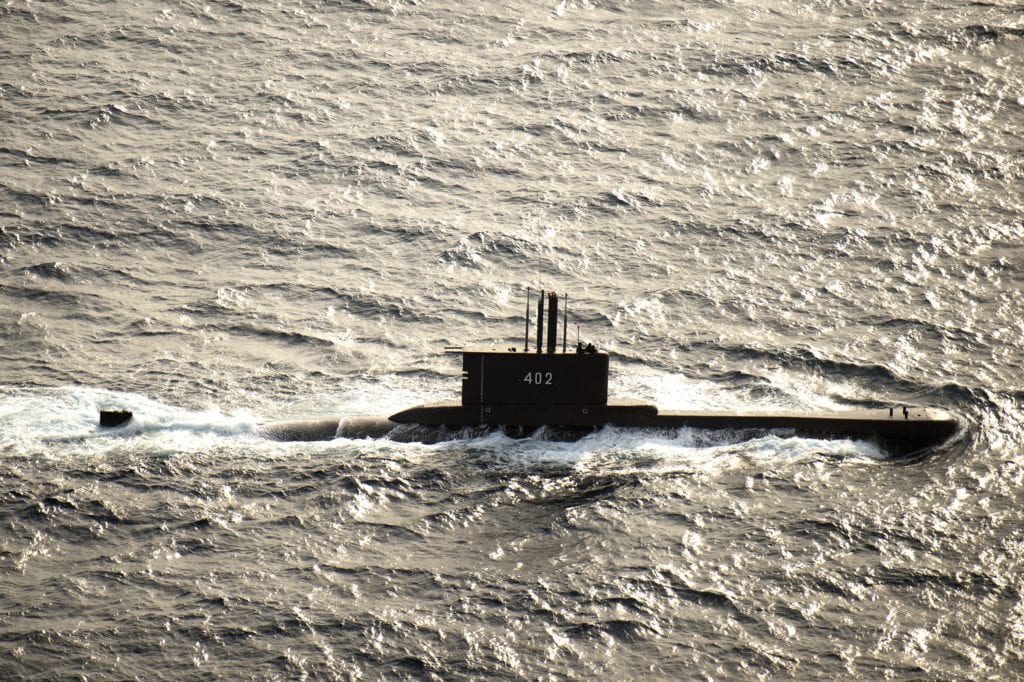
The Indonesian navy has changed that status of its submarine, KRI Nanggala (402), and her crew of 53, from “sub miss” to “sub sunk.”

Indonesian authorities said the damaged submarine has been located. 

“The KRI Nanggala is divided into three parts, the hull of the ship, the stern of the ship, and the main parts are all separated, with the main part found cracked,” said Indonesian navy Chief of Staff Yudo Margono.

“We received underwater pictures that are confirmed as the parts of the submarine, including its rear vertical rudder, anchors, outer pressure body, embossed dive rudder and other ship parts,” said military chief Hadi Tjahjanto, speaking to the media in Bali on Sunday.

KRI Nanggala went missing during a torpedo firing exercise on Wednesday in waters between Bali and Java, Indonesia.  A massive search effort was conducted by the navy, known officially as the Tentara Nasional Indonesia-Angkatan Laut (TNI-AL). Other nations, including the U.S., dispatched ships, aircraft, personnel to help in the search and rescue of the crew.

Aircraft searching the area noted an oil slick was which was suspected to have come from the submarine. “That oil spill location is the last time we had contact with the submarine,” Indonesian navy spokesman First Adm. Julius Widjojono said.

In addition to the oil slick, confirming the likelihood that the submarine broke apart was the retrieval of several items that were shown to journalists. A container of grease used for periscopes, part of a torpedo launcher, part of a metal tube, prayer mats and fuel were recovered were about two miles from the where the submarine commenced its dive before it went missing. Later a life vest from the sub was found. The water at the location where the floating debris was found is 2,788 feet.

There were no reports of loud underwater noises that would point to an explosion, but Margono said the heavy pressure on the vessel probably caused the hull to lose integrity, permitting some items to escape and rise to the surface.

“With the authentic evidence we found believed to be from the submarine, we have now moved from the ‘sub miss’ phase to ‘sub sunk,’” Margono said at a press conference. 

Margono later said sonar detected a submarine-like object at 850 meters (2,790 feet), far below the Nanggala’s safe operating depth.

“It can be stated that the KRI Nanggala has sunk and all of its crew have died,” military chief Marshal Hadi Tjahjanto told reporters.

The Indonesian submarine KRI Nanggala (402) participates in Cooperation Afloat Readiness and Training (CABAT) in 2015. U.S. NAVY / Mass Communication Specialist 3rd Class Alonzo M. Archer

Although initial reports stated the submarine was last reported at a location north of Bali, a later statement from the Indonesian Ministry of Defense said the sub was lost in the Bali Strait, between the islands of Java and Bali that connects to the Indian Ocean to the south and Bali Sea to the north.

The search effort was coordinated from the naval base at Banyuwangi, on the eastern tip of Java, the most populated of Indonesia’s 17,000 islands.

Earlier in the search effort, an Indonesian ship, KRI Rimau, detected a very strong magnetic signature, in an area consistent with the submarine’s last known position, later confirmed by survey ship, KRI Riguel.

Before the submarine was confirmed sunk, a number of nations sent help or offered to support the search effort. Singapore, Malaysia and India dispatched submarine rescue ships and two Australian warships sailed to join the search efforts.

“HMA Ships Ballarat and Sirius, both presently at sea on separate regional deployments, are making best speed for the search area,” said a Friday press release from Australia’s defense department.

Rear Adm. Mark Hammond, of the Australian task force, added that his thoughts were with the submariners of KRI Nanggala, their families and the Indonesian people. “As always, we stand ready to assist our fellow mariners in the Indonesian navy,” he said.

The U.S. Navy sent a P-8 Poseidon maritime patrol aircraft to support the effort.

“It’s a sophisticated platform that could be helpful in leading the Indonesian government to a better idea of the location,” said Pentagon spokesman John Kirby.

Secretary of Defense Lloyd J. Austin III spoke with Indonesian Defense Minister Prabowo Subianto to inform him that the aircraft was coming and provide any additional assistance that might be needed, Kirby told reporters.

In addition to the P-8, the U.S. sent three C-17 aircraft carrying boats and underwater search and rescue equipment from Dover Air Base on Friday.

Indonesian President Joko “Jokowi” Widodo directed that the search and rescue efforts for Nanggala and crew was a national priority. “To the families of the crew, I understand your feeling right now. However, the government has done and will continue to do its utmost to search and rescue all crew on board,” he said while the search was underway.

“I am deeply saddened to learn the Indonesian submarine lost at sea earlier this week is now believed sunk. Our thoughts and prayers are with the Indonesian navy, their Sailors and all those families who lost loved ones,” said Chief of Naval Operations, Adm. Mike Gilday. “As Sailors, we share a love for the sea and have a bond of fellowship with all who sail on it. We have a respect for its dangers and also understand the importance of the worlds’ oceans to our collective way of life.

“No doubt, Indonesia is a good friend and partner. Despite this tragic loss, it is my hope that we will continue to operate together in support of a free and open Indo-Pacific,” Gilday said.

The mission now changes from rescue to recovery.


Rescue Effort Underway for KRI Nanggala: Indonesian Submarine, Crew of 53, Missing Off Bali

KRI Nanggala in the Java Sea in 2015. WIKIPEDIA

The Indonesian Navy has confirmed that one of its submarines, KRI Nanggala (402), and its crew of 53, is missing.
Reports quoting Indonesian defense officials say KRI Nanggala was participating in scheduled naval exercises about 60 miles north of the island of Bali when it submerged in waters about 2,300 feet deep. Nanggala had requested and received clearance to dive to conduct a live-torpedo firing drill. When communications were lost, the navy immediately commenced a search with ships and aircraft.

International media quoted Adm. Yudo Margono, the chief of staff of the Tentara Nasional Indonesia-Angkatan Laut (TNI-AL), saying that Nanggala had fired two torpedoes during the exercise. He said the crew had enough oxygen to support the crew for 72 hours.

Tentara Nasional Indonesia-Angkatan Laut (TNI-AL), which translates to “Indonesian National Military-Naval Force,” commissioned ships have the prefix KRI, which means Kapal Republik Indonesia or “Republic of Indonesia Ship.”

“It is true that the KRI Nanggala-402 lost contact since early this morning around 3:00 a.m. [Wednesday local time],” said 1st Adm. Julius Widjojono.

A TNI statement said: “It is possible that during static diving, a blackout occurred so control was lost and emergency procedures cannot be carried out and the ship falls to a depth of 600-700 meters (about 2,000 to 2,300 feet).”

“We know the area but it’s quite deep,” Widjojono told reporters.

However, Widjojono told the independent Indonesian TV network, KompasTV, that the diesel-electric submarine was built to sustain pressure at a maximum depth of around 250 to 500 meters (820 to 1,640 feet). “Anything more than that can be pretty fatal,” he said.

Searchers noted an oil slick near where Nanggala submerged, which may have come from the missing submarine.
Indonesia has requested support from several nations, including Singapore, Australia and Malaysia. The United States, Germany, France, Turkey, India and have also offered to help search for the missing submarine.

“It’s very distressing for families and particularly for the Indonesian navy,” said Australian Foreign Minister Marise Payne. “We have indicated that we will help in any way we can. We operate very different submarines from this one, but the Australian Defence Force and our Australian Defence organisation will work with defence operations in Indonesia to determine what we may be able to do. We will go to the support of our neighbour in any way we can.”

Singapore has dispatched M/V Swift Rescue, a commercial ship under charter to the Republic of Singapore Navy carrying sophisticated submarine rescue equipment, including a Deep-Submergence Rescue Vessel (DSRV), hyperbaric chamber and a medical team.

The TNI operates five submarines. Nanggala is one of two 1,300-ton,195-foot Cakra-class boats were built in Germany by Howaldtswerke, commissioned in the Indonesian Navy in 1981. The two Type 209 submarines have undergone periodic refits.

Indonesia has three newer Type 209 submarines from South Korea, with the first being commissioned in 2017. The newest, KTI Alugoro, built at DSME in South Korea and the government-owned PT PAL in Indonesia, was commissioned last month on March 21. Three more boats are on order, to be completed at PT PAL.

The International Submarine Escape and Rescue Liaison Office (ISMERLO) sent an alert stating that it had been notified of the missing submarine and was standing by to support any response.

ISMERLO was established in 2003 by NATO and the Submarine Escape and Rescue Working Group to coordinate international submarine search and rescue operations.

ISMERLO’s international team of submarine escape and rescue are based at COMSUBNATO, part of the NATO Allied Maritime Command at Northwood, U.K., and on call 24/7/365.

“We have a wide variety of open communications capabilities to respond to a crisis,” said Italian Navy Cmdr. Gennaro Vitagliano, head of the ISMRERLO Branch at COMSUBNATO. “We are free to talk to everybody, because we are talking about saving lives at sea.”

Vitagliano said there are 41 member nations who operate submarines, including Indonesia. The only two nations that have submarines and are not members of ISMERLO are Iran and North Korea. “The rest of the world is fully involved with ISMERLO. Each nation has their points of contact and they are always accessible. We are a worldwide network to save lives at sea. We train and operate to a common standard, as set forth in A/MTP-57, the Submarine Search and Rescue Manual, or Global SUBSAR Manual. Our organization and our system must be functional, tested and ready at all times. We conduct periodic exercises, and when we do, we can identify shortfalls is our rescue plans and procedures. Our goal is to minimize time to first rescue.”


From Saving Habitats and Endangered Species to Preserving Ancient Artifacts, the Department of the Navy is Responsible and Proactive

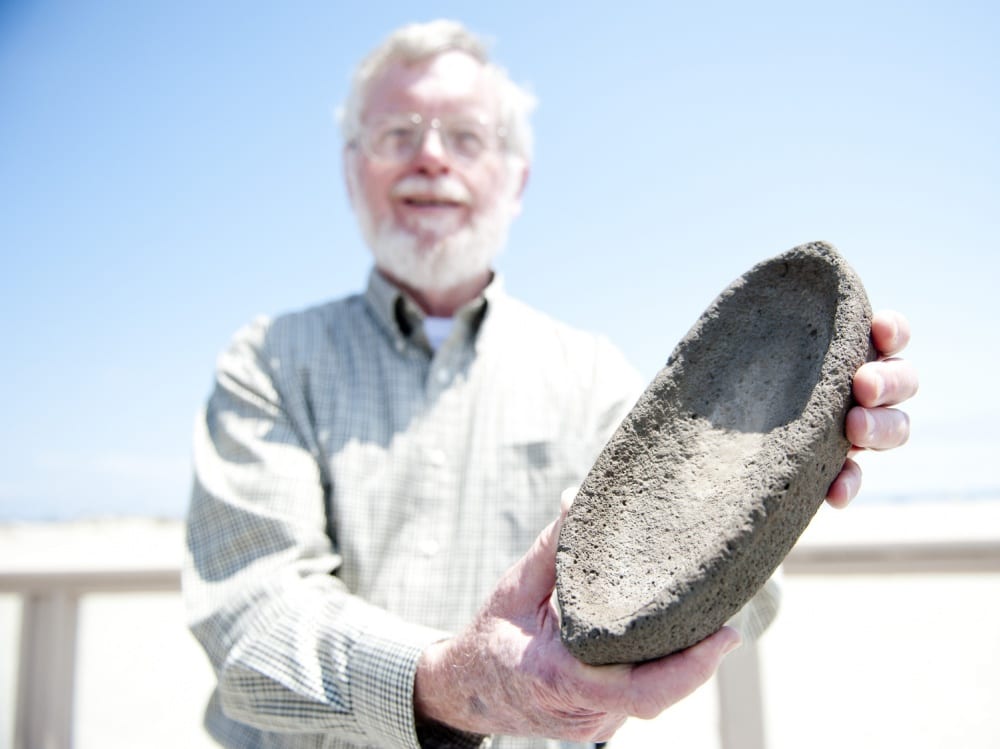
Navy professionals recovered this small boat carving, or effigy, on San Clemente Island in 2013, as part of a Navy cultural resources management program that has been in place for more than 40 years. The carving represents a canoe used prehistorically by Native Americans who traveled from the mainland to the Southern Channel Islands. The Navy works with modern-day tribes to help identify, protect, and manage cultural resources on Navy lands. U.S. NAVY / Mass Communication Specialist 2nd Class Shawnte Bryan

The Department of the Navy is steward to some of America’s most precious archeological sites as well as natural habitats for migratory and endangered species.

On the archeological front, there are some spectacular examples. At Naval Air Weapons Station China Lake, California, the public can see one of the largest collections of Native American Rock Art at Little Petroglyph Canyon, where more than 6,000 images were left by the ancient Coso people of California.

The Foxtrot Petroglyph Site at Marine Corps Air Ground Combat Center, Twentynine Palms, California, is listed in the National Register of Historic Places, and has a variety of different types of rock art, including both petroglyphs (images created through pecking, scratching, or rubbing onto the stone surface) and pictographs (images painted onto stone) at the same site.

Naval Base Pearl Harbor is the site of ancient native Hawaiian fishponds, such as the Okiokiolepe Fishpond, listed in the National Register of Historic Places.

Numerous other prehistoric archeological sites in the Western U.S. are protected by the Navy at Naval Air Station (NAS) Fallon, Nevada, NAS Whidbey Island, Washington and NAS North Island, California, and other installations.

Artifacts at the Posey Site at Naval Surface Weapons Center, Indian Head, Maryland, provide evidence of intensive Indian trade with Europeans. NAS Pensacola is the site of one of the earliest European settlements in Florida, Santa Maria de Galve, established in 1698. 

As these examples indicate, Navy and Marine Corps installations are often established located on lands previously occupied by various cultures and ethnic groups in the past.

“It is DoN policy to locate and identify these sites, which number in the tens of thousands, and to protect them and any artifacts and collections that may be excavated or erode from them,” said W. Brock During, environmental program director for Commander, Navy Installations Command.

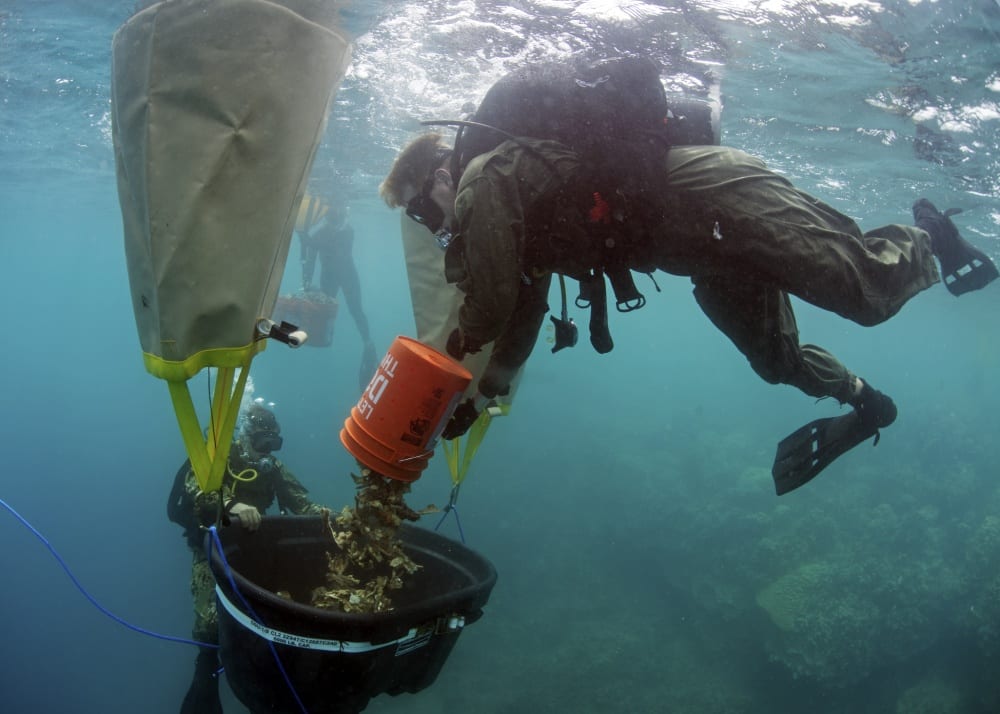
Explosive ordnance disposal technicians assigned to Explosive Ordnance Disposal Mobile Unit (EODMU) 5 help repair a damaged coral reef in Apra Harbor June 29, 2017. EODMU 5 coordinated with Guam’s Department of Agriculture, Division of Aquatic and Wildlife Resources (DAWR) and Guam Environmental Protection Agency (EPA) to assist in the coral reef restoration. U.S. NAVY / Mass Communication Specialist 3rd Class Alfred A. Coffield

Moving coral

The Department of the Navy is also steward of a number of sensitive ecological areas, and being a good environmental steward also means restoring, protecting and enhancing the quality of the environment for current and future generations.

In fiscal year 2021, Joint Region Marianas (JRM) expects to spend millions for conservation projects, primarily associated with military construction, military training and ungulate management. For example, a wharf improvement project at Apra Harbor on U.S. Naval Base Guam involves relocation of approximately 4,500 coral colonies. Future projects include plans to relocate an additional 150,000 coral colonies.

The Navy and other DoD services partner with other federal, state and local partners, specifically U.S. Department of Agriculture Animal and Plant Health Inspection Service Wildlife Services, to coordinate and conduct brown tree snake inspections of all units and their equipment that come to the Mariana Islands to train. Brown tree snakes are an invasive species that can wipe out native birds and animals.

Ungulate fencing projects on military installations on Guam is protecting native habitats from two specific non-native invasive species — feral pigs and deer — which destroy natural vegetation, increase rates of erosion, contribute to the loss of native plant and animal species and increase the spread of invasive plants.

JRM is working to protect the endangered Serianthes nelsonii, commonly known as the fire tree, endemic to Guam and the Commonwealth of the Northern Mariana Islands. Guam’s only mature Serianthes nelsonii tree is located on Andersen Air Force Base. The preservation efforts, including the planting of numerous saplings, are aimed at increasing the Serianthes nelsonii population conserving Guam’s unique limestone forests. JRM’s habitat conservation and watershed management activities are helping to reduce erosion and improve water quality.

“Taking a proactive approach to protecting the region’s natural and cultural resources remains a priority for DoD,” said Rear Adm. John Menoni, JRM commander. “We recognize that the stewardship of the region’s cultural and natural resources is a significant responsibility and it is one we take seriously.”

Helping Habitats

In and around Naval District Washington, wildlife biologists at NSF Dahlgren are conducting Atlantic and Shortnose Sturgeon surveys where the fish are being tagged with radio-frequency identification, or RFID transmitters, to track their movements in the Potomac River.

Yearly bird surveys counting Rufus red knots and great blue herons are conducted at NAS Patuxent River’s Bloodsworth Island Range. NSF Dahlgren, NSF Indian Head and NAS Patuxent River have been working together on a five-year survey of tricolored, little brown, Indiana, and northern long-eared bats.

A number of facilities are creating pollinator habitats to benefit the rusty-patched bumble bee and the monarch butterfly. The bases are also conducting bald eagle and spotted turtle and diamondback terrapin surveys are ongoing at NAS Patuxent River, and NSA Bethesda is conducting species inventories of herpetofauna, small mammals, benthic macroinvertebrates, and avian species.

Naval Station Guantanamo Bay, Cuba, is a safe habitat for endangered species, such as the Hutia, known locally as “banana rats,” Cuban rock iguana and Cuban boa.

In Navy Region Northwest, the restricted access to beaches at Naval Magazine Indian Island at Kilisut Harbor — home to protected bald eagle nests, endangered newts and cougars — and clam harvesting agreements with local tribes have resulted in some of the best tribal clamming in the Puget Sound and Sailish Sea. 

One of the largest old growth forests in the “Evergreen State” is the Navy-managed old growth forest at the Jim Creek communications facility and recreation area near Naval Station Everett. The Navy owns the 4,827-acre property, purchased in 1950, but a paper company owned the timber rights. In 1992, the Navy purchased the timber rights to the land it already owned for $3 million, which at that time was the single largest natural resource conservation project ever funded by the DoD.

Working with the San Diego Zoo Wildlife Alliance, California Department of Fish and Wildilfe, U.S. Fish and Wildlife Service (USFWS) and others, the Navy’s California least terns and western snowy plover protection program has protecting nest sites and hatchlings to ensure the survival of these federally protected species.

Once a remote ammo depot, Naval Weapons Station Seal Beach is now surrounded by dense urban development, yet this base, located in the Los Angeles metropolitan area, is the only military installation that has a National Wildlife Refuge completely enclosed within the fence line. The 965 acres of coastal wetlands has been a sanctuary for local and migratory wildlife since 1972. 

In the San Diego Bay, the Navy has partnered the Port of San Diego and nonprofits to improve the natural habitat and expand the eelgrass, a fundamental resource for sustaining life in the bay.

The Center for Conservation Biology from the College of William and Mary band eagles at Naval Air Station Patuxent River, Md., to monitor the nesting successes of the species on base and to know the impacts of eagles on the mission. U.S. NAVY / Mass Communication Specialist 2nd Class Anita C. Newman

‘We care’

Some wildlife protection programs are simple and low-cost. In 1986, it was estimated that the eastern bluebird population had declined by 90 percent in its historic range over the preceding 50 years due to changes in agriculture practices, competition from invasive bird species and loss of nest sites. So, Alisha Sutton of the U.S. Naval Research Laboratory’s Explosive Safety & Environmental Branch with her colleagues to establish a nest box trail for eastern bluebirds at NRL’s Chesapeake Beach facility.

Most recently, Sutton and her team moved the nest boxes from fencing to stand-alone posts with predator guards to prevent snakes and other predators from getting into the box and eating the young bluebirds.

NRL is also helping the Chesapeake Bay’s oyster population recover. Oysters play a unique role in the health of the bay by their ability to filter water and improve water quality. But in recent years, the bay’s oyster population has declined dramatically because of overharvesting, pollution, disease, and habitat loss, and with it the health of bay’s ecosystem.

NRL is working in partnership with the Chesapeake Beach Oyster Cultivation Society (CBOCS) to cultivate oysters. CBOCS provides tiny oyster “spat” to sink in cages near NRL’s Chesapeake Bay Detachment docks where the oysters can grow. After about a year in this “nursery,” the cages are hauled out of the water, the oysters counted and then taken to deeper water to be spread on a reef.

“The work is as muddy and tedious as it is rewarding,” said Alisha Sutton. “This summer we spread 7,000 matured spat on the reef.

“The Navy has a lot of acreage all over the world,” Sutton said. “We’re members of the community and we’re dedicated to taking good care of the land which are entrusted with. We care about the land, the water and the air in the environment where we are working.”


Philippines Looks to Bolster Fleet with Retired Patrol Coastal Boats

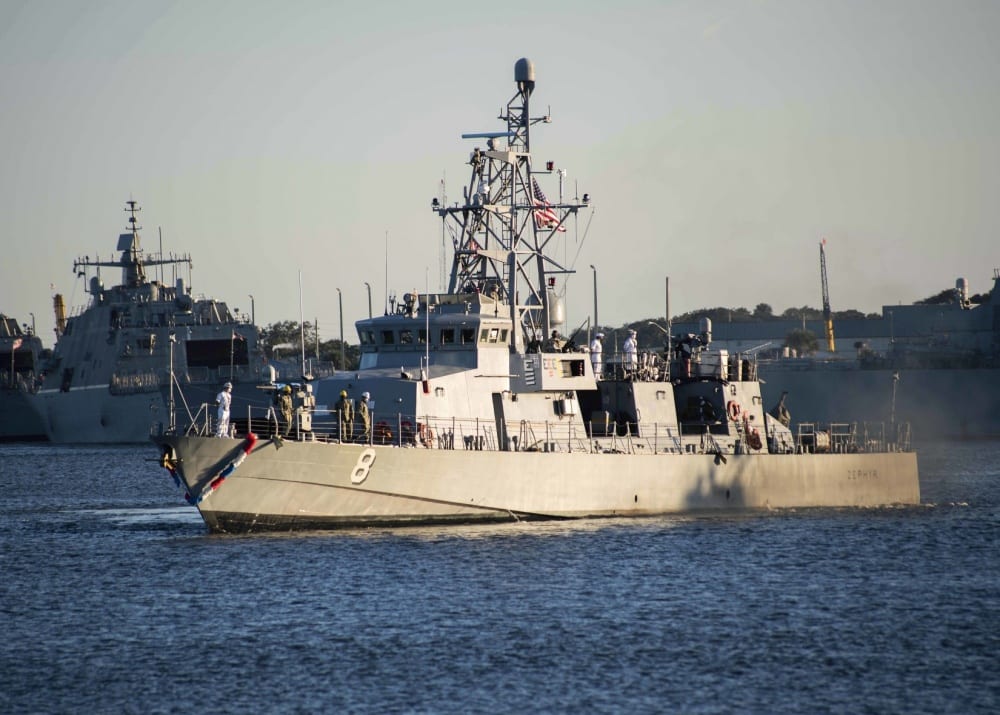
The Cyclone-class coastal patrol ship USS Zephyr (PC 8), shown here returning to Naval Station Mayport after a 2016 deployment to the U.S. 4th Fleet area of operations in support of Joint Interagency Task Force South’s mission, which included counter illicit drug trafficking in the Caribbean. U.S. NAVY / Mass Communication Specialist 1st Class Brian G. Reynolds

As the U.S. Navy divests itself of its Cyclone-class of Patrol Coastal (PC) boats, the Philippine navy (PN) has said the PCs would be welcome in its fleet.

In a statement, PN chief Vice Adm. Giovanni Carlo Bacordo said, “The PN has manifested its interest in the decommissioned Cyclone-class patrol vessels [CCPVs] of the U.S. Navy as a stop-gap to the decommissioned legacy PN ships. As to how many, that depends on the seaworthiness and efficiency of the CCPVs that will be offered, and this will be determined by the PN Joint Visual Inspection Team.

“We have manifested our interest with JUSMAG [Joint U.S. Military Assistance Group] and U.S. INDOPACOM,” the Indo-Pacific Command, he added.

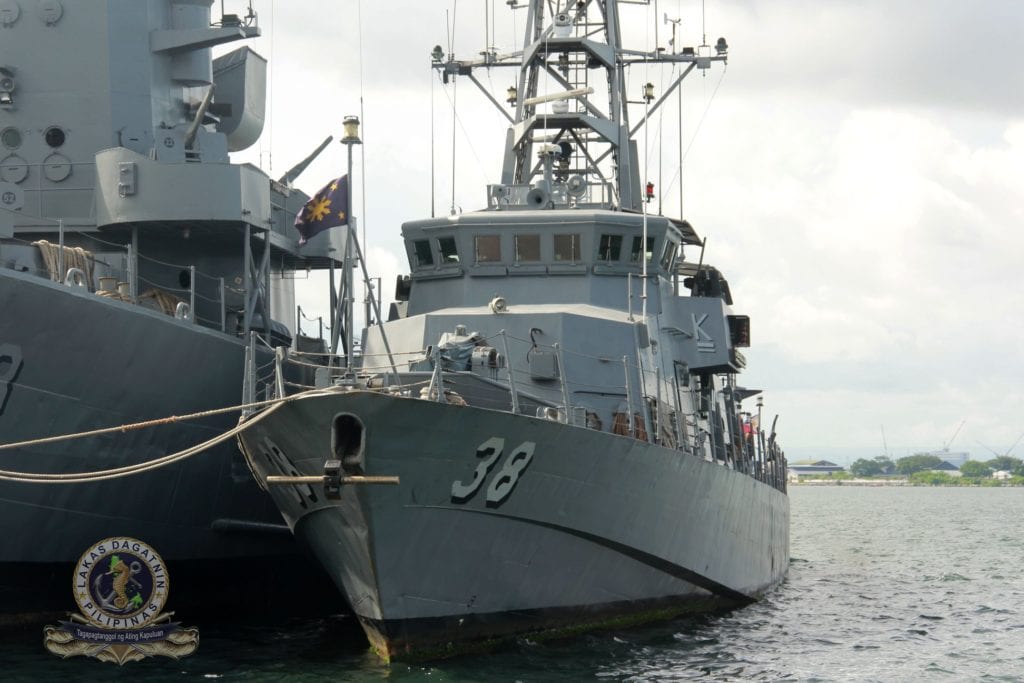
At present, the PN has one Cyclone-class patrol vessel in its service, the BRP General Mariano Alvarez (PS 38), formerly the ex-USS Cyclone (PC 1), which was transferred to the PN in 2004.

Of the 14 ships in the class, four were loaned to the Coast Guard but later returned.  The lead ship, Cyclone, then was transferred to the Philippines in 2004.

Three of the remaining 13 USN PCs were recently decommissioned. Ten more remain in service in Bahrain as part of the U.S. 5th Fleet. Of the three retired ships, the U.S. Navy said one would be made available for foreign military sale, but the other two would be scrapped.

USS Zephyr (PC-8), USS Shamal (PC-13) and USS Tornado (PC-14) were decommissioned in March. All three ships were based in Mayport, Florida, where they supported the U.S. 4th Fleet with counter-drug trafficking and illegal migration patrols in the Eastern Pacific, off Central America and in the Caribbean.   

“These three warships have served our Navy and our country well,” said Capt. Mike Meyer, commander, Naval Surface Squadron Fourteen. “Each of them has operated well past their designed service life, with their crews contributing demonstrably to meeting our national objectives.”

The Navy said Zephyr and Shamal would be scrapped, while Tornado would be considered for possible foreign military sale.

BRP General Mariano Alvarez (PS38) at Naval Base Cavite, Philippines, in 2019. DEFENSE OF THE REPUBLIC OF THE PHILIPPINES

According to a USN release, the decision to decommission these three ships stems from the fact they all exceeded their designed service life. “Based on the rising cost of modernization efforts, the Navy will receive a better return by decommissioning and freeing up funds to invest in other platforms,” the statement said.

The PCs were specifically tailored to support Special Operations Forces insertion and extraction and related duties. In that role, however, the PCs were too large for covert missions, but too small to effectively serve as surface combatants. So, the Navy planned to divest itself of the class, transferring the lead ship to the Philippines, and loaning three more to the Coast Guard. Events surrounding 9/11, however, made clear the need for ships able to operate in littoral waters. 

PCs have four diesel engines and four screws, capable of speeds up to 35 knots. They have a range of 2,000 to 2,500 nautical miles and an endurance of 10 days.

For their size, they are well armed. The U.S. ships were upgraded with remotely-operated stabilized 25 mm guns, and carried unmanned aircraft for surveillance and monitoring of boarding parties. Griffin missiles were installed on 5th Fleet ships to be used against surface threats.

And unlike many patrol vessels, PCs look like a surface combatant. “We’ve got a beautiful silhouette coming over the horizon with the sun in the background,” said Lt. Cmdr. Roger Young, who commanded officer of USS Firebolt (PC 10) in 2018. “I mean, you say, ‘that’s a warship.’”

Increased interoperability

The top military officer in the Indo-Pacific theater said the U.S. is committed to its Philippine ally and treaty partner.  That means a more capable navy.

In Congressional testimony, Commander of U.S. Indo-Pacific Command Adm. Phil Davidson said his command is focused on strengthening allies and partners.

“The United States’ network of allies and partners is our principal advantage against any adversary. USINDOPACOM depends upon the collective capabilities of our allies and partners to address the challenges to a Free and Open Indo-Pacific,” Davidson said. “Through increased interoperability, information-sharing, and expanded access across the region, we will present a compatible and interoperable coalition to our adversaries in crisis and armed conflict.  Terrorism continues to pose a security challenge in the Philippines, and USINDOPACOM is committed to helping the Philippines ensure that the southern Philippines does not become a safe-haven for terrorists that would threaten the entire region. I am also focused on helping to develop the territorial defense capability of the Armed Forces Philippines and look forward to re-engaging with the Philippines National Police Maritime Group to continue improving their ability to protect their sovereign interests.”

PN modernization

The PCs were designed for a 15-year life service. But Zephyr, for example, served for 26 years.

While the PCs are more than two decades old, they are decades newer than a pair of recently deactivated ships in the PN, the 221-foot BRP Quezon (the former USS Vigilance (AM-324),) and 185-foot BRP Pangasinan (formerly USS PCE 891).  Both ships were commissioned in the U.S. Navy in 1944. Quezon was commissioned in the PN in 1967, and served for 53 of years with the Philippine Navy. Transferred from the U.S. to the Philippines in 1948, Pangasinan had 72 years of service with the Philippine navy when she was decommissioned.

Even as older ships are retired, the PCs would be among the newer and more capable ships in the PN.

“This makes sense for the Philippine navy,” said retired Capt. Brian Buzzell, who is very familiar with the Philippine navy and the regional security issues. “They have had the lead boat for years. The issue will be what armaments will come with the boats.”

Buzzell notes that China has been ratcheting up the pressure on the Philippine government to accept their incursions into their economic zones. “The Cyclone-class PC would be a perfect vessel to patrol the disputed fishing areas,” he said. “Additionally, the PCs would complement the two new South Korean frigates.”

The PN recently added two new Jose Rizal-class frigates built in South Korea, the BRP Jose Rizal (FF 150), commissioned in 2020; and BRP Antonio Luna (FF 151), commissioned at Subic Bay in March of this year.  


Navy, Coast Guard Formalize Partnership Between Naval Postgraduate School and Coast Guard Research and Development Center

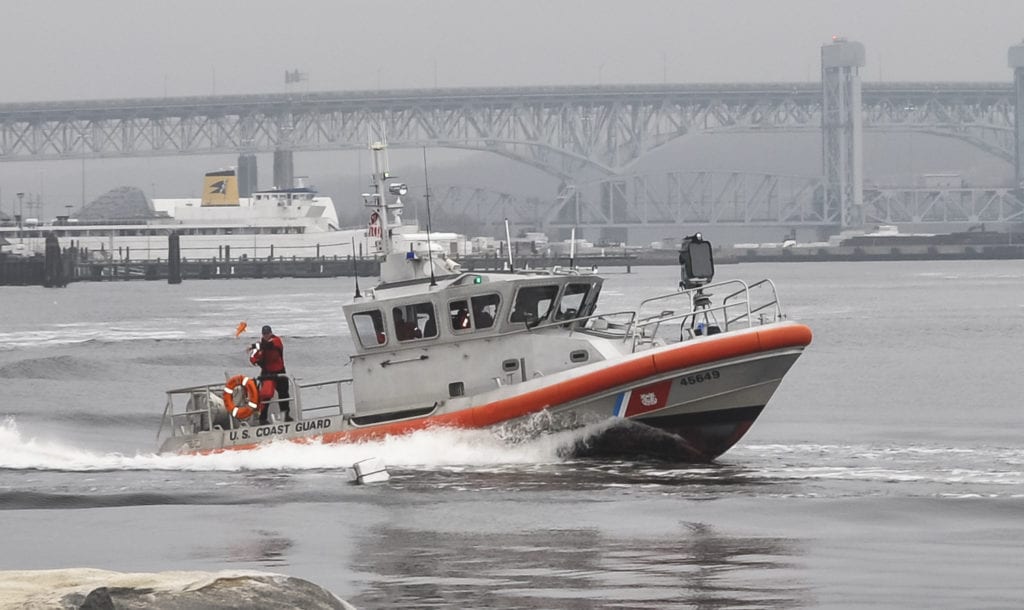
A Coast Guard crewmember jettisons a Maritime Object Tracking Technology marker as part of a Coast Guard Research and Development Center technology demonstration on the Thames River, New London, Connecticut, Thursday, Feb. 15, 2018. U.S. COAST GUARD RESEARCH AND DEVELOPMENT CENTER

The U.S. Naval Postgraduate School (NPS) and Coast Guard Research and Development Center (RDC) signed a new five-year memorandum of understanding (MOU) on April 14, 2021, which facilitates collaboration on joint research that directly supports common defense priorities and Coast Guard statutory missions. 

NPS President retired Vice Adm. Ann E. Rondeau and RDC Commanding Officer Capt. Dan Keane met on a virtual platform to both sign the document that will continue and enhance collaborative research and educational cooperation between the two institutions. The document establishes a framework for future collaboration, joint research and access to capabilities.

“The Tri-Service Maritime Strategy (TSMS), Advantage at Sea, prioritizes developing future capability and capacity for both the Navy and the Coast Guard,” said Rondeau. “Our formalized partnership not only strengthens the strong ties between NPS and the Coast Guard, but it brings to bear our defense-focused faculty and operationally experienced Navy and Coast Guard students in joint projects to develop our future force and support that strategy.”

Keane said partnerships are vital to the RDC portfolio accomplishment strategy, such as with Department of Defense and Department of Energy labs, the Federal Lab Consortium, and academia. “Perhaps one our strongest and most impactful partnerships is with the Naval Postgraduate School,” he said.

“Since an MOU was signed three years ago, the RDC has become a topic sponsor, we have proposed questions related to our portfolio that have turned into academic products; NPS researchers have worked with our researchers on summer studies; and we have provided platforms for NPS experimentation. We believe that we have just scratched the surface and the future is incredibly bright,” said Keane. “The partnership is strong today, and is only going to grow stronger in the future. We are excited about the next five years.”

According to a joint statement about the signing, the MOU will help focus NPS on aspects of the TSMS that chiefly fall to the Coast Guard to define research projects that those students, and NPS faculty, can work on together and advance toward solving key maritime challenges. “In addition to identifying thesis topics of mutual interest, the MOU includes access and use of each institution’s unique laboratories and facilities, and involves other key research exchanges to mutually advance their mission of research and education for warfighting advantage,” the statement said.

Planning is underway to facilitate joint research projects on such things including renewable energy, additive manufacturing, maritime-domain awareness and wargaming.

There is a small cohort of mid-career Coast Guard officers attending NPS as students, joining the 600 naval officers and 300 Marine Corps officers attending the school.

According to NPS Dean of Research Dr. Jeffery Paduan, NPS has an impressive cadre of subject matter experts. The school offers masters and doctorate programs in 70 different fields of studies with 227 tenure-track faculty and 347 non-tenure track faculty. 

Paduan said both NPS and RDC have distinguished histories as leading research institutions. “The Navy and Coast Guard face overlapping challenges at sea, and both of our organizations complement each other in addressing these problems. This MOU will lead to many more joint projects and shared benefits.”

Students will benefit from thesis topics and capstone projects of mutual interest, with access  to each institution’s unique laboratories, facilities, expertise and research capabilities at sea and ashore.

Rondeau said the teaming brings opportunities to understand and solve problems, and solidifies a promising “partnership in science, technology, education, learning and teaming — and in the end, winning. This MOU opens up our apertures to possibilities that are in front of us. I truly believe this has power beyond even what we can imagine today.”


Submarine Day Observance Calls Attention to Growing Opportunities in Submarine Construction

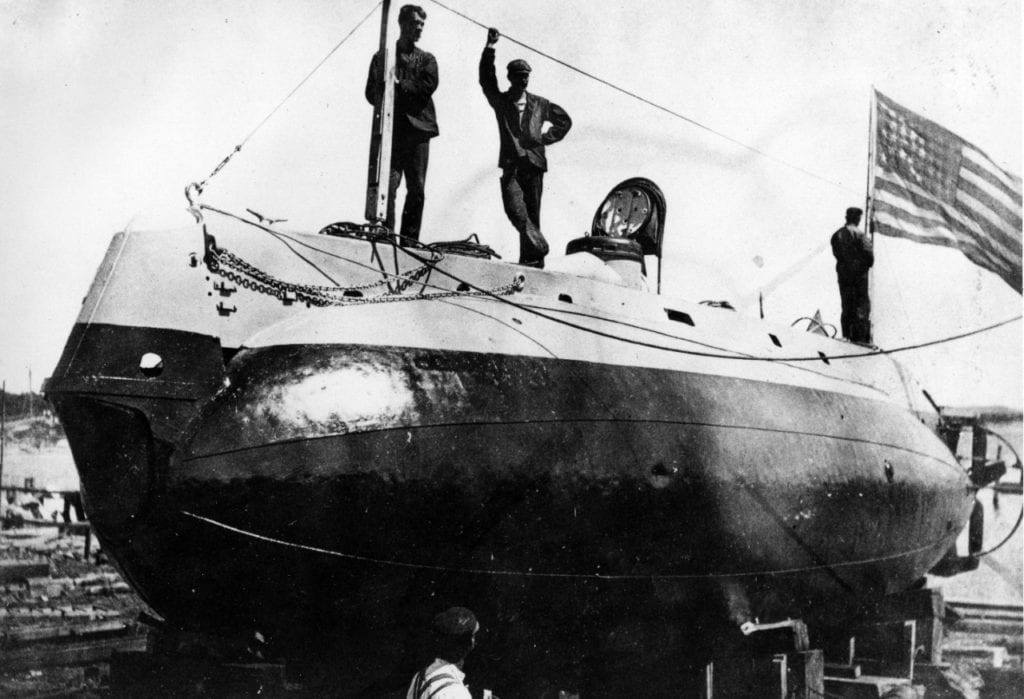
USS Holland (SS-1), the U.S. Navy’s first commissioned submarine, joined the fleet in 1900. SUBMARINE FORCE LIBRARY & MUSEUM COLLECTION

The Southeastern New England Defense Industry Alliance (SENEDIA) is recognizing National Submarine Day with a “TechTalk” featuring senior leaders from General Dynamics Electric Boat, as well highlighting men and women in the region who are employed in submarine construction related careers.

“Southeastern New England is the nation’s hub for submarine shipbuilding and undersea technology, and although the COVID-19 pandemic posed challenges for all businesses, our industry remains strong, with more rewarding opportunities ahead for those interested in the high-wage, high-growth, high-demand career pathways that are available across the defense landscape,” said Molly Donohue Magee, SENEDIA’s executive director. “National Submarine Day is a great opportunity for our colleagues across the industry to come together to celebrate our successes, share innovation, and grow the talent pipeline we need to continue to thrive.”

“National Submarine Day is an opportunity to remember the origins of the nation’s submarine shipbuilding industry, and to recognize the critical role that submarines have played in our national defense,” Magee said.

National Submarine Day, normally celebrated on April 11, commemorates the acquisition of the U.S. Navy’s first modern submarine, USS Holland (SS-1) in 1900.  She was designed by inventor John Phillip Holland and built in Elizabeth, New Jersey, and commissioned in the US Navy on Oct. 12, 1900, at Newport, Rhode Island.

Holland was the first submarine with the seakeeping ability and endurance to conduct long transits, and the power to run submerged for any considerable distance. She had a six-man crew and could dive and maintain a depth of 75 feet.  After the Navy purchased and evaluated USS Holland, they ordered six more of her type.

The inventor’s company, the Holland Torpedo Boat Company, later became Electric Boat.

General Dynamic Electric Boat executives, Sean Davies, vice president of Quonset Operations, and Andrew Bond, vice president of human resources, presented a virtual “TechTalk” on the scope, magnitude and growth of the U.S. Navy’s Columbia and Virginia-class submarine programs. 

Electric Boat is experiencing significant hiring of trade and industrial skilled employees and growth and expansion at Electric Boat. In 2020, EB hired 2,000 people, mostly in the second half of the year due to earlier COVID limitations. In 2021, Bond said EB expects to hire 2,400 engineers, tradesmen and support personnel. 

A network of partnerships of government, academic, nonprofit and business organization in Connecticut and Rhode Island are helping develop the qualified workforce that design and build the submarines of today and the future.

“We will put more than 1,000 people through those pipelines in Rhode Island, and we have a parallel pipeline in Connecticut,” said Davies. “Our training programs used to focus on either Connecticut or Rhode Island, but SENEDIA brings a cross state and region perspective, so we can expand into Massachusetts and further into New England.” 

According to Magee, SENEDIA membership includes 130 companies, mostly in southeastern new England, but beyond as well supporting submarine construction and undersea technology. The organization has a contract from the DoD Industrial Base and Sustainment Office focused on submarine workforce development, specifically related to the trades and industrial skilled employees.

“The shipyards offer high-tech and high-wage jobs, and they are in high demand,” she said. “The Navy wants to make sure there is a strong pipeline of current and future workers for submarine construction and other naval shipbuilding needs. We can solve the need today, but  we have to make sure we have the pipeline for tomorrow.”


Logistics and Partnerships Sustain Ships at Sea

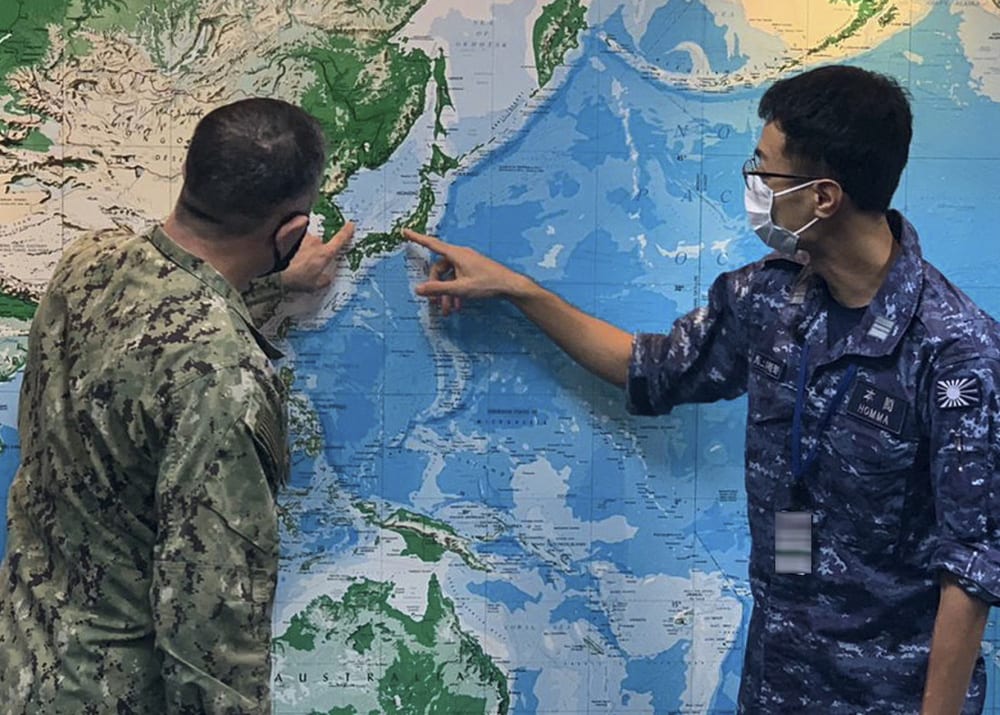
U.S. Navy Lt. Cmdr. Cory Eggers, left, replenishment officer with Commander, Logistics Group Western Pacific (COMLOG WESTPAC) and Japan Maritime Self-Defense Force Lt. Cmdr. Shuzo Homma discuss potential replenishment-at-sea locations in the COMOG WESTPAC conference room. This photo has been altered for security purposes by blurring out identification badges. U.S. NAVY / Lt. Teddy Haghverdi

To maintain a naval presence throughout the vast Indo-Pacific area of operations requires a logistics network that can supply and sustain naval ships while they are at sea. Singapore-based Commander, Logistics Group Western Pacific (COMLOG WESTPAC)/Task Force 73 (CTF 73), is the U.S. 7th Fleet’s provider of combat-ready logistics, operating government-owned and contracted ships to keep those ships armed, fueled and fed.

That includes the scheduling and coordination of the combat logistics force (CLF). 

The Military Sealift Command operates three different classes of CLF ships. The 45,000-ton, 689-foot USNS Lewis and Clark class of Dry Cargo/Ammunition Ships (T-AKEs) deliver ammunition, food, fuel, parts and supplies and material to the fleet. The Henry J. Kaiser Class T-AOs are 677 feet long and displace more than 40,000 tons, carrying 180,000 barrels of aviation and diesel fuel for ships and aircraft deployed at sea. The 49,000-ton, 754-foot Supply-class of Fast Combat Support ships (AOE) can keep up with the carrier strike groups to bring 177,000 barrels of oil; 2,150 tons of ammunition; 500 tons of dry stores; and 250 tons of refrigerated stores to Navy task forces.

CTF 73 supports almost every exercise and operation that occurs in 7th Fleet, whether directly or indirectly. “The vastness of Seventh Fleet and shear number of ships demand teamwork between CTF 73 and Military Sealift Command Far East,” said Lt. Catherine Anthony, surface operations officer at Commander, Logistics Group Western Pacific. “Logistics is what enables our fleet to sustain at sea. Without our ability to [replenish at sea], combatants would be tethered to port, and we would not have the same power projection, flexibility, and mobility we as a Navy have become accustomed to.”

CTF 73’s mission also includes supporting, and being supported by, U.S. allies and partners in the region.

One of the closest of those partners is the Japan Maritime Self-Defense Force (JMSDF). Evidence of that cooperation is establishment  and assignment of a JSMDF liaison officer (LNO), Lt. Cmdr. Shuzo Homma, at COMLOG WESTPAC/CTF 73.  Homma works directly with the staff’s replenishment officer to ensure the interchangeability and combined logistics operations between the two services involving Military Sealift Command and JMSDF ships.

As LNO, Homma coordinated with Military Sealift Command Far East to execute numerous underway replenishments for U.S. and JMSDF ships.

“If we can achieve more-advanced and interchangeable logistics in the areas where both the U.S. Navy and JMSDF operate, we can achieve better efficiencies in the use of our CLF assets and extend our ability to support units further from logistics hubs,” said Homma.

Replenishment operations involve refueling at sea and the delivery of provisions via connected or vertical replenishments. Homma points to a replenishment-at-sea (RAS) between the JMSDF Masyuu-class supply ship JS Oumi (AOE 426) and the Arleigh Burke-class guided missile destroyer USS John S. McCain (DDG 56) as a prime example of what the two navies can accomplish together.

“That was the first RAS that delivered cargo and fuel to a U.S. ship that was engaged in operations from a JMSDF oiler,” said Homma. “In order to accomplish this event, we needed to work on both operational and legal issues related to ACSA [Acquisition and Cross-Servicing Agreement]. We were able to load U.S. supply parts and U.S. subsistence on a JMSDF logistics ship and deliver them during a RAS event. This is a process that could take weeks and we did it in days.”

The positioning of a JMSDF LNO at CTF 73 is a combined U.S. Pacific Fleet/JMSDF effort developed by the JMSDF/U.S. Navy Logistics Interoperability and Integration Strategic Framework. The goal is to build better interoperability and interchangeable logistics between JMSDF and U.S. Navy forces in the 7th Fleet area of operations.

“Our combined logistics capabilities play a big role in our navies’ abilities to operate effectively, efficiently and interchangeably in the Indo-Pacific,” said Lt. Cmdr. Cory Eggers, CTF 73’s fleet replenishment officer. “Having a JMSDF LNO here in Singapore and being able to work together, in person, to put the pieces together and overcome logistical challenges has absolutely enhanced our efforts.”

“Interoperable and interchangeable logistics require trust. We can move fuel and parts with speed, but only as far and fast as our network can take us. This partnership builds the collective strength, speed and operational reach of our supply chains,” said Capt. Chuck Dwy, assistant chief of staff for logistics at COMLOG WESTPAC, who was instrumental in developing the LNO program.

“The LNO program reflects the trust we place in partners at every level,” said Rear Adm. Joey Tynch, commander of COMLOG WESTPAC/CTF 73.


Space Mission Support: Coast Guard Patrols Restricted Areas Around Launches, Re-Entries

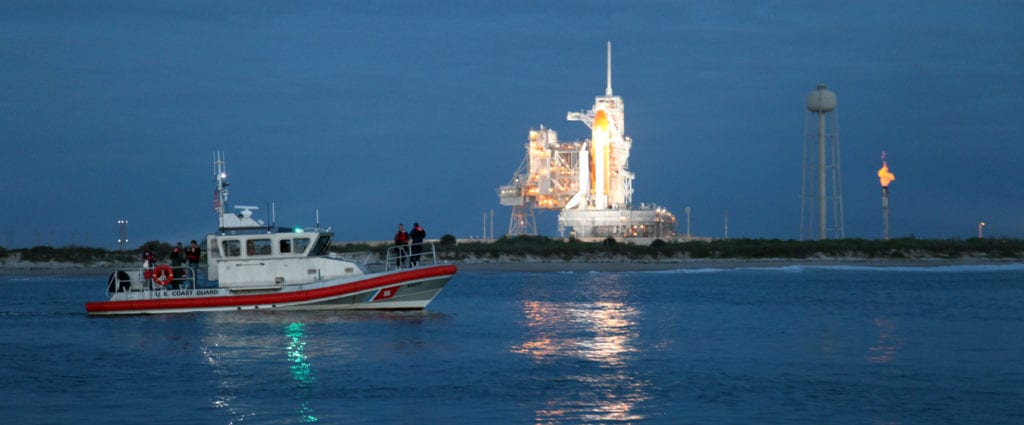
A Coast Guard Station Port Canaveral crew aboard a 45-foot response boat protects the waters near Cape Canaveral, Florida. U.S. COAST GUARD

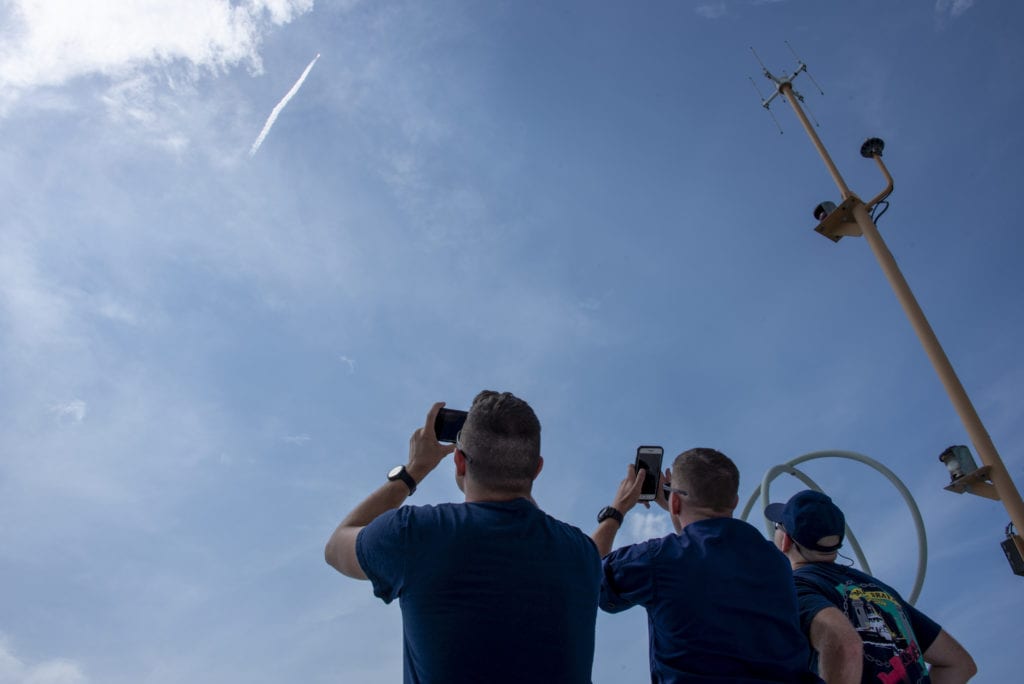
The world was transfixed with the images of the NASA Perseverance rover landing on Mars in February. Like all space missions, it involved a myriad of partners and collaborators. Even the U.S. Coast Guard plays an important but little-known role in launch operations. In fact, the service is involved in ensuring maritime safety and security for almost every U.S. space launch.

NASA, Department of Defense and commercial space launch sites are located next to the ocean. In addition to the Kennedy Space Center (KSC) at Cape Canaveral in Florida, NASA and the Air Force also use Vandenberg Air Force Base near Lompoc, California, on the West Coast. NASA also conducts launches from its Wallops Island facility near Chincoteague, Virginia, and SpaceX has developed a commercial launch facility at Boca Chica near Brownsville, Texas, on the Gulf of Mexico. The Navy has the ability to launch targets from the Pacific Missile Range Facility on the island of Kauai, but these are not orbital missions. Other space ports are planned.

“We’ve been a mission supporter since 1955,” said Cmdr. Jill Lamb, chief of response for Sector Jacksonville, Florida.

When the space shuttle program shut down, major missions departing from the U.S. also wound down. That’s changed, however. The volume of space missions is growing as companies provide more opportunities to launch payloads, and space tourism is becoming a thing. Business is booming.

“We use a local risk assessment tool for each launch,” said Lamb. “It’s scalable, so we can look at all the factors and adjust our force laydown. It might vary, depending on if were dealing with a satellite launch or an astronaut launch.”

The Coast Guard has a memorandum of agreement with the Space Force’s 45th Space Wing. During major evolutions at the space center, the 45th, working with NASA and the commercial providers, will publish the limited access safety zone and establish a command center where the Coast Guard will participate. On launch day, the Coast Guard will monitor and patrol that zone.

Lamb said the captain of the port (COTP) promulgates a notice to mariners and local notice to mariners to set forth those limited access safety areas. In the case of the KSC launches, the COTP is the sector commander at Jacksonville, assisted by the commanding officer of Station Port Canaveral. On the day of the launch, the warnings are broadcast on marine radio channels. The restricted areas are created to keep unwary boaters or gawkers from being under an area where debris or hazardous materials might fall during a launch.

According to Chief Warrant Officer John Chandler, Station Port Canaveral’s commanding officer, the highest risk during a launch is typically within the first minute or minute and a half, depending on launch vehicle, configuration, and other factors. In some cases, flight abort tests intentionally come down shortly after launch.

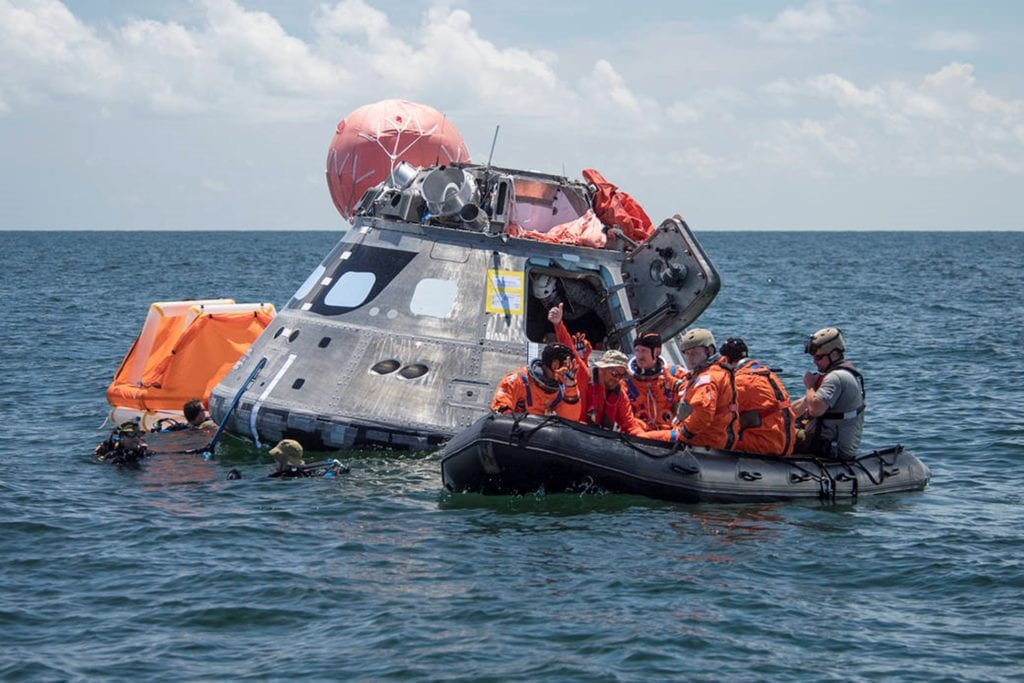
The Coast Guard provides security for landing zones when astronauts return to Earth in the Pacific or Gulf of Mexico. This 2017 test demonstrates how they will safely egress the spacecraft. NASA / Josh Valcarel

“As the local unit, we always maintain a standby SAR [search and rescue] posture,” Chandler said. “During those launches that are deemed high risk, or when we receive a request from the 45th for surveillance assets, our vessels would patrol within the launch danger area, ensuring vessel masters are aware of the hazardous areas and CG enforceable limited access areas [LAAs]. Our job with the USSF day of launch is to provide CG authority in the event a boater is causing the overall risk analysis to increase, which can affect proceeding to launch, hold or scrub.”

Usually, the mere act of informing the boaters to clear out is enough.

“No one really wants to place their vessels in any unwarranted danger. But, if our crews encounter vessels within the LAAs, we are authorized by the COTP to provide notification of violation and initiate additional enforcement documentation if necessary. Thus, for those masters who are less than cooperative, we make sure they understand that these areas are under Coast Guard authority and civil and criminal penalties can be applied.”

While space launches were traditionally a NASA show, today’s launch activities are increasing commercial operations.

“We interact with Canaveral Port Authority, Brevard County Sheriff’s Office, and Florida Fish and Wildlife,” Chandler said. “Our launch partnerships include Space Force, Air Force, NASA, FAA, as well as the launch providers themselves, such as SpaceX, United Launch Alliance, Blue Origin, Boeing and Orbital ATK.”

The sector commander also wears the officer in charge of marine inspection hat and, as such, is involved with inspecting and approving vessels such as the autonomous barges used to recover the booster sections and return them to port.

“They use some highly specialized maritime vessels, and we go aboard to ensure compliance with regulations and safety requirements,” Lamb said. “It’s becoming more challenging to learn these new vessels. They don’t fit squarely into the typical ship categories we’re used to, and each of these commercial operators have their own types of vessels. And as the technology advances and their experience grows, the operators are constantly adjusting their procedures and modifying their vessels, which means we need to conduct frequent inspections to deal with the changes.”

Historic Role

From its Cape Canaveral location just south of the Kennedy Space Center and the launch complexes operated by NASA and the U.S. Air Force, Port Canaveral has played a long and historic role in the development and growth of the space industry on Florida’s Space Coast.

Large assemblies and materials such as bulk fuels can arrive by sea at Port Canaveral. The port is an extremely busy cruise ship homeport, and also hosts Navy submarines when they call at the Navy Ordnance Test Unit.

According to Port Canaveral CEO Capt. John Murray, “Public interest in commercial space operations such as crew capsule splashdowns and recovery of space-related assets has grown as the industry’s operational cadence has increased.”

The port worked with the Coast Guard and local and state law enforcement agencies to create the security model for recovery missions off the coast of Florida.

Crew members aboard the Coast Guard Cutter Maria Bray watch as a SpaceX Falcon 9 rocket carrying NASA astronauts Doug Hurley and Bob Behnken in the Crew Dragon spacecraft launches from Launch Complex 39A at Kennedy Space Center, May 30, 2020, in Cape Canaveral, Florida. Coast Guard units and crews supported the launch by enforcing safety and security zones during the rocket’s launch in order to protect members of the public, vessels, harbors, ports and waterfront facilities. U.S. COAST GUARD / Petty Officer 2nd Class Ryan Dickinson

Traditionally, Coast Guard safety zones may not extend beyond U.S. waters. In December 2020, Congress included a provision to expand the safety zone authority from 12 miles up to 200 miles offshore in the National Defense Authorization Act. This gives the Coast Guard the ability and authority to set and enforce restricted vessel navigation zones to protect the safety and security of offshore and at sea space recovery operations.

Port Canaveral also worked with its state law enforcement partners at the Florida Fish and Wildlife Conservation Commission (FWC) and commercial and military space partners to craft proposed legislation that would allow for FWC personnel to come alongside the U.S. Coast Guard in enforcing restricted vessel traffic and access to near-shore recovery operations in Florida’s coastal waters.

A new space port is being established in the Gulf of Mexico. The SpaceX South Texas launch site, also known as the Boca Chica launch site, is a private rocket production facility, test site and spaceport constructed by SpaceX, located approximately 32 kilometers east of Brownsville, Texas, on the U.S. Gulf Coast. Those launches will be supported by Sector Corpus Christi and Station South Padre Island.

The Coast Guard has the additional job of recovering rocket boosters and returning them to port. Due to the trajectories, the boosters are not jettisoned close to the launch sites — in the case of Canaveral launches, they are recovered off North Carolina. This work started in the era of the space shuttle but continues, although now some booster sections are landing on autonomous barges so they can return to port and be reloaded for a subsequent flight.

Now that U.S. capsules are once again returning to Earth, the Coast Guard has worked closely with NASA and SpaceX to plan the recovery of the SpaceX Dragon crew in August 2020. The Coast Guard established a safety zone and warned boaters to stay out of the zone before splashdown. Mariners were alerted to pending hazardous operations within a specified boundary by a broadcast notice to mariners. The zone went into effect three hours before the capsule splashed into the Gulf.

“When a when capsule detaches from the ISS, it’s coming home pretty quick,” Lamb said. “We need to be in the right place at the right time.”

When the two NASA astronauts landed in the water near Pensacola, Florida, boaters basically ignored the safety zone. The Coast Guard was not involved in recovering the crew or the capsule but was helping to keep the area clear. Boaters crowded around the spacecraft while recovery crews tried to get to the Dragon capsule and get the crew safely onto the recovery boat.

The Coast Guard said later that “numerous boaters ignored the Coast Guard crews’ warnings and decided to encroach the area, putting themselves and those involved in the operation in potential danger,” according to a statement.

More recently, an unmanned SpaceX CRS-21 Cargo Dragon capsule came down in the Gulf of Mexico west of Tampa Bay in January of this year. The Coast Guard established the safety zone and warned boaters to stay out before splashdown. The zone went into effect three hours before the capsule splashed into the Gulf exactly on time, and this time there was no interference.

While launches are becoming more routine, Lamb said they’re still spectacular to observe. “It’s a pretty incredible view.”


Japan Launches Lead Ship of 22 Mogami-Class Frigates

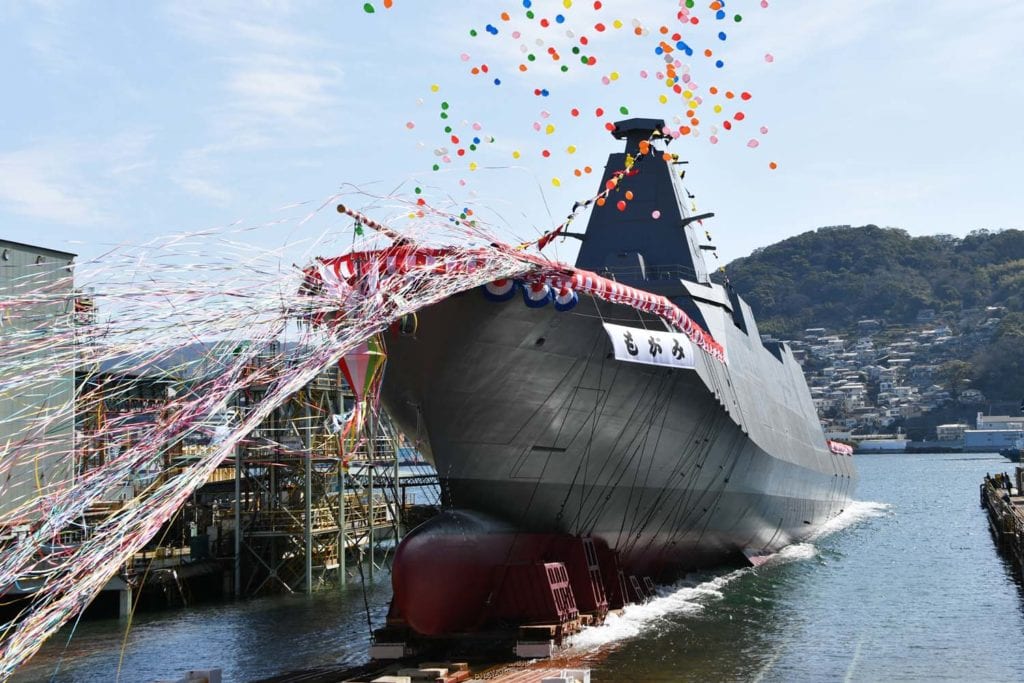
Mitsubishi Heavy Industries launched Mogami, the first of a new class of 22 multirole frigates for the Japanese Maritime Self Defense Force, in a March 3 ceremony at the company’s Nagasaki Shipyard & Machinery Works. Japanese Maritime Self Defense Force

The Japanese Maritime Self Defense Force has launched the first of a new class of multi-mission surface combatant.

The Mogami (FFM 1)-class frigate, also known as the 33FFM program, will be stealthy multi-mission surface combatants with the capability to employ unmanned surface and undersea vehicles to conduct mine countermeasures operations.

The first ship was launched at Mitsubishi Heavy Industries in Nagasaki on March 3. The second ship in the class, Kumano, is being built at Mitsui Engineering and Shipbuilding Tamano Works in Okayama.

Eight of the 426-foot, 5,500-ton Mogami-class FFMs are currently under contract, with 22 of them planned. The Maritime Self Defense Force plans to build two per year.

The Mogami will be armed with a MK 45 5-inch gun, 16 MK 41 Vertical Launch System tubes, eight anti-ship missiles, SeaRAM ddefensive missiles, torpedoes and decoy launchers.

The FFM has a flight deck and hanger to embark an SH-60L helicopter and could also handle unmanned aircraft systems. A rear ramp beneath the flight deck can be used to launch and recover unmanned surface vehicles and unmanned underwater vehicles as well as lay sea mines.

The 30FFM features a futuristic combat information center with a 360-degree video wall.

The stealthy design draws from MHI’s experience with the Mitsubishi X-2 Shinshin stealth fighter technology demonstrator.

The Combined Diesel and Gas Turbine propulsion system features a Rolls Royce MK30 gas turbine and two MAN diesels, delivering speeds of up to 30 knots. The crew of 90 personnel is smaller than existing combatants of comparable size.

The Mogami class will replace some mine warfare ships and escort ships, and will be available for peacekeeping, anti-piracy and humanitarian missions, freeing  larger and more capable combatants that are now being used in those roles to assume other duties.