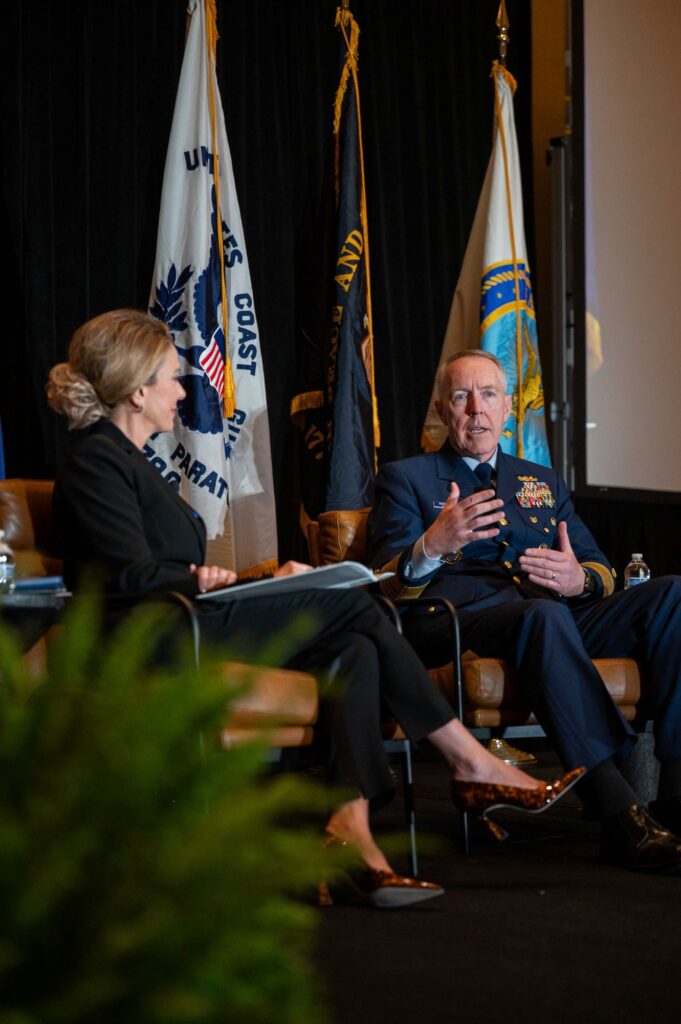
U.S. Coast Guard Commandant Admiral Kevin E. Lunday addresses the service’s successes and challenges at Sea-Air-Space. Photo credit: Laura Hatcher
The U.S. Coast Guard is quickly allocating an unprecedented $24.6 billion funding infusion provided to the Department of Homeland Security agency in last year’s budget reconciliation bill. At the same time, the armed services branch is shuttered, caught in the political crossfire over the actions of another DHS entity, Immigration and Customs Enforcement.
In describing this bizarre situation to a Sea-Air-Space 2026 audience on April 22, the 28th Coast Guard Commandant, Admiral Kevin E. Lunday, looked to Charles Dickens, who opens “A Tale of Two Cities” with the famous lines, “it was the best of times, it was the worst of times. …”
“We want to get those worst of times out of here,” he said in a conversation with ABC News correspondent Kyra Phillips on the closing day of the conference. Lunday urged Congress to fund the Coast Guard to “ensure our readiness but pay our people.”
Citing an emergency authority, the White House directed DHS to cut checks to personnel across the agency, including affected members of the Coast Guard, a temporary solution that most agree is not a substitute for annual appropriations.
Promise Amid the Peril
Despite the funding stoppage, Lunday said it’s still an “amazing time for our service.”
That’s in part thanks to the nearly $25 billion from the reconciliation bill, which is funding long-deferred shipbuilding and modernization efforts at the agency, which Lunday has led since Jan. 15, 2026.
Lunday said the Coast Guard relies on an aging fleet — including 50-year-old cutters — to conduct much of its work. For instance, this year these stalwart vessels freed frozen shipping lanes in the New England, New York and Great Lakes regions so ships could deliver essential cargo like home heating oil and other goods.
“Keeping commerce moving is a constant, constant effort,” he said. “In fact, it’s one of the most important, but maybe one of the things that is not aways seen.”
These operations have continued amid a decades-long downward spiral in readiness, Lunday said. He said the Coast Guard requires about $20 billion in annual funding but has in recent years received just under $13 billion per year.
To reverse that trajectory, Lunday’s team knew they needed to get the new cash out the door quickly. To do this, the service created an acquisition “super highway” to accelerate the shipbuilding acquisitions process.
The Coast Guard has already obligated $9 billion of the new money, with three new heavy icebreakers and 11 new Arctic security cutters set to roll off the U.S. shipyards starting in 2028.
“No one is moving that fast,” Lunday said.
Topline Annual Appropriations
However, it’s critical that Congress also support the president’s fiscal 2027 budget request of $15.6 billion to build on the one-time cash injection from the reconciliation bill, he said. The plus-up in yearly funding is necessary for homeports, hangars, facilities and other infrastructure to support the roughly 100 new assets funded through the bill, he said.
That includes funding to train, hire and support the families of roughly 1,300 additional personnel needed to crew the new vessels.
“And the ’27 budget request goes a long way to do that,” he said. “But we’re going to need to continue to see that topline growth, not only in the operating funds but continued investments in capital assets to be able to meet the demands of the American people.”
The Coast Guard is currently comprised of about 41,000 active-duty military and 8,700 civilian employees, 6,200 reservists and 26,000 auxiliary volunteers.
Compared to its size, Lunday said the Coast Guard delivers “unprecedented value” to the nation, saving lives, protecting the maritime borders, keeping trade routes safe and free, and providing disaster assistance worldwide. Some of these operations in 2025 involved:
Saving 5,220 people and assisting more than 19,000 through search-and-rescue missions.
Diverting a four-person crew far inland to help respond to the July 4 Central Texas floods, which ultimately killed 135 people.
Deploying USCG cutters Storis, Healy and Waesche to protect U.S. sovereignty in the Arctic by chasing off five Chinese research vessels that traversed U.S. waters.
Ensuring the safe maritime passage of $1.8 billion tons of cargo, a 13% annual increase.
Seizing a record-breaking 511,000 pounds of cocaine trafficked to the United States by cartels.
As the 236-year-old service begins its promising next chapter, Lunday said he hopes the funding lapse can end so he can refer to a different Dickens’ tome: “Great Expectations.”
Coast Guard Academy Think Tank Puts Polar Issues Front and Center
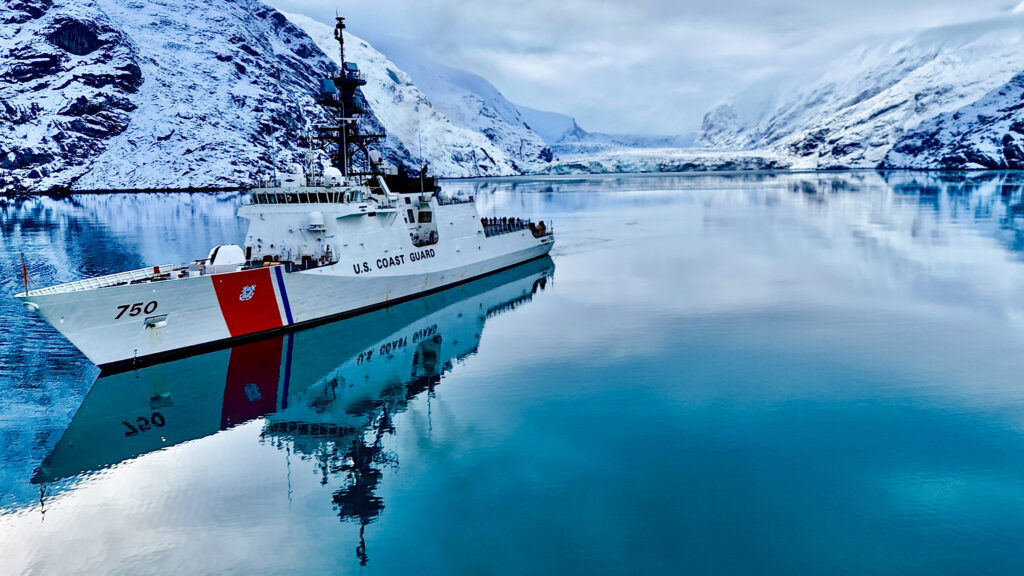
Coast Guard Cutter Bertholf (WMSL 750) transits through Glacier Bay, Alaska, Oct. 24, 2024. During the patrol, Bertholf’s crew operated as far north as the Arctic Circle, patrolling along the maritime boundary line between the United States and Russia and supporting U.S. strategic interests in the North Pacific Ocean. Photo credit: U.S. Coast Guard | Troy Spence
The Arctic is a hot topic these days. As sea ice melts, many questions surface: How should Arctic nations manage more shipping traffic while preserving the delicate environment? Can countries maintain a history of regional cooperation in this increasingly contested space?
As these and other concerns come to the fore, there’s one entity keeping all things polar on the front burner: the Center for Arctic Study and Policy, or CASP.
This tiny U.S. Coast Guard Academy office — with an annual operating budget of just $150,000 and two salaried positions — plays an outsized role in promoting knowledge of the north and south polar regions, a growing area of human interest as the environment rapidly changes.
The Arctic polar region is primarily ocean, surrounded on its edges by the eight member states of the Arctic Council: Canada; the Kingdom of Denmark, which includes Greenland and the Faroe Islands; Finland; Iceland; Norway; the Russian Federation; Sweden; and the United States, where Alaska includes a 1.5-million-square-mile exclusive economic zone in its surrounding waters.
Council decisions are achieved in agreement with six “permanent participants” that represent Aleut, Arctic Athabaskan, Gwich’in, Inuit, Saami and Russian Indigenous people, who have inhabited the Artic for millennia. About 10% of the 4 million Arctic residents are native peoples, according to the “Arctic Review,” an online publication covering polar issues.
There is a long history of international cooperation regarding Arctic scientific research and discovery and access to the region’s abundant fisheries, oil and gas assets, minerals, tourist sites and other resources. But rapid changes to the area’s physical, economic, geopolitical and technological characteristics have altered the future of polar affairs. As a result, many nations, including the United States, have intensified their focus on the region.
The U.S. Coast Guard, part of the Department of Homeland Security, underscored the region’s strategic importance in its 2023 Arctic Strategic Outlook Implementation Plan: “Global geopolitical trends combined with changes to the Arctic’s physical environment are increasing the region’s economic opportunities and strategic importance while hastening the impacts and risks to U.S. Arctic residents, commercial activity, and U.S. national security.”
In the middle of the action is CASP, the U.S. Coast Guard’s only scholarly center and internal think tank. It focuses only on the polar regions — mostly the Arctic but also Antarctica.
Widening Interest, Changing Arctic
Tony Russell, CASP’s executive director since 2022, said his personal interest in the Arctic started in 2007. He was serving as an active-duty officer in the Coast Guard and completing a master’s degree at the Marine Corps University. The Arctic, Russell thought, would be a unique thesis topic.
“That was when folks were just beginning to understand how access — physical access — was increasing via the sea ice reducing [and asking] what does that mean?” said Russell, who retired from the Coast Guard as a captain in 2020. Global attention to the region also coalesced around a 2008 U.S. Geological Survey report predicting the Arctic Circle had massive stores of undiscovered oil and gas reserves.
Then, as now, the drastic environmental changes were hard to ignore: According to the National Snow and Ice Data Center, scientists have observed a consistent decline in Arctic sea ice cover in nearly 50 years of continuous satellite monitoring — a rate of decline of more than 2% per decade. In 2025, sea ice cover is at its lowest level since recording began in 1979.
The Arctic in the past four decades has warmed three times faster than the worldwide average, according to “Arctic Climate Change Update 2024: Key Trends and Impacts — Summary for Policymakers,” a report by the Arctic Council’s Arctic Monitoring and Assessment Programme.
The evolving situation sparked new areas of concern, collaboration and potential conflict among nation-states, residents, the scientific community and industry players.
The area’s residents, land, waterways and wildlife face new threats from erosion, flooding, wildfires and greater human activity. The Arctic is at risk from more air crashes, vessel collisions and groundings. It’s also exposed to threats to subsea cables, unsafe shipping through the Russian maritime Arctic and friction from regional military exercises (involving the U.S. and its allies but also Russia and China).
“That all speaks to rising interest for U.S. national security,” Russell said.
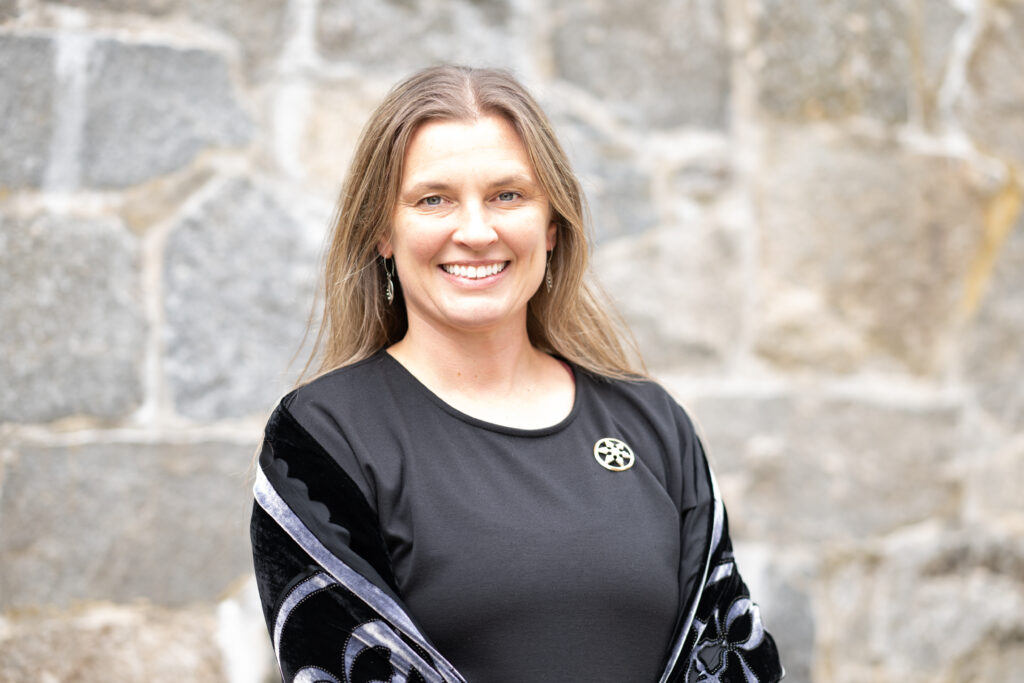
Dr. Abbie Tingstad poses for a photo at the U.S. Coast Guard Academy, Sept. 25, 2024. Tingstad is a renowned Arctic analyst, a trusted voice on the challenges posed by the changing environment in the region and also the first Visiting Research Professor at the Center for Arctic Study and Policy (CASP) at the U.S. Coast Guard Academy. Photo credit: U.S. Coast Guard | Petty Officer 2nd Class Janessa-Reyanna Warschkow
Renewing the Center’s Mission
Although CASP was founded in 2014, Russell’s tenure began as the Coast Guard Academy was relaunching and revitalizing the center, complete with new offices at the academy’s New London, Connecticut, headquarters. The center is now housed within the academy’s Office of Scholarship, Research and Innovation. Its renewed mission is focused on educating cadets, conducting research and analysis, and broadening partnerships.
At the reborn CASP, a federally funded rotating research professor position was first filled in 2023 by Arctic analyst Abbie H. Tingstad, who holds a Ph.D. and the title of visiting arctic research professor. Tingstad’s predecessors, Drs. Rebecca Pincus and Barry Zellen, were funded by Coast Guard Academy alumni donations.
In addition to overseeing a two-year research agenda, Tingstad is a sought-after expert on Arctic affairs and widely published author of Arctic peer-reviewed research, policy papers and presentations, and media commentaries. Her work has touched on topics such as the role of icebreakers in diplomacy and the effects of a poleward shift in fish stocks in the Northern Bering Sea.
Tingstad also directs CASP’s participation in international policy development for the Arctic. “For example,” Tingstad said, “we are part of a multinational network of research and educational institutions that are shaping the conversation about all the facets of Arctic security and what that means, and how it’s changing, and what it implies for governance and cooperation in the Arctic region.”
CASP is also educating the next generation of Coast Guard officers. It accepts some 18 to 20 cadets every other semester into its polar studies course, focused on U.S. and international strategies and policies in the region. In addition to studying Arctic history and policy, cadets attend expert lectures involving academia, the military, business, Indigenous communities and political spheres.
They also benefit from CASP’s reorganization, which “allowed us to increase our access to all of the academic disciplines at the academy,” Russell said. That’s important because “the challenges that the Arctic faces are definitely multidisciplinary,” he said, involving infrastructure, science, policy, business and more. “All of those things factor into what’s going on in the Arctic region.”
Each year, CASP encourages six to eight cadets to delve deeper into polar issues as Arctic scholars. Russell highlighted two cadets, among others, making important contributions to Arctic policy.
Elise Beauchemin, an Arctic scholar studying marine environmental science, completed CASP-sponsored internships last year with the University of Alaska Anchorage and at CASP. She worked with the Coast Guard Research and Development Center, the Massachusetts Institute of Technology’s Lincoln Labs, and the Navy’s Undersea Warfare Development Center. She also completed a course supporting Tingstad’s research. Beauchemin was accepted into the prestigious Fulbright U.S. Student Program and recognized by DHS Secretary Kristi Noem at the Coast Guard Academy commencement in May.
And, after completing the Arctic studies course, Emelia Campbell was one of three team members invited to partner with the Coast Guard’s Maritime Law Enforcement Fisheries Division to research implementation options for the Central Arctic Ocean Fisheries Agreement. This 10-party pact bans commercial fishing in the central Arctic Ocean for 16 years while scientists study the ecological impact. With CASP, Campbell participated in the Fridtjof Nansen Institute’s Arctic Security Conference in Oslo, Norway. In January 2025, she presented research findings at the Arctic Frontiers conference in Tromsø, Norway, and later briefed Coast Guard executives.
CASP has also sponsored cadets to attend and present at industry conferences, such as the Navy League’s Sea-Air-Space, American Society of Naval Engineers symposia and International Marine Design Conference.
The center supports summer internships for roughly eight cadets each year. “We have two cadets right now on an exchange with the Icelandic Coast Guard,” Russell said, where they’re “getting some great exposure” working with another Arctic nation partner.
Other cadets have interned at the Marine Exchange of Alaska, a nonprofit focused on preventing maritime disasters; the Arctic Domain Awareness Center, a DHS research center at the University of Alaska Anchorage; and the Defense Department’s Ted Stevens Center for Arctic Security Studies.
Promoting International Partnerships
In addition to maintaining a spirit of cooperation, CASP’s ongoing outreach and engagement with most Arctic nations and dozens of U.S. and international organizations — through cadet exchanges, tabletop exercises, policy and research development, and other areas — is yielding Arctic insights for potential action by U.S. and allied militaries, policymakers, industry groups and affected populations.
For the Coast Guard decision-makers, Russell said, CASP “helps flatten the learning curve and it helps maintain consistency and quality of information we’re using for those decisions.” And for external partners who need or want to share information with the Coast Guard, “we know who the subject matter experts are within the service that do that.”
Through its extensive partner network, CASP can foster international dialogue on issues such as illegal fishing, homeland defense, Arctic-capable shipping design, transportation safety, biodiversity preservation, ecosystem management and emergency preparedness.
For instance, CASP helps nations better prepare for Arctic emergencies, which now occur with relative frequency. That includes this year’s Bering Air Flight 445 that crashed on the sea ice on the way to Nome, Alaska, killing 10 people on board; and the 2023 grounding of a 206-person cruise ship stranded for days on Greenland’s remote East Coast.
A recent CASP-hosted tabletop exercise convened emergency response and aviation representatives from four nations and several U.S. military and federal organizations to wargame crises in remote areas of the Arctic. The exercise revealed potential gaps in training, infrastructure, communication and hardware. CASP also moderated a panel discussion on cruise ship search and rescue with the Association of Arctic Expedition Cruise Operators and maritime rescue organizations.
“At the end of the day,” Russell said, “the process is as important as the answer, and we strive to provide the kind of analytical research and defendable background knowledge that best informs polar policy choices and answers.”
Erika Fitzpatrick is an award-winning writer living in Washington, D.C. With more than 20 years of experience in public policy journalism and communications, she specializes in covering issues affecting service members, veterans and military families. This article originally appeared in the July-August issue of Seapower.
DIU Is Vehicle for Boosting Navy Technology
A team of Department of Defense drone operators and experts test the technical capabilities of various uncrewed aerial systems during a Defense Innovation Unit led prize challenge to identify platforms, components, and capabilities for Blue UAS, which clears and validates flying platforms are safe to fly, cyber-secure, and meet DOD requirements, at Marine Corps Air Ground Combat Center, Twentynine Palms, California, on Nov. 2-6, 2024. Photo credit: DIU | Devon Bistarkey
As the U.S. Navy and Department of Defense race to develop more innovative offensive and defensive capabilities to deter China and other adversaries, most agree that greater engagement with the private technology sector is needed.
That’s in part the impetus behind the Replicator initiative, a DoD effort started in 2023 to speed adoption of commercial military and national security technology, particularly lower-cost uncrewed capabilities. This is also key to realizing the goals of the new 2024 Navigation Plan, released in September by Admiral Lisa M. Franchetti, then the 33rd chief of naval operations. The plan focuses on faster integration of robotics and autonomous resources.
Enter the Defense Innovation Unit, a once “experimental” DoD office that in 10 years has become a central player in the Pentagon’s push to adopt and scale commercial technology for military applications.
Since its start in 2015, the office has pioneered deep relationships with Silicon Valley and the tech sector nationwide and a process for quickly prototyping military applications of commercial technologies. This has led to 450 prototype contracts and $68 billion in private investment, according to DIU’s fiscal 2023 annual report. These investments translated into 62 contracts for commercial solution transitions to the warfighter, the DIU report says.
Although DIU is a small office, with a fiscal 2024 budget of $983 million (compared to the nearly $875 billion in annual authorized defense spending), its influence is growing and getting attention. In 2023, the Pentagon elevated DIU in the organization chart to report directly to the office of the defense secretary. Now, DIU Director Douglas A. Beck serves on or provides leadership and staff support to various entities driving Pentagon innovation, including the Deputy’s Innovation Steering Group and Defense Innovation Working Group, both of which have oversight roles in implementing Replicator.
This puts “DIU at the forefront to deliver future capabilities at speed and scale,” Beck said in Feb. 15, 2024, testimony before the House Armed Services Committee.
DIU-Navy Collaboration
To learn more about how DIU works with the Navy to bring about innovation, Seapower spoke late last year with Alex Campbell, a highly decorated Navy captain who is director of the Maritime portfolio at DIU. Campbell, who has a master’s degree in business administration from Georgetown University, is a designated officer in explosive ordnance disposal, diving and salvage, and surface warfare and a naval parachutist. He supported the conflicts in Iraq, Afghanistan and others around the globe and, throughout his career, earned multiple service and campaign awards.
Campbell is also experienced in defense procurement. He ran the counter weapons of mass destruction portfolio for Special Operations Command and programs to build uncrewed, underwater systems and software. At DIU, Campbell connects Navy and combatant commanders with commercial firms to address complex military maritime needs.
The condensed and edited discussion follows.
How does DIU leverage relationships with the tech sector to develop solutions for the military?
DIU has this really unique, within the DoD, understanding of the commercial technology space. A really important part of DIU is our commercial operations team, and they essentially live, eat and breath where investment is happening in the commercial tech space and the defense tech space and also live, eat and breathe where these early and midstage startup companies are and [where] even more mature companies [are]. They have what I would call a real-time market survey, so that when we work through these problems of a service or combatant command, we’re able to then pair them with certain parts of the commercial tech sector or the defense tech sector [to develop needed capabilities].
What’s one example of a Navy-DIU partnership?
Project Overmatch is an important partner with DIU and has been for the last two or three years. And they have a remit to build basically a modernized tactical communications grid across ships and aircraft and in the joint world … to bring forth the best in [artificial intelligence] and autonomy capabilities for these tactical use cases, which makes them a great partner for DIU. [This is essentially to] do digital transformation for ships, submarines and aircraft, [which is] really, really, really difficult.
Why is this transformation so challenging?
Because you have all of these weapons systems [on a destroyer] — whether it’s radars or missile systems or torpedoes or electronic warfare systems — and they all generate just terabytes and terabytes of data in any given day. And there’s a lot of room to improve essentially saving that data and finding a way to get that data into a cloud repository so that both government engineers and commercial companies can access that data so that they can build software capabilities that improve a warfighter’s ability to do their job. You really can’t create AI capability if you can’t find a meaningful way to bring in all of the data that these Navy platforms generate on the day to day.
What is the fundamental importance of data in building naval autonomy, whether on a drone boat or on a destroyer?
If I have a drone boat and it’s driving through the ocean and it encounters some big tanker on the ocean, it needs to be able to ingest data from a camera or from a radar system. It needs to know where that tanker is out in front of it, and it needs to know, “Hey, I have to turn left or I’m going to crash into the tanker.”
It may sound like a very simple example, but you have to collect data over hundreds and hundreds of hours of running these drone boats out in the ocean in order to essentially have examples to train algorithms so that they know … whatever it is they need to do. This must all be in accordance with Coast Guard regulations for how a boat would behave if a human were driving it. And so, on the autonomous-system side, you have to collect all of that data to help inform how that drone boat will behave on the ocean. In that regard, data is fundamental.
And how is data functioning to render a destroyer more autonomous?
On a destroyer, you have these radar systems that do a whole range of things. But if you want to, for example, train a machine-learning capability to automatically sense specific targets, you need to collect a whole lot of data from those radar systems. And then you have to have a human being basically watch the playback from those radar systems and say, “OK, this particular signal in my radar data, that’s a commercial airliner. This particular signal on my radar data is a seagull. This particular piece of data is a military aircraft.”
And then you train an algorithm to automatically detect those things based on all the different data signatures …. and so, in that regard, data is just as fundamental to the drone boat as it is to the destroyer.
But humans still make the critical decision in the field?
You’re not removing the human being from a lethal decision-making process; you’re creating tools so that they can make better decisions faster.
What are the even steeper challenges in operationalizing autonomous capabilities for maritime military missions?
On the [more] difficult end of that spectrum [from navigation of a single drone boat], you have to figure out how to get hundreds or thousands of those craft to not only turn left, turn right, speed up and slow down — to avoid a tanker or an island or whatever — now you have to have all of those platforms doing it in concert with one another. And communicating in concert with one another, and creating effectively what I’ll call a model of the world around them.
So, if I have hundreds of these platforms on the surface of the ocean, or in the air, or under the sea, I need all of those platforms to understand where all of their partners are in the world. And then I need them to sense the world around them such that they can accomplish very specific missions. And that mission autonomy is very complex.
I think those are the areas we’re looking to push into. That’s sort of the next frontier of employing autonomous systems at scale. And that’s something the commercial world hasn’t even really figured out.
Then-Deputy Secretary of Defense Kathleen H. Hicks and staff members participate in interactive demonstrations during a DIU capabilities brief at the DIU, Mountain View, California, Dec. 12, 2023. Photo credit: Department of Defense | U.S. Navy Petty Officer 1st Class Alexander Kubitza
How does DIU work with the Navy and the larger military community to address these complicated issues?
DIU spends time understanding a problem set from both the military’s and the commercial technology sector’s perspective. By understanding both sides of the coin, we are able to say, “OK, we’ve identified this problem, we’ve spent time with you to understand the left and right limit of these problems.” Regardless of where the problem starts from — whether it’s a program office or from a fleet — we like to get that entire team of stakeholders together. Because what we’ve found is that if we don’t do that, we can probably go run a really fun prototype, but the likelihood that that prototype is going to turn into a production contract and actually get fielded to a Sailor in a way that is integrated with other capabilities around it is very low.
How does the “commercial solutions opening” process work to develop those capabilities?
The central value proposition of DIU is this thing called a commercial solutions opening, which is a business and an acquisition process. We take a really thorough understanding of the problem, and we take a really thorough understanding of the tech and commercial space, and we forge that into a plan to go execute a project [in collaboration with government technology, warfighting and program management offices in the Navy or other services]. And in this commercial solutions opening, we put a solicitation or a request for proposal on our website. And then companies can bid on that proposal or bid on that request and provide a proposal for how they would go about solving for this problem.
How is DIU’s process different from the traditional acquisition process?
In the traditional defense acquisition process, when you put a request for proposal or a solicitation out, it’s usually this 10-, 20-, 30-page, very detailed document that really specifies solutions in many cases. When we put a solution or an RFP out it’s usually one-and-a-half to three pages [that’s] just a problem statement. It very rarely specifies a specific solution. And what we find is we really open the door to compelling solutions that you might not otherwise get when you specify a solution in your RFP.
And this process is faster. We do this pretty quickly. We post these solicitations for 10 days at a time, sometimes up to 15 days at a time, and then we move really quickly. Let’s say we get 100 proposals, we move really quickly to … pick the best paper proposals, and then bring those teams in to do a live pitch and live Q and A, and sometimes we actually do live demonstrations depending on what the problem is and what the intended capability is.
How does the other transaction authority funding mechanism speed things up?
The other transaction authority is a contracting authority and nothing more. There’s no financial authority tied to it. It is a mechanism to do contracting that is outside of the federal acquisition regulation, which is what most contracts in the DoD are done through.
But in the context of the Navy, almost every contracting shop in the Navy could choose to write and conduct more OTA-based contracts. So, it’s not an authority issue, it’s an adoption issue. We usually award one to five OTAs within 120 days of that solicitation going out. Which is three to five times faster than a traditional prototype contract … using the FAR as their guidebook and as their authority. And so that speed really makes a big difference in terms of getting companies to start solving warfighter problems faster and also keeping pace with technology … and then getting those prototypes out there as quickly as possible.
What happens in the prototype process?
Our protypes usually last 12 to 24 months. At the end of that 12- to 24-month period, we’re going to try and field some viable product of that capability and ideally transition it to that traditional program office. [And Congress has in recent years given DoD more authority to quickly produce successful prototypes developed via competitively awarded OTAs.] So, I can take a successful prototype capability awarded through a competitively sourced OTA, and I can use that to do a sole-source production award immediately thereafter.
Is DIU willing to work with the prime defense contractors (e.g., Boeing, Lockheed Martin and Raytheon)?
We’re not anti-prime in any way, shape or form. But, at the same time, DIU exists with a specific remit to expand the industrial base for commercial dual-use tech companies, for new defense performers and for nontraditional defense performers. Part of the reason that DIU was stood up originally, around 10 years ago, was to essentially rebuild a bridge that had atrophied with commercial tech and Silicon Valley to create opportunities [and] to create space for that tech to be applied and leveraged by the DoD in ways that [weren’t] happening.
Why wasn’t that happening?
Part of the reason [is that a] 50-person startup can’t afford to hire five people just to do military business development and to navigate the somewhat complex maze and pathway of a FAR-based contract. Or [know] how to leverage Congress to put an earmark in for the defense budget. All of these things that the defense primes have hundreds and hundreds of people doing every day.
DIU exists to really simplify the process so that a 50-person startup … can essentially provide the same sort of proposal for any customer. OTA contracts are much simpler and much more like a commercial contract than what you’re going to see through the FAR.
Do you expect the Navy to conduct more projects with DIU in the future?
We have been seeing an absolute increase in demand signal from the Navy, both for software and for hardware applications. So, I feel like that’s a growth area. And I think the Navy is increasingly aware of DIU’s ability to move quickly and to bring in commercial companies and commercial performers that may not have otherwise bid in the traditional FAR-based contracting process on SAM.gov.
Erika Fitzpatrick is an award-winning writer living in Washington, D.C. With more than 20 years of experience in public policy journalism and communications, she specializes in covering issues affecting service members, veterans and military families.This story originally appeared in the April edition of Seapower magazine.
Sea-Air-Space: Lockheed Martin Touts Readiness to Build ‘Golden Dome’ Missile Shield
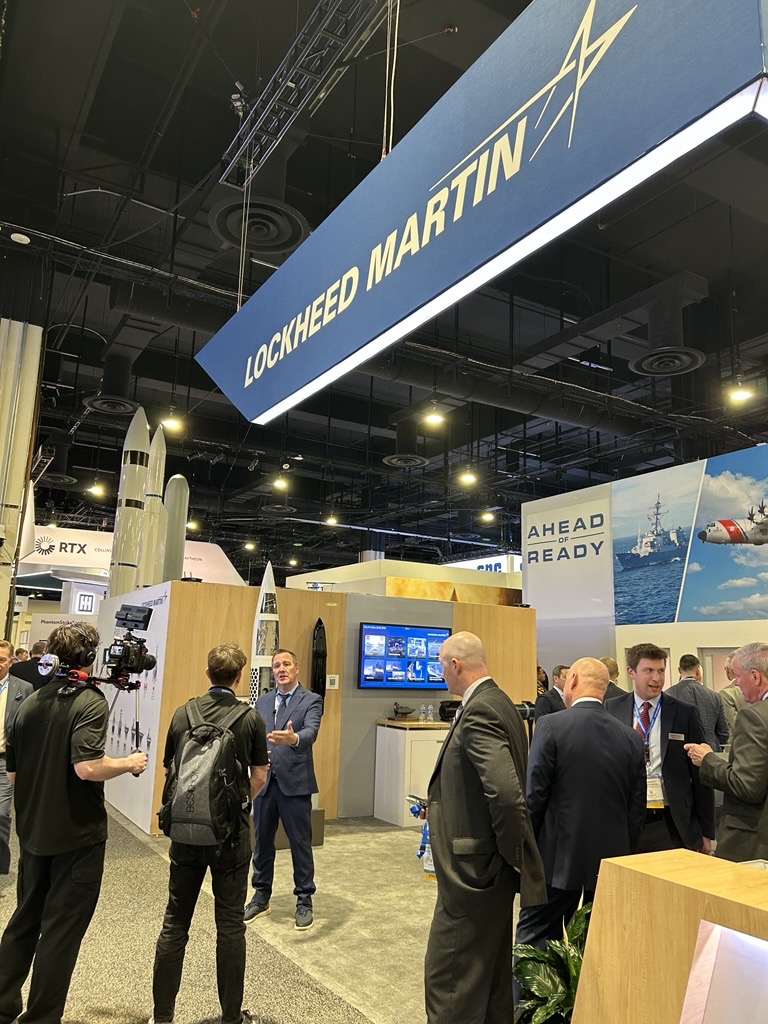
Lockheed Martin’s Dan Tenney speaks with reporters at Sea-Air-Space 2025. Photo credit: Lockheed Martin
A representative from Lockheed Martin said at Sea-Air-Space 2025 the firm is “ready now” to help the nation stand up the “Golden Dome” missile defense system, a new priority of the Trump administration that resurrects some aspects of the Reagan-era Strategic Defense Initiative.
“What does it mean to be ready now? I think it means we have systems that are fielded, they’re operational, they’re proven,” said Dan Tenney, vice president of Strategy and Business Development for Lockheed Martin’s Rotary and Mission Systems section. “They’re actually in operation today.”
A Jan. 27 White House executive order calling for America to develop its own version of Israel’s Iron Dome air defense system unleashed a flood of activity in the defense community. This comes as the government develops the fiscal 2026 defense budget request to Congress, which reportedly could approach $1 trillion, to jumpstart Golden Dome and to support the many other defense priorities.
A March 19 story published by DOD News confirmed the Pentagon is working to bring the Golden Dome from concept to reality.
“Consistent with protecting the homeland and per President Trump’s [executive order], we’re working with the industrial base and [through] supply chain challenges associated with standing up the Golden Dome,” said Steven J. Morani, acting undersecretary of defense for acquisition and sustainment, in the article. “This is like the monster systems engineering problem. This is the monster integration problem.”
This is also a costly proposition. So far, the United States has funneled around $3 billion to Israel — an 8,500-square-mile country roughly the size of New Jersey — for batteries, interceptors and other costs related to Iron Dome, which it stood up in 2011, according to a 2023 Congressional Research Service report.
Establishing a missile defense system covering the entire United States — with a land area of nearly 3.8 million square miles — is estimated to cost billions of dollars annually and present many more barriers to success.
Nevertheless, Tenney said Bethesda-based Lockheed Martin is well positioned to assist.
“We think the future is really going to be around this integration,” Tenney said. “We do operate from seabed to space,” he said, with deep experience developing systems in global positioning, missile warning and tracking, radar, missile defense, high-energy lasers and other capabilities.
“When I think about Golden Dome,” Tenney said, “in so many ways I think we’re going to use existing systems but bring them together.”
Sea-Air-Space: Private Equity Floats Role in U.S. Military and Commercial Shipbuilding
A McKinsey & Company luncheon and a Navy-Coast Guard panel, shown here, at Sea-Air-Space both addressed the issue of investing to help spur the shipbuilding industry. Photo credit: Dan Goodrich
Could private equity investments and business practices jolt the United States’ shipbuilding industry, helping onshore military and commercial capacity to deliver more Navy ships “very fast, very soon,” as President Trump called for in his joint address to Congress last month?
In many ways, yes, argued Benjamin Plum and Christian Rodriguez, associate partners at McKinsey & Company’s Aerospace & Defense Practice, at a Sea-Air-Space 2025 luncheon April 7.
“In shipbuilding,” Plum said, “there’s more appetite for private capital than there has been before because of the stronger demand signals that we’re seeing, both [as] part of this administration but I think more broadly — right? This is a theme that’s continuing.”
Outstripping Capacity
Government, industry, associations and academia have in recent years agonized over ways to increase the speed and scale of shipbuilding — to meet Navy goals for building new ships; upgrading existing ships, submarines, and unmanned systems; and recruiting and training qualified Sailors and mariners. According to a report by the Congressional Budget Office, the 2025 Navy shipbuilding plan calls for 515 “naval platforms,” which includes 381 battle force ships (from 295 today) and 134 unmanned surface and undersea vessels. (The U.S. blue-water flag fleet for international commerce is less than 80 ships.)
“If fully implemented, the plan would eventually result in the fleet’s being larger than it has been at any time since 2001,” CBO said. “However, if the Navy is unable to reduce the maintenance delays that it has been experiencing for more than a decade, it would not be able to deploy as many ships as achieving its 381-ship goal would suggest.”
Speaking at a House Armed Services Committee’s Seapower and Projection Forces Subcommittee hearing last month, Brett A. Seidle, deputy assistant secretary of the Navy for research, development and acquisition, acknowledged the erosion of tier-one shipyards since the end of World War II. Contributing factors, he said in a March 11 DOD News article, include changing Navy requirements, acquisition red tape, worker shortages, and underinvestment and industry consolidation. “Cost and schedule performance remain challenging with deliveries approximately one to three years late and cost rising faster than overall inflation,” he said.
Renewed National Focus
To reduce delays and jumpstart the industry, the Trump administration is reportedly preparing an executive order to revamp the industry, including creating a White House office of shipbuilding focused on the issue. A bipartisan group of lawmakers late last year introduced the SHIPS for America Act, to oversee and provide consistent funding for U.S. maritime policy.
This situation could also present opportunities for private equity to step into the breach, Plum and Rodriguez said at the Sea-Air-Space event. “What we’re starting to see [in shipbuilding] is a desire for a more organized, tiered system like you would see in aerospace,” Plum said.
Risk-averse investors can look to the Navy shipbuilding plan and the federal budget for insights into opportunities in the naval shipbuilding market, Rodriguez said.
According to Plum and Rodriguez, private-capital investments can improve shipyard operations and combat the industry’s perennial problem of retaining skilled workers in the following ways:
Higher wage levels: “These are very, very difficult jobs that are done often outside in arduous conditions, and I think making sure the entry-level pay rate is right is very important,” Plum said.
Better quality of facilities: The industry needs climate-protected facilities that make the work doable and attractive.
Advanced technology: “We have to bring technology to shipbuilding in a way that other industries have done,” Plum said, including incorporating advanced manufacturing “to attract and retain new talent.”
More outsourcing: The shipbuilding industry is historically involved in every phase of ship construction. However, private companies can implement money-saving process efficiencies and develop modern, modular systems that improve ships, shipbuilding processes, and facilities.
Diversify the Industry
Navy and Coast Guard officials said at an afternoon Sea-Air-Space panel on priority defense investments that the government is doing more strategic outsourcing to spur shipbuilding.
The big yards can push component manufacturing to different locations to better produce on the timelines needed for a 30-year shipbuilding plan, said Gordon Jaquith, executive director of the Department of Navy Relations and vice president and director of the Systems, Tactics, and Force Development Division at CNA, a nonprofit research and analysis firm.
Yet big challenges remain. “The way to onshore an entire industry, meaning shipbuilding, back to the United States is not something we can do overnight,” said Rear Admiral Matt Lake, assistant commandant for resources and chief financial officer at the U.S. Coast Guard.
This requires addressing some of the root causes for stagnation in shipbuilding, he said, including barriers to entry for basic services in areas such as ship design, lack of an ecosystem of suppliers to feed parts into the industrial base, and federal domination that leads to monopolistic practices and undermines diversification.
“To solve that problem and bring shipbuilding back you absolutely have to look at the commercial sector as well,” Lake said.
Sea-Air-Space: Navy Spearheads Historic Investments in Shore Infrastructure
Representatives from government and industry discuss the need to update the nation’s aging shore infrastructure, including speeding ship construction through practical reforms. Photo credit: Erika Fitzpatrick
The U.S. Navy is modernizing the condition, configuration and affordability of its public shipyards and shore infrastructure, according to Rear Admiral Dean VanderLey, including by departing in some cases from traditional acquisition strategies.
“Our shore infrastructure on our Navy bases primarily [is] where we train our Sailors and maintain our ships and warfare platforms, and so is very critical to the ultimate readiness of our forces,” VanderLey, commander of Naval Facilities Engineering Systems Command, said April 8 in the panel discussion, “Revitalizing Shore Infrastructure: Meeting Modern Naval Demands.”
The Navy’s four public shipyards — Norfolk (Virginia) Naval Shipyard, Portsmouth (Maine) Naval Shipyard, Puget Sound (Washington) Naval Shipyard and Intermediate Maintenance Facility, and Pearl Harbor (Hawaii) Naval Shipyard and Intermediate Maintenance Facility — were first built in the 19th and 20th centuries.
“Now we’re using them to maintain nuclear-powered vessels,” VanderLey said. The youngest, Pearl Harbor, was founded in 1908 — the year the Ford Model T rolled off the assembly plant and was offered for sale at $850.
“After 100 years, it’s probably time to do something,” quipped panelist Mark Edelson, program executive officer for Industrial Infrastructure at the Department of the Navy. “Everything has gotten bigger and needs more power.”
Upgrading and Modernizing
Fortunately, Edelson said, the Navy has recognized the foundational element of naval installations to all the combat forces, and, in 2018, established the Navy’s Shipyard Infrastructure Optimization (SIOP) to upgrade shore infrastructure. Naval ports and bases face myriad issues, including aging facilities and equipment, insufficient utilities and information technology, lack of worker amenities, and rising waters in some places and diminishing sources of fresh water in others.
“We’re benefiting from historic investments in the shipyards to get after all of those things,” Edelson said.
SIOP, led by Program Executive Office, Industrial Infrastructure and supported by the Naval Facilities Engineering Systems Command, Naval Sea Systems Command and Commander, Navy Installations Command, to date has finished 44 facilities projects worth nearly $1.2 billion, according to the Navy. Another 48 projects are under contract for $6 billion in additional improvements, including construction of four dry docks and upgrades to shipyard utilities.
Some of these projects are hardly straightforward. A recent project to build a new Waterfront Production Facility at the Portsmouth Naval Shipyard required negotiating with the state historic preservation office to retain the building’s original architectural features while modernizing ship servicing capabilities and improving workflow.
“Now the light machine shop, the artisans, the engineers are all in the same building next to two dry docks to get the throughput that we need,” Edelson said.
Departing from Tradition
VanderLey said the Navy is making practical reforms to speed up infrastructure modernization by:
▪ Prioritizing resources. The Navy is first upgrading the most critical infrastructure, including dry dock improvements to support the “future force,” including USS Gerald R. Ford-class aircraft carriers, and future versions of the Virginia- and Columbia-class submarines.
▪ Reforming acquisition strategies.The Navy is in some cases departing from the traditional acquisition process, which typically involves firms bidding on Navy-defined requirements in design and construction. It’s now involving contractors earlier, to mold project design, VanderLey said. That’s helpful in complex infrastructure projects, he said, when cost and schedule are “less about what you’re building than about how you have to build it.”
The Navy is also awarding design-build-to-budget contracts, which allow flexibility and speed while controlling costs.
▪ Alternating construction methods. VanderLey said the Navy is capitalizing on the trend of “industrialized construction” or “off-site construction,” where certain parts or modules — child care centers, barracks, or dorms — are prefabricated off-site for later assembly into the overall build. “In Europe about 45% of their construction is done that way; in the United States, it’s about 5%,” he said.
“We see potential for savings in cost and schedule of roughly 30%,” VanderLey added. “So, we’re aggressively going after those types of approaches.”
Commercial shipbuilding faces similar challenges to the Navy in needing to upgrade its similarly aging infrastructure, in part to recruit and retain workers.
“People need infrastructure too,” said Roger Camp, senior director for Business Development, Naval Programs, at Hanwha Defense USA, a subsidiary of South Korean defense giant Hanwha Group, which purchased the Philly Shipyard last year for $100 million.
He said his firm is exploring ideas to make the maritime facility more attractive to workers, by locating parking closer to the plant, outfitting training areas with virtual reality tools, and expanding — not replacing — production resources through use of AI and robotics.
“We have to have technical infrastructure,” Camp said. “Not just piers not just buildings, but the actual facilities to be able to augment the humans that build our ships.”
Sea-Air-Space: SHIPS Act Aims to Counteract China’s Maritime Dominance
A Taiwanese Yang Ming cargo ship at the Port of Los Angeles. Photo credit: Port of Los Angeles
Most observers agree it’s a national security imperative for the United States to counteract growing Chinese maritime domination. The imbalance is stark: Just 80 U.S.-flagged vessels conduct international commerce today, compared with China’s 5,500 vessels. But how should America slow this worrisome trend?
The measure seeks to grow the U.S. international fleet by 250 ships in 10 years through executive-level oversight; consistent funding for shipbuilding; and shipyard worker recruitment, training, and retention.
“I think one of the most crucial and important aspects of the SHIPS Act itself is not even so much what’s in it but that it’s a comprehensive approach,” said Mark Vlaun, deputy general counsel for American Roll-On Roll-Off Carrier Group, at a Sea-Air-Space 2025 panel on April 9. “It’s almost strategic in its own right.”
Among other provisions, the measure would establish for the first time a Maritime Security Trust Fund, similar to the Highway Trust Fund. The fund would provide a steady stream of support for ship construction, including financial incentives; assistance to small shipyards; loan guarantees; and maritime college and career training.
“We’ve always been a maritime nation, but the truth is we’ve lost ground to China, who now dominates international shipping and can build merchant and military ships much more quickly than we can,” said Sen. Mark Kelly, Democrat of Arizona, in a statement introducing the SHIPS Act measure on Dec. 19, 2024.
Kelly, a U.S. Navy veteran and the first U.S. Merchant Marine Academy graduate to serve in Congress, is joined on the bill by Senate co-sponsor Sen. Todd Young (R-Indiana), and House co-sponsors Reps. Trent Kelly, (R-Mississippi), and John Garamendi, (D-California).
The thrust of the legislation reinforces key themes that surfaced repeatedly at Sea-Air-Space 2025: A revived U.S. Merchant Marine attracts more public and private investments in commercial shipyards and suppliers. This in turn accelerates Navy efforts to improve its public shipyards, shore infrastructure, and best practices in shipbuilding. Combined, these efforts lead to greater maritime military and economic security overall.
Navy and Coast Guard shipbuilding acquisition can already benefit from lessons learned in programs run by the Maritime Administration (MARAD), a U.S. Department of Transportation office that supports maritime transportation infrastructure, including shipyard grants and loan guarantees.
Panelist Dave Heller, MARAD’s associate administrator for Business and Finance Development, said he’s seen how commercial practices at some of the smaller shipyards can speed the construction of military icebreakers and other similarly sized vessels.
“There are lots of ways to get what you need, to get it in the water quickly, and that’s usually through a commercial model,” Heller said.
Heller’s office supports a variety of opportunities in ship infrastructure support, including an $8.75 million Small Shipyard Grant Program that’s inviting applications until May 15, 2025. Shipyards generally with fewer than 1,200 employees can apply for grants averaging $820,000 for capital improvements and maritime training programs.
Supporters of the SHIPS Act argue the measure could better coordinate these programs and national policies to encourage systemic, long-term changes in U.S. maritime policy. “Continuing to maintain a maritime presence is absolutely imperative for us,” said panelist Robert Hurd, legislative director for Rep. Garamendi. “[Capitol] Hill in general is really excited for this opportunity
Navy Seeks to Accelerate Adoption of AI/ML Powered Systems
The Arleigh Burke-class guided-missile destroyer USS Truxtun (DDG 103), left, operates in the Red Sea, May 1, 2023, while supporting the Department of State’s efforts to evacuate U.S. citizens and others who have requested departure from Sudan. Credit: U.S. Africa Command
Deterring China and addressing other global security challenges require the U.S. Navy to evolve in key areas, including faster integration of robotics and autonomous capabilities, said Admiral Lisa M. Franchetti, the 33rd chief of naval operations, in the new 2024 Navigation Plan released in September.
“We know that robotic and autonomous systems, augmenting the multi-mission conventional force, will provide opportunities for us to expand the reach, resilience, and lethality of the combined manned-unmanned Navy team,” Franchetti said. “As we build that team for the future, we are working now on concept and requirements analysis for larger robotic systems, as well as the artificial intelligence applications that help us sense and make sense of a complex, information-centric battlespace.”
The plan comes amid a Pentagon push to accelerate artificial intelligence/machine learning (AI/ML) technologies in offensive and defensive applications in the joint force and across the armed services. But advancing Franchetti’s goal — one of seven fleet readiness targets the plan envisions reaching by 2027, when Washington expects China to be on a war footing — won’t be easy in a service that tends to focus on continuity versus change.
“When we think about AI and the Navy, one of the most important things is getting it on the ship,” Bill Rivers, a fellow at the Yorktown Institute and content strategist at Palantir Technologies, told Seapower. “So, it’s software onto hardware onto the ship [and] that requires an accreditation process, which takes time.”
Last year, the Department of Defense announced the Replicator initiative to speed up adoption of commercial technology in the military and national security space, particularly lower-cost unmanned capabilities. Led by the Defense Innovation Unit, a DoD office based in Silicon Valley, Replicator calls for quickly fielding more autonomous systems across multiple domains in part by cutting red tape and encouraging industry-defense partnerships.
In 2023, Navy Secretary Carlos Del Toro stood up the Disruptive Capabilities Office to invest in, adopt and scale cutting-edge hardware and software. Joining that office and reporting to Del Toro and Franchetti are two Navy task forces working on AI/ML: Task Group 59.1, which focuses on developing unmanned capabilities; and Task Force Hopper, focused on AI/ML.
Franchetti said in the Navigation Plan that the Navy already leads the joint force in operationalizing robotic and autonomous systems across numbered fleets and in Navy special warfare, in areas such as sensors and munitions. The Navy in 2024 established an enlisted Robotics Warfare Specialist rating and is growing robotics expertise in the officer corps.
The Navy has also in recent years worked on develop AI/ML capabilities in partnership with the DIU, an office established nearly a decade ago to incubate commercial technology solutions that address national security challenges. Recent DIU-Navy partnerships include Project AMMO, to develop machine learning operations tools to improve underwater threat detection. In 2022, DIU engaged five vendors — Arize AI, Domino Data Lab, Fiddler AI, Latent AI, and Weights & Biases — to develop various components of the capability.
There is also a collaboration with the Navy’s Project Overmatch to enable unmanned systems to operate in “disconnected, denied, intermittent, and/or limited bandwidth environments.” In January 2024, DIU awarded three vendors — Ditto, Syntiant, and HarperDC — prototype agreements to develop capabilities in areas such as synchronizing and distributing data to improve the operating picture and creating retrainable AI models that improve the effectiveness of unmanned systems.
In addition to Pacific threats and Houthi attacks, Franchetti noted, Russia’s ability to adapt to Ukrainian innovations on the battlefield demonstrated the need for a more agile Navy that can bring additional AI/ML-powered technologies to the fight.
“What’s needed now,” Rivers said, both in the Navy and across the defense enterprise, are “commanders who are willing to lean in, find these opportunities to battle test these capabilities, so that the carriers, the cruisers, boats can communicate back to maritime operations centers” and build out “how they would actually fight with these tools at the edge, on the worst day.”
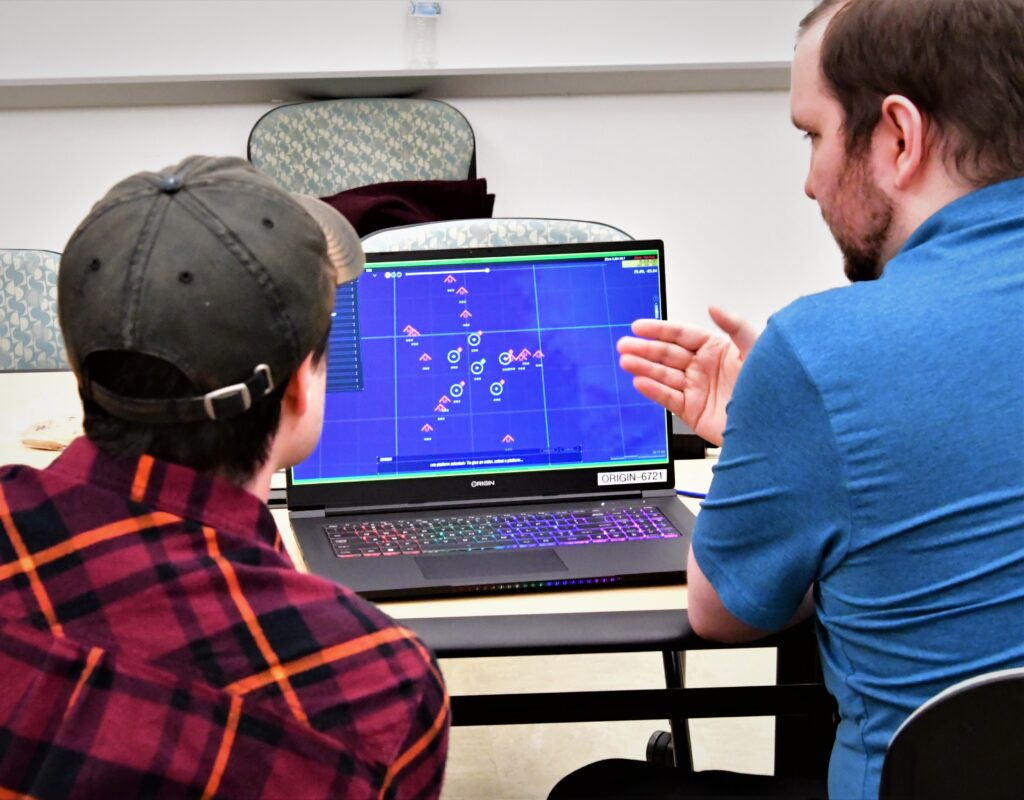
College students used the Joint Cognitive Operational Research Environment software to compete in the 2023 Artificial Intelligence and Machine Learning Innovation Challenge at Dahlgren. The software demonstrated three different scenarios involving a multitude of ships and threat counts to challenge the students’ decision-making. Credit: Naval Surface Warfare Center Dahlgren Division | Morgan Tabor
He said software and AI can also serve a “powerful role” in improving defense manufacturing and maintenance through better use of real-time data. “There is no kill chain without the supply chain,” Rivers said. “It’s not just on DoD or the government to do this, it’s a whole-of-enterprise effort.”
However, compared with all other DoD components, the Navy spends the least on technology produced by new players in the defense field, according to the 2024 NATSEC100 report by the Silicon Valley Defense Group. These are firms that specialize in advanced computing and software, trusted AI and autonomy, space technology, advanced materials, and integrated sensing and cyber capabilities.
The report found the top 100 tech firms with defense experience received just $22 billion in federal funding and only $6 billion in DoD funding. (For context, the 2024 National Defense Authorization Act authorized over $874 billion in defense spending.) “Perhaps even more strikingly,” the report said, “81% of the total amount awarded by the United States government, and 65% of the DoD-awarded funding, went to a single company, SpaceX.”
Lieutenant Artem Sherbinin, chief technology officer for Task Force Hopper, called on industry to help the Navy close the digital technologies gap. In February remarks reported by National Defense magazine, he said a key “opportunity” for the field is the fiscal 2024 NDAA, which authorized around $11 billion in Navy commercial IT spending.
Emerging needs include tools to counteract adversarial unmanned systems, especially in light of reports that the Navy used $1 million missiles to defeat $100,000 Houthi drones threatening Red Sea shipping lanes.
“Do we need to find, or should we find, a more cost-effective way of downing, say, an inexpensive drone? Absolutely,” said Rear Admiral Fred Pyle, director of surface warfare division N96 in the Office of the Chief of Naval Operations, in a May 14 discussion with the Center for Strategic and International Studies. “And we’re working towards that, and we have some solutions that I can’t go into, but we are going to get after finding more cost-effective ways to address those lower-end threats.”
A Sept. 27 memo issued by Defense Secretary Lloyd Austin formalized this imperative, calling for the next phase of Replicator to focus on countering the threat of small uncrewed aerial systems to critical installations and force concentrations.
The Navy is testing directed energy and other types of counter-drone systems and taking other steps to foster partnerships with industry on AI/ML applications.
In March 2024, 600 representatives from government, academia, and industry attended the eighth annual Naval Applications of Machine Learning (NAML) workshop, hosted by the Naval Information Warfare Center. Attendees heard 150 presentations on efforts to use AI/ML in naval operations in a range of ways — from translating bridge-to-bridge audio transcriptions to transforming drone command systems.
But, as Sherbinin explained in an August LinkedIn post, the Navy is apt to take longer than other services to adopt new digital capabilities. That’s in part because much of the Navy budget goes to buying or maintaining super-expensive items such as aircraft carriers, where the “‘digital’ things that we can’t see” — software, AI, data — “become an afterthought,” he said.
And the Navy is steeped in a tradition that can be averse to disruption. “Simply stated,” Sherbinin said, “change is hard in the naval service.”
Justin Fanelli, Department of the Navy Acting chief technology officer and technical director of PEO Digital, gives a speech during the eighth annual Naval Applications of Machine Learning (NAML) workshop, March 12, 2024, in San Diego. Credit: U.S. Navy | Mass Communication Specialist 1st Class Bobby Siens
Erika Fitzpatrick is an award-winning writer living in Washington, D.C. With more than 20 years of experience in public policy journalism and communications, she specializes in covering issues affecting service members, veterans, and military families. This article originally appeared in the December issue of Seapower.
Navy Expands Suicide Intervention and Mental Health Services; Survivors Say More Must Be Done
Boatswain’s Mate Seaman Kalea Howe, assigned to the amphibious assault ship USS Wasp (LHD 1), poses and screams for a photo to personify feelings of anxiety and depression. This photograph was captured using multiple exposure techniques and was later used to accompany a story about depression for suicide prevention month. U.S. Navy | Mass Communication Specialist 1st Class Alora R. Blosch
“The reason I’m writing this is because I feel you are the only person that can make the changes necessary for others to not suffer the same fate I did,” Petty Officer 3rd Class Brandon Caserta wrote to his commanding officer. “If you can successfully take action and make the changes, you will prevent more suicides within the Navy.”
Brandon died by suicide June 25, 2018. That year, he joined a tragic roster of 68 U.S. Navy Sailors on active duty who took their own lives.
Before his death at age 21, the Peoria, Arizona, native wrote letters to his family, friends, supervisor and others that described toxic leadership and a hostile work environment. Stationed at Naval Station Norfolk while attached to Helicopter Sea Combat Squadron 28, he reported being hazed, bullied and sexually assaulted. Brandon felt the Navy had labeled him a failure. He asked for, but was denied, medical attention.
Brandon’s parents, Teri and Patrick Caserta, argue Brandon would be alive today had the military intervened to provide their son with confidential access to mental health services. Their advocacy in the aftermath of Brandon’s death led to passage of the Brandon Act, which the Department of Defense officially launched one year ago this month.
The Brandon Act requires the Navy and all military branches to make it easier for service members to ask for mental health treatment confidentially — for any reason, at any time and in any environment. Supervisors or commanders of service members who invoke the Brandon Act must quickly facilitate evaluations, assuring privacy.
“If you’re on a ship in the middle of nowhere and you need mental health care, it might take a day or two and happen by telemedicine or some other way,” Dr. Lester Martinez-Lopez, the assistant secretary of defense for health affairs, said in a Jan. 22, 2024, DoD News article on the Brandon Act. “But it doesn’t matter where you are. All you need to do is raise your hand and tell your supervisor and they will take care of that as soon as possible.”
The Brandon Act passed as part of the fiscal 2022 National Defense Authorization Act, signed into law by President Biden Dec. 27, 2021. The DoD implemented the policy May 5, 2023, giving the service branches 90 days to roll it out to all service members, starting with the active-duty components.
Along with the other services, the Navy has since reiterated that suicide prevention is a top priority and communicated about the self-referral process available under the Brandon Act. The Navy is taking other steps to reduce stigma associated with asking for mental health services and promote help-seeking behavior. Efforts include expanding virtual and in-person health, mental health and quality-of-life offerings, particularly those aimed younger enlisted service members, who data show are most at risk of death by suicide.
In 2022, the Navy began moving its Sailor Assistance & Intercept for Life (SAIL) suicide intervention program from an in-person model to a virtual model. The Navy completed the transition to fully virtual SAIL in January 2024. The virtual model is staffed with dedicated remote counselors from the Fleet and Family Support Center (FFSC). The Navy says more Sailors are now using the service, citing in the increased accessibility and privacy of virtual care and assistance. The program is operated by the Commander, Navy Installations Command (CNIC), which oversees 10 Navy regions, 70 bases and more than 43,000 employees.
By the end of 2024, the Navy plans to complete the expansion of FFSC’s virtual clinical counseling program, which will provide Sailors and their families in all 10 Navy regions with remote access to short-term assessments, treatment planning, clinical counseling, and referrals from licensed mental health professionals.
‘More Needs to be Done’
In a phone interview with Seapower magazine, Patrick and Teri Caserta commended Navy and other Pentagon leaders for their willingness to improve access to suicide interventions and other mental health services.
“The (virtual) SAIL program is a step in the right direction,” said Patrick, a 22-year retired U.S. Navy senior chief and naval counselor.
But, he added, “more needs to be done” to end military suicides, including expanding awareness of the Brandon Act and educating commanders that “if you violate the Brandon Act, you’re breaking the law.” Among the lawmakers overseeing Brandon Act implementation and spearheading related legislation in Congress is Sen. Tim Kaine (D-Virginia), whose state is the home of Naval Station Norfolk, where Petty Officer Caserta died.
“I’ve heard heartbreaking stories from many servicemembers and their families about mental health challenges, the lack of resources, and the stigma associated with asking for help,” Kaine told Seapower in a statement.
Members assigned to U.S. Naval Forces Central Command talk to a Sailor during a mental health awareness event in Bahrain, April 12, 2023. U.S. Army | Specialist Aaron Troutman
OIG Evaluation
Kaine, a member of the Senate Armed Services Committee and chair of its Seapower subcommittee, said he’s committed to expanding service members’ access to mental health care and to preventing military suicides, including assessing the effectiveness of Navy efforts to address this issue.
Pursuant to a directive Kaine and colleagues included in the fiscal 2023 national defense bill, the DoD’s Office of Inspector General in February 2024 launched an evaluation of the Navy’s suicide prevention and response efforts.
A Feb. 27 OIG memo said subjects of the evaluation include the Department of the Navy, Office of the Under Secretary of Defense for Personnel and Readiness and the Defense Health Agency in the National Capital Region. Evaluators plan site visits to Naval Station Norfolk as well as to Naval Base San Diego in California; Naval Base Kitsap in Bremerton, Washington; and Naval Station Pearl Harbor in Hawaii. OIG said it could add other locations to evaluate.
Under Navy policy, commanders must submit a SAIL referral after a Sailor experiences suicide ideation or attempts suicide and is evaluated by a medical treatment facility or emergency department, Cornealius L. Stamps, the SAIL clinical counseling program analyst, said in an email interview with Seapower.
A SAIL case manager must contact the referred Sailor within one day to offer assistance and care services. Sailors who accept services can receive virtual counseling from a remote SAIL or clinical counselor or see an FFSC clinical counselor in person.
SAIL’s move to a virtual model with dedicated case managers has coincided with an increase in Sailors accepting services, Navy-provided data shows. The percentage of Sailors referred to SAIL who accepted services rose from 46.5% in 2020 to 62.67% in 2023. To meet the demand for services, SAIL’s staff of case managers rose 42%, Stamps said.
It’s too early to say if these and other programs are reducing the number of miliary suicides. In all of calendar year 2022, 492 active-duty, National Guard and reserve service members died by suicide, according to the DoD. This was fewer than the 524 service members who died this way in 2021. Most military deaths by suicide occur among enlisted men under age 30.
More recent quarterly data showed no increase or decrease in Navy active-duty service member deaths by suicide, even as these deaths increased in the active Army, Marine Corps and Air Force. Those three services combined saw 19 more active-duty service member deaths by suicide in the first quarter of calendar year 2023, compared to the first quarter of calendar year 2022.
Stamps said the response to virtual SAIL so far is encouraging.
“Sailors have shared positive feedback about SAIL’s virtual services through the program’s anonymous surveys, during conversations with their case managers,” she said, noting, “we’ve also heard similar sentiments echoed by referring leaders.”
Sailors can also request SAIL services by contacting their local FFSC, a chaplain or another available mental health program. And although CNIC doesn’t oversee ship operations, Sailors aboard a ship without counseling services can ask their command to arrange SAIL services by phone.
“It’s well-known that military service is challenging and comes with unique stressors that those in the general public will never face,” Stamps said. “Recognizing that you need help and asking for it is a sign of strength.”
Greater Awareness
In addition to offering virtual SAIL and more remote counseling options, the Navy in July 2023 issued Brandon Act-related guidance and resources in a directive-type memo and fact sheet. The service issued a revised Navy Mental Health Playbook addressing mental health within commands and plans to update and send out additional marketing materials throughout the year. In January 2024, the Navy distributed to all commands the Suicide Related Behavior Response and Postvention Guide, streamlining suicide crisis response guidance and providing step-by-step instructions on the SAIL referral procedures.
Despite these efforts, Patrick and Teri Caserta said too many service members and military families still don’t know about the Brandon Act or how to access mental health services.
They’re working for change through the Brandon Caserta Foundation, making sure all service members and veterans get the help they need, without retaliation. They want new military recruits educated about the Brandon Act before service even begins. They want Brandon’s image on military posters with the message that it’s OK for Sailors and service members to seek care, for any reason. They want mental health counselors embedded at the unit level and for the military to establish a uniform response to this crisis.
Ultimately, they want to continue to share what Brandon’s experienced — to raise awareness about military suicide, empower service members and families and enact policy changes that will end military and veteran deaths by suicide.
“We know that Brandon’s story saves lives,” Teri Caserta said.
Sidebar:Navy Goes Virtual to Boost Sailors’ Access to Quality-of-Life Programming
To boost the quality of life and health of today’s Sailors, the Navy in late January launched a new Virtual Single Sailor Program (VSSP), a platform offering service members and their families worldwide remote access to electronic sports contests, fitness programs and other entertainment and wellness resources. “Obviously, the modern-day Sailor has changed in the way that they interact with information and each other,” said Lisa Sexauer, who is director of Fleet Readiness for Navy Installations and oversees the Navy’s Morale, Welfare and Recreation programs. “And so being able to reach them with useful information and also virtual dynamic programming — wherever the Navy operates and wherever their mission allows them to access that information — is kind of the brainchild behind it.”
Sailors can log onto the platform to virtually participate in esports, locate community-based recreational events, access workout builders and find vacation discounts and other resources.
“The real effort here is to create some connectedness and for people to build communities of support (and) friendships,” Sexauer told Seapower.
VSSP emerged from an ongoing effort to pilot- and focus-test quality-of life-programs that better meet the “desires and needs” of Sailors, she said, particularly those in the E-1 to E-6 enlisted paygrades. Along these lines, the Navy said earlier this year it is considering offering free highspeed Wi-Fi to all Sailors. This is pending the results of a February-September pilot test of the service at 12 permanent party unaccompanied housing locations at Naval Station Norfolk, NAVMEDCEN Portsmouth and Norfolk Naval Shipyard.
In early March, installation commanders also got the go ahead to implement 24/7 entry to staffed or unstaffed fitness facilities.
“If we require our Sailors to be physically fit and healthy so they can fulfill the Navy mission and deploy at a moment’s notice, then we must provide the facilities and resources for them to do so,” Vice Admiral Scott Gray, commander of Navy Installations Command, announced March 8. “Not only does this make sense, it is the right thing to do for the quality of life of our Sailors and other service members.”
Navy Strives to Realize its Vision for Greater Use of Unmanned Systems
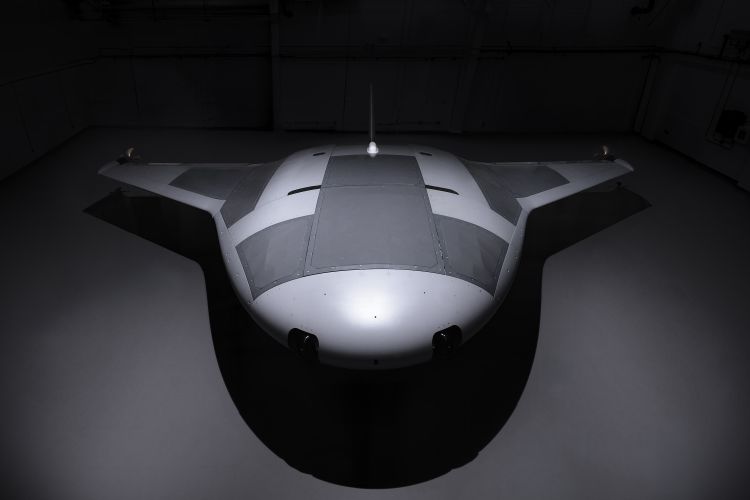
A full-size prototype of Manta Ray, a new class of uncrewed underwater vehicle, is assembled in Northrop Grumman’s Annapolis facility. Northrop Grumman
Unmanned systems are increasingly part of maritime defense, but integrating remote air, surface and undersea capabilities into fields of operation requires new thinking and a whole lot of trust, military leaders and experts said at Sea-Air-Space 2024.
“In force fleet, we really try to move from experiments to operationalizing,” said Rear Admiral James Aiken, commander of U.S. Naval Forces Southern Command and commander, U.S. 4th Fleet. “And then we also want to go from the tactical — from those simple functions that we talk about — to the operational.”
Aiken spoke at a panel of senior and retired military leaders from the Navy, Marine Corps, U.S. Coast Guard and private industry.
Moderating the panel was Bryan Clark, senior fellow and director at the Hudson Institute, a naval operations expert and co-author of the study, “Unalone and Unafraid: A Plan for Integrating Uncrewed and Other Emerging Technologies into US Military Forces.”
Clark and co-author Dan Patt argued in the paper the Navy could use “AI-enabled uncrewed vehicles” to gain and sustain operational advantage against a great-power rival like China. “The ability of uncrewed systems to provide resilience and adaptability depends on scale,” Clark and Patt wrote in the paper, published last year.
The Navy described its vision for integrating unmanned aerial systems, ships and undersea vehicles into the fleet and fleet marine force in the “Advantage at Sea” strategy and the follow-on “Unmanned Campaign Framework,” released in 2001. But, as a 2022 U.S. Naval Institute article argued, Congress is unlikely to fund these vehicles unless the Navy develops a more complete conception of their use across conflicts.
That work is ongoing, panel speakers indicated.
Rear Admiral Kevin Smith, Program Executive Officer of Unmanned and Small Combatants with Naval Sea Systems Command, said his office is supporting Navy efforts by designing, developing, building and modernizing unmanned systems. These include unmanned maritime systems and mine and expeditionary warfare systems. Areas of study and experimentation focus on mechanical and electrical systems, autonomy, interoperability and more.
“Obviously a lot of data is being gathered,” Smith said, which can be used to improve the systems and define their requirements for acquisition. And this applies to large unmanned system as well as medium and small systems.
“Taking the Sailor out of harm’s way isn’t very important — it’s paramount,” Smith said.
Aiken said getting these tools more quickly into a battlefield environment requires less testing and more operations. He said this has involved “putting unmanned vessels into the hands of operators” and “testing our assumptions” on how the Navy deploys, positions and otherwise uses them.
Aiken said the goal is to combine manned and unmanned systems, and to stack unmanned systems, “which I call the Reese’s effect, where we’re putting peanut butter and chocolate together,” he said. He cited the use of unmanned surface vessels with communications balloons as part of a mesh network.
Retired Rear Admiral John Tammen, deputy of the Undersea Enterprise Campaign for the Northrop Grumman Mission Systems Sector, said he sees three broad areas of opportunities to further the Navy’s efforts in this area:
• First, there are more players on the field from private industry. Tammen said a brief walk through the Sea-Air-Space exhibit hall showed the array of firms either operating their own vehicle or supporting their components. “That was very exciting to see and I think we need to support that,” he said.
• Two, the evolution of using unmanned systems in capacities beyond surveillance to man-unmanned operations. “The example I like to use is the P-8 tied to the Triton,” he said. “Being able to get something that’s greater than the sum of the parts — one plus one equals three.”
• Three, the increasing ability to get significant payload far forward, from undersea, Tammen said, as has been demonstrated in the DARPA-Northrop Grumman Manta Ray UUV program and others.
In fact, unmanned systems that are contractor-owned and operated appeal to the U.S. Coast Guard, which has a smaller budget and less acquisition, said Thom Remmers, Systems Strategic Team Lead and Naval Engineer and Acquisition Program Manager.
Aiken said at the end of the day, a lot of success involves building service members’ trust in unmanned systems — not for use in a lab but in the real world.