Ships and Human Performance: Surface Forces Take Holistic Approach to Sailors, Crew Training
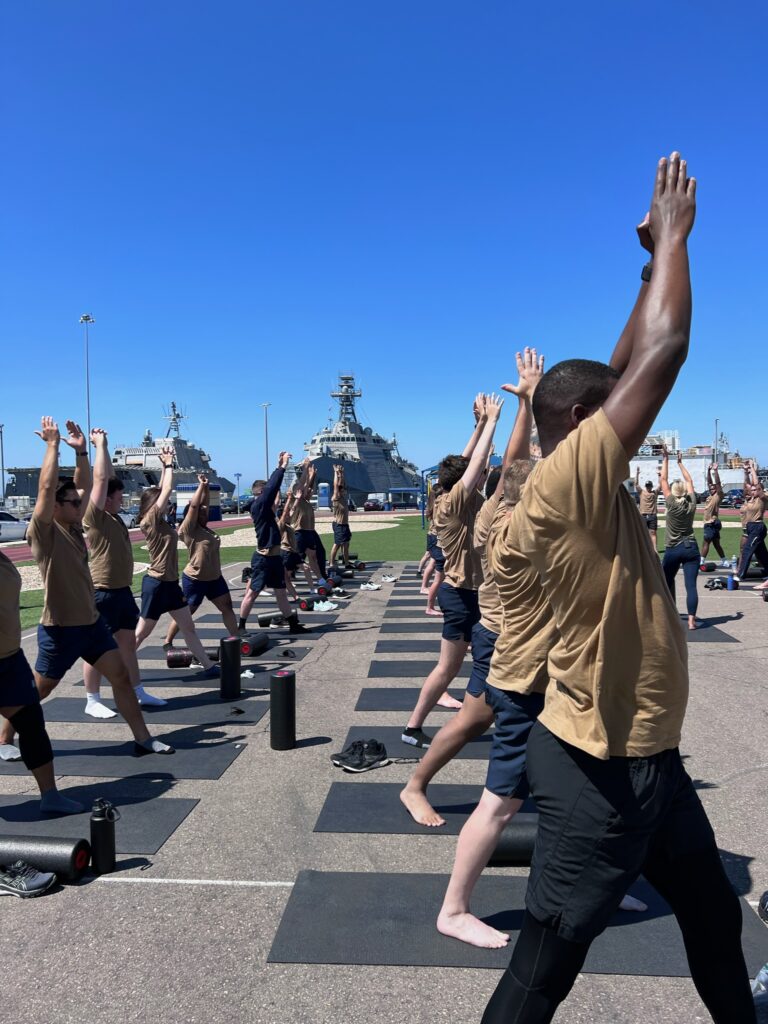
Human performance company O2X led littoral combat ship crews in two days of exercise and yoga classes during a workshop in San Diego in late 2021. U.S. NAVY

On the surface of it, the idea of training Sailors about nutrition, exercise, fitness, injury prevention, sleep and mental well-being didn’t seem like a hard sell. Two days of classroom instruction, workout drills and yoga sessions, all led by professional trainers, gave them a temporary break in their routine aboard ship in homeport at Naval Base San Diego.

The workshops led by O2X Human Perfor­mance over the past year are an outgrowth of an innovative program that began in 2021 at Surface Warfare Officers School to teach future ship commanders how to better lead their crews by maximizing their own work performance, physical fitness, mental health and mental readiness. The holistic approach to these pro­grams are among the surface Navy’s continuing course changes after investigations into the causes of shipboard mishaps, including collisions and groundings, found commanders and crews plagued by sleep deprivation, stress, fatigue and inadequate training.

The initial series of workshops for ships’ crews — sup­ported by Naval Surface Force officials in concert with Naval Health Research Center’s Crew Readiness and Watchstanding (CREW) efforts — found that all Sailors benefit from the training and incorporated it into their own work and personal lives.

“We’ve collected a substantial data. It’s loved. Ev­erybody likes it,” said Dale Russell, the Naval Surface Force’s operational safety and human factors advisor in San Diego.

As of mid-October, 770 Navy personnel have gone through the O2X program since it was incorporated into the Prospective Commanding Officer/Executive Officer courses at Surface Warfare Officer School in Newport, Rhode Island, according to O2X Human Performance, a Scituate, Massachusetts-based company founded by three former Navy SEALs. That includes 440 officers at SWOS and 305 sailors and officers from Naval Surface Forces Pacific ships in San Diego, including destroyer USS Preble (DDG 88), littoral combat ship USS Man­chester (LCS 14) and, more recently, the Blue Crew of USS Omaha (LCS 12).

Buoyed by the positive feedback, Naval Surface Force is weighing the next step and plans to expand its invest­ment across the waterfront by developing a program in-house. Consider it the human equivalent of preven­tative maintenance measures the Navy long has had in place for its multi-billion-dollar inventories of ships and aircraft.

Preventative Maintenance

It would be “an O2X-like program that is organic to the fleet and is built around firefighting and damage con­trol,” Russell said. “It will give the team something to rally around. It’ll build unit cohesion, solidarity, camara­derie… [and] it’ll give them a context to get into physical shape. This will give them something to train around.”

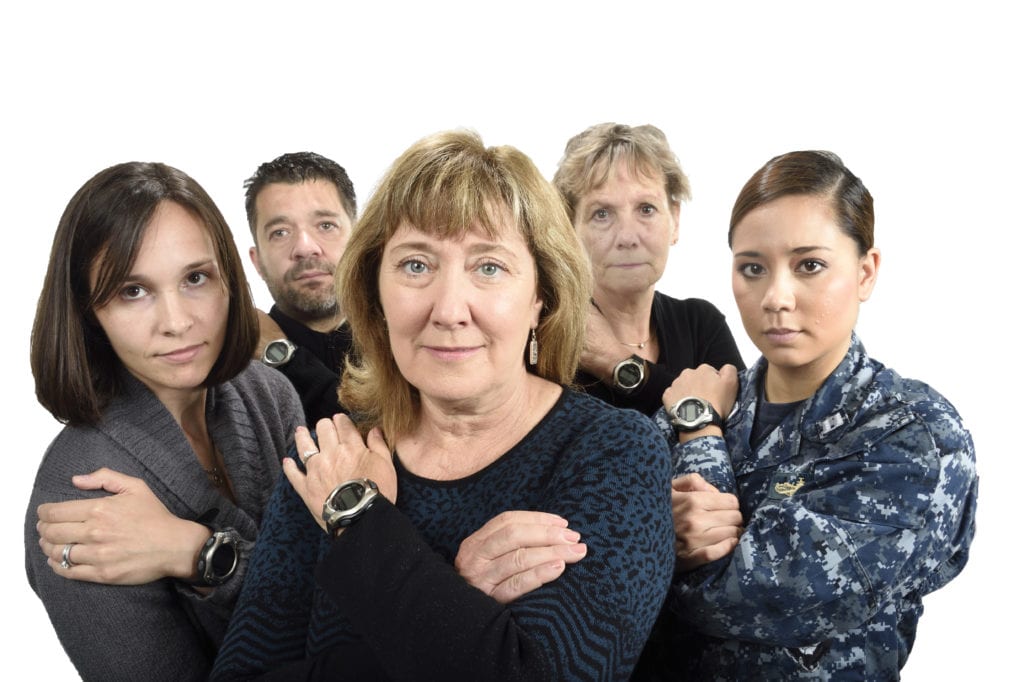
An ongoing CREW study, into wearables for fatigue management, is helping get “this curriculum in front of as many Sailors, leaders and surface fleet that we possibly can,” said Adam La Reau, a former SEAL and co-founder of O2X Human Performance. Sailors “are excited that the Navy is putting the time into them.

“We’re providing skills-based training. That education, just like with their skills-based training with the jobs that they do every single day, continues,” La Reau said. “Human performance is no different than [training] in their roles as a navigator. They constantly have to learn.”

“This is not something that you provide one time,” he said. Ideally, “they have to be built into their routine, built into their battle rhythms, but also at touchpoints. These are hard installs of education along the way. It could be when a ship is coming out of a maintenance cycle. It could be at Great Lakes, post-A School. It could be periodically when a ship crew change-out happens.”
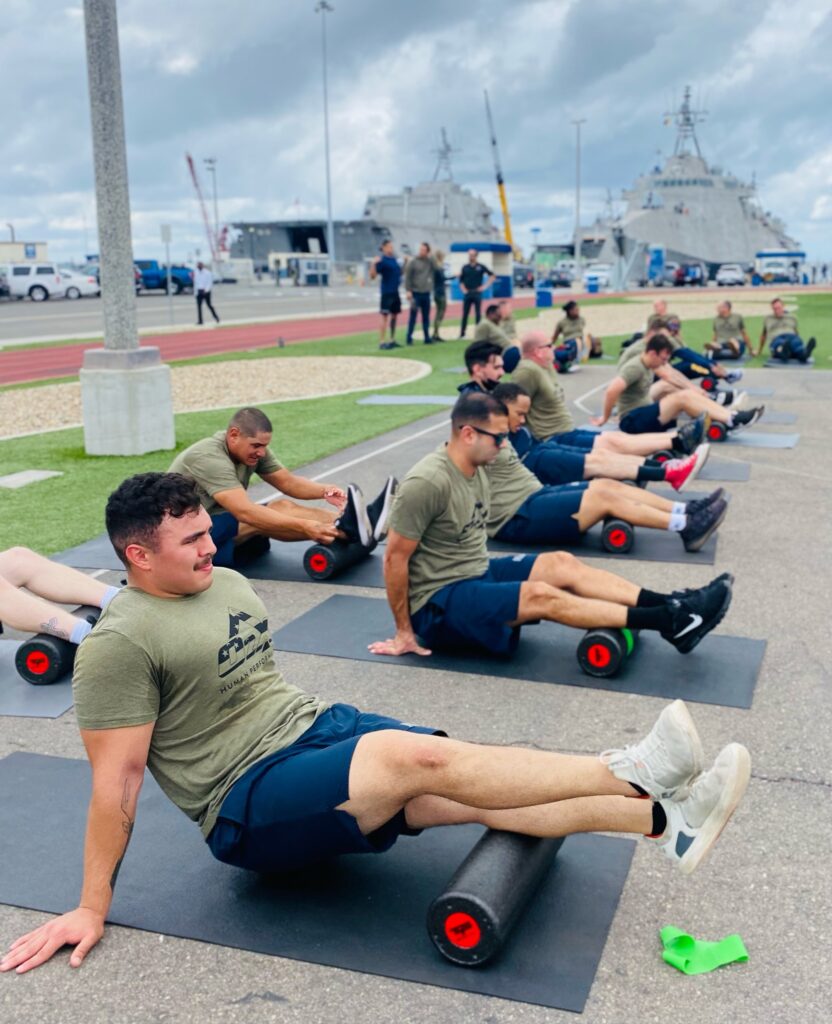
The O2X classes are an outgrowth of a program that began in 2021 at Surface Warfare Officers School to teach future ship commanders how to better lead their crews by maximizing their own work performance and physical fitness. U.S. NAVY

O2X’s mantra focuses on one making small but import­ant incremental changes of 1% — whether in sleep or nutrition habits, managing stress or exercise routine. Each workshop wraps up with an all-hands discussion on making that goal a daily reality. “It’s not just with the leaders, it’s with the entire crew and teaching them about taking ownership,” La Reau said.

“It’s like everyone’s on a team, and you’re walking into a locker room every single day and we continue to fill each other up. We find ways as an organization, not necessarily waiting for the CO or the XO or one of the senior enlisted to step up and say something. Everybody has a voice here,” he added. “The Sailors have a ton of examples of previous ships and past experiences that may be small things that we could potentially change. We don’t have to do it the way we’ve always done it.”

O2X Human Performance is working with Naval Health Research Center over the next year in the CREW study and with the Navy’s Center for Security Forces and is talking with aviation and safety commands for potential collaboration in similar vein as the fleet.

“There’s quite a bit of appetite and opportunity,” La Reau said, noting the training touches on safety, health, wellness, readiness, resilience, retention and maybe recruitment. “There’s also a risk-mitigation factor here. It’s driving self awareness. It’s understanding what your capabilities are, understanding … how to persevere through challenging times or in the moment to be able to dig into resources to execute at a very high level.”

The best part, he said, is “we’re seeing these individu­als saying, ‘I need to make a change. Me being a good leader is definitely tied to taking care of myself and me being a good example. Especially onboard a vessel, onboard a ship. People are emulating what I do and how I live my life. I need to take care of myself, so I can take care of my ship and my Sailors and so I can be the best leader that I can be. And I can do the things that the country has asked me to do.’”

Naval Surface Force and Naval Health Research Cen­ter continue to process and analyze feedback and data collected through the workshops’ participants who use wearable devices that track sleep, exercise and other information. “The scientific literature is pretty clear: If you exercise, your biophysical response makes you sleep better, which gives cortisol, which makes you feel bet­ter. It builds social bonds, which make you feel better, sleep better, exercise better,” Russell said. “So, it’s a positive feedback loop.”

The reality of daily life in the fleet, however, makes physical training extremely hard for many Sailors and crews to sustain, he acknowledged. But Sailors want just that. In safety climate assessments across the fleet, collected as part of the CREW effort over the last two years, “Sailors have voiced: We really want to work out more. We’re bummed that we don’t have group PT,” Russell said. “A very small percentage of the ships even have mandatory PT, because of the nature of the environment they work in. We’ve realized that a paradigm shift is needed, but that’s easier said than done in a large organization like ours.”

Naval Surface Force officials, led by Vice Adm. Roy Kitchener, are working to change that. As it develops its organ­ic human performance training, the surface Navy also will roll out a new watchbill software, OWL, designed to help leaders and crews manage fatigue.

“We are right now pilot-testing that on, I think eight ships this fall, currently. If this works out, then we’ll start rolling it out to the fleet next year, fleetwide,” Russell said. “We are getting ready to rewrite our CREW Endurance instruction to capture that.”
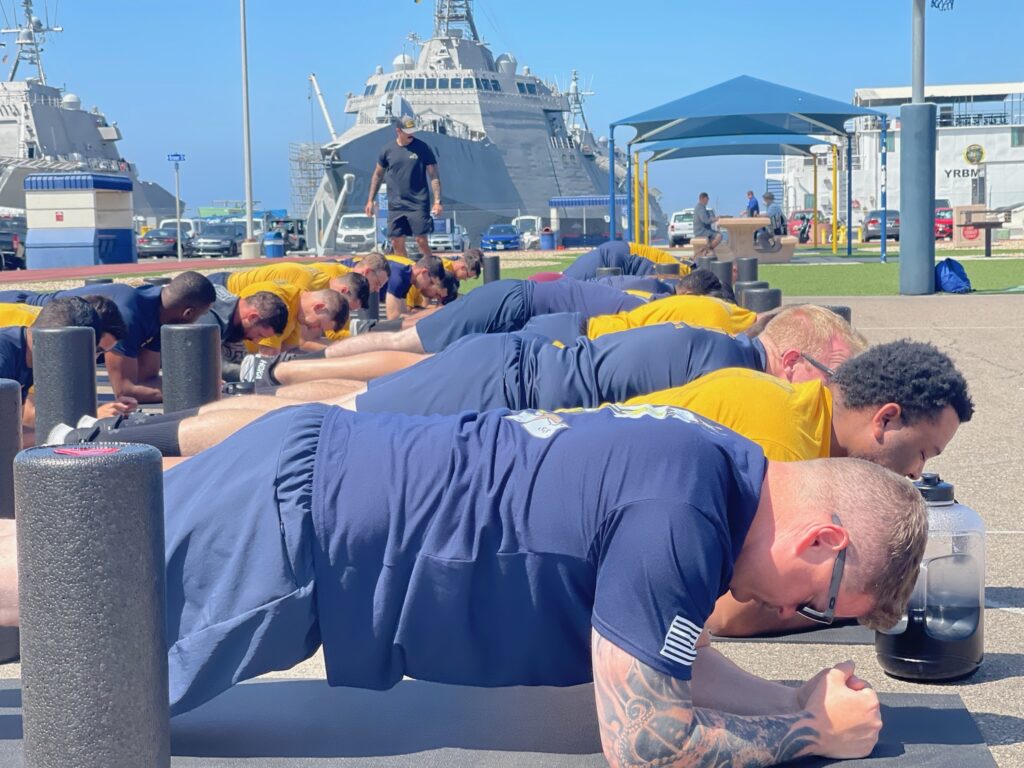
Buoyed by positive feedback, Naval Surface Force plans to expand its investment across the waterfront by developing a similar program in-house. U.S. NAVY

Wearable Devices

SURFOR also is looking at using wearable devices as “an occupational management” tool, he said, provided they can develop algorithms that work for shipboard life. Trackers such as Fitbit work if one is “walking on terra firma, not on water, which throws off some of the sen­sors on it,” he said. With 18 months of data collected so far, SURFOR is “putting motion sensors aboard the ships so we can kind of get a feel for how a ship like an LCS bobs in the water as opposed to an amphib, so we can tweak the algorithm based on whatever ship they’re on.

“The plan will be to roll out 55,000 wearables to the entire fleet,” he said, acknowledging the challenge since one-third of a ship’s crew turns over annually. More likely those devices would be fielded to field it to “key, critical billets,” likely the bridge, engineering and com­bat information center.

Several months ago, Kitchener allocated $1 million for the authority to operate “a wireless hub to go on ships and pull the data off the wearables to the ship’s net­work — CANES — and feed it into OWL,” Russell said. If all goes as planned, that connectivity will be up and running on those ships during exercise Talisman Saber in 2023 “so we can kind of pressure-test it.”

“OWL will give the leadership on the ship that visibil­ity of what’s going on. … They can break it down by department, watchbill, however they want to slice and dice that data,” he said. Connectivity can be spotty at sea, so they’re looking to push data off the ship and into Jupiter, the Navy’s enterprise data link environment. The combination of OWL implementation and wearables could provided a “check engine,” light, for example, for someone who didn’t sleep well at night.

“That could the touchpoint” for a leader to then ask them to go see medical or ask about their sleep, Rus­sell said. “So no matter – whether you have COVID or whether you haven’t slept well or you had a fight with your loved one or you’ve got an STD — it’s your heart-rate variability and deviation from that. … We’re just trying to trigger that touchpoint and say, something’s wrong. Let’s go see what might be wrong.”


From Submarine to Mars Explorer, Discovery is this Navy Veteran’s Mission

NASA’s Perseverance Mars rover looks back toward its tracks on July 1, 2021 (the 130th sol, or Martian day, of its mission), after driving autonomously 358 feet (109 meters) — its longest autonomous drive to date. Taken by one of the rover’s navigation cameras, the image has been processed to enhance the contrast. NASA / JPL-CALTECH

When the Perseverance rover landed on Mars on Feb. 18, cheers and applause filled mission control at NASA’s Jet Propulsion Laboratory in Pasadena, California. In the crowd celebrating was Matt Wallace, who as a young naval submarine officer plied the depths of the seas before journeying into a long career exploring space and the vast unknowns of the Red Planet.

Wallace had faced similar stress the day Perseverance was launched atop a United Launch Alliance Atlas Rocket V that blasted off from Cape Canaveral, Florida, on July 30, 2020. As the Mars 2020 deputy project manager and then project manager, he helped guide the rover’s mission to further explore Mars. He knew the planet well, starting as a power systems engineer on the Mars Pathfinder Sojourner vehicle and later working on the Spirit, Opportunity and Curiosity rover missions.

But landing Perseverance was just as exciting and nerve wracking.

“That’s the thing you worry the most about. It’s so complex, and Mars always throws a surprise at you,” he said. “It was a big moment for everybody. Having been in this program as long as anybody, it was a particularly proud moment for me.”

The project team includes 2,000 people in Pasadena at JPL, a research and development center funded by NASA and managed by Caltech and more than 1,000 contractors around the country. “It’s been exciting and gratifying, both for me and for the team to understand that what they do is important,” Wallace said, adding, “I’m very, very proud.”

The team includes about 20 military veterans. “They really come to the table with a lot of great skills and great focus,” he said. “They tend to fit in very well. A lot of what we do requires teamwork.”

Wallace is particularly heartened by the broad public support and global interest in the Mars mission.

“The level of public excitement is off the charts,” he said, compared to Sojourner, the first to land and capture images of Mars’ dry, rock-strewn red landscape. “I think people are coming out of this year of COVID, and they’re looking for something that everyone can cheer for.” They include his former academy classmates.

“I heard from every single one of my 19th Company classmates,” Wallace, a 1984 graduate of the U.S. Naval Academy, said with a chuckle. “It had been on the news here and there, and people caught that.” He also appeared in a May 2020 CBS “60 Minutes” segment about the Mars launch and in the academy’s magazine.

Wallace, left, making lieutentant junior grade on the USS Albuquerque. MATT WALLACE

Naval Interests

Wallace was just a toddler when the first U.S. attempts to reach Mars succeeded when the spacecraft Mariner 4 took grainy photographs of craters on its surface. As a young boy, he watched the televised Apollo missions to the moon and read books by Ray Bradbury, whose collection of science fiction writings includes “The Martian Chronicles” series about Mars and Martian life.

His father served in the U.S. Air Force, and while growing up around the Washington, D.C., area, Wallace listened to stories about the military, including one about a successful submerged trek under the North Pole by the nuclear-powered submarine USS Nautilus (SSN-571). “It intrigued me,” he recalled, and considerations about military service led to the Naval Academy.

“I just kind of fit into the Navy’s nuclear power program,” he said. At the academy, he got involved in telerobotics, which furthered his interest in space and is key to NASA’s space programs, including Mars.

Wallace graduated with a degree in systems engineering and, after initial training, reported to the Los Angeles-class attack submarine USS Albuquerque (SSN 706) at Naval Submarine Base New London, Connecticut.

The nuclear-powered submarine was relatively new, having commissioned into the fleet in 1983. But it was the Cold War, and the crew and boat stayed busy training and operating at sea. “It didn’t feel like training a lot of the time,” he said. “It felt like preparation. We had a very high op tempo … 75% op tempo.”

Still, he said, “I loved it. I really enjoyed it. I was single, and I could spend 75% of my time at sea and one of three days on ship when we were in port.”

Wallace was drawn to the boat’s engineering and mechanics. “The submarine is a very complex system,” he said, “and you have to learn all the engineering and reactor systems and qualify” in areas including weapons, communications, navigation and sensors. “I really enjoyed that multidiscipline.”

He learned about leadership, starting off with a small radar team, and the need for people with technical expertise who can operate well under pressure and as a team. “You absolutely have to figure out how to stay calm [and] make good decisions when everything is falling apart,” he said.

It also taught him how to work with a diversity of people. “Your crew comes from all different backgrounds across the country,” he said. “I had to understand that really quickly as a JO [junior officer] on a submarine and figure out how to make that connection.

“That part of my career was so informative and so important to me,” he said of his five years in the Navy, which provided him “a lot of skills that I still use today.”

From Sub to Space

Wallace received a master’s degree in electrical engineering from California Institute of Technology in Pasadena and was attracted to the challenge of space missions that demand people skilled in problem-solving, innovation and out-of-the-box thinking, so he landed work at JPL. He joined engineers and scientists tackling the problems and challenges of space flight to Mars and found similarities from his time undersea.

“The ocean is not always a friendly environment. There’s danger lurking in the ocean, especially when you are training to be in a highly unsafe environment,” he said. “Space is very much the same,” with dangers from radiation, cold temperatures, dust and loss of communications, and “they both require very highly reliable engineering systems.”

After Sojourner, Wallace led the assembly and test team for the twin Mars rovers Spirit and Opportunity missions that landed on Mars in 2004, and was a flight system manager for the 2012 Curiosity mission. Much like the military, the Mars project “feels like another way to serve,” he said. “It’s something bigger than just doing the job, to be doing something with a lasting influence … for the future. And that’s what exploration is about. It’s about learning things you don’t know.

“It’s a hard business,’ he added. “It’s a very challenging domain to work in, like the military. This is not a 9-to-5 job. There is no textbook you can get to tell you know to land on Mars.”

Ancient Life

Discovery and science — specifically astrobiology — are at the heart of the Mars mission to search for ancient microbial life that may have existed 3 billion years ago. “I was intrigued by the challenge …  and the notion of looking for ancient life on Mars,” Wallace said. “At first, it seemed like a very unlikely technical rationale for going to the planet.”

But Curiosity found evidence of liquid water on Mars, with a neutral pH pointing to a once-habitable environment. “We are very seriously looking for evidence that life evolved on Mars at the same time that life was evolving on Earth. To me, that is just such a fundamental, transformational, scientific conclusion to learn that life could have evolved somewhere other than Earth.”

Perseverance landed in the Jezero Crater, which NASA scientists think was once a river delta, for a planned two-year exploration. With the autonomous helicopter Ingenuity, the rover on June 9 began its scientific work exploring and collecting dust, dirt and rocks that might contain microbes. Those samples, placed into 43 titanium tubes, are the reason for the next big mission to bring them to Earth for analysis and research.

NASA and the European Space Agency are working on that return mission, launching a spacecraft to Mars in 2026 at the earliest. “There’s an interesting crossover coming up. In order to get the samples off the surface of Mars, we have to essentially launch a small rocket into orbit, and it looks a lot like a surface-to-air missile,” Wallace said. For the development of that rocket, already underway, “we’ve been talking about which aspects of the industrial community and the military community could help with that.”

Matt Wallace, deputy project manager, NASA’s Jet Propulsion Laboratory, participates in a Mars 2020 post-launch news conference at NASA’s Kennedy Space Center in Florida on July 30, 2020. NASA / JPL-CALTECH

New Posting

On June 7, Wallace ended his tour as Mars 2020 project manager and became JPL’s deputy director for planetary science.

“From Sojourner to Spirit and Opportunity to Curiosity to Perseverance, Matt has played key roles in the design, construction and operations of every Mars rover NASA has ever built,” Jennifer Trosper, the new project manager, said in a June 9 NASA news article. “And while the project is losing a great leader and trusted friend, we know Matt will continue making great things happen for the planetary science community.”

Wallace is particularly excited about one mission, the Europa Clipper, an orbital spacecraft under development that will travel to Jupiter and study its mysterious, icy moon to look for signs of life. Clipper, expected to launch in 2024, could help identify ice and water, according to NASA. It’s no easy mission as the planet’s high radiation levels will require armored equipment and systems.

Another mission is the August 2022 launch of a spacecraft to the asteroid Psyche in the belt between Mars and Jupiter in the hope of new insights into how Earth and other planets formed. It’s expected to begin circling the asteroid and begin sending imagery and scientific data sometime in 2026.

“I’m looking forward to it,” Wallace said of his new role. “There’s a lot of great staff in the planetary sciences directorate … and a lot of research and development.”


Fatigue at Sea: Researching How Lack of Sleep Can Affect Sailors

Naval Postgraduate School (NPS) Department of Operations Research Associate Professor Nita Shattuck, center, has led a long line of NPS students on a mission to improve the lives of their fellow service members around the world. For more than 15 years, she has devoted herself to a singular task: ensuring service members get enough rest to perform their best, especially when they are deployed and must deal with potentially life-threatening situations. Naval Postgraduate School / Javier Chagoya

Lack of sleep is problem that’s long dogged sailors at sea. Insomnia and general fatigue often are blamed for leading to mistakes, mishaps and collisions at sea, some fatal.

It’s not just anecdotal. Recent research studies have found long workdays and inconsistent sleep schedules driven by varying watchbills, undermanned crews, busy shipboard routines and high-operational tempo created fatigued crews. Limited time for rest and even noise and bright lights cut into getting a good slumber at sea.

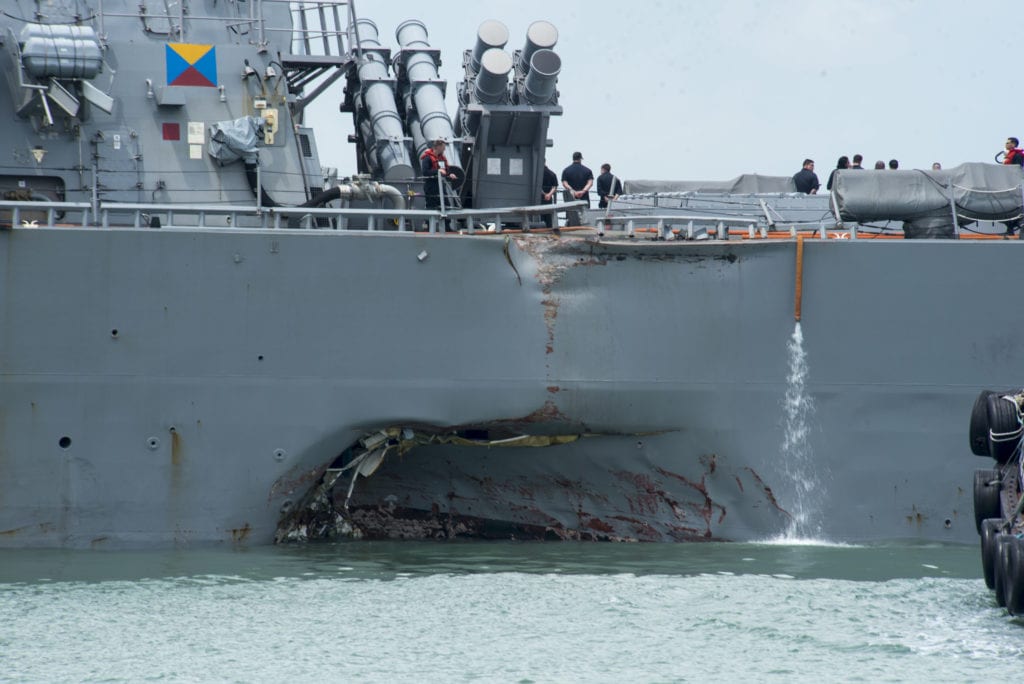
The problem became obvious in 2017 when guided-mis- sile destroyers USS Fitzgerald (DDG 62) ran into a cargo ship and USS John McCain (DDG 56) collided with a tank- er ship in the predawn hours, the latter which resulted in the deaths of 10 Sailors. Then-Chief of Naval Operations Adm. John Richardson told a congressional committee several months later that “both of these accidents were preventable” and he ordered an overhaul of how the fleet trains, mans and operates to prevent future mishaps and bolster safer operations.

Along with recent adoptions across the surface fleet of watchbills providing more consistent periods for sleep and rest, new research projects are using high-tech devices and collecting data to fine-tune those changes and identify ways for skippers and crews to sleep more soundly and perform better, whether at sea, in the air or in the field. Researchers already are finding simple, low-tech solutions to thwart light and sound to ensure a sounder snooze at sea. And the “Crew Endurance” team at Naval Postgraduate School in Monterey, Cali- fornia, is developing online training tools and videos to help skippers and Sailors become a well-rested, more focused force.

Navy officials “are changing the culture about sleep,” said Nita Shattuck, operations research professor at Naval Postgraduate School, who leads the Crew Endurance team. “It’s been slow in coming, but I absolutely think it’s happening.”

Shattuck has spent more than 30 years studying sleep, fatigue and performance issues in the Navy, Coast Guard and Marine Corps, and her work has led to the recent changes in watchbills. “There’s still more work to be done,” she said, “but I think they’ve made huge inroads.”

Damage to the portside is visible as the Guided-missile destroyer USS John S. McCain (DDG 56) steers towards Changi Naval Base, Republic of Singapore, following a collision with the merchant vessel Alnic MC while underway east of the Straits of Malacca and Singapore on Aug. 21. The National Transportation Safety Board found that fatigue from lack of sleep played a role in the collision and others. U.S. Navy / Mass Communication Specialist 2nd Class Joshua Fulton

Lack of Sleep

Adults need seven hours of sleep, at a minimum, but the National Sleep Foundation estimates that nearly one- third of adults averaged fewer than six hours. There’s a cost to fatigue — especially at sea.

USS John McCain’s bridge watch team, including the com- manding officer and executive officer, averaged nearly five hours of sleep in the previous 24 hours before the collision due to shifting watch schedules and lack of sleep- ing time, the National Transportation Safety Board found. Moreover, the “bridge watchstanders, particularly the lee helmsman, were acutely fatigued at the time of the accident, which impacted their situation awareness and their ability to respond to the perceived steering emergency.”

The collision happened at 5:24 a.m. in the Singapore Strait, a time which NTSB noted was “considered to be a circadian low (roughly 2 a.m. to 6 a.m.), when the body is normally more fatigued and prone to diminished alertness and degraded performance,” and the ship’s shifting watch schedules changed sleep periods daily, “which compounds fatigue related to lack of sleep and circadian lows.”

Circadian rhythms are the body’s internal clock based on the 24-hour periods of daylight and dark, but according to the National Sleep Foundation, “a disturbed sleep-wake circadian rhythm can give rise to serious sleeping problems.”

Undoubtedly, the 2017 collisions — along with prior collision of the guided-missile cruiser USS Lake Champlain (CG 57) with a fishing boat and grounding by USS Antietam (CG 54) — shook the Navy. Just months later, Naval Surface Force leaders ordered changes to give crews sufficient rest and sleep.

“The role exhaustion played in the four incidents in 2017 varies from ship to ship; however, there is no debate about the wisdom of implementing circadian rhythm–based watchbills and shipboard routines on surface force ships to provide predictable, protected periods of sleep for our Sailors and optimize alertness and recuperation,” then-Vice Adm. Thomas S. Rowden, Surface Force commander, wrote in a 2018 paper, “Surface Forces are Refocused,” directing all ships to implement those principles or incorporate circadian-rhythm principles.

Shattuck noted the surface fleet moved quickly as it already was working on improvements driven by ongoing research into fatigue and sleep. But previous years’ mishaps had met with little appetite to institute changes, even after earlier studies found links between sleep and performance.

In 2002, a study found shifting a ship’s crew from day to night air operations disrupted sleep and caused fatigue for “a large number” of Sailors, who slept during day- light hours and worked all night. Participants in the study on USS John C. Stennis (CVN 74), deployed supporting combat operations in Afghanistan, wore watch-like ActiGraphs on their wrist that collected sleep and activity data and logged their sleep, work and other activities. The workday ran from about 6 p.m. until 10 a.m. the next day.

After 30 days, Sailors reported less sleep, especially those who spent any time outside. “It is evident that sleep deprivation and fatigue due to the reversed schedule was a major problem for many of the participants in this study, Shattuck and Lt. John Nguyen wrote in the May 2003 paper for the Aerospace Medical Association. They added, “other factors may have contributed to the differences observed in sleep hours and predicted effectiveness, (e.g., working conditions, light exposure levels, type of work performed, health issues and combat stress).”

New Studies

In the two decades since that study, amid higher optempos and combat operations in Afghanistan and Iraq, military researchers and sleep labs across the services, including NPS, Naval Health Research Center in San Diego and Walter Reed National Military Medical Center in Bethesda, Maryland, have been delving into sleep and operational performance. NPS researchers have more than a half-dozen projects focused on sleep issues and solutions. These include projects on fully manned watches, sleep inertia, leaders and stress inoculation, aviator sleep and video gaming.

In one study of circadian-based watch schedules, an NPS team is collecting sleep data on guided-missile destroyer USS Gonzalez (DDG 66) “to see how are people implementing that,” Shattuck said. The study is looking at the ship’s engineering department, which got additional personnel to round out requirements, “so we are looking to see how does extra manning affect workload and sleep?

“Ships are always undermanned,” she noted, “but we’re looking to see what would happen if they do have the manning that the Navy says that they need.”

Another study focuses on sleep inertia. Someone jolted awake from deep sleep usually feels a disorienting brain fog or grogginess for some time, but that can be a critical decision-making time when out at sea. A study is looking at the problem to find ways to make that transition to full attention and performance quicker, and safer.

“How can we help somebody, like a commanding officer, if something happens in the middle of the night [and] you’ve got to awaken and make decisions?” Shattuck said. “We are monitoring people’s brainwaves with an EEG [electroencephalogram] and monitoring their sleep, so we’ll see when they go into deep sleep, we awaken them.” They then sit up and do a battery of tests and are “either exposed to bright light or to an olfactory stimulus, like a smell like wasabi … that’ll awaken them.”

A study kicked off in early January at Surface Warfare Officers School, where researchers are monitoring prospective COs and XOs “to see how they can help them perform better in case of emergencies, if something happens,” Shattuck said, focusing on leaders and stress inoculation.

The officers will use the wearable titanium Oura ring and armband stress monitors to track heart rate and other data as they go through several trainers and tests. “We’re collecting physiological data in these prospective COs and XOs and basically documenting what they’re doing to them,” she said.

In a study on aviator sleep requested by the Marine Corps, NPS researchers are using bright lights and a flight simulator in the NPS sleep lab to see how they could be used to help adjust aviators’ internal clock by tracking melatonin levels in transitioning between day and night flight schedules. Exposure to high-energy, blue-enhanced white light at their “normal” bedtime will hasten what’s called “Circadian entrainment,” Shattuck said, and presumably help them for that night flight simulating F/A-18 Hornet jet missions of several hours in different light conditions.

“So you’ve been flying days and now we’ve got to transition you to flying nights safely, and how do we do that?” she said. The study also seeks to determine how long it takes to adjust to the new schedule and how flight performance is impacted.

Two new separate studies by NPS will look at the prevalence of video gaming in the Marine Corps and in the Navy. Some recent studies have shown psychological benefits to video gaming but also problems including addiction, insomnia and lower performance.

Shattuck has seen the problem firsthand at sea among Sailors and Marines during her sleep research. “I’ve collected all of this data on ships and we’ve ridden the ships and … here are these folks that are supposed to be sleeping and they’re on the mess decks or they’re in their racks playing video games,” she said. Playing an occasional video game “is totally understandable, it’s just kind of a way to decompress, perhaps. But when you’re doing it to the exclusion of sleeping and having it impact your work and that’s what we’re concerned about.”

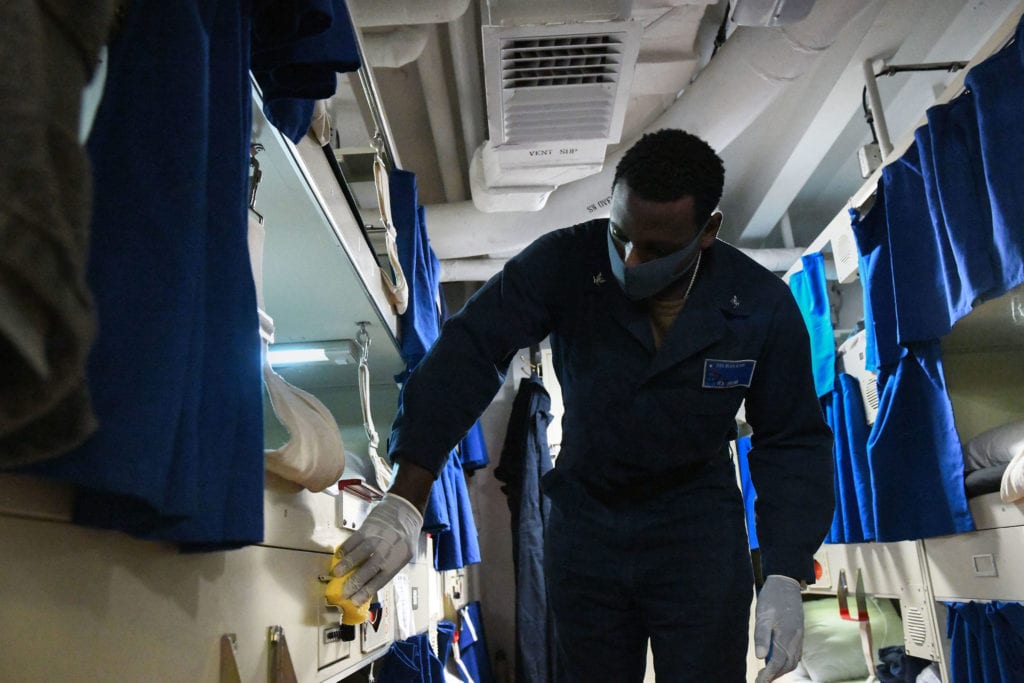
Berthing racks on the USS Blue Ridge (LCC 19), shown here being cleaned by Information Systems Technician 3rd Class Delvonte Brown. Researchers at the Naval Postgraduate School are considering new light-tight rack curtains and special sleep kits to help tune out light and noise. U.S. Navy / Mass Communication Specialist Seaman Apprentice Erik M. Rivera Jr.

Low-Tech Solutions

With noise and bright lights a constant on ship, another study is looking at whether thicker curtains on berthing racks can help Sailors get better sleep. Earlier this year, NPS bought and installed 300 pairs of heavy, flame-retardant canvas rack curtains on the guided-missile destroyer USS Paul Hamilton (DDG 60) and, with the help of wrist activity monitors, researchers are tracking the quality of sleep the crew gets.

The curtains reduce light intrusion and have pockets where Sailors can stash personal items. “Oh yeah, they love them,” Shattuck said. The curtains are made by NavyRackPacks, a small company founded by a Navy spouse and sold online and in some exchanges.

NPS also has distributed to ships’ crews involved in ongoing studies “warfighter sleep kits” that include eye coverings, a sleep mask that is convex so it doesn’t press against the eyes, a set of soft ear plugs and a card with advice about sleep, she said.

“They’re so nice to let us to come out and study the ship and everything, I want to do something nice for the crew,” she added.


Specialized Undersea Rescue Force on Call to Aid Submariners in Trouble

Sailors from Undersea Rescue Command (URC) and Argentines load the Submarine Rescue Chamber (SRC) onto the Norwegian construction support vessel Skandi Patagonia. Undersea Rescue Command, the U.S. Navy’s only submarine rescue unit, mobilized to support the Argentine government’s search and rescue efforts for the Argentine Navy diesel-electric submarine ARA San Juan. U.S. Navy / Lcdr. John Babick

Within days of an Argentine navy submarine reported missing in 2017, several hundred tons of U.S. Navy rescue equipment arrived in South America and went to sea in a hastily assembled international rescue mission.

The diesel-electric submarine ARA San Juan (S-42) had last made contact with the Argentine Navy on Nov. 15, 2017, when the captain of the 44-member crew reported the boat had taken on water while surfacing in heavy seas to get air through its snorkel. Two days later, Argentina mobilized a search-and-rescue mission with the help of the U.S. Navy and international partners.

Within a day, crews with Undersea Rescue Command (URC) at North Island Naval Air Station, California, loaded equipment cranes, a rigid-hull boat and conex boxes packed with the Submarine Rescue Diving and Recompression System (SRDRS) onto an Air Force C-5M Super Galaxy plane, one of several that transported equipment to Argentina. The rescue system included a Sibitzky remotely operated vehicle to assess the disabled sub and rescue hatch clearance, a tethered Pressurized Rescue Module ROV to carry up to 16 personnel at a time to the surface and a transfer-under-pressure capability to decompress rescued personnel.

A week later, the mission transitioned to search and recovery. One year after San Juan went missing, the seabed exploration company Ocean Infinity found its wreckage in a ravine at 3,018 feet at the edge of the continental shelf, near where international anti-nuclear proliferation monitors had first detected an underwater explosion.

URC crews, at one point in the operation, thought they had found the sub. “But it turned out not to be the San Juan. It was an old ship,” recalled Cmdr. John Babick, Submarine Squadron 11 deputy for undersea rescue, speaking at his office at Naval Base Point Loma, California. “Unfortunately, in that case, the visual verification target was not the target that they were looking for.”

The Argentine mission was URC’s first real-world operational use of the Sibitzky ROV, which came online in 2016. Most recently, in August, crews deployed the ROV for visual verification and initial survey of a Marine Corps amphibious assault vehicle that sank off California’s San Clemente Island, killing eight Marines and a Navy corpsman that were trapped inside.

URC’s unique team of undersea and rescue specialists – about 140 active-duty Sailors, Reservists and contractors – constantly train and prepare 24/7 to surge and deploy to help rescue a disabled submarine down to depths of 2,000 feet. “Our mission is primarily a humanitarian one,” said Cmdr. Josh Powers, URC’s commander. “Thankfully, we’re not called upon to respond very much, which is a good thing.

“Rescuing a submarine,” Powers said, “is a no-fail mission.”

Time is most critical. “If there is some tragedy that occurs, if asked, our job is to remain ready to go on an airplane and fly anywhere,” said Capt. Patrick Friedman, who as Submarine Squadron 11 commander is the immediate-superior-in-charge responsible for the unit. Friedman also is the first person to leave if the call comes. “I’m the United States combined rescue forces commander. If it’s a United States-led rescue effort, I would fly immediately to the location.”

Sailors from Undersea Rescue Command (URC) and Argentines load submarine rescue equipment onto the Norwegian construction support vessel Skandi Patagonia. Undersea Rescue Command, the U.S. Navy’s only submarine rescue unit, mobilized to support the Argentine government’s search and rescue efforts for the Argentine Navy diesel-electric submarine ARA San Juan. U.S. Navy / Lcdr. John Babick

Challenges in Rescue

Submarine rescue is a complex military operation, requiring deploying search-and-rescue capabilities – from URC, Supervisor of Salvage and Diving, international military partners and contracted firms – to an airport and seaport closest to the disabled sub’s last-reported location, if known. Remote locations are harder on logistics. Then there is locating the submarine and grappling with weather and sea conditions that can hamper search-and-rescue efforts.

“It’s a big ocean, and if a DISSUB [distressed submarine] goes down, you’re really hoping that they’re able to launch a radio buoy or something to alert you to where they are – because this all starts with you have to find them first,” Babick said.

The Sibitzky usually arrives first, ahead of the rescue module. It can attach a beacon to mark location and can survey the disabled sub.

“It’s going to try to make communications, if it can, either underwater telephone or hull taps. They’re going to want to know how many survivors you have, what your atmospheres are. It’s going to want to know what the list and the trim of the boat is on the bottom,” said Babick. “It’s also going to be taking a look at the hatches, to make sure … you’re going to use has a clean and free rescue seat to mate with.” If needed, operators can use the ROV’s arms to cut netting or move debris blocking a hatch.

If the sub’s hull is intact and deemed survivable, the rescue module Falcon (PRM-1) swims down and mates to the boat. “If the internal pressure of the submarine is pressurized, you can take that Sailor … all the way to the surface support ship … [and] put him into a decompression chamber,” Babick said.

But likely scenarios of flooding or fire mean higher internal pressures put the crew at greater risk of decompression sickness that worsens with each hour and day waiting for rescue.

“You just can’t take that Sailor, him or her, straight to the surface,” he said. “You do need that transfer under pressure capability to ensure that the Sailor does not suffer from a decompression sickness, the bends.”

Rescue teams also have a submarine rescue chamber, a system largely unchanged since its inception in the 1930s. An SRC rescued 33 men from the sub USS Squalus (SS-192) in 1939, “and the system has been relatively unchanged since then,” Babick said. It can carry up to six personnel per sortie, “so it takes time to get everyone off, and the submarine cannot be pressurized, which is the biggest limitation.” The SRC operates at depths to 850 feet, pulling itself along a cable to mate to the disabled sub.

The PRM is “the most advanced capability that we have,” Friedman said, noting “we’re taking some steps toward the digital age. Connections to the units are via fiber optics, so we can get faster connections to be able to get more information on and off the ship or off the rescue asset.” SRDRS in 2008 replaced the deep submergence rescue vehicles Avalon and Mystic, part of the DSRV program developed after the 1963 loss of USS Thresher (SSN-593).

Navy Leads The Way

The worldwide proliferation of inexpensive, small diesel-electric submarines makes undersea rescue capability even more critical. “There’s a lot of interest in submarines, especially smaller countries,” said Friedman, who participated in international sub rescue exercise Pacific Reach off Australia last year. “More than 40 countries are operating submarines – more than 400 throughout the world.”

Undersea Rescue Command has to be ready to mate with different types of subs, said Babick, so it’s important to understand particular features of those subs, such as where a hatch is located and how it opens. “If you want your submarine to have the opportunity to be rescued from the U.S., there is a NATO standard that your rescue seat has to mate to.” Otherwise, those subs might only have escape as an option if no available rescue system matches up.

“It’s important to partner with nations all over the world to make sure we lend our expertise and support in different areas of the world so that we can affect a submarine rescue,” said Powers. “If there’s a submarine on the bottom waiting to be saved, it’s going to be the news story of the day and the event that everybody’s focused on,” he added.

Exercises like Pacific Reach help identify differences and commonalities in navies’ boat and rescue capabilities. “We did a lot of work on how we cooperate with other submarine rescue systems operating together in close proximity in the waterspace above the disabled submarine and how we would conduct that command-and-control needed to have two submarine rescue vehicles in the same waterspace at the same time so, we minimize rescue vehicle sortie times and speed up how fast it takes to get all of those survivors off of the submarine,” Powers said.

“You can’t afford to have complacency toward any aspect of this mission if you want to be successful when you’re called on to respond. There’s always things to learn. Every time you take the system out, you learn something new,” he said. “We just had the decompression complex delivered for the first time as part of our equipment at the end of last year. We are just finishing our first operations periods at sea with that system, and we’re learning a lot about how to decompress Sailors, the different scenarios we might encounter on a disabled submarine, and how we communicate internally inside and outside the decompression complex, as well as how we coordinate with assets off of our vessel for follow-on medical care.”

Friedman noted that while its capabilities have been rarely used for real-world missions, URC remains ready to deploy at a moment’s notice. “Our commitment to Sailors is: If you’re in rescueable waters, we’re coming to get you,” he said. “We will do everything we can to make sure we can live up to that commitment.”

This story is from the October edition of Seapower magazine. Check out the digital version of the full magazine here.


Navy, Marines Demonstrate ‘Blue-Green’ Future of Expeditionary Logistics at Pacific Blitz 2019

Sailors assigned to Coastal Riverine Squadron 11 conduct navigational check rides on Sea Ark patrol boats during Pacific Blitz 2019 at Marine Corps Base Camp Pendleton, California. U.S. Navy/Chief Mass Communication Specialist William S. Parker

Some 10,000 Marines and Sailors stretched their
logistical muscles to support and supply sea-based operations during a major
exercise to prepare naval expeditionary forces for enemy threats and a
potential future fight across an island-dotted battlespace.

During Pacific Blitz 2019, they built expeditionary
bases, cleared and repaired an airfield and seaport, resupplied units on land
and warships at sea, and created medical care, refueling and rearming
positions. The exercise, held March 12 through March 31 in Southern California,
combined two regular training events — maritime prepositioning exercise Pacific
Horizon and amphibious integration exercise Dawn Blitz.

Chief of Naval Operations Adm. John Richardson (center) and Commandant of the Marine Corps Gen. Robert B. Neller (right) speak to Marines during Pacific Blitz 2019. U.S. Navy/Mass Communication Specialist 1st Class Sarah Villegas

The force-level training event for I Marine Expeditionary
Force and the Navy’s 3rd Fleet, supported by Naval Expeditionary Combatant
Command (NECC), focused on distributed maritime operations with emphasis on
expeditionary logistics and sea control. That includes operational capabilities
to refuel, resupply, repair, and rearm expeditionary forces dispersed at sea
and ashore — and likely against capable, peer-like enemy forces. Those missions
are critical to the Marine Corps and Navy concepts of Distributed Maritime
Operations (DMO), Littoral Operations in a Contested Environment (LOCE) and
Expeditionary Advanced Base Operations (EABO).

https://youtu.be/4kKxor1DES4

The campaign-level exercise required fleet and force
battle staffs to integrate and “action officers work through the pains of: how
do you actually do this, how do you coordinate, do our systems talk well to
each other and how do we get better at those pieces,” said Lt. Cmdr. John
Ruggiero, a lead planner at NECC headquarters in Virginia Beach, Virginia,
exercise liaison to 3rd Fleet and I MEF. Both sides want “to ensure that we
continue to build on what we’ve learned, to make sure we document what we’ve
learned and keep that going.” Lessons learned will wrap into follow-on
exercises such as Large-Scale Exercise 2020, Ruggiero said.

NECC provided something of a bridge supporting fleet and
force missions in the battlespace, where expeditionary advanced bases, advanced
naval bases, sea bases, airfields and ports provided logistical hubs to support
and sustain operational forces.

U.S. Marine Corps Pfc. Noe Quintanillo, an embarkations clerk, secures a truck on a landing craft during Pacific Blitz 2019. Cpl. Jacob Farbo/I Marine Expeditionary Force

“We are constantly looking for opportunities like Pacific
Blitz where we can demonstrate this capability,” said Cmdr. Brian Cummings,
NECC explosive ordnance disposal planner and exercise liaison to 3rd Fleet and
I MEF. “When people think Navy, they think airplanes, they think carriers, they
think DDGs and they think submarines — but they’re not necessarily thinking
expeditionary teams of four to 10 people that are thinking of putting missiles
back on DDGs in disassociated locations.”

Sailors worked with 1st Marine Logistics Group to
construct advanced naval bases and facilities at simulated “islands” in the
scenario-based exercise. In a first, they removed and unpacked an Expeditionary
Medical Facility from the roll-on/roll-off cargo ship USNS Sgt. William R.
Button (T-AK-3012), set it up at an expeditionary base at Camp Pendleton,
California, and later broke it down, packed it up and reloaded it onto Button.

“When people think Navy, they think airplanes, they think carriers, they think DDGs and they think submarines — but they’re not necessarily thinking expeditionary teams of four to 10 people that are thinking of putting missiles back on DDGs in disassociated locations.”

Cmdr. Brian Cummings, NECC explosive ordnance disposal planner, exercise liaison to 3rd Fleet and I MEF

Navy Seabees at five sites built several berthing areas,
did concrete slab and masonry work, repaired a damaged airfield, repaired and
rebuilt a 3.5-mile gravel road and, in a proof-of-concept, built a
90,000-square-foot heavy equipment storage area with a 24-foot wide, 8-foot
tall berm.

“The best part of this exercise was all these projects were
real-world projects, with the exception of the berm … being utilized by their
customers,” said Builder 1st Class Jacob Kusay of Naval Mobile Construction
Battalion 5.

U.S. Marines and Sailors offload supplies during the two-week Pacific Blitz exercise. Lance Cpl. Betzabeth Galvan/1st Marine Logistics Group

But it wasn’t just about construction. The road and berm
projects were part of the realistic battle scenarios, Kusay said, so “we set up
our own 360-degree security, maintained their own security watch 24/7 until the
project was completed.”

More than 100 Marines with Marine Aviation Logistics
Squadron 16 packed their mobile facilities onto aviation logistics ship SS
Curtiss (T-AVB-4) at Port Hueneme, California, and got underway to do aircraft
maintenance at sea, a new experience for maintainers accustomed to working in
hangars and airfields.

“That’s kind of why we do this, to operate outside our
comfort zone to expand our capabilities,” said Capt. Mark Stone, supply officer
with 3rd Marine Aircraft Wing’s aviation logistics department. Stone helped
coordinate movements by boats and MV-22 Osprey tilt-rotors and CH-53E Super
Stallion heavy-lift helicopters to and from the Curtiss.

The Marine Corps relies on Curtiss and SS Wright (T-AVB-3)
on the East Coast to provide at-sea intermediate-level maintenance of rotary
and fixed-wing aircraft. Marines repaired, tested or maintained aircraft parts
brought to the ship. Those they couldn’t fix were sent to the depot for
overhaul. Marines “repaired a significant amount of components for us to get
back to MALS-16 to support the flight line,” Stone said. By the end of the
exercise, Marines on the ship had fixed or repaired 134 components, Maj. James
Moore, MALS-16 operations officer, said in an email.

Pacific Blitz “gave us a great overview, start to finish, of how would we do this down range as far as transportation, getting equipment supplies and ordnance from point A to point B.”

Chief Aviation Ordnanceman Raymond Gibree

Pacific Blitz provided a rare, hands-on training in an
expeditionary ordnance reload operation typically handled by Navy Munitions
Command teams. It was the first time Navy Cargo Handling Battalion 1 did the
rapid resupply mission, a new capability the Navy is weighing expanding since
the future distributed battlespace may require other units to rapidly resupply
and reload warships.

Sailors used a forklift and crane to load an SM-2 missile
into a vertical launch system tube on guided-missile destroyer USS Michael
Murphy (DDG-112) March 13 at Seal Beach Naval Weapons Station, California.

Seabees offload an AC generator unit from the back of a cargo truck onto a forklift. U.S. Navy/Petty Officer 3rd Class Jack Aistrup

“It gave us a great overview, start to finish, of how
would we do this down range as far as transportation, getting equipment
supplies and ordnance from point A to point B,” said Chief Aviation Ordnanceman
Raymond Gibree, senior adviser with the reload team.

“We garnered a tremendous amount of experience with the reps
and sets we got, under the oversight of NMC,” Gibree said. “We are expected to
do this mission in many different locations, under many different circumstances
and under permissive, hostile and uncertain areas.”

The scenario
included transporting the team on two Navy ships and utility landing craft to
reach Michael Murphy. It helped “make sure we can provide that capability to
the fleet in more locations, more responsive to their requirements,” Ruggiero
said, “wherever they happen to be.”


Marine Corps Officials Look to Micro-Grid to Help Offset Hike in F-35 Energy Costs

SAN DIEGO — The F-35 Lightning II jet will hike Marine Corps Air Station (MCAS) Miramar’s utility costs by 150 percent compared to legacy F/A-18 Hornets, an expense driven by greater power requirements to maintain and operate the highly complex, fifth-generation aircraft, a senior official told a group of energy officials.

But an expanding micro-grid and alternative energy projects could take a bite out of that bigger bill when the F-35 comes online by 2020, Col. Charles B. Dockery, the MCAS Miramar commander, said at a briefing Dec 3.

“We know already our F-35 hangars are burning about 150 percent more energy than the standard Hornet or Harrier hangar that I grew up in, so that’s a concern,” he told California Public Utilities Commission and California Energy Commission members who joined state, city and energy firm representatives for a two-day conference at the San Diego base.

Existing, older hangars can’t fully support the modern, multimission joint strike fighter, which requires hangars with upgraded electrical support. The Marine Corps is in the process of retrofitting, building or planning for hangars to support the F-35 at its fixed-wing air stations, including Yuma MCAS, Arizona, and Beaufort MCAS, South Carolina, that house the first F-35 operational and fleet replacement squadrons.

The F-35’s advanced electronics, navigation, avionics, communications and weapons systems are designed to be a leap in technology and combat power, but the jet is a power hog of sorts when grounded. Compared to legacy aircraft, it draws on more power for maintenance checks, repairs and operations when on the apron or inside hangars, so these must have the proper electrical connections, data networks, communications links, and heating, ventilation and air conditioning systems in aircraft bays.

“There’s infrastructure that is required to do some specific maintenance on the lift fan of the aircraft or [that] it requires conditioned air as part of that process,” Dockery said, in response to a question about the F-35’s increased power support requirement.

“This is a story that’s going on across the Navy as we try and rise to this new global power competition,” said John A. Kliem, a retired captain and civil engineer and executive director of the Navy’s Resilient Energy Program Office.

Miramar’s first F-35 hangar is currently under construction and is slated for completion in late 2019. It’s one of nine construction projects planned at the air station to support the F-35.

The Marine Corps is buying the single-seat F-35 Lightning II — the F-35B with short-takeoff-and-landing capability and the F-35C for land and shipboard operations — to replace its fleet of Hornets, AV-8B Harriers and EA-6B Prowler jets. So far, the Marine Corps has two F-35 squadrons based at Yuma MCAS and another squadron at Iwakuni MCAS, Japan.

The first F-35C and F-35B jets are scheduled to arrive at Miramar starting in 2020, with Marine Fighter Attack Squadron 314 transitioning from the F/A-18 Hornet to the F-35C and VMFA-225 from its twin-seat F/A-18D Hornets to the F-35B, according to the 2018 Marine Aviation Plan.

Dockery, a veteran F/A-18 naval flight officer, said energy costs for 2020 “is always in the back of my mind.” It’s among several energy-related and budgetary challenges the air station faces as it looks to stay capable, relevant and modernized to support operational forces.

Two-thirds of the Marine Corps and Navy’s air-to-air and air-to-ground and live-fire training ranges are located within one flight’s distance from Miramar, located in northern San Diego. That location makes Miramar critical to support military training and project joint forces across the Indo-Pacific region. “We help 3rd MAW [Marine Aircraft Wing] project their aircraft … so they can maintain their ready and lethal force to deploy,” he said.

Just last year, utility costs forced Miramar, headquarters of the 3rd MAW, to shift $1.5 million to cover its utility budget, Dockery said. “I don’t see that changing through FY19.”

To add to that worry, expected cuts coming in the next Department of Defense’s budget, as well as shrinking Navy capital funding, could lead to more belt-tightening moves in the fiscal 2020 budget. That outlook may worsen in the face of likely higher energy costs, a trend of climbing rates that affect all military installations. This is compounded by aging installation infrastructure.

“We haven’t seen a lot of spending increases on the installation side,” said Dockery. “We are constantly almost doing triage to make sure we are fixing the right things on time.”

But Miramar officials hope that the Navy and Marine Corps’ investments in renewable, “green” energy innovations, along with more efficient fossil-fuel systems, will offset rising costs, including tapping into landfill gases for electricity and beefing up its micro-grid.

“We have some opportunities out there … that’s not only going to keep my costs down but is also going to make me energy resilient,” Dockery said.

A $20 million investment by the Defense Department is helping help shore up that resiliency, officials say.

In recent years, Miramar demonstrated a micro-grid to help find ways for installations to become more energy efficient and build energy resiliency to reduce costs and enable continued operations when the power grid goes down.

“If everything goes dark, I need something I can turn on right now,” Dockery said.

Miramar already buys 3.2 megawatts of electricity — one megawatt is enough to power 750 to 1,000 homes — from San Diego Gas & Electric, the local utility provider. A backup power plant will provide to up 7 megawatts of power from four diesel and natural-gas generators to power the air station’s flightline and more than 100 buildings nearby.

“So when SDG&E goes dark, I’m still launching and recovering airplanes,” said Dockery.

This year, Miramar received a $5 million California Energy Commission grant to store up to 3 megawatts of energy in the installation micro-grid with backup batteries.

By next year, Miramar will draw from a mix of energy sources, including electricity and natural gas from the regional power grid; electricity generated by solar and methane gas from the adjacent San Diego landfill and integrated into the air station’s micro-grid; and a building-level, $3 million micro-grid project with a large solar array and batteries to power the station’s Energy & Water Operations Center building off-grid, or in “island mode.” The Marine Corps also is boosting its collection and use of reclaimed water, which reduces the amount of pricier potable water that Miramar purchases, and a water project agreement with the city of San Diego is expected to improve water quality and water resiliency at Miramar, officials said.

“Resilience is a solution that involves all of it,” Mick Wasco, Miramar’s energy program manager, said in a briefing to the group.

“We had the renewables, but we had to bring in conventional power to make it all work,” he added. The addition of battery storage also will help provide “power quality” and consistent demand, filling in as needed with fluctuations in available renewable-power generation, he noted.

Lt. Col. Brandon Newell, who heads innovation projects for Marine Corps Installations-West, said the goal is to shore up critical infrastructure when most needed.

“Our vision — our aspiration — for resiliency for installations is that we can go 14 days, no matter what happens external to the base, (and) that energy, water, communications, food and logistics can support the mission that’s required of that base,” Newell said.

The Marine Corps also is boosting its collection and use of reclaimed water, which reduces the amount of pricier potable water that Miramar purchases, and a water project agreement with the city of San Diego is expected to improve water quality and water resiliency at Miramar, officials said.

“This is really a cool thing; the whole Navy is excited,” Kliem told the group, noting Miramar is the first DoD installation to sign an IGSA, or intergovernmental support agreement, with localities — it’s a congressional authority — to help build energy resiliency. “There’s a lot of things that can be done with this once we break the code on how to do this.”