Projecting Power in Contested Regions: Marine Corps’ EABO Moves from Paper to Reality
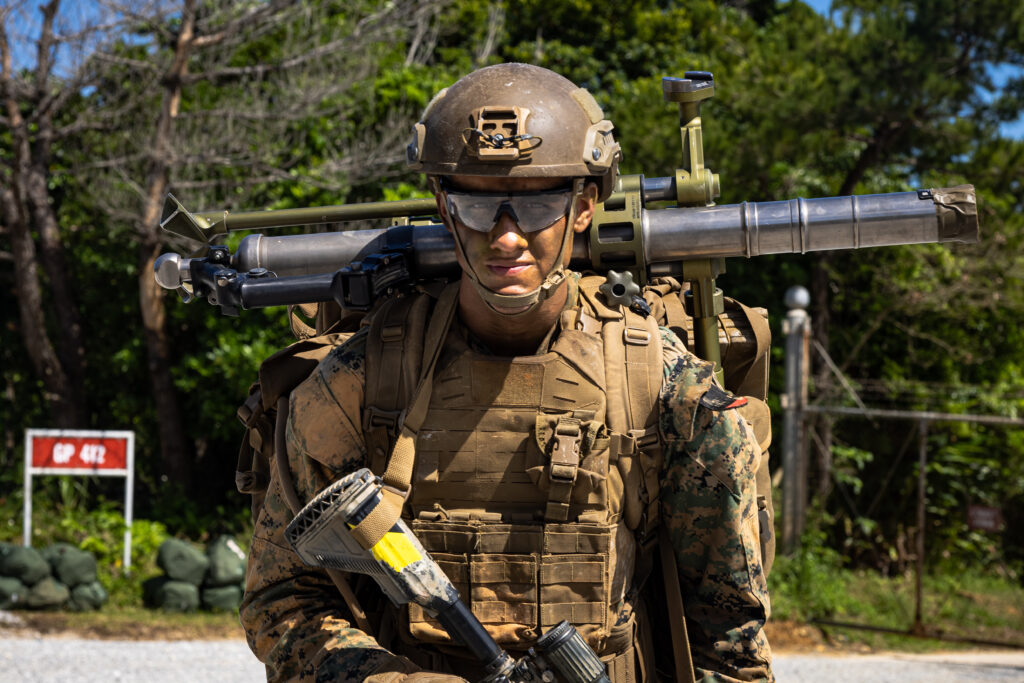
U.S. Marine Corps Pfc. Aiden Mcmahon carries an M224 60mm mortar during a field training exercise at the Central Training Area, Camp Hansen, Okinawa, Japan, May 14, 2025. The FTX allowed Marines to build tactical proficiency in support of expeditionary advanced base operations. Photo credit: U.S. Marine Corps | Lance Cpl. Rodney Frye

The Expeditionary Advanced Base Operations (EABO) concept debuted in 2019 as a new strategy for the U.S. Marine Corps to fight not only with the support of naval forces but also to defend and support those forces in turn, coordinated operations that project and hold power from sea to shore in contested littoral regions.

In a sense, the time honored-quip that Marines “aren’t retreating, just attacking in a different direction” reflects a new capability to attack in any direction from any island chain or coastline.

In March 2019, Marine Corps Commandant General Robert Neller and Chief of Naval Operations Admiral John Richardson jointly announced the development of the EABO strategy as a way to hold a contested region and dissuade a potential adversary from detecting, much less engaging, in an area where flexible mobile bases would be an elusive target with high-tech capabilities.

Neller and Richardson approved and signed the previously classified Concept for Expeditionary Advanced Base Operations, beginning a development that in the past seven years has rapidly progressed from words on paper to hands-on exercises and innovations in the maritime environment.

The initial blueprint for the evolving concept was the Marine Corps’ Tentative Manual for Expeditionary Advanced Operations, followed by a second edition in March 2023. The vision of the two service chiefs is described in the 134-page manual, which includes “a foundational naval concept to address challenges created by potential adversary advantages in geographic location, weapons system range, precision and capability,” while also “integrating Fleet Marine Force (FMF) and Navy capabilities to enable sea denial and sea control, and support sustainment of the fleet.”

EABO on the Move

The U.S. Navy has had the Marine Corps’ back for more than 80 years of expeditionary warfare in the Pacific, but with EABO the Corps holds much more than the high ground. Instead, the vision is to cover an extensive, spread-out littoral region of coastline, island and choke points with advanced technology that can strike not only surface and aviation targets but also can direct surface forces on incoming threats. The concept also calls for quickly packing up and redeploying to a different austere location with equal firepower and air assets defending against aggressors who might not know where the Navy-Marine Corps team is.

Recent exercises halfway around the globe in the High Countries like Denmark demonstrated how NATO countries can work in concert with Marines to quickly set up bases with advanced equipment airlifted onto remote fields with short runways and minimal facilities.

High Countries were an apt description for Marine Corps Europe taking part in a Norwegian-led Arctic operation that took place from Sept. 1-3, 2025, the latest test of Expeditionary Advance Based Operations. It demonstrated that NATO Allied forces from the United Kingdom Royal Air Force and Norwegian armed forces could work alongside Marines in a first-of-its kind mission to quickly insert military assets to a remote and austere location.

The prime focus of the operation was to practice real-world NATO sea denial and maritime domain awareness capabilities. In turn. the operation helped contribute the ability to quickly respond and defeat any crisis or threat to NATO allies.

The deadliest threat to adversary surface combatants was also tested with rapidly deployed Light Tactical Vehicles (LTVs) airlifted as a stand-in for launch bases of the U.S. Marine Corps special weapon for littoral regions and choke points, the Navy-Marine Expeditionary Ship Interdiction System (NMESIS), pronounced “Nemesis.”

The Marines also tested NMESIS anti-ship missile deployments earlier in the year in arguably the most highly contested area of future conflict, the Luzon Strait, a choke point for China to wage war against Taiwan and threaten merchant shipping.

The lethal component of the unmanned mobile launcher gives Marines the ability to sink warships and other maritime targets from land, one more aspect of the EABO doctrine.
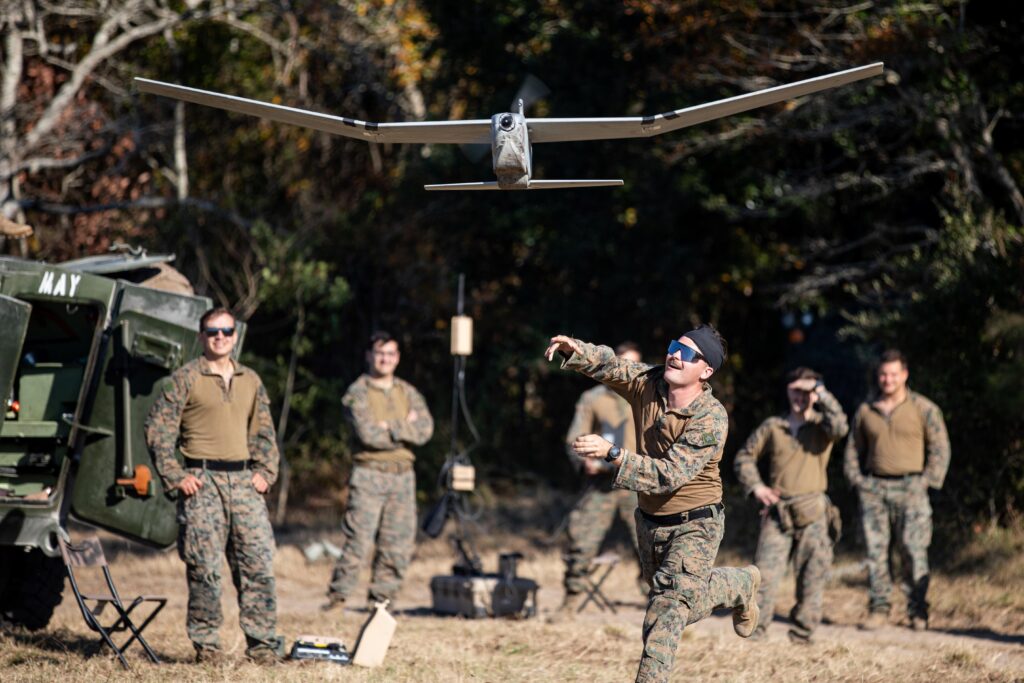
U.S. Marine Corps Sergeant Brandon Arey, a Light Armored Reconnaissance Marine with White Platoon, Bravo Company, 2nd LAR Battalion, 2nd Battalion, 6th Marines, throws a Puma RQ-20B drone into flight during Expeditionary Advanced Base Operations aboard Marine Corps Base Camp Lejeune, Dec. 6, 2021. Photo Credit: U.S. Marine Corps | Cpl. Armando Elizalde.

Back to the Future

“Hit ‘em where they ain’t” was the Korean War motto of General of the Army Douglas MacArthur as he pulled an end run against Chinese and North Korean forces nearly encircling the South Korean capital of Seoul. EABO does something similar but more to the tune of, “Where we ain’t you’ll never know until it’s too late.”

The different between the classical island-hopping expeditionary operations and Expeditionary Advanced Base Operations is summed up on the Marine Corps website: “EABO support the projection of naval power by integrating with and supporting the larger naval campaign. Expeditionary operations imply austere conditions, forward deployment and projection of power. EABO are distinct from other expeditionary operations in that forces conducting them combine various forms of operations to persist within the reach of adversary lethal and nonlethal effects.”

All three Marine Expeditionary Forces have conducted exercises using the Stand-In Force concept and EABO in multiple regions globally.

“Our two Marine Littoral Regiments are reinforcing the Marine Corps’ Force Design vision for distributed, lethal, maneuverable and purpose-built formations in the Indo-Pacific,” said Marine Corps Combat Development Command’s Lieutenant Colonel Eric Flanagan.

“Sustaining Marines in contested environments is just as critical as sensing the enemy or maintaining command and control. The Marine Corps is shifting from traditional supply chains to a more agile, resilient sustainment network — one designed to maneuver under threat, reinforce dispersed forces, and sustain operations across the vast distances of the Indo-Pacific,” Flanagan said.

The U.S. Navy and Marine Corps are addressing a key gap in the Indo-Pacific by developing the Medium Landing Ship (LSM), designed for enhanced mobility, beach access and sustainment in contested littoral environments. 

As part of this effort, the Navy has selected the Damen Naval Landing Ship Transport 100 (LST 100) design as the basis for the LSM program. The non-developmental design will reduce cost, schedule and technical risk. Feeling the need for speed, both the Navy and Marine Corps are eager for the urgently needed capability to reach the fleet thanks to accelerated timelines made possible with the proven design.

Critical Enablers

The rapid move from 2019 theory to present-day reality includes the just-completed 2025 Aviation Plan, which provides a renewed focus on distributed operations and emphasizes sustained operational effectiveness in contested environments through enhanced logistics, sustainment strategies and expeditionary advanced base concepts.

Flanagan, from his perspective as director of communications strategy and operations, sees the future as present with the airborne forces of the Marine Corps.

“Our modern technologies like the ACV, MV-22, CH-53K and F-35B are all critical enablers of Expeditionary Advanced Base Operations, enabling forward-deployed, distributed operations. Years of wargaming, experimentation and study have matured our concepts for EABO,” Flanagan said, “so that our concepts align with the way the broader force will fight.” .

Jim McClure’s first exposure to the Marines was as a four-year scholarship Marine Option Midshipman at the University of Notre Dame. He is a Life Member of the Navy League of the United States and a frequent contributor to Seapower. This story first appeared in the February-March, 2026, issue of Seapower.
Paws for Effect: Support Pup Sage is Popular on USS Gerald R. Ford

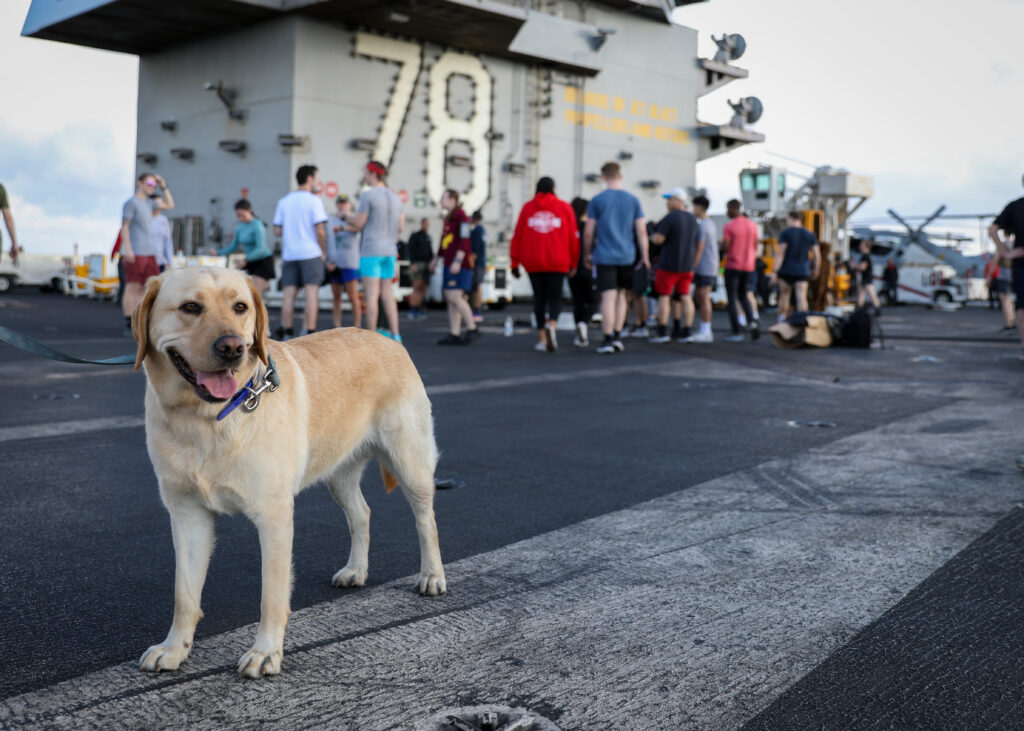
Sage, a three-year-old female Labrador Retriever, deployed aboard the world’s largest aircraft carrier, USS Gerald R. Ford (CVN 78) through Mutts with a Mission, watches the Thanksgiving Turkey Trot 5K on the flight deck, Nov. 23, 2023. U.S. Navy | Chief Mass Communication Specialist Mike DiMestico

Captain Rick “Powder” Burgess took command of the aircraft carrier USS Gerald R. Ford (CVN 78) just eight days before it was to sail on its first full-length combat deployment. In putting the new ship through its paces he would be employing 23 different new technologies, but his first decision as commanding officer involved a 24th innovation — the Navy’s first-in-class vessel, its largest, longest and most advanced, would have a specially trained dog aboard to boost morale and help the crew go the distance.

The three-year-old female Yellow Labrador named Sage was on board as the Gerald R. Ford left Norfolk in May 2023 for duty that was expected to involve being near the Russia-Ukraine conflict.

“I made the decision to deploy with Sage. That was not directed by admirals or anyone else,” Burgess said. “I wanted to bring her on in an effort to help Sailors with the resiliency piece, which has always been a challenge. And you know it’s probably always been a challenge, but we were coming off a couple years with Covid, and we were having longer deployments.”

While military dogs have seen duty on land and aboard ship doing security duties, Sage was specially trained to bring peace of mind and comfort, both sorely needed by Sailors battling loneliness and stress, close confines and combat tempo. Sage was provided by arrangement with a Virginia Beach non-profit called Mutts With A Mission, founded to provide disability and support dogs for veterans and first responder organizations.

“And I saw her as a free opportunity, honestly, to help out with Sailors. And so, Sage is unique in many ways, she’s the first of the program,” Burgess said.

“Ideally, the way the program is conceived, between the ages of two and three these handpicked dogs will go through training. They will get immersion, they’ll find out or figure out how to climb up and down ladders. They will do all that part of it, the logistical side of it. Then they come to the crew, at the age of three, and they’ll stay until they’re 10 years old.”

Sage’s job is to help Sailors handle immense emotional stress and the Ford’s first journey would prove to be an unanticipated stressor when war broke out in Israel on Oct. 7. A five-month tour turned into an eight-month endurance session of homecomings delayed, including three about-faces from homeward bound back to a Middle East aflame from Syria to Gaza and on down to the Red Sea. That’s also where the second demonstration dog, a male named Demo, served aboard USS Dwight D. Eisenhower (CG 69), which replaced Ford on deployment.

“We had an extraordinarily low number of admissions for suicidal ideations compared to those folks that previously deployed, so clearly Sage obviously contributed to that success,” Burgess said.

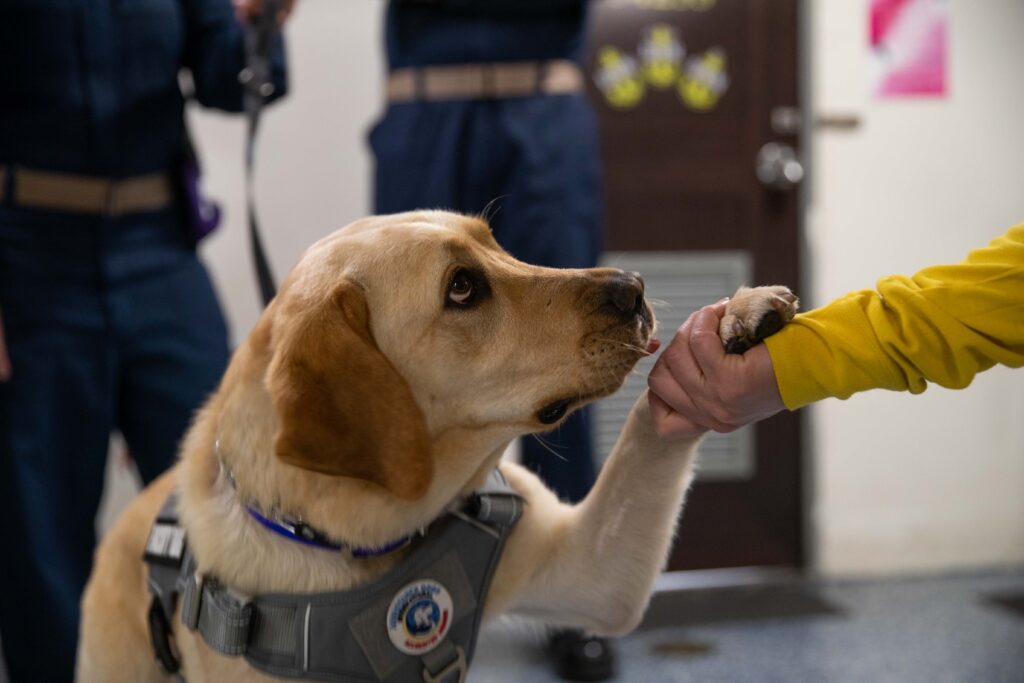
Sage, a three-year-old female yellow Labrador Retriever, is deployed aboard the aircraft carrier USS Gerald R. Ford (CVN 78), May 3, as part of the Expanded Operational Stress Control Canine pilot program. U.S. Navy | Mass Communication Specialist 2nd Class Jackson Adkins

Fans on Ford and Beyond

While the new ship, new captain, new crew and new dog were all getting their sea legs, the sweet and gentle creature quickly developed a fan base.

“We learned early on too there was a new thing on ‘Green Sheet,’ which has the daily schedule for the crew to look at … someone came up with the idea to put a paw print by where the events [were] and where Sage would participate. And we immediately saw attendance double, triple, quadruple,” Burgess said.

“Come for the dog, stay for the talk,” was the goal of shipboard presentations where Sage held court for groups of sailors, as COMNAVAIRLANT [Commander, Naval Air Force Atlantic] PAO Dawn Stankus told Navy Times. The playful pup was center stage as the Navy’s mental health teams aboard ship described the options available for seeking help.

Coral Gables, Florida, psychiatrist Arthur Bregman has internationally recognized expertise treating ADHD, depression, anxiety, PTSD, substance abuse disorder, and many other issues for a wide range of ages.

“It’s the 20- to 40-year-olds, the Millennials, who are our new Greatest Generation,” Bregman said of the current generation of military service members with that perfect description of the age range on a naval vessel from the youngest Sailors to the senior officers.

“There’s a powerful health benefit,” Bregman said of Sage’s healing skills during the week in January that the Ford and Carrier Air Wing 8 returned home. “It decreases depression, reduces anxiety, lowers stress … it’s just so good to have a dog involved, to be attuned to our behavior and emotions.”

Bregman’s insights come from his fame, from Europe to America in print and broadcast news stories, on his pinpointing of the global peacetime crisis known now as Cave Syndrome. From Covid then to the aircraft carrier now, people have felt the effect of being trapped emotionally and physically in close confines for so long and then have trouble adjusting to the outside world.

Whether before groups or one-on-one, Sage was a valued emotional resource, Burgess said.

“She made an appreciable difference on people. There were many examples of Sailors going to her handler and saying, ‘Hey, could I just spend five minutes with Sage?’ Again, we don’t know if that saved somebody from going down and seeking admission for mental health reasons or otherwise, but she was a calming presence. and every time Sailors got to spend time with her, it was meaningful.”

Sage’s popularity soon grew to include not only the Sailors and Marines of the attached air wing but also every ship in the Ford Strike Group. This led to Sage being outfitted with proper PPE [‘pup protective equipment’] and heading via helo to the guided missile cruiser USS Normandy [CG 60], goggles and booties and all of that, she did great. They fenced off part of their flight deck for her and the crew to come to her,” Burgess said with a proud smile.

Burgess asked the cruiser’s captain why he wanted Sage to hold court on the flight deck rather than inside the ship. “It was a logistics problem. The entire crew wanted to get in there … the entire crew wanted to see her.”

With both ship and crew back home and preparing for the next deployment, Sage remains on board many days of the week continuing her permanent assignment to the ship. And as her captain is certain, she is very much a member of the crew.

This story appears in the October 2024 issue of Seapower magazine.


The Correspondent and the Colonel: Pearl Harbor and 9/11 Link Defender and Daughter

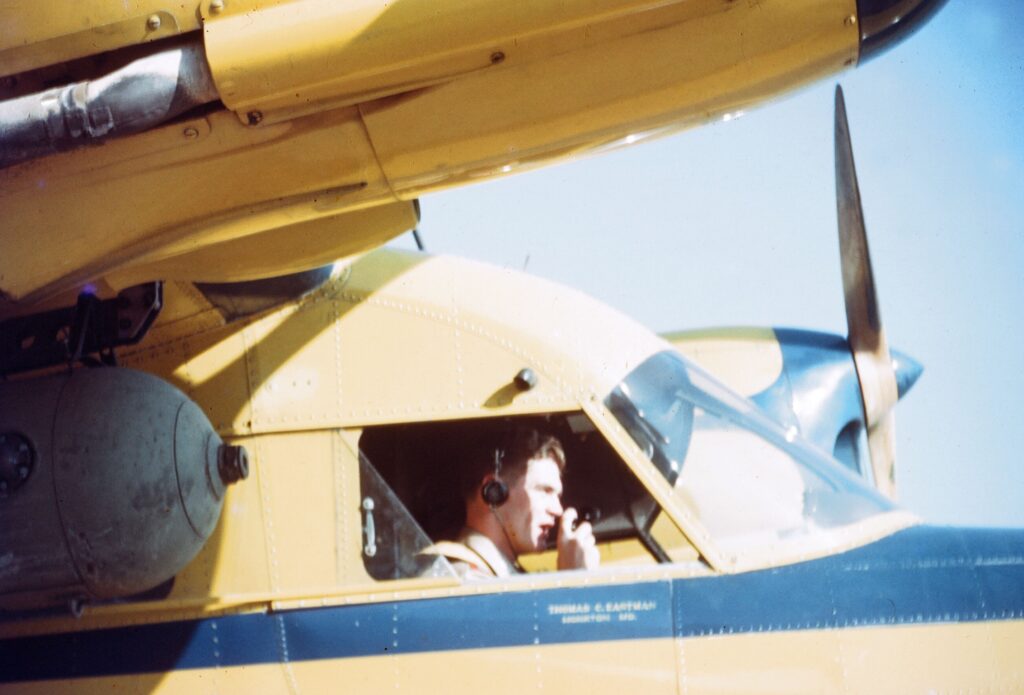
Charles Compton at Coastal Air Patrol Base 1 in Atlantic City, New Jersey. Compton family

Charles Compton was like many a Chicago teenager who learned to fly in the late 1930s and impressed a lovely girl or two along the way on airborne dates. One beauty would become his wife.

“It was a lot of fun years. But then it all changed,” Compton said in 2011 when he was promoted to the rank of colonel by the Civil Air Patrol to honor his life of service.

Dec. 7, 1941

“I was out practicing touch and goes, and I landed. Somebody came out and said, “all aircraft are grounded,” he said. No one knew what was coming next.

Sept. 11, 2001

ABC News White House Correspondent Ann Compton started a routine day with a chore made easier by a run of the mill story. She was the pool reporter responsible for doing all the fact gathering for other broadcast news media outlets as President George Bush listened as Florida grade schoolers read for him. As a parent It was a lot of fun to witness. But then it all changed.

Compton watched the President’s face as White House Chief of Staff Andy Card whispered in his ear, “A second plane hit the second tower. America is under attack.”

“The Pearl Harbor moment was immediate,” Compton said. “As we were taking off, the Pentagon was hit.”

For the next 10 hours, the network TV reporter was one of the few on Air Force One as the presidential aircraft and its fighter escorts headed for cross-country protection, soaring above a nation of planes quickly descending and landing as fast as they could, wherever they could. All aircraft were grounded, and no one knew what was coming next.

August 1943

A little plane flew through the mist of a New Jersey morning off New York Harbor and pulled into a tight circle to sweep low, glancing for U-boats ravaging shipping just outside major harbors and along the coast. Charlie Compton was in his own plane, wearing a makeshift Army Air Corps uniform of the Civil Air Patrol. The CAP was organized formally six days before Pearl Harbor. America wasn’t ready to defend itself on the home shores due to limited military planes and pilots.

Right after Pearl Harbor, Compton tried to get into the fight and fly with the Army and Navy but was denied by both for having only one kidney. He eventually found his way to the first coastal patrol base of the Civil Air Patrol in Atlantic City, New Jersey.

The Axis Powers were more than ready. An east coast oceanfront of sunbathers and ship traffic quickly became a kill zone of merchant convoys being attacked within sight of shore. The bodies of merchantman washed ashore as ships carrying vital supplies and war materiel to Europe were sometimes sunk amid the explosions and towering flames of torpedoed tankers.

The Germans called it “the happy time.” But the little yellow planes kept coming.

One of them would be Compton and a fellow pilot hunting for submarines one day, escorting a convoy the next. Through the Army and then Navy, the escorts began to make a difference.

The goal wasn’t necessarily to sink subs but to drive them away, like a border collie does predators of the sheep. And in short order, the sheep were no longer going to the slaughter and the hunter became the harried.

The network of coastal patrol bases stretched from Maine to Mexico.

For some time now the CAP planes had been armed with an assortment of bombs, singly and in pairs.

“In mid-May 1942, senior Army and Navy leaders authorized the arming of CAP coastal patrol aircraft,” according to Frank Blazich Jr., the military history curator at the National Museum of American History. “Depending on capacity, aircraft typically carried one to three 100-pound AN-M30 general purpose demolition bombs; larger aircraft carried either the AN-M57 250-pound demolition bomb, or one 325-pound Mk 17 depth bomb.”

The nascent Battle of the Atlantic wasn’t meant to be won by attrition as much as by harrassing the German subs into diving to avoid being attacked from the air. Every dive to avoid being spotted or attacked meant less time to charge their batteries on the surface.

“We were all out there pretty gung-ho and looking for a fight,” Compton said, but that made the Army weaponers cautious as to when the CAP planes would be armed. “We could tell what kind of day it was going to be if we saw the Army ordnance trailers out there arming the aircraft,” he said.

No bomb loading meant the focus was to be on escort and observation, reporting back to female CAP radio operators.

“And then we would generally fly three-hour missions, by escorting the tankers and the colliers and the cargo ships, up and down the coast … and then hand off to other sections,” he said.

But often there was no one to hand off the overwatch duties to, because the imperiled convoys were making a beeline to Europe. They were on their own, escorted by a handful of navy ships from the U.S., Canada and Great Britain.

“We did fly low enough to give them a wave. And when we saw them off and dipped our wing, and saw them heading east into harm’s way while we were able to go back to our safe haven. We thought a lot about those brave souls, some that didn’t make it,” Compton reflected during his promotion ceremony. 

Even today, his daughter Ann speaks passionately about her father’s feelings of the time.

“That’s a long trek for a merchant ship,” she says, recalling how this part of his service laid heavy on his heart then, and on hers today. “The pain he felt that they were sailing into harm’s way and he could no longer protect them — he took that very hard.”

Blazich wrote that “on July 19, 1942, German Admiral Karl Doenitz, commander of all German U-boats, withdrew his last submarines operating off the East Coast after increasing losses and reduced success against merchant traffic.”

The former national historian of the Civil Air Patrol, Blazich said “the CAP coastal patrol operation ceased on August 31, 1943, in accordance with an Army agreement to transfer all anti-submarine operations to the Navy.” His definitive and painstakingly researched book, “An Honorable Place in American Air Power” (2020 Air University Press, Maxwell AFB Florida) tells the full tale, as does this fact sheet:

The CAP reported the following to the U.S. military regarding the 18 months of coastal patrol operations:

• 57 attacks on enemy submarines

• 82 bombs dropped against submarines

• 173 radio reports of submarine positions

• 17 floating mines reported

• 36 dead bodies reported

• 91 vessels in distress reported

• 363 survivors in distress reported

• 836 irregularities noted

• 1,036 special investigations at sea or along the coast

• 5,684 convoy missions as escorts for Navy ships

• 86,685 total missions flown

• 244,600 total flight hours logged

• Over 24 million total miles flown

• 26 fatalities, 7 serious injuries, 90 aircraft lost.

The cost of freedom was paid for with the blood and sweat of brave civilian volunteers whose limitations for military service were transcended to remarkable service to the country.

Colonel Charles Compton lived on to have a family that included two boys and the reporter girl who would be an eyewitness to the next time the improbable happened, America caught unaware and under siege. His daughter Ann reports his final years, including his 104th in 2020, were marked by birthday tributes by the cadets he cared so much about, and cared for him in turn. His legacy and theirs lives on in the Evanston, Illinois, squadron that bears his name.

A larger family exists today in the 60,000 adult and cadet volunteers of the Civil Air Patrol, whose core missions of emergency services, aerospace education and youth program continue to serve America in “defending the skies of the homeland,” including security exercises with intercepting Air Force and Air Guard jets, drug interdiction maneuvers with homeland security aircraft, along with humanitarian disaster relief and search and rescue missions saving dozens of lives each year with the world’s largest fleet of single-engine airplanes.

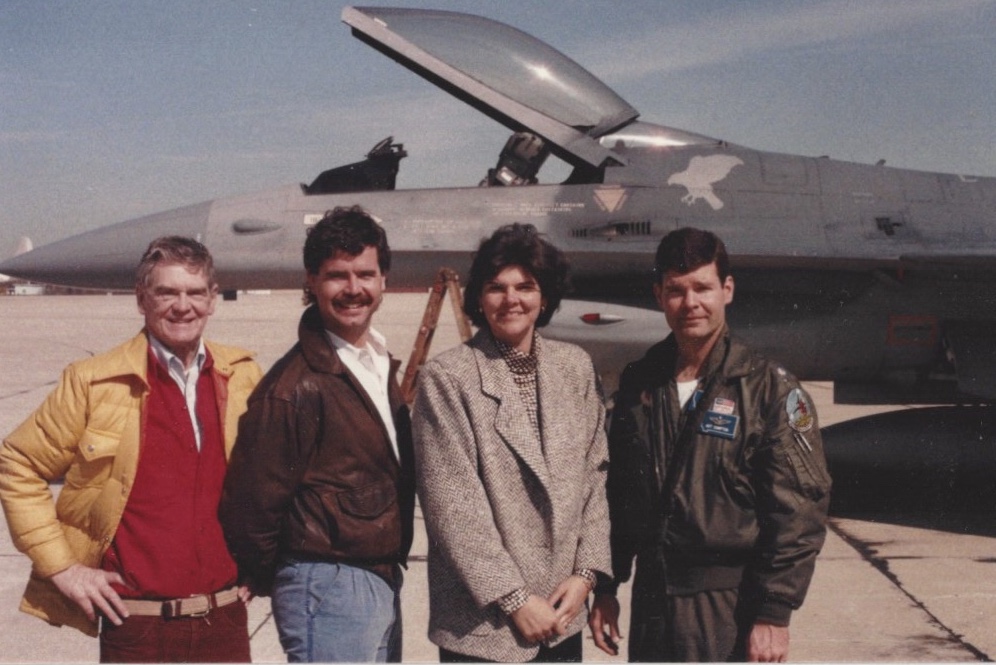
Colonel Compton (far left) with sons and daughter Ann Compton at Naval Air Station Glenview, Illinois. Compton family

Sept. 12, 2001

As yet another small plane of the Civil Air Patrol took off from New Jersey, the situation was that all planes were grounded and no one knew what would happen next.

Like so many before, it rose over the New York and New Jersey shores, yet this time it did not swoop low over the coastline or sweep past the harbor and out to the shipping lanes.

Instead of turning back to the harbor of New York City it headed up above Manhattan, the sole civilian plane in the skies of all America, swooping low to begin its circling run through the mist and around smoke rising over the wreckage of the twin towers of the World Trade Center.

New Yorkers below were still in a state of shock. Their only sense of security that remained came from the swift arrival of Navy fighters from the aircraft carriers George Washington and John F. Kennedy the day before. Those F/A-18 Hornets joined Air Force and Air National Guard interceptors in an ongoing aerial combat aircraft patrol. An obvious deterrent to terrorism, but more importantly a visual representation of protection from above.

The little red, white and blue aircraft circling the towers was doing a familiar role in a new way. Beneath its red tail marked USAF AUX and bearing the crest of the Civil Air Patrol, Lt. Col. Jacques Heinrich and his mission crew digitally photo-mapped the wreckage, to show the paths to save and the ways to recover.

The vital images from that CAP colonel were authorized by, and delivered to, President Bush at the White House as Ann Compton continued her journalistic vigil, an echo of the living example father set, protecting the sea lanes and the sea services with no pay or fanfare six decades before.

Jim McClure is a life member of the Navy League of the United States and a frequent contributor to Seapower. This story originally appeared in the February-March issue of Seapower magazine.