FBI Supervisory Senior Resident Agent Leah Greeves appears at a press conference May 21, confirming the active shooter at NAS Corpus Christi was a terrorism-related incident. KRIS
ARLINGTON, Va. – A lone gunman trying to crash security at the North Gate of Naval Air Station Corpus Christi, Texas, was stopped by Naval Security Forces, the Navy said May 21.
Early reports from the base on Twitter said Naval Security Forces responded to an active shooter at approximately 6:15 a.m. local time. That notice said the said shooter “has been neutralized.”
The latest information from the Navy Office of Information said, “The shooter no longer poses a threat.” One Sailor attached to Navy Security Forces at the air station sustained minor injuries and was released from a local hospital, according to the Navy statement.
The FBI and Naval Criminal Investigative Service (NCIS) are investigating with local law enforcement. FBI is the lead investigative agency.
The incident took place just three days after the Justice Department and FBI announced the Saudi gunman who killed three Sailors and wounded eight others at a NAS-Pensacola, Florida, last December had incriminating cell phone evidence linking him to an al-Qaida affiliate. Pentagon spokesman Jonathan Hoffman, at a press briefing on an unrelated matter May 21, said that since the NAS-Pensacola shootings, the department had increased security at installations, but he did not know the exact measures taken at the Texas facility.
FBI officials are saying the incident at Corpus Christi was terrorism-related. Authorities previously said a shooter had been “neutralized,” but there may be a second person of interest still at large, FBI Supervisory Senior Resident Agent Leah Greeves said during a short press briefing. The agent did not provide additional information but said the shooter is deceased.
The base, on the Gulf Coast of Texas, was on lockdown after the incident began, but the Navy said the installation was open with traffic flowing through the South Gate. The North Gate remained closed.
Theodore Roosevelt Rides the Waves Again
Aviation Ordnanceman Airman Andrew Halford holds the American flag on the flight deck of the aircraft carrier USS Theodore Roosevelt as the ship departs Apra Harbor, Guam, on May 21. U.S. Navy/Mass Communication Specialist 2nd Pyoung K. Yi
ARLINGTON, Va. — Sidelined pier-side for nearly two months after an outbreak of COVID-19 infected 1,100 crew members, hospitalized several and killed one, the USS Theodore Roosevelt sailed from Naval Base Guam on May 21 on a test run to ensure the carrier’s aircraft and personnel are ready to resume their mission.
The Nimitz-class aircraft carrier, the first Navy warship to endure an outbreak of the virus at sea, is underway to begin a 10- to 14-day “shakedown cruise type of activity” that includes recertifying Carrier Air Wing 11, the ship’s flight deck and the crew, Pentagon spokesman Jonathan Rath Hoffman told media assembled there.
After the air wing completes carrier qualification flights, the Theodore Roosevelt will return to Guam to pick up remaining crew members who have been quarantined while recovering from the virus, Hoffman said, adding that there’s been no change in the carrier’s mission to the Indo-Pacific.
The Navy has learned a lot about social distancing, the wearing of face coverings, frequent testing and temperature surveillance since the first cases appeared aboard the carrier in March, Hoffman said, but “no one going into this believes this is the last we’ve seen of [the] coronavirus.”
Nevertheless, “We’re not going leave our ships in port. We’re not going stand down. We’re going to continue to sail, continue to patrol,” he added.
After moving nearly 4,000 crew members off the ship and cleaning the entire vessel from bow to stern, hundreds of crew, enough to operate the ship while it is underway, have returned from quarantine after passing rigorous return-to-work criteria. Scaled-back manning allowed the ship to bring on board the right makeup of personnel required to safely operate and complete a particular mission requirement, according to a Navy statement.
“We are scaling our manning on board based on our mission requirement,” said Capt. Carlos Sardiello, the Theodore Roosevelt’s commanding officer. “Carrier qualification requires fewer personnel than other missions and bringing fewer Sailors on board will enable enhanced social distancing while underway,” he added.
In addition to social distancing, Sailors aboard will execute Navy COVID-19 prevention and mitigation policies, including all required lessons learned from a safety stand down last week and a simulated underway earlier this week.
The aircraft carrier USS Theodore Roosevelt departs Apra Harbor following an extended visit to Guam in the midst of the COVID-19 global pandemic. U.S. Navy/Engineman 1st Class Thomas N. Turner
During the simulated underway, known as a “fast cruise,” the crew walked through routine and emergency procedures while executing COVID-19 mitigation measures, including wearing masks, medical surveillance of 100% of the crew, adjusted meal hours, minimizing in-person meetings, sanitizing spaces and a simulated medical evacuation.
“It feels great to be back at sea,” said Rear Adm. Stu Baker, commander of Carrier Strike Group 9.
“Getting Theodore Roosevelt and Carrier Air Wing 11 one step closer to returning to their mission in the Indo-Pacific is a great achievement for the crew,” Baker said.
More Returning Theodore Roosevelt Sailors Test Positive for COVID-19
The USS Theodore Roosevelt, still moored at Naval Base Guam on May 15. Theodore Roosevelt’s COVID-negative crew returned from quarantine beginning on April 29 and is preparing to return to sea. U.S. Navy/Mass Communication Specialist 3rd Class Conner D. Blake
Note: This post was updated May 19, 2020 at 6 p.m.
ARLINGTON, Va. — Despite 14 crewmembers testing positive for COVID-19 a second time, the virus-stricken aircraft carrier USS Theodore Roosevelt is running a pier-side simulation to prepare for eventual return to sea after months sidelined at Naval Base Guam.
The first deployed Navy warship to suffer a COVID-19 outbreak, the TR has been docked in Guam since March 27, undergoing a bow-to-stern intensive cleaning while most of the nearly 5,000 crewmembers were disembarked and quarantined or isolated on Guam. After 14 days under observation ashore and twice testing negative for the virus, crewmembers began returning to the ship by the hundreds in late April.
The returning crew are conducting a simulation called “Fast Cruise,” that recreates normal underway conditions, while still moored in Guam.
“Fast Cruise is the culmination of all systems being online and operationally checked as the crew executes major at sea evolutions while being pier side. The crew will simulate normal underway conditions and test the critical systems required to sustain the ship away from the pier,” Pacific Fleet spokesperson Cmdr. J, Myers Vasquez said in a statement March 19. “As TR prepares to return the ship to sea their way forward is conditions-based and is dependent on the recovery of the crew,” the statements added. It was not clear whether the most recent re-infections would slow the carrier’s return to its mission. “Due to operational security concerns, the U.S. Navy does not address future ship movements or operations,” Vasquez’s statement noted.
Ensign Rocky Bowman (right) checks Aviation Structural Mechanic 2nd Class Justin Banks into the USS Theodore Roosevelt on May 16 after Banks completed off-base quarantine. U.S. Navy/Mass Communication Specialist Seaman Erik Melgar
Nine more Sailors have joined five others who tested positive for COVID-19 last week, a Navy official said May 18. All were among more than 1,100 crew members who were diagnosed with the virus and taken off the ship and isolated or quarantined for 14 days. To return to the carrier after two weeks of observation, Sailors had to test negative two straight times. The initial five who were re-infected were among hundreds of crewmembers who have returned to the Roosevelt since late April.
“Fast cruise is a major milestone for the ship and for the crew,” said Capt. Carlos Sardiello, commanding officer of the Teddy Roosevelt. “Our Sailors have tested all of the ship’s systems individually, but this is our opportunity to integrate all of that together and show that Theodore Roosevelt is ready and able to go back to sea.”
Following a successful fast cruise, the ship will commence underway training and carrier qualifications to support the air wing’s return to operational readiness.
Sardiello, who previously commanded the ship, took over again in early April when his replacement, Capt. Brett Crozier, was relieved of his command. A fleetwide investigation is looking into how the COVID-19 outbreak on the Theodore Roosevelt was handled by the chain of command and whether Crozier should be restored as the carrier’s commander.
During the ship’s infection surveillance, a single active case of tuberculosis also was identified and diagnosed. The diagnosed individual was removed from the ship, isolated and will remain under the direct care of the Navy’s health system until cleared by doctors, according to a March 14 statement from the Navy. A thorough contact investigation has been conducted, and those Sailors have been medically evaluated and cleared. There are no other active cases pending.
Decrypted iPhones Reveal al-Qaida Link to NAS Pensacola Shooter
Master-at-Arms 3rd Class Arnel Salacup with Naval Air Station Pensacola security forces conducts a traffic stop at the base on May 7. U.S. Navy/Joshua Cox
ARLINGTON, Va. — Information gleaned from the iPhones of a Saudi gunman who killed three Sailors and wounded eight others at a Florida naval base last December links him to an al-Qaida affiliate, FBI and Justice Department officials disclosed on May 18.
U.S. Attorney General William Barr announced that the FBI had recently succeeded in unlocking the phones of 2nd Lt. Mohammed Saeed Alshamrani of the Royal Saudi Air Force, who was killed by security officers during the Dec. 6, 2019, rampage at Naval Air Station Pensacola, Florida, where he was an aviation cadet.
‘’The phones contained important, previously unknown information that definitively established Alshamrani’s significant ties to al-Qaida in the Arabian Peninsula [AQAP], not only before the attack, but before he even arrived in the United States,” said Barr, adding “the FBI now has a clearer understanding of Alshamrani’s associations and activities in the years, months and days leading up to the attack.”
Investigators received court authorization to search the contents of Alshamrani’s iPhones the day after the 2019 attack. But they were unable to unlock the phones’ security features and approached Apple Inc., manufacturer of the iPhone, for assistance in early January. However, the technology company declined to assist, officials said, and it took FBI technicians months to access the phones’ contents, which ended up showing that Alshamrani and his AQAP associates communicated using apps that featured end-to-end encryption to evade law enforcement.
Additional information stored in the phones revealed Alshamrani had been radicalized by 2015, had connected and associated with AQAP operatives and joined the Royal Saudi Air Force to carry out a “special operation.” In the months before the attack, Alshamrani had specific conversations with overseas AQAP associates about plans and tactics. The FBI maintained he was communicating with AQAP right before the attack and conferred with his associates up until the night before the December shootings.
Attorney General William Barr (center) is joined by other national security officials to discuss the Dec. 6, 2019, shooting rampage at NAS Pensacola with the media. U.S. Justice Department
Ensign Joshua Watson, Airman Mohammed Haitham and Airman Cameron Walters were killed in the attack and eight others were severely wounded. Alshamrani was armed with a locally obtained 9 mm Glock handgun.
The incident prompted the Pentagon to order a stop to all International Military Student (IMS) training at U.S. installations and directed a review of all vetting and security procedures. Defense Secretary Mark Esper later approved an extensive list of recommendations and directed immediate implementation across all the military services.
The added background checks and new physical security procedures included restrictions on IMS possession and use of firearms and ammunition. New control measures also limited IMS access to military installations and U.S. government facilities and set new standards for training and education on detecting and reporting insider threats.
Barr said Saudi Arabia “gave complete and total support for our counter-terrorism investigation and ordered all Saudi trainees to fully cooperate. There was no evidence of assistance or pre-knowledge of the attack by other members of the Saudi military training in the United States, officials said.
Despite Isolation, Five Returning Roosevelt Sailors Test Positive for Virus
USS Theodore Roosevelt Sailors run on the pier of Naval Base Guam on May 8. The Roosevelt’s COVID-negative crew started returning from quarantine on April 29 and is preparing to return to sea. U.S. Navy/Mass Communication Specialist 3rd Class Zachary Wheeler
ARLINGTON, Va. — Five more Sailors from the sidelined aircraft carrier USS Theodore Roosevelt have tested positive for COVID-19, despite 14 days in isolation on Guam, according to the U.S. Navy.
The five, who previously tested COVID positive and were taken off the carrier, retested positive after returning to the carrier, despite “rigorous recovery criteria, exceeding [Centers for Disease Control and Prevention] guidelines,” Navy spokesperson Lt. Cmdr. Megan Isaac said on May 15.
Meanwhile, the Pentagon inspector general’s office announced on May 11 that it had launched an evaluation of the Navy’s policies to “prevent and mitigate” the spread of infectious diseases on ships and submarines and whether “mitigation measures that are effective in preventing the spread of COVID-19 were implemented across the fleet.”
Despite the latest setback, the Defense Department and the Navy “have learned much over the last few weeks on how to confront outbreaks on ships,” Pentagon spokesman Jonathan Rath Hoffman told a press briefing, noting that only two warships — the Roosevelt and the destroyer USS Kidd — out of 90 Navy vessels at sea have confronted the virus. He noted the Navy was able to respond more quickly and limit the outbreak on the Kidd because of lessons learned with the Roosevelt.
Capt. Carlos Sardiello, current commanding officer of the Theodore Roosevelt, talks with the families of Roosevelt Sailors during a virtual town hall meeting on May 10. U.S. Navy/Mass Communication Specialist 3rd Class Conner D. Blake
Hoffman also cited Chairman of the Joint Chiefs of Staff Gen. Mark Milley’s frequent claim that “’the TR could be at sea tomorrow if called upon and would be able to fight through this outbreak.”
The new COVID-positive results aboard the Roosevelt come as the carrier, docked in Guam since March 27, prepares to return to sea after a bow-to-stern deep-cleaning process by about 700 crew members. The rest of the ship’s crew, more than 4,000 in total, are disembarked on Guam and either isolated or quarantined. More than 1,100 Sailors from the Roosevelt tested positive for COVID. To return to the carrier after 14 days observation, Sailors had to test negative in two successive tests. The infected five were among hundreds of crew members who have returned to the Roosevelt since late April.
“While onboard, these five TR Sailors self-monitored and adhered to the strict social distancing protocols established by the Navy,” Isaac said in a statement. However, they developed flu-like symptoms “and did the right thing reporting to medical for evaluation,” the statement added.
The five Sailors were immediately removed from the Roosevelt and placed back into isolation. Their close contacts were mapped, and they are receiving the required medical care. “A small number of other Sailors who came in close contact with these individuals were also removed from the ship and tested. They will remain in quarantine pending retest results,” the statement said.
“A process has been put in place to quickly address the issue,” Hoffman told the briefing. “We do want to get to a place where there is zero infections on the ship and the entire ship’s complement is back at sea, but that may take little bit more time,” he said.
After becoming the first Navy ship to suffer a COVID-19 outbreak at sea, the Roosevelt was caught in a controversy that led to Capt. Brett Crozier’s removal from command and the resignation a week later of then-acting Navy Secretary Thomas Modly, who had ordered Crozier ousted.
Following a first preliminary inquiry, the Navy initiated a probe into Crozier’s actions that was widened by Modly’s successor, acting Navy Secretary James McPherson, to include the entire Pacific Fleet chain of command. Some, including reportedly Chief of Naval Operations Mike Gilday, recommended Crozier be reinstated after the preliminary probe ended.
SOCOM Commander: Fighting Terrorists is Another Way to Counter Great Nation States
Army Gen. Richard D. Clarke, Commanding General, U.S. Special Operations Command, shown here in February 2020 discussing training with students attending the Tactical Skills phase of the Special Forces Qualification Course at Camp Mackall, North Carolina, discussed the role Special Operations Forces play in the “Great Power Competition” at a virtual conference May 12. U.S. ARMY / Staff Sgt. Keren-happuch Solano
ARLINGTON, Va. – As the National Defense Strategy shifts toward the “Great Power Competition” with Russia and China, there is still a key role for Special Operations Forces to play, countering both terrorists and peer competitors, the head of U.S. Special Operations Command (SOCOM) said.
In fact, Army Gen. Richard Clarke said, the main reason U.S. special operations forces like the Army’s Green Berets and Navy SEALs were created – to battle violent extremist organizations (VEOs) like al-Qaida and ISIS – is, in a way, “equal” to Great Power Competition.
“Going after the VEOs is not mutually exclusive to competing with great powers,” Clarke said in a live-streamed address to the National Defense Industry Association’s virtual Special Operations Forces Industry Conference (SOFIC) May 12. The capabilities required of Special Operations Forces fighting violent extremists in places like Asia and the Pacific serve a dual purpose. “By being there, we are also countering great nation states,” he added.
This dual role has implications for the defense industry, Clarke said. “No longer can we just build counter-VEO capabilities that serve a single purpose. As we look at the precision, lethality and mobility requirements as examples, we absolutely have to develop them so they can compete and win with Russia and China, but they could also work in a counter VEO fight,” he added.
SOCOM’s top priority is next generation intelligence, surveillance and reconnaissance (ISR) capability, Clarke said. That means sustainable ISR technology that “can provide the capability in both Great Power Competition and working for our SOF teams in remote, austere, short take-off-and land battlefields,” he said. Another priority is next-generation mobility and next-generation effects like the Hyper-Enabled Operator concept, which grew out of the TALOS (Tactical Assault Light Operator Suit) program, nicknamed the “Iron Man Suit.”
The six-year TALOS project focused on high-tech body armor that could also monitor a wearer’s stress and increase strength and speed through an exoskeleton. “Today’s technology doesn’t allow for the Iron Man suit, but the idea is there,” Clarke said. The command is looking to equip the Hyper-Enabled Operator with a collection of useable data from lightweight, body mounted computers, cameras and other sensors to better navigate the future battlespace, which Clarke said would be increasingly “complex, dynamic and lethal.”
Clarke spoke from Tampa, Florida, where SOCOM headquarters is based and where the annual SOFIC gathering, conducted virtually this year because of the coronavirus pandemic, is held.
Lessons Learned From Teddy Roosevelt Outbreak Help Ease COVID-19 Impact on USS Kidd
A Sailor salutes the national ensign as he disembarks the USS Kidd at Naval Base San Diego on April 28 as part of the Navy’s response to the COVID-19 outbreak on board the guided-missile destroyer. While in San Diego, the Navy will provide medical care for the crew and clean and disinfect the Kidd. U.S. Navy/Mass Communication Specialist 2nd Class Alex Corona
ARLINGTON, Va. — The safe return to port of the guided-missile destroyer USS Kidd — with none of its crew needing hospitalization after a COVID-19 outbreak at sea — is due largely to lessons learned from the spread of the virus more than a month ago aboard the aircraft carrier USS Theodore Roosevelt that turned deadly, according to a Defense Department spokesman.
The Arleigh-Burke class destroyer Kidd was participating in counter-narcotics operations in the U.S. Southern Command area of responsibility in the Pacific Ocean when several of its Sailors began exhibiting flu-like symptoms in late April.
One Sailor aboard the Kidd was evacuated to the U.S. mainland for testing on April 22 after experiencing shortness of breath. The commander of the U.S. Pacific Fleet redirected the amphibious assault ship USS Makin Island — which is equipped with an intensive care unit, ventilators and additional testing capability — to rendezvous with the Kidd. Even before that, an eight-member medical team flew out to the Kidd on a helicopter and began testing the crew for symptoms of the virus. As of April 25, 33 Sailors aboard the Kidd had tested positive for it.
“The effort by the captain and the crew of the Kidd, the Makin Island and the rest of the medical team should be lauded for what they did and how they were able to get that ship back to port and how they were able to get the crew off,” Pentagon spokesman Jonathan Rath Hoffman told a press briefing on May 1. “Right now, there’s a large number of sick but, fortunately, none are hospitalized, and we’re going to continue to hope that everybody recovers quickly.”
The USS Kidd arrives in San Diego on April 28. U.S. Navy/Mass Communication Specialist 2nd Class Alex Millar
The Kidd reached San Diego, not its homeport, on April 28. After testing 100% of the more than 300 crew members, the U.S. Navy said 78 active COVID-19 cases were detected. None of the Kidd’s crew is hospitalized, according to the Navy.
All crew members will complete at least 14 days in quarantine or isolation and must achieve two negative tests for the virus before returning to the ship. Medical professionals, chaplains, a resiliency counselor and a psychologist are supporting the Sailors in isolation and quarantine.
While in San Diego, the USS Kidd will undergo a deep cleaning that balances decontamination with preventing damage to the ship’s systems. It is not known how COVID-19 made its way onto the destroyer.
“Fortunately, we are able to take many of the lessons learned from the Theodore Roosevelt and apply them to the Kidd so that we were able to address the outbreak — obviously, a very different ship, a different size.”
Pentagon spokesman Jonathan Rath Hoffman
“Fortunately, we are able to take many of the lessons learned from the Theodore Roosevelt and apply them to the Kidd so that we were able to address the outbreak — obviously, a very different ship, a different size — but was able to address it rapidly in a way that we were able to get the ship to port,” Hoffman said.
The Theodore Roosevelt, which also was at sea when COVID-19 broke out, is still sidelined in Guam, more than a month after the first Sailors there were diagnosed.
As case numbers spiked, the carrier’s captain sent a lengthy e-mail, which was leaked to a newspaper, complaining that the evacuation of the 4,000-plus Sailors of the Roosevelt was occurring too slowly, endangering the crew. This led then-acting Navy Secretary Thomas Modly to relieve the skipper, Capt. Brett Crozier, of his command. The ensuing controversy and a speech highly critical of Crozier that Modly delivered a few days later to the Roosevelt’s crew sparked Modly’s resignation on April 7.
The Roosevelt’s entire crew has been tested for COVID-19, the Navy said in its May 1 update. There are 1,102 active cases left from the carrier — an increase due to exit testing of Sailors who are asymptomatic, the Navy said, adding that 53 Sailors have recovered after completing at least 14 days in isolation and clearing two successive tests with negative results.
Three Sailors are being treated in U.S. Naval Hospital Guam for COVID-19 symptoms. None of those crew members are in the intensive care unit. A Roosevelt Sailor did die in mid-April from COVID-19 complications.
Hospital Corpsman 2nd Class Shane Miller (left) and Hospital Corpsman 2nd Class Austin Kelly draw blood for COVID-19 testing from a Sailor assigned to the USS Kidd after its arrival in San Diego on April 28. U.S. Navy/Mass Communication Specialist 2nd Class Alex Corona
At War With the Virus: Sea Services Forced to Radically Change Course to Battle the COVID-19 Outbreak
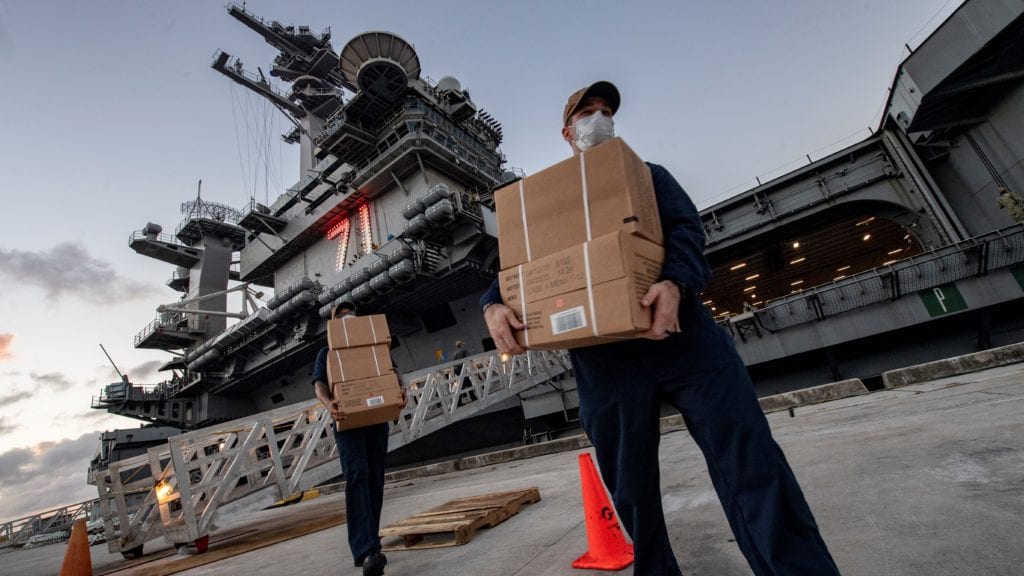
Sailors assigned to the aircraft carrier USS Theodore Roosevelt move meals ready to eat for Sailors who were negative for COVID-19 and asymptomatic at local hotels in an effort to implement social distancing and stop the spread of COVID-19. U.S. Navy/Mass Communication Specialist 1st Class Julio Rivera
The novel coronavirus has been a stunning and tragic disrupter of U.S. sea service operations — both major and routine, traditional events as well as long-planned operations.
Shortly after the World Health Organization declared COVID-19 a pandemic on March 11, the effect on America’s military started to come into sharper focus.
Check out the digital edition of the May Seapower magazine here.
By April 16, the U.S. Navy had reported 1,224 novel coronavirus cases. Most of those, 983, were Sailors, including 655 from the USS Theodore Roosevelt — the ship that is the hot spot for the virus. Another 134 cases were civilians, 53 dependents and 54 contractors.
A total of 13 Sailors, 13 civilians, three dependents and six contractors had been hospitalized. Also by April 16, 200 had recovered, the Navy said. On April 13, the Navy said that the first active-duty Sailor had died — a Roosevelt crew member — joining three civilian employees and two Navy contractors who perished.
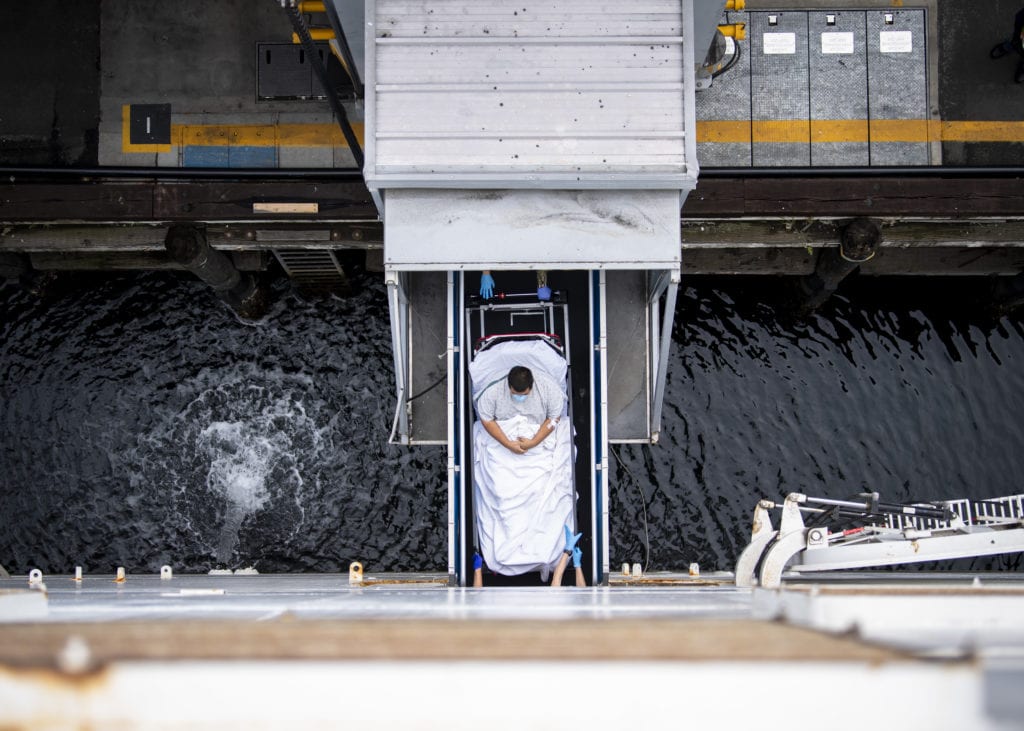
Sailors transport a patient to the hospital ship USNS Mercy. U.S. Navy/Mass Communication Specialist 2nd Class Ryan M. Breeden
As of April 16, the U.S. Marine Corps reported 340 COVID-19 positives among uniformed Marines, dependants, civilians and contractors. The U.S. Coast Guard had 90 cases but 31 had recovered by that date. Also by April 15, the hospital ship Mercy, docked in L.A., had seven test positive and sent into isolation. More than 100 had been in contact with those who tested positive there.
Spotlight on the Teddy Roosevelt
By mid-April, four aircraft carriers — the cornerstone of the Navy’s ability to project power forward — had at least one Sailor on board test positive for the viral infection. The USS Nimitz and USS Carl Vinson, both based in Bremerton, Washington, and the USS Ronald Reagan in Japan all were in port when their COVID-19 cases were discovered.
But nowhere was the outbreak more acute or visible to the world than on the fourth aircraft carrier, the Theodore Roosevelt, which put into port at Guam. That carrier became the first ship at sea to report a case.
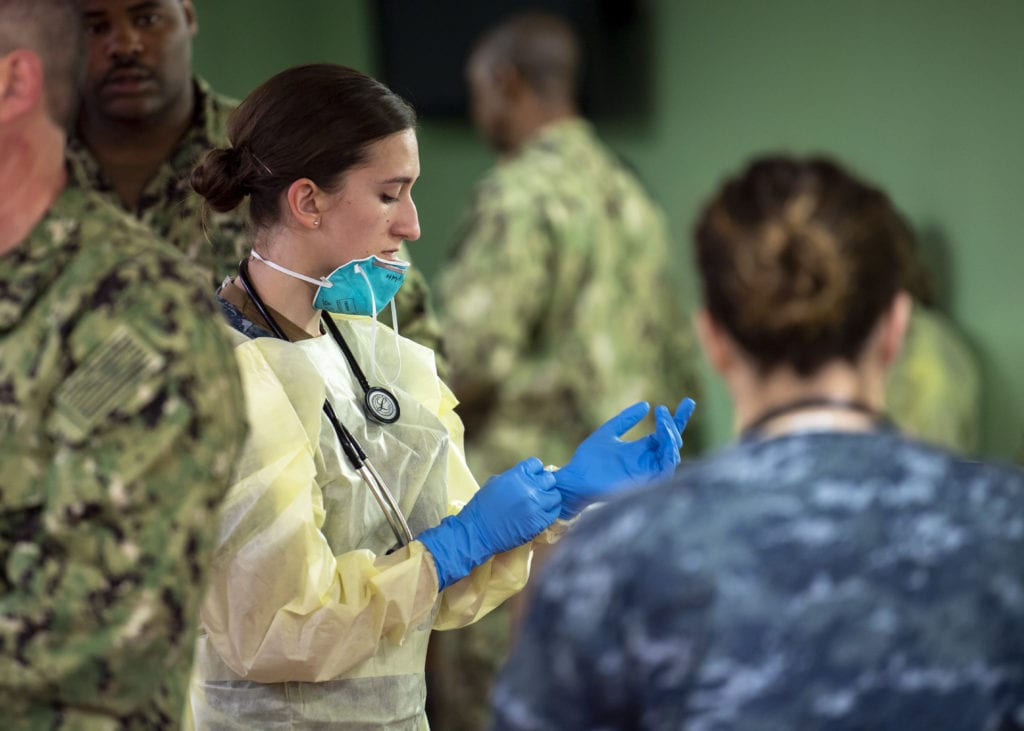
Hospital Corpsman 3rd Class Kimberly Wyss dons surgical gloves aboard the hospital ship USNS Mercy, which is deployed to Los Angeles in support of the nation’s COVID-19 response efforts and serves as a referral hospital for non-COVID-19 patients admitted to L.A.-area hospitals. U.S. Navy/Mass Communication Specialist 2nd Class Ryan M. Breeden
The then-captain of the Theodore Roosevelt, Brett Crozier, who later tested positive and went into quarantine himself, drew attention to his Sailors’ plight with a March 30 letter to Navy leadership. The letter was leaked and ran the next day with a story in the San Francisco Chronicle, drawing worldwide media attention.
As outcry grew over the fate of the Roosevelt’s crew, then-acting Navy Secretary Thomas Modly announced April 2 the removal of Crozier from his command. Modly then flew to Guam, where he would compound the controversy in a speech to the crew that included profanity-laced criticism of Crozier. The speech stirred more criticism of the Navy and Modly, who submitted his resignation on April 7.
By April 15, it was reported that Chief of Naval Operations Adm. Mike Gilday, after prelimary findings from a follow-on report of the affair, was considering reinstating Crozier.
As of April 16, 94% of the Theodore Roosevelt’s crew had been tested; 3,919 were negative with the 655 positives. Five were hospitalized in Guam, with one in intensive care. Of the 4,800 crew, 4,059 Sailors had moved ashore.
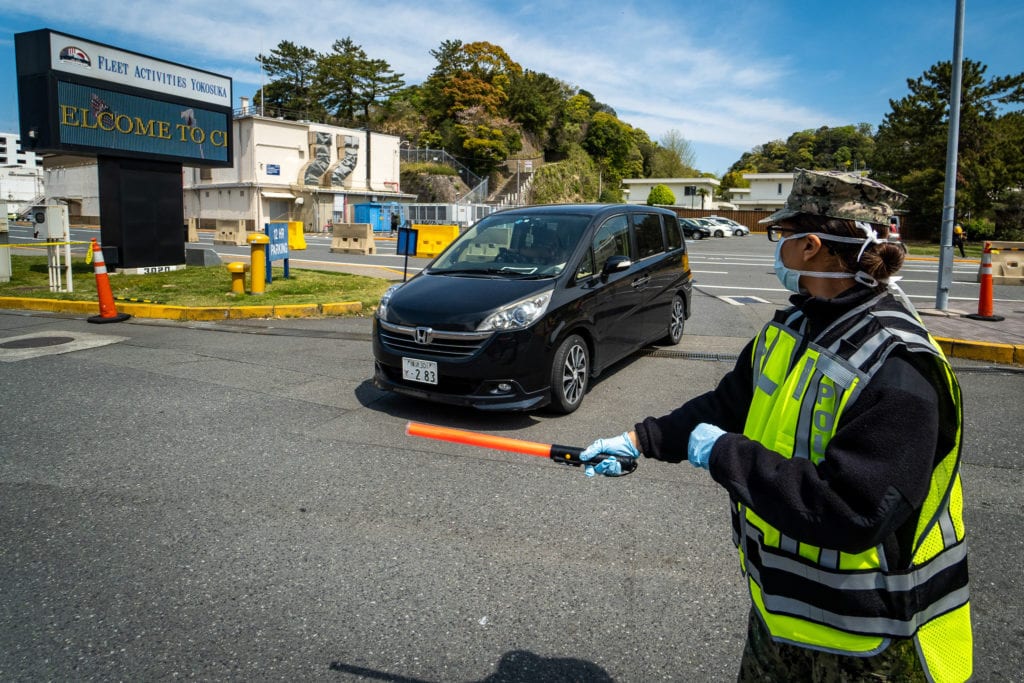
Commander, Fleet Activities Yokosuka, security department Sailors direct incoming gate traffic to COVID-19 screening stations on base. U.S. Navy/Taylor Curry
Concern for the Submarine Fleet
Of special concern is the health of the ballistic missile submarine force — the maritime leg of the nuclear triad with bombers and ground-based missiles — and other subs.
Crew members were undergoing enhanced medical screenings and 14-day isolation before beginning training or deployment aboard a sub, Gilday announced on March 24.
As of press time for Seapower in mid-April, no cases had been reported within the submarine force, but the Navy and all other services, starting in late March, were not reporting COVID-19 cases broken down by specific sectors of the fleet to protect operational security.
Wargame Foreshadows a Real Pandemic
Three months before the outbreak was detected in China, 50 experts participated in a wargame, Urban Outbreak 2019, that simulated the rapid spread of a disease.
The scenario involved a nation of 21 million people hit by a virus that led to respiratory failure and death.
The wargame generated a debate among “players” over the need for mass-enforced quarantine, like the U.S. population faces today. The players split between those who espoused quarantine as a reality and those who believed it would drive the infection underground and spread the disease faster.
The game’s results were scheduled to be discussed at a workshop in March, but like so many events in and out of the military these days, the real-life COVID-19 risk forced officials to postpone the workshop until at least this summer.
Pentagon Plans Testing, Screening, Manufacturing Push in COVID-19 Battle
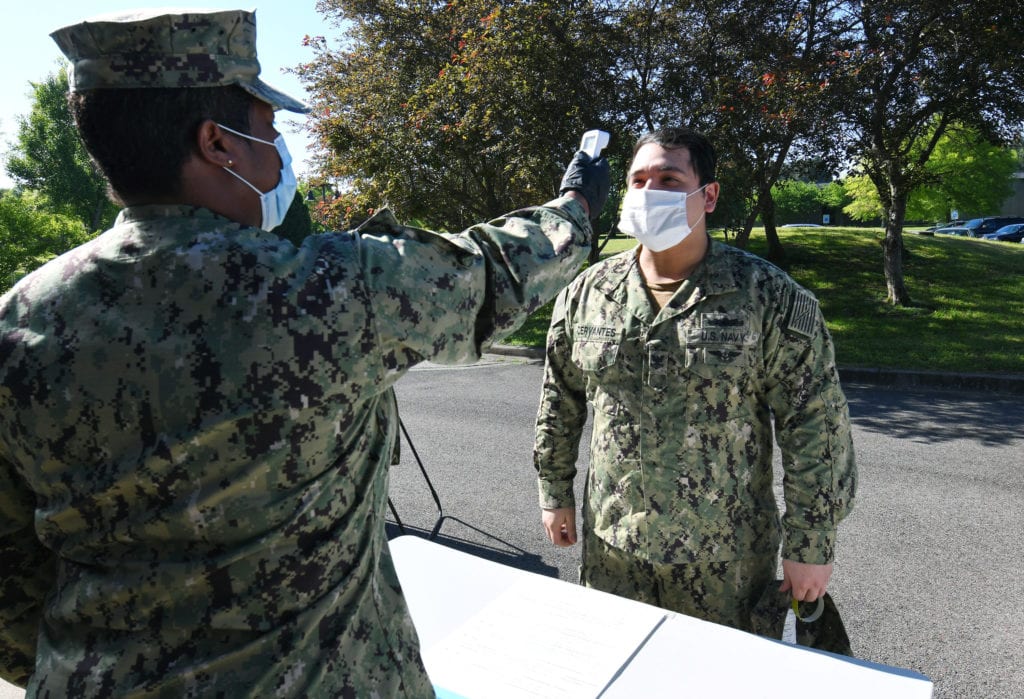
Master Chief Personnel Specialist Nikita Maher (left) uses a touchless thermometer on Personnel Specialist 2nd Class Francisco Cervantes at an entrance checkpoint of Goetsch Hall at Navy Personnel Command in Millington, Tennessee. U.S. Navy/Chief Mass Communication Specialist Michael Russell
ARLINGTON, Va. — The Defense Department is rolling out new strategies for screening the force for the novel coronavirus to halt the spread, spot those needing medical treatment early and still enable the military to fulfill its mission, according to two top Pentagon officials.
“As we learn more about the virus, we will continue to evolve our approach,” Deputy Defense Secretary David Norquist told a Pentagon press briefing that was live-streamed on April 22.
He noted that hundreds of thousands of active-duty and civilian personnel are teleworking. However, for thousands more who cannot practice social distancing because they work in constrained spaces like new recruits in training or Sailors and Marines on ships or submarines at sea, there is a new general process to screen for COVID-19.
For those groups, the first of four containment steps is screening with the use of questionnaires and thermometers to identify at-risk individuals. Next comes 14 to 21 days of quarantine, depending on a unit’s risk tolerance, to identify those who are infected but not yet showing symptoms. A third step calls for conducting swab tests and temperature checks, prior to leaving quarantine, to identify those who have since become infected but remain asymptomatic. Finally, as a unit moves to its mission, Norquist said, “we’ll keep this group together but limit its outside interaction to prevent the introduction of infection.”
“As we learn more about the virus, we will continue to evolve our approach.”
Deputy Defense Secretary David Norquist
Procedures like face coverings, hand washing, maintaining clean workspaces and continued monitoring will all still apply as units move forward while therapeutic treatments and vaccines are still being developed, he said.
COVID-19 had infected more than 802,000 people in the U.S. and had killed 44,575 as of April 21, according to the U.S. Centers for Disease Control and Prevention. The Pentagon reported on April 22 that 3,578 cases of COVID-19 have been detected among U.S. military and civilian personnel, dependents and contractors; 25 have of those have died. The U.S. Navy continues to have the largest number of cases — 1,298 — compared to 841 for the Army, 337 for the Air Force, 259 for the Marine Corps and 713 for the National Guard.
Meanwhile, under the authorities granted by the Defense Production Act, the government is moving to increase production of critical N95 masks to 39 million in the next 90 days and to 141 million over the next six months, Norquist said. The Pentagon is working with vendors to increase swab production from three million a month to 20 million, also boosting production of personal protective equipment for medical personnel, reagents for testing kits and active pharmaceutical ingredients.
As testing supplies become more prevalent, testing will be conducted through a priority-based, tiered system recently approved by Defense Secretary Mark Esper, Air Force Gen. John Hyten, the vice chairman of the Joint Chiefs of Staff, told the press briefing.
Tier 1 will focus on critical national capabilities, like strategic nuclear deterrent units. Tier 2 will focus on engaged, fielded forces around the world. Tier 3 is for forward-deployed and redeploying forces and Tier 4 includes the remainder of the military.
Hyten was asked if he thought it was unwise for the Army Corps of Engineers to continue building treatment facilities, with hundreds of beds, in big city convention centers, even as existing ones are under-used.
“For gosh sakes, no! That’s what I want to see,” he said. If the beds are all filled, that means local hospitals have been overwhelmed. “You always want to have excess capacity, not too little capacity,” he added.
Foggo: U.S. Military in All-New Territory in Fight Against Virus
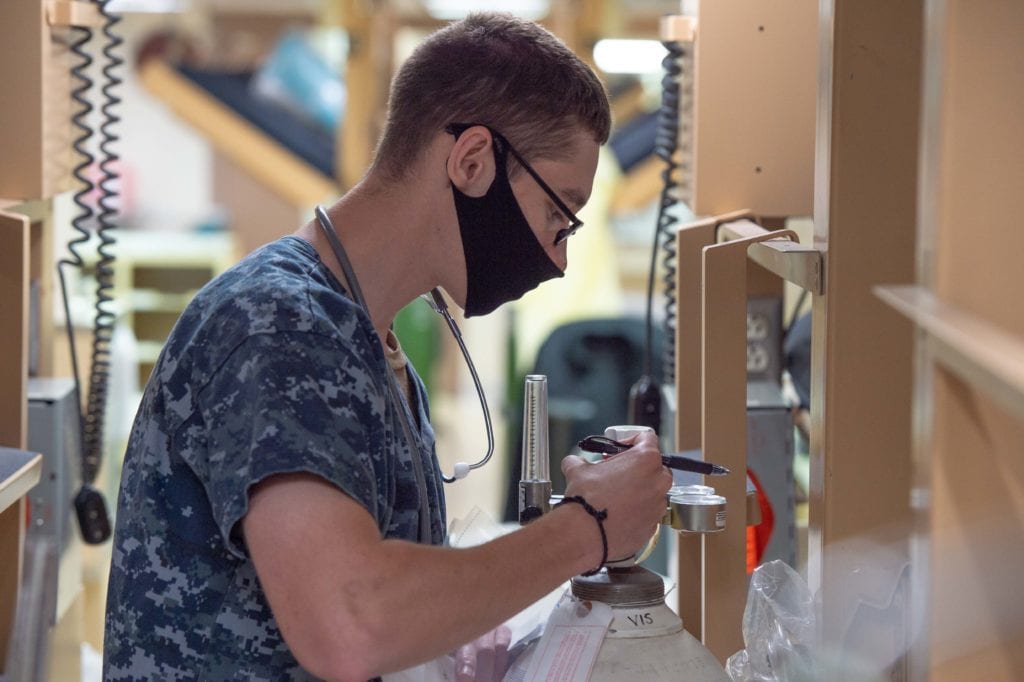
Hospitalman Recruit Jacob Cortes monitors the level of oxygen in a tank aboard the hospital ship USNS Mercy on April 14, docked in Los Angeles in support of COVID-19 response efforts. U.S. Navy/Mass Communication Specialist Seaman Luke Cunningham
ARLINGTON, Va. — The scope of the COVID-19 pandemic shows the new domain that the U.S. military must prepare to operate in, according to the top commander of U.S. naval forces in Europe and Africa.
“That seventh domain is just simply germs. It’s the biosphere we operate in,” Adm. James Foggo III said April 15 during a webcast for Navy League’s Sea-Air-Space 2020: Virtual Edition. “And I think we’re going to have to take that into account in our preparations for deterrence and defense in the future.”
To register and then watch this Sea-Air-Space 2020: Virtual Edition webinar live online, click here.
Foggo, commander of Allied Joint Force Command, which is based in Naples, Italy, as well as U.S. Naval Forces Europe and U.S. Naval Forces Africa, said the challenges of a massive NATO exercise, Trident Juncture 2018, which involved 50,000 personnel, 70 ships, 10,000 ground vehicles and 165 different aircraft, taught him that logistics should be added to the five battlespace domains of land, sea, air, space and cyber. However, the coronavirus outbreak that has sickened 1.9 million people worldwide, killed more than 123,000 and devastated Italy shows that there’s now a seventh domain.
“That seventh domain is just simply germs. It’s the biosphere we operate in.”
Adm. James Foggo III
“It hit us earlier, here in Italy,” where the Joint Force has facilities at Aviano Air Base in the north, Naval Air Station Sigonella in Sicily and Gaeta, near Naples, where the amphibious command ship USS Mount Whitney, the flagship of the 6th Fleet, is based.
Foggo credited Microsoft founder, billionaire and philanthropist Bill Gates for suggesting in a 2015 speech that, in addition to traditional wargames and tabletop exercises, pandemic planning take priority.
Foggo also cited a fast-spreading virus wargame, Urban Outbreak 2019, co-sponsored by the U.S. Naval War College, the Uniformed Services University of the Health Sciences and Johns Hopkins University’s Applied Physics Lab, as “a start in preparation for the future and incorporation into our planning processes.”
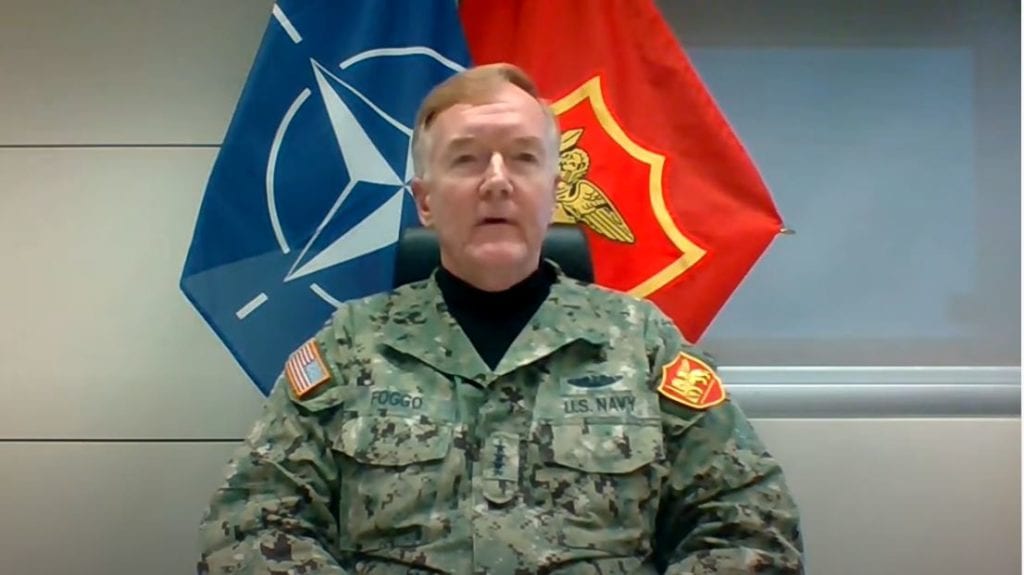
Adm. James Foggo III, commander of Allied Joint Force Command, U.S. Naval Forces Europe and U.S. Naval Forces Africa, spoke on April 15 during a Navy League Sea-Air-Space 2020: Virtual Edition webcast.
The admiral stressed the importance of testing for COVID-19 to determine if someone is infected and whether persons they’ve come in contact with be isolated.
“Testing works in our favor,” Foggo said. “We can’t afford to take anybody off the line in a day of Great Power Competition, where we have adversaries, competitors and, most importantly, we have violent extremists who take advantage of any chink in the armor.”
In the future, “we’re going to have to plan ahead on how we’re going to protect the force against something like the coronavirus until we get a vaccine against COVID-19, and then beyond that there will be a next coronavirus, and I think we’ll be much better prepared for that in the future.”