Jones Act Defenders Challenge Economic Arguments for Repealing Century-Old Law
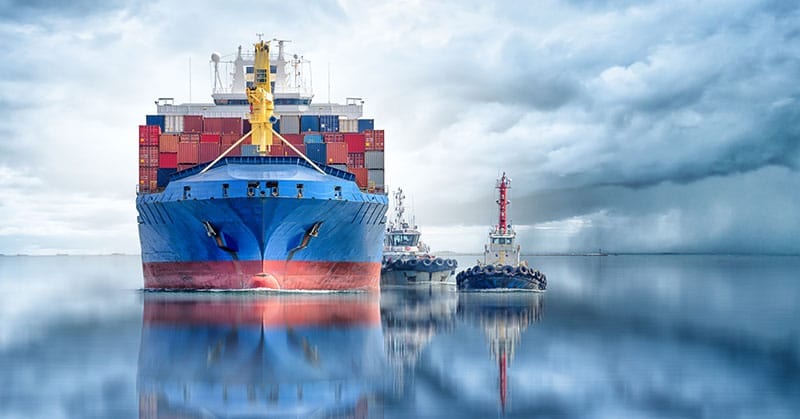
The usefulness today of the 100-year-old Jones Act was the main topic of discussion during a webinar aired on April 14 as part of the Navy League’s Sea-Air-Space 2020: Virtual Edition.

ARLINGTON, Va. — The 100-year-old Jones Act is far from an outdated law that keeps shipping prices high and hurts the nation’s economy, a panel of maritime policy experts argued on April 14.

“The biggest misconception of the Jones Act is the cost impact, the final cost to delivered goods,” John McCown, founder of Blue Alpha Capital, a maritime financial services firm, said on a webcast for Navy League’s Sea-Air-Space 2020: Virtual Edition. “Many of the critics have distorted what that number is, cherry picked it, taken it out of context,” McCown added.

To register and then watch this Sea-Air-Space 2020: Virtual Edition webinar live online, click here.

The Jones Act — also known as the Merchant Marine Act of 1920 — bars foreign-built, foreign-owned or foreign-flagged vessels from conducting coastal and inland waterway trade within the United States and between the United States and some of its territories such as Puerto Rico. The law also generally applies restrictions that effectively prohibit Jones Act-compliant ships from being overhauled at foreign shipyards. Ship crews must be composed of U.S. citizens or legal U.S. residents.
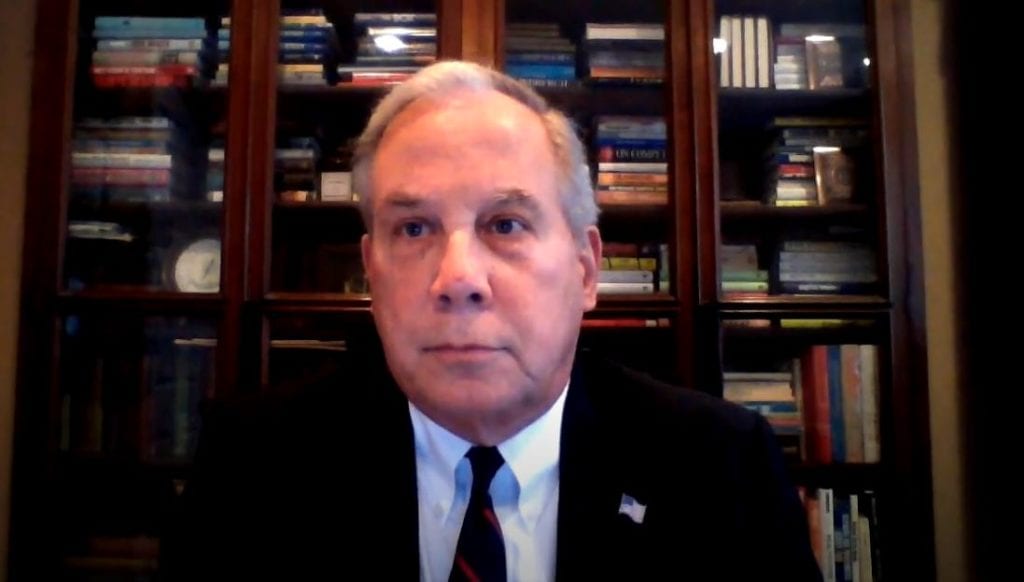
John McCown, founder of Blue Alpha Capital, a maritime financial services firm, joined the discussion on the Jones Act during a webcast for the Navy League’s Sea-Air-Space 2020: Virtual Edition.

Opponents say it’s time to repeal the law because it has led to higher shipping costs, which pass along higher prices to vendors, retailers and consumers. They also maintain higher costs have driven the commercial shipbuilding industry overseas, leading to a smaller pool of qualified U.S. merchant mariners.

That claim has turned the Jones Act into a scapegoat for “all sorts of economic ills,” McCown said. He noted that after Hurricane Maria devastated Puerto Rico in 2017, critics claimed the Jones Act was strangling Puerto Rico’s economy and, without the law, there would be a 15% drop in consumer prices. Such a price cut “translates to $9 billion a year,” which, McCown said, was a ludicrous estimate many times the total annual revenue of the Jones Act.

“The biggest misconception of the Jones Act is the cost impact, the final cost to delivered goods. Many of the critics have distorted what that number is, cherry picked it, taken it out of context.”

John McCown, founder of Blue Alpha Capital

U.S. Navy and Coast Guard officials have defended the law, saying that without it, there would be no pool of U.S. noncombat ships — or trained American seafarers to man them — in a war or other national emergency. If cost becomes the deciding factor in maritime trade, leading to elimination of the Jones Act, then commerce on U.S. coastal waters and internal waterways like the Mississippi River would be taken over by another nation, most likely China, the second-biggest economy and shipbuilder in the world, and a “Great Power” competitor, proponents of the law argue.

Given medical supply shortages in the current COVID-19 pandemic, dependence on foreign vessels and foreign crews could pose not just a national security risk, but economic and homeland security risks if the U.S. remains dependent on foreign supply chains, especially for medical equipment and pharmaceuticals, noted former Oklahoma Rep. Ernest Istook, a senior fellow at the Frontiers of Freedom, a conservative think tank. “If they decide to do something that might cut us off, then we are at their mercy,” he added.
COVID-19 Piles on Coast Guard’s Funding, Readiness Challenges, Says Commandant

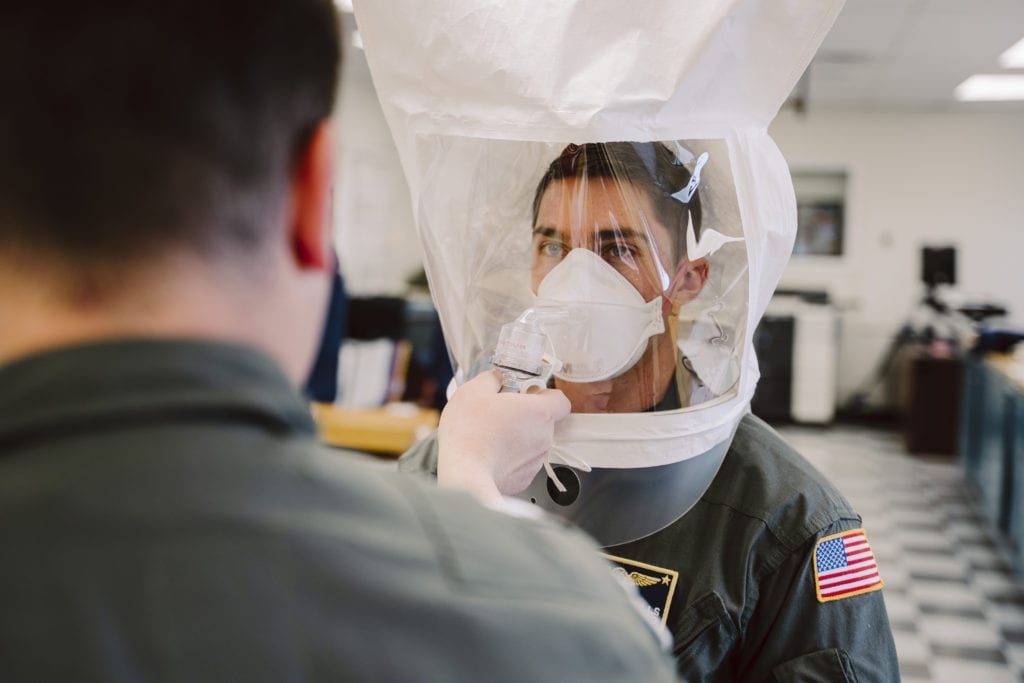
Coast Guard Petty Officer 3rd Class Evan Grills is fitted for an N95 respirator at Air Station Kodiak, Alaska, on March 24. Amid the COVID-19 pandemic, aircrews are taking additional measures to reduce potential exposure to the virus while also maintaining full mission readiness. U.S. Coast Guard/Petty Officer 1st Class Bradley Pigage

ARLINGTON, Va. — The U.S. Coast Guard, already facing longer term readiness and funding issues, is shifting manpower and equipment to meet the new challenge of the COVID-19 pandemic, the commandant of the Coast Guard told Navy League’s Sea-Air-Space 2020: Virtual Edition on April 13.

With the novel coronavirus also forcing the U.S. Navy, Marine Corps, Army and Air Force to come up with new ways to shield the force while still protecting the nation, Adm. Karl Schultz said his primary focus is on “maintaining a ready, healthy workforce to accomplish the Coast Guard’s primary missions” to facilitate the marine transportation system.

To register and then watch this Sea-Air-Space 2020: Virtual Edition webinar live online, click here.

See: As Part of Investments, Coast Guard Creates Major S.C. Base  

“Right now, we’re focused on people, readiness and enabling the economic prosperity and security of the nation,” Schultz said, noting the Coast Guard’s role as part of the Department of Homeland Security and its mission.

In addition to safeguarding the nation’s 355 seaports and 25,000 miles of commercial waterways as well as conducting maritime search and rescue and counter-narcotics operations, the constantly moving COVID-19 challenge has added new obstacles like offloading tens of thousands of cruise ship passengers, some of them ill with the virus. Coast Guardsmen did so April 2, helping to escort the cruise ships Zaandam and Rotterdam to port in Port Everglades, Florida.

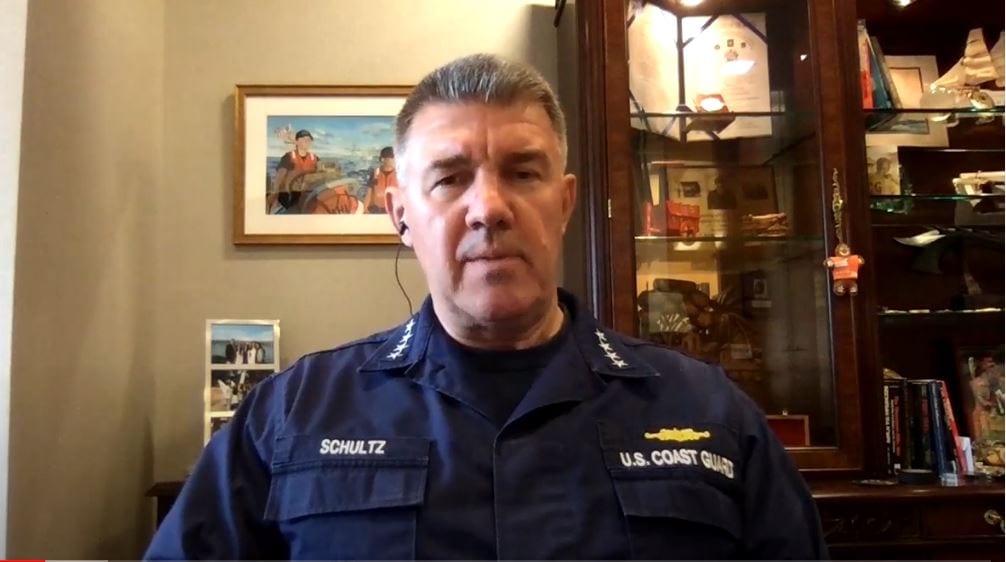
Commandant Adm. Karl Schultz participates in the Navy League’s Sea-Air-Space: Virtual Edition.

Schultz also noted that there are between 75 and 100 commercial vessels in U.S. waters with as many as 100,000 crewmen on board who may need Coast Guard assistance at some point during the crisis.

Before the coronavirus outbreak, the Coast Guard was facing a readiness challenge with aging ships and aircraft,  deteriorating infrastructure ashore and an information-technology system on “the brink of catastrophic failure,” the commandant said in his State of the Coast Guard address in February. 

“But the focus right now is [a] ready Coast Guard, men and women, to get into the fight and get after these COVID-19 challenges that are in our wheelhouse.”

Coast Guard Commandant Adm. Karl Schultz

Schultz said thousands of Coast Guard personnel are now teleworkers because of social-distancing rules, but thousands more are still front-line operators in the air and on the water. “This is really showing just how critical this C5I [command, control, communications, computers, cyber and intelligence] issue is,” Schultz said. “Clearly there’s a money piece to this,” he added. “We’ve got to stop patching old systems.”

When he took command of the Coast Guard in June 2018, Schultz said his focus was on people — getting better facilities and equipment for them, an improved retirement system and recruiting for a more diverse force representative of the nation.

“People remains the absolute center of gravity for Coast Guard readiness,” he said in a live-streamed question-and-answer session during Sea-Air-Space 2020: Virtual Edition.

“But the focus right now is [a] ready Coast Guard, men and women, to get into the fight and get after these COVID-19 challenges that are in our wheelhouse,” he added.

The Sea-Air-Space 2020: Virtual Edition event was created after the annual live exposition had to be canceled due to a prohibition against large gatherings in the wake of the COVID-19 pandemic.


Modly Resigns After Backlash Over Insults Directed at Carrier’s Ousted Captain

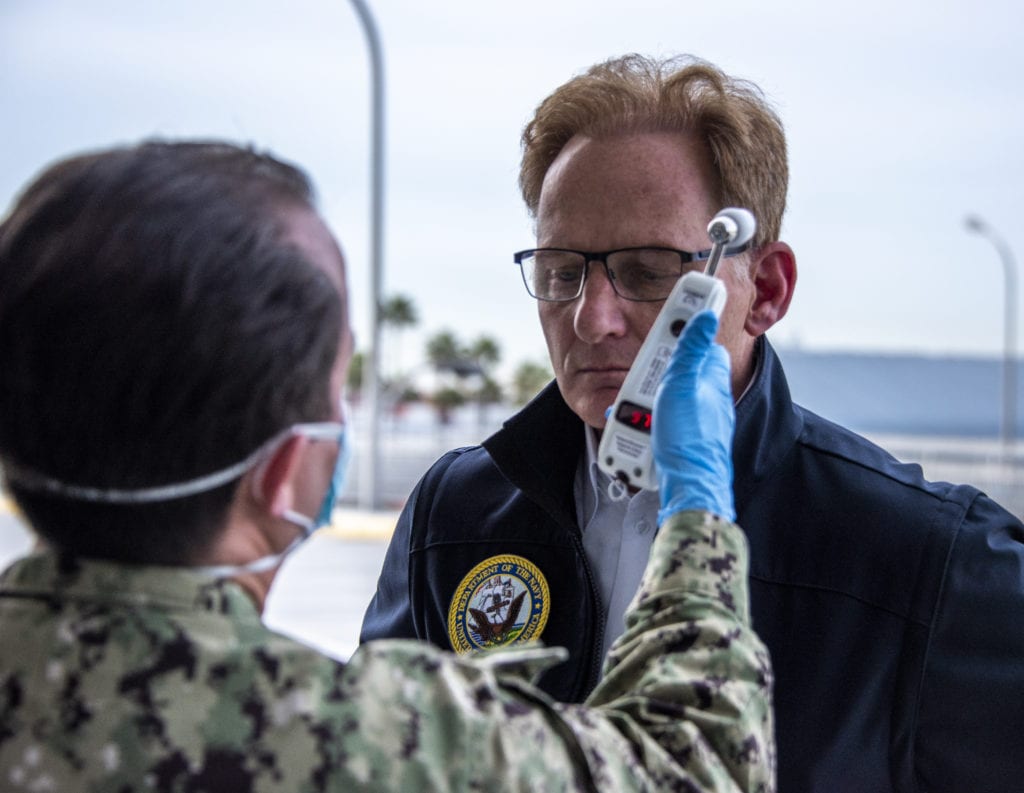
Acting Navy Secretary Thomas B. Modly, who had his temperature checked March 31 during a COVID-19 screening before boarding the hospital ship Mercy in Los Angeles, resigned April 7 after a backlash over his comments toward the former captain of the aircraft carrier USS Theodore Roosevelt. He later apologized for those remarks. U.S. Navy/Mass Communication Specialist 2nd Class Natalie M. Byers

ARLINGTON, Va. — Thomas B. Modly resigned as acting Navy secretary on April 7, a day after calling the ousted captain of the coronavirus-infected USS Theodore Roosevelt “stupid” in a profanity-laced speech to the aircraft carrier’s crew.

Defense Secretary Mark Esper accepted Modly’s resignation, noting in a statement that Modly “resigned on his own accord, putting the Navy and the Sailors above self.”

Esper said he was appointing current Army Undersecretary James McPherson, a retired Navy admiral, as acting Navy secretary until a permanent secretary can be confirmed. McPherson himself was confirmed by the Senate for the Army post only 14 days ago.

In his statement, Esper said he had “the deepest respect for anyone who serves our country, and who places the greater good above all else. Secretary Modly did that today, and I wish him all the best.”

Esper noted that the investigation which Chief of Naval Operations Adm. Mike Gilday had launched into the Roosevelt affair was continuing and any further action regarding its fired commander, Capt. Brett Crozier, “will wait until that investigation is completed.”

Esper said he was appointing current Army Undersecretary James McPherson, a retired Navy admiral, as acting Navy secretary until a permanent secretary can be confirmed.

Modly’s resignation came after a tumultuous series of events that saw him relieve Crozier from command on April 2, fly to Guam, where the ship is docked, and defend his actions in a April 6 address to the ship’s crew that was sprinkled with profanity. In that speech, Modly called Crozier “too naive or too stupid to be the commanding officer of a ship like this,” according transcripts of recordings of Modly’s remarks made by several of the carrier’s crew.

Modly later said, “I stand by every word I said,” even the profanity. However, less than 24 hours after the speech, Modly issued an apology to Crozier, to the Theodore Roosevelt’s crew and the Navy.

“Let me be clear,” Modly said in his statement of apology, “I do not think Capt. Brett Crozier is naive or stupid. I think and have always believed him to be the opposite. I believe, precisely because he is not naive and stupid, that he sent his alarming e-mail with the intention of getting into the public domain in an effort to draw public attention to the situation on his ship.”

Modly “resigned on his own accord, putting the Navy and the Sailors above self.”

Defense Secretary Mark Esper

Crozier’s March 30 letter to dozens of Navy brass and fellow naval aviators sparked the initial controversy that ultimately led to Modly’s resignation a week later.

After three Sailors on the Roosevelt tested positive for COVID-19 — and still more were found to be infected after the carrier made a scheduled port visit at Guam — Crozier believed the carrier had inadequate space to isolate or quarantine Sailors. “The spread of the disease is ongoing and accelerating,” Crozier wrote. He called for disembarking all but a token force of about 10% of the crew until all could be tested for infection, isolated for the required 14 days and the ship sanitized.

The letter was leaked to the San Francisco Chronicle, which published it on March 31, gaining worldwide media attention and highlighting Crozier’s plea: “We are not at war. Sailors do not need to die. If we do not act now, we are failing to properly take care of our most trusted asset — our Sailors.”

The next day, at a Pentagon press briefing, Modly said he was “disappointed” to hear those remarks but added, “We need a lot of transparency in this situation, and we need that information to flow up through the chain of command.”

On April 3, Modly ordered Crozier relieved of his command, saying he had “lost confidence in his ability to lead” during the virus outbreak. Before the letter was published, Navy leadership had already been in touch with Crozier, Modly said. The captain said he wanted his crew evacuated from the ship faster but did not relay “the various levels of alarm that I, along with the rest of the world, learned from his letter when it was published two days later,” Modly said.


President Grants New York Governor’s Request for Hospital Ship Comfort to Take COVID-19 Patients

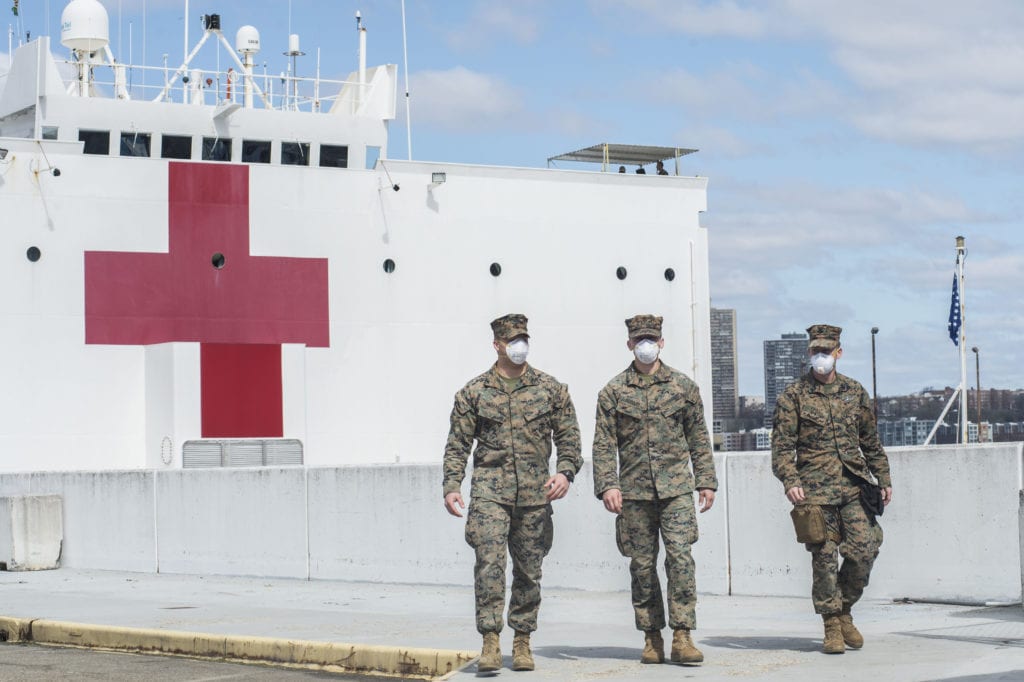
U.S. Marines walk along Pier 90 in New York City as part of a security detachment supporting the Military Sealift Command hospital ship USNS Comfort. U.S. Navy/Mass Communication Specialist 2nd Class Adelola Tinubu

ARLINGTON, Va. — The governor of New York, the state hardest hit by the COVID-19 pandemic, wants the hospital ship USNS Comfort to switch missions and accept patients with the novel coronavirus ahead of an anticipated spike in infections and deaths.

At his daily news conference April 6 in Albany, N.Y., broadcast by numerous news outlets, Cuomo said he would call on President Trump to direct the 1,000-bed Medical Treatment Facility on board the USNS Comfort to start treating COVID-19 patients. Trump later granted Cuomo’s request. A crew member on the hospital ship later tested positive for the virus, several media outlets reported.

See: Navy Deploys Medical Personnel to New Orleans, Dallas

See: Coast Guard Oversees Disembarkation of Cruise Passengers

The Comfort and the USNS Mercy, which was sent to help another overburdened medical system in Los Angeles, were designated as referral hospitals for non-COVID 19 patients, to allow local health professionals and hospitals to focus their attention and equipment, like intensive care units and ventilators, on COVID-19 patients.

However, the Comfort, docked in the Hudson River, has seen only a handful of non-COVID patients. Noting mandatory stay-at-home orders in the state, which have reduced auto accidents, crime and other activities that might require a trip to the hospital in ordinary times. “We don’t need the Comfort for non-COVID,” Cuomo said, “we need it for COVID.”

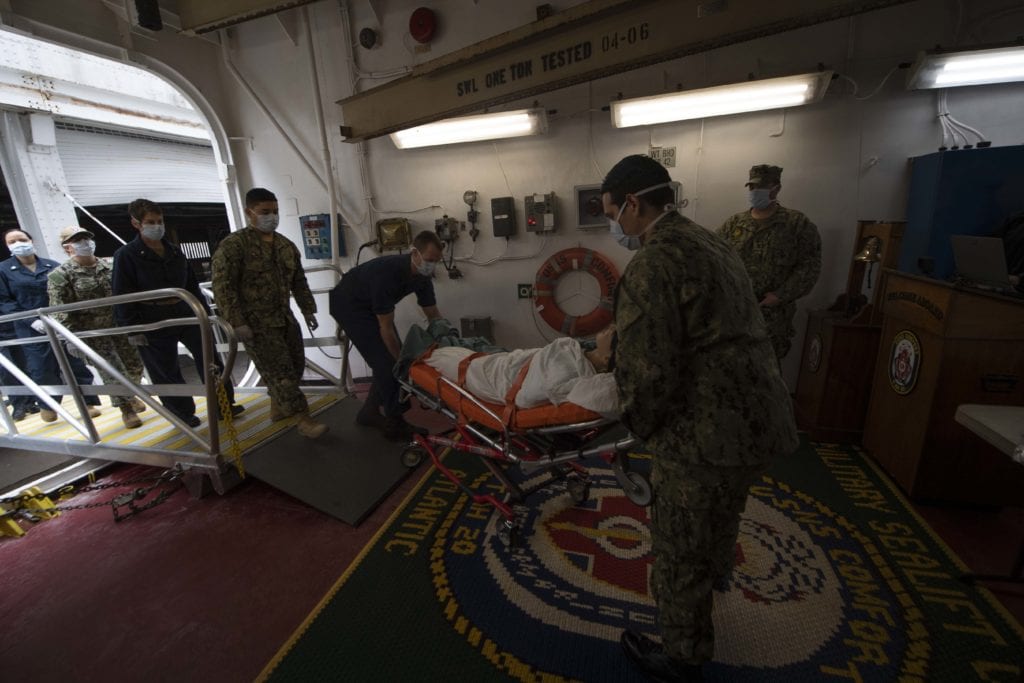
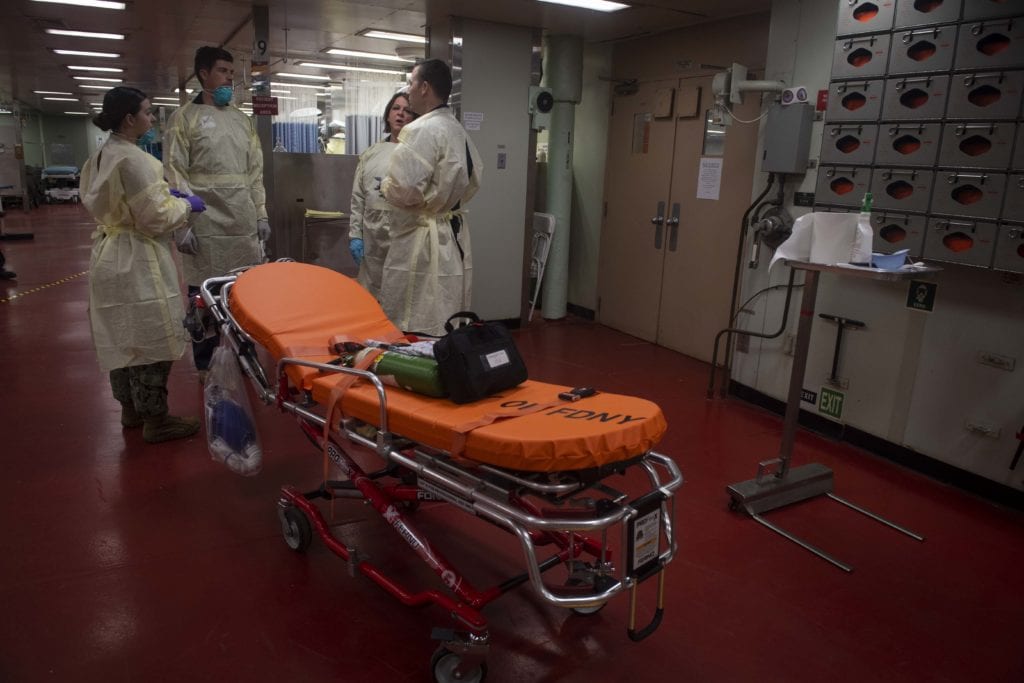
The patient transport team prepares to receive a patient aboard the hospital ship USNS Comfort while the ship is moored in New York. U.S. Navy/Mass Communication Specialist 2nd Class Sara Eshleman

President Trump raised the issue April 5 at a coronavirus task force briefing at the White House. While the ship’s mission wasn’t supposed to be for virus treatment “at all,” Trump said, “It looks like more and more we’ll be using it for that.”

New York State has been the epicenter of the COVID-19 outbreak in the United States with 130,689 cases and 4,758 deaths. The 800-foot-long Comfort, a converted oil supertanker, can provide a range of services such as general surgeries, critical care and ward care for adults. The ship wasn’t accepting obstetrics or pediatric cases, for which it had no specialists or equipment. Walk-in patients weren’t permitted, and ambulances couldn’t take patients directly to the Comfort. Patients first had to be transported to a city hospital for evaluation, including testing for COVID-19 before they could be transported to the ship.

Pentagon officials announced April 3 that screening for care on the USNS Comfort was being modified and will occur pier-side to reduce the backlog at some of the nearby New York hospitals. The screening effort for the Comfort no longer would require a negative test, but each patient still will be screened by temperature and a short questionnaire. The Pentagon also announced that the 2,500-bed non-COVID facility set up in New York’s Javits Convention Center would start taking COVID-19 positive patients.

Capt. Patrick Amersbach, the USNS Comfort’s medical commander, told reporters in a teleconference April 2 that if the mission changed, all the Comfort’s beds would have to be reconfigured to keep those with the virus far apart from those not infected.

“We understand that introducing COVID-19 positive patients into the FMS environments elevates the risk of transmission to other patients and our medical providers. This decision was risk-informed and made to ensure that DoD can continue to provide these local communities the type of medical care they most need. Force health protection is a top priority and our medical professionals will have the required personal protective equipment needed for this mission,” the Defense Department announcement said.

The shipboard coronavirus relief operation in both New York and Los Angeles is led by the Federal Emergency Management Agency in coordination with U.S. Northern Command, Military Sealift Command and the U.S. Navy.


Former Commander of Theodore Roosevelt to Replace Ousted Skipper

Sailors aboard the amphibious assault ship USS America watch the aircraft carrier USS Theodore Roosevelt get underway in formation in the Philippine Sea. U.S. Navy/Mass Communication Specialist Seaman Jomark A. Almazan

ARLINGTON, Va. — The most recent former commander of the USS Theodore Roosevelt will replace the aircraft carrier’s ousted skipper, Capt. Brett Crozier, who was dismissed April 2 after his plea to the U.S. Navy for more help dealing with a shipboard coronavirus outbreak went public.

Rear Adm. Select Carlos Sardiello, who commanded the Teddy Roosevelt from July 2017 until last November, will replace the man who took over from him just five months ago — as soon as Sardiello can reach Guam, where the carrier is docked.

Until that time, Capt. Dan Keeler, the carrier’s executive officer, is in command. Several videos posted on social media on April 3 show large crowds of Theodore Roosevelt personnel cheering for Crozier as he departs down the carrier’s gangway alone. Thousands of the TR’s 4,900 personnel have been offloaded, isolated and tested on Guam to counter the spread of the novel coronavirus, COVID-19.   

Rear Adm. Select Carlos Sardiello, captain of the Theodore Roosevelt from July 2017 until last November, will assume command of the aircraft carrier again following the ouster of Capt. Brett Crozier. U.S. Navy/Mass Communication Specialist 3rd Class Becca Winberry

Sardiello “is extremely well-acquainted with the ship, many members of its crew and the operations and capabilities of the ship itself,” acting Navy Secretary Thomas Modly told an April 2 press briefing where he announced Crozier’s removal. Sardiello “is the best person in the Navy right now to take command under these circumstances,” Modly said.

A few days after three of the TR’s sailors tested positive for COVID-19 and were evacuated by air, the carrier made a scheduled port visit at Guam, where the number testing positive grew to more than 100. Most of those Sailors have minor or no symptoms and none have been hospitalized.

In a four-page March 30 letter to Navy leadership, Crozier said that the TR had inadequate space to isolate or quarantine Sailors in keeping with guidance from the U.S. Centers for Disease Control and Prevention and the Navy. “The spread of the disease is ongoing and accelerating,” Crozier wrote. He called for disembarking all but a token force of about 10% of the crew until all could be tested for infection, isolated for the required 14 days and the ship sanitized. The letter was leaked to the San Francisco Chronicle, which published it on March 31.

At a Pentagon press briefing the following day, Modly said he was “disappointed” to hear of Crozier’s remarks but avoided saying whether the captain would be fired for going outside normal channels to draw attention to his ship’s plight. “We need a lot of transparency in this situation, and we need that information to flow up through the chain of command,” Modly said.

However, at the April 2 briefing, also attended by Chief of Naval Operations Adm. Mike Gilday, Modly said he was ordering Crozier removed from his command because he had “lost confidence in [Crozier’s] ability to lead” the Roosevelt during the virus outbreak. Before Crozier’s letter was published, Navy leadership had been in touch with the captain, Modly said. Crozier said he wanted his crew evacuated from the carrier faster but did not relay “the various levels of alarm that I, along with the rest of the world, learned from his letter when it was published,” Modly said.

Crozier “had allowed the complexity of his challenge with the COVID breakout on the ship to overwhelm his ability to act professionally, when acting professionally was what was needed most.”

Acting Navy Secretary Thomas Modly

Nor had Crozier discussed the situation with his immediate superior, the carrier strike group’s commander, Rear Adm. Stuart Baker, who was on board the TR “right down the passageway from him,” Modly said. The secretary also complained that Crozier had not encrypted the letter, which was sent over nonsecure, unclassified e-mail outside the chain of command that raised questions about the operational capabilities and security of the aircraft carrier.

After discussions in person and by teleconference with Gilday, the commanders of the U.S. Pacific Fleet, the 7th Fleet, Navy Surgeon General Rear Adm. Bruce Gillingham and others, Modly said he concluded Crozier “had allowed the complexity of his challenge with the COVID breakout on the ship to overwhelm his ability to act professionally, when acting professionally was what was needed most.”

Moldy said Gilday has directed Vice Chief of Naval Operations Adm. Robert Burke to investigate the circumstances and climate of the entire Pacific Fleet “to help determine what may have contributed to this breakdown in the chain of command.”


Captain of COVID-19-Plagued Aircraft Carrier Relieved of Command

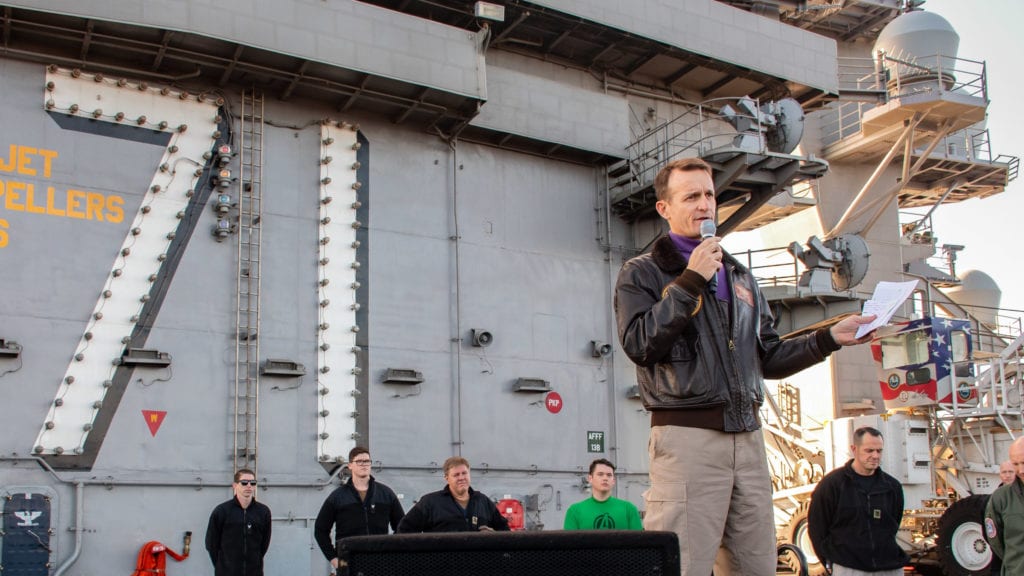
Capt. Brett Crozier addresses the crew for the first time as commanding officer of the aircraft carrier USS Theodore Roosevelt during a change-of-command ceremony in November on the ship’s flight deck. U.S. Navy/Mass Communication Specialist 3rd Class Sean Lynch

ARLINGTON, Va. — The commander of the aircraft carrier USS Theodore Roosevelt — whose letter to U.S. Navy brass about leadership’s slow response to a coronavirus outbreak that endangered his crew was leaked to a San Francisco newspaper — has been relieved of his post.

Acting Navy Secretary Thomas Modly announced April 2 that the carrier’s commander, Capt. Brett Crozier, was being relieved of command of the ship, now docked in Guam, where nearly 100 Sailors tested positive for the novel coronavirus, COVID-19.

See: New York, L.A. Hospital Ships Brace for Expected Wave of Patients

In a hastily called press briefing, Modly said Crozier was not fired in retaliation for his letter but because the secretary had lost confidence in his leadership. Crozier “had allowed the complexity of his challenge with the [COVID-19] breakout on the ship to overwhelm his ability to act professionally, when acting professionally was what was needed.”

On March 30, in a four-page letter to Navy leadership, Crozier said that his ship had inadequate space to isolate or quarantine Sailors in keeping with guidance from the U.S. Centers for Disease Control and the Navy.

Crozier “had allowed the complexity of his challenge with the [COVID-19] breakout on the ship to overwhelm his ability to act professionally, when acting professionally was what was needed.”

Acting Navy Secretary Thomas Modly

“The spread of the disease is ongoing and accelerating,” Crozier wrote. He called for disembarking all but a token force of about 10% of the crew from the ship until all could be tested for the infection, isolated for the required 14 days and the ship adequately cleaned.

The letter was leaked to the San Francisco Chronicle, which published it two days later. The Chronicle article, which gained wide attention, included Crozier’s position that: We are not at war. Sailors do not need to die. If we do not act now, we are failing to properly take care of our most trusted asset — our Sailors.”

Reaction to Crozier’s April 2 dismissal was swift from at least some leaders on Capitol Hill, where Democrats on the House Armed Services Committee — including its chairman, Rep. Adam Smith (D-Wash.) — decried the move. “While Captain Crozier clearly went outside the chain of command,” the congressmen wrote in a statement, his dismissal “is a destabilizing move that will likely put our service members at greater risk and jeopardize our fleet’s readiness.” 

Hospital Corpsman 2nd Class Michael Lusk takes a swab sample for COVID-19 testing aboard the aircraft carrier USS Theodore Roosevelt on April 1 with the ship docket in Guam. U.S. Navy/Mass Communication Specialist 3rd Class Dartañon D. De La Garza

At an April 1 press briefing at the Pentagon, Modly declined to say whether Crozier would be fired for going outside channels to draw attention to his ship’s plight. Chief of Naval Operations Adm. Mike Gilday also declined to comment on the fate of Crozier’s command of the Theodore Roosevelt.

Modly noted that Crozier stayed within Navy channels by sending his letter up the chain of command and added that the special medical team which deployed to the Roosevelt echoed some of the captain’s concerns.

“Let me emphasize that this is exactly what we want from our officers and our medical teams. We need a lot of transparency in this situation and we need that information to flow up through the chain of command,” Modly said at the briefing.


New York, L.A. Hospital Ships See Few Patients But Brace for Expected Wave

Sailors practice patient transfer from the pier onto the hospital ship USNS Comfort as they prepare to admit patients in New York in support of the nation’s COVID-19 response efforts. U.S. Navy/Mass Communication Specialist 2nd Class Sara Eshleman

ARLINGTON, Va. — Both commanders of medical operations on the two Military Sealift Command hospital ships sent to ease the load of non-coronavirus cases at hard-pressed local hospitals in Los Angeles and New York City said their staffs have treated only a handful of patients so far.

Capt. John Rotruck, commander of the Medical Treatment Facility USNS Mercy in Los Angeles, and Capt. Patrick Amersbach, the Medical Treatment Facility USNS Comfort commander in New York, told an April 2 Pentagon press conference by phone that their vessels were rushed to both cities to be in place before hospitals were overwhelmed by COVID-19 patients so, as Rotruck said, “when capacity demand really increases, we’ll be ready.”

See: Navy dismisses outspoken captain of the USS Theodore Roosevelt

The Mercy, based in San Diego, reached L.A. on March 27 and received its first patient March 29. Since then, 15 patients have been transferred from local hospitals to the hospital ship. Five have been discharged and 10 others are still being treated on board.

That effective throughput showed the hospital ships could act as “a relief valve for local hospitals,” Rotruck said. Otherwise, if the ships filled up “we would be of little use to the local hospitals.” The Norfolk, Virginia-based Comfort set sail six days ahead of original plan on March 28 and reached New York two days later. Comfort staff have treated 30 people since April 1.

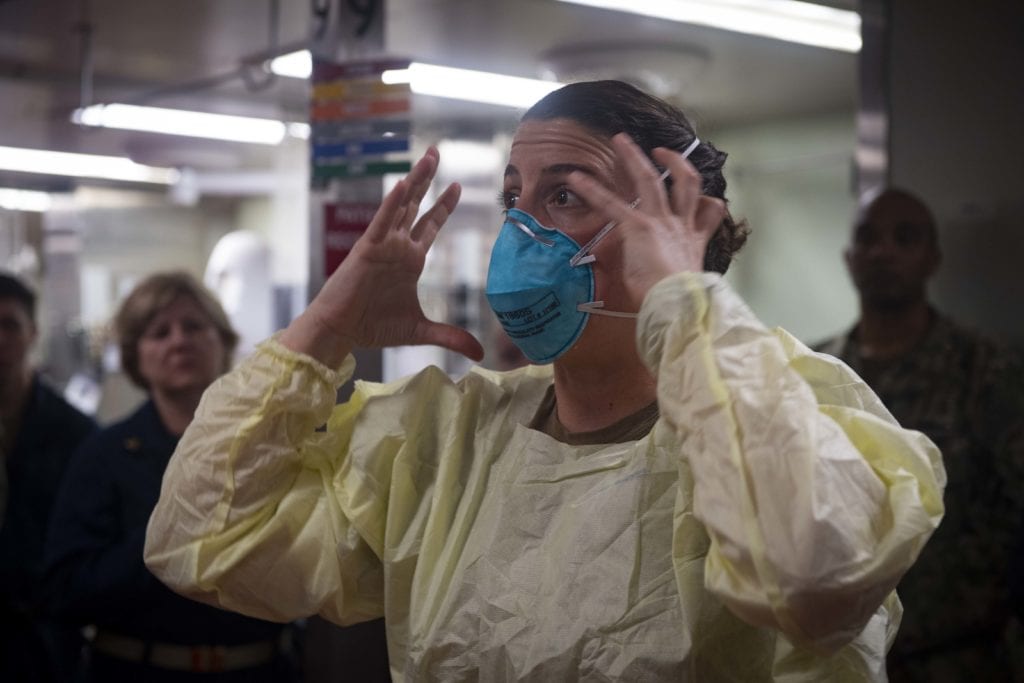
Lt. Cmdr. Nevin Yazici demonstrates how to properly fit an N95 respiratory protective device aboard the Comfort in New York. U.S. Navy/Mass Communication Specialist 2nd Class Sara Eshleman

“We were brought into New York City as quickly as possible,” Amersbach said, to “accept COVID-19-free patients to take pressure off local health systems before the wave hit.”

Both huge vessels can provide a full spectrum of services, including general surgeries, critical care and ward care for adults. That will allow local health care professionals to focus on treating COVID-19 patients and for shore-based hospitals to use their intensive care units and ventilators for threating those patients. Neither ship is accepting obstetrics or pediatric patients, which the captains said would require more specialists and equipment than the ships have for their primary mission.  

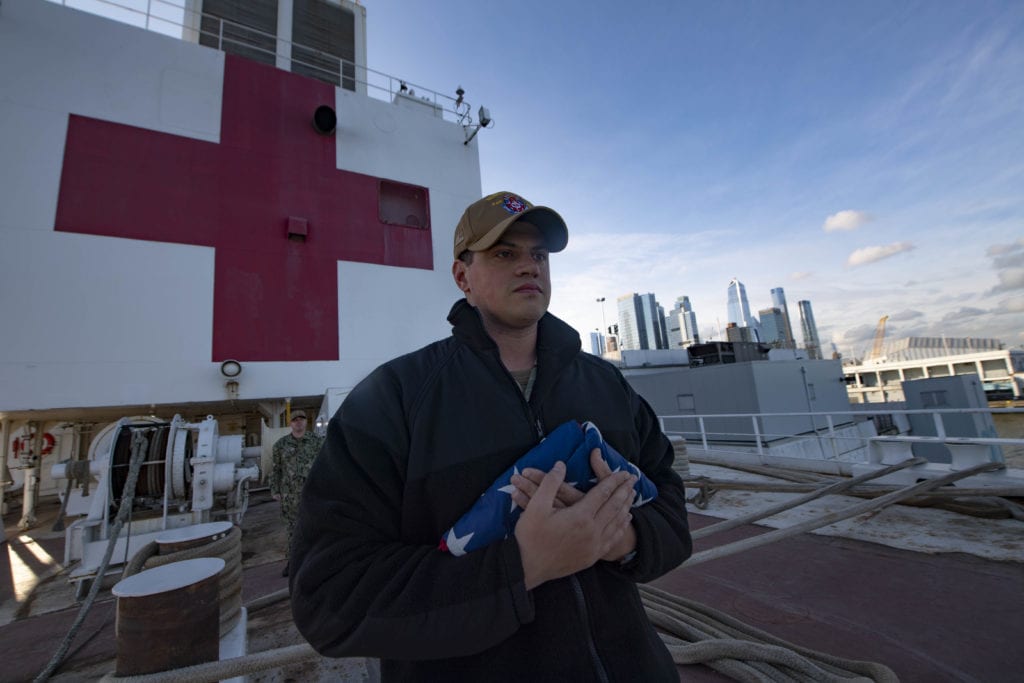
Aviation Boatswain’s Mate 2nd Class Justin Cosgrove participates in morning colors aboard the Comfort while the ship is moored in New York City in support of the nation’s COVID-19 response efforts. U.S. Navy/Mass Communication Specialist 2nd Class Sara Eshleman

Rotruck said the cases doctors on the Mercy have treated ranged from traumatic accident injuries to gastrointestinal, heart and lung issues. In both cities, all patients are referred by local hospitals to a central command center for disposition and are screened and tested for COVID-19 before they can come aboard the ships.

Medical staff on the ships, who include Navy reservists as well as active-duty personnel, were screened for COVID-19 before they came on board and any new staff will have to self-isolate in New York or Los Angeles for 14 days before boarding either ship.

If higher authorities changed the ships’ mission to treat COVID-19 patients, Rotruck speculated that Mercy would have to “transfer all the non-COVID-19 patients off the ship and become a 100% COVID operation.” Amersbach said if the mission changed, all the Comfort’s beds would have to be reconfigured to keep those with the virus far apart from those not infected.

Rotruck said the apparent deliberate derailment of a railroad locomotive near the port area where the Mercy is berthed did not affect the ship’s staff, patients or services. “It happened well outside of our fence line,” said Rotruck, adding that the Navy and Defense Department will adjust force protection procedures if there are additional security concerns.

In New York City, were supplies of personal protection equipment (PPE) for local medical staff are running critically low, Amersbach said the Comfort hasn’t received any requests for supplies or equipment from hospitals, adding that such requests would be forwarded to the Federal Emergency Management Agency. “We currently have enough PPE, equipment and stores on board,” he said, “at least for the next couple of weeks, depending on how many patients we get aboard the ship.”

The two hospital ships aren’t the only Navy Department responses to the medical needs of the civilian population, acting Navy Secretary Thomas Modly told a press briefing on April 1.

Scalable, modular, rapidly erectable shelters, known as Expeditionary Medical Facilities, were sent to temporary medical stations at convention centers in Dallas and New Orleans. Marine Corps Systems Command and the Naval Information Warfare Center, Pacific, were designing 3-D parts to assist the University of California-San Diego convert ventilators to handle multiple patients, Modly said.


COVID-19 Testing, Isolation Expand for Crew of Aircraft Carrier as Navy Dismisses Captain

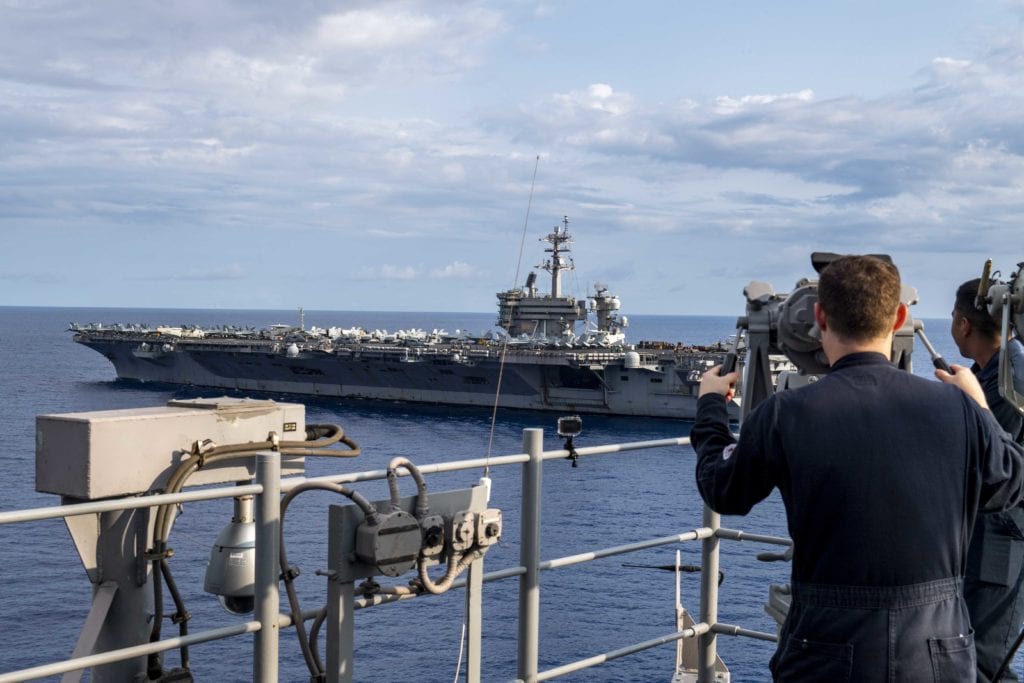
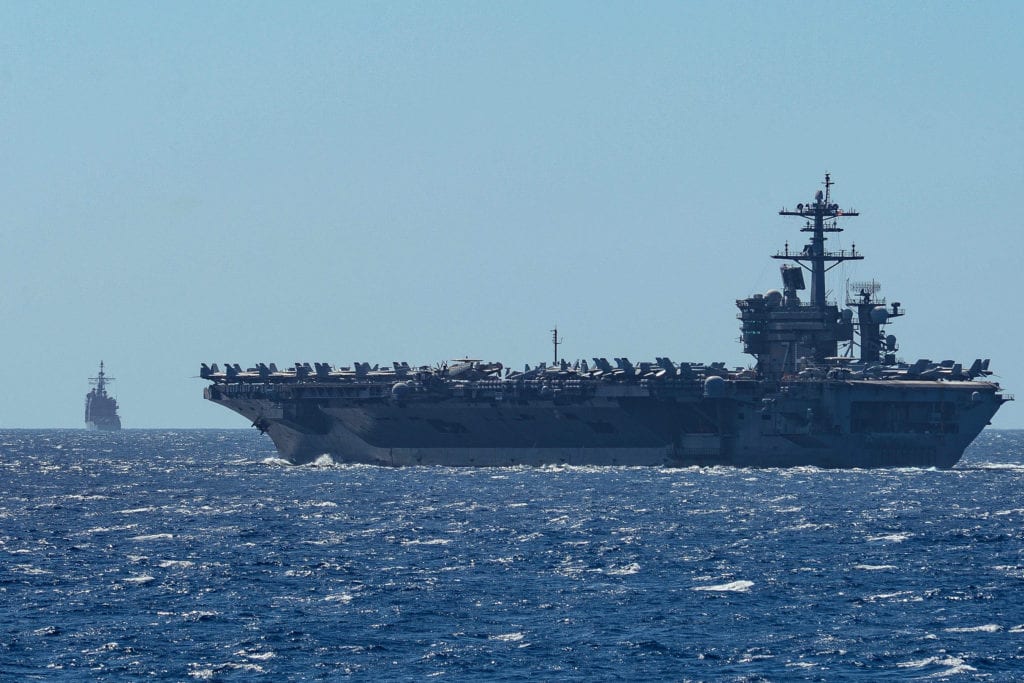
The aircraft carrier USS Theodore Roosevelt and the Ticonderoga-class guided-missile cruiser USS Bunker Hill transit the Philippine Sea on Feb. 29. U.S. Navy/Mass Communication Specialist 3rd Class Sean Lynch

ARLINGTON, Va. — U.S. Navy officials are scrambling to find accommodations on Guam to isolate thousands of Sailors from the aircraft carrier USS Theodore Roosevelt, the first — and, so far, only — deployed Navy ship to be caught up in the coronavirus outbreak.

Meanwhile, media widely reported on April 2 that the Navy had dismissed the commanding officer of the carrier for speaking out about the Navy’s response to the outbreak aboard his ship.

Nearly 1,000 of the 4,865 Sailors that the Theodore Roosevelt got underway with in January are off the ship and being isolated on Guam, acting Navy Secretary Thomas Modly told a Pentagon press briefing on April 1. Officials hoped to have about 2,700 off the carrier in the next couple of days, he said. Less than 100 of the Sailors have tested positive for the novel coronavirus, COVID-19, and none have been hospitalized, Modly said.

See: Ship Construction Ongoing, Repairs Continuing Amid Outbreak

The entire ship’s company will not be evacuated all at once for security reasons, Modly stressed.

“We cannot and will not remove all the Sailors off the ship,” he said, adding that except for size, the 1,092-foot-long Roosevelt is not like a cruise ship. “The ship has weapons, munitions, expensive airplanes and a nuclear reactor,” he noted.

Chief of Naval Operations Adm. Mike Gilday said about 1,000 Sailors would be needed to handle maintenance and security as well as for cleaning and disinfecting the huge vessel. Gilday said healthy Sailors, after 14 days of quarantine, could rotate to the Roosevelt, replacing those still working on board.

The Navy is looking beyond its own properties and other Defense Department facilities on Guam to house Sailors taken off the ship for testing, isolation or quarantine. Modly said officials are working with Guam’s governor to free up hotel space there.

Once Sailors are tested they will either be isolated for 14 days if they test negative for COVID-19 or quarantined if they test positive for the virus, which has sickened 927,986 around the world and killed more than 46,000 people, including more than 4,700 in the United States.

As of April 1, 1,273 Roosevelt Sailors, about 24% of the crew, have been tested for COVID-19. Only 93 tested positive. Of those, 86 showed symptoms, while the other seven did not. Another 593 tested negative. Not all test results have returned, Modly said.

Officials said they still don’t know how the disease was brought on board. The Roosevelt’s last port of call — 15 days before the first three Sailors tested positive for COVID-19 — was Da Nang, Vietnam, in January when the World Health Organization reported only 16 cases in the country, all far to the north in Hanoi. Modly noted that aircrews were flying on and off the carrier and before it deployed most of the crew was on holiday leave. The ship also visited Guam in February. “Understanding exactly who patient zero is, is probably going to be an impossible task,” Gilday said.

Capt. Brett Crozier, now the former commanding officer of the aircraft carrier USS Theodore Roosevelt, gives remarks during an all-hands call on the ship’s flight deck in December. Crozier, in a letter sent up the Navy’s chain of command, pleaded for help to stem the COVID-19 outbreak on his ship. The letter was leaked to a San Francisco newspaper. Crozier was dismissed from his post on April 2. U.S. Navy/Mass Communication Specialist Seaman Alexander Williams

“Let me emphasize that [Crozier’s letter] is exactly what we want from our officers and our medical teams. We need a lot of transparency in this situation, and we need that information to flow up through the chain of command.”

Acting Navy Secretary Thomas Modly

In a March 30 letter to Navy leadership, the carrier’s commander, Capt. Brett Crozier, said his ship had inadequate space to isolate or quarantine Sailors in keeping with guidance from the Centers for Disease Control and the Navy. “The spread of the disease is ongoing and accelerating,” Crozier wrote. He called for disembarking all but a token force of about 10% of the crew from the ship until all could be tested for infection, isolated for the required 14 days and the ship adequately cleaned.

The letter was leaked to the San Francisco Chronicle, which published it two days later, on March 31. The article, which gained wide media attention, included Crozier’s position that: “We are not at war. Sailors do not need to die. If we do not act now, we are failing to properly take care of our most trusted asset — our Sailors.”

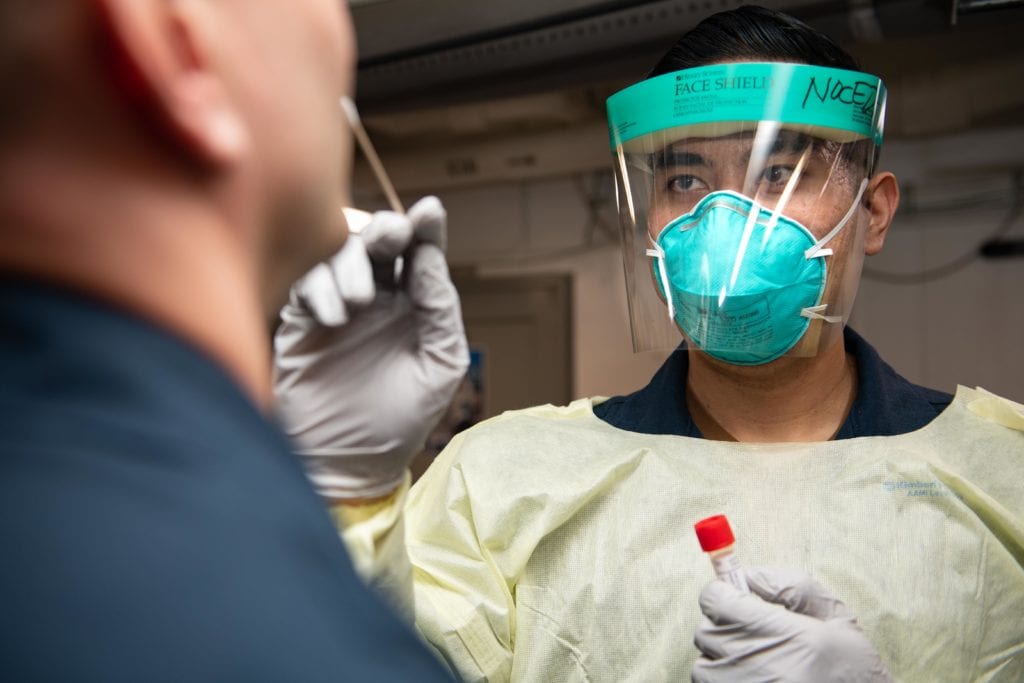
Hospital Corpsman 2nd Class Adrian Noceda takes a sample for testing aboard the aircraft carrier USS Theodore Roosevelt on March 27. U.S. Navy/Mass Communication Specialist Seaman Kaylianna Genier

Modly said the captain sent his letter through channels up the chain of command. The acting Navy secretary said that the special medical team that deployed with the Roosevelt is concerned about the same problem Crozier cited, not having enough space aboard for isolation measures, Modly said.

Citing Crozier’s letter, Modly said: “Let me emphasize that this is exactly what we want from our officers and our medical teams. We need a lot of transparency in this situation, and we need that information to flow up through the chain of command.” He said he didn’t know how the letter leaked to the San Francisco newspaper and probably never would.


Marines Grapple with Maintaining Readiness Amid COVID-19 Restrictions

Marine provost marshals take precautions against COVID-19 at Marine Corps Air Ground Center in Twentynine Palms, California. U.S. Marine Corps

ARLINGTON, Va. — Restrictions imposed by the battle against the coronavirus are presenting the U.S. Marine Corps with an array of new challenges — from maintaining grooming standards to how, when and where America’s force in readiness can train safely in a pandemic.

In a joint Pentagon press briefing on March 26 with Marine Commandant
Gen. David Berger, acting Navy Secretary Thomas Modly said the Marines have
scaled back training at Marine Corps Air Ground Combat Center, Twentynine Palms
and the Mountain Warfare Training Center, both in California. They also have
canceled training with foreign partners and much of the Headquarters Marine
Corps staff have been ordered to work from home.

See: More Cases on Roosevelt as COVID-19 Spreads Across Navy, Marine Corps

Promotion boards can spread out over several rooms and
shooters can spread out on the firing line of a pistol range, but “in a live-fire
exercise you can only do so much to moderate social distancing,” Berger said.

“The Marine Corps is unique,” the commandant explained. “We
are mandated by law to be the nation’s most ready force.” He has given local
commanders leeway to operate as they see best depending on the local situation
rather than issuing a blanket, Corps-wide list of restrictions. When it comes
to training, Berger said, “commanders are taking measures that make sense but
also making sure their units are trained and ready to go.”

“This is a unique time. We’re trying to find unique answers. It’s not going to be the same as sitting in the bleachers at graduation. There’s no way to replicate that.”

Sgt. Major of the Marine Corps Troy Black

Basic training graduations have been closed to all
outsiders, including family, to prevent spreading disease. “It’s driving us to
be pretty creative,” Berger said. The ceremonies are now televised and
digitally recorded for each new Marine.

“This is a unique time. We’re trying to find unique answers,”
said Sgt. Major of the Marine Corps Troy Black, but he conceded “it’s not going
to be the same as sitting in the bleachers at graduation. There’s no way to
replicate that.”

Although leaders have halted face-to-face meetings between
recruiters and enlistment prospects, the Marines have not stopped training or
bringing new recruits to boot camps in California and South Carolina. Both facilities
have begun screening incoming recruits before they depart from processing stations
and when they arrive at the recruit depot. Any showing symptoms are isolated. At
least two have tested positive for the virus, but no drill instructors have,
Modly said.

“Everybody’s still getting their head shaved as long as the
barbers come to work,” Berger said, “but there will come that time when it gets
worse and worse and worse, where barbers won’t come to work. In that case we’ll
have to make a decision: ‘Do Marines cut Marines’ hair?’ Commanders at both of
our recruit depots have thought their way through it.”

Berger noted headquarters hasn’t said grooming standards are
relaxed for a given period. “What we have said is commanders have the latitude
to make adjustments based on what’s available at your location.”


More Cases on Roosevelt as COVID-19 Spreads Across Navy, Marine Corps

Sailors prepare surgical equipment to be sterilized aboard the hospital ship USNS Mercy. U.S. Navy/Mass Communication Specialist Seaman Luke Cunningham

ARLINGTON, Va. — COVID-19 cases are on the rise among U.S.
Navy personnel, including five more Sailors diagnosed with the novel
coronavirus aboard the deployed aircraft carrier USS Theodore Roosevelt,
according to acting Navy Secretary Thomas Modly.

The news brings the number of Roosevelt crew members testing
positive for COVID-19 to eight and raises the total number of infected active-duty
uniformed Navy personnel to 104, Modly told a Pentagon press briefing March 26,
adding that 23 Navy civilian employees, 16 family members and 19 civilian
contractors also have the virus.

He acknowledged that those totals indicate the Navy has the
highest number — about one third — of all coronavirus cases in the military. By
contrast, the Marine Corps, which keeps a separate tally, has reported 31 cases
of COVID-19 among active-duty personnel, including the first service member
working in the Pentagon to test positive. Also, five civilian Marine Corps
employees, five dependents and three contractors also have tested positive.

A sign put up to limit the spread of COVID-19 is displayed in the Marine Corps Exchange at Marine Corps Base Camp Lejeune, North Carolina on March 23. U.S. Marine Corps/Lance Cpl. Taylor Smith

“I think we are trending higher. Some data that I saw this
morning showed that we are probably a third of all the active-duty people that
have tested positive,” said Modly, adding “I don’t have a reason for that.”
While the Navy is deployed around the world and has large concentrations of
people in places like San Diego and Norfolk, Virginia, Modly said any estimated
explanations were just speculation. “We have not done the forensics yet on
where these individual Sailors contracted the disease and, until we know that,
it would be irresponsible for me to say why we think this is happening,” he
said.

All eight infected Sailors evacuated from the Roosevelt to Guam had mild symptoms and were not hospitalized but they are quarantined, Modly said. In a change from earlier plans, he said 100% of the nearly 5,000 crew members on board the carrier would be tested for the coronavirus “to ensure we are able to contain whatever spread might have occurred on the ship.” He stressed the ship is operationally capable and “can do its mission if required to do so.”

The Roosevelt is making a previously-scheduled port visit to Guam, where testing the whole crew will be completed. All crew will be confined to the ship or the pier area while in port. In the meantime, the ship has 800 testing kits, with more on the way by air, and some limited ability to process the samples. Sailors who test positive will be transported to the U.S. Naval Hospital Guam for further evaluation and treatment as necessary.

The infected Marine stationed at the Pentagon was last in the building on March 13 and tested positive on March 24 and is in isolation at home. His workplace has been cleaned by response crews. Both Marine Corps recruit depots have begun screening incoming recruits and at least two have tested positive for the virus, but no drill instructors have. Two other Marines stationed at Parris Island have tested positive, but they were already in quarantine when their tests came back, Modly said.

The Navy has accelerated preparations for the hospital ship USNS Comfort to sail to New York City to help relieve local hospitals’ non-COVID-19 workload. Originally planned to depart from Norfolk, Virginia, on April 3, “in all likelihood she’s getting underway this weekend,” Modly said. “Hopefully she’ll be in New York by the early part of next week,” he added. The Navy’s other hospital ship, USNS Mercy, has been deployed to perform similar duties treating non-coronavirus cases in Los Angeles.