Changing Arctic Environment Could Also Change Technologies Needed to Protect It, Experts Say

Dr. Alyson Azzara, international trade specialist with the U.S. Department of Transportation, says replacement fuels will presumably need to be zero emission. NAVY LEAGUE / Lisa Nipp

NATIONAL HARBOR, Md. — In addition to cooperating with each other and maintaining a physical presence at the top of the world, Arctic nations need to consider what technologies will still be needed when there’s less ice to negotiate, according to a panel discussion on the Arctic domain.

“The demand for heavy ice breakers is going to decrease” in the not too distant future if the Arctic becomes “an ice-free zone,” Richard Jenkins, CEO of unmanned surface vessel (USV) maker Saildrone said Aug. 2 at the Navy League’s Sea-Air-Space expo in National Harbor, Maryland. 

“Unmanned systems are not a replacement for manned systems,” Jenkins said during the panel discussion, Arctic Domain Readiness. However, he added manned-unmanned teaming could reduce the need for humans to be present 24/7 in the harsh Arctic environment, with USVs or aerial or undersea drones keeping watch and alerting military, Coast Guard or scientific teams to changing situations. 

With no year-round ports for large ships, ice breakers like the Coast Guard Cutter Healy, which recently began a four-month deployment to the Arctic have to pack enough food and fuel for an extended stay in the region, Jenkins said. The changing environment may be “an opportunity to rethink how to design our ships going forward,” he added. 

Dr. Alyson Azzara, international trade specialist with the U.S. Department of Transportation, noted that new international regulations to address climate change will ban heavy fuel oil use by ships starting in 2024 and global fuel sulphur cap. Replacement fuels “will be, presumably, zero emission and low carbon fuels. And those fuels don’t exist yet,” she said.

In addition to concerns about the spread of pollution with increasing maritime traffic crossing the Arctic as melting sea ice opens more transit channels, scientists have noticed underwater noise pollution is on the rise. “The volume has doubled in under 10 years,” Azzara said.

“That’s important for the environment, for marine mammals,” she said, “but it’s also important for anything operating or listening or recording under the ice, under the water.” 

Operating in the Arctic “becomes more difficult when there’s more noise” under the water said Vice Adm. Andrew Lewis, commander of the U.S. 2nd Fleet, another panel member. 


Lawmakers Leery of Navy’s Still-Vague Mission Plans for New Unmanned Systems

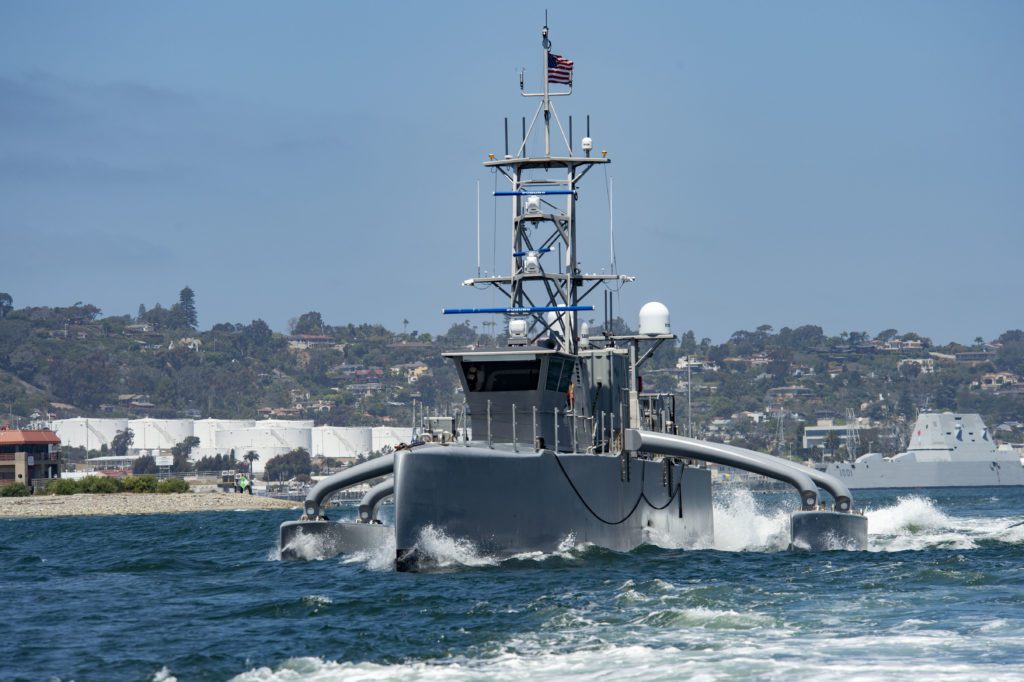
The Seahawk medium displacement unmanned surface vessel launches for the U.S. Pacific Fleet’s Unmanned Systems Integrated Battle Problem 21 (UxS IBP 21), April 20. UxS IBP 21 integrates manned and unmanned capabilities into operational scenarios to generate warfighting advantages. U.S. NAVY / Mass Communication Specialist 2nd Class Thomas Gooley

ARLINGTON, Va. — Two senior House Armed Services Committee members, who strongly support U.S. Navy plans to acquire a wide range of unmanned air and maritime systems to enhance the size of the fleet, say they still have concerns about how undefined the mission remains.

Appearing at a virtual unmanned defense systems conference sponsored by the Association for Unmanned Vehicle Systems International (AUVSI) on July 27, both Reps. Joe Courtney (D-Connecticut), and Jim Langevin (D-Rhode Island), agreed that unmanned surface and undersea vessels will have a key role confronting the pacing threat of China across the vast distances of the Indo-Pacific region.

“These systems will be the key to a distributed force that moves away from exquisite, expensive platforms — which are high value targets — and towards a more modular and nimble fleet that can, hopefully, plan to overwhelm the adversary,” said Langevin, who chairs the HASC’s Intelligence, Emerging Threats and Capabilities subcommittee.

Having unmanned platforms ranging in size from small to extra-large vessels that reduce the risk to Sailors in a contested environment, and handle jobs that don’t require human presence, “is just a really smart investment moving forward,” said Courtney, chairman of the HASC Seapower and Projection Forces subcommittee.

However, “we’ve been wrestling with the issue of what is the future fleet size for the Navy and what’s the fleet architecture look like,” Courtney said, adding that the Biden administration’s first Navy budget had no FYDP [future years defense plan] and the shipbuilding plan had only ranges of vessels, not specific numbers. He acknowledged the White House will have more time and experience by next year’s budget, adding that will be the one to watch.

“We really do need some clarity about just where are we going,” Courtney said, recalling the HASC’s “traumatic experiences” in the past with unique new platforms that were funded in a hurry, like the littoral combat ship, but “didn’t pan out as well as the Navy or Congress hoped.”

Langevin, whose subcommittee Courtney described as “the tip of the spear for a lot of these questions,” said he was concerned the Navy and other services could become over-reliant on unmanned systems.

“They can be a great component, but I’m still very cautious — recognizing that our enemies and adversaries understand where we’re going with new technologies. They’re going to invest in and try to create asymmetric systems that will interfere with those capabilities and take them out,” with less compunction than they might for a manned vessel in a non-war situation, he said.

“The other thing that we have to ensure is, as we get more and more into the 21st century and make use of machine learning and artificial intelligence, we absolutely have to ensure the integrity of the data decisions are based on and also, that there’s always a human in the loop,” Langevin said, adding, “We have to make sure that we understand the decision-making process by making sure that when it comes to carrying out kinetic effects, we don’t delegate too much in terms of AI decision-making.”


Russia’s Increasing Aggression in Black Sea Region Disturbs U.S. Naval Commander

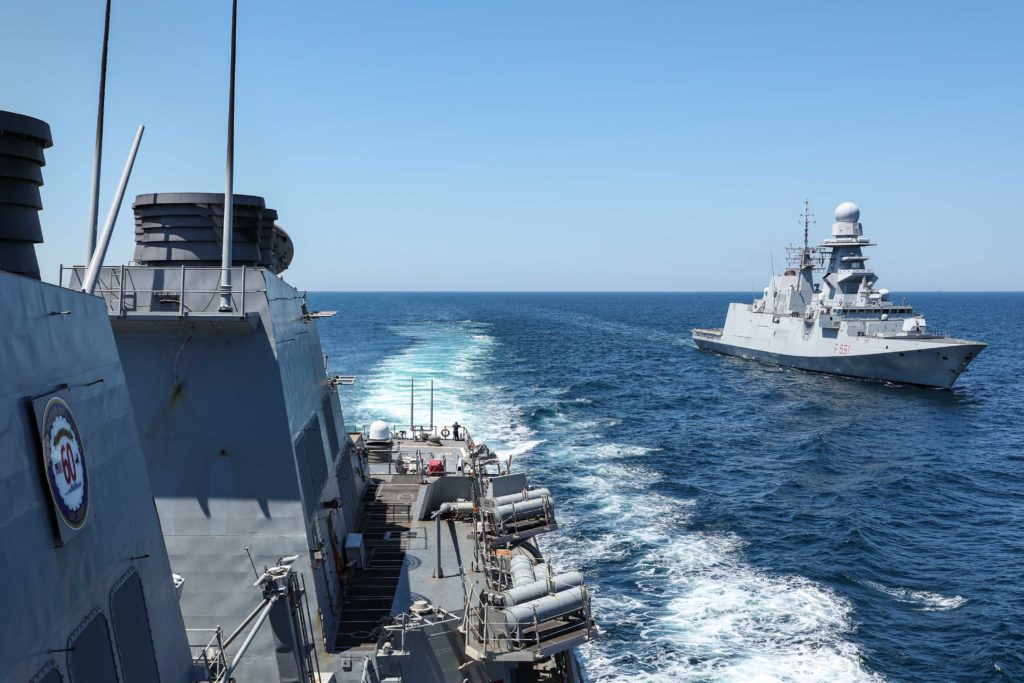
The Italian frigate Virginio Fasan (F 591) approaches the Arleigh Burke-class guided-missile destroyer USS Ross (DDG 71) for a replenishment-at-sea approach drill in the Black Sea during the Bulgarian-led Exercise Breeze, July 15, 2021. U.S. NAVY / Mass Communication Specialist 2nd Class Claire DuBois

ARLINGTON, Va. — Russia’s aggressive behavior during a recent multinational exercise in the Black Sea, hosted by the United States and Ukraine, underscores Moscow’s increasingly provocative actions in the air and at sea, says the commander of U.S. Naval Forces in Europe and Africa.

For nearly a decade, a resurgent Russia has mounted a huge military buildup in the North Atlantic, the Eastern Mediterranean, the Arctic and the Black Sea. “They want to be in control of those waters, for their own exclusive use,” said Adm. Robert Burke, adding “We can’t cede that to the Russians.”   

Noting that Russian aircraft overflew U.S. Navy ships at dangerously low altitudes during the recently ended Exercise Sea Breeze 21, Burke said they were creating a tactical risk that could morph into a strategic issue. “And that’s a big concern with this increasing aggressiveness,” he said, adding “We’re not going to flinch and we’re not going to take the bait.”  

Sea Breeze, a long-standing exercise in the Black Sea to enhance interoperability and capability among participating forces in the region, has grown from eight participants in 1997 to 32 this year. The 2021 exercise included 5,000 personnel, 32 ships and 40 aircraft supplied by from 17 NATO members, U.S. allies like Australia, and partner nations like Sweden and Senegal.

The admiral praised U.S. and allied commanders for their controlled reaction to Russian belligerence. “When a strike aircraft overflies a destroyer at 100 feet altitude, right over top, our COs are making a judgment call of whether that strike fighter is on an attack profile or not,” said Burke, who is also commander of Allied Joint Forces Command Naples. “It could be argued that they’re baiting us into shooting first. We’re not going to do that first without provocation, but I’m also not going to ask my commanding officers to take the first shot on the chin,” he added without elaboration.

When officials notified Russian authorities about their plans three weeks before Sea Breeze 21 began, the Russians reacted by closing off half of the western part of the Black Sea and announcing their own ship bombing exercise. “If it wasn’t so threatening, it would be laughable,” Burke told a livestreamed edition of the United States Navy Memorial’s SITREP speakers series July 20.

Such “extreme bullying” at other times has led some smaller nations to avoid those areas, “which is exactly the behavior the Russians are seeking.” Burke said. China acted similarly in the South China Sea, he said, building “stationary aircraft carriers” on coral islands where ownership is disputed by neighboring countries. Elsewhere, he said, the Chinese Communist Party’s Belt and Road Initiative is seeking to expand its influence through infrastructure projects — with financial strings attached — in 52 of Africa’s 54 nations, while Chinese entities hold a controlling interest in 15 European ports.


SECNAV Nominee Calls Chinese Adventurism His Main Threat Concern

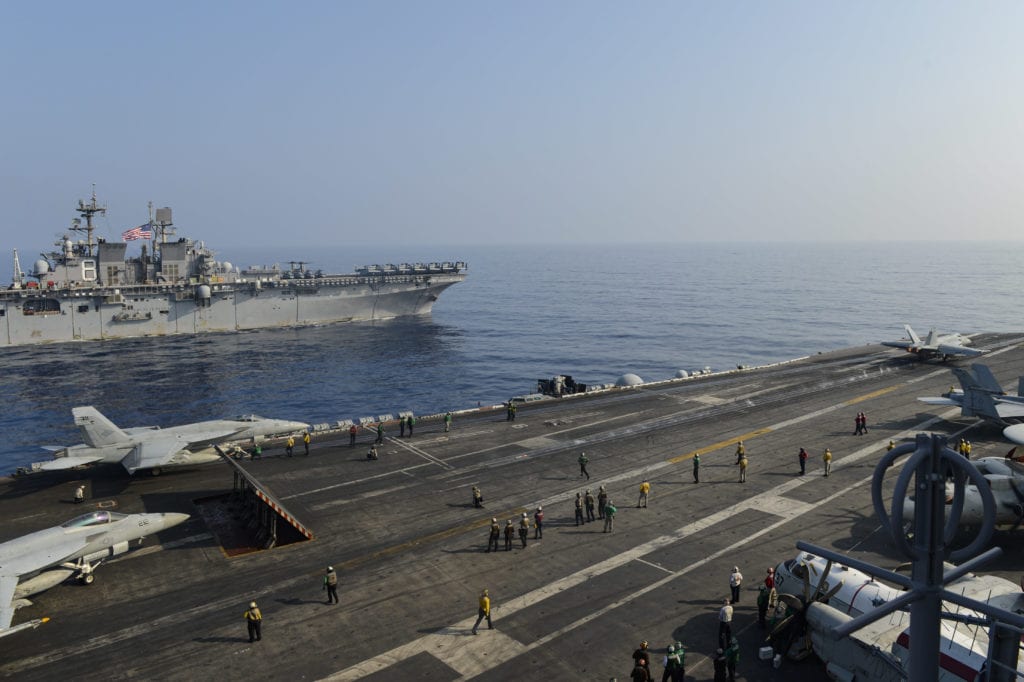
The Theodore Roosevelt Carrier Strike Group transits in formation with the Makin Island Amphibious Ready Group in the South China Sea April 9, 2021. The Theodore Roosevelt Carrier Strike Group, Makin Island Amphibious Ready Group and the Ticonderoga-class guided-missile cruiser USS Port Royal (CG 73) are conducting expeditionary strike force operations during their deployments to the 7th Fleet area of operations. U.S. NAVY / Mass Communication Specialist Seaman Faith McCollum

ARLINGTON, Va. — Former U.S. Navy surface warfare officer Carlos Del Toro, the Biden administration’s choice to be the next secretary of the Navy, told a Senate hearing July 13 that he will be “exclusively focused on the China threat.”

At a confirmation hearing before the Senate Armed Services Committee with four other nominees for senior Pentagon posts, Del Toro, a U.S. Naval Academy graduate and former destroyer commander, was quizzed on several topics from lagging shipbuilding plans and aging shipyards to the challenge of projecting power in the Arctic without sufficient deep water ports, sturdy-hulled Navy ships or Coast Guard ice breakers to operate in the far north.

However, several Republican lawmakers, who view the Navy’s $211.7 billion fiscal 2022 budget — with $22.6 billion for shipbuilding, a 3% reduction from $23.3 billion in 2021 — as too little to maintain Navy readiness, zeroed in on the People’s Republic of China and the challenge it presents as a pacing competitor and a threat to Taiwan.

Noting China’s “global adventurism” presented both a national security threat and an economic threat, Del Toro said it was “incredibly important to defend Taiwan, in every way,” adding that a comprehensive approach should be taken to provide Taiwan with “as much self-defense measures as humanly possible.”

Asked by Sen. Rick Scott of Florida about Indo-Pacific wargame scenarios indicating the United States and its allies would not be able to defend Taiwan, Del Toro noted that as a graduate of the Naval War College as well as Annapolis he was well acquainted with war gaming programs but has not been privy to recent classified studies. However, if confirmed as Navy secretary, Del Toro said he intended “to dive into that immediately, so I can better understand that threat and match that threat.”

Del Toro added, “I’m going to be exclusively focused on the China threat and exclusively focused on moving our maritime strategy forward in order to protect Taiwan and all of our national security interests in the Indo-Pacific theater.”

Both Democrats and Republicans were concerned about the fiscal 2022 plans to decommission 15 ships, including four littoral combat ships and seven Ticonderoga-class guided missile cruisers, while requesting funds to build just one destroyer. Sen. Roger Wicker (R-Mississippi) noted those changes would drop the fleet size to 290 ships, below the 355-ship fleet mandated by 2018 legislation.

Del Toro said he fully supported the 355-ship goal, and with the shift to “a more dominant maritime strategy in the Indo-Pacific” to deter China, the Navy and Marine Corps will need more resources to field “the combat effectiveness we will need.” He committed to working to make that case with Defense Secretary Lloyd Austin and the White House in developing the Navy’s fiscal 2023 budget request.

SASC Chairman Jack Reed (D-Rhode Island) noted at the hearing’s start that “deferred ship maintenance, reduced steaming and flying hours, and cancelled training and deployments have created serious readiness problems,” and “cost overruns and delays in schedules have plagued both public and private shipyards.”

Citing his experience in the Navy and a small business owner for 17 years, Del Toro said he understood the responsibility of the Navy secretary “to ensure the return on investment that American taxpayers make in supporting our Navy.”

It was “incredibly important to ensure, that requirement creeps don’t interfere with the continuing cost of projects,” he said, adding that having the right program managers in place and the right oversight from their leadership to ensure projects stay on track was a key element as well as paying immediate attention when challenging problems are first identified and taking necessary actions to correct them.

“It takes a team to make that happen, they have to have the support from their senior leadership and the military as well for it to be an effective solution,” he said.


Navy Has the Highest COVID Vaccination Rate in DoD; Marine Corps the Lowest

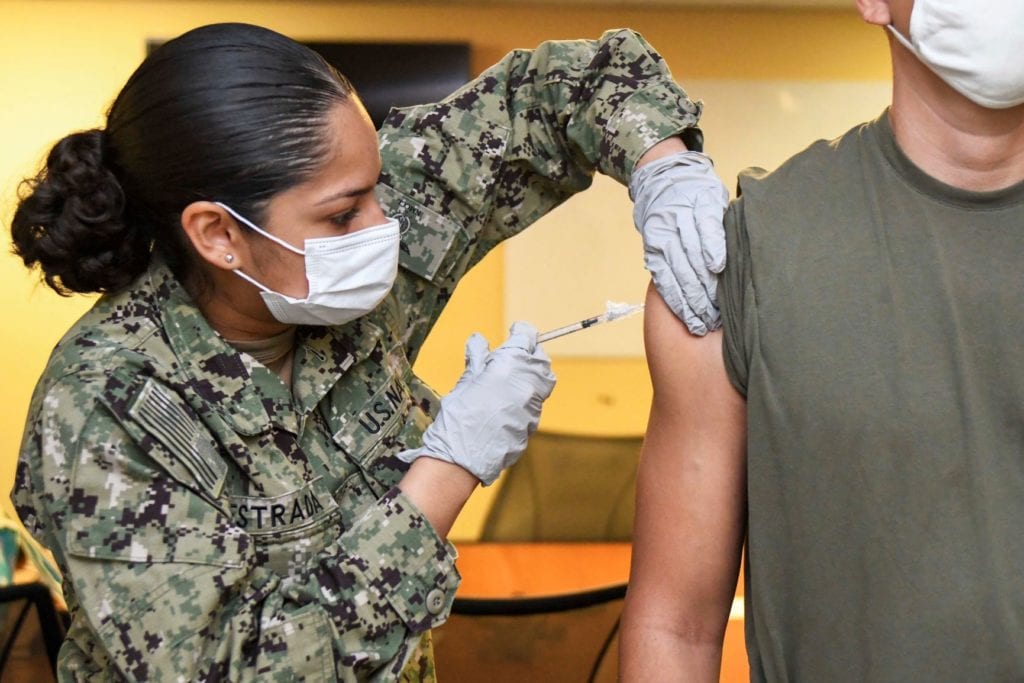
Navy Seaman Denisse Estrada-Suarez administers the COVID-19 vaccine during a Tiger Team visit to Marine Forces Special Operations Command at Camp Lejeune, N.C., June 15, 2021. NAVAL MEDICAL CENTER CAMP LEJEUNE

ARLINGTON, Va. — The U.S. Navy has the highest rate, 77%, of active duty personnel who have gotten at least one vaccination shot against COVID-19 virus, while the Marine Corps, at 58%, has the lowest, according to Defense Department health officials.

At a June 29 Pentagon briefing to update reporters on the Defense Department’s success in battling the coronavirus pandemic, officials announced efforts to determine why just 68% of the military overall have been vaccinated with at least one dose, and how to encourage more services members to roll up their sleeves to get their first and follow-on shots.

“The pandemic is not over, and we are not done with all-out efforts to encourage vaccination,” said Dr. Terry Adirim, acting Assistant Secretary of Defense for Health Affairs.

In addition to the Navy at one end of the active duty vaccination rate and the Marines at the other, officials said the first shot vaccination rate was 70% for the Army and 61% for the Air Force. There were no numbers for the Space Force and officials did not address reasons for the disparity of vaccination numbers among the services.

While COVID-19 case counts are dropping across the department and base commanders have been reducing local health protection condition (HPCON) levels, Adirim said recent data shows the unvaccinated or under-vaccinated are more susceptible to COVID variants, which are far more dangerous, especially the delta variant.

According to the military health system, the delta variant of COVID-19 is more transmittable, causes more severe disease, and results in higher cases of hospitalization and death than any other strain of the virus.

Of the 21 military personnel currently hospitalized with COVID, none were vaccinated, said Army Lt. Gen. Ronald Place, director of Defense Health Agency. He and Adirim said they were concerned about the risks posed to unvaccinated personnel at installations located in states and counties in the United States with low vaccination rates.

“The Delta variant poses a threat to unvaccinated personnel,” said Adirim, adding that the best way to beat it was through vaccination. Officials noted that a single dose of anti-COVID vaccine was only 33% effective against the Delta variant, while getting a second dose was 88% effective.


Pacific Fleet Commander Says He Has a Duty To Prevent Seizure of Taiwan

Commander, U.S. Pacific Fleet Adm. Sam Paparo speaks to Forward Deployed Naval Forces, Commander, Fleet Activities Sasebo and tenant command leadership onboard CFAS June 9, 2021. U.S. NAVY / Mass Communication Specialist 3rd Class Jasmine Ikusebiala

ARLINGTON, Va. —  The commander of U.S. Pacific Fleet says he is concerned about People’s Republic of China (PRC) as a pacing threat, but he is also confident in his forces, allies and operational designs to thwart any attempt by China to seize Taiwan by force.

“China is a pacing threat,” Adm. Sam Paparo said June 29 during the final webinar of the West 2021 symposium of the Armed Forces Communications and Electronics Association, and the U.S. Naval Institute. Paparo said he interpreted that to mean China’s development of its own combat capability, particularly maritime capability, “is the factor that we’re taking into account in making our own investments in our own combat capabilities.”

Paparo, who took command of the Pacific Fleet in May, said he completely agreed with the former head of Indo-Pacific Command, Adm. Philip Davidson, who told a Senate hearing in March that China might attempt to take over Taiwan in six years, as part of its aim to expand its influence across the region and supplant the U.S. leadership role in the rules-based international order by 2050. China claims Taiwan, a position officially supported by the United States.

“I worry about China’s intentions,” Paparo said. “It doesn’t make a difference to me, whether it is tomorrow, next year  or whether it is in six years. At Pacific Fleet and Indo-Pacific Command we have a duty to be ready to respond to threats to U.S. security.”

That duty includes delivering a fleet “capable of thwarting any effort on the part of the Chinese to upend that [world] order, to include the unification by force of Taiwan to the People’s Republic of China,” the admiral said. “But I also feel confident in our Sailors, Marines and Coast Guardsmen … as well as our operational designs to thwart such an effort with the teamwork of our allies and partners.” 

Asked if there was any further discussion of creating a numbered fleet for the Indian Ocean, Paparo noted that by Navy doctrine, every numbered fleet is a tactical three star headquarters that can be deployed worldwide against any task.

“No numbered fleet, anywhere in the world has a monopoly on any battle space. They are broadly associated with bits of geography by convention,” he said. While hard to imagine the 5th, 6th or 7th fleets being separated from the geographic areas where they have deep relationships as a function of their placement, the 4th, 2nd and 3rd fleets “are up and ready rounds that can be deployed to the point of need.”


Representative Suggests Including Lawmakers in Navy War Gaming to Help Inform Advocacy

Naval Postgraduate School students participate in analytic wargames they designed to explore solutions for some of the Defense Department’s most pressing national security concerns. Rep. Mike Gallagher (R-Wisconsin) says he’d like to see some congressional participation in Navy wargaming allowed this year. NAVAL POSTGRADUATE SCHOOL / Javier Chagoya

ARLINGTON, Va. — The U.S. Department of the Navy (DoN) should invite supporters in Congress to the wargaming process “so we can better advocate for the Navy,” a House Armed Services Committee member has suggested.

During a Washington think tank event June 28 on the state of the U.S. maritime industrial base and competition with China, Rep. Mike Gallagher (R-Wisconsin) said he would like to see Chief of Naval Operations Adm. Mike Gilday, Marine Corps Commandant Gen. David Berger and other Pentagon officials “join a few of us navalists in Congress,” in a room with just a map  “and just in simple terms, have them walk us through their theory of the case for what they think the PLA [People’s Liberation Army] is trying to do. What we need to do to counter.”

Irritated by the limited time lawmakers get to question military leaders during public committee hearings, Gallagher called for better communication between Navy and Marine Corps leaders and congressional supporters during a virtual joint appearance with fellow HASC member, Rep. Rob Wittman (R-Virginia), presented by the Hudson Institute.  “So, I’m an advocate for allowing some congressional participation in Navy wargaming this year,” Gallagher said.

Without directly commenting on Gallagher’s idea, Wittman acknowledged “folks want to know and hear more, especially, as Rep. Gallagher said, outside the committee hearing side.”

Wittman and Gallagher joined several senators in introducing the Supplying Help to Infrastructure in Ports, Yards, and America’s Repair Docks (SHIPYARD) Act of 2021 in April. The proposed legislation would provide $25 billion to make investments needed to optimize, improve, and rebuild shipyard facilities, electrical infrastructure, environmental systems, and the equipment of public and private shipyards in the U.S. that support the U.S. Navy fleet.

The act would designate $21 billion for the Navy’s four public shipyards in Virginia, Maine, Hawaii, and Washington, $2 billion for major Navy private new construction shipyards, and $2 billion for Navy private repair shipyards. 

Wittman and Gallagher noted U.S. shipyards were having trouble servicing the current 296-ship fleet and would be insufficient to maintain a 355-ship needed to counter the PLA Navy (PLAN) in China, which now has the world’s largest navy with an overall battle force of 350 ships and submarines.

“We are far behind China in the trajectory of building our Navy. We are far behind China in the shipyard infrastructure that we need,” Wittman said.

He noted the U.S. Navy’s fiscal 2022 budget request seeks only eight ships, but plans to retire 15 ships, seven of them cruisers. “The question is, if you’re going to be reducing the number of ships you build, how do you sustain an industrial base — not just the physical facilities but also the manpower?”

Gallagher said PLAN has grown its battle force by 117 ships since 2005 and over the same period, the U.S. Navy battle force has grown by just five ships.

“That is not the right trendline,” he said.


DoD Data Assistance Teams Going to Combatant Commanders in New AI Initiative

The Naval Surface Warfare Center Dahlgren Division’s Sly Fox Mission 23 team demonstrates autonomous remote tactical engagement multi-domain intelligence swarm capabilities, in Dahlgren, Virginia, Aug. 7, 2018. U.S. NAVY / John Joyce

ARLINGTON, Va. — U.S. combatant commanders around the globe will be the first to get data handling assistance from the Pentagon’s new artificial intelligence (AI) initiative, because they work in the toughest decision-making environments, the head of the Joint Artificial Intelligence Center says.

“The hard work of creating successful environments and implementing AI in the dirty, dangerous, challenged warfighting environments right at the edge is what really matters,” Marine Corps Lt. Gen. Michael Groen told reporters at a Pentagon press briefing June 24.

Transforming the Defense Department (DoD) from a platform-centric organization, where each military service has its own technology silo, into one integrating AI, machine learning and other technologies at scale to stay ahead of peer competitors “is truly the challenge of a generation,” said Groen, director of the Joint Artificial Intelligence Center (JAIC).

To accelerate progress on the Joint All-Domain Command and Control (JADC2) strategy DoD launched an AI and Data Acceleration (ADA) Initiative, Deputy Defense Secretary Kathleen Hicks announced June 21 at the DoD Artificial Intelligence Symposium and Tech Exchange.

JADC2 aims to connect sensors from all of the services into a single network, sharing intelligence, surveillance and reconnaissance data to enable faster decision making. The change is needed because in a digital-driven world, decisions in future conflicts with degraded environments will have to be made swiftly, perhaps within seconds, say Pentagon officials.

In a supporting memo, Hicks stated the ADA Initiative will support Combatant Commands in “integrating and scaling ongoing and proven capabilities used in real-world operations, simulations, experiments and demonstrations.” The goal is to rapidly advance data and AI-dependent concepts, like JADC2, to the ADA initiative and generate capabilities through a series of experiments and exercises — each one advancing l learning a step further.

“A key part of an AI-ready department is a strong data foundation,” Hicks told the symposium in a virtual appearance. “Data enables the creation of algorithmic models, and, with the right data, we are able to take concepts and ideas and turn them into reality,” she added.

The initiative is creating operational data teams that will be forward-deployed within 30 days to the data office at all 11 combatant commands. The teams will catalog, manage and automate data feeds to assist warfighters in making their data visible, accessible, understandable, linked, trustworthy, interoperable and secure.

DoD will build on that with additional “flyaway teams of technical experts” to help combatant commands streamline and automate workflows through the integration of AI. The expert teams, expected to be dispatched within 60 to 90 days, will support continuous experimentation to improve commanders’ ability to act with speed and precision.

The combatant commanders are getting the operational data teams “because they have their own exercise environments, but they [also] have real decision environments, really the toughest decision environments of anybody, and yet they don’t often have a lot of tools to deal with those kinds of things,” Groen said.


Navy, Marine Corps Leaders Say Unmanned Systems Will Be Key Element in Peer Competition

The MQ-9 Reaper is an armed, multi-mission, medium-altitude, long-endurance unmanned aircraft, one of several unmanned systems Navy leaders say help extend the reach and capabilities of the fleet. U.S. AIR FORCE / Sgt. Dennis J. Henry Jr.

ARLINGTON, Va. — The top commanders of the U.S. Navy and Marine Corps say increased deployment of unmanned air and maritime systems will help extend the reach and intelligence capabilities of the fleet and the force, while sowing uncertainty among peer competitors.

“We intend to use our fleet in a distributed manner, so unmanned obviously will give us volume, more ships, and will allow us to come at, let’s say China or Russia, at many vectors across many domains,”  Chief of Naval Operations Adm. Mike Gilday told a recent House Armed Services Committee hearing. In effect, forcing adversaries to spread their resources and be on guard everywhere, all the time.

The Navy and Marine Corps released their Unmanned Campaign Plan in March, but some in Congress have said it was short on details. At the June 14 HASC hearing on the Navy Department’s fiscal 2022 budget request, Chairman Rep. Adam Smith (D-Washington) asked Gilday and Marine Corps Commandant Gen. David Berger to explain how unmanned systems will help their mission.  

For unmanned aircraft systems (UAS), “the vision you’re talking about probably has four different parts,” Berger said. They include intelligence collection; logistics, lethality and command and control, “the ability to fuse and move information laterally and back to the joint force.

“Beginning last year, we started our transition to a mixed capability of long range ship and ground-based unmanned aerial systems including the MQ-9 Reaper,” Berger said. “This will significantly expand our ISR capabilities and will enable us to better support the fleet and the joint force operational commander, including anti-submarine warfare.”

The Marines have initiated a partnership with industry to develop a future autonomous, long range, unmanned surface vessel. “That will extend the reach of our MEUs [Marine Expeditionary Units]. That vessel will give us a new tool for maritime gray zone competition. It will help thicken what we call the C5ISR network. It will add to our conventional naval deterrent using loitering munitions,” Berger said.

Gilday said the two biggest challenges unmanned systems presented the Navy are reliability on vessels that would have to operate for months at a time, and command, and control. “We feel like we’re on a good path on both, but we don’t have any intentions of scaling any of these efforts until we get to a place where we’re comfortable with both of those aspects.”

He noted the Navy recently completed its largest unmanned exercise on the West Coast with unmanned undersea, surface and air systems operating with manned surface ships; had the first successful refueling of an F/A-18 Super Hornet from an MQ-25 drone; and had the third unmanned surface vessel make a transit of more than 4,000 miles from the Gulf Coast, through the Panama Canal to California, operating autonomously 98% of the time.

“We are making strides,” Gilday said, but widespread use of unmanned craft is “a big step though. I think it’s going to be phased with respect to minimal manning before we ever get to a point where we use an unmanned completely unattended.”


Acting SECNAV Says Memo Doesn’t Mean He’s Canceling Nuclear Sea-Launched Cruise Missile

The crew of the Los Angeles-class fast-attack submarine USS Annapolis (SSN 760) successfully launches Tomahawk cruise missiles off the coast of southern California as part of a Tomahawk Flight Test (TFT) June 26, 2018. (U.S. Navy photo by Mass Communication Specialist 1st Class Ronald Gutridge)

ARLINGTON, Va. — Acting Navy Secretary Thomas Harker says he is not planning to scrap the Nuclear Sea-Launched Cruise Missile (SLCM-N) despite a memo that appears to indicate otherwise.

“The program is in our FY22 (fiscal year 2022) budget,” Harker told a House Armed Services Committee hearing June 15. Some Republican lawmakers were outraged after news outlets reported earlier this month that Harker directed the Navy in a June 4 memo to “defund” the sea-launched cruise missile in fiscal 2023.

The memo surfaced after the Pentagon released the fiscal 2022 defense budget but before the start of a Nuclear Posture Review (NPR), a statement by the senior Republicans on the House and Senate armed services committees noted. The NPR is an appraisal of U.S. nuclear policy conducted when a new administration takes office.

The statement, issued by Rep. Mike Rogers of Alabama and Sen. Jim Inhofe of Oklahoma, called Harker’s move “bewildering and short-sighted. The Biden administration has decided to project weakness ahead of a summit with Vladimir Putin — another gift to our adversaries.”

In the process of determining within the Navy Department which items to put in the 2023 budget request, Harker told the HASC “my initial guidance was based on the fact that the overall posture review and the [updated] National Defense Strategy have not been completed, so I didn’t want anyone to assume that [SLCM-N] would be in until we had further guidance from the Nuclear Posture Review.”

Under questioning by Rep. Michael Turner, R-Ohio, Harker conceded his background and experience was in accounting and finance, not making strategic nuclear weapons decisions. He also said he had not consulted anyone else in the Pentagon, including Chief of Naval Operations Adm. Mike Gilday, before writing his memo. Turner accused Harker’s action of undermining “President Biden and the United States” by indicating a nuclear weapon “is going to be unilaterally defunded without any negotiations or without receiving any concessions from Russia.” 

Harker asserted “Sir, it was a preliminary, internal document.” Sounding skeptical of Harker’s claim he was the only decision maker in the matter, Turner asked the acting secretary to deliver to the committee “all communications concerning the deliberations, advice, review, directions and analyses” undertaken to write the memo. Harker said he would.

The HASC chairman, Rep. Adam Smith, D-Washington, has stated his opposition to the low-yield warhead and SLCM-N as being destabilizing to the nuclear balance. During the presidential election campaign, Biden said he wanted to reduce U.S. reliance on nuclear weapons.