CNO Hosts Israel’s Head of Navy, Focused on Partnership and Maritime Security
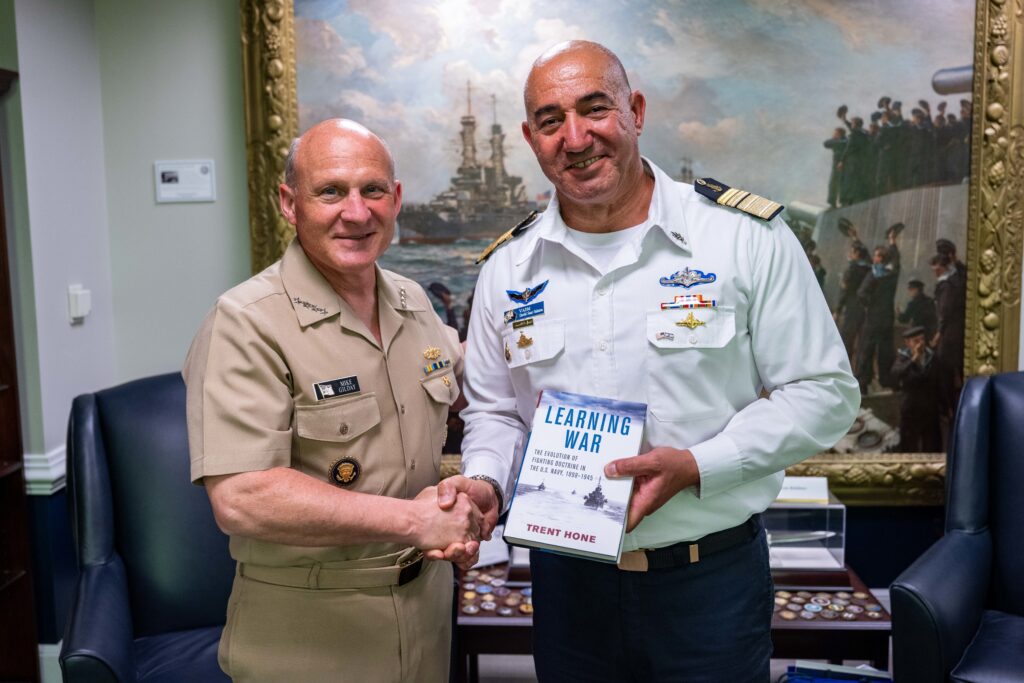
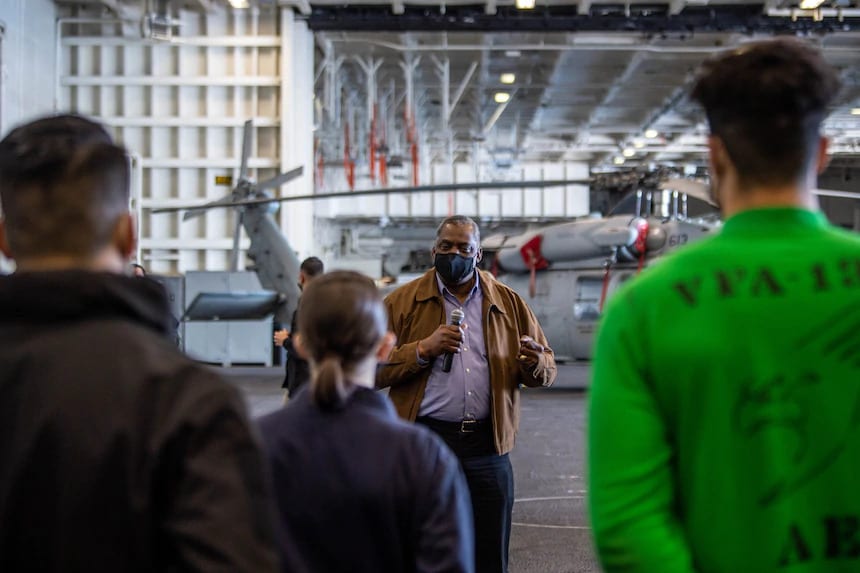
Chief of Naval Operations Adm. Mike Gilday meets with Commander in Chief of the Israeli Navy Vice Adm. David Saar Salama during an office call at the Pentagon, June 8. U.S. NAVY / Mass Communication Specialist 2nd Class T. Logan Keown
WASHINGTON — Chief of Naval Operations (CNO) Adm. Mike Gilday hosted the commander in chief of the Israeli Navy, Vice Adm. David Saar Salama, in Washington, D.C., for a formal counterpart visit, June 8-9, the CNO’s public affairs office said in a release.
The two leaders discussed several topics of shared interest including force design, strategic competition, unmanned technologies and regional security efforts.
The two-day visit included a full honors ceremony, meetings with senior U.S. Navy leadership and a visit to the United States Holocaust Memorial Museum.
“Our strategic partnership with Israel is ironclad and enduring,” said Gilday. “United by our commitment to a rules-based international order, free and open seas, and advancing collective capabilities, our two navies have never been more aligned than they are today. I look forward to working closely with Adm. Salama to strengthen our partnership and interoperability.”
“The cooperation between the Israeli Navy and the U.S. Navy, led by my friend Adm. Mike Gilday, is another testament to the strength of the strategic partnership and friendship between the two navies,” said Salama. “The joint work with the U.S. Navy, especially with the 5th and 6th Fleets, will continue to yield many achievements for Israel and overall maritime security. Together, we will continue to face the challenges ahead in order to maintain stability at sea.”
U.S. Navy and Israeli Naval Forces regularly operate together around the world, particularly in the U.S. 5th and 6th Fleet Area of Operations. Most recently, the U.S. Navy and the Israeli Navy participated in Intrinsic Defender 22, a bilateral exercise focused on maritime security operations, explosive ordnance disposal, health topics and unmanned systems integration.
On Sept. 1, 2021, the U.S. Department of Defense officially reorganized Israel within the area of responsibility of U.S. Central Command.
This was the first meeting between Gilday and Salama.
Navy Trains to Counter Drone Threats at Point Mugu
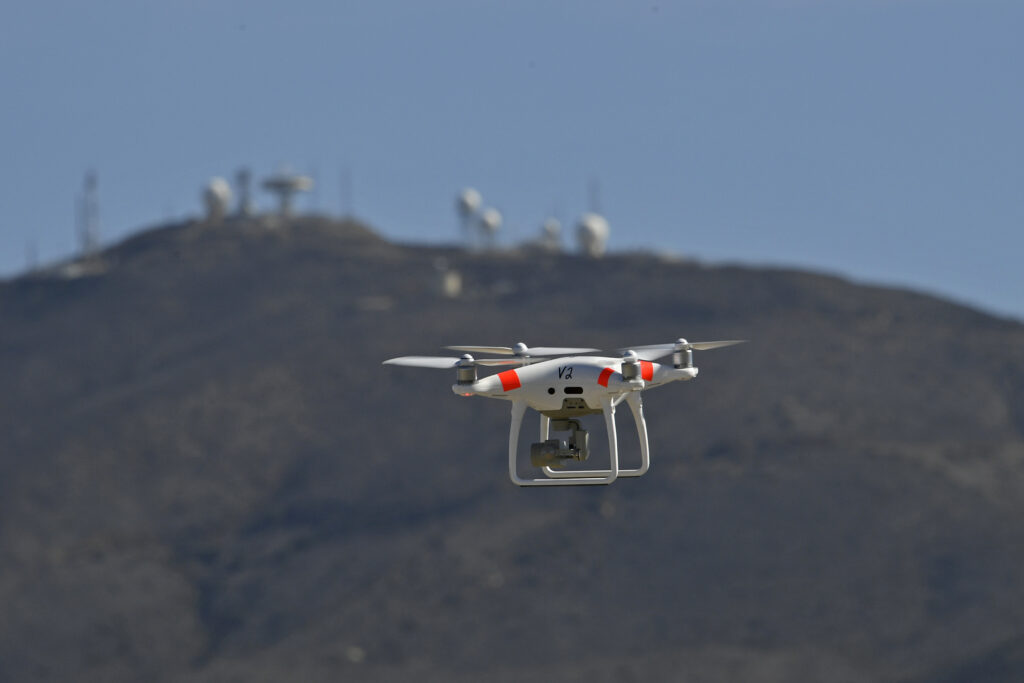
Naval Air Warfare Center Weapons Division’s Pacific Target Marine Operations and Threat/Target Systems Department recently deployed small drones over Naval Base Ventura County, Point Mugu to provide cost-effective unmanned aerial system familiarization and threat training. U.S. NAVY / Ensign Drew Verbis
VENTURA COUNTY, Calif. — The Pacific Target Marine Operations, a division of Naval Air Warfare Center Weapons Division’s Threat/Target Systems Department, recently deployed small drones over Naval Base Ventura County, Point Mugu, to provide cost-effective unmanned aerial system familiarization and threat training.
“The Low-Speed Aerial Target- Small [LSAT-S] program developed a cost-effective target training and deployment program that directly represents the UAS threat the fleet faces daily,” said Pete Pena, PTMO program lead. “UAS are classified by their size, range, and speed, and are broken into five groups based on those attributes. We’re flying group 1 drones which are considered to be the greatest threat to military forces across the globe due to their unique range of capabilities as well as their relatively low cost and small size.”
In 2021, speaking at a U.S. Senate committee, Gen. Kenneth McKenzie, commander of U.S. Central Command, referred to the proliferation of small drones as the “most concerning tactical development” since the emergence of improvised explosive devices.
Groups 1-3 can range from over-the-counter handheld drones to medium sized drones with sensors and the capacity to deliver weaponized payloads. However, the main threat that comes from groups 1-3 is intelligence, surveillance, and reconnaissance. These drones can be difficult to detect and destroy due to their low flying altitude and small size.
“Point Mugu is a no drone zone,” said Fire Controlman 1st Class Petty Officer Michael Jordan, assigned to NBVC. “It is difficult to obtain authorization to operate drones in this controlled airspace, even for military units. So, this demonstration provided a rare opportunity for watch standers to experience live drone flights and provide identification, which is the first step in countering threats.”
In 2019, Ellen Lord, the former undersecretary of defense for acquisition and sustainment, established a waiver system to authorize drone operations on military ranges in highly controlled conditions, to test the U.S. military’s counter-UAS capabilities.
Civilian and military operators had a chance to fly multiple different scenarios onboard Point Mugu, Pena added. Each test presented a range of conditions, spanning from the direction a UAS was flying to a variance in flight patterns, altitudes, airspeeds, and representative threats.
“This demo is a force multiplier which allows us to offer more frequent and robust counter-UAS presentations to the fleet and installation commanders,” said Cmdr. Todd “Jazz Hands” Faurot, LSAT-S pilot. “This increases our defenses during peacetime and also providing for a war time surge capability.”
The first step in countering the rising threat from UAS is target acquisition and identification. The proliferation of UAS, especially group 1-3, the downsizing of the technology, and its decreasing costs of production will make threat detection difficult.
“Our demonstrations provide the fleet with important UAS familiarization and training to face this increasing airborne threat,” added Pena.
NBVC is comprised of three distinct operational facilities: Point Mugu, Port Hueneme and San Nicolas Island. It is Ventura County’s largest employer and protects Southern California’s largest coastal wetlands through its award-winning environmental program.
ONR Chief Unveils New Vision to Reimagine Naval Power
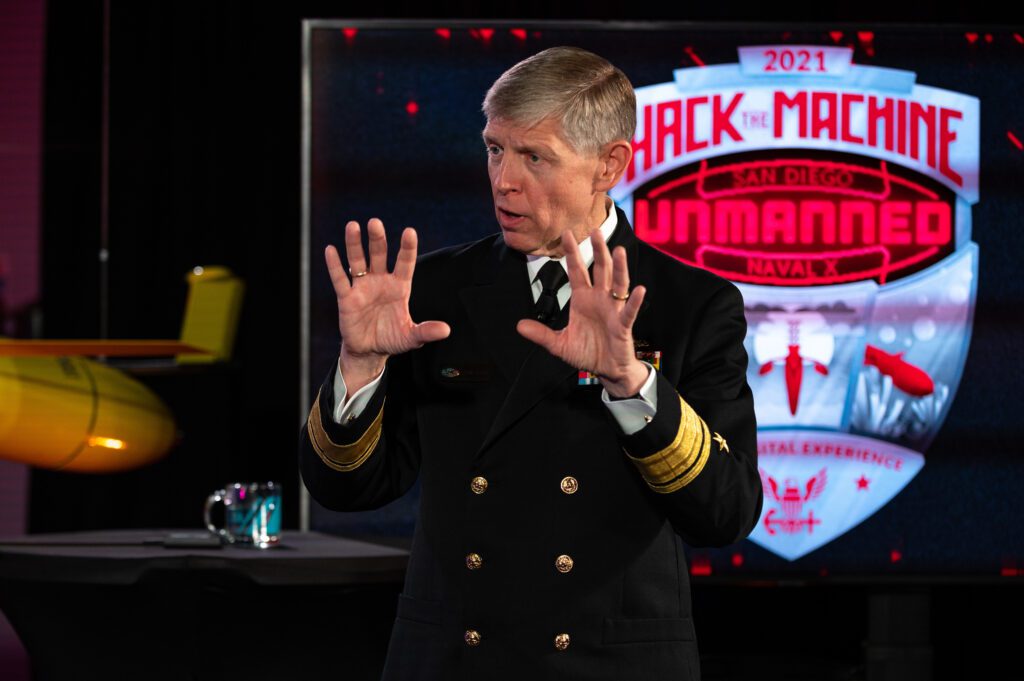
Rear Adm. Lorin Selby, chief of naval research, delivers remarks at the HACKtheMACHINE Unmanned competition in Alexandria, Virginia, Nov. 17. HACKtheMACHINE Unmanned is the first in a series of public-facing technology challenges aimed at accelerating discovery and teambuilding between the DoN, industry and academia for the creation of groundbreaking unmanned and autonomous systems. U.S. NAVY / Michael Walls
ARLINGTON, Va. — Declaring “Our time to innovate is now,” Chief of Naval Research (CNR) Rear Adm. Lorin C. Selby last week introduced a new vision for future naval power, one based on faster development of unmanned, autonomous systems, vibrant partnerships with industry and academia and reimagined naval formations.
“I think this decade, the 2020s, will have special significance for our nation and our role in leading the world,” Selby told a nationwide audience during the HACKtheMACHINE Unmanned event. “What can we do today that can deliver measurable results in two years, that leads to deployed capabilities at scale in five years, to fully realize that reimagined future?”
Small, Agile, Many
A critical important component of future naval success, he said, is incorporating advanced cyberphysical technologies found in the “small, the agile, and the many” — small unmanned, autonomous platforms that have the agility to be built and adapted quickly, in large numbers, and at far lower costs compared to larger platforms. These unmanned air, surface and subsurface vehicles will carry an array of sensors and modern payloads, and perform multiple missions.
“The small, the agile and the many have the strong potential to define the future in a world where the large and the complex are either too expensive to generate in mass, or potentially too vulnerable to put at risk,” he said.
“We are talking about how to iterate at scale and at speed. How to take things that meet operational needs and making them part of the force structure, deploying them in novel naval formations” that will “confuse and confound the tasks our adversaries must consider.”
One of the advantages of the small, agile and many platforms in this new formation is that Selby believes they can be built relatively inexpensively compared to existing force structure. This makes them more attritable in high-end conflict — in other words, if they are shot down or otherwise put out of action, American forces will have dozens, even thousands, of backups in place. Having large numbers of advanced but inexpensive platforms in the fleet to counter an adversary’s expensive platforms could play an important role in deterring aggressive actions.
Selby gave his remarks during a keynote address at the HACKtheMACHINE Unmanned competition, held virtually Nov. 16-19. This event, which is expanding to multiple cities across the country, is a public-facing technology challenge aimed at accelerating discovery and team building between the Department of the Navy, industry and academia.
The ultimate goal of such events, Selby said, is to create new ways of doing business for autonomous and software-based systems. Comparing this moment in history to the dawn of the industrial revolution, when technological advances drove massive change, he noted that today, “data is the new oil, and software is the new steel.”
Sponsored by ONR, in conjunction with Program Executive Office (PEO) C41, PEO Integrated Warfare Systems, PEO Unmanned and Small Combatants, the Navy’s Cybersecurity Office (PMW-130) and industry partners like Fathom5 and Booz Allen Hamilton, HACKtheMACHINE Unmanned is one of the ways ONR is working to support the Navy’s 2021 Unmanned Task Force and integrate unmanned and autonomous technology at scale.
A Strategic Hedge
Selby emphasized the importance of America’s current naval force structure needing a “strategic hedge.” He noted that in World War II, the Navy was primarily invested in battleships as the nucleus of combat power for any future conflict. However, the Navy and the nation had a “hedge” investment in aircraft carrier and submarine force structure. Ultimately the hedge proved crucial to victory — far different from the beginning of the war, when battleships were seen by many as the key.
The small, the agile and the many represent a viable hedge to support the large and the complex platforms that comprise the backbone of today’s force structure. Rapid development of unmanned, autonomous systems provides the technological drive to create a hedge option for the 21st century Navy and Marine Corps. Developing this strategic hedge at ONR is one of many ways the organization helps the Navy and Marine Corps adapt to potential futures.
Finally, the CNR stressed the importance of moving from the current requirements-driven acquisition process — a successful process for large platforms, but one not rooted in speed — to a “problem-driven” process, where the Naval Research Enterprise asks operators and commanders what problems they are facing, and rapidly creates solutions to solve their problems.
That approach has already begun. ONR provided dozens of unmanned platforms and sensors used in last April’s Integrated Battle Problem 2021, which focused on a PACFLEET battle problem. In 2022, those efforts will continue, including partnering with SOUTHCOM to deliver new tools for drug interdiction efforts.
Navy and Port of Hueneme Help Relieve U.S. Supply-Chain Congestion
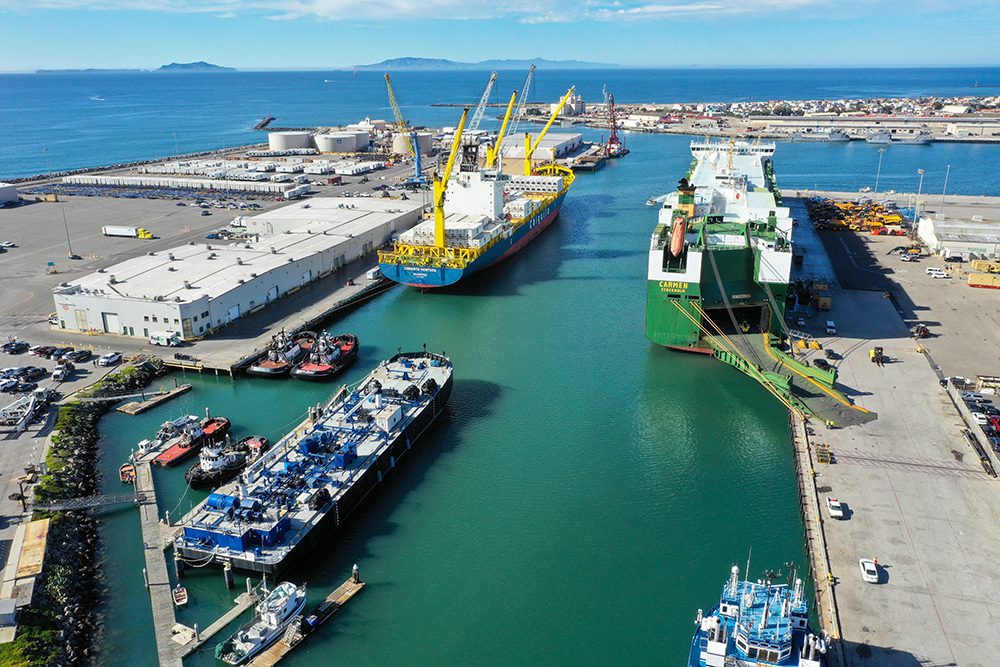
The U.S. Navy in partnership with the Oxnard Harbor District is providing resources onboard Port Hueneme in direct support of decreasing port congestion in Los Angeles County and reducing the national supply-chain shortage, Nov. 22, 2021. U.S. NAVY
PORT HUENEME, Calif. — The U.S. Navy in partnership with the Oxnard Harbor District (OHD) is providing resources onboard Port Hueneme in direct support of decreasing port congestion in Los Angeles County and reducing the national supply-chain shortage, Nov. 22, 2021.
A standing Joint Use Agreement (JUA) with Naval Base Ventura County and OHD, allows the Navy to support commercial supply chain logistics when activated.
“Naval Base Ventura County recently welcomed a large cargo vessel,” said Daniel J. Herrera, assistant program director for port operations, NBVC. “Ports of America already off-loaded a large number of 40-foot containers into lot 22 onboard Port Hueneme, which is merchandise expected to have direct impact with helping to support holiday supply demands.”
The Department of the Navy entered into a JUA in 2002 with the OHD, replacing the 1994 memorandum of understanding, authorizing commercial use of Wharf 3 onboard NBVC, including approximately 21 acres of contiguous land, buildings 546 and 548, and if available, up to an additional 10 acres of industrial land located outside of the Wharf 3 area.
Jason Hodge, President of the OHD which owns the Port of Hueneme, said commercial business at the port has increased significantly over the past year and when it comes to moving cargo, the Port’s flexible “can do” attitude is similar to the Navy Seabees’ “Can Do” motto of completing a task no matter the condition or situation.
“The port appreciates the partnership with NBVC and locating additional space to accommodate excess holiday shipments coming through the port,” Hodge said. “We are delighted to come together to meet the challenge of providing a solution to help keep essential goods moving. Our long-standing history of partnership continues with this call-to-action to address the national supply chain challenge.”
The JUA was activated in November as a resource to help reduce the shipping congestion affecting Los Angeles County’s major ports and contributing to the national supply crisis. Vessels would arrive into the port to unload a portion of their containers before continuing on to Los Angeles County or chose to unload all their containers at the Port of Hueneme to avoid the backlog of ships farther south.
USS Arlington Arrives in Haiti to Support USAID
The San Antonio-class amphibious transport dock ship USS Arlington (LPD 24) transits the Atlantic Ocean Aug. 14, 2021. U.S. NAVY / Mass Communication Specialist 3rd Class Jesse Schwab
CARIBBEAN SEA – The San Antonio-class amphibious transport dock ship USS Arlington (LPD 24) arrived in U.S. 4th Fleet area of operations off the coast Haiti to begin humanitarian assistance and disaster relief operations, Aug. 21, said Lt. Laura Price, U.S. Naval Forces Southern Command / U.S. 4th Fleet.
Arlington departed Naval Station Norfolk Aug. 17 to support U.S. Agency for International Development (USAID) following a 7.2-magnitute earthquake that struck Haiti on Aug. 14, 2021.
“Our initial focus is to concentrate on saving lives while alleviating suffering for the people of Haiti,” said Capt. Eric Kellum, commanding officer of Arlington. “Assisting those in need due to a natural disaster is something this team is trained and ready to do. Our presence here demonstrates our nation’s commitment to supporting our partners in this part of the world.”
Arlington has approximately 600 Sailors and Marines which includes service members embarked from Bravo Company, 1st Battalion, 6th Marine Regiment to provide lifesaving and humanitarian assistance support. The ship is augmented by two MH-60 Seahawk helicopters from the “Chargers” of Helicopter Sea Combat Squadron (HSC) 26, a landing craft, utility (LCU) from Assault Craft Unit (ACU) 2, Fleet Surgical Team (FST) 2, in addition to staff from Destroyer Squadron (DESRON) 40, and amphibious and aviation planners.
The mission forms part of an inter-agency framework lending aid to Haiti, including the Disaster Assistance Response Team (DART), which was deployed Aug. 14 immediately after the earthquake occurred. U.S. Southern Command Joint Task Force-Haiti, commanded by Navy Rear Adm. Keith Davids was stood up to coordinate military support, with Arlington deployed as a maritime component.
Arlington joins other U.S. Southern Command components and U.S. Coast Guard ships already on station, in addition to allies and partners from the Netherlands, France, and United Kingdom.
USS Arlington, homeported in Norfolk, Virginia, is part of Expeditionary Strike Group 2, whose mission is to provide timely, operational, amphibious expertise in support of national tasking to sustain maritime security and defense of the nation.
NAWCAD Team Brings First-of-its-Kind P-8A Decoy Prototype to Test
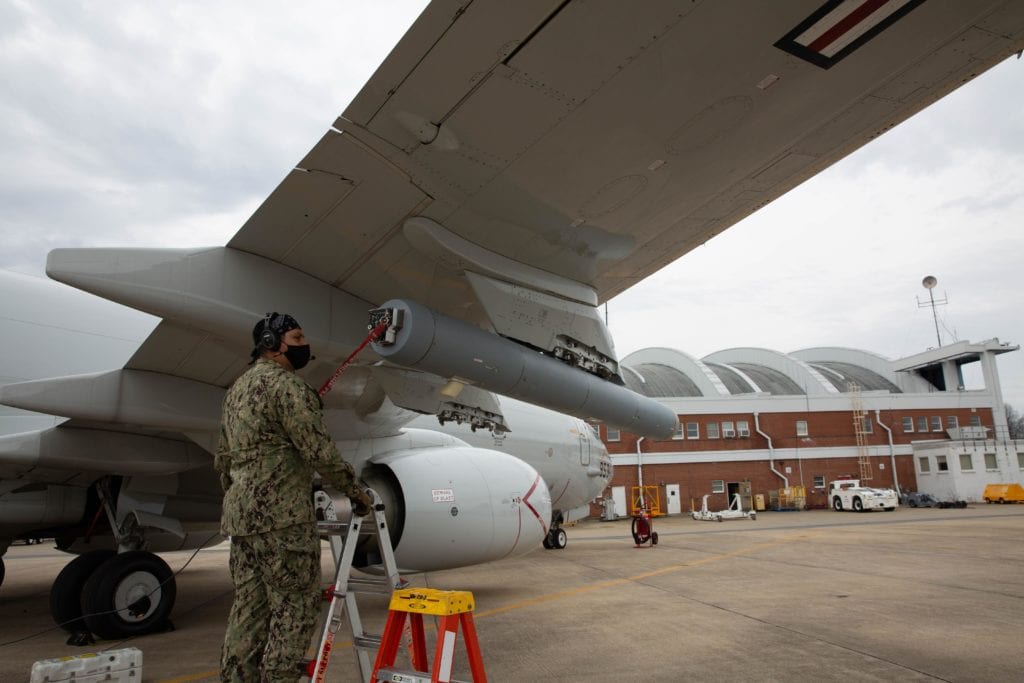
A member of Air Test and Evaluation Squadron (VX) 20 puts a pod-mounted radio frequency countermeasure system on a P-8A Poseidon, March 12. The pod successfully competed an air worthiness test at the Naval Air Warfare Center Aircraft Division (NAWCAD) Atlantic Test Ranges. U.S. NAVY
PATUXENT RIVER, Md. — An Air Test and Evaluation Squadron (VX) 20 P-8A Poseidon successfully completed an airworthiness test of a pod-mounted radio frequency countermeasure (RFCM) prototype at the Naval Air Warfare Center Aircraft Division (NAWCAD) Atlantic Test Ranges, March 12, the Naval Air Systems Command said in an April 9 release.
The first-of-its-kind radio frequency defense decoy could allow the P-8A to thwart enemy radio frequency missile attacks.
“This has the potential to be a game-changer for protecting the warfighter,” said Capt. Eric Gardner, program manager for the Maritime Patrol and Reconnaissance Aircraft Program Office (PMA-290). “We continue to look for ways to enhance capabilities that allow the fleet to be successful.”
Getting the pod into testing, in just over a year, took a complete team effort.
Constantly looking for upgrades to the P-8A, PMA-290 set out to find a solution to a potential threat from surface-to-air radio frequency missiles.
Outlining their needs and running lead on the project, PMA-290 brought in the Advanced Tactical Aircraft Protection Systems Program Office (PMA-272), the Rapid Prototyping, Experimentation & Demonstration (RPED) team, and the NAWCAD Aircraft Prototype Systems Division (APSD) to get the ball rolling.
The RPED team supported APSD in designing the RFCM pod, which integrated the proven AN/ALE-55 Fiber Optic Towed Decoy from PMA-272 into a shell. The team developed the shell design based on the certified AGM-84 Harpoon missile, and then incorporated unique tracks and housing to fit and deploy the decoy.
By employing the assistant secretary of the Navy for research, development and acquisition’s delegation of other transactions authority (OTA) for prototype projects, PMA-290 and NAWCAD were able to complete a one-of-a-kind contract with BAE Systems to develop the RFCM pod’s additional internal equipment suite. The OTA, a non-Federal Acquisition Regulation contracting approach, could potentially allow this critical self-protection technology to transition from prototype to fleet capability in much less time than a traditional effort.
APSD and BAE leveraged the established AN/ALE-55 electrical design to accommodate the suite’s installation.
“A lot of the challenge and effort went into designing, to our best estimates, for what BAE was expected to put in the pod,” said Michael Hansell, the leading APSD engineer for the project. “We had to adapt and redesign rapidly. We worked as fast as possible to support PMA-290 and RPED to make sure we could pivot and adjust to meet established timelines.”
Constant tweaks were needed as the teams continued to hone in on a capable design.
“Michael Hansell and his team’s flexibility and willingness to go above and beyond, to work through issues and prepare for BAE, was key in getting [the pod design and build] done in a timely manner,” said James Sherman, the APSD project lead.
The Naval Innovative Science & Engineering (NISE) program funded the project, which provided the means to conceptualize, prototype, build, and test this new capability for the Navy.
This funding accelerated the design and manufacturing cycle for the prototype to just under six months. The expedited developmental process supports the rapid prototyping of new and developing technologies and provides the resources to find solutions and incorporate improvements to fill capability gaps in the fleet faster.
The teams were also able to use PMA-272’s F/A-18 lab equipment to speed up the timeline.
All this teamwork culminated in the successful airworthiness test with VX-20.
“This shows that when we identify a need and work rapidly as a team we can bring a viable solution to test that has the ability to greatly impact the warfighter,” said Lt. Cmdr. Mike Marschall, PMA-290 weapons and rapid capabilities co-team lead.
Following the test, the pod went to Naval Air Weapons Station China Lake, California, where it successfully completed effectiveness testing, March 21-26. It will now continue to be tested at a system level leading to platform integration through planned capability fielding phases.
Austin Praises Nimitz Carrier Strike Group for Record-Breaking Deployment
Secretary of Defense Lloyd J. Austin III flew out to the aircraft carrier USS Nimitz off the coast of California to thank the crew for a record-setting deployment in the U.S. Indo-Pacific Command and U.S. Central Command areas of responsibility. Department of Defense
PACIFIC OCEAN – Secretary of Defense Lloyd J. Austin III flew out to the aircraft carrier USS Nimitz off the coast of California to thank the crew for a record-setting deployment, the Department of Defense said in a Feb. 25 release.
The Nimitz Carrier Strike Group is returning after operations in U.S. Indo-Pacific Command and U.S. Central Command (CENTCOM) areas of responsibility. It was the first carrier strike group to deploy under COVID-19 protocols. By the time the carrier strike group reaches home, the Sailors and Marines aboard will have been gone for 321 days.
The Nimitz, the cruiser USS Princeton, and the destroyers USS Sterett and USS Ralph Johnson made up the group.
“You’ve just demonstrated incredible professionalism, resilience and focus,” Austin told the crew over the ship-wide public address system. “It’s been very impressive.”
The group provided carrier support in the Persian Gulf in support of CENTCOM during a particularly tense time with Iran. The group also participated in maritime exercise Malabar 2020 alongside Indian, Australian and Japanese ships. The carrier strike group also participated in dual-carrier operations with the USS Theodore Roosevelt and USS Ronald Reagan carrier strike groups. The group also operated in the South China Sea.
Austin praised the group for these efforts. “You’ve sent a clear message about America’s resolve,” he told the crew. “Any potential adversary out there — in this ocean or any other ocean — has to know when they look at what you accomplished, that the United States takes very seriously our security commitments around the world.”
He thanked the Sailors for working with key allies and partners across the U.S. combatant commands.
The Nimitz Carrier Strike Group had the longest deployment since the Vietnam War. It was lengthened by COVID-19 protocols that called for a quarantine before departing and the elimination of port calls during the deployment. The Navy aims for deployments to be roughly six months. The Nimitz group will be away from family and friends almost twice that.
“I don’t want deployments this long to be the norm,” the secretary said. “And so, we need to take a hard look at that, but you handled it very, very well. You led. You took care of each other in the midst of a pandemic, and you were a team.”
In a news conference with Pentagon reporters on the hangar deck, Austin thanked families in particular. “Their families have been very, very supportive as well,” he said. “And I want to make sure I give them a shout out again, and provide our thanks for their sacrifices.”
The Nimitz was on its way home from the CENTCOM area of responsibility when events in the region necessitated its return. Events such as these happen. He noted the year-long deployments to Iraq and Afghanistan that stretched to 18 months, as an example.
“I understand the stress that, that can place on families,” he said. “So as secretary, what I want to do is make sure that … going forward, we do everything we can to minimize that kind of stress.”
That means taking care of equipment, sure, but really ensuring that service members and their families are taken care of. “We’re going to continue to learn,” he said. “We’re going to continue to make sure we have the resources. [We’re going to ensure] that we’re doing the right things to pace ourselves going forward. Because I really think this is important.”
Overall, the carrier strike group steamed more than 87,300 nautical miles during its deployment. The carrier launched 10,185 sorties totaling 23,410 flight hours logged.
Article by Jim Garamone, DoD News
SECDEF Tours Navy EOD to Assess Unmanned Capabilities
Defense Secretary Mark T. Esper visits Naval Base Point Loma for an unmanned underwater vehicle demonstration, Point Loma, California, Sept. 17, 2020. DEPARTMENT OF DEFENSE / Lisa Ferdinando
SAN DIEGO – Secretary of Defense Dr. Mark T. Esper visited components of Explosive Ordnance Disposal Group (EODGRU) 1 at Naval Base Point Loma, California, Sept. 17, to learn how Navy EOD is building a more lethal, agile and resilient force by augmenting human expertise and decision-making with autonomous unmanned systems (UMS) capabilities for the fleet and Joint Force.
While meeting with Esper, EODGRU-1 Commodore Capt. Oscar Rojas described how Navy EOD is an integral member of the UMS triad, which is composed of the surface, subsurface and expeditionary (EOD and Naval Special Warfare) communities.
The UMS triad enables strategic effects by leveraging cutting-edge technologies to pair real-time, relevant information with immediate tactical options to deter adversaries in the maritime environment.
“We are enhancing our human-machine teaming efforts to more efficiently illuminate and eliminate or neutralize surface and undersea threats,” said Rojas. “Our UMS systems development efforts are at the front of autonomous capabilities to recognize, analyze, communicate and take appropriate response to various threats. This could involve neutralizing the threat, alerting a human operator or networking with other UMS systems, all to offer commanders the most advantageous results at a specific time and place.”
Rojas also described how the Navy EOD Expeditionary Mine Countermeasure (ExMCM) companies help maintain freedom of navigation in denied waterways, in war and in daily competition. Created to help address the long-standing challenge of clearing naval minefields and explosive threats, ExMCM companies are used by operational commanders to maintain the military advantage before and after a threat is placed in the water. Expanded and enhanced commander’s awareness and layered options result from advancing the use of the unmanned underwater vehicles (UUV) and remotely operated vehicles (ROV) embedded within the ExMCM company. Each company has 30 Sailors, tailorable to teams as small as two based on mission requirements.
“Our ExMCM companies are essential to supporting fleet and Joint Force objectives, across all environments. They are not constrained to a specific craft, allowing them to deploy from air, land and sea to neutralize surface and subsurface threats,” said Rojas.
Lt. Nick Stoner briefed Esper on current and next-generation technologies in UUVs and ROVs, much of which Navy EOD is already using in operations.
“It was an honor to talk with Secretary Esper about how we are advancing artificial intelligence and human-machine teaming in our operations today,” said Stoner, an EOD officer with EODGRU-1 who works on Navy EOD maritime and underwater capability development. “We are developing, implementing and rapidly adapting the vanguard of available technology for small and medium UUVs and ROVs to enhance our capability as a force and support the National Defense Strategy.
“A cornerstone of our success has been close relationships with our engineering teams. There is constant, two-way feedback between them and the users in the field, which allows for ongoing system updates and modifications to increase capabilities,” said Stoner. “It has been, and continues to be, a team effort.”
Developing future technology for Navy EOD also involves innovative acquisitions strategies, said Rojas. This includes collaborating with the Navy’s Expeditionary Program Office and DOD’s Defense Innovation Unit to capture current operational challenges and streamline the procurement process to rapidly address them.
“This allows Navy EOD to accelerate the adoption of emergent commercial technology so we can pace, and outperform, adversary threats to the fleet and Joint Force that threaten sea control and power projection,” Rojas said.
The EOD operators in the field also play a critical role in refining Navy EOD technologies and systems, said Rojas.
“Our Sailors use these tools daily and understand the challenges. We empower them to give the design-to-employment team direct feedback to rapidly find solutions to any issues that might arise,” Rojas said, adding that personnel conduct an in-depth, post-deployment analyses with Navy EOD leadership, as well as program management and engineering teams. This touch point drives down the time it takes to get new technology to the force and ensures prioritization of the most urgent fleet-driven requirements.
Operating from Naval Amphibious Base Coronado, California, EODGRU-1 oversees the manning training and equipping of EOD Mobile Units 1, 3, 5 and 11; Mobile Diving and Salvage Unit 1; EOD Expeditionary Support Unit 1; and EOD Training and Evaluation Unit 1. EODGRU-1 is also capable of deploying as a battalion level staff to command task forces in theater.
NAVWAR Provides Technical Expertise for Underwater Ice Study in Sweden
Electronics Technician 1st Class Robert Hart and Electronics Technician 1st Class Richard Goldberg assigned to Space and Naval Warfare Systems Command Reserve Program supported Naval Information Warfare Center Pacific engineers in coordination with the Swedish Defense Research Agency and the Swedish Coast Guard to explore how ice affects sound propagation and background noise in the underwater domain utilizing various sensors, magnetometers and a remotely operated vehicle. U.S. NAVY
SAN DIEGO —
Naval Information Warfare Systems Command (NAVWAR) joined the Swedish Defense
Research Agency and the Swedish Coast Guard in Lulea, Sweden, to test how ice
effects sound in the underwater domain March 11-23.
As part of
an ongoing program with Swedish authorities, personnel from the NAVWAR Reserve
Program (NWRP) and Naval Information Warfare Center Pacific (NIWC Pacific)
Unmanned Maritime Vehicle (UMV) Lab teamed to support the event.
NWRP
Sailors and NIWC Pacific engineers utilized various sensors, magnetometers and
a Seabotix vLBV, a remotely operated vehicle (ROV), to identify the potential
impact of ice on sound propagation and background noise underwater.
NWRP
Sailors operated the ROV to test acoustic transceivers and collect sonar and
video imagery of the conditions beneath the ice and to provide logistic mission
support with programming magnetometers.
“Sonar
and camera data from the ROV provided insight into the structure of the ice,”
said Tom Pastore, a NIWC Pacific engineer. “Simultaneous acoustic measurement
data between various fixed points will allow researchers to characterize the
impact of ice-covered waters as compared to an open surface. This is an
important addition to the scientific body of knowledge and leads us towards
better modeling capability in under-ice regions.”
The
collective team from NAVWAR and Sweden have a second trial scheduled for first
quarter of fiscal year 2020.
NWRP
Sailors leverage their education, corporate knowledge and military experience
and apply those skills to UMV and other technology testing events to address
potential challenges with respect to complex command, control, communications,
computer and intelligence systems.
“NAVWAR
Reservists provide manpower with diverse technical and operational skill sets,
enabling the sponsor to successfully complete the mission no matter the challenges,”
said Thomas McDermott, NWRP UMV program manager.
Bainbridge Answers Distress Call
Sailors aboard the Arleigh Burke-class guided-missile destroyer USS Bainbridge (DDG 96) render aid to the crew of the M/V Kokuka Courageous. Bainbridge is deployed to the U.S. 5th Fleet areas of operations in support of naval operations to ensure maritime stability and security in the Central Region, connecting the Mediterranean and Pacific through the western Indian Ocean and three strategic choke points. U.S. NAVY / Mass Communication Specialist 3rd Class Jason Waite
GULF OF OMAN (NNS) — The Arleigh Burke-class
guided-missile destroyer USS Bainbridge (DDG 96) responded to a distress call
from the M/V Kokuka Courageous in the Gulf of Oman the morning of June 13.
The Bainbridge received a call from the
Kokuka Courageous crew advising that their ship was in distress approximately
30 nautical miles from Bainbridge’s location.
“This is what we’re out here for,” said Cmdr.
M. Kathryn Devine, commanding officer of Bainbridge. “Our mission is to ensure
maritime safety and to answer the call for aid when we can.”
All 21 crew members of the Kokuka Courageous
had evacuated to a tug boat and were transferred to the Bainbridge. One of the
Kokuka Courageous sailors suffered burns on his hands and was treated
immediately by the Bainbridge medical team.
Once safely aboard Bainbridge, the Kokuka
Courageous crew received medical check-ups, showers and clean clothes along
with food and any other attention they required.
“I’m very proud of my crew and their quick
response to the situation,” said Devine. “They’ve done an incredible job of
making sure the crew of the tanker was safely brought aboard and taken care
of.”
Bainbridge is underway as part of Abraham
Lincoln Carrier Strike Group’s (ABECSG) deployment in support of maritime
security cooperation efforts in U.S. 5th, 6th and 7th Fleet areas of
operations.
With Abraham Lincoln as the flagship,
deploying strike group assets include staffs, ships and aircraft of Carrier
Strike Group 12 (CSG 12), Destroyer Squadron 2 (DESRON 2), USS Leyte Gulf (CG
55) and Carrier Air Wing 7 (CVW 7).