USSOCOM Upgrades Personal Diver Equipment
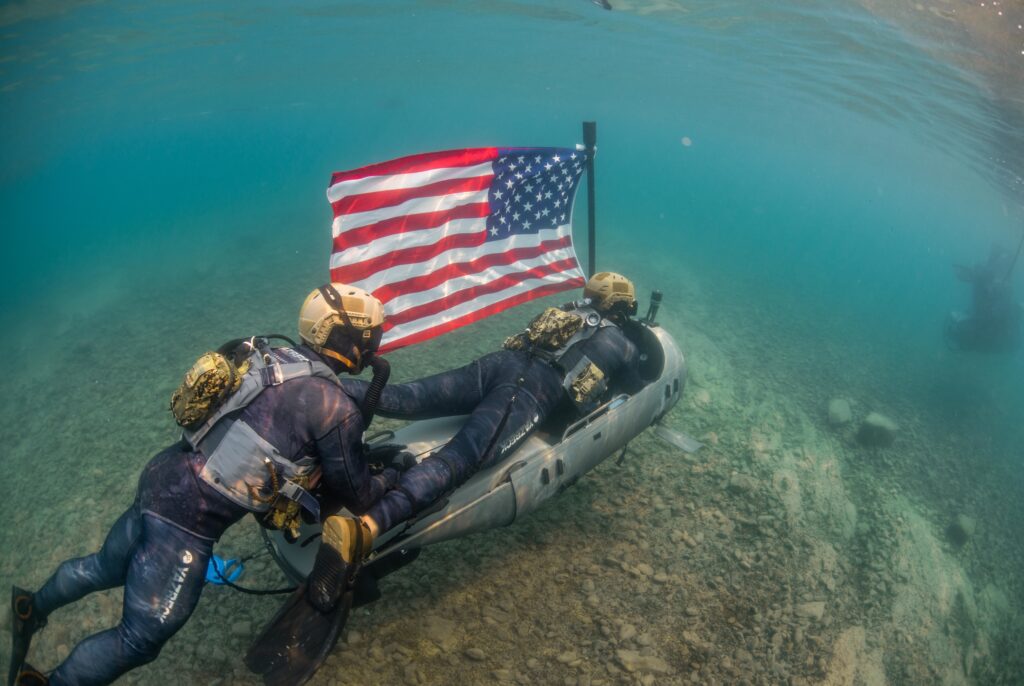
Sailors assigned to various Naval Special Warfare commands operate a Diver Propulsion Device during high-altitude dive training in 2022. Photo credit: U.S. Navy | Mass Communication Specialist 2nd Class Alex Perlman

U.S. Special Operations Command is upgrading its Special Operations Forces’ personal diving equipment.

“Technology for the combat diver has advanced significantly and SOF continues to enhance diver capabilities to maintain an agile and lethal combat diving force,” Lieutenant Commander Kassie Collins of USSOCOM said in response to a question from Seapower.

The SOF Combat Diver program (under U.S. Special Operations Command PEO Maritime) consists of maritime environmental protection (free diver heating and cooling, full face masks, and chemical, biological, radiological, and explosive protection), life-support systems (underwater breathing apparatus, treatment systems, and decompression systems), diver navigation (handheld digital navigation and integrated navigation), diver propulsion (collective, hands-free), underwater communication (acoustic, optical, and diver-to-host) and signature management (equipment signature reductions and signature detection), Collins said.

“Early wins for the SOF Combat Diver program include digitizing legacy navigation and equipping energized propulsion devices in lieu of fins. As a result, the program has been able to rapidly accelerate development and fielding of navigation and propulsion devices. The SOF Combat Diver program also continuously evaluates battery technology to ensure safety and maximize endurance. Currently, this program does not have a requirement for drones or AI [artificial intelligence].”

Because many USSOCOM programs are generally classified, USSOCOM didn’t provide equipment specifics to the categories.

For Diver Propulsion, a search of SAM.gov., the official U.S. federal government contracting website did provide some details. In the summer of 2025, the Naval Special Warfare Center was looking into acquiring the Patriot3 Brand Jetboots V6 Diver Propulsion Device, essentially a low-noise, low-weight brushless motor ducted thruster propeller strapped to a diver’s thighs. The hands-free Jetboots provide 40 pounds of thrust and increase a special operations diver speed by around four knots at a depth of 300 feet and a range of a dozen miles on two batteries, or one to six hours of battery life.

TheWarZone website reported U.S. Navy SEALs having Jetboots since July 2020, but Jetboots was conceptualized and patented in 2013, so USSOCOM could be seeking supply support and maintenance in addition to new Jetboot replacements. A $10 million dollar contract was awarded to Patriot3 Inc. that runs through 2027.

For Diver Navigation, USSOCOM is working with Safety and Security International (SSI) regarding its Tactical Diver Readiness Assembly. This increases special operations divers’ situational awareness and rapid deployment in maritime and expeditionary environments by combining the functions and features of a mission critical multi-function dive watch with a modular load carriage and safety components to provide advanced underwater navigation instrumentation and real-time dive diagnostics in MOLLE-compatible pouches.

The navigation devices can be made digitalized, smaller and lighter, while still incorporating GPS features, real-time diving diagnostics, and advanced underwater navigation instruments.

Further investigation into SAM.gov. yields a request for information on underwater communications technologies that are not radio frequency based, as well as for power sources focused on power-harvesting technologies instead of batteries or connected power sources. The current status of USSOCOM’s underwater communications technologies and novel power sources is unknown.

The 2019 USSOCOM RFI also seeks improvements in human performance in harsh maritime conditions for extended operating periods “with or without personal protective equipment,” to:

  • Reduce the potential of musculoskeletal injuries related to combat diving
  • Improve combat diving-related physical performance capabilities
  • Enable continuous physiologic monitoring of diver biometrics in sea water at depths greater than 90 feet for periods of up to or greater than 72 hours
  • Provide a variety of nutrition and hydration products for consumption while underway
  • Manage bodily functions while underway
  • Provide force resistance equipment for confined environments
  • Reduce cognitive deficits related to prolonged undersea exposure
  • Provide active heating/cooling protection in the water column.


Combat Craft Medium to Gain New, Improved Sibling

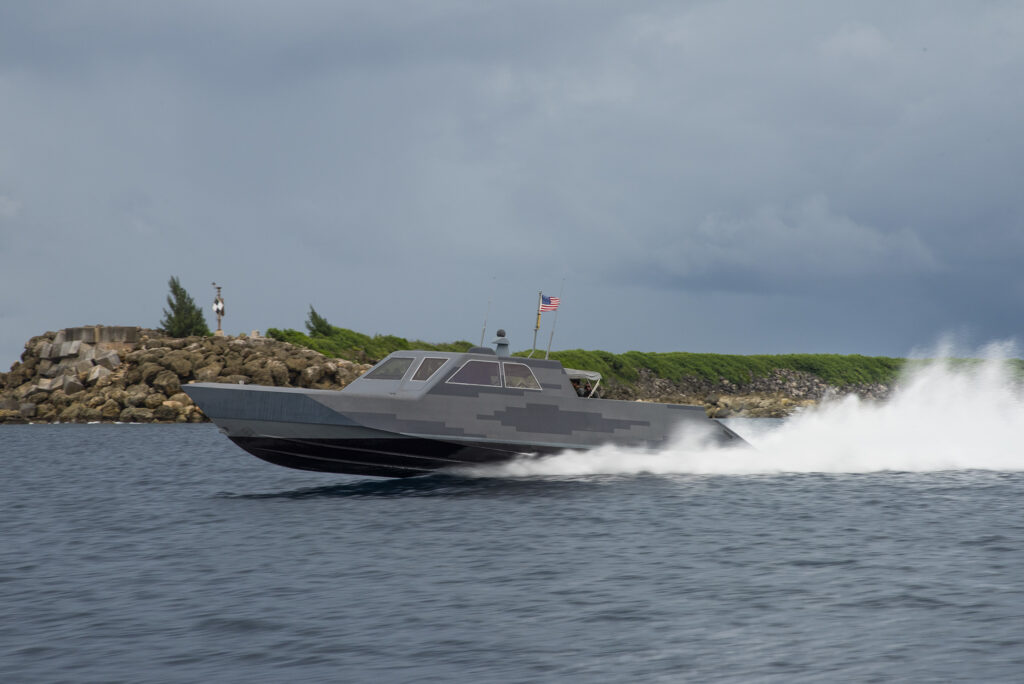
A Combatant Craft Medium assigned to a West-coast based Naval Special Warfare unit maneuvers in Apra Harbor, Guam, in 2021. Photo credit: U.S. Navy photo by Shaina O’Neal

The United States Special Operations Command’s Combat Craft Medium Mark 1 will get a new and improved next-generation sibling in the future called the Combat Craft Medium Mark 2. Currently, USSOCOM is working with Oregon-based company ReconCraft on the first completely new Naval Special Warfare boat design since 2015.  

Built by Vigor Industrial, the CCM Mark 1 is a durable, stealthy, low-observable, armored double-hull aluminum boat used by Naval Special Boat Teams for infiltration and extraction of special operations forces in medium-threat environments. It is 60 feet long with a width (beam) of 13 feet and a draft of 3.3 feet, can travel at over 52 knots and can carry .50 caliber M2 heavy machine guns, Mark 19 automatic grenade launchers and 7.62mm M240G medium machine guns on the aft deck.

It has a crew of four and can carry 19 special operators. Range is 600 nautical miles at 40 knots. Vigor Industrial built 31 CCMs, which are transportable via trucks towing trailers and C-17 military cargo aircraft.

According to SAM.gov, the United States’ official federal contracting website, “The CCM Mk2 will replace the CCM Mk1 with a high-speed, aluminum-hulled craft designed to enhance USSOCOM’s maritime capabilities. It incorporates advanced materials and technologies to support multi-role capabilities for maritime missions. This effort includes the design consulting, prototyping, fabrication and outfitting of a single CCM Mk2 prototype, with the potential for a follow-on production contract or agreement.”

Key Specifications for the CCM Mk2

  • Hull Material: High-performance aluminum.
  • Engines: Twin 1,600 hp marine diesels
  • Propulsors: Marine waterjets
  • Dimensions:Length 68.6 feet, beam 14.2 feet, draft 3.6 feet.
  • Fuel:Diesel, with a capacity of approximately 3,200 gallons.
  • Mobility: Configured for road and military aircraft transport.

Thus, the CCM Mark 2 is slightly longer, wider and deeper than the CCM Mark 1.

“In August 2025, U.S. Special Operations Command awarded an Other Transaction Authority agreement to ReconCraft LLC to produce the Combatant Craft Medium Mark 2 Engineering Development Model,” Lieutenant Commander Kassie Collins of USSOCOM replied in response to a question from Seapower. “CCM Mk2 will replace the CCM Mk1 fleet, providing Naval Special Warfare with an enhanced capability to conduct long-range, multi-mission operations in maritime environments. CCM Mk2 incorporates integrated survivability enhancements to support irregular warfare operations in maritime environments across the globe.”

Seapower asked if the CCM Mark 2 will replace the CCM Mark 1 on a one-for-one basis and if the CCM Mark 1s will be retired.

“The CCM Mk1 fleet continues to support the demand signal around the globe. The CCM Mk2 platform is being built from the ground up to include upgrades that the CCM Mk1 has incorporated throughout its service, while providing more space, power and opportunity to adapt to future payloads or systems.  When the production of the CCM Mk2 begins, the CCM Mk1 will continue to support the force and we will evaluate boats on an individual basis to determine an informed service life, balancing commander’s needs and resources,” Collins responded.

ReconCraft declined to comment on the Combat Craft Medium, Mark 2, and USSOCOM and the company have no images or photos to share since the CCM Mark 2 is an entirely new design starting from the proverbial drawing boards. Questions on CCM Mark 2 armament and sensors were not provided at this early stage of the design process.


Can the U.S. Navy’s E-2D Hawkeye Substitute for the Canceled Air Force E-7A Wedgetail?

An E-2D Hawkeye attached to the “Greyhawks” of Airborne Command and Control Squadron (VAW) 120 performs a touch-and-go landing aboard the Nimitz-class aircraft carrier USS George H.W. Bush (CVN 77). Photo credit: U.S Navy | Mass Communication Specialist 2nd Class Pierce Luck

The U.S. Air Force’s E-7A Wedgetail Airborne and Early Warning and Control (AEW&C) aircraft was canceled by the Trump Administration in the summer of 2025, although Congress is moving to block such a decision and enacting legislation to prevent the movement of funds out of the E-7A program.

Can its duties be undertaken by the U.S. Navy’s smaller, cheaper E-2D Hawkeye?

“I’ll leave that to the decision makers in the United States Air Force as to what the right thing is,” Vice Admiral Daniel L. Cheever, commander of Naval Air Forces and Naval Air Force, U.S. Pacific Fleet, said during a Center for Strategic and International Studies’ “Future of Naval Aviation” live webinar event on Aug. 26, in response to a question from Seapower.

“Is the E-2D one of the most capable command and control platforms out there? Yes, it is,” he said. “It has air refueling, so we can stay on station and go serious long ranges. And that team, very small team in the E-2D, is incredibly capable … the three folks in the back are incredible warfighters. Talk about folks that can think strategic, operational, and tactical all at the same time. I think of them as a large umbrella over the whole force, and command and control, and give you the right call at the right time.

“And I think about the trust … the implicit trust I have in the E-2D crew. If they say something and direct me, I do it,” said Cheever, an F/A-18 Hornet pilot. “I don’t pause. I don’t go `Is that the right decision?’ I do whatever they say whenever they say it because they’re always right. And they have that global essay situational awareness that the E-2D brings. And so, it’s kind of inherent [in] that trust piece.”

The E-7A program has been behind schedule and over budget. A single E-7A airborne battle management aircraft’s cost increased by $136 million, or 23%, from $588 million to $724 million. The E-7A is needed to replace the decades old and outdated E-3 Sentry Airborne Warning and Control System (AWACS). Both aircraft are manufactured by Boeing and both have aerial refueling capabilities.

The E-7A is already in foreign air forces’ service, flying for the Royal Australian Air Force, the Republic of Korea air force, and the Turkish air force. The E-7A production numbers are low, with 13 flying or in order with air forces around the world in 2025.

The U.S. Air Force has none, although it wanted 26 before the Pentagon canceled the program and concluded the E-2D Hawkeye can fulfill the AEW&C task, even though the turboprop-powered E-2D is much smaller and thus less capable in speed, range, and endurance. E-2Ds use a 360-degree rotating dorsal antenna that can switch from mechanical to electronic scanning for detecting threats over land, water, and in the littorals.

The jet-powered E-7A is based on a larger Boeing 737 Next Generation (737-700) commercial jetliner and has more range and endurance because it doesn’t have to take off from an aircraft carrier. E-7As use a Multi-role Electronically Scanned Array (MESA) fixed to the top of the aircraft, which provides 360-degree long-distance detection and tracking of airborne and sea targets.

“As an interim solution, the U.S. military wants to grow the Navy’s E-2D Hawkeye fleet to perform that mission while it builds a network of space-based sensors that can warn troops of enemy aircraft and missiles and help direct the movement of forces,” according to an article in Air & Space Forces magazine. “Hawkeyes would supplement a diminished [E-3] AWACS fleet, about half of which have already retired with no alternative in place.”

The Pentagon’s fiscal 2026 budget request calls for $1.4 billion to buy more E-2s, Bryn Woollacott MacDonnell, the department’s acting budget chief, told the magazine. It would also spend $150 million to create a joint expeditionary Hawkeye unit with five planes.

“The E-2D is in production and, as Admiral Cheever indicates, it’s a very capable platform that can operate with both persistence and at range from areas of interest,” Bradley Martin, a retired U.S. Navy captain and RAND Corporation’s senior policy researcher, told Seapower.

“It could carry out missions for the joint force in an effective manner. The main advantage is that it’s an aircraft in production with a capability for upgrades as new technology becomes available. This observation does not imply that RAND necessarily recommends the E-2D over the E-7A, just that E-2Ds could perform most of the missions the joint force requires.”


Newly Modified Coast Guard Cutter Storis Prepares for Arctic Duty

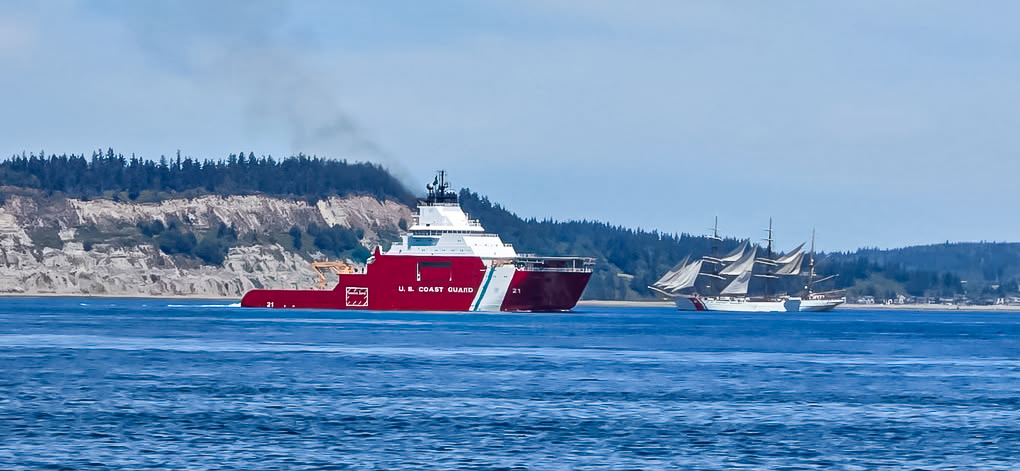
The U.S. Coast Guard Cutter Storis (WAGB 21) transits the Puget Sound near Whidbey Island and crosses paths with the Coast Guard Cutter Eagle (WIX 327), July 11, 2025. The arrival of Storis marks a milestone in the Coast Guard’s Force Design 2028 initiative and broader Arctic strategy. Photo credit: U.S. Coast Guard

The U.S. Coast Guard’s newly acquired icebreaker Storis recently arrived in Seattle to prepare for its first Arctic patrol, after a six-week voyage from Bollinger Shipyards in Mississippi.

The Coast Guard bought the M/V Aiviq (now the Storis) late last November in a $125 million deal with Offshore Surface Vessels LLC. Aiviq is a 360-foot U.S.-built vessel that has supported oil exploration in the Chukchi Sea off the coast of Alaska in the Arctic Ocean and has deployed twice to the Antarctic, according to the service.

Aiviq was built in 2012 and acquired by the Coast Guard in December 2024, making Storis 13 years old as of 2025. It’s the youngest of the icebreaking fleet; before Storis, the Coast Guard had only two active-duty icebreakers, the 26-year-old medium Arctic icebreaker Healy and the 49-year-old heavy Antarctic icebreaker, Polar Star.

The Storis (WAGB-21) is a Polar Class 3 icebreaker meant for Arctic ice patrols. Polar Class 3 denotes an icebreaker that can break about 2.5 meters (approximately 8 feet) of ice. Storis has four Caterpillar C280-12 engines producing 4,060 kilowatts each and propulsion is provided by two ducted controllable-pitch propellers and three bow thrusters and two stern thrusters. Speed is 15 knots (28 km/h; 17 mph) in the open ocean and five knots (9.3 km/h; 5.8 mph) when breaking one meter (3.2 feet) of ice. Crew size is approximately 60 officers and the crew that will be assigned in the summer of 2025.

“Storis departed Pascagoula, Mississippi on June 4 [2025] and transited the Panama Canal June 12 enroute to its future homeport of Juneau. Storis will be commissioned into service in August in Juneau,” said Lieutenant Commander Steve Roth, chief of media relations at the Coast Guard.

Seapower also asked what kinds of modifications were made to Storis.

“Prior to CGC Storis departing Mississippi, the Coast Guard installed StarShield and Coast Guard network connectivity for communications and crew safety,” Roth said. “The service also added standard Coast Guard self-defense capabilities, including a modular armory, ammunition storage, four .50 caliber machine gun mounts, and pyrotechnic lockers. Storis has not been fitted with a Mark 38 [25mm autocannon].”

StarShield is SpaceX’s military-centric satellite program that uses the Starlink satellite constellation network for secure high-bandwidth data and communications transmissions for the government, national security and the military. 

Storis will hold a commissioning ceremony in Juneau in August, where it will transition to active status before conducting an Arctic District presence patrol.

“Following that patrol, the Coast Guard will conduct further assessments of the ship to define its capability, develop operational requirements, develop program management planning (including cost, schedule, performance), and look to modify the ship to bolster the U.S. Coast Guard’s capability in the Arctic as required,” Roth said.


U.S. Coast Guard Refits Commercial Icebreaker Aiviq for Service as USCG Storis

The tug Aiviq traveling with the mobile drilling unit Kulluk in tow 116 miles southwest of Kodiak City, Alaska, in 2012. Credit: U.S. Coast Guard | Petty Officer 2nd Class Chris Usher

The Coast Guard awarded a contract Nov. 20 to Offshore Service Vessels LLC, of Cut Off, Louisiana, to acquire the motor vessel (M/V) Aiviq, a 360-foot U.S.-built polar class 3-equivalent icebreaker, U.S. Coast Guard Media Relations said in an Dec. 16 email.

“The Coast Guard first presented its research and recommendation to acquire a commercial icebreaker in a 2021 report. This approach was made possible through direction and statutory relief provided in the Don Young Coast Guard Authorization Act of 2022 and funding appropriated in fiscal year 2024,” the email said.

The Coast Guard renamed the Aiviq into Storis, a Scandinavian term meaning “a floating mass of closely crowded icebergs and floes.”

Much about the U.S. Coast Guard’s modifications and conversion of the commercial icebreaker, Aiviq, remains unclear as Coast Guard media did not respond to specific questions from Seapower about its refit, including schedule, cost, armament, crew complement, and material and structural changes.

The Coast Guard did tell Seapower that, “with minimal modifications, this polar icebreaker will be capable of projecting U.S. sovereignty in the Arctic and conducting select Coast Guard missions. The service will evaluate the vessel’s current condition and capability and identify requirements, and what modifications will be necessary, to attain full operational capability. The firm fixed-price contract, with a total value of $125.0 million, also includes provisions for technical data, spares, necessary modifications, certifications, crew training, and operational readiness activities.”

Built in 2012 by North American Shipbuilding Company of Larose, Louisiana, for $200 million, Aiviq was designed for towing and laying anchors for drilling rigs and oil spill response in the Chukchi Sea of Alaska. That makes the Storis 12 years old as of 2024. In comparison, the only other Arctic medium icebreaker, USCGC Healy, was launched Nov. 15, 1997, and commissioned Aug. 21, 2000, and is 24 years old, and the only Antarctic heavy icebreaker, Polar Star, is 48 years old, having been commissioned in 1976. Polar Sea, Polar Star’s sister, is inactive due to an engine malfunction in 2010 and has served as a parts donor to the Polar Star.

The 360-foot (110 meter) Storis has a crew of 28 and accommodations for 64 personnel. Its beam is 80 feet (24.4 meters), depth of 34 feet (10.4 meters) with a draft of 28 feet (8.6 meters). Powered by four Caterpillar C280-12 engines, each producing 4,060 kilowatts, driving two ducted controlled-pitch propellers, the Storis can sail at 15 knots (28 km/h; 17 mph) and five knots (9.3 km/h; 5.8 mph) in one meter (3.3 feet) of ice. Stability comes from three bow thrusters and two stern thrusters.

“The recently acquired polar icebreaker will bridge national presence in the Arctic while the service awaits delivery of the Polar Security Cutters,” said a Coast Guard Media Relations spokesperson. The Coast Guard said the Storis’s homeport is to be determined soon although maritime publications hint at Juneau, Alaska. Current estimate for delivery of the first PSC is 2030.

“The Coast Guard’s initial activities will be focused on readying the vessel for deployment to the Arctic in the summer of 2026,” Coast Guard Media Relations Office said. “A series of phased modifications will then occur between annual Arctic operations to achieve full operational capability.”