SECNAV Celebrates Keel Laying of the Future Frigate USS Constellation 

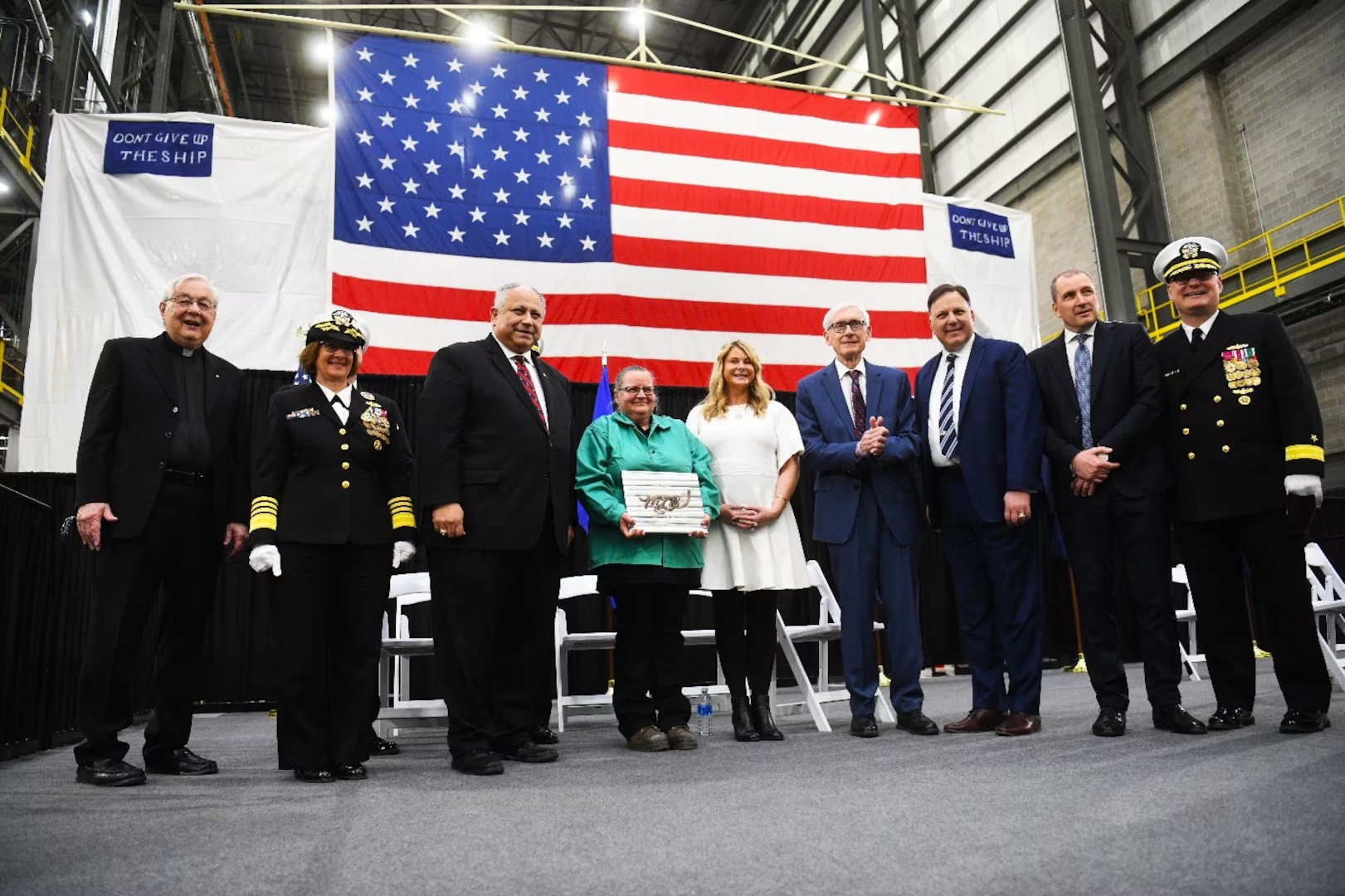
The U.S. Navy symbolically laid the keel to its first Constellation-class guided-missile frigate, the future USS Constellation (FFG 62) during a keel laying ceremony at Fincantieri Marinette Marine, Marinette, Wisconsin, April 12. Distinguished guests (left to right) pictured: James Dillenburg, Ceremony Chaplain; Admiral Lisa Franchetti, Chief of Naval Operations; Carlos Del Toro, secretary of the Navy; Jean Wagner, welder; Melissa Braithwaite, ship sponsor; Tony Evers, governor of Wisconsin; Mark Vandroff, CEO, Fincantieri Marinetti Marine; Marco Galbiati, CEO, Fincantieri Marine Group; Rear Admiral Kevin Smith, Program Executive Officer, Unmanned and Small Combatants.

SECNAV Public Affairs, 12 April 2024

Secretary of the Navy Carlos Del Toro traveled to Marinette, Wisconsin, to celebrate the keel laying for the future USS Constellation (FFG 62), April 12. 

The Constellation is the first ship of the Constellation-class frigates awarded to Fincantieri Marinette Marine in 2020.

“USS Constellation and the Constellation-class frigates are a critical next step in the modernization of our surface ship inventory, increasing the number of players on the field available globally for our fleet and combatant commanders,” said Secretary Del Toro.  

Chief of Naval Operations Adm. Lisa Franchetti joined Secretary Del Toro during the historic occasion. 

“This ship will be critical in putting more players on the field,” said Franchetti. “The Constellation-class frigate, named after the USS Constellation — the first of six frigates authorized by the Naval Act of 1794 and the first in-class designed and built by American workers — will ensure the free flow of American commerce by sea.” 

The ship’s sponsor is Melissa Braithwaite, the spouse of former Secretary of the Navy Kenneth Braithwaite, who named the ship in 2020. 

“I am truly honored to be here as the USS Constellation sponsor. It is one of the greatest honors of my life,” said Melissa Braithwaite. “Being a Navy wife and Ken’s long service in the Navy, today, I had the honor of truly belonging to the Navy myself.” 

During his remarks, Del Toro thanked Wisconsin Governor Tony Evers for his leadership, pointing out that the state’s shipbuilding industry was integral to the national maritime statecraft efforts to rebuild commercial and naval power.  

“This yard is teeming with activity — Americans from all walks of life coming together to build warships in a demonstration of our industrial might, and showcasing the talents of the skilled workforce that our nation must expand during this critical period in our world’s history, said Del Toro. 

“After having helped support some of the efforts to update and expand Fincantieri’s facilities to meet the needs of an effort of this size, it is great to be here now to celebrate these projects and see how this hard work is paying off,” said Evers. “This contract to build these frigates is a great opportunity for Wisconsin to showcase our rich shipbuilding and maritime history and cement our role as leaders in this industry.” 

The Constellation-Class Guided-Missile Frigate (FFG 62) represents the Navy’s next-generation small surface combatant. This ship class will be an agile, multi-mission warship capable of operations in both blue-water and littoral environments, providing increased combat-credible forward presence that provides a military advantage at sea.  

Read Del Toro’s full remarks here. 


Canadian-Led CTF 150 Conducts Third Drug Interdiction in a Week

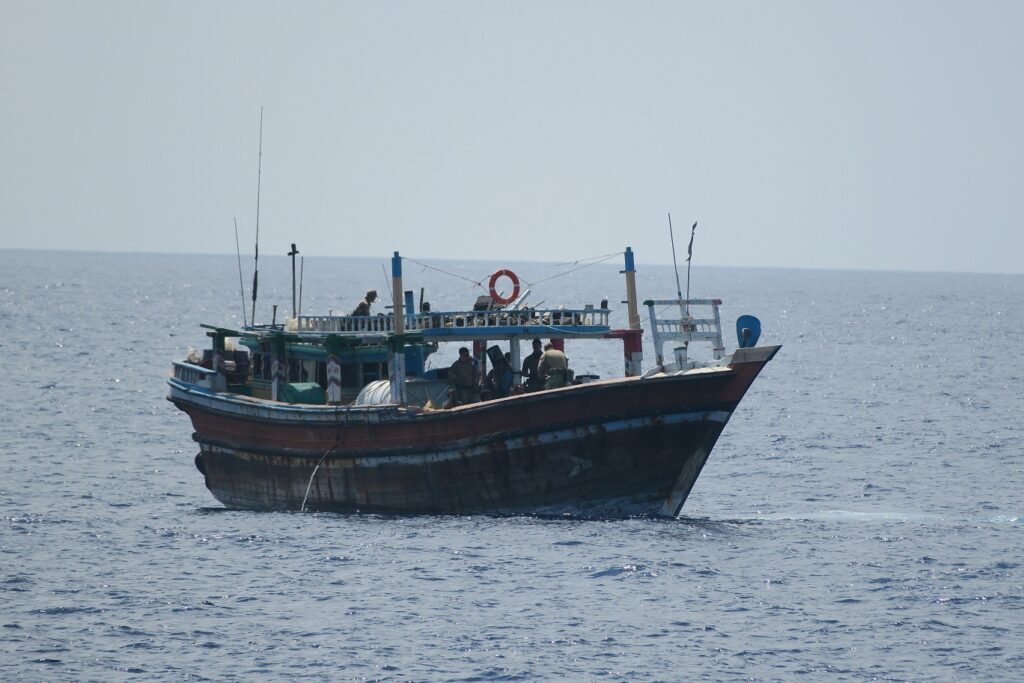
Service members from the Royal Navy’s Duke-class Type 23 frigate HMS Lancaster (F229) search a suspected drug smugglers vessel during Focused Operation Crimson Barracuda in the Arabian Sea, April 11.

By Combined Maritime Forces Public Affairs

MANAMA, Bahrain — The Royal Navy’s HMS Lancaster (F229), operating in support of the Canadian-led Combined Task Force (CTF) 150, carried out its second successful drug seizure in as many days, seizing 2,000 kg of hashish from a dhow in the Arabian Sea, April 11.

Lancaster, a Duke-class Type 23 frigate, seized the illicit drugs as part of Focused Operation Crimson Barracuda in an effort to counter illegal drug smuggling, who’s profits often goes to funding terrorist activity. In the two days they have participated in Crimson Barracuda, the crew has interdicted a total of 3,300 kg of illicit narcotics.

On April 10, Lancaster seized 800 kg of hashish, 390 kg of methamphetamines and 110 kg of heroin from another dhow in the Arabian Sea.

“For the second day in a row, CTF 150 and the crew of HMS Lancaster prevented harmful and illicit drugs from reaching their final destination,” said Royal Canadian Navy Capt. Colin Matthews, Commander, Combined Task Force 150. “Once again, we have prevented criminal and terrorist organizations from profiting off the sale of these drugs to fund their activities. I am incredibly proud of this team for all that they have accomplished in such a short window.”

Crimson Barracuda counters terrorist and criminal organizations’ use of the high seas to smuggle narcotics, weapons, and other illicit substances in the Indian Ocean, Arabian Sea and Gulf of Oman.

CTF 150 is one of five task forces under Combined Maritime Forces, the world’s largest international naval partnership. CTF 150’s mission is to deter and disrupt the ability of non-state actors to move weapons, drugs and other illicit substances in the Indian Ocean, the Arabian Sea and the Gulf of Oman.

Combined Maritime Forces is a 42-nation naval partnership upholding the international rules-based order by promoting security and stability across 3.2 million square miles of water encompassing some of the world’s most important shipping lanes.


SENEDIA’s New England Submarine Shipbuilding Partnership Surpasses 5,000 Workers Trained

MIDDLETOWN, R.I. – SENEDIA—The Alliance for Defense Tech, Talent, and Innovation—announced today that their New England Submarine Shipbuilding Partnership continues to expand and has now facilitated the training of more than 5,000 people across the region for high-paying careers in submarine shipbuilding.

The news comes as SENEDIA and industry leaders recognize National Submarine Day, which marks the anniversary of the Navy’s first commissioned submarine.

In just over three years, SENEDIA has provided technical support and facilitated the investment of $40+ million in 25 programs across six training institutions—including community colleges in Rhode Island, Connecticut, and New Hampshire—with 96 percent of participating students completing the training.

“Defense has a $119 billion annual economic impact in New England and the region serves as the epicenter of the submarine shipbuilding supply chain. To maintain that strength, further grow the industry, and support our national defense, we need to foster a robust workforce pipeline with hands-on experience and skills aligned to the needs of employers,” said Molly Donohue Magee, SENEDIA Chief Executive Officer. “Our training network sets participants up for successful careers in Defense and connects employers with emerging talent that is highly skilled and motivated to grow their careers in the industry.”

The New England Submarine Shipbuilding Partnership Regional Training Network has 25 active programs and is on track to train 2,800 people annually. This training capacity represents significant growth from the partnership’s launch in mid-2020. It took 14 months to reach the first 1,000 trained, 10 months to reach the second, and now only takes an average of five months to reach each additional 1,000. As of January 2024, SENEDIA has facilitated the training of 5,000 people in support of submarine shipbuilding trade and industrial jobs.

“Submarine construction is critical to national security and supports thousands of good-paying jobs here in Rhode Island. SENEDIA is leading efforts when it comes to the recruiting, training, and placement of hard-working folks here in Rhode Island and across New England, who are ready and eager to take on a career in the industry,” said U.S. Senator Jack Reed (RI), Chairman of the Senate Armed Services Committee. “There are a wide spectrum of jobs and roles in the submarine manufacturing workforce. These are family-sustaining jobs and I encourage anyone looking for a career in this industry to check out what SENEDIA is offering and explore the opportunities available through the partnership.”

“The nation and its defense industrial base continues to benefit from the joint investments in SENEDIA made through the Department of Defense (DoD)’s IBAS program and U.S. Navy,” said Adele Ratcliff, Director of DoD’s Innovation Capability and Modernization office. “The submarine industrial base (SIB), in particular is at a crucial juncture, and helping our small and medium SIB suppliers to meet their workforce attraction, hiring, training, and retention needs is keenly felt throughout the Pentagon. Mitigating risks to our critical path through execution of supply chain workforce investments is just one way that SENEDIA is helping to reconstitute our industrial skills workforce of today and tomorrow.”

The partnership, which is funded under ICAM’s Industrial Base Analysis and Sustainment (IBAS) program, has received $67.7 million since August of 2020 in support of the trades and industrial skills workforce development of the New England submarine industrial base.

In addition to the investment in support of training, SENEDIA has provided $2 million in training infrastructure, such as welding machines, virtual painters, equipment installation, and facility upgrades to accommodate new technology and equipment.

“SENEDIA and its New England Submarine Shipbuilding Partnership is a critical ally in our drive to build the modern skilled workforce that the Navy needs to deliver the world’s most capable submarines. SENEDIA empowers its institutional partners to sustainably accelerate and expand programming in a way that opens doors for the next generation workforce,” said Rear Admiral Scott Pappano, Program Executive Officer, Strategic Submarines for the United States Navy.  The Navy’s Submarine Industrial Base (SIB) program provides technical oversight for SENEDIA’s effort, as well as support helping to connect the next generation of submarine shipbuilders with the servicemembers who will operate these vessels.

“Workforce development and training is critical to ensuring businesses and organizations can thrive, which is why I’m proud to continue supporting the work of SENEDIA and organizations like Granite State Manufacturing, a submarine industrial base supplier with facilities in Manchester and Nashua, as they continue to expand and grow,” said U.S. Senator Jeanne Shaheen, a senior member of the U.S. Senate Armed Services Committee. “I’m grateful for the work that the partnership is doing to support the defense industry in New Hampshire through workforce development and will continue doing what I can in Congress to provide critical funding and resources for these programs.”

The training programs supported through the partnership are closely aligned to the needs of employers, including the skills necessary to work for General Dynamics Electric Boat, the nation’s prime submarine builder.

“With the partnership’s help to significantly grow our workforce since 2020, Electric Boat’s ability to add to our team of shipbuilders is stronger than ever, yet demand remains high and we must continue to grow our ranks in the coming years,” said Kevin Graney, president of General Dynamics Electric Boat. “SENEDIA’s support is ensuring that the workers coming out of the training programs are prepared to start on day one and deliver mission-critical work.” 

SENEDIA’s New England Submarine Shipbuilding Partnership Regional Training Network is successful due to its many strong training partners, including the New England Institute of Technology, Rhode Island Office of Postsecondary Commissioner – Westerly Education Cetner, Three Rivers Community College, Thielsch Engineering, Nashua Community College, and Porter and Chester Institute.

“What’s impressed me is SENEDIA’s collaboration with key programs in my district such as EWIB’s award-winning Manufacturing Pipeline Initiative (MPI) and Youth MPI. Given the significant growth in demand for trades training, SENEDIA’s resources have been an instrumental part of meeting the FY23 and FY24 needs of our employers, schools, and primarily, the trainees.  In fact, at EB alone we’re on pace for delivering over 220 cohorts over the last two and a half years and surpassed 3,200 job placements at EB-Groton alone last month. SENEDIA played a significant role in helping us make that all possible,” said Congressman Joe Courtney, Ranking Member of the House Seapower and Projection Forces Subcommittee.
Kongsberg Maritime to Supply Propulsion Systems for Coast Guard’s OPC

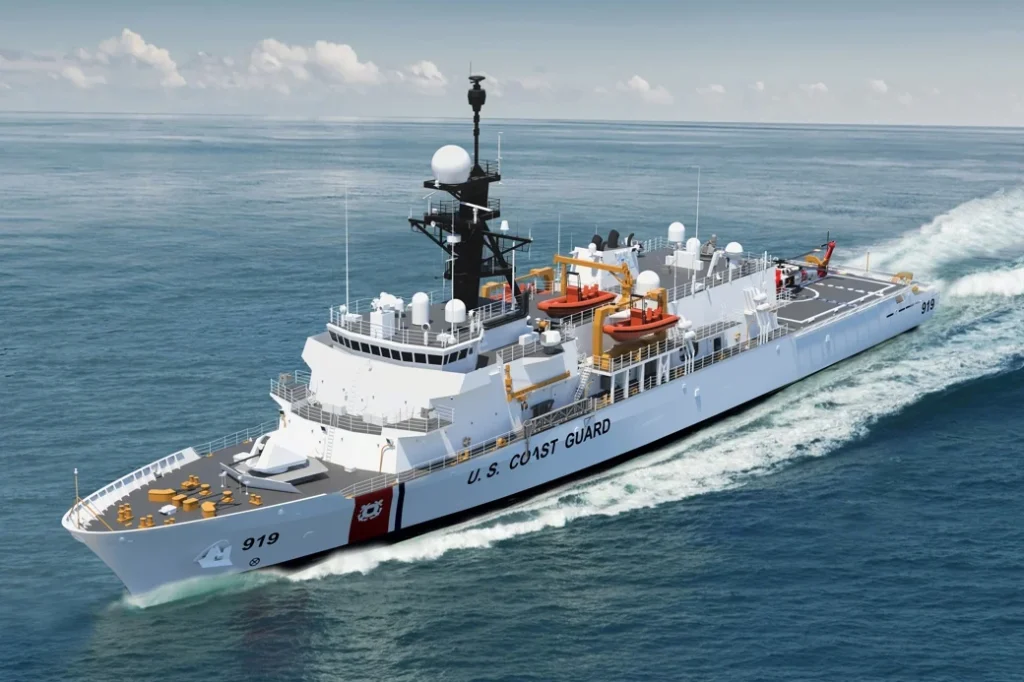
A rendering of the Offshore Patrol Cutter. Kongsberg Maritime

Kongsberg Maritime has been selected by Austal USA to supply its Promas propulsion system to the latest ship in the United States Coast Guard’s new Offshore Patrol Cutter (OPC) Heritage Class program.

This initial contract is to supply Kongsberg Maritime equipment for the fifth ship, Coast Guard Cutter Pickering, which is the first to be built by Austal USA at their yard in Mobile, Alabama.

The Coast Guard’s new OPC program represents a significant investment in maritime capability and is expected to run up to 25 ships. The new vessels will replace the Coast Guard’s medium endurance cutters and meet the need for long-term offshore capability to maintain current and future mission effectiveness.

Promas combines rudder and controllable pitch propeller into one propulsion system which optimizes the hydrodynamic properties of the ship and delivers increased efficiency and thrust while using less energy. For the OPC, as well as twin Promas, Kongsberg Maritime is contracted to supply steering gear, rudders, fin stabilizers and tunnel thrusters.

Björn ten Eicken, Kongsberg Maritime, Vice President – Naval, said: “Kongsberg Maritime has a proud history of supplying mission critical technology to United States Coast Guard programs.

“We have supplied our propulsion systems for naval and governmental forces for more than 80 years, and we’re delighted to have developed an efficient and effective system specifically suited to the challenging and varied operations of these new ships. Our Promas systems typically deliver efficiency savings of around 6%, so vessels are able to extend their range, something which can be crucial on longer missions.

“We’re looking forward to working with the Coast Guard and Austal USA on delivering these highly capable ships.”

The OPC vessels will be able to provide long range patrol capability. At 360 feet long, they will have a displacement of 3,700 long tons, maximum speed of 22.2 knots, and a range of 9,050 nautical miles at 14 knots. 


HII Delivers Amphibious Transport Dock Richard M. McCool Jr. to U.S. Navy

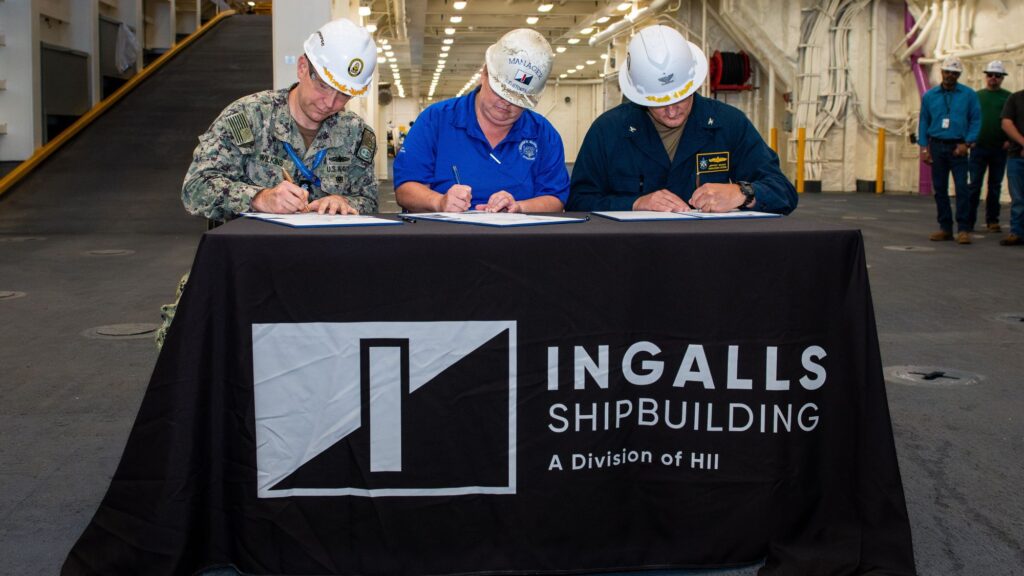
HII’s Ingalls Shipbuilding division delivered amphibious transport dock Richard M. McCool Jr. (LPD 29) to the U.S. Navy on April 11. Pictured from left to right are SUPSHIP Gulf Coast’s LPD Program Manager Representative Cmdr. James R. Wilkins IV, Ingalls Shipbuilding’s LPD Program Manager Davianne Stokes, and Prospective Commanding Officer for Richard M. McCool Jr. (LPD 29) Capt. Jeffrey D. Baker. HII

PASCAGOULA, Mississippi — HII’s Ingalls Shipbuilding division announced the delivery of amphibious transport dock Richard M. McCool Jr. (LPD 29) to the U.S. Navy.

Richard M. McCool Jr. is the 13th San Antonio-class ship delivered by Ingalls and is the final Flight I transition ship before Ingalls moves into production of the LPD Flight II line.

“The LPD 29 delivery demonstrates how our shipbuilders are enabling our combined Navy and Marine Corps team,” said Kari Wilkinson, president of Ingalls Shipbuilding. “It is the most recent example of what U.S. industry and government partnerships can accomplish by putting another player on the field. We will now bring the full weight of this collaborative team to bear on steady-state Flight II execution going forward.”

Ingalls has two Flight II LPDs under construction including Harrisburg (LPD 30) and Pittsburgh (LPD 31). In March 2023, Ingalls was awarded a modification to the contract for the procurement of the detail design and construction of Philadelphia (LPD 32), the 16th ship in the San Antonio class and the third LPD Flight II.

The San Antonio class is foundational to the U.S. Marine Corp’s Force Design construct and can support a variety of crisis response, special operations and expeditionary warfare missions. LPDs can operate independently or as part of amphibious readiness groups, expeditionary strike groups, or joint task forces. These capabilities allow the U.S. Navy to protect America’s security abroad and promote regional stability and preserve future peace.