Navy Establishes Cyber Warfare Enlisted Rating 

*****

ARLINGTON, Va. — The U.S. Navy’s effort to expand its cyber warfare capabilities took another step with the establishment of the Cyber Warfare Technician (CWT) rating in its enlisted force. 

The CTWs will conduct both offensive and defensive cyber warfare. 

The action came only two days after the Navy established Maritime Cyber Warfare Officer designator for information warfare officers who focus on cyber warfare. 

As announced in a June 29 directive from the chief of naval operations, all Sailors in the existing Cryptologic Technician-Networks (CTN) rating will convert to the CTW rating. In addition, the CTWs will no longer be formally associated with the family of cryptologic ratings. 

The Navy currently had 2,288 Sailors rated as CTNs as of last week, most of whom were already working in cyber warfare, said Naval Information Forces Force Master Chief Laura Nunley, speaking to reporters in a press conference last week. More than 93% of the CTNs already were working in cyber warfare. 

“We are looking at further opportunities to expand that to some of the supporting roles and possibly cross-rate into there, and then we’re also looking into recruiting aspects of bringing in more enlisted to the new cyber warfare technician [rating].” Nunley said. 

“All CTNs will be required to change their rating badge to the new CWT rating badge within twelve months of release of this message,” the directive said.  

The new rating badge was designed by CTN2 Kelly Bullard. 

Vice Admiral Kelly Aeschbach, commander, Naval Information Forces, told reporters in the press conference that most of the current Navy cyber forces are on in shore duty in the Navy’s cyber mission force predominantly at Fort Meade, Maryland; Hawaii; Pensacola, Florida; Fort Gordon, Georgia; and San Antonio, Texas.  

“Those are aligned with our big National Security Agency presence and the Navy Information Operations Command integrated in each of those locations,” Aeschbach said, noting that most of the cyber warriors are organized in teams ashore. 

The admiral said that she expects “over the next couple of years as we mature both the [Maritime Cyber Warfare Officer] and the [CWT] ratings and we deliver some new capabilities afloat, that we will likely see some new opportunities” for cyber warriors to serve afloat. 

Aeschbach said that the Navy is trying to frontload training of CWTs so that they are “fully trained before they arrive at command, which was something that was not happening two years ago. We’ve made a lot of progress in that area, and we’re also providing much more substantial mentoring,” she said.   

“When you talk about the substantial mentoring, and when you talk about the growth of the cyber mission force, and that’s slowing down the growth of the teams, we did take some of the near-term operational growth to actually create dedicated training and mentoring teams, which is modeled on how we train in aviation and in the surface community where we always have a small component of the force focused on what we call force generation or training and keeping units and teams standard up to a certain level one our folks are inside a certain unit,” the admiral said. “And we already are seeing some impact from that. We will put the operational growth back. It will still happen; it’s just going to happen at a little bit slower pace as we get to the total number of teams over the two to four years.” 


HII’s Ingalls Shipyard Has Capacity for More Navy Shipbuilding

An aerial image of HII’s Ingalls Shipbuilding.

*****

ARLINGTON, Va. — HII’s Ingalls Shipyard is always looking for opportunities for more shipbuilding work and its yard has the capacity to take on more work, a senior company official said, including future awards of new classes of frigates and medium landing ships.

“We’re looking at all of our opportunities, said George Nungesser, Ingalls’ vice president for Program Management, speaking June 27 to reporters during the Modern Day Marine expo in Washington, noting that Ingalls is interested in being a second construction shipyard for the Constellation-class guided-missile frigates currently being built by Fincantieri’s Marinette Marine shipyard in Wisconsin. “We know surface combatants!”

The Ingalls shipyard builds Arleigh Burke-class guided-missile destroyers (DDGs), San Antonio-class amphibious platform dock ships, and America-class amphibious assault ships for the U.S. Navy and Legend-class national security cutters (NSCs) for the Coast Guard.

The company delivered the first Flight III Arleigh Burke-class DDG, the future USS Jack H. Lucas (DDG 125), June 27, and the 10th NSC, the future USCGC Calhoun (WMSL 759) began its first sea trials the same day.

Asked if Ingalls was interested in bidding on the Navy’s future medium landing ship (LSM) program, Nungesser said, “We’re always interested in future ship classes, future endeavors. With a legacy of over 85 years, we’re pretty agile. We will continue to monitor the program development of that particular program and look forward to working with the Navy to see where this goes, when it something comes out as an RfP [Request for Proposals].”

Nungesser said the Ingalls shipyard currently has excess capacity, noting that the company has invested more than $1 billion in Shipyard of the Future initiatives that were completed last year. He noted that hiring and retaining the work force is a more challenging aspect industry-wide, and that Ingalls has funded a number of initiatives with local educational institutions to attract young people toward the shipbuilding trades.

“We do not meet the needs of our customers without our work force, and we are pleas with the trends that we are seeing in terms of hiring, retention, and developing talent,” he said.

“What we need — including our defense industry base — is a strong, consistent demand signal from the government to keep this shipbuilding industry healthy and responsive,” he said. “A strong demand signal enables companies to plan for the future, to hire, to train, and retain a skilled work force, and also promote investment in new equipment, facilities, and technologies.


Textron Puts Its Cottonmouth ARV to the Test for the Marine Corps

***** 

ARLINGTON, Va. — Textron has been demonstrating the capabilities of its Cottonmouth candidate for the U.S. Marine Corps’ Advanced Reconnaissance Vehicle (ARV) competition and has been granted funding to continue testing through calendar year 2023.

The ARV is to be an amphibious, wheeled armored vehicle to replace the Corps’ current Light Armored Vehicle in its reconnaissance battalions. It is to be equipped as a node in the command-and-control network during expeditionary operations and is to be able to serve as a battlefield quarterback, deploying sophisticated full-spectrum sensors and unmanned systems — including unmanned aerial vehicles and unmanned surface vessels—and manned/unmanned teaming.

Textron built and demonstrated an earlier concept demonstrator vehicle, called Alpha, mainly to demonstrate its automotive performance in terrain. The company followed with a company-owned Cottonmouth prototype, in which integration of government-furnished systems was accomplished. The prototype Cottonmouth was mission delivered to the Nevada Automotive Test Center for testing by the Marine Corps in December 2022.

During 2020-2021, Textron built the Alpha prototype with company funding.

“We ran the same test profile that we believed the Marines were going to run on what became our prototype deliverable for their testing under the contract agreement,” said David Phillips, Textron’s senior vice president, Land and Sea Systems, in a June21 interview with Seapower. “We had de-risked it from the standpoint of automotive, rugged, reliable, ran it through all of the cross-country, smoke testing, various different soil types, so that we could submit our proposal to the Marine Corps with actual data, not just paper.”

In September 2021, Textron began fabrication of the deliverable prototype at its Slidell, Louisiana, facility, and began systems integration work at its Hunt Valley, Maryland facility, where “we were able to test out components before actually installing them in the vehicle. The biggest difference between the Alpha prototype — which was mainly automotive — and what delivered and are testing now is the integration of all the capability: all the government furnished radios, communications equipment, computers, cyber, all of the things that make the vehicle a system,” Phillips said.

In September 2022, Textron delivered a “replica systems integration lab” to the Naval Information Warfare Systems – Atlantic in Charleston, South Carolina.

The prototype Cottonmouth was mission delivered to the Nevada Automotive Test Center for testing by the Marine Corps in December 2022.

“The vehicles have performed very well with the Marines,” Phillips said, of the automotive and durability testing it went through. “It accumulated a thousand miles across the variety of relevant Marine Corps mission profiles.”

Phillips said that the prototype’s electronic systems currently are being tested by the Marine Corps Tactical Systems Support Activity, including “sensing and disseminating data across the battlefield, and beyond the battlefield to the fleet and higher headquarters.”

The ARV prototype was able to operate and communicate with a Group 2 unmanned aerial system at a distance of 50 kilometers, he said, noting that the prototype has accrued 500 hours of testing of the electronic systems.

The vehicle’s swim characteristics “in the plunging surf” were successfully tested at Camp Pendleton, California. In the water the ARV is propelled by waterjets geared to the vehicle’s Cummings diesel engine, said Zach Bupp, Textron’s program director, Land Systems.

The Textron ARV is a “clean-sheet design,” Phillips said, saying that it was the best way for the Marine Corps to have its Tier 1 and 2 requirements met, as well as the “vast majority of their lower-tier requirements.”

He characterized the Textron design as revolutionary rather than evolutionary.

Phillips said that size and weight are critical requirements because of transportability, noting that four Textron ARVs — at 37,00 pound each — could be carried on of the Navy’s LCAC 100-class ship-to-shore connectors.

The Textron ARV rides on six wheels rather than eight, which Philips said reduced the weight and complexity of the vehicle and prosed no problems with operations in the terrain in which it was tested.

He also said his company is doing trade studies of subsystems that could be installed on the Cottonmouth to create a family of systems that could be deployed in an ARV-centric reconnaissance battalion.

Philips said the government’s Milestone B decision for selection and to authorize low-rate initial production is expected during the first or second quarter of calendar year 2025.


Naval Air Warfare Rapid Capabilities Office Approved in HASC Chairman’s NDAA Mark

***** 

ARLINGTON, Va.— A rapid capabilities office for U.S. naval aviation is included in the chairman’s mark for the 2024 National Defense Authorization Act in order to speed up development and delivery of critical technologies and systems to naval aviation forces by using “alternative or rapid acquisition pathways for procurement.” 

The Naval Air Warfare Rapid Capabilities Office, to be co-located with the Naval Air Systems Command headquarters at Naval Air Station Patuxent River, Maryland, would have the following missions, according to the draft legislation: 

‘‘(1) to contribute to the development and testing of low-cost, rapid reaction targeting and weapon systems, electronic warfare and other non-kinetic capabilities, and integrated targeting solutions to fulfill naval and joint military operational requirements;  

(2) to contribute to the rapid development, testing, and fielding of new unclassified and classified naval air warfare capabilities. 

The office would be led by a designee of the secretary of the Navy and would report to the chief of naval operations. The office would be overseen by a board of directors to include the secretary of the Navy, the chief of naval operations, the commander, Naval Air Systems Command, and the commander, Naval Air Forces. 

‘‘The Secretary of the Navy shall ensure that the head of the Office may use available alternative or rapid acquisition pathways for procurement,” the draft said. “The Joint Capabilities Integration and Development System process shall not apply to acquisitions by the Office.” 


Coast Guard Concludes 21 Years of Maritime Security Detachments to Gitmo 

GUANTANAMO BAY, Cuba (Feb. 4)–Patrolling the waters of Guantanamo Bay are members of Port Security Unit 305 from Fort Eustis, Va. PSU 305 deployed to the Cuba in late January in support of the global war on terrorism. USCG photo by PA3 Krystyna Johnson

***** 

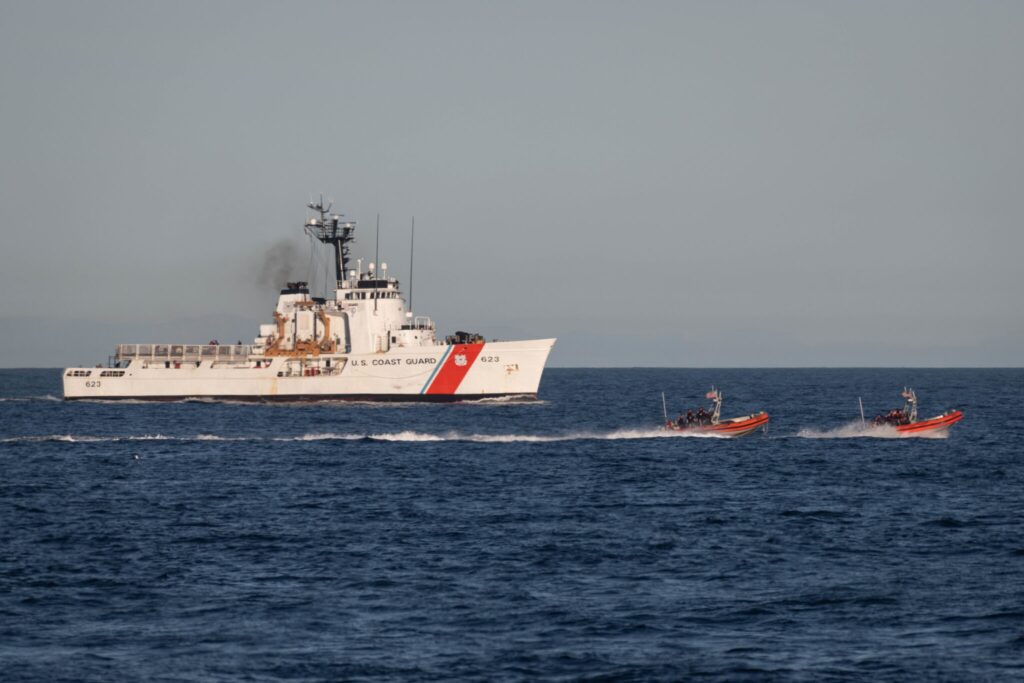
ARLINGTON, Va. — The Coast Guard has closed its maritime security detachment in Guantanamo Bay (Gitmo), Cuba, concluding a 21-year presence of port security units that provided security to the naval base, the longest continuous deployment of the Coast Guard Reserve in its history. 

As noted in a June 13 message from the Coast Guard commandant, the Maritime Security Detachment cased its colors that date.    

Port Security Unit (PSU) 305, which provided the last detachment, also was the first to staff the Maritime Security Detachment in 2002, when prisoners seized by U.S. forces during Operation Enduring Freedom in Afghanistan and elsewhere were imprisoned at Gitmo.  

“Since 2002, the Coast Guard has safeguarded critical assets and infrastructure for Joint Task Force Guantanamo in support of Operation ENDURING FREEDOM,” the message said. “Through countless hours of rigorous training, relentless vigilance, and steadfast resilience, Coast Guard Port Security Units and Maritime Safety and Security Teams have upheld the highest standards of professionalism while executing this vital mission.” 
 

PSU 305 returned to Virgina on June 14 after its nine-month deployment, which was the unit’s fifth such deployment over the 21 years. 

With the closure of the detachment. Responsibility for maritime anti-terrorism/force  
protection of Gitmo was transferred to Naval Station Guantanamo Bay, the message said. 


CNO: ‘We Need to be in the Way’ 

TAIWAN STRAIT (June 3, 2023) The Arleigh Burke-class guided-missile developer destroyer USS Chung-Hoon (DDG 93) observes PLA(N) LUYANG III DDG 132 (PRC LY 132) execute maneuvers in an unsafe manner while conducting a routine south to north Taiwan Straight transit alongside the Halifax-class frigate HMCS Montral (FFG 336), June 3. USS Chung-Hoon is on a routine deployment to U.S. 7th Fleet and is assigned to Commander, Task Force (CTF 71)/Destroyer Squadron (DESRON) 15. CTF 71/DESRON 15 is the largest forward-deployed DESRON and the U.S. 7th Fleet’s principal surface force. (U.S. Navy photo by Mass Communication Specialist 1st Class Andre T. Richard)

*****

ARLINGTON. Va. — The U.S. Navy needs a non-provocative but purposeful presence in the seas around China to deter challenges to international rules and the security interests of the United States, the chief of naval operations said. 

CNO Admiral Michael Gilday, speaking June 7 to an audience at the Brookings Institution, a Washington think tank, remarked on the recent incidents in the South China Sea and Taiwan Strait, particularly the unsafe maneuvers of the PLAN(N) destroyer Luyang III last week in the vicinity of the U.S. Navy destroyer USS Chung-Hoon and Canadian frigate HMCS Montreal. 

“We’re handling that, I think, very well, very professionally,” Gilday said. 

“I am encouraged by the most recent turn in dialogue by senior leaders with the toning down of, I would say, militaristic tone,” the CNO said. “I think that’s been helpful. We need to continue to operate out there, and we need to continue to operate forward. We need to assure allies and partners. At the same time, we need to deter anybody, any nation that tends to challenge those international rules, challenge the security interests of not only the United States but our allies and partners and put our economic interests in jeopardy.  

“So, I think we need to be out there, and we need to be in the way,” the admiral said. We can’t just be milling about. It has to be purposeful, and it has to be non-provocative. Let me just underscore that.” 

Gilday said he was concerned about the “lack of transparency” of the Chinese military and “their intentions with respect on how they intend to use their navy to reach President Xi’s goals are concerning with respect on military expansion.”   

Gilday also noted the positive contribution of the Chinese PLAN Navy in anti-piracy operations in recent years off the coast of East Africa.  

“They have been good partners with combating piracy, thwarting it, and keeping those sea lanes open for all,” he said. “That should be a model for the behavior that we should expect from the PRC. I would encourage more of those types of collaborative operations at sea that benefit all of us.”  

Gilday noted that “mil-to-mil [military-to-military] relationships are intended to be a shock absorber. No matter the political climate, those mil-to-mil relationships have to be steady, predictable, and they have to be very measured.” 

Also speaking in the seminar was Peter Levesque, president of CMA CGN shipping company and of American President Lines, who remarked on the tensions in the South China Sea. 

“The major challenge for us is, obviously, what happens in the South China Sea,” Levesque said. “Five trillion dollars of goods flow through the South China Sea every year. It’s a major shipping lane, obviously, for CMA and for the other carriers. We’re worried about what everybody’s worried about, that two planes go bump in the night, or two ships go bump in the night accidentally and spiral into something bigger, and all of a sudden, we can’t use those trade lanes or insurance companies won’t insure our ships to go through those trade lanes.  

“It’s a real concern, and I don’t think we fully comprehend how big of an impact that would be not only to the global supply chain but the U.S. supply chain in particular if tensions get to the point where that’s an unusable space,” he said. 


TRANSCOM to Double Sealift Tanker Force 

*****

ARLINGTON, Va. — The U.S. Transportation Command (TRANSCOM) plan to double the number of fuel tankers in its Tanker Security Program to improve the capacity to deliver fuel to forward operating forces, particularly in the Pacific, the TRANSCOM’s commander said. 

“We are concerned about not having enough U.S-flagged vessels to meet our requirements, so we are absolutely getting after that with the support of Congress,” said Air Force General Jacqueline Van Ovost, commander, U.S. Transportation Command, speaking June 6 to an audience of the Brookings Institution, a Washington think tank. “We have stood up the Tanker Security Program. We now have 10 U.S.-flagged tankers — manned with U.S. merchant mariners — medium-range tankers that we will be able to use to assuredly be able to have access to in times of conflict. And we’re working on the next 10 as well to assuredly move fuel to inside the first and second island chain, more shallow-draft vessels that we didn’t have before.” 

TRANSCOM has taken on from the Defense Logistics Agency (DLA)the role of transporting and delivering fuel to U.S. forces abroad. 

“The new strategic environment exposes vulnerabilities to our supply chain management that we just didn’t have before,” Van Ovost said. “So, this new global fuel mission allows us to take the very best of DLA Energy and what they’re doing, which is the business end of managing supply chains and allows us to put our TRANSCOM expertise of command and control and planning and posture to ensure that we can deliver that fuel wherever and whenever we need it.  

“We also need to re-look where our fuel posture is to meet the requirements — what do have to have forward, where are the refineries, etc., how are going to move that fuel and how are we going to have the assets to do it,” she said.  


Marine Corps Generals to Integrate with Navy Numbered Fleet Staffs

CAMP COURTNEY, Okinawa (Feb.16, 2023) U.S. Navy Rear Adm. Derek Trinque, commander Task Force 76/3, left, Japan Maritime Self-Defense Force Rear Admiral Motoyuki Kanezashi, commander, Amphibious and Mine Warfare Force, left-center, Japan Ground Self-Defense Force Maj. Gen. Shingo Nashinoki, commander, Amphibious Rapid Deployment Brigade, right-center, and U.S. Marine Brig. Gen. Fridrik Fridriksson, deputy commander TF 76/3, right, pose for a photo during Iron Fist 23 aboard Camp Courtney, Okinawa, Japan, Feb. 16, 2023. This visit took place during Exercise Iron Fist and provided an overview of TF 76/3, focusing on the command-and-control structure and command position, and how it improves the commander’s ability to control forces and command from ashore without the need to embark. Iron Fist is a U.S. Marine Corps Forces Pacific-directed, 31st Marine Expeditionary Unit-executed, bilateral training exercise between the U.S. Marine Corps and the Japan Ground Self-Defense Force and aims to improve staff planning, enhance core competencies in amphibious operations and interoperability, and maintain a positive military-to-military relationship between Japan and the United States. (U.S. Marine Corps photo by Staff Sgt. Andrew Ochoa)

***** 

ARLINGTON, Va. — The U.S. Marine Corps is planning to establish integrated staffs with two U.S. Navy numbered fleets next year, according to the latest update to is Force Design 2030 concept. 

The Corps plans to integrate a brigadier general in the headquarters staffs of U.S. Sixth Fleet and the U.S. Seventh Fleet.   

“We need to formalize the process for establishing integrated Navy-Marine Corps staffs with numbered fleets while giving the MEF CGs [Marine Expeditionary Force commanding generals] the ability to adapt organizations to the specific needs of their partner numbered fleets,” said General David H. Berger in the latest Force Design 2030 document. “Whenever feasible, and in coordination with the efforts of the appropriate combatant commanders, these integrated staffs should also include key ally and partner representation to strengthen our integrated deterrence, offering a mature approach to campaigning. 

“NLT 1 September 2024, Commander, Marine Corps Forces Pacific (COMMARFORPAC) and Commander, Marine Corps Forces Europe and Africa (COMMARFOREUR/ AF) will formalize the establishment of O-7 staffs within Sixth and Seventh Fleet headquarters.” 

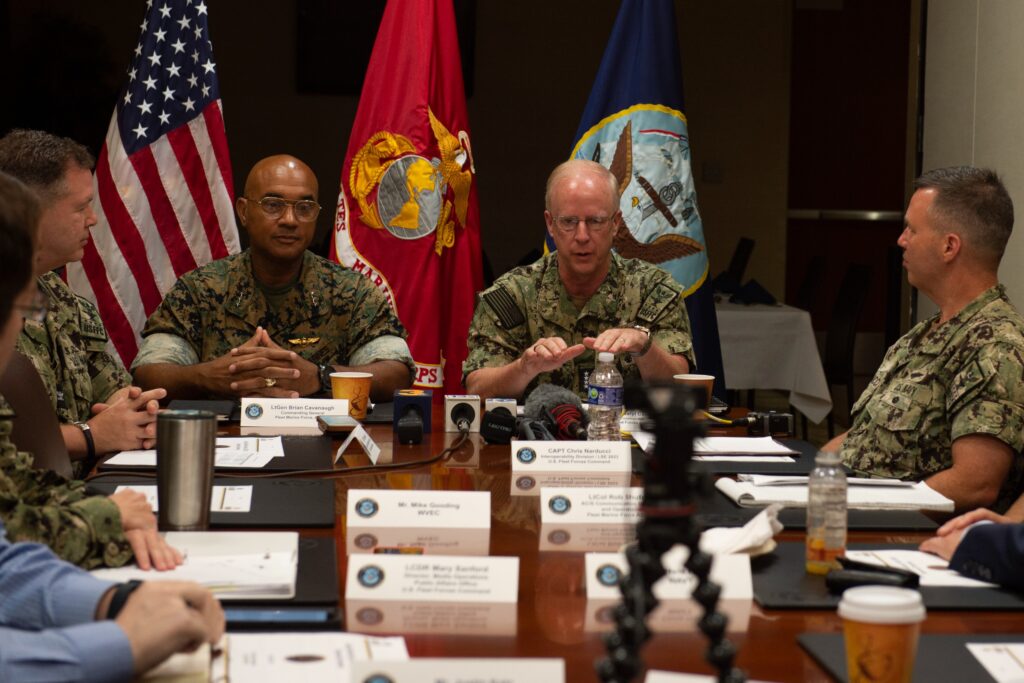
Lieutenant General Karsten S. Heckl, deputy commandant for Combat Development and Integration and commanding general, Marine Corps Combat Development Command, speaking June 2 to reporters in press conference, said the move would be in accordance with the commandant’s guidance to returning to a Fleet Marine Force. 

“A big piece of that is getting the staffs right,” Heckl said. “We realize now more than ever that in this operating environment — now that we’re back to great power competition, without question — it is important that these staffs be properly, fully integrated, or we’re going to have problems. 

“A mentor of mine told me 30 years ago that if you get the command and control of any problem figured out, you’ve got 90% of it solved, and that’s what we’re doing here” he said.   

Brigadier General Kyle Ellison, commanding general of the Marine Corps Warfighting Lab, also speaking at the press conference, stressed that such a staff would be integrated to the point that it could have a Navy rear admiral in command with a Marine Corps brigadier general as deputy, or vice versa. He mentioned Task Force 79 — III Marine Expeditionary Force — and Task Force 76 — the 7th Fleet’s amphibious force — as a “completely integrated staff with an integrated maritime operations center right there on Camp Courtney [Okinawa]. 

“It’s critically important to recognize that it’s not just the O-7,” Ellison said. “It’s integrating the staffs so you have a truly naval staff to execute naval operations in support force. That is exciting in that typically happens only when you are task-organized and for a specific mission. Now we’re standing it up and experimenting with it as a permanent structure, and that’s happening as we speak as an 18-month experimentation that was agreed upon by two three-stars — commander of III MEF and the 7th Fleet commander.” 


Navy F-5 Jet Crashes Near Key West

KEY WEST, Fla. (Nov. 6, 2020) An F-5N Tiger-II from the “Sun Downers” of Fighter Squadron Composite (VFC) 111 takes off from Naval Air Station Key West’s Boca Chica Field during the last day of training before the potential bad weather resulting from Tropical Storm Eta. Naval Air Station Key West is the state-of-the-art facility for combat fighter aircraft of all military services, provides world-class pierside support to U.S. and foreign naval vessels, and is the premier training center for surface and subsurface military operations. (U.S. Navy photo by Danette Baso Silvers)

Release from NAS Key West

************************** 

ARLINGTON, Va. — A U.S. Navy F-5N Tiger II jet crashed near Key West. Florida, on May 31, the Navy said. 

Naval Air Station (NAS) Key West said in a Facebook post that the aircraft’s pilot “ejected from an F-5N aircraft approximately 25 miles from Boca Chica Field at approximately 9:20 a.m. today. A NAS Key West Search and Rescue crew launched an MH-60S helicopter and rescued the pilot, who is being transported to a Miami-area hospital for further evaluation.” 

The pilot and F-5N were assigned to Fighter Squadron Composite (VFC) 111, which is a reserve adversary squadron based at NAS Key West. Adversary squadrons provide training in combating enemy aircraft to fleet units. The Navy and Marine Corps have four such squadrons on strength.  

The Navy is investigating the cause of the mishap. 


Smith Nominated as Next Commandant of the Marine Corps

*********** 

ARLINGTON, Va. — President Joe Biden has nominated Marine Corps General Eric M. Smith as the next commandant of the U.S. Marine Corps, Defense Secretary of Defense Lloyd J. Austin III said in a May 31 release.  

Smith currently is serving as the 36th assistant commandant of the Marine Corps. If confirmed by the Senate, Smith would be come the 38th commandant.  

Smith, a combat veteran of the wars in Iraq and Afghanistan, has served in senior positions that developed the doctrine of the Marine Corps and has been instrumental in implementing Commandant General David H. Berger’s Force Design 2030 concept, a plan to re-design the Corps to meet the challenges of great power competition and higher-end warfare.   

Below is an excerpt from Smith’s official biography posted on the Marine Corps’ website: 

“Born in Kansas City, Missouri, and raised in Plano, Texas, General Smith graduated from Texas A&M University and was commissioned in 1987. He has commanded at every level, including Weapons Company, 2nd Battalion, 2nd Marine Regiment during Operation Assured Response in Monrovia, Liberia; 1st Battalion, 5th Marine Regiment during Operation Iraqi Freedom; and 8th Marine Regiment/ Regimental Combat Team 8 during Operation Enduring Freedom. He also served in Caracas, Venezuela as part of the U.S. Military Group. 

As a General Officer, he commanded U.S. Marine Corps Forces Southern Command, 1st Marine Division, III Marine Expeditionary Force, and Marine Corps Combat Development Command. 

General Smith’s staff assignments as a General Officer include serving as the Director of Capability Development Directorate, Combat Development and Integration; Senior Military Assistant to both the Deputy Secretary of Defense and Secretary of Defense; and Deputy Commandant for Combat Development and Integration.”