Navy Scaling Back Planned Triton Deployable Sites from Five to Three

***** 

ARLINGTON, Va. — The U.S. Navy is planning to reduce the number of planned deployment sites for its MQ-4C Triton high-altitude, long-endurance unmanned aerial vehicles in accordance with its planned reduction in the number of Tritons being procured.   

“FY24 quantity is being reduced from four to two aircraft; a total program of record procurement is being reduced from 70 aircraft to 27,” said a Navy spokesperson in response to a query from Seapower. “This quantity reduction is based on the Joint Requirements Oversite Council re-evaluation of worldwide ISR&T [intelligence, surveillance, reconnaissance, and targeting] requirements that resulted in direction to reduce total MQ-4C deployable locations (orbits) from five to three.” 

The Navy had originally planned to establish orbits in Jacksonville, Florida; Whidbey Island, Washington; Sigonella, Sicily; Guam; and a base in the U.S. Central Command area of responsibility. The Navy did not specify which three sites were still planned for the Triton. 

At five orbits and four Tritons per orbit — able to keep an aircraft on station 24/7 — the 20 aircraft required was far lower than the planned for procurement of 70. The original planned procurement would have allowed the Navy to purchase them at economic quantities, keep some in storage, and to sustain Triton operations over many years as the early aircraft reached the end of their service lives. 

With three orbits, the total number of 12 Tritons required to sustain them would leave 15 available for attrition, training, and depot-level maintenance.    

“When determining the number of air vehicles for a program of record, attrition is a part of the equation when considering the lifespan of the program,” the spokesperson said. 

Unmanned Patrol Squadron (VUP) 19, home-based at Naval Air Station Jacksonville, Florida, deployed two MQ-4Cs to Andersen Air Force Base in Guam in 2020 to provide MISR&T for the U.S. 7th Fleet while developing the concept of operations and the tactics to refine the Triton’s operations. The detachment operated from Guam; Naval Air Facility Misawa, Japan; and Marine Corps Air Station Iwakuni, Japan, the Navy said in a March 16 release. The detachment returned from deployment in March.  

The two deployed Tritons were of the baseline Integrated Functional Capability (IFC) 3 configuration. The squadron has since received newer versions in the IFC 4 configuration, which are equipped with a more capable sensor suite that will allow them to replace the Navy’s fleet of EP-3E Orion electronic reconnaissance aircraft. The MQ-4C will supplement the Navy’s P-8A Poseidon maritime patrol aircraft.   

VUP-19 is bringing the Triton to Initial Operational Capability in 2023 with the establishment of an orbit in Guam in support of the 7th Fleet’s Task Force 72.  

Northrop Grumman delivered the fourth IFC 4 Triton to the squadron in May to complete the set of aircraft for the Guam orbit while the first aircraft for the second orbit is scheduled to deliver in June, according to Rho Cauley-Bruner, director, Triton program.


Navy Orders Ninth John Lewis-Class Fleet Replenishment Oiler 

***** 

ARLINGTON, Va. — The U.S. Navy has ordered construction of the ninth fleet replenishment oiler of the new John Lewis class for the Military Sealift Command. 

The Naval Sea Systems Command awarded to General Dynamics National Steel and Shipbuilding Co., San Diego, California, a $736 million contract modification for the detail design and construction of T-AO 213. Work is expected to be completed by March 2028, the Department of Defense said in a May 22 announcement. 

NASSCO delivered the lead ship of the class, USNS John Lewis (T-AO 205), in 2022, the first of six ordered under a 2016 contract. Two more were ordered under a 2022 contract modification, with an option for a third. That option was exercised with the contract award T-AO 213.  

Five ships of the class currently are under construction: Harvey Milk (T-AO 206), which will be delivered this year; Earl Warren (T-AO 207); Robert F. Kennedy (T-AO 208); Lucy Stone (T-AO 209); and Sojourner Truth (T-AO 210). Future ships include Thurgood Marshall (T-AO 211) and Ruth Bader Ginsburg (T-AO 212). The Navy plans to procure a total of 20 ships of the class.  

The John Lewis class is replacing the Henry J. Kaiser class of fleet replenishment oilers. The new ships can carry 57,000 barrels of oil as well as some dry cargo and frozen stores. They can operate at 20 knots.  


Marine Corps Receives First of Two C-40A Transport Aircraft

The Marine Corps’ first C-40A aircraft, assigned to Marine Transport Squadron (VMR) 1, Marine Air Group 41, 4th Marine Air Wing, Marine Forces Reserve, lands at Naval Air Station Joint Reserve Base Fort Worth Texas, May 19, 2023. VMR 1 will use these aircraft to support the Marine Corps and joint services with assault support in the form of air logistics, providing time-, place- or mission-sensitive, long-range, multipurpose air transport and critical logistical support of key personnel and cargo between and within combatant commands and theaters of war. (U.S. Marine Corps photo by Lance Cpl. Ashley Corbo)

***** 

ARLINGTON, Va. — The U.S. Marine Corps has taken delivery of its first Boeing C-40A Clipper transport aircraft, the first of two that will be operated by the Marine Forces Reserve. 

The C-40A arrived at Naval Air Station Joint Reserve Base Fort Worth Texas on May 19, the Marine Forces Reserve said in a release. It will be operated by Marine Transport Squadron One (VMR-1), a unit of Marine Aircraft Group 41, 4th Marine Air Wing. 

“VMR-1 will use these aircraft to support the Marine Corps and joint services with assault support in the form of air logistics, providing time-, place- or mission-sensitive, long-range, multipurpose air transport and critical logistical support of key personnel and cargo between and within combatant commands and theaters of war,” the release said.  

VMR-1 flew two C-9B Skytrain II aircraft from Joint Base Andrews-NAF Washington, Maryland, until 2017, when the squadron moved to NAS-JRB Fort Worth to provide crews to share C-40A Clipper transports with Navy Fleet Logistics Support Squadron 59. According to the 2022 Marine Corps Aviation Plan, VMR-1 will move to Marine Corps Air Station Kaneohe Bay, Hawaii, by fiscal 2024 to replace the two C-20G Gulfstream IV transports there that support the Indo-Pacific Command.  

The two Marine C-40As were not new-build aircraft but were converted from two used Boeing 737 airliners. The Navy Air Reserve operates 17 C-40As — the first of which was delivered in 2001 — in six fleet logistics support squadrons for Navy-unique fleet-essential airlift missions.  


Admiral: Ecosystems Around Shipyards Can Attract, Retain Workers

***** 

ARLINGTON, Va. — The services offered by communities adjacent to shipyards can help attract and retain skilled shipbuilding and repair workers, a Navy admiral in charge of shipbuilding said.  

“One of the things we’ve seen that is very successful is building ecosystems around the shipyards — Congress working with state and local governments to aid in the development of systems around shipyards that really provide opportunity, said Rear Admiral Thomas J. Anderson, Navy Program Executive Officer for Ships, testifying May 11 before the House Oversight and Accountability Subcommittee on National Security, the Border, and Foreign Affairs.  

“If there is no housing in the area of a shipyard, you’re going to have a hard time having blue-collar labor come in and be interested in a job there,” Anderson said. “Things like health care, day care, [and] housing are really important to have in the vicinity of the yards to attract the talent that we need to build the ships we need in the future.” 

Anderson said that “[o]ne of the real challenges we have in this country is availability of blue-collar labor. We saw that as a challenge as we were in COVID and when we came out of COVID and we continue to struggle to identify talent to come in, people who are interested in the blue-collar trades.  

“So, support of our budget requests that provide funding to develop the work force that comes in two ways: the submarine industrial base, which I mentioned earlier, has targeted funds to help advance the work force,” he said. “Additionally, last year in the NDAA [2023 National Defense Authorization Act], Section 122, provided a requirement for the Navy — when awarding shipbuilding contracts in the future — to fund a percentage of the overall cost of the ship to go toward workforce development items.”  

Anderson noted that supplier industrial base funds are being used “to get people interested in blue-collar labor, get them married up with companies that support that supply chain. The submarine industrial base is where we really need efforts.” 

The admiral said that “somewhere between 80,000 and 100,000 tradespeople [need] to be hired over the next 10 years” for the submarine shipbuilders. 

Anderson touched on a more inspirational aspect of attracting shipyard workers: “Growing the work force, making sure that young people understand that it is an honorable and important profession to build ships or to repair ships for the U.S. Navy, something that not just the Congress but at all levels of our country is something that we can stress and will pay dividends as we expand our capacity.” 


Navy Orders Four CMV-22B Osprey COD Aircraft, Bringing Total to 48

SASEBO, Japan (Feb. 23, 2022) A CMV-22B Osprey tiltrotor aircraft assigned to the “Titans” of Fleet Logistics Multi-Mission Squadron (VRM) 30, prepares to land at Commander, Fleet Activities Sasebo (CFAS) while conducting passenger and cargo transfer operations. For 75 years, CFAS has provided, maintained, and operated base facilities and services to empower forward-deployed U.S. and Allied Forces while providing superior support to their families and the community. (U.S. Navy photo by Mass Communication Specialist 1st Class Jeremy Graham)

************* 

ARLINGTON, Va. — The U.S. Navy has ordered four additional CMV-22B Osprey carrier-onboard delivery aircraft, according to a March 5 Defense Department contract announcement.   

The Bell Boeing Joint Project Office, Amarillo, Texas, was awarded a $482.3 million contract modification by the Naval Air Systems Command for the four CMV-22Bs, the announcement said. The order follows a Feb. 26 order for four CMV-22Bs.  

The order completes the Navy’s plan to procure 48 CMV-22Bs. The aircraft are scheduled to be delivered by June 26 under the June 2018 multiyear procurement contract.      

The Navy’s CMV-22B replaces the C-2A Greyhound for the Carrier On-Board Delivery (COD) mission. Its mission is to transport personnel, mail, supplies and cargo from shore bases to aircraft carriers at sea.  

The CMV-22B differs from the MV-22B by having a high-frequency radio, extra fuel capacity, improved fuel dump capability, improved lighting for cargo handling and a public address system. The aircraft can carry up to 6,000 pounds up to a range of 1,150 nautical miles. It is capable of internally carrying the F-135 engine power module for the F-35 Lightning II.     

The first CMV-22B squadron, VRM-30, is working up a detachment to deploy on board USS Carl Vinson (CVN 70). VRM-30 detachments have completed two deployments to the Western Pacific.    

Full operational capability of the CMV-22B is scheduled for 2024.


Marine Units Ordered to the Southern Border

***** 

Arlington, Va. — U.S. Marines from two units have been selected to augment the Department of Homeland Security in assisting with operations along the U.S. southwest border, according to the U.S. Northern Command. 

The Marines will “provide support with duties including data entry, warehousing, support, and additional detection and monitoring support efforts,” a May 6 Northern Command release said. “This military support increases the availability of Customs and Border Patrol (CBP) law enforcement personnel to conduct law enforcement-specific duties.  

The Marines will come from two regiments from the 2nd Marine Division at Camp Lejeune, North Carolina: 

  • 2nd Marine Regiment 
  • Combat Logistics Battalion 2 

The Army’s 93rd Military Police Battalion based at Fort Bliss, Texas, and some Air Force personnel from unidentified units also are being assigned the same duties. All assigned forces are to be in place by May 10. 

“Military personnel will not be permitted to support migrant processing and escort duties or other activities that involve direct participation in civilian law enforcement activities, be responsible for property seized from migrants, or require direct contact with migrants,” the release said.  


Navalist: Investment in Carrier Air Wings Needed to Keep Carriers Relevant

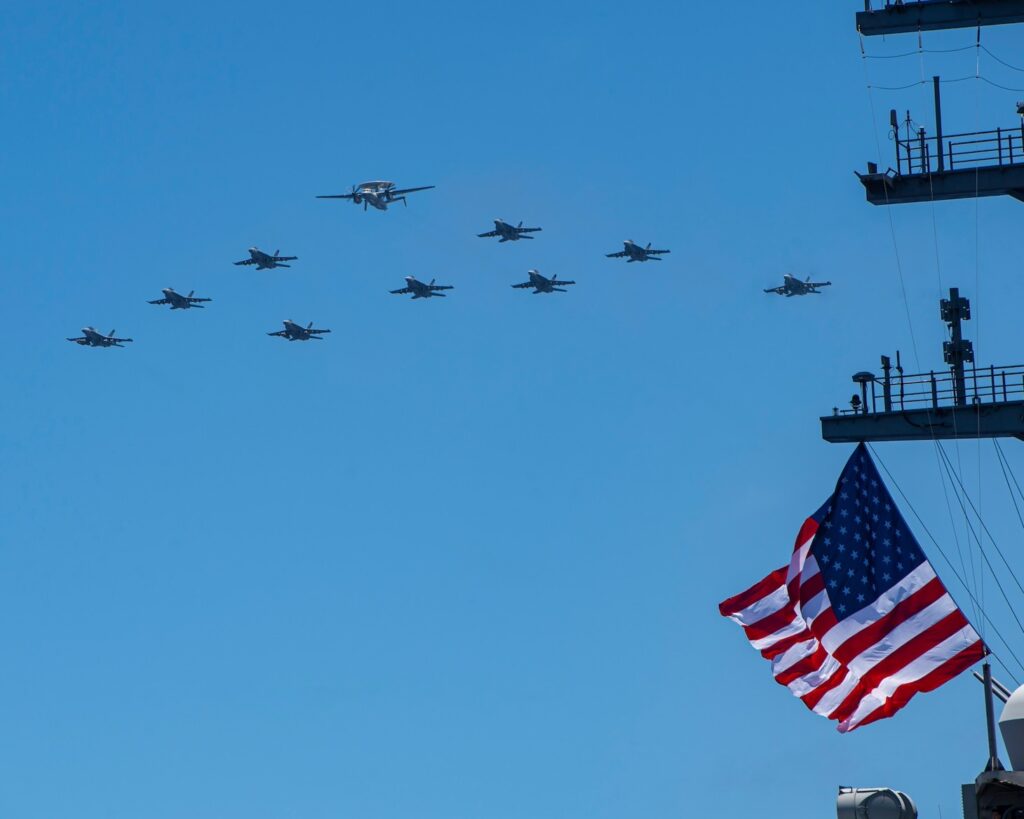
SOUTH CHINA SEA (April 22, 2023) F/A-18F Super Hornets from the “Mighty Shrikes” of Strike Fighter Squadron (VFA) 94 fly in formation above the aircraft carrier USS Nimitz (CVN 68) during an all-domain joint exercise, demonstrating unique theater-wide multi-discipline high-end warfighting capability, maritime superiority, power projection, speed of maneuver and readiness. VFA-94 is attached to the Nimitz Carrier Strike Group, currently underway in U.S. 7th Fleet area of operations conducting routine operations. 7th Fleet is the U.S. Navy’s largest forward-deployed numbered fleet, and routinely interacts and operates with allies and partners in preserving a free and open Indo-Pacific region. (U.S. Navy photo)

***** 

ARLINGTON, Va. — The U.S. Navy’s aircraft carrier force is losing relevance because of a lack of investment in the aircraft that it carries, a naval analyst said. 

“We are a carrier-based force, so we have the 11 aircraft carriers mandated by law,” said Dr. Jerry Hendrix, senior fellow of the Sagamore Institute, a retired Navy captain, and former director of the Navy History and Heritage Command, speaking May 1 at an event at the Hudson Institute, a Washington think tank. “We built our navy around the aircraft carrier ever since the Battle of Midway. It is the preeminent platform in our navy. And yet, because of the lack of investment in the carrier air wing itself, the carriers themselves are losing their relevance.” 

“We’re actually seeing this in wargame activities, whether it’s wargames in the commercial or civilian sector or academic sector or whether the things we’re hearing out of the Pentagon, where the carriers are having lesser and lesser roles to play in some of these wargames,” Hendrix said. “So, if you want the carrier to remain relevant as a centerpiece, you have to make significant investments in that carrier air wing to get to a long-range, penetrating strike capacity back that will allow those carriers to operate in anti-access/area-denial environments.” 

Hendrix also said the Navy needs to look hard at the force mix between the Atlantic and Pacific regions. He said he believes a greater submarine capacity is needed in the Pacific region than necessarily in the Atlantic, despite the fact that the primary Russian naval threat is its attack submarine force. 

He noted the Navy’s return to building frigates, with the Constellation-class guided-missile frigate now under construction.  

“We need to have the frigate be a frigate, providing presence, convoy escort,” he said. “Don’t ask every frigate to be a destroyer and don’t ask every destroyer to be a cruiser and a battleship — it’s what we’ve done in recent years. We need to look at that small-end, small-capacity, small surface combatants and drive more investment into whether it’s manned or unmanned, getting back out there to be able to operate in small, confined spaces but also build more platforms at a cheaper price.” 

Hendrix indicated that he sees the traditional carrier strike group as needing to be re-thought. 

“I would see us really departing from the tried and the true, the standard method of one carrier, two cruisers, four destroyers, and two attack submarines,” he said. “I want to see the fleet of the future look significantly different than the fleet of today. In fact, if it doesn’t, we’ve made a strategic mistake at that point.” 


Berger: Lack of Amphibs Left AFRICOM with No Sea-Based Option for Sudan Evacuation

MEDITERRANEAN SEA (April 30, 2022) The San Antonio-class amphibious transport dock ship USS Arlington (LPD 24), center, and the Military Sealift Command Henry J. Kaiser-class fleet replenishment oiler USNS Laramie (T-AO 203), background, sail through the Mediterranean Sea while conducting a replenishment-at-sea, April 30, 2022. Arlington, assigned to the Kearsarge Amphibious Ready Group, is on a scheduled deployment under the command and control of Task Force 61/2 operating in U.S. Sixth Fleet in support of U.S., Allied and partner interests in Europe and Africa. (U.S. Navy photo by Mass Communication Specialist 1st Class John Bellino)

***** 

WASHINGTON — The presence of an amphibious ready group (ARG), with a Marine expeditionary unit (MEU)embarked, gives a regional combatant commander an option to respond to a crisis ashore. When the United States government decided to evacuate its embassy in Sudan on April 23, last week, no ARG-MEU was available in the region. 

Similarly, if the United States government had decided that projecting a force ashore in Sudan was needed to protect or evacuate some 15,000 Americans in Sudan, it would have had few options.  

To Marine Corps Commandant General David. H. Berger, testifying April 2 before the House Armed Services Committee, the Sudan crisis is an example of the lack of a crisis response capability that the Navy and Marine Corps amphibious warfare forces, if nearby, could have provided to the combatant commander, in this case, Marine General Michael E. Langley, commander, U.S. Africa Command (AFRICOM).  

To Berger, the crisis illustrated yet again why the nation’s need for 31 [large and medium amphibious warfare ships] to provide the crisis response and deterrence capabilities needed by U.S. combatant commanders.  

Berger was referring to the statutory requirement in the 2023 National Defense Authorization Act for the Navy to sustain a fleet of a minimum of 31 amphibious warfare ships. Without such a force, there would be occasions when response would be lacking. 

“We would have gaps during the year when we would not have an at-sea capability for the combatant commander when something happens,” Berger said. “We would not be deterring; we would not be in a position to respond. In places like Türkiye or places like Sudan, I feel like I let down the combatant commander, because General Langley needs options. He didn’t have a sea-based option. That’s how we reinforce embassies. That’s how we evacuate them. That’s how we deter. 

“It opens up risks for the combatant commander,” Berger said. “We have to have 31 [large and medium amphibious warfare ships] at a minimum; nothing less.” 


Vietnam War Commemoration to Host ‘Epic Event’

Arlington, VA – The United States of America Vietnam War Commemoration is set to host its biggest event to date to honor Vietnam veterans, said Major General Ed Chrystal and Commander Brian Wierzbicki, acting director and chief of public engagement, respectively, in a media roundtable held on April 25. 

The “Welcome Home! A Nation Honors our Vietnam Veterans and their Families,” event will be held on the National Mall in Washington, D.C. May 11-13.  The Commemoration expects thousands to attend over the three-day event, featuring special guest speakers and concerts. The opening ceremony, concerts, and speaking events will also be streamed live for those who cannot attend in person. 

“This national once-in-a-lifetime event will honor Vietnam veterans and their enduring legacy of service inspiring Americans to thank them and their families for their service and sacrifice,” the Commemoration stated in a press release. 

In 2008, Congress authorized the establishment of the Vietnam War Commemoration, signed into law by President George W. Bush in January of that year. President Obama inaugurated Commemoration at the Vietnam Veterans Memorial in 2012. Since that time, the Commemoration has worked to build partnerships to reach as many of the approximately 7 million Vietnam veterans both in the U.S. and abroad. 

So far, the Commemoration has reached approximately 3.7 million Vietnam veterans, according to Wierzbicki. The Welcome Home event is designed to “serve as a catalyst” to reach others so that they may be recognized and thanked, he said. Both Wiezbicki and Chrystal talked about the importance of honoring our veterans, stating that, “how we treat those who fought our past wars will have a direct impact” on who will be willing to fight our wars in the future. 

You can read more about the United States of America Vietnam War Commemoration and the upcoming Welcome Home! event at the organization’s website


General Lists Marine Corps VTOL Development Priorities for Congress 

BALTIC SEA (May 18, 2022) U.S. Marine Corps Capt. Ryan Mortensen and Capt. Jeffrey Jaeckel, both AH-1Z pilots assigned to the Aviation Combat Element, 22nd Marine Expeditionary Unit, take-off during flight operations aboard the amphibious assault ship USS Kearsarge (LHD3) in the Baltic Sea, May 18, 2022. The Kearsarge Amphibious Ready Group and embarked 22nd Marine Expeditionary Unit are participating in the Estonian-led exercise Siil 22 (Hedgehog 22 in English). Siil 22 brings together members of the Estonian Defense Force and Sailors and Marines under Commander Task Force 61/2 to enhance Allied interoperability and preserve security and stability in the Baltic region. (U.S. Marine Corps photo by Staff Sgt. Brittney Vella)

***** 

WASHINGTON — The Marine Corps general in charge of aviation requirements detailed for Congress the service’s priorities for vertical takeoff and landing (VTOL) platforms during testimony regarding the 2024 defense budget hearings.  

“Our VTOL Family of Systems has three lines of effort,” said Lieutenant General Michael S. Cederholm, deputy commandant for aviation, testifying April 19 before the Tactical Air and Land Forces subcommittee of the House Armed Services Committee. 

“The first one is logistics,” Cederholm said. “We’re looking at a risk-worthy, unmanned logistics connector. We’re in the process of developing and working through our process and Initial Capabilities Requirement Document right now. That’s gone through and is sitting at the MROC [Marine Requirements Oversight Council] for decision.” 

Cederholm said the second line of effort “is attack/strike. We have taken a different approach because we’re at different stages of modernization. The Marine Corps is in a unique position — a good one. The relative health of our fleet and the nascent age of our fleet of H-1s [AH-1Z and UH-1Y helicopters] and V-22s. We’re just transitioning to the 53Kilo [CH-53K helicopter]. This gives us an opportunity to — in the future — not wait but very expeditiously and thoroughly explore the intersection point between budget, requirements, and future capabilities. We can look at the attack/strike role and what are the advances in teaming, autonomy; advances in lethality and survivability.” 

The general listed the third line of effort, “is to replace our extant platforms like the MV-22 when it ages out with the Next-Gen Assault Support.” 

Cederholm said he “is excited [about] where the Marine Corps is. We have a sense of urgency, but we also have time to be thorough in our approach to unmanned in the future.”