Builders, Suppliers of Navy Ships Facing Inflation Costs for Materials 
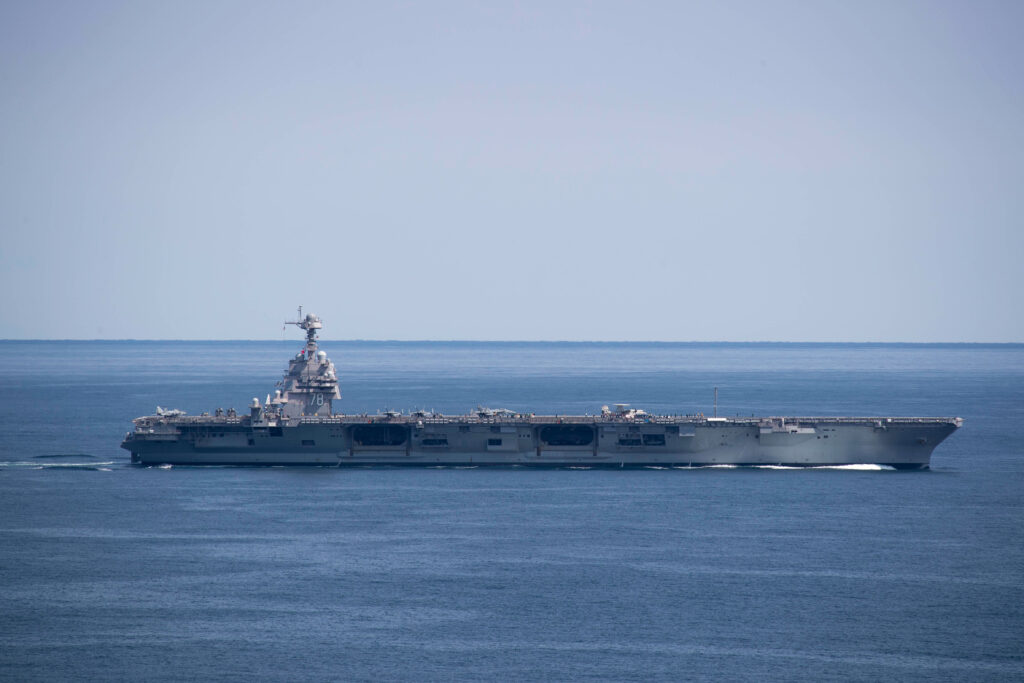
USS Gerald R. Ford (CVN 78) transits the Atlantic Ocean, March 30, 2022. U.S. NAVY / Mass Communication Specialist 3rd Class Jackson Adkins

ARLINGTON, Va. — The price inflation hitting American consumers also is hitting the shipyards that builds ships for the U.S. Navy, which are facing increased costs for the materials used to build the ships and their components, said two executives who chair shipbuilder and supplier industrial base coalitions.

Suppliers who were not given advance funding especially are vulnerable to price inflation, which could have long-term effects in driving up the cost of the ships the Navy plans to procure. In addition, the shipbuilders are facing daunting labor shortages in the current tight labor market. 

David Forster, a retired Navy captain, Global Strategy Executive of Naval Services, Rolls-Royce North America Inc., and chairman of the Amphibious Warfare Industrial Base Coalition, and Rick Giannini, chairman of the Aircraft Carrier Industrial Base Coalition and CEO of Milwaukee Valve, described the industrial base challenges of the fiscal 23 budget and Future Years Defense Plan in an April 1 interview with Seapower.  

Giannini said inflation is the top concern of the aircraft carrier industrial base, especially to those suppliers who did not receive advance funding during the COVID-19 pandemic. He said the block buy of CVNs 80 and 81 saved the taxpayers money because it allowed suppliers to order advance materials, which are now in hand and unaffected by the inflation now hitting the industry. 

Giannini’s company, Milwaukee Valve, uses a large amount of nickel and copper in its aircraft carrier components, which it ordered as soon as possible for two CVNs and was able to lock in the low costs before the current inflation. He said the prices of nickel have jumped and that suppliers that did not or could not order earlier were now facing the effects of inflation.   

The ACIBC chairman said the CVN block buy is going well from his perspective and the ACIBC is working to show Congress the benefits of a two-CVN buy, including the advance procurement of materials that helps the suppliers to have the materials on hand when the builder needs them, making for a smooth build rate. 

Forster said the Navy’s efforts to award contracts early during the first two years of the COVID pandemic “saved a lot of jobs” and gave credit to James “Hondo” Geurts, then assistant secretary of the Navy for research, development and acquisition, for his successful efforts to advance funding to shipbuilders and in turn to their suppliers.   

Forster said the three to 3.5 year build cycle for amphibious assault ships was in place and good for the stability of the industrial base, but the Navy’s 2023 budget plan to end procurement of the Flight II San Antonio-class amphibious transport dock ships after a “handshake deal” for a block buy was disappointing and illustrated the ambiguity of the plans, especially since Marine Corps Commandant Gen. David Berger supported a requirement of 31 large- and medium-size amphibious warfare ships. In concert with the 2023 budget calling for the decommissioning of four dock landing ships, the Navy’s budget is at odds with its plans to a build a force structure of 31 amphibious warfare ships.  

Forster also noted the procurement of the light amphibious warship had slid until 2025, a further challenge to stability for the workforce. 

He also advocates the Navy procure a replacement for the amphibious assault ship USS Bonhomme Richard, which was scrapped after a devastating fire in July 2020, having been modified for operation of the F-35B strike fighter. 

Giannini said the second major concern of the shipbuilders and its supplier industrial base was the workforce, which is stressed by the difficulty of hiring skilled labor. He cited the increasing age of the workforce and the retirements earlier than planned as a consequence of the COVID-19 pandemic.   

The Navy’s shipbuilding and ship retirement plans for 2023 and the Future Years Defense Plan and are likely to face intense scrutiny from the armed services committees in Congress, who have pushed back against retirement plans for several ships in the recent past and have been critical of the Navy’s “divest to invest” strategy. 
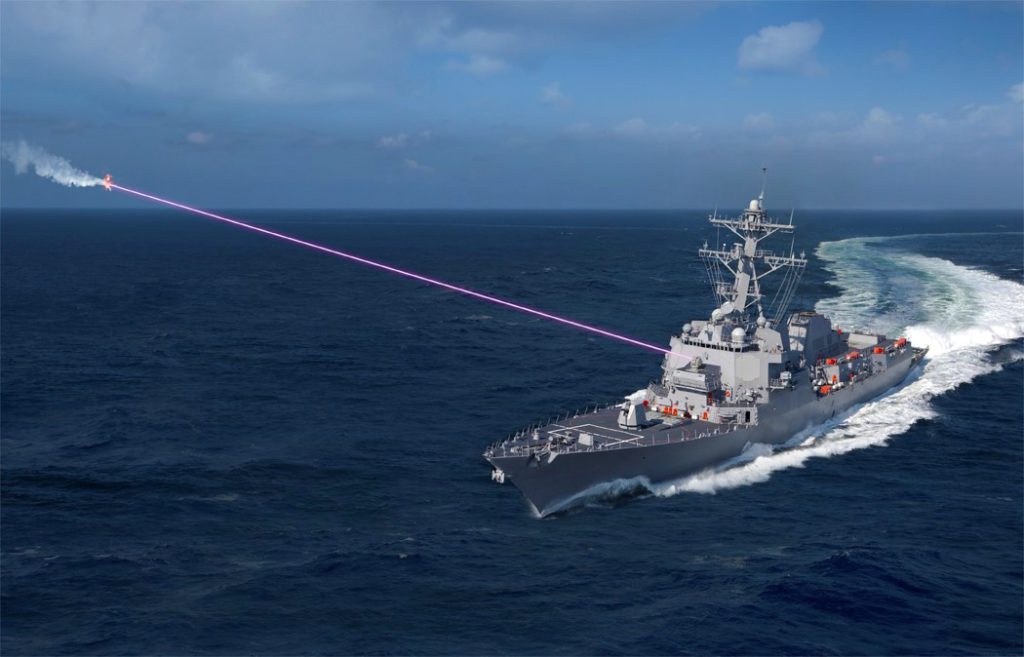


HELIOS Laser Weapon System Delivered for Installation on USS Preble 

An artist’s rendering of Lockheed Martin’s HELIOS system. LOCKHEED MARTIN

ARLINGTON, Va. — The Navy’s newest laser weapon system has completed range testing at Wallops Island, Virginia, and is being installed on the U.S. Navy’s Flight IIA Arleigh Burke-class guided-missile destroyer USS Preble in San Diego. 

The first High-Energy Laser with Integrated Optical Dazzler and Surveillance, or HELIOS, built By Lockheed Mission Systems and Sensors, has started phased delivery to the Preble at the BAE Systems yard in San Diego. It will be the first laser weapon system to be integrated with a ship’s Aegis Combat System and power and cooling systems, said Jon Rambeau, Lockheed Martin’s vice president and general manager for Integration for Systems and Sensors, during a March 30 interview with Seapower

The 60-kilowatt HELIOS is scalable, Rambeau said, up to 120 kilowatts with minor modifications such as the addition of more fiber-optic laser modules. It has replaced the Preble’s forward Mk15 Close-In Weapon System.  

“We believe the 60- to 120-kilowatt-range systems can be effective against an ASCM [anti-ship cruise missile],” Rambeau said. “We’ve done some modeling that demonstrates that, we believe, and also looking soon to be able to back that up with some real-world test data. Watch for some news that should be coming soon as we continue the test program.”   

The 60-kilowatt HELIOS also can be used for surveillance and as a counter-unmanned aerial system dazzler. The HELIOS also is adaptable to the Ship Self-Defense System on aircraft carriers and newer amphibious warships. 

“After better than a decade of that question being out there, ‘When are these systems going to demonstrate that they’re tactically relevant,’ we’re really right at the threshold of that to the point where the conversation is not going to be anymore, ‘Are those going to work?’ and ‘Are they going to be useful on the battlefield?’” Rambeau said. “Rather, the question is going to turn more to funding priorities, price points, the capacity of our industry primes, and the supply chain that could build these things in full quantities and at scale and then, ultimately, conversations around doctrine and how they would actually be employed in combat. 

“It’s really exciting time in lasers and it has been a long time in coming,” he said. 

The HELIOS contract was awarded to Lockheed Martin in January 2018. The company is also developing a layered laser weapon system for the U.S. Army.   


NAVCENT Commander: Goal of 100 USVs in Area by Summer of 2023 

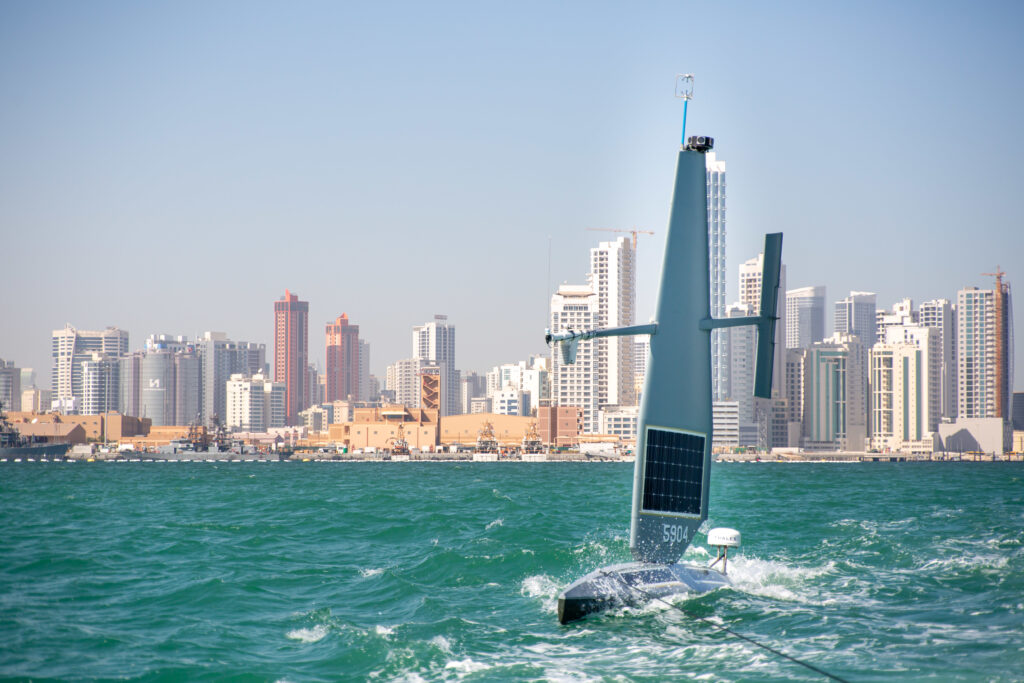
A Saildrone Explorer unmanned surface vessel is being towed out to sea in the Arabian Gulf off Bahrain’s coast, Jan. 27. U.S. Naval Forces Central Command began operationally testing the USV as part of an initiative to integrate new unmanned systems and artificial intelligence into U.S. 5th Fleet operations. U.S. ARMY / Specialist Natianna Strachen

ARLINGTON, Va. — The commander of the U.S. 5th Fleet/Naval Forces Central Command said he is pleased with the results of the experimentation with unmanned vessels and artificial intelligence in his area of operations and predicts a significant expansion of their use in his area of responsibility in the near future. 

Vice Adm. Brad Cooper, speaking March 28 in an online discussion sponsored by the Washington think tank the Middle East Institute, said his task force for unmanned vehicle experimentation, Task Force 59, “has exceeded our every expectation.” 

Unmanned systems are not new to the 5th Fleet; it has operated RQ-4A Global Hawk surveillance unmanned aerial vehicles and Mk18 mine countermeasures unmanned underwater vehicles for years. But Cooper said the maturation of unmanned surface vessels is relatively new and has enabled a great expansion in their use in the role of maritime domain awareness, allowing his command to “put more eyes out on the water.”  

The admiral said by linking two USVs together, they could use “artificial intelligence to map the waters around them … detecting when something is unusual — smuggling, illegal fishing, you name it, and then sending the information back to the command center.

“That process has allowed us to expand our maritime domain awareness two or three times,” he said, noting that with more nations using USVs, the maritime domain awareness in the region could expand to 30 times the coverage. 

“Our goal is to have 100 of these USVs patrolling around the waters of the Middle East by the summer of 2023,” Cooper said. “It a heavily partnered effort; it would mostly be an investment by partners. … We’re going to find ourselves in a pretty good spot because the capabilities speak for themselves.”  

In January and February, about 80 unmanned systems were deployed in International Maritime Exercise 2022 in scenarios ranging over the Persian Gulf, North Arabian Sea, Gulf of Oman and the Red Sea.  

Task Force 59 has accrued more than 7,000 hours of operating USVs. One type of USV stayed at sea for 45 days without need of additional fuel or maintenance.  

For example, TF-59 has deployed high-endurance Saildrone USVs, which were controlled from Alameda, California, to patrol the Gulf of Aqaba. In another example, MARTAC provided five of its high-speed USVs for the experiments.   

Cooper said for the price of one Arleigh Burke-class guided-missile destroyer, he could buy or lease around 2,000 Saildrone USVs. 


Marine Corps Hornet Squadron Repositioned to Eastern Europe 

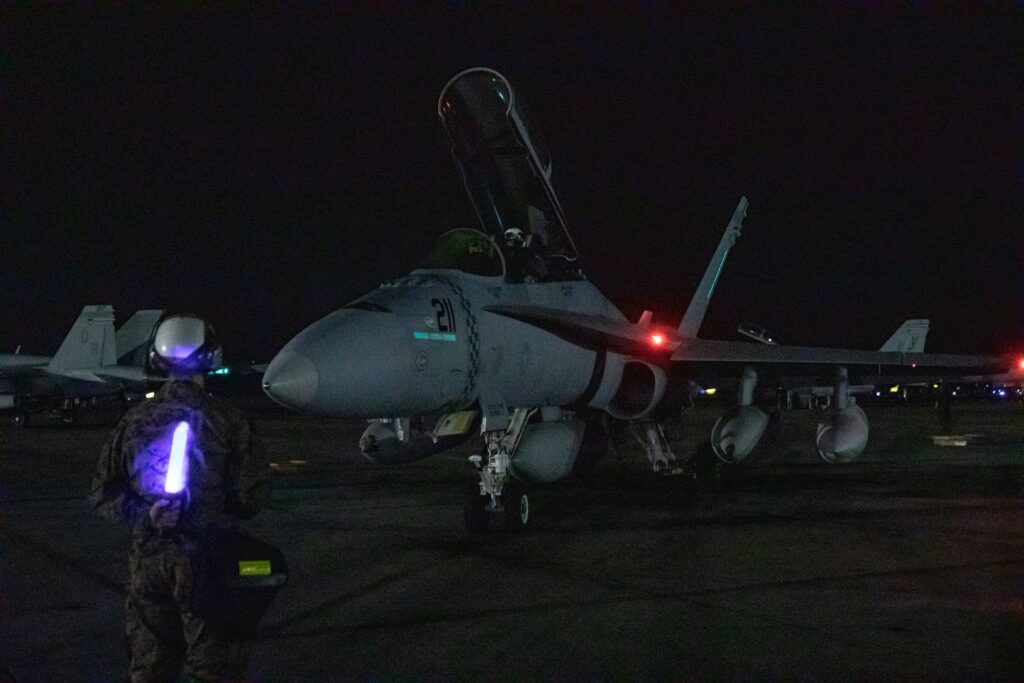
U.S. Marines with Marine Fighter Attack Squadron (VMFA) 312 assigned to 2nd Marine Aircraft Wing, II Marine Expeditionary Force, depart in F/A-18C Hornets from Marine Corps Air Station Beaufort, South Carolina, Feb. 26, to participate in Exercise Cold Response (Ex CR22) in Norway. U.S. MARINE CORPS / Cpl. Aidan Parker

ARLINGTON, Va. — The Defense Department has added another tactical jet squadron to eastern Europe to shore up U.S. European Command and possible NATO forces in the region, the Defense Department said.  

Defense Department spokesman John F. Kirby told reporters March 29 that a 10-plane Marine Corps F/A-18 squadron based at Marine Corps Air Station Beaufort, South Carolina, would be dispatched to an airfield — which he did not name — in eastern Europe.  

Kirby did not name the squadron but referred to the recent Exercise Cold Response in Norway, where Marine Fighter Attack Squadron 312 (VMFA-312) was deployed. It is likely that VMFA-312 was the squadron chosen. VMFA-312 operates F/A-18C/D Hornets. Other Hornet squadrons based at Beaufort include VMFA-115, VMFA(AW)-224 and VMFA(AW)-533. 

Kirby also announced that “a couple of Marine C-130s” were also going to be repositioned to eastern Europe. These likely are KC-130J Super Hercules tanker/transports from Marine Aerial Refueler/Transport Squadron 252, base at MCAS Cherry Point, North Carolina. 

Also deploying from Exercise Cold Response to Lithuania are Marines assigned to Marine Air Control Group 28, Kirby said. 

On March 29, Kirby announced that a Navy EA-18G Growler electronic attack squadron, VAQ-134, arrived at Spangdahlem Air Base, Germany, to strengthen U.S. forces on NATO’s Eastern Flank. 


Marine Corps’ Black Sheep to Ride the Lightning 

An AV-8B Harrier and an F-35B Lightning II are staged during the change of command and re-designation ceremony for Marine Fighter Attack Squadron 214 aboard Marine Corps Air Station Yuma, Arizona, March, 25. U.S. MARINE CORPS / Sgt. Samuel Ruiz

ARLINGTON, Va. — The Marine Corps’ famous Black Sheep squadron has a new designation as it upgrades to from its AV-8B Harrier II attack jet to its new aircraft, the Lockheed Martin F-35B Lightning II strike fighter. 

Marine Attack Squadron 214 (VMA-214) — the Black Sheep — was re-designated Marine Fighter Attack Squadron 214 (VMFA-214) at Marine Corps Air Station (MCAS) Yuma, Arizona, on March 25, marking the beginning of its transition from the AV-8B to the F-35B.  

VMA-214 was the last AV-8B squadron based at Yuma and based near the West Coast. Three other AV-8B squadrons — VMAs 223, 231, and 542 — remain in service at MCAS Cherry Point, North Carolina. The Harrier is scheduled to serve with the Marine Corps until fiscal 2028. 

Having flown the Harrier since 1989, the Black Sheep routinely deployed six-plane detachments on board amphibious assault ships as part of the Air Combat element of a Marine Expeditionary Unit and flew combat missions in numerous operations. 

The Black Sheep began as Marine Fighter Squadron 214, activated with F4F Wildcat fighters on July 1, 1942, in Hawaii. In August 1943, Maj. Gregory “Pappy” Boyington and Maj. Stan Bailey formed a group of unassigned pilots into a combat squadron with the callsign “Black Sheep” and flew their F4U-1 Corsair fighters to an outstanding record in the Solomon Islands. 

The squadron has built a solid legacy with numerous aircraft types in combat in World War II, the Korean War, the Vietnam War, Somalia, Iraq and Afghanistan and many other crises. For the official history of the Black Sheep, see this link: https://www.3rdmaw.marines.mil/Units/MAG-13/VMA-214/History/ 

“Having previously served in VMA-214 and flown the AV-8B for many years, the Black Sheep and the Harrier hold a special place in my heart,” said Maj. Gen. Bradford J. Gering, the commanding general of 3rd Marine Aircraft Wing, in a Marine Corps release. “As 3rd MAW says a bittersweet farewell to the Harrier, we are excited to increase our number of F-35B squadrons with the re-designation of VMFA-214.” 

“The re-designation of VMA-214 to VMFA-214 is the end of a legacy for the Black Sheep and Marine Aircraft Group-13,” said Lt. Col. Keith Bucklew, the outgoing commander of VMA-214. “This symbolic event finalizes the sundown for Harriers on the West Coast and closes the chapter on 58 years of attack aircraft operations for the Black Sheep. 

“Finishing this mission with a successful 11th Marine Expeditionary Unit deployment is a testament to the viability and performance of the Harrier over the last 33 years and, more importantly, the talent of the Marines who managed them,” Bucklew said. “The AV-8B will be missed in the skies of Yuma, but it is time to transition to the next generation of fighter attack aircraft.” 

“The F-35’s fifth-generation strike fighter capability brings more lethality and flexibility to combatant commanders than any other fighter platform,” said Lt. Col. Christopher Kelly, the commanding officer of VMFA- 214. “The STO/VL capability inherent in the F-35 B variant allows the Marine Corps to operate expeditiously and from remote locations, making the model uniquely qualified at supporting expeditionary advanced base operations.” 


Proposed Navy Aircraft Procurement Reduced for 2023 

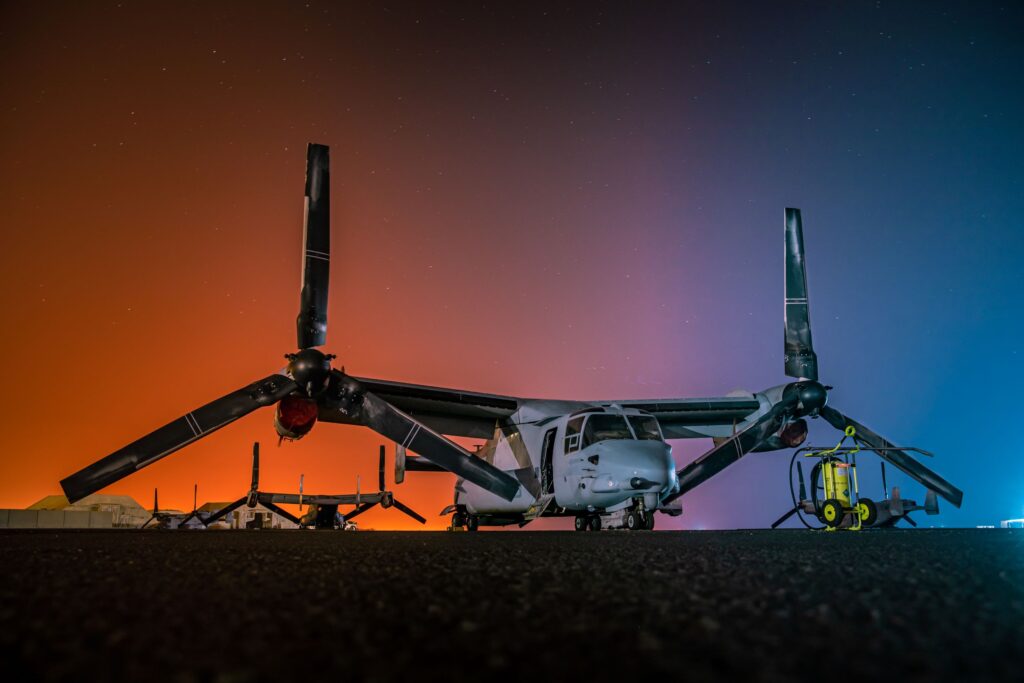
The new fiscal year will mark the sunset on new MV-22 Osprey purchases, according to new budget documents. U.S. MARINE CORPS / Lance Cpl. Andrew Skiver

ARLINGTON, Va. — The Navy plans to procure 96 aircraft in fiscal 2023, down from the 129 aircraft enacted in the fiscal 2022 appropriations law. The numbers are expected to go even lower over the years of the Future Years Defense Program. 

The Department of the Navy has requested the following: 

  • 15 F-35B Lightning II strike fighters for the Marine Corps 
  • 13 F-35C Lightning II strike fighters (9 for the Navy, 4 for the Marine Corps) 
  • 5 E-2D Advanced Hawkeye command and control aircraft 
  • 5 KC-130J Super Hercules transport/refueling aircraft 
  • 10 new multi-engine training aircraft 
  • 10 CH-53K King Stallion heavy-lift helicopters 
  • 25 TH-73A Thrasher training helicopters 
  • 3 MQ-4C Triton unmanned surveillance aircraft 
  • 4 MQ-25A Stingray unmanned aerial refueling aircraft 
  • 5 MQ-9A Predator unmanned aerial surveillance aircraft 

Assuming 10-plane squadron strength, the planned F-35C procurement does not even fill one Navy F-35C squadron or half of a Marine Corps F-35C squadron. But F-35C procurement is planned to increase significantly starting in 2024, to 15 per year for the Navy and four per year for the Marine Corp, except for three in 2027.  

The Navy — again — is planning on ending F/A-18E/F Super Hornet strike fighter procurement with the 2022 batch of 12 mandated by Congress. It remains to be seen if Congress will again keep procurement of the Super Hornet alive.  

As proposed, the new fiscal year would be the last year of procurement of the E-2D and the TH-73A. No more P-8A Poseidon maritime patrol aircraft or MV-22B or CMV-22B Osprey tilt-rotor aircraft are planned. 

Procurement of the KC-130J would pause or stop after two are purchased in 2024. The Navy has been hoping to replace its C-130T/KC-130T organic airlift fleet with C-130Js, but that seems far in the future if it happens. 

The new fiscal year will be the first for procurement of the MQ-25A as it heads for operational capability in 2025. The 2023 budget also resumes procurement of the MQ-4C after a year gap, and more MQ-9As for the Marine Corps as it fills its unmanned squadrons with the Reaper to support expeditionary advance base operations. 

The type aircraft to be procured to replace the T-44C multi-engine training aircraft has yet to be announced, but the 2023 budget plans to procure 10 Multi-Engine Training Systems, with a total of 58 in a three-year run. 

The T45TS line in the Navy’s budget graph shows procurement starting in 2025. The term T45TS is familiar as T-45 Training System, of which the Boeing T-45 Goshawk aircraft is the main component. However, Seapower understands this line item to be a surrogate for a yet-to-be solution for the Navy’s need for a T-45C replacement. 


Navy Fleet Would Shrink Further Under 2023 Ship Decommissioning Plan  

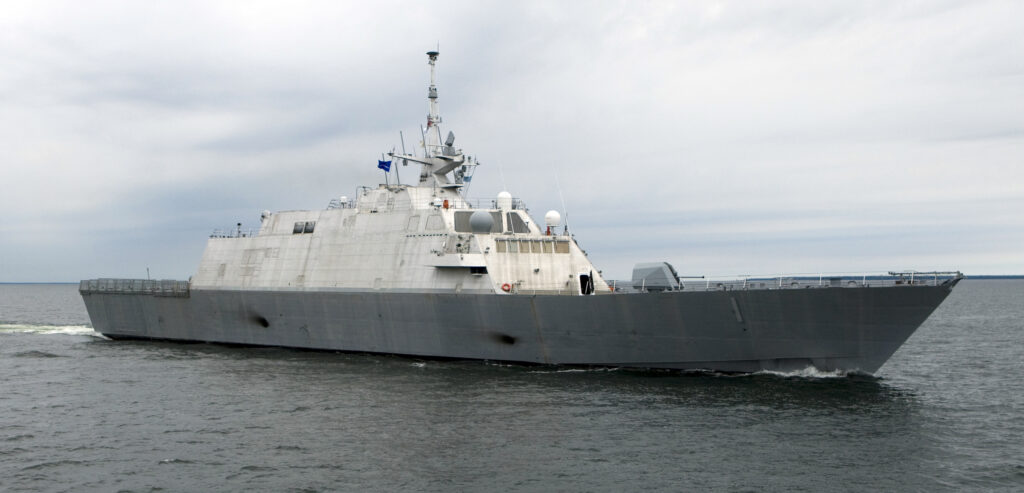
The first U.S. Navy Littoral Combat Ship, Freedom. The Navy plans to retire nine LCS, most or all from the Freedom class. U.S. NAVY

ARLINGTON, Va. — Normally the number of new U.S. Navy ships requested for the next a new fiscal year garners the most attention of reporters, but this time it was the number of ships the Navy is seeking to decommission that drew the most attention.  

Under the Future Years Defense Plan, the size of the Navy’s battle force would shrink from 298 today to 280 in fiscal 2027. Chief of Naval Operations Adm. Michael Gilday has advocated divesting in order to invest, and this budget supports that concept.  

During the Navy Department’s March 28 fiscal 2023 budget briefing at the Pentagon, Rear Adm. John Gumbleton, deputy assistant secretary of the Navy for Budget, said the Navy is requesting the retirement of 24 ships, compared with the construction of nine battle force ships. 

Gumbleton listed the types of the 24 ships targeted for retirement: 

  • 9 littoral combat ships
  • 5 Ticonderoga-class guided-missile cruisers
  • 2 Los Angeles-class nuclear-powered attack submarines 
  • 2 Henry J. Kaiser fleet replenishment oilers
  • 4 Whidbey Island- or Harpers Ferry-class dock landing ships
  • 2 Montford Point-class expeditionary transfer dock ships

He said the retirements would save the Navy $3.6 billion over the Future Years Defense Plan. 

Most, if not all, of the littoral combat ship retirements would be of the troubled Freedom variant and would save the Navy $50 million annually. Also, under the 2023 plan the LCS antisubmarine warfare mission package would not be installed on the remaining LCSs, with the ASW mission taken up by the new Constellation-class frigate. 

The two Montford Point-class expeditionary transfer dock ships are less than 10 years old and their proposed retirement reflects changes in Marine Corps amphibious operational concepts toward more distributed maritime operations. 

The Navy recently has pointed our more problems with the older Ticonderoga-class guided-missile cruisers to the level of safety concerns being a major issue.  

The nine battle force ships requested for 2023 by the Navy include:  

  • 2 Virginia-class SSNs 
  • 2 Flight III Arleigh Burke-class guided-missile destroyers
  • 1 Constellation-class guided-missile frigate
  • 1 America-class amphibious assault ship
  • 1 Flight II San Antonio-class amphibious transport dock ship
  • 1 John Lewis-class fleet replenishment oilers 
  • 1 Navajo-class towing, salvage and rescue ship

For 2022, the Navy requested eight ships, but Congress increased the number to 13 in the enactment of that budget. 

The 2023 budget would continue to fund the Columbia-class ballistic-missile submarine, the Ford-class aircraft carriers, and advance procurement for two Virginia-class nuclear-powered attack submarines. 

Gumbleton said 2023 would be the last year for procurement of the San Antonio-class transport dock ship. 

Also, under the Future Years Defense Plan, production of the Constellation-class guided-missile frigate would alternate one and two ships year by year.  

Procurement of the light amphibious warship and the submarine tender replacement would begin in fiscal 2025, followed by the next-generation logistics ship in 2026. Research and development funding is provided for the large unmanned surface vessel and the extra large unmanned underwater vessel. 

The 2023 budget also would fund the purchase of two used sealift ships for the Maritime Administration’s Ready Reserve Force. 

The fiscal 2023 also requests funding for two LCAC 100-class ship-to-shore connectors and the service-life extension of two LCAC 01-class connectors; but does not request more new LCU 1700-class utility landing craft. The plan also would fund advance procurement funds for the refueling and comprehensive overhaul of the USS Harry S. Truman (CVN 75), which the Navy not long ago wanted to decommission to fund other priorities.  

Rep. Rob Wittman (R-Virginia), ranking member of the House Armed Services Committee’s Seapower and Projection Forces panel, has been critical of the Navy’s “divest to invest” strategy, which is shrinking the fleet. He issued a statement March 28, excerpted below:    

“I am particularly disappointed that even as we aim to grow our naval and projection forces, this budget continues the divest to invest strategy that will shrink our fleet once again, underinvest in the fifth-generation fighters we need to compete with peer adversaries, reduces our Air Force tanker force structure and once again prioritizes future technologies over the capacity and capabilities servicemembers need now to ensure we have a credible American military. I will work with my colleagues in Congress this year to ensure that we deliver a defense budget that genuinely invests in the national security of our nation.” 


Navy Deploys More EA-18G Electronic Attack Jets to EUCOM 

A U.S. Navy EA-18G Growlers assigned to the “Garudas” Electronic Attack Squadron (VAQ) 134, Naval Air Station Whidbey Island, Washington, waits to receive air-to-air refueling from a Royal Air Force Voyager tanker assigned to 101 Squadron, RAF Brize Norton, United Kingdom, during a Red Flag-Nellis 22-1 mission Feb. 3, 2022, at Nellis Air Force Base, Nevada. U.S. AIR FORCE / Airman 1st Class Zachary Rufus

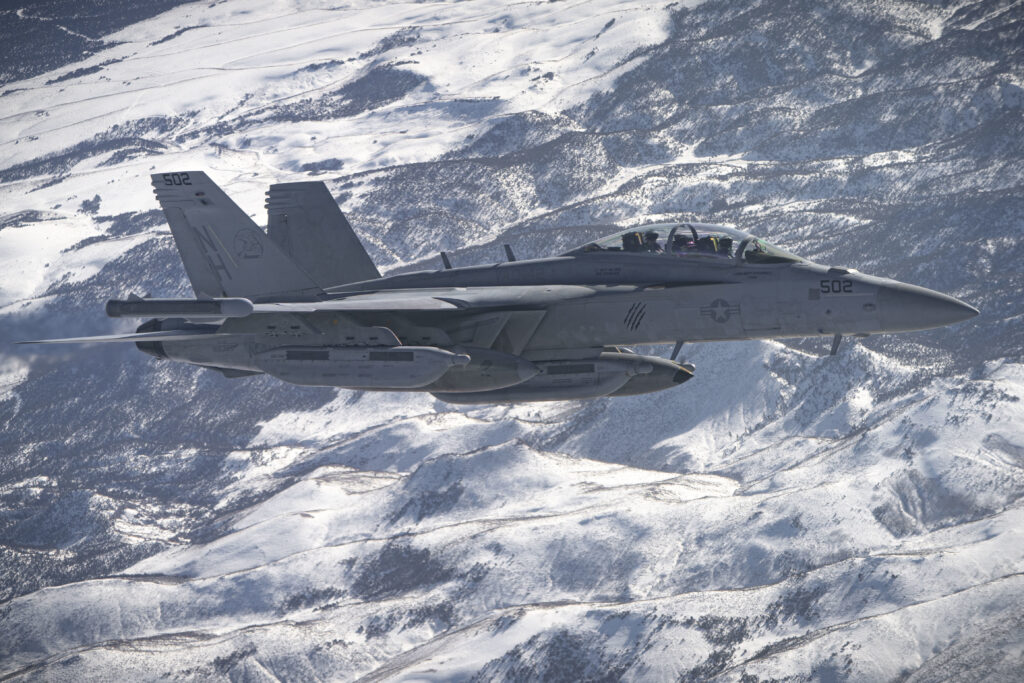
ARLINGTON, Va. — A squadron of U.S. Navy EA-18G Growler electronic warfare aircraft has been deployed to the European Command as part of the build-up of forces in support NATO’s eastern flank. 

According to Defense Department spokesman John Kirby, the six EA-18Gs of Electronic Attack Squadron 134 (VAQ-134) — the Garudas — and their support personnel were to be staged by March 28 at Spangdahlem Air Base in Germany, home of the U.S. Air Force’s 52nd Fighter Wing, which fields one squadron of F-16CJ fighters. The EA-18Gs are home-based at Naval Air Station Whidbey Island, Washington. Spangdahlem is approximately 650 miles from the borders of NATO countries in Eastern Europe with Ukraine. 

“The purpose of this deployment is to bolster readiness, enhance NATO’s collective defense posture and further increase air integration capabilities with our allied and partner nations,” Kirby said in a release. “They are not being deployed to be used against Russian forces in Ukraine. They are being deployed completely in keeping with our efforts to bolster NATO’s deterrence and defense capabilities along that eastern flank. The deployment is not in response to a perceived threat or incident.” 

The Navy has five-land-based expeditionary VAQ squadrons in addition to nine carrier-based VAQ squadrons, all equipped with EA-18Gs. For many years they deployed to bases in Southwest Asia to support combat in Afghanistan, Iraq, and Syria, and currently deploy to Misawa, Japan. The Navy’s Growlers provide electronic attack support for all of the armed services. The aircraft can jam enemy radars and communications and fire anti-radiation missiles at radar sites. 

“I am extremely proud of the men and women in VAQ-134,” said Navy Capt. Christopher M. Bahner, commander, Electronic Combat Wing, U.S. Pacific Fleet, in a Defense Department release. “The Garudas have performed exceptionally well during their planned work-up cycle and stand ready to support U.S. expeditionary and allied task forces in Europe. Expeditionary EA-18G squadrons integrate with joint and coalition forces to provide our commanders capabilities to defend our forces in all potential phases of operation, while allowing our Carrier Air Wing EA-18G squadrons to remain at sea, defending freedom of navigation with our carrier strike group teams.” 

Another EA-18G squadron, VAQ-137, currently is deployed with Carrier Air Wing One on board USS Harry S. Truman in the Mediterranean Sea. VAQ-137 has been flying patrols over Romania and Poland in support of NATO operations since the Russian invasion of Ukraine. 


Marine Corps Orders 36 More Amphibious Combat Vehicles 

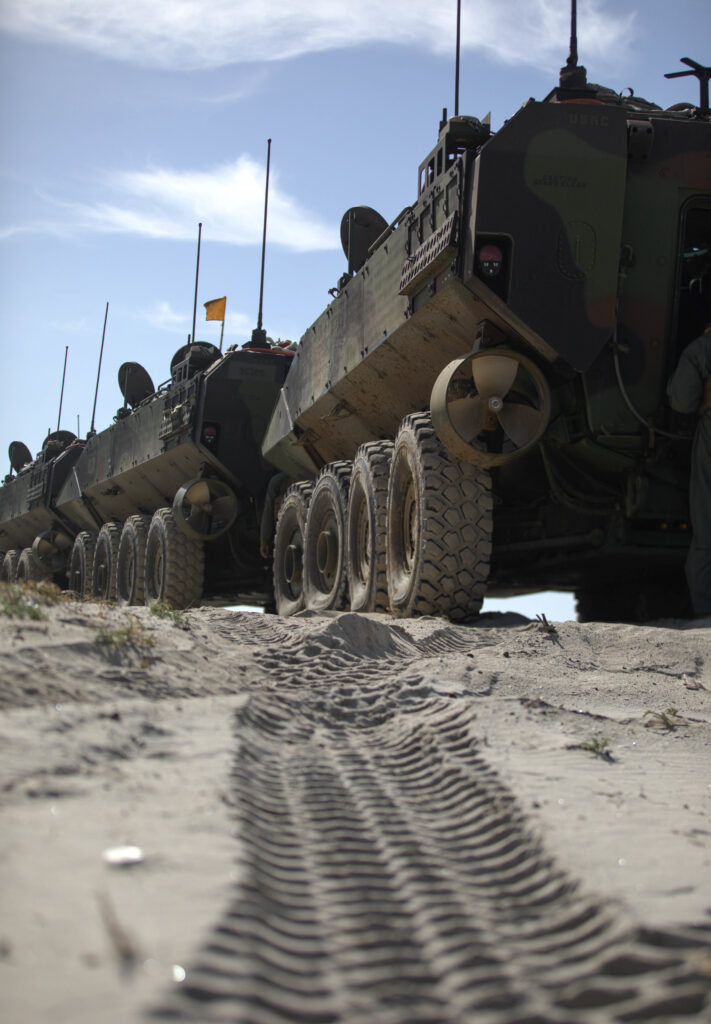
U.S. Marine Corps amphibious combat vehicles with 3d Assault Amphibian Battalion, 1st Marine Division, conduct movement on the shore after a successful training evolution at Marine Corps Base Camp Pendleton, California, March 13. U.S. MARINE CORPS / 2nd Lt. Joshua Estrada

ARLINGTON, Va. — The Marine Corps has ordered 36 more Amphibious Combat Vehicles, the Defense Department announced March 25. 

Marine Corps Systems Command, Quantico, Virginia, awarded BAE Systems Land & Armaments L.P., Sterling Heights, Michigan, a $173.6 million contract modification for a full-rate production lot of ACVs and “associated production, and fielding and support costs.” The deliveries are expected to be completed by March 2024. 

The ACV is an amphibious armored vehicle — with a crew of three Marines — designed to carry 13 Marines in shock-mounted seats from ship to shore in an opposed landing and to carry those Marines inland. Its V-shaped hull is designed to provide blast protection from mines.  

In addition to the personnel carrier versions (ACV-P), BAE Systems has delivered the prototype of the command variant (ACV-C) and is under contract to design and develop the 30mm cannon-armed variant (ACV-30) and the recovery variant (ACV-R). 

The contract raises the number of ACV-Ps ordered so far to more than 250. They are in full-rate production.

The ACV achieved initial operational capability on Nov. 13, 2020. The ACV is replacing the AAV7 family of assault amphibious vehicles that have been in service since the early 1970s. 


Navy’s New Hovercraft Delivers Helicopter for Air Force 

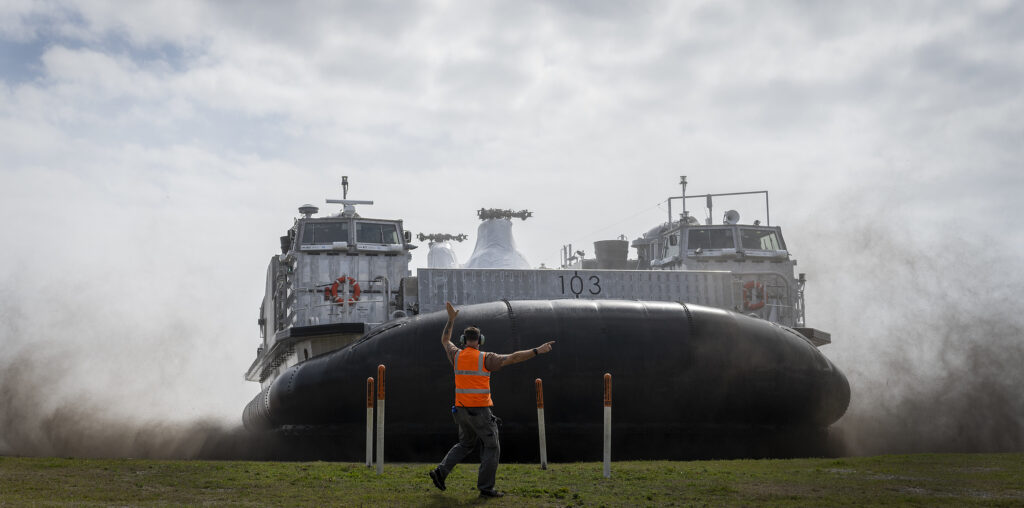
Skip Whitmore, Naval Surface Warfare Center Panama City, marshals a Landing Craft Air Cushion vehicle onto shore south of Hurlburt Field, Florida, Feb. 24. The amphibious landing craft carried a CH-46 Sea Knight helicopter from Pensacola to be used for training purposes within Eglin Air Force Base range. U.S. AIR FORCE / Samuel King Jr.

ARLINGTON, Va. — An unusual transport mission last month demonstrated the capabilities and versatility of the Navy’s new LCAC 100-class ship-to-shore connector. 

The Air Force 96th Test Wing at Eglin Air Force Base, Florida, requested the assistance of the Naval Surface Warfare Center – Panama City Division to solve a problem in transporting a CH-46 helicopter from Naval Air Station Pensacola, Florida, to Eglin. The retired helicopter was to be used to “support future training operations for the Air Force Special Operations Command Special Tactics Training Squadron,” Jeremy Roman of the NSWC PCD public affairs office said in a March 23 release. 

“With a height of nearly 17 feet, transporting the helicopter by land would have required extensive preparation work in order to lower the height to safely maneuver on public highways,” Roman said.   

The 96th Test Wing and the NSWC PCD determined the best solution was using one of the LCAC 100-class ship-to-shore connectors, which recently entered fleet service, to transport the helicopter over the water to Eglin.

LCAC 103, the third production LCC 100-class SSC, was selected for the mission, conducted on Feb. 24. 

“LCAC 103 transited from Panama City, Florida, to NAS Pensacola where the CH-46 was loaded and then transported to Eglin AFB,” Roman said. “The LCAC 103 then displayed its amphibious capability by transiting from water to shore at Eglin AFB where the CH-46 was rolled off the deck onto dry land. LCAC 103 further demonstrated the SSC amphibious capabilities by transiting across Santa Rosa Island at the Eglin AFB Test Range to navigate back to base via the most efficient route to NSWC PCD. This long-distance, land-hopping mission, supported post-delivery test and trials objectives by successfully gaining reliability growth hours while demonstrating required capabilities for Navy and Marine Corps expeditionary forces.” 

“NSWC PCD is a Navy research, development, test and evaluation laboratory, and this mission displayed the fruit of the RDT&E and acquisition teamwork which is providing this critical expeditionary capability to the fleet. It is always a bonus when that capability supports our sister military branches and partners,” said Randy Whitehead, NSWC PCD Air Cushion Vehicle and Seabasing technical program manager, in the release.

“This was an excellent demonstration of key capabilities such as the LCAC’s unique combination of range, speed, amphibious versatility and lift capacity. It not only allowed us to successfully execute this mission but also showed how SSC can bring more to the table for future Distributed Maritime Operations.” 

The LCAC 100-class SSC is built by Textron Systems and is replacing the older LCAC 01 class hovercraft in the fleet. Testing of the LCAC 100 craft is conducted at NSWC PCD. Recently, two LCAC 100s were delivered to the fleet’s Assault Craft Unit 4 at Little Creek, Virginia.