Navy’s Two-Carrier Block Buy Stabilized Supplier Base During COVID Pandemic, Industry Exec Says
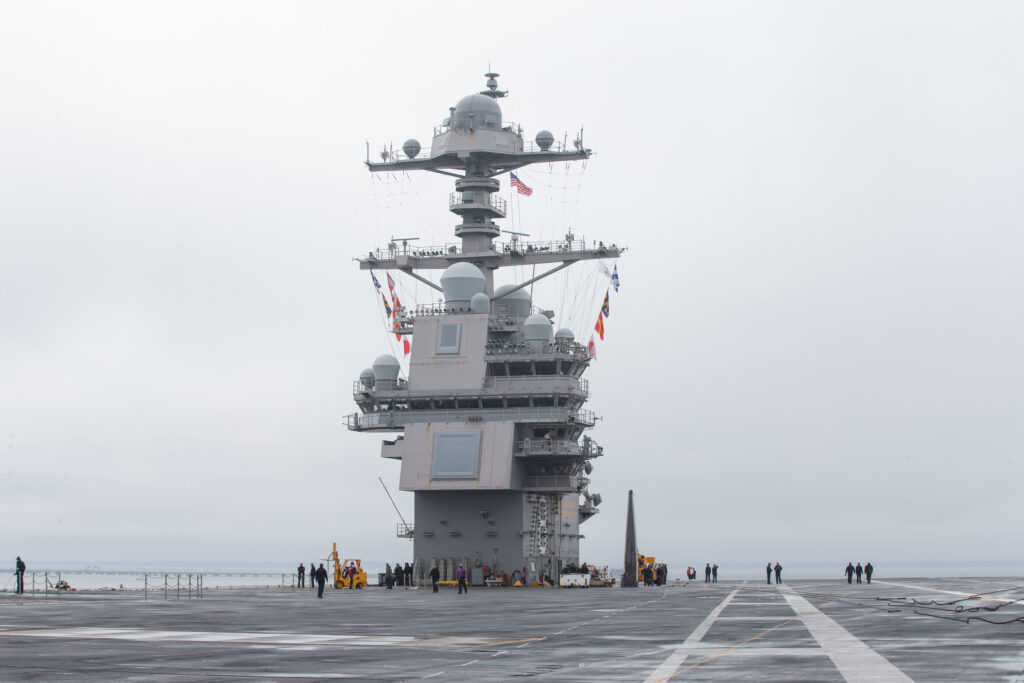
USS Gerald R. Ford (CVN 78) transits the James River after leaving Newport News Shipyard during sea and anchor, Feb. 25, 2022. Ford is underway in the Atlantic Ocean after completing the industrial portion of a six-month planned incremental availability. U.S. NAVY / Mass Communication Specialist 3rd Class Jacob Mattingly

ARLINGTON, Va. — The Navy’s procurement and congressional funding of two Ford-class aircraft carriers in a single block buy enabled numerous small suppliers to weather or even survive the COVID pandemic, an industry official said. The stability of the program also enabled the aircraft carrier industrial base to control costs and enact savings.  

Stable and predictable funding provided by the block procurement of CVN 80 and CVN 81, in place before the pandemic, gave the aircraft carrier industrial base the ability to absorb the shock of the pandemic, especially for the small lower-tier suppliers, said Rick Giannini, chairman of the Aircraft Carrier Industrial Base Coalition and CEO of Milwaukee Valve, speaking March 22 in a phone conference with Seapower

“The two-carrier buy was really very helpful to the supply base [during the pandemic], because those orders in the hands of the suppliers before COVID gave them the work to get through things,” Giannini said.    

Giannini said the ACIBC’s top priority is “stable and predictable funding,” which he defined as “a two-carrier block buy over eight years, with carriers purchased on four-year centers. 

“And with that comes advance planning funding early in the cycle,” which he said “really is the catalyst. It’s great to have the bulk buy, but if we don’t have the funds to go and buy those raw materials as a supply base, it makes it very difficult to enact the savings that come out of it. We got good funding for [CVNs] 80 and 81, and one of the lessons is we need more early on so we can get more of the supply base involved.” 

Giannini cited the experience of his own company, Milwaukee Valve.

“We were able to buy all of the materials for two full shipsets up front. Now we have that material in our facility so that the lead times not be impacted by material problems. Nor will the cost change. And it saves significant dollars and will improve the lead times overall.”      

He said a two-carrier block buy is “very doable. We’re hoping we can get it moved up into 2024 — eight years after the AP [advance procurement] money came in for 80/81. We’re really trying to match the procurement of the Nimitz class. They were built on 3.5-year centers. So, four [-year centers] is good enough.” 

The carrier industrial base coalition includes 2,000 companies from 46 states that employ approximately 121,000 workers. Its member companies provide $9.6 billion worth of materials and services for one aircraft carrier.  

Workforce issues became prominent during the pandemic because many “baby boomer” workers retired earlier than planned. A shortage of skilled workers is focusing companies on recruiting and developing shipyard and manufacturing workers. Many companies are forming partnerships with local community and technical colleges and trade schools. 

Giannini’s Milwaukee Valve company’s workforce is down about 8% in personnel, he said. Also, he noted that when a worker contracted COVID-19, about 10 other workers around that worker had to be quarantined, greatly affecting workflow for a week or two at a time. Absenteeism had risen to about 8 to 10 points on a fairly consistent basis, he said.   

Giannini attended the dinner March 21 — sponsored by the Navy League —with Chief of Naval Operations Adm. Michael Gilday in Norfolk, Virginia, to celebrate the centennial of the U.S. Navy’s first aircraft carrier, where, he noted, the CNO said the Navy needed a force level of 12 aircraft carriers. 



SASC Chair Reed: Defense Budget Turmoil Fault ‘Not in Our Stars, But in Ourselves’ 

Sen. Jack Reed (D-Rhode Island), chairman of the Senate Armed Services Committee during a hearing in review of the fiscal 2023 defense authorization request on March 8. DOD / U.S. Air Force Tech. Sgt. Jack Sanders

WASHINGTON — The chairman of the Senate Armed Services Committee quoted Shakespeare to lay the blame on Congress itself for the defense budget legislative turmoil over the last two decades of multiple continuing resolutions, and said budget delays are especially dangerous in the world’s current geo-political climate. 

“We’ve gotten into a very bad habit over the last several years, but I hope we can get it done,” said Sen. Jack Reed (D-Rhode Island), when asked by Seapower if he foresaw a return to the regular defense budget legislative process in Congress. Reed spoke March 23 in a webinar with reporters of the Defense Writers Group.

Reed noted the fiscal 2022 budget was received late from the Defense Department, which pushed back deliberations. The 2023 president’s budget proposal is scheduled to be delivered to Congress March 28, almost two months later than the normal plan. 

Reed said getting the defense budget out on time is “extremely helpful to the services. Most services don’t — regrettably — plan to do anything in the first quarter of the new fiscal year because they assume they won’t have a budget and, in some cases, even authorization acts. That’s a whole quarter of just standing around tapping your feet, and in this world, with these adversaries, and the speed of technology, that’s wasted time.”

Reed noted the services had to wait nearly six months before the 2022 defense budget finally was appropriated.  

“It’s not an efficient way to spend money,” he said. 

“The problem is, as Shakespeare said, is not in our stars but in ourselves,” Reed said. “In Congress we have been, for many reasons, distracted. It’s a complicated political environment and I hope we can refocus.” 

Reed said he, ranking member Sen. James Inhofe (R-Oklahoma) and the Senate Appropriations Committee leaders would like to get their defense bills done on time. 

“Sometimes we become hostage to other issues, unfortunately,” Reed said. “But our goal is very clearly to get it done and get it done on time.”  

Reed also took the opportunity to say in the current world climate, the United States has to “reimagine how we fight. We have to develop new warfighting concepts. We have new equipment. We have new areas of space and cyber that have been around by every day are much more critical for what we have to do.” 

Reed said tough choices have to be made about legacy systems, and that the U.S. has to look to its allies as a “major source of strength.” 


DoD Inspector General to Audit Navy’s MQ-25 UAV Program 

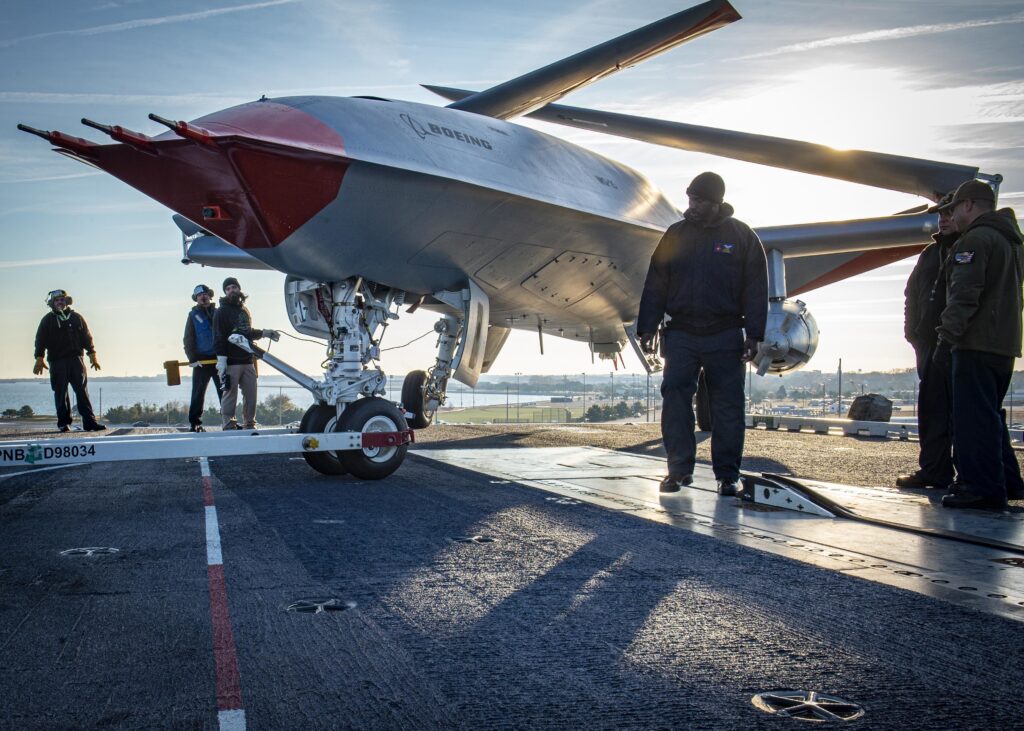
The Boeing unmanned MQ-25 aircraft on the flight deck aboard the aircraft carrier USS George H.W. Bush (CVN 77) in 2021. U.S. NAVY / Mass Communication Specialist 3rd Class Brandon Roberson

ARLINGTON, Va. — The inspector general of the Department of Defense is planning to conduct an audit of the U.S. Navy’s MQ-25 Stingray aerial refueling unmanned aerial vehicle program. 

In a March 21 memorandum addressed to the undersecretary of Defense for Acquisition and Sustainment, the director for Operational Test and Evaluation, and the auditor general of the Department of the Navy, the inspector general said, “The objective of this audit is to determine whether Navy officials are effectively managing the MQ-25 Stingray program to meet operational capability requirements and user needs. We may revise the objective as the audit proceeds, and we will also consider suggestions from management for additional or revised objectives.” 

The MQ-25 program is designed to provide a UAV capable of refueling carrier-based aircraft, thus freeing more F/A-18E/F Super Hornet strike fighters for their primary missions.  

A prototype of the MQ-25A, built by Boeing, has flown and has demonstrated the ability to refuel F/A-18s, F-35 Lightning II strike fighters and E-2D Advanced Hawkeye early warning aircraft. The prototype, known as T1, also was put through flight deck handling trials at sea on board the aircraft carrier USS George H.W. Bush (CVN 77) in December 2021.  

Boeing is under contract to build seven MQ-25As. The Navy anticipates it will procure a total of 72 Stingrays under current planning. Initial operational capability is planned for fiscal 2025. 


Navy Decommissions Two More Patrol Ships 

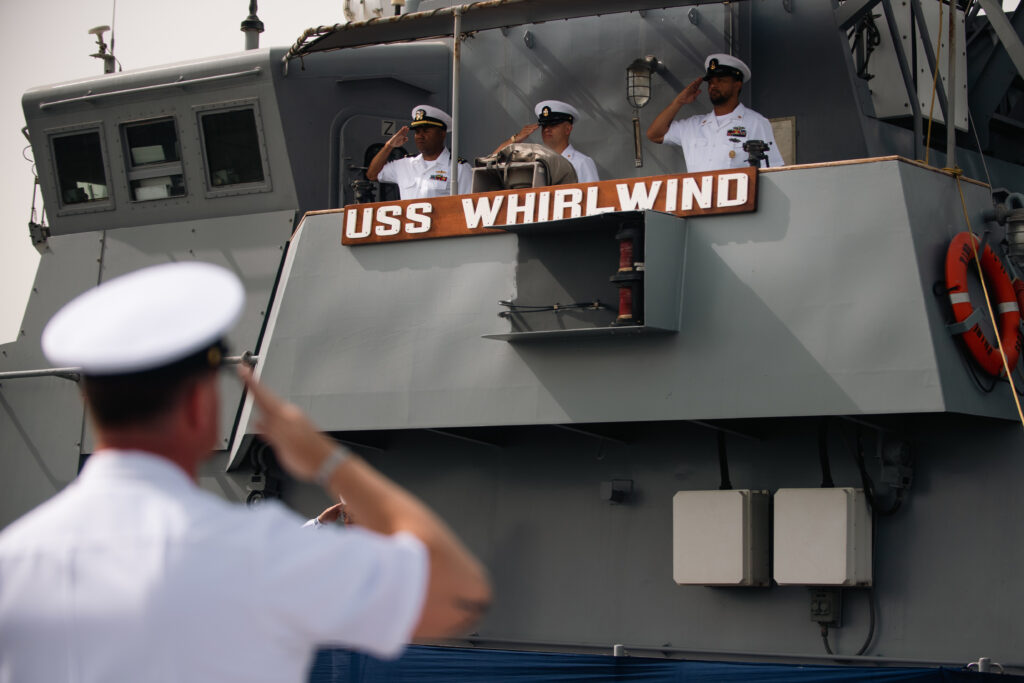
Sailors assigned to the coastal patrol ship USS Whirlwind (PC 11) salute during the ship’s decommissioning ceremony on March 21 at Naval Support Activity Bahrain. U.S. NAVY / Mass Communication Specialist 2nd Class Dawson Roth

ARLINGTON, Va. — The U.S. Navy decommissioned two more Cyclone-class coastal patrol ships in March, bring to five the number of PCs retired from the U.S. 5th Fleet this year, all within a one-month period, according to the fleet’s public affairs office. 

USS Whirlwind (PC 11) was decommissioned in ceremonies held in Bahrain on March 21. A week earlier, USS Squall (PC 7) was decommissioned on March 14. The recent PC force reductions began on Feb. 23 with the decommissioning of USS Firebolt (PC 10), followed by Typhoon (PC 2) on Feb. 28 and Tempest (PC 2) on March 7.  

All of the above decommissioned PCs will be made available for foreign military sales. 

The reductions leave the Navy’s last five PCs on strength still in service with the 5th Fleet: USS Hurricane (PC 3), USS Monsoon (PC 4), USS Sirocco (PC 6); USS Chinook (PC 9) and USS Thunderbolt (PC 12).  

USS Squall — like its sister ships, it was built by Bollinger Shipyards — was commissioned on July 4, 1994. It was based at Naval Amphibious Base Coronado, California until late 2005, when it was moved to Naval Amphibious Base Little Creek, Virginia. In 2013. Squall was assigned to the 5th Fleet. 

USS Whirlwind was commissioned on July 1, 1995. It was stationed at Little Creek from which it supported operations in the U.S 4th and 6th Fleet areas of responsibility. The Whirlwind also provided homeland security near New York City’s harbor following the 9/11 terrorist attacks on the city. The ship was transferred to the 5th Fleet in 2013. 

“Our patrol coastal ships have made a lasting impact here in the region supporting naval operations and safeguarding maritime security,” said Capt. Robert Francis, commander of Task Force 55 at U.S. 5th Fleet, in the March 21 5th Fleet release. “This was only made possible by the dedicated Sailors who served aboard these ships for nearly three decades.” 


Marine Corps Orders Development of Recovery Variant of ACV 

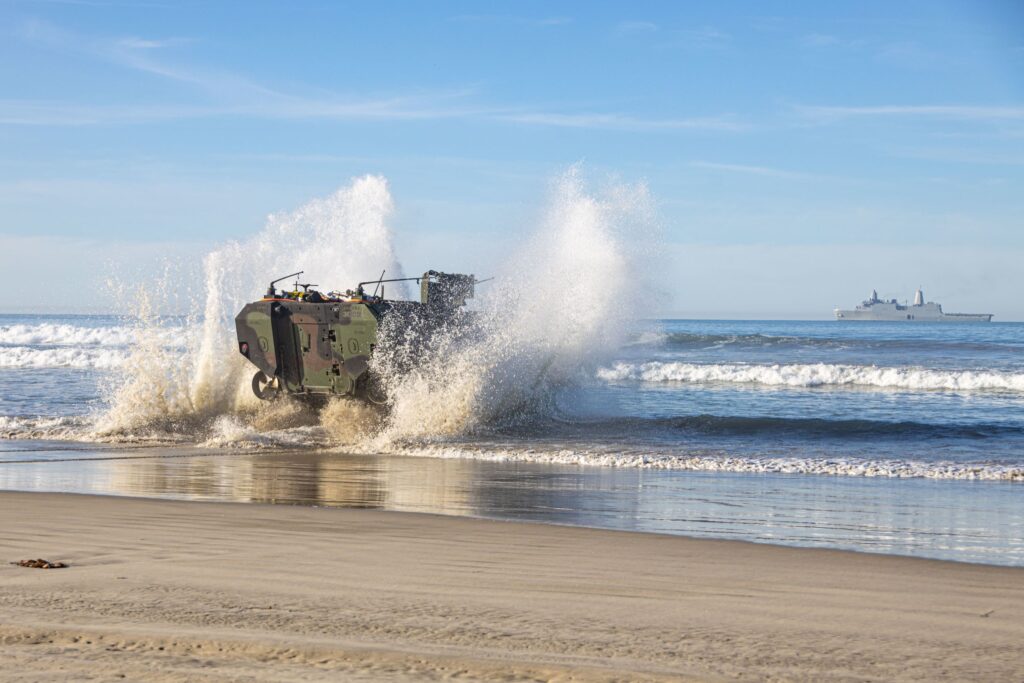
U.S. Marines assigned to the 3rd Assault Amphibian Battalion, 1st Marine Division, conduct waterborne training with an Amphibious Combat Vehicle from shore to loading amphibious transport dock ship USS Anchorage (LPD 23) at Marine Corps Base Camp Pendleton, California, Feb. 12. U.S. MARINE CORPS / Lance Cpl. Willow Marshall

QUANTICO, Va. — The Marine Corps has taken the next step in developing its family of Amphibious Combat Vehicles by beginning development of a maintenance/recovery variant of the ACV. 

The Marine Corps Systems Command awarded BAE Systems Land & Armaments L.P., Sterling Heights, Michigan, a $34.9 million cost-plus-fixed-fee contract modification to procure labor and material for the design and development of the ACV-R maintenance/recovery variant, according to a March 18 Defense Department contract announcement.   

Development of the command-and-control variant, the ACV-C, and the ACV-30 — the latter armed with a 30mm cannon — began in June 2019. The first ACV-C variant was delivered to the Marine Corps in February 2021. 

The basic infantry personnel carrier, the ACV-P, is in full-rate production and is in service with amphibious assault battalions. 

Work on the ACV-R under the contract modification has an expected completion date of October 2023.  


Four Marines Die in MV-22B Crash in Norway 

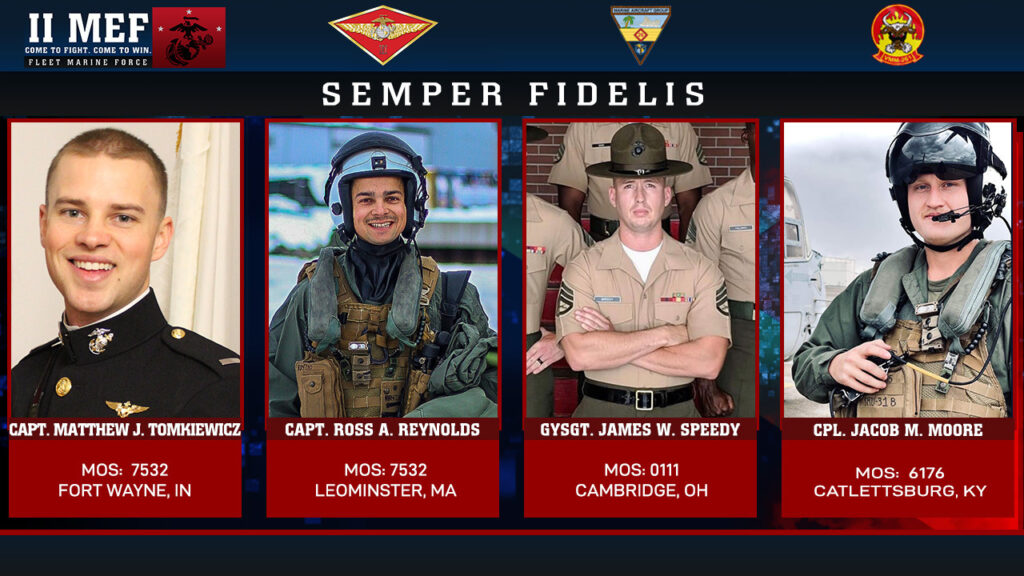
Four Marines died in a crash during a training flight south of Bodo, Norway, in support of Exercise Cold Response 2022, March 18. All four Marines were assigned to Marine Medium Tiltrotor Squadron 261. U.S. MARINE CORPS

ARLINGTON, Va. — A Marine Corps MV-22B Osprey tilt-rotor transport aircraft crashed in Norway on March 18, killing all four Marine crewmen on board. 

The Osprey, assigned to Marine Medium Tiltrotor Squadron 261 (VMM-261), based at Marine Corps Air Station New River, North Carolina, was on a flight south of Bodo, Norway, when it crashed while supporting NATO’s Exercise Cold Response 2022. 

Killed in the crash were Capt. Matthew J. Tomkiewicz of Fort Wayne, Indiana; Capt. Ross A. Reynolds of Leominster, Massachusetts; Gunnery Sgt. James W. Speedy of Cambridge, Ohio; and Cpl. Jacob M. Moore of Catlettsburg, Kentucky, according to a March 21 release from the II Marine Expeditionary Force.   

Norwegian agencies, including the Royal Norwegian Air Force’s 330 Squadron and the Hoved Redning Sentralen civil emergency and response organization led in locating the aircraft’s wreckage and in recovery of the bodies of the victims. 

“The pilots and crew were committed to accomplishing their mission and serving a cause greater than themselves,” said Maj. Gen. Michael Cederholm, commanding general, 2d Marine Aircraft Wing, in a release. “We will continue to execute the mission while keeping these Marines and their service in the forefront of our minds. We will never allow these Marines and their service to go unnoticed or unappreciated. Keep these Marines and their loved ones in your thoughts and prayers.” 

The mishap is under investigation. 


Budget Funds 37 F-35s for U.S. Naval Aviation in 2022 

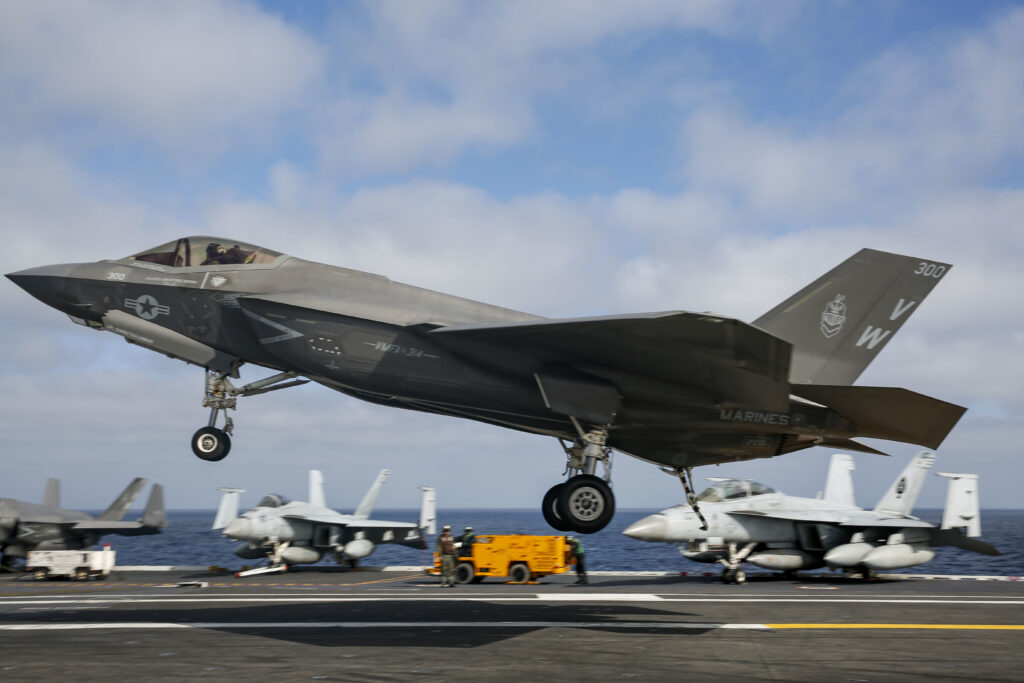
An F-35C Lightning II, assigned to the “Black Knights” of Marine Fighter Attack Squadron (VMFA) 314, prepares to land on the flight deck of the aircraft carrier USS Abraham Lincoln (CVN 72). U.S. NAVY / Mass Communication Specialist 3rd Class Michael Singley

ARLINGTON, Va. — The fiscal 2022 budget, finally signed into law almost halfway through the fiscal year, provides for 37 F-35 Lightning II strike fighters for the Navy and Marine Corps, as well as 12 FA-18 Super Hornet strike fighters. 

Of the overall 85 F-35s funded in the budget, the 37 for naval aviation include 17 F-35B short-takeoff/vertical-landing versions and five carrier-capable F-35Cs for the Marine Corps and 15 F-35Cs for the Navy, according to the F-35 Joint Program Office. The rest of the 2022 lot is comprised of 48 F-35As for the Air Force. 

The Marine Corps currently fields five F-35B and one F-35C fleet squadrons, while the Navy fields two F-35C fleet squadrons. 

Still in low-rate initial production after more than 15 years, the F-35 has not yet completed its initial operational test and evaluation.  

The Navy’s program of record for the F-35 totals 353 F-35Bs for the Marine Corps, 67 F-35Cs for the Marine Corps and 273 F-35Cs for the Navy. 

Congress, concerned about a continuing strike fighter shortage, also funded 12 more F/A-18 Super Hornet strike fighters for the Navy, continuing production for yet another year even though the service has been trying to stop the program for a few years. The Navy’s program of record for the Super Hornet through fiscal 2021 totaled 678 F/A-18E/Fs (379 F/A-18Es and 299 F/A-18Fs). The model breakdown of the 12 fiscal 2022 Super Hornets is not yet available. 


Berger: Ukraine War Demonstrates Vulnerability of Tanks to Missile-Armed Infantry 

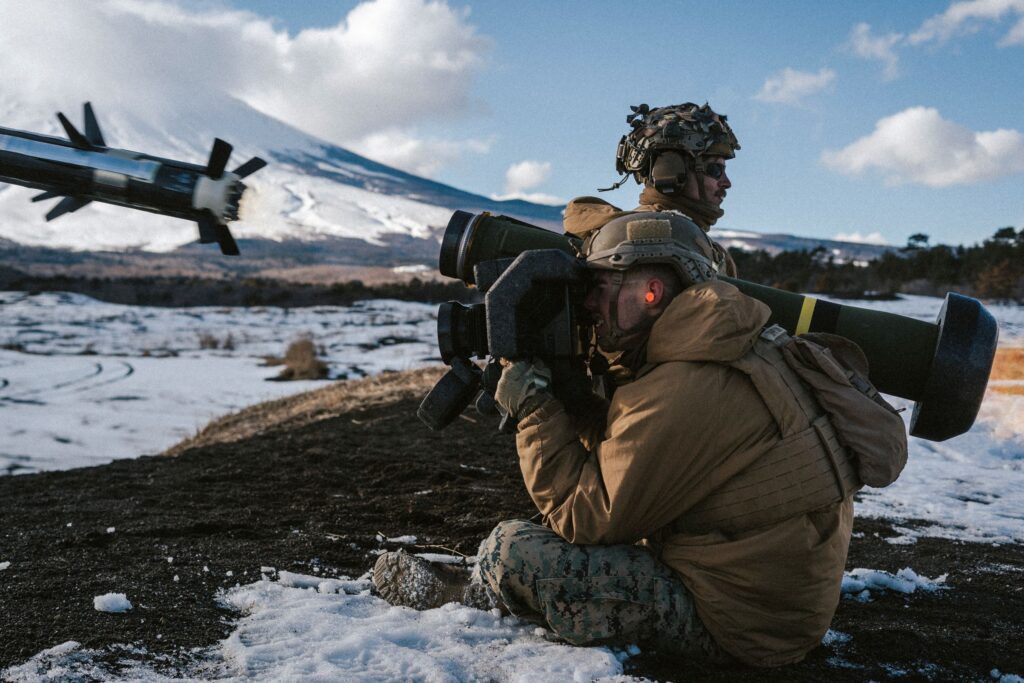
U.S. Marines with 1st Battalion, 3d Marines, 3d Marine Division fire a Javelin shoulder-fired anti-tank missile while conducting squad attacks during Fuji Viper 22.3 at Combined Arms Training Center, Camp Fuji, Japan, Feb. 17. Javelins have proven to be effective against tanks in Ukraine and elsewhere. U.S. MARINE CORPS / Cpl. Juan Carpanzano

WASHINGTON — The success of Ukrainian forces in countering Russian armored vehicle columns with missiles and rockets in the ongoing Russian invasion of Ukraine shows the vulnerability of tanks to missile-armed infantry, the Marine Corps commandant said, and seemed to reinforce his decision to shed tanks from the Corps as part of his Force Design 2030 concept.    

During a live-streamed conversation with Washington Post columnist David Ignatius, Gen. David Berger said the Russian forces seemed to be ineffective in using a combined arms approach in that they were not using “maneuver to bolster your fires or using fires to set up your forces for maneuver. In both cases, one without the other … is very ineffective.” 

Berger also said Ukrainian forces seemed to be effective at causing confusion among Russian forces by stripping away Russian reconnaissance — which he said parenthetically that U.S. Marines “were very, very good at.”  

The commandant also noted Russian forces seemed to have planned for a very short war and lost momentum with poor logistics planning. He said the Ukrainian forces seemed to be able to strike at the Russian “logistics backside.”  

Berger noted that amphibious operations are very complex and the Russian forces seemed to unnecessarily delay their limited amphibious operations. He said amphibious operations remain very much the core mission of the Corps.    

 “Amphibious landings, amphibious assault, forcible entry — things which Marines are known for for 70 years — we’ll continue to do but in a very different way,” Berger said. “Why? Because the character of war is changing. We need to change with it. 

“Instead of tank-on-tank formations, I would say if you look at Armenia and Azerbaijan, Lebanon, or even right now in Ukraine, it’s pretty clear the top-down missile attacks on the top side of heavy armor makes [tanks] pretty vulnerable,” he said.  

The Javelin missiles supplied by the United States to Ukraine have a vertical attack mode. 

“Tanks did tremendous work for us for many years in many different scenarios,” Berger said. “Going forward, they are heavier, too difficult to logistically support, and in some cases too vulnerable to attack from a proliferation of very inexpensive missiles. 

“So, in some cases, we’ve let go of things that were very successful in the past in order to move towards things that we are going to need in the future,” he said. “The aviation/ground/logistics team — that’s the strength of the Marine Corps having it all organic — we are an enabler for the joint force. We’re the first ones on the scene to figure it out. We need the mobility to do that, which means we need amphibious ships, which [are] critical for the nation to have. 

“You need to have the ability — I would say especially today in Ukraine — to have a crisis response force from the sea,” he said. “That means we need to have the number of amphibious ships necessary to global in the pacific or the Mediterranean. For the U.S., that’s 31 amphibious ships we have to have in order to do what the nation needs us to do.” 


MH-60R Helicopters Approved by State Dept. for Spain 

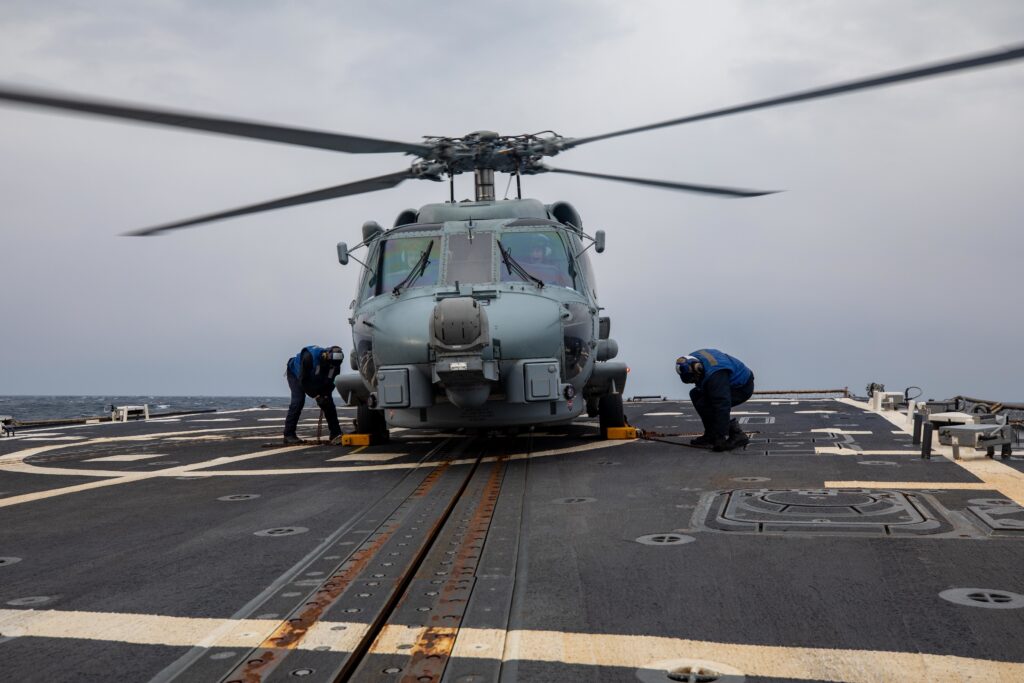
Boatswain’s Mate Seaman Armando Herrera, left, and Boatswain’s Mate 3rd Class Clifford Turner remove chocks and chains from a MH-60R Seahawk helicopter aboard the Arleigh Burke-class guided-missile destroyer USS Roosevelt (DDG 80), March 13. U.S. NAVY / Mass Communication Specialist 2nd Class Andrea Rumple

WASHINGTON — The U.S. State Department has approved the possible Foreign Military Sale of MH-60R Seahawk helicopters along with support and related equipment to Spain, the Defense Security Cooperation Agency said March 15. 

The DSCA said the total cost of the program would be approximately $950 million. Approved was the possible sale of eight MH-60Rs, built by Lockheed Martin. 

The sale also would include engines, avionics, data links and other communications systems, APS-153 radars, electronic countermeasures and support systems, Airborne Low-Frequency Sonars, rocket launchers, AGM-114R(N) Hellfire missiles, Advanced Precision Kill Weapon System rockets, GAU-21 machine guns, and sonobuoys, as well as a flight simulator, spare parts, publications, training, engineering, logistics, ferry and technical support.  

“The proposed sale will improve Spain’s capability to meet current and future threats. The MH-60R Multi-Mission Helicopter will provide the capability to perform anti-surface and anti-submarine warfare missions along with the ability to perform secondary missions including vertical replenishment, search and rescue, and communications relay and will bolster the Spanish navy’s ability to support NATO and remain interoperable with the U.S. and the NATO alliance,” the announcement said.  

Spain currently operates SH-60F versions of the Seahawk. 

Spain would become the eighth nation to procure the MH-60R. The MH-60R is in service with the U.S. Navy, Australian navy, Danish navy, Saudi navy, and Indian navy. Greece and the Republic of Korea also have ordered MH-60Rs. 


Carrier Aircraft Operate Over Yellow Sea in Response to North Korean ICBMs 

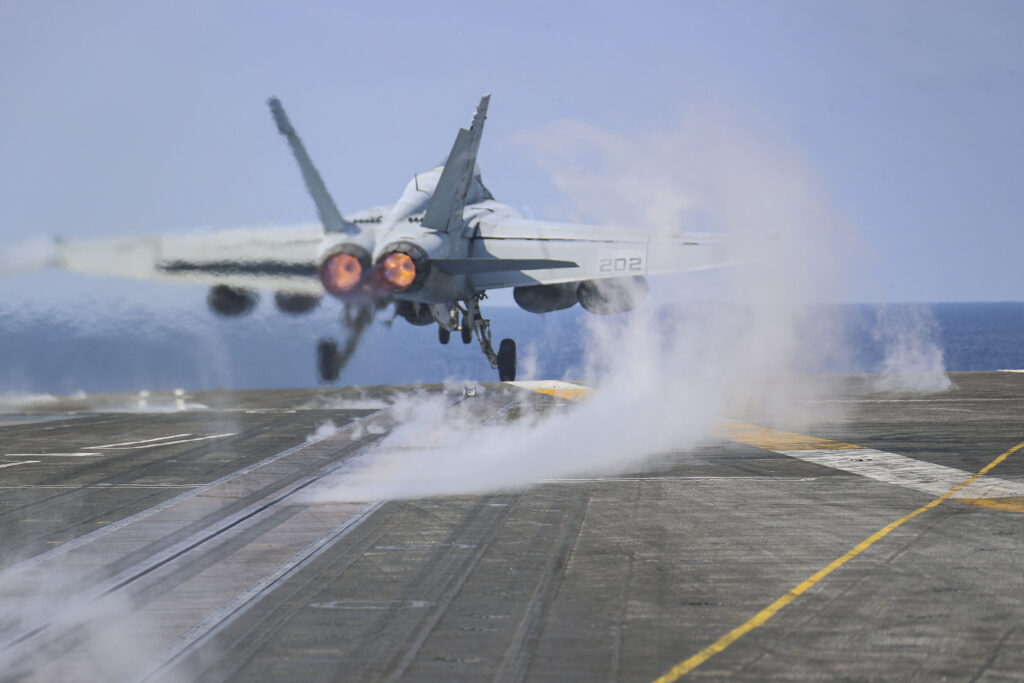
An F/A-18E Super Hornet, assigned to the “Tophatters” of Strike Fighter Squadron (VFA) 14, launches from the flight deck of the Nimitz-class aircraft carrier USS Abraham Lincoln (CVN 72) on March 15. U.S. NAVY / Mass Communication Specialist 3rd Class Javier Reyes

ARLINGTON, Va. — U.S. Navy and Marine Corps operated over the Yellow Sea off the west coast of North Korea in a demonstration in response to North Korean launches of intercontinental ballistic missiles. 

USS Abraham Lincoln (CVN 72), deployed in the Western Pacific region, launched F-35C Lightning II and F/A-18 Super Hornet strike fighters assigned to Carrier Air Wing Nine into international airspace over the Yellow Sea, which was described as “a demonstration of our resolve and commitment to our regional allies,” in a March 15 release from U.S. 7th Fleet.  

The flights were in response to the launch of two ICBMs by the Democratic People’s Republic of Korea on Feb. 27 and March 5, respectively.  

The F-35Cs are assigned to Marine Fighter Attack Squadron 314, which have taken the Marine Corps’ F-35Cs on their first deployment. 

In addition, the U.S. Air Force aircraft based in the region also participated.  

The U.S. Indo-Pacific Command has increased reconnaissance and surveillance collection efforts in the Yellow Sea, while U.S. forces in Korea have increased the posture of ballistic-missile defense in South Korea, 

“The ICBM launches by DPRK are a brazen violation of multiple UN Security Council resolutions — as well as its international commitments — and pose a threat to regional neighbors and the international community,” the release said.

“We have made clear our growing concern over the significant increase in DPRK’s missile testing, and we will continue to take all necessary measures to ensure the security of the United States and our allies. We remain in close coordination with our allies and partners to address the threats posed by the DPRK. Our commitment to the defense of the Republic of Korea and Japan remains ironclad.”