Congress Orders Navy to ‘Buy American’ for Some Ship Components
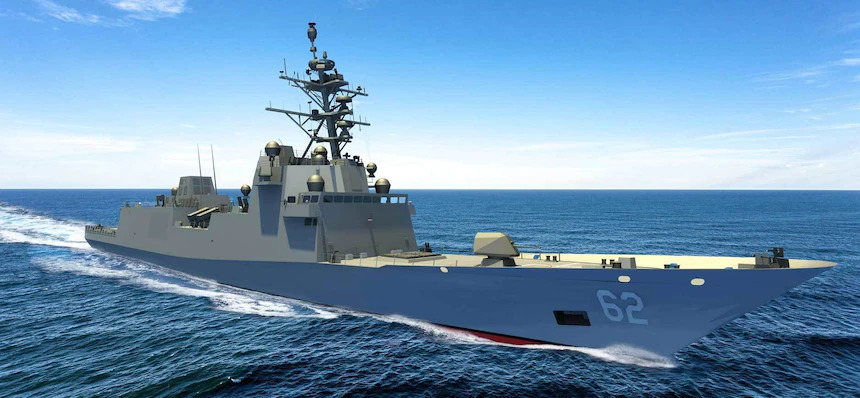
The new budget bill calls for the 11th and subsequent Constellation-class guided-missile frigates to have many of its components purchased from American companies. U.S. NAVY
ARLINGTON, Va. — Buried deep in the text of the 2022 budget bill signed into law March 15 by the president are certain provisions to force the Navy to “buy American,” purchasing from U.S. companies many of the components and systems that will be installed on some new-construction ships for the U.S Navy and Military Sealift Command.
For the 11th Constellation-class guided-missile frigate and subsequent, the Navy is forbidden to award new contracts unless the following components are manufactured in the United States: air circuit breakers; gyrocompasses; electronic navigation chart systems; steering controls; pumps; propulsion and machinery control systems; totally enclosed lifeboats; auxiliary equipment pumps; shipboard cranes; auxiliary chill water systems; and propulsion propellers, provided that the Navy “shall incorporate United States-manufactured propulsion engines and propulsion reduction gears into the [frigate] program beginning not later than with the eleventh ship of the program.”
For the seventh and subsequent John Lewis-class fleet replenishment ships, for example, the Navy is forbidden to fund purchase of the following components unless they are manufactured in the United States: auxiliary equipment (including pumps) for shipboard services; propulsion equipment (including engines, reduction gears, and propellers); shipboard cranes; spreaders for shipboard cranes; and anchor chains.
Similarly, for the T-ARC(X) cable-laying ship and T-AGOS(X) ocean surveillance ship programs, the Navy is forbidden to use funds for a new contract for “requirements development, performance specification development, concept design and development, ship configuration development, systems engineering, naval architecture, marine engineering, operations research analysis, industry studies, preliminary design, development of the Detailed Design and Construction Request for Proposals solicitation package, or related activities … unless these contracts include specifications that all auxiliary equipment, including pumps and propulsion shafts, are manufactured in the United States.”
Russian Navy Blockades Ukraine’s Coast, Continues Missile Strikes
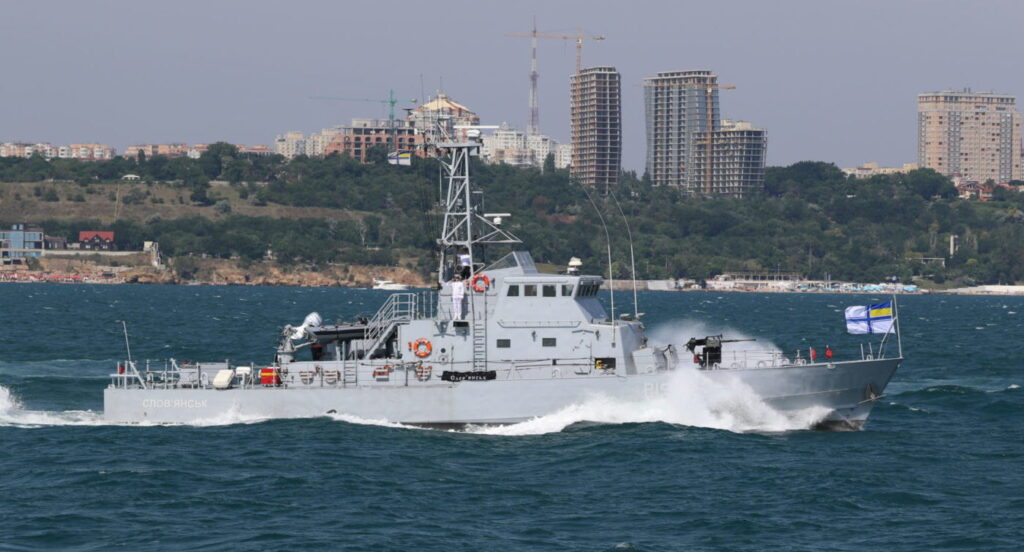
The Ukrainian Slovyansk, formerly the U.S. Coast Guard Island-class cutter Cushing, was reportedly destroyed on March 3. WIKIPEDIA
ARLINGTON, Va. — The Russian Black Sea Fleet has set up a naval blockade of Ukrainian ports along the Black Sea, a United Kingdom defense official said, and is continuing fire support of the Russian invasion of Ukraine.
“The [U.K.] Ministry of Defence’s Defence Intelligence said Russian naval forces have established a distant blockade of Ukraine’s Black Sea coast, effectively isolating Ukraine from international maritime trade,” Air Vice-Marshal Mick Smeath, British defence attaché in Washington, said in a March 13 release.
While the Russian navy has taken a lesser role than its army counterparts in the invasion of Ukraine, it has taken part in offensive operations and amphibious warfare.
“Russian naval forces are also continuing to conduct missile strikes against targets throughout Ukraine,” Smeath said.
Some Russian navy warships are equipped with Kalibr cruise missiles.
Russian naval infantry — the equivalent of U.S. Marines — have landed ashore in Ukraine to participate in the campaign in southeastern Ukraine.
“Russia has already conducted one amphibious landing in the Sea of Azov and could look to conduct further such operations in the coming weeks,” Smeath said.
Ukraine’s main port on the Black Sea, Odesa, remains in Ukrainian hands.
Press reports have said that a Ukrainian patrol boat — the Slovyansk, formerly the U.S. Coast Guard Island-class cutter Cushing — was destroyed by a Russian aircraft on March 3.
A Russian patrol boat, the Vasily Bykov, reportedly was severely damaged and sunk on March 7 by rockets launched by a Ukrainian battery, according to press reports.
Some of the Russian ships in the region entered the Black Sea after a transit from Russia’s Baltic Sea and Northern Fleet. These included several amphibious warfare ships and missile-armed surface warships.
Aquilino: Fuel Logistics to Be Dispersed in Wake of Red Hill Closure
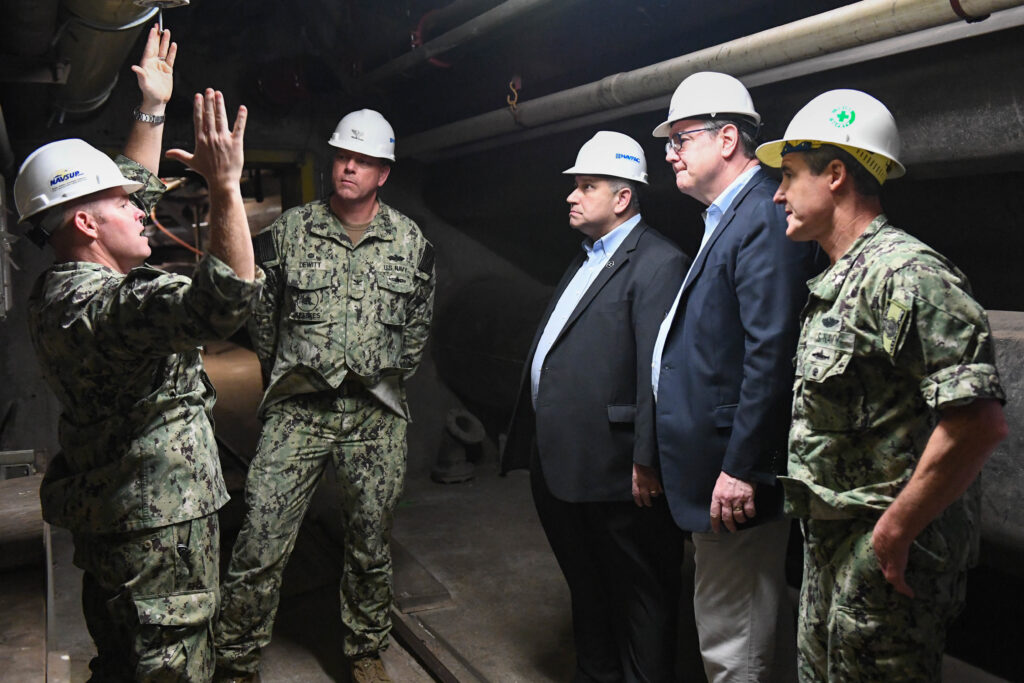
Secretary of the Navy Carlos Del Toro and General Counsel, Department of the Navy John P. “Sean” Coffey receive a brief on well operation and recovery initiatives from Capt. Burt Hornyak, commanding officer, Fleet Logistics Center Pearl Harbor during a tour of the Red Hill Well in Aiea, Hawaii, in February. U.S. NAVY / Mass Communication Specialist 2nd Class Chelsea D. Meiller
WASHINGTON — The commander of U.S. forces in the Indo-Pacific region addressed concerns from Congress about the impact of the closure of the Red Hill fuel depot in Hawaii during March 9 testimony on Capitol Hill.
Rep. Mike Rogers, ranking member of the House Armed Services Committee, said in his opening remarks that Navy Secretary Carlos Del Toro’s decision to close Red Hill was made “without laying out the resources to replace that capacity. That’s extremely short-sighted. The response from the department has been the same: the answer is just one policy announcement away. And that’s unacceptable.”
Rogers told Adm. John C. Aquilino, commander, U.S. Indo-Pacific Command, that “he wanted to hear how Indo-Pacific Command will implement new operational concepts and new systems to ensure that logistics support at new operating locations throughout the Indo-Pacific.
“But most importantly, I want to know how you intend to do that in the next five years,” Rogers said. “We all know China is not going to give us 10 to 20 years to prepare for conflict. We simply cannot procrastinate any further. The issue like Red Hill presents an opportunity to modernize beyond the World War II logistics model. But I’m deeply worried about the cycle of indecision and procrastination at the Pentagon.”
Aquilino said that as senior leadership looked at options with regard to Red Hill, three criteria had to be met: clean water for the people of Hawaii, service members and their families; meeting the war plan and warfighting requirements; and cost.
“We developed a plan that actually goes in alignment with a more distributed plan — both forward- and land-based — combined with a sea-based component to allow for a more distributed, survivable, resilient network of fuels, as well as meeting all of the security and the strategic fuel reserve requirements,” the admiral said. “I actually think that we’re going to be in a better place, and we meet all three requirements.”
Aquilino said the Department of Defense, the Environmental Protection Agency and the Hawaii Department of Health are working together toward a solution.
“We will go as fast as safe allows,” he said. “We have to make sure the facility is safe, to transfer that fuel into places that we’re going to end it, but we’re certainly not waiting. As soon as we can get it done, we’ll be ready to move, and as soon as we’re able to contract some of those other facilities, as well as the sea-based option.”
The Defense Department had announced the Red Hill facility would be closed within the year.
“That just allows us to be able to distribute that fuel with the contract requirements, the sea-based requirements, and the need to put it in the correct spots,” Aquilino said.
Patrol Ship USS Tempest Decommissioned in Bahrain
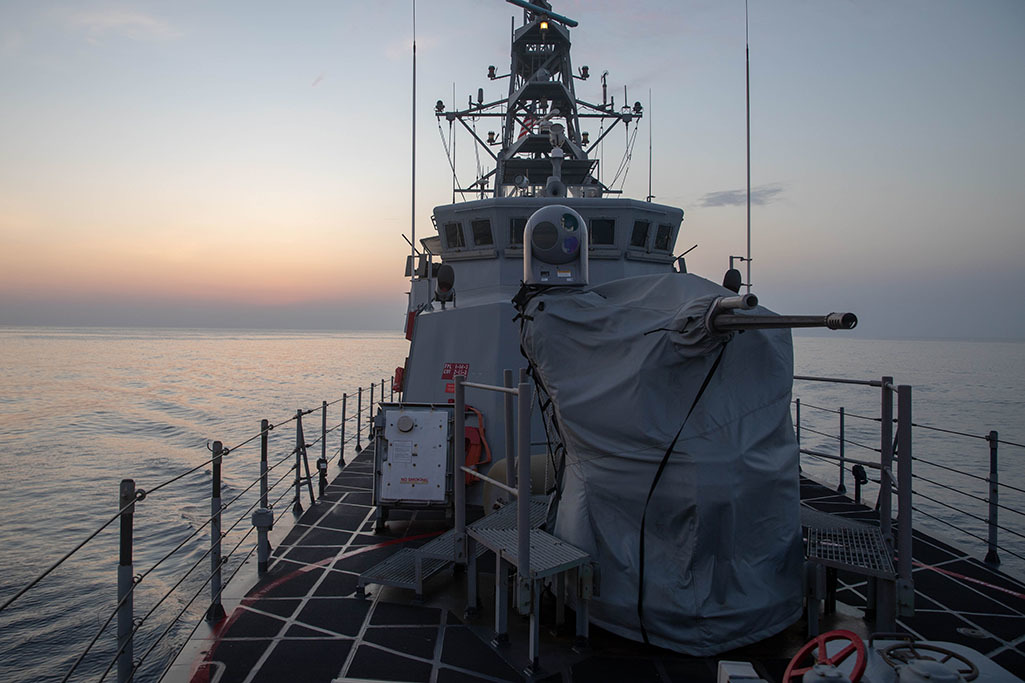
Patrol coastal ship USS Tempest (PC 2) transits the Arabian Gulf, July 20, 2021. U.S. ARMY / Spc. Joseph DeLuco
ARLINGTON, Va. — The coastal patrol ship USS Tempest (PC 2) was decommissioned in ceremonies held March 7 at Naval Support Activity Bahrain after 29 years of service.
The Tempest, the oldest serving PC, is the third PC of the U.S. 5th Fleet to be decommissioned this year. Its retirement was preceded in February by USS Firebolt and USS Typhoon. Lt. Cmdr. Matthew J. Intoccia was Tempest’s last commanding officer. Seven PCs remain in service in the 5th Fleet.
The 179-foot-long Tempest was built by Bollinger Shipyards in Lockport, Louisiana, and was commissioned Aug. 21, 1993. After serving off Haiti in 1994 in support of Operations Uphold Democracy and Restore Democracy. After 9/11, the Tempest patrolled the coast of the United States in support of Operation Noble Eagle.
With the Coast Guard needing more capacity for maritime security patrols, the Navy transferred five PCs to the Coast Guard, first in an “in commission, special” status, then decommissioned for full transfer to the Coast Guard. Tempest became WPC 2 on 1 October 2004. The ship was returned to the Navy on Aug. 22, 2008, and recommissioned into the Navy’s fleet as PC 2 on Aug. 23. 2008. The Tempest had been assigned to the 5th Fleet since 2013.
In an interview published on the 5th Fleet website, Intoccia said the “capstone of my time on Tempest is undoubtedly our last patrol. I consider it a culmination of all the hard work and dedication over our past 18 months. Together, with our battle buddy USS Typhoon and our embarked U.S. Coast Guard team, we conducted multiple interdictions with a high seizure yield. In my opinion, we reached the apex of the ship’s capability during that patrol, and I could not be more proud of my crew’s performance.
“I hope Tempest is remembered as a capable bastion of our nation’s commitment to free and unimpeded navigation in the maritime domain, and for her rich legacy of joint and multinational cooperation,” he said. “Small in stature and crew but mighty in deed, Tempest has been operated by our country’s best during 29 years of U.S. Navy service.”
U.S. Naval Aviation No Stranger to Southeast Europe Operations
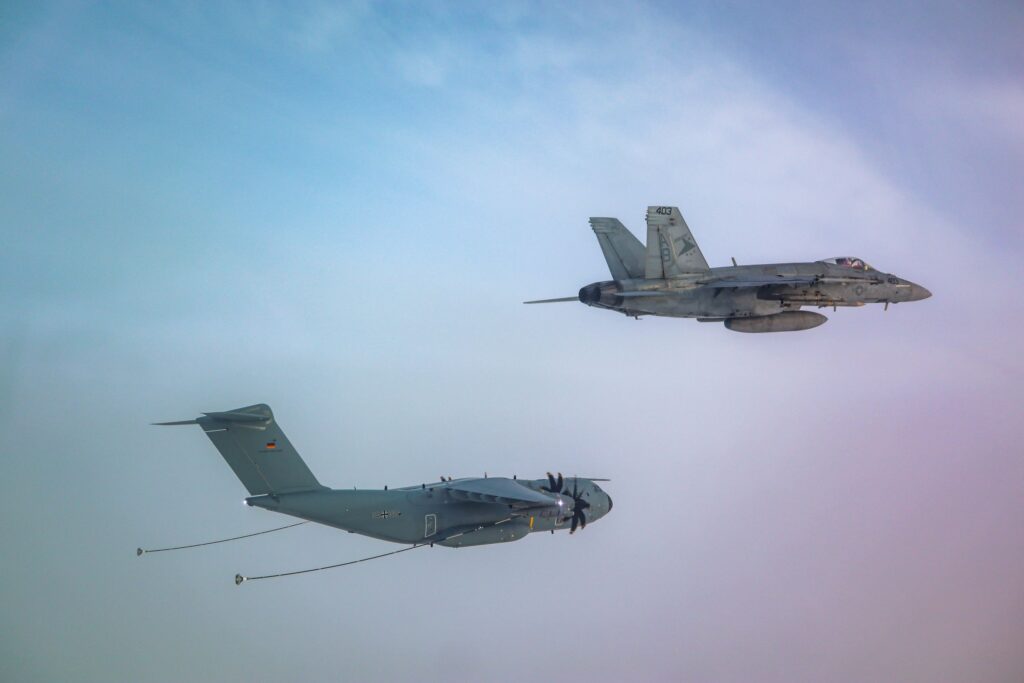
A German air force A400M tanker, left, and an F/A-18E Super Hornet, attached to the “Sunliners” of Strike Fighter Squadron (VFA) 81, fly over the north Aegean Sea March 4. ELECTRONIC ATTACK SQUADRON 137
ARLINGTON, Va. — The skies over southeast Europe are not normally associated with the history of U.S. naval aviation, but the current patrols being flown over the region by Navy aircraft from the aircraft carrier U.S Harry S. Truman are just the latest of at least three operations conducted by U.S. naval aviation in the region since the end of the Cold War. The Russian invasion of Ukraine has triggered the latest operations.
The USS Harry S. Truman carrier strike group, with Carrier Air Wing One (CVW-1) embarked in the carrier, is deployed to the Mediterranean, operating in support of NATO operations. The CSG has operated in the restrictive waters of the Adriatic Sea and the Aegean Sea on this deployment as well. The routine deployment also is showing the value of forward-deployed naval forces, available on short notice to respond to international crises.
“Conducting enhanced Air Policing from North Aegean waters further illustrates NATO’s continued ability to share and pool existing capabilities,” said Rear Adm. Curt Renshaw, commander, Carrier Strike Group Eight, in a March 7 release from the U.S. 6th Fleet. “We set out to prove that this dynamic employment of an aircraft carrier — in pretty restrictive waters — could be done, and in doing so, we have demonstrated the enduring U.S. commitment to Allies.”
U.S. carriers in the region provided air cover and close air support in the early-to-mid-1990s during Operations Deliberate Force and Deny Flight during the civil wars that broke out as Yugoslavia splintered eventually into seven separate nations.
In 1999, during Operation Allied Force, U.S. carriers in the Adriatic Sea launched strikes into Serbia and Kosovo to protect the Kosovars from Serbian action. Navy P-3C Orion patrol aircraft also launched Standoff Land-Attack Missiles against Serbian targets. Navy and Marine Corps EA-6B and F/A-18 aircraft operated from bases in Italy as well.
In recent years, Navy P-3, P-8, and EP-3 maritime patrol reconnaissance aircraft expanded patrols over the Black Sea region.
This week, CVW-1 aircraft, including F/A-18E/F Super Hornet strike fighters and EA-18G Growler electronic attack aircraft, have flown patrols in the region to defend NATO nations’ airspace as part of the NATO Response Force. The squadrons conducting the patrols include strike fighter squadrons VFA-11, VFA-34, VFA-81 and VFA-211 as well as electronic attack squadron VAQ-137.
In recent weeks, CVW-1’s squadrons also have flown in training exercises with the Romanian and Italian air forces.
Marine Crew Ejects from F/A-18D Before Crash on Plantation
An F/A-18D Hornet from Marine All-Weather Fighter Attack Squadron (VMFA) 533 conducts air operations and maritime surface warfare training with the guided-missile cruiser USS Monterey (CG 61), not pictured, in 2016. U.S. NAVY / Mass Communication Specialist 2nd Class William Jenkins
ARLINGTON, Va. — A Marine Corps F/A-18D Hornet strike fighter crashed shortly near Beaufort, South Carolina on March 3, according to the 2nd Marine Aircraft Wing.
The two Marines in the crew ejected safely and incurred no injuries, the Wing said in a release, which said the crash occurred approximately 3:15 p.m.
“The aircraft crashed in an unpopulated area near Marine Corps Air Station Beaufort, South Carolina, and there was no damage to civilian property,” the Wing said.
According to television station WJCL, the Hornet crashed on the Coosaw Plantation owned by former South Carolina governor Mark Sanford.
The Hornet, assigned to the Hawks of Marine All-Weather Fighter Attack Squadron 533 (VMFA(AW)-533), a unit of Marine Aircraft Group 31. The squadron is one of four Hornet squadrons based at MCAS Beaufort.
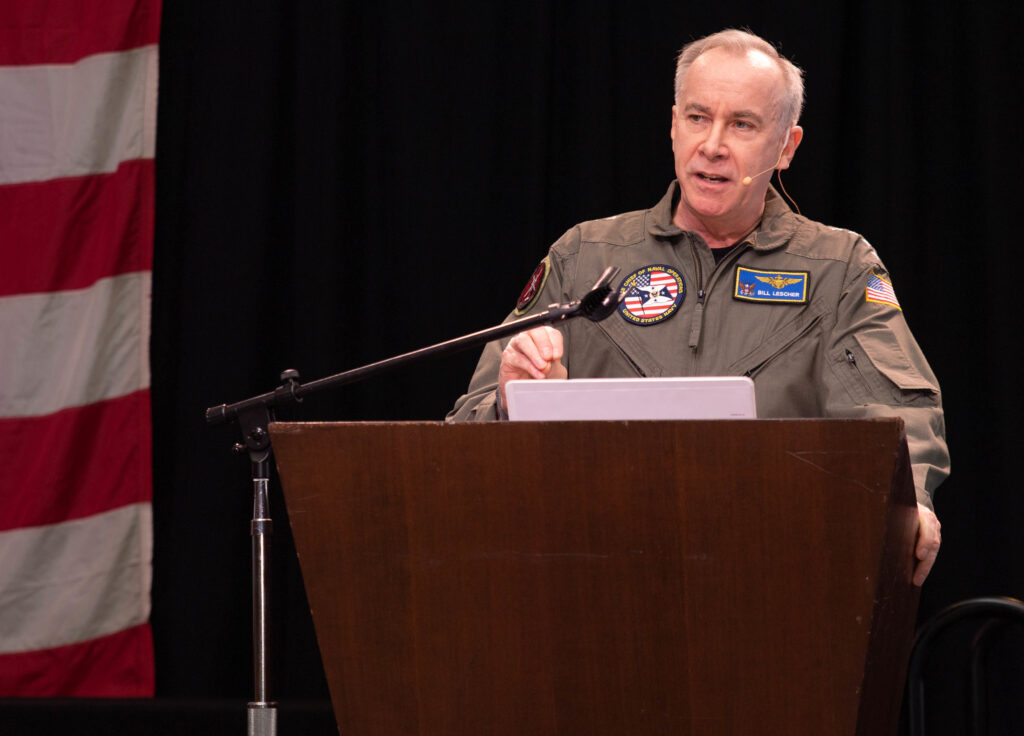
Adm. William Lescher, vice chief of naval operations, speaks to Naval Aviators at the 2021 Naval Helicopter Association Symposium. U.S. NAVY / Mass Communication Specialist 2nd Class Chelsea D. Meiller
ARLINGTON, Va. — Retention of Sailors in the fleet is going well but the demographics trend for recruiting is getting tougher, said the vice chief of naval operations, who also explained the efforts to reduce the shortage of Sailors on the Navy’s surface ships.
“We’re very focused on retention, and it’s strong right now,” said VCNO, Adm. William K. Lescher, testifying March 3 before a joint hearing of the Seapower and Projection Forces subcommittee and Readiness subcommittee of the House Armed Services Committee. “It’s at a very strong level.
“Part of the reason we’re focusing on it is because recruiting is becoming increasingly difficult for all the services and even more broadly,” Lescher said. “The last data I [saw] showed that that portion of the U.S. population that’s eligible to serve, their propensity to serve from 2018 was 13% and to 2021 is now 10%. All of the service recruiters are seeing symptoms of the ‘great resignation’ and/or a labor market that is so tough that at our new-construction shipyards, our repair shipyards, our aviation depots, all are struggling to bring in — we’re all competing for — the same talented group. So, we’re laser-focused on that.”
During the hearing, Rep. Sara Jacobs (D-California) cited a Government Accountability Office report that found the surface fleet is 15% undermanned compared with required levels, since under-manning was part of the reason for the 2017 collisions involving the destroyers USS Fitzgerald and USS John McCain.
In response, Lescher pointed out the Navy has increased its end-strength by 23,000 personnel since those incidents and is “getting very much after it [the under-manning]. Part of the reason that it remains under-manned is because we have been adding billets as well. … As we add billets to address the overwork issue and make sure the crew is sized for everything that is expected of it, we’re then chasing that with our accessions. So, we’re closing the gaps across the Navy.”
The VCNO said “the other element is strong certification and focus on the manning that we deploy our ships with. The remaining work we have to get after with a strong sense of urgency is across the full OFRP [Optimized Fleet Readiness Plan] cycle as well.”
Also testifying was Vice Adm. Roy Kitchener, commander, Naval Surface Forces, who spoke on the use of data for the last year in a program involving tracking expertise and proficiency in six shipboard rates, or Sailor job specialties, in engineering and combat systems.
“We track each individual and what their proficiency and experience are, and then we are able to put them where we think we need them,” Kitchener said. “For example, if a ship is down in a number of years of experience in an engineering work center or an Aegis fire control system, we can actually make sure we send the right person there that increases the proficiency. It’s a much better measure of fit. … Right now, it’s part of the manning process. We’re using it extensively to fill those gaps at sea … making sure that we have the right people to go there.”
Kitchener said the results to date are “very encouraging” and “it’s a metric that we’re going to continue to go after to allow us to make sure we have that manning right on the ship.”
Navy Patrol Ship USS Typhoon Decommissioned
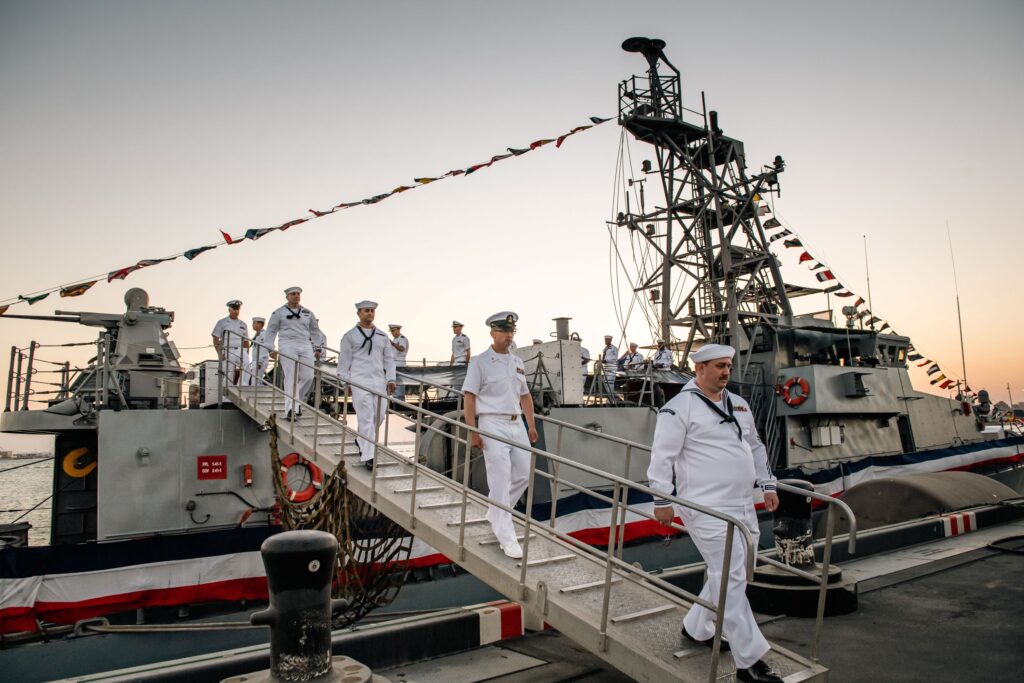
Sailors disembark patrol coastal ship USS Typhoon (PC 5) during the ship’s decommissioning ceremony at Naval Support Activity Bahrain. Typhoon commissioned in 1994 and began conducting routine coastal patrol operations under U.S. 5th Fleet in 2004. U.S. NAVY / Mass Communication Specialist 2nd Class Dawson Roth
ARLINGTON, Va. — A second Cyclone-class coastal patrol ship has been retired from the fleet in the Persian Gulf. USS Typhoon (PC 5) was decommissioned in Manama, Bahrain, on Feb. 28 after 28 years of service, a few days after its sister ship, USS Firebolt (PC 10), was decommissioned on Feb. 23.
The event drops to eight the number of Cyclone-class PCs forward deployed to the U.S. 5th Fleet. Three PCs based in the United States were decommissioned last year, leaving the rest of the class in the Persian Gulf.
The 174-foot-long, 375-ton Typhoon was built by Bollinger Shipyards in Lockport, Louisiana, and commissioned in Tampa, Florida, Feb. 12, 1994.
During the late 1990s and early 2000s, the Typhoon deployed to the Mediterranean and Baltic seas. It was forward to the 5th Fleet in 2004. In the Persian Gulf and Arabian Sea, the Typhoon conducted maritime security patrols, including anti-piracy and anti-smuggling operations, security patrols for offshore oil rigs and terminals, and shipping escort.
The Typhoon and its sister ships will be replaced in the Persian Gulf by forward-deployed littoral combat ships beginning in 2022.
Navy’s Second F-35C Fleet Squadron Declared Safe for Flight
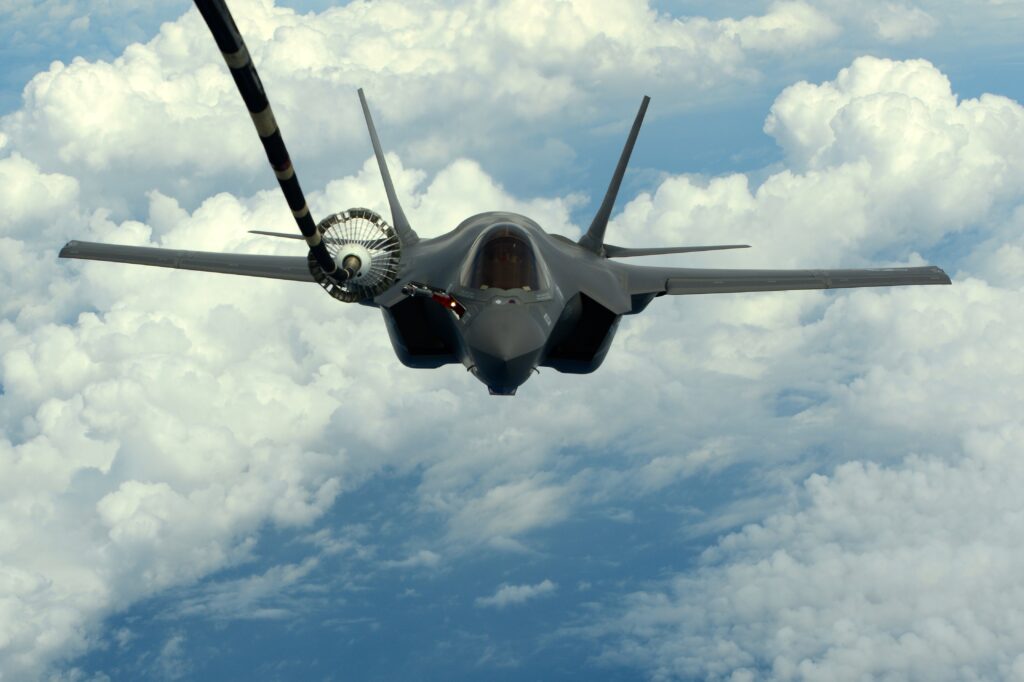
A Navy F-35C Lightning II is drogue refueled by a KC-10A during a training mission near Eglin Air Force Base, Florida, in 2015. U.S. AIR FORCE /Staff Sgt. Brian Kelly
ARLINGTON, Va. — The Navy’s second fleet squadron to operate the F-35C Lightning II strike fighter has been declared safe for flight in that aircraft.
Strike Fighter Squadron 97 (VFA-97) — the Warhawks — reached that status Feb. 18, a few days after VFA-147, the first fleet F-35C squadron, returned on board USS Carl Vinson (CVN 70) from the first F-35C deployment.
The first Marine Corps F-35C squadron, Marine Fighter Attack Squadron 314, currently is deployed to the Indo-Pacific region on board USS Abraham Lincoln (CVN 72).
VFA-97, which began transition to the F-35C in February 2021, had operated the F/A-18E Super Hornet strike fighter since 2013, when it had upgraded from the F/A-18C version.
The Warhawks were established on June 1, 1967, as an A-7 Corsair II squadron and were deployed the next year to the Vietnam War.
Atlantic Fleet Name a No-Go, for Now
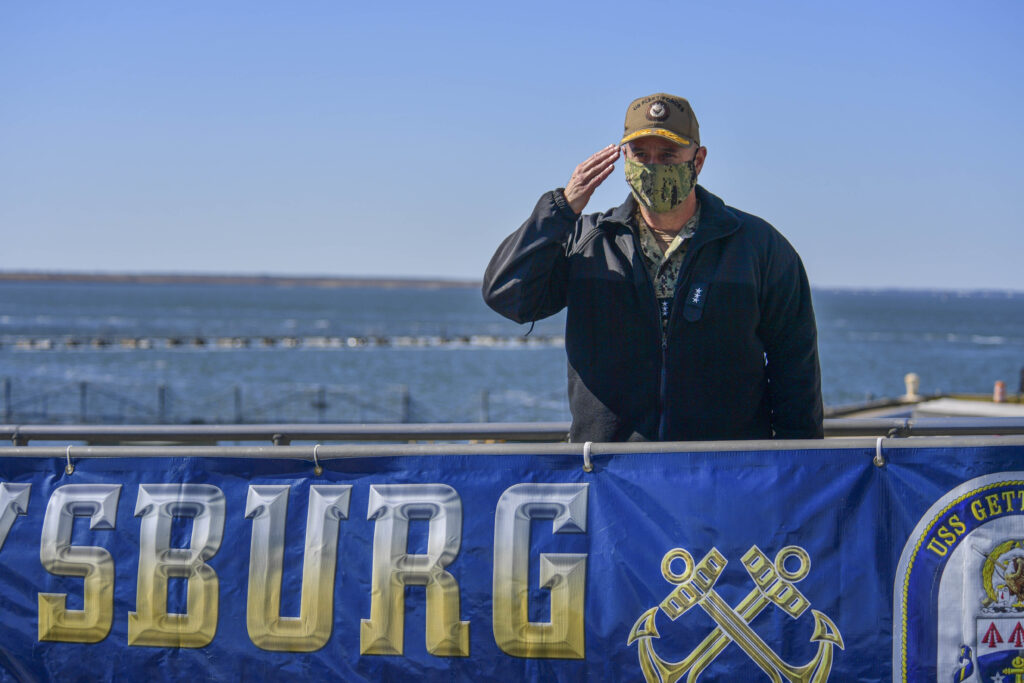
Vice Adm. James Kilby, deputy commander, U.S. Fleet Forces Command, departs the Ticonderoga-class guided-missile cruiser USS Gettysburg (CG-64), following a visit to the ship, Feb. 10. Plans to redesignate Fleet Forces Command as the U.S. Atlantic Fleet appear to have been abandoned. U.S. NAVY / Mass Communication Specialist 1st Class Jacob Milham
ARLINGTON, Va. — Just over a year ago, the president approved the proposal to re-designate the U.S. Fleet Forces Command as the U.S. Atlantic Fleet. The proposal — for now, at least — is in the dustbin of history.
In January 2021, shortly before leaving office, the re-designation was approved by then-President Donald Trump. Now, more than a year later, the proposal has not been enacted.
“From my understanding, that proposal was not forwarded following the Global Posture Review,” said Capt. Jereal Dorsey, special assistant for public affairs for the secretary of the Navy, in response to a query from Seapower.
The Defense Department’s Global Posture Review was ordered by President Joe Biden on Feb. 4, 2021, and its recommendations were approved by him in November 2021. The Navy said in the interim that the renaming proposal for U.S. Fleet Forces Command would depend on the results of that review.
The original commander, U.S. Atlantic Fleet staff, had a long pedigree that began in 1906, when the North Atlantic Squadron and South Atlantic Squadron were combined. The fleet existed in various forms until 2006, when the chief of naval operations renamed Commander, U.S. Atlantic Fleet, to Commander, U.S. Fleet Forces Command, which assumed the duties of the former fleet plus the mission of the former Commander, Fleet Forces Command, which was “to serve as the primary advocate for fleet personnel, training, requirements, maintenance and operations issues,” according to the U.S. Fleet Forces Command website.
The re-designation plan originally was announced by then-Navy Secretary Kenneth J. Braithwaite, testifying Dec. 2, 2020, before the Readiness and Management Support subcommittee of the Senate Armed Services Committee, noting the changing world requires that the Navy must evolve to meet the threat.
Atlantic Theater Challenges
“Our existing structure operates on the premise that we still live in a post-9/11 state, where NATO’s flanks are secure, the Russian Fleet is tied to the pier, and terrorism is our biggest problem,” Braithwaite said. “That is not the world of today. As the world changes, we must be bold, evolved, and change with it. Instead of perpetuating a structure designed to support Joint Forces Command, we are aligning to today’s threat.
“To meet the maritime challenges of the Atlantic Theater, we will rename Fleet Forces Command as the U.S. Atlantic Fleet and will refocus our naval forces in this important region on their original mission, to controlling the maritime approaches to the United States and those of our allies,” he said. “The Atlantic Fleet will confront the reassertive Russian navy, which has been deploying closer and closer to our East Coast with a tailored maritime presence, capability and lethality.”
Speaking Jan. 11, 2021, in a webinar of the Surface Navy Association convention, CNO Adm. Michael Gilday discussed the pros of the redesignation.
“It underscores the importance of the Atlantic in a way that the title ‘Fleet Forces’ doesn’t,” Gilday said. “It actually is a testament to recent tangible decisions that we made to increase our power in that body of water, to include bringing 2nd Fleet back, standing up SubGru 2 [Submarine Group 2]. It will also include standing up [NATO’s] Joint Force Command Norfolk, which is focused on the Atlantic.”
Gilday said, “in a day and age when the homeland is no longer a sanctuary, and homeland defense is at the fore of every plan the combatant commanders have put together, the name ‘Atlantic Fleet’ always carries some gravitas with respect to defense of the nation.”
He noted the complexity of the re-designation, saying the command “also has responsibilities as a component [command] for [U.S.] Northern Command and the Eastern Pacific that extend up to the Arctic as well as their role as component of the [U.S] Strategic Command. They really have a global responsibility with respect to the command and control of our SSBNs [ballistic-missile submarines].”
Adm. Christopher W. Grady, then-commander, U.S. Fleet Forces Command, seconded the complexity in a Jan. 13, 2021, webinar at the convention, noting the downside “might be that we would lose emphasis on what we do for the homeland. Indeed, I control forces in both the Pacific and down south [in U.S. Southern Command area of responsibility].
“So, we will balance all that, and in the end the name change is an important branding opportunity, and we will move out on that,” Grady said.
Grady is now vice chairman of the Joint Chiefs of Staff.