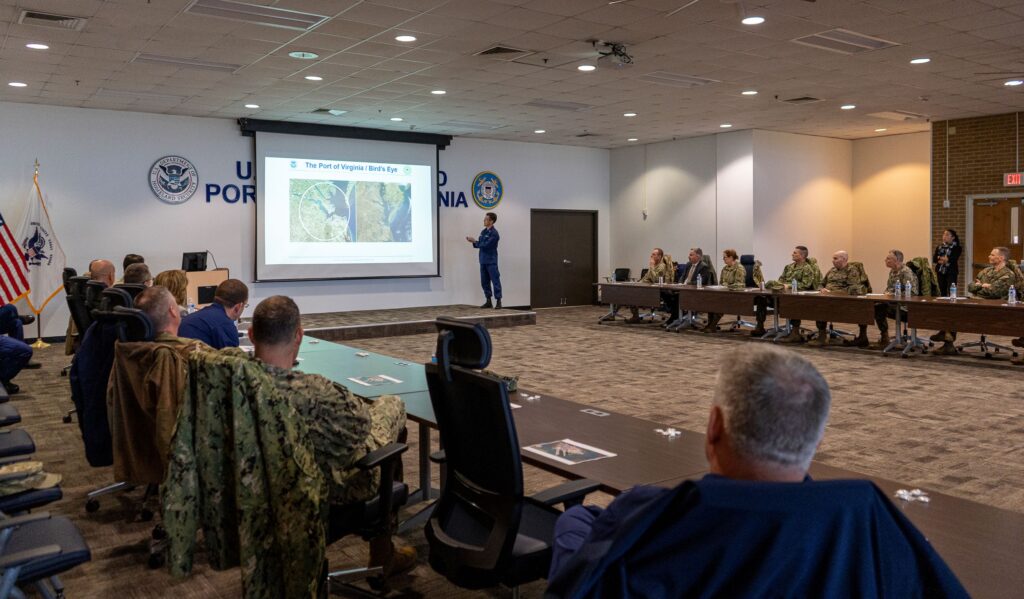
Coast Guard Capt. Samson Stevens shows an aerial view of the Port of Virginia during the Cyber Component Commanders’ Conference aboard Coast Guard Base Portsmouth, Virginia, March 6, 2020. The service has now created a cyber mission specialist rating. U.S. COAST GUARD / Seaman Katlin Kilroy
ARLINGTON, Va. — The Coast Guard commandant has announced the creation of a cyber mission specialist rating and corresponding chief warrant officer specialty to increase the focus and professionalism of the service’s cyber capabilities.
Commandant Adm. Karl Schultz made the announcement during his Feb. 24 annual “State of the Coast Guard Address” before an audience at Coast Guard Air Station Clearwater, Florida.
In a Feb. 25 message to the Coast Guard, Shultz further amplified the announcement, saying, “Cyberspace is an operational domain continuously evolving while growing in importance and complexity. Operations in cyberspace require a professional and skilled workforce [military and civilian]. Competition to recruit, retain, and grow cyber talent is constant. A dedicated CMS enlisted rating with accessions beginning at the E-5 paygrade, as is done with the diver rating and an accompanying CYBR [cyber] specialty, will best provide a trained, proficient, and professional workforce to enable and conduct cyberspace operations.
“Members of the CMS rating and CYBR specialty will have the opportunity to serve in a broad range of missions,” he said. “The Coast Guard’s cyber program plays a critical role operating a secure cyberspace for the Service, protecting the Marine Transportation System against malicious actors seeking to identify new ways to exploit cyberspace, and countering adversaries’ intent on disrupting Coast Guard operations or negatively impacting national interests. Members of the CMS rating and CYBR specialty will continue to serve in critical positions within [Coast Guard] Cyber Command, U.S. Cyber Command, DHS Cybersecurity and Infrastructure Security Agency areas, districts and sectors and elsewhere as required.
The Coast Guard Cutter Polar Star (WAGB 10) transits in the Chukchi Sea, Dec. 19, 2020. The first future polar security cutter will be named Polar Sentinel. U.S. COAST GUARD / Lt. Jared Payne
ARLINGTON, Va. — The commandant of the Coast Guard used the occasion of his annual “State of the Coast Guard” address to announce the name of the first future polar security cutter.
“Today, I am excited to name the first polar security cutter; that name will be Polar Sentinel,” said Commandant Adm. Karl Schultz, speaking Feb. 24 before an audience at Coast Guard Air Station Clearwater in Florida.
The name is in keeping with the Coast Guard’s earlier class of polar icebreakers, one of which — the Polar Star — is the only operational heavy icebreaker in the U.S. military services and is badly in need of replacement. The first PSC is expected to be delivered by Halter Marine in 2025. Halter Marine also is under contract for a second PSC.
“Detailed work remains underway in preparation for construction of our first polar security cutter,” Schultz said. “That will be a state-of-the-art ship requiring exacting designs, complex steel work and systems integration. … When our fleet of polar security cutters becomes operational, the work of these uniquely capable assets will be essential to protecting our economic, our environmental and our national security interests in what we call the high latitude regions.”
The commandant said the Our Coast Guard “is amidst [its] largest shipbuilding effort since the Second World War as we build the fleet that will serve the nation for decades to come.”
He said the the 10th national security cutter to be named for the first master chief petty officer of the Coast Guard, the Charles Calhoun, will be christened in June.
He also noted the first offshore patrol cutter, the Argus, is more than 60% complete and the second OPC, the Chase, is “well on its way.”
Shultz said the Coast Guard anticipates “awarding the largest acquisition contract in the history of our service for the next 11 offshore patrol cutter hulls” this spring.
The newly competed OPC contract award follows the earlier OPC contract award to Eastern Shipbuilding Group for the first nine OPCs. The Coast Guard plans to procure a total of 25 OPCs, which will replace 28 medium-endurance cutters, some of which are more than 50 years old.
“That legacy fleet [of medium-endurance cutters] loses nearly 500 patrol days on an annual basis due to unplanned maintenance and repairs,” the admiral said, noting that if all those days were lost from counter-narcotics patrols, it would result in 44,000 pounds of illegal drugs that could have been interdicted from reaching the United States.
Shultz also said the service is making progress on the acquisition of 30 waterways commerce cutters, noting that “these new tenders will have greater endurance, speed and deck-load capacity to efficiently maintain 28,000 aids to navigation, marking over 12,000 miles of navigable inland waterways. These aids to navigation are a critical component of our marine transportation system, upon which cargoes and commodities comprising 25% of our nation’s gross domestic product move annually.
“For the first time in history, our inland fleet will be able to accommodate mixed-gender crews, providing all enlisted members of our service these unique afloat experiences,” he said.
Navy Launches Design Efforts for Modernize VLF System for C-130 Aircraft
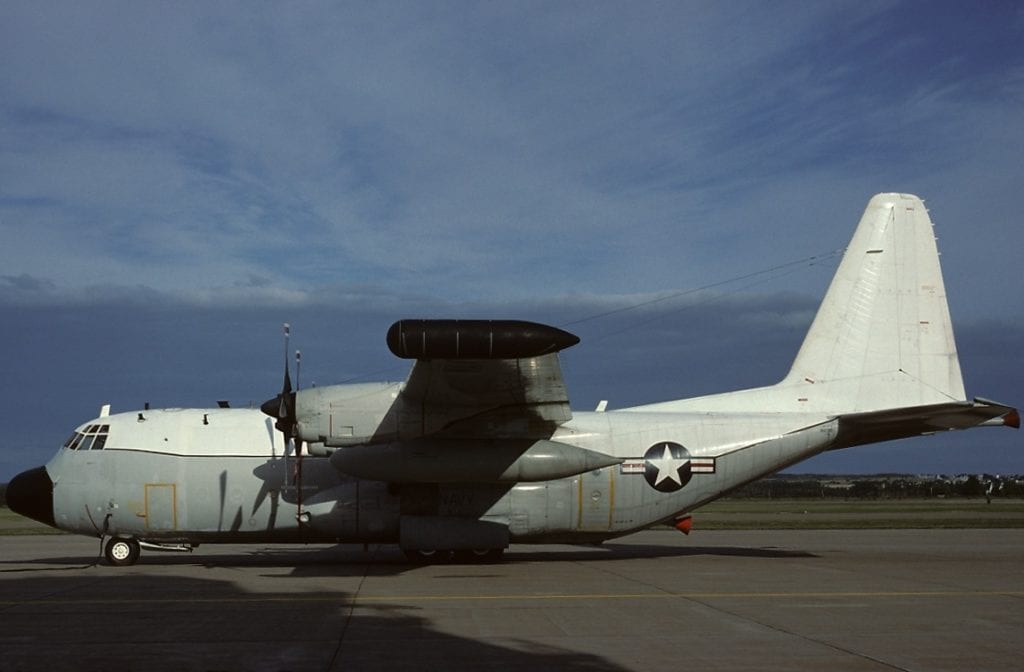
A Lockheed EC-130Q Hercules, which previously handled the Navy’s TACAMO work. The Navy has now decided to acquire the C-130J-30 Super Hercules as its platform for communicating with deployed ballistic-missile submarines. WIKIPEDIA / Alain Rioux
ARLINGTON, Va. — The U.S. Navy has awarded a developmental design contract to an aerospace company for very low frequency communications systems modernization for integration into C-130 aircraft.
The Naval Air Systems Command awarded Collins Aerospace of Cedar Rapids, Iowa, a $48.3 million contract for “developmental design and risk reduction engineering efforts for airborne very low frequency systems modernization in support of Airborne Strategic Command, Control, and Communications Program Office (PMA-271) program capability requirements,” according to a Feb. 22 Defense Department contract announcement.
The VLF system would be installed on C-130 aircraft, which is planned by the Navy to assume the TACAMO strategic communications role from the E-6B Mercury aircraft.
The communications role called TACAMO by the Navy — a term meaning “Take Charge and Move Out” — has been performed for three decades by the E-6 Mercury, a variant of the Boeing 707 airliner. After the Cold War, the Airborne National Command Post role previously performed by Air Force EC-135 “Looking Glass” aircraft was incorporated into the E-6 with the installation of the Airborne Launch Control System, combining the TACAMO and ALCS in one platform.
The Navy has performed the TACMO mission since 1963, beginning with four C-130G (later EC-130G) Hercules aircraft, later augmented by eight newer EC-130Q Hercules. The E-6 replaced the EC-130s, giving the two TACAMO squadrons, VQ-3 and VQ-4, a faster, quieter, more comfortable platform for the long missions.
The TACAMO aircraft are equipped with a long trailing-wire antenna used to relay very low frequency radio messages to submerged ballistic-missile submarines. The airframes go through considerable stress as they maintain high angle of bank for prolonged periods to maintain tight orbits to wind the trailing-wire antenna into a vertical position, needed for the radio waves to penetrate the water most effectively.
A request for information issued Dec. 18, 2020, by PMA-271 announced the Navy “intends to negotiate and award sole-source contracts to Lockheed Martin Corporation, Marietta, [Georgia], for the efforts associated with the procurement of up to three C-130J-30 “Stretch” green airframes in [fiscal 2022/2023] for testing and analysis.
The C-130J is the current, much more modern version of the C-130 and is flown by the Air Force, Marine Corps and Coast Guard, as well as many foreign air forces. The C-130J-30 is similar but has a 15-foot-longer fuselage. The rugged C-130J is able to operate from many more airfields than the current E-6B Mercury.
“Specifically, this contract provides non-recurring engineering effort to address size, weight, and power cooling in the components, systems, subsystems, or weapons replaceable assembly, model-based systems engineering development, weight reduction analysis, cyber security risk assessment and logistics analysis,” the announcement said.
The contract work is expected to be completed in March 2024.
CNO Is ‘Sighted on a Bigger, More Capable Navy’
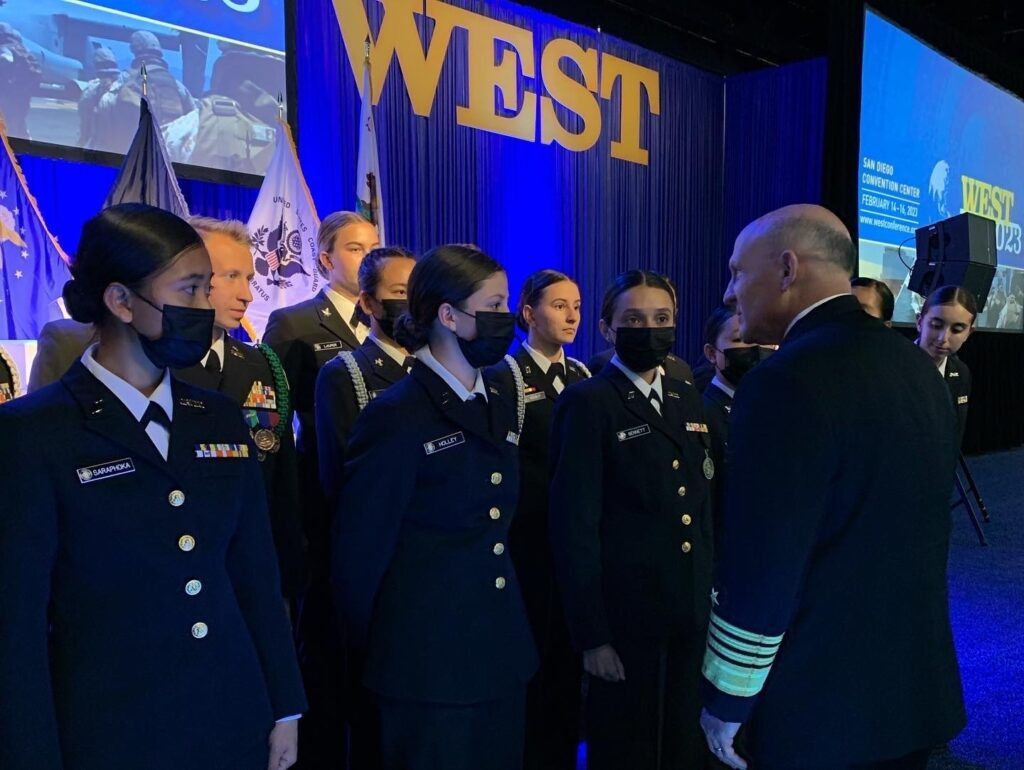
Chief of Naval Operations (CNO) Adm. Mike Gilday speaks with ROTC members during WEST 2022. U.S. NAVY / Cmdr. Courtney Hillson
ARLINGTON, Va. — Addressing the topic of future force structure after it submerged again into the depths of analysis, the Navy’s top officer laid out his views for a “bigger, more capable Navy” in the future informed by a series of exercises over the last year, estimating a requirement for a fleet of more than 500 manned and unmanned ships, including 12 aircraft carriers.
“We’re going through another force-structure assessment right now, based on the hard work we’ve done over the last five or years in really thinking about how we would fight differently in terms of in a distributed fashion, across a wide, vast ocean like the Pacific, in terms of integrating all domains simultaneously,” said Adm. Michael Gilday, speaking Feb. 18 at the West 2022 Symposium sponsored in San Diego by the U.S. Naval Institute and the Armed Forces Communications and Electronics Association.
“In thinking about what the future fleet looks like, we spent time taking a look at a couple of different force structures assessments in 2019 and 2020,” the CNO said. “The one that I base my best advice on is the one that we finished up in 2020 that we did along with the Marine Corps, but it was actually led by OSD [Office of the Secretary of Defense]. I found that to be an important stakeholder in that process because this wasn’t just Marine Corps-speak or Navy speak or Department of the Navy-speak, but it was more broadly supported by OSD.
“Based on that [and] large-scale exercises like we did last summer — leveraging live virtual construct [LVC]— based on the integrated battle problem we just did over in 5th Fleet with some 100 unmanned platforms over the past few weeks, I’ve concluded, constant with the analysis, we need a naval force of over 500 ships,” he said.
Gilday said his view on carrier aviation “remains unchanged. I think we need 12 carriers.”
The CNO also said “we need a strong amphibious force to include probably nine big-deck amphibs and another 19-20 [medium amphibious warfare ships] to support them [and] perhaps 30 or more smaller amphibious ships to leverage maritime littoral regiments — and the punch that they’re going to provide in places close inside the fight — to 60 destroyers and probably 50 frigates; 70 attack submarines; a dozen ballistic-missile submarines; to about 100 support ships. And probably, looking to the future, 150 unmanned [vessels].
“We’re doing a lot of work inside the FYDP [future years defense plan] now. I think it speaks out to the vulnerabilities that we hear called out by the Joint Staff and the chairman in his risk assessment,” Gilday said. “So, in the long term, I’m sighted on a bigger, more capable Navy. We’re working our way through that with respect to budgets but certainly not taking our eye off the ball with respect to requirements. We do think differently because the future is now in terms of bringing more capability out of the force that we have.”
AIs on the Prize: Competitions Foster Artificial Intelligence Applications for Naval Use
Advanced Naval Technologies Exercise 2021 provided government, industry and academia participants a collaborative, low-risk environment that leverages the Naval Research and Development Establishment’s unique laboratories and ranges, while practicing operators and planners simultaneously explore advanced tactics and assess the operational relevance of emerging technologies. U.S. NAVY / Joe Bullinger
Recent initiatives by the Department of Defense to foster rapid innovation and modernization have involved conducting prize competitions among existing and would-be defense contractors to develop technology for military use. The competitions enable small businesses to put forth and demonstrate their ideas in realistic scenarios and can, in time, lead to production contracts.
Artificial intelligence and machine learning is one area receiving intensive attention from the Defense Department because of the increasing challenges of managing overwhelming amounts of data and making decisions in a timely manner. The challenge is made even more acute because of the present sophisticated peer competition with China and Russia. The current politico-military situations in Ukraine, the Taiwan Strait and the South China Sea are scenarios in which AI/ML potentially can help decisionmakers. AI can have applications at the national level all the way down to the tactical level. The technology can help not only with situational awareness but also with predictions — indications and warning.
In a recent prize competition sponsored by the Department of Defense, a small company named BigBear.ai, headquartered in Columbia, Maryland, won the prize. The competition between 12 teams was a Project Overmatch AI Advanced Naval Technology Exercise, or ANTX.
Brian Frutchey, chief technology officer for BigBear.ai, said the company adapted for the Navy a program developed for the U.S Army, which was “dealing with hybrid warfare, the gray zone conflict out in Eastern Europe and wanting to find tools that could automate the sense-making of all of the different data that they need to look at for the hybrid warfare environment.”
It was not just “counting the planes and tanks and soldiers anymore,” Frutchey said. “They have to look at the economies, political relationships, migration of people, cyber activity, all these new domains that the strategic analyst needs to be cognizant of and needs to model into their anticipatory intelligence.”
BigBear.ai built the Virtual Anticipation Network (VANE) — the weathervane — to point to where the winds of war were blowing. Now the dominant product at Big Bear.ai, VANE, funded by the deputy assistant secretary of defense for Special Operations in Low Intensity Conflicts, was used by the company to win the $75,000 prize in the ANTX. BigBear.ai was one of 12 companies selected to participate in the competition, which was conducted during the last half of 2021.
Frutchey said in the ANTX the VANE was looking for telemetry for maritime vessels and aircraft, as well as weather, the information environment, among other domains “that we brought together so that we could inform when these things are happening with airplanes flying through the Taiwanese air defense zone [ADIZ],” including events leading up to and during the events of interest, such as Chinese aircraft entry into the ADIZ; rerouting of air traffic; even press releases. As the observation of the indicators is automated, human analysts are able to handle more data “and with a significant amount of agility be able to pivot to new situations faster than they could before.”
He says what sets BigBear.ai apart “is that we have built machine learning that expects data to not be the whole story. I think that’s key because especially for our defense and intelligence partners, you don’t always have control of the data that you’re trying to analyze. There’s always this uncertainty in the data where you have gaps and holes and inaccuracies and because of that we have to use machine learning that assumes that you’re going to be having those errors, those issues and, even further, you don’t always get to measure the stuff you want to measure.”
VANE presents its analysis on a dashboard on a monitor for analysts to observe. A “heat map or density chart” shows areas with a lot of activity in a given period.
“We also look at baseline behaviors,” Frutchey said. “The analysts get concerned when that level raises above some threshold. In the first week of October, it went to 56 [Chinese] sorties in a day at one point and they were using strategic bombers in some of those sorties. Those kinds of things are a normal low-level buzz, but I want to be alerted when the models predicting that a week from a now, a month from now, there is going to be above some threshold, or the rate of change is going to be significant. … We give them those alerts, and the user can, of course, then drill into the alert and explore the forecast data. … So, we were looking at aggressive activities in the South China Sea for the AI ANTX exercise.
“We also have scenario forecasts [that] allow you to assess courses of action,” he said. “What if Russia invades Ukraine? What will that do to the price of Bitcoin? Or what if, in the AI ANTX example, we asked the question, what if we ran a naval exercise in the Luzon Strait? What would that do to Chinese behaviors in the South China Sea? If we were to go with a carrier striker to the Luzon Strait and run a little naval exercise, what would that do to behaviors? And so, we can run those simulations and we can then show the user, here’s how the world would change a month from now if we were to run that exercise next week.”
NAVWAR Commander Rear Adm. Douglas Small presents the AI-based ANTX’s first-place prize to Big Bear.ai Chief Technology Officer Brian Frutchey, right. NAVWAR / Elisha Gamboa
VANE is scalable, Frutchey said. “Vane is built to elastically scale in the cloud as large as it needs to go. It’s actually one of the big powers on our platform is that it is completely serverless, which means it’s not like it’s a monolithic app that’s a bunch of servers chewing up resources all day long. It’s a collection of functions and, as the customers need those functions, the system is built to grab resources in the cloud, spin those up to do the work that’s needed and then turn them off when the work is done. Our systems churn through terabytes of data to build these models at global scales.”
Frutchey said the Overmatch ANTX win shows the company’s prescriptive analytics are appropriate for operational as well as strategic purposes.
“We are beginning to talk to the program offices for major command-and-control systems, [such as] the Global Command-and-Control System-Maritime,” he said.
Matching Best of Breed
AI is also being applied on a tactical level. Draper, a company known for building ballistic-missile guidance systems, entered a competition last summer conducted by the Naval Surface Warfare Center Crane Division in Crane, Indiana. The prize challenge was to determine the feasibility of taking autonomy software and implementing it on another organization’s hardware.
“I think what the government was trying to learn is how difficult is it to separate those two [software and hardware],” said Drew Mitchell, Defense Systems associate director at Draper and general manager of Draper’s Tampa, Florida, office. “That way I can match best of breed software up with best of breed hardware. Generally, those aren’t the same when the company delivers that end product to the government. And it’s also very expensive. So, they’re trying to figure out a way to reduce costs on some of these autonomous platforms.”
The prize challenge was split into three phases. In Phase 1, Draper, which had a lot of experience developing platform-agnostic software, submitted a white paper that was accepted along with those of 20 other companies. Phase 2 was a simulated exercise which involved loading autonomy algorithms into a small quadrotor unmanned aerial system and navigating it inside a building, mapping the interior and identifying objects in the building, all without the aid of GPS.
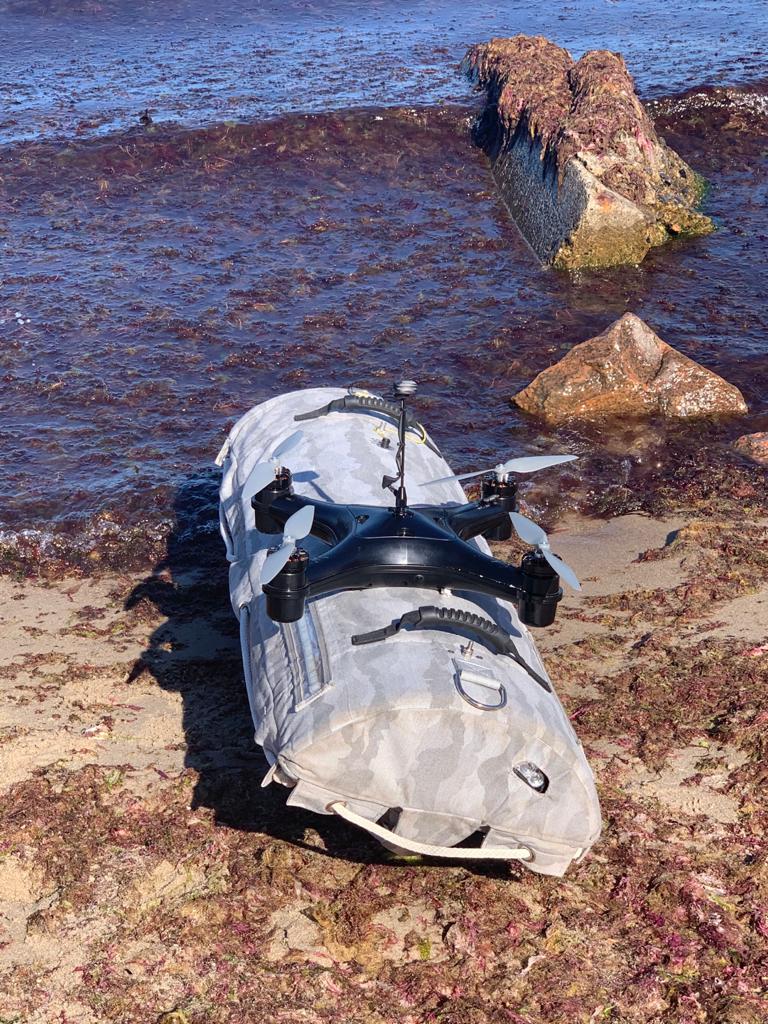
Hydronalix’s EMILY unmanned surface vessel and Adapt UAV. HYDRONALIX
Five contestants made it to Phase 3, which involved an actual demonstration of the scenario of Phase 2 using a Hydronalix quadrotor drone into which their respective software was loaded.
“It was completely autonomous, so you give the drone some sort of basic instruction, basically, fly forward and then it takes it over from there,” Mitchell said. “It senses the environment, and it does that through cameras, and it uses the same camera to do the navigation algorithm using a vision-based navigation system. It uses the same camera to collect a map of the environment or generate a map of the environment. A lot of that is very processor intensive. In a small package, like a small drone quadcopter not much bigger than a book, there’s not a whole lot of processor available on there to do all that stuff.”
Draper used vision-aided navigation algorithms it has used in its other programs.
“We used what’s called a visual inertial odometry,” Mitchell said. “It’s a lot like how the human eye and brain work in terms of referencing objects as you see them and then as you move, your brain is still calculating, oh, I saw this point and now the point is three feet from me as I move closer to it, from that point it’s now two feet from me, and from that, you can infer a lot of direction. It’s not highly accurate but it’s enough accuracy to help the IMU [inertial measuring unit] on board. It aids the IMU, so the IMU doesn’t drift off widely.
“The predominant systems today use GPS to aid that inertial unit,” Mitchell explained. “GPS gives it a position, so it knows, okay, I see that point, and then I move again, I see that point, I know where I am. But if you’re indoors, GPS doesn’t work and the big push within the Department of Defense is to do things without GPS because they know in a future conflict it’s probably going to be one of the first things our adversaries take out. Using these vision-based techniques, you’re able to get clearly decent navigation accuracy in a very small package and do this completely autonomously.
“We were able to show with very little time and resources and a very rudimentary hardware platform that the government provided us, we were able to navigate inside of a building with no GPS,” he said. “We were able to identify objects. We were able to map certain parts of an environment. Of course, it wasn’t optimal. The places that we did on our own were way better than what we’d developed through that process, but we did help the government understand that it is possible to do it.”
Draper came in second in the prize competition, with EPISCI coming in first.
Marine General: Exercises Don’t Pressure-Test Logistics for Real-World Operations
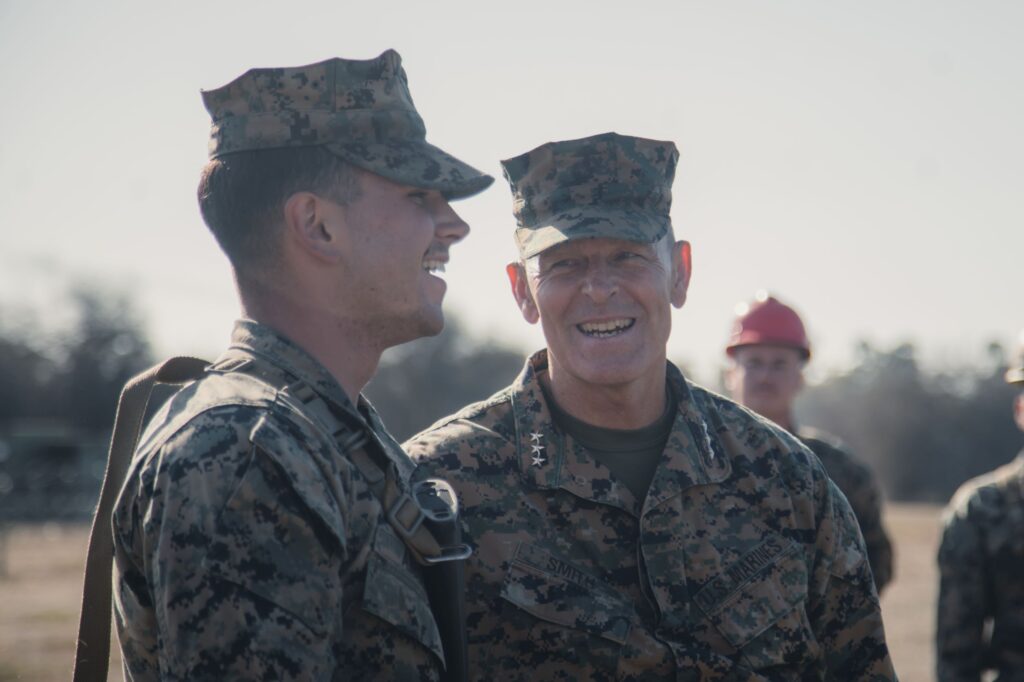
U.S. Marine Corps Lt. Gen. George W. Smith, commanding general of I Marine Expeditionary Force, speaks with Cpl. Brady Abbott, left, regarding I MEF Support Battalion’s Mission Readiness Exercise at Marine Corps Base Camp Pendleton, Dec. 8, 2021. U.S. MARINE CORPS / Lance Cpl. Gadiel Zaragoza
ARLINGTON, Va. — A Marine Corps general who commands one of the Corps’ three Marine expeditionary forces said logistics does not get a realistic challenge when military exercises are executed, primarily because of the short duration of the exercises.
“When I focus on a particular concern, I would offer that we’re not placing enough emphasis on logistics, and particularly logistics in a distributed and contested maritime environment,” said Lt. Gen. George Smith, commander of the I MEF, based in California, speaking on a panel of the West2022 conference sponsored by the U.S. Naval Institute and the Armed Forces Communications and Electronics Association.
“I say that because it [logistics] is hard to exercise,” Smith said. “Exercises truly aren’t long enough to truly exercise and pressure-test logistics. In the war games that I’ve participated in, far too often forces are where they ideally would like to be with a whole bunch of sustainment piled up. The war games don’t last long-enough to test logistics.”
Smith said “logistics is undoubtedly the pacing function when we talk about operations in the Pacific. When you look at the vast expanse of the Pacific, and all the attendant challenges, logistics is going to be that pacing function. So, as I MEF looks to shifting to the Pacific and get west of the IDL [International Date Line], our logistics team is looking really hard at updating and developing logistics nodes and distribution sites and looking at a whole new prepositioning constructs for the MEF so that we can seamlessly and effectively transition from competition steady-state campaigning to conflict. Without logistics, without that sustainment, we will not be able to do that.
“It must nest within INDO-PACOM’s [U.S. Indo-Pacific Command’s] larger logistics posture and I would add that we’re working hard to reduce what is already a strained TRANSCOM [U.S. Transportation Command] capacity and what the expectations of the joint force are,” he said.
Smith said the Corps is looking how to “bridge the gap of theater to operational to tactical logistics, often referred to as the last tactical mile,” which he said logisticians call the “‘last logistical mile.’”
The I MEF commander said his command would team with the Marine Corps Warfighting Lab to bring a stern-[ramp] landing vessel to the U.S. West Coast to exercise “as part of exercising that last tactical mile, that last logistics mile.”
Smith said exercising with the vessel “would help us in our future operating concepts to deliver that logistics to the warfighter in these distributed locations.”
The Navy is developing two new classes of ships to support Distributed Maritime Operations and Expeditionary Advance Base Operations. The light amphibious warship is being designed to support Marine littoral regiments and other forces and will have bow ramp for discharging personnel and vehicles on a shore. The next-generation logistics ship will be smaller and less expensive than the Combat Logistics Force’s replenishment ships.
First Sea Lord: Royal Navy Is ‘Back to the Modern Era,’ Tilting to the Indo-Pacific
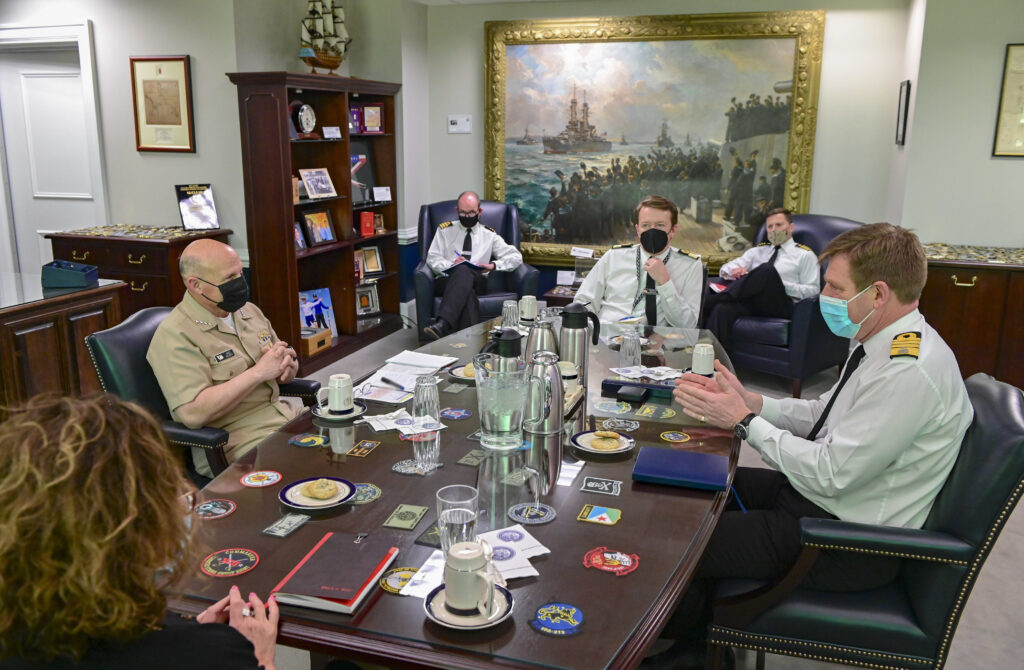
Chief of Naval Operations Adm. Mike Gilday, left middle, meets with Royal Navy Adm. Sir Ben Key, First Sea Lord and Chief of the Naval Staff of the United Kingdom. U.S. NAVY / Mass Communication Specialist 1st Class Sean Castellano
ARLINGTON, Va. — The head of the United Kingdom’s Royal Navy said his fleet is modernizing and expanding its reach around the world to respond to the current and future challenges.
“It’s the end of the beginning for us, “Adm. Sir Ben Key, First Sea Lord and chief of staff of the U.K. Royal Navy, speaking Feb. 16 at the Center for Strategic and International Studies, a Washington think tank, commenting on the Royal Navy’s return to operating large aircraft carriers.
Key said he was challenged by the government to grow the Royal Navy and focus on the changing competition in the world, away from a 20-year focus in the Middle East to more of a tilt to the Indo-Pacific region.
The 2021 deployment of the Royal Navy’s Carrier Strike Group 21 — centered on the new carrier HMS Queen Elizabeth and its fifth-generation strike fighters, F-35Bs Lightning IIs — all the way to Japan and back was termed by Key as a “reaching deployment.”
“We’re merely bringing our history back to the modern era,” Key said, also noting that “we’re back in the big carrier game.”
The HMS Queen Elizabeth and the HMS Prince of Wales were designed from the keel up to support and operate fifth-generation fighters, he noted.
Decades ago, the Royal Navy operated several aircraft carriers and maintained a significant naval presence “east of Suez,” as strategists and historians called the presence.
Key also mentioned the presence in the Pacific of two Royal Navy offshore patrol vessels, HMS Spey and HMS Tamar, which are on long-term multi-year deployments to the region, engaging with partner nations.
“We want to be part of an ongoing dialogue,” he said, noting the need to enforce rules-based order in the maritime domain, including efforts against transnational crime and fisheries enforcement. He said the Royal Navy needs to work alongside the navies and coast guards of the United States, Australia, New Zealand, France and the South Pacific island nations.
Key cited the recent AUKUS agreement “as a good example of opening up rather than closing down” and said that it would reduce barriers to sharing, and not just in the realm of nuclear-powered submarines.
He sees a benefit of Royal Navy presence in the Indo-Pacific region as not only beneficial with navy leadership but also opportunities for the Royal Navy to learn.
Navy Orders Six CH-53K Helicopters for Israel
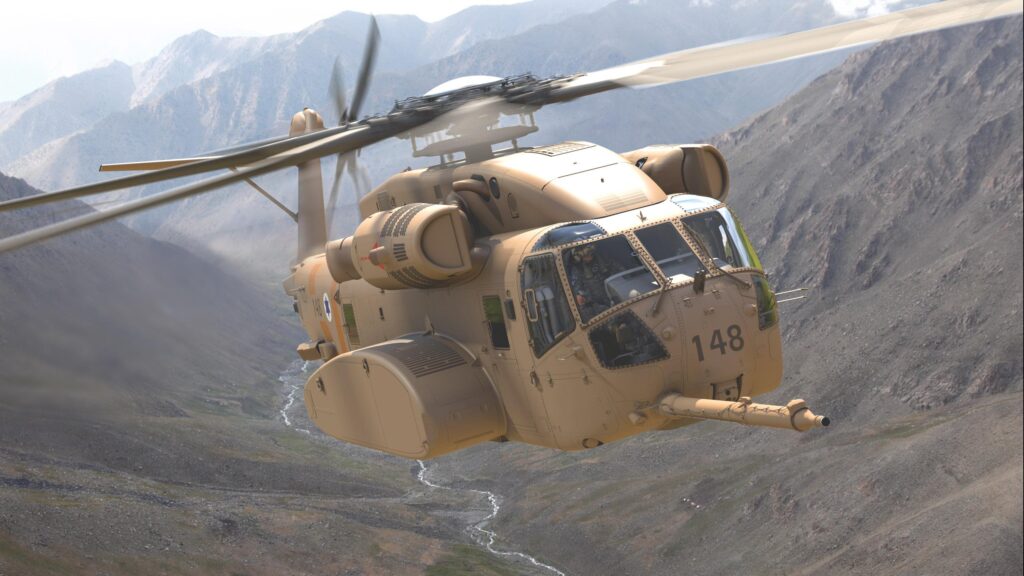
An artist’s rendering of a CH-53K helicopter for the Israeli air force. SIKORSKY AIRCRAFT
ARLINGTON, Va. — The U.S. Navy has ordered six CH-53K King Stallion helicopters for the Israeli air force, following an agreement signed in December.
The Naval Air Systems Command awarded Sikorsky Aircraft a $372 million fixed-price incentive contract modification under the Foreign Military Sales program “to exercise an option for the production and delivery of four low-rate initial production, Lot 6, CH-53K Heavy Lift aircraft, as well as associated aircraft programmatic and logistical support for the government of Israel,” the Defense Department said in a Feb. 15 announcement.
The Israeli air force and the U.S. government signed an agreement Dec. 4 for the procurement of the CH-53Ks.
The CH-53K is in production for the U.S. Marine Corps as the service’s newest heavy-lift helicopter and is replacing the CH-53E Super Stallion. In Israeli service, the CH-53Ks will replace the 50-year-old CH-53D Sea Stallion helicopters, which are named Yasurs by Israel. The King Stallions primarily will support Israeli special operations forces, but also support other vertical lift missions and rescue operations.
Delivery of the Israeli CH-53Ks is expected to be completed by November 2025.
U.S. Marine, British F-35Bs Flew Seamlessly with Israeli, Italian, Japanese F-35s during Queen Elizabeth Deployment
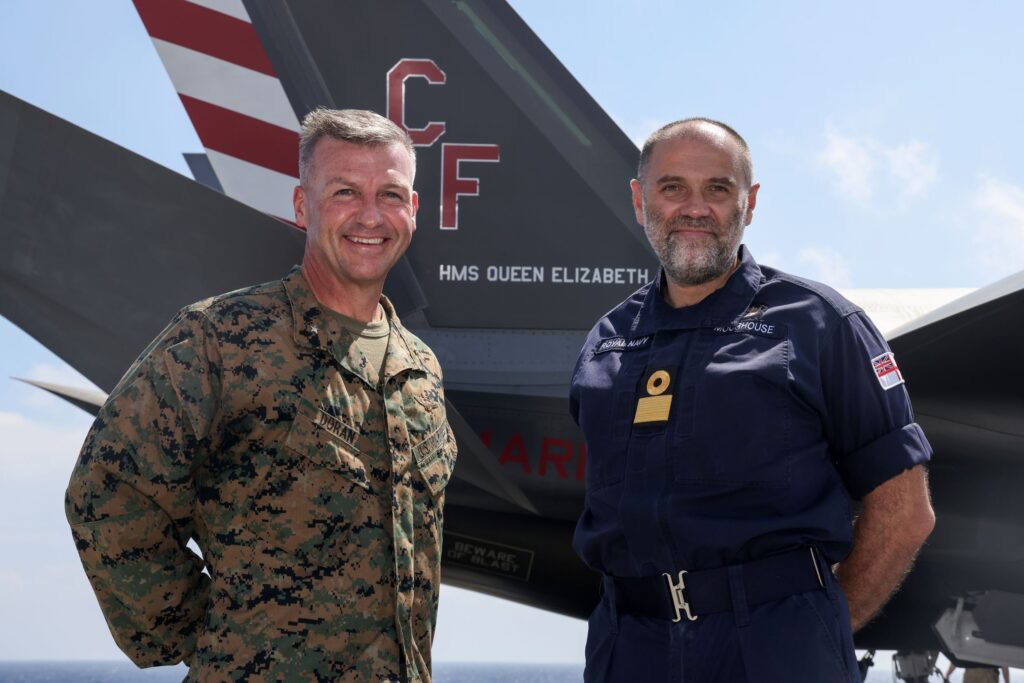
U.S. Marine Corps Brig. Gen. Simon Doran, U.S. Senior National Representative to the United Kingdom Carrier Strike Group 21, and Royal Navy Commodore Steve Moorhouse, commander of the CSG-21, stands in front of a Marine Fighter Attack Squadron 211 F-35B Lightning II aboard HMS Queen Elizabeth in the South China Sea Oct. 8, 2021. U.K. ROYAL NAVY / LPhot Unaisi Luke
ARLINGTON, Va. — The senior U.S. officer embarked on last year’s deployment of the Royal Navy aircraft carrier HMS Queen Elizabeth, who also flew the F-35B Lightning II strike fighters from the ship, praised the F-35B and the Marine Corps and Royal Air Force pilots who flew them and the crews who maintained them during the wide-ranging deployment and operated with F-35s from three other nations: Israel, Japan and Italy.
“It’s quite interesting having come from a background in F/A-18s to now be in the F-35 and to just see the manner in which this airplane can share information not just between U.S. and U.K. jets, but we had the opportunity to fly with Italian, Israeli and Japanese F-35s,” said Brig. Gen. Simon Doran, who served as U.S. senior national representative to Carrier Strike Group 21 (CSG-21), speaking to reporters during a Feb. 15 phone conference sponsored by Headquarters Marine Corps, along with Rear Adm. Steve Moorhouse, former commander of CSG-21, now the U.K. Royal Navy’s director of force generation.
“The manner in which this airplane processes information, … I can tell you, having flown it, it really does some tremendous things in the air that provides situational awareness that can be used by decision makers to hopefully give an advantage,” Doran said. “I truly do believe that in the world of aviation right now it’s an unmatched capability that was demonstrated by us moving around the world and operating with so many different nations — our allies and our partners.”
Moorhouse said the Queen Elizabeth’s F-35Bs operated over the Black Sea in support of a Royal Navy Type 45 destroyer and a Royal Netherlands Navy frigate and conducted sorties in support of Operation Inherent Resolve in Syria and Iraq.
Doran said the deployment was “a fantastic experience for us. We got to stress the system both in the material condition of the F-35, its ability to sustain sorties that were of longer duration, and also number of sorties per day. It was really interesting to see if we could demonstrate the unmatched capability of the F-35 against some of the Russian aircraft and we were quite fortunate in that we got to intercept and escort more Russian aircraft than any other deployments, certainly since the Cold War.
“It was a really good experience for our aircrew as well a great experience for our maintainers to really stress the system while at sea and demonstrate that capability, to not just talk about something but actually do it in some strenuous conditions, while still maintaining a level of professionalism,” he said.
Doran said that VMFA-211deploed with 10 F-35Bs and flew more than 1,200 sorties and more than 2,000 flight hours during the Queen Elizabeth’s 6.5-month, May to December 2021 deployment, which ranged over 40,000 nautical miles, operated with more than 40 nations, and participated in 17 operations and named exercises. The squadron interacted with 13 of those nations.
Doran, who was born in Liverpool, England, was an F/A-18 Hornet pilot for six deployments in U.S. Navy aircraft carriers and has since learned to fly the F-35B. He was frocked to brigadier general while at sea on the Queen Elizabeth. He flew both U.S. and U.K. F-35Bs during the deployment.
“Operating from Queen Elizabeth was not difficult whatsoever,” he said. “With a ship that is purpose-built for a particular airplane and with an airplane as advanced as the F-35, most of your training in the F-35 goes into using it as a weapon system or as a system to gather and disseminate information. The actual takeoff and recovery of the airplane is thankfully quite easy. It really was a pleasure to fly to and from that ship.”
While deployed, the F-35Bs on the Queen Elizabeth also operated from the U.S Navy’s amphibious assault ships USS America and USS Essex and the Italian aircraft carrier Cavour.
Doran said planning for the deployment began more than a decade ago, even while the Queen Elizabeth was under construction. VMFA-211 worked up on the carrier in 2020 well before deployment and completed a Red Flag exercise after shortly after 617 Squadron — the U.K. F-35B unit paired with VMFA-211 for the deployment — completed the exercise.
During the deployment, Doran served as adviser to then-Commodore Moorhouse and represented the U.S. geographic combatant commanders in maintaining operational control of all U.S. units assigned to the CSG. He also was on hand to address any issues that countered U.S. policy and could negotiate with the commodore “to make sure that everything complied with the guidance and intent that I was provided by the Office of the Secretary of Defense and the chairman of the Joint Chiefs of Staff.”
“I think having the sons and daughters of the U.S. and the U.K serving side-by-side around the world, especially sharing some of the hardships of operating while a global pandemic is going on has lasting friendships that will serve both nations quite well,” he said. “It was incredibly pleasing from a both a personal and professional level to see U.S. Sailors and Marines working alongside Royal Navy Sailors and airmen side-by-side over seven months and really learning how to operate at a very high level under some adverse conditions and still have a smile on their face and execute at a very professional level.”
The general said, “the return on the investment [of the deployment] from the U.S. point of view was really good when it came down to the tactical level of warfighting and training together.”
Doran said the visit of Queen Elizabeth II to her namesake ship “really cemented in our minds the importance of this deployment from the very beginning and what is does to reinforce the special relationship between our two nations to demonstrate that on the high seas is absolutely incredible.”
Navy to Deliver Next-Generation Ship-to-Shore Connectors to Assault Craft Unit
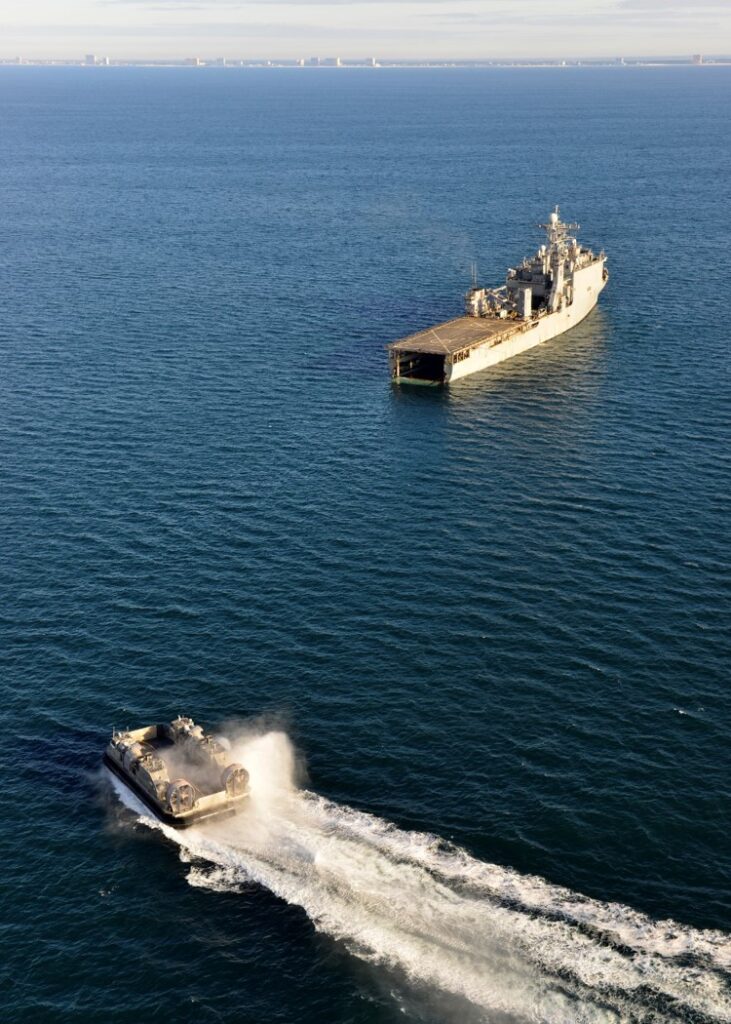
The next generation landing craft, ship-to-shore connector, landing craft, air cushion (LCAC), successfully completed well deck interoperability testing with USS Carter Hall (LSD 50) and demonstrated the craft are another step closer to fleet integration. NSWC PANAMA CITY / Ron Newsome
ARLINGTON, Va. — The Navy is set to deliver the first two operational next-generation landing craft, air cushion 110-class ship-to-shore connectors on Feb. 11 to an assault craft unit in Little Creek, Virginia, Navy officials said.
The two SSCs are on board the dock landing ship USS Carter Hall (LSD 50) inside the ship’s well deck en route to Joint Expeditionary Base Little Creek-Fort Story, Virginia, after having completed well deck interoperability testing in Panama City, Florida. The two craft will be delivered to ACU-4, which has long operated the SSC’s predecessor, the LCAC 01 class, said Thomas Rivers, executive director, Amphibious, Auxiliary and Sealift Ships, Program Executive Office-Ships, speaking Feb. 10 at the National Defense Industrial Association’s Expeditionary Warfare Conference.
Four LCAC 100s have been delivered to the Navy so far, with delivery of three or four more expected in 2022, said Capt. Scot Searles, program manager, Amphibious Assault and Connectors Programs, PEO-Ships, also speaking at the conference. A total of 24 are on contract, with 12 under construction.
Rivers said initial operational capability of the LCAC 100 class will be reached when the ACU is equipped with six craft.
Capt. Kevin Lane, the Navy’s resource sponsor for Amphibious Warfare, also speaking at the conference, said IOC is expected in 2023, with first deployment of the craft expected in 2024.
The deck operability testing “was conducted as part of the first phase of ship interface testing and helped validate user requirements by performing multiple well deck entries and exits from USS Carter Hall,” said Team Ships Public Affairs in a release. “LCACs are built with similar configurations, dimensions, and clearances to the legacy LCAC — ensuring the compatibility with existing well deck equipped amphibious ships.”
“The success of the well deck testing and other recent evolutions validates these modernized craft will be a game changer for the Navy-Marine Corps team as they execute various missions in the maritime domain,” Searles said.
The test event, a collaboration between, PEO Ships, USS Carter Hall, Naval Surface Warfare Center Panama City Division and other stakeholders, was the culmination of months of preparation. The testing also has historical significance, as Panama City is the location of the Navy’s Air Cushion Vehicle Center of Excellence with the first-ever well deck operations occurring off Panama City in 1985 between legacy LCAC 01 and USS Whidbey Island (LSD 41).