DCNO Crites: Inflation in Shipbuilding Costs a Challenge for Navy Fleet Expansion
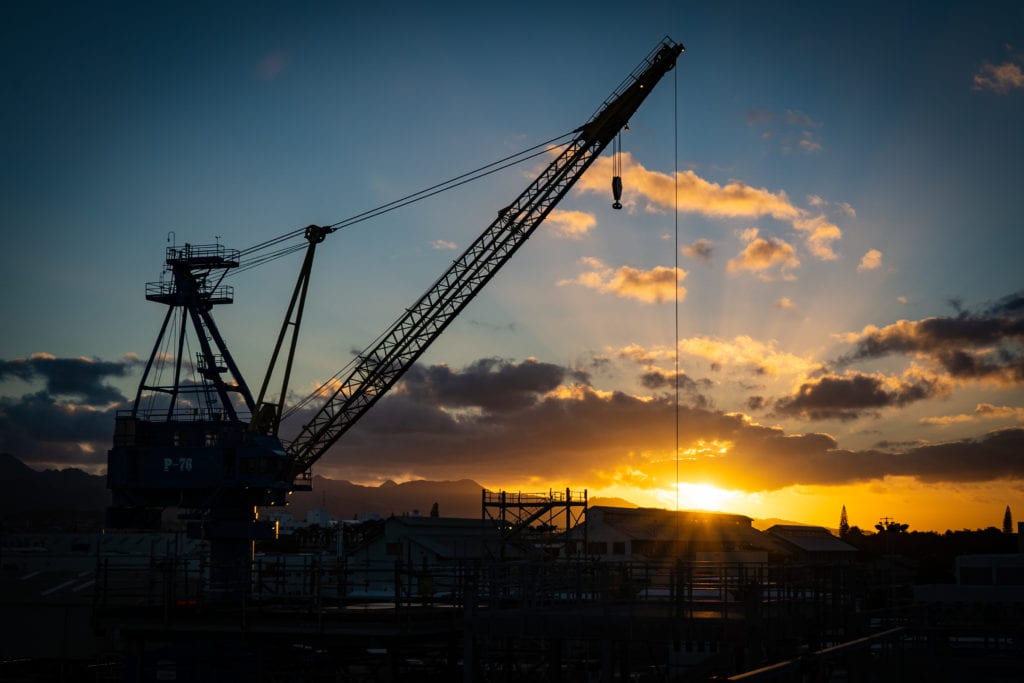
Sunrise over the Pearl Harbor Naval Shipyard and Intermediate Maintenance Facility, Feb. 11, 2021. U.S. NAVY / Public Affairs Specialist Dave Amodo
WASHINGTON — The Navy’s expansion to a larger fleet is hampered not only by the flat topline of the fiscal 2022 budget but also inflation in the costs and complexity of shipbuilding, a senior Navy admiral said.
As the Navy works to tailor its battle fleet to meet the challenges of the era of great power competition and divest some platforms that are aging out or needed less in terms of priorities, it also faces costs exceeding inflation that put pressure on the shipbuilding budget.
While the U.S. Navy proposes retirement of 15 battle force ships in fiscal 2022, it proposes to fund only eight battle force ships in that year, a setback in terms of growing the fleet to a congressionally mandated level of 355 ships.
“What we’ve seen over the last 10 or 11 years is essentially a flat budget, said Vice Adm. Randy Crites, deputy chief of naval operations for Integration of Capabilities and Resources, testifying July 21 during a hearing of the defense subcommittee of the Senate Appropriations Committee. “We have not kept pace with inflation. Back in 2010 we had about 280 battle force ships. We declined as we went through sequestration down to 271 and we built our way out of that up to about 297 today. That occurred as a result of a number of reform efforts and divestitures that we did inside the service.
“That challenge that we’re facing now is that the good ideas, the [divestiture of] things that we don’t need to bring to the future fight, we’re starting to run out of that,” Crites said. “So, we’re challenged as we see labor costs far exceeding inflation; the cost and complexity of the work we’re trying to do; and materials we’re trying to buy all outpacing inflation. Yet we need to balance within the program that we have.”
Crites said the Navy’s current priorities have not changed.
“The No.1 priority is to bring in Columbia [ballistic-missile submarine. No. 2 is to ensure that we have a ready force; No. 3 is to make sure that we’re bringing the capabilities that we need; and No. 4 has been capacity that we can afford,” he said.
Sea-Air-Space 2021 Prequel: Law Of Sea Convention Could be Negotiated to Overcome Constitutional Objections, Analyst Says
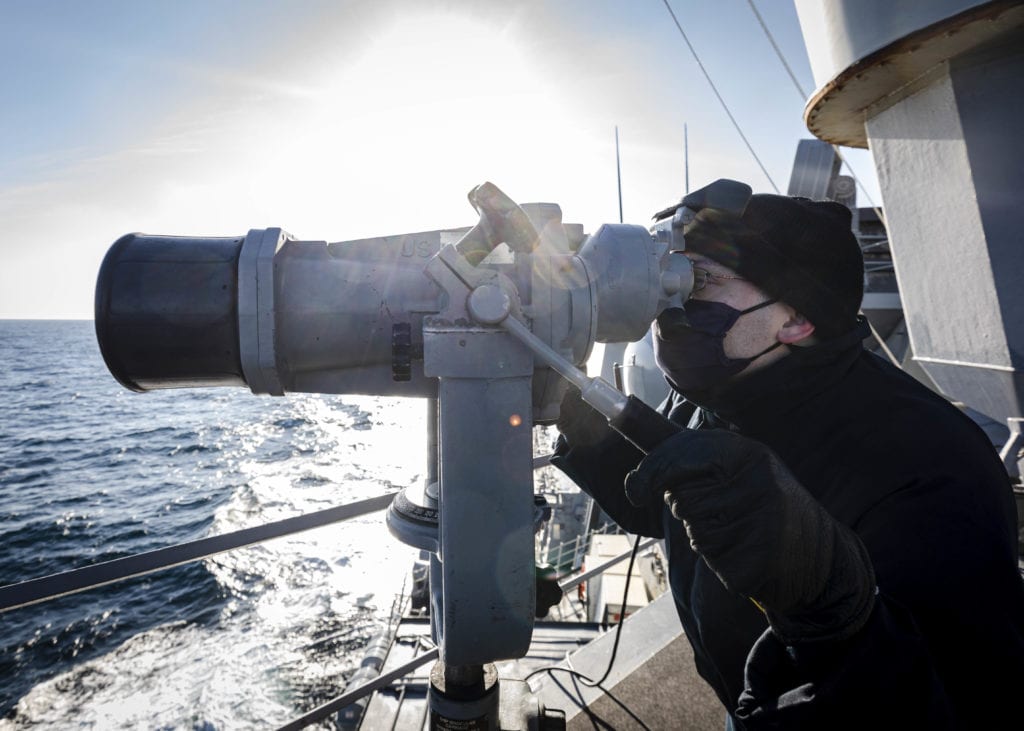
Ensign James Bateman, from Huntsville, Alabama, scans the horizon utilizing the “big eyes” while standing watch on the on the bridge wing as the guided-missile destroyer USS John S. McCain (DDG 56) conducts freedom of navigation (FON) operations in late 2020. U.S. NAVY / Communication Specialist 2nd Class Markus Castaneda
ARLINGTON, Va. — The United Nations Convention on the Law of the Sea (UNCLOS) could be ratified by the U.S. Senate if a few objections were addressed, a naval analyst said.
Speaking 20 July in a webinar of the Navy League’s Sea-Air-Space Prequel, Marine Corps Col. James McGinley, a retired naval aviator and a lawyer, said that the UNCLOS could be challenged on constitutional grounds that it could negate the right of the U.S Senate to provide “advice and consent.”
The UNCLOS, signed by 168 nations, governs a wide array of maritime issues including economic, military, commerce, mining interests. It has yet to be ratified by the Senate, where it last was given a hearing in 2012.
“The United States was a huge part of the formation of UNCLOS back in the ‘80s,” he said. “The United States signed [in 1994] but did not ratify,” said retired Adm. Jonathan Greenert, former chief of naval operations, also speaking in the webinar.
Speaking of the example of Arctic energy exploration and seabed mining, retired Adm. Paul Zukunft, former commandant of the Coast Guard, said during the webinar, “We have a right to this, yet we haven’t signed onto the ground rules to lay claim what is rightfully ours.”
Zukunft also pointed to the absurdity of the Chinese “Nine-Dash Line,” which the Chinese Communist Party uses to claim most of the South China Sea as its territorial waters.
“If you use that same [justification], then Denmark and Leif Ericsson should probably claim the United States EEZ [Exclusive Economic Zone],” Zukunft said. “We don’t have a voice at that forum because we have not ratified the Law of the Sea convention. We’re trying to resolve this with Freedom of Navigation [FON] exercises but at the end of the day, the fact that we don’t have a voice at the table for this aspect of maritime governance, all we can do is sit back and watch, and try to counterbalance using economic or military leverage to correct that behavior.”
The admiral said the Coast Guard has 65 bilateral agreements with other nations “that allow us to board vessels of those signatory nations — whether it’s a fishing violation, [an] encounter [with] drug movement, or even the potential of a weapon of mass destruction in the maritime domain — [the Coast Guard is authorized to] stop, apprehend, search those vessels on behalf of those flag nations.”
FON “doesn’t represent a policy,” Greenert said. “It is nothing more than a statement by us concerning free passage in certain straits or waters of the world.
“What’s happening right now is China is showing some real mischief and it goes beyond some of the seabed issues and Nine Dash Line issues,” he said. “China is starting to reinterpret UNCLOS. They’re pushing things around within the convention. Frankly, in my view, they need to be confronting by another leader. For example, China is working to change the definition of ‘high sea’ to their advantage. China is working to put the [EEZs] per UNCLOS to be controlled by the littoral nation. They have 28 land-locked countries in the United Nations on board in this endeavor.”
Greenert said that if this provision were adopted, military operations would need permission of the littoral nation.
McGinley spoke about the legal logjam of UNCLOS in the U.S. Senate.
“As it exists today, there has been such consistent resistance to ratification,” he said. “We’re now pushing half century. A lot of the original thinking on this was in 1956. There are parts of [UNCLOS] that are extraordinarily helpful to the U.S. and to our interests, but I worry that the poison pills that are buried in this thing — over 208 pages — are enough to keep us from success.”
McGinley suggested two approaches to achieve ratification.
“One would be a hard pivot and talk to the key opposition folks in the Senate and say, ‘Here’s what we need. What works for you?’ and then start with a fresh piece of paper with regard to — not to the entire globe — but to the key maritime partners as well as some of the other maritime nations we think would be most important to success,” he said.
“A second would be to take a radically different approach in the Senate,” he continued. “Part of the problem is Articles 309 and 310. The Constitution’s Article 2 Section 2 gives us advice and consent for our Senate. Part of what happens under the RUDS [Reservations, Understandings and Declarations] in any treaty is the ability for our Senate to say, ‘When we look at these words, we understand to mean this. Here is a statement of what we agree to,’ or, ‘here are our reservations; we don’t agree to these particular articles, but we do agree to these other articles.’”
McGinley explained the poison pills in the treaty.
“This is an odd treaty in that it purports to take away the constitutional right of the U.S. Senate to provide its advice and consent. … It is so significant that a ratification could actually face a successful constitutional challenge,” he said. “A fresh piece of paper would go beyond that, but if the Senate wanted to go forward with it, they ought to do it very publicly … that we are specifically rebuking 309 and 310, and then take a very tight look at Article 82 — which is a real significant transfer of the American families’ money — and also look at Article 144 — which is a straight-up transfer of technology. Almost all of this was negotiated at a time when we did not have the technological capability, so when those pills were put in, they were thought of as worthless and so far in the future it wouldn’t matter. Now those are real, and they are significant. They’re part of what makes this treaty harder to pass with each passing year.”
McGinley explained why the United States has been able to set a good example despite lack of ratification.
“My hat is off to the [U.S.] Navy, which I’ve watched out in the 5th Fleet with extraordinary seamanship,” he said. “It is that professionalism that has developed international customary law to the point that, even though we are not parties to this treaty, we actually exemplify — through our own conduct, and over time we have developed — norms.”
McGinley noted that in 2016 China said it would ignore binding arbitration from the verdicts from the court of arbitration about one of the islands in the South China Sea.
“It’s as if they have never signed the treaty,” he said. “So, it comes down to non-parties behaving as if they were parties and parties behaving as if they had never signed it. … The U.S. Navy’s professionalism still sets the standard and is developing navigational norms and customary international law as a result of their professionalism.”
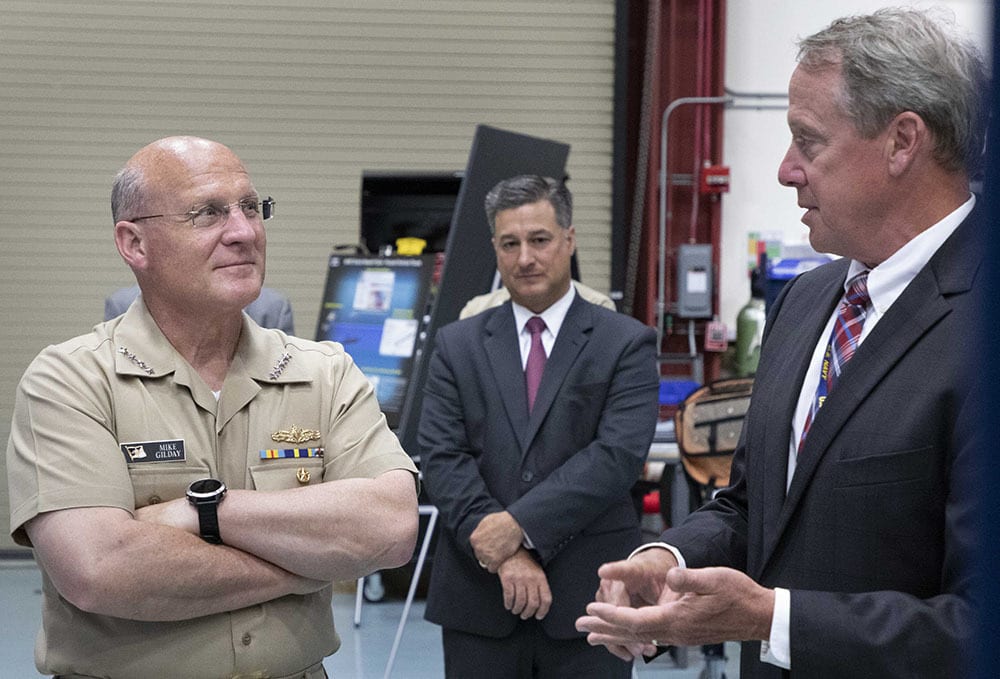
Chief of Naval Operations Adm. Mike Gilday (from left) speaks with Naval Undersea Warfare Center Headquarters Director of Undersea Warfare Eugene Hackney Jr. as Christopher DelMastro, head, Division Newport’s Platform and Payload Integration Department, listens, during a visit to the Division on June 28, 2021. U.S. NAVY
ARLINGTON, Va.—The U.S. Navy’s 2022 budget proposal to decommission seven guided-missile cruisers is not just based on the age and material condition of the ships. According to the chief of naval operations (CNO), the lethality of the cruisers’ combat system is lagging behind the developing threat capabilities.
CNO Adm. Michael Gilday, speaking in a prerecorded webinar of the Navy League’s Sea-Air-Space Prequel, noted that the seven Ticonderoga-class cruisers are equipped with the SPY-1A or early SPY-1B radars, which are the oldest radars that are the main sensor of the Aegis Combat System. The SPY-1A is an analog system, increasingly anachronistic in the Digital Age.
The radars “are approaching obsolescence … and they have difficulty actually seeing the threat, based on the speed and the profiles that we see threat missiles flying at these days.”
Gilday said the cost to own and operate the seven CGs over the five-year Future Years Defense Plan would come to $5 billion.
“These ships on average right now are 32 years old,” he said. “We are seeing cracks. We are seeing challenges in the material condition of these ships that are, to a certain degree, unpredictable. So, they’re ‘unknown unknown.’ When we tried to deploy a ship most recently [USS Vella Gulf] and had to bring it back twice because of fuel tank cracks, is an example of something we just couldn’t predict that we have to react to, and it does have an impact on reliability. We need to be able to provide the secretary of defense reliable assets that they can count on to do the nation’s business.”
The CNO said the above factors “really came into play from a realistic standpoint in terms of making the argument for the best of those cruisers. The cost alone with respect to cruiser modernization is running tens of millions of dollars above what we had originally estimated, largely due to the unknowns that come into play with hulls that are over three decades old.”
The seven cruisers marked for decommissioning are USS San Jacinto (CG 56), USS Lake Champlain (CG 57), USS Monterey (CG 61), USS Hue City (CG 66), USS Anzio (CG 68), USS Vella Gulf (CG 72), and USS Port Royal (CG 73).
SCO Plans for Overlord USV Transfer to Navy in January
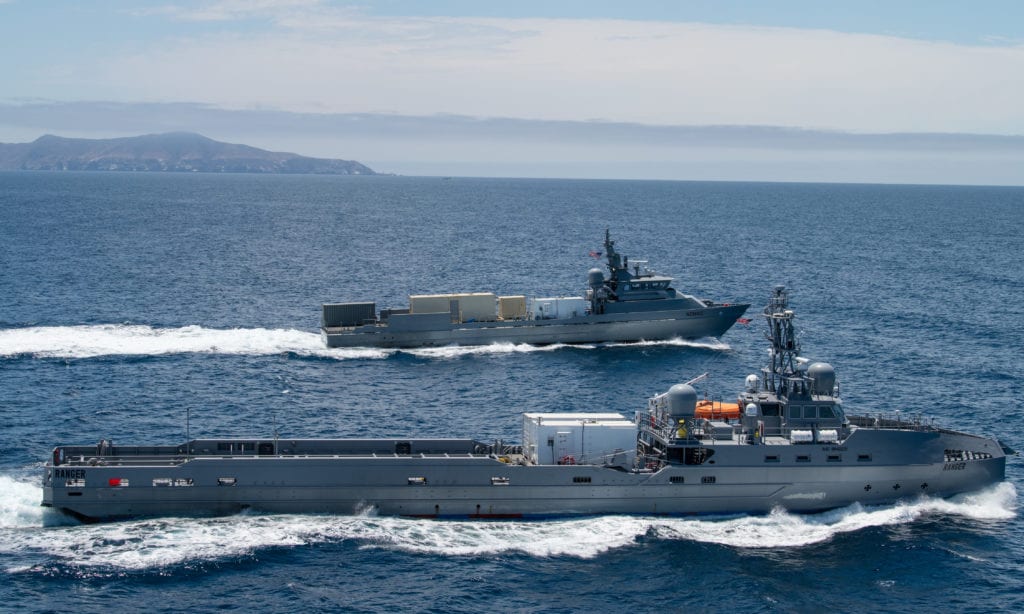
Aerial photos of USS Ranger and USS Nomad unmanned vessels underway in the Pacific Ocean near the Channel Islands on July 3, 2021. U.S. NAVY / Eric Parsons
ARLINGTON, Va. — The two Ghost Fleet Overlord autonomous unmanned surface vessels (USVs) designed to experiment with unmanned fleet technologies are scheduled to be turned over to the U.S. Navy early next year, likely January, and will be joined in 2022 by two more such vessels.
The two USVs, named Ranger and Nomad, were developed by the Office of the Secretary of Defense Strategic Capabilities Office (SCO). They will be used by the Navy’s San Diego-based Surface Development Squadron One to mature technology and develop concepts of operations for unmanned combatants; tactics, techniques and procedures, and operator experience for USVs as the Navy develops it future Large USV and Medium USV.
The Overlord USVs are repurposed vessels based on an oil rig offshore support vessel design, said Luis Molina, deputy director for Strategic Capabilities for the Department of Defense, speaking to reporters in a June 13 roundtable webinar. The support vessels were designed to be robust, requiring minimal crews. The Overlord vessels feature government-furnished equipment, including a common control system.
Ranger made the transit from the Gulf of Mexico to San Diego via the Panama Canal in October, followed in May and June by Nomad. The ocean transits, planned in advance, were monitored and controlled by Sailors of Surface Development Squadron One in the shore-based Unmanned Operations Center in San Diego, where the controllers are able “to change missions in situ,” said Capt. Pete Small, the Navy’s program manager for Unmanned Maritime Systems, also speaking at the roundtable event. The Overlord USVs are equipped with sensors to “react to contacts along the way.”
Small said the Navy is looking for “supervised autonomy” as the level of control over its USVs.
Nomad, for example, sailed 4,421 nautical miles, 98% in an autonomous mode, according to a June 7 Defense Department release. Transit of the Panama Canal required the manual navigation by a skeleton crew on each ship in accordance with canal regulations.
Molina said the SCO will continue to exercise the Overlord vessels until turnover the Navy to do “fleet demonstration exercises and operational vignettes.”
“We’re currently targeting a January turnover date to the Navy,” Molina said. “But we’re working hand in hand with the Navy, and we have been for the last four years, so that handover and transition is expected to be fairly seamless. We are completing the integration of some of the systems on the ships.”
Two more Overlord vessels are funded by the Navy and are scheduled for delivery by the end of 2022, Small said, which — together with the Sea Hunter and Sea Hawk USVs — will give the Navy six unmanned ships for experimentation.
Navy Confident Strike Fighter Shortfall Will Be Gone by 2025, Admiral Says
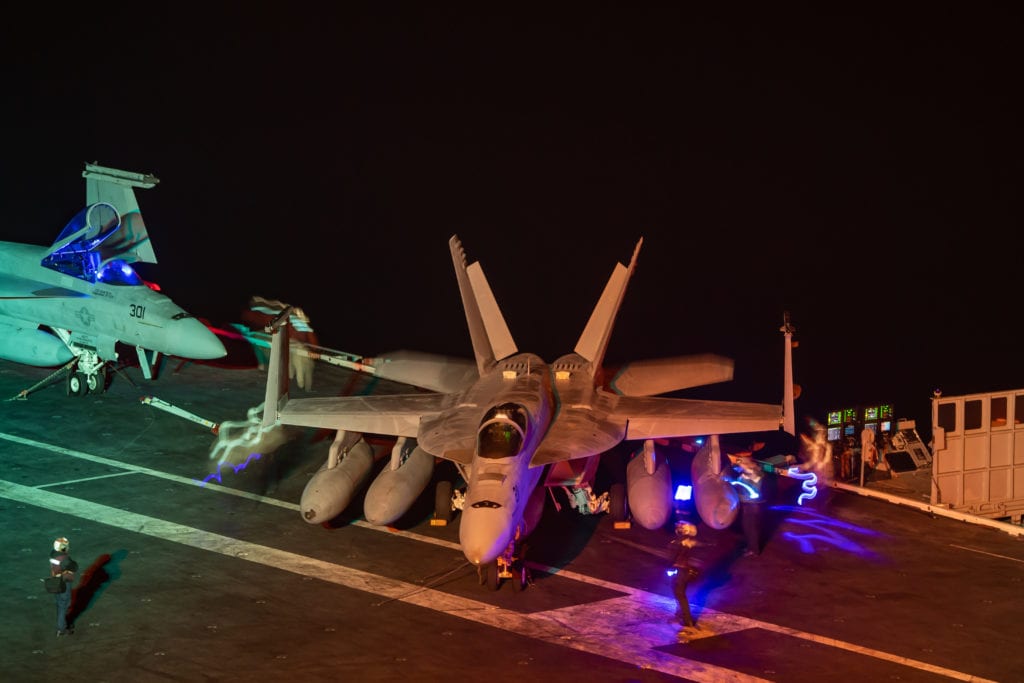
Sailors conduct pre-flight checks on an F/A-18E Super Hornet, assigned to the “Stingers” of Strike Fighter Squadron (VFA) 113, on the flight deck of Nimitz-class aircraft carrier USS Carl Vinson (CVN 70), July 9, 2021. U.S. NAVY / Mass Communication Specialist Seaman Sophia Simons
ARLINGTON, Va. — The Navy’s director of air warfare told the Congress that the Navy is on track to eliminate its shortfall of strike fighter aircraft by 2025.
Testifying July 13 before the Tactical Air and Ground Forces subcommittee of the House Armed services Committee, Rear Adm. Andrew J Loiselle, the director of air warfare in the Office of the Chief of Naval Operations, was questioned by Rep. Vicky Hartzler, (R-Missouri) — in whose state the Boeing F/A-18E/F Super Hornet strike fighter is built — about the Navy’s decision not to seek additional procurement of more Super Hornets in fiscal 2022 and the effect on the Navy’s current strike fighter shortage.
“We have taken the F-35C portion of our 44 strike fighters [per carrier air wing] and reduced that from two squadrons of F-35s down to a single squadron but then increased then number of [aircraft] from 10 to 14,” Loiselle said.
The admiral pointed out that the Navy’s adversary aircraft requirements changed to replace some legacy F/A-18s with ex-Air Force F-16s and ex-Swiss Air Force F-5 fighters instead of Super Hornets. He also said the Fleet Readiness Center at Naval Air Station North Island, California, “has been able to return 28 Super Hornets from long-term down status and put those back in the fleet.
“We believe that those improvements [will] reduce our strike fighter shortfall to zero by 2025 based on current year analysis,” Loiselle said.
The admiral said the two Service Life Modernization (SLM) for the Super Hornets “will have the additional capacity at the 2025 period in question to take additional SLM [aircraft] should our current analysis be revised, and we require that additional capacity. We believe the infrastructure will support additional modifications to the Block III” version of the Super Hornet.
Hartzler asked about the Super Hornets being inducted for SLM having more corrosion evident than was predicted, noting that alleviating the corrosion would add time to conduct an SLM.
Loiselle said the SLM line was about halfway through modifying the first 30 of the Block II Super Hornets planned for the process, noting the first 30 aircraft were intended to enable the artisans to learn the needs of the aircraft.
“I agree 100% that there was damage beyond expectations from a corrosion perspective on some of the initial aircraft,” he said. “However, Boeing has seen significantly improved condition in the aircraft that we are now submitting for SLM. So, with the number of Block II Super Hornets in our inventory, compared with the number of Block II Super Hornets that we intend to conduct SLM on, that allows us some selectivity in those [aircraft] we put through the modification line. We’re learning in this process and we’re now conducting inspections prior to induction looking at these hard areas to identify whether or not the corrosion present in those aircraft justifies inclusion in out SLM process or whether or not we might look at a different to conduct that on.
“But right now, we’re continuing to learn and continuing to bring down the time associated with getting the aircraft through the SLM process,” he said. “We anticipate that by the 2025 timeframe we should be in full swing on two lines at one year per SLM aircraft at that point in time in 2023 and after, coming of the line in a full 10,000-hour modification in full Block III configuration.”
Loiselle also said the Navy “currently is executing a multi-year procurement of F/A-18s — 78 total. We’ve got 70 left to deliver and [those will be delivered] between now and fiscal year ’25. So they are continuing to add to our total of F/A-18s. That’s why I think we can get to SLM and modifications of current F/A-18s after that time frame.”
He noted the Navy lists an unfunded priority of five F-35Cs to accelerate transition to its desired mix of fourth- and fifth-generation fighters.
Navy Details 2022 Ship Retirement Schedule
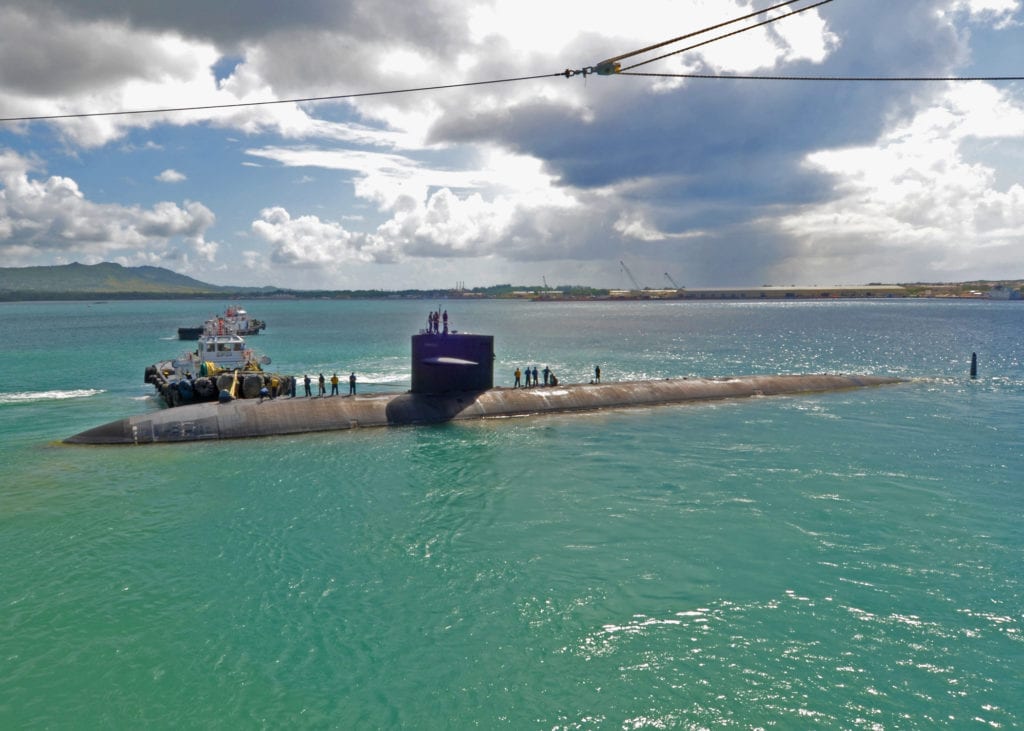
The Los Angeles-class attack submarine USS Oklahoma City (SSN 723), shown here in 2012, has been listed for recycling according to the Navy’s planned ship retirement schedule for fiscal 2022. U.S. NAVY / Mass Communication Specialist Seaman Chris Salisbury
ARLINGTON, Va. — The U.S. Navy has determined its planned ship retirement schedule for fiscal 2022. The list includes 22 ships, including 15 battle force ships.
In a July 2 administrative message, the Office of the Chief of Naval Operations announced the plans to decommission 19 ship ships from the fleet and remove from service three ships from the Military Sealift Command.
The list includes two Los Angeles-class attack submarines (SSNs); seven Ticonderoga-class guided-missile cruisers (CGs); five Cyclone-class coastal patrol ships (PCs) and four littoral combat ships (LCSs) — three Freedom-class and one Independence-class LCS. The PCs are forward deployed to the Persian Gulf; they are not considered battle force ships.
The Navy is proposing to retire seven Ticonderoga-class CGs during fiscal 2022, including two — USS Hue City and USS Anzio — which were not previously planned for retirement. The material condition of the cruisers’ hull and mechanical systems has attracted considerable concern while the cost of keeping the cruisers in service has risen.
Vice Adm. Jim Kilby, deputy chief of naval operations for Warfighting Requirements and Capabilities, testified June 17 before the Seapower and Projection Forces subcommittee of the House Armed Services Committee that retaining the seven CGs would cost roughly $5 billion across the Future Years Defense Plan. Retaining the ships for two years would cost more than $2.87 billion. He said the cost to modernize Hue City and Anzio alone would cost approximately $1.5 billion.
Extending the service lives of the cruisers “is costing more than we thought it would be,” he said. “Initially it was $2.4 billion, but we’re adding a lot of money to do that.”
The proposed cruiser retirements have been criticized by some in Congress as antithetical to growing the fleet to meet the demands of great power competition.
The decommissioning of some littoral combat ships also has attracted congressional attention, given that they are relatively new ships.
Congressional mark-ups of defense bills may challenge some of the proposed retirements.
The ships to be retired and the dates in 2022 by which they scheduled for retirement are listed below:
Ship Name Projected Inactivation Inactive Status
(All dates in 2022 except where noted)
USS Tempest (PC 2) March 29 Foreign Military Sales
USS Typhoon (PC5) March 14 Foreign Military Sales
USS Squall (PC 7) April 10 Foreign Military Sales
USS Firebolt (PC 10) March 1 Foreign Military Sales
USS Whirlwind (PC 11) April 24 Foreign Military Sales
USS San Jacinto (CG 56) Sept. 30 Reserve
USS Lake Champlain (CG 57) March 31 Reserve
USS Monterey (CG 61) Feb. 22 Reserve
USS Hue City (CG 66) March 31 Reserve
USS Anzio (CG 68) March 31 Reserve
USS Vella Gulf (CG 72) Feb. 18 Reserve
USS Port Royal (CG 73) March 31 Reserve
USS Fort Worth (LCS 3 March 31 Reserve
USS Coronado (LCS 4) March 31 Reserve
USS Detroit (LCS 7) March 31 Reserve
USS Little Rock (LCS 9) March 31 Reserve
USS Whidbey Island (LSD 41) April 30 Reserve
USS Providence (SSN 719) Dec. 2 (2021) Recycle
USS Oklahoma City (SSN 723) June 21 Recycle
USNS Apache (T-ATF 172) June 30 Disposal
USNS 1st LT Harry L. Martin (T-AK 2015) Dec. 30 Disposal
USNS LCPL Roy M. Wheat (T-AK 3016) Dec. 31 Disposal
Navy Orders MH-60R Helicopters to Replace Transfers to Greece
An MH-60R Seahawk helicopter assigned to the Swamp Foxes of Helicopter Maritime Strike Squadron (HSM) 74 flies in front of the guided-missile cruiser USS San Jacinto (CG 56). U.S. NAVY / FRENCH NAVY / Chief Petty Officer Bruno Gaudry
ARLINGTON, Va. — The Navy has ordered three MH-60R helicopters from the manufacturer to replace three transferred to the government of Greece.
The Naval Air Systems Command awarded Lockheed Martin a $129 million contract modification for the production and delivery of three MH-60R Seahawk helicopters “as replacement-in-kind for the Navy,” the Defense Department said in a June 29 contract announcement.
The three replacement-in-kind (RIK) aircraft are in support of the Hellenic navy Foreign Military Sales, said Liz Mildenstein, a spokeswoman for the Naval Air Systems Command. “The U.S. Navy issued three ‘green’ exportable MH-60Rs to the Hellenic navy in order to support the stated delivery schedule in the FMS case. The RIK aircraft are to replenish the U.S. Navy inventory.”
The Naval Air Systems Command, through the Foreign Military Sales Program, originally awarded a $194 million contract modification to Lockheed Martin for four MH-60Rs and three airborne low-frequency sonar systems to be used by the helicopters for Greece, according to an Oct. 26 Defense Department contract announcement.
The MH-60R is the U.S. Navy’s maritime strike and anti-submarine helicopter. The helicopter type also has been ordered and/or exported to the Royal Australian Navy, the Royal Danish Air Force, and the Royal Saudi Navy, the Republic of Korea Navy and the Indian Navy.
Congressman Asks SECDEF to Direct Recission of SLCM-N Cancellation Memo
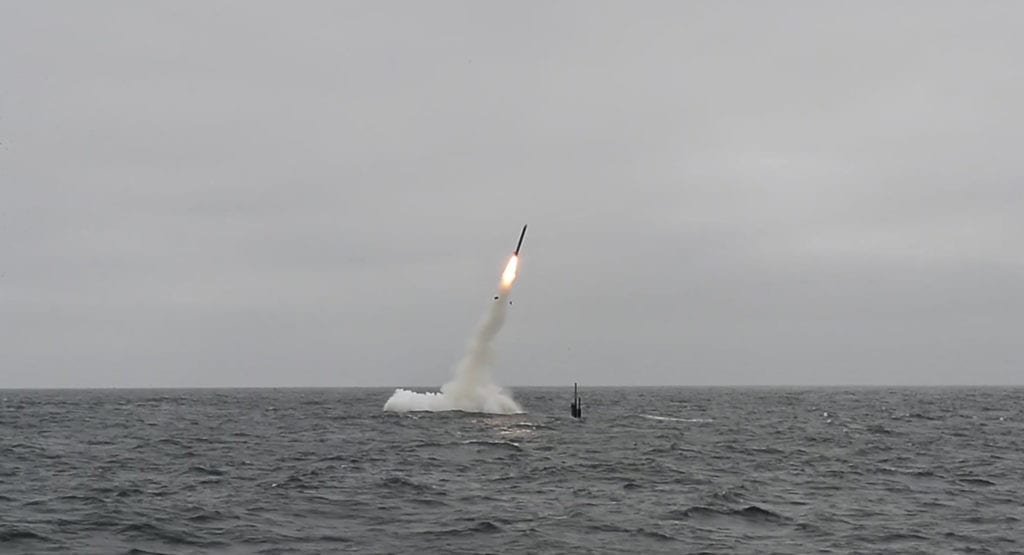
The crew of the Los Angeles-class fast-attack submarine USS Annapolis (SSN 760) successfully launches Tomahawk cruise missiles off the coast of southern California as part of a Tomahawk Flight Test (TFT) June 26, 2018. U.S. NAVY / Mass Communication Specialist 1st Class Ronald Gutridge
ARLINGTON, Va. — The ranking member of the Strategic Forces subcommittee of the House Armed Services Committee HASC) said he asked Secretary of Defense Lloyd Austin to direct the acting Navy Secretary to rescind a directive that cancels a sea-launched nuclear cruise missile program, the SLCM-N.
The Defense Department’s (DoD’s) 2018 Nuclear Posture Review (NPR) said the department would pursue a Sea-Launched Cruise Missile-Nuclear (SLCM-N) “leveraging existing technologies to help ensure its cost effectiveness. SLCM will provide a needed non-strategic regional presence, an assured response capability. It also will provide an arms-control compliant response to Russia’s non-compliance with the Intermediate-range Nuclear Forces Treaty, its non-strategic nuclear arsenal, and its other destabilizing behaviors.”
The review asserted an SLCM “will not require or rely on host nation support to provide deterrent effect. They will provide additional diversity in platforms, range, and survivability, and a valuable hedge against future nuclear ‘break out’ scenarios.”
The president’s 2022 budget would, if approved by Congress, fund the SLCM-N in 2022. But a memorandum by Acting Navy Secretary Thomas Harker — issued before the summit meeting in Switzerland between U.S. President Biden and Russian President Vladimir Putin — directed that the SLCM-N be defunded in the 2023 budget, said Rep. Mike Turner, R-Ohio, speaking July 7 in a webinar of the Hudson Institute.
“The acting secretary of the Navy issues a memorandum that instructed the staff constructing the budget for 2023 to defund this sea-launched cruise missile,” Turner said. “It is currently funded in this [2022] budget as it came over from President Biden’s submission. In his testimony, he [Harker] claimed to not have spoken to anyone” and made the decision “just on his own.”
Turner pointed out the need for a flexible deterrent, that SLCM-N is “a weapon that is absolutely needed” to counter Russia’s INF treaty violations.
“The acting secretary, in saying that he didn’t speak to anyone, the secretary of defense and the chief of staff have all said that they were not involved officially,” Turner said. “Now, what’s horrible about this is that Biden was on his way to go meet with Putin to have their so-called summit, and on Biden’s agenda was, of course, arms control, and here we have the acting secretary of the Navy basically telling Russia that we’re not going to field this, we’re not going to develop it, we’re going to defund it. And it really undermined the president that the acting secretary admitted that he understood that his actions had undermined the president of the United States.”
In June 15 testimony before the HASC, Harker said that, in considering the 2023 budget in work, “my initial guidance was based on the fact that the overall posture review and the [updated] National Defense Strategy have not been completed, so I didn’t want anyone to assume that [SLCM-N] would be in until we had further guidance from the Nuclear Posture Review.”
Turner said he sees an undercurrent of within DoD that is undermining the U.S. nuclear strategic deterrent through universal disarmament of the United States.
“Here we have a missile that has a capability that we need and that we have this desire for arms control,” Turner said, noting that canceling a needed capability “would unilaterally concede and get nothing from the Russians or Chinese in any concessions in their systems. But that undercurrent of policy at DoD really has to be brought forward. … The [next] Nuclear Posture Review is ongoing; even the assessment of alternatives for the SLCM itself is ongoing.
“Now I’ve asked the secretary of defense to direct the acting secretary of the Navy to rescind this direction,” Turner said. “I certainly hope that he does that. It sends the wrong message.”
The HASC chairman, Rep. Adam Smith, D-Washington, has stated his opposition to the SLCM as being destabilizing to the nuclear balance.
Saildrone USVs Set for 7th Arctic Mission
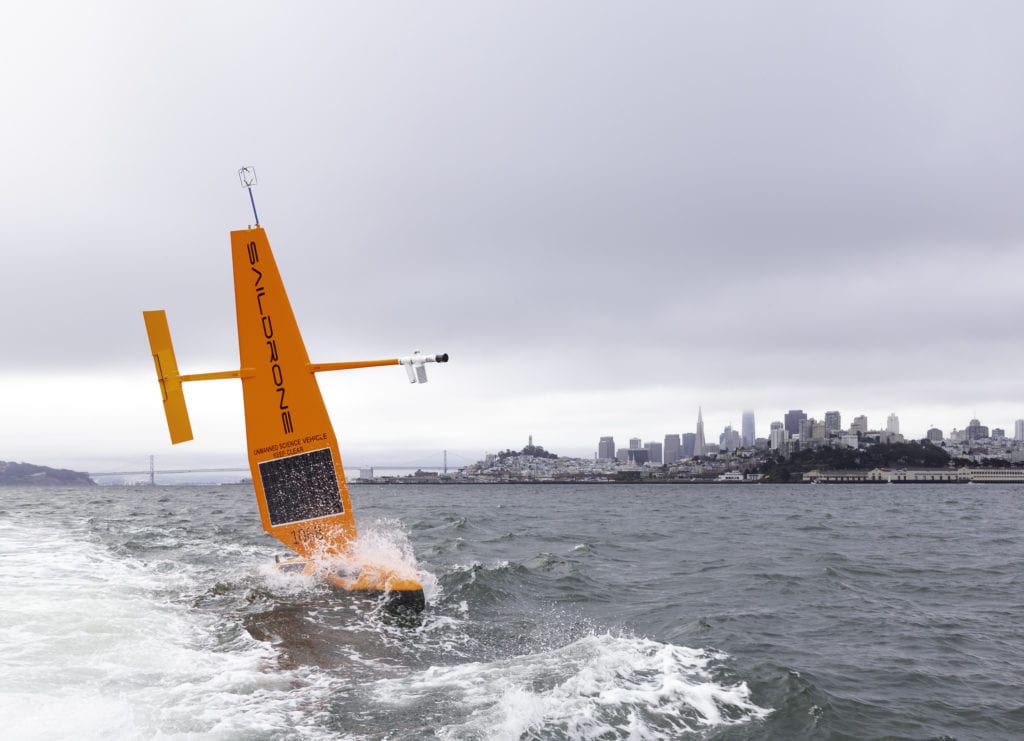
A Saildrone Explorer at work. SAILDRONE
ARLINGTON, Va. — Saildrone is set to conduct an Arctic research mission for the seventh consecutive year with its autonomous unmanned surface vessels (USVs) powered by wind and sun. The company is conducting the missions with six of its smallest USV, the 23-foot-long Explorer.
The six USVs are being launched from Dutch Harbor, a port in the Aleutian Islands. Four will collect data in the Bering Sea and two will collect data in the Chukchi and Beaufort Seas in the Arctic Ocean.
The voyages are being conducted to collect atmospheric, oceanographic and bathymetric data for the National Oceanic and Atmospheric Administration (NOAA) and NASA. The sensors on board the Saildrones will be collecting data on carbon dioxide dissolved in the water; bathymetry; climate and weather — including heat, radiation, carbon and atmospheric variables; wind speed and direction; and radiation and temperatures.
“Every year we have increased our capabilities,” said Rich Jenkins, Saildrone’s CEO, who noted that the Explorer USVs have “incredible reliability.”
For maritime domain awareness, the Explorers also are fitted with 360-degree cameras that record visual information 24/7 using machine learning algorithms to spot anomalies, such as a passing vessel, imaging every five seconds.
“We’ve amassed hundreds of millions of images of the open ocean from the Arctic down to the Southern Ocean,” Jenkins said. “We train the machine-learning model to recognize things visually” such as vessels, icebergs, birds, whales, dolphins, etc.
Data on vessels can be fused with data from the Automatic Information System for increased maritime domain awareness. Saildrone leases the services of Iridium commercial satellites for transmitting data between a USV and a ground station.
CH-53K Helicopter Cost Trending Downward, Marine General Says
U.S. Marine Corps Maj. Gen. Michael S. Cederholm flies the CH-53K “King Stallion” at Marine Corps Base Camp Lejeune, North Carolina, June 12, 2021. U.S. MARINE CORPS / Cpl. Yuritzy Gomez
ARLINGTON, Va. — The unit cost of the Marine Corps’ new heavy-lift helicopter is trending in the right direction as the helicopter prepares for its Initial Operational Test and Evaluation (IOT&E), a senior Marine Corps officer told Congress.
Rep. Vicki Hartzler, R-Missouri, during a June 30 hearing of the subcommittee on Tactical Air and Land Forces for the House Armed Services Committee, asked Lt. Gen. Mark Wise, the Corps’ deputy commandant for aviation, about the cost of a CH-53K King Stallion being $125 million, more than the cost of an F-35 strike fighter. She noted the proposed 2022 budget requested nine CH-53Ks, down from the 11 planned earlier for 2022. She also asked if the Marine Corps’ requirement for 200 CH-53Ks would be reduced in light of the Corps’ planned reduction of heavy helicopter squadrons from eight to five.
Wise replied that unit cost for the CH-53Ks in Low-Rate Production Lot 5 in fiscal 2021 was $97 million and for Lot 6 in fiscal 2022 was projected to be $94 million, lower than the cost of an F-35, “and trending in the right direction.”
The general also said the Corps originally determined the requirement for CH-53Ks to be about 220 aircraft but reduced the official number to 200 because of affordability. He said the requirement will remain at 200 aircraft for the foreseeable future.
“If there is a reduction, it will probably be less than we would normally think had we actually bought the program of record that was the requirement to begin with,” Wise said. “As we get to determining what that number is, any reduction would not happen until the end of program buys. That would reduce the likelihood that the cost would rise, depending on the last lot buys.”
The general noted the 200 number was based on an projected attrition rate that had not been updated.
“So, it could go below 200 — and it ma y— but I’m not sure it’s going to go grossly below” 200, he said.
Wise said progress has been made through risk-reduction initiatives in dealing with technical issues such as engine gas re-ingestion.
“As we get ready to start into IOT&E — we’re actually starting next month — we’re seeing some fairly impressive readiness rates for the test birds that are going to be doing that operational test,” he said.