A Swiftships Landing Craft Utility 1700. SWIFTSHIPS
ARLINGTON, Va. — The U.S. Navy has ordered five more of its new utility landing craft (LCU) for its amphibious warfare forces.
Naval Sea Systems Command awarded Swiftships of Morgan City, Louisiana, a $59.3 million modification to a previously awarded contract “to exercise an option for the construction of five Landing Craft, Utility (LCU) 1700-class transportation boats (1707 through 1711),” the Defense Department said in a May 7, 2021, announcement. Delivery is expected by November 2023. The funds will come from the fiscal 2021 budget.
In February 2019, the Navy ordered LCU 1701 and 1702 under a $26.7 million contract modification. The craft will follow the prototype of the LCU 1700 class. In April 2020, the Navy ordered LCUs 1703-1706 under a $50.1 contract.
“The LCU 1700 class will recapitalize the LCU 1610 capabilities and have a design life of 30 years,” the Naval Sea Systems Command said. “LCU 1700 craft will be a highly reliable and fuel-efficient heavy-lift platform whose capability will be complementary to the faster air cushion landing craft, which have a significantly shorter range, smaller payload capacity, no habitability and operating hour limitations.”
The Navy’s amphibious warfare ships equipped with well decks routinely deploy with LCUs embarked. The Navy plans to procure a total of 32 LCU 1700 craft.
NAVWAR Commander: Overmatch is ‘Imposing Risk over a Wider Expanse’
From left, Naval Information Warfare Systems Command (NAVWAR) commanding officer Rear Adm. Douglas Small, Navy Marine Mammal Program Director Mark Xitco, Acting Secretary of the Navy Thomas Harker, Naval Information Warfare Center (NIWC) Pacific commanding officer Capt. Andrew Gainer and NIWC Pacific Executive Director Bill Bonwit pose for a group photo during a recent visit to NAVWAR and NIWC Pacific locations in San Diego April 21, 2021. The visit allowed Navy leaders to discuss updates for a high priority initiative called Project Overmatch. U.S. NAVY / Aaron Lebsack
ARLINGTON, Va. — The admiral in charge of Project Overmatch said the Naval Operational Architecture (NOA) being developed by the Navy is necessary to preserve free access to the seas and hold adversaries at risk with fully netted, distributed force.
Rear Adm. Douglas Small, commander, Naval Information Warfare Systems Command (NAVWAR), said the U.S. Navy, which enjoyed unfettered maritime supremacy since the Cold War, can no longer take that supremacy nor freedom of navigation for granted, especially with the rise of China and its navy which is rapidly improving in capability and capacity.
He spoke May 7 at a webinar jointly conducted by the U.S. Naval Institute and the Center for Strategic and International Studies and sponsored by Huntington Ingalls Industries.
Small said the Navy’s Project Overmatch is charged to “deliver the Naval Operational Architecture,” a capability to enhance distributed maritime operations by imposing “risk over a wider expanse.”
Small said the goal of the architecture is for it to be the connective tissue for the Navy’s sensors, weapons, and command structure, to operate near and far, at every axis and in every domain, and synchronize those effects to form a widely distributive force.
The admiral said the system of systems the Navy relies on for warfighting can be increasingly vulnerable to Chinese intrusion or countermeasures and the United States needs to maintain an overmatch to minimize such vulnerability, taking the system of systems “to a higher level.”
That overmatch is not only necessary to put potential enemies at risk but to assure allies and partners, he said.
NOA is the naval component of the Joint All-Domain Command and Control architecture.
Flight Testing Soon for Upgraded Marine Corps K-MAX UAS
The Marine Corps’ first two Kaman K-MAX Helicopters arrived at Marine Corps Air Station Yuma, Ariz., Saturday, May 7, 2016. The K-MAX will be added to MCAS Yuma’s already vast collection of military air assets, and will utilize the station’s ranges to strengthen training, testing and operations across the Marine Corps. U.S. MARINE CORPS / Pfc. George Melendez
ARLINGTON, Va. — Kaman Air Vehicles, a division of Kaman Aerospace Corp., has conducted the first flight of the upgraded heavy-lift K-MAX unmanned rotorcraft — the K-MAX Titan — and expects to fly the two Marine Corps similarly upgraded K-MAX aircraft this month, the company said in a release.
“We are excited to reach this major milestone on K-MAX Titan — watching this capability take to the skies and knowing that we are going to solve some of the toughest challenges for our commercial and military customers,” said Roger Wassmuth, senior director, Business Development, Air Vehicles Division, in the release.
The new K-MAX Titan system will be available for existing K-MAX aircraft as well as on new production K-MAX helicopters, the company said. The K-MAX is a rugged, low-maintenance aircraft that features a counter-rotating rotor system and is optimized for repetitive external load operations. The aircraft can lift up to 6,000 pounds (2,722 kilograms) with unmatched performance in hot and high conditions.
At the same time, Kaman is upgrading the autonomous capabilities of the two Marine Corps K-MAX air vehicles through a funded government contract. The two air vehicles are being upgraded with the K-MAX Titan unmanned system and Near Earth Autonomy’s sensor-based autonomy suite.
Flight-testing of the upgraded Marine Corps K-MAX air vehicles is expected to start in May 2021.
The Marine Corps’ acquired two K-MAX systems as cargo resupply UAS, which it designated as CQ-24As. The system consists of two unmanned K-MAX helicopters, main operating base and forward operating base ground control stations, and associated ground support equipment and spares. The Marine Corps conducted evaluations of the K-MAX to fill an urgent requirement for an unmanned ability to deliver/retrograde cargo to forward operating bases while avoiding the use of convoys over dangerous routes.
In November 2011, the Marine Corps deployed the CQ-24A as a government-owned, contractor-operated system into Afghanistan for a six-month evaluation in combat conditions. The deployment was extended through May 2014. The two K-MAX aircraft, along with the rest of the system, were delivered to Marine Operational Test And Evaluation Squadron One (VMX-1) in 2016 to support further cargo UAS experimentation and concept of operations development. In April 2019, Kaman was awarded a contract to replace the avionics in the CQ-24s and return them to flight status.
Navy Reserve Recapitalizing Adversary Aircraft Fleet, Admiral Says
An F-5N Tiger-II from the “Sun Downers” of Fighter Squadron Composite (VFC) 111 takes off from Naval Air Station Key West’s Boca Chica Field during the last day of training before the potential bad weather resulting from Tropical Storm Eta. U.S. NAVY / Danette Baso Silvers
ARLINGTON, Va. — The Reserve Tactical Support Wing of the Navy Air Reserve provides the fleet with adversary services to train crews in aerial combat between dissimilar aircraft and does so using a fleet of F-5 Tiger II and F/A-18 Hornet fighters. The Navy is taking steps to recapitalize the adversary fleet with refurbished fighters.
“The Reserve Tactical Support Wing (TSW) maintains 31 F-5N/F aircraft to provide low-to-mid level threat replication,” wrote Vice Adm. John Mustin, chief of Navy Reserve, in a statement submitted to the defense subcommittee of the House Appropriations Committee for its May 4 hearing.
The F-5Ns are refurbished F-5Es procured from the Swiss Air Force, and the F-5Fs are two-seat versions procured from the manufacturer and later refurbished. These aircraft are flown by two squadrons, VFC-13 at Naval Air Station (NAS) Fallon, Nevada, and VFC-111 at Naval NAS Key West, Florida. In order to increase the number of adversary aircraft, the Navy purchased a further 11 F-5E/F aircraft from Switzerland in fiscal 2020.
“Prior to delivery, these aircraft will receive modern avionics and an airframe reconfiguration to match the current active Navy airframe configuration,” Mustin said. “These 11 aircraft will deliver to TSW squadrons from 2022-2025 as F-5N+/F+, increasing both capacity and capability.”
TSW also provides critical high-end adversary support to the Fleet with 27 F/A-18A-D Hornets. These aircraft are assigned to VFA-204 at NAS Joint Reserve Base New Orleans, Louisiana, and VFC-12 at NAS Oceana, Virginia.
“Due to the extremely high projected cost per flight hour (+$44,000) of these ‘Legacy Hornets,’ the Navy is accelerating divestment from the F/A-18A-D aircraft,” the admiral said. “VFC-12’s transition from the F/A-18A-D Hornet to the Block I FA-18E/F Super Hornet in [fiscal 2021] is the first step towards accelerating Legacy Hornet divestment.”
Mustin said there are not enough Block I Super Hornets to replace the legacy Hornet adversary fleet, so the Navy is proposing the aircraft be replaced by used Air Force and Air National Guard F-16 fighters.
He also said the adversary aircraft need upgrades with threat-representative capabilities “such as Infrared Search and Track Systems and the evolution of the Adversary data link known as RedNet.”
Mustin also pointed out the sustainment issues with the adversary fleet.
“Within the next decade, 62% of the Navy Reserve’s current adversary aircraft will be retired due to the high cost of each service hour, or because they have reached the end of their service life,” he said. “Recapitalization and expansion of adversary capacity in the Navy Reserve presents a cost-effective, sustainable solution to develop warfighting readiness.”
The admiral also tallied the value of the adversary fleet.
[In fiscal 2020], active component strike fighter squadrons flew 13,129 hours of adversary support, generating more than half of the total Navy adversary hours while adding costly flight hours on inventory-limited fleet aircraft,” he said. “Flying more adversary hours in the Reserve increases service life of those active fleet strike fighter aircraft and at the same time reduces overhead operational costs. As such, increasing Navy Reserve support to Navy adversary requirements will improve active component strike fighter service life, while enabling the dedication of fleet flight hours to train for warfighting readiness.”
Mustin: KC-130J Transport is Navy Reserve’s Top Equipment Priority
Sailors assigned to the “Minutemen” of Fleet Logistics Support Squadron (VR) 55 prepare to load cargo onto a C-130T Hercules at Naval Air Facility (NAF) Misawa, Japan. Vice. Adm. John Mustin, chief of Navy Reserve, says his top acquisition priority is the KC-130J Super Hercules to replace the C/KC-130Ts. U.S. NAVY / Mass Communication Specialist Seaman Benjamin Ringers
ARLINGTON, Va. — The admiral in charge of the Navy Reserve said his top acquisition priority is the KC-130J Super Hercules transport/tanker aircraft, needed to replace the service’s C/KC-130T Hercules transports.
“Procurement of the KC-130J to replace the legacy C/KC-130T is the Navy Reserve’s top equipment priority,” wrote Vice Adm. John Mustin, chief of Navy Reserve, in a statement submitted to the defense subcommittee of the House Appropriations Committee for its May 4 hearing. “Transitioning from legacy airframes to the modern KC-130J aircraft is necessary to fill critical capability and capacity gaps and ensure interoperability with our active and reserve component Marine Corps and Air Force partners, who have already transitioned to the KC-130J.”
The Navy’s Unique Fleet Essential Airlift forces are operated entirely by the Navy Reserve. The fleet consists of 30 C/KC-130T and 17 C-40A aircraft that provide the organic intra-theater air logistics, including transporting oversized cargo (F-35 engines, AMRAAM and Harpoon missiles, submarine masts, etc.) to forward-deployed and expeditionary naval Forces, “a critical link in the warfighting supply chain,” Mustin wrote.
The admiral submitted a summary of the legacy Hercules fleet’s performance in fiscal 2020:
“Last year, fleet logistics [VR] squadrons flew 22,707 flight hours and transported 111,625 passengers and 22.2 million pounds of cargo for the Navy and the Department of Defense,” he wrote. “Executing these missions generated a cost avoidance of nearly $1.0 billion per year relative to alternative means of transportation. At the height of the COVID-19 pandemic, Navy Reserve VR squadrons ensured the continuity of Navy training pipelines, safely flying Sailors between training sites when commercial options were reduced or unavailable. Supporting global operations, VR squadrons also transported personnel between U.S. overseas bases around the world. Specifically, C-130 missions increased 7.5% [from 817 missions to 878], while flight hours increased 16.6% [from 7,922 to 9,235 hours]. Even with the increased execution of flight hours and missions, demand continues to increase for C-130 lift, with unmet lift requests reflecting a gap between demand and capacity. To date, [fiscal] ‘21 indicates an even greater demand for cargo this year than in [fiscal] ‘19 and [fiscal] ‘20.
Mustin cited the low readiness of the C/KC-130T fleet and the need to recapitalize it.
“Every mission capable aircraft generates an average of $48.6 million in cost avoidance for the transport of equipment,” he wrote. “The current Mission Capable rates of the C/KC-130T average 25% of Total Aircraft Inventory and required modifications of that legacy airframe will limit aircraft availability to a maximum of 33% until 2030. Comparatively, we expect to realize a 70% mission capable rate for the KC-130J which will provide an additional $200 million per year in transportation and cost savings to the Navy. The current C/KC-130T fleet struggles to meet current fleet demand and lacks the required capability and capacity to meet wartime intra-theater logistics requirements, a situation best remedied through recapitalization.”
Textron Submits Concept for Marine Corps Advanced Recon Vehicle
Textron Systems’ Cottonmouth concept for the Marine Corps’ Advanced Reconnaissance Vehicle. TEXTRON SYSTEMS
ARLINGTON, Va. — Textron Systems has submitted to the Marine Corps its proposal for the competition to build the Advanced Reconnaissance Vehicle (ARV), a Corps requirement for an amphibious scout vehicle that will serve as a sensor node in the Corp’s planned modernization to meet the challenges of great power competition with expeditionary advanced base operations in the Indo-Pacific region.
The ARV proposal, called Cottonmouth by Textron, is designed to be a “next -generation Naval Sensor Node,” fitted with “cutting edge sensor technology,” the company said in a May 4 release. “Cottonmouth delivers advanced maneuverability and a synergized sensor system to enhance reconnaissance operations.”
The Cottonmouth has a 6×6 compact build that will allow four ARVs to fit on an LVAC 100-class ship-to-shore connector, also built by Textron. The Cottonmouth would be “equipped with multi-spectrum sensors, providing seamless communication between the Navy and Marine Corps to employ unmanned systems and joint-warfighting weapons systems. This provides the next-generation decision dominance needed to defeat threats beyond line of sight.”
The Cottonmouth’s sensors would include Elbit Systems of America’s IronVision, “which uses “see-through” technology to provide the vehicle with advanced visibility and 360-degree situational awareness,” the release said.
The Cottonmouth is a six-wheeled vehicle designed to operated by two personnel and to carry five additional mission personnel. It is designed for rugged land operations and water operations — using waterjets — in waves of 2 to 3 feet.
Dave Philips, Textron System’s vice president for Land Systems, said the ARV would serve as a “quarterback” of a new platoon concept, which may include five other variants of the ARV. He said company is focused on Cottonmouth as a naval sensor node, but the company expects to build an infantry fighting vehicle version of the vehicle equipped for direct and indirect fire in the future.
Marketing imagery of the vehicle shows a notional weapon system mounted atop the vehicle, in this case a remote-operated Kongsberg CROWS-J with a .50-caliber machine gun and an anti-tank missile system, said Luke Wright, Textron’s ARV program manager.
For the prototype, the government is providing the competing contractors Lockheed Martin Stalker unmanned aerial vehicles to be integrated within their vehicles.
The Marine Corps plans to replace its fleet of approximately 600 LAV-25 Light Armored Vehicles with 500 ARVs.
The Cottonmouth Alpha purpose-built, open-architecture prototype was developed using more than $6 million so far, Philips said, and is a vehicle not required by the initial phase of the program, which is being put through requirements validation testing at the National Automotive Test Center in February 2021. Amphibious capabilities are being evaluated during the current quarter. As of May 3, the vehicle had logged 748 hours of operation in testing.
Philips said the Marine Corps will select up to three competitors for the prototype phase of the ARV program. Up to two contractors will be chosen for the engineering and manufacturing development (EMD) phase. He estimates the EMD phase will be conducted in 2024.
Berger Touts Vehicle-Mounted Naval Strike Missile for Marine Corps
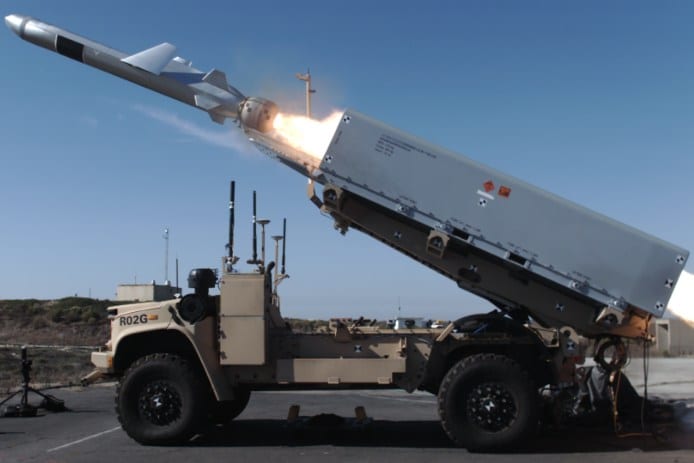
A Naval Strike Missile being fired from a modified, unmanned Joint Light Tactical Vehicle. U.S. NAVY
ARLINGTON, Va. — The vehicle-mounted Naval Strike Missile was highlighted by the Marine Corps’ commandant as an example of rapid development to meet the challenges of great power competition and enable the Corps to hold enemy naval units at risk from expeditionary bases.
While testifying April 29 before the defense subcommittee of the House Appropriations Committee, Gen. David H. Berger, commandant of the Marine Corps, held up a recently released photo of a Naval Strike Missile (NSM) being fired from a modified unmanned Joint Light Tactical Vehicle (JLTV) known as ROGUE.
The Navy Marine Expeditionary Ship Interdiction System, or NMESIS, successfully fired a Naval Strike Missile off the California coast, the system’s builder, Raytheon Missiles & Defense, a Raytheon Technologies business, said in an April 28 release. “The inaugural test proved the system’s ability to fire a Naval Strike Missile, or NSM, from a U.S. Marine Corps ground launcher and score a direct hit against a surface target at sea. The Marines will use NMESIS to support the U.S. Navy from the shore against enemy ships. NMESIS is comprised of the Raytheon Missiles & Defense-made NSM and a Remotely Operated Ground Unit for Expeditionary (ROGUE) Fires vehicle, produced by Oshkosh Defense.”
“Our Naval Strike Missile is a vital weapon for denying enemies the use of key maritime terrain,” said Kim Ernzen, vice president of Naval Power at Raytheon Missiles & Defense. “This test further demonstrates our partnership for advancing the Marine Corps’ modernization priorities of enabling sea control and denial operations.”
“Our role in contributing to [freedom of the seas] is, where [sea] denial, where [sea] control has to happen from a tactical to operational perspective, we can do that by moving the capability around that hold an adversary’s navy at risk from sip and from shore,” Berger said.
“This is the speed at which we have to develop a capability like that,” he said. “This is the brilliance of a couple of young officers and Oshkosh [Defense], and a few other people creating other capabilities long before they’re even thought all the way through. This Joint Light Tactical Vehicle is unmanned. The people at Oshkosh and these two [Marine Corps] majors thought, ‘We can do this.’ They took the cab off the back and they put [the NSM] on the back and a fire control system. Now we can move this around on vessels, put it ashore, and hold an adversary’s navy at risk in order to ensure that the lines of the sea are kept open.
“Our job is to support the fleet commander,” Berger said. “The fleet’s job is to support the joint force commander.”
Berger also said a benefit of the NSM is that it is common to the Navy and Marine Corps and can be shifted to where it is needed most.
CNO: Hypersonic Missiles First on Zumwalt DDGs Before Block 5 Virginia SSNs
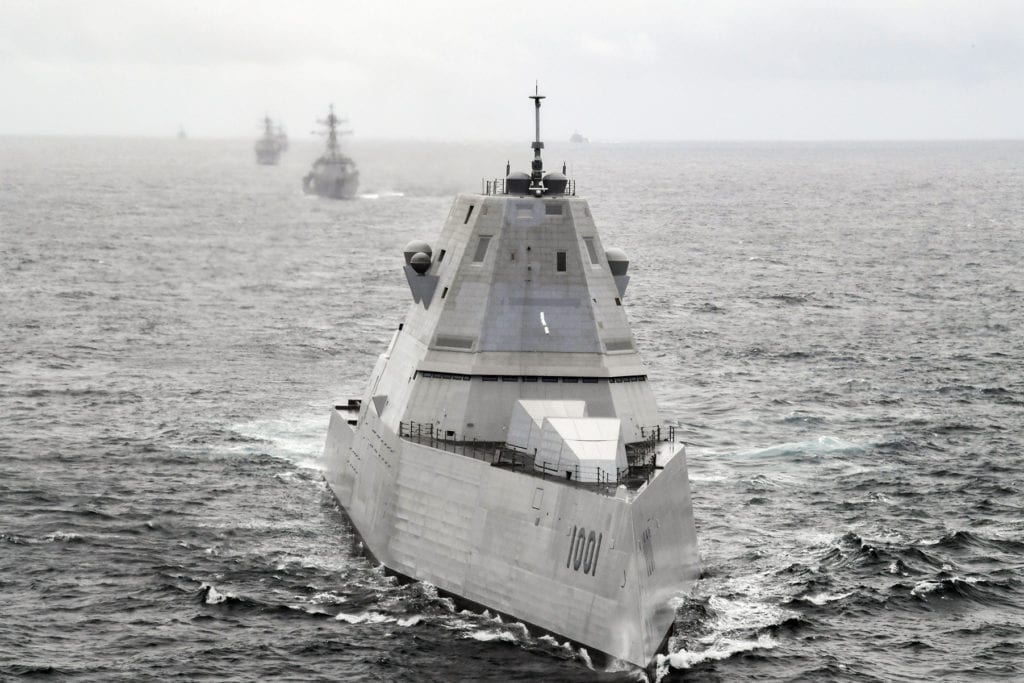
The Zumwalt-class guided-missile destroyer USS Michael Monsoor (DDG 1001) leads a formation including the Arleigh Burke-class guided missile destroyers USS Fitzgerald (DDG 62), USS Spruance (DDG 111), USS Pinckney (91), and USS Kidd (DDG 100), and the Independence-variant littoral combat ship USS Coronado (LCS 4) during U.S. Pacific Fleet’s Unmanned Systems Integrated Battle Problem (UxS IBP) 21, April 21. U.S. NAVY / Chief Mass Communication Specialist Shannon Renfroe
ARLINGTON, Va. — The Navy’s top officer said Zumwalt-class guided-missile destroyers will be the first U.S. Navy ships to be armed with hypersonic missiles.
“With respect to our research and development budget, hypersonics is our top priority, so we are working closely with the Marine Corps, with the Army, and with the Air Force to reach a capability that we can deliver to the fleet in 2025,” said Adm. Michael Gilday, chief of naval operations, testifying April 29 before the defense subcommittee of the House Appropriations Committee.
“We intend to do that on the latest and greatest destroyers we have, the Zumwalt-class destroyer,” Gilday said. “Our intent is to first put the weapon on those destroyers and then on our Virginia-class Block 5 submarines. Right now, our projection is that capability will be on our submarines by 2028.”
As recently as November, Vice Adm. Johnny Wolfe, director of Strategic Systems Programs, said the plan was to deploy the Conventional Prompt Strike (CSP) capability hypersonic missiles first on the four Ohio-class guided-missile submarines (SSGNs)
The CSP will be deployed by the U.S. Army first in 2023. Wolfe said the Initial Unit Training of Army units without the All-Up Round will begin in 2021. A canister hot-launch operational demonstration is planned for 2022. Delivery of the Army’s prototype truck-hauled delivery system is scheduled for 2023. The delivery of the All-Up Round — including the hypersonic glide body — is planned for 2024.
Gilday said a hypersonic weapon was successfully tested last year with the Army, being fired thousands of miles at very high speed and with very high precision.
“We’re very excited about the path we are on right now in hypersonics,” he said. “We’re very confident of the delivery timeline.”
Navy’s Unmanned Systems Battle Problem Features All-Domain Sensing
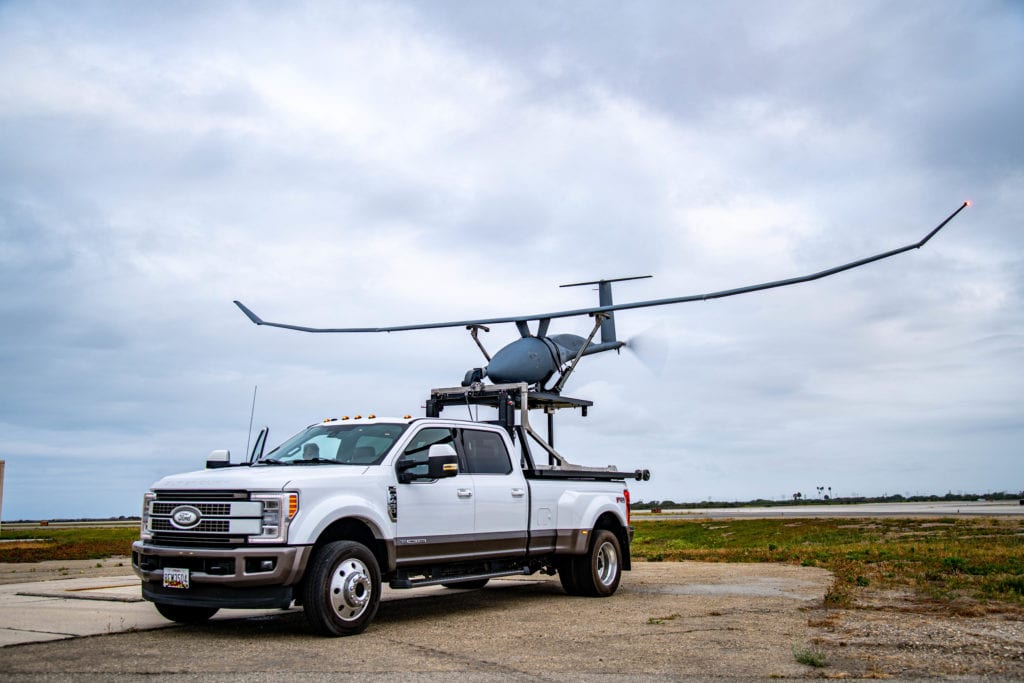
A Vanilla ultra endurance land-launched unmanned aerial vehicle (UAV) undergoes operational pre-flight checks during U.S. Pacific Fleet’s Unmanned Integrated Battle Problem (UxS IBP) 21 at Naval Base Ventura County, Point Mugu. UxS IBP 21 integrates manned and unmanned capabilities into challenging operational scenarios to generate warfighting advantages. U.S. NAVY / Construction Mechanic 2nd Class Michael Schutt
ARLINGTON, Va.— The Unmanned Systems Integrated Battle Problem (UxS IBP) conducted off the coast of California over the last week featured sensor data exchange and remote sensing in all domains from seabed to space, and involved a variety of scenarios, including swarm attacks by drones and launch and recovery of an unmanned underwater vehicle by a submarine.
Rear Adm. Robert Gaucher, director of the Maritime Headquarters for the U.S. Pacific Fleet, and Rear Adm. James Aiken, commander, Carrier Strike Group Three, and commander of the IBP, spoke about the exercise to reporters during an April 26 teleconference.
“Just yesterday, we successfully teamed air and surface manned and unmanned capability to put [an SM-6 missile] well past over the horizon from [the Arleigh Burke-class guided-missile destroyer USS] John Finn on a target and it struck the target very, very successfully,” Aiken said.
The manned/unmanned chain of events for the missile shoot was totally passive, [without] any active sensor. The target was detected by a combination of manned and unmanned platforms and a space system to locate and identify the target, track it with electronic support measures (ESM) bearings and pass the information to the John Finn, which was able to shoot the SM-6 at range, well beyond line of sight.
The admiral said the vignettes exercised during the IBP included focused warfighter vignettes, an anti-submarine warfare and surface ISR [intelligence, surveillance and reconnaissance] vignette, and an over-the-horizon strike vignette, the latter being the SM-6 event mentioned above.
Unmanned surface and air systems were used to prosecute a submarine-like target. This event included an MQ-9 SeaGuardian UAV dropping sonobuoys and up-linking data after a P-8 maritime patrol aircraft departed station.
In one scenario, a USV obtained an ESM electronic support measures bearing on a surface target, passed the locating data to the information warfare commander, who passed it to the surface warfare commander, who used a swarm drone attack against the target, a surface vessel.
During one event, a submarine was able to launch and recover an IVER-4 UUV using a torpedo tube.
“Being able to do that without divers [is] reducing a ton of risk for our divers to have to go recover … was a big win,” Gaucher said.
He also said the IVER-4 was able to conduct its own surveillance and reconnaissance and intelligence preparation of the battlespace.
“We were also able to deliver some kinetic effects in support of undersea and seabed warfare,” he said.
Control of unmanned systems during the IBP was conducted variously from a shore site, from ships at sea, or autonomously.
“I know that unmanned can proved me video from overhead,” Gaucher said. “I know I can put a towed array sensor on a medium-sized unmanned surface vessel, and I can control it from the shore for theater ASW. … I know that I can operate a system in and out of the torpedo tube of a submarine to support seabed warfare.”
“From a [Pacific Fleet] perspective, we were very pleased about how the Integrated Battle Problem came out, in particular with our ability to integrate unmanned [systems] into that battle problem in a contested environment,” Gaucher said, noting that 29 different unmanned technologies were part of the IBP, with about 50% surface, 30% subsurface, and 20% above the surface.
Gaucher stressed that goals for the IPB included using unmanned systems to avoid putting personnel in harm’s way and to improve targeting “so we get a better solution when we launch.”
STATCOM Chief Defends Low-Yield Warhead on Submarine-Launched Ballistic Missiles
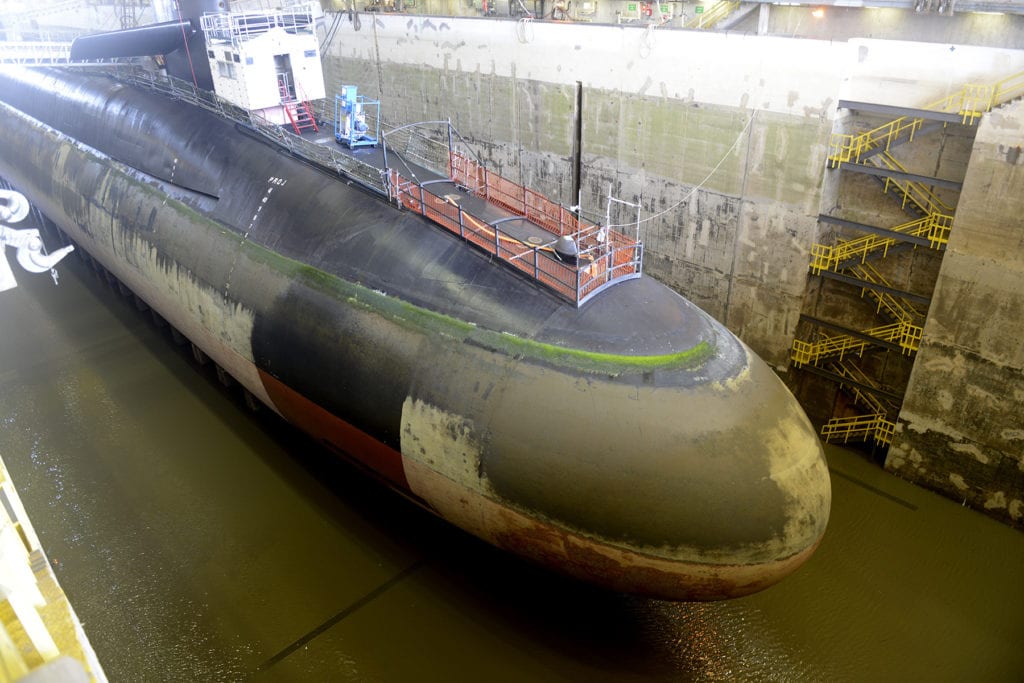
The Ohio-class ballistic-missile submarine USS Tennessee (SSBN 734) (Blue) arrives at the Trident Refit Facility (TRF) dry dock berthing at Naval Submarine Base Kings Bay, Ga., for a planned maintenance period, August 13. Tennessee is one of five ballistic-missile submarines stationed at the base and is capable of carrying up to 20 submarine-launched ballistic missiles with multiple warheads. U.S. NAVY / Mass Communication Specialist 1st Class Ashley Berumen
ARLINGTON, Va. — The commander of the nation’s strategic deterrent forces again defended the low-yield nuclear warhead that the Navy has deployed at sea on Trident submarine-launched ballistic missiles on board ballistic-missile submarines (SSBNs). This time he cited analysis to support the deployment.
Adm. Charles A. Richard, commander, U.S. Strategic Command (STRATCOM), testified April 22 before the Strategic Forces subcommittee of the House Armed Services Committee (HASC) on the status of the nation’s strategic forces.
“Within the last year, STRATCOM started formally measuring risk of strategic deterrence failure,” Richard said. “This is a formal risk assessment designed to make sure that we are analytically rigorous in all the things that we do, acknowledging that this is fundamentally trying to measure a subjective process, the decision making of another country. Our assessment is that the deployment of a low-yield [warhead] improved the risk of strategic deterrence, i.e., it lowered it because of the deterrent effect it achieved.”
The submarine-launched low-yield warhead became a requirement noted in the 2018 Nuclear Posture Review. The result was the W76-2 warhead, which was deployed in 2019 on the tips of some Trident submarine-launched ballistic missiles carried by Ohio-class SSBNs.
With the change in presidential administrations and the leadership of the Congress, critics, including HASC Chairman Adam Smith, D-Washington, have been bolder in expressing long-held opposition to the W76-2 low yield warhead as de-stabilizing to the nuclear balance.
In hearings this week before subcommittees of the Senate and House armed forces committees and in a Pentagon news conference, Richard noted that this era was the first in which the United States was faced with deterring two peer competitors — Russia and China. He termed China as the greatest strategic threat to the United States, but that Russia was the greatest nuclear threat to the United States.
He said the United States requires the total capacity of the nuclear triad — intercontinental ballistic missiles, bombers and submarine-launched ballistic missiles — to maintain strategic deterrence.