Navy Opens Deeper Inquiry Into Theodore Roosevelt; Move Delays Decision on Captain’s Reinstatement
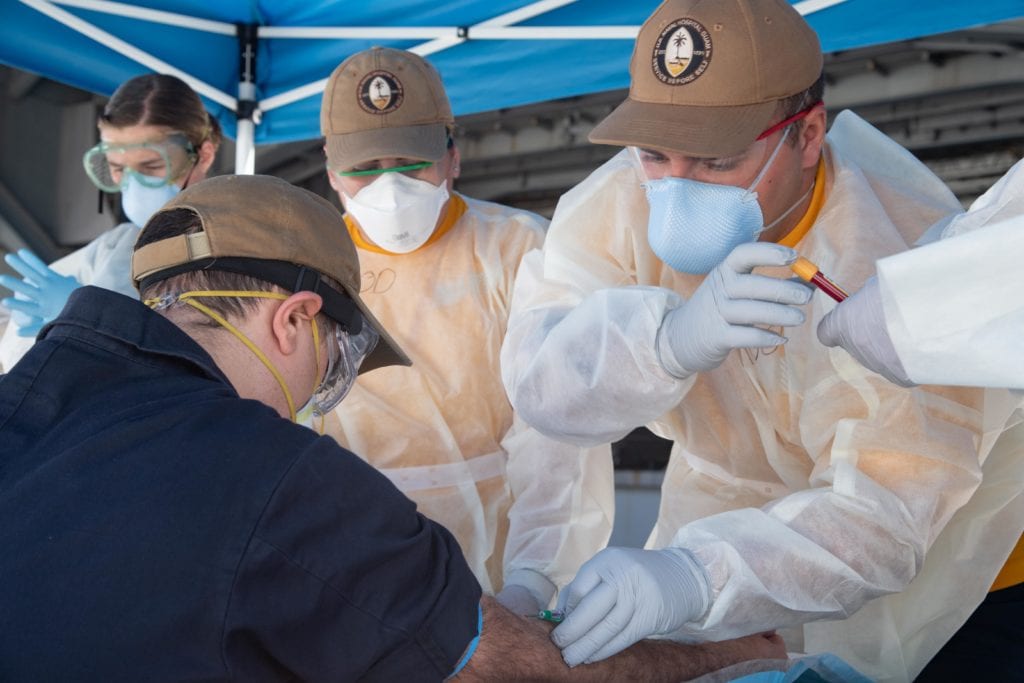
Navy Hospitalman Rudy Flores (right), assigned to Naval Hospital Guam, takes a blood sample on April 23 from Mass Communication Specialist 1st Class Christopher Liaghat, a crewman assigned to the USS Theodore Roosevelt, as part of an investigation of the COVID-19 outbreak there. U.S. Navy/Mass Communication Specialist Seaman Kaylianna Genier
ARLINGTON, Va. — Acting U.S. Navy Secretary James McPherson has directed Chief of Naval Operations Adm. Mike Gilday to conduct a second deeper investigation of the events surrounding the COVID-19 outbreak on the aircraft carrier USS Theodore Roosevelt that has claimed the life of a Roosevelt Sailor, hospitalized others and infected hundreds more.
The results of a first preliminary investigation were forwarded last week by Gilday to McPherson, who took them under review. McPherson is a retired Navy flag officer in the Judge Advocate General Corps.
“Following [discussion with Gilday], I have unanswered questions that the preliminary inquiry has identified and that can only be answered by a deeper review,” McPherson said in an April 29 statement.
“This investigation will build on the good work of the initial inquiry to provide a more fulsome understanding of the sequence of events, actions and decisions of the chain of command surrounding the COVID-19 outbreak aboard USS Theodore Roosevelt.”
Vice Chief of Naval Operations Adm. Robert Burke will be in charge of the second investigation, which is expected to wrap up by May 27, unless an extension is granted, according to an April 30 statement from Cmdr. Nate Christensen, a spokesman for Gilday. From there, Gilday is expected to review the results and issue any recommendations.
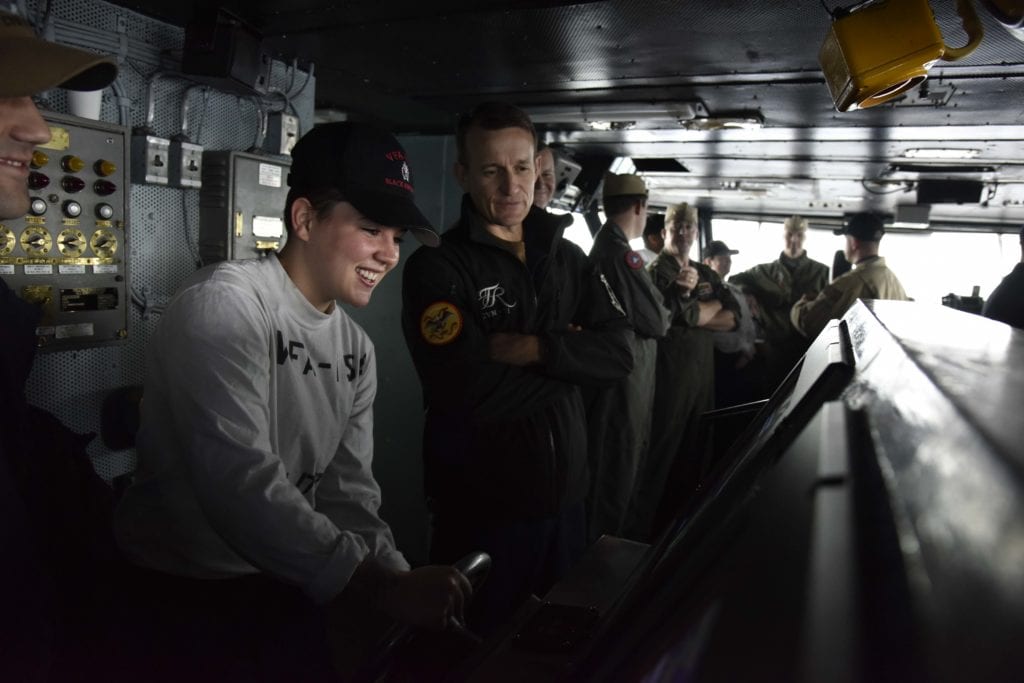
Capt. Brett Crozier (center), at the time commanding officer of the USS Theodore Roosevelt, in February instructs Information Systems Technician 3rd Class Eden Betzler on how to steer the ship. U.S. Navy/Mass Communication Specialist 2nd Class Pyoung K. Yi
The Navy reported as of April 25 that the entire crew of the Theodore Roosevelt had been tested for the virus, resulting in 4,105 negatives but 833 positives — including the carrier’s former commanding officer, Capt. Brett Crozier.
Of the total cases, 112 Sailors had recovered and 4,273 Sailors from the Roosevelt had been moved ashore. Also, as of April 25, two of the ship’s Sailors were in U.S. Naval Hospital Guam under treatment for COVID-19 symptoms. Another Sailor died from complications of the infection, the Navy announced on April 13.
The Theodore Roosevelt’s public affairs office announced April 29 that the ship was preparing to return to sea following a bow-to-stern cleaning process. The crew members that were quarantined ashore are beginning to move back on board.
“This investigation will build on the good work of the initial inquiry to provide a more fulsome understanding of the sequence of events, actions and decisions of the chain of command surrounding the COVID-19 outbreak aboard USS Theodore Roosevelt.”
Acting Navy Secretary James McPherson
Since March 27, the Roosevelt has been sidelined in Apra Harbor, Guam. Crozier was relieved of his command on April 2 by then-acting Navy Secretary Thomas Modly after fallout from a letter written by the captain to his chain of command leaked to a San Francisco newspaper. A few days later, Modly flew to Guam to visit the ship and address the crew, but he stepped down on April 7 after his address — which was highly critical of Crozier — generated many calls for Modly’s resignation.
According to several press reports, Gilday recommended Crozier’s reinstatement to McPherson. Defense Secretary Mark Esper received a verbal update from Gilday on April 24. Another report said that U.S. Army Gen. Mark Milley, chairman of the Joint Chiefs of Staff, recommended the more extensive investigation.
Gilday had directed Burke to probe the circumstances and climate of the entire Pacific Fleet “to help determine what may have contributed to a breakdown in the chain of command,” Modly said April 2, the day he relieved Crozier as commander of the ship only months after Crozier had assumed command.
A day earlier, at a press briefing on the Roosevelt virus outbreak, Gilday spoke of “a potential comms breakdown, wherever it occurred. We’re not looking to shoot the messenger here, we want to get this right.”
Deputy Editor Scott Achelpohl and Seapower Correspondent John M. Doyle contributed to this report.
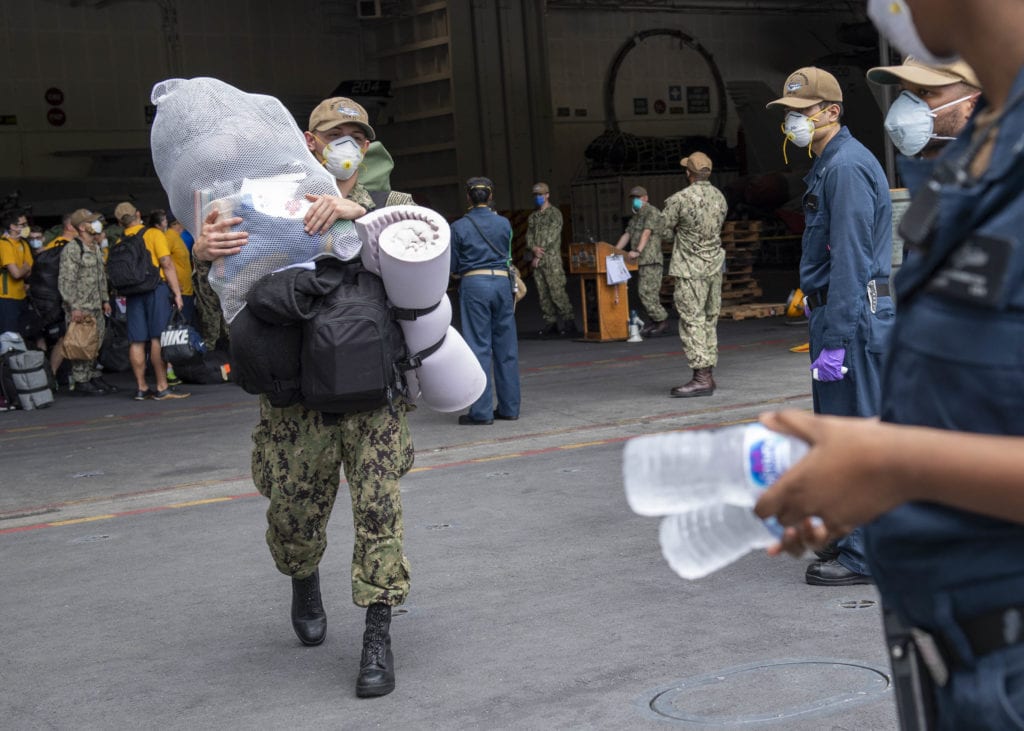
U.S. Navy Airman Andrue Barraza departs the Theodore Roosevelt on April 25 for quarantine after completing essential watch-standing duties. U.S. Navy/Mass Communication Specialist 1st Class Chris Liaghat
Triton Deploys at Last: The Navy Takes Its New UAV to the Western Pacific
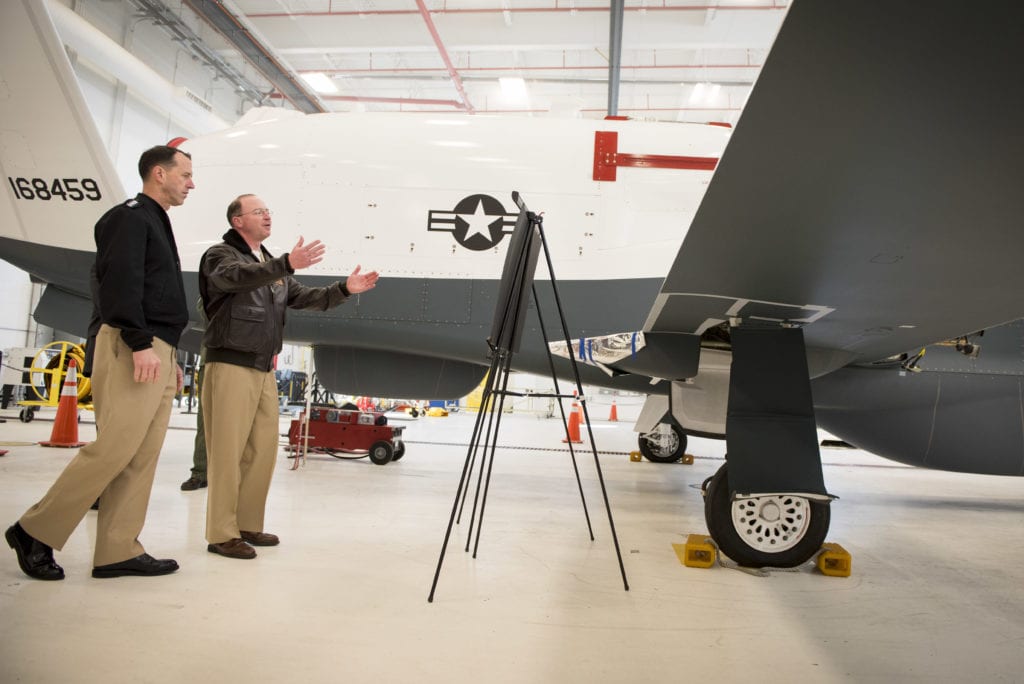
An MQ-4C Triton sits in a hangar at Andersen Air Force Base, Guam, after arriving for a deployment as part of an early operational capability test. U.S. Air Force/Senior Airman Ryan Brooks
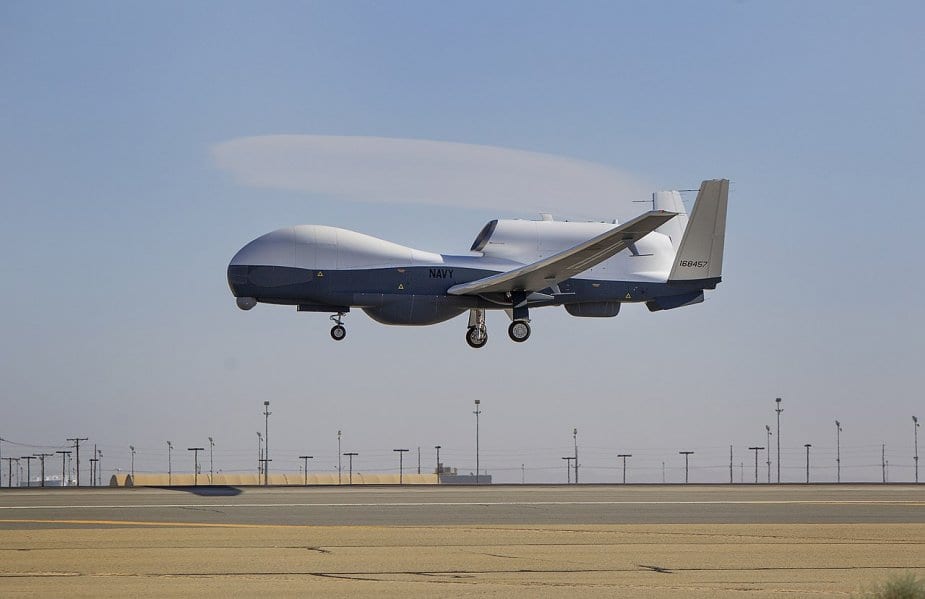
In January, the U.S. Navy’s newest surveillance aircraft, the Northrop Grumman-built MQ-4C Triton, a high-altitude, long-endurance unmanned aerial vehicle (UAV), embarked on its first deployment, a move to demonstrate what the Navy calls early operational capability.
Two MQ-4Cs assigned to Unmanned Patrol Squadron 19 (VUP-19), the first Triton squadron, deployed to Andersen Air Force Base on Guam and were in place by Jan. 26 to fly missions in support of the U.S. 7th Fleet.
Check out the digital edition of the May Seapower magazine here.
“VUP-19 is operating Triton to further develop the concept of operations and fleet learning associated with operating a high-altitude, long-endurance system in the maritime domain,” Capt. Dan Mackin, the Navy’s Triton program manager, said in response to a query from Seapower. “The squadron plans to conduct multiple flights per month in support of Commander Task Force 72, 7th Fleet and Indo-Pacific Command.”
“The fielding of the Navy’s premier unmanned aircraft system and its additive, persistent, multisensor data collection and real-time dissemination capability will revolutionize the way maritime intelligence, surveillance and reconnaissance [ISR] is performed,” Mackin said in a Jan. 26 Navy release.
“While developing the concept of operations, the MQ-4C Triton is actively conducting missions that are complementing the P-8A Poseidon,” said Cmdr. Kim DaCosta-Azar, commanding officer of VUP-19, in an email response to Seapower. “This complement brings increased persistence, capability and capacity through its multisensor mission payload.”
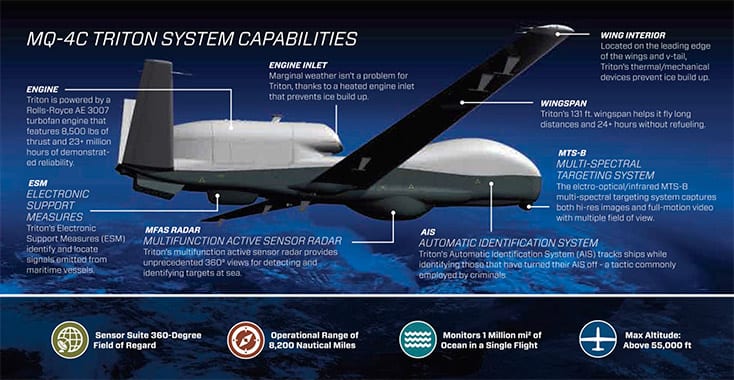
The MQ-4C’s mission payload includes a Northrop Grumman-built ZPY-3 Multifunction Active Sensor, an X-band radar with modes that include maritime surface search, spot synthetic aperture radar (SAR), strip SAR, inverse SAR snapshot and inverse SAR high-resolution. The radar’s 360-degree scan enables the Triton to cover 2.7 million square miles during a mission.
The Triton’s suite also includes a Sierra Nevada-built ZLQ-1 electronic surveillance measures sensor equipped with specific emitter identification and with an automatic identification system. A Raytheon-built MTS-B multispectral electro/optical/infrared sensor with a laser designator/pointer/range-finder capability also is installed.
“The fielding of the Navy’s premier unmanned aircraft system and its additive, persistent, multisensor data collection and real-time dissemination capability will revolutionize the way maritime [ISR] is performed.”
Capt. Dan Mackin, the Navy’s Triton program manager
The Triton can transmit its data to a ground station, including video live-streaming. It also can be an alternative communications relay to space-based satellites.
“The MQ-4C Triton will provide 7th Fleet with a round-the-clock ISR capability, as the aircraft have capability to fly more than 24 hours during each mission,” DaCosta-Azar said. “The VUP-19 detachment has the ability to pilot the MQ-4C from Guam or from Jacksonville, Florida, mission-control station. The majority of the VUP-19 crew operates from Naval Air Station Jacksonville.”
VUP-19 is headquartered at Naval Air Station Jacksonville, but its Tritons are home-based at Naval Air Station Point Mugu, California.
“The introduction of MQ-4C Triton to the 7th Fleet area of operations expands the reach of the U.S. Navy’s maritime patrol and reconnaissance force in the Western Pacific,” said Capt. Matt Rutherford, Task Force 72’s commander. “Coupling the capabilities of the MQ-4C with the proven performance of P-8, P-3 and EP-3 will enable improved maritime domain awareness in support of regional and national security objectives.”
Praise for — and Commitment to — the MQ-4C
Chief of Naval Operations Adm. Michael Gilday praised the Triton during March 11 testimony before the Senate Appropriations Committee’s Defense subcommittee.
“The capabilities that the MQ-4 brings are game-changing in terms of long-range ISR at altitude, with sensors that we haven’t had supporting the fleet before,” he said. “We’re still committed” to the Triton.
Mackin said the Navy’s program of record remains at 68 UAVs, despite a gap of two years — 2021 and 2022 — proposed in the Navy’s 2021 budget proposal. The total does not include the two Navy-owned and one Northrop Grumman-owned test aircraft.
Then-Chief of Naval Operations Adm. John Richardson views the Triton at Naval Air Station Patuxent River, Maryland, in 2016. U.S. Navy/Mass Communication Specialist 1st Class Nathan Laird
The Navy has ordered 20 Tritons to date and has accepted delivery of seven: three flyable test aircraft (including one owned by Northrop Grumman), one fatigue test article and three production aircraft, the latter three delivered to VUP-19. One of the VUP-19 Tritons was involved in a flight mishap during a landing at NAS Point Mugu on Sept. 13, 2018.
“The Triton aircraft damaged during the gear-up landing at Point Mugu has been stricken from inventory although some components were salvaged for use on training devices,” Mackin said.
Configurations With More Advanced Capabilities
He said the two MQ-4Cs deployed to Guam are in the Triton’s baseline configuration known as IFC 3 (Integrated Functional Capability 3). The Navy is working on deploying the Triton with IFC 4, which gives the UAV a signals intelligence capability and will put it on the path to replace the Navy’s EP-3E electronic reconnaissance aircraft. IFC 4, also called the multi-int (multi-intelligence) capability, is planned for fiscal 2022.
Multi-int capability deployed in four Tritons at a single site to establish a 24/7 orbit over the Western Pacific area of operations also will mark the achievement of initial operational capability for the Triton.
The Northrop Grumman-owned MQ-4C in the test program is being used to advance the Triton’s capabilities.
The Triton completes its first flight on May 22, 2013, from the Northrop Grumman manufacturing facility in Palmdale, California. U.S. Navy via Northrop Grumman/Alex Evers
“We are … integrating and testing IFC-4 upgrades to meet the U.S. Navy’s and Australia’s multi-intelligence requirement, which will ultimately enable the U.S. Navy to retire the EP-3,” said Doug Shaffer, vice president and program manager, Triton program, Northrop Grumman, in response to a query from Seapower.
Mackin said there “is a plan for upgrading older aircraft to the multi-int configuration with some [aircraft] already” in the works.
VUP-19 eventually will operate 12 MQ-4Cs operated and maintained by 500 personnel. The Navy plans to establish a second Triton squadron, VUP-11, at Naval Air Station Whidbey Island, Washington. The two squadrons together eventually will field 20 Tritons at five sites to sustain five around-the-clock orbits. The remaining 48 Tritons would be used for training, attrition and the maintenance pipeline over the service life of the UAV.
The groundwork for the MQ-4C, based on the U.S. Air Force Block 20 RQ-4A Global Hawk, was laid more than a decade ago with the Broad-Area Maritime Surveillance Demonstration (BAMS-D) program, in which the Navy acquired from the Air Force two Block 10 RQ-4As and their integrated sensors that included an electro-optical sensor, SAR with a ground moving target indicator and wide-area search modes. The Navy added an LR-100 electronic surveillance measures sensor, the automatic identification system, inverse SAR capability, and maritime moving target and maritime search sensing.
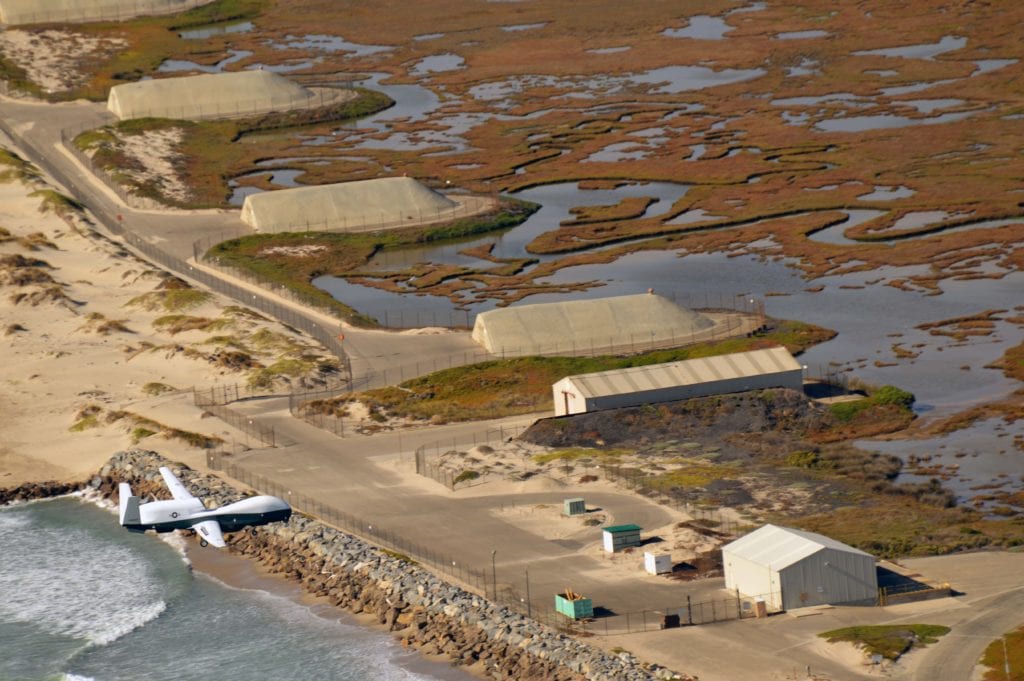
The first Triton, assigned to VUP-19, Detachment Point Mugu, arrives at Naval Base Ventura County, California, in 2017. U.S. Navy/Public Affairs Specialist Theresa Miller
The Navy in 2011 received three more RQ-4As from the Air Force for the BAMS-D. Since then, one RQ-4A was lost in a mishap in eastern Maryland in 2012 and another was shot down by Iranian forces last June. A third was damaged in a takeoff mishap in November. Mackin said repair is underway on the damaged RQ-4A.
The Navy deployed the RQ-4A to the U.S. Central Command area of responsibility in early 2009 for a planned six-month deployment. Now, more than 11 years later, after continuous deployment, the Navy still values the BAMS-D program as it awaits more deployments of the MQ-4C Triton.
According to the 2021 budget proposal, the Navy plans to phase out the BAMS-D, beginning in fiscal 2023, to allow the sea service to fund the whole MQ-4C program. “The MQ-4C will assume the signal intelligence mission from the EP-3E in [fiscal] 2022, which will require aircraft and control station modifications and calibrations to keep pace with emerging signals of interest at greater sensitivity thresholds.”
Allies See Triton’s Value, Sign Up to Take Delivery
Two allied nations are on track to operate the Triton. Australia signed a memorandum of understanding for up to six Tritons in June 2019, with delivery of the first scheduled for 2023. Germany also has announced its intention to procure three Tritons. Foreign procurement may be key in sustaining a steady Triton production line if the Navy gaps the procurement in 2021 and 2022.
“A two-year gap in production would have significant negative effects on the production line and the supplier base,” Shaffer said. “A pause would mean we lose the lessons learned that have enabled our suppliers and Northrop Grumman to achieve production efficiencies and get to this mature point of the program, which would then add more risks and costs to the program.
“We estimate that stopping and restarting the line alone will cost roughly $100 million to $150 million and then each aircraft likely costs about $20 million more. We are working closely with the Navy on multiple options [that] could keep the production line open and potentially result in cost savings for both the Navy and Australia.
“We have had multiple discussions with the U.S. Navy and Australia about options to fill the [fiscal] ’21 and ’22 production lines with Australian aircraft,” he said. “An acceleration of the Australian program would result in significant savings to Australia and ensure cost savings to the U.S. Navy by preventing a pause in Triton production. While any decision to accelerate the Australian program is between the U.S. Navy and Australia, we are prepared to provide the necessary support to an accelerated Australian program.”
Geurts: Third Zumwalt DDG Will Be Commissioned After Combat Systems Activation
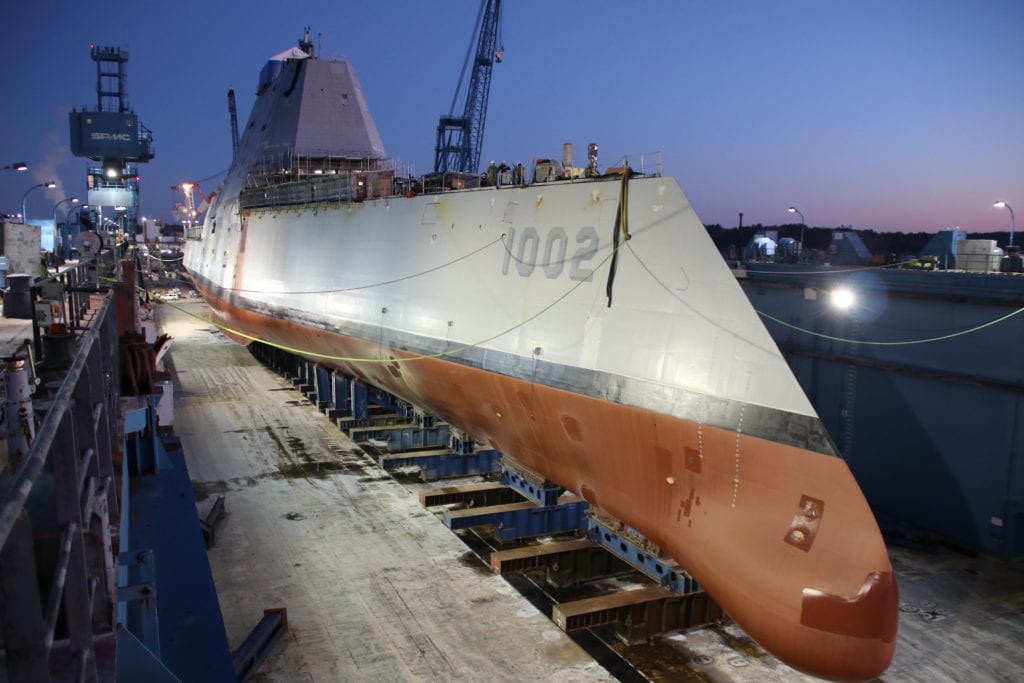
The USS Lyndon B. Johnson is made ready before flooding of the dry dock at General Dynamic-Bath Iron Works shipyard and subsequent launching of the third Zumwalt-class destroyer in 2018. U.S. Navy via General Dynamics-Bath Iron Works
ARLINGTON, Va. — The U.S. Navy’s third Zumwalt-class guided-missile destroyer will be commissioned after its combat systems are fully installed and activated, rather than going through a two-part delivery, the Navy’s top acquisition official said.
The future USS Lyndon B. Johnson (DDG 1002), under construction at the Bath Iron Works shipyard in Bath, Maine, will not be commissioned until after its combat systems are installed, unlike the process used for its two predecessors, USS Zumwalt (DDG 1000) and Michael Monsoor (DDG 1001), said James F. Geurts, assistant secretary of the Navy for research, development and acquisition, speaking to reporters in an April 28 teleconference.
In the case of the first two of the class, the ships’ hulls were completed and put through trials and then delivered to the Navy before their combat systems were installed. The Zumwalt was commissioned — in a status the Navy calls In Commission, Special — in Baltimore and then proceeded to San Diego for installation and activation of its combat systems. It was delivered to the Navy on April 24 and will begin at-sea testing of its systems preparing for its initial operational test and evaluation and its 2021 initial operational capability milestone.
The USS Michael Monsoor similarly was commissioned on Jan. 26, 2019, and proceeded to San Diego for its combat systems installation, which was completed in March.
The Lyndon B. Johnson is 93% complete, Geurts said, but will not be delivered and commissioned until its combat systems are installed. Since the combat systems activation will be conducted in San Diego, it will need to proceed there in a status other than as a commissioned ship.
“We did change to a single-phased delivery for that ship, and so we are adjusting that ship’s future plans based on all the learning we’ve had on DDG 1000 and DDG 1001,” Geurts said.
“I’m personally not a fan of two-phased delivery,” he said. “I can understand why we do them. In certain cases, I think they’re also problematic because you end up delivering the ship more than once and you can get into a delayed test-maintain-fix cycle.”
Senate Bill Would Fund Second Virginia-Class Sub in 2021
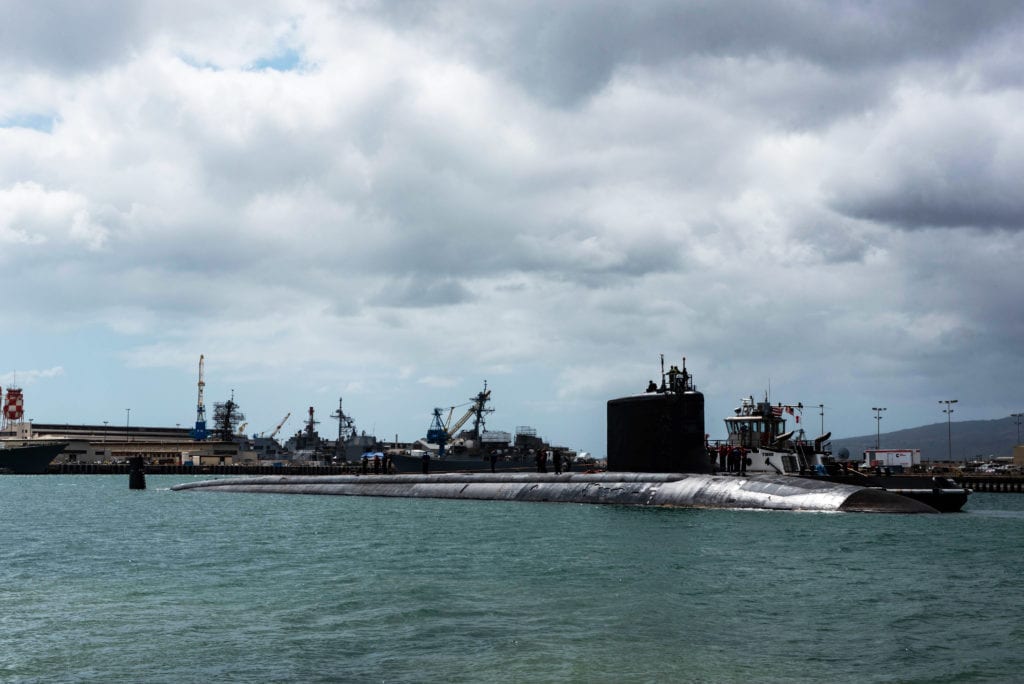
The Virginia-class fast-attack submarine USS North Carolina departs Joint Base Pearl Harbor-Hickam on March 25 for a regularly-scheduled deployment. A member of the Senate Armed Services Committee has introduced a $43 billion bill that would fund, among other things, a second Virginia-class sub in fiscal year 2021. U.S. Navy/Mass Communication Specialist 1st Class Michael B. Zingaro
ARLINGTON, Va. — A member of the Senate Armed Services Committee has introduced a $43 billion bill to strengthen U.S. forces in the Indo-Pacific to counter Chinese competition and that would fund, among other things, some of the U.S. Navy’s priorities on its unfunded list, including a second Virginia-class attack submarine.
Sen. Tom Cotton (R-Ark.) introduced the Forging Operational Resistance to Chinese Expansion (FORCE) Act on April 22, which his office said is a “critical investment in the United States’ ability to compete with China.”
The bill would include “$6.1 billion to regain the advantage in the Indo-Pacific region; $9.2 billion in capability increases for Great Power Competition; $11 billion for mitigating coronavirus impacts to procurement programs; $3.3 billion for mitigating coronavirus impacts to [the] defense industrial base; $1.5 billion for hospital ship recapitalization; [and] $12.0 billion to enhance national resilience and critical infrastructure.”
The bill would provide $3.9 billion to upgrade naval lethality, a summary of the bill said, including funds for:
A second fiscal 2021 Virginia-class submarine.
Virginia-class submarine industrial base expansion.
Subsea and seabed warfare capability for the Virginia class.
Advanced procurement for the Columbia-class ballistic-missile submarine
Additional Naval Strike Missiles and their launchers.
Integration of the long-range air-to-surface missiles on all combat aircraft.
Additional sonobuoys for anti-submarine warfare.
Marine Corps modernization, including ground-based anti-ship missiles.
The bill also would fund adding hypersonic weapons on compatible fighter aircraft and accelerating development of directed energy weapons and cyber offensive and defensive capabilities.
Also provided in the bill would be $4.88 billion to the Navy and Marine Corps to “provide emergency aid for those programs that are most vulnerable” to mitigate the effects of the COVID-19 pandemic, including funds for shipbuilding and conversion; the Columbia-class submarine industrial base; aircraft procurement; operations and maintenance; and research, development, test and evaluation.
Cotton’s bill also specifically provides “funding for the Navy to replace the [hospital ships] USNS Comfort and USNS Mercy with new American-built vessels. This would be an opportunity to provide American jobs and grow the American industrial base for the future,” the bill summary said.
Trump Authorizes Navy to Fire on Harassing Iranian Craft
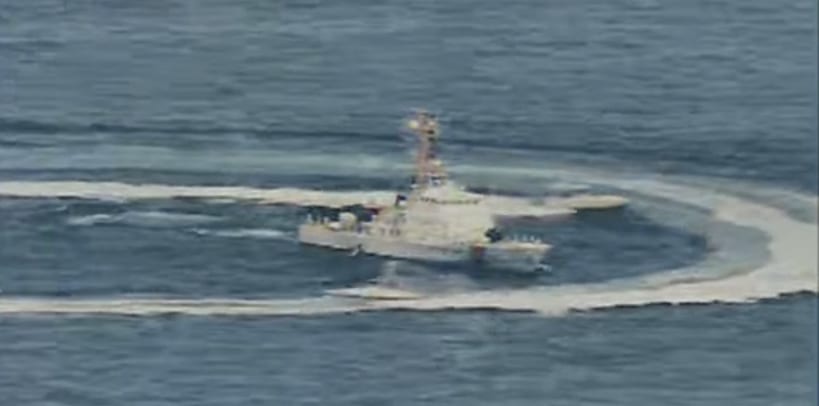
Iranian vessels harass a U.S. ship by crossing its bow and stern. U.S. forces are conducting joint interoperability operations in the U.S. 5th Fleet area of operations in the northern Persian Gulf. U.S. Navy
ARLINGTON, Va. — President Trump has authorized the U.S. Navy to fire on Iranian boats that harass American ships, following a recent episode where armed Iranian craft came dangerously close to and harassed Navy and U.S. Coast Guard vessels engaged in an exercise in the northern Persian Gulf.
“I have instructed the United States Navy to shoot down and destroy any and all Iranian gunboats if they harass our ships at sea,” Trump said in an April 22 tweet.
Under routine rules of engagement, U.S. ships are inherently authorized to fire in self-defense, but this new authority gives the ships’ commanders permission to fire if they are being harassed by the Iranian craft.
“If we see a hostile act, if we see hostile intent, we have the right to respond up to and including lethal force and, if it happens in the Gulf, if it happens in any way, we will respond with overwhelming lethal force, if necessary, to defend ourselves. It’s really that simple.”
Air Force Gen. John Hyten, vice chairman of the Joint Chiefs of Staff
“On April 15, 11 Iranian Islamic Revolutionary Guard Corps Navy (IRGCN) vessels repeatedly conducted dangerous and harassing approaches of the USS Lewis B. Puller, USS Paul Hamilton, USS Firebolt, USS Sirocco, USCGC Wrangell and USCGC Maui while the U.S. vessels were conducting joint integration operations with U.S. Army AH-64E Apache attack helicopters in the international waters of the North Arabian Gulf,” the U.S. 5th Fleet said in a release.
“The IRGCN vessels repeatedly crossed the bows and sterns of the U.S. vessels at extremely close range and high speeds, including multiple crossings of the Puller with a 50-yard closest point of approach and within 10 yards of Maui’s bow,” the release added.
“The U.S. crews issued multiple warnings via bridge-to-bridge radio, five short blasts from the ships’ horns and long-range acoustic noise maker devices but received no response from the IRGCN. After approximately one hour, the IRGCN vessels responded to the bridge-to-bridge radio queries, then maneuvered away from the U.S. ships and opened distance between them.”
The Iranians occasionally have used their small, fast, armed and highly maneuverable boats in swarms to harass naval and merchant ships in the Persian Gulf and last year captured merchant ships flagged in the United Kingdom and other nations.
Many U.S. ships are armed with Mk38 25 mm chain guns and M2 .50-caliber machine guns — in addition to larger-caliber guns on some ships — for countering fast attack craft, while many helicopters based on U.S. ships are armed with Hellfire and Advanced Precision Kill Weapon System guided missiles that are effective against such craft.
In January 2016, Iranian boats seized two U.S. Navy riverine command boats and detained the crews after the U.S. boats strayed into Iranian waters off Farsi Island in the Persian Gulf. The crews and boats later were released.
“The IRGCN’s dangerous and provocative actions increased the risk of miscalculation and collision, were not in accordance with the internationally recognized Convention on the International Regulations for Preventing Collisions at Sea ‘rules of the road’ or internationally recognized maritime customs and were not in accordance with the obligation under international law to act with due regard for the safety of other vessels in the area,” according to the 5th Fleet release.
Questioned at an April 22 Pentagon news conference, Deputy Defense Secretary David L. Norquist said that “all of our ships retain the right of self-defense and people need to very careful in their interactions to understand the inherent right of self-defense.”
“Every capability that we deploy — every ship that deploys into harm’s way — has the inherent right of self-defense, as the secretary just described,” said Air Force Gen. John Hyten, vice chairman of the Joint Chiefs of Staff, who also spoke at the news conference.
“What that means: if we see a hostile act, if we see hostile intent, we have the right to respond up to and including lethal force and, if it happens in the Gulf, if it happens in any way, we will respond with overwhelming lethal force, if necessary, to defend ourselves. It’s really that simple. Nobody should doubt that the commanders have the authority right now to respond to any hostile act or hostile intent.”
“I like that the president warned an adversary,” Hyten said. “That’s what he’s doing — he’s providing a warning. ‘If you want to go down that path, we will come, and we will come large, so don’t go down that path.’ He’s saying it in clear, certain terms. We understand that direction, and every commander that is deployed has the ability to execute that.”
Norquist said he thought the intent of the president’s tweet was clear. “When you talk about harassment, you’re talking about actions designed to provoke, actions designed to threaten. It’s a very clear message that the Iranians should understand.”
Hyten added: “You can’t let a fast boat get into a position where they can threaten your ship. We have very specific guidance on how we can use lethal force.”
Navy Cybersecurity Director: ‘No Relaxation of Defenses’ During Telework Time
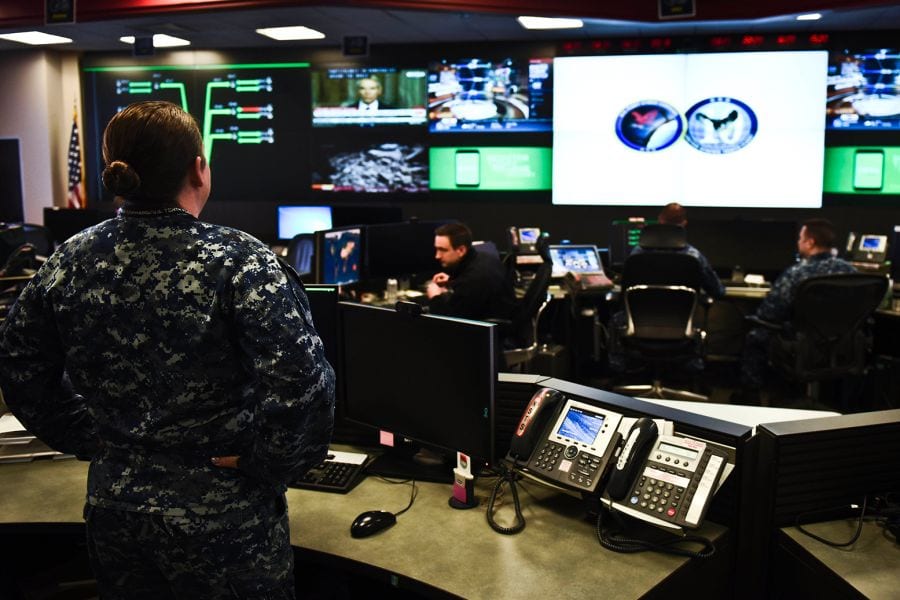
Sailors stand watch in the Fleet Operations Center at the headquarters of U.S. Fleet Cyber Command. U.S. Navy
ARLINGTON, Va. — The U.S. Navy is maintaining a vigilant cyber watch over its data networks as it balances network security and protecting the health of its Sailors amid the COVID-19 pandemic, a Navy admiral said.
“We’re trying to balance two different priorities,” Rear Adm. Kathleen Creighton, director of cybersecurity in the Office of the Chief of Naval Operations, said during an April 17 webcast that was part of the Navy League’s Sea-Air-Space 2020: Virtual Edition. “One is keeping our Sailors and civilians safe and to enable them to work remotely and second is to ensure operational readiness.”
To register and then watch this Sea-Air-Space 2020: Virtual Edition webinar live online, click here.
Creighton said the Navy has had to go through a big cultural shift from working in offices to “ensuring as many people as possible can work from home remotely.”
She said that, in addition to Defense Department partners, the Navy’s industry partners had taken a “first responder-type approach to helping the Navy” by adding infrastructure to handle the ballooning demand for secure telework.
“We’re trying to balance two different priorities. One is keeping our Sailors and civilians safe and to enable them to work remotely and second is to ensure operational readiness.”
Rear Adm. Katherine Creighton
The admiral cited the need for significant expansion of capacity, the need to maximize collaboration capabilities, and determination of any need to change cybersecurity policy “to ensure we can take advantage of remote telework options.”
She said that “on any given day probably only a few thousand people accessed the Navy’s network remotely … before COVID-19. Now, we are seeing upwards of 150,000 or more people accessing the network remotely.”
The great increase in telework required an expansion in capacity requirement for laptop computers, mobile phones, iPads and the VPN servers that they connect to as well as an expansion of Microsoft Outlook 365 use. Circuitry also had to be added to handle the increased use of devices as well as more people manning the help desk for the network.
Creighton said the Navy “has been on a road to modernize and to start using more collaboration capabilities, and this crisis has pushed us to roll those out faster. We’re using some temporary capabilities, and we’re looking to accelerate our permanent capabilities.”
She said the Navy is discovering where the bottlenecks in the network are and fixing them on a piece-by-piece basis. In addition to expanded circuitry, the Navy has been cleaning up user accounts and increasing licenses.
“Every time we increased the capacity, it was used. It filled right up,” she said. “So, the Navy is taking working from home very seriously, trying to protect our Sailors and civilians.”
“Our adversaries in cyberspace know we were doing business differently, so they are responding in kind,” she said, “so we have made sure that anything we have done has not relaxed our cybersecurity standards.”
“There has been no relaxation of any defenses,” she said. “We are securely connecting with that same network from home.”
Creighton said a temporary cloud is being set up to handle a faster roll-out of Office 365.
Looking to the future after the COVID-19 pandemic, Creighton said she believes “there would be a desire to continue a greater level of telework than we saw in the past, so we need to be sure that our network has the capacity to do that, that we have the procedures in place to do it, but most importantly we’re able to do it securely to protect our information and our people’s identity and other things we value as a Navy.”
Marine Cyber Official: ‘Our Networks Are Resilient’ in COVID-19 Environment
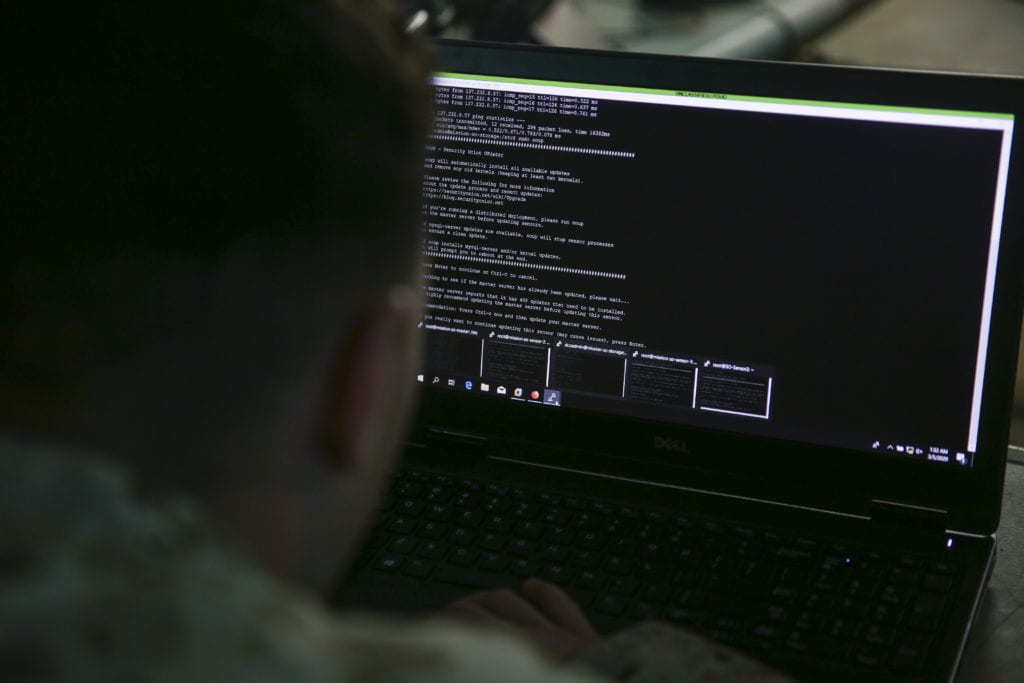
A U.S. Marine assess data during an exercise, Native Fury 20, in the United Arab Emirates on March 5. U.S. Marine Corps/Sgt. Alexis Flores
ARLINGTON, Va. — The U.S. Marine Corps’ cyber networks are being defended and upgraded even as the COVID-19 pandemic forces ad hoc adaptation in their operation, a senior Marine Corps official said.
“Our networks are good, and they are operating at a good capacity and are resilient,” said Gregg Kendrick, executive director of Marine Corps Forces Cyberspace Command, speaking April 17 in a webcast for Navy League’s Sea-Air-Space 2020: Virtual Edition.
To register and then watch this Sea-Air-Space 2020: Virtual Edition webinar live online, click here.
“We’re pleased with our effective efforts in our ability to support the force as it has gone to ad hoc telework or alternate work sites and maintain our capacity and, more importantly, our operational capability to support our warfighters and our commanders that are out there deployed in harm’s way.”
Kendrick said the Corps is monitoring its networks differently in the current environment.
“We do look at our virtual private networks and then we look at our physical and transport layer, our network stack from Layer 1 to Layer 4, so from that perspective we’re focused on those types of metrics and really watching our latency,” he said.
“So, we are very focused on the security. Every decision we have made in regards to supporting the ad hoc telework option has really [been] focused. We’ve had a fundamental security look, and we’ve really looked at our modernization efforts to ensure that we are aware of any of the advanced persistent threats and/or capabilities that are out there to ensure that we have a good, resilient as well as available network.”
“We’re pleased with our effective efforts in our ability to support the force as it has gone to ad hoc telework or alternate work sites and maintain our capacity.”
Gregg Kendrick, Marine Corps Forces Cyberspace Command
Kendrick said his force is looking at “which applications are in use the most, which are stressed the most at the highest capacity, what exactly are our latent measures, … and our overall bandwidth [including] by bandwidth region. Everything [security metrics] is funneled through our enterprise security desk so that we can rapidly pull metrics and shift resources as needed to support our Marine warfighters.”
He said Cyberspace Command is starting to see trends in the pandemic environment, “but we are definitely waiting for this to evolve and then we will be able to draw conclusions, but at the same time we don’t want to let a trend propagate to a point where we have to go into a different work cycle.”
“The bad guys are always looking at what we’re doing, and they are looking to do harm,” Kendrick said. “We protect our workforce. We secure, operate and defend the Marine Corps enterprise networks.”
Kendrick said that through the Corp’s new command-and-control network structure the service is bringing a “unity of command that provides a much clearer readiness picture of our network, our resiliency picture, and then a better overall visualization of the data flow from the end points all the way to the data centers and then back out where they need to go.”
The executive director said the Corps is adopting Microsoft Office 365 to achieve a more efficient capability combined with a hybrid cloud architecture, aiming for higher velocity.
“In the end state the adversary gets a vote,” he said. “They move at speed unconstrained by rules of engagement or the laws of nation states. We need to implement the best infrastructure, the best applications, the best operational processes as efficiently as possible so that we can modernize, provide the best capability to the warfighter, at the same time ensuring security from adversary actions and resiliency across the networks.”
Ford Weapons Elevators Set for Completion by Summer 2021 Shock Trials
Huntington Ingalls Industries-Newport News Shipbuilding division contractors aboard the aircraft carrier USS Gerald R. Ford test a lower-stage weapons elevator. U.S. Navy/Mass Communication Specialist Seaman Apprentice Riley McDowell
ARLINGTON, Va. — The installation and turnover of the advanced weapons elevators on the aircraft carrier USS Gerald R. Ford is proceeding well, with the goal to complete the work by summer 2021, a top U.S. Navy official said.
“We need to get all of the elevators up and running prior to her full-ship shock trials planned for [summer 2021],” James. F. Geurts, assistant secretary for research, development and acquisition, told reporters during an April 16 teleconference.
He said that the carrier had just returned from 32 days at sea where it conducted carrier qualifications for fleet and student pilots, logging 1,352 catapult launches and arrested landings — “generating readiness for the fleet” — and that one lower elevator had completed testing.
“I’m pleased with the performance of the shipyard,” Geurts said. “Ford in the [post-delivery testing and trials] period deployed at least 50% of the time. I have been very proud of the shipbuilder’s creativeness in getting the elevators worked on while the ship is underway. We’re ahead slightly of the schedule. My main focus is getting these first two lower elevators turned over [to the crew] because that will allow full access from the magazine all the way to the flight deck.”
Geurts said the priority is to give the crew access to the magazines and the second is adding redundancy and capacity. He said a lesson learned during the elevator installation was to have elevator specialists among the shipbuilder’s work force.
“You can’t just have any trade work on the elevators,” he said. “What the shipbuilder has done is create essentially an elevator trade [with] a separate schoolhouse. We’re essentially using Ford to build the teams that will then continue and flow all the way through [the subsequent carriers, CVNs 79 through 81]. There is work being done on those follow-on carriers.
“They’re also going to have to improve their efficiency at getting the work done.”
In Perhaps a First, USS Delaware Commissioned Underwater
The USS Delaware transits the Atlantic Ocean with some company after departing Huntington Ingalls Industries Newport News Shipbuilding division during sea trials last August. U.S. Navy via Ashley Cowan/Huntington Ingalls Industries
ARLINGTON, Va. — The COVID-19 pandemic is driving the U.S. Navy to adapt some of the ways it conducts business, but the commissioning of a submarine underwater is likely to be a first.
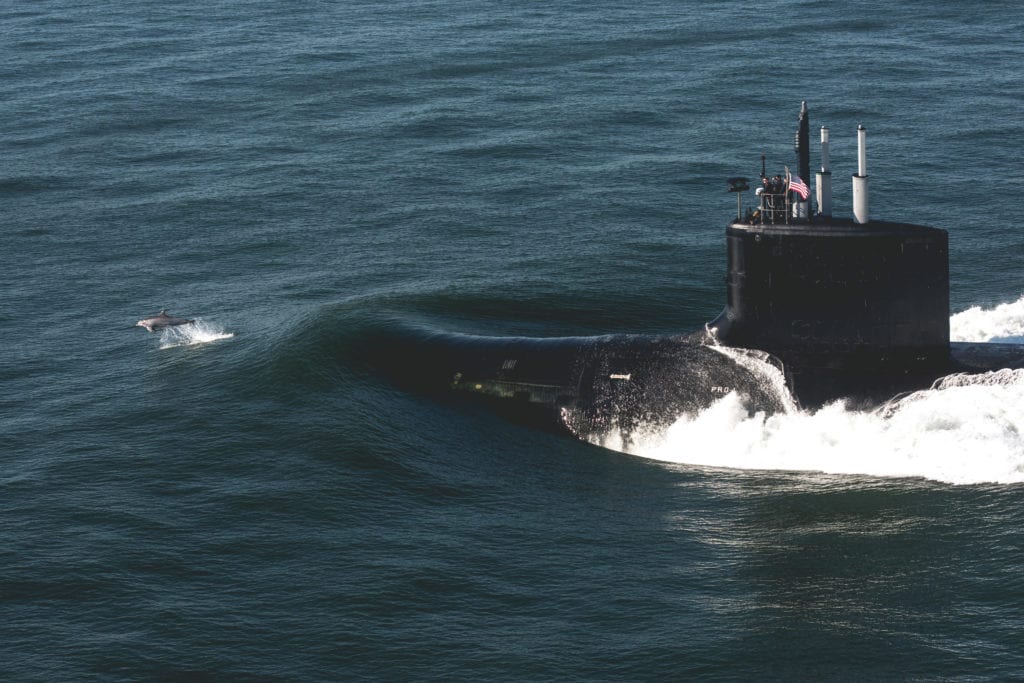
The Virginia-class attack USS Delaware was commissioned into the Navy on April 4 while the sub was underwater, James F. Geurts, assistant secretary for research, development and acquisition, told reporters during an April 16 teleconference.
Geurts said the Delaware’s crew replicated commissioning ceremony traditions that could be accomplished beneath the surface, including “bringing the ship to life” and sounding the claxon. The crew also fired water slugs through the Delaware’s torpedo tubes.
“Due to public health safety and restrictions on large public events, the commissioning ceremonies for the future USS Delaware and future USS Vermont were canceled for April 4 and 18, respectively,” Bill Couch, a spokesman for Naval Sea Systems Command, told Seapower back on March 24.
A Navy release added: “Although the traditional commissioning ceremony was canceled due to restrictions on large gatherings brought on by the COVID-19 pandemic, the Navy commissioned USS Delaware administratively on April 4 and transitioned the ship to normal operations. Meanwhile, the Navy is looking at an opportunity to commemorate the special event with the ship’s sponsor, crew and commissioning committee.”
The Delaware is the eighth and last Block III Virginia-class SSN. The Vermont is the first of 10 Block IV Virginia-class subs. The two subs were built jointly by General Dynamics’ Electric Boat and Huntington Ingalls’ Newport News Shipbuilding.
Navy, Marine Officials: AI Will Augment — Not Replace — Humans
Rear Adm. David Hahn, chief of naval research, and Jennifer Edgin, the U.S. Marines Corps’ assistant deputy commandant for information, were the guests on a webcast April 16 for the Navy League’s Sea-Air-Space 2020: Virtual Edition on the two sea services’ possible uses for artificial intelligence.
ARLINGTON, Va. — U.S. Navy and Marine Corps officials close to the effort to develop artificial intelligence in machines say the technology is advancing rapidly and will be used where it can add value.
Discussing AI in an April 16 webcast of the Navy League’s Sea-Air-Space 2020: Virtual Edition were Rear Adm. David Hahn, chief of naval research, and Jennifer Edgin, the Marines’ assistant deputy commandant for information. They said AI has an “incredible capability” and will have a “huge role to play” in warfighting.
To register and then watch this Sea-Air-Space 2020: Virtual Edition webinar live online, click here.
Hahn said that AI can help sort the enormous amounts of data available to the warfighter and perform many tasks that previously were performed by humans.
“Things advance faster when artificial intelligence is applied,” Hahn said.
He stressed, however, that AI will not replace humans, but will augment them.
“I don’t think you should look at it as replacing [humans], he said. “I think you should look at it as a value add. That value add will come in speed of decision, or the efficiency of the operation, or the effectiveness of that decision or that event. I think that this [AI] is a force multiplier for the humans who are engaged in these activities.
“It’s up to us to find the combinations of artificial intelligence and other technologies like autonomy to apply the appropriate ways to naval warfare,” he said. “I don’t think it’s a one-for-one, and we’re not going to trade out a human for a machine. We’re going to make the whole team better with this human-machine teaming concept.”
“I don’t think you should look at [AI] as replacing [humans]. I think you should look at it as a value add.
Rear Adm. David Hahn
Hahn stressed that AI and autonomy are not the same, but where they intersect, AI can add value to autonomy.
“Autonomy is going to move along a pathway, and when machine learning or some other method of artificial intelligence can add to that autonomy to accomplish a mission, then there will be an intersection,” he said. If it adds value to the mission, then it will make sense to do it.”
Humans are still required for many types of decisions and the services are working on the issues that arise with the use of AI.
“That conversation is maturing,” Hahn said.
The admiral said that he sees a “democratization” of the tools of AI, in which it becomes the domain not just of academia but will eventually spread to general use by the military and the public. A disadvantage of that democratization is that the AI in use will be available to adversaries, and AI that can be used for beneficial purposes also can be used for nefarious purposes.
AI “is an incredible capability that we in the Marine Corps seek to harness,” Edgin said. “Our philosophy is how do we want to pair Marines with machines to be more effective on the battlefield. We don’t want Marines to be spending their time putting a whole bunch of data into a spreadsheet. We want Marines to be able to make judgement decisions. We want them to use that Level 4 fusion capability that we have as humans to develop courses of action to lead at the small-unit level.”
“One of the most beneficial tools we have today is actually the individual Marine,” she added. “What we try to do is unleash their potential to identify technologies, identify problems, and then quickly implement a solution.
“If there is one truth in AI, there will always be something new and exciting that can potentially provide benefits to us.”