In Perhaps a First, USS Delaware Commissioned Underwater
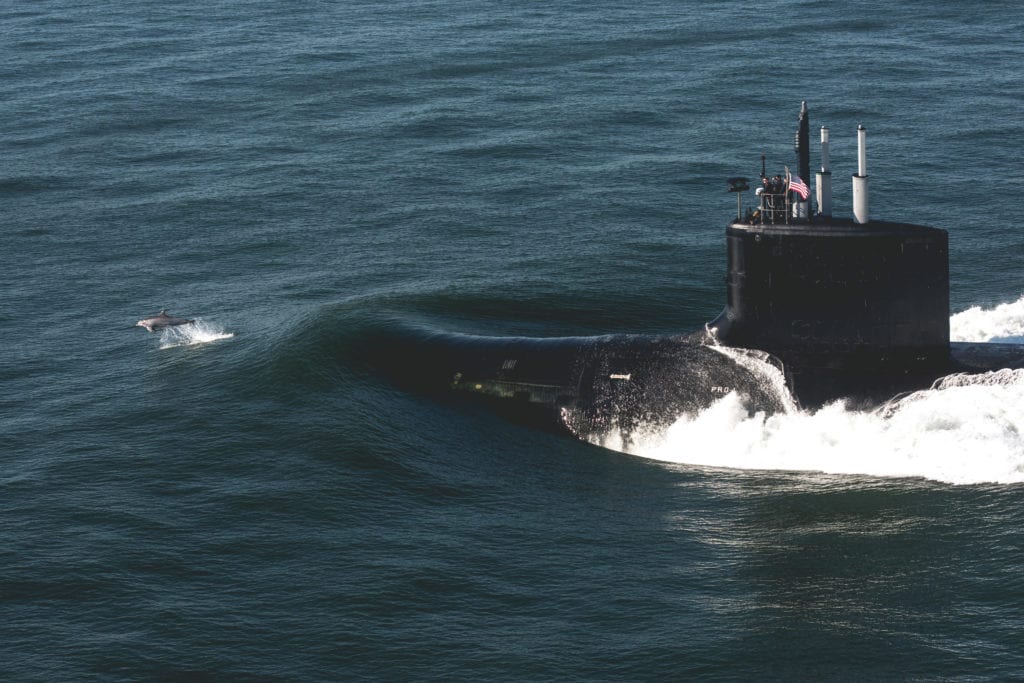
The USS Delaware transits the Atlantic Ocean with some company after departing Huntington Ingalls Industries Newport News Shipbuilding division during sea trials last August. U.S. Navy via Ashley Cowan/Huntington Ingalls Industries
ARLINGTON, Va. — The COVID-19 pandemic is driving the U.S. Navy to adapt some of the ways it conducts business, but the commissioning of a submarine underwater is likely to be a first.
The Virginia-class attack USS Delaware was commissioned into the Navy on April 4 while the sub was underwater, James F. Geurts, assistant secretary for research, development and acquisition, told reporters during an April 16 teleconference.
Geurts said the Delaware’s crew replicated commissioning ceremony traditions that could be accomplished beneath the surface, including “bringing the ship to life” and sounding the claxon. The crew also fired water slugs through the Delaware’s torpedo tubes.
“Due to public health safety and restrictions on large public events, the commissioning ceremonies for the future USS Delaware and future USS Vermont were canceled for April 4 and 18, respectively,” Bill Couch, a spokesman for Naval Sea Systems Command, told Seapower back on March 24.
A Navy release added: “Although the traditional commissioning ceremony was canceled due to restrictions on large gatherings brought on by the COVID-19 pandemic, the Navy commissioned USS Delaware administratively on April 4 and transitioned the ship to normal operations. Meanwhile, the Navy is looking at an opportunity to commemorate the special event with the ship’s sponsor, crew and commissioning committee.”
The Delaware is the eighth and last Block III Virginia-class SSN. The Vermont is the first of 10 Block IV Virginia-class subs. The two subs were built jointly by General Dynamics’ Electric Boat and Huntington Ingalls’ Newport News Shipbuilding.
Navy, Marine Officials: AI Will Augment — Not Replace — Humans
Rear Adm. David Hahn, chief of naval research, and Jennifer Edgin, the U.S. Marines Corps’ assistant deputy commandant for information, were the guests on a webcast April 16 for the Navy League’s Sea-Air-Space 2020: Virtual Edition on the two sea services’ possible uses for artificial intelligence.
ARLINGTON, Va. — U.S. Navy and Marine Corps officials close to the effort to develop artificial intelligence in machines say the technology is advancing rapidly and will be used where it can add value.
Discussing AI in an April 16 webcast of the Navy League’s Sea-Air-Space 2020: Virtual Edition were Rear Adm. David Hahn, chief of naval research, and Jennifer Edgin, the Marines’ assistant deputy commandant for information. They said AI has an “incredible capability” and will have a “huge role to play” in warfighting.
To register and then watch this Sea-Air-Space 2020: Virtual Edition webinar live online, click here.
Hahn said that AI can help sort the enormous amounts of data available to the warfighter and perform many tasks that previously were performed by humans.
“Things advance faster when artificial intelligence is applied,” Hahn said.
He stressed, however, that AI will not replace humans, but will augment them.
“I don’t think you should look at it as replacing [humans], he said. “I think you should look at it as a value add. That value add will come in speed of decision, or the efficiency of the operation, or the effectiveness of that decision or that event. I think that this [AI] is a force multiplier for the humans who are engaged in these activities.
“It’s up to us to find the combinations of artificial intelligence and other technologies like autonomy to apply the appropriate ways to naval warfare,” he said. “I don’t think it’s a one-for-one, and we’re not going to trade out a human for a machine. We’re going to make the whole team better with this human-machine teaming concept.”
“I don’t think you should look at [AI] as replacing [humans]. I think you should look at it as a value add.
Rear Adm. David Hahn
Hahn stressed that AI and autonomy are not the same, but where they intersect, AI can add value to autonomy.
“Autonomy is going to move along a pathway, and when machine learning or some other method of artificial intelligence can add to that autonomy to accomplish a mission, then there will be an intersection,” he said. If it adds value to the mission, then it will make sense to do it.”
Humans are still required for many types of decisions and the services are working on the issues that arise with the use of AI.
“That conversation is maturing,” Hahn said.
The admiral said that he sees a “democratization” of the tools of AI, in which it becomes the domain not just of academia but will eventually spread to general use by the military and the public. A disadvantage of that democratization is that the AI in use will be available to adversaries, and AI that can be used for beneficial purposes also can be used for nefarious purposes.
AI “is an incredible capability that we in the Marine Corps seek to harness,” Edgin said. “Our philosophy is how do we want to pair Marines with machines to be more effective on the battlefield. We don’t want Marines to be spending their time putting a whole bunch of data into a spreadsheet. We want Marines to be able to make judgement decisions. We want them to use that Level 4 fusion capability that we have as humans to develop courses of action to lead at the small-unit level.”
“One of the most beneficial tools we have today is actually the individual Marine,” she added. “What we try to do is unleash their potential to identify technologies, identify problems, and then quickly implement a solution.
“If there is one truth in AI, there will always be something new and exciting that can potentially provide benefits to us.”
Geurts: Accelerated Acquisitions Position Navy, Industry for Period After COVID-19 Crisis Wanes
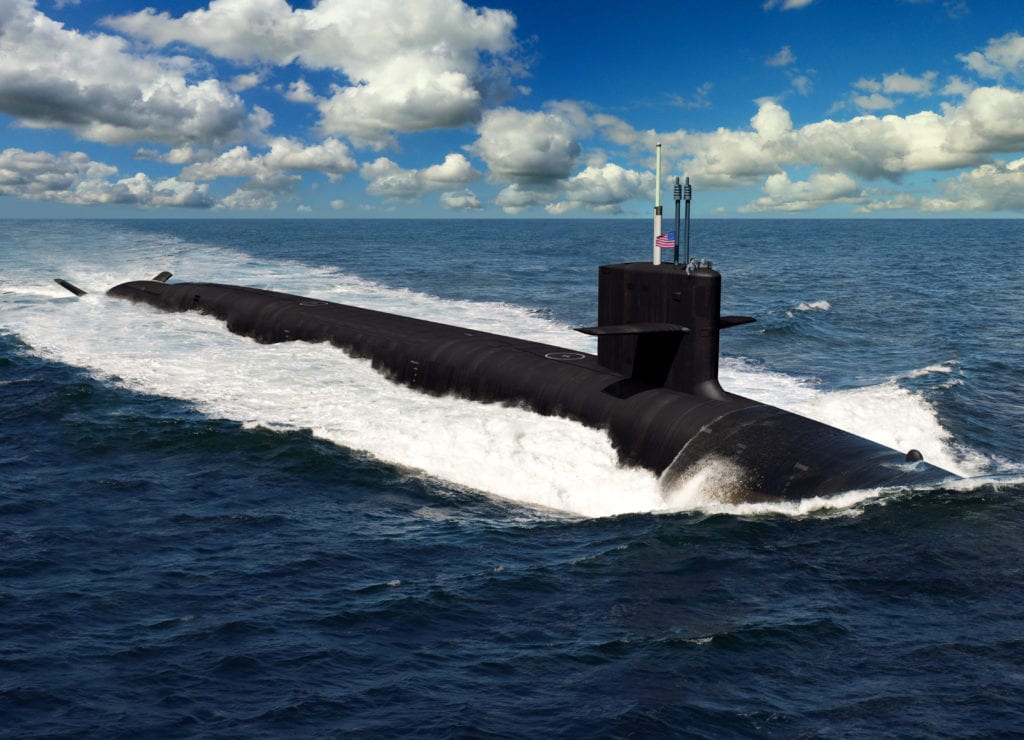
An artist rendering of the Columbia-class ballistic missile submarine. The Navy’s top acquisition official said April 15 during a Navy League Sea-Air-Space 2020: Virtual Edition webcast that work is proceeding on such programs as the Columbia SSBN and the next-generation guided-missile frigate, despite the disruption of COVID-19. U.S. Navy
ARLINGTON, Va. — The U.S. Navy’s top acquisition official said the service’s efforts to accelerate contract awards in the midst of the COVID-19 pandemic are helping the defense industry sustain its economic health at all levels and positioning the Navy and industry to emerge from the crisis without falling behind on work and ready to resume normal operations.
James F. Geurts, assistant secretary of the Navy for research, development and acquisition, speaking during an April 15 webcast of the Navy League’s Sea-Air-Space: Virtual Edition, said the Navy and the defense industry are working to keep on task and be in a position to accelerate “out of the crisis.”
To register and then watch this Sea-Air-Space 2020: Virtual Edition webinar live online, click here.
“Ships still have to come out on time,” Geurts said, noting that the Navy can’t afford to lag once the world starts to recover from the crisis.
Geurts said the Navy has moved up the award of some contracts to inject “a lot of money in the system” to “get funds in the contractor hands” and “bring that work to the left” — meaning getting in started sooner. An example is the award last week — months early — of LPD 31, the second Flight II San Antonio-class amphibious transport dock ship.
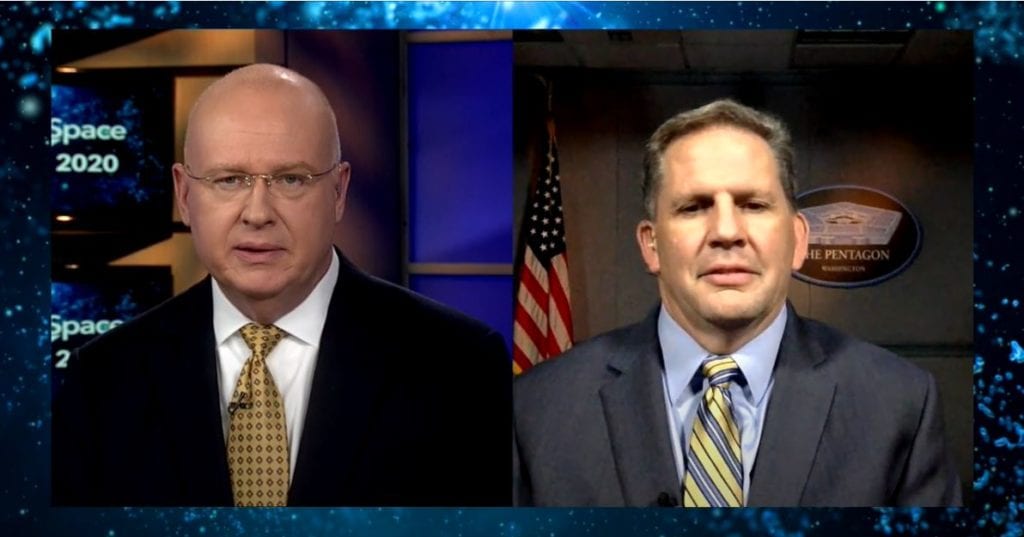
James F. Geurts (right), assistant secretary of the Navy for research, development and acquisition, and Sea-Air-Space 2020: Virtual Edition moderator Francis Rose discuss Navy and defense industry acquisitions preparedness during and after the pandemic.
Accelerating contract awards enables shipyards and other contractors to stack a backlog of work and keep their workers employed. The contractors also can push funds to their lower-tier subcontractors to the same effect.
Geurts said it was “counterintuitive … that the best way to secure [the health of the defense industrial base] was to accelerate going into a crisis. Most folks would want to slow down, wait and see, and that would exactly create the wrong conditions.”
“The risk is being too risk-averse in our approach. The other risk is being reckless in our approach.”
“Ships still have to come out on time,” even as the Navy and industry weather but eventually recover from the pandemic.
James F. Geurts
He said that all of stakeholders are going at the situation “deliberately but urgently and thoughtfully. A challenge for us will be [that] it’s not a one-size-fits-all solution. This crisis hits different areas of the country, different sectors differently at different times. The key to success will be great networks, leveraging the data we have and building on a foundation of trust.”
As the Navy worked to advance contract awards, Geurts said he saw his now “massively distributed,” largely teleworking work force shows greatly improved performance as it works to help the defense industry get though the pandemic.
The Navy also is ordering spare parts sooner to build up the supply and to shore up the suppliers who provide them.
Geurts said he confers with shipyard presidents or CEOs every other day to assess the status of work and provide opportunities to share lessons learned and to discuss best practices, ways to avoid disruption and how to speed up recovery.
“It’s been awesome,” he said of the response from the defense industry.
The assistant secretary said the Navy’s acquisition priorities have not changed in the pandemic, citing that work is proceeding on such programs as the Columbia-class ballistic-missile submarine and the next-generation guided-missile frigate. He stressed the Navy’s ongoing efforts to minimize delays and disruptions to the service’s programs.
MARAD’s Buzby: Readiness of Sealift, Ready Reserve Force Suffering
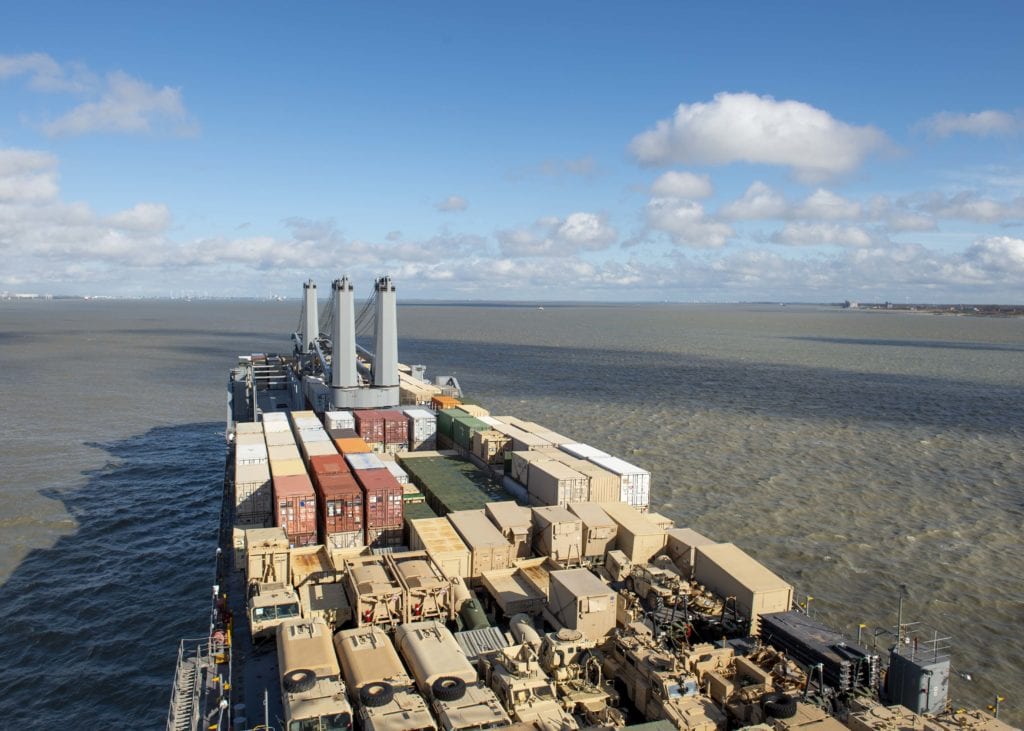
The U.S. Military Sealift Command large, medium speed roll-on/roll-off ship Benavidez transits the English Channel. U.S. Navy/Mass Communication Specialist 3rd Class Jordan R. Bair
ARLINGTON, Va. — U.S. strategic sealift fleets need recapitalization and some increased manning to achieve the readiness that the nation needs to sustain its maritime power, the U.S. maritime administrator said April 14.
“The readiness is suffering,” a fact that sealift stakeholders recognize, Maritime Administrator Mark H. Buzby said during a webcast that is part of the Navy League’s Sea-Air-Space 2020: Virtual Edition.
To register and then watch this Sea-Air-Space 2020: Virtual Edition webinar live online, click here.
Buzby pointed out that rusting ships, obsolete equipment, unavailable parts and repairing and replacing ships are the materiel challenges faced by the Maritime Administration (MARAD) and the U.S. Navy’s Military Sealift Command (MSC).
MARAD’s Ready Reserve Force of 46 ships and MSC’s 15 sealift ships all need recapitalization, Buzby added.
He said the federal government is taking three approaches to recapitalizing the fleets and that a combination of those “will help us renew the fleet”:
Extending the service lives of some existing ships to possibly 60 years.
Replacing 25 to 26 ships with new or converted used vessels.
Procuring built-for-purpose sealift ships “from the keel up.”
Recruiting and retaining enough mariners remains a challenge as well, Buzby said. Commercial mariners in the U.S. Merchant Marine — including those in the Ready Reserve Force, on Maritime Security Program ships available for mobilization and the declining U.S.-flag merchant fleet — and the government’s civilian mariners who work for the MSC are part of the pool that man the sealift ships.
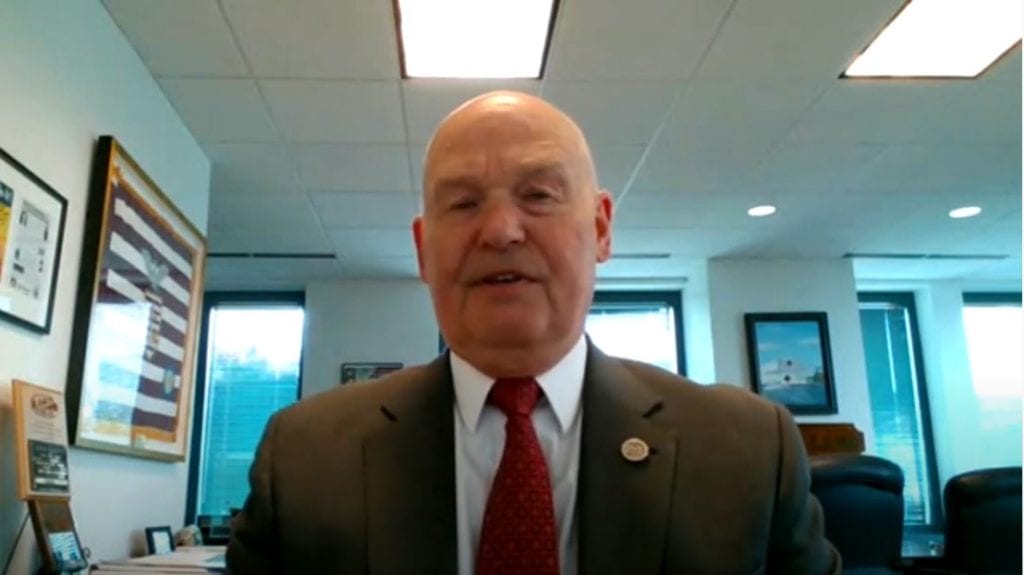
Maritime Administrator Mark H. Buzby participates in a webcast for the Navy League’s Sea-Air-Space 2020: Virtual Edition
He said that 24 ships in the Ready Reserve Force are steam-powered, operated by a shrinking pool of technicians qualified to operate and maintain the obsolete propulsion system.
Buzby said the mariner pool is “enough for a steady state today” but inadequate for a substantial mobilization requirement.
Of help would be to place more merchant ships “under the U.S. flag so it gets the pool … where it needs to be,” he added.
Building up the U.S.-flag merchant fleet is a considerable challenge, he said, because competitors such as China that have state-run enterprises can undercut the U.S. in terms of lower-cost shipbuilding and manning and can therefore compete more effectively for cargo business.
“We’re asking our merchant marine to play on an unlevel playing field,” he said.
USMI to Build Special Operations Combatant Craft
ARLINGTON, Va. — United States Marine Inc. (USMI) has been awarded a $108 million contract to build combatant craft for the U.S. Special Operations Command, the Defense Department said in a release.
The $108 million maximum indefinite-delivery/indefinite-quantity delivery order contract with a five-year ordering period calls for combatant craft assault vessels to support Special Operations Command (USSODOM) missions around the world, the release said. USSOCOM operates a fleet of coastal and riverine craft in support of those operations.
USMI CEO Barry Dreyfus Jr. said the contract would allow the company to retain and possibly expand its workforce, according to another release from the office of Sen. Roger Wicker (R-Miss.). USMI is based in Wicker’s state in Gulfport.
“USMI looks forward to continuing our work on behalf of the warfighter, and we appreciate the confidence [USSOCOM] continues to have in us,” Dreyfus said.
The sole source contract is expected to be completed by April 2025.
Coast Guard: Illegal Fishing in Oceans a National Security Issue
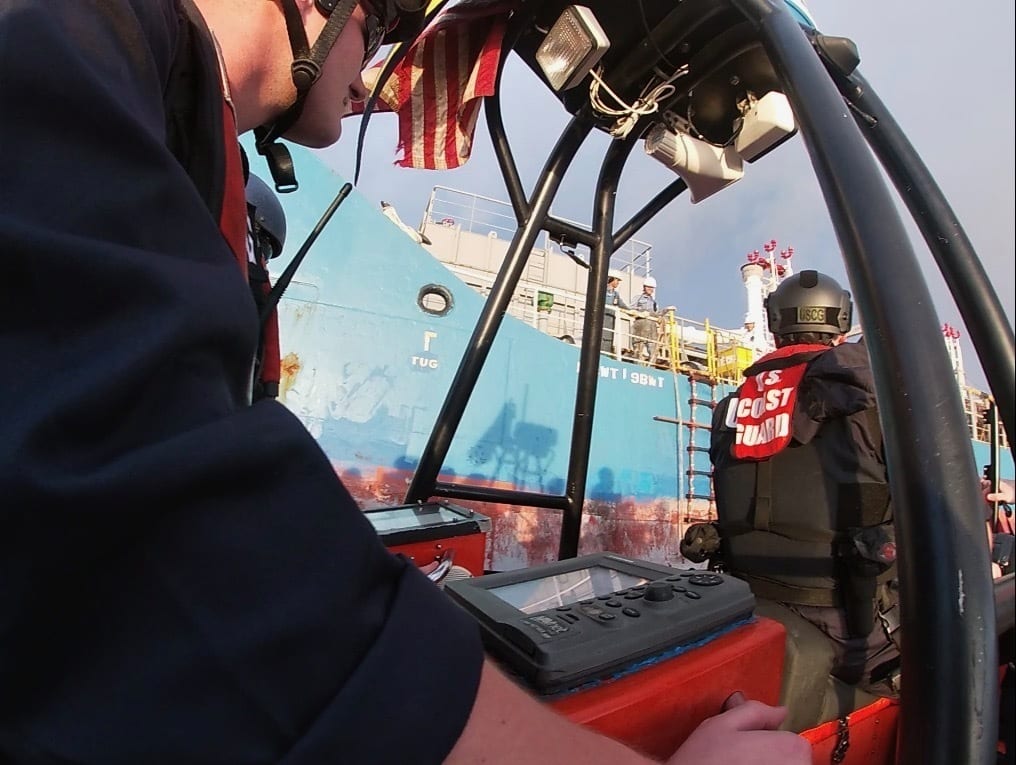
Boarding officers from the U.S. Coast Guard and Canadian Conservation and Protection navigate to board a fishing vessel in the South Pacific in January 2019. Canadian Department of Fisheries and Oceans
WASHINGTON — Illegal, unreported and unregulated fishing (IUU) is a national security issue that threatens global economic order and the sovereignty of nations and that enforcement is over-stretched to counter the threat, U.S. officials said.
IUU includes fishing without a permit, catching over a legal limit, catching the wrong species and catching fish that are too small.
To register and then watch this Sea-Air-Space 2020: Virtual Edition webinar live online, click here.
Speaking during a Navy League Sea-Air-Space: Virtual Edition webcast on April 13, Rear Adm. Doug Fears, the Coast Guard’s assistant commandant for response policy, said that IUU “is an issue of sovereignty and a national security issue because the competition for global fish stock and protein is ongoing.”
Fears said the Coast Guard “is as an internationally trusted partner and is a supporter of an international rules-based governance structure that benefits each country that has an economic exclusion zone.”
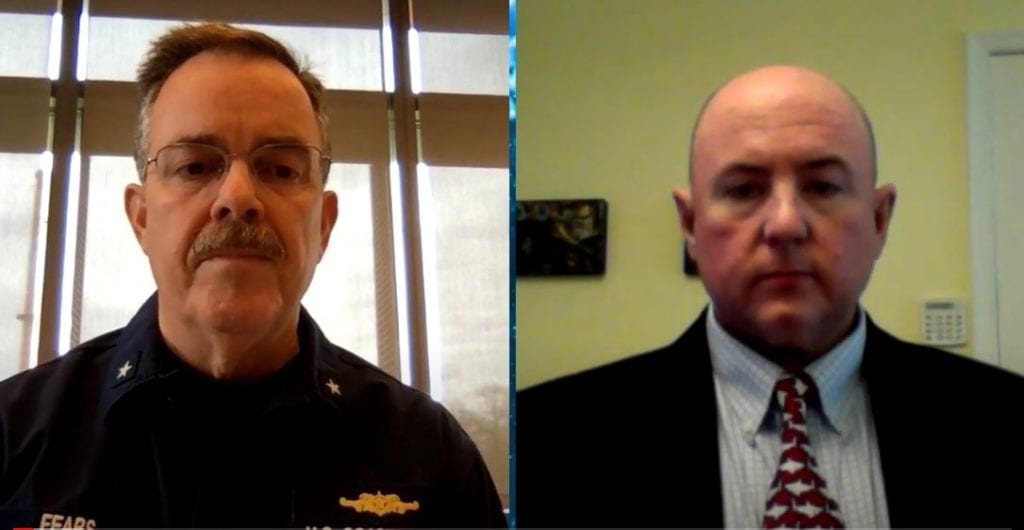
Rear Adm. Doug Fears (left), the U.S. Coast Guard’s assistant commandant for response policy, and Dave Hogan, acting director of the Office of Marine Conservation with the U.S. State Department, discuss Illegal, unreported and unregulated fishing during a Navy League Sea-Air-Space: Virtual Edition webinar.
Dave Hogan, acting director of the Office of Marine Conservation with the U.S. State Department, who also spoke during the Navy League webcast, said the State Department negotiates with international and regional partners to establish the rules to manage the fish stocks on the high seas in cooperation with the National Oceanic and Atmospheric Administration’s Fisheries Service, the Coast Guard and other agencies.
“Each nation exercises sovereignty over its economic exclusion zone,” Fears said. “When another nation violates that, [IUU] is harming the fish stock that may not be recoverable.”
Fears also pointed out that some nations are engaging in aggressive behavior against others in driving away fishing boats of other nations that are legally fishing and thus violating the sovereignty of those nations. He cited a recent example of Chinese coast guard activity against an Indonesian fishing vessel. The U.S. Defense Department on April 9 called out China’s coast guard for sinking a Vietnamese fishing vessel.
“The United States Coast Guard has the authorities, the capability, the global reach — we’re trusted partners. Our model is a well-respected model. Our limiting factor is capacity.”
Rear Adm. Doug Fears
Hogan said the United States has an ongoing dialogue with China on IUU issues. He said the State Department has asked China to “do better” with its distant-water fleet fishing in the waters of other countries.
He said IUU fishing is going on in all the world’s oceans, and that the violators include stateless high-seas drift-net vessels in the North Pacific. Whereas most fishing companies worldwide are privately owned, China’s are state-run.
“The United States Coast Guard has the authorities, the capability, the global reach — we’re trusted partners,” Fears said. “Our model is a well-respected model.”
“Our limiting factor is capacity,” he added. “While we operate around the world, we can’t operate in all the places that deserve the attention in IUU fishing.”
Fears cited the South China Sea, the waters off West Africa and the central and western Pacific and the Gulf of Mexico as prime areas where IUU occurs.
Hogan said the United States is still trying to find a multilateral solution to the competing claims in the South China Sea. He also said he encourages nations to cooperate, despite their disputes, so fish stocks aren’t depleted and that their own economic security and the environment aren’t undermined.
Fears said that IUU often is networked by organized crime, such as the drug cartels, which have “tentacles” in human trafficking and other smuggling operations. “A lot of the drug cartels and similar organizations monetize illicit activities, whatever they be,” he said.
Fears also said a Coast Guard presence is an effective counter to IUU fishing but that the sea service needs more ships, aircraft and personnel to project that presence.
Wicker Praises HII Contract for Amphibious Transport Dock Ship
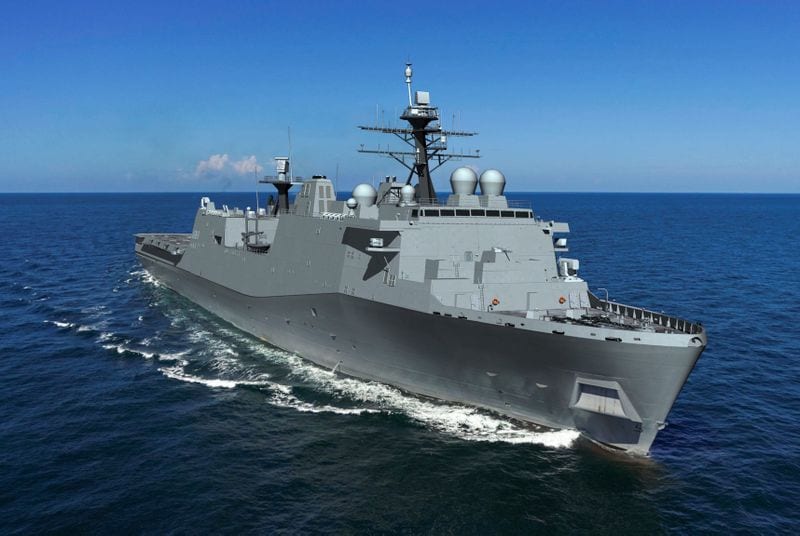
An artist’s rendering of an amphibious transport dock ship. Huntington Ingalls Industries
ARLINGTON, Va. — The earlier-than-expected April 3 award to Huntington Ingalls Industries’ shipbuilding division of a $1.5 billion contract modification for the procurement of the detail design and construction of amphibious transport dock ship LPD 31 was praised by a U.S. senator as a move to shore up shipbuilding.
Sen. Roger Wicker (R-Miss.), a senior member of the Senate Armed Services Committee, commended the decision to award the shipbuilding contract for LPD 31, which he said “was announced earlier than expected and intended to help the Mississippi shipbuilder mitigate the destabilizing effects of the coronavirus outbreak on its workforce,” according to a release from the senator.
“This is great news for the dedicated men and women of Ingalls Shipbuilding and the many other suppliers who rely upon a stable rate of construction at the shipyard,” Wicker said. “The talented tradespeople in Pascagoula have been continuing the fight to get our Navy the ships it needs, even in the midst of the great uncertainty brought on by the coronavirus epidemic.”
LPD 31 will be the 15th in the San Antonio class and the second Flight II LPD, according to an April 3 release from Huntington Ingalls.
“In building this 15th LPD, Ingalls experienced shipbuilders will continue this hot production line of great amphibious warships for our Navy/Marine Corps team,” Ingalls Shipbuilding President Brian Cuccias said in the release.
Wicker worked with the other members of the Senate Armed Services Committee to authorize procurement of LPD 31 and provide incremental funding authority to the Navy in the fiscal 2019 and 2020 National Defense Authorization Acts, his release said. Both actions gave the Navy the flexibility to expedite the ship’s purchase.
The San Antonio class is a major part of the Navy’s 21st century amphibious assault force. The 684-foot-long, 105-foot-wide ships are used to embark and land Marines, their equipment and supplies ashore via air cushion or conventional landing craft and amphibious assault vehicles, augmented by helicopters or vertical takeoff and landing aircraft such as the MV-22 Osprey.
Navy Orders Materials for Harpoon Missiles for Six Allies and Partners
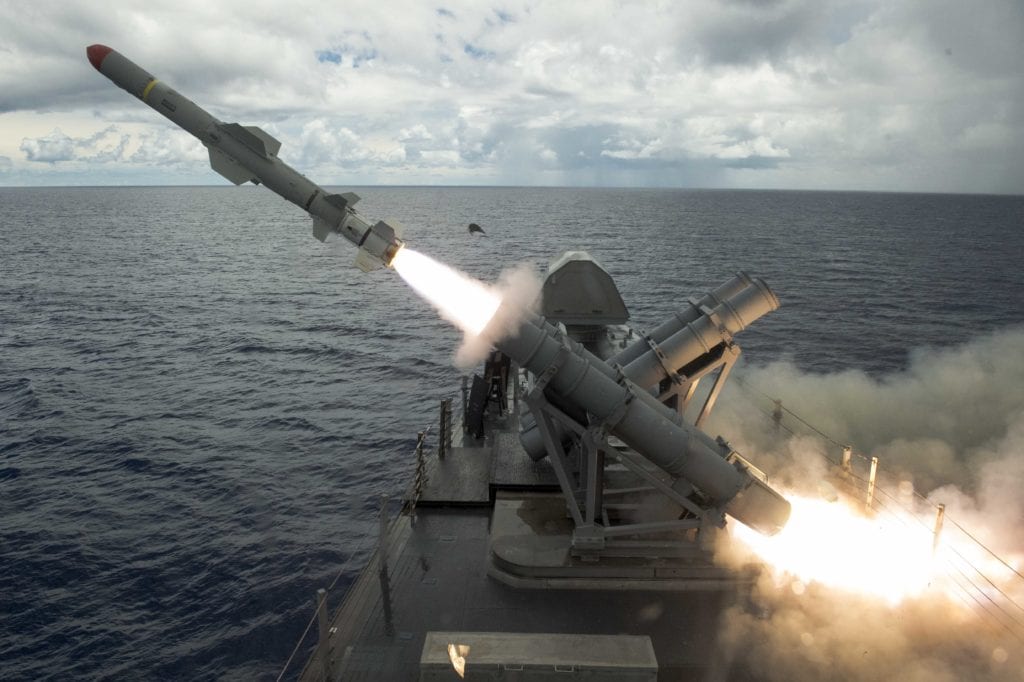
A Harpoon missile launches from the missile deck of the littoral combat ship USS Coronado off the coast of Guam. U.S. Navy/Mass Communication Specialist 2nd Class Kaleb R. Staples
ARLINGTON, Va. — The U.S. Navy has ordered materials for AGM/RGM-84 Harpoon anti-ship cruise missiles for six allied and partner nations, the Defense Department said in an April 2 release.
Naval Air Systems Command awarded Boeing a $73.2 million contract modification to provide additional long-lead material funding for full-rate production Lot 91 of the Harpoon missile under the foreign military sales program. Work is expected to be complete by December 2023.
When produced, the missiles will be delivered to the governments of Saudi Arabia, Qatar, Thailand, South Korea, Brazil and Japan.
The Harpoon missile family is deployed by the armed forces of 31 nations.
Navy Orders Four New LCU 1700 Utility Landing Craft from Swiftships
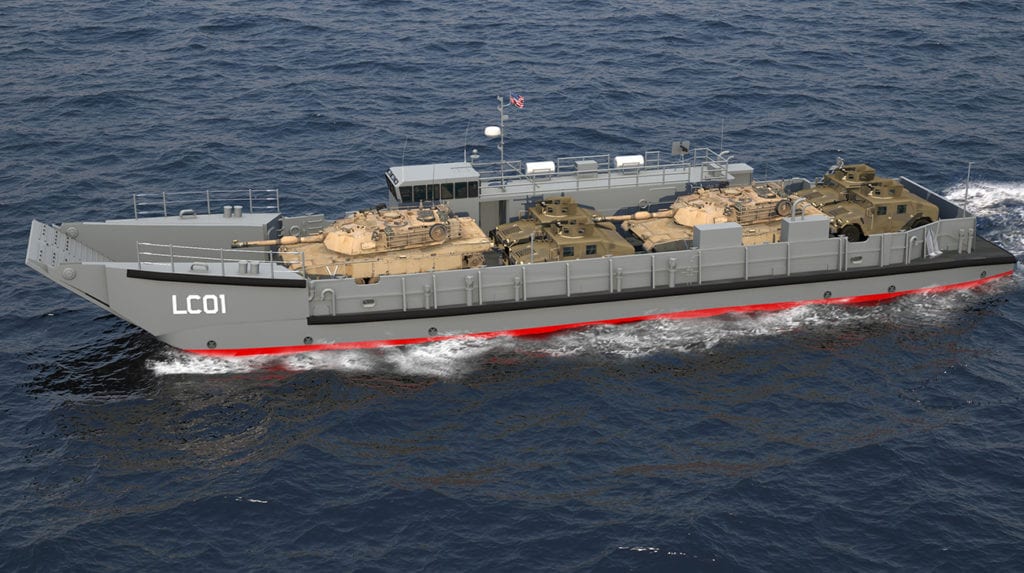
A Swiftships Landing Craft Utility 1700. Swiftships
ARLINGTON, Va. — The U.S. Navy has ordered four more of its new utility landing craft (LCU) for its amphibious warfare forces.
Naval Sea Systems Command awarded Swiftships of Morgan City, Louisiana, a $50.1 million modification to a previously-awarded contract “to exercise an option for the construction of four Landing Craft Utility (LCU) transportation boats (1703 through 1706),” the Defense Department said in an April 2 announcement. Delivery is expected by October 2022. The funds will come from the fiscal 2020 budget.
In February 2019, the Navy ordered LCU 1701 and 1702 under a $26.7 million contract modification. The craft will follow the prototype of the LCU 1700 class. Delivery is expected by May 2021.
“The LCU 1700 class will recapitalize the LCU 1610 capabilities and have a design life of 30 years,” the contract announcement said. “LCU 1700 craft will be a highly reliable and fuel-efficient heavy-lift platform whose capability will be complementary to the faster air cushion landing craft, which have a significantly shorter range, smaller payload capacity, no habitability and operating hour limitations.”
The Navy’s amphibious warfare ships equipped with well decks routinely deploy with LCUs embarked. The Navy plans to procure a total of 32 LCU 1700 craft.
Navy Orders Two E-2D Advanced Hawkeye Aircraft
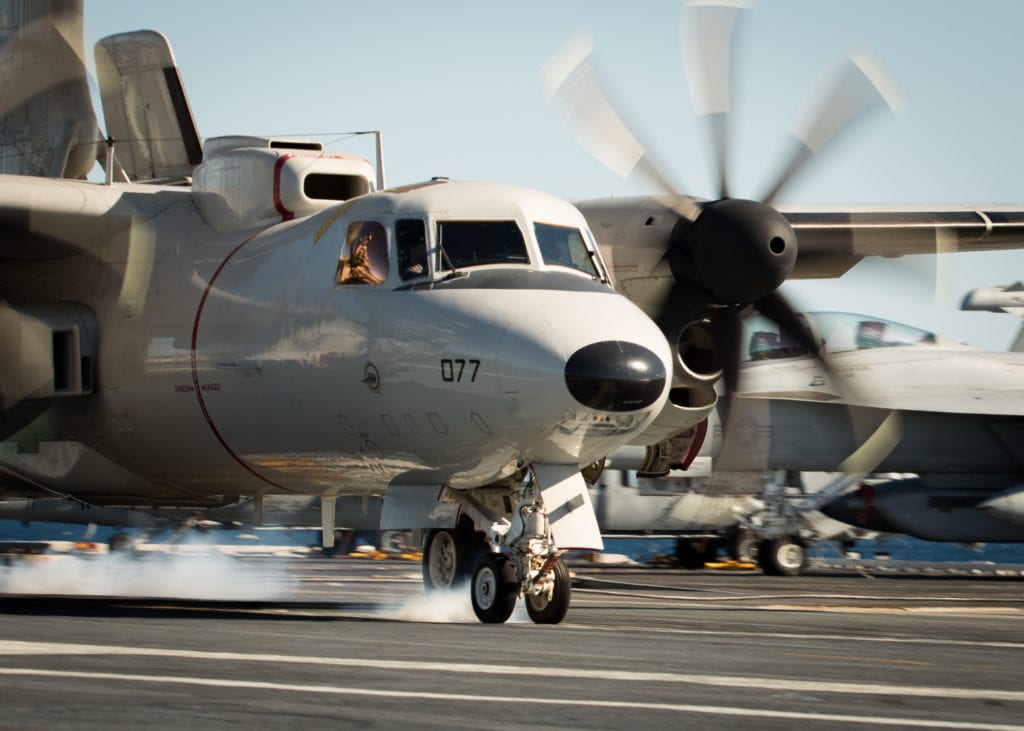
A E-2D Hawkeye lands on the flight deck of the aircraft carrier USS Gerald R. Ford. U.S. Navy/Mass Communication Specialist 3rd Class Ryan Carter
ARLINGTON, Va. — The U.S. Navy has ordered two more E-2D Advanced Hawkeye battle management aircraft, the Defense Department said in a contract announcement.
Naval Air Systems Command awarded Northrop Grumman Aeronautics Systems of Melbourne, Florida, a $404 million contract modification to the previously awarded, fixed-price-incentive-firm-target contract, the department said in an April 1 release.
One of the E-2Ds is being procured as part of fiscal 2019’s full-rate production (FRP) Lot 8 while the second as part of fiscal 2020’s FRP Lot 9.
This modification exercises contract options for nonrecurring engineering and software support activities. Work is expected to be complete by March 2025, the release said.
The Navy expects to procure a total of 86 E-2Ds. Japan has received four E-2Ds of and has ordered an additional nine. The E-2Ds are replacing E-2C Hawkeye aircraft in both the U.S. Navy and the Japanese Air Self-Defense Force.