Navy, Coast Guard to Surge Drug-Interdiction Support to SOUTHCOM
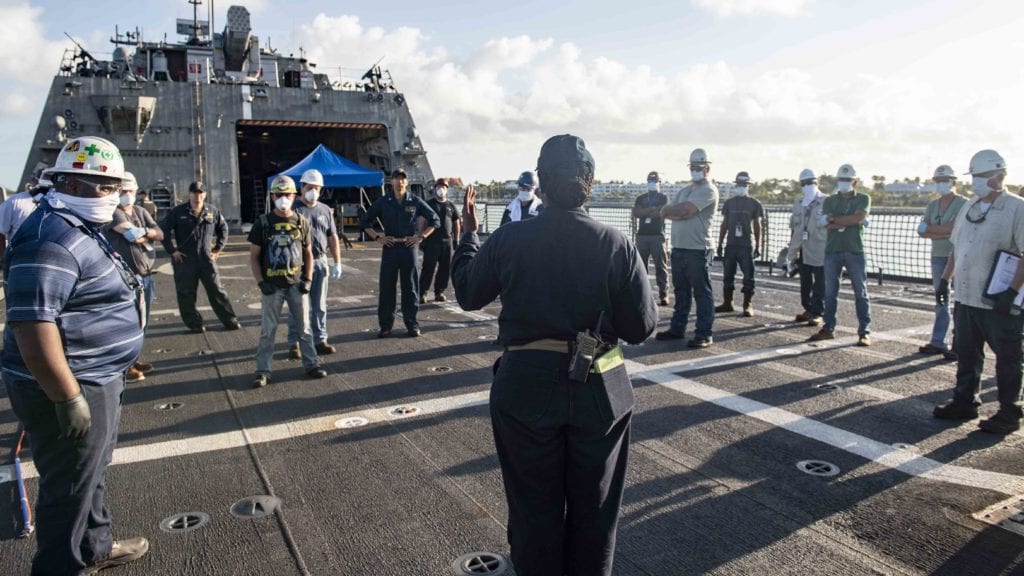
Chief Hospital Corpsman Bianca McQueen briefs contractors on COVID-19 mitigation tactics on the flight deck of the Freedom-variant littoral combat ship USS Detroit while in port in Key West, Florida. Detroit is deployed to the U.S. Southern Command area of responsibility to help counter drug trafficking. U.S. Navy/Mass Communication Specialist 2nd Class Anderson W. Branch
ARLINGTON, Va. — The U.S. Navy and Coast Guard will surge ships and aircraft to the U.S. Southern Command’s area of responsibility to counter increased cartel drug running amid the COVID-19 pandemic, President Trump and Defense Department officials announced.
At an April 1 press briefing at the White House, Trump announced that SOUTHCOM “will increase surveillance, disruption and seizures of drug shipments and provide additional support for eradication efforts, which are going on right now at a record pace.”
“We’re deploying additional Navy destroyers, [littoral] combat ships, aircraft and helicopters; Coast Guard cutters; and Air Force surveillance aircraft, doubling our capabilities in the region,” he added. “Very importantly, our forces are fully equipped with personnel protective equipment, and we’ve taken additional safety measures to ensure our troops remain healthy.”
#COVID19 will not stop the @DeptofDefense from protecting the American people from illegal drugs. At the direction of the @POTUS, additional U.S. ships, aircraft, and security forces are underway to disrupt narcotics trafficking. pic.twitter.com/BFTbxqcFGn
— Archive: Dr. Mark T. Esper (@EsperDoD) April 1, 2020
Gen. Mark A. Milley, chairman of the Joint Chiefs of Staff, said at the briefing that “we came upon some intelligence some time ago that the drug cartels, as a result of COVID-19, were going to try to take advantage of the situation and try to infiltrate additional drugs into our country. As we know, 70,000 Americans die on an average annual basis to drugs. That’s unacceptable. We’re at war with COVID-19, we’re at war with terrorists, and we are at war with the drug cartels as well.”
“This is the United States military,” Milley added. “You will not penetrate this country. You will not get past Jump Street. You’re not going to come in here and kill additional Americans. And we will marshal whatever assets are required to prevent your entry into this country to kill Americans.”
Attending the briefing as well was Defense Secretary Mark Esper, who added: “This initiative is part of the administration’s whole-of-government approach to combating the flow of illicit drugs into the United States and protecting the American people from their scourge.”
Esper said the additional forces would “nearly double our capacity to conduct counter-narcotics operations in the region. Last year alone, United States Southern Command’s operations resulted in the seizure of over 280 metric tons of drugs, much of which was designated for shipment to America.”
“This initiative is part of the administration’s whole-of-government approach to combating the flow of illicit drugs into the United States and protecting the American people from their scourge.”
Defense Secretary Mark Esper
In a tweet that day, Esper posted a briefing slide listing in more detail the types of forces that would be surged into the Caribbean Sea and eastern Pacific areas off the coast of Central and South America.
The list included Navy destroyers and littoral combat ships, Coast Guard cutters, Navy P-8A Poseidon maritime patrol aircraft and Air Force E-3 Sentry and E-8 Joint STARS surveillance aircraft. The destroyers and littoral combat ships carry MH-60 Seahawk helicopters, while some Coast Guard cutters carry MH-65 Dolphin helos.
Geurts: Ship Construction Ongoing, Repairs Continuing Amid COVID-19 Outbreak
Earl Cobbs of Newport News, Virginia, grinds a bulkhead in the hangar bay aboard the aircraft carrier USS John C. Stennis in Norfolk during the carrier’s refueling and complex overhaul. U.S. Navy/Mass Communication Specialist 3rd Class Joshua L. Leonard
ARLINGTON, Va. — The U.S. Navy is continuing to build and repair ships amid the COVID-19 pandemic but also is looking ahead to position itself to accelerate as the nation recovers from the pandemic, the service’s top acquisition official said.
The repair yards are “continuing to get the work done,” James F. Geurts, assistant secretary of the Navy for research, development and acquisition, said during an April 1 teleconference with media.
“We’ll see some challenges,” Geurts said, but noted that his office is focused on “one or two steps down the road” and on “how to accelerate out of recovery” to maintain the readiness of the fleet.
He said that 95% to 98% of the Navy’s acquisition work force is teleworking and that he “was not seeing a drop-off in performance.”
The assistant secretary reiterated his focus on three lines of operation:
The health of the defense industrial work force, including the government work force and its industrial partners such as prime contractors, subcontractors, small suppliers and individuals.
Ensuring the health of the industrial base.
Ensuring warfighting readiness of the Navy and U.S. Marine Corps.
“We haven’t slowed down,” he said, and that the work force “is continuing to press hard.”
Geurts said he continues to see some tightening in the supply chain and that his workforce in continually reassessing measures to work out the challenges. He lately is focusing attention on the transportation and distribution networks to monitor potential disruptions in the supply chain.
Geurts has been pressing to get contracts issued earlier than normal to assure the shipbuilders and repair yards and their suppliers that “work is coming.”
He pointed out that awarding contracts two months early has the advantage of getting planning and work started early; “creating some resiliency” as challenges arise; and making possible an acceleration of the post-pandemic recovery.
He said that contracts awarded recently included those for two Navajo-class towing, salvage and rescue ships; 18 P-8A maritime patrol aircraft, the AIM-9X Sidewinder air-to-air missile, berthing barges and patrol boats, and that contracts were imminent for a Block II San Antonio-class amphibious transport dock ship and for the new class of utility landing craft.
He also said he has yet to see the impact of the pandemic on the next-generation frigate program.
Geurts also pointed to the upcoming April commissionings of the Virginia-class attack submarines Delaware and Vermont and the upcoming combat systems completion of the guided-missile cruiser USS Zumwalt as evidence that the Navy’s acquisition of ships is not slowing down.
Navy Regional Maintenance Centers Continuing Work Amid COVID-19 Crisis
A docking team from the Japan Regional Maintenance Center (RMC) collaborates with port operations workers to close a caisson. The RMCs are continuing to maintain Navy ships amid the COVID-19 pandemic, the sea service says. U.S. Navy/Ryo Isobe
WASHINGTON — In the middle of the COVID-19 pandemic, the U.S. Navy’s Regional Maintenance Centers (RMCs) are continuing to maintain the Navy’s ships, even in countries where the pandemic is especially severe, the Navy said.
“Our priority is the protection of our workforce, [and] our commanders have the flexibility to respond to conditions in their areas to effectively carry out their missions while meeting the critical needs of their people,” said Colleen O’Rourke, spokeswoman for Naval Sea Systems Command, in response to a query from Seapower. “Our RMCs continue to maintain the readiness of our fleet.”
The Navy has RMC activities in two countries hardest hit by the virus, at Rota, Spain, and Naples, Italy.
“We are committed to taking every measure possible to protect the health of our force,” O’Rourke said. “We remain in close coordination with host nation authorities, U.S. Embassy and public-health authorities to ensure the well-being of our personnel and local population.”
Q&A With CNO Adm. Mike Gilday
Chief of Naval Operations Adm. Mike Gilday visits with Sailors aboard USS Kearsarge in August during his first ship visit following the CNO change-of-office ceremony. U.S. Navy/Chief Mass Communication Specialist 2nd Class Nick Brown
Since August, Adm. Mike Gilday has
led the world’s most powerful navy as the 32nd chief of naval operations. The son
of a Sailor and a native of Lowell, Massachusetts, he is a surface warfare
officer who graduated from the U.S. Naval Academy and holds master’s degrees
from the Harvard Kennedy School and the National War College.
At sea, he deployed with USS Chandler
(DDG 996), USS Princeton (CG 59) and USS Gettysburg (CG 64). He commanded
destroyers USS Higgins (DDG 76) and USS Benfold (DDG 65) and subsequently
commanded Destroyer Squadron 7, serving as sea combat commander for the Ronald
Reagan Carrier Strike Group.
As a flag officer, he served as commander, Carrier Strike Group 8, embarked aboard the USS Dwight D. Eisenhower (CVN 69), and as commander, U.S. Fleet Cyber Command and U.S 10th Fleet.
Check out the digital edition of the April Seapower magazine here.
His staff assignments include the
Bureau of Naval Personnel, staff of the CNO and staff of the vice CNO. Joint
assignments include executive assistant to the chairman of the Joint Chiefs of
Staff and naval aide to the president.
As a flag officer, he served in joint
positions as director of operations for NATO’s Joint Force Command Lisbon; as
chief of staff for Naval Striking and Support Forces NATO; director of
operations, J3, for U.S. Cyber Command; and as director of operations, J3, for
the Joint Staff. He recently served as director, Joint Staff.
Gilday answered questions from Senior
Editor Richard R. Burgess in writing.
Why the renewed
emphasis on mastering fleet-level warfare?
GILDAY: The nature of
war at sea today is changing. Maritime operations stretch from the seabed to
space and across the electromagnetic spectrum. Long-range missiles that fly at
supersonic and hypersonic speed have decreased the amount of time a commander
has to make decisions, and the emergence of cyber and space as warfighting
domains have created a much more complex operating environment for our Sailors.
To meet these challenges, our fleets must
be the operational center of warfare. Fleet commanders must own the physical
and virtual battlespace they are responsible for and drive the fight, if
required to do so.
“We fight and win as a team, and we are better when we integrate more closely with the Marine Corps. We will build capability with our most natural partner, tying more closely with them at all levels.”
However, to be able to fight as a fleet,
we must exercise as a fleet. We have made great investments in our maritime
operational centers [MOCs], which gives fleet commanders the ability to do just
that. We need to exercise — and the only way to do that is with iron out there
at scale.
Upcoming fleet exercises, like Large
Scale Exercise 2020, will leverage operational concepts like Distributed
Maritime Operations, Expeditionary Advanced Base Operations and Littoral Operations
in a Contested Environment. Combined with war-gaming, future exercises will
serve as the key opportunity for experimentation and the development and
testing of alternative concepts. These exercises and experiments will inform
doctrine and tactics, and future fleet headquarters requirements, capacity and
size, and investments in future platforms and capabilities.
Going forward, we must leverage experience from combatant command, joint and other service exercises to better prepare the Navy to integrate, support and lead the joint force in a future fight.
Gilday delivers remarks Feb. 7 during a full honors ceremony for Vice Adm. Michael Noonan, chief of the Royal Australian Navy, at the Navy Yard in Washington, D.C. U.S. Navy/Mass Communication Specialist 1st Class Raymond D. Diaz III
The Optimized Fleet Readiness Plan and Dynamic Force Employment, in theory, would seem to be in tension. How should the Navy ensure a sustainable personnel tempo while keeping adversaries off balance?
GILDAY: People are our most important resource, and the Navy cannot succeed without its Sailors — they are our asymmetric advantage.
While we strive to have a predictable model for our Sailors and their families, it’s important to remember that sometimes the world gets a vote, which may require us to respond at a moment’s notice — and differently than we planned.
In which aspects do you see integration with the U.S. Marine Corps as having the greatest potential for improving naval power?
GILDAY: We fight and win as a team, and we are better when we integrate more closely with the Marine Corps. We will build capability with our most natural partner, tying more closely with them at all levels.
Together, we will build Navy-Marine Corps integration by aligning concepts, capabilities, programming, planning, budgeting and operations to provide integrated American naval power to the Joint Force. Opportunities for increased integration include our cyberspace operations, war-game and exercise programs, development of the Naval Tactical Grid, and potential Dynamic Force Employment options.
Alongside the United States Marine Corps, our Navy is the bedrock of integrated American naval power.
Gilday visits with Sailors assigned to Helicopter Maritime Strike Squadron 40 during his first visit as CNO to Naval Air Station Jacksonville and Naval Station Mayport, Florida, on Sept. 17. U.S. Navy/Chief Mass Communication Specialist Nick Brown
Where
do you see the best application of unmanned systems for naval warfare?
GILDAY: Unmanned is an
important part of the future. It must be a central component of our future
battle force to support the way we want to fight in a distributed way. Going
forward, I believe there will be a requirement for seaborne-launched vehicles
to deliver effects downrange, likely using a mix of manned and unmanned assets.
Ultimately, we must leverage technology to expand our reach, lethality and
warfighter awareness in undersea, surface and air domains. We must continue to
experiment more with unmanned, and we need to do it with greater speed.
Based on your experience, what does the Navy need to do to be prepared for war in the cyber domain?
GILDAY: Cybersecurity is commanders’ business. Commanders need to own it. Commanders must understand the status of their networks and systems and the potential operational risk they are assuming if readiness has degraded.
Going forward, we need to invest in training and retaining the best and brightest, and in cyber infrastructure; treat the network ([Navy-Marine Corps Intranet], ONE-NET, afloat networks) like the warfighting platform it is, giving priority to ensure it is secure and defended; defend forward — disrupt threats before they reach our networks; develop cyber-resiliency (think shipboard damage control) — identify, protect, detect, react and restore the network; integrate MOC to MOC, across the fleets and interagency, in every major exercise and operation; [and] partner with other services, interagency, industry, allies and partner nations.
“We must ensure the fleet’s readiness today so we can deliver credible ready forces tomorrow. This includes the prioritization of force design and the delivery of naval forces capable of imposing lethal power to any adversary and aggressive pursuit of increased lethality and modernization across the Navy.”
What have you learned the most about your role so far as a member of the Joint Chiefs?
GILDAY: My role as a Joint Chief is one that I take extremely seriously, and it is important that I provide the president, secretary of defense and chairman of the Joint Chiefs the best military advice I can. That is why I spend a lot of time studying and thinking about near-peer competitors, potential adversaries and our future force.
What are the main priorities of the Navy’s 2021 budget?
GILDAY: The Navy’s first acquisition priority is recapitalizing our strategic nuclear deterrent. We will continue to drive affordability, technology development and engineering integration efforts to support Columbia’s [ballistic-missile submarine] fleet introduction on time or earlier, maintain mastery of the undersea domain and sustain a formidable forward presence through our aircraft carrier fleet.
We must ensure the fleet’s readiness today so we can deliver credible ready forces tomorrow. This includes the prioritization of force design and the delivery of naval forces capable of imposing lethal power to any adversary and aggressive pursuit of increased lethality and modernization across the Navy.
Gilday visits with Sailors on Sept. 17 at the Littoral Combat Ship Operational Trainer Facility at Naval Station Mayport, Florida. U.S. Navy/Chief Mass Communication Specialist Nick Brown
How do you explain the lower shipbuilding budget and the early ship retirements given the need for a larger fleet?
GILDAY: The fiscal 2021 budget supports implementation of the National Defense Strategy, which remains our guidepost and drives our decision-making. While we are committed to building the largest Navy we can, the capacity reductions in the recent budget submissions were made with the service’s priorities of strategic deterrence, readiness, lethality and modernization in mind. We remain focused on maximizing the naval power of our ships, aircraft, unmanned vehicles, weapons and systems we have today in our fleet.
Our balanced approach in our budget submission provides a Navy ready to fight today while committing to the training, maintenance and modernization to provide a Navy ready to fight tomorrow. Naval power is critical to implementing the National Defense Strategy. But naval power is not just a function of fleet size: It is a combination of the readiness, lethality and capacity of that fleet.
Our
No. 1 priority is the Columbia-class ballistic-missile submarine. This request
also heavily invests in readiness accounts, such as ship and aircraft depot
maintenance and modernization, manpower, live virtual constructive training,
steaming days, and flying hours. It invests in new systems to make our fleet
more lethal, including increasing our weapons inventory, bolstering the range
and speed of those weapons, exploring directed energy weapons, and
incorporating new technologies such as hypersonics. This request grows our
fleet in size, generating sustainable, capable capacity.
The
configurations in some older platforms require a significant amount of
modernization, and we believe that the significant investment necessary for modernization
necessary to ensure platforms can operate in contested environments is better
utilized in other programs.
Looking to the next 10 years, how can the Navy best balance the funding needs between current readiness and new acquisition
GILDAY: Mission No. 1 for every Sailor — active and Reserve, civilian and uniform — is the operational readiness of the fleet.
We
must ensure the fleet’s readiness so we can deliver credible ready forces. This
includes the prioritization of force design and the delivery of naval forces
capable of imposing lethal power to any
adversary. That must be balanced with an aggressive pursuit of increased
lethality and modernization across the Navy, against the constraints of our
budget topline.
Going forward, we will continue to
prioritize investments using the National Defense Strategy as our
guidepost.
With the nuclear deterrent as the Navy’s No. 1 priority, what concerns do you have about the Columbia SSBN being on track to deploy on time?
GILDAY: Lead-ship construction for Columbia began in 2020 and the Navy continues to identify opportunities to drive schedule and cost margin. While the construction schedule is aggressive, it is achievable. The Navy is actively overseeing shipbuilders as they manage the submarine and aircraft carrier industrial base suppliers to minimize risk and incorporate recent lessons learned.
Why is the Navy asking for more Sailors
for the fleet?
GILDAY: To operate effectively as a force, we
need to properly man our ships, submarines and aviation squadrons, and this
budget request supports that effort with a 2% increase in active-duty Sailors (plus
7,300 from fiscal 2020 to 2021). Recruiting, developing and retaining a
high-quality military and civilian workforce is essential for our warfighting
success.
How is the budget strengthening the nation’s sealift capability?
GILDAY: We have a three-prong approach to strengthening our sealift capability, which includes the procurement of commercial vessels with 20 to 25 years of life remaining at a cost of $30 million, as opposed to acquiring new vessels at a cost of $300 million, $400 million or $500 million. Additionally, the Navy is conducting at service life extension [SLE] on existing sealift ships, which includes six service life extensions, put in place last year. The Navy intends to increase SLEs from six to 10 in 2021.
Navy Orders Two More Navajo-Class Towing, Salvage, Rescue Ships
Gulf Island Shipyard held a keel laying ceremony on Oct. 30, 2019 for the future USNS Navajo (T-ATS 6), the lead ship of the Navy’s new class of towing, salvage and rescue vessels. U.S. NAVY
ARLINGTON, Virginia — The Navy has ordered two more Navajo-class T-ATS towing, salvage and rescue ships, the Defense Department said in a March 25 contract notice.
The Naval Sea Systems Command has awarded Gulf Island Shipyards LLC in Houma, Louisiana, a $129.9 million firm-fixed-price contract modification “to exercise options for the construction of two additional towing, salvage and rescue ships (T-ATS) and for the performance of unique item identification on the T-ATS 6-class program.
“The contract also includes options for associated support efforts related to the ship design and construction for special studies, engineering and industrial services, provisioned items orders, unique item identification and data rights license,” the notice said. “Work is expected to be complete by October 2022.”
The Navajo-class T-ATS is designed to combine and replace the current capabilities of the three Powhatan (T-ATF 166) class of fleet ocean tugs and two Safeguard (T-ARS 50) class rescue and salvage ships, which will reach the end of their expected service lives starting in 2020.
The Navajo-class is designed with 6,000 square feet of deck space for embarked salvage and rescue systems. The ship will have an overall length of 263 feet and a beam of 59 feet. It will be able to carry a 1,796-ton load.
Gulf Island Shipyard is currently building the first three T-ATSs: the future USNS Navajo (T-ATS6), USNS Cherokee Nation (T-ATS 7) and USNS Saginaw Ojibwe Anishinabek (T-ATS 8). These three ships are scheduled for delivery in 2021.
Marine Force Design 2030: Reduce Tube Artillery, Increase Rockets, Missiles
Marines in an M1A1 Abrams main battle tank conduct a patrol during a predeployment training exercise at Marine Corps Air Ground Combat Center Twentynine Palms, California. Force Design 2030 dictates that the Corps reduce its investment in heavily armored ground combat systems. U.S. Marine Corps/Lance Cpl. Dalton S. Swanbeck
ARLINGTON, Virginia — The Marine Corps commandant has issued his plans for a major redesign of the Marine Corps’ force structure by 2030, with substantial reductions in some venerable weapon systems and increases in new systems.
For example, traditional tube artillery is under the gun, as are tanks, but rocket artillery and precision missiles are boosted in the plan.
Force Design 2030, signed out this month by Commandant Gen. David H. Berger, is aimed at more closely aligning the capabilities of the Corps with the National Defense Strategy, from a priority of confronting violent extremism to “great power/peer-level competition,” with emphasis on the Indo-Pacific.
“Such a profound shift in missions, from inland to littoral, and from nonstate actor to peer competitor, necessarily requires substantial adjustments in how we organize, train and equip our Corps,” Berger said in the document.
“A return to our historic role in the maritime littoral will also demand greater integration with the Navy and a reaffirmation of that strategic partnership. As a consequence, we must transform our traditional models for organizing, training and equipping the force to meet new desired ends, and do so in full partnership with the Navy.”
Berger, foreseeing flat future defense budgets, said he is “operating under the assumption that we will not receive additional resources, we must divest certain existing capabilities to free resources for essential new capabilities. … With the shift in our primary focus to Great Power Competition and a renewed focus on the Indo-Pacific region, the current force has shortfalls in capabilities needed to support emerging joint, naval and Marine Corps operating concepts.”
He said the Corps is over-invested in heavily armored ground combat systems (tanks), towed cannon artillery and short-range, low endurance unmanned aerial systems (UAS) incapable of employing lethal effects.
Accordingly, Berger plans to, among other initiatives, to reduce the number of tube artillery batteries from 16 to five. These units are armed with the M777 towed cannon built by BAE Systems.
In contrast, the Corps plans to increase its rocket artillery batteries from 7 to 21. These batteries are equipped with the Lockheed Martin-built M142 HIMARS (High-Mobility Artillery Rocket System). The Corps intends to create batteries of anti-ship missiles such as the Raytheon’s Tomahawk Maritime Strike Missile and the Kongsberg/Raytheon Naval Strike Missile. These missiles will enable Marine expeditionary forces to operate in contested littoral environments.
“This investment provides the basis, over time, for generating one of the fundamental requirements for deterrence, and ultimately successful naval campaigns — long-range, precision expeditionary anti-ship missile fires,” Berger said. “This requirement is based on one of the more well-supported conclusions from wargaming analysis conducted to date.”
The Corps also plans to eliminate its fleet of M1A1 main battle tanks, divesting its “entire capacity of seven companies and prepositioned capacity,” he said.
“We have sufficient evidence to conclude that this capability, despite its long and honorable history in the wars of the past, is operationally unsuitable for our highest-priority challenges in the future,” Berger said. “Heavy ground armor capability will continue to be provided by the U.S. Army.”
Because the Corps plans to reduce its active-component infantry battalions from 24 to 21, its amphibious assault requirements will be lessened. Accordingly, two of the six amphibious assault companies are slated for the cut. The units operate the AAV7 assault amphibious vehicle and the new Amphibious Combat Vehicle, both built by BAE.
The Corps is looking at increasing force structure of light armored reconnaissance companies from nine to 12.
“While I have repeatedly stated that all-domain reconnaissance and counter-reconnaissance will be a critical element of any future contingency, I remain unconvinced that additional wheeled, manned armored ground reconnaissance units are the best and only answer — especially in the Indo-Pacific region,” Berger said.
“We need to see more evidence during Phase III [of the study] to support this conclusion before engaging in an expansion of our existing capacity, or committing billions of dollars in procurement funds towards the acquisition of an Advanced Reconnaissance Vehicle (ARV).”
Geurts: Navy Acting to Shore Up Industrial Base to Ease Virus Impact on Readiness
Contractors aboard the aircraft carrier USS Gerald R. Ford test a lower stage weapons elevator. Navy Assistant Secretary James F. Geurts says the sea service is working to make sure that remaining work on the Ford and construction of the Columbia-class submarine is minimally disrupted during the COVID-19 outbreak. U.S. Navy/Mass Communication Specialist Seaman Apprentice Riley McDowell
ARLINGTON, Va. — The U.S. Navy is taking active measures to ease the impact of the COVID-19 virus on the operations and finance of its defense industrial base to minimize disruptions to its acquisition and readiness, the service’s top acquisition official said.
James F. Geurts, assistant secretary of the Navy for research, development and acquisition, speaking March 25 in a teleconference with reporters, said the Navy is “using all the levers we have” such as moving up contract awards, accelerating contract payments and establishing baselines to compare pre-virus versus post-virus contractor performance.
Geurts said his effort is focused of three lines of operation:
The health of the defense industrial work force, including the government work force and its industrial partners such as prime contractors, subcontractors, small suppliers and individuals.
Ensuring the health of the industrial base.
Ensuring warfighting readiness of the Navy and U.S. Marine Corps.
Geurts said he is communicating with various stakeholders such as shipbuilder and aircraft builder presidents and Navy shipyards, regional maintenance centers and fleet readiness centers to take the pulse of operations and address concerns at all levels, including reducing barriers and freeing up funding. He said he is especially concerned about the resilience of the many small supplier companies that fill out the industrial supply chain.
The Navy’s concerns about major shipyards vary by site, but Geurts said the sea service is “seeing a tightening on the supply base as smaller shops deal with their local situations. We’ve got a pretty good view of that with some of the real-time systems we are using. I do expect some delay or disruption.”
Geurts said a key initiative was to establish baselines of the performance of current programs before the pandemic hit to understand the effects of delay and disruption with delays that were already incurred in programs and work through those issues on the back side of the pandemic and adjust as necessary.
He said the Navy is not slowing down in its contracting activity and is, in fact, accelerating it “wherever we can to get that demand signal in” so that there is meaningful work waiting as the pandemic ends to avoid a lag effect in getting back to work at full speed.
Regarding ship repair periods, the secretary said the Navy is reducing the normal 10% payment withholdings across the board.
For claims that have been adjudicated but not yet paid, the Navy is looking to pay those out, and where claims have not yet been adjudicated, it will attempt to accelerate adjudication of those claims.
“On the [contract] penalty side, we will continue to understand where those penalties are and work through how to deal with those penalties,” Geurts said.
Geurts said his team is 90% to 95% dispersed and teleworking but he is “driving the team to accelerate” and he praised its dedication to performance despite the disruption of the virus.
The secretary said the Navy is working to make sure there is no or only minimal disruption to the construction of the Columbia-class ballistic-missile submarine and the remaining work on the aircraft carrier Gerald R. Ford.
He said he has “not seen any major impacts to that work [on the Columbia SSBN] yet but we are tracking it very closely.”
Navy Ship Commissionings on Track Despite Pandemic, But Ceremonies Are Delayed
Sonar Technician (Submarine) 1st Class Ryun Lewis (right) demonstrates line-handling procedures to U.S. Naval Sea Cadets during a tour of the Virginia-class attack submarine USS Delaware March 7. The Delaware is moored pier side at Naval Station Norfolk and will be commissioned administratively due to COVID-19 restrictions. U.S. Navy/Mass Communication Specialist 2nd Class Cameron Stoner
ARLINGTON, Va. — The U.S. Navy plans to put two Virginia-class attack submarines in commission in April despite the COVID-19 pandemic, but the ceremonies marking the events will be delayed.
“Due to public health safety and restrictions on large public events, the commissioning ceremonies for the future USS Delaware and future USS Vermont were canceled for April 4 and 18, respectively,” Bill Couch, a spokesperson for Naval Sea Systems Command, said in a March 24 e-mail to Seapower.
“The commissioning of both ships will take place administratively, and the ships will begin normal operations with the fleet.”
The Delaware is the eighth and last Block III Virginia-class SSN. The Vermont is the first of 10 Block IV Virginia-class subs. The two submarines were built jointly by General Dynamics’ Electric Boat and Huntington Ingalls’ Newport News Shipbuilding.
“We greatly value the support of all those who were planning to attend, and we will look for a future opportunity to commemorate these special events with the sponsors, crews and commissioning committees,” Couch said.
Marine Corps to Double UAS Squadrons, Reduce Rotary Squadrons by 2030
An RQ-21A Blackjack UAS attached to Marine Medium Tiltrotor Squadron 163 sits on a launcher aboard the amphibious transport dock ship USS John P. Murtha. U.S. Marine Corps/Cpl. Adam Dublinske
ARLINGTON, Va. — The U.S. Marine Corps is planning to change its aviation community significantly as part of a long-range effort to align its force structure more with the National Defense Strategy, including doubling the number of unmanned aerial system (UAS) squadrons and deactivating three rotary-wing squadrons.
In a March 23 release, the Marine Corps Combat Development Command (MCCDC) announced that it was redesigning its force “for naval expeditionary warfare in actively contested spaces, fully aligning the Service with direction of the National Defense Strategy. The Marine Corps has identified areas of modernization and realignment to meet these demands.”
Among several initiatives planned for execution by 2030, the MCCDC said it would “double the number of UAS squadrons and austere lethal unmanned air and ground systems, enhancing our ability to sense and strike.”
The Corps fields four Marine UAV squadrons (VMUs) — three in the active component and one in the reserve component. All four operate RQ-21A Blackjack UAS and one, VMU-2 at Marine Corps Air Station (MCAS) Yuma, Arizona, operates two MQ-9 Predator UAVs under a contractor arrangement. The Corps intends to procure six MQ-9s for its VMU squadrons under current planning.
MCCDC also announced plans to deactivate three rotary-wing squadrons by 2030. They include:
Marine Medium Tiltrotor Squadron 264 (VMM-264), based at MCAS New River, North Carolina and one of 19 MV-22B squadrons in the Corps.
Marine Heavy Helicopter Squadron 462 (HMM-462), based at MCAS Miramar, California and one of eight CH-53E squadrons in the Corps.
Marine Light Attack Helicopter Squadron 469 (HMLA-469), based at MCAS Camp Pendleton, California, and one of nine squadrons in the Corps operating the AH-1Z and UH-1Y helicopters.
In addition, the Corps plans to deactivate HMLA-367 at MCAS Kaneohe Bay, Hawaii, and relocate the squadron to Camp Pendleton, presumably for reactivation.
The Corps also plans to reduce the number — Primary Aircraft Authorized — of F-35Bs in some of its Marine Fighter Attack Squadrons (VMFAs). The original plan was to field 10 F-35Bs in some squadrons and 16 in others, with the extra six used to deploy as detachments on board amphibious assault ships. The F-35C squadrons also would be limited to 10 aircraft.
First Marine Corps F-35C Squadron One Step Closer to Deployment
Capt. Tommy Beau Locke flies the first F-35C aircraft attached to the Black Knights of Marine Fighter Attack Squadron (VMFA) 314 over Naval Air Station Lemoore with an F/A-18A assigned to VMFA-314 flown by Lt. Col. Cedar Hinton. U.S. Navy/Lt. Cmdr. Darin Russell
ARLINGTON, Va. — The U.S. Marine Corps’ first squadron to operate the F-35C Lightning II strike fighter has achieved certification as “safe for flight,” a major milestone toward eventual combat readiness and deployment.
Marine Fighter Attack Squadron 314 (VMFA-314), based at Marine Corps Air Station Miramar, California, recently completed five months of transition as it retired its F/A-18C Hornet strike fighters and trained in the carrier-capable F-35C with the Navy’s F-35C fleet replacement squadron, Strike Fighter Squadron 125 (VFA-125), at Naval Air Station Lemoore, California. The certification was achieved on March 20, the III Marine Aircraft Wing said in a release.
The certification process “ensures the squadron is manned with qualified personnel to implement maintenance and safety programs in support of fleet operations. All transitioning squadrons are required to complete this certification prior to independently conducting flight operations,” the release said.
“The certification process encompasses areas such as equipment, personnel and programs. Requirements include the installation and operation of management information systems and their accompanying support networks. There is also a requirement for operational F-35C squadrons to maintain robust maintenance programs and complete various inspections ranging from conventional weapons technical proficiencies to safety. Squadron personnel complete a transition curriculum and maintain specific competencies in accordance with Naval Air Training and Operating Procedures and Standardization guidelines.”
VMFA-314 is in line to deploy on an aircraft carrier in 2022, according to the 2019 Marine Corps Aviation Plan, as one of four strike fighter squadrons of a carrier air wing. Under the TACAIR Integration Plan, the Marine Corps contributes some VMFA squadrons to carrier air wings. Currently, one F/A-18C-equipped squadron, VMFA-323, is assigned to Carrier Air Wing 17 and will make the last F/A-18C carrier deployment. VMFA(AW)-225 will be the next Marine Corps squadron to make the transition to the F-35C.