SECNAV Advocates Increased Legal Immigration to Increase Shipbuilder Workforce
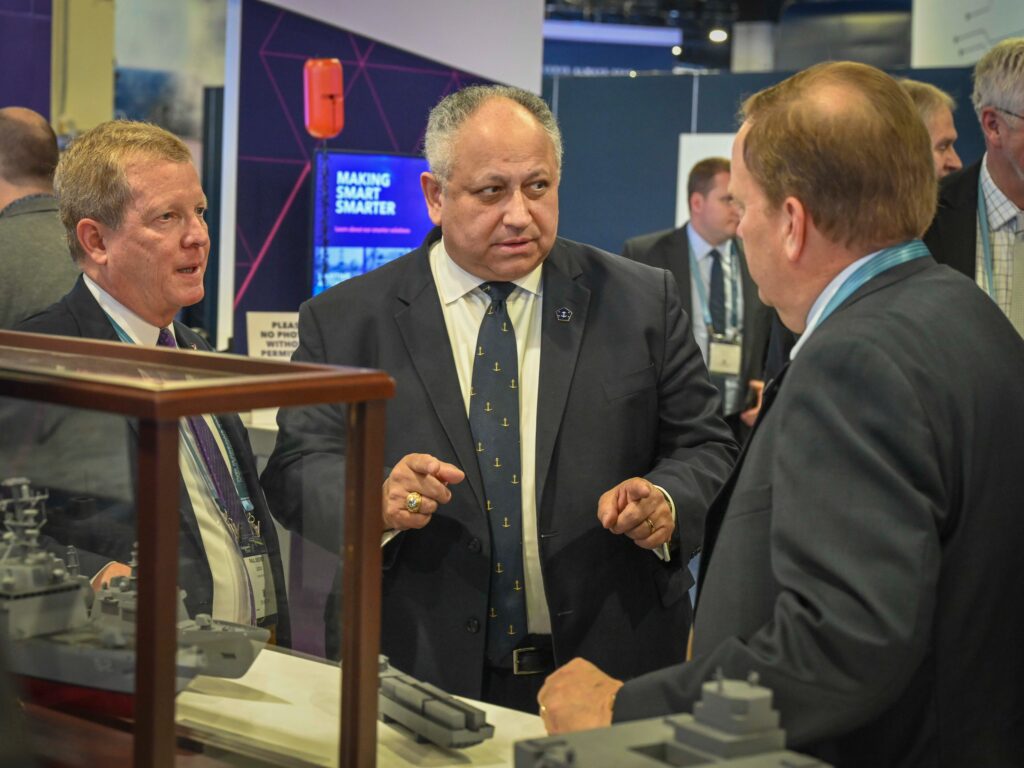
Secretary of the Navy Carlos Del Toro visits industry booths during the Navy League of the United States’ Sea-Air-Space Exposition 2024 at National Harbor, Maryland, April 9. U.S. Navy | MC2 Jared Mancuso
By Richard R. Burgess, Senior Editor
ARLINGTON, Va. — The secretary of the Navy said the shortage of workers in the U.S. shipbuilding industry could be partially alleviated by allowing more legal immigrants into the country to work in the shipyards.
Speaking April 23 at the Stimson Institute, a Washington think tank, SECNAV Carlos Del Toro acknowledged that supply chain issues caused by the COVID-19 pandemic negatively affected the ability on shipyards to meet delivery schedules of Navy ships, said he thought “the bigger problem than that … is actually the lack of blue-collar workers that we have in this country.
“Regretfully, we’re a pretty divided country politically, you might say, but it really is time for Congress to get together and pass comprehensive reform and increase the amount of legal immigration that we actually allow into this country [and] increase the amount of work visa programs that are authorized for blue-collar workers to come from other nations and actually do the work here as has actually existed since the founding of our government, very much so,” Del Toro said.
The SECNAV noted the current unemployment rate in many U.S. states is low, “but what we’ve got to do is open up the spigot a bit, basically, on legal immigration to allow blue-collar workers to come here and also to devote an enormous amount of resources into re-training individuals so they can actually work in our shipyards and be employed by the types of trades that are open to shipyard workers, for example.”
Del Toro noted the U.S. government will in the next five years “be pumping in $15 billion investment into the submarine industrial base alone and an additional billion-dollar investment into the surface industrial base as well.”
The SECNAV also noted that the atrophied U.S. commercial shipbuilding industry needs to be reinvigorated by a “whole-of-government effort around a national maritime statecraft.”
Insitu Going Strong at 30, Focusing on Maritime Operations
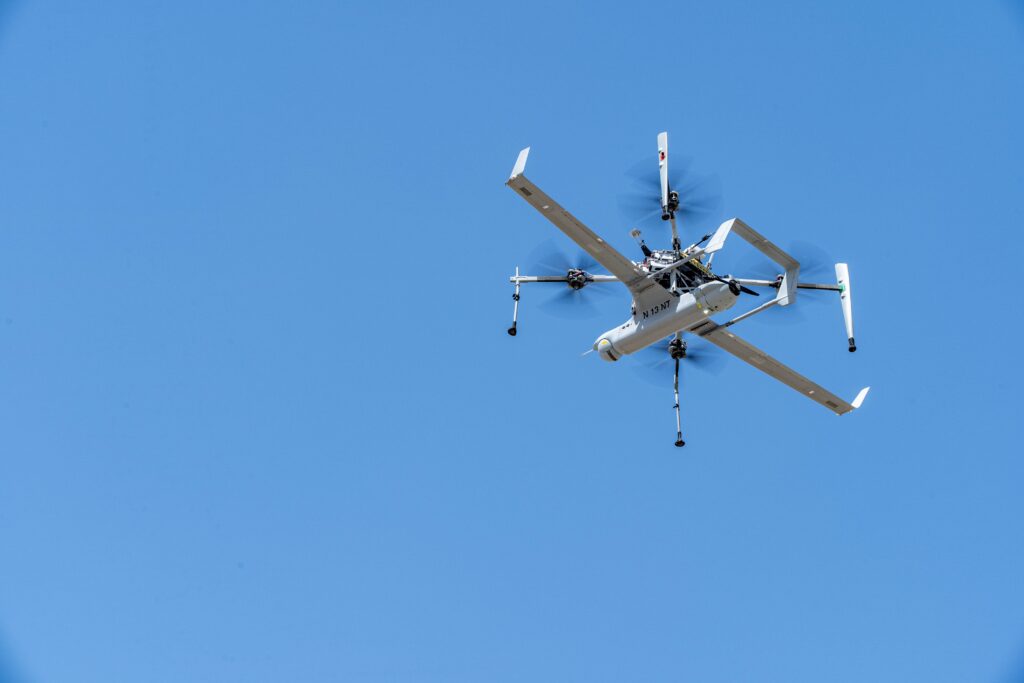
Insitu’s FLARES system carries an Integrator SUAS aloft to launch it. Photo Credit: Insitu
By Richard R. Burgess, Senior Editor
NATIONAL HARBOR, Md. — Insitu, one of the most experienced companies in the small unmanned aerial systems (SUAS) market, will mark 30 years of operations in May.
The company (in parent company Boeing’s Booth 1337), noted for its ISR (intelligence, surveillance, and reconnaissance) services and sales of modular SUAS such as ScanEagle and Integrator, especially for U.S. and allied operations in Afghanistan, is emphasizing maritime deployment of its SUAS with the shift of U.S. focus to the Indo-Pacific region, Diane Rose, president and CEO of Insitu, said in an interview with Seapower.
The Integrator UAS gets VTOL capability using the FLARES system. Photo Credit: Insitu
Insitu’s SUAS have flown 175,000 sorties, accumulating 1.5 million flight hours, including 70,000 hours of maritime operations, Rose said. The SUAS are operated by or for 40 customers — to include 20 navies and coast guards — in 35 countries. The SUAS have been operated from 28 classes of naval vessels.
Insitu’s SUAS have been provided to Ukraine via Foreign Military Sales and have been “very successful in that space,” she said, and Insitu will “continue to support that effort.”
Insitu continues to manufacture air vehicles and provide spare parts, system upgrades, and training to users. Modular sensors, provided by partner companies, can be swapped in the field to flexibly meet mission requirements.
“Our architecture allows us to integrate very quickly third-party sensors and payloads,” Rose said. “With the customer’s interests and missions in mind, we have a unique capability to offer solutions that support whatever the customer’s needs may be.”
Rose said there was a downtick in ISR services at land-based sites for the United States military since the end of the war in Afghanistan, but an uptick in international interest in Insitu’s products and services, especially focused on the maritime domain in the Indo-Pacific region, with an associated evolution in technology to satisfy emerging and changing customer needs.
The U.S. Navy and Coast Guard continue to use Insitu’s ISR services. The Navy also has procured Insitu SUAS. Navy units continue to use the RQ-21A Blackjack version of the Integrator, while Navy Special Warfare units use the RQ-27B version of the ScanEagle.
“Maritime operations are hard, and this is what 30 years of experience gives us,” Rose said. “Shipboard movement, shipboard radars and antennas, the EMI [electro-magnetic interference] environment, the harsh weather conditions, global logistics — how do you re-supply your systems, how do you meet the ships at the various ports?
“There’s a lot to supporting maritime operations, and I think that’s really why you see the success of our systems’ enduring,” she said, speaking of the long service of ScanEagle in the ever-evolving field of uncrewed aerial systems.
For customers who procure Insitu SUAS, the company provides training on how to operate the systems and also operates a 24/7 Operations Action Center, which provides customers engineering support and responses to trouble reports.
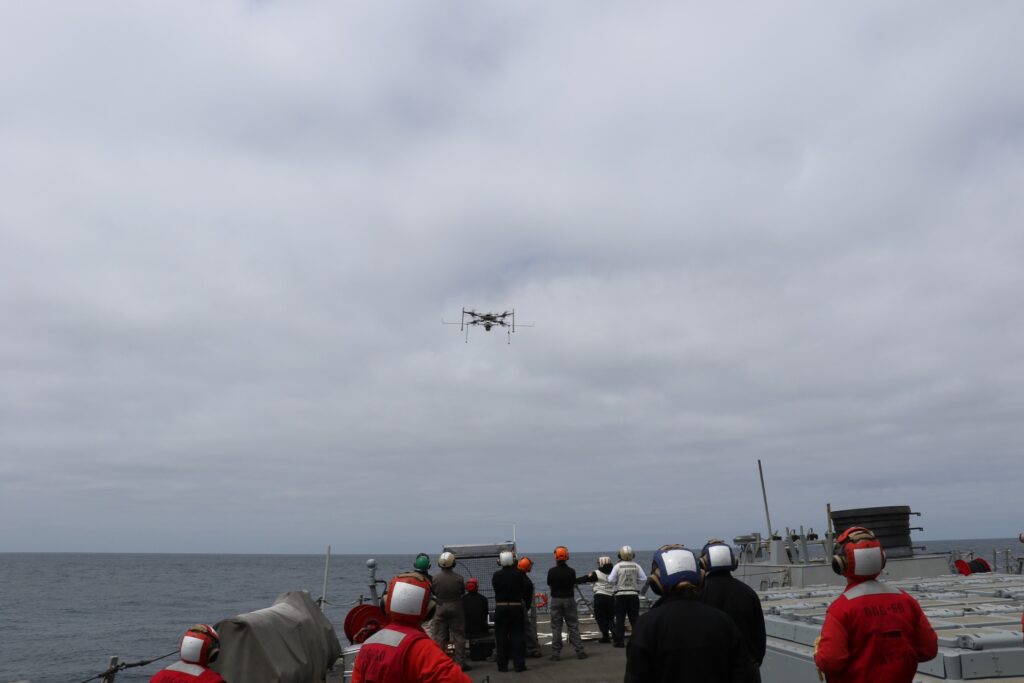
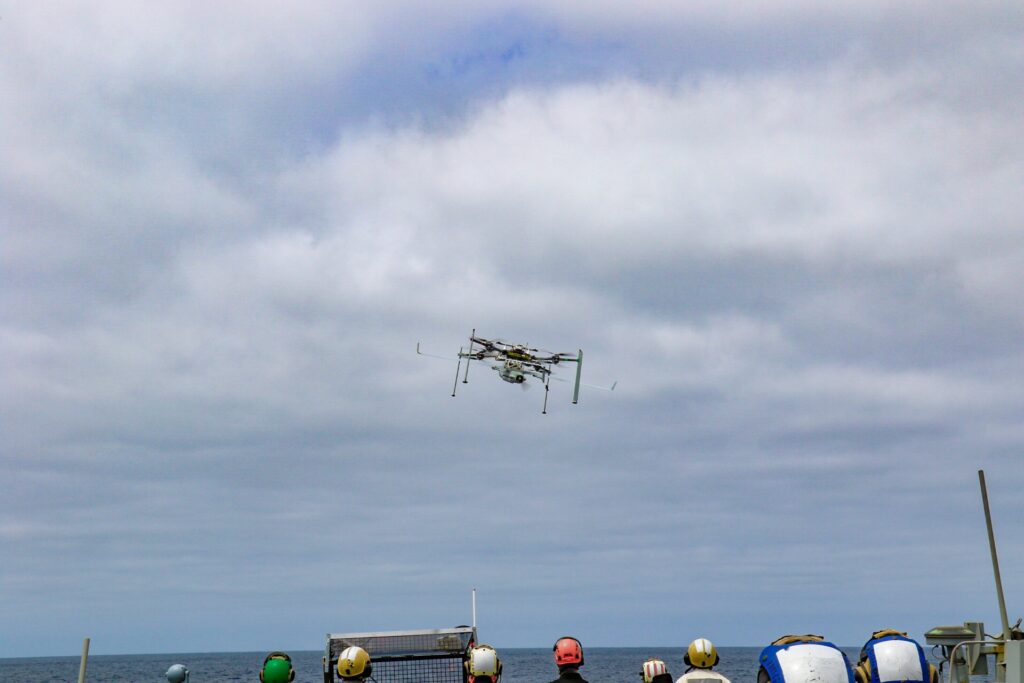
This year at the Navy League’s Sea-Air-Space (SAS) Expo, Insitu will be highlighting its vertical takeoff capability in the FLARES (Flying Launch and Recovery System (FLARES) octocopter, which it introduced at the 2023 SAS. FLARES can carry an Integrator UAS aloft 500 feet and launch it on its mission, enabling the Integrator to maintain its range, endurance, and payload capacity. The octocopter alleviates the need for a launch rail, reducing the footprint of the system and making shipboard and expeditionary operation easier. The recovery method remains the same.
Rose said Insitu has one customer so far for FLARES that carries a ScanEagle aloft.
At Sea-Air-Space, Insitu will highlight its FLARES systems, which provides VTOL capability to fixed-wing UAS Photo Credit: Insitu
She said the 570-employee company is interested in growing its technical talent but emphasizes lean and efficient operations in a highly competitive industry.
Insitu continues to press forward to address battlespace challenges, including SUAS operations in a GPS-denied environment and with kinetics. The company has conducted inert-drop flight tests from Group2/3 SUAS.
Navy Awards Boeing Additional Funds for MQ-25 Drones for Testing
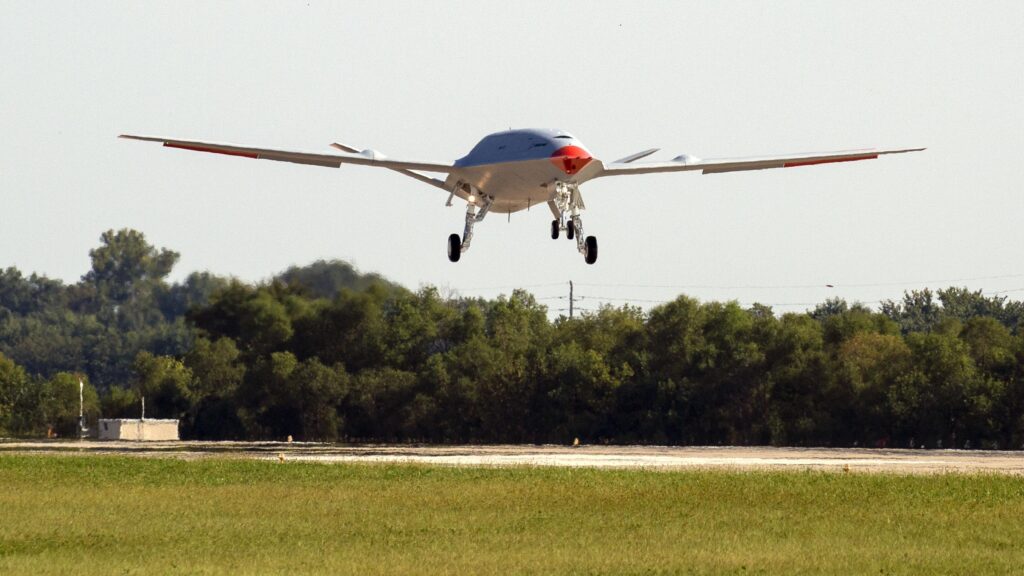
The Boeing-owned MQ-25 test unmanned aerial vehicle, T1. (Boeing)
By Richard R. Burgess, Senior Editor
ARLINGTON, Va. — The Navy has awarded Boeing funds to enhance the production of MQ-25A Stingray carrier-based aerial refueling unmanned aerial vehicles, bringing to five the number procured for testing.
The Naval Air Systems Command awarded The Boeing Company a cost-plus-fixed-fee, cost-plus-incentive-fee, fixed-price incentive (firm-target) $657.1 million contract modification for the aircraft, according to a March 29 Defense Department contract announcement.
“This modification adds scope for the production and delivery of two additional MQ-25 System Demonstration Test Article aircraft (air vehicles four and five), to include associated tooling and communication system changes for the Navy,” the announcement said. “Additionally, this modification definitizes obsolescence phase two for non-recurring engineering to address product baseline obsolescence to support low-rate initial production for the MQ-25 Stingray program.”
The MQ-25A is a single-engine carrier-based UAV designed to refuel other aircraft while in flight. The Navy is procuring the Stingray to refuel F-35 Lightning II and F/A-18E/F Super Hornet strike fighters, EA-18G Growler electronic attack aircraft, and E-2D Advanced Hawkeye command and control aircraft.
Procurement of the MQ-25A will allow the Navy to free up Super Hornet strike fighters from the aerial refueling role for their primary combat missions. It also will help preserve the service life of the Super Hornet fleet.
The Navy ordered four development models of the MQ-25A in August 2018, followed by an order for three more in April 2020. The company-owned prototype made its first flight in September 2019 and in 2021 demonstrated its ability to refuel the F-35C, F/A-18E/F, and the E-2D. The September 2022, the Navy awarded Boeing a contract for advance materials for Low-Rate Initial Production Lot 1. Initial operational capability is expected in 2026. The Navy plans to procure 72 Stingrays.
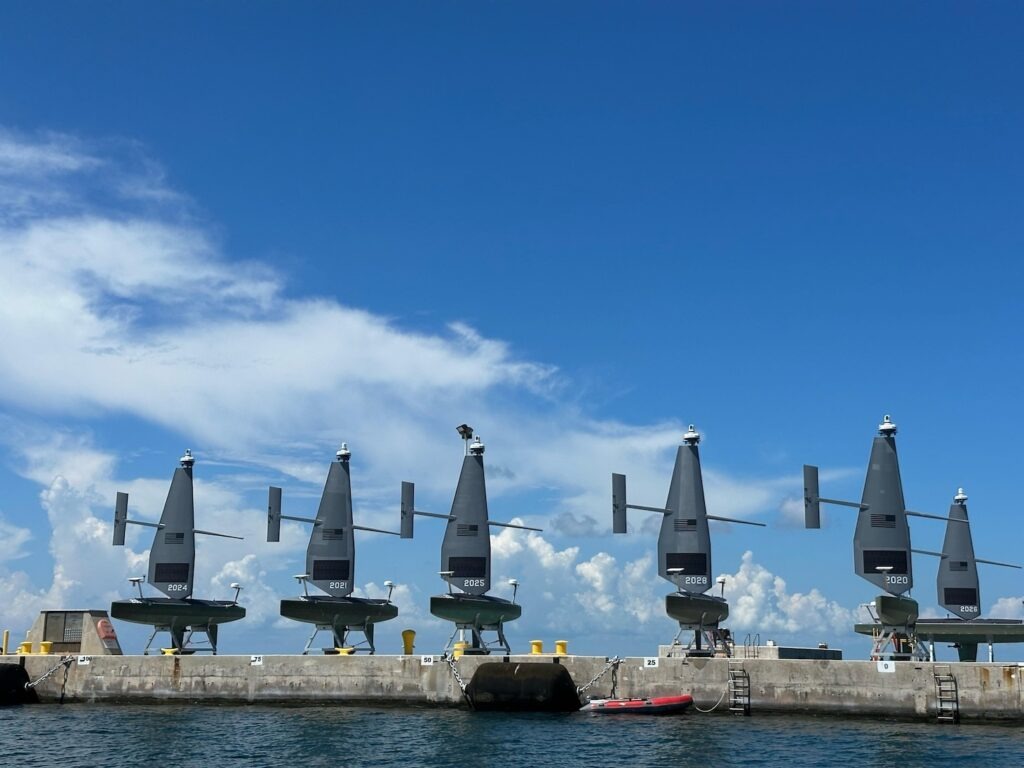
230913-N-N3764-1001 NAVAL STATION KEY WEST, Fl. – (Sept. 13, 2023) — Commercial operators deploy Saildrone Voyager Unmanned Surface Vessels (USVs) out to sea in the initial steps of U.S. 4th Fleet’s Operation Windward Stack during a launch from Naval Air Station Key West’s Mole Pier and Truman Harbor, Sept. 13, 2023.
By Richard R. Burgess, Senior Editor
ARLINGTON, Va. — The Navy’s use of unmanned systems in the U.S 4th Fleet area of operations (AOR) is enabling the fleet to move from experimentation to operationalization of the unmanned systems, even discovering unanticipated advantages of those systems.
The stability of the region and the relatively benign environment — from high-end threats — of the fleet’s AOR has enabled the fleet to experiment with unmanned systems and develop trust in them, said Rear Admiral James Aiken, commander, U.S. 4th Fleet and commander, Naval Forces, U.S. Southern Command, in a March 27 Defense One webinar conversation.
“This is a take-risk AOR,” Aiken said, noting that the environment allows the fleet to experiment in “creative ways” with unmanned systems.
“We want to take unmanned systems and operationalize them,” he said.
For one example, he said that unmanned surface vessels can identify ships and boats engaged in illegal fishing.
The admiral said that leasing unmanned systems for experimentation — as opposed to procuring them — enables the fleet to more easily discontinue use of systems that prove inadequate. He mentioned one system — which he did not name — that proved to be deficient for its role in high sea states.
Aiken said that during the last UNITAS exercise with regional navies, a representative from the U.S. 5th Fleet attended as an advisor. The 5th Fleet’s Task Force 59 has for several years conducted experimentation with unmanned surface vessels (USVs) in the Missile East.
Aiken said that one surprising discovery was the deterrent value of USVs. He said that the very presence of Saildrone USVs north of the northern coast of Haiti served as a deterrent to migrants seeking to reach another shore, including the United States.
Navy to Send Beach Group, Sealift Ships to Support Gaza Relief
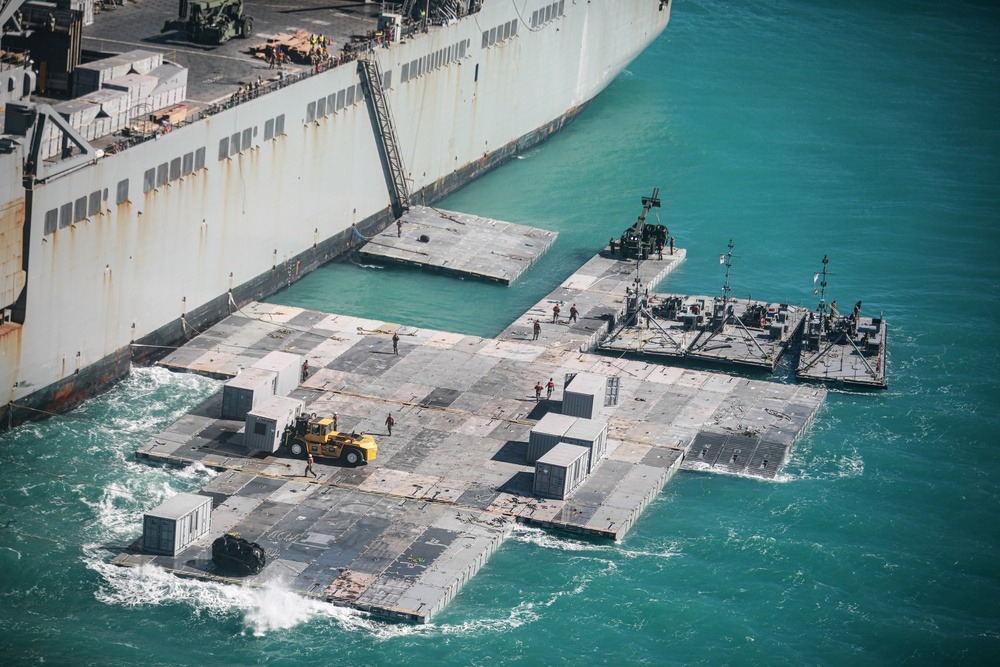
A Joint Logistics Over-the-Shore Trident floating pier and causeway is shown under assembly. (US Army photo by Sgt. Ashunteia Smith)
By Richard R. Burgess, Senior Editor
ARLINGTON, Va. — The U.S. Navy is sending an expedition of beach cargo handling forces to assist in the establishment of a floating causeway and pier to handle delivery of relief supplies to Gaza.
Speaking on background, a Navy official told reporters on March 20 that Beach Group One, augmented by other logistics forces, would be deployed to the eastern Mediterranean Sea to deliver and assemble lighterage of the Joint Logistics Over-the-Shore (JLOTS) system to convey supplies to the Trident pier and causeway Joint Logistics Over-the-Shore (JLOTS) pier that will be assembled by the Army’s Transportation Corps.
Beach Group One, based in San Diego, is a command that provides beachmasters and LCAC air cushion landing craft to amphibious warfare ships, as well as a JLOTS.
The JLOTS equipment — positioned in Jacksonville, Florida — will be transported to the Mediterranean on three sealift ships — 2nd USNS LT John P. Bobo, USNS1st LT Baldomero Lopez, and Maritime Administration’s Ready Reserve Force ship Roy P. Benevidez — with the latter transporting Army equipment. The ships will deploy nonstop straight to operations area and remain on station off Gaza to provide berthing and support for the Sailors and Soldiers involved in the relief operation. The Beach Group One personnel will be flown to the Mediterranean to join their equipment.
The official said the Navy would be sending 260 personnel to the operation, including augmentees from Beach Group Two and Navy Cargo Handling Battalion One. The personnel would include boatswain’s mates, Seabees, hospital corpsmen, quartermasters, and operations specialists, as well as other ratings.
The beach group will assemble a Roll-On/Roll Off Discharge Facility (RRDF), a 72-foot-by-270-foot floating platform built from nine sections that join together. The official said the RRDF takes four-to-five days to assemble. The RRDF, positioned three miles from the beach, will be moored alongside ships to accept their cargo containers, offloaded onto the RRDF by cranes. The containers are then loaded onto lighterage that are moved by tugboats to the Army Trident pier, which is attached to a causeway that leads to the shore. The containers are then trucked ashore by the tractor-trailers.
The sealift ships and the JLOTS will be supported by medium landing craft, repair craft, and small boats.
The JLOTS was last used in Exercise Talisman Saber in July 2023. The official said that the JLOTS is assembled regularly for training and proficiency, usually once or twice per year.
The official confirmed that no U.S. military personnel will be operating ashore in Gaza. Contract personnel will be used to drive the tractor-trailers onto the pier to receive the cargo.
The duration of the operation is yet to be determined. The official said the beach group would be meeting whatever was required by its operational commander. He said the command-and-control structure in the theater was still being worked out.
Navy Orders 17 Block III Super Hornets Plus Data Package
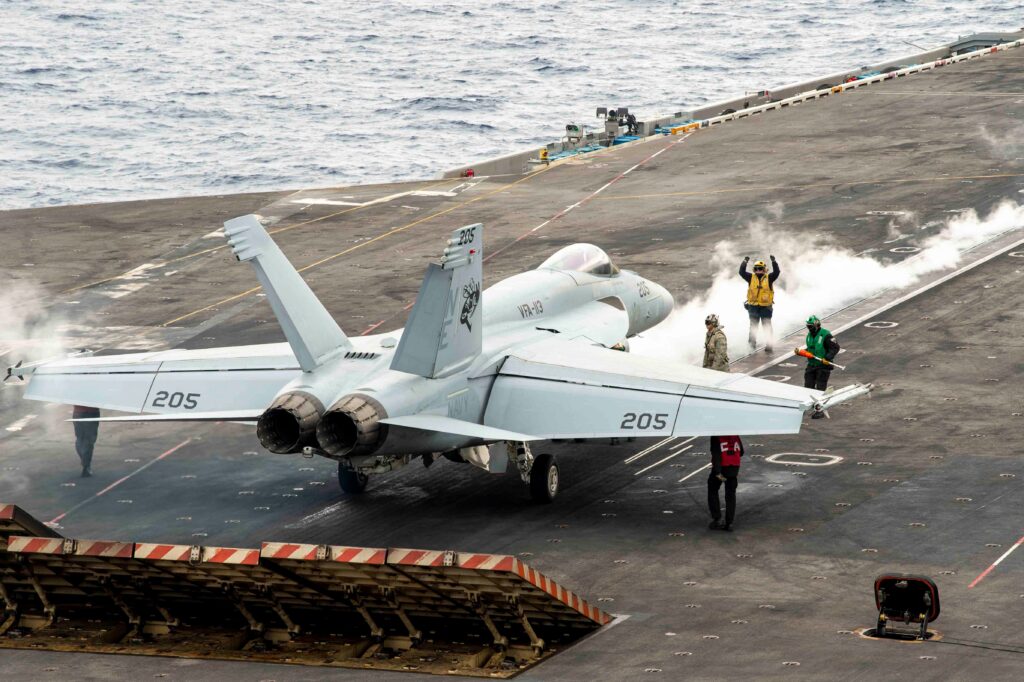
PHILIPPINE SEA (Dec. 4, 2023) An F/A-18E Super Hornet from the “Stingers” of Strike Fighter Squadron (VFA) 113 prepares to launch from the flight deck of the Nimitz-class aircraft carrier USS Carl Vinson (CVN 70). (USN photo by MC3 Joshua Sapien)
By Richard R. Burgess, Senior Editor
ARLINGTON, Va. — The Navy has ordered 17 more Block III F/A-18E/F Super Hornet strike fighters for the fleet, with the contract action also providing for the initial phase of delivery of the aircraft’s data package.
In a March 19 Defense Department contract announcement, the Naval Air Systems awarded to Boeing a not-to-exceed $1.14 firm-fixed-price, undefinitized contract modification to procure “10 F/A-18F Lot 46 aircraft, as well as two F/A-18F and five F/A-18E Lot 47 aircraft.”
The contract also shows progress in resolution with Boeing over the rights to the aircraft’s data package, important to the sustainment of the Super Hornet fleet.
“This modification also provides for Phase One of the F/A-18E/F and EA-18G technical data package including the operation, maintenance, installation and training data in support of F/A-18 and EA-18G sustainment efforts for the Navy,” the release said.
“The technical data package was a crucial part of this negotiation; it is necessary for naval aviation’s operational readiness and post-production sustainment,” said Rear Adm. John Lemmon, program executive officer for Tactical Aircraft Programs, in a March 19 Navy release. “The Super Hornet remains a predominant aircraft in the carrier air wing and will continue to provide significant combat capability into the 2040s. The Navy received appropriated funds from Congress to purchase these Super Hornets to help mitigate the strike fighter shortfall. The award is an Undefinitized Contract Action with the intent to definitize within the next few months.”
Delivery of the new Super Hornets is scheduled from late 2026 through to begin in the winter of 2026, with final delivery no later than April 2027.
The Block III version of the Super Hornet completed its first carrier deployment last month with the return of the USS Carl Vinson from the Western Pacific Ocean. Strike Fighter Squadron 113 took the Block IIIs on the deployment.
Aircraft Carrier Suppliers Alarmed at Navy’s Planned Delay of CVN 82
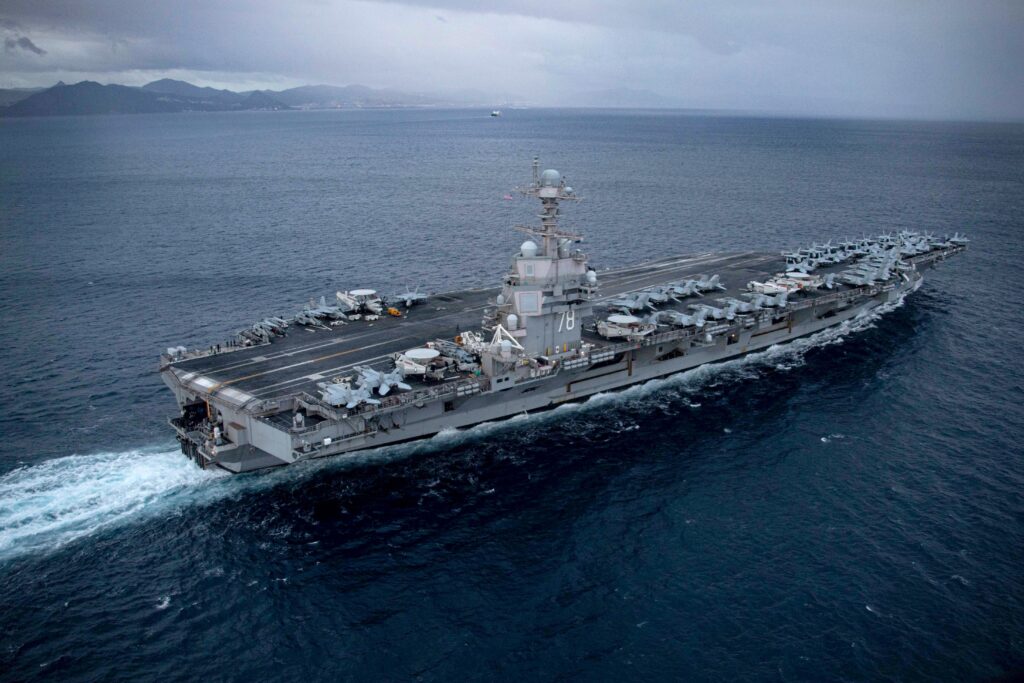
STRAIT OF GIBRALTAR (Jan. 5, 2024) The world’s largest aircraft carrier USS Gerald R. Ford (CVN 78) transits the Strait of Gibraltar, Jan. 5, 2024. (USN photo by MC2 Jacob Mattingly)
By Richard R. Burgess, Senior Editor
ARLINGTON, Va. — The coalition of suppliers of components, parts, and services for the construction of the U.S. Navy’s aircraft carriers (CVNs) is alarmed at the proposed two-year delay of authorization for CVN 82 — the fifth Gerald R. Ford-class CVN — and the potential disruption to the supplier base for the ships.
Lisa Dante Papini, chair of the Aircraft Carrier Industrial Base Coalition (ACIBC), which represents more than 2,000 businesses, said she is “extremely concerned” about the proposed delay for CVN 82 from 2028 to 2030, noting that 40% of the suppliers said in a survey that they would be negatively affected by the delay.
Papini said the delay likely would involve worker layoffs, production lines going cold, and suppliers de-prioritizing military requirements and seeking more work in other sectors. She noted that re-starting cold production lines and hiring or re-hiring workers is a lengthy and expensive process. The skills needed — such as welding — are in high demand in other industries as well, complicating the attraction of new workers.
“That’s why we’re concerned about going cold,” she said.
She also explained the need for advance funding for supplying aircraft carrier construction three years in advance of construction start.
“We’re so far to the left of those delivery dates,” she said. That’s why we ask for advance funding.”
Papini, like her counterparts in the Amphibious Warfare Industrial Base Coalition and the Submarine Industrial Base Coalition, emphasizes that stability and predictability of shipbuilding helps the supplier base “level-load their work;” recruit, train, and retain their workers; reduce costs, and deliver products on time.
The ACIBC met with senators and congressmen on March 20 on Capitol Hill to explain its concerns and priorities.
Navy Awards Bell Textron Contract for 12 AH-1Z Helicopters for Nigeria
KOREA STRAIT (March 29, 2023) An AH-1Z Viper helicopter takes off from the amphibious assault ship USS Makin Island (LHD 8), March 29, 2023. (U.S. Marine Corps photo by Gunnery Sgt. Chad J. Pulliam)
By Richard R. Burgess, Senior Editor
ARLINGTON, Va. — The government of Nigeria is slated to receive 12 AH-1Z Viper helicopter gunships, becoming the third foreign customer for the Viper.
In a March 12 contract announcement, the Naval Air Systems Command awarded to Bell Textron of Fort Worth, Texas, a $455 million “firm-fixed-price, undefinitized contract for the production and delivery of 12 AH-1Z helicopters for the government of Nigeria, as well as provides associated engineering, program management and logistics support, and non-recurring engineering for obsolescence.”
Deliveries to the Nigerian government are expected to be complete by July 2028.
Bell built 189 AH-1Zs for the U.S. Marine Corps and 12 for Bahrain, and is building four for the Czech Republic, along with eight UH-1Y Venom utility helicopters. The Czech Republic also is receiving free of charge six AH-1Zs and two UH-1Ys that formerly were part of the U.S. Marine Corps’ inventory.
Navy 2025 Budget Requests Only 6 Battle Force Ships
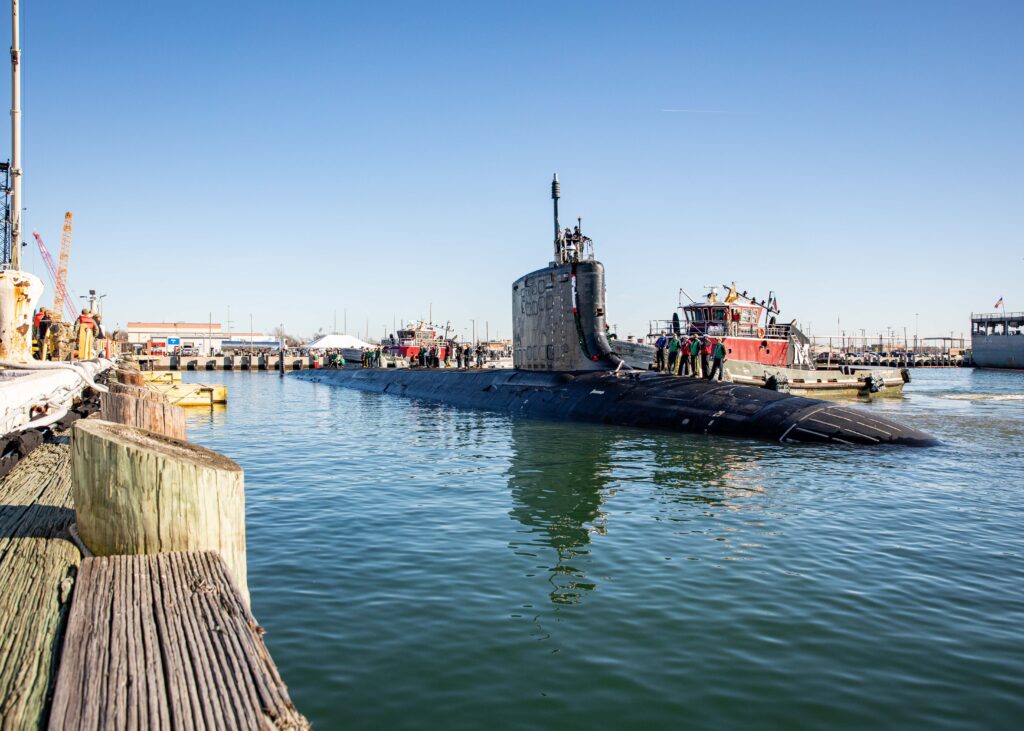
NAVAL STATION NORFOLK — The Virginia-class fast-attack submarine USS Washington (SSN 787) prepares to moor pierside during the boat’s homecoming at Naval Station Norfolk, Dec. 15, 2023. (U.S. Navy photo by Mass Communication Specialist 1st Class Cameron Stoner)
By Richard R. Burgess, Senior Editor
ARLINGTON, Va. — The U.S. Navy’s fiscal 2025 budget request proposes only six battle force ships, which, combined with planned ship retirements, would reduce the size of the battle force from 296 ships to 287 ships.
The Navy’s proposed $257.6 billion budget — which officials said prioritizes readiness over procurement, would include $32.4 billion for ship construction. Those funds would procure one Block VI Virginia-class attack submarine (SSN), two Flight III Arleigh Burke-class guided-missile destroyers, one Constellation-class guided-missile frigate, one Flight II San Antonio-class amphibious platform dock ship (LPD), and one medium landing ship.
The proposal for only one Virginia-class SSN, rather than two, was made out of concern for the submarine industrial base, which currently is delivering only 1.3 hulls instead of the desired two SSNs per year. The gap is designed to help realign the investments in the submarine industrial base. Under the Future Years Defense Plan (FYDP), the Navy expects to return to the procurement rate of two SSNs per year in fiscal 2026. Navy Undersecretary Erik Raven, speaking to reporters March 11 at the budget roll-out, said advance procurement for the SSNs is proceeding to “set up the program for long-term success.”
The ship construction budget also includes continued incremental funding for two aircraft carriers and second Columbia-class ballistic-missile submarine, the refueling and comprehensive overhaul of a Nimitz-class aircraft carrier, the service-life extension of three aircushion landing craft, and the purchase of two used commercial ships for use as sealift ships.
The procurement of the San Antonio-class LPD would mark a reversal from the 2024 plan to end procurement of the class. Navy Undersecretary Erik Raven, speaking to reporters March 11 at the budget roll-out, said the Navy is intent on growing the large- and medium amphibious warfare ship fleet to a minimum of 31 ships.
The FYDP features the procurement start in fiscal 2027 of a new class of ship, the light replenishment oiler (T-AOL).
Raven said the Navy currently has 88 ships under contract, with 66 of those under construction.
Planned ship retirements include two Ticonderoga-class guided-missile cruisers (Shiloh and Lake Erie); two Independence-class littoral combat ships (Jackson and Montgomery), one Whidbey Iland-class dock landing ship (Germantown); one Montford Point-class expeditionary transfer dock ship (John Glenn) and the four oldest Spearhead-class expeditionary fast transports (Spearhead, Choctaw County, Millinocket, and Fall River).
Rep. Rob Wittman, R- Virginia, a member of the Seapower subcommittee of the House Armed Services Committee, criticized the ship construction plan as too little.
“The president is once again proposing to shrink the Navy by reducing the Navy force structure from 296 ships in FY24 to just 287 in FY25. By only building six ships, President Biden is also threatening to devastate our naval fleet and the Hampton Roads industrial base by slowing aircraft carrier construction and failing to meet the two Virginia-class submarines per year cadence required to support the AUKUS security pact,” Wittman said in a March 11 statement.
Amphib Warship Part Suppliers Press Congress for Stability in Shipbuilding
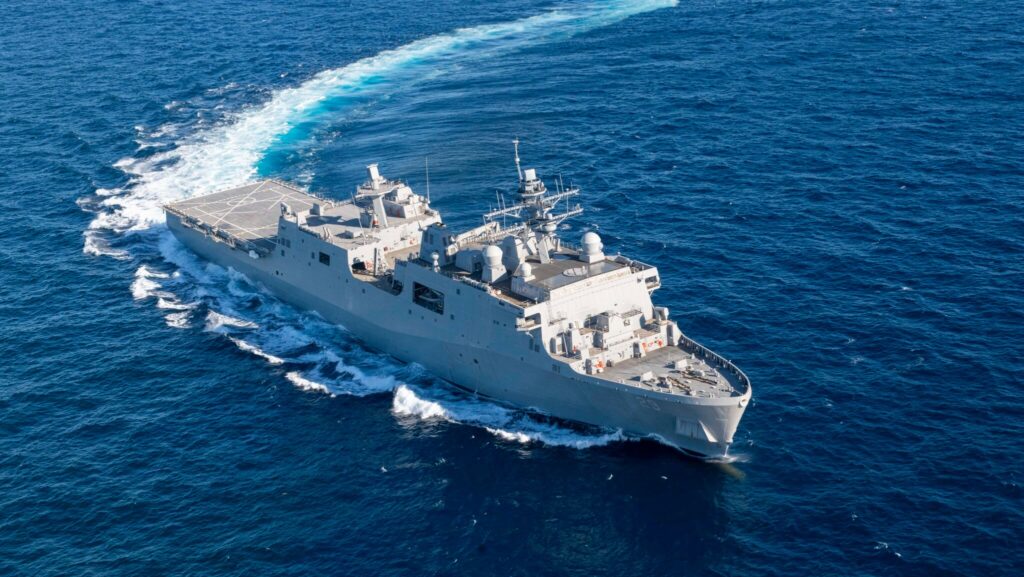
The future USS Richard M. McCool Jr. (LPD 29), the Navy’s next Flight I San Antonio-class amphibious transport dock ship, seen on sea trials. (HII)
By Richard R. Burgess, Senior Editor
ARLINGTON, Va. — The U.S. companies that supply components and parts for the U.S. Navy’s amphibious warfare fleet expressed support for the Marine Corps baseline requirement of 31 large and medium amphibious warfare ships in the U.S. fleet and the industry’s need for stability and predictability in schedules.
Retired Coast Guard Capt. Paul J. Roden, chairman of the board of the Amphibious Warfare Industrial Base Coalition (AWIBC), which represents approximately 650 companies throughout the United States, told Seapower that the Marine Corps has stressed that “ready and available” 31-ship requirement is “not a ceiling, it’s the floor.”
Roden stressed the point that it is difficult for suppliers to produce efficiently when production schedules are unpredictable. He said that the stability needed is best achieved when the large-deck amphibious assault ships (LHAs) are built with construction intervals of four-year centers and the amphibious platform dock ships (LPDs) are built with intervals of two-year centers.
Full funding by Congress for LPD 33 in the fiscal 2025 defense budget is a priority for the AWIBC, he said.
AWIBC recently conducted a survey of its member companies.
Regarding the shipbuilding intervals, “50% of the survey respondents replied that extending those would result in an increase in cost of their products and services. When you are throwing uncertainty to any procurement, then there is risk, and risk is addressed by cost, so it is really in the Navy’s best interest to maintain those centers.”
Roden said that if an LHA or LPD were delayed by a year or more, “40% of all of our members [companies] would anticipate needing to lay off workers due to uncertainty and not having full capacity in plants of the AWIBC suppliers. About a third said they would have to explore commercial contracts as well as de-prioritize shipbuilding, but in many cases, there is just not a commercial market.”
He said that “about 70% of our respondents said that the most helpful thing that the government could do is provide predictability and stability.
“One way of going about that — that has been proven successful in other programs—is through multi-ship and multi-year procurement strategies,” he said.
Roden also said that “just over 50% of the suppliers that contribute to both amphibious warship and submarine programs … said that steady amphib contracts benefit their company’s capacity and capability to deliver on submarine programs. Having predictability and stability in shipbuilding programs allows suppliers to make investments. If they know the business is coming, they can make investments in work force training, enhancing work force, investing in equipment, investing in other infrastructure that would improve the quality and on-time delivery of products.”