Shield AI V-BAT Selected as Japan Maritime Self-Defense Force’s First Maritime ISR Platform
From Shield AI, Jan. 22, 2025
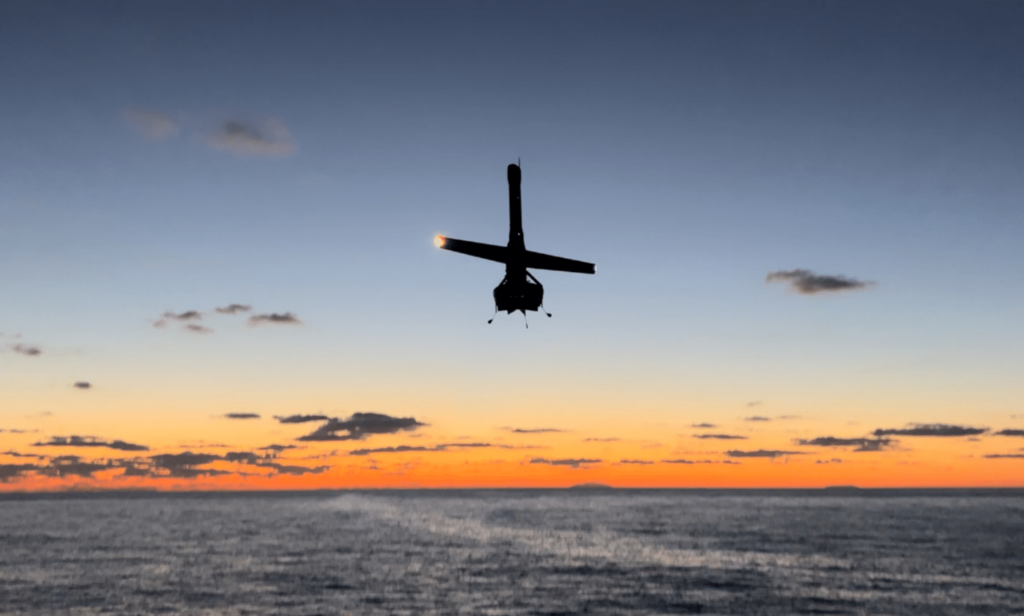
WASHINGTON (January 22, 2025) – Shield AI, the defense technology company building an AI-powered autonomy software platform and tools for the world, announced today that its V-BAT unmanned aircraft system (UAS) has been selected by the Japan Maritime Self-Defense Force (JMSDF) as the country’s first-ever maritime-based intelligence, surveillance, and reconnaissance (ISR) platform. V-BAT will provide advanced ISR capabilities to JMSDF surface vessels, reinforcing Japan’s defense posture and operational readiness in the Indo-Pacific region.
This milestone deal represents the beginning of a planned multi-year stream of increasing V-BAT orders to support JMSDF operations. Under the agreement, the JMSDF will acquire multiple V-BAT UAS from Shield AI, enhancing the surveillance and intelligence-gathering capabilities of its surface vessels.
“Japan is a vital ally in the Indo-Pacific and critical to regional deterrence efforts, and this partnership strengthens Japan’s ability to respond effectively to crises and ensures they are equipped with a reliable and proven platform for maritime ISR missions,” said Brandon Tseng, Shield AI’s President, Co-founder, and former Navy SEAL. “The JMSDF’s selection of V-BAT reflects their understanding of the future of warfare—where operational success requires blending high-cost assets with intelligent, affordable unmanned systems like V-BAT. Every U.S. and allied maritime vessel should be equipped with V-BAT to provide shipborne ISR capabilities wherever and whenever they are needed, and it’s fantastic to be making that vision a reality with JMSDF.”
The V-BAT is the only single-engine ducted-fan vertical takeoff and landing (VTOL) UAS operationally deployed in multiple regions globally. With its unique ducted fan design and the ability to launch and recover in confined spaces, it is ideally suited for shipborne and austere environments, ensuring flexibility and resilience in complex missions. V-BAT has earned its reputation for reliability, operating with impunity even in GPS- and comms-denied environments. Its proven performance in contested regions like Ukraine, the Black Sea, and the Indo-Pacific demonstrates its ability to withstand advanced electronic warfare threats that have grounded many traditional drones.
Delivering the strategic capabilities of much more expensive aircraft, V-BAT excels in missions ranging from ISR to strategic targeting, search-and-rescue, and maritime interdiction. Its versatility and cutting-edge autonomous features make it a critical asset in modern defense operations.
DOD Orders 1,500 Troops, Additional Assets to Southern Border
Jan. 22, 2025 | By Matthew Olay, DoD News
The Defense Department is sending 1,500 active-duty service members and additional air and intelligence assets to the southern border to augment troops already conducting enforcement operations in that region, Acting Secretary of Defense Robert Salesses announced this afternoon via a statement to the media.
The announcement came roughly 36 hours after President Donald J. Trump issued an executive order directing DOD to address the situation at the border.
“On Monday, to protect the security and safety of United States citizens, President Trump declared that a national emergency exists at the southern border of the United States. The president directed me to take all appropriate action to support the activities of the secretary of homeland security in obtaining complete operational control of the southern border of the United States,” the statement reads.
The Pentagon has since established a task force to oversee the expedited implementation of border-related executive orders; with U.S. Northern Command heading up the effort and being supported by U.S. Transportation Command, the National Guard Bureau, the military services and the Department of Homeland Security.
The 1,500 additional active-duty service members authorized by Salesses will initially be put to work on the placement of physical barriers and other border missions within the next 24 to 48 hours, a senior military official told the media.
The additional active-duty personnel includes 1,000 soldiers, as well as 500 Marines who had previously been on standby in Southern California to potentially help combat the Los Angeles County wildfires that broke out two weeks ago, the senior official said.
With 2,500 active-duty personnel already in the region, the additional 1,500 troops will represent a 60% increase in active-duty forces since Trump was sworn in on Monday, Salesses remarks in his statement.
“We anticipate that overall, on the southwest border, will provide real-time situational awareness of persons, vehicles, vessels and aircraft; and they’ll work with on operator-level maintenance, movement and staging of assets,” the senior military official said.
In addition to the additional active-duty ground personnel, DOD will provide airlift support for flights operated by DHS to implement the deportation of more than 5,000 individuals detained by CBP at the border sectors in San Diego and El Paso, Texas, Salesses’ statement reads.
Transcom is providing two C-130 Hercules and two C-17 Globemaster aircraft to assist in that support, the senior military official said.
Additionally, the official added that there are UH-72 Lakota military helicopters that began flying today in support of CBP.
DOD is also coordinating with the State Department to obtain diplomatic visas and provide host-nation notification for those individuals who are deported, a senior defense official said.
DOD is also providing intelligence analyst support at the border.
“We’re in the process of sourcing those requirements right now,” the senior military official said.
“We also anticipate that there could be some additional airborne intelligence, surveillance and support assets that would move down to the border to increase situational awareness,” the official added.
Regarding DOD’s future activity on the border, the senior defense official said that — while there are no specifics to release at the moment — there will be a number of additional border enforcement missions developing.
“This is going to be a big priority for the department under the acting secretary and the secretary that will be coming on board,” the defense official said.
“In short order, will develop and execute additional missions in cooperation with DHS, federal agencies, and state partners to address the full range of threats outlined by the at our nation’s borders,” Salesses’ statement reads.
“President Trump directed action from on securing our nation’s borders and made clear he expects immediate results. That is exactly what our military is doing under his leadership,” the statement concludes.
SENEDIA Continues to Strengthen Defense Workforce
Real Jobs RI Grant Supports Rhode Island’s $7.6 Billion Defense Industry
From SENEDIA, Jan. 23, 2025
MIDDLETOWN, R.I. – SENEDIA, the alliance for defense tech, talent, and innovation, announced today a $200,000 grant to continue their highly-successful Defense Partnership Program. The program, administered through Real Jobs RI, connects job seekers with direct hire, internship, and training opportunities in the defense sector, which represents more than 34,000 jobs and $7.6 billion in economic output in Rhode Island.
“Real Jobs is critical to our efforts to fortify national security and grow the defense industry, an essential part of the economy in Rhode Island and across the region,” said Molly Donohue Magee, chief executive officer of SENEDIA. “The meaningful skill-building, on-the-job experience, and job search support we foster through this program ensures a strong defense workforce for today and tomorrow.”
Real Jobs RI has supported the Defense Partnership Program since 2016, enabling training and job placements in high-wage, high-growth, high-demand careers in defense, including IT and cybersecurity, engineering/science, supply chain management, technology, and business support. In 2024, the program placed more than 60 applicants into good-paying jobs and facilitated employment support for more than 100 candidates, including resume and interview prep, direct outreach to employers, internship opportunities, and technical certifications.
“Defense is a key part of the Rhode Island economy, and its impact reverberates across many other industries,” said Matthew Weldon, director of the Rhode Island Department of Labor and Training that oversees the Real Jobs RI program. “Connecting Rhode Island companies with talented and skilled workers – from recent high school graduates pursuing rewarding careers to mid-career professionals looking to leverage new skills – is a win for the employer, for the candidate, and for our state.”
The Defense Partnership Program builds on SENEDIA’s broader portfolio of workforce development and industry advocacy. Through the Department of Defense sponsored New England Submarine Shipbuilding Partnership, SENEDIA has facilitated the training of more than 5,100 people for employment opportunities in Rhode Island and has strengthened the talent pipeline across the K-12, higher education, and advanced training levels.
Building a strong workforce pipeline is essential to sustaining and growing the industry. According to SENEDIA’s 2023 Economic Impact Report of the Defense Cluster in New England, defense represents more than 10 percent of the state’s economy and generates $3 billion in labor income for Rhode Island workers. Across the region, the sector accounts for $119.1 billion in economic output, more than 407,000 jobs, and more than $40 billion in income.
General Dynamics Mission Systems To Provide Advanced Electronics In MK 54 Torpedoes For The U.S. Navy
Sailors aboard the Arleigh Burke-class guided-missile destroyer USS Winston S. Churchill (DDG 81) maneuver a Mark-54 torpedo to the flight deck. Photo Credit: U.S. Navy
From General Dynamics Mission Systems, Jan. 21, 2025
FAIRFAX, Va. – General Dynamics Mission Systems announced today that it was awarded a fixed-price-incentive, firm-fixed-price, cost-plus-fixed-fee, and cost-only contract from the U.S. Navy in December for up to $808.6 million to produce MK 54 MOD 1 Lightweight Torpedo Kits and related test equipment, spares, provisioned item orders, engineering support and hardware support for the MK 54 Lightweight Torpedo Program. Work will be performed in Canonsburg, Pennsylvania, and is expected to be completed by December 2032.
“Our Progeny Systems employees have been providing advanced torpedo electronics to the U.S. and allied Navies for 18 years. This contract ensures that our surface ships and aircraft will have the most modern and capable torpedoes in the world for many years to come,” said Laura Hooks, vice president and general manager of Maritime and Strategic Systems at General Dynamics Mission Systems.
Progeny Systems was acquired by General Dynamics Mission Systems in 2022. Headquartered in Manassas, Virginia, Progeny Systems provides a wide spectrum of capabilities and lifecycle support services for U.S. submarines and surface ships.
General Dynamics Mission Systems provides mission-critical solutions for defense, intelligence and cybersecurity customers across all domains. Headquartered in Fairfax, General Dynamics Mission Systems employs approximately 12,000 people worldwide. More information about General Dynamics Mission Systems is available at gdmissionsystems.com.
NAWCAD Lakehurst Hosts Groundbreaking Ceremony For New Test Site Capability
Naval Air Warfare Center Aircraft Division Lakehurst held a groundbreaking ceremony on Jan. 14 for an upgrade of the Runway Arrested Landing Site testing facility. The update will house a Joint Precision Approach and Landing System (JPALS) and an Unmanned Carrier Aviation Mission Control System for the MQ-25 and other aircraft programs. (U.S. Navy Photo)
From Naval Air Systems Command, Jan. 22, 2025
JOINT BASE MCGUIRE-DIX-LAKEHURST, N.J. — On a day when the ground at Naval Air Warfare Center Aircraft Division Lakehurst was so cold it made digging into the dirt a challenge, a groundbreaking ceremony for an upgrade of the Runway Arrested Landing Site testing facility welcomed the start of a new chapter in the installation’s testing capabilities.
The Jan. 14 event was attended by representatives of the Unmanned Carrier Aviation (PMA-268), Aircraft Launch and Recovery Equipment (ALRE) (PMA-251) program offices, and NAWCAD Lakehurst leadership, including Capts. Daniel Fucito and Mike Kline, as well as other stakeholders of the project.
When completed, the update will house a Joint Precision Approach and Landing System (JPALS) and an Unmanned Carrier Aviation Mission Control System for the MQ-25 and other aircraft programs.
“This groundbreaking represents a significant step forward in Lakehurst’s ability to complete the initial carrier suitability testing for one of the Navy’s major North Star programs in the MQ-25,” said CDR. Adam Pawlak, NAWCAD Lakehurst Officer-in-Charge.
The JPALS update will allow compatibility testing for the MQ-25 on ALRE systems, starting with the TC-13 steam catapult and MK-7 arresting gear currently used on legacy aircraft carriers. Future testing will also be conducted using the Electromagnetic Aircraft Launch System and Advanced Arresting Gear found on the newer Ford-class carriers.
The update will also include a Mobile Integrated Telemetry System, which can be used to set up temporary aircraft data management telemetry systems during testing.
Pawlak added the groundbreaking ceremony lays the foundation for Lakehurst’s ability to test critical unmanned platforms of the future.
U.S. Seventh Fleet Opens New Navigation, Seamanship and Shiphandling Trainer (NSST) Facility
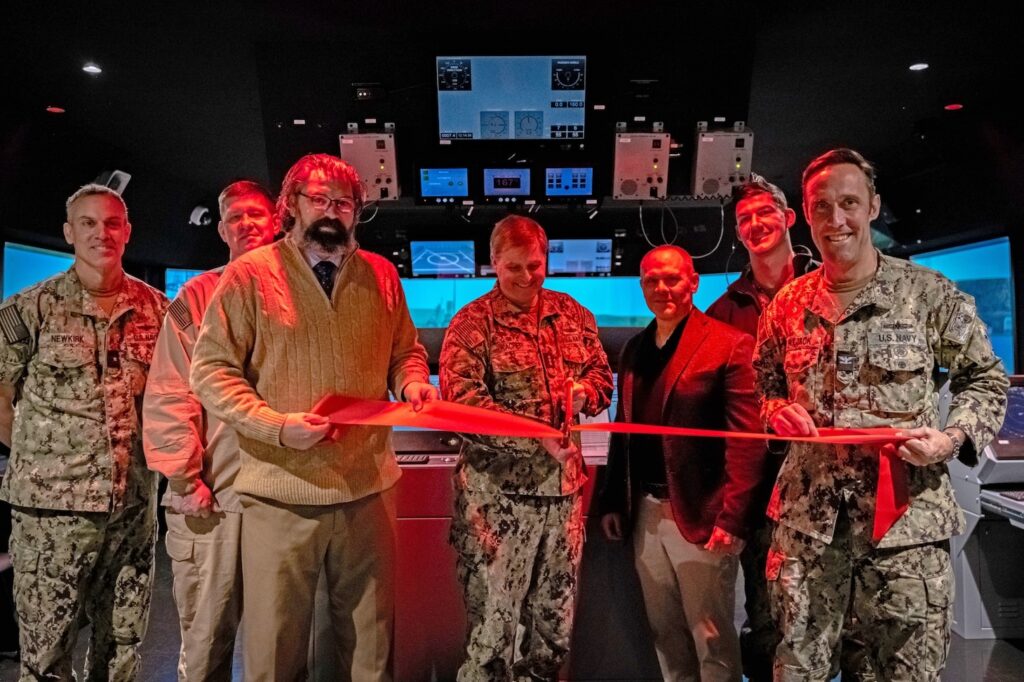
Vice Adm. Fred Kacher, center, commander of U.S. 7th Fleet, opens the new Navigation, Seamanship, and Shiphandling Trainer (NSST) facility during a ribbon-cutting ceremony at Commander, Fleet Activities Yokosuka (CFAY), Jan. 16, 2025. With Kacher are Rear Adm. Greg Newkirk, left, commander of Task Force 70, Capt. Dave Huljack, deputy commodore of Destroyer Squadron (DESRON) 15, Capt. Shockey Snyder, back, commander of Naval Surface Group Western Pacific, and NSST team members. (U.S. Navy photo by MC1 Caroline H. Lui)
From Destroyer Squadron 15, Jan. 21, 2025
YOKOSUKA, Japan — Adm. Fred Kacher, commander, U.S. Seventh Fleet, opened the new Navigation, Seamanship, and Shiphandling Trainer (NSST) facility at a ribbon-cutting ceremony in Yokosuka, Japan, Jan. 16, 2024.
“I’ve seen how history and time bend to the winner who works hard and plans—this is what simulation allows us to do,” said Kacher. “It’s great to see the power of these trainers, and we’re thrilled to bring this capability to the fleet.”
During the ceremony, Kacher received a tour of the new facility and observed Sailors and junior officers from the waterfront simulating harbor movements. Capt. Dave Huljack, deputy commodore of Commander, Destroyer Squadron (DESRON) 15, also attended the ribbon cutting ceremony.
“Our teams our busy, and we’re getting after it. We don’t only use these facilities for certification, we practice close-quarters shiphandling, tactical maneuvering, and just getting better,” said Huljack. “Building more trainers surges the volume of qualified and capable mariners that we’re able to bring to the fight.”
Members from the NSST staff Jesse Summerlin, Brad Stallings, and Bill Ault explained the capabilities of the new facility and spoke on the importance of the NSSTs as a whole.
“We’re already booked at 95% capacity for the remainder of the calendar year,” said Summerlin, an LB&B Associates NSST Instructor. “The demand from the ships has been overwhelming and our team stands ready to accept the challenge and continue to provide the best possible product to our customers on the Yokosuka waterfront.”
DESRON 15 is the Navy’s largest destroyer squadron and the U.S. 7th Fleet’s principal surface force. It is forward deployed to the U.S. 7th Fleet area of operations in support of security and stability in the Indo-Pacific.
U.S. 7th Fleet is the U.S. Navy’s largest forward-deployed numbered fleet, and routinely interacts and operates with allies and partners in preserving a free and open Indo-Pacific region.
USS Philippine Sea Departs Naval Station Norfolk On Final Scheduled Deployment
NORFOLK, Va. (January 20, 2025) The Ticonderoga-class guided-missile cruiser USS Philippine Sea (CG 58), departs from Naval Station Norfolk, January 20th, 2024. Philippine Sea will deploy to the U.S. Southern Command Area of Responsibility (USSOUTHCOM AOR) to support maritime operations with partners in the region, conduct Theater Security Cooperation (TSC) port visits, and support Joint Interagency Task Force South (JIATF-South) to deter illicit activity along Caribbean and Central American shipping routes. (U.S. Navy photo by Chief Mass Communication Specialist Evan Thompson/Released)
From U.S. Fleet Forces Command, Jan. 20, 2025
NORFOLK, Va. - The Ticonderoga-class guided-missile cruiser USS Philippine Sea (CG 58) departed Naval Station Norfolk for a scheduled deployment to the U.S. 4th Fleet area of operations, Jan. 20.
Philippine Sea will deploy to the U.S. Southern Command Area of Responsibility (USSOUTHCOM AOR) to support maritime operations with partners in the region, conduct Theater Security Cooperation (TSC) port visits, and support Joint Interagency Task Force South (JIATF-South) to deter illicit activity along Caribbean and Central American shipping routes.
“The deployment of Philippine Sea to the U.S. Southern Command area of responsibility highlights the Navy’s ability to generate and certify out of cycle combat-ready forces in order to execute critical missions,” said Adm. Daryl Caudle, commander, U.S. Fleet Forces Command. “The ship and crew will play a pivotal role in enhancing regional security and supporting bilateral and multinational efforts to counter challenges unique to Fourth Fleet. This deployment also underscores our commitment to building a resilient and adaptable force that meets global demands while fostering trust and interoperability with our global maritime partners.”
This is scheduled to be Philippine Sea’s final deployment after more than 35 years in service.
The ship previously deployed on October 14, 2023 as part of the Dwight D. Eisenhower Carrier Strike Group (IKECSG) to U.S. 5th and 6th Fleet area of operations in support of maritime security operations, theater security cooperation efforts, and enhanced vigilance activities operations with NATO Allies and Partners.
“My sailors have received the highest level of training and are fully prepared to meet the challenges of our deployment,” said Capt. Steven Liberty, commanding officer of Philippine Sea. “The vigilant and hard work of the War Dogs is a testament to the level of pride, professionalism, and resiliency in all of them.”
U.S. 4th Fleet employs maritime forces in cooperative maritime security operations in order to maintain access, enhance interoperability, and build enduring partnerships that foster regional security in the USSOUTHCOM AOR.
USSOUTHCOM AOR encompasses 31 countries and 16 dependencies and areas of special sovereignty, including the land mass of Latin America south of Mexico, waters adjacent to Central and South America, and the Caribbean Sea. The region represents about one-sixth of the landmass of the world assigned to regional unified commands.
U.S. Fleet Forces Command is responsible for manning, training, equipping, and providing combat-ready forces forward to numbered fleets and combatant commanders around the globe.
SECNAV Del Toro Names Future John Lewis-class Oilers T-AO 215 and T-AO 216
From SECNAV Public Affairs, Jan. 16, 2025
Secretary of the Navy Carlos Del Toro announced the names of two future John Lewis-class fleet replenishment oilers, T-AO 205-class, to be the future USNS Joshua L. Goldberg (T-AO 215), the future USNS Thomas D. Parham Jr. (T-AO 216).
Secretary Del Toro detailed the announcement Jan. 16 during video remarks directed to the Department of Navy’s (DoN) chaplain corps.
“Our Navy Chaplains are more than just religious figures—they are beacons of hope, resilience, and unwavering support in the demanding world of naval service,” said Secretary Del Toro. “These ships will carry forward their spirit of selfless service and will forever be a recognition of the invaluable contributions of Navy Chaplains.”
The naming selection of the future T-AO 215 and T-AO 216 follows the tradition of naming John Lewis-class oilers after civil rights leaders and will be the first to bear her name. Secretary Del Toro previously named USNS Thurgood Marshall (T-AO 211), USNS Ruth Bader Ginsberg (T-AO 212), USNS Harriet Tubman (T-AO 213), and USNS Dolores Huerta (T-AO 214).
There have been no Navy vessels previously named for Captain Joshua L. Goldberg or for Thomas D. Parham, Jr.
“The heart of the Navy Chaplain Corps mission is to care for Sailors, Marines, Coast Guardsmen, and their families, always focused on serving them. Naming these ships after a couple of heroic chaplains is both humbling and reassuring that we have the support of our military leaders in building the Spiritual Readiness of our flock,” said Navy’s Chief of Chaplains Rear Adm. Gregory N. Todd. “Chaplains Goldberg and Parham were model servant leaders and shone with the inner strength that comes from higher purpose, facing numerous challenges of their time strengthened by their connection to the Divine. Their example inspires all of us.”
The naming of the future T-AO 215 honors Captain Joshua L. Goldberg, USN (1896-1994), the first Jewish rabbi to volunteer for naval service in World War II and the first to be promoted to O-6.
Born in the Russian Empire in present-day Belarus, Goldberg was drafted into the Imperial Russian Army during World War I. Deserting in 1916 and emigrating to the U.S., he subsequently enlisted in the U.S. Army, serving in Europe.
After leaving the service in 1920, he became a rabbi in 1926. Commissioning in the U.S. Naval Reserve in December 1941 and called to active duty in 1942, Goldberg actively ministered to Sailors with an inter-faith team, designed and wore the first prescribed Jewish prayer tallith, helped develop the radio program, “The Navy Goes to Church,” and wrote Ministering to Jews in the Navy, which was intended to guide non-Jewish chaplains in ministering to the needs of Jewish Sailors ashore and afloat. He also served, in an unofficial capacity, as the Chief of Chaplain’s consultant on Jewish affairs. He remained in the Navy following the end of the war, serving as District Chaplain to the Third District, and then as special consultant on Jewish matters to Armed Forces Chaplains Board in 1950.
He retired in 1960, receiving the Legion of Merit in recognition of his myriad contributions. The Goldberg Award, which is given to the O-3 or O-4 chaplain who has shown excellency in facilitating the religious needs of their Sailors, is named in his honor.
Secretary Del Toro named Teresa Todd, spouse of the Rear Adm. Todd and Debbie Anderson, spouse of the Navy’s Program Executive Officer (PEO) Ships, Rear Adm. Thomas J. Anderson to serve as sponsors of the future USNS Joshua L. Goldberg.
They, in their role as the ship’s sponsor, will represent a lifelong relationship with the ship and crew. The following individuals were identified as sponsors.
T-AO 216 is named to honor Navy Chaplain, Captain Thomas David Parham Jr., USN (1920-2007), the Navy’s first African American Sailor promoted to O-6.
A daughter of the late Capt. Parham, Capt Mae Pouget, USN (Ret), expressed the family’s gratitude to the Navy on the naming selection.
“Daddy served sailors and Marines with humility, empathy, and respect, showing love for all from his Heavenly Father. Chaplain Parham’s legacy of military service lasted from 1944 to 2021, through himself, his children and his son-in-law,” said, Capt. Pouget. “The family would like to thank Secretary Del Toro, U.S. Senate Chaplain Barry Black, Chaplain of the Marine Corps Rear Adm. Carey Cash, and Rabbi Arnold Resnicoff.”
Ordained into the Presbytery of Mahoning (Youngstown, Ohio) in 1944, Parham commissioned as a Lieutenant (junior grade) in the U.S. Naval Reserve Chaplain Corps in September that same year. After a string of shore assignments in which he was mainly assigned to minister to Black units, he sought release from active duty in 1946.
With the onset of the Korean War, he returned to active naval service in 1951. Though he still faced discrimination, Rear Admiral Stanton Salisbury, then Chief of Chaplains, made it clear that the Chaplains Division had no plans to assign Parham to “segregated duty.” After serving overseas in Japan from 1953-1955 and transferring to the U.S. Navy in 1955, he was assigned to the First Marine Division as Chaplain in 1956. Following other assignments with the Marine Corps, he had duty afloat on-board Valley Forge (LPH 8) and subsequently served at Naval Air Station Newport, where he advanced to O-6 in 1966. Assigned to the Bureau of Personnel as Assistant Chief of Chaplain for Plans in 1967, Parham was actively involved in efforts to boost minority recruitment and address the Navy’s recurring drug problems. He continued to undertake shore assignments in D.C., Maryland, and Virginia until his retirement in 1982.
Secretary Del Toro named Capt. Mae Pouget to serve as the sponsor of T-AO 216. Capt. Pouget served in the Navy as a medical officer.
“Having served on a submarine tender with sailors and civilian mariners, I have the utmost respect for the Military Sealift Command,” said Capt. Pouget. “I will advocate for and attend to the USNS Thomas J. Parham Jr. (T-AO 216) and pray for her divine protection.”
Fleet replenishment oilers are designed to supply fuel to the Navy’s operating carrier strike groups. The oilers have the ability to carry a load of 162,000 barrels of oil and maintain significant dry cargo capacity
SECNAV Del Toro Names Future Medium Landing Ship LSM 1
From SECNAV Public Affairs, Jan.16, 2025
From SECNAV Public Affairs, Jan.16, 2025
Secretary of the Navy Carlos Del Toro announced Jan. 16, USS McClung (LSM 1) as the name for the first ship in the new McClung-class of medium landing ships.
“The Landing Ship Medium (LSM) will be an asset to the Marine Corps’ amphibious capabilities, designed to greatly enhance operational flexibility and combat readiness,” said Del Toro. “I am honored to name the first ship in this class after Major McClung, a selfless leader and hero who embodied the highest ideals of service, honor, and loyalty to our nation.”
Honors U.S. Naval Academy graduate and Public Affairs Officer Major Megan M.L. McClung, USMC, who was killed in action while serving in Iraq. This will be the first Navy vessel to bear her name.
“When the McClung family spoke with Secretary of the Navy, Carlos Del Toro, and learned of his intent to name a ship for Megan, our emotions ran high. In our discussion, Secretary Del Toro shared the support of General Eric Smith, Commandant of the Marine Corps, in the naming selection, he spoke of Megan’s commitment to the Navy and Marine Corps. Our family is incredibly honored that Megan’s service to her country is being honored in this way,” said Mike McClung. “Megan lived a life of bringing the stories of mission and brave commitment to the world but never needed to be that story. As a family we sometimes discuss how Megan would have felt being the center of that story, but we know that she would have found the greater story she has become a part of. With this great honor of naming this ship after her, Megan would remind us all that the greatest duty of this ship is to get others to their story, and to Be Bold, Be Brief, and Be Gone. The United States Navy again remembers Megan today and this ship and all who serve on it, will continue to tell her story as they bravely create their own legacy.”
Commissioned in 1995 after graduation from the United States Naval Academy (USNA), McClung served on active duty until 2004 when she joined the Marine Corps Reserve. Recalled to active duty in 2005, McClung deployed to Al Anbar Province, Iraq, as the media relations officer for I Marine Expeditionary Force (Forward).
On 6 December 2006, she was killed alongside two U.S. Army Soldiers, Captain Travis Patriquin and Specialist Vincent Pomante III, by a roadside improvised explosive device in Ramadi. McClung was the first female Marine officer to be killed in the Iraq war and the first female graduate of the USNA to be killed in the line of duty.
In 2007, the broadcast studio at Camp Victory, Iraq, was named in her honor. The Defense Information School (DINFOS) presents a leadership award in her name to one graduating member of the Public Affairs & Communication Strategy Qualification Course. She was inducted into the DINFOS Hall of Fame in 2024. The Marine Corps presents the Major Megan McClung Leadership Award, in recognition of the recipients’ leadership skills and their contributions towards the tenets of equal opportunity, human relations, and public service, annually at the Joint Women’s Leadership Symposium. Major McClung is buried at Arlington National Cemetery.
Along with announcing the ship’s name, Secretary Del Toro announced the sponsors for the future USS McClung (LSM 1) will be her mother, Dr. Re McClung and her niece, Gabrielle McClung. They, in their role as the ship’s sponsor will represent a lifelong relationship with the ship and crew.
The Navy’s Medium Landing Ship (LSM) program, previously called the Light Amphibious Warship (LAW) program, envisions procuring a class of 18 to 35 new amphibious ships to support the Marine Corps, particularly in implementing a new Marine Corps operational concept called Expeditionary Advanced Base Operations (EABO).
Mechanized and utility landing craft are rugged, steel displacement vessels used by amphibious forces to transport equipment and troops from ship to the shore, along the shore, and from shore back to the amphibious warships. Landing craft are also used to support civilian humanitarian/maritime operations.
Status of the Surface Force
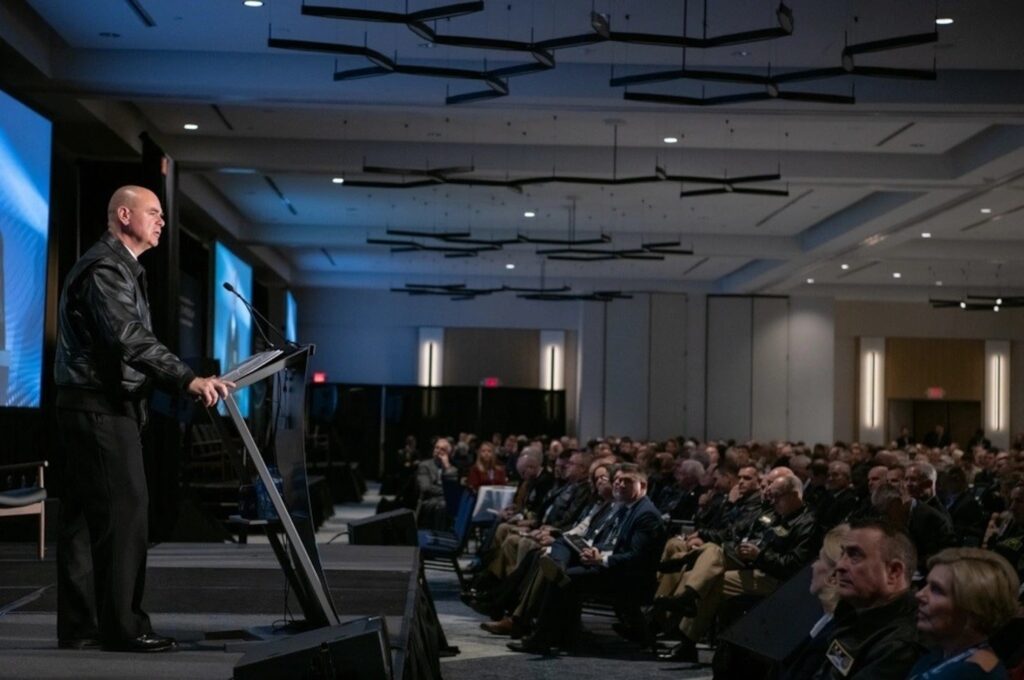
ARLINGTON, Va. (Jan. 14, 2025) Vice Adm. Brendan McLane, commander, Naval Surface Forces, delivers a status of the force update at the Surface Navy Association’s (SNA) 37th National Symposium. The symposium brings together joint experts and decision-makers in the military, industry, and Congress to discuss how the Surface Force is a critical element of national defense and security. (U.S. Navy photo by Mass Communication Specialist 1st Class Claire M. Alfaro) Surface Navy Association National Symposium, Jan. 14, 2025
Status of the Surface Force Address as delivered by Vice Admiral Brendan McLane:
I am very thankful and grateful to you the Surface Navy Association for all of the hard work that goes into making this phenomenal symposium a success. Every year, I walk away from this week in January thinking that the event could not have been better, and every year it just keeps getting better. This is a credit to the entire SNA staff. Thanks to Admiral Hunt, Admiral Dave Hart, Captain Chris Bushnell, Julie Howard, Debbie Gary, and the entire SNA team for all the effort, planning, time, and energy it takes to put on such a fantastic event. Please join me thanking them.
Before I get started, I also want to thank Bryan McGrath…he has been our strategic advisor, he’s been our corporate memory, if you think back how long that has been, and he’s been my personal executive coach on the staff. I am very, very grateful to everything Bryan has done for SURFOR. He has been our center of gravity in the update to our strategy that I’ll be talking to you about today. This is going to be his last SNA as part of the SURFPAC team, and I’m really gonna miss him. Please give him a big round of applause!
It does my heart good to look out into the audience and see so many uniforms. There is no better opportunity for conversation and exchange between industry and the fleet than SNA. I encourage all of you to, just like Admiral Hunt said, hit the booths, ask questions, talk to each other, gain more understanding by doing so. As an example, last year, I talked to Paul Smith, and he recommended I include industry in my weekly maintenance meetings. It’s like a 90-minute meeting on Wednesday afternoon where we go through every maintenance availability that’s going on West Coast, Hawaii, and Japan. My staff howled at this, and it took a bit to work out the legalities and logistics but we’re doing exactly that, what Paul Smith suggested. I have to say the frequent interaction of industry to get that perspective is refreshing and good for team building. At the end of the day, we all want the same thing: maintenance finished on time and a more ready Surface Force. Thank you very much to Paul Smith.
I’m particularly excited to see so many Sailors from the fleet here, something we began intentionally encouraging several years ago, and now has become standard. I am excited to meet you and hear from you this week.
In 1775, 250 years ago, the Second Continental Congress established what is now the United States Navy with “a swift vessel, to carry ten carriage guns, and a proportionable number of swivels, with eighty men, be fitted, with all possible dispatch, for a cruise of three months…” With this declaration, the Congress established the Navy with which we gained our independence. Now some of you within industry might argue that they weren’t really good at defining requirements! You might say that nothing has changed since then. Since then, our mission has certainly expanded and evolved significantly. But at the core, our mission and our spirit are the same, and at the heart of our warfighting spirit is the Surface Warfare Enterprise. So, it’s fitting that we kick off the 250th year here at SNA, and this year’s theme, Sharpen the Sword, challenges us to celebrate the momentous occasion by energizing ourselves like never before to be prepared to fight and win at sea.
CNO, in her NAVPLAN, charged us to ensure that 80% of our Force is Combat Surge Ready by 2027. Combat Surge Ready is defined as a ship that’s complete with Surface Warfare Advanced Tactical Training, or “SWATT,” and is ready to go. We have two years to achieve and sustain this into the future. Our 250 years of naval experience have passed on to us a treasure of massive accomplishments both to reassure us of what’s possible and to inspire us to achieve even greater goals.
Thanks to the vision of Roy Kitchener, we are already well on our way to increasing readiness. When he released our Competitive Edge strategy, he set our North Star to 75 Mission Capable ships. We have learned much in the pursuit of that for the last 3 years. We’ve learned a lot from the last year in the Red Sea, and from recent years of fleet experiments with directed energy weapons and with unmanned surface vessels, and from our recent study of amphibious ship maintenance. All of this rapid learning has been applied to our update of the Competitive Edge strategy. Thanks to the hard work and collaboration with our Flags, retired and active, especially NAVSEA, SURFLANT, N96, and SWMDC, we have revised our roadmap to achieve and sustain 80% of our warships in a combat surge ready state by 2027.
You will see our Competitive Edge 2.0, copies on the floor there, maintain the original framework and its five Lines of Effort, the identification of accountable officers, and the assignment of completion dates. Like any organization competing at the highest level, we update our strategy with the times and as we learn. This strategy provides the demand signal to our enterprise to think and act differently, taking advantage of our opportunities, and accelerating our quest for a more ready Surface Force.
So before we dive headlong into those important matters, I want to play a short video, a video appropriate to kick off 2025, the 250th Anniversary of our Warfighting Navy!
Our Sailors are the key to our warfighting advantage—our competitive edge. One of the shortcomings of the original Competitive Edge strategy was its insufficient emphasis on our Sailors, we are turning this around by concentrating on them as our key to sustained success at sea. Starting with Enlisted Leadership Development, we are moving out with a cultural renovation that produces a Surface Force with leaders who can assess, problem solve, innovate, and execute better than any strategic competitor. We’ve achieved much here already with Warrior Toughness and Get Real, Get Better and that fires me up for the work ahead.
One of our continued Get Real, Get Better moments is the 8,179 apprentice gaps that we have in our Surface Force. While we as a whole Navy have improved manning by making our recruiting mission in 2024, and a big thanks here to Navy Recruiting and the Fleet’s Every Sailor is A Recruiter program. It’s going to take more years of this to fill all of our gaps at sea, especially gaps with Chief Petty Officers. What we’re going to do is maximize the most of what we have is twofold. First, we get to peak personnel on a ship earlier because the bulk of our training comes through learning as teams during Basic, Advanced, and Integrated Phase events. So rather than wait to plus up manning before deployment, we will mass force at the beginning of Basic Phase.
The second way we’re getting after our gaps at sea is with our Reserve Component to Sea Initiative, RC2SEA. This is our only way to bring in Sailors laterally. Yes, it takes on average 10 years to make a Chief! Unless, you bring one in from the Reserves. Thanks to my Deputy, Admiral Ted LeClair, who has energized RC2SEA by aligning volunteer Reserve Sailors to empty billets on surface ships. In FY24, 167 Reserve Sailors force-wide have filled long term orders on ships. More work to do in 2027 and beyond. Both of these efforts are big parts of our Competitive Edge 2.0 First Line if Effort strategy: develop the leader, warrior, mariner, and manager.
To make better managers, we are operationalizing our Get Real, Get Better mindset, skillsets, and toolsets in our Wardrooms, Chief’s Messes, and into our work centers to methodically improve our standards with a bias for root cause analysis and transparency.
To make better warriors, SMWDC is refining our Surface Warfare Combat Training Continuum, or SWCTC. Think of what we’ve done for Mariner skills and apply that to warfighting. We are creating warfighting training paths that span the professional life of every tactical watch-stander from E1 to O6. This provides the ability to allow data-driven career insights to predict key insertion points for refresher training and updates.
To make better leaders, we are starting a new Command Master Chief coaching program, running a Chief Petty Officer Academy pilot program, and we have begun developing advanced engineering instructors—think Engineering WTIs—our first 8 AEIs graduated last month. I want to personally thank Force Master Chief Larry Lynch for spearheading these efforts and his continued leadership of our Force.
Retaining our talent is key to our readiness. PERS-4, led by Admiral Jeff Heames, are conducting data-informed engagements with every ship’s triad. We started doing this in the Wardrooms to get after more department heads. What Jeff is doing now is providing a “punch list,” by name, of Sailors our triads can engage with a pathway for a direct Detailer access which speeds up getting to ‘yes’ to stay Navy. Retaining talented SWO JOs is just as important. Officers like those on the screen – LT Scott Harris (ASWO and WTI) and LTJG Colton Grossheim (Single Longer Tour and COMMO) are signing their Department Head Retention Bonuses in the CO’s Cabin of USS O’Kane with proud Strike Group Commander Adan Cruz looking on.
Those two Divos plus 273 more signed up for Department Head in 2024, representing a 98% increase over 2022. Please join me in applauding the efforts of our Chief of Navy Personnel Admiral Cheeseman, Admiral Heames, and Captain Francis and his PERS-41 Team to really improve things.
As we get after our personnel gaps, I couldn’t be prouder of how the Sailors that we do have on board, are accomplishing the mission.
On the morning of 11 November 2024, Commander Matt Adams, Captain of USS Spruance—you saw him and his team in the video. Matt and his ship were transiting south through the strait of Bab-el-Mandeb. His team defended against one of the most complex attacks on Navy warships in decades. Matt and his team successfully engaged 3x ASBMs that were shot at a depressed trajectory, 3x ASCMs, and 7x one-way attack UAVs. Matt had prepared his team through endless drills to act decisively in the moment, just like Paul Rinn described.
Something that I think that gets lost in after action reports, news stories, and post-deployment briefs is the whole ship effort required in combat. On Spruance, it wasn’t just the Sailors on the controlling stations on the Bridge and in CIC. Supply was on hand bringing everyone food on station. The Chaplain was roving, offering spiritual strength. Sailors literally did not want to turn over the watch, because they wanted to be in the seat to defend the ship. Even once off watch, they would come back to check on the next section. Truly a whole ship effort, everyone involved in the fight from the bottom of their hearts.
And Spruance wasn’t content to just stop there. Their motto of “Launch the Attack,” commits them to an excellence built on the solid foundation of constant improvement. That’s why every tactician in the fleet can read their war diary on SMWDC’s Collaboration at Sea site. Now every warship can learn and improve their own combat effectiveness from Spruance’s experience.
This is what you can expect from a warship literally stacked with WTIs, to include the CO and the XO. Because this is the winning readiness model: the right leadership, stellar tacticians, and a warship built and sustained to fight and win at sea. This is our Sailors embodying the centuries-old legacy of Navy wins. This is sharpening the sword in action. And our sharp swords become our legacy.
We’ve had 26 ships so far operate in the Red Sea Weapons Engagement Zone, and thanks to the efforts of many in this room, we’ve rapidly learned a tremendous amount, allowing us to better prepare the next deploying warships like the ones in NIMITZ CSG starting C2X next week. Last year, I told you the story of USS Carney. What it took our enterprise to bring her back from Rota, modernize her in Mayport, and prepare for employment in the Basic, Advanced, and Integrated Training Phases. And how on deployment not a minute was ever wasted, training and self-assessment continued everyday. CNY returned home safely this past Spring and all told, after a 235-day deployment, the ship was in 55 engagements and fired 71 missiles. The CO, Jeremy Robertson is now at SMWDC and working on SWATTs to advance our competitive edge of tactical development. He is truly investing his battle experience into our Sailors and Warships.
The fight in the Red Sea has tactically evolved. The first phase from the early outset of hostilities in October ’23, saw largely inexpensive drones and cruise missiles shot at irregular intervals. Beginning in late Jan ’24, we observed a marked escalation in the scale and complexity of enemy techniques and capabilities, with the employment of anti-ship ballistic missiles, and roving, one-way UAVs in pre-assigned kill boxes. We’ve sped-up our own learning and teaching so that our deploying ships are always prepared with the latest TTPs before they go over the horizon.
All of this is possible because SMWDC and our industry partners created a robust operational feedback loop. This used to require a ship to be pierside, physically removing the tapes and shipping them to Dahlgren. Now, after a battle, a warship sends off a large data package containing their detect to engage sequence over-the-air. This rapid data transfer is followed by expedient analysis at NSWC, Dahlgren, which is now running 24/7. Within 48 hours, they provide our Warfighters with rapid feedback on their engagement and actionable information for the whole Force on how to best counter the tactics and threats that we’re having. This rapid learning is reinforced and spread by leaders like CDR Robertson, who incorporate it into tactical education for our warships during SWATT and C2X. Our ships practice scenarios involving threat-profiles and kinematics informed by the latest real-world action. This operational, fully informed feedback loop continues to drive our competitive edge beyond the exercises, all the way into our schoolhouses at Surface Combat Systems Training Command and Surface Warfare Schools Command.
I’d like to spend a moment with you on what is often referred to as the “cost curve,” or the relationship between the cost of the weapons the Houthis are firing and the cost of the missiles we are intercepting them with. There are several points worth making here.
First, none of our Commanding Officers are worried about the cost curve, nor should they be. They have other things to worry about, like what’s for breakfast. The cost of the missile that they are going to shoot is not one of them.
Second, increasingly, more modest threats are being engaged with guns and electronic countermeasures and aircraft, both fixed wing and rotary. Proper threat assessment and operational feedback allow our Commanders to make the best tactical decisions. As an example of engaging with guns, take USS O’Kane for instance. O’Kane protected a merchant convoy against hostile UAVs and employed their 5-inch gun to successfully defeat the threat. This is their fo’c’sle on the morning after. I love this story because it was a whole ship effort. Off watch personnel, including 4 cross-trained Sonar Technicians and 3 junior Machinist Mates who happened to be lifting weights in Forward Pallet staging when shooting began, took the initiative and worked the early hours of the morning moving 5-inch shells from Deep Mag to refill the loader-drum. Volunteers pitching in on a working party led by a junior GM2 kept O’Kane seamlessly in the fight. Those are America’s Warfighting Sailors.
Also on the topic of the cost curve, in collaboration with our teammates at Integrated Warfare Systems and the Rapid Capabilities Office, our destroyers have tested several new C-UAS systems, each bringing unique tactical capabilities to the fight. Through an accelerated capability introduction process, to include onboard testing and training alongside development of enhanced tactics, techniques and procedures, I expect several of these systems to be deployed soon. As technical maturity increases, I’m confident we’ll have even more cost-effective systems available in the counter unmanned systems fight across the entire force.
I stood here last year and said that I was not satisfied with our progress on directed energy. And after a year of repairs, fleet experiments, site visits, and lots of learning, I am still dissatisfied. I want to instill a greater sense of urgency and I intend to continue to advocate strongly for the resources necessary to overcome some of these hard, technical challenges like atmospheric turbulence, track targeting, clutter conditions, saturation attacks, and beam control. All of which Preble, here in the picture you can see her HELIOS. Lasers like this, high powered microwaves are the way of the future because they will augment a ship defense with an unlimited magazine.
One lesson we’ve learned here is that we need to remove the burden that at-sea testing on our operational warships. Perhaps this is counter-intuitive but, we can move faster in fleet introduction with land-based testing. High-Powered Microwave is showing promise in development at Dahlgren, where we can test without synchronizing a ship’s schedule. Containerized launchers and virtualized combat systems also enable rapid testing with minimal impact to operational warships. To this end, I would like to see dedicated investment in more land-based testing infrastructure. This would allow system maturation and would absorb the lion’s share of development prior to at-sea testing requirements.
Equally as important as the Red Sea, our Sailors are standing the watch in the eastern Mediterranean ready to defend Israel against ballistic missile threat. First in April, Carney and Arleigh Burke combined to destroy more than 80 one-way attack UAVs and at least six ballistic missiles, which include the first employment of the SM-3 in combat. Then in October, Bulkeley and Cole fired interceptors against a barrage of more than 200 Iranian ballistic missiles. This is a mission that the Navy has been rehearsing for over a decade. When I think of how many crews and how many ships it has taken to be prepared for that moment—literally hitting a bullet with a bullet—I realize that even though probably to everybody here it has become a routine thing, it is no less impressive. I’m proud that all that hard work by so many ships and crews and how it paid off when the moment came.
When not in combat, our Surface Warriors are leading the way in safety of life at sea and humanitarian assistance. In August, William P Lawrence DDG 110, headed directly into the path of Hurricane Gilma in order to save a mother and her 7 year-old daughter adrift in a sailboat 925 miles off the coast of Hawaii. The sailing vessel’s master, who was the only one aboard who knew how to sail, had passed away in an accident. The Coast Guard had received a distress alert from the boat’s emergency position beacon and asked the Navy to help. Willy P was ready to go and raced for 36 hours at 24kts directly towards the hurricane to close the speed of the sailboat. When they got there, the seas were already up to 8 to 10 ft, the ship could see that the hurricane was not far off. They courageously launched their RHIB and thanks to the great proficiency of the Coxswain, Seaman Michael Hunter, whom you can almost see in this picture, they saved both on board plus their cat and turtle[BM1] . They had only a short window before the seas and the hurricane would swallow them up, so I applaud the great engineers on William P Lawrence, answering all bells to make best speed back to the safe harbor of Hawaii. Thanks to the quick action of those courageous Sailors, two people were saved…and their pets, too.
One story that did not get the attention it deserved in ’24 was our Naval Beach Group One Sailors in the Gaza Relief Mission, Operation Neptune Solace. They employed the Joint Logistics Over-The-Shore capability—think floating pier, to flow humanitarian aid to Gaza. Heavy weather presented many challenges, and the pier was repaired and redeployed multiple times. Our Sailors delivered 28,884,843 pounds of food and aid. This was the second largest humanitarian mission conducted by the US military, exceeded only by the Berlin Airlift in 1948. This was a truly remarkable accomplishment!
On the other side of the globe, USS Boxer with embarked Marines from the 15th Marine Expeditionary Unit provided tons of American aid to the Northern Philippines. With their MV-22 Ospreys, they helped access Basco, an island on the north side of the Luzon Strait that had been ravaged by a typhoon. These stories highlight the exceptional work our Sailors and Marines are accomplishing and are truly illustrative of the world-wide coverage of our warfighting team.
In support of these efforts, we’ve had considerable success from the ADCON side of the Surface Warfare Enterprise. Our goal is clear- generate the warships, crews, concepts, and capabilities to fight and win at sea. Admiral Downey and I are committed to significantly reducing the Days of Maintenance Delay across the force. Considerable learning, discipline, and partnership with industry have already contributed to raising maintenance on-time completion rates to 65% in FY24. This has reduced days of maintenance delay down to 2,633 days. This is a 62% drop since 2019! Significant and impressive but we still have lots of work to do to drive it down to zero by 2027.
Especially with Amphibious Warship maintenance availabilities. Since 2018, of the 25 Amphibious Ready Groups/Marine Expeditionary Units who deployed, 38% were delayed due to amphib maintenance availabilities not finishing on time. Those availability delays resulted in the loss of 400 operational days at sea.
In response to this, I launched a 90-day amphibious maintenance review with Vice Admiral Jim Downey last Spring. The learning from this process has been significant and we are executing the recommendations which include the designation of Signature Availabilities for Big Decks that will accelerate our planning and contract award milestones, which will improve procurement timelines, strengthen partnerships throughout the enterprise, and lead to workload stability for our industrial base. Initiatives like that reinforce efforts codified in our Competitive Edge strategy second LOE, Produce More Ready Ships.
Also, on the material front of Competitive Edge’s LOE 2 are more data-driven initiatives to improve our readiness. NAVSUP has been laser focused on shifting our logistics approach from “just in time” to “just in case.” This “just in case” approach is not a luxury, it’s about having the parts onboard we know we will need to maintain full redundancy for sustained operations at sea; as well as the parts critical to self-sustain in a fight to overcome battle damage. NAVSUP has invested $1.4B in surface material and removed COSAL modeling constraints. This is paving the way for targeted investments in critical system materials, making sure we can get more ready players on the field and sustain them over the horizon. Ships combat surge ready works best when it’s at full redundancy.
One capability that we have significantly advanced in our 3rd LOE of our strategy is the integration of unmanned vessels into the fleet. Bill Daly will spend a good bit of time on this in his speech later, but as far as Type Commander concerns go, I am very optimistic that the things we’ve already started have put us on an excellent position to integrate this incredible capability rapidly into the fleet. Standing up USVRON-3 out of hide last May was a big win for us. You’d think the automation would be the hardest part–and that’s hard, no doubt, but launching USVs from an Independence Class Mission Bay isn’t exactly easy either, especially the first time you try it. BZ to USS Manchester and USS Comstock for being the first ships to experiment with this.
Over the past year alone, Fleet Operators have worked hand-in-hand with the Program Office, Warfare Centers, and Industry partners conducting rapid testing and experimentation as we drive to develop and operationalize Surface Force Robotics Autonomous Systems. Sailors participated in War Games, conducted on-the-water testing, and incorporated USVs into experiments.
Through the work of our exceptional Sailors, our future force is coming into greater focus and clarity. Hybrid and autonomous, coupled with some of the most advanced combat systems in the history of warfare, championed by America’s Warfighting Sailors, Surface Warfare provides the competitive edge needed to deliver warfighting advantage whenever and wherever needed. Look no further than some of our advances with DDG FLT IIIs joining the Fleet with SPY-6, SEWIP BLK III, and AEGIS Baseline 10. As you can see USS Chosin here successfully testing our new transferable re-load at sea method.
250 years of our Navy is a major milestone and like many waypoints that mark our history, they occur at a moment of change, conflict, and crisis. These waypoints reassure us that we’ve navigated shoal water in the past but also warm us up for the hard work ahead, hard work that demands we leverage our enterprise fully, generating combat ready warships who will lead in the future fight. There is no substitute for combat effectiveness on the first day of combat or the thousandth day.
An effective force is a ready force, predicated on full redundancy, self-sufficiency, and brilliant execution of our tactics. We must carry forward the spirit of 250 years of rich naval legacy. Many things have changed since the early days of our Nation but the centrality of the maritime domain in the American and Global conscious remains. Protecting our sea lanes globally remains a ubiquitous and enduring challenge. The sun never sets on our Force. Our readiness is the firmament that will enable our Surface Force to fight and win at sea. Competitive Edge 2.0 is how we will be more ready. Let’s all re-commit to sharpening our swords for the next 250 years.
Thank you for your time this afternoon and I look forward to hearing your questions.