Enabling Off-the-Shelf Autonomous Naval Warfare 

Enabling Off-the-Shelf Autonomous Naval Warfare (1)

How an autonomous fleet of small, uncrewed platforms can extend maritime reach 

From Northrop Grumman 

The nature of naval warfare is often unpredictable. As near-peer adversaries work to rapidly increase their total number of vessels, uncrewed systems will play an important role in enabling the U.S. Navy to continue to project power and ensure sailors are able to execute missions. 

Northrop Grumman is a proven technology leader with large uncrewed autonomous systems (UAS). The company has now developed two mission-focused autonomous capabilities on the smaller UAS, called Helix and Scion, that will rapidly transform existing commercial uncrewed platforms into resilient and survivable combat and surveillance systems. Executing real-world mission scenarios at the Naval Surface Warfare Center Silent Swarm 2024 exercise, these autonomous technologies demonstrated Northrop Grumman’s readiness to fill existing maritime domain awareness gaps and securely find, fix and track elements in maritime operations. 

Northrop Grumman’s platform-agnostic payload, consisting of an electronic warfare transceiver, a mission integration system and swarming software, loaded onto an uncrewed surface vehicle. (Photo Credit: Northrop Grumman) 

The Navy is actively exploring emerging technologies that enable uncrewed aerial vehicles (UAVs) and uncrewed surface vehicles (USVs) to extend the range of its communications and electronic warfare (EW) capabilities. Northrop Grumman’s Scion – a multifunction EW payload – was created and tailored specifically to the needs of surface operations and can connect to commercially available USV platforms using a common interface. Helix combines an array of uncrewed platforms, payloads and software, allowing for autonomous, multi-domain and multi-modal operations. Its ecosystem is further complemented by digital twin solutions, providing operators with a three-dimensional, dynamic view of the battlespace in a virtual environment. 

“We developed an initial proof of concept for Scion’s capabilities for the Navy in 2023,” said Matt O’Driscoll, chief engineer for Scion, Northrop Grumman. “Building on last year’s successful demonstration, we added five uncrewed systems in the air and two on the surface for this year’s Silent Swarm exercise and all of the systems worked collaboratively and autonomously to find target vessels.” 

At Silent Swarm 2024, sophisticated EW and autonomy payloads were deployed on a distributed team of uncrewed autonomous vehicles, providing data to the command and control software and an advanced situational awareness tool, as seen above. (Credit: Northrop Grumman) 

The concept of operations Northrop Grumman demonstrated included a USV equipped with the Scion EW payload, which collaborated with UAVs launched and controlled by Helix to find, fix, track and target vessels. Helix provided the autonomy engine for intelligent collaborative uncrewed systems and gave operators a near-real-time, multi-layered view of the mission landscape. Through this exercise, Scion enriched Helix’s ecosystem of uncrewed mission solutions. 

“At Silent Swarm, we showcased the combination of the Helix software and the Scion payload as an EW system capable of finding and locating radio frequency emissions over the water,” said Tyler Dillstrom, chief engineer for Helix, Northrop Grumman. “Our autonomy software in control of the USVs used those detections to correlate, identify and track targets from the air and on the surface.”    

Future mission success in the maritime domain will depend on the ability to command and control diverse fleets of uncrewed vehicles with a wide range of payloads. Northrop Grumman’s efforts at Silent Swarm demonstrate the company’s commitment to model-based digital engineering and our ability to deploy solutions more quickly and affordably. With digital capabilities, Northrop Grumman can simulate scenarios in a digital environment before fielding a system. This contributes to future program affordability and confidence in first-time quality. It also showcases Northrop Grumman’s legacy of trusted autonomous solutions in all domains. 

There will be many approaches to ensuring the United States and its allies increase in capacity and capability. Intelligent autonomous platforms will prove to be force multipliers in naval warfare, extending the warfighter’s reach and freeing up valuable resources for other critical missions. 


Theodore Roosevelt Carrier Strike Group Returns to San Diego After 9-month Deployment 

16 October 2024 

From Courtesy Story 

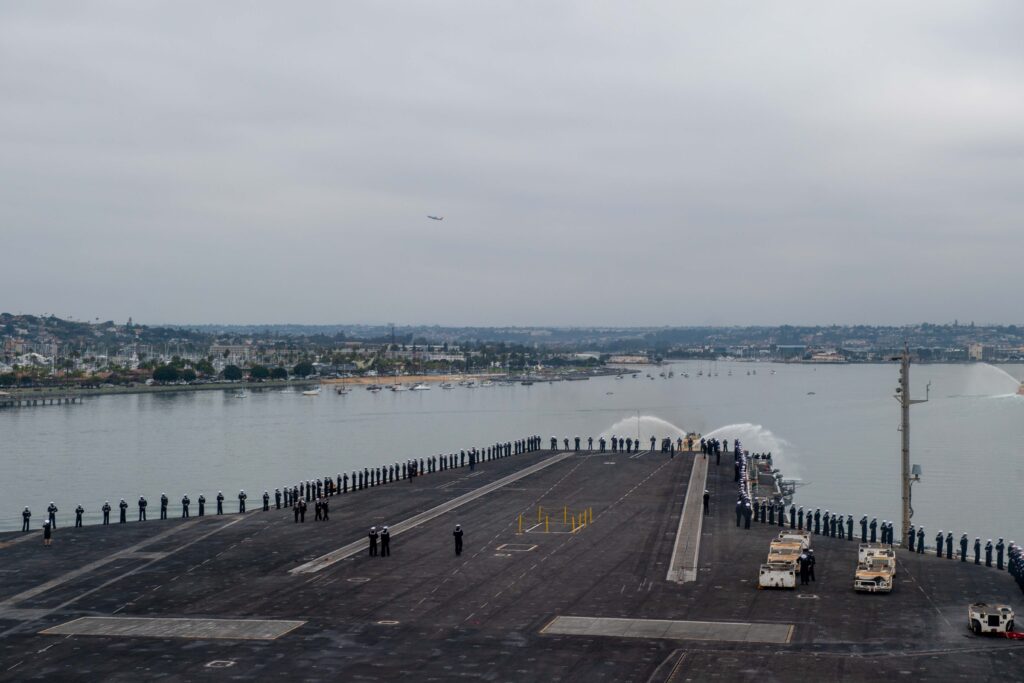
SAN DIEGO – The Nimitz-class aircraft carrier USS Theodore Roosevelt (CVN 71), the flagship of the Theodore Roosevelt Carrier Strike Group (TRCSG) returned to its homeport of San Diego Oct. 15 after conducting operations in the U.S. 3rd, 5th and 7th Fleet areas of operation as part of a routine deployment in support of global maritime security operations. 

TRCSG is a multiplatform team of ships, aircraft, and more than 6,000 Sailors, capable of carrying out a wide variety of missions around the globe. Deploying units of the strike group include Theodore Roosevelt, Destroyer Squadron (DESRON) 23, Carrier Air Wing (CVW) 11, and the Ticonderoga-class guided-missile cruiser USS Lake Erie (CG 70). While the Arleigh Burke-class guided-missile destroyers USS Russell (DDG 59), USS Halsey (DDG 97) and USS Daniel Inouye (DDG 118) also returned to their respective home ports, Lake Erie and Arleigh Burke-class guided-missile destroyer USS John S. McCain (DDG 56) remain deployed in the 7th Fleet area of operations supporting global maritime security operations. 

 
TRCSG deployed to the Indo-Pacific region to support regional security and stability, keep sea lanes open, and to reassure our allies and partners of the U.S. Navy’s unwavering commitment to the region. The strike group was later ordered to the U.S. Central Command area of responsibility to strengthen U.S. military force posture and capabilities throughout the Middle East in light of escalating regional tensions. 
 
“The strike group’s ability to quickly adjust from operations in 7th Fleet to 5th Fleet is a testament to both the flexibility of our naval forces as well as the strength and training of our Navy Sailors,” said Commander, Carrier Strike Group 9, Rear Adm. Christopher Alexander. “We had the distinct honor to strengthen our skills and relationships with 10 allied and partner nations, demonstrating our nation’s commitment to the freedom of navigation.” 
 
The TRCSG strengthened interoperability through dual carrier operations with the Carl Vinson Carrier Strike Group and Abraham Lincoln Carrier Strike Group, participation in exercise Valiant Shield 2024, and numerous bilateral and multilateral maritime exercises in the Philippine and South China seas as well as in the U.S. Central Command area of responsibility. 
 
Notable key leader engagements and visits aboard Theodore Roosevelt included the president of the Republic of Korea, chief of naval operations for the Republic of Korea Navy, lieutenant governor of Guam, U.S. Pacific Fleet commander, U.S. 7th Fleet commander, Republic of Singapore Navy fleet commander, U.S. ambassadors to the Republic of Korea, Singapore, Thailand and Qatar, and senior officers from the armed forces of the Japan Maritime Self-Defense Force, Republic of Korea and Royal Thai Navy, among others. 
 
The deployed Sailors from the TRCSG demonstrated their proficiency in enhanced maritime security operations through more than 9,000 sorties including 21,000 flight hours, 28 replenishments-at-sea, and more than 71,000 nautical miles traveled. 
 
Ships of the TRCSG conducted routine port visits to Bahrain, Diego Garcia, Guam, the Republic of Korea, Singapore and Thailand. 
 
“The crew worked incredibly hard and maintained mission focus this entire deployment,” said Capt. Brian Schrum, commanding officer, Theodore Roosevelt. “I am extremely proud of our Sailors and the work accomplished across the world’s oceans to keep our nation safe at home.” 
 
CVW 11 consisted of nine squadrons: the “Blue Blasters” of Strike Fighter Squadron (VFA) 34, the “Fist of the Fleet” of VFA-25, the “Flying Checkmates” of VFA-211, the “Black Knights” of VFA-154, the “Liberty Bells” of Airborne Command and Control Squadron (VAW) 115, the “Rooks” of Electronic Attack Squadron (VAQ) 137, the “Wolf Pack” of Helicopter Maritime Strike Squadron (HSM) 75, the “Eightballers” of Helicopter Sea Combat Squadron (HSC) 8 and the “Rawhides” of Fleet Logistics Support Squadron (VRC) 40. 
 
As an integral part of U.S. Pacific Fleet, Commander, U.S. 3rd Fleet operates naval forces in the Indo-Pacific and provides the realistic and relevant training necessary to execute the U.S. Navy’s timeless role across the full spectrum of military operations—from combat missions to humanitarian assistance and disaster relief. U.S. 3rd Fleet works in close coordination with other numbered fleets to provide commanders with capable, ready forces to deploy forward and win in day-to-day competition, in crisis, and in conflict. 
 
For more information about Carrier Strike Group 9 and USS Theodore Roosevelt visit https://www.surfpac.navy.mil/ccsg9/ and https://www.dvidshub.net/unit/COMCARSTRKGRU-9; Facebook: www.facebook.com/usstheodoreroosevelt 


USS Russell Returns Home to San Diego 

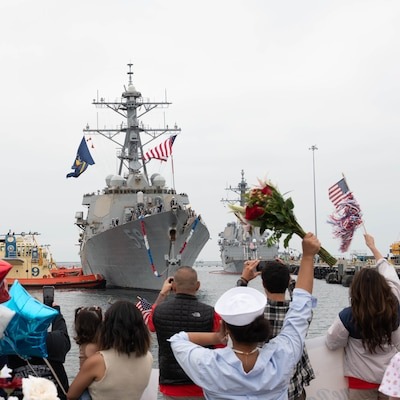
USS Russell (DDG 59) returns to homeport after an eight-month deployment Naval Base San Diego, Oct. 15, 2024. (MC2 Maria G. Llanos) 

16 October 2024 

From Courtesy Story 

SAN DIEGO – The Arleigh Burke-class guided-missile destroyer USS Russell (DDG 59) returned to Naval Base San Diego Oct. 15, following an eight-month deployment with the Theodore Roosevelt Carrier Strike Group (TRCSG) to the U.S. 3rd, 5th, and 7th Fleet areas of operation. 

Russell and its crew, known as the Red Dragons, departed San Diego Feb. 10, 2024, and joined TRCSG to conduct global maritime security operations supporting regional stability. 

“Our Red Dragon team performed superbly on deployment. No matter the challenge, our Sailors rose to the occasion and represented our ship, Navy, and country with honor,” said Cmdr. Mike McInerney, commanding officer of Russell. “Keeping Russell in its highest state of readiness for eight months straight is no easy feat, yet our crew of 300 did this with a self-sufficient mindset, grit, and determination. We have a proud, combat ready, and battle-minded crew. I’m honored to be part of this fantastic team, and the crew is excited for some well-earned time off with loved ones.” 
 
While deployed, Russell provided primary ballistic missile defense support and secondary air and missile defense support to the Nimitz-class aircraft carrier USS Theodore Roosevelt (CVN 71). Additionally, Russell executed 161 MH-60 Seahawk helicopter deck hits, to include refueling and personnel and parts transfers, from Helicopter Maritime Strike Squadron (HSM) 75 and Helicopter Sea Combat Squadron (HSC) 8. 
 
During port visits, the Red Dragons made a point to volunteer their time through community outreach events. While in Singapore, Sailors performed maintenance and cleaning at the Teen Challenge therapeutic center. In Thailand, they volunteered their time at the Father Ray Foundation for underprivileged children. Community outreach events give Sailors a chance to make a positive impact and diversify their cultural knowledge by developing relationships with partner and ally nations. 
 
“It was really cool to be of service to the Father Ray Foundation in Thailand,” said Personnel Specialist 1st Class Chilee Osuji. “It felt rewarding to provide services to those in need, meet the local people and play soccer with the kids! I’m grateful I had the opportunity to expand my worldview in this way.” 
 
Russell also conducted various exercises with partner navies, strengthening important relationships with allies and partners. Russell participated in a trilateral exercise in April with TRCSG, the Japan Maritime Self-Defense Force and the Republic of Korea Navy. In September, Russell conducted a bilateral exercise with the Italian Navy, increasing interoperability between the two countries’ navies. 
 
Maintaining crew proficiency was important for the Red Dragons to sustain readiness while underway. Russell’s training schedule included over 150 casualty response drills, integrating tactical and technical scenarios to include anti-air warfare, anti-surface warfare, anti-submarine warfare, electronic warfare, engineering, damage control and seamanship. 
 
The Theodore Roosevelt Carrier Strike Group is comprised of Carrier Strike Group 9 staff, Destroyer Squadron (DESRON) 23 staff, the flagship Nimitz-class aircraft carrier USS Theodore Roosevelt (CVN 71), with embarked Carrier Air Wing (CVW) 11, and DESRON 23 ships that include guided-missile destroyers USS Daniel Inouye (DDG 118), USS Halsey (DDG 97), USS John S. McCain (DDG 56) and USS Russell (DDG 59). 
 
An integral part of U.S. Pacific Fleet, U.S. 3rd Fleet operates naval forces in the Indo-Pacific and provides the realistic, relevant training necessary to execute the U.S. Navy’s role across the full spectrum of military operations – from combat operations to humanitarian assistance and disaster relief. U.S. 3rd Fleet works together with our allies and partners to advance freedom of navigation, the rule of law, and other principles that underpin security for the Indo-Pacific region. 
 
For more information on Russell, please visit https://www.surfpac.navy.mil/ddg59/ and https://www.dvidshub.net/unit/USSR-DDG59. 


BAE Systems and Kongsberg Sign Teaming Agreement for New Platform Situational Awareness Tool 

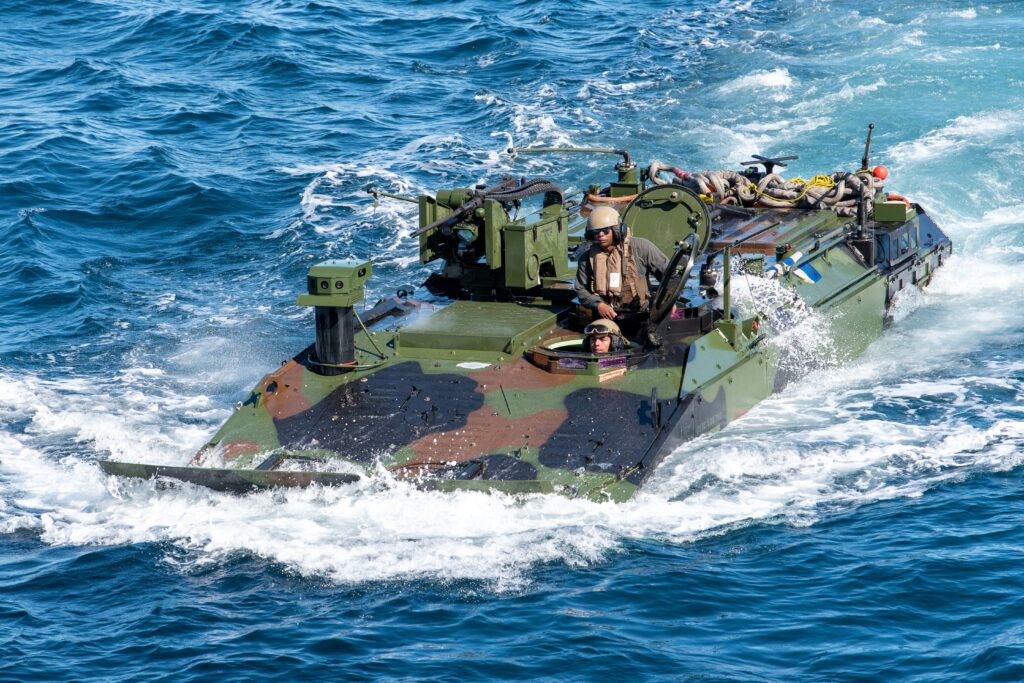
PACIFIC OCEAN (March 11, 2022) U.S. Marines assigned to the 3rd Assault Amphibian Battalion, 1st Marine Division conduct waterborne training with the Amphibious Combat Vehicle (ACV) from aboard the amphibious transport dock USS Anchorage (LPD 23 (U.S. Navy photo by MC2 Hector Carrera) 

The Integrated Combat Solution tool will give Warfighters the situational awareness they need for any mission, as well as options to respond to potential threats 

From BAE Systems 

WASHINGTON — October 16, 2024 — BAE Systems has entered into a teaming agreement with Kongsberg Defence and Aerospace to bring Integrated Combat Solution (ICS) to the U.S. defense market. The transformational battlefield situational awareness tool for combat vehicles will provide the Warfighter with the capability to link and share video streams, metadata, target information, slew-to-cue commands, and much more, reducing the typical threat response speed from minutes to seconds. Together, with Kongsberg developing the ICS tool and BAE Systems integrating it onto combat vehicles, the companies will support technology upgrades through the product lifecycles.  

“The ability for troops to rapidly pass targeting information across the battlefield to other platforms and engage a target remotely is critical to their mission,” Andy Corea, vice president and general manager of BAE Systems’ Combat Mission Systems business, said. “The combined talents of Kongsberg’s innovation and expertise in remote weapon systems and our lead systems integration capability provides the Warfighter the opportunity to obtain fully integrated enhanced combat capability – helping them stay aware and unmatched in battle.”  

ICS is a tool that can be used across the U.S. Marine or U.S. Army’s fleet of vehicles as a critical enabler of their mission. Built with an open-systems approach, ICS can be integrated on any battlefield platform equipped with a weapon system and on-board sensors – keeping troops aware and safer in the fight. ICS will give Warfighters more options to respond to potential threats, matching the rapid pace of warfare in the future. ICS uses an integrated network to link the sensors on different battlefield assets together, allowing command and control of weapon stations, turrets, jammers and other effectors from a single screen inside the vehicle. 

“Together we will deliver ICS as a core enabler of modern warfare, providing all-domain visibility, command and control,” said Kjetil Reiten Myhra, executive vice president defence systems, Kongsberg Defence and Aerospace. “This force multiplier streamlines complicated threat responses, networking mobility platforms and other assets for increased combat capability.” 

The ICS capability has already been demonstrated on the Amphibious Combat Vehicle (ACV) and Armored Multi-Purpose vehicle platforms, and the combined team of BAE Systems and Kongsberg looks forward to the opportunity to provide it across the ground combat forces. The ICS system is also featured at the BAE Systems booth (#6041) at AUSA this week on the Armored Multi-Purpose Vehicle (AMPV) platform, further demonstrating the team’s ability to integrate it on different combat vehicles. 


Navy Demonstrates First At-sea Reloading of Vertical Launching System 

From Thomas McMahon, Oct. 15, 2024 

SAN DIEGO—The U.S. Navy achieved a breakthrough in combat readiness today as it successfully demonstrated the Transferrable Reload At-sea Method (TRAM) on an underway warship in open ocean for the first time. 

Sailors aboard the Ticonderoga-class cruiser USS Chosin (CG 65) used the hydraulically-powered TRAM device to load an empty missile canister into the ship’s MK 41 vertical launching system (VLS) while off the coast of San Diego on Oct. 11. 
 
The successful demonstration marks a critical step in the capability to rearm warships at sea—a top priority outlined by Secretary of the Navy Carlos Del Toro. 
 
“Today, we proved just how game-changing TRAM truly is—and what a powerful deterrent it will be to our competitors,” said Del Toro, who witnessed the demonstration. “This demonstration marks a key milestone on the path to perfecting this capability and fielding it for sustained operations at sea.” 
 
“This was an outstanding effort by the sailors and civilians involved in demonstrating this game-changing capability for the Navy,” said Capt. James “Mike” Williams, commanding officer of Chosin. 
 
The groundbreaking at-sea test follows a successful land-based demonstration in July at Naval Surface Warfare Center, Port Hueneme Division (NSWC PHD) in California. 
 
Engineers at NSWC PHD developed the TRAM prototype as a way to rearm warships during the underway replenishment (UNREP) process—when a supply ship connects to a combatant at sea to transfer vital material such as fuel and food. 
 
“The combatant can stay near the fight to be rearmed, refueled and resupplied all at the same time,” said Rich Hadley, UNREP division manager at NSWC PHD. “As Capt. Arleigh Burke said, ‘All time spent in replenishing was time lost in combat.’ TRAM improves operational effectiveness by reducing the amount of time the warfighter must spend away from the fight replenishing.” 
 
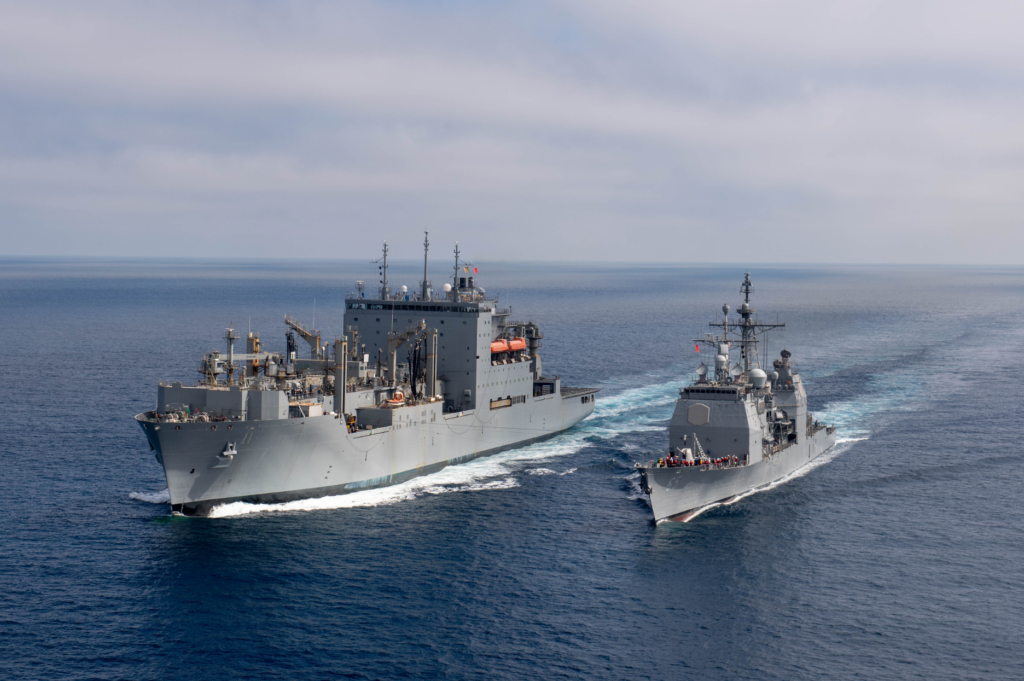
For the at-sea demonstration, Chosin connected to USNS Washington Chambers (T-AKE 11), a Military Sealift Command dry cargo and ammunition ship, which transferred the missile canister across cables to the cruiser. The sailors then used TRAM to move the missile canister along rails attached to the cruiser’s VLS modules, tilt it into a vertical position, and lower it into a VLS cell with TRAM’s built-in cable and pulley system. 
 
“Deploying TRAM into the Military Sealift Command logistics fleet,” said Tim Barnard, director of the NAVSEA technology office (05T), “would enable combatants to remain in theater while reloading their VLS missile launchers instead of having to travel long distances to a port, greatly expanding the volume and tempo of long-range fires—and the U.S. Navy’s advantage over adversaries.” 
 
MK 41 VLS provides rapid-fire missile launch capability for the U.S. Navy’s destroyers, cruisers and future Constellation-class frigates. 
 
Del Toro said the Navy is on track to begin fielding TRAM in two to three years. 


U.S. Marines Complete Typhoon Krathon Humanitarian Assistance Efforts 

From Marine Rotational Force – Southeast Asia 

MANILA, Philippines – U.S. Marines across multiple forward-deployed commands concluded six days of foreign disaster relief efforts in the Philippines Oct. 10, 2024, supporting the U.S. Agency for International Development’s humanitarian response to Typhoon Krathon (locally known as Julian) at the request of the Philippine government. 

Marines and Sailors from Marine Rotational Force – Southeast Asia (MRF-SEA); 1st Marine Aircraft Wing (I MAW); III Marine Expeditionary Force (III MEF); and the 15th Marine Expeditionary Unit (15th MEU) embarked aboard the amphibious assault ship USS Boxer (LHD 4) delivered nearly 96,000 pounds of foreign disaster relief supplies to Batan Island, a remote island in the Batanes Province and one of the locations most impacted by Krathon.  

Typhoon Krathon originated 155 miles southwest of Okinawa before moving northwest, reaching peak intensity Oct. 1, with sustained winds of 195 kph (120 mph). Krathon heavily battered the northern islands of the Philippines, leading to evacuations, infrastructure damage, and food supply insecurity in affected communities.  

At the request of the Government of the Republic of the Philippines, U.S. Secretary of Defense Lloyd Austin directed U.S. Indo-Pacific Command to support USAID’s relief efforts due to the unique capabilities and high state of readiness of forward-deployed U.S. Marine Corps forces.  

MRF-SEA first arrived in the Philippines in late September to participate in upcoming training exercises with the Armed Forces of the Philippines. Operating out of Fort Bonifacio, Philippines, MRF-SEA immediately began coordination with the U.S. Department of State, USAID, the AFP, and other U.S. Marine Corps units to plan support for the relief effort. Two teams of Marines and Sailors from MRF-SEA integrated with USAID and AFP personnel in Manila and Laoag to plan and prepare for the arrival of KC-130J Hercules aircraft from 1st MAW in Okinawa, Japan, and personnel from 3rd Marine Logistics Group. 

“Before Marine Corps aircraft ever touched down in the Philippines, Marines and Sailors with MRF-SEA were integrated with our partners in the U.S. and Philippine governments, on site at Villamor Air Base and Laoag International Airport, with the manpower and heavy equipment needed to package and move aid material,” said Col. Stuart Glenn, commanding officer, MRF-SEA. “Forward-deployed Marine Corps forces allow us to quickly respond to humanitarian missions because we’re already in the region. I am extremely proud that our team was able to set the necessary conditions to quickly provide relief to the Philippine people.” 

After arriving on Oct. 5, the cargo planes were loaded with supplies at Villamor Air Base and flown to Laoag International Airport in northern Luzon for staging and preparation to move the supplies to their final destination on Batan Island. The KC-130 crews conducted 26.2 hours of flight operations, successfully transported all aid materials to Laoag. 

As U.S. and Philippine personnel worked to move supplies north, the 15th MEU arrived aboard USS Boxer and began flight operations to support relief efforts on Oct. 8. MV-22B Ospreys, assigned to Marine Medium Tiltrotor Squadron (VMM) 165 (Reinforced), landed in Laoag, and combined teams from the 15th MEU, MRF-SEA, and Philippine Marines spent the next three days loading Ospreys, the Marine Corps’ medium-lift tiltrotor V/STOL platform, with disaster relief supplies for the final leg of the movement to the Basco Airport on Batan Island. Pilots and aircrews from VMM-165 (Rein.) conducted more than 55 flights and successfully delivered the final disaster relief material on Thursday, Oct. 10. 

“The primary focus of our mission is helping the people of the Philippines recover as quickly and safely as possible,” said Col. Sean Dynan, commanding officer, 15th MEU. “Humanitarian assistance in an expeditionary environment is what we train to do, and it is one of the reasons we are forward-deployed as an amphibious force.” 

The forward presence and ready posture of U.S. Marine forces in the Indo-Pacific region was pivotal to the rapid and effective response to Typhoon Krathon, demonstrating the U.S.’s commitment to its allies and partners during times of need. 


Airbus U.S. Space & Defense Completes First Aerial Logistics Connector Demo 

From Airbus, Oct. 14, 2024 

Airbus U.S. Space & Defense announced today that it recently completed its first program demonstration in support of the U.S. Marine Corps Aerial Logistics Connector contract at Marine Corps Air Station New River and Marine Corps Base Camp Lejeune. 

The demonstration evaluated the performance characteristics of the UH-72B Lakota platform, validated the aircraft’s ability to carry specialized cargo, showcasing Airbus’ approaches to meeting Marine Corps requirements for an Aerial Logistics Connector system to support expeditionary advanced base operations. 

“Integrating warfighter inputs early on in this phase of the contract helps ensure we’re hitting all the marks and gives us invaluable insights so we deliver the right capabilities to the U.S. Marine Corps,” said Rob Geckle, Jr., Chairman and CEO of Airbus U.S. Space and Defense.    

This event is part of the Aerial Logistics Connector Middle Tier of Acquisition (MTA) Rapid Prototyping Program, which aims to provide the service with aircraft prototypes to demonstrate capabilities to the warfighter through a series of operational demonstrations and experiments. Future demonstrations will provide further information about the aircraft’s capabilities and will focus on modifications necessary for the aircraft to meet Marine Corps requirements to operate autonomously and carry specialized payloads. These demonstrations will continue throughout the rest of 2024 and 2025 and will inform future acquisition decisions for the opportunity to build prototype aircraft. 

In May 2024, Naval Air Systems Command (NAVAIR) awarded Airbus U.S. Space & Defense a Phase I Other Transactional Authority Agreement, through Naval Aviation Systems Consortium, based on its unmanned UH-72 Logistics Connector concept, a variant of the proven UH-72 Lakota platform. 

The Aerial Logistics Connector effort is one of several efforts across the Department of Defense to deliver logistical support in distributed environments during peer or near peer conflicts. 


Fifth U.S. Navy DDG Homeport Shifts to Rota, Spain 

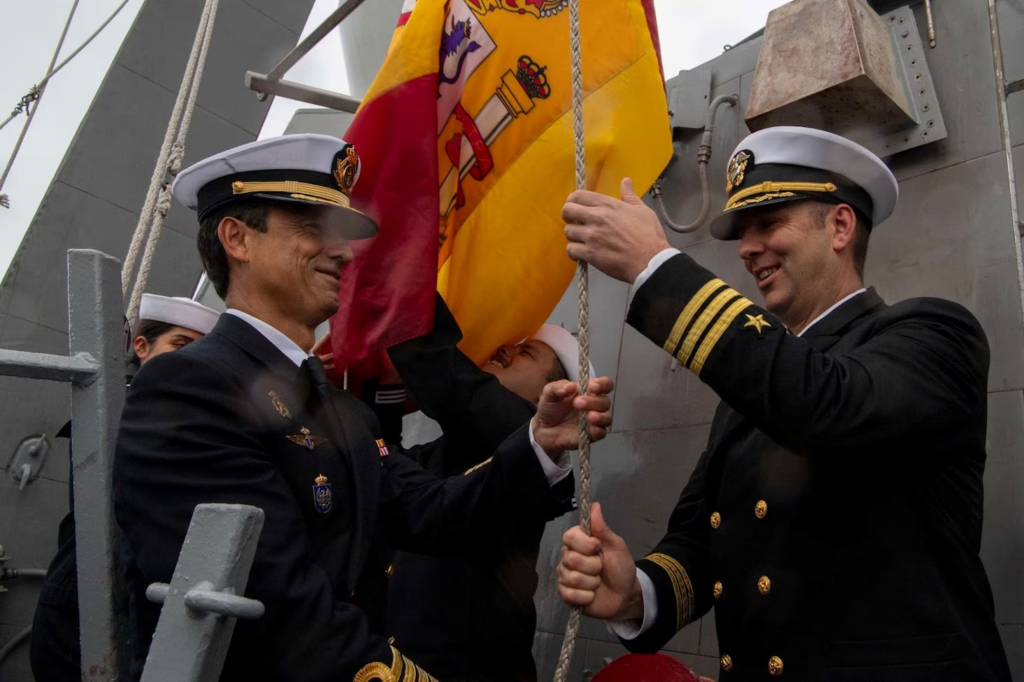
NAVAL STATION ROTA, Spain (Oct. 15, 2024) Cmdr. Scott Burrill, the commanding officer of the Arleigh-Burke class guided-missile destroyer USS Oscar Austin (DDG 79), raises a Spanish flag with Spanish Armada Capt. Ernesto Guesos, Commander, 41st Frigate Squadron, during the ship’s homeport shift to Naval Station (NAVSTA) Rota, Spain, from NAVSTA Norfolk, Va., Oct. 15, 2024.

by U.S. Naval Forces Europe and Africa/ U.S. Sixth Fleet Public Affairs 

15 October 2024 

ROTA, Spain – The Arleigh Burke-class guided-missile destroyer USS Oscar Austin (DDG 79) arrived to its new homeport of Naval Station Rota, Oct. 15, as the first of two additional DDGs to join the Forward Deployed Naval Force-Europe (FDNF-E) force. 

The arrival of Oscar Austin expands U.S. Navy capabilities in the U.S. European Command (EUCOM) and U.S. Africa Command (AFRICOM) areas of responsibility. Oscar Austin is now assigned to Destroyer Squadron (DESRON) 60 / Commander, Task Force (CTF) 65 and U.S. 6th Fleet. 

“USS Oscar Austin’s arrival to Naval Station Rota strengthens our commitment to maintaining a forward presence in Europe,” said Vice Adm. J.T. Anderson, Commander, U.S. 6th Fleet. “The addition of this ship to our forces in the region provides our Allies with an added layer of security and assurance, and serves as a powerful symbol of the enduring partnership between the United States and Spain.” 

Modernized with the latest Aegis Ballistic Missile Defense (BMD) upgrade, USS Oscar Austin offers a key capability for the U.S., directly contributing to extended deterrence by providing Allies and partners protection against the threat of ballistic missile attack. The second U.S. Navy destroyer to shift its homeport to Naval Station Rota, scheduled to arrive in 2026, also has the latest Aegis BMD upgrade. 

“Arleigh Burke-class guided-missile destroyers are true multi-mission ships, capable of providing maritime security, conducting anti-air and anti-submarine warfare, and providing humanitarian assistance and disaster relief,” said Capt. Alex Mamikonian, commodore, DESRON 60 and CTF 65. “Bringing USS Oscar Austin to Spain enhances our ability to maintain ready and postured forces to assure, deter and defend in an increasingly complex security environment.” 

Oscar Austin departed Norfolk, Va. Sept. 30 to transit to Spain and assist in providing full coverage and protection for all NATO European populations, territories and forces against the increasing threats posed by the proliferation of ballistic missiles. 

The initial decision to base destroyers out of Spain is part of the U.S. European Phased Adaptive Approach announced by President Obama in 2009. Since its announcement, the U.S. has broadened its Ballistic Missile Defense (BMD) capabilities in theater including increasing FDNF-E from four to six and the finalization of the second Aegis Ashore site in Poland. 

Oscar Austin is the first Flight IIA Arleigh Burke-class guided-missile destroyer and proudly bears the name of Pfc. Oscar P. Austin, United States Marine Corps. Oscar Austin was commissioned on August 19, 2000, in Norfolk, Va. Oscar Austin is ballistic missile defense, anti-submarine, and anti-surface warfare capable. The ship can embark two MH-60R Seahawk helicopters to assist in anti-submarine and other warfare areas. Destroyers can work with Carrier Strike Groups, Surface Action Groups, Expeditionary Strike Groups or independently. 

U.S. 6th Fleet, headquartered in Naples, Italy, conducts the full spectrum of joint and naval operations, often in concert with allied and interagency partners, in order to advance U.S. national interests and security and stability in Europe and Africa. 


Project Link: New T-45 Mixed Reality Trainer Improves Readiness 

Shown is a T-45C prototype mixed reality cockpit view. Note: Dials, displays, and out-of-the-cockpit view are virtual images while the cockpit panels and buttons are seen in the “real world” via a video pass-through camera.

From Naval Air Systems Command, Oct. 11, 2024  

PATUXENT RIVER, Md. — The Naval Aviation Training Systems and Ranges Program Office (PMA-205) and the Naval Air Warfare Center Training Systems Division (NAWCTSD) are bringing the future of training to student aviators with the new T-45C Goshawk mixed-reality simulator, also known as Project Link. 

The Navy is pioneering emerging technologies through the Naval Aviation Training Next (NATN) program, focusing on extended reality (XR) for aviation training. XR encompasses virtual reality (VR), augmented reality, and mixed reality (MR), offering immersive experiences by blending virtual and real worlds. 

Project Link is one of several efforts aligned under the NATN program advancing aviation training by exploring the use of XR trainers; providing individualized training syllabi; and improving performance assessment through updated methods, metrics, and measurements.  

The NATN program is an innovative initiative by the U.S. Navy to use advanced technologies like VR and artificial intelligence to streamline and enhance the training process for new student naval aviators. While AR/VR/MR training solutions do not entirely replace other methods of training, the benefits of these systems can be profound. 

Recent technological advancements made MR a promising solution for flight training, with MR trainers showing potential in supplementing operational flight trainers and offering greater realism and immersion through a blend of virtual and physical cockpit elements.  

“I am excited about the feedback from Chief of Naval Air Training instructors and students on mixed reality technology,” said Capt. Kevin McGee, PMA-205 program manager. “Industry has been improving mixed reality over the past five to seven years and I believe MR is now mature enough to provide significant value in the virtual training environment, replacing some of the larger, more expensive visual projector systems that are employed in our pilot training systems.” 

An initial capability evaluation of the T-45C MR simulator prototypes, conducted by the Naval Undergraduate Flight Training Systems Program (PMA-273), assessed their capability to support future procurement decisions for the undergraduate jet training pipeline. Despite closely resembling the T-45C Goshawk cockpit and using commercial head mounted display systems for visual projection, the prototypes faced some limitations in certain functionalities. The PMA-205/NAWCTSD team addressed the discrepancies and improved the system fidelity, leading to the procurement of four training devices delivered to Meridian, Mississippi, in April. Through the Office of the Under Secretary of Defense for Research and Engineering’s Accelerate the Procurement and Fielding of Innovative Technologies (APFIT) program, the Navy procured an additional 20 systems with eight to arrive in Meridian and 12 to be delivered to Kingsville, Texas, in 2025. 

“These systems reached a level of readiness that allowed for their delivery and immediate integration into training programs. This successful outcome demonstrates the effectiveness of collaborative efforts in refining and advancing military training technologies,” said Cmdr. Lee “Scampi” Sciarini, deputy director, Research and Technology Programs, Naval Air Warfare Center Training Systems Division (NAWCTSD). 

Lt. Cmdr. Joseph Geeseman, PMA-205 Science and Technology Portfolio manager, emphasized the importance of fleet feedback during the development process. 

“These user-evaluation events provide the development teams the opportunity to more narrowly focus their efforts, ensuring that the T-45C MR trainer end product not only meets training requirements, but also exceeds fleet expectations in the look, feel, and ease-of-use of these leading-edge training systems,” Geeseman said. 


RTX’s Raytheon Completes Hydrodynamic Testing for the Barracuda Mine Neutralization System  

Milestone moves program one step closer to operational testing  

From RTX 

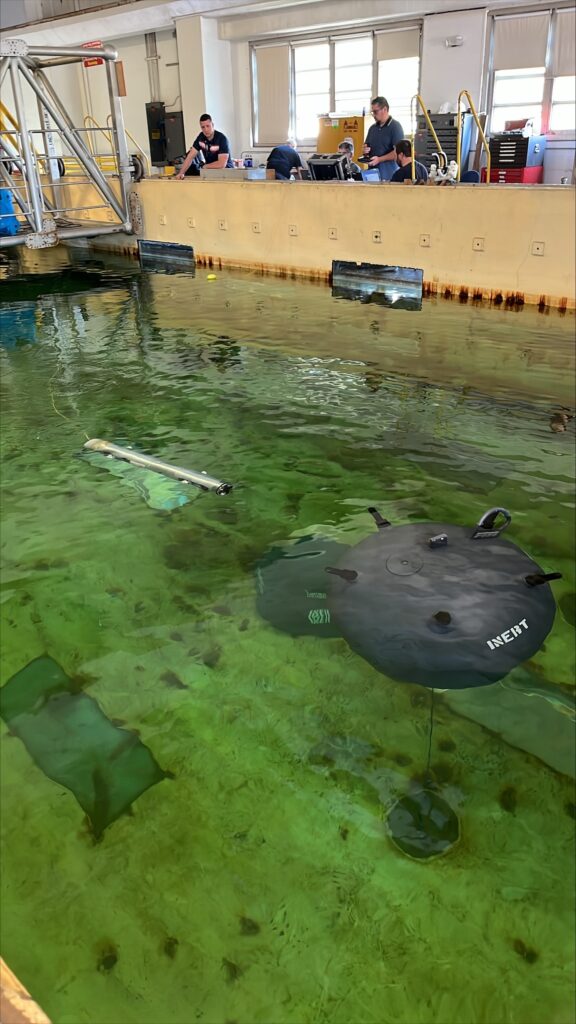
PORTSMOUTH, R.I. (October 7, 2024) — Raytheon, an RTX (NYSE: RTX) business, recently conducted a series of controlled environmental tests for the Barracuda Mine Neutralization System at the Naval Surface Warfare Center Carderock Division. 

Using a production representative test unit, Barracuda operated and collected data in environments of various sea states and water currents, demonstrating the ability to hydrodynamically control itself in conditions simulating the ocean. 

The test demonstrated the ability of the vehicle to detect, track and hold position on a target on its own. It was the first time Raytheon has executed this type of testing with the Barracuda mine neutralizer underwater vehicle and moves the program one step closer towards meeting operational requirements. 

“This event marks a significant milestone in the advancement of underwater security and naval defense,” said Barbara Borgonovi, president of Naval Power at Raytheon.  “Barracuda’s performance reaffirms its position as a game-changing solution for identifying and neutralizing naval mines, a critical challenge in modern naval operations.” 

Barracuda is the U.S. Navy’s program of record for next-generation mine neutralization. It is a semi-autonomous system that uses sonar and camera systems to locate and neutralize undersea mine threats.   

Raytheon was first awarded a contract for Barracuda in 2018. The program completed its critical design review in March 2023, and has now entered its qualification testing phase. In July 2023, Raytheon was awarded a contract to deliver engineering development model units to the U.S. Navy. The program will go into Low-Rate Initial Production in 2027.