Final VH-92A Presidential Helicopter Delivered
From U.S. Naval Air Systems Command, August 19, 2024 
 
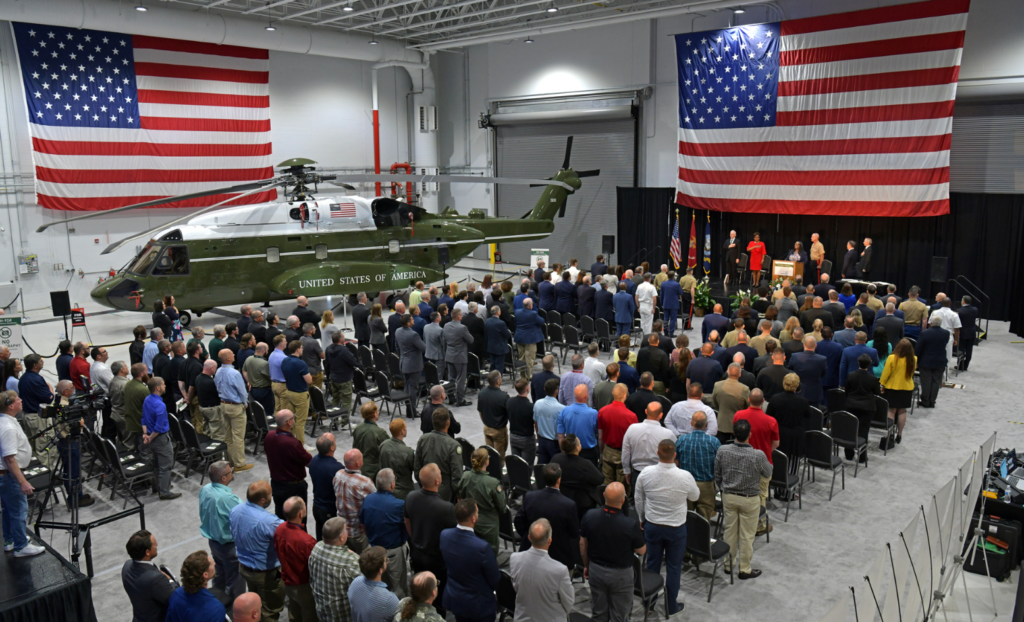
NAVAL AIR SYSTEMS COMMAND, Patuxent River, Md. — Presidential Helicopters Program Office (PMA-274) and the Marine Corps accepted delivery of the final VH-92A helicopter, built by Sikorsky, a Lockheed Martin Company, in August. The achievement signifies the completion of the program of record to deliver 23 new presidential helicopters in support of the executive lift mission. 
 
The total inventory of 23 VH-92A aircraft will consist of 21 operational and two test aircraft. This quantity allows for aircraft to be ready to support the executive lift mission, undergo various levels of maintenance, lifecycle upgrades, and provide assets for pilot/aircrew training. 
 
“This exceptional team has successfully completed the program of record for the VH-92A within budget and schedule,” said Brigadier General David Walsh, program executive officer for air anti-submarine warfare, assault, and special mission programs. “This helicopter not only embodies the hard work and dedication of those responsible for building and delivering the aircraft, but it will remain a recognizable patriotic asset known around the globe for safety, security, and reliability.” 
 
In May 2014, PMA-274, with approval from the Navy, awarded Sikorsky a contract to build the next presidential helicopter, the VH-92A, a derivative of the commercial S-92. 
 
The new presidential helicopter was built to increase performance and payload over the VH-3D and VH-60N. It will provide enhanced crew coordination systems and communications capabilities in addition to improving availability and maintainability. 
 
The Marine Corps works with the White House Military Office, PMA-274, and HMX-1 to ensure the conditions are set for a successful transition from the current in-service VH-3D and VH-60N aircraft to the VH-92A. Currently there are ten VH-3Ds, six VH-60Ns, and nine VH-92As that support various missions assigned to HMX-1. 
 
“Between the program staff and artisans within Sikorsky and PMA-274, we have the best and brightest. These great Americans are experts at their craft and put their all into this platform,” said Colonel Alex Ramthun, PMA-274 program manager. “Not only have we delivered increased performance and reduced maintenance costs and time over the current fleet of presidential helicopters, but we have also delivered the next phase of Marine One helicopters. Knowing those who step aboard any of the 21 VH-92As will have absolute top-notch execution, maintenance, and service for the life of the aircraft makes me proud to be part of this amazing team.” 
 
The VH-92A Patriot is in the midst of a phased plan to ensure a smooth, safe, and timely transition from the legacy VH-3D and VH-60N aircraft. 
 
PMA-274 expeditiously provides safe, ready, high-performing, and affordable aircraft, capabilities, and support to HMX-1. 


U.S. Navy Investigating Incident Involving Two MH-60S Seahawks at Naval Air Station Fallon 

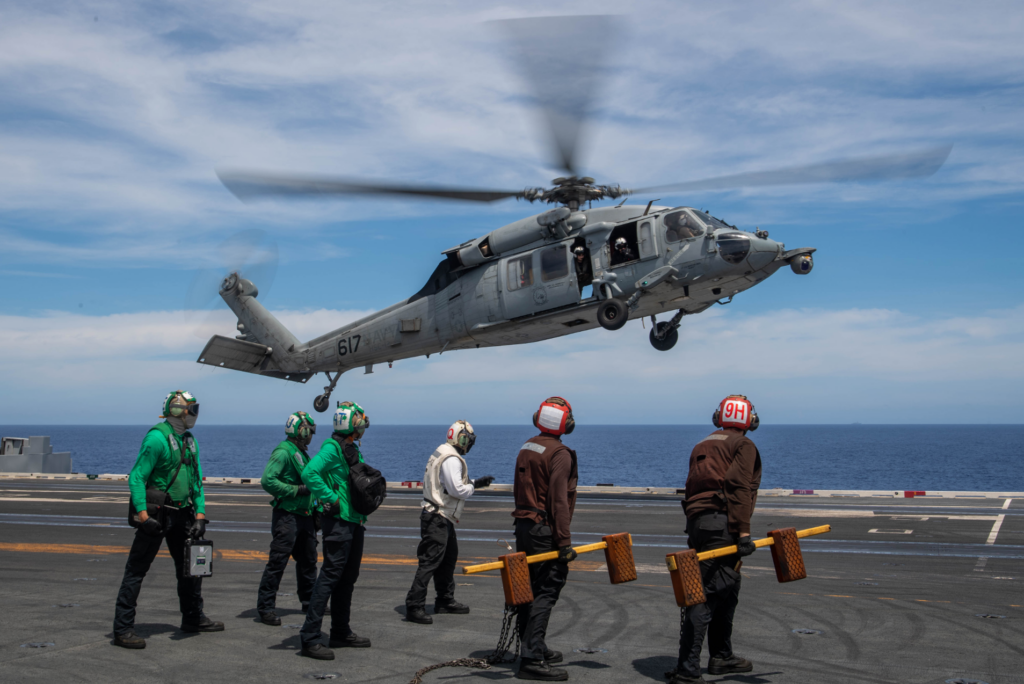
PHILIPPINE SEA (June 10, 2024) Sailors stand by to assist as an MH-60S Sea Hawk, attached to the Golden Falcons of Helicopter Sea Combat Squadron (HSC) 12, lands on the flight deck of the U.S. Navy’s only forward-deployed aircraft carrier, USS Ronald Reagan (CVN 76), during flight operations in support of Valiant Shield 2024 in the Philippine Sea, June 10. (U.S. Navy photo by MC3 Kazia Ream)

From Commander, Naval Air Force, U.S. Pacific Fleet, 16 August 2024 

FALLON, Nev. – The U.S. Navy is investigating the cause of an incident involving two MH-60S Seahawk helicopters assigned to Helicopter Sea Combat Squadron (HSC) 12 on the training ranges of Naval Air Station (NAS) Fallon, Nevada, at approximately 7:25 p.m. (PDT) on Aug. 15. 

The two helicopters, each with a crew of five personnel, were conducting routine training at the time of the incident. All ten crew members were transported to a nearby hospital for medical treatment and have been released from the hospital following medical treatment for non-life threatening injuries. 

The cause of the mishap remains under investigation. Security personnel from NAS Fallon have secured the mishap site, which is on the Fallon Range Training Complex in a remote location. 

Assigned to Carrier Air Wing (CVW) 5, HSC-12 is currently at NAS Fallon for comprehensive, integrated training in both real and simulated environments. CVW-5 is the ready, reliable and proven Forward-Deployed Naval Forces-Japan (FDNF-J) carrier air wing. CVW-5 will remain the FDNF-J air wing following the planned hull swap with Nimitz-class aircraft carrier USS George Washington (CVN 73). Shape


USS Halsey Returns Home from Westpac Deployment 

The Arleigh Burke-class guided-missile destroyer USS Halsey (DDG 97) returns from a seven-month deployment to its homeport at Naval Base San Diego, Aug. 16, 2024. (U.S. Navy photo by MC2 Maria G. Llanos)

By Mass Communication Specialist 2nd Class Maria Llanos, Aug. 16, 2024 

NAVAL BASE SAN DIEGO, Calif.  –  The Arleigh Burke-class guided-missile destroyer USS Halsey (DDG 97) returned to Naval Base San Diego Aug. 16, following a seven-month deployment to U.S. 7th Fleet. 

Halsey departed San Diego on Jan. 10 as part of the Theodore Roosevelt Carrier Strike Group and served as a carrier escort before detaching to conduct independent operations in the Indo-Pacific region. 

“I am tremendously proud of my Sailors’ sense of ownership and dedication to each other and the mission,” said Cmdr. Sara Lynch, Halsey’s commanding officer. “We operated successfully across a wide spectrum of operations with allies and partners from around the world and displayed the immense capability of Halsey Sailors and the U.S. Navy.” 

While deployed to U.S.7th Fleet, Halsey conducted operations across multiple warfare areas, providing regional stability and supporting a free and open Indo-Pacific. Halsey participated in various multi-nation exercises such as Noble Dingo, Milan, Tiger Triumph, Tenacious Trident, and Valiant Shield, which reinforced America’s commitment to allies and partners throughout the Indo-Pacific region and increased force interoperability. 

Across U.S. 7th Fleet, Halsey contributed to enduring partnerships critical to maintaining an international rules-based order, including key tri-lateral operations with the Japan Maritime Self-Defense Force and Republic of Korea Navy during Freedom Edge. Halsey participated in several operations with the Royal Australian Navy, including flight operations, tactical maneuvering and a personnel exchange before participating in Exercise Milan 2024, a multinational exercise in India with maritime events from anti-submarine warfare to live fire engagements of an unmanned aerial vehicle. 

“I am incredibly proud of this crew for always rising to the occasion,” said Lynch. “I am also extremely grateful to the families and friends back home who supported our Sailors during these last seven months.” 

An integral part of U.S. Pacific Fleet, U.S. 3rd Fleet leads naval forces in the Indo-Pacific and provides the realistic, relevant training necessary to flawlessly execute our Navy’s role across the full spectrum of military operations—from combat operations to humanitarian assistance and disaster relief. U.S. 3rd Fleet works together with our allies and partners to advance freedom of navigation, the rule of law, and other principles that underpin security for the Indo-Pacific region. 


Aug 16-18 U.S. Central Command Update 

From U.S. Central Command 

August 18, 2024 
 

TAMPA, Fla. – In the past 24 hours, U.S. Central Command forces successfully destroyed one Iranian-backed Houthi uncrewed aerial vehicle (UAV) in a Houthi-controlled area of Yemen. 

It was determined the UAV presented an imminent threat to U.S. and coalition forces, and merchant vessels in the region. These actions were taken to protect freedom of navigation and make international waters safer and more secure. 
 

Aug. 16, 2024 
 

TAMPA, Fla. – In the past 24 hours, U.S. Central Command (USCENTCOM) forces successfully destroyed one Iranian-backed Houthi Unmanned Surface Vessel (USV) in the Red Sea. 

It was determined this USV presented a clear and imminent threat to U.S. and coalition forces, and merchant vessels in the region. This action was taken to protect freedom of navigation and make international waters safer and more secure for U.S., coalition, and merchant vessels. 


AUSTAL USA Expands Advanced Technology Operations 

From Austal USAMOBILE, Ala. – Austal USA cut the ribbon for an expanded research center at the Austal USA Advanced Technologies (AT) facility in Charlottesville, Va.  With the addition of 10,000 square feet, the now 25,000 square-foot facility houses equipment for Industry 4.0 application development and will allow the team’s capabilities to grow substantially over the next 12 months. 

The expansion is necessary to support the company’s growing role in the U.S. Navy’s additive manufacturing program.  Austal USA Advanced Technologies is spearheading the Navy’s effort to revolutionize their supply chain through the implementation of additive manufacturing for castings, forgings, and fittings. Leading a team of industry partners, Austal USA Advanced Technologies operates the Navy’s Additive Manufacturing Center of Excellence (AM CoE) in Danville, Va., the U.S. Navy’s flagship for additive manufacturing of components for shipbuilding and ship repair. Austal USA Advanced Technologies is also leading efforts to implement other Industry 4.0 tenets to advance shipbuilding practices. This includes piloting extended/augmented reality tools for workforce training and enhancing and furthering shipyard automation. 

The growth of Austal USA’s footprint in Charlottesville comes as the Navy’s AM CoE in Danville passed a major milestone in printing the 100th part in support of the Navy submarine and surface fleet. This milestone is on the path to creating a build-to-print capability in the submarine industrial base and Navy supply-chain at large.  This capability chiefly supports Columbia- and Virginia-class submarine new construction as well as sustainment of Virginia- and Ohio-class submarines. 

“The expansion of our Advanced Technologies research center demonstrates Austal USA’s recognition of the importance of the U.S. Navy’s submarine program to our Nation’s maritime defense,” commented Austal USA President, Michelle Kruger. “Not only are we a principal player in the additive manufacturing function but we are also building modules for both the Virginia- and Columbia-class submarines in our Mobile, Ala. new construction facility, a testament to our highly talented and capable workforce.” 

The 100th part printed is a copper-nickel, angle valve (PL114) manufactured using an EOS M400, laser powder-bed fusion additive manufacturing printer at the Danville AM CoE. The Puget Sound Naval Shipyard requested the part for installation on USS Pennsylvania (SSBN-735), an Ohio-class ballistic missile submarine commissioned in 1989. 

The consortium of companies that operate additive manufacturers at this facility began printing first-articles-of-manufacture on-site in April 2023. AM data files produced at the Danville AM CoE will be available to submarine industrial base suppliers as manufacturing guidance where an alternative is sought to casting or forging of those parts. A plan for installation of the first articles printed at the Danville AM CoE is underway. 

As the installation of the first 100 printed parts is completed or in-progress, the Danville AM CoE is becoming a significant contributor to the 100-part challenge issued by PEO SSBN Executive Director, Matt Sermon. In April 2024, at the Navy League’s Sea-Air-Space conference, Sermon encouraged ship builders and submarine industrial base suppliers to supply and install 100 AM-printed parts on Navy vessels by the end of calendar year 2024. 

In addition to its role as the on-site heat treatment lead, Austal USA Advanced Technologies directs the production workflow and integrates the engineering, additive manufacturing, machining and post-processing, and quality inspection and testing capabilities of its AM partners. The Austal USA team ensures that the rigorous requirements of its Navy customers are met while delivering installable parts that demonstrate the ability of new manufacturing processes to shorten lead times for many parts that are traditionally cast or forged. 

​ 


U.S. Submarine Tender to Support AUKUS Pillar 1 Milestone 

From the Navy Office of Information, Aug. 16, 2024 

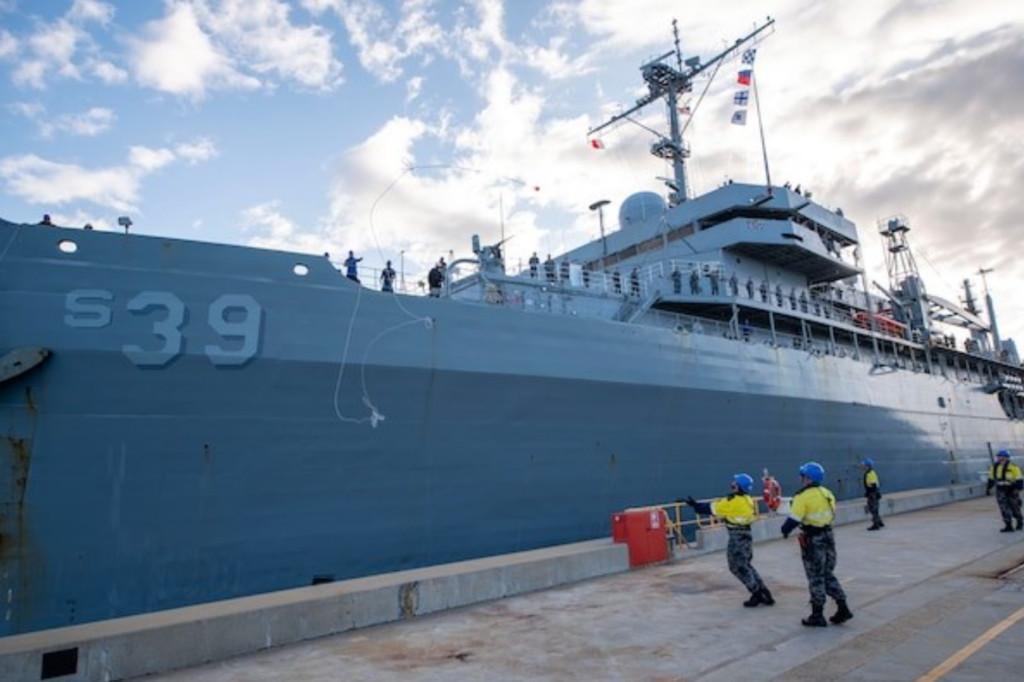
HMAS STIRLING, Australia - The U.S. Navy submarine tender USS Emory S. Land (AS 39) pulled into HMAS Stirling, Aug. 16, marking the seventh port visit in Australia since the ship left its homeport of Guam, May 17. 

The mixed crew of U.S. Navy and Royal Australian Navy personnel will take part in a Submarine Tendered Maintenance Period (STMP) over the next several weeks as Australian technicians perform maintenance on a U.S Navy nuclear-powered fast-attack submarine (SSN) scheduled to arrive for a port visit. 
 
The STMP marks a significant step toward Australia becoming sovereign-ready to operate, maintain, and support a fleet of conventionally armed SSNs, which is a central requirement in executing Pillar 1 of the AUKUS security partnership between Australia, the United Kingdom, and the United States. 
 
“Our knowledge exchange with the Royal Australian Navy (RAN) Fleet Support Unit (FSU) since January has been exceptionally productive,” said Capt. Brent Spillner, commanding officer of the Emory S. Land. “Within weeks they were working shoulder-to-shoulder with U.S. technicians on real submarine repairs, and for the last six weeks we’ve had a team of U.S. Sailors embedded in the FSU West workshops at HMAS Stirling. We’re learning as much from them as they are from us, and we have Australian sailors and officers in the key management positions for the STMP.” 
 
More than 30 Australian sailors will execute the majority of planned maintenance work under the supervision of U.S. personnel, which will include the replacement of a mast in the submarine’s sail and a key hydraulic valve, along with the simulated removal of a large pump weighing more than 3,500 pounds from within the boat. 
 
“Both of our navies are benefiting tremendously from the interoperability we’ve been developing during this deployment, and are now better able to support each other’s fleets around the world. This STMP marks the first time that Australian workers will perform maintenance on an American SSN in Australian waters, but it’s really just the next step in a long partnership,” said Spillner. “This is an important milestone and learning opportunity as we work together to establish Submarine Rotational Force – West, where both U.S. and UK submarines will regularly transit through HMAS Stirling, with maintenance and logistics assisted by Australian personnel, as they develop their own Intermediate-Level Maintenance capability for the eventual Australian SSNs.” 
 
The deployment has been an opportunity for sailors from the three navies to work together. 
 
“The opportunity to have RAN sailors from FSU integrated with my repair department has been phenomenal,” said Cmdr. Derek Fletcher, repair officer aboard Emory S. Land. “The ability to work side-by-side in Guam on U.S. SSNs and then continue that side-by-side work on RAN vessels and even a Royal Navy vessel while in Australia has truly demonstrated our interoperability. It’s been incredible to see our Sailors working together to provide repair services to vessels from all three AUKUS partners.” 
 
Since the start of the Emory S. Land’s deployment, 176 U.S. Sailors have participated in 18 community relations events, investing 731 hours into the communities of Darwin, Cairns, Sydney, Melbourne, and Adelaide. While in port at HMAS Stirling, U.S. Sailors are planning an additional eight to 10 community relations events throughout the region, as well as having the ability to tour Western Australia. 
 
“This deployment is like none other I have ever experienced and will not easily be forgotten,” said Lt. Cmdr. Mark Miller, Emory S. Land’s chaplain. “The warmth and hospitality which the U.S. Sailors have received is truly heartfelt. We are grateful for the strong bond of our two nations and we look forward to our stop in Western Australia.” 
 
Emory S. Land is on deployment supporting the U.S. 7th Fleet, the U.S. Navy’s largest forward deployed numbered fleet, operating with allies and partners in preserving a free and open Indo-Pacific region. Emory S. Land provides expeditionary intermediate-level maintenance, services, and logistics support to deployed submarines. 
 
Guam is home to the U.S. Navy’s only submarine tenders, Emory S. Land and USS Frank Cable (AS 40), as well as Los Angeles-class fast-attack submarines. The submarine tenders provide maintenance, hotel services and logistical support to submarines and surface ships in the U.S. 7th Fleet area of operation. The submarines and tenders are maintained as part of the U.S. Navy’s forward-deployed submarine force and are capable of meeting global operational requirements. 
For more information about Emory S. Land, visit us at http://www.csp.navy.mil/emorysland/ or like us on Facebook at http://www.facebook.com/EmorySLand, or on Twitter @EmorySLand. 
For more news from USS Emory S. Land (AS 39), visit http://www.navy.mil/local/as39/. 


August 15 U.S. Central Command Update 

From U.S. Central Command 

Aug. 15, 2024 
 

TAMPA, Fla. - In the past 24 hours, U.S. Central Command (USCENTCOM) forces successfully destroyed one Iranian-backed Houthi ground control station in a Houthi-controlled area of Yemen. 

It was determined this ground control station presented a clear and imminent threat to U.S. and coalition forces, and merchant vessels in the region. This action was taken to protect freedom of navigation and make international waters safer and more secure for U.S., coalition, and merchant vessels. 


Navy Medicine Enterprise Established to Support Readiness and Warfighting 

From Bobbie Camp, 16 August 2024 

FALLS CHURCH, Va. - Vice Chief of Naval Operations Adm. Jim Kilby approved the establishment of the Navy Medicine Enterprise (NME), which is an operationally focused organizational structure providing senior fleet leadership a mechanism to address and prioritize health service support requirements to meet operational objectives, Aug. 14. 

Vice Chief of Naval Operations Adm. Jim Kilby approved the establishment of the Navy Medicine Enterprise (NME), which is an operationally focused organizational structure providing senior fleet leadership a mechanism to address and prioritize health service support requirements to meet operational objectives, Aug. 14. 
 
The commitment of Navy Medicine to both operational and preventive care is crucial in sustaining our force,” said Kilby. “This is about setting standards of care for our people – from physical and mental health, to training and education. Ensuring our naval medical forces are properly manned, trained, and equipped means we’re ready now and for the future fight.” 

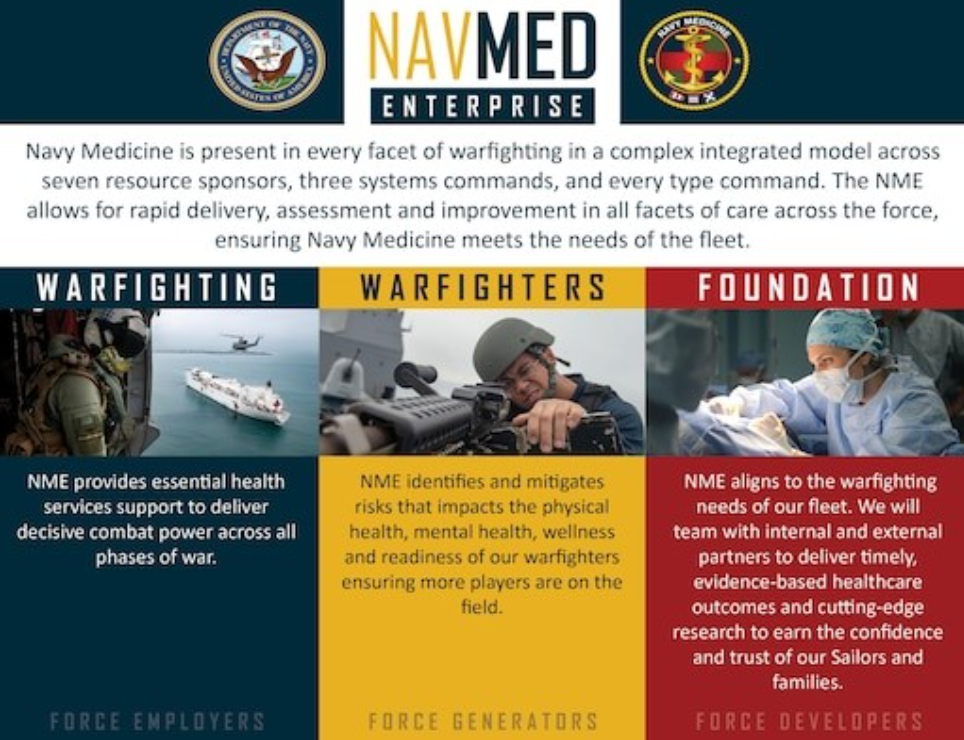
A graphic illustration depicts the Navy Medicine Enterprise (NME), which allows for rapid delivery, assessment and improvement in all facets of care across the force, ensuring Navy Medicine meets the needs of the fleet. Navy Medicine is present in every facet of warfighting in a complex integrated model across seven resource sponsors, three systems commands, and every type command. (U.S. Navy graphic illustration by U.S. Navy) 

 
The U.S. Navy Surgeon General will lead the NME, providing a single integrated voice of a cooperative partnership operating within existing command structures and U.S. Code Title 10 authorities. 
 
“Navy Medicine warfighters are integrated across every facet of warfighting, whether providing health services with the fleet or from the foundation,” stressed U.S. Navy Surgeon General and Chief, U.S. Navy Bureau of Medicine and Surgery Rear Adm. Darin Via. “The NME allows us to ensure we are addressing the needs of the fleet, not only through my authorities as the Surgeon General, but also aligned across the authorities of seven resource sponsors, three system commands and every type command.” 
 
NME will address the readiness, and physical and mental health of all warfighters through healthcare services support designed to prevent illness and injury, maximize baseline human performance, and treat and rehabilitate warfighters’ post illness and injury through standardized quality of care, policy, education, training, and the delivery of medical forces in support of the warfighters. 
 
“Health services are the backbone of effective warfighting in the U.S. Navy, ensuring that every Sailor and Marine is mission-ready and resilient,” said Adm. Daryl Caudle, commander, U.S. Fleet Forces Command. “The Navy Medicine Enterprise stands as a crucial pillar, providing comprehensive support to fleet commanders by mitigating risks, optimizing human factors, and maintaining peak operational health readiness, ultimately ensuring our enduring overmatch, our warriors, can sustain our maritime dominance and strategic advantage.” 
 
The foundation of the NME process will be formed by stakeholders and organizations who are integral to the warfare improvement program who prioritize fleet capabilities and priorities. The NME process also includes coordination with resource sponsors to ensure alignment, reduce duplication, and to achieve organizational goals. 
 
The Fleet Readiness Enterprise construct was established by the Chief of Naval Operations in 2002 to improve efficiency and effectiveness in producing readiness in fleet units and forces, institute structure and process to better support informed decisions on readiness resource allocation and risk mitigation. The enterprise construct enables a more holistic approach to developing fleet recommendations to the Office of the CNO regarding warfighting capabilities and programming. 
 
Navy Medicine – represented by more than 44,000 highly-trained military and civilian health care professionals – provides enduring expeditionary medical support to the warfighter on, below, and above the sea, and ashore. 


Japan Buys Two SeaGuardians From GA-ASI  

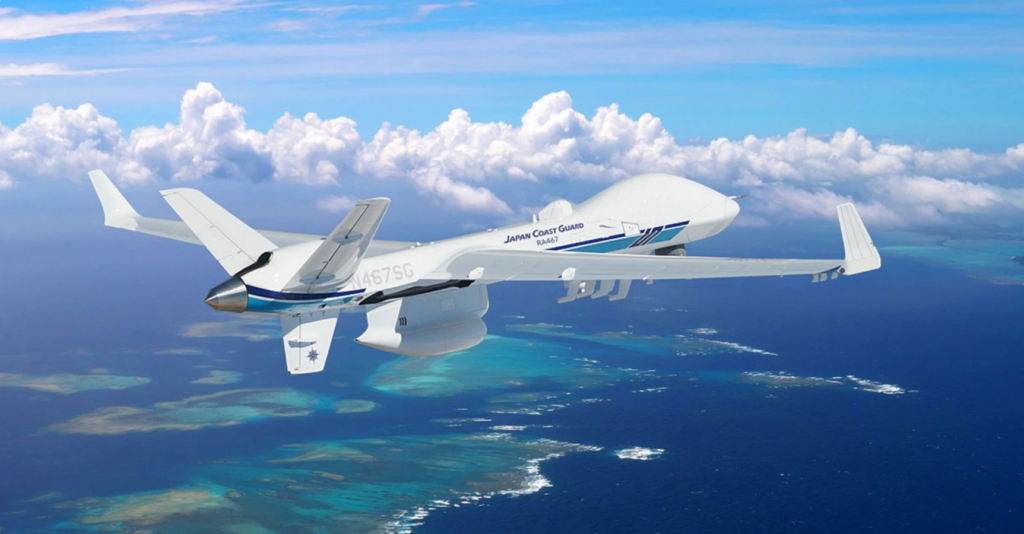
SAN DIEGO, August 15, 2024 (Newswire.com) – The Japan Coast Guard (JCG) has signed a contract for the purchase of two SeaGuardian® Remotely Piloted Aircraft (RPA) from General Atomics Aeronautical Systems, Inc. (GA-ASI), scheduled for delivery in 2025. This follows JCG’s ongoing Company-Owned, Contractor-Operated agreement with GA-ASI for operating SeaGuardian, which began in April 2022.  

“Since JCG started operating SeaGuardians, they have been used for various JCG missions, including supporting search and rescue and disaster response, specifically during the 7.6 magnitude earthquake early this year near the Noto Peninsula of Ishikawa Prefecture and maritime surveillance during the 2023 G-7 Summit in Hiroshima, and the system has performed efficiently and effectively,” said GA-ASI CEO Linden Blue. 

SeaGuardian is a medium-altitude, long-endurance RPA system that can fly for 24 hours or more, depending on the configuration.  

GA-ASI has strengthened its Maritime Wide Area Surveillance (MWAS) for Japan with Optix+, which gathers information from the SeaGuardian sensors, as well as other data sources, displaying the full picture of surveillance information for its operator. This functionality makes it easy to task and direct its Intelligence, Surveillance and Reconnaissance (ISR) information in real time. GA-ASI’s Optix+ software suite rapidly correlates and exploits collected data into an easily shared common operational picture. Having multi-source correlated data enables automatic detection of anomalous behaviors over waters. 


Navy Completes Install of First MQ-25 Unmanned Air Warfare Center Aboard USS George H.W. Bush 

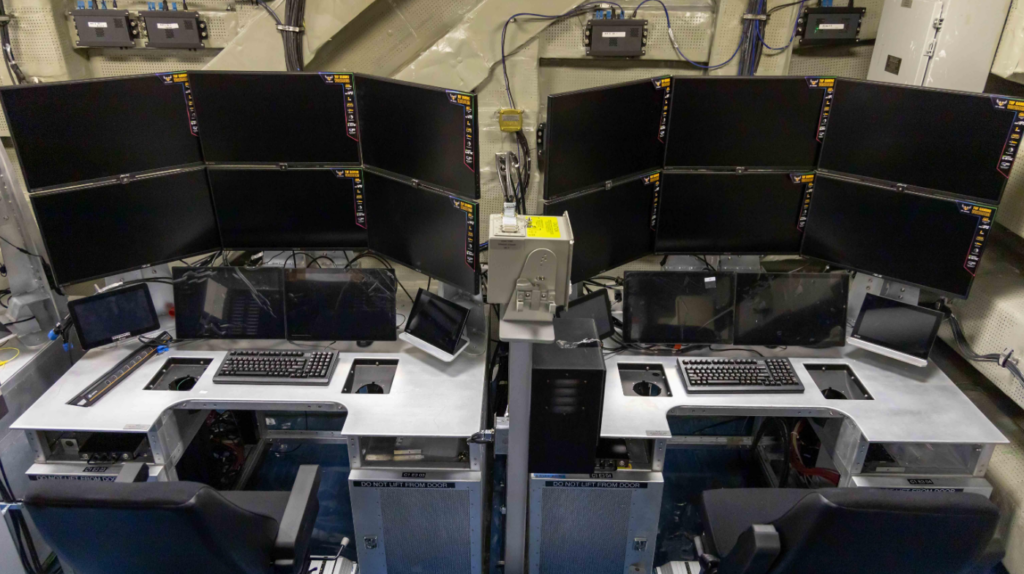
The first installation of the Unmanned Air Warfare Center (UAWC) aboard USS George H.W. Bush (CVN 77), where air vehicle pilots will control future MQ-25 Stingray airborne operations. (U.S. Navy photo)

Aug 15, 2024 

Naval Air Systems Command, Patuxent River, Md. — The Navy recently installed the world’s first Unmanned Air Warfare Center (UAWC) aboard USS George H.W. Bush (CVN 77), where Air Vehicle Pilots (AVPs) will control future MQ-25™ Stingray airborne operations. 

This major installation was a multi-year effort coordinated across multiple ship availability periods and the ship’s deployment schedule. 

The CVN-based control room, known as the UAWC, includes software and hardware systems that make up the first fully operational and integrated Unmanned Carrier Aviation Mission Control System (UMCS) MD-5E Ground Control Station (GCS). UMCS is the system-of-systems required for the MQ-25 air vehicle command and control and is critical to the unmanned aircraft refueler’s operations. 

“CVN 77’s UAWC lays the foundation for how the U.S. Navy will operate and control unmanned aircraft, and perhaps other unmanned vehicles, with UMCS,” said Unmanned Carrier Aviation (PMA-268) Program Manager Capt. Daniel Fucito. “These systems will initially support the MQ-25 but also future unmanned systems such as Collaborative Combat Aircraft that comprise the Air Wing of the Future.” 

The GCS, developed by the Navy, includes Lockheed Martin’s Skunk Works® Multi Domain Combat System (MDCX™), the power behind the GCS, along with additional supporting equipment and hardware. The hardware installed in the racks and cockpits is the baseline for the production systems currently being fabricated for installation on CVNs 70, 71, and 76 beginning in fiscal year 2025.  

“The support we received from all the organizations was incredible,” said Gordon Carlon, acting PMA-268 UMCS CVN installation lead. “Our program is accomplishing things on a much faster timeline than any other normal start-up program.” 

PMA-268’s UMCS team worked with multiple program offices, systems commands and shipyards to integrate the UAWC into existing networks and the carrier architecture. The Naval Air Warfare Center Aircraft Division Webster Outlying Field Alteration Installation Team, AirWorks, and Lockheed Martin assisted with the coordination and physical installation of the UAWC while Naval Sea Systems Command, Norfolk Naval Shipyard, and CVN 77 organized schedules, equipment, and logistics. 

Early next year, CVN 77 will lead the first at-sea testing of the UAWC’s operational networks, building on initial network testing with a simulated GCS that took place in January aboard USS Abraham Lincoln (CVN 72). 

“This will be the first time the AVPs from Unmanned Carrier-Launched Multi-Role Squadron (VUQ) 10 will operate the MD-5 from an aircraft carrier. They will use the actual GCS hardware and software aboard CVN 77 to communicate with a simulated air vehicle in the lab in Pax River,” said Joe Nedeau, PMA-268 UMCS lead. 

PMA-268 is the lead systems integrator for MQ-25, working closely with its two prime industry partners, Boeing and Lockheed Martin, to seamlessly integrate the MQ-25 into carrier operations, including deck handing, taxiing and launch and recovery.  When operational, MQ-25 will provide an aerial refueling capability to extend the range and flexibility of the carrier air wing.