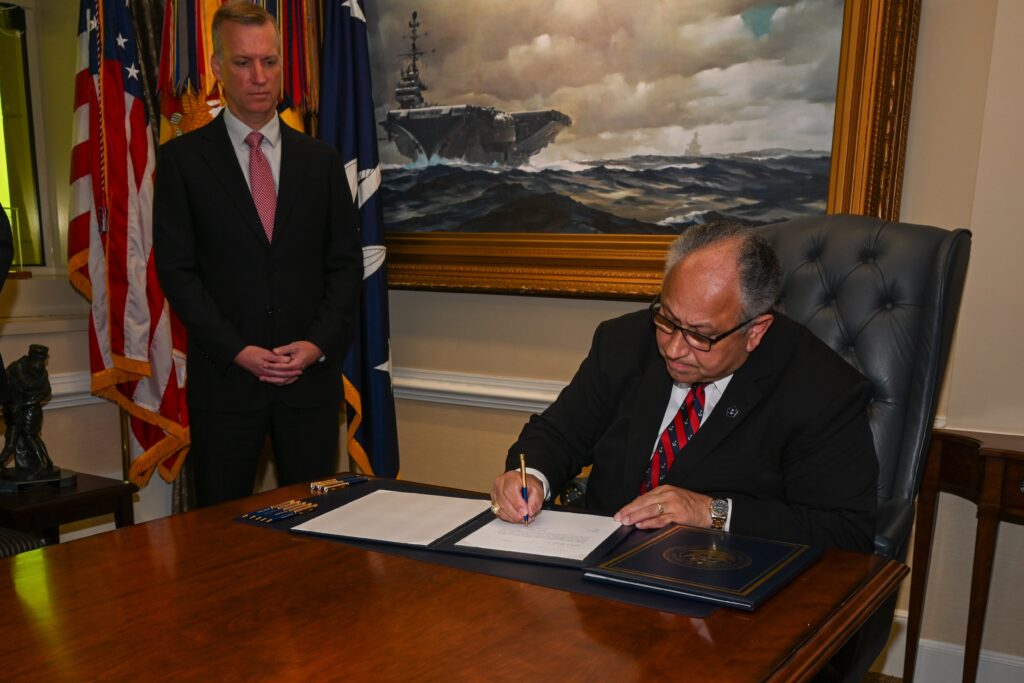
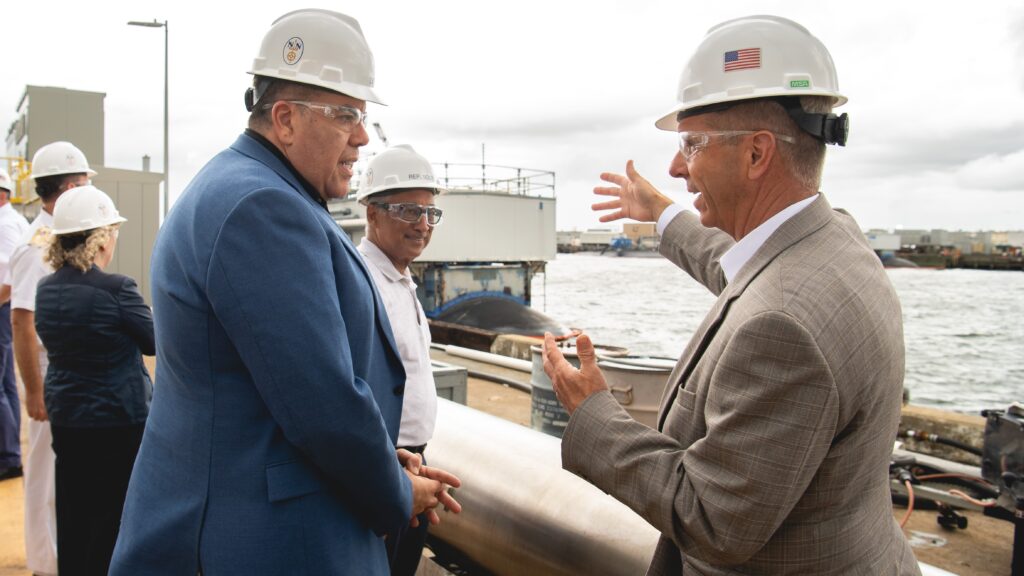
U.S. Navy Embarks Expeditionary Medical Unit Aboard USNS Cody for Test and Evaluation
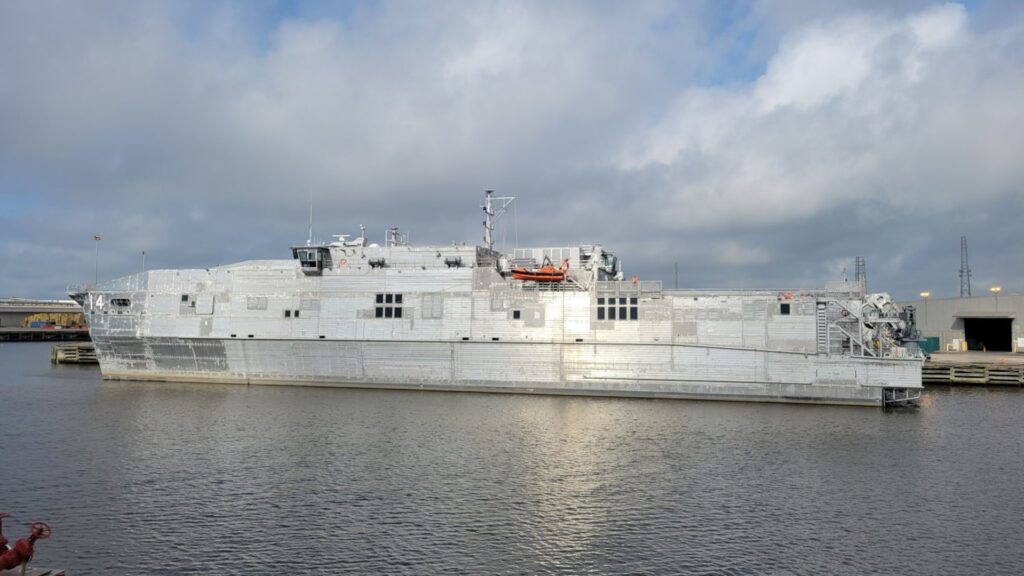
MOBILE, Alabama (May 2, 2024) USNS Cody (T-EPF 14) moored pier side in the harbor at Austal USA’s shipyard in Mobile, Alabama. 

By Program Executive Office Unmanned and Small Combatants (PEO USC) Public Affairs, July 16, 2024 

WASHINGTON, D.C.  – The U.S. Navy is embarking the first Expeditionary Medical Unit (EMU), a cutting-edge medical support system with personnel from EMU-1 designed to provide Role 2 (R2) level healthcare services both afloat and ashore, aboard the expeditionary fast transport USNS Cody (T-EPF 14) at Joint Expeditionary Base Little Creek-Fort Story, July 15-26. EMUs will enhance medical support in various military and humanitarian missions, ensuring comprehensive care from the sea to the shore. 

EMUs extend the Navy’s R2 care capabilities currently aboard amphibious assault ships and aircraft carriers to smaller ships and vessels. It offers a broad spectrum of medical and healthcare services such as biomedical repair, command and control, information technology, sterile supply, medical operations, and patient decontamination provided by medical support personnel. 

“The mission of the EMU is to deliver R2 healthcare services with versatile surgeries, intensive care unit, acute care ward, radiology, pharmacy, laboratory, dental service, and combat operational stress control,” said Capt. Jonathan Haase, program manager of the Expeditionary Missions program office. “EMUs are strategically equipped to receive patients from afloat platforms, directly from combat areas to provide patient holding, patient movement, and prolonged field care, based on injury severity and EMU’s specific mission for the Navy.” 

As an embarked mission, EMUs are designed to be moveable and transportable, allowing for flexibility in deployment across various naval platforms. 

“The EMU onboard the USNS Cody is crucial because it provides a mantle for agile and enhanced surgical intervention,” said Mabinty Chapman, deputy assistant program manager of the Expeditionary Missions program office and retired chief medical corpsman. “The union of dexterity and military medicine is embedded in our Navy’s newest vessel, fulfilling the future standard of damage control surgical care in a distributed maritime environment.” 

The equipment for EMUs is contained within ten 20-foot equivalent units (TEUs), which facilitates the storage and transport of both the authorized medical allowance list and dental allowance list items. These primarily commercial off-the-shelf items are protected by environmental control systems when at sea, ensuring their readiness and functionally across the spectrum of warfare during naval operations. 

“The Navy is dedicated to maintaining peace and security through diverse missions, from combat operations to humanitarian assistance,” concluded Haase. “With the introductions of the EMU, the Navy will continue its commitment to providing exceptional medical care and support to service members and affected communities worldwide.” 

PEO USC designs, develops, builds, maintains and modernizes the Navy’s unmanned maritime systems; mine warfare systems; special warfare systems; expeditionary warfare systems; and small surface combatants.  


Defeat ISIS Mission in Iraq and Syria for January – June 2024

From U.S. Central Command, July 16,2024 

TAMPA, Fla. –From January to June 2024, ISIS has claimed 153 attacks in Iraq and Syria. At this rate, ISIS is on pace to more than double the total number of attacks they claimed in 2023. The increase in attacks indicates ISIS is attempting to reconstitute following several years of decreased capability.   

To continue the effort to defeat ISIS and prevent its ability to conduct external attacks, United States Central Command, along with our Defeat ISIS partners, Iraqi Security Forces and the Syrian Democratic Forces, conducted 196 Defeat ISIS Missions resulting in 44 ISIS operatives killed and 166 detained in the first half of 2024. In Iraq, 137 partnered operations resulted in 30 ISIS operatives killed and 74 ISIS operatives detained. In Syria, 59 operations conducted alongside the SDF and other partners resulted in 14 ISIS operatives killed and 92 ISIS operatives detained.   

The above operations resulted in eight senior ISIS leaders killed and 32 captured in both Iraq and Syria. These leaders include those responsible for planning of operations outside of Syria and Iraq, recruiting, training, and weapons smuggling. The removal of these individuals from their leadership positions further degrades ISIS capabilities to conduct external operations in the U.S. and allied nations.   

The continued pursuit of the approximately 2,500 ISIS fighters at large across Iraq and Syria is a critical component to the enduring defeat of ISIS.  Equally important are the ongoing international efforts to repatriate more than 9,000 ISIS detainees in detention facilities in Syria, and the repatriation, rehabilitation, and reintegration of more than 43,000 individuals and families from the Al Hol and Al Roj camps. This is down from the peak of over 70,000 in 2019.   

“The global enduring defeat of ISIS relies on combined efforts of the Coalition and partners to remove key leaders from the battlefield and the repatriation, rehabilitation, and reintegration of families from Al Hol and Al Roj,” said Gen. Michael Erik Kurilla, commander of U.S. Central Command. “We continue to focus our efforts on specifically targeting those members of ISIS who are seeking to conduct external operations outside of Iraq and Syria and those ISIS members attempting to break out ISIS members in detention in an attempt to reconstitute their forces.” 


AIRBUS U.S. UH-72 Lakota Fleet Surpasses 1.5 Million Flight Hours 

From Airbus, 17 Jul 2024 

Today, Airbus U.S. Space and Defense announced the UH-72 Lakota fleet surpassed 1.5 million flight hours with U.S. Army, U.S. Army National Guard, and U.S. Navy. 

“This milestone is an incredible achievement for the Lakota fleet and reflects its impressive reliability over the past 18 years,” said Robert Geckle, Chairman and CEO of Airbus U.S. Space & Defense. “Having reached the one million flight hour milestone less than three years ago, this number is indicative of Lakota’s value as a staple of the U.S. military that is multi-mission capable, reliable, and affordable.”   

With nearly ten different configurations, the Lakota provides unmatched versatility; more than 480 Lakota helicopters have been delivered to date. 

Today, Army, Navy, and Army National Guard units use Lakota helicopters to perform essential training and real-world missions year-round across 50 U.S. states and territories.  

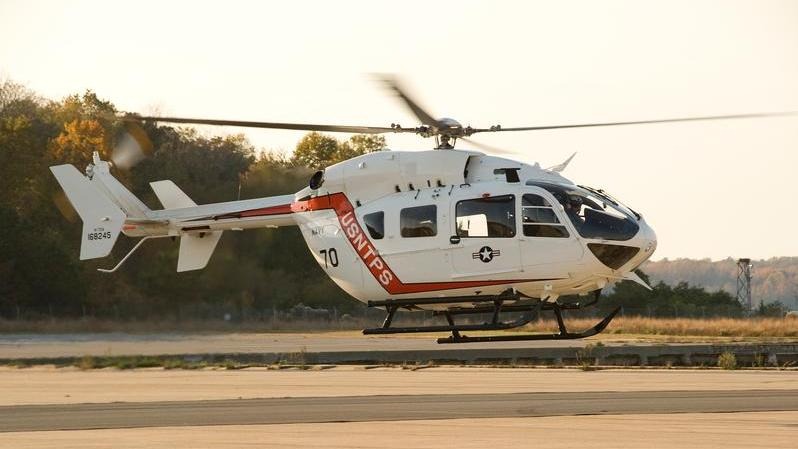
Airbus delivered the first Lakota helicopter to the U.S. Army in 2006, and currently supports a fleet of 223 UH-72As that serve as the primary training helicopters for the service. 212 UH-72A and 18 UH-72B Lakota aircraft support Army National Guard operations including counter drug, search and rescue, and disaster response, among others. The helicopters are used at the U.S. Naval Test Pilot School to teach aviators rotary wing flying characteristics and test procedures. 

“Our aircraft has proven its value to the U.S. Army and Navy by performing a range of important and often overlooked missions and will continue to deliver as needed for years to come,” said Didier Cormary, Head of Military Helicopter and Uncrewed Systems for Airbus U.S Space and Defense. “This milestone is a testament to the many U.S. military veterans who built the helicopter and take pride in supporting the aviators who serve our nation at home and abroad.”  

Approximately one-third of the workforce in Columbus, Mississippi, who build and deliver the Lakota are veterans.   


SECNAV Exonerates 256 Defendants from 1944 Port Chicago General and Summary Courts-Martial

From SECNAV Public Affairs, 17 July 2024 

WASHINGTON, DC – The Secretary of the Navy announced on July 17 the full exoneration of the remaining 256 defendants of the 1944 Port Chicago general and summary courts-martial. 

The Honorable Carlos Del Toro, Secretary of the Navy, made the announcement on the 80th anniversary of an explosion that occurred at Port Chicago Naval Magazine in California. The explosion killed 320 people, injured 400 others, destroyed two ships and a train, and caused damage to the nearby town of Port Chicago.  

Secretary Del Toro expressed his deepest condolences for the Sailors, civilians, Coast Guardsmen, members of the U.S. Maritime Service, and one Marine who lost their lives and for their family members. 

Following the 1944 explosion, white supervising officers at Port Chicago were given hardship leave while the surviving African-American Sailors were ordered back to work. The circumstances surrounding the disaster were reflective of the Navy’s personnel policies at the time, which barred African-American Sailors from nearly all seagoing jobs. Most of the Navy ordnance battalions assigned to Port Chicago Naval Magazine and similar facilities were comprised of African-American enlisted personnel and white officers.   

In the absence of clarity on the explosions or further safety training, 258 African-American Sailors refused to resume ammunition handling. After threats of disciplinary action, 208 of the Sailors returned to work; however, the Navy still subsequently convicted all 208 Sailors at a summary court-martial for disobeying orders.  

The Navy sentenced each of the summary court-martial defendants to a Bad Conduct Discharge and forfeiture of three month’s pay. During subsequent reviews of the summary court-martial, the Bad Conduct Discharges were suspended, the forfeitures reduced, and one conviction was set aside for insufficient evidence. 

The remaining 50 Sailors continued to refuse to return to work and were charged with mutiny. The Navy later convicted all 50 Sailors (who came to be called the “Port Chicago 50”) of mutiny at a mass general court-martial. Each of these defendants was sentenced to a Dishonorable Discharge, fifteen years confinement at hard labor, reduction in rate to E-1, and total forfeitures of their pay.   

During subsequent reviews of the general court-martial, the Dishonorable Discharges were suspended and the period of confinement was reduced from 15 years to 17-29 months. One conviction was also set aside for mental incompetency. By January 1946, nearly all the Sailors were released and given the opportunity to finish their contracts.  

“The Port Chicago 50, and the hundreds who stood with them, may not be with us today, but their story lives on, a testament to the enduring power of courage and the unwavering pursuit of justice,” said Secretary Del Toro. “They stand as a beacon of hope, forever reminding us that even in the face of overwhelming odds, the fight for what’s right can and will prevail.” 

After a thorough review of the case and related materials, the General Counsel of the Navy concluded that there were significant legal errors during the courts-martial. The defendants were improperly tried together despite conflicting interests and denied a meaningful right to counsel.  

The courts-martial also occurred before the Navy’s Court of Inquiry report on the Port Chicago explosion was finalized, which certainly would have informed their defense and contained nineteen substantive recommendations to improve ammunition loading practices.   

Following the Navy’s most recent review, Secretary Del Toro fully exonerated the remaining 256 defendants of the 1944 Port Chicago general and summary courts-martial.  

If any family members of the defendants of the 1944 Port Chicago general and summary courts-martial would like to reach out to the Department of the Navy for future notifications on the topic or more information, please reach out to [email protected] or 703-697-5342. 


NOAA Orders Second High-Altitude Jet for Hurricane and Climate Research 

Artist’s concept of the NOAA Gulfstream G550. (Image credit: Gulfstream Aerospace Corporation)

New aircraft, to join NOAA fleet in 2028 

By Jonathan Shannon, July 16, 2024 

Today, NOAA announced that it is exercising a $106 million contract option with Georgia-based Gulfstream Aerospace Corporation to purchase a fully modified G550 aircraft that will be specially configured to support hurricane and tropical storm forecasts, atmospheric research and other NOAA missions. 

Funded in part by the Inflation Reduction Act, as part of President Biden’s Investing in America agenda, the fully instrumented aircraft is expected to join NOAA’s fleet in 2028. This will be NOAA’s second G550. The first, which NOAA ordered from Gulfstream in 2019, is expected to be delivered in spring 2025 and will replace NOAA’s aging Gulfstream IV-SP, which has been an essential part of the NOAA Hurricane Hunter fleet since 1996. 

“These new state-of-the-art aircraft will greatly enhance NOAA’s ability to gather data critical to hurricane research and forecasting, atmospheric river research and forecasting, climate studies and other missions,” said NOAA Administrator Rick Spinrad, Ph.D. “Infrastructure investments like this protect both lives and livelihoods.” 

Both twin-engine aircraft will be equipped with a variety of sensors for collecting atmospheric data, including a tail-mounted Doppler radar system. The G550s, which can fly fast, far and high with a range of more than 4,000 nautical miles and a maximum altitude of 51,000 feet, will paint a detailed picture of atmospheric conditions above and around hurricanes and other tropical cyclones — information essential for accurate forecasts. 

Data collected by the G550s will supplement the critical low-altitude data collected by NOAA’s pair of four-engine Lockheed WP-3D Orion turboprop aircraft, which fly directly into storms. 

When aircraft data are available, hurricane track and intensity forecasts are improved significantly. Longer lead-time for tropical cyclone forecasts are imperative as coastal populations and infrastructure continue to grow, evacuation decision times increase and climate change raises hurricane intensity, rainfall and storm surges. 

“The acquisition of these highly capable aircraft is a major step forward in the recapitalization of NOAA’s aircraft fleet, which forecasters, researchers and decision-makers depend on for life-saving information,” said Vice Adm. (select) Nancy Hann, director of the NOAA Commissioned Officer Corps and NOAA Marine and Aviation Operations

Together, the G550s will help NOAA meet the requirements of the Weather Research and Forecasting Innovation Act of 2017 by creating additional capability for hurricane reconnaissance. 

The G550s will be based at the NOAA Aircraft Operations Center in Lakeland, Florida, along with NOAA’s other specialized environmental data-gathering aircraft. The fleet is operated, managed and maintained by a combination of NOAA Corps officers and civilian personnel. 


Coast Guard Maritime Safety and Security Team (MSST) Seattle 91101 to Conduct Waterborne Missions in Homer, Alaska 

HOMER, Alaska — The Coast Guard is scheduled to conduct waterborne operations in the Homer vicinity over the summer as Sector Western Alaska and U.S. Arctic augments its capabilities with small boat teams from Maritime Safety and Security Team Seattle (MSST) 91101. 

MSST 91101, utilizing two 29-foot response boat crews, will patrol harbors, fishing grounds, and trafficked waterways including areas with significant traffic convergence to enforce living marine resources (LMR) regulations on domestic, commercial, recreational, and charter fishing vessels. 

“For the next few months, our teams will be conducting operations around Homer in support of various missions, including search and rescue, recreational and commercial vessel safety, and protection of Alaska’s living marine resources,” said Lt. Karl Gunther, Sector Western Alaska and U.S. Arctic enforcement chief. “Teams will maintain a regular presence on the water and conduct routine boardings at sea to inspect a vessel’s catch, gear, and other items to ensure regulatory compliance as well as safety.” 

Mariners are advised to research the federally mandated safety and fishery requirements for their vessels prior to conducting operations in Kachemak Bay and to prepare for the highly likely occurrence that a Coast Guard boarding team inspects their vessel for compliance. 

Coast Guard boarding teams have the authority to (at any time) go aboard any vessel operating under the jurisdiction of the United States, and address inquiries to those on board, examine the ship’s documents and papers, and examine, inspect, and search the vessel as outlined in 14 USC 522.  


NIWC Atlantic Develops 5G Technology for Use Across the Fleet

12 July 2024 

By Jerry Sekerak and Amanda Vallieres 

The U.S. Navy fleet could soon start reaping the benefits of 5G technology. For the past several years, in collaboration with Office of the Under Secretary of Defense, Research and Engineering (OUSD R&E) FutureG office, Naval Information Warfare Center (NIWC) Atlantic has developed and tested 5G capabilities in naval ship environments and is primed and ready to deploy those capabilities on board U.S. Navy ships. This same technology used by just about every civilian with a cell phone is now ready and waiting to start making an impact on improving shipboard quality of life and quality of work, that combined is known as Quality of Service (QoS) for Sailors.   

The U.S. Navy fleet could soon start reaping the benefits of 5G technology. For the past several years, in collaboration with Office of the Under Secretary of Defense, Research and Engineering (OUSD R&E) FutureG office, Naval Information Warfare Center (NIWC) Atlantic has developed and tested 5G capabilities in naval ship environments and is primed and ready to deploy those capabilities on board U.S. Navy ships. This same technology used by just about every civilian with a cell phone is now ready and waiting to start making an impact on improving shipboard quality of life and quality of work, that combined is known as Quality of Service (QoS) for Sailors.   
 
This new shipboard 5G technology got its start about five years ago in NIWC Atlantic’s Assured Real-Time Communications (ARC) Laboratory in Norfolk, which focuses on joint interoperability and cybersecurity. 
 
While Wi-Fi technology has recently been piloted and used in limited but successful capacities in the Navy, such as with “Sailor Edge Afloat and Ashore” on board USS Abraham Lincoln (CVN 72), NIWC Atlantic engineers are working to implement 5G technology both afloat and ashore to make Wi-Fi and other technologies more effective, efficient and secure. Ultimately, NIWC Atlantic’s efforts of 5G implementation will help ensure better overall QoS in part due to its more advanced security and performance.  
 
“What our NIWC Atlantic (5G) engineers did with industry partners has laid a solid engineering foundation for 5G technology to potentially take off across the Navy,” said Peter Reddy, NIWC Atlantic Executive Director. “The use cases we worked on here were shipboard and pier side, and there are a lot of other use cases that 5G will satisfy in the Department of the Navy.” 
 
The work that NIWC Atlantic does with 5G technology relates back to advancing QoS. “We try to use that [QoS] mindset in our development of engineering processes so that we’re looking at solutions that meet [common communication capabilities such as] gaming or FaceTime, where Sailors are able to witness the birth of their children. It also allowed us to address security challenges with command and control-type communications,” said Kevin Thompson, a senior engineer at NIWC Atlantic and test director for the Assured Real-Time Communications (ARC) Laboratory. 
 
In the early stages however, NIWC Atlantic wasn’t able to test this technology in a true shipboard environment without disrupting active Navy operations and activities. Fortunately, in 2021, USS Wisconsin (BB 64), an Iowa-class battleship that is now a functioning museum ship ported in Norfolk, Virginia, reached out to NIWC Atlantic’s Norfolk 5G team asking if they had a replacement part for one of their messaging systems. Over time, the museum ship crew and NIWC Atlantic 5G teams formed a meaningful relationship that continued to develop, and eventually provided the 5G team an opportunity to request, and subsequently start the testing of 5G aboard USS Wisconsin. 
 
Testing on board USS Wisconsin by the NIWC Atlantic Norfolk 5G team has been vital to the success of 5G technology. NIWC Atlantic engineers deployed a private 5G core and tested 5G coverage and performance in the ship’s interior spaces. They ultimately found that 5G propagation within those confined interior spaces proves to be excellent and consistent with results from prior testing. 
 
However, working with 5G data hasn’t always been smooth sailing. Since ships face unique radio frequency (RF) spectrum and security challenges, and because 5G technology is a common technological area used for many different purposes, the 5G team found it difficult to predict whether commercial 5G solutions would work as expected in Navy operational environments. 
 
Also, 5G technology has different levels of maturity. “What that means is when we start looking at how we implement solutions leveraging 5G for quality of work and quality of life, we’re taking two different systems and trying to figure out how we make them agree on a common infrastructure that can support both things,” said Thompson. 
 
Nevertheless, NIWC Atlantic has been hard at work overcoming the various challenges associated with 5G data. According to Thompson, NIWC Atlantic continues to come up with collaborative solutions so 5G successfully works across all devices and systems. Currently, they are trying to improve and maintain the relationships they have with different program offices so NIWC Atlantic can implement 5G technology into their existing systems.   
 
Arnel Castillo, senior engineer working as Program Manager (PM) for NIWC Atlantic’s 5G prototyping efforts, explained that these relationships are vital. “You have to be able to respect the processes that are in place today, that way when you insert this technology, there is some grain of familiarity and some confidence that you’re not totally changing the paradigm,” said Castillo. 
 
Thus far, the NIWC Atlantic 5G team has achieved numerous advancements with 5G technology including developing a reference architecture for ship-wide, littoral, blue-water, pier-side, and ashore operational domains. 
 
The team also designed and implemented the Department of Defense’s (DoD) maritime 5G multi-vendor (shipboard and pier-side networks) testbed, which enables the experimentation of 5G networks and user equipment (UE) in a wide range of 5G frequencies. 
 
Additionally, they implemented the DoD’s first Voice over New Radio (VoNR) and Video over New Radio (ViNR) private 5G network, which is especially favored by Sailors since it provides them with a better QoS. 
 
According to both Castillo and Thompson, 5G technology holds a promising future for all Sailors. Not only will this technology, common to cell phones, soon transform communications and connectivity on all naval ships both afloat and ashore, the Get Real Get Better initiative helps arm leaders and problem-solvers with a near-limitless warfighting advantage. 
 
“The great work this team has done has really positioned the Navy very well to be ready to move out quickly to rapidly expand 5G capabilities across the fleet,” said Reddy. 


July 15 U.S. Central Command Update

From U.S. Central Command, July 15, 2024 

TAMPA, Fla. – In the past 24 hours, U.S. Central Command (CENTCOM) forces successfully destroyed five Iranian-backed Houthi uncrewed aerial vehicles (UAV), three over the Red Sea and two over Houthi-controlled areas of Yemen.  

It was determined these UAVs presented an imminent threat to U.S., coalition forces, and merchant vessels in the region. These actions were taken to protect freedom of navigation and make international waters safer and more secure. 

Additionally, Iranian-backed Houthis launched multiple attacks against MT Bentley I, a Panama-flagged, Israel-owned, Monaco-operated tanker vessel in the Red Sea carrying vegetable oil from Russia to China. Iranian-backed Houthis used three surface vessels in this attack, one uncrewed surface vessel (USV) and two small boats. No damage or injuries have been reported at this time. 

Later, Iranian-backed Houthis launched an anti-ship ballistic missile (ASBM) from a Houthi-controlled area of Yemen, over the Red Sea toward MT Bentley I. No damage or injuries have been reported at this time. 

Separately, Iranian-backed Houthis attacked MT Chios Lion, a Liberian-flagged, Marshall Islands-owned, Greek-operated crude oil tanker with a USV in the Red Sea. The USV caused damage, but MT Chios Lion has not requested assistance. No injuries have been reported at this time. 

This continued reckless behavior by the Iranian-backed Houthis threatens regional stability and endangers the lives of mariners across the Red Sea and Gulf of Aden. The Houthis claim to be acting on behalf of Palestinians in Gaza and yet they are targeting and threatening the lives of third country nationals who have nothing to do with the conflict in Gaza. USCENTCOM will continue to act with partners to hold the Houthis accountable and degrade their military capabilities.  


HII Hosts Congressional and Australian Delegation at Newport News Shipbuilding

NEWPORT NEWS, Va., July 15, 2024 (GLOBE NEWSWIRE) — Shipbuilder and all-domain technologies provider HII (NYSE: HII) hosted Rep. Robert C. “Bobby” Scott, D-Va.; Rep. Rob Wittman, R-Va.; and a delegation of Australian parliamentarians at its Newport News Shipbuilding division Friday. 

The visit was held in support of the trilateral Australia, United Kingdom and United States (AUKUS) partnership. HII continues to bolster AUKUS, which set in motion tasking across all three countries to determine the optimal pathway to provide Australia with conventionally armed, nuclear-powered submarines. 

The Australian delegation included Milton Dick, speaker of the Australian House of Representatives; Australian House of Representatives members David Littleproud, Sharon Claydon, Joanne Ryan and Bert van Manen; as well as officials from the Parliament of Australia and the Embassy of Australia. 

During the visit, the delegation engaged with senior leadership about the company’s nuclear-powered submarine sustainment expertise, supply chain management experience and longstanding industry-leading workforce development efforts. 

Photos accompanying this release are available at: https://hii.com/news/hii-hosts-congressional-and-australian-delegation-at-newport-news-shipbuilding/

“We are honored the delegation chose to invest time with us during their trip to the United States, and thank Congressmen Scott and Wittman for their continued support,” NNS President Jennifer Boykin said. “We value every opportunity to demonstrate how HII is working in earnest to leverage our experience and stewardship of complex platforms and technologies in support of the critical AUKUS agreement.” 

“I am proud to represent thousands of the nation’s best shipbuilders and welcome the Australian delegation to Hampton Roads where we build nuclear-powered submarines,” Scott said. “We welcome the opportunity to support the AUKUS agreement and strengthen the bonds with our Australian allies.” 

“The AUKUS agreement is integral to deterring China’s growing military aggression in the Indo-Pacific, and Virginia’s robust submarine industrial base plays an outsized role in upholding our nation’s commitment to this trilateral security pact,” Wittman said. “As vice chairman of the House Armed Services Committee, I was proud to bring this delegation of Australian Parliamentarians to Newport News and show them the cutting-edge platforms and technology used to build Virginia-class submarines here in the Commonwealth.” 

“I’m proud to lead a delegation of cross-party representatives from the Australian Parliament to demonstrate enduring bipartisan support for the AUKUS partnership,” Dick said. “It was great to join Congressmen Wittman and Scott for this visit to HII. The tour was an excellent opportunity to deepen our understanding of the work behind nuclear powered submarine construction, workforce and supply chain development as Australia develops our nuclear powered submarine enterprise.” 

NNS is one of only two shipyards capable of designing and building nuclear-powered submarines for the U.S. Navy. HII is the founding member of the AUKUS Workforce Alliance (AWA), a dedicated partnership committed to preparing a skilled workforce in support of all steps of Australia’s optimal pathway to sovereign nuclear-powered submarines. 


Dwight D. Eisenhower Carrier Strike Group Returns from Combat Deployment 

NORFOLK, Va. (July 14, 2024) The Nimitz-class aircraft carrier USS Dwight D. Eisenhower (CVN 69) returns to Naval Station Norfolk, July 14, 2024, concluding a nine-month deployment to the Atlantic. (U.S. Navy Photo by MC2 Hunter Day) 

From Carrier Strike Group Two (CSG-2), 15 July 2024 

NORFOLK, Va. – The Dwight D. Eisenhower (IKE) Carrier Strike Group (CSG) returned to Norfolk, after a historic nine-month combat deployment to U.S. 5th Fleet, July 14, 2024. 

The strike group – comprised of the nine squadrons of Carrier Air Wing (CVW) 3, Ticonderoga-class guided-missile cruiser USS Philippine Sea (CG 58), and Arleigh Burke-class guided-missile destroyers USS Gravely (DDG 107) and USS Mason (DDG 87) of Destroyer Squadron (DESRON) 22 – engaged in combat operations in the Middle East region from Nov. 2023 to June 2024. 
 
“We provide options to our nation’s decision makers. Our job is to preserve the peace, respond in crisis, and if necessary, fight and win decisively, and you delivered on all of those objectives,” said Chief of Naval Operations Adm. Lisa Franchetti. “You had a mission and you did it every day with purpose and perseverance.” 
 
When Houthi capabilities threatened innocent merchant traffic in critical waterways, CVW-3 collaborated with U.S. Air Force assets and coalition partners to launch seven pre-planned, dedicated strikes into Iranian-backed, Houthi-controlled territories in Yemen. The Arleigh Burke-class guided-missile destroyers USS Laboon (DDG 58) and USS Carney (DDG 64) augmented the strike group in the U.S. 5th Fleet operating area, launching Tomahawk Land Attack Missiles (TLAMs) into Yemen from the Red Sea to support the strikes. 
 
“When called upon, the force brought the fight to the Houthis in their front yard, linking airpower and dynamic and self-defense strikes. These acts reduced the risk to shipping and also reinforced our nation’s commitment to maritime security,” said Vice Adm. George Wikoff, commander, U.S. 5th Fleet. “The currency used to fund this important mission was incredible focus, resiliency and professionalism of the sailors of the IKE Carrier Strike Group over eight months…this is the Navy’s finest moments since World War II.” 
 
Beyond self-defensive strikes into Yemen, IKECSG units engaged dozens of one-way attack uncrewed aerial vehicles, uncrewed surface vehicles (USVs), and uncrewed underwater vehicles, earning awards including the Combat Action Ribbon and Navy Unit Commendation award. Several aviators were also awarded personal medals for their exemplary actions against the December 31, January 9, and subsequent Houthi attacks on IKECSG units. At sea, Philippine Sea and Gravely successfully escorted over 28 high-value, vulnerable units conducting innocent passage through the Strait of Hormuz, Gulfs of Oman and Aden, Bab al-Mandeb Strait, and through the Red Sea. 
 
In total, IKECSG warships launched 155 standard missiles, and 135 TLAMs from their vertical launch system across self-defense and pre-planned strikes. IKECSG aircraft expended nearly 60 air-to-air missiles and released 420 air-to-surface weapons. 
 
The Houthi targets in Yemen posed an immediate threat to U.S., coalition, and merchant shipping, and these strikes were designed to degrade Houthi offensive capabilities.across more than 460 pre-planned, dynamic, and self-defense targets. 
 
These threats damaged many civilian vessels, and IKECSG warships answered their distress calls. Laboon rescued stranded civilians in the Red Sea and returned them to the regional coast guard. Philippine Sea and its embarked detachment of MH-60R helicopters from Helicopter Maritime Strike Squadron (HSM) 74 rescued 24 civilian mariners in distress after a USV struck the M/V Tutor in the southern Red Sea. 
 
For nine months, the units within IKECSG sustained operations with minimal port calls thanks to their seamless integration with Military Sealift Command (MSC). The Supply-class fast combat ship USNS Supply (T-AOE 6) deployed as a part of the IKECSG. Also supporting logistics in the Red Sea were the Henry J. Kaiser class USNS Kanawha (T-AO 196), and the Lewis and Clark-class dry cargo ship USNS Alan Shepard (T-AKE 3). Together with the carrier, they enabled all strike group operations, logistics support, command and control structure, and essential medical resources. 
 
The Sailors of IKECSG demonstrated unparalleled resiliency, supported by the embarked Deployment Resiliency Team who worked tirelessly to build connections between Sailors, families, and friends. The team included a Deployed Resiliency Counselor, two psychologists, a Licensed Clinical Social Worker, an Embedded Integrated Prevention Coordinator, seven Chaplains, and a command facility dog named Demo, As IKECSG returns home, Return and Reunion teams are embarked to offer Sailors workshops and one-on-one counseling designed to help them ease back into reuniting with loved ones at home. 
 
“What a wonderful day,” said Rear Adm. Kavon Hakimzadeh, Commander, CSG-2, IKECSG, speaking on the return of IKECSG. “These Sailors are surrounded by their loved ones after a long deployment. Every single one of them demonstrated a level of courage and resiliency that we can all be proud of. I am so proud to be part of this Navy team, and I am grateful to everyone who put in the time and effort to make this a great homecoming!” 
 
The units departed their homeports of Norfolk and Oceana, Virginia, Mayport, Florida, and Whidbey Island, Washington, on Oct. 13 & 14 for the scheduled deployment. Now back home, IKECSG Sailors will get opportunities for downtime to rest and recuperate. 
 
Squadrons of Carrier Air Wing 3 include the “Gunslingers” of Strike Fighter Squadron (VFA) 105, the “Fighting Swordsmen” of Strike Fighter Squadron (VFA) 32, the “Rampagers” of Strike Fighter Squadron (VFA) 83, the “Wildcats” of Strike Fighter Squadron (VFA) 131, the “Screwtops” of Carrier Airborne Early Warning Squadron (VAW) 123, the “Zappers” of Electronic Attack Squadron (VAQ) 130, the “Dusty Dogs” of Helicopter Sea Combat Squadron (HSC) 7, the “Swamp Foxes” of Helicopter Maritime Strike Squadron (HSM) 74 and the “Rawhides” of Fleet Logistics Support Squadron (VRC) 40. 
 
For more information about the Dwight D. Eisenhower Carrier Strike Group, head to Facebook (/CSGTwo & /TheCVN69); Instagram (@CarrierStrikeGroupTwo & @TheCVN69); LinkedIn (Carrier-Strike-Group-TWO). For inquiries, email [email protected]