Fighter Squadron 147, Fleet Logistics Squadron 30 Detachment to Forward Deploy to Japan 

ATLANTIC OCEAN (May 8, 2024) Lt. Cole Drechsler, from Temecula, California, assigned to Strike Fighter Squadron (VFA) 147, takes off from the Nimitz-class aircraft carrier USS George Washington (CVN 73) in an F-35C Lightning II in the Atlantic Ocean, May 8, 2024. (U.S. Navy photo by MC3 August Clawson) 
 

15 July 2024 

From Commander, Naval Forces Japan 

YOKOSUKA, Japan — The U.S. Navy announced today that Strike Fighter Squadron (VFA) 147 and Fleet Logistics Multi-Mission Squadron (VRM) 30, Detachment Forward Deployed Naval Forces (FDNF) will forward deploy to Iwakuni, Japan. 

The squadrons will join the aircraft of Carrier Air Wing (CVW) 5, which is forward-deployed to Marine Corps Air Station Iwakuni. 
 
The F-35C Lightning II aircraft of VFA-147 will replace the F/A-18 Hornets of VFA-115, while the CMV-22B Osprey aircraft of VRM-30, Det FDNF will replace the C-2A Greyhound aircraft of the Fleet Logistics Squadron (VRC) 30 (later assigned to VRC-40 — ed.) detachment previously supporting CVW 5 and Carrier Strike Group (CSG) 5. 
 
The F-35C is the most capable fighter in the U.S. Navy and the backbone of air superiority; it complements the carrier strike group with a dominant, multi-role, 5th generation aircraft that enhances U.S. power projection and deterrence. 
 
The Navy’s V-22 variant includes increased operational range, faster cargo loading/unloading, aerial refueling capability, increased survivability and enhanced beyond-line-of-sight communications when compared to the legacy C-2A. This aircraft brings agility, flexibility and sustainability to effectively operate our naval forces forward in a high-end fight. The CMV-22B represents the next generation of the Carrier Onboard Delivery (COD) mission and is the critical enabler to ensure sustained deployed mobility for the carrier strike group. 
 
CVW 5 is currently embarked aboard the Nimitz-class aircraft carrier USS Ronald Reagan (CVN 76), which is slated to return to the United States for scheduled maintenance this year after nearly nine years forward-deployed to Japan. 
 
Ronald Reagan, which is conducting routine operations in the Pacific Ocean, will be replaced as America’s forward-deployed aircraft carrier in Yokosuka by USS George Washington (CVN 73). CVW 5 will continue to serve as the U.S. forward-deployed carrier air wing and will be embarked aboard George Washington upon its return to Japan later this year. 
 
George Washington previously served as the Navy’s forward-deployed carrier in Yokosuka from 2008-2015. 
 
The forward presence of VFA-147 and VRM-30 supports the United States’ commitment to the defense of Japan and the security and stability of the vital Indo-Pacific region. They will directly support the Defense Strategic Guidance to posture the most capable units forward in the Indo-Pacific region. 
 
The United States values Japan’s contributions to the peace, security and stability of the Indo-Pacific and its long-term commitment and hospitality in hosting U.S. forces forward deployed there. These forces, along with their counterparts in the Japan Self-Defense Forces, make up the core capabilities needed by the alliance to meet our common strategic objectives. 
 
The security environment in the Indo-Pacific requires that the U.S. Navy station the most capable ships and aircraft forward. This posture enables rapid response times for maritime and joint forces, and brings our most capable ships with the greatest amount of striking power and operational capability to bear. 


CNO, MCPON Attend Largest Maritime Exercise in the World, Emphasize Interoperability with Allies and Partners 

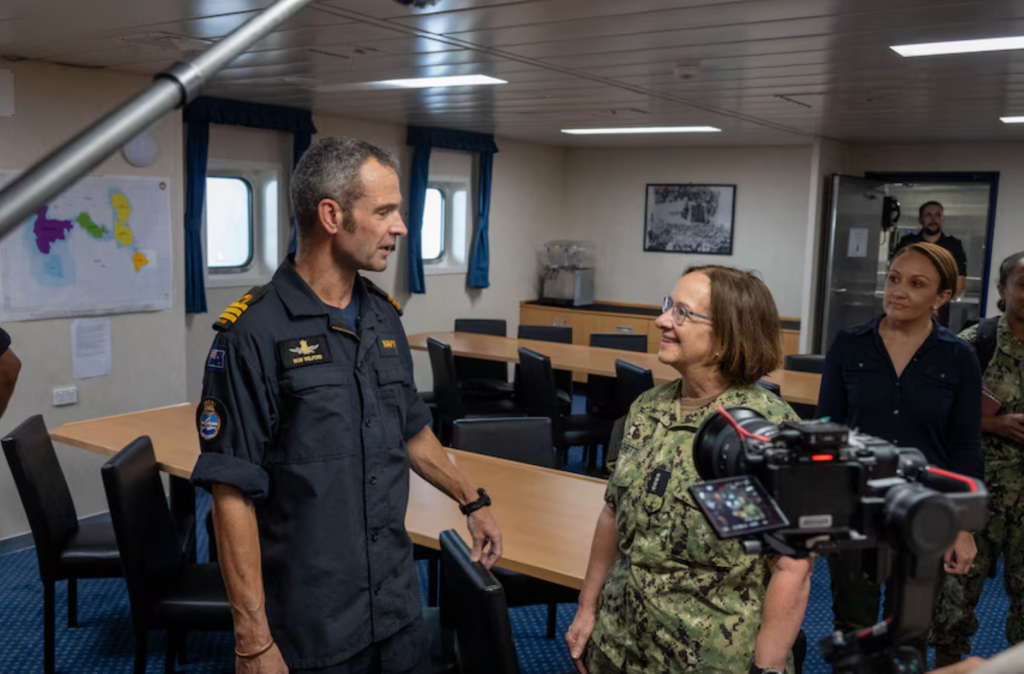
PEARL HARBOR, Hawaii – Chief of Naval Operations Adm. Lisa Franchetti and Master Chief Petty Officer of the Navy James Honea tour the Royal New Zealand Navy Ship HMNZS Aotearoa (A-11) during Rim of the Pacific (RIMPAC) 2024, July 11. (U.S. Navy photo by MCC Michael Zingaro/Released) 

HONOLULU — Chief of Naval Operations (CNO) Adm. Lisa Franchetti and Master Chief Petty Officer of the Navy (MCPON) James Honea traveled to Hawaii, July 10-12, 2024, to meet with Sailors and visit Allies and partners participating in Rim of the Pacific (RIMPAC) Exercise 2024. 

Franchetti and Honea visited several U.S. and partner nation ships, where they spoke with Sailors and service members across the Joint Force, observed the ongoing exercise, and emphasized the strategic importance of interoperability with Allies and partners. 

“RIMPAC is the world’s premier joint and combined exercise in the maritime domain. It’s a great opportunity to operate, to train, and to build interoperability with an amazing cross section of Allies and partners, from the Indo-Pacific to the Americas and to Europe,” said Franchetti. “It’s really important that we work together on areas of mutual concern to maintain freedom of the seas and uphold the rules based international order that has supported peace, stability and prosperity for so many years.”  

CNO and MCPON started the visit by holding an all hands call at Joint Base Pearl Harbor-Hickam, with Sailors assigned to USS Shiloh (CG 67), USS Antietam (CG 54), USS Wayne E Meyer (DDG 108), USS Decatur (DDG 73), and USS Hopper (DDG 70) in attendance. CNO and MCPON thanked the Sailors for their service and all that they do to contribute to America’s Warfighting Navy. 

“Thank you. Thank each and every one of you for what you do, for being the warfighters that you are, for building the warfighting teams that you do and all the readiness it takes to do that,” said Honea. “Thank you very, very much for what you’re doing, being on this pointy end, ready to surge at any moment.” 

Following the all hands call, CNO and MCPON visited the crew and shipyard maintenance team of the Virginia-class fast-attack submarine USS Hawaii (SSN 776) and triad of the USS Minnesota (SSN 783) to congratulate them on their successful maintenance periods.  

“Central to my America’s Warfighting Navy is the need to put more players on the field, and that applies to our submarines,” said Franchetti. “I know that we can’t deter and win against our would-be adversaries without getting all our submarines on the field. Whether it’s new construction ships or those in maintenance, we need to get these platforms in and out of the shipyard on time and on cost. And, we have to get all the people – with the right skills, tools and training – to man our submarines. That’s all more players on the field, and you did that. I am so proud of you for all that you accomplished.” 

Franchetti and Honea also visited the Virginia-class fast-attack submarine USS Illinois (SSN 786) to meet with the crew and congratulate them on their success in the maintenance period and with the “Every Sailor a Recruiter” program. Since the CNO’s call to action earlier this year, the crew of Illinois has found, coached, and mentored 11 future Sailors to get contracts and join the Navy, the highest number for any command, with the USS Carl Vinson (CVN 70) in second place with 10. 

“The crew of the USS Illinois is extremely motivated and focused on excellence in all mission areas which also includes investing in their warfighter development with their high completion rate of the Enlisted Leader Development course,” said Honea. “Illinois exemplifies the culture of excellence, and I’m not surprised they fully embraced ‘Every Sailor is a Recruiter’ and excelled at it as well. The crew exudes the ship’s motto ‘None More Brave.’ They know who makes a great teammate and recruits and mentors them to ensure our Navy has the most lethal combat warfighters. I am extremely proud of them and happy that CNO and I were able to present them with a small token of appreciation for their hard work.”  

After visiting the submarines CNO and MCPON visited the K. Mark Takai Pacific Warfighting Center on Ford Island, the command-and-control center for RIMPAC, observing more than 250 watchstanders from the Joint and Combined Forces participating in the exercise. CNO and MCPON also met with senior naval leaders from several Allied and partner nations, to include Australia, Chile, Colombia, Peru, and the Republic of Singapore. 

“The United States is an Indo-Pacific nation. We know that our partnerships in this region make a difference–that friendship is strength. We don’t take that for granted,” said Franchetti. “It’s great to be out here working together with all of you. This is an incredible opportunity to continue to build interoperability across the entire maritime domain from humanitarian assistance, logistics, anti-submarine warfare all the way up to the highest end of combat training.” 

Finally, CNO and MCPON flew out to a number of ships participating in RIMPAC. They visited the Republic of Korea ship ROKS Cheon Ja Bong (LST-687), the Japanese ship JS Kunisaki (LST-4003), and the Royal New Zealand ship HMNZS Aotearoa (A-11), where they thanked service members, met with leadership, and observed the exercise first-hand. 

“It was great to be able visit these ships, see their RIMPAC experiences, talk to them about what they are hoping to get out of the exercise, and thank them for being here and taking on some key leadership roles in the exercise,” said Franchetti. 

In its 29th iteration, dating back to 1971, the biennial event is the world’s largest international joint exercise in the maritime environment, providing a unique training opportunity to foster and sustain cooperative relationships critical to ensuring security on the world’s oceans. Capabilities exercised during RIMPAC range from disaster relief and maritime security operations to sea control and complex warfighting. 

This was Franchetti’s first time attending RIMPAC as CNO. 


RTX’s Pratt & Whitney completes F135 Engine Core Upgrade preliminary design review 

Caption: PACIFIC OCEAN (June 7, 2024) An F-35C Lightning II, assigned to Strike Fighter Squadron (VMFA) 314, launches from the flight deck of the Nimitz-class aircraft carrier USS Abraham Lincoln (CVN 72). (U.S. Navy photo by MCSA Mario Castro Gamez) 

Program remains on track to fully enable the F-35’s future needs  

July 15, 2024 

EAST HARTFORD, Conn., July 15, 2024 /PRNewswire/ — Pratt & Whitney, an RTX (NYSE: RTX) business, completed the F135 Engine Core Upgrade’s (ECU) preliminary design review (PDR), affirming the ECU’s design is on schedule and exceeding expectations. The upgrade will deliver increased engine durability and performance that will fully enable Block 4 and beyond capabilities for all three variants of the F-35 worldwide. 

During the PDR, Pratt & Whitney and the F-35 Joint Program Office evaluated the ECU’s design changes and propulsion technologies, both of which are needed to restore full life to the engine and provide improved performance to enable next generation weapons and sensors. 

“Pratt & Whitney is upgrading the F135 engine with technology from multiple development programs to deliver increased capability and performance for the warfighter,” said Chris Johnson, vice president of Pratt & Whitney’s F135 program. ”Upgrading the F-35’s propulsion system to ECU is a critical step toward ensuring the F-35 remains the world’s premier air dominance fighter.” 

Earlier this year, the U.S. Department of Defense formally selected the F135 ECU as the only modernization solution for the F-35’s propulsion system because it assessed that Pratt & Whitney alone “has the experience, special skills, proprietary technical documentation, software/algorithms, and technical expertise required to furnish the supplies and services.” 

“The PDR was a successful first step toward the capability the ECU will provide in meeting the challenging performance and durability requirements of the F135,” said U.S. Navy Capt. Mitchell Grant, F-35 propulsion program manager. “The ECU will ensure that the U.S. and our international partners remain well positioned to outpace adversary threats.” 

To date, Pratt & Whitney has delivered more than 1,200 F135 production engines, with more than 860,000 engine flight hours recorded. The F135 ECU will be incorporated into F-35s at the point of production or retrofitted at one of the multiple F135 depot sustainment facilities around the world. 


July 12-14 Central Command Update 

From U.S. Central Command 

July 14, 2024 
 

TAMPA, Fla. – In the past 24 hours, U.S. Central Command (USCENTCOM) forces successfully destroyed two Iranian-backed Houthi uncrewed aerial vehicles (UAV) over the Red Sea and one uncrewed surface vessel (USV) in the Red Sea.  

USCENTCOM forces also successfully destroyed one Houthi UAV in a Houthi-controlled area of Yemen.  

It was determined these systems presented an imminent threat to U.S., coalition forces, and merchant vessels in the region. These actions were taken to protect freedom of navigation and make international waters safer and more secure. 

July 12, 2024 
 

TAMPA, Fla. – In the past 24 hours, U.S. Central Command (USCENTCOM) forces successfully destroyed three Iranian-backed Houthi uncrewed aerial vehicles (UAV) in a Houthi-controlled area of Yemen.  

It was determined these UAVs presented an imminent threat to U.S., coalition forces, and merchant vessels in the region. These actions were taken to protect freedom of navigation and make international waters safer and more secure. 


USS San Diego to Forward Deploy to Japan

11 July 2024 

The San Antonio-class amphibious transport dock ship USS San Diego (LPD 22) will move to Sasebo, Japan, to join the Forward Deployed Naval Forces Japan (FDNF-J), the U.S. Navy announced today. This will be executed as a permanent change of station for the crew and family members. 

San Diego will replace USS Green Bay (LPD 20), which has been forward deployed to Sasebo for a decade. Green Bay will return to the United States at its new homeport of San Diego. The forward presence of San Diego supports the United States’ commitment to the defense of Japan, enhances the national security of the United States and improves its ability to protect strategic interests. San Diego will directly support the Defense Strategic Guidance to posture the most capable units forward in the Indo-Pacific Region. 
 
The United States values Japan’s contributions to the peace, security and stability of the Indo-Pacific and its long-term commitment and hospitality in hosting U.S. forces forward deployed there. These forces, along with their counterparts in the Japan Self-Defense Forces, make up the core capabilities needed by the alliance to meet our common strategic objectives. 
 
The security environment in the Indo-Pacific requires that the U.S. Navy station the most capable ships forward. This posture allows the most rapid response times possible for maritime and joint forces and brings our most capable ships with the greatest amount of striking power and operational capability to bear in the timeliest manner. 
 
Maintaining an FDNF capability with the most advanced ships supports the United States’ commitment to the defense of Japan and the security and stability of the vital Indo-Pacific region. 


NAVAIR Selects Near Earth Autonomy for USMC Aerial Logistics Connector Program

Near Earth will use Leonardo’s AW139 helicopter for the Aerial Logistics Connector program.

PITTSBURG, Pa. – [July 12, 2024] – NAVAIR has selected Near Earth Autonomy (Near Earth) to lead one of the teams demonstrating optimized logistics using rotorcraft for the U.S. Marine Corps’ Aerial Logistics Connector (ALC) program through an Other Transaction Agreement (OTA) under the Naval Aviation Systems Consortium (NASC). In collaboration with industry leaders Leonardo and Honeywell, Near Earth will showcase advanced autonomy on the Leonardo AW139 helicopter to provide logistical support during expeditionary operations in contested environments. The AW139, renowned for its versatility in defense, medical rescue, law enforcement, and energy operations worldwide, combined with Near Earth’s logistics mission autonomy system, will be the centerpiece of this program. 

The objective is to field a flexible solution capable of transporting various types of cargo and serving in casualty evacuation roles, operating in both crewed and uncrewed configurations. This dual capability will significantly expand the range of missions USMC rotorcraft will be able to undertake. Specifically, the 20-month initiative will demonstrate the rapid deployment of cargo up to 3,000 lb. over a 200 NM radius. 

For the ALC program, Leonardo will implement a fast loading, securing, and unloading system for Joint Modular Intermodal Containers (JMIC) on the AW139 helicopter. This system will integrate seamlessly with the helicopter, maintaining payload capacity and structural integrity. Honeywell, which already provides the AW139’s autopilot, will augment it to enable autonomous take-off and landing capabilities. As the prime contractor, Near Earth will demonstrate a fully integrated logistics system featuring onboard autonomy that guides the aircraft and modifies the flight trajectory to avoid hazards without requiring a remote operator. Additionally, Near Earth will demonstrate mission autonomy, enabling lightly trained personnel to request, dispatch, monitor, and retask supply deliveries in contested environments. 

The ALC program marks an operational-scenario implementation of Near Earth’s foundational vision — to pioneer autonomous solutions for full-scale helicopter logistics. This initiative underscores Near Earth’s commitment to enhancing efficiency, safety, and reliability in aerial logistics. 

Sanjiv Singh, CEO of Near Earth, stated, “We started the company in 2012 to demonstrate autonomous resupply operations in austere environments at an unprecedented scale. We proved feasibility in 2017 with an autonomous UH-1, and now the Aerial Logistics Connector program allows us to demonstrate a complete system that meets this operational need in the near future. We look forward to working with our partners at Leonardo, Honeywell and NAVAIR to build upon state-of-the-art to advance the efficiency and safety of military logistics. ” 

“Leonardo Helicopters is excited to introduce the USMC to the world-class AW139 helicopter for this next-generation FVL mission,” said Scott Volkert, Dir. of USMC Programs for Leonardo Helicopters. “The combination of Near Earth’s autonomy and AW139 platform will provide the Marines relief on their combat rotorcraft fleet and reduce their workforce requirements.” 

“The future of aviation will include several layers of autonomy, and Honeywell is proud to work with our partners to provide the cutting-edge technologies that enable safe and secure autonomy solutions across a range of vehicles, including the AW139,” said Matt Milas, president, Defense & Space, Honeywell Aerospace Technologies. 

This project builds on Near Earth’s extensive experience with numerous defense logistics products and initiatives. In 2010, the founders demonstrated the first autonomous helicopter flight for the Army Combat Medic program. From 2012 to 2017, Near Earth focused on the USMC Autonomous Aerial Cargo/Utility System (AACUS), to demonstrate an aircraft-agnostic autonomy system suitable for logistics. Currently, Near Earth is actively integrating autonomy into various other aircraft to support USMC logistics needs. Near Earth also leads Project Crimson to enable autonomous delivery of blood and medical supplies for Army Telemedicine and the Army Heavy VTOL UAS program to demonstrate a multipurpose uncrewed aerial system. 


July 11 U.S. Central Command Update

U.S. Central Command 

July 11, 2024

TAMPA, Fla. – In the past 24 hours, U.S. Central Command (USCENTCOM) forces successfully destroyed five Iranian-backed Houthi uncrewed surface vessels (USV) in the Red Sea. 

USCENTCOM forces also successfully destroyed two Houthi uncrewed aerial systems (UAS) over the Red Sea and one Houthi UAS in a Houthi controlled area of Yemen. 

It was determined these systems presented an imminent threat to U.S., coalition forces, and merchant vessels in the region. These actions were taken to protect freedom of navigation and make international waters more safe and secure. 


Progeny Systems to Develop Weapon Launch Modernization Upgrade for Virginia Class Submarines

From General Mission Systems, July 11, 2024  

FAIRFAX, Va. – General Dynamics Mission Systems Progeny Systems announced today that it was awarded an $11,996,038 cost-plus, fixed-fee modification to a previously awarded contract to exercise options to provide engineering and technical support for modernizing Virginia Class Block I/II submarines with the Common Weapon Launcher (CWL) system, along with the continuance of other ongoing projects. Work will be performed in Manassas, Va., and is expected to be completed by July 2026. 

“Progeny Systems has many years of experience supporting the U.S. Navy’s submarine programs, especially in combat systems. We are pleased that the Navy has contracted with us to modernize older Virginia Class submarines with the capable and flexible CWL system. The Progeny Systems team also offers software and hardware platforms for payload control, tactical control, torpedoes, acoustics, cybersecurity, electronic warfare and mission readiness. We look forward to delivering this modern weapon launch capability to our Navy customers,” said Laura Hooks, vice president and general manager of Maritime and Strategic Systems at General Dynamics Mission Systems. 

Progeny Systems was acquired by General Dynamics Mission Systems in 2022. Headquartered in Manassas, Va., Progeny Systems provides a wide spectrum of capabilities and lifecycle support services for U.S. submarines and surface ships. 


Arnold Magnetic Technologies Highlights Custom Electromagnetic Capabilities for Aerospace & Defense Applications

ROCHESTER, N.Y. — Arnold Magnetic Technologies Corporation (Arnold), a subsidiary of Compass Diversified (NYSE: CODI) and leading global manufacturer of high-performance magnets and precision thin metals, highlights its custom electromagnetics used in aerospace and defense applications. Through exploring the deepest parts of space in search of near-Earth objects, Arnold’s electromagnets (also known as solenoids) provide the flexibility needed in generating magnetic fields so necessary for critical waveguide applications.  

As one of NASA’s founding partners, Arnold’s electromagnetics have been an integral part of nearly every government-sponsored satellite, including Doppler weather and radar systems and the US Air Force (USAF) Airborne Warning and Control System (AWACS). Arnold is also bringing its deep expertise to the development of the next generation quadrupoles and dipoles being used in electromagnetics for large fusion and pulsed power projects.  

Arnold manufactures a wide variety of custom electromagnets that generate uniform or proportioned magnetic field shapes and with a wide range of magnetic field intensities. These electromagnets are either made up of tape wound foil wafers or built up from coils of wire.  

All Arnold tape wound electromagnets feature coils that are electrically controlled to the precise field strength desired. Depending upon specific requirements, magnetic field distribution may be uniform, or it may have peaks, plateaus, and valleys along the axial length of the electromagnet, Shaped field electromagnets can be custom-designed to specific configurations with great precision. Coils may be of various widths within the electromagnet and they can be made interchangeable.  

Customers can select nominal ID and OD to meet application size requirements. Also available are special designs that use chilled oil or liquid nitrogen to allow higher than normal current, generating up to 200 percent greater field intensity than an uncooled design. 


Bollinger to Play Critical Role in NEW POLAR PARTNERSHIP (“ICE Pact”)

As the only U.S. builder of heavy polar icebreakers, Bollinger to provide expertise and capacity to NATO allies 

LOCKPORT, La., – July 11, 2024 – Bollinger Shipyards (“Bollinger”) today praised the White House’s announcement of the Icebreaker Collaboration Effort (“ICE Pact”), a trilateral agreement between the United States, Canada and Finland to contribute capacity and know-how for building polar icebreakers for the United States and its allies, and to counter the expanding presence of our nation’s adversaries and strategic competitors in the Arctic region. 

The first and only shipbuilder in the United States to engineer and construct a heavy polar icebreaker in over 50 years, Bollinger will play a critical role in ICE Pact and its efforts to strengthen the polar capabilities of the United States and its allies through the creation of a fleet of polar icebreakers. Bollinger is currently under contract to build the Polar Security Cutter (PSC) heavy polar icebreaker for the United States Coast Guard. 

“As the premiere builder of American-made polar icebreakers, Bollinger Shipyards is proud to support the United States and our NATO allies with our deep expertise and capacity,” said Ben Bordelon, Bollinger Shipyards President and CEO. “We have made, and will continue to make, significant, long-term investments in our facilities, infrastructure and workforce. Our goal is to create a world-class American-owned shipyard capable of producing the first fleet of American-made polar icebreakers in over half a century, and we’re honored that responsibility lies with Bollinger.” 

Earlier this year, Bollinger’s Pascagoula workforce exceeded 1,000 employees – a substantial reversal of a decade-long trend of declining employment under the Pascagoula facility’s previous owner and reflects Bollinger’s commitment to growth, innovation, and investment along Mississippi’s Gulf Coast. 

Bordelon continued, “Our success in reaching this milestone is a testament to the hard work and dedication of our employees, as well as the strategic initiatives we’ve implemented to expand and grow our workforce and operations. We are incredibly proud that Bollinger Shipyards is a critical part of the industrial base for our military and are honored to play a part in ensuring the national security of our nation.” 

Since acquiring the Pascagoula facility in 2022, Bollinger has invested more than $40 million in upgrades to the facility’s infrastructure, technology, and personnel to establish a Center of Excellence in building world-class icebreakers. Bollinger has also launched innovative workforce development initiatives, such as its Shipfitter Bootcamp, a comprehensive 14-week workforce development program in partnership with Mississippi Gulf Coast Community College designed to equip current and future Bollinger employees with the essential skills and knowledge required to take their careers as shipfitters to the next level.  

ABOUT THE POLAR SECURITY CUTTER (PSC) PROGRAM 

The U.S. Coast Guard requires polar icebreaking capability to support the country’s economic, commercial, maritime and national security needs in the Polar Regions. The new Polar Security Cutters (PSCs) will be national assets that will ensure access to both polar regions and be capable of executing key Coast Guard missions, including defense readiness; marine environmental protection; ports, waterways and coastal security; and search and rescue. The ships will operate worldwide and face the range of extreme environmental conditions found in the polar, tropical and temperate regions.