AV Successfully Demonstrates LOCUST Laser Weapon System Aboard USS George H.W. Bush
From AeroVironment, Inc., April 21, 2026
ARLINGTON, Va., April 21, 2026 – AeroVironment, Inc. (“AV”) (NASDAQ: AVAV) today announced the successful demonstration of its palletized LOCUST® Laser Weapon System (LWS) aboard the USS George H.W. Bush (CVN-77) in October 2025 in collaboration with the U.S. Navy and the U.S. Army Rapid Capabilities and Critical Technologies Office (RCCTO).
During the live-fire event, the Palletized High Energy Laser (P-HEL) system tracked, engaged, and neutralized multiple target drones—marking a major milestone toward fielding operational directed energy capabilities across all domains and platforms. This achievement validates that the LOCUST LWS is truly platform-agnostic, seamlessly transitioning from fixed-site and land-based mobile platforms, such as the Joint Light Tactical Vehicle (JLTV) and Infantry Squad Vehicle (ISV), to the dynamic and demanding environment of a maneuvering aircraft carrier.
“LOCUST delivers effective, all-domain protection against emerging drone threats at the speed of light—on any platform, in any domain, for any mission,” said John Garrity, Vice President of Directed Energy Systems at AV. “Rolling LOCUST onto a ship and quickly initiating operations facilitates the expanded use of high-energy lasers across the Fleet without the need for costly, time-consuming ship modifications. This is a game-changer for the Navy and for our national security.”
True platform flexibility: Rapid integration across ground and maritime platforms
Ship compatibility: LOCUST features roll-on, roll-off capabilities and can recharge its battery bank or fully run off ship’s power,–marrying an unlimited DE magazine with an essentially unlimited power source while reducing logistical footprint and integration complexity
Precision aim point and beam control: Accurately acquiring targets, tracking, and eliminating threats on a dynamic, moving shipboard platform
Proven lethality: Engaging and defeating multiple aerial threats in a realistic operational environment
Cross-service commonality: Open interfaces and a common laser weapon system architecture fulfill the requirements of multiple services
AV’s LOCUST family of high-energy laser systems provides scalable, proven solutions for countering unmanned aerial systems and other evolving threats, enabling the joint force to defend against emerging challenges with unmatched precision, speed, and efficiency–on land and at sea. LOCUST is part of AV’s suite of layered C-UAS solutions, including the radio frequency (RF)-based Titan C-UASTM family of products and the Freedom Eagle (FE-1) kinetic missile–all enabled by AV_Halo open architecture software.
Addressing Challenges Ahead: NAVAIR Leadership Discusses Organizational Changes and Industry’s Role at Sea-Air-Space
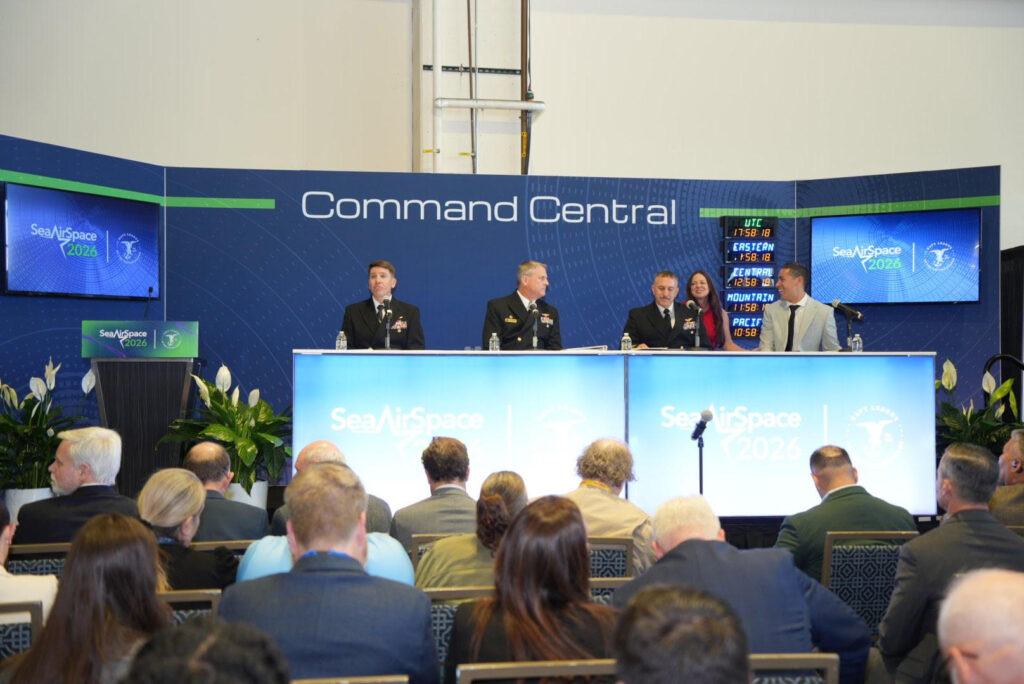
From left, NAVAIR Commander Vice Adm. John E. Dougherty IV; Rear Adm. Todd Evans, Commander, Naval Air Warfare Center Aircraft Division and chief engineer with NAVAIR; Vice Commander Capt. Joseph Hidalgo, Commander, Fleet Readiness Centers (COMFRC); and Paul McGinty, director of the NAVAIR Rapid Capability Cell speak during the panel “Start with the Fleet: Readiness, Capability, Speed,” Tuesday afternoon at the Sea-Air-Space 2026 Exposition.
From Naval Air Systems Command, Apr 21, 2026
NATIONAL HARBOR, Md. — NAVAIR personnel kicked off Tuesday at Sea-Air-Space Exposition 2026 with “Start with the Fleet: Readiness, Capability, Speed,” a panel led by NAVAIR Commander Vice Adm. John E. Dougherty IV, who was joined by Rear Adm. Todd Evans, Commander, Naval Air Warfare Center Aircraft Division and chief engineer with NAVAIR; Vice Commander Capt. Joseph Hidalgo, representing Commander, Fleet Readiness Centers (COMFRC); and Paul McGinty, director of the NAVAIR Rapid Capability Cell.
Dougherty began the panel by laying out NAVAIR’s highest priorities.
“[At NAVAIR we need] to develop our people and grow our culture, to provide the readiness the warfighter needs, to accelerate delivery capability and to elevate our game,” he said. “It’s about focusing on outcomes and transforming our business so that we find better ways to deliver capability to the warfighter. We have got to go quicker, and I know that we’re ready to meet that challenge.
“What we can’t forget is that we’re in a great power competition, and in great power competition, the bar for our performance is raised. The threat is moving very fast in terms of capability and capacity and it’s up to us to get after that.”
Dougherty said the Navy is currently transitioning to Portfolio Acquisition Executive organizations. Under the PAE model, leaders are empowered —and expected— to make disciplined, data-driven trade-offs across cost, schedule and performance, with a clear priority on time to field. Additionally, each PAE is responsible for understanding and actively managing the industrial base supporting their portfolio, including production capacity, supply chain risk and opportunities to expand or diversify suppliers. He encouraged industry partners to “be aggressive” in engaging with naval aviation programs during this time to get input and ideas and keep the production engines running.
“This is a generational opportunity for this industry,” Evans said regarding the acquisition changes. “This industry has been around for a long time, and we’ve always heard ‘go fast, just go faster.’ That is tremendously difficult to change. In order to enable that change, we also have to change.”
“What gets me excited about it for naval aviation is [having a] single, accountable owner,” Dougherty said. “[The way we are organized now] there isn’t really one leader that’s in charge of making sure that all our capability roadmaps are aligned, that we’re putting our dollars toward the most consequential outcomes as we deliver warfighting capability. I like ‘portfolio’ over ‘program management.’ It’s about integrated warfighting capability. I think there is real opportunity in this PAE structure to drive better warfighting outcomes across all our programs with a capability mindset.”
Hidalgo highlighted the depot work done at the various Fleet Readiness Center sites, where most maintenance and sustainment work is performed on aircraft components and engines.
“We’re here for the warfighter,” Hidalgo said. “COMFRC is one of the sole source places where we can do work that gets it to the warfighter right there on the flight line. We get direct calls back from the warfighters because we’re on the flight line and working hand in hand with industry to help us improve anything we need to get done in a more expeditious timeframe.”
“On the rapid capability front, we’re trying to connect those [warfighter] needs and capabilities to true outcomes,” McGinty said, outlining what the NAVAIR Rapid Capability Cell is focused on. “We’re partnering with industry early, bringing our resources to bear with the expertise we have resident in our warfare centers and working within the systems and authorities we have … I think the key to this is really connecting to those problem sets, really trying to break down the barriers between what the warfighter needs and what we are asking industry to do and pin us all up in that space together to get after it.”
In response to a question about what keeps the panelists up at night, Dougherty said he knows that there is someone in NAVAIR who knows how to do things better.
“I don’t know it, but they do, and I need to get that information,” he said. “I believe that good ideas come from the heart of the organization. Our people are our most important asset. We have a world-class workforce here at NAVAIR. They’ve got fantastic ideas. I worry that there’s a lot more of that for us to tap into.”
“I want to make sure we are taking care of our people, making sure that they are adequately trained, that they have the equipment they need, and have the components [for aircraft],” Hidalgo said. “The people that we have at FRC are driving to get readiness to the warfighter. That is one of the things that keeps me up at night, making sure we have the things ready for the warfighter.”
When asked how NAVAIR is changing the contracting process in order to speed projects along, Dougherty said the organization is always “looking for ways to accelerate that timeline.”
“Our contracts team on the government side does pretty good on hitting their timelines. The ask that I would have for industry is to hit the timelines and get proposals back Negotiations can take too long, for sure, so there’s room for improvement.”
Dougherty said industry is needed now to help with current needs as well as any coming future fight.
“That future fight is maybe not so distant, if you look at the geopolitics in the world,” he said. “I would double-down on my message of urgency and double-down on the message that we have many operational needs. I need to connect you to those operational needs better and I want your thoughts.
“We’re in great power competition and we intend to win. And we’re going to get after it with you.”
Coast Guard’s sole heavy icebreaker returns home following Antarctic deployment
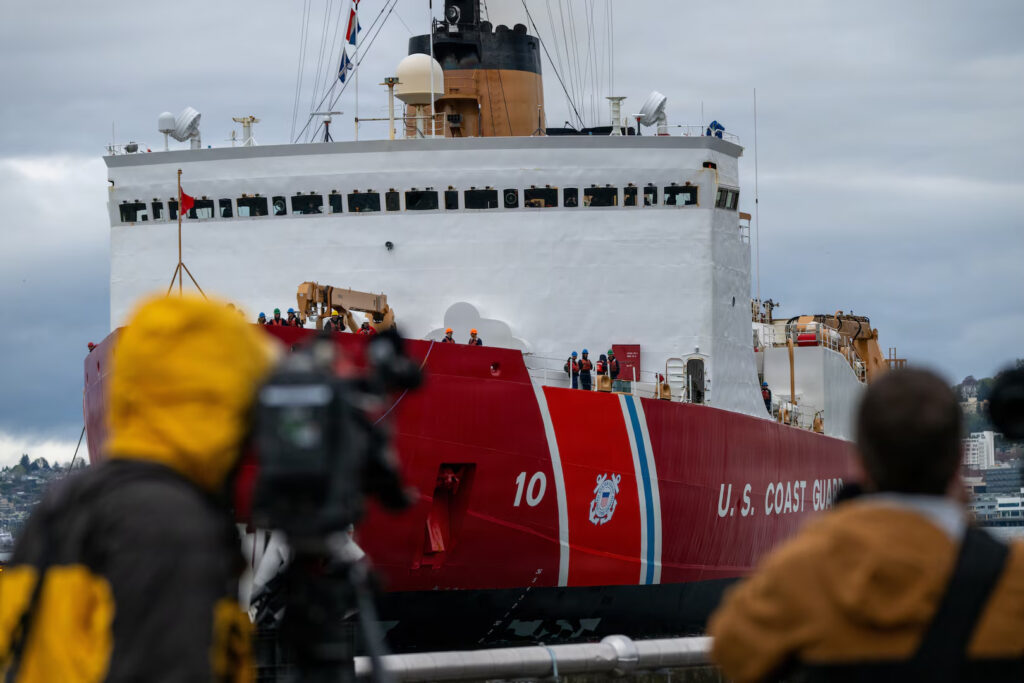
U.S. Coast Guard Cutter Polar Star (WAGB 10) returns to Coast Guard Base Seattle following a 146-day Antarctic deployment in support of Operation Deep Freeze, April 13, 2026. The Polar Star is the United States’ only surface asset capable of providing year-round access to both Polar Regions. It is a 399-foot heavy polar icebreaker commissioned in 1976, weighing 13,500 tons and is 84 feet wide with a 34-foot draft. (U.S. Coast Guard photo by Petty Officer 2nd Class Briana Carter)
From U.S. Coast Guard Northwest District, April 20, 2026
SEATTLE — The crew aboard the U.S. Coast Guard Cutter Polar Star (WAGB 10) returned home to Seattle on April 13, following a 146-day Antarctic deployment in support of Operation Deep Freeze (ODF) 2026.
Polar Star departed Seattle Nov. 20, traveling more than 20,000 nautical miles through ocean and ice to complete ODF 2026. ODF is the logistical support provided by the Department of War to the U.S. National Science Foundation (NSF)-managed U.S. Antarctic Program (USAP).
While spending 62 days in Antarctic waters, Polar Star conducted multiple mission sets before departing the Antarctic region on March 8. The cutter established a seven-mile-long channel through fast ice up to eight feet thick and escorted a fuel tanker and container vessel through the ice in McMurdo Sound in order to resupply McMurdo Station. Polar Star also escorted a tug with the 330-foot-long NSF Discovery Pier for install at McMurdo Station to provide a semi-permanent means to moor ships for the USAP.
Polar Star supported the Commission for the Conservation of Antarctic Marine Living Resources (CCAMLR) by completing sighting reports of fishing vessels in the Ross Sea. Through monitoring and documenting fishing activity, the crew helped ensure compliance with established regulations, protecting marine resources and U.S. interests in one of the world’s most remote and scientifically significant regions.
“Coming back to Seattle following deployment for the first time in a few years means a lot, especially considering how we spend over 300 days away from homeport each year,” said Rasnake. “So, we’ll enjoy the warm embrace of friends and family for a minute before quickly getting back after the hard work of maintaining this cutter and getting it ready for next year’s mission.”
While transiting home, Polar Star’s crew made port calls in Hobart, Australia and Wellington, New Zealand. While in Hobart, Polar Star hosted international visitors from CCAMLR, Australian Armed Forces and Australian Government, including the commanding officer of Navy Headquarters Tasmania.
In Wellington, the U.S. Embassy hosted a reception aboard Polar Star, where David Gehrenbeck, U.S. Chargé d’Affaires to New Zealand, hosted 40 distinguished guests, including, the Honorable Judith Collins, the 43rd Minister of Defence. Other guests and Embassy representatives from over ten different countries joined Polar Star’s crew members to acknowledge the U.S. and New Zealand’s joint support of the Antarctic Treaty and celebrate Polar Star’s first visit to Wellington since December 2021.
Commissioned on Jan. 17, 1976, Polar Star is the nation’s only active heavy icebreaker and has served as a cornerstone of U.S. presence in the polar regions. For five decades, the cutter has executed missions ranging from Antarctic resupply and search and rescue to environmental protection and national defense.
“Polar Star reminded us of her age on more than one occasion this deployment, but as always, this crew demonstrated the cutter’s unique capability by working together through each challenge and finding a way to get the job done,” said Capt. Jeff Rasnake, Polar Star’s commanding officer.
Polar Star will be completing its annual dry dock maintenance over the summer, ensuring it is ready to meet all mission requirements for ODF27. The critical work completed during these periods ensures that U.S. maintains year-round access to the high latitudes.
HII Accelerates ROMULUS USV Program: Four New ROMULUS Vessels Head into Production
From HII, April 21, 2026
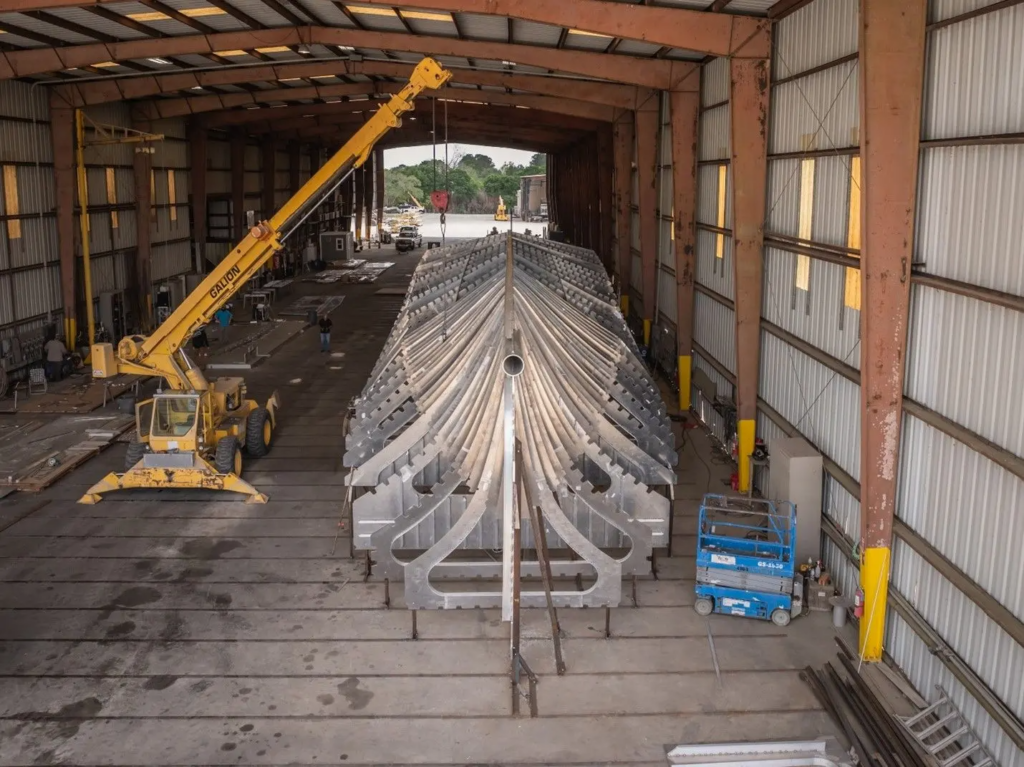
NATIONAL HARBOR, Md., (April 21, 2026) —HII (NYSE: HII), America’s largest military shipbuilder and global leader in autonomous maritime systems, announced today plans for the production of four ROMULUS 151 vessels to be built by Breaux Brothers Enterprises in Louisiana in addition to the ROMULUS 151 currently under construction.
The announcement signals a rapid shift toward initial production, as HII pushes to accelerate delivery of autonomous surface capability to the U.S. Navy and allied partners.
“ROMULUS represents a shift in how we deliver unmanned capability to the fleet,” said Andy Green, executive vice president of HII and president of HII’s Mission Technologies division. “We are combining shipbuilding experience, scalable manufacturing, proven autonomy, and strong industry partnerships to move quickly from prototype to operational deployment. The progress we are seeing today — including these initial production vessels — reinforces that we are on a disciplined path to deliver meaningful capability at speed and at scale.”
Built for Scale and Mission Flexibility
ROMULUS is a modular family of AI-enabled USVs designed to meet current and emerging requirements for the U.S. Navy, U.S. Marine Corps, joint forces, and allied partners. The platform supports a wide range of missions, including intelligence, surveillance and reconnaissance (ISR), mine countermeasures, strike operations, counter-unmanned systems, and the launch and recovery of unmanned underwater and aerial vehicles.
Engineered for serial, repeatable production, ROMULUS vessels combine endurance, global reach, and modular adaptability. The family is designed to scale across multiple vessel sizes while maintaining a common manufacturing approach and autonomy baseline.
Advancing a Scalable Manufacturing Model
The ROMULUS program is supported by HII’s expanding unmanned vessel production ecosystem, including its assembly facility at Breaux Brothers Enterprises and the High-Yield Production Robotics (HYPR) initiative. Together, these efforts are designed to transition unmanned vessel production from prototype builds to high-rate, digitally enabled manufacturing.
In March, HII released a plan outlining an expanded ROMULUS assembly facility at Breaux Brothers and introduced HYPR as HII’s initiative to apply industrial robotics and digital quality systems to unmanned platform manufacturing. By integrating automation, advanced tooling, and standardized workflows, HII aims to reduce unit costs, improve schedule predictability, and enable program-level delivery of unmanned systems aligned with evolving fleet needs.
“ROMULUS is engineered from the outset for scale,” Green added. “By aligning design, autonomy, and manufacturing, we are creating a production model that delivers predictable outcomes and positions us to meet growing demand for autonomous maritime capability.”
GA-ASI Selected by U.S. Navy PMA-281 for Collaborative Autonomy Mission Planning and Debrief Project
From General Atomics Aeronautical Systems Inc.
CAMP Initiative To Demonstrate Advanced Mission Planning, AI Model Management, and Autonomy Workflows
SAN DIEGO – 20 April 2026 – General Atomics Aeronautical Systems, Inc. (GA-ASI) was selected by the U.S. Navy’s Naval Air Systems Command (NAVAIR) PMA-281 for the Collaborative Autonomy Mission Planning and Debrief (CAMP) project. The initiative will advance mission planning capabilities, AI model management, and autonomy workflows for Autonomous Combat Platforms, culminating in a government sponsored demonstration targeting a 2026 Fleet exercise.
The project will demonstrate the potential for extending PMA-281’s Mission Planning Software framework to support advanced autonomy operations, including behavioral tasking, Rules of Engagement (ROE) configuration, AI decision thresholds, and comprehensive mission debrief capabilities. The effort integrates with the Navy’s Joint Digital Autonomy Range (JDAR) and Joint Simulation Environment (JSE) to enable rapid testing and validation of autonomy-enabled mission profiles.
“This project demonstrates our commitment to delivering integrated mission planning and debrief solutions that enable effective human-autonomy teaming,” said Mike Atwood, Vice President of Advanced Programs for GA-ASI. “By advancing collaborative autonomy workflows and leveraging government simulation environments, we’re providing the Navy with critical capabilities to rapidly test, evaluate, and deploy autonomous systems for complex operational missions.”
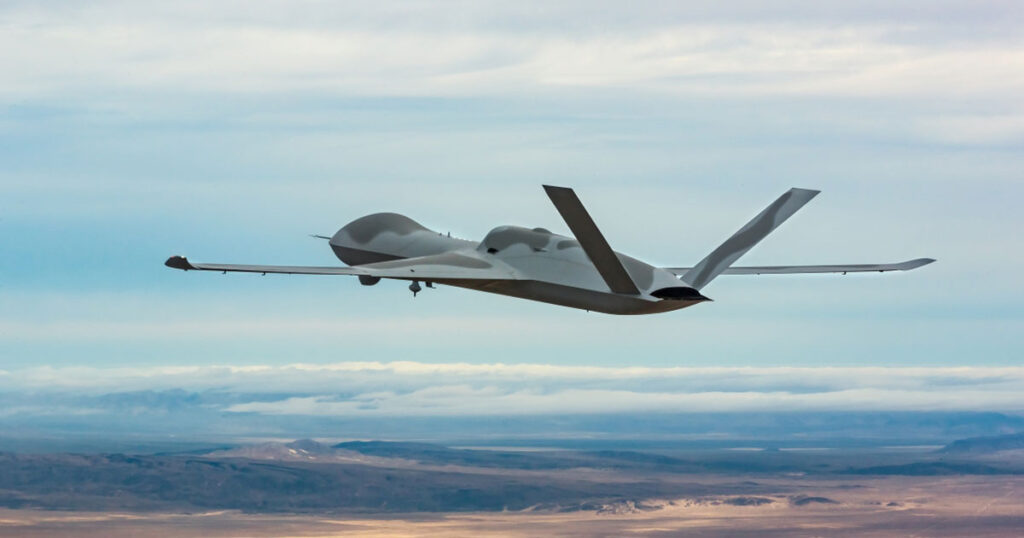
The CAMP project will demonstrate key capabilities on the MQ-20 Avenger® platform equipped with Government Reference Implementation (GRI) autonomy, Electronic Warfare (EW), and Infrared Search and Track (IRST) payloads. The initiative emphasizes robust communications architectures featuring Link 16, Tactical Targeting Network Technology (TTNT), and Starlink satellite communications for resilient command and control.
In addition, this project advances operationally scalable autonomy by delivering enterprise mission planning, trusted AI governance, and accelerated digital validation to support Autonomous Combat Aircraft. By integrating secure AI model lifecycle management, human-centered oversight, and high-fidelity simulation environments, GA-ASI is enabling rapid capability iteration and seamless human-autonomy teaming.
The planned demonstration will showcase advanced mission planning and debrief capabilities for autonomy-enabled operations, integrated with Navy systems and evaluated in complex contested operational scenarios. The effort will highlight how mission planning software enables behavioral tasking, Electronic Warfare (EW) and Infrared Search and Track (IRST) employment, combat air patrol, and target engagement, with execution and coordination demonstrated via Link 16-enabled platforms including F/A-18 Super Hornets.
Lockheed Martin to Integrate PAC-3 MSE Into Aegis Combat System
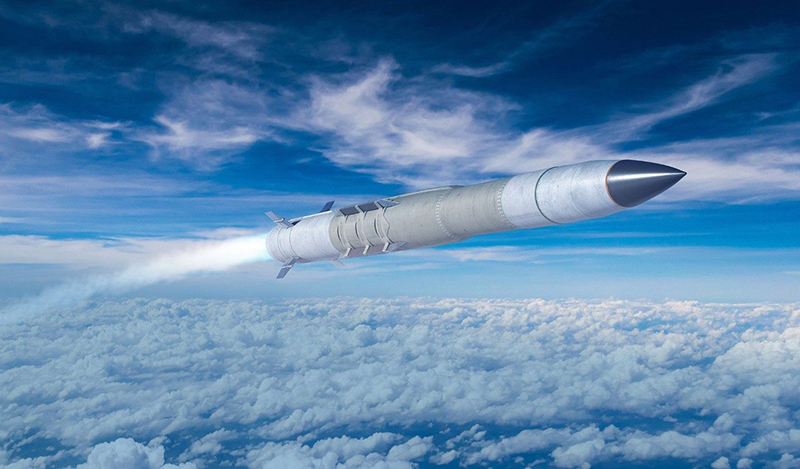
An artist’s rendering of a PAC-3 MSE in flight. Credit: Lockheed Martin
The U.S. government announced a contract with Lockheed Martin (Booth 901) for the development, integration and testing of PAC-3 Missile Segment Enhancement (MSE) into the Aegis Combat System for the first time.
This move places the U.S. Navy among the ranks of PAC-3 MSE users around the world, including the U.S. Army and 16 partner nations, giving Navy warships “a razor-sharp defense that helps keep America’s freedom of the seas unchallenged,” the company announced Tuesday.
PAC-3 MSE is a key integrated air and missile defense capability for the U.S. and its allies. The U.S. government awarded Lockheed Martin a multi-million contract to continue munitions acceleration efforts and deliver a record number of PAC-3 MSE interceptors in 2026. This new contract builds on the framework agreement Lockheed Martin signed with the U.S. Department of Defense to rapidly accelerate the production and delivery of PAC-3 MSE.
“By integrating PAC‑3 MSE’s capabilities into Aegis, the Navy is taking a decisive step forward in defending America’s fleet and our global interests against the most advanced threats,” Jason Reynolds, vice president and general manager of Lockheed Martin IAMD, said in a press release. “Lockheed Martin is driving the innovation behind this effort — bringing together advanced, combat‑proven systems in new ways to accelerate capability and deliver a decisive advantage in maritime defense.”
Before receiving government funding, Lockheed Martin said it made internal investments to integrate the system with Aegis and the MK41 Vertical Launching System.
“This integration further expands the capability of Aegis to engage missile threats at multiple layers, enabling a more comprehensive and effective defense against evolving threats, ensuring the warfighter has the strategic advantage,” Chandra Marshall, vice president of Lockheed Martin Multi-Domain Combat Solutions, said in the release.
PAC-3 MSE hit-to-kill technology that delivers exponentially more kinetic energy on the target than can be achieved with blast fragmentation mechanisms, the company said. PAC-3 MSE is combat proven against ballistic and cruise missiles as well as hypersonic and airborne threats.
White House Commitment to Shipbuilding Sparks Industry Optimism
From left, Amber Stein, Kari Wilkinson, Ben Bordelon and George Whittier speak at the panel on Navy and Coast Guard shipbuilding. Credit: Brett Davis
By Erika Fitzpatrick, Seapower Correspondent
The White House’s commitment to multiyear investments in new Navy ships, including the recently announced fiscal 2027 request of $65.8 billion for the Golden Fleet Initiative, is spurring changes in the shipbuilding industrial base, industry leaders said April 21 at Sea-Air-Space 2026.
The Pentagon’s $1.5 trillion budget request would provide the Navy with more than $377 billion, a 24% increase over fiscal 2026 levels. Industry players, including George Whittier, CEO of Wisconsin-based Fairbanks Morse Defense (Booth 1337), a U.S. Navy warship service and component provider and supplier, welcomed the budget details, also released Tuesday.
“Critically, the Pentagon said it would request multiyear authorities from Congress for long-running programs,” Whittier said in a statement. “Much of the nation’s strategic manufacturing capacity and technical expertise is in our maritime supplier base. This is exactly the kind of certainty the shipbuilding industrial base needs to thrive.”
Although shipbuilding manufacturers and suppliers now have confidence that pledged investments in sea power have a better chance to happen, Congress decides appropriations for the coming fiscal year, which begins Oct. 1, 2026.
Nevertheless, the budget visibility is helping manufacturers prepare for the massive workload in the pipeline, said Kari Wilkinson, executive vice president and president of Newport News Shipbuilding at HII (Booth 923).
“We have built submarine and carriers for many years, and we know we can do this,” she said. “We expect our customers to be demanding.
“It’s fundamentally about people,” Wilkinson said, including hiring, training and equipping personnel to fulfill orders. That requires changing the narrative that shipbuilding careers are unstable and distributing the workload to suppliers.
“It is a different landscape today than it has been, but that isn’t daunting,” she said. “This is a team sport.”
The administration’s emphasis on schedule — rapid delivery — is pushing shipbuilding to ramp up planning and workforce development, concurred Ben Bordelon, president and CEO at Louisiana-based Bollinger Shipyards.
Bollinger supports shipbuilding for the Navy and U.S. Coast Guard, which also received a cash infusion from Congress that’s led to a boom in icebreaker and cutter shipbuilding.
With these investments, the industry can now say to its talent pipeline that shipbuilding is sustained, profitable work. “We’re selling a career versus a job,” Bordelon said.
Saildrone Unveils Spectre High-speed USV for Naval Operations
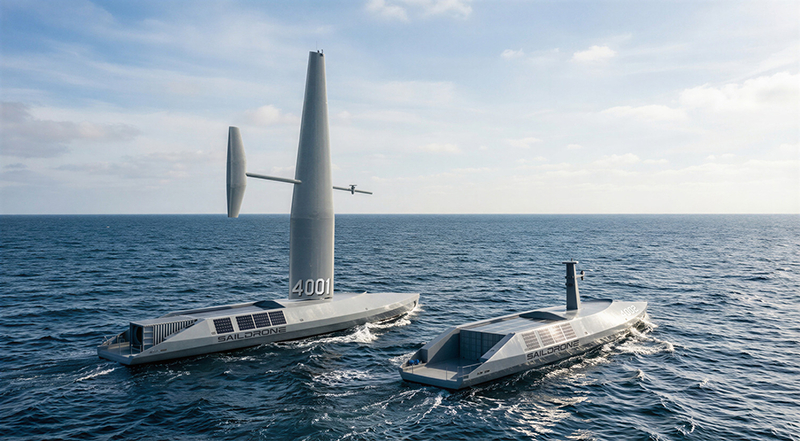
A rendering of the Saildrone Spectre with its sail, and in sail-less kinetic strike mode. CREDIT: Saildrone
Saildrone (Booth 1315) today released the design of the Saildrone Spectre, a 52-meter-long, 250-ton uncrewed surface vessel intended for anti-submarine warfare.
Capable of speeds up to 30 knots, Spectre is the largest, fastest, and most capable Saildrone platform to date, the company said. It leverages the endurance and reliability of the company’s Saildrone wing system but is designed to operate without the wing for kinetic strikes.
“Spectre is the result of 25 years of continually pushing the boundaries of what’s possible. A unique design evolved through the hard lessons of operational experience in the real world,” said Richard Jenkins, Saildrone’s founder and CEO. “Spectre is not a craft hurriedly readied to meet a particular RFP, but diligently evolved over multiple years to meet the operational requirements of our customers and fill critical capability gaps in the ASW domain.”
Cruising at 25 knots with a 25,000 kilogram payload, Spectre has a range of 3,280 nautical miles in flat water and 2,790 nautical mile range in Sea State 4 head sea. Controllable-pitch propellers enable efficient operations throughout the speed range, allowing for controllable acoustic signatures and near-silent slow-speed operations for tow bodies such as thin-line towed arrays and variable-depth sonar systems.
The concealed payload deck provides room for containerized payloads, ranging from dual 40-foot containers, up to five 20-foot containers, or a mixture of configurations. Spectre’s maximum payload capacity is over 70 tons.
“Spectre represents a transformative step forward for naval surface warfare. Its endurance, payload flexibility, and seamless integration with advanced missile and sonar systems will give the U.S. Navy a persistent, low observable USV that can deliver on a spectrum of maritime missions,” said Paul Lemmo, vice president and general manager, sensors, effectors, and mission systems at Lockheed Martin. “Lockheed Martin is proud to partner with Saildrone to bring this capability to life, and we look forward to demonstrating its power at upcoming on-water, live fire demonstrations.”
Spectre performance has been verified and tested at Force Technologies’ tow tank in Copenhagen, Denmark, the company said.
Spectre is constructed from aluminum and will be built in Wisconsin at the Fincantieri system of shipyards, which has the capacity to manufacture five Spectre vessels per year. Construction will begin shortly, with the first vessel undergoing sea trials in early 2027.
The 43-meter (140-foot) composite Saildrone Wing will be manufactured by American Magic Services (AMS) at the American Magic High Performance Center in Pensacola, Florida. Building on its experience serving the marine, aerospace, and defense industries, AMS is capable of producing five Spectre wings per year.
Working with Lockheed Martin, Saildrone has ensured Spectre design compatibility with a wide range of Lockheed Martin payloads, including thin-line towed arrays such as the TB29 and the Mk70 VLS Launcher. Spectre can carry two Mk70s and is capable of deploying the CAPTAS-4 variable-depth sonar system from Thales/AAC.
Department of the Navy Releases FY27 Budget Request
From the Department of the Navy, April 21, 2026
WASHINGTON, D.C. – The Department of the Navy released their Fiscal Year (FY) 2027 President’s Budget request today focused on restoring American maritime dominance with a total Navy topline of $377.5B, an increase of more than $70.B compared to last year. This generational investment in our future fleet represents a 23% growth over the previous fiscal year and signals a clear commitment to the Golden Fleet Initiative, modernization and readiness.
The budget request is part of President Trump’s historic $1.5T topline provided for national defense submitted to Congress on April 3, that ensures the United States is able to maintain the world’s most powerful and lethal naval force.
“This is a strategy-driven budget,” said Secretary of the Navy John Phelan. “It’s not about business as usual – it’s about making generational investments in real, usable capability for our warfighters.”
This year’s budget submission was guided by Secretary of the Navy John Phelan’s priorities: strengthening shipbuilding and the maritime industrial base; fostering a more adaptive, accountable, and innovative warfighter culture; and investing in the health, welfare and training of our people. The submission was also guided by Chief of Naval Operations Adm. Daryl Caudle’s Fighting Instructions and the Commandant of the Marine Corps Gen. Eric Smith’s Force Design Strategy.
This budget request will launch a new age of American shipbuilding, bolster munitions supplies, enhance operational strength, sustain the force, and improve the health, welfare and training of our people and their families.
“This is the money that builds the future fleet,” said Deputy Assistant Secretary of the Navy for Budget Rear Adm. Ben Reynolds. “It funds the acquisition of 34 new ships and 123 new aircraft, directly translating dollars into the steel and systems that will guarantee our maritime dominance for decades to come.”
To usher in America’s Golden Fleet Initiative, the Department of the Navy is requesting $65.8 billion in shipbuilding funds to buy 18 battle force ships and 16 auxiliary ships. This funding will allow the Navy to purchase one Columbia-class submarine, two Virginia-class submarines, one FF(X) Frigate, one Arleigh Burke-class Destroyer, one America-class Amphibious Assault ship, one San Antonio-class Amphibious Transport Dock, six Medium Landing Ships, two John Lewis-class Oiler Tankers, two Submarine Tender Replacements, and one Ocean Surveillance Ship. The request also continues incremental funding for the third Ford-class carrier, CVN 80, and fourth Ford-class carrier, CVN 81. This request will also support the design and development of the Navy’s premier large surface combatant, the BB(X) Battleship.
For aircraft procurement, the Department’s request of $34.4B billion supports the purchase of 123 aircraft, including 47 F-35s, 12 P-8As, 6 E-2Ds, 22 CH-53Ks, 3 MQ-25s, 5 MQ-9As, as well as modification, spares, and support equipment. This request doubles F-35 procurement and accelerates aircraft procurement to ensure a robust industrial base.
The weapons procurement request of $22.6 billion includes significant investments in a variety of munitions including Standard Missiles, Tactical Tomahawk Missiles, and Patriot PAC-3s.
The ground procurement request for the Marine Corps for $6.3B supports units across the Fleet Marine Force, investing in key warfighting capabilities including 32 Navy/Marine Expeditionary Ship Interdiction System (NMESIS) Launchers and 103 Naval Strike Missiles (NSM) that enhance precision fires capabilities and contribute meaningfully to the joint kill chain. The request also invests in ground based air defense, supporting 42 Marine Air Defense Integrated Systems (MADIS) and 16 Medium Range Intercept Capability (MRIC) systems along with 410 missiles that enable Marines to maneuver and operate under complex aerial threat conditions.
“This budget significantly enhances our ability to be a globally responsive, resilient, and lethal naval expeditionary force in readiness,” said Gen. Smith. “It delivers much-needed investment in amphibious warships and medium landing ships, strengthens our aviation combat element, increases our magazine depth, and takes care of our strategic advantage, our Marines. Together, these investments ensure we are ready to fight today and modernizing to meet the demands of the future fight.”
Fostering a More Adaptive, Accountable, and Innovative Warfighter Culture
The budget request invests smartly in our capabilities – acquiring the new FF(X) frigate to take-on lower priority missions and freeing up our advanced destroyers for high-end combat. Additionally, we are investing heavily in unmanned platforms to provide a strategic hedge and multiply our force. We are making key investments in the Golden Fleet Initiative that will revitalize America’s maritime industrial base and restore American maritime dominance.
The Department of the Navy includes a $150B request for operations and maintenance, emphasizing our desire to drive platform readiness towards an 80% combat surge ready posture by reducing maintenance delays and applying a disciplined focus across manning, training, modernization and sustainment. This investment supports training, deployment costs and flying hours to ensure our Sailors and Marines remain the most lethal force in the world.
Ensuring the United States maintains the world’s most innovative and capable military, the Department of Navy is investing $36.2B in research and development. The Department will continue to focus on a major modernization effort across the force, from strategic deterrence recapitalization to air and surface warfare posturing to counter emerging threats and maintain our decisive edge
“The FY27 budget request is a definitive order to shift our Navy from a peacetime posture to a warfighting footing,” said Caudle. “Operationalizing the Foundry, Fleet and Fight framework, we are ensuring our Sailors have the lethal platforms and the delegated autonomy they need to win decisively. We are not just observing the security environment; we are actively shaping it with credible tailored forces to ensure peace through strength.”
Investing in the Health, Welfare and Training of our People
Our greatest asset continues to be the extraordinary men and women of our United States Navy, Marine Corps and civilian workforce. This budget request dedicates $70.1B to military personnel, funding an overall military end strength of 621,500 Sailors and Marines, and dedicating $2.5B to enhance the quality of life for our Sailors and Marines so that they can continue providing the expeditionary force necessary to promote and protect America’s interests at home and abroad. The Department of the Navy is taking direct action to improve unaccompanied housing, deliver healthier and more accessible dining, and expand child and youth programs.
Media may direct further queries to the U.S. Navy Office of
FRCSW Produces First Organic Super Hornet to Undergo Block III Modifications
From Fleet Readiness Center Southwest, April 21, 2026
SAN DIEGO — At Fleet Readiness Center Southwest (FRCSW), innovation is not a buzzword, it’s a daily commitment to the warfighter. That commitment reached an historic milestone with the command’s completion of its first fully organic F/A-18 Super Hornet Block III modification. For the first time, U.S. military artisans and engineers executed the complete upgrade in-house, marking a pivotal step forward in naval aviation readiness.
This achievement represents more than technical success. It is the culmination of deliberate planning, disciplined execution, and the relentless professionalism of FRCSW’s workforce and partners.
The Block III modification is the third and most advanced phase of the Service Life Modification (SLM) effort for the Super Hornet fleet. FRCSW and its partners approached this modernization in three phases:
Structural Service Life Extension – Expanding aircraft life from 6,000 to 10,000 flight hours.
Block III upgrades to deliver network and mission enhancements.
Block III Advanced Cockpit System (ACS) and comprehensive avionics modernization.
This phased approach allowed FRCSW artisans and engineers to refine processes, sequence work efficiently, and reduce cost and turnaround time (TAT).
The Block III configuration includes significant upgrades including:
Advanced Cockpit System (ACS) installation
A new large-area cockpit display
Comprehensive avionics suite upgrades
Enhanced aircraft networking capability
Electrical system modernization to support upgraded systems
The ACS fundamentally transforms the cockpit. Aircraft that once relied on older display technology are now equipped with modern, user-friendly large screen interfaces. This upgrade allows pilots to fully leverage the aircraft’s enhanced capabilities, bringing this fourth-generation platform significantly closer to fifth-generation performance at a fraction of the cost.
The modification does not extend the physical life of the aircraft, that is the purpose of the structural SLM, but it ensures the avionics and mission systems remain tactically relevant for the aircraft’s service life. Together, structural SLM and Block III modernization form a comprehensive life-extension and capability-enhancement strategy that ensure the Super Hornet will remain a key component of the Navy’s carrier air wing well into the 2040s.
The Block III modification is one of the most complex avionics upgrades undertaken at FRCSW in over a decade.
The process essentially guts the cockpit:
Removal and replacement of structural components
Extraction and reinstallation of wiring and fiber optics
Installation of new displays and interface systems
Electrical upgrades to support modern avionics
The governing Technical Directive (TD) is more than 350 pages long and provides extremely specific instructions, down to how wiring and fiber optics must be routed and secured. FRCSW artisans and engineers work closely with Boeing engineers to ensure every step meets current safety and quality standards.
As aircraft are disassembled, teams frequently discover unplanned issues, corrosion, worn wiring, or legacy damage that must be corrected before modernization can proceed. This adds layers of complexity to an already intricate effort and highlights the need for, and success of, the command partnerships with Boeing and F/A-18 and EA-18G Program Office (PMA-265).
One hurdle the team had to overcome in this effort was that multiple trades must operate in tight cockpit spaces:
Avionics technicians
Sheet metal mechanics
Ordnance specialists
Engineers and quality assurance personnel
Thus, sequencing becomes a carefully choreographed process. One team’s delay affects all others. Planning is everything.
Any new process at FRCSW must meet the same uncompromising safety and quality standards as legacy programs. The command’s award-winning safety culture underpins every evolution. That culture was recently recognized with the CNO Aviation Safety Award: https://www.dvidshub.net/news/495142/frcsw-wins-cno-aviation-safety-award
For 3 years, FRCSW has successfully executed structural SLM repairs. Now, with full Block III capability added to its portfolio, the command has evolved into a complete modernization hub for the Super Hornet fleet.
With a current turnaround time of approximately 365 days, reduced from an originally projected 15 months, the command has already exceeded expectations and cost performance has been equally impressive coming in well under budget, all while maintaining strict adherence to safety and quality standards.
Looking ahead, all fleet squadrons are transitioning to full Block III configuration thus this workload will continue well into the 2030’s.
While this milestone represents the first fully organic execution of the modification, it is not accomplished in isolation. FRCSW collaborates closely with PMA-265, which oversees F/A-18 programs, and maintains coordination with Boeing during TD validation and engineering alignment.
The true strength of this program lies in integration, engineering, logistics, supply, manufacturing, quality assurance, and production operating as a unified team across the command and the COMFRC enterprise.
This is not simply maintenance. It is modernization. It is capability generation. It is combat readiness built by American hands. FRCSW employees have supported naval aviation for more than a century. From early aviation maintenance efforts to today’s advanced Super Hornet and Growler modernization programs, the workforce has consistently delivered.
Integrating structural life extension with full avionics transformation, FRCSW has ensured that the F/A-18 Super Hornet remains lethal, relevant, and deployable well into the future.