Cubic Awarded NAVAIR Contract to Provide Secure Live Virtual and Constructive Advanced Training Environment (SLATE)
From Cubic Defense, 29 May 2024
SAN DIEGO – Cubic Defense,the world’s leading provider of advanced air combat training, is awarded a contract modification with Naval Air Systems Command (NAVAIR) to provide engineering support services for a demonstration in Guam, Valiant Shield ‘24.
“Cubic’s SLATE technology injects synthetic entities and computer-generated forces to bring the realism of the pacing multi-domain high-end threat environment to the live cockpits and operator consoles,” said Paul K. Averna, VP and GM, Advanced Training Solutions for Cubic Defense. ”Tomorrow’s fight will be different, and our Joint and Coalition operators deserve a fully vetted system that ensures combat readiness today.”
29 May Red Sea Update
From U.S. Central Command, May 29, 2024
TAMPA, Fla. – At approximately 8:40 p.m. (Sanaa time) May 28, U.S. Central Command (USCENTCOM) forces successfully destroyed two missile launchers in an Iranian-backed Houthi-controlled area of Yemen.
Separately, at approximately 11:30 p.m. (Sanaa time) on May 28, Iranian-backed Houthis launched two anti-ship ballistic missiles (ASBM) from Houthi-controlled areas of Yemen into the Red Sea. There were no injuries or damage reported by U.S., coalition, or commercial ships.
The following day, between 1:26 and 1:38 a.m. (Sanaa time) on May 29, USCENTCOM forces successfully destroyed two uncrewed aerial systems (UAS) over the Red Sea launched from an Iranian-backed Houthi controlled area of Yemen.
It was determined these missiles and systems presented an imminent threat to U.S., coalition forces, and merchant vessels in the region. These actions are taken to protect freedom of navigation and make international waters safer and more secure.
Defense Department Conducts Recover, Repair Mission for Temporary Pier After Heavy Sea States
May 28, 2024 | By Matthew Olay, DOD News
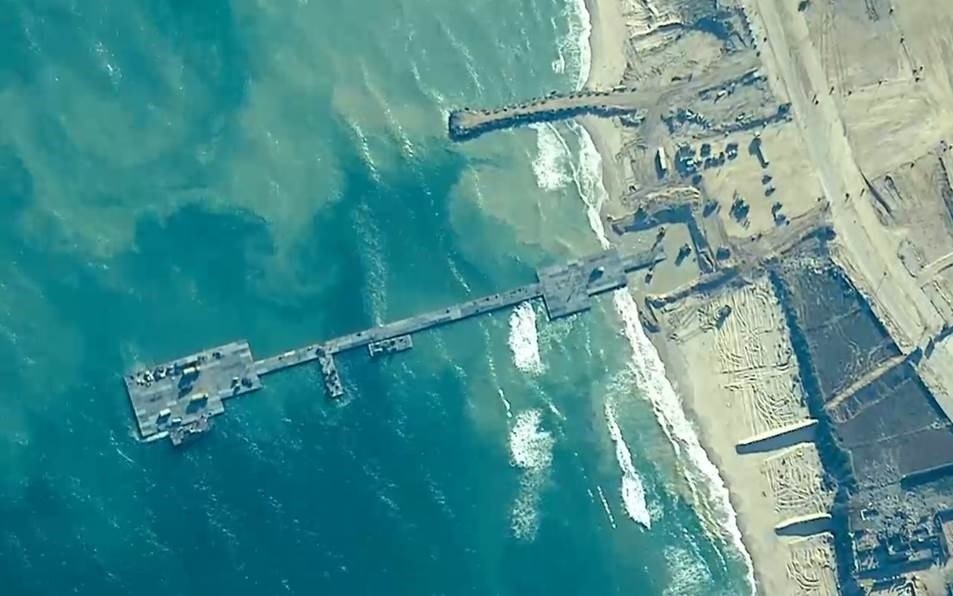
The Defense Department is working to recover three of four vessels associated with its temporary humanitarian aid pier in Gaza after rough seas caused the motorized sections to run aground May 25, the Pentagon announced today.
The vessels, which are part of U.S. Central Command’s Joint Logistics, Over-the-Shore capability — and which are used to stabilize the trident pier — broke free from their anchors and beached ashore after suffering a loss of power, Deputy Pentagon Press Secretary Sabrina Singh told reporters.
“As of today, one of the Army vessels that was beached on the coast of Israel near Ashkelon has been recovered. The second vessel that was also beached near Ashkelon will be recovered in the next 24 hours, and the remaining two vessels that were beached near the Trident pier are expected to be recovered in the next 48 hours,” Singh said, adding that the Israeli Navy is assisting in the recovery efforts.
The U.S is not authorizing any American boots on the ground in Gaza, and that is not hindering efforts to recover the three vessels, Singh said.
In addition to the JLOTS vessels running aground, high sea states and a North African weather system caused a portion of the trident pier to detach from the pier that is currently anchored into the Gaza coastline earlier today, resulting in damage to the trident pier and necessitating a need to rebuild and repair it, Singh said.
Over the next 48 hours, U.S. forces will remove the pier from its anchored position on the coast and tow it back to the Israeli coastal city of Ashdod to begin repairs.
“The pier proved highly valuable in delivering aid to the people of Gaza. Thus, upon completion of the pier repair and reassembly, the intention is to re-anchor the temporary pier to the coast of Gaza and resume humanitarian aid to the people who need it most,” Singh told reporters, noting that, to date, over 1,000 metric tons of aid has been delivered to the pier for humanitarian organizations to distribute to Palestinians.
Meanwhile, Singh said, U.S. forces are currently loading humanitarian aid into vessels in Cyprus for transport to Gaza so that it can roll out immediately once the repaired pier is reattached to the shoreline in the coming days.
First announced March 8 of this year after President Joe Biden called on the military to lead the temporary humanitarian aid operation, the JLOTS pier became operational May 17.
When questioned as to whether the pier is durable enough to complete its mission, Singh said DOD is optimistic.
“I think, unfortunately, we had a perfect storm of high sea states and … this North African weather system also came in at the same time, creating not an optimal environment to operate the JLOTS,” Singh said.
“But we believe that — given the time of year — we will be able to re-anchor this pier; and it will be able to be operational; and, hopefully, weather conditions won’t hinder it anymore.”
When further pressed as to whether the pier, which is budgeted at roughly $300 million, is worth the cost, Singh reiterated how much aid the pier was able to get into Gaza in just a short period of time.
“… t’s pretty important for the people that are suffering right now — that are in a dire humanitarian situation — to get whatever aid they can, by whatever means,” Singh said.
“We want to do everything possible to help; and it is our forces — our men and women — who are running toward the problem and doing everything they can to find a solution.”
Centcom anticipates repairs to the pier to take approximately one week.
Coast Guard Cutters Sea Dog, Sea Dragon Decommissioned in St. Marys, Georgia
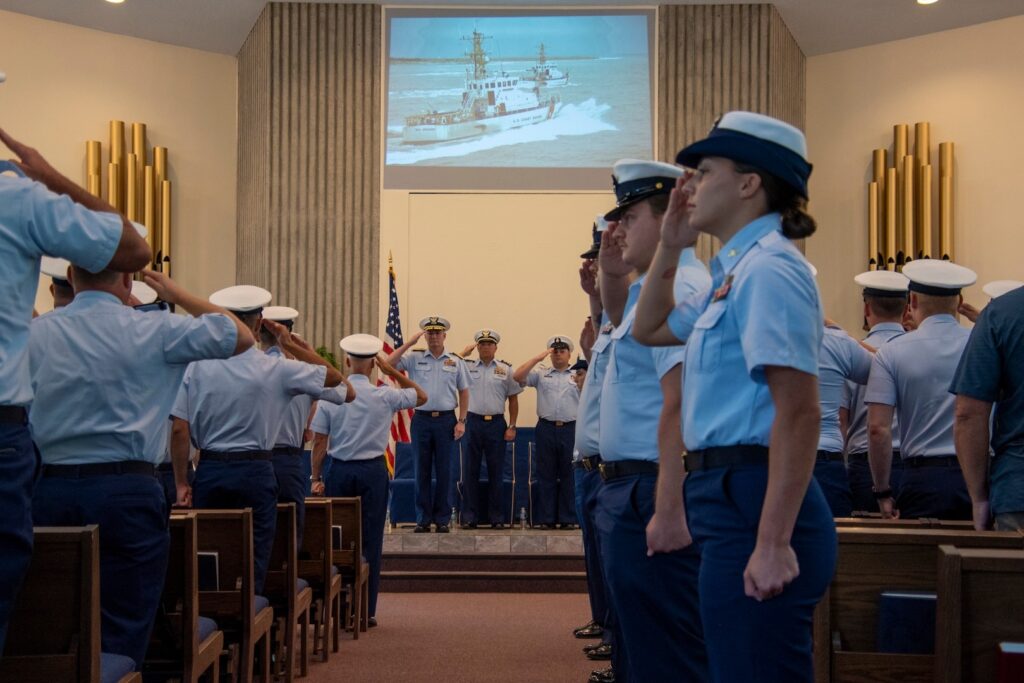
Coast Guard members salute during the playing of the national anthem during a decommissioning ceremony for the Coast Guard Cutters Sea Dog and Sea Dragon in St. Marys, Georgia, May 29, 2024. (U.S. Coast Guard photo by Petty Officer 1st Class Ryan Dickinson)
U.S. Coast Guard 7th District,M ay 29, 2024
JACKSONVILLE, Fla. — The Coast Guard decommissioned the U.S. Coast Guard cutters Sea Dog (WPB 87373) and Sea Dragon (WPB 87367), Wednesday, during a ceremony in St. Marys, Georgia.
Rear Adm. Douglas M. Schofield, Coast Guard District Seven commander, presided over the ceremony honoring the years of service the Sea Dog and Sea Dragon provided to the nation.
The Sea Dog and Sea Dragon were 87-foot marine protector-class cutters assigned to Coast Guard Maritime Force Protection Unit Kings Bay in the Coast Guard’s Seventh District.
Maritime Force Protection Unit Kings Bay is designed to support the Navy’s efforts to provide anti-terrorism and force protection for its Ohio-class ballistic missile submarines and to assist in meeting its Presidential mandates for ballistic weapon security.
The Sea Dragon was commissioned in January 2008 and the Sea Dog was commissioned in July 2009.
“The men and women of the cutters Sea Dog and Sea Dragon, past and present, have exemplified unwavering professionalism and dedication, safeguarding our nation’s waters and supporting critical defense missions,” said Capt. David Vicks, commanding officer of Maritime Force Protection Unit Kings Bay. “I extend my profound gratitude to these courageous crews as we honor their steadfast service.”
Following the decommissioning ceremony, the cutters will be transferred to Marine Corps Air Station Cherry Point.
The Coast Guard cutters Sea Devil (WPB 87368) and Sea Fox (WPB 87374) have relocated from Bangor, Washington, to replace the Sea Dog and Sea Dragon.
Red Sea Update
Red Sea Update
From U.S. Central Command, May28, 2024
TAMPA, Fla. – Between 12:05 p.m. and 1:40 p.m. (Sanaa time) May 28, Iranian-backed Houthis launched five anti-ship ballistic missiles (ASBM) from Houthi-controlled areas of Yemen into the Red Sea. M/V Laax, a Marshall Island flagged, Greek owned and operated bulk carrier, reported being struck by three of the missiles, but continued its voyage. There were no injuries reported by U.S., coalition, or merchant vessels.
Separately, between 10:04 a.m. and 1:30 p.m. (Sanaa time), U.S. Central Command (USCENTCOM) forces successfully destroyed five uncrewed aerial systems (UAS) over the Red Sea, launched from an Iranian-backed Houthi-controlled area of Yemen.
It was determined the systems presented an imminent threat to merchant vessels in the region. These actions are taken to protect freedom of navigation and make international waters safer and more secure for U.S., coalition, and merchant vessels.
Coast Guard Crew Offloads $468 Million Worth of Cocaine in San Diego
From U.S. Coast Guard 11th District, May 28, 2024
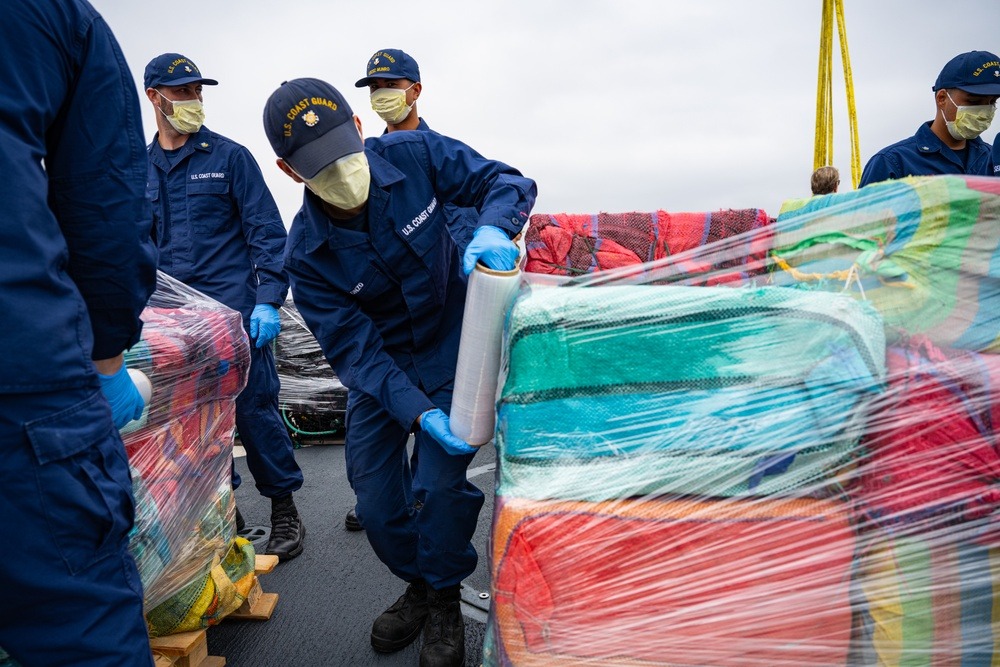
SAN DIEGO — The crew of Coast Guard Cutter Munro (WMSL 755) offloaded approximately 33,768 pounds of cocaine, with an estimated value of $468 million, on Tuesday in San Diego.
The offload is a result of eight separate suspected drug smuggling vessel interdictions or events off the coasts of Mexico and Central and South America by the Coast Guard Cutter Munro in February and March.
“The crew put in an incredible amount of work over very long hours, and I couldn’t be prouder of them,” said Capt. Rula Deisher, commanding officer, Coast Guard Cutter Munro. “Their dedication and grit goes to show that Munro is one of the best national security cutters in the fleet, and we are committed to keeping the country safe by stopping illegal drugs before they hit the street. There isn’t a better crew to serve with and I’m honored to have spent my final patrol with them.”
Multiple U.S. agencies, including the Departments of Defense, Justice, and Homeland Security, collaborate in the effort to combat transnational organized crime. The Coast Guard, Navy, Customs and Border Protection, FBI, Drug Enforcement Administration, and Immigration and Customs Enforcement, along with allied and international partner agencies, all play a role in counter-narcotic operations. The fight against drug cartels in the Eastern Pacific Ocean requires unity of effort in all phases, from detection and monitoring to interdictions and criminal prosecutions.
“I am extremely proud of this crew and their dedication to disrupting organized crime in the Eastern Pacific,” said Rear Admiral Andrew Sugimoto, commander, Coast Guard District 11. “The effort put in while interdicting more than 33,000 lbs of cocaine in a few weeks’ time is unparalleled. We will continue our commitment to stopping these criminals and the vast amounts of drugs they attempt to bring into our country.”
The fight against drug cartels in the Eastern Pacific Ocean requires unity of effort in all phases, from detection, monitoring and interdictions to criminal prosecutions by international partners and U.S. Attorneys’ Offices in districts across the nation. The law enforcement phase of counter-smuggling operations in the Eastern Pacific Ocean is conducted under the authority of the Eleventh Coast Guard District, headquartered in Alameda, Calif. The interdictions, including the actual boardings, are led and conducted by members of the U.S. Coast Guard.
These interdictions relate to Organized Crime Drug Enforcement Task Forces (OCDETF) designated investigations. OCDETF identifies, disrupts, and dismantles the highest-level criminal organizations that threaten the United States using a prosecutor-led, intelligence-driven, multi-agency approach. Additional information about the OCDETF program can be found at https://www.justice.gov/OCDETF.
The Coast Guard Cutter Munro is the sixth Legend Class National Security Cutter, and is homeported in Alameda, Calif.
Common deployments include the entire Pacific Rim with port calls that may include San Diego, Kodiak, and Honolulu. Foreign destinations include countries like Mexico, Costa Rica, Panama, Guatemala, El Salvador, Ecuador, Japan and all of the Pacific Island Nations.
The Coast Guard Cutter Munro’s crew can operate in the most demanding open ocean environments, including the hazardous fisheries of the North Pacific and the vast approaches of the Southern Pacific, where significant narcotics trafficking occurs.
Austin: New Officers Ready to Lead in Complex World
May 24, 2024 | By Jim Garamone, DOD News
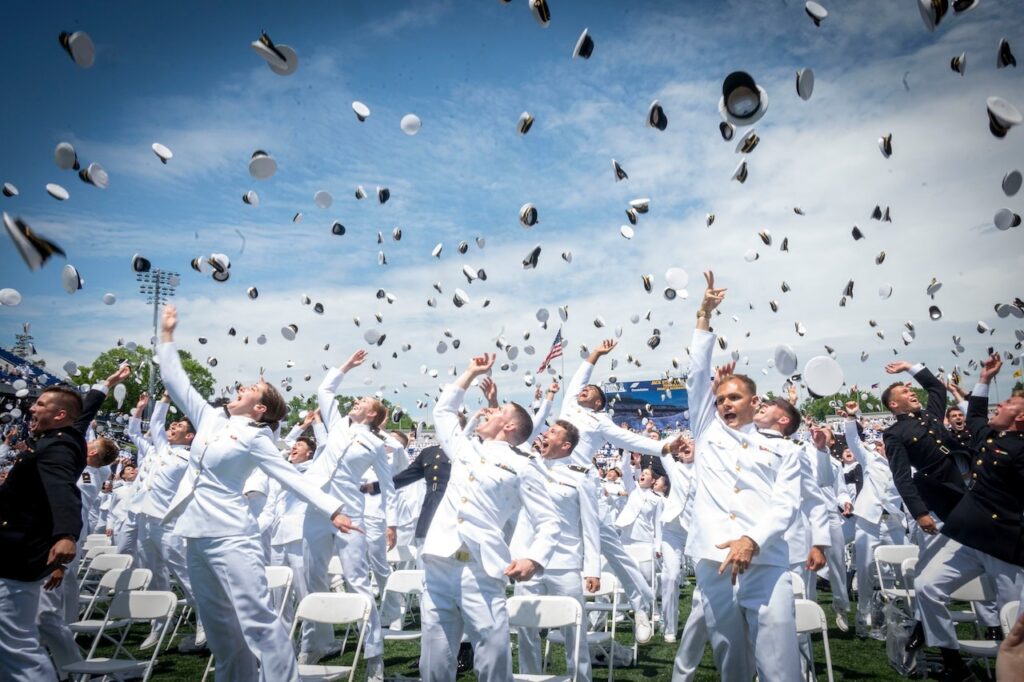
Even as new Navy ensigns and Marine Corps second lieutenants were being commissioned at the U.S. Naval Academy, U.S. Central Command issued a release on the latest threat to mariners in the Red Sea.
“At approximately 7:26 a.m. on May 23, Iranian-backed Houthis launched two antiship, ballistic missiles into the Red Sea,” the Centcom release said. “There were no injuries or damage reported by U.S., coalition or commercial ships. This continued malign and reckless behavior by the Iranian-backed Houthis threatens regional stability and endangers the lives of mariners across the Red Sea and Gulf of Aden.”
This is just one of the threats that the new officers will confront as they begin their military careers. It’s an example of the challenges these young officers must face as they join the ranks.
Secretary of Defense Lloyd J. Austin III told the graduating service members in Annapolis, Maryland, that their experiences at the Naval Academy have made them ready to confront the challenges of the future.
“I hope that you will see your years here as a long lesson in grit, adaptability and discipline,” the secretary said. “You put in the ‘reps and sets’ to succeed as a team and grow as teammates. And that’s what we’ll continue to expect of you — today and every day.
“The United States has the most capable Navy and Marine Corps in the world. … And make no mistake, we’re going to keep it that way. And you’re going to keep it that way.”
The graduating class arrived at the academy at the height of the COVID-19 epidemic. They had to adapt to a new learning situation and new procedures in order to graduate. “You have lived by your class motto: ‘From Adversity, Victory’,” Austin said. “And during a once-in-a-generation pandemic, that’s exactly what you showed.”
This is the second year in a row that Austin, a graduate of the U.S. Military Academy at West Point, New York, has officiated at the Naval Academy’s graduation. “Last year, I told the class of 2023 that they would learn that the lifeblood of the rules-based international order is actually seawater,” he said. “And over the past year, we’ve seen how important your mission is. Sea power is a beacon projecting American power and American principles to the world. Our allies and partners depend on it, and our foes and rivals envy it.”
The Navy and Marine Corps are upholding U.S. principles from the South China Sea to the Red Sea. Austin said the United States is seeing new challenges to the open world of rules, rights and responsibilities built with U.S. leadership after World War II. “In times like these, freedom of navigation rides on the bow waves of U.S. Navy ships,” he said. “As officers, you will help us increase American security and model American values worldwide. Our sailors and Marines let the U.S. military project power anywhere on Earth.”
The new ensigns and second lieutenants will join the services working to “secure the world’s sea lanes for the free flow of ships, commerce and ideas,” Austin said. “We’re depending on you to sail, fly and operate wherever international law allows. We’re depending on you to deepen old alliances and forge new friendships. And we’re depending on you to deter conflict and to keep the peace.”
Yes, the new officers must be prepared for war, but they must do more. Austin quoted Navy Adm. Arleigh Burke, who in 1961 said that Navy officers must “understand not only how to fight a war, but how to use the tremendous power which they operate to sustain a world of liberty and justice.”
“And you will be tested. Just ask last year’s graduates,” the secretary said.
The secretary spoke with ensigns of the class of 2023 who are aboard the USS Carney. “They helped defend freedom of navigation in the Red Sea,” he said. “They helped those in distress at sea. They helped degrade the capabilities of the Iranian-backed Houthi militia. And they helped shoot down missiles and UAVs . In fact, the Carney conducted 51 engagements in six months, which is the most direct Navy engagement with a foe since World War II.
“And the message of those ensigns on the Carney to the class of 2024 is this: You are ready.”
The secretary said they will lead sailors and Marines through tension and uncertainty.
WASHINGTON — The U.S. Coast Guard released the 2023 calendar year statistics on recreational boating incidents Tuesday, reporting a decrease in fatalities and incidents.
Fatalities fell by 11.3 percent to 564 from 636 in 2022, while overall incidents decreased by 4.9 percent from 4,040 to 3,844. Non-fatal injuries also declined by 4.3 percent from 2,222 to 2,126.
Alcohol continued to be the leading known contributing factor in fatal boating accidents in 2023, accounting for 79 deaths, or 17 percent of total fatalities.
The data also shows that in 2023:
The fatality rate was 4.9 deaths per 100,000 registered recreational vessels, a 9.3 percent decrease from last year’s rate of 5.4 deaths per 100,000 registered recreational vessels. (In 1971, when the Safe Boating Act was first passed, the rate was 20.6 deaths per 100,000 registered recreational vessels.)
Property damage totaled $63 million.
Operator inattention, improper lookout, operator inexperience, excessive speed and machinery failure ranked as the top five primary contributing factors in accidents.
“Boaters should remain vigilant on the water as most incidents occur when you might least expect them – in good visibility, calm waters and little wind,” said Capt. Amy Beach, Inspections and Compliance director. “The most frequent events involve collisions with other vessels, objects or groundings, which is why it is so important to keep a proper lookout, navigate at a safe speed, adhere to navigation rules and obey navigation aids.”
Deaths occurred predominantly on vessels operated by individuals who had not received boating safety instruction, accounting for 75 percent of fatalities. Open motorboats, personal watercraft and cabin motorboats were the vessel types most involved in reported incidents.
Drowning accounted for 75 percent of deaths, with 87 percent of those victims not wearing life jackets. The Coast Guard reminds boaters to wear serviceable, properly sized and correctly fastened life jackets.
“The most frequent event in fatal incidents involved events where people ended up in the water. A fall overboard, capsizing and cases where a person voluntarily departed a vessel accounted for over half of fatal incidents,” said Beach.
In 2023, there was a slightly higher percentage of deaths attributed to canoes and kayaks compared to other vessel types. The Coast Guard encourages boaters to check the weather and water conditions prior to getting underway.
The data in the report is based on incidents that resulted in at least one of the following criteria: death, disappearance, injury that required medical treatment beyond first aid, damages to the vessel(s) or other property that equaled or exceeded $2,000, or a loss of vessel.
In addition to wearing a life jacket and taking a boating safety course, the Coast Guard recommends all boaters attach the engine cut-off switch, get a free vessel safety check and boat sober.
“We praise our state and non-profit partners in boating safety who have endeavored to reduce casualties through educational outreach and enforcement,” said Beach.
The full 2023 Recreational Boating Statistics report is available to the public at http://www.uscgboating.org. The report can be found under the “Statistics” menu selection and the “Accident Statistics” submenu selection.
The Coast Guard encourages boaters to explore the website, which provides information about boating safety course providers, requesting a vessel safety check, what to put in a float plan, choosing the appropriate life jacket and more.
Bell Awarded Funding for Phase 1B of DARPA Speed and Runway Independent Technologies (SPRINT) X-Plane Program
Bell completes conceptual design phase for X-plane program
Fort Worth, Texas (May 28, 2023) Bell Textron Inc., a Textron Inc. (NYSE: TXT) company, has been down-selected for Phase 1B of Defense Advanced Research Projects Agency (DARPA) Speed and Runway Independent Technologies (SPRINT) X-Plane program. The SPRINT program intends to design, build, and fly an X-Plane, an experimental aircraft to demonstrate enabling technologies and integrated concepts necessary for a transformational combination of aircraft speed and runway independence for the next generation of air mobility platforms. In Phase 1A, Bell executed conceptual design review and will move into preliminary design efforts for the SPRINT X-plane.
“Bell is honored to be selected for the next phase of this revolutionary program and ready to execute preliminary design,” said Jason Hurst, executive vice president, Engineering, Bell. “We completed our initial risk reduction efforts with our sled test demonstration at Holloman Air Force Base, and we look forward to building on this success with our continued work with DARPA.”
Bell completed risk reduction testing at Holloman Air Force Base in late 2023, showcasing folding rotor, integrated propulsion, and flight control technologies. Bell is building on its investment in High-Speed Vertical Takeoff and Landing (HSVTOL) technology and past X-plane experience to inform the X-plane development for this program.
Bell’s HSVTOL technology blends the hover capability of a helicopter with the speed (400+ kts), range, and survivability of jet aircraft. Bell has developed high-speed vertical lift technology for more than 85 years, pioneering innovative VTOL configurations like the X-14, X-22, XV-3 and XV-15 for NASA, the U.S. Army and U.S. Air Force, and continues to build on its proven history of fast flight from the Bell X-1.
Red Sea Update
From U.S. Central Command, May 27, 2024
TAMPA, Fla. – At approximately 4 a.m. (Sanaa time) on May 27, U.S. Central Command (USCENTCOM) forces successfully destroyed one uncrewed aerial system (UAS) over the Red Sea, launched from an Iranian-backed Houthi controlled area of Yemen.
It was determined the UAS presented an imminent threat to merchant vessels in the region. These actions are taken to protect freedom of navigation and make international waters safer and more secure for U.S., coalition, and merchant vessels.
From U.S. Central Command, May 26, 2024
TAMPA, Fla. – At approximately 10 a.m. (Sanaa time) on May 26, U.S. Central Command (USCENTCOM) forces successfully destroyed one uncrewed aerial system (UAS) over the Red Sea, launched from an Iranian-backed Houthi controlled area of Yemen. It was determined the UAS presented an imminent threat to merchant vessels in the region. These actions are taken to protect freedom of navigation and make international waters safer and more secure for U.S., coalition, and merchant vessels.
From U.S. Central Command, May 25, 2024
TAMPA, Fla. – At approximately 3:50 a.m. (Sanaa time) on May 25, Iranian-backed Houthis launched two anti-ship ballistic missiles (ASBM) toward the Red Sea. There were no injuries or damage reported by U.S., coalition, or commercial ships.
This continued malign and reckless behavior by the Iranian backed Houthis threatens regional stability and endangers the lives of mariners across the Red Sea and Gulf of Aden.