ULA Signs Agreements with Bollinger Shipyards and Bristol Harbor Group Inc. to Design and Build New Ship to Carry Vulcan Rockets
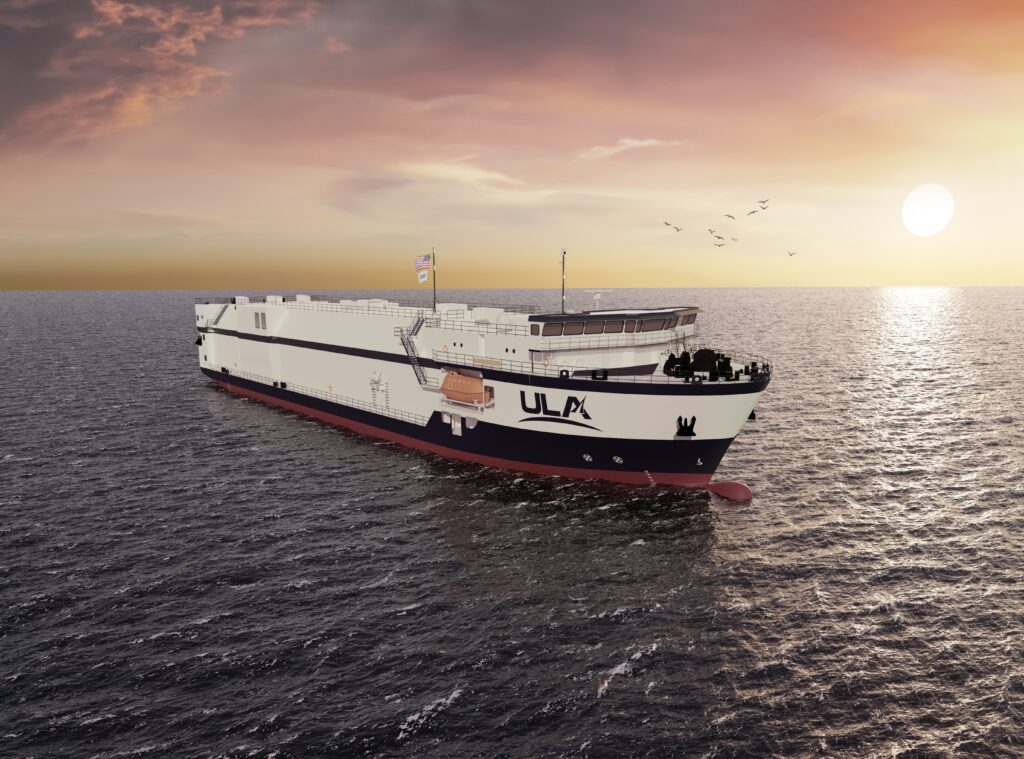
Centennial, Colo., May 8, 2024 – ULA announced that it has signed agreements with Bollinger Shipyards in Lockport, Louisiana and Bristol Harbor Group, Inc. in Bristol, Rhode Island, to design, oversee and build a new ship to transport Vulcan rockets from the factory in Decatur, Alabama to the launch sites at Cape Canaveral Space Force Station in Florida and Vandenberg Space Force Base in California. 
  
“We are pleased to be partnering with two of the best companies in the business to build our second transportation ship,” said Chris Ellerhorst, ULA’s vice president of the Kuiper Program. “Over the next year, ULA will be doubling its launch rate capacity in support of our Amazon customer and to ensure timely deliveries of the rockets to the launch site, we needed to build a second ship to support our transportation needs.” 
  
ULA awarded Bollinger Shipyards a contract to build a second roll-on/roll-off vessel classed for both ocean-going and river service. Construction has just begun on the 356-ft-long ship at Bollinger’s shipyard located in Amelia, Louisiana with delivery to ULA expected in January 2026. 
  
“We’re proud to continue our partnership with ULA in support of their increasing capabilities and launch capacity,” said Ben Bordelon, President and CEO of Bollinger Shipyards. “Bollinger’s skilled workforce is second to none when it comes to designing, engineering and building complex vessels to meet the challenges of today and tomorrow, and we look forward to beginning work on SpaceShip to ensure delivery of Vulcan rockets from the factory to the launch pad.” 
  
“ULA currently has its first ship called RocketShip that has been in service for decades and with this second ship called SpaceShip our maritime fleet will enable enterprise transportation capacity of four Vulcan launch vehicles across two voyages to either the East or West Coast,” said Ellerhorst. 
  
In addition, ULA has also hired Bristol Harbor Group, Inc., a well-respected naval architecture and marine engineering firm to oversee the design and build phases of the project with Bollinger. 
  
Vulcan is ULA’s next generation rocket, and it saw its successful inaugural launch in January 2024. Vulcan will provide high performance and affordability while continuing to deliver superior reliability and orbital precision for all our customers across the national security, civil and commercial markets. 
  
For Amazon, ULA’s new Vulcan rocket is contracted for 38 launches to support the majority of the deployment for the Project Kuiper constellation, which will provide fast, affordable broadband service to unserved and underserved communities around the world.   
 
All rockets are not created equal. ULA is the nation’s most experienced, reliable and accurate launch service provider delivering unmatched value, a tireless drive to improve, and commitment to the extraordinary. Vulcan’s inaugural launch marked the beginning of a new era of space capabilities and provides higher performance and greater affordability while offering the world’s only high energy architecture rocket to deliver any payload, at any time, to any orbit. 


Amphibious Combat Vehicles Mark Operational Debut in Pacific

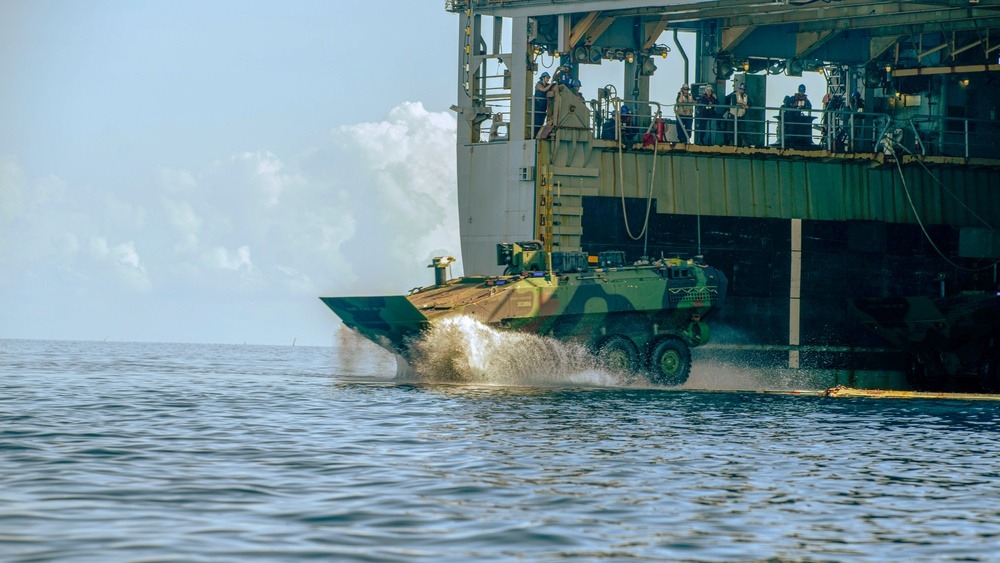
A U.S. Marine Corps amphibious combat vehicle attached to Alpha Company, Battalion Landing Team 1/5, 15th Marine Expeditionary Unit, splashes off the amphibious dock landing ship USS Harpers Ferry (LSD 49) during Exercise Balikatan 24 in Naval Detachment Oyster Bay, Palawan, Philippines, May 4, 2024. (U.S. Marine Corps photo by Lance Cpl. Peyton Kahle) 

From Communication Strategy and Operations, 15th Marine Expeditionary Unit 

May 6, 2024 

OYSTER BAY, Philippines – The 15th Marine Expeditionary Unit’s Amphibious Combat Vehicles Platoon conducted a live-fire, waterborne gunnery range exercise in Oyster Bay, Philippines, May 4, 2024, marking the first overseas employment of the ACVs during their initial deployment.  

The ACV platoon launched from aboard amphibious dock landing ship USS Harpers Ferry (LSD 49) before organizing into assault sections to close with and engage multiple shore-based targets, using their Remote Weapons Systems to control externally-mounted Mark 19 40 mm grenade machine guns.  

Section leaders within the ACV Platoon, which is part of Alpha Company, Battalion Landing Team 1/5, used the opportunity to coordinate and control the simultaneous fires of all of their section’s weapons while afloat to maximize the effect against the targets ashore. The ACV provides unique capabilities to the amphibious force, increasing command and control capability, mobility ashore, and a stabilized weapon system to support maneuver.  

“The hard work and dedication of our Marines is what made today’s training successful,” said U.S. Marine Corps Col. Sean Dynan, commanding officer of the 15th MEU. “Today’s training is a proof of concept across the Marine Corps for successful ACV employment in its intended environment.”  

The ACVs fired 40 mm training rounds that mark targets with orange chalk upon impact, instead of using high explosives in Oyster Bay.  

Upon completion of the gunnery exercise, the ACV platoon and all ACVs reembarked aboard Harpers Ferry.  

This waterborne gunnery range took place while the 15th MEU continues to participate in other bilateral training events during Exercise Balikatan 24, which incorporates several combined joint all-domain operation events that increase U.S.-Philippine bilateral interoperability and lethality across land, air, sea, space, and cyberspace domains. The exercise is a tangible demonstration of U.S. and Philippine cooperation to strengthen the Alliance in an increasingly complex Indo-Pacific security environment.  

The ACV Platoon, along with Alpha Co. and other elements from across the 15th MEU, deployed from Southern California March 19 aboard Harpers Ferry.  

During this first deployment, 15th MEU will continue to provide insights for ACV employment, embarkation, maintenance requirements, logistics trains, and integration with our allies and partners. These insights are vital for the service to ensure we continue to provide our Marines with the most operationally ready and capable platforms.  

The 15th MEU is under the command and control of Combined Task Force 76/3, employed by U.S. 7th Fleet to operate with allies and partners in preserving a free and open Indo-Pacific.  


Fairbanks Morse Defense Awarded Purchase Order for Common Rail Technology Retrofit Kit on San Antonio Class Ships

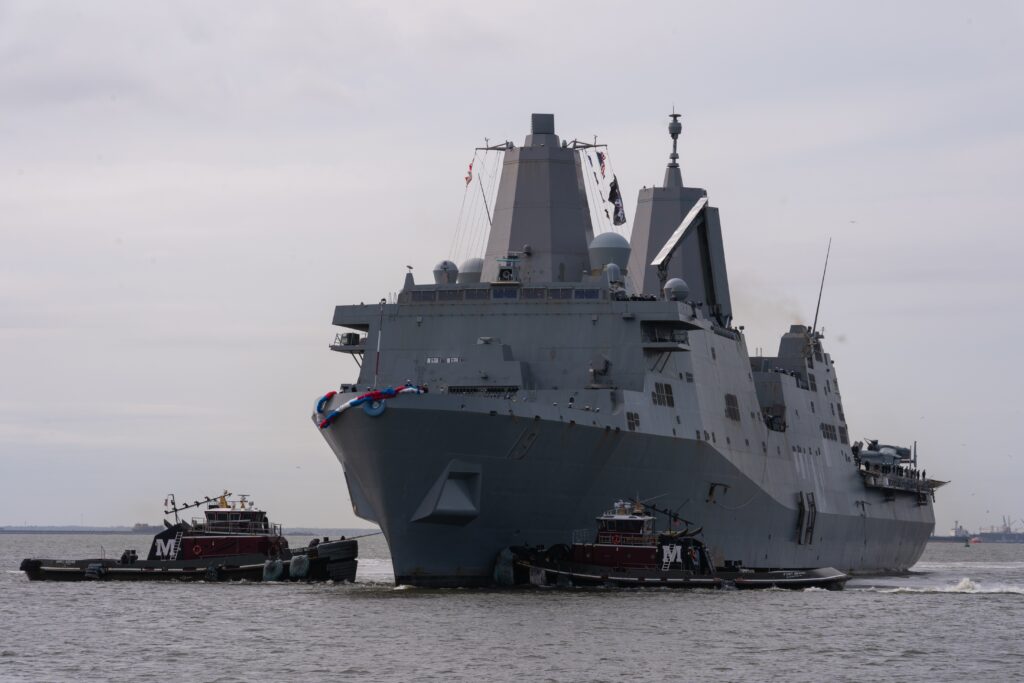
NAVAL STATION NORFOLK (March 22, 2024) The San Antonio-class amphibious transport dock ship USS Mesa Verde (LPD 19), assigned to the Bataan Amphibious Ready Group (ARG), returns to Naval Station Norfolk following an eight and a half-month deployment operating in the U.S. 5th and U.S. 6th Fleet areas of operation, March 22, 2024. (U.S. Navy photo by MC2 Manvir Gill)

Common rail technology improves engine efficiency, lowering fuel costs and carbon emissions 

BELOIT, Wis. – May 7, 2024 – Fairbanks Morse Defense (FMD), a portfolio company of Arcline Investment Management, has been awarded a purchase order by HII’s Ingalls Shipbuilding division to deliver an FM PC2.5 STC common rail technology retrofit kit, which will upgrade existing PC2.5 STC engines currently installed on U.S. Navy San Antonio-class amphibious transport dock ships. 

FMD’s common rail fuel injection technology maximizes performance through enhanced fuel efficiency and reduced carbon emissions. The high-pressure rail electronic fuel injection system can provide 5.5% fuel savings through improved fuel atomization with more complete and efficient combustion. 

FMD has already integrated common rail (CR) technology on engines that have been delivered to Ingalls Shipbuilding for the construction of multiple amphibious ships, including USS Richard M. McCool Jr. (LPD 29), USS Harrisburg (LPD 30) and USS Pittsburgh (LPD 31). The four engines being assembled for the future LPD-32 will also include common rail technology. 

“Fairbanks Morse Defense greatly values the trust that the U.S. Navy has placed in our power and propulsion systems, which is why our teams are continually working to deliver solutions that enhance performance and align with the Navy’s cost and sustainability goals,” said FMD CEO George Whittier. “We’ve already demonstrated the success of our common rail technology through sea trials for LPD 29, and we look forward to working with Ingalls Shipbuilding to retrofit the engines installed on LPD 17 through LPD 28 ships.” 

Manufactured in the U.S. and serviced worldwide, FMD’s proven marine technology is engineered for excellence to ensure reliable operation, extended asset lifecycles, and minimal downtime. In addition to delivering its power and propulsion systems, the defense contractor has repeatedly been selected by the Navy and Military Sealift Command to provide mission-critical marine technology, turnkey services, and OEM parts throughout their vessels. 


NOAA Breaks Ground on New Marine Operations Center Facility in Newport, Rhode Island

By Keeley Belva, NOAA, May 6, 2024 

Today, the Department of Commerce’s National Oceanic and Atmospheric Administration (NOAA) held a groundbreaking ceremony for a new facility on Naval Station Newport in Rhode Island that will serve as the future home of the NOAA Marine Operations Center-Atlantic

In December, the U.S. Navy, on behalf of NOAA, awarded $146,778,932 to Skanska USA to build the new NOAA facility. The design and construction of the facility is funded in part by the Inflation Reduction Act, the largest climate investment in history, as part of President Biden’s Investing in America agenda. 

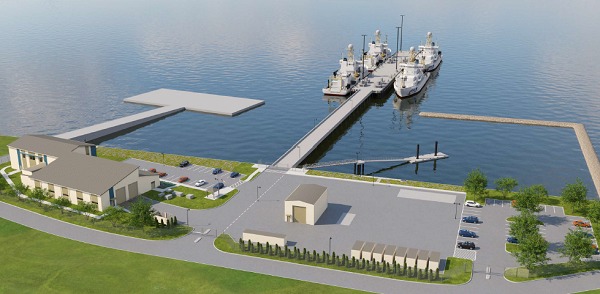
The facility will include a pier to accommodate four large vessels, a floating dock for smaller vessels, space for vessel repairs and parking and a building to be used for shoreside support and as a warehouse. Construction is anticipated to be completed in 2027. This project will operate under a Project Labor Agreement, consistent with EO 14063, issued by President Biden.  

“Thanks to the leadership of President Biden and the hard work of Rhode Island’s elected leaders we are making transformative investments in Rhode Island and all across the country,” said U.S. Secretary of Commerce Gina Raimondo. “President Biden’s Investing in America Agenda made it possible for NOAA to construct this new facility and make advances in critical climate and ocean research, while also cementing NOAA’s relationships with the Navy and the community of Newport. This facility will support science and a healthy economy well into the future. 

“I’m proud to say that this new facility has been designed to take future changes in our climate into consideration,” said NOAA Administrator Rick Spinrad, Ph.D.. “It will be LEED certified and will soon be the homeport for one of our newest, lower-emissions vessels, working towards the goal to minimize NOAA’s own impact on the environment.” 

“The new, state-of-the-art Marine Operations Center-Atlantic facility is critical to NOAA’s mission and delivering on our commitments to regional, international and other diverse partners,” said NOAA Corps Rear Admiral Nancy Hann, Director of the NOAA Commissioned Officer Corps and NOAA Marine and Aviation Operations. “Newport has always been a welcoming community to NOAA, and we are appreciative of the support from local, state and congressional leaders, as well as our mission partners at Naval Station Newport.” 

NOAA’s fleet of 15 research and survey ships are operated, managed and maintained by NOAA Marine and Aviation Operations. Ranging from large oceanographic research vessels capable of exploring the world’s deepest ocean, to smaller ships responsible for charting the shallow bays and inlets of the U.S., the fleet supports a wide range of marine activities, including fisheries surveys, nautical charting and ocean and climate studies. NOAA ships are operated by NOAA Corps officers and civilian professional mariners. 

“NOAA is the top scientific weather and oceans agency and I was pleased to help Rhode Island land MOC-A. Naval Station Newport’s location and the years of strategic federal investments we’ve made here are really paying off. Bringing NOAA’s premiere research fleet and Atlantic operations center to the Ocean State means hundreds of jobs for Rhode Island and a brighter future for our Blue Economy,” said Senator Jack Reed. 

“I am very pleased to celebrate the groundbreaking of NOAA’s new Atlantic Marine Operations Center right here in Rhode Island. The research conducted here will help us better understand the effects of climate change on the oceans and support job growth for years to come,” said Senator Sheldon Whitehouse. “This day would not have been possible without Senator Reed’s longtime dedication to relocating the Center to the Ocean State.” 

“The National Oceanic and Atmospheric Administration’s growing footprint in the Ocean State will be a massive jobs and economy boon for years to come,” said Congressman Gabe Amo. 

“The work to construct and staff the Marine Operations Center-Atlantic, right here on Naval 
Station Newport, will improve our national security — and non-military — operations. I am 
grateful for the leadership of Senators Jack Reed and Sheldon Whitehouse, Secretary Gina 
Raimondo, and all our state and local partners here today to break ground on new climate- 
resilient infrastructure that continues Rhode Island’s fight against climate change.” 

“Rhode Island is proud to be selected as the home of the new NOAA Marine Operations Center-Atlantic,” said Governor Dan McKee. “This facility will bolster our efforts to build climate-resilient infrastructure and support our blue economy. We’re grateful to President Biden, Secretary Raimondo and our congressional delegation for their support of this project which will put Rhode Islanders to work in good-paying jobs and pay dividends for generations to come.” 


May 6 Red Sea Update

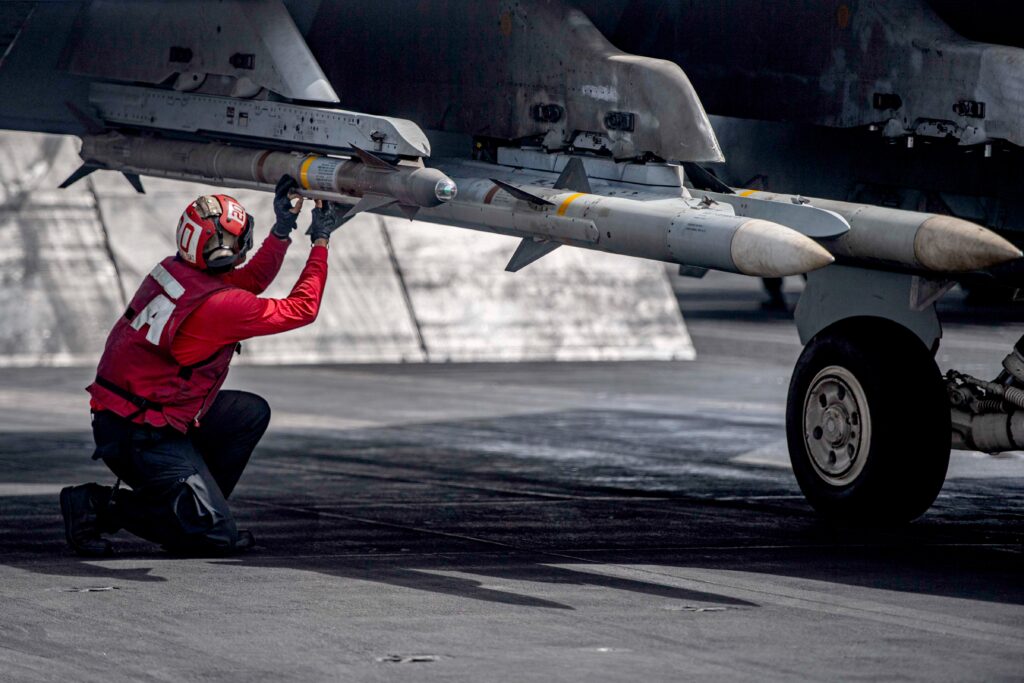
RED SEA (April 19, 2024) An Aviation Ordnanceman inspects ordnance on an F/A-18E Super Hornet, attached to the “Rampagers” of Strike Fighter Squadron (VFA) 83, during flight operations aboard the Nimitz-class aircraft carrier USS Dwight D. Eisenhower (CVN 69) in the Red Sea, April 19. (Official U.S. Navy photo)

From U.S. Central Command 

May 6, 2024 

TAMPA, Fla. – At approximately 10:47 a.m. (Sanaa time) on May 6, 2024, U.S. Central Command (USCENTCOM) forces successfully engaged and destroyed one uncrewed aerial system (UAS) launched by Iranian-backed Houthi terrorists over the Red Sea.   

It was determined the UAS presented an imminent threat to U.S., coalition forces, and merchant vessels in the region. These actions are taken to protect freedom of navigation and make international waters safer and more secure for U.S., coalition, and merchant vessels. 


USCG Cutter Diligence Returns Home Following Gulf of Mexico Fisheries Patrol and Response to Francis Scott Key Bridge Collapse

U.S. Coast Guard Atlantic Area, May 6, 2024 

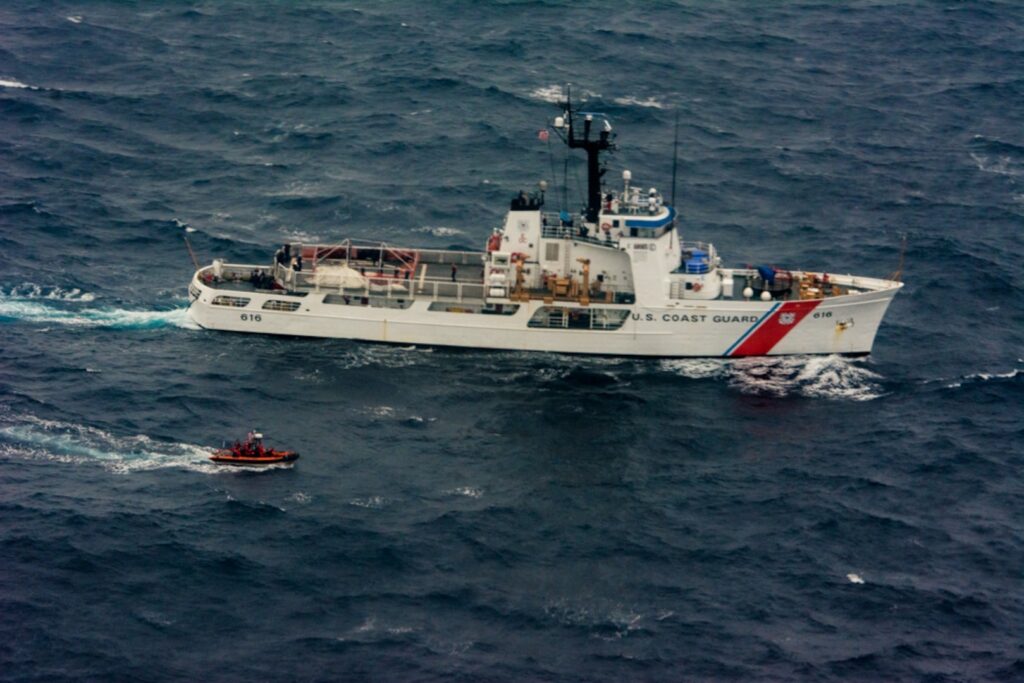
PENSACOLA, Fla. — The crew of Coast Guard Cutter Diligence (WMEC 616) returned to their home port in Pensacola April 27 after a two-month deployment spent conducting a living marine resources patrol in the Gulf of Mexico, undergoing a maintenance availability at the Coast Guard Yard in Baltimore, and later responding to the Francis Scott Key Bridge collapse. 

Diligence’s crew patrolled within the U.S. Coast Guard Eighth District area of responsibility, based in New Orleans, and supported Coast Guard Sector Corpus Christi’s efforts to counter illegal, unreported, and unregulated (IUU) fishing in U.S. territorial waters. 

At sea, Diligence’s law enforcement teams conducted boardings of U.S. fishing vessels to enforce federal laws and safety regulations. While operating along the International Maritime Boundary in the Gulf of Mexico, Diligence conducted a joint patrol with Mexican navy ship ARM Chichen Itza (PC 340), as well as a crew exchange. 

Diligence later proceeded to the Coast Guard Yard in Baltimore for a mission-essential maintenance availability to undergo repairs and preventative maintenance projects. 

During the transit to Baltimore, crew members spotted a boater in distress who had run out of fuel off the southern coast of Florida. Diligence provided initial rescue and assistance to the vessel. The boater was later towed safely back to land by a 45-foot Response Boat-Medium crew from Coast Guard Station Miami Beach. 

While undergoing repairs in the Coast Guard Yard, Diligence was one of the first Coast Guard units to respond to the Francis Scott Key Bridge collapse. In the first hours, Diligence’s small boat crews conducted search and rescue operations for missing persons and later provided a persistent presence to enforce a safety zone during salvage efforts. 

“The crew truly embodied the Coast Guard’s motto of ‘Always Ready’ this patrol by carrying out a variety of different missions,” said Cmdr. Nolan Cain, commanding officer of Diligence. “They responded quickly and decisively to a mariner in distress and supported response efforts in the wake of the Francis Scott Key Bridge collapse.”  

Diligence is a 210-foot, medium endurance cutter homeported in Pensacola with 78 crewmembers. The cutter’s primary missions are counterdrug operations, migrant interdiction, enforcement of federal fishery laws, and search and rescue in support of U.S. Coast Guard operations throughout the Western Hemisphere. 

For information on how to join the U.S. Coast Guard, visit GoCoastGuard.com to learn about active duty, reserve, officer and enlisted opportunities. Information on how to apply to the U.S. Coast Guard Academy can be found here


U.S. Navy Christens Newest Unmanned Surface Vessel, Vanguard

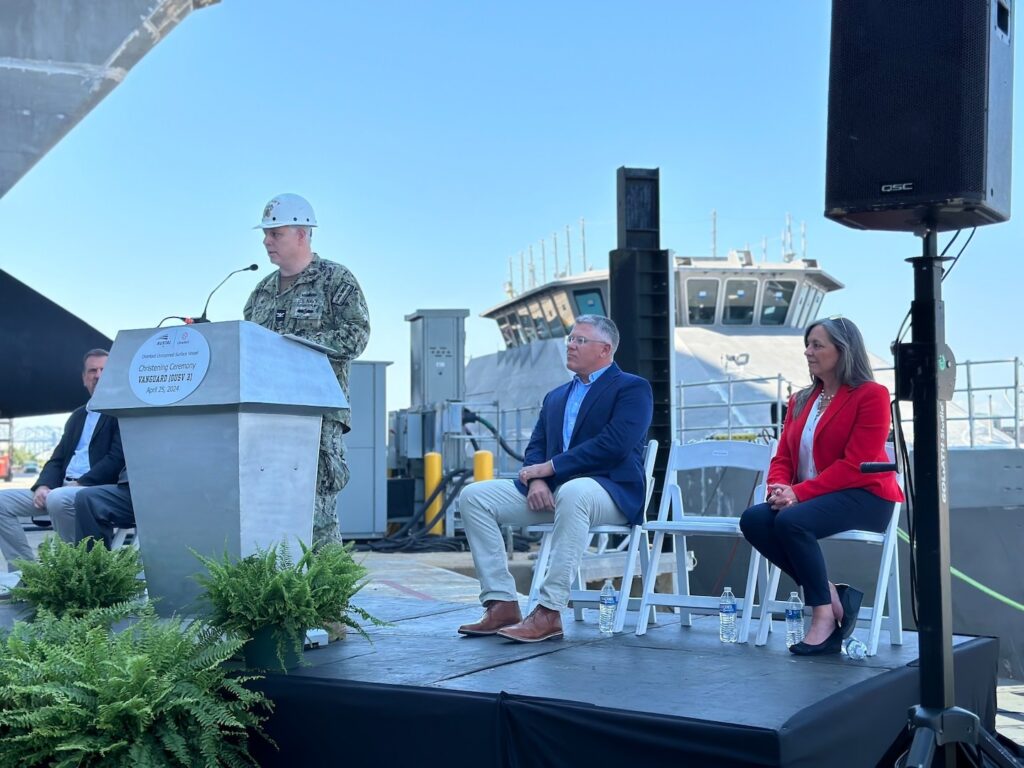
Capt. Scot Searles, Unmanned Maritime Systems Program Manager, addresses attendees during the Vanguard christening ceremony, 25 April. (U.S. Navy photo)

By Program Executive Office Unmanned and Small Combatants (PEO USC) Public Affairs, May 6, 2024 

WASHINGTON – The U.S. Navy christened Vanguard, the newest Unmanned Surface Vessel (USV) during a recent ceremony in Mobile, Alabama.   
  
Vanguard is the Navy’s first USV purpose-built from the keel up for unmanned operations and is part of the Pentagon-sponsored Overlord program.   

“Vanguard represents a significant leap forward in unmanned technology,” said Rear Adm. Kevin Smith, Program Executive Officer, Unmanned and Small Combatants. “The addition of Vanguard will enable the expansion of unmanned testing, experimentation and development, accelerating the transition to the hybrid fleet.”  

The Overlord program has played a pivotal role in accelerating and advancing the use of unmanned technology across the Navy. The Pentagon-funded effort launched the Navy’s experimentation with USVs and the resulting prototypes now fulfill a vital role in preparing the fleet to adopt USVs in operations. The knowledge and experience gained from the program is driving the development and requirements for the Navy’s future Large USV (LUSV) program. LUSVs are intended to be low cost, high endurance, modular USVs that can employ a variety of payloads. The USV prototypes are integral to the Navy’s mission of expanding unmanned operations and growing a manned-unmanned hybrid fleet.   

“Vanguard’s name could not be more fitting. The state-of-the-art technology she will employ is revolutionary and will be at the forefront of establishing new standards for our fleet,” said Capt. Scot Searles, Unmanned Maritime Systems program manager. “We are thrilled to achieve this important milestone and are looking forward to Vanguard leading the way as she enhances our nation’s naval power and strategic capabilities.”  

Austal USA and L3Harris jointly led the development and construction of Vanguard. Once outfitting and testing is complete, Vanguard will transit to San Diego and join sister ships Mariner and Ranger as part of the Navy’s Unmanned Surface Vessel Division One (USVDIVONE), responsible for the tactical development of USV concepts of operations and training.   

PEO USC designs, develops, builds, maintains and modernizes the Navy’s unmanned maritime systems; mine warfare systems; special warfare systems; expeditionary warfare systems; and small surface combatants.  


Royal Navy Enhances Underwater Capabilities with Acquisition of Additional HII Advanced Unmanned Vehicles

From HII 

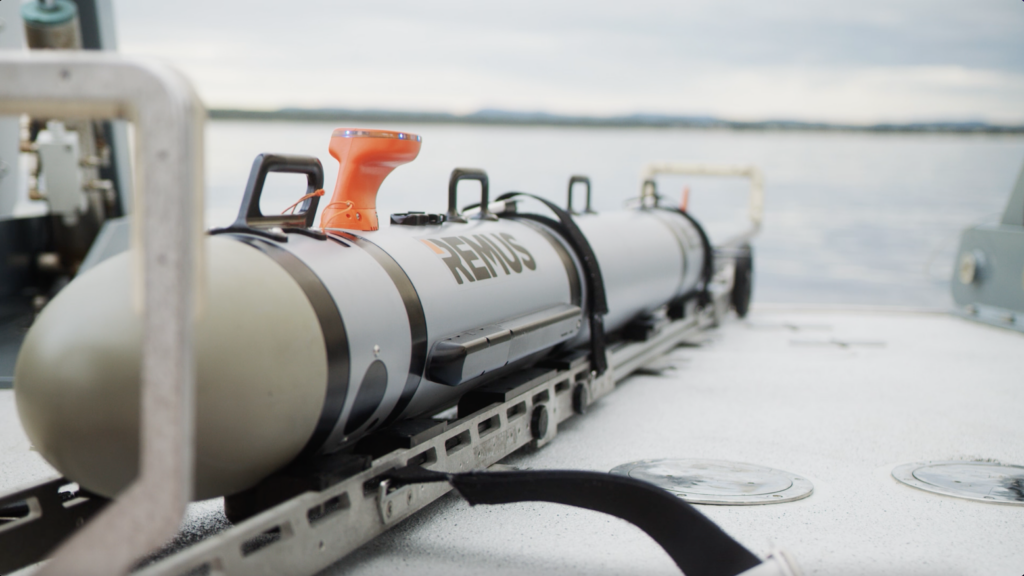
MCLEAN, Va., May 06, 2024 (GLOBE NEWSWIRE) — HII, the leading manufacturer of underwater unmanned vehicles (UUVs), announced the recent sale of three REMUS 100s and five REMUS 300s to the Royal Navy. 

This transaction marks a significant milestone in the longstanding partnership between HII and the United Kingdom military to support the Royal Navy’s capabilities in underwater exploration, countermine and surveillance programs. 

Over the past 20 years, the U.K.’s Ministry of Defence has acquired a mix of REMUS 100s, Remus 300s and REMUS 600s for mine countermeasure operations. 

The Ministry of Defence’s first two REMUS 100s, acquired in 2001, are still in operation today, demonstrating the resilience and modernization capabilities of the HII-built UUVs. 

The REMUS 100s and 300s, known for their versatility and reliability, are set to enhance the Royal Navy’s operational efficiency for a variety of maritime missions. These UUVs are equipped with advanced sensors and systems, enabling them to perform a wide range of tasks, from reconnaissance to mine countermeasures. 

Duane Fotheringham, president of Mission Technologies’ Unmanned Systems business group, stated, “We are honored to support the Royal Navy in their mission to maintain maritime security. The trust placed in our REMUS vehicles by the United Kingdom and other allies is a testament to the quality and reliability of our technology. We look forward to further strengthening our partnerships and contributing to global maritime safety.” 

A photo accompanying this release is available at: https://hii.com/news/hii-royal-navy-REMUS-unmanned-vehicle-acquisition/

The sale of REMUS 100s and 300s to the Royal Navy follows a history of successful collaborations between HII, the U.S. Navy, and U.S. allies around the world, with REMUS UUVs being widely used by NATO members. 

HII has sold more than 600 UUVs to 30 countries worldwide, including 14 NATO member countries like the U.K. 

Recent HII REMUS milestones: 

  • March 2024: HII announced the sale of a REMUS 620 UUV to an international customer in the Indo-Pacific Region. 
  • December 2023: The U.S. Navy announced the first end-to-end submarine torpedo tube launch and recovery of a REMUS UUV using the Yellow Moray system. This capability to deploy a drone through a torpedo tube creates new opportunities for surveillance, reconnaissance and other missions. 
  • October 2023: HII announced the award of a contract to build nine small UUVs for the U.S. Navy’s Lionfish System program. The contract has since grown to 42 vehicles and has the potential to grow to as many as 200 over the next five years with a total value of more than $347 million. 
  • September 2022: HII delivers three REMUS 100 UUVs to the United Kingdom’s Royal Navy. The new systems provide enhanced endurance and the latest generation of sensors and payloads, allowing for increased data quality and mission efficiency. 
  • August 2022: The Royal New Zealand Navy received delivery of four REMUS 300 UUVs for use in mine countermeasure and survey operations. 


BlueHalo and Kraken Partner to Advance Autonomous Maritime Operations

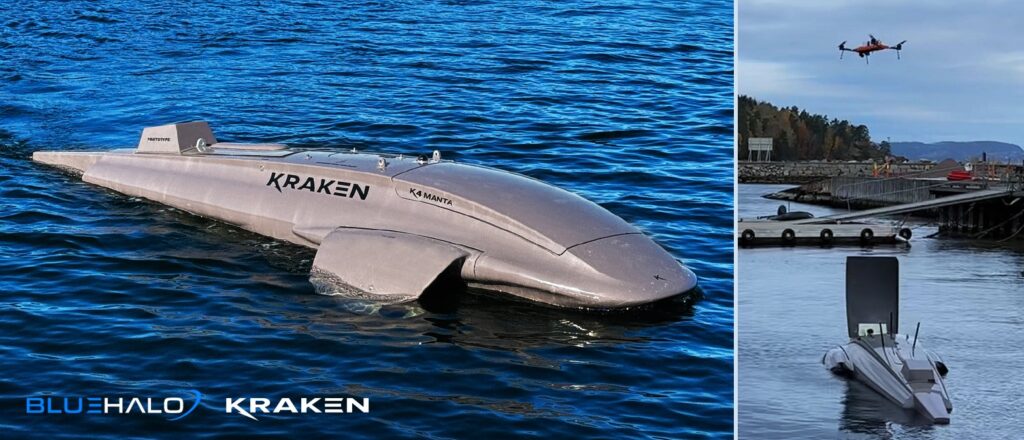
ARLINGTON, Va. and LONDON, U.K. — BlueHalo, the company transforming the future of global defense,  and Kraken Technology Group, a maritime technology leader specializing in disruptive high-performance platforms, today announced a strategic partnership to integrate BlueHalo’s cutting-edge Artificial Intelligence and Machine Learning (AI/ML)-backed autonomous mission systems into Kraken’s littoral security platforms to develop next-generation uncrewed surface vehicles (USV) and uncrewed surface/sub-surface vehicles (USSV) along with multi-domain, ‘marsupial’ capabilities. 

Through this partnership, the entities will work together to integrate BlueHalo’s industry-leading autonomous innovations within a range of Kraken vessels–including the K3 SCOUT USV, the K4 MANTA USSV and the K5 KRAKEN Gunship–to yield significant innovations in maritime autonomy and develop new littoral capabilities addressing critical national security priorities. BlueHalo will also integrate its Titan and SkyView Radio Frequency (RF)-based counter-uncrewed aircraft system (C-UAS) technologies as payload within the K3, K4, and K5 portfolio for mobile, maritime UAS detect and defeat capabilities. 

“This expansion into the maritime domain is one of several initiatives we have been planning as part of our long-term strategic vision. The ability to rapidly and seamlessly adapt current leading technologies to adjacent domains allows us to out innovate adversaries and extend BlueHalo’s ring of protection,” said Jonathan Moneymaker, BlueHalo Chief Executive Officer. “Kraken’s innovative spirit and passion for customer success align directly with our DNA and we are excited to be bringing these disruptive offerings to the mission.” 

“Partnering so closely with BlueHalo on the integration of K3 has demonstrated clear synergies in both vision and expertise. With this combined effort, Kraken and BlueHalo are working together to expand these innovations across our other vessels and pursue even more opportunities to meet critical customer needs,” said Mal Crease, Founder and CEO of Kraken Technology Group. “Game-changing capabilities deployed at pace is our sole objective, and this partnership will ensure our ability to deliver against exponentially growing  
market demand.” 

The BlueHalo AI/ML-backed autonomous platform will serve as the primary core of autonomous operations and functions within the Kraken USV and USSV–leading mission-focused operations, maintaining situational awareness, signaling directions to the autonomous maritime controller, enabling multi-vessel swarming, and supporting hybrid maritime and land “marsupial” operations. 

BlueHalo has extensive technical experience delivering state-of-the-art autonomous capabilities, including R&D, engineering, systems development, fabrication and prototyping, manufacturing, integration and sustainment activities. These capabilities enabled the development of HaloSwarm–a transformational, autonomous drone swarming technology with unmatched mission efficiency and performance previously unavailable to the warfighter. The company also offers an entire ecosystem of uncrewed solutions purpose-built for any environment, including the Intense Eye UAS, which is part of the U.S. Defense Innovation Unit (DIU) Blue UAS Cleared List for rigorously vetted, policy-compliant, commercial UAS. 

Kraken has a successful record of rapidly developing and manufacturing disruptive, scalable littoral platforms at high-volume. K3 SCOUT is a low-cost, low-signature, high-performance autonomous multi-mission USV for use both commercial and military applications. K4 MANTA is a unique, innovative scalable platform under development which will bring multi-mission payloads over large distances, before submerging for covert infiltration, persistent recce or loitering roles. K5 KRAKEN will be the definitive built-for-purpose, high-performance littoral gunship, capable of rapid solo or swarmed precision engagement in defense of littoral or afloat assets.  


USCGC Active Returns from Eastern Pacific Patrol; One Life Saved, $50.8M of Cocaine Interdicted

U.S. Coast Guard Pacific Area, May 3, 2024 

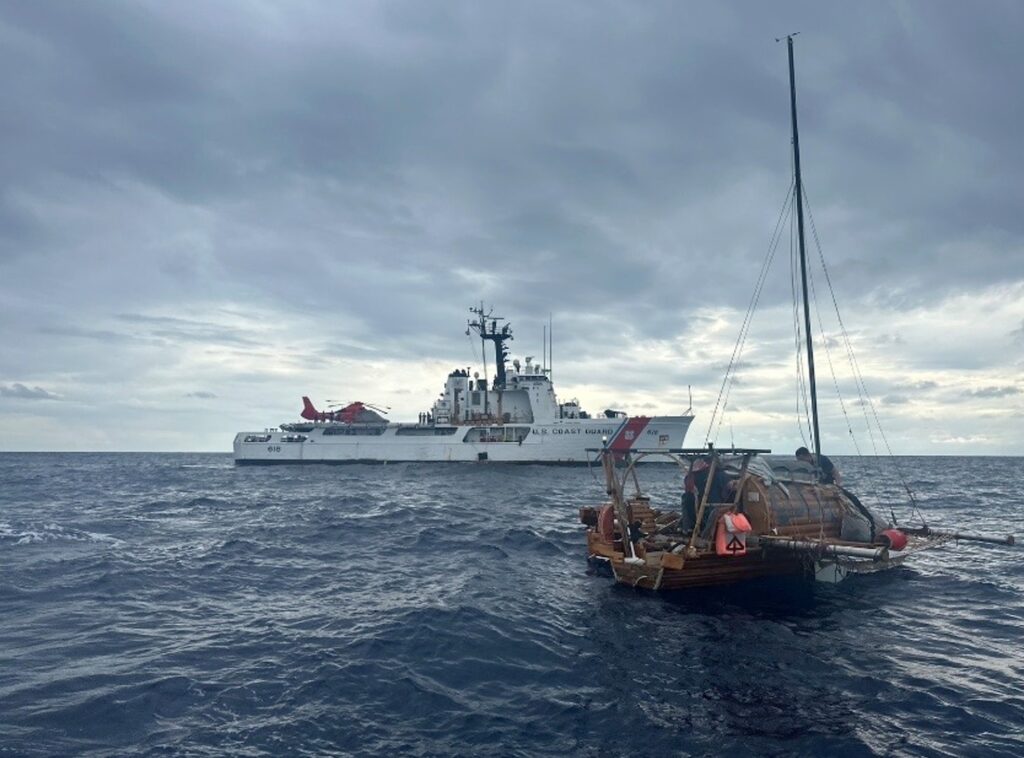
PORT ANGELES, Wash. — The U.S. Coast Guard Cutter Active (WMEC 618) and crew returned home to Port Angeles Friday after completing a 54-day multi-mission patrol in support of a Joint Interagency Task Force-South (JIATF-S) counternarcotics patrol in the Eastern Pacific Ocean. 
 
During the patrol, Active’s crew interdicted 3,858 pounds of cocaine worth an estimated $50.8 million in a coordinated effort involving both airborne and surface units, resulting in a safe and successful interdiction. 
 
In addition to the cocaine interdiction, Active’s crew disrupted two other smuggling events while serving as the sole U.S. surface asset operating in the region for 28 days in support of Joint Interagency Task Force-South’s counter-narcotics campaign. Throughout the deployment, the cutter patrolled over 12,000 nautical miles, a distance roughly equivalent to five spans of the continental U.S. 
 
“Any interdiction at sea is challenging, with a variety of factors at every step, and no two are ever the same,” said Cmdr. Adam Disque, Active’s commanding officer. “The cases we encountered on this patrol were particularly difficult, and the crew fought through obstacles at every turn, working extremely hard to accomplish this mission. I could not be more proud of the team as they fully embodied our cutter’s nickname, ‘The Li’l Tough Guy’.” 
 
On April 12, Active received notification of a single-handed sailor in distress more than 300 nautical miles northeast of the Galapagos Islands. The sailor’s boat was disabled, and he was adrift at sea after reporting a pod of whales damaged his sailboat. 
 
Active diverted over 200 nautical miles at high speed to conduct a search and rescue operation. Upon arrival, the crew safely embarked the mariner and brought him back to shore. 
 
“This sailor was very fortunate that we happened to be in the area; he was far from normal shipping lanes and well out of range for any coastal rescue system,” said Petty Officer 3rd Class Gordon Smith, an Active crewmember who participated in the search planning. “It was fortunate that we were able to find him relatively quickly and get him on board before the weather or situation deteriorated.” 
 
Active’s two pursuit boats were supplemented by an MH-65E helicopter and aircrew from the Helicopter Interdiction Tactical Squadron (HITRON) to respond in a multi-mission environment on the high seas. HITRON, based in Jacksonville, Florida, conducts airborne use of force to stop vessels suspected of breaking U.S. and international laws on the high seas. 
 
During this patrol, specialized law enforcement members from the Coast Guard’s Pacific Tactical Law Enforcement Team and the Maritime Security and Response Team – West deployed aboard to support their mission and augment Active’s crew. 
 
Active regularly patrols international waters off southern Mexico and Central America to combat transnational organized crime in the Western Hemisphere, specifically the smuggling of narcotics. 
 
Active, a 57-year-old medium endurance cutter, is homeported in Port Angeles. The multi-mission cutter falls under the operational command of the Coast Guard Pacific Area Commander. Patrolling from the northernmost part of the contiguous United States to the equator, Active is critical in conducting search and rescue, counter-narcotics law enforcement, living marine resource protection, and homeland defense operations.