Northrop Grumman Completes Assembly of Manta Ray UUV
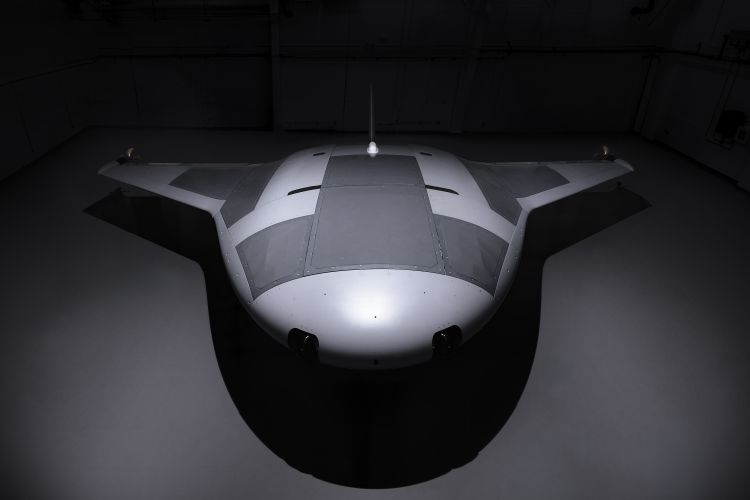
A full-size prototype of Manta Ray, a new class of uncrewed underwater vehicle, is assembled in Northrop Grumman’s Annapolis facility. (Photo Credit: Northrop Grumman)
ANNAPOLIS, Md. – April 8, 2024 – (PHOTO RELEASE) Northrop Grumman Corporation (NYSE: NOC) completed assembly of a full-size uncrewed underwater vehicle (UUV) prototype known as Manta Ray. A new class of UUV, it is an extra-large glider that will operate long-duration, long-range and payload-capable undersea missions without need for on-site human logistics.
Manta Ray was built through a Defense Advanced Research Projects Agency (DARPA) program aimed at advancing key technologies to benefit future UUV designs, including techniques to manage energy, increased payload capacity, low-power propulsion and more.
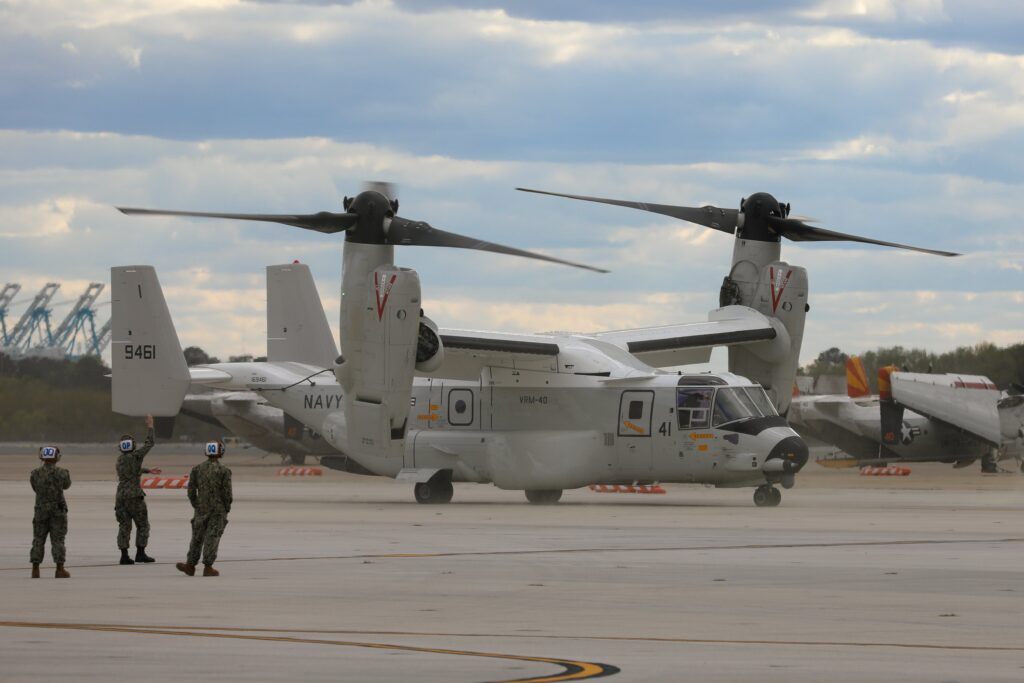
First East-Coast-Assigned Navy CMV-22B OSPREY Arrives in Norfolk
NORFOLK, Va. — The first East Coast-assigned Navy tiltrotor vertical/short takeoff and landing (V/STOL) CMV-22B Osprey aircraft, assigned to Fleet Logistics Multi-Mission Squadron (VRM) 40, arrived to Naval Station Norfolk on April 5.
“Naval Aviation is ecstatic to welcome the first CMV-22B Osprey to Norfolk,” said Rear Adm. Doug Verissimo, commander, Naval Air Force Atlantic (CNAL). “This first aircraft’s arrival symbolizes an evolution and change in Naval Aviation as we look toward the future. The event represents the hard work and stamina of our aviators, aircrewmen, maintainers and sustainment personnel in the VRM community.”
The CMV-22B will provide the fleet’s medium-lift and long-range aerial logistics capability, eventually replacing the C-2A Greyhounds of Fleet Logistics Support Squadron (VRC) 40 over the next several years. The squadron’s relocation to Naval Station Norfolk is part of their permanent duty station change from Naval Air Station (NAS) North Island in preparation to provide fleet logistic aviation assets to the Atlantic Fleet beginning in 2025.
The VRM-40 “Mighty Bison” were established aside their existing sister squadron, VRM-30, and the training squadron, VRM-50, aboard NAS North Island in March 2022.
All squadron personnel have been officially stationed in Norfolk since Feb. 1, 2024. The remaining VRM-40 aircraft will begin to arrive to Hampton Roads in the summer of 2024.
VRM-40’s leadership consists of Cmdr. Matthew Boyce, commanding officer; Cmdr. Mason Fox, executive officer, and Command Master Chief Bradley Wissinger.
“We are proud to join the Commander, Naval Air Force Atlantic team and eager to lean forward into our next phase of stand-up,” Boyce said.
Fox discussed the importance of standing up a new squadron on the East Coast.
“We’re excited to be in our permanent home at Naval Station Norfolk and focused on continuing to build the squadron to execute our mission – delivering high priority people and parts to carrier strike groups at sea,” Fox said. “The Osprey is an extremely capable aircraft and will be critically important to the way the Navy fights for many years to come.”
In addition to VRM-40, a type wing detachment was established onboard Naval Station Norfolk earlier in 2023 to provide local representation of Commander, Fleet Logistics Multi-Mission Wing (CVRMW), based at NAS North Island.
CVRMW’s mission is to provide Pacific and Atlantic Fleet VRM squadrons the ability to sustain lethality for carrier strike groups of the future through the timely, persistent air logistics missions our nation demands any place in the world. The CMV-22B is the Navy’s long-range/medium-lift element of the intra-theater aerial logistics capability responsible for transporting personnel, mail and priority cargo from shore logistics sites to ships at sea.
Naval Air Force Atlantic is responsible for sven nuclear-powered aircraft carriers, 55 aircraft squadrons, 1,200 aircraft and 52,000 officers, enlisted and civilian personnel with priorities focused on warfighting, people, and readiness by providing combat ready, sustainable naval air forces with the right personnel, properly trained and equipped, with a focus on readiness, operational excellence, interoperability, safety, and efficient resourcing.
USS Leyte Gulf Takes Down Semi-Submersible Vessel
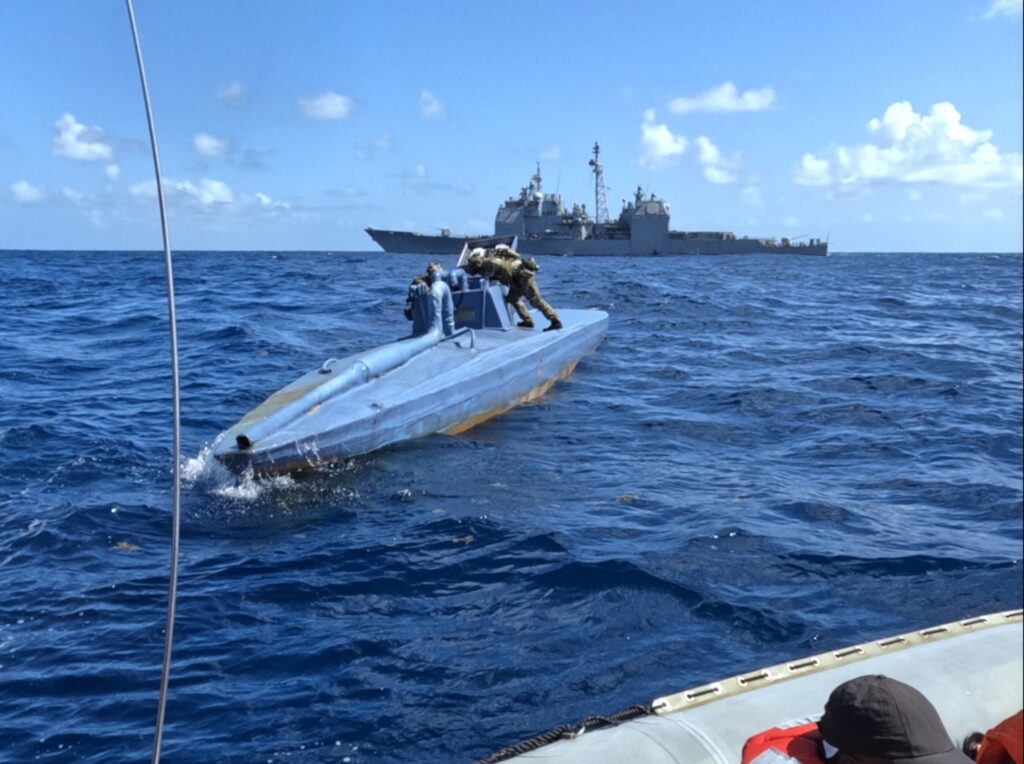
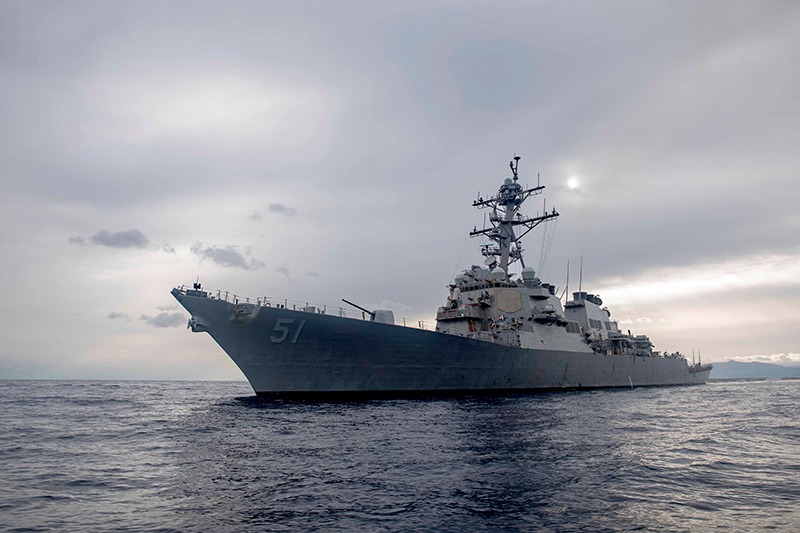
ATLANTIC OCEAN (March 22, 2024) – The Ticonderoga-class guided missile cruiser USS Leyte Gulf (CG 55), embarked U.S. Coast Guard Law Enforcement Detachment (LEDET) and Helicopter Maritime Strike Squadron (HSM) 50 work together to intercept a self-propelled semi-submersible drug smuggling vessel (SPSS), in the Atlantic Ocean, March 22, 2024 (U.S. Coast Guard Courtesy Photo)
By USNAVSOUTH/4TH FLEET PUBLIC AFFAIRS, April 8, 2024
ATLANTIC OCEAN – The Ticonderoga-class guided missile cruiser USS Leyte Gulf (CG 55), with an embarked U.S. Coast Guard (USCG) Law Enforcement Detachment (LEDET), has made multiple drug interdictions in the U.S. Southern Command (USSOUTHCOM) area of operations (AOR).
In March, while on patrol in the Atlantic Ocean, the crew detected a self-propelled semi-submersible drug smuggling vessel (SPSS). With assistance from Helicopter Maritime Strike Squadron (HSM) 50, the crew acquired the location of the SPSS and LEDET members launched a rigid-hull inflatable boat (RHIB) to intercept the vessel. The LEDET detained the individuals aboard the SPSS and seized approximately 2,370 kilograms of cocaine. Then the crew conducted a sinking exercise (SINKEX) on the SPSS.
“Spotting this vessel was like finding a needle in the haystack,” said Lt. Commander Travis Lee, Leyte Gulf’s senior aviator. “I’ve been doing this for seven years and not once been able to find and acquire such an asset until now.”
Taking down the SPSS was only the latest success for USS Leyte Gulf on this deployment.
In February, while on patrol in the Caribbean Sea, the ship intercepted three different vessels using coordinated air and surface operations involving both U.S. and partner nation forces.
During the interdictions, the LEDET boarded and took positive control of each vessel. On Feb. 6, the ship recovered 520 kilograms of cocaine worth an estimated $12.8 million. On Feb. 15, they recovered 600 kilograms of cocaine worth an estimated $15.25 million. Then on Feb. 28, the crew recovered another 600 kilograms of cocaine worth an estimated $15 million.
“Our Leyte Gulf team was ready when called upon to execute all three interdictions,” said Commanding Officer Capt. Nathan Diaz. “The successful seizure of more than $42 million in illicit drugs is a testament to the interoperability of our partner nations, the Coast Guard and the Leyte Gulf team.”
“It was an exciting day to be the Officer of the Deck running the bridge for one of our interdiction operations,” said Lt. j.g. Jayden Hodgson, an officer of the deck and public affairs officer aboard the ship. “Leyte Gulf prevented the illicit importation of drugs that day and we are only getting started.”
USS Leyte Gulf is currently deployed in the USSOUTHCOM AOR to support bilateral and multinational maritime operations with partners in the region, conduct Theater Security Cooperation (TSC) port visits, and to support JIATF-South in countering illicit-drug trafficking.
LEDETs are deployable specialized forces of the U.S. Coast Guard that enforce U.S. laws and treaties in the maritime domain.
U.S. Naval Forces Southern Command/U.S. 4th Fleet supports U.S. Southern Command’s joint and combined military operations by employing maritime forces in cooperative maritime security operations to maintain access, enhance interoperability, and build enduring partnerships in order to enhance regional security and promote peace, stability and prosperity in the Caribbean, Central and South American region.
Learn more about USNAVSOUTH/4th Fleet at https://www.fourthfleet.navy.mil, https://www.facebook.com/NAVSOUS4THFLT and @NAVSOUS4THFLT.
April 6 Red Sea Update
U.S. Central Command, April 7, 2024
TAMPA, Fla. – Between approximately 10:00 a.m. and 3:00 p.m. (Sanaa time) on April 6, U.S. Central Command (CENTCOM) forces successfully destroyed one mobile surface-to air missile system in Houthi controlled territory of Yemen. CENTCOM forces also shot down one unmanned aerial vehicle (UAV) over the Red Sea.
Additionally, at approximately 6:00 p.m. (Sanaa time), a Coalition vessel detected and successfully engaged and destroyed one inbound anti-ship missile.
There were no injuries or damage reported by U.S., coalition, or commercial ships. It was determined that these systems presented a threat to U.S. and coalition forces and merchant vessels in the region. CENTCOM is dedicated to protecting the freedom of navigation and making international waters safer and more secure for Coalition and merchant vessels.
CMF’s Combined Task Force 150 Seizes Nearly 400 Kilograms in Illegal Narcotics in the Arabian Sea
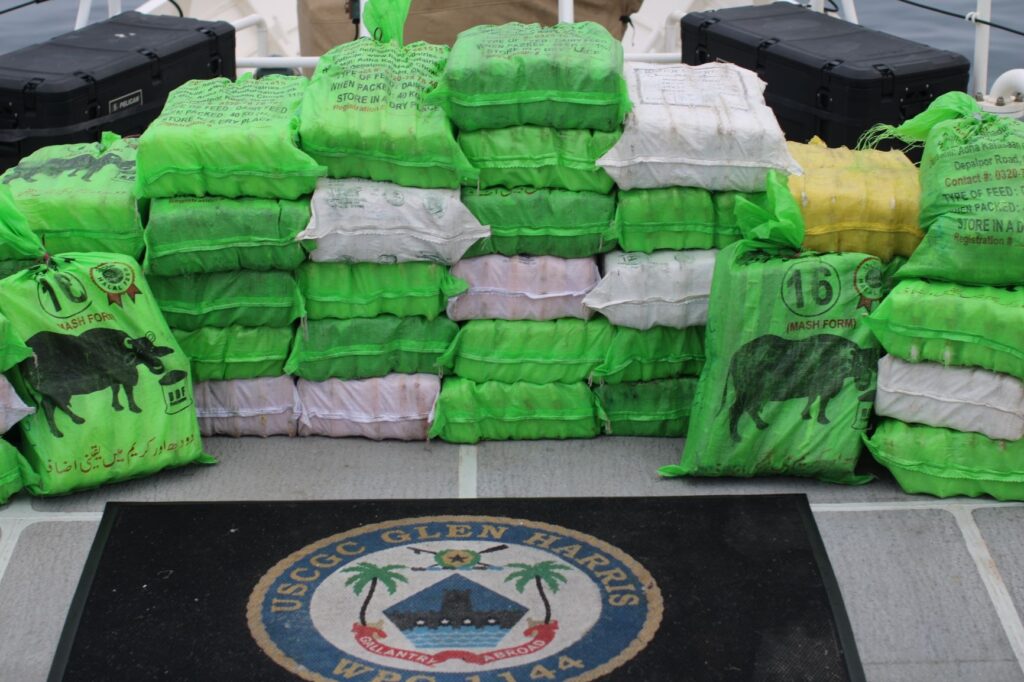
Bags of illegal narcotics seized from a vessel are stacked on the deck of the U.S. Coast Guard Sentinel-class fast response cutter USCGC Glen Harris (WPC 1144) in the Arabian Sea, April 4. (Photo by U.S. Coast Guard)
By U.S. Naval Forces Central Command Public Affairs | April 08, 2024
MANAMA, Bahrain — A U.S. Coast Guard cutter, working in direct support of Combined Task Force (CTF) 150 of Combined Maritime Forces, seized nearly 400 kilograms of illegal drugs from a dhow in the Arabian Sea, April 4.
Crewmembers from the Sentinel-class fast response cutter USCGC Glen Harris (WPC 1144) discovered and seized 15 kilograms of heroin and 375 kilograms of methamphetamine aboard the dhow. After weighing and documenting the haul, the crew properly disposed of the narcotics.
“This is the second major interdiction of the USCGC Glen Harris and the CTF-150 team with a combined total of 1,160 kg of drugs seized to date, denying income to criminal and terrorist organizations from the profits of illicit narcotics,” said Capt. (N) Colin Matthews, commander of CTF-150. “This exceptional multinational cooperation between our two teams is an example of the impacts we can make when we work together.”
On March 5, Glen Harris, working in support of CTF 150, seized 770 kilograms of methamphetamines from a dhow in the Arabian Sea.
Glen Harris is forward deployed to Bahrain. The fast response cutter is part of a contingent of U.S. Coast Guard ships forward-deployed to the region under Patrol Forces Southwest Asia (PATFORSWA). PATFORSWA deploys Coast Guard personnel and ships alongside U.S. and regional naval forces throughout the Middle East.
CTF 150 is one of five task forces under Combined Maritime Forces, the world’s largest international naval partnership. CTF 150’s mission is to deter and disrupt the ability of non-state actors to move weapons, drugs and other illicit substances in the Indian Ocean, the Arabian Sea and the Gulf of Oman.
Combined Maritime Forces is a 42-nation naval partnership upholding the international rules-based order by promoting security and stability across 3.2 million square miles of water encompassing some of the world’s most important shipping lanes.
COMPACFLT Holds Change of Command Ceremony in Pearl Harbor
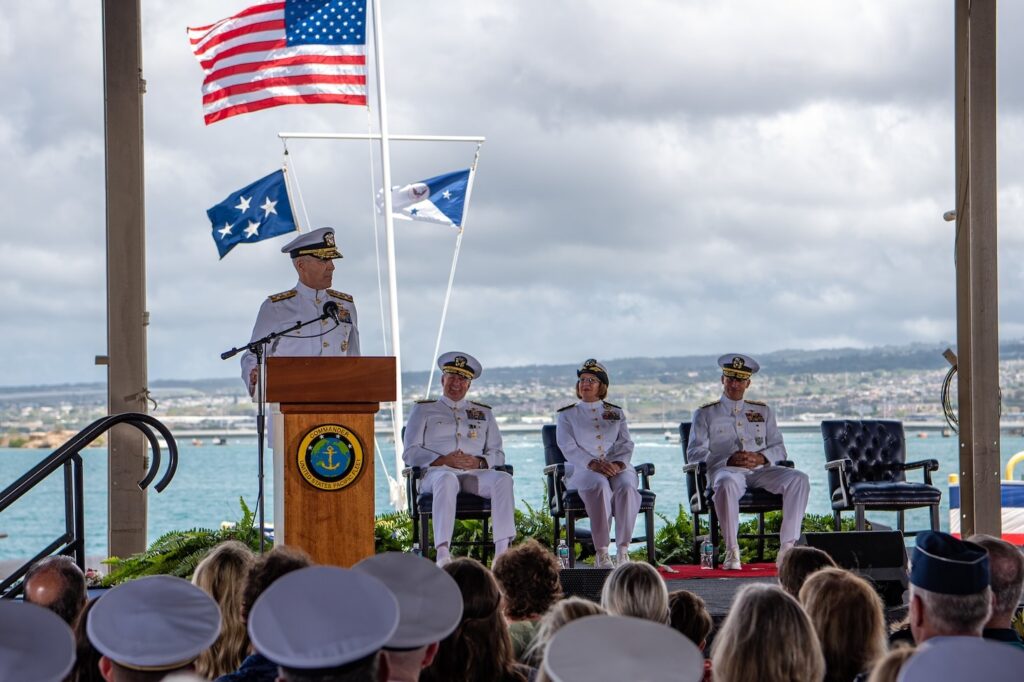
Adm. Stephen Koehler addresses the audience after becoming the commander, U.S. Pacific Fleet during the COMPACFLT change of command ceremony onboard Joint Base Pearl Harbor-Hickam, April 4. (U.S. Navy photo by Mass Communication Specialist 2nd Class Jeremy R. Boan)
From Commander, U.S. Pacific Fleet Public Affairs, Apr 4. 2024
Adm. Stephen Koehler assumed command of the U.S. Pacific Fleet (PACFLT) during a change of command ceremony on Joint Base Pearl Harbor-Hickam, April 4. He relieved Adm. Samuel Paparo, who took over as commander of PACFLT in May 2021.
Adm. John Aquilino, commander, U.S. Indo-Pacific Command, opened the ceremony by thanking Adm. Lisa Franchetti, chief of naval operations, for sending her best leaders to U.S. Pacific Fleet.
“You are looking at the world’s greatest warfighters sitting behind me,” said Aquilino. “In the world’s most concerning theater, against our world’s most dangerous adversaries, what has been chosen to run this theater are our best warfighters. That is not by accident.”
Adm. Lisa Franchetti, chief of naval operations, presided over the ceremony. She welcomed Koehler and praised Paparo for his leadership during his time as the PACFLT commander.
“Sam, you understood that the most powerful tool we have — our true strategic advantage — comes from our strong relationships with our allies and partners,” said Franchetti. “And that our shared values and common interest bind us together, and put more ready players on the field — every single day. Sam, I cannot be more proud of the work that you’ve done as the Pacific Fleet commander, and I’m excited about what is yet to come as you head up the hill (to Camp Smith), and become the 27th commander of U.S. Indo-Pacific Command next month.”
Franchetti welcomed Koehler saying: “You know how to build strong teams to get after our vital mission here in the Indo-Pacific at this critical time in our nation’s history. There is no one more ready to lead this Fleet. I am absolutely confident that you are the right person at the right time to lead our Sailors in the Indo-Pacific. And I look forward to seeing all that this Fleet will accomplish on your watch.”
While under Paparo’s command, PACFLT qualified as a joint task force, established Task Force 504, a task force focused on combat sustainment; Fleet Information Warfare Command Pacific; expanded opportunities for deployed ship repair in India; and completed numerous joint and combined multi-lateral operations across the region with allies and partners.
“These accomplishments and many more have demonstrated our capability and our will to our would-be adversaries. These accomplishments have deterred conflict and preserved the peace,” said Paparo.
He took a moment to address the Sailors, chief petty officers, civilians and officers across the Fleet, both at sea and ashore.
“The best part of my job has been watching this team in action,” Paparo said. “I appreciate all that you have done over the last three years. And as I utter these words, your efforts continue. Every day you continue building a more effective fighting force. I am honored to remain your teammate as I take up my next duty, and I am proud to turn over command to Adm. Stephen “Web” Koehler.”
Koehler comes to the historic Pearl Harbor headquarters from Washington, D.C., where he served as director for Strategy, Plans and Policy, J5, Joint Staff.
“I could not be more excited and honored to assume command of the finest fleet in the world, whose capabilities are second to none,” said Koehler. “The U.S. Pacific Fleet answers our nation’s call to compete with unity of purpose, without hesitation, and with a powerful and resolute force.”
Koehler is the 38th commander since the Fleet’s Pearl Harbor headquarters was established in February 1941. He commissioned through the Naval Reserve Officers Training Corps (NROTC) at University of Colorado at Boulder in 1986, and was designated a naval aviator in March 1989. He has flown over 3,900 hours in the F-14 Tomcat and F-18 E/F/G Super Hornet with 600 carrier landings.
“Success during competition will require a bias for action, constant drive for excellence, continued vigilance, and the ability to rapidly transition to seizing the initiative and holding it,” said Koehler. “Success will require teamwork with precise execution and mastery of the basics, and then stretching ourselves operationally and tactically as a team of teams. Success will require cooperation across the supporting elements of the Navy, collaboration across numbered fleets, joint integration, and teamwork with allies and partners.”
U.S. Pacific Fleet is the world’s largest fleet command with an area of operations that encompasses 100 million square miles, nearly half the Earth’s surface, from Antarctica to the Arctic Circle and from the West Coast of the United States into the Indian Ocean. The U.S. Pacific Fleet consists of approximately 200 ships and submarines, nearly 1,200 aircraft, and more than 130,000 Sailors and civilians.
HII Completes Dry Dock Work for Aircraft Carrier USS John C. Stennis (CVN 74) Refueling and Complex Overhaul
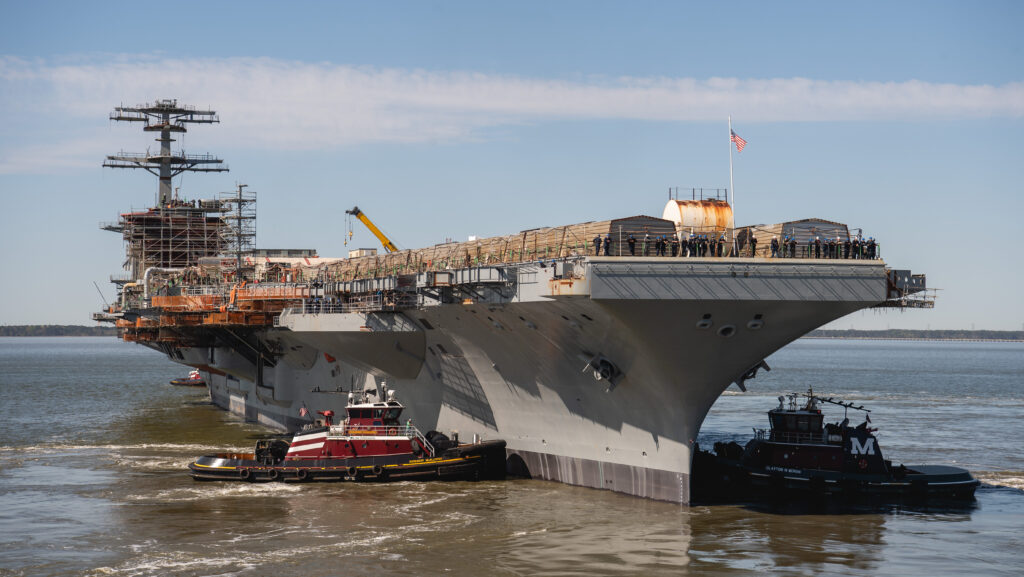
NEWPORT NEWS, Va., April 08, 2024 (GLOBE NEWSWIRE) — HII’s (NYSE: HII) Newport News Shipbuilding division has completed the dry dock portion of the refueling and complex overhaul (RCOH) of Nimitz-class aircraft carrier USS John C. Stennis (CVN 74).
Following the recent flooding of more than 100 million gallons of water into the dry dock, USS John C. Stenniswas successfully moved to an outfitting berth at the shipyard, where the remainder of the RCOH work and testing will be completed.
“Witnessing Stennis leave the dry dock and return to the water is a testament to the hard work of our shipbuilders, the crew and our government partners,” said Rob Check, NNS vice president of in-service aircraft carrier programs. “We remain laser focused on the work ahead during this RCOH period and look forward to preparing this mighty aircraft carrier for the next half of its operational life.”
During the dry dock phase of the RCOH, USS John C. Stennis received significant upgrades and began an extensive overhaul process, both inside and outside the ship. In addition to defueling and refueling its power plant, NNS shipbuilders preserved tanks and replaced thousands of valves, pumps and piping components. On the outside, they performed major structural updates to the island, mast and antenna tower; upgraded all aircraft launch and recovery equipment; painted the ship’s hull, including sea chests and freeboard; restored the propeller shafts; and installed refurbished propellers and rudders.
During the next phase of RCOH, shipbuilders will complete the overhaul and installation of the ship’s major components and test its electronics, combat and propulsion systems. This period will also focus on improving the ship’s living areas, including crew living spaces, galleys and mess decks.
“Our focus remains steadfast to get our ship back into the fight and to foster the professional and personal development of our sailors,” said Capt. J. Patrick Thompson III, the ship’s commanding officer. “We look forward to continue working with our industry partners to complete remaining production and test work and redeliver Stennis back to the fleet.”
USS John C. Stennisis the seventh Nimitz-class aircraft to undergo its RCOH — the mid-life refueling overhaul and maintenance availability that produces a recapitalized carrier capable of supporting current and future Navy requirements. Once the RCOH is complete, USS John C. Stenniswill be equipped to operate in the fleet for the second half of her 50-year expected service life.
Naval Supply Systems Command introduces Naval Sustainment System- Supply 2.0
Naval Sustainment System-Supply (NSS-Supply) 2.0 is focused on delivering fleet outcomes and supply’s contribution to fleet readiness, whereas NSS-Supply’s original focus was to capture supply chain value.
Navy fleet readiness goals fall into three categories: Subsurface, Surface, and Aviation, allowing NAVSUP to focus on supply’s contribution to meeting fleet readiness goals.
How? NSS-Supply uses the “Agile” framework driven by data analytics. NSS-Supply is currently analyzing data to see what supplies are keeping the Surface Warfare community from reaching their North Star readiness target of 75 mission capable ships. A good example is the targeting of on-board sparing for systems that have outdated spares modeling. Getting the right mix of spares on board increases readiness and improves endurance.
Simply stated, NSS-Supply 2.0 moves away from a monetized-value calculation to a readiness calculation directly linked to fleet readiness goals.
NSS-Supply is built on the CNO’s priorities of warfighting, warfighters, and the foundation that supports them. The essential element is the Agile approach which quickly assesses problem areas and rapidly deploys innovation into the E2E supply chain using the Get Real, Get Better mindset to deep-dive supply chain issues that accelerate the Navy’s warfighting advantage.
Initiatives are built from the Chief of Naval Operations, Navigation Plan Implementation Framework (NIF) priorities and objectives. Additionally, Performance-to-Plan (P2P) is inculcated in the NSS-Supply culture to drive baseline Get Real readiness performance and NSS-Supply is the Get Better engine that allows accountable commanders to implement world-class readiness solutions across the Navy’s E2E supply chain.
NSS-Supply has undertaken 33 initiatives since 2021. The following examples provide a few highlights:
Achieved average RTAT reduction of 40% in aviation and 30% in maritime repairs.
Established first Regional Maintenance Center reoccurring repair agreements to repair 104 parts for wholesale stocking.
Increased nuclear submarine capabilities through improved spares pool health and enhanced policies to increase critical submarine parts inventories.
Engaged key suppliers to improve contract performance, expanded contract strategies, and improved inventory performance.
Built and implemented E2E Naval Shipyard Supply Chain Management tool to significantly improve submarine material support.
NSS-Supply continues to tackle supply chain initiatives directly supporting the warfighter as a multi-year journey to transform the end-to-end supply chain and provide the sustainment outcome the fleet needs that responds to the VCNO directive that designated the Commander, Naval Supply Systems Command as the Navy’s E2E Navy Supply Chain Integrator.
CDR Kirk Engler is director of Naval Sustainment System – Supply, Naval Supply Systems Command and Melissa Olson is deputy director.
U.S. 4th Fleet Announces Southern Seas 2024 Deployment
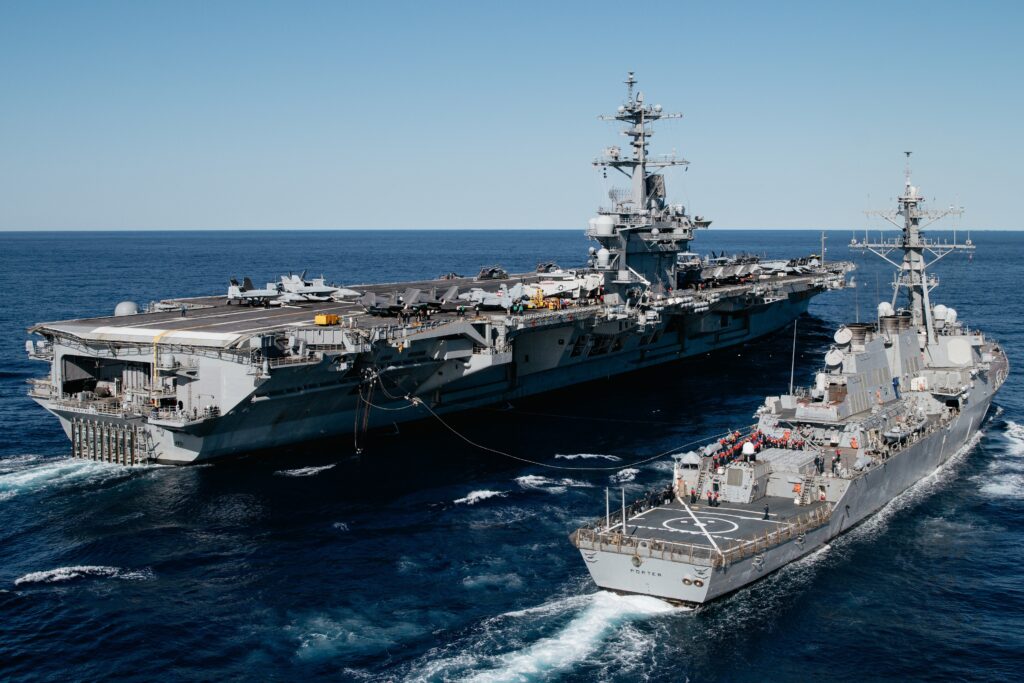
ATLANTIC OCEAN (Feb. 26, 2024) The Arleigh Burke-class guided-missile destroyer USS Porter (DDG 78) conducts a replenishment-at-sea with the Nimitz-class aircraft carrier USS George Washington (CVN 73) while underway in the Atlantic Ocean, Feb. 26, 2024. (USN photo by MC2 Nicholas A. Russell)
From U.S. 4th Fleet, 5 April 2024
MAYPORT, Fla. - The U.S. Navy aircraft carrier USS George Washington (CVN 73) will deploy to the U.S. Southern Command area of operations over the next few months as part of U.S. Naval Forces Southern Command/U.S. 4th Fleet’s Southern Seas 2024 deployment.
George Washington, Arleigh Burke-class guided-missile destroyer, USS Porter (DDG 78), and Henry J. Kaiser-class replenishment oiler USNS John Lenthall (T-AO-189) are scheduled to conduct passing exercises and operations at sea with partner nation maritime forces as the ships circumnavigate the continent of South America. Southern Seas 2024 will feature subject matter expert exchanges and provide the opportunity for distinguished visitors from partner nations to see aircraft carrier operations up close. Engagements are planned with Argentina, Brazil, Chile, Colombia, Ecuador, Peru, and Uruguay, with port visits planned for Brazil, Chile, and Peru.
“Southern Seas 2024 will provide the opportunity to improve interoperability and increase proficiency with partner nation maritime forces,” said Rear Adm. Jim Aiken, Commander U.S. Naval Forces Southern Command/U.S. 4th Fleet. “Deployments like Southern Seas strengthen maritime partnerships and build trust with our partners in the region.”
“We look forward to building readiness and advancing training as we engage with our friends and partners in South America,” said Rear Adm. Robert Westendorff, Commander, Carrier Strike Group 10. “We also look forward to visiting several spectacular locations in South America, as U.S. Navy Sailors don’t often get to see this part of the world.”
New for Southern Seas 2024, an embarked international staff of approximately two dozen officers from 11 partner nations will serve aboard USS George Washington. This international staff will receive instruction from U.S. Naval War College professors and will work alongside embarked Destroyer Squadron 40 personnel to conduct detailed operational planning in support of operations at sea. Countries planning to participate in this embarked international staff include Argentina, Brazil, Canada, Chile, Colombia, Ecuador, the Netherlands, Paraguay, Peru, Trinidad and Tobago, United Kingdom, and the United States.
Southern Seas 2024 marks the 10th mission to the region since 2007 and the third time involving USS George Washington. The aircraft carrier also conducted Southern Seas 2008 and Southern Seas 2015. Like the previous deployments, Southern Seas 2024 will foster goodwill, strengthen maritime partnerships, counter threats, and build our team.
Aircraft carrier USS George Washington is one of the centerpieces of America’s Naval forces – the most adaptable and survivable airfields in the world. On any given day, Sailors aboard an aircraft carrier and its air wing come to the fight trained and equipped across a full range of missions. They are ready to control the sea, conduct strikes, and maneuver across the electromagnetic spectrum and cyberspace. No other naval force fields a commensurate range and depth of combat capabilities.
VMFA-542 achieves full operational capability as U.S. Marine Corps’ first F-35 operational squadron on the East Coast
From Communication Strategy and Operations Office,
2nd Marine Aircraft Wing
Apr. 5, 2024
MARINE CORPS AIR STATION CHERRY POINT, N.C. – Marine Fighter Attack Squadron (VMFA) 542, 2nd Marine Aircraft Wing (MAW), achieved full operational capability, Wednesday, as the U.S. Marine Corps’ first East Coast F-35 Lightning II Joint Strike Fighter squadron in the Fleet Marine Force.
Full operational capability means that VMFA-542 is ready for full operations and completed its transition from a legacy tactical-aircraft platform to the F-35B Lightning II. The squadron is now capable and eligible to deploy globally in support of planned or contingency operations. As 2nd MAW’s first operational fifth-generation fighter-attack squadron, they can fulfill their mission essential tasks (METs) in support of the Marine Air-Ground Task Force (MAGTF). These METs include close-air support, strike, strike coordination and reconnaissance, offensive anti-air warfare, suppression of enemy air defenses, electronic attack, electronic support, and active air defense.
“Achieving full operational capability is a testament to the exceptional hard work and professionalism from the Marines of VMFA-542,” said Lt. Col. Brian Hansell, commanding officer of VMFA-542. “This milestone marks the addition of a battle-ready aviation squadron with unmatched combat lethality and survivability to the Marine Expeditionary Force. We are ready and able to conduct missions globally in support of the MAGTF as we continue to prepare for the next challenge.”
The F-35 is a fifth-generation fighter jet with advanced stealth, agility and maneuverability, sensor and information fusion, and provides the pilot with real-time access to battlespace information. It is designed to meet an advanced threat while improving lethality, survivability, and supportability. The F-35B Lightning II is the short-takeoff and vertical-landing F-35 variant. This capability allows the aircraft to operate from amphibious assault ships and expeditionary airstrips less than 2,000 feet long.
VMFA-542 began its transition to the F-35B Lightning II in December 2022 and received its first F-35B on May 31, 2023. The squadron then achieved initial operational capability, Feb. 5, before receiving its 10th aircraft, March 25, and achieving full operational capability, April 3.
The squadron also recently participated in Exercise Nordic Response 24 in Norway, which was a two-week exercise with NATO allies and partners demonstrating military prowess across land, maritime, and aviation domains against challenging arctic and mountainous conditions. During the exercise, VMFA-542 conducted a distributed-aviation-operations event at Kallax Air Base in Lulea, Sweden, March 13, marking the first time a U.S. F-35 Lightning II aircraft landed in Sweden, the first time any F-35 operated at Kallax Air Base, and one of the first training events conducted by Sweden as a NATO member.
VMFA-542 is a subordinate unit of 2nd MAW, the aviation combat element of II Marine Expeditionary Force.