SECNAV Del Toro Meets With Industry on V-22 Osprey
Release from SECNAV Public Affairs
*****
22 December 2023
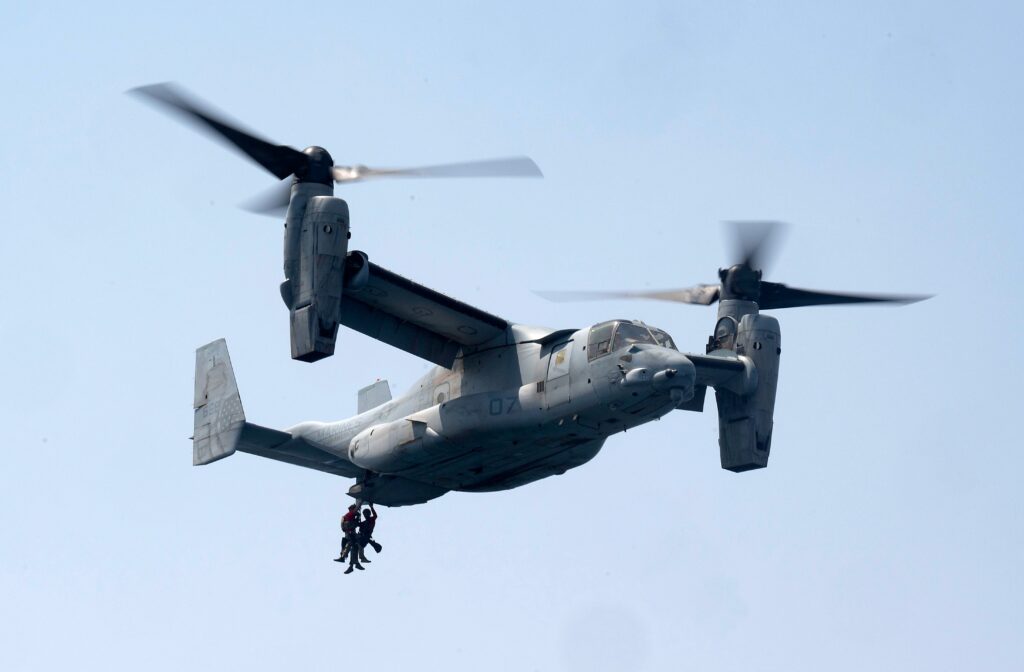
Secretary of the Navy Carlos Del Toro met with the chief executives of Bell Boeing earlier this week to discuss the V-22 Osprey program following the Dec. 6 grounding of the V-22 fleet.
“We are committed to the reliability, availability, and safety of this vital aircraft,” said Secretary Del Toro. “The Navy is working closely with our Service and industry partners to return the Osprey to flight, while our priority remains ensuring the safety of our Sailors, Marines, and Airmen.”
“I was reassured by our industry partners’ commitment to improving reliability and readiness of the V-22 while providing the safest aircraft to accomplish the V-22’s unique missions in both competition and conflict.”
The grounding of the V-22 Osprey fleet is the result of a fatal crash off the coast of Japan on Nov. 29. The cause of the crash is currently under investigation.
Navy and Marine Corps V-22 aircraft deliver transformational speed, depth, and agility to our Sailors and Marines, conducting all-weather assault support, time-critical logistics and supply missions in support of Naval Forces and Combatant Commanders.
U.S. Coast Guard Cutter Polar Star Departs Australia, En Route to Antarctica
Editor’s Note: To follow the U.S. Coast Guard Cutter Polar Star’s Operation Deep Freeze journey, click here for more imagery.
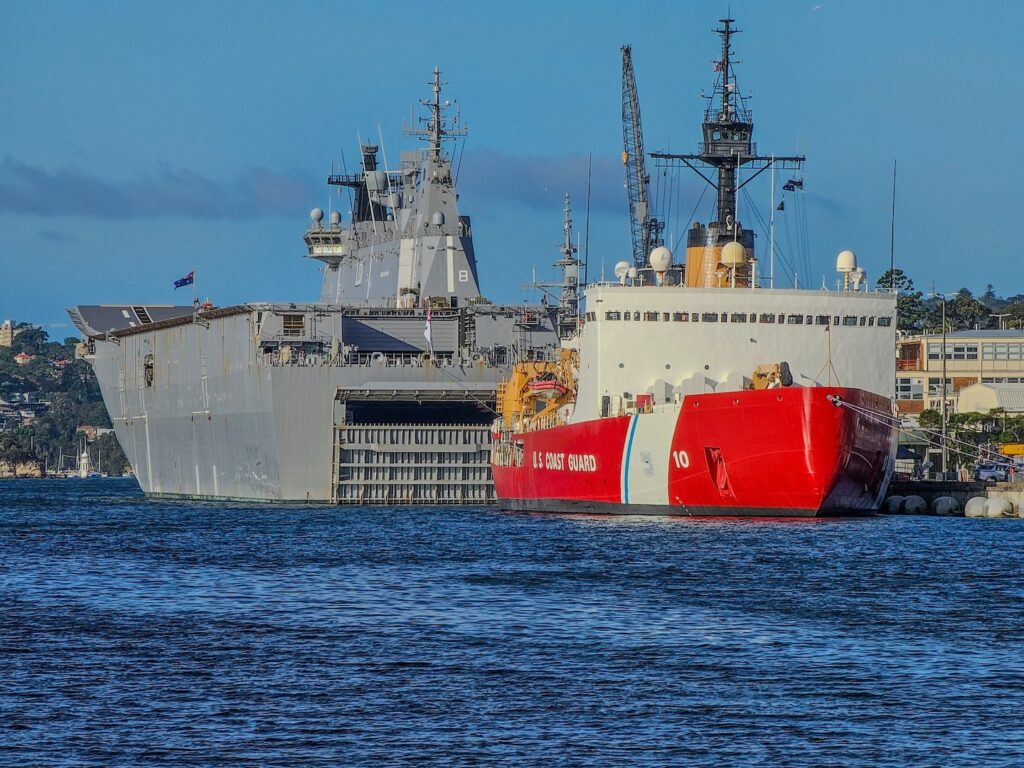
HOBART, Australia — U.S. Coast Guard Cutter Polar Star (WAGB 10) and crew departed Hobart, Wednesday, after a four-day port call in Hobart and an earlier stop in Sydney, to begin the journey across the Southern Ocean en route to Antarctica in support of Operation Deep Freeze 2024.
While in Hobart and Sydney, the crew hosted tours aboard the Polar Star for guests from the U.S. Embassy including U.S. Ambassador for Australia Caroline Kennedy and members from the Australian government, Royal Australian Navy, Tasmanian government, local industry partners, and local schools and universities.
“A sincere thank you to our Australian hosts and all our international partners whose incredible collaboration has defined the success of Operation Deep Freeze,” said Capt. Keith Ropella, commanding officer of Polar Star. “The cohesion among Antarctic programs reinforces the significance of our joint efforts, fostering a legacy of success for future scientific endeavors in this challenging environment.”
Operation Deep Freeze is a joint military service mission to resupply the United States Antarctic stations of the National Science Foundation, who is the lead agency for the United States Antarctic program (USAP). This year marks Polar Star’s 27th voyage to Antarctica. Every year, a joint and total force team work together to complete a successful Operation Deep Freeze season. Military members from the U.S. Air Force, Army, Coast Guard, and Navy work together through Joint Task Force-Support Forces Antarctica to continue the tradition of providing U.S. military support. Operation Deep Freeze works closely with other Antarctic programs to include those of Australia and New Zealand, as well as those Nations’ respective defense forces.
Leading up to and during the transit, the crew received training and prepared themselves to support this vital mission despite the austere environment. Operation Deep Freeze is one of the more challenging U.S. military peacetime missions due to the harsh environment in which it is conducted. Antarctica is the coldest, windiest, most inhospitable continent on the planet, and each trip requires careful planning and coordination.
“Through rigorous training and specialized preparations, our Coast Guard team stands ready for the challenges of Operation Deep Freeze,” said Lt. Cmdr. Don Rudnickas, operations officer of Polar Star. “The Coast Guard’s unwavering commitment underscores our dedication to the success of U.S. missions in the Polar Regions, ensuring the safety and efficacy of our operations.”
The Polar Star provides heavy icebreaking capabilities to facilitate sealift, seaport access, bulk fuel supply, and port cargo handling for three U.S. research stations in Antarctica with McMurdo Station being the largest. The cutter’s icebreaking capabilities enable the safe delivery of critical supplies to sustain USAP’s year-round operations and support international partnership in the harsh Antarctic environment. It’s vitally important that the U.S. maintains a maritime domain presence in Antarctica to protect uninhibited international access to the region.
When the Polar Star deploys in support of Operation Deep Freeze, they routinely spend the holiday season away from home. During the cutter’s first stop in Honolulu, the crew celebrated Thanksgiving while underway and moored alongside the U.S. Navy fleet at Joint Base Pearl Harbor-Hickam in Honolulu.
During the transit across the Pacific, the crew sailed through the position 0 degrees latitude and 180 degrees longitude, also known as “The X” marking the intersection of the equator and international date line. Crossing this exact position is a unique and rare opportunity among Coast Guard crews.
On December 10, the Polar Star moored at HMAS Kuttabul alongside several Royal Australian Navy ships close to the center of Sydney during a logistics stop for fuel and supplies.
The Polar Star departed its Seattle homeport November 15 and has traveled approximately 7,700 miles with stops in Honolulu, Sydney and Hobart.
The Polar Star is the United States’ only asset capable of providing access to both Polar Regions. It is a 399-foot heavy polar icebreaker commissioned in 1976, weighing 13,500 tons, 84-feet wide, with a 34-foot draft. The six diesel and three gas turbine engines produce up to 75,000 horsepower.
USS Washington Returns from Deployment
*****
21 December 2023
From Mass Communication Specialist 1st Class Cameron Stoner
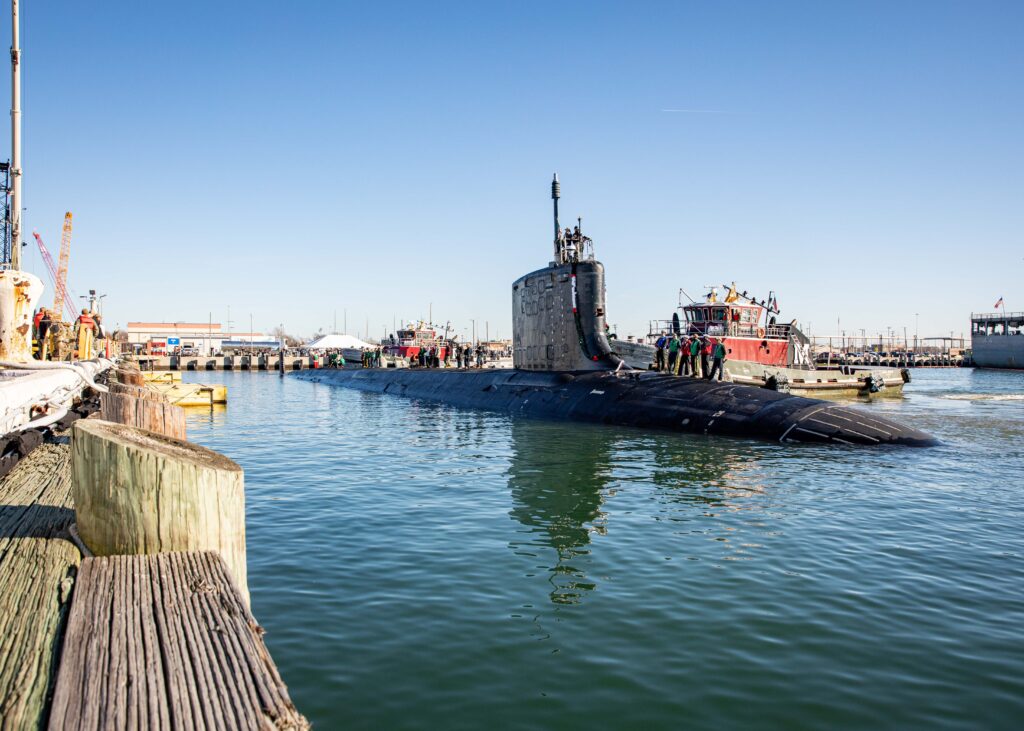
NORFOLK, Va. — The Virginia-class fast-attack submarine USS Washington (SSN 787) returned to its homeport at Naval Station Norfolk after successfully completing a scheduled deployment, Dec. 15, 2023.
Under the command of Cmdr. Clint Christofk, Washington, also referred to as ‘Blackfish’, returns from a six-month deployment where it executed the Chief of Naval Operations’ maritime strategy by supporting national security interest and maritime security operations.
“The crew onboard Blackfish fought hard through a difficult deployment, showing the tenacity that submariners are known for,” said Christofk. “I am immensely proud of the crew for their grit, drive, and dedication to the mission, which allowed Blackfish to complete a historic deployment.”
Washington’s return to Norfolk is just in time for the holidays, which had the crew, friends and families more excited than usual for the boat’s return.
“We are all happy to be back in Norfolk to rest and celebrate the holidays with loved ones,” said Christofk before saying Washington’s battle cry. “Fear the Blackfish!”
“It feels amazing to feel the sun on my face and to know I’m home,” said Wiley. “I’m going to miss the down times after a long day of watch and working a lot where the crew got to spend time together, but everyone is definitely more relaxed and happier that they’re now home with their families in time for the holidays.”
If being home in time for the holidays was not enough to be excited for, Culinary Specialist (Submarine) 1st Class Joel Huffman was one of the first Sailors off the boat to greet his significant other with the traditional first hug.
“If feels so good to be back home and to have the opportunity to be one of the first crewmembers off that boat that I almost can’t put it into words,” Huffman. “We’re all very much looking forward to relaxing and distressing over the holidays after all the hard work we did.”
During the deployment, Washington garnered more days on station that any east coast deployment on record, had the first chief intelligence specialist to earn the submarine warfare qualifications, known as ‘dolphins’, and had the most women ever deployed on a fast-attack submarine, including one chief petty officer.
Washington steamed more than 37,000 nautical miles with the crew supporting diplomatic relationships by conducting port visits in Faslane, Scotland, and Grotsund, Norway.
Forty-four enlisted Sailors and five officers earned their submarine warfare qualification, known as ‘dolphins,’ 10 officers promoted, and four Sailors reenlisted.
Fast-attack submarines are multi-mission platforms enabling five of the six Navy maritime strategy core capabilities – sea control, power project, forward presence, maritime security, and deterrence. They are designed to excel in anti-submarine warfare, anti-ship warfare, strike warfare, special operations, intelligence, surveillance and reconnaissance, irregular warfare and mine warfare. Fast-attack submarines project power ashore with special operations forces and Tomahawk cruise missiles in the prevention or preparation of regional crises.
The Virginia-class submarine is 377 feet long and 34 feet wide, and weighs about 7,900 tons when submerged. Underwater, it can reach speeds in excess of 25 knots.
Navy Locates and Recovers Downed Black Hawk in the Mediterranean Sea
*****
MEDITERRANEAN SEA – A team of deep ocean salvage experts located and recovered the downed MH-60 Black Hawk that crashed into the Mediterranean Sea on Nov. 10. The aircraft was conducting routine training when it experienced an in-flight emergency resulting in the crash.
21 December 2023
From Commander, U.S. Sixth Fleet Public Affairs Office
MEDITERRANEAN SEA – A team of deep ocean salvage experts located and recovered the downed MH-60 Black Hawk that crashed into the Mediterranean Sea on Nov. 10. The aircraft was conducting routine training when it experienced an in-flight emergency resulting in the crash.
Under the direction of Commander, Task Force (CTF) 68, the Navy embarked experts from Supervisor of Salvage and Diving (SUPSALV), Phoenix International, Explosive Ordnance Disposal Mobile Unit 8 (EODMU 8), and U.S. Army Special Operations Aviation Command (USASOAC) aboard the contracted multipurpose vessel, NG Worker, and proceeded to the crash site on Dec. 8. Once on station, highly skilled operators located and recovered the aircraft using state-of-the-art underwater survey and recovery equipment mounted on the Deep Drone remote operated vehicle (ROV). The Deep Drone is a 4,100 pound ROV designed to meet the Navy’s mid-water salvage requirements to a maximum depth of 8,000 feet.
“The success of this mission can be attributed to highly trained Sailors, Soldiers, and civilians from the combined Army-Navy team who came together and displayed extreme skill to safely recover the helicopter,” said Cdr. John Kennedy, Commanding Officer of EODMU 8 and Commander, Task Group (CTG) 68.1. “Everyone onboard was humbled by the opportunity to play a small role in helping to bring closure to grieving families.”
Assigned to U.S. Army Special Operations Command, the MH-60 Blackhawk was carrying five special operations aviation Soldiers when it crashed. All Soldiers on board were killed. The remains of two Soldiers were recovered during initial search and recovery efforts.
The remains of the three other Soldiers were recovered and will be flown to Dover Air force Base and returned to the families. The identities of the Soldiers recovered will be withheld pending notification to next of kin.
The cause of the crash is under investigation. For information regarding the incident, contact the U.S. Army Special Operations Command Public Affairs office at 910-432-6005, or by email at [email protected].
U.S. Navy Accepts Delivery of First Extra Large Unmanned Undersea Vehicle Test Asset System
By Program Executive Office Unmanned and Small Combatants
HUNTINGTON BEACH, Calif., — The U.S. Navy recently accepted delivery of the first Extra Large Unmanned Undersea Vehicle (XLUUV) Test Asset System, designated XLE0, from the manufacturer Boeing. The XLUUV, also known as Orca, marks a significant milestone in advancing the Navy’s undersea capabilities.
The delivery of the Navy’s first-ever Orca XLUUV Test Asset System, XLE0, is the culmination of nearly a decade’s worth of research, design, manufacturing and testing by the Program Executive Office for Unmanned and Small Combatants (PEO USC) and the Unmanned Maritime Systems Program Office (PMS 406).
“This has been a very busy year for the XLUUV team and their hard work is culminating in delivery of the Navy’s first-ever unmanned diesel-electric submarine,” said Capt. Scot Searles, program manager of the Unmanned Maritime Systems (PMS 406) program office. “We look forward to continued success with our Boeing teammates in fielding this important capability for the warfighter.”
XLE0 began in-water testing in Spring 2023 in Huntington Beach, California. Lessons learned from XLE0’s testing will be applied to Orca XLUUV 1 through 5, which will be built and delivered to the Navy in the future.
The Orca XLUUV is a cutting-edge, autonomous, unmanned diesel-electric submarine with a modular payload section to execute a variety of missions critical to enhancing the Navy’s undersea prowess. Configured to accommodate various payloads, the Orca XLUUV allows for the seamless integration of sensors, communication systems, and other mission-specific components, adapting to the evolving requirements of naval operations.
With its long-endurance capability, the Orca XLUUV can operate autonomously for extended periods. This allows for sustained operational presence and increased mission effectiveness in challenging undersea environments.
BAE Systems Gets $92M Contract to Continue Navy ATC and Landing Systems Support
Release from BAE Systems
*****
MCLEAN, Va. – Dec. 20, 2023 – BAE Systems has received a follow-on contract to continue supporting Air Traffic Control & Landing Systems Operations Onboard Navy Ship and Shore Based Sites (AOOSS). The five-year indefinite-delivery/indefinite-quantity contract, valued at $92 million, was awarded by the U.S. Navy Naval Air Warfare Center Aircraft Division (NAWCAD).
“Since 1993, we have been providing technical and engineering services for AOOSS worldwide,” said Lisa Hand, vice president and general manager, BAE Systems Integrated Defense Solutions. “For those 30 years, we have worked closely with our customers to bolster their readiness—a legacy we’re very proud of. We’re equally proud to continue to support this mission moving forward.”
Under the new contract, BAE Systems will continue to provide fleet services, technical support, and operational software development and maintenance to support various air traffic control and landing systems for the U.S. Navy, U.S. Marine Corps, U.S. Coast Guard, Military Sealift Command, and international customers.
BAE Systems will complete the work in Great Mills, St. Inigoes, and Patuxent River, Maryland; Chesapeake, Virginia; and San Diego, California.
Navy Awards RTX $80M to Prototype Advanced Electronic Warfare for Super Hornet
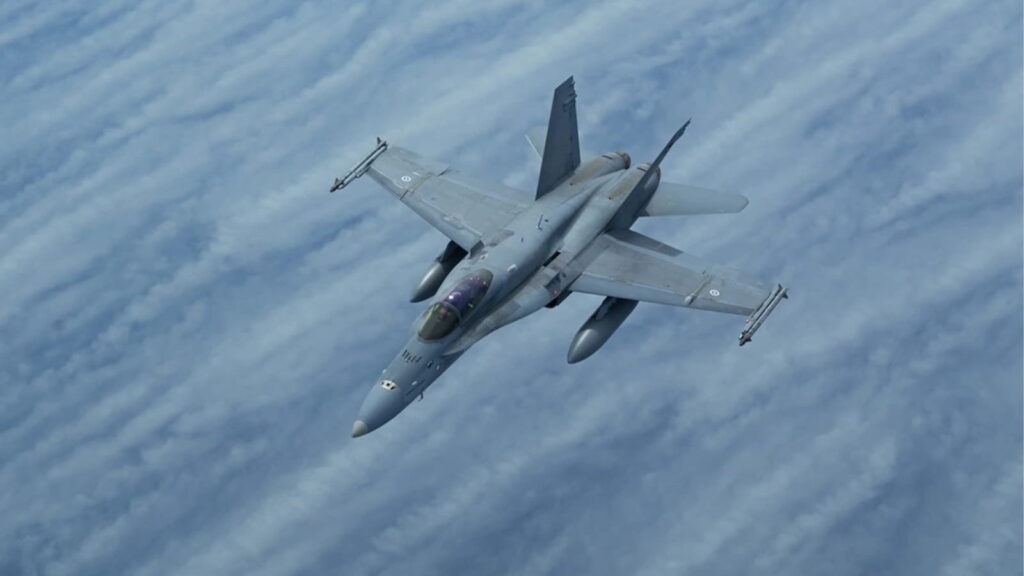
A U.S. Navy F/A-18 Super hornet aircraft soars above the Baltic Sea Region while participating in BALTOPS-22, June 9, 2022. (U.S. Navy)
ADVEW will replace legacy systems with a one-box solution
GOLETA, Calif., Dec. 19, 2023 /PRNewswire/ — The United States Navy awarded Raytheon, an RTX (NYSE: RTX) Business, an $80 million contract in a down select to prototype Advanced Electronic Warfare, or ADVEW, for the F/A-18 E/F Super Hornet. This prototype will be considered as a replacement for the existing AN/ALQ-214 integrated defensive electronic countermeasure and AN/ALR-67(V)3 radar warning receiver with a consolidated solution that will deliver superior electronic warfare capabilities to the backbone of the Navy’s carrier air wing.
“These advancements are paving the way for the next generation of electronic warfare,” said Bryan Rosselli, president of Advanced Products & Solutions at Raytheon. “We are completely replacing and consolidating the legacy systems into a one-box solution that will deliver a generational refresh to the electronic warfare capability for the lifetime of the Super Hornet.”
Raytheon’s Advanced Electronic Warfare offering will provide significant performance upgrades by modernizing existing electronic warfare systems into fewer components and incorporating government-defined open architecture. Development of this new solution will closely align and integrate with other combat-proven, radio frequency sensors and effectors employed by the Super Hornet. ADVEW will ensure F/A-18E/Fs maintain their operational electronic warfare advantage, while significantly improving survivability against advanced, complex threats.
Development and testing of ADVEW will mainly take place in Goleta, California. During the prototype phase, the system will undergo preliminary design review, critical design review, and flight testing over a 36-month period.
USCGC Active Returns Home After Counternarcotics Patrol in Eastern Pacific Ocean
PORT ANGELES, Wash. – U.S. Coast Guard Cutter Active and crew returned to its home port, Tuesday, after a 57-day patrol in support of Joint Interagency Task Force-South’s (JIATF-S) counternarcotics campaign in the Eastern Pacific Ocean.
Active and crew routinely deploys to this region in an effort to disrupt transnational criminal organizations specifically in pursuit of illegal trafficking of narcotics. Equipped with two boats and an MH-65E helicopter from Helicopter Interdiction Tactical Squadron (HITRON), Active and crew met a variety of mission demands.
Active’s crewmembers aided in the rescue of five Ecuadorian fishermen, November 19, who were adrift on their disabled vessel for an estimated 19 days. The survivors faced harsh elements and prolonged exposure which created life threatening conditions. Active’s crew provided medical care and rehydration to the fishermen as they began to recover from their critical condition before transferring them to authorities in El Salvador.
The crew successfully interdicted over 3,400 pounds of cocaine and detained three suspected narcotics traffickers. Less than 24 hours after the holiday interdiction, Active successfully apprehended three more suspected smugglers transporting more than 2,400 pounds of cocaine.
“I am extremely proud of the crew and their relentless pursuit of our mission objectives,” said Cmdr. Adam Disque, commanding officer of the Active. “Interdictions at sea are always challenging, and no two are the same. These back-to-back operations were exceptionally well coordinated, which included the tactical employment of an interdiction helicopter, multiple surface boat deployments, and our highly trained boarding teams. The whole crew is always grateful to contribute to the fight against the transnational crime that triggers violence and instability at home.”
The Active is a 210-foot medium endurance cutter homeported in Port Angeles, Washington. This multi-mission platform falls under the operational command of the Coast Guard Pacific Area. As a Coast Guard resource, Active deploys in support of the Coast Guard’s Eleventh and Thirteenth Districts as well as JIATF-S. Patrolling from northern most part of the contiguous United States, all the way to the equator, Active is a critical asset conducting search and rescue, counter-narcotics law enforcement, living marine resource protection, and homeland defense operations.
U.S. Navy Successfully Completes Large Unmanned Surface Vessel Testing Milestone
Release from Naval Sea Systems Command
*****
Dec. 20, 2023
By Program Executive Office Unmanned and Small Combatants
WASHINGTON – The U.S. Navy successfully completed a milestone “no touch” 720-hour continuous power demonstration of a diesel generator for Unmanned Surface Vessel (USV) operations. Demonstrating the capability and durability of engine plants to operate for extended periods without human intervention at sea is a critical enabler for the continued expansion of unmanned operations and development of the future manned-unmanned Hybrid Fleet concept.
The generator test was mandated by a congressional requirement inserted in the 2021 National Defense Authorization Act, directing the Navy to achieve the 720-hour test milestone before the Large USV could proceed into formal development. The congressionally directed testing included 100 hours of pre-testing before the 720-hour demonstration phase commenced. During the demonstration phase, no human intervention and no preventative or corrective maintenance on the equipment was allowed.
This land-based test was conducted by Bollinger and Carter Machinery on behalf of Caterpillar in Chesapeake, Virginia. The Navy’s Program Executive Office for Unmanned and Small Combatants (PEO USC) and the Unmanned Maritime Systems Program Office (PMS 406) oversaw the successful test completion. The rigorous testing validated that the 1550 kw Caterpillar 3512C model engine demonstrated sufficient mechanical reliability to support the requirements of an unmanned ship to operate for 30 days.
“This testing achievement is a key milestone for the Navy’s unmanned surface vessel programs and allows the Navy to move forward with developing and acquiring the Large Unmanned Surface Vessel (LUSV), specifically,” said Capt. Kevin Smith, Program Executive Officer, Unmanned and Small Combatants.
The LUSV will deliver adjunct missile magazine capacity to the Fleet as part of the Navy’s Distributed Maritime Operations concept. The LUSV is envisioned to be greater than 200 ft. in length with a full load displacement of approximately 1,500 tons. LUSVs are intended to be low-cost, high endurance, modular USVs that can employ a variety of payloads.
In 2020, six LUSV conceptual design contracts were awarded to refine program requirements and to work with industry to provide feedback on the LUSV requirements. The Bollinger team is the first to successfully complete the 720-hour no-touch electrical generation and distribution system demonstration. It is now eligible for use on the LUSV program. Five other LUSV teams are currently in test with their engine systems to meet the 720-hour performance requirement.
PEO USC and PMS 406 lead the Navy’s efforts to develop, deliver and sustain capable and affordable unmanned maritime systems to meet Fleet requirements.
USS John L. Canley to Be Commissioned in San Diego
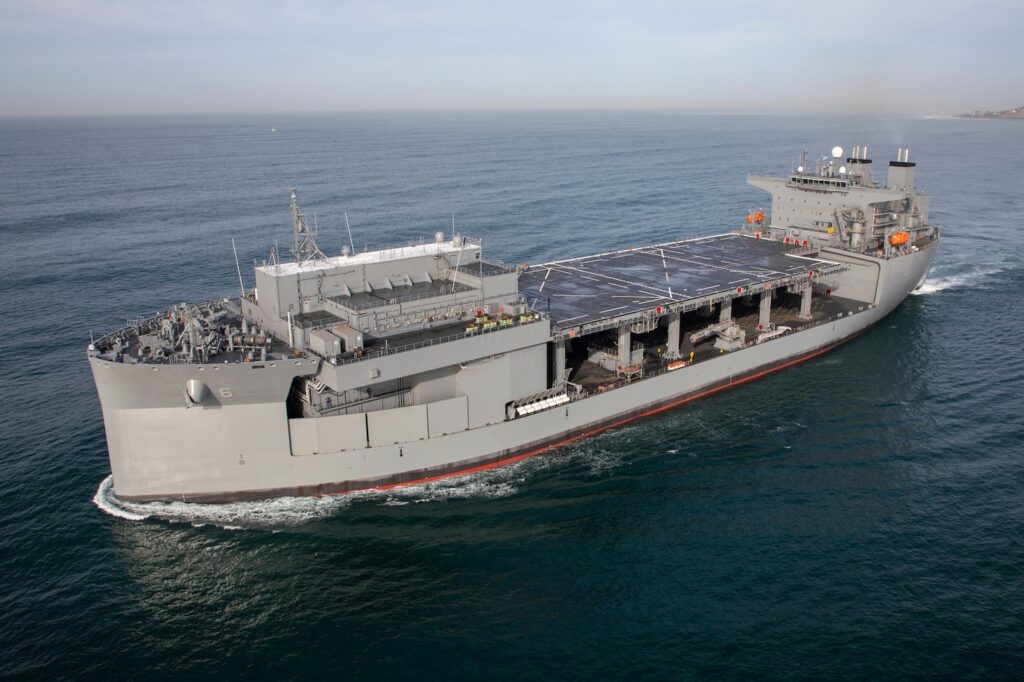
SAN DIEGO — The future USS John L. Canley (ESB 6) will join the active fleet Feb. 17, with a commissioning ceremony at Naval Base Coronado’s Naval Air Station North Island in San Diego.
The first of its name, the ship honors United States Marine Corps Sgt. Maj. John L. Canley, Ret., who was awarded the Medal of Honor 50 years after his actions during the Battle of Hue City. Canley served as Company Gunnery Sergeant, Company A, First Battalion, First Marines, First Marine Division in the Republic of Vietnam from Jan. 31 to Feb. 6, 1968. Sgt. Maj. Canley passed away in Bend, Oregon May 11, 2022.
On Nov. 10, 2020, then Secretary of the Navy Kenneth J. Braithwaite announced that ESB 6 would be named USS John L. Canley to honor a man who exemplified all that has made our service strong and our Nation thrive.
The ship’s sponsor is Patricia Sargent, Canley’s daughter.
ESB 6 will be the newest commissioned Expeditionary Sea Base (ESB) and the sixth ship in the expeditionary mobile base platform.
ESB 6 is a highly flexible platform used across various military operations. When commissioned, the ship will be employed as a mobile sea-based asset. It will be a part of the critical access infrastructure supporting the deployment of forces, equipment, supplies, and warfighting capability.
The mission of CNSP is to man, train, and equip the Surface Force to provide fleet commanders with credible naval power to control the sea and project power ashore.
The future USS John L. Canley will be part of the Forward Deployed Naval Force operating from Saipan.
For more news from Naval Surface Forces, visit DVIDS – Commander, Naval Surface Force, U.S. Pacific Fleet and Commander, Naval Surface Force, U.S. Pacific Fleet.